PHILIPPINE FOLK DANCE
Learning Objectives
 Define folk dance
 Relate with the historical origin of Philippine folk dance.
 Identify the classification of Philippine folk dance.
 Analyze the characteristics of Philippine Folk dance as well as
the Do’s and Don’ts.
 Make an e-portfolio about Philippine Folk dance.
Why do we have to conserve the Philippine
Folk Dances?
What is Folk Dance
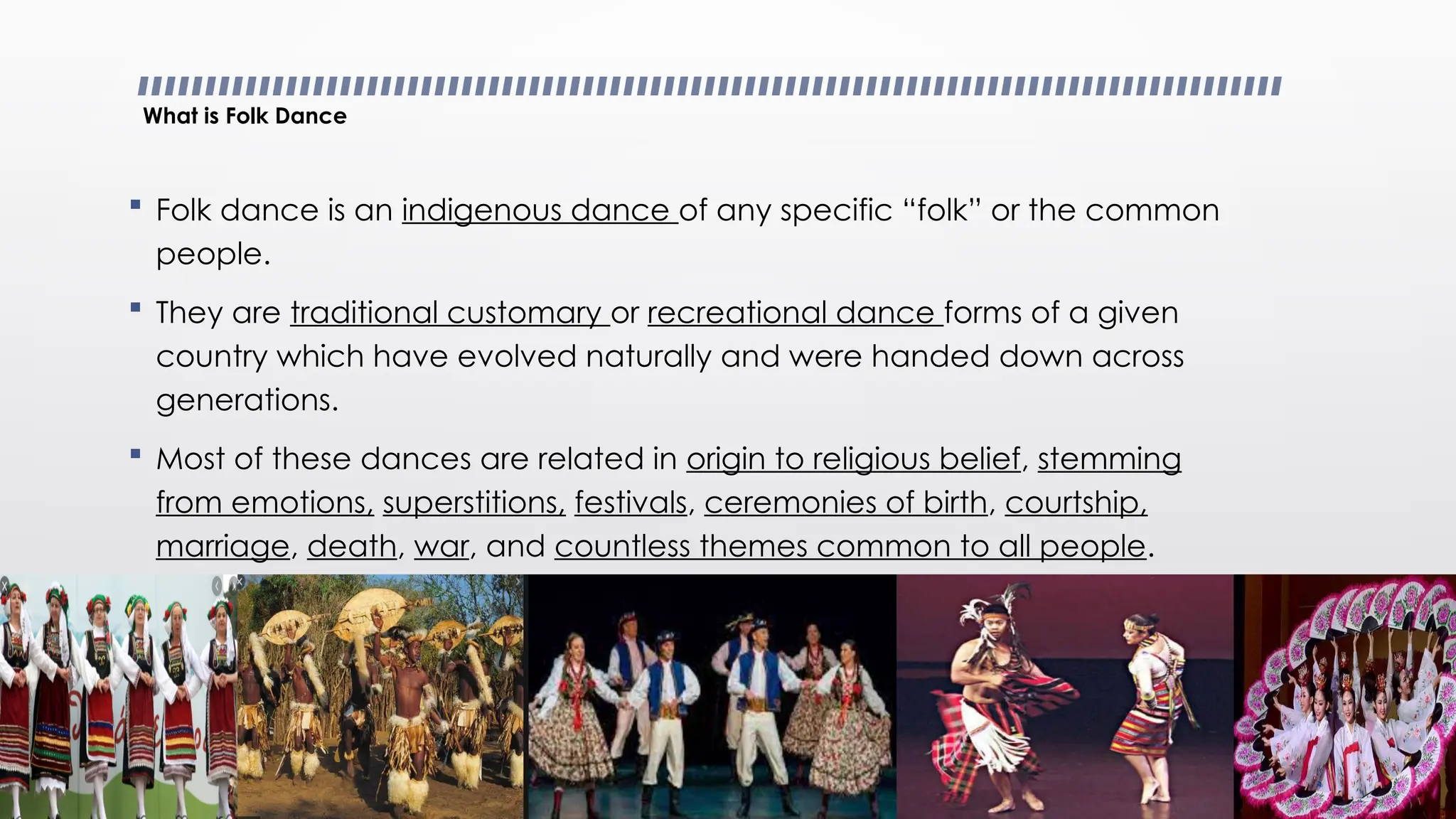
 Folk dance is an indigenous dance of any specific “folk” or the common
people.
 They are traditional customary or recreational dance forms of a given
country which have evolved naturally and were handed down across
generations.
 Most of these dances are related in origin to religious belief, stemming
from emotions, superstitions, festivals, ceremonies of birth, courtship,
marriage, death, war, and countless themes common to all people.
History of the Philippine Folk Dance
Philippines came from tribes' rituals, prayers and celebrations.
Some places of Tagalog regions have Spanish and European
influence.
Visayan region was inspired by animal movements and shape by the
Muslim Culture.
The Indigenous people express their sentiments and feelings through
dance in the form of thanksgiving for bountiful harvest, as an offering
to the gods in supplication for the recovery of a sick member of the
family, as thanks for the birth of a child, and as ceremonials in
preparation for battle, victory, love, marriage, or death.
They set to dance and music the many milestones in the drama of
their everyday existence.
TYPES OF PHILIPPINE
FOLK DANCE
Igorot Dance (Tuwali War Dance)
Muslim Dances (Singkil)
Tribal Dance (Talaingod)
Maria Clara Dance (Habanera Botoleña)
Rural and Barrio (Sayaw sa Bangko)
Classification of Philippine
Folk Dances
National Dances
 National dance means found throughout the island
with little or no modification.
 Tinikling is the Philippines national dance.
 Dancers mimic the tikling bird's grace and agility
by dancing between large bamboo poles.
Cariñosa- Panay Island
TINIKLING-Leyte
NATURE DANCES
Occupational Dance (MANANGUETE DANCE)
Religious or Ceremonial
(Sta Clarang Pinong Pino-Fertility Dance)
Comic dances
(Kinoton-Comic Ilocano Folk Dance)
Game Dance (Pukol)
Wedding dances (Binasuan)
Courtship Dance (Pantomina)
Festival dances (Pandanggo sa Ilaw)
War Dance (Palu-Palo Ivatan War)
Characteristics of Philippine Folk dances:
 In general, dancers stand apart.
 There is little, if any, bodily contact.
 Most of the dances are done by pairs or couples.
 Hand movements play an important part.
 Most dances are in long formation.
 Most dances begin and end with “saludo.”
 Dances from the lowlands have more foreign elements those found in the
uplands.
 War dances are found among non-Christian tribes.
Do’s in Folk Dancing
Dance in a natural, simple and direct manner.
Dance with ease and smoothness.
Use the proper costume for the dance.
Follow directions and dance instructions as
closely as possible.
Dance with feeling and expression.
Don’t’s in Folk Dancing
 Do not exaggerate the dance steps.
 Do not make the dances too dainty and graceful like
ballet
 Don’t make entrance and exit long.
 Don’t make steps too elaborate and complicated.
 Don’t call a dance a folk dance unless steps come
from traditional dances.
Philippine History Folk, Classical, Contemporary Dance

Philippine History Folk, Classical, Contemporary Dance

  • 1.
  • 2.
    Learning Objectives  Definefolk dance  Relate with the historical origin of Philippine folk dance.  Identify the classification of Philippine folk dance.  Analyze the characteristics of Philippine Folk dance as well as the Do’s and Don’ts.  Make an e-portfolio about Philippine Folk dance.
  • 3.
    Why do wehave to conserve the Philippine Folk Dances?
  • 4.
    What is FolkDance  Folk dance is an indigenous dance of any specific “folk” or the common people.  They are traditional customary or recreational dance forms of a given country which have evolved naturally and were handed down across generations.  Most of these dances are related in origin to religious belief, stemming from emotions, superstitions, festivals, ceremonies of birth, courtship, marriage, death, war, and countless themes common to all people.
  • 5.
    History of thePhilippine Folk Dance Philippines came from tribes' rituals, prayers and celebrations. Some places of Tagalog regions have Spanish and European influence. Visayan region was inspired by animal movements and shape by the Muslim Culture. The Indigenous people express their sentiments and feelings through dance in the form of thanksgiving for bountiful harvest, as an offering to the gods in supplication for the recovery of a sick member of the family, as thanks for the birth of a child, and as ceremonials in preparation for battle, victory, love, marriage, or death. They set to dance and music the many milestones in the drama of their everyday existence.
  • 6.
  • 7.
  • 8.
  • 9.
  • 10.
    Maria Clara Dance(Habanera Botoleña)
  • 11.
    Rural and Barrio(Sayaw sa Bangko)
  • 12.
  • 13.
    National Dances  Nationaldance means found throughout the island with little or no modification.  Tinikling is the Philippines national dance.  Dancers mimic the tikling bird's grace and agility by dancing between large bamboo poles.
  • 14.
  • 15.
  • 16.
  • 17.
  • 18.
    Religious or Ceremonial (StaClarang Pinong Pino-Fertility Dance)
  • 19.
  • 20.
  • 21.
  • 22.
  • 23.
  • 24.
  • 25.
    Characteristics of PhilippineFolk dances:  In general, dancers stand apart.  There is little, if any, bodily contact.  Most of the dances are done by pairs or couples.  Hand movements play an important part.  Most dances are in long formation.  Most dances begin and end with “saludo.”  Dances from the lowlands have more foreign elements those found in the uplands.  War dances are found among non-Christian tribes.
  • 26.
    Do’s in FolkDancing Dance in a natural, simple and direct manner. Dance with ease and smoothness. Use the proper costume for the dance. Follow directions and dance instructions as closely as possible. Dance with feeling and expression.
  • 27.
    Don’t’s in FolkDancing  Do not exaggerate the dance steps.  Do not make the dances too dainty and graceful like ballet  Don’t make entrance and exit long.  Don’t make steps too elaborate and complicated.  Don’t call a dance a folk dance unless steps come from traditional dances.