INTRODUCTION TO GROOVY
AND GRAILS AT TAULIA
2012-07-11 for TechTalks.ph
Philip Stehlik
About
•  Entrepreneur living in San Francisco
•  Co-Founder and CTO Taulia
•  Coding since teenage years (PHP, Objective-
     C, ABAP, JS, Java, Groovy)
•    Taulia serving Fortune 2000 companies with
     financial software (SaaS + Add-On for SAP)
•    Engineering team of ~20 people
•    Almost everything in Groovy
Taulia's tech stack
•  Groovy and Grails from day 1 (Grails 1.0)
•  Completely in the cloud
•  Integrating with many outside systems
•  Partners (e-invoicing, orders, payment
     details, ...)
•    Web Services
•    Interfacing with 'Legacy' technologies
•    Gradle, Spring, Hibernate, Jersey, Maven, ...
How to interact with our systems
•  Browser
•  REST
•  SOAP
•  XMLRPC
•  File exchange (FTP(S), AS2, SSH)
•  Lots of data munching and transformation
Kinds of data
•  Invoices, Payment history, Orders
•  Vendor data – address, social security, tax ID
•  Messages, logins, users
•  Logs
•  Complete history of 2 yrs of our customers
  upon project launch
Why we like Groovy
•  Simple, nice language
•  Dynamic features (for builders, testing, ...)
•  Closures
•  Tight and easy integration possibilities with
     Java
•    Open source (Apache 2 license)
•    Grails
Groovy
•  Started development in 2003
•  Groovy 1.0 January 2, 2007
•  Dynamic language for the Java Virtual
  Machine
Groovy
•  Almost all valid Java code is valid Groovy
     code
•    Mostly dynamic typing (static typing since 2.0
     in core)
•    Closures
•    DSLs and builders
•    Object oriented
•    Also 'scripting language'
System.out.println("Hello,           // optional semicolon
  World!");                          // System.out, brackets,
println 'Hello, World!'              // main(), class defn

                                     // dynamic typing
def name = 'Luke'                    // GString
println "$name, I am your father."


String yodaSays = """${name}, your   // multi-line string
father he is."""                     // with static typing

                                     // BigDecimal equals()
assert 0.5 == 1/2


def printSize(obj) {                 // optional duck typing
      print obj?.size()              // safe dereferencing
}                                    //   native list syntax
def letters = ['a', 'b', 'c']        //   closure support
letters.each { letter ->             //   overload '<' on String
                                     //   or: for (pet in pets)
    assert letter < 'd'
}
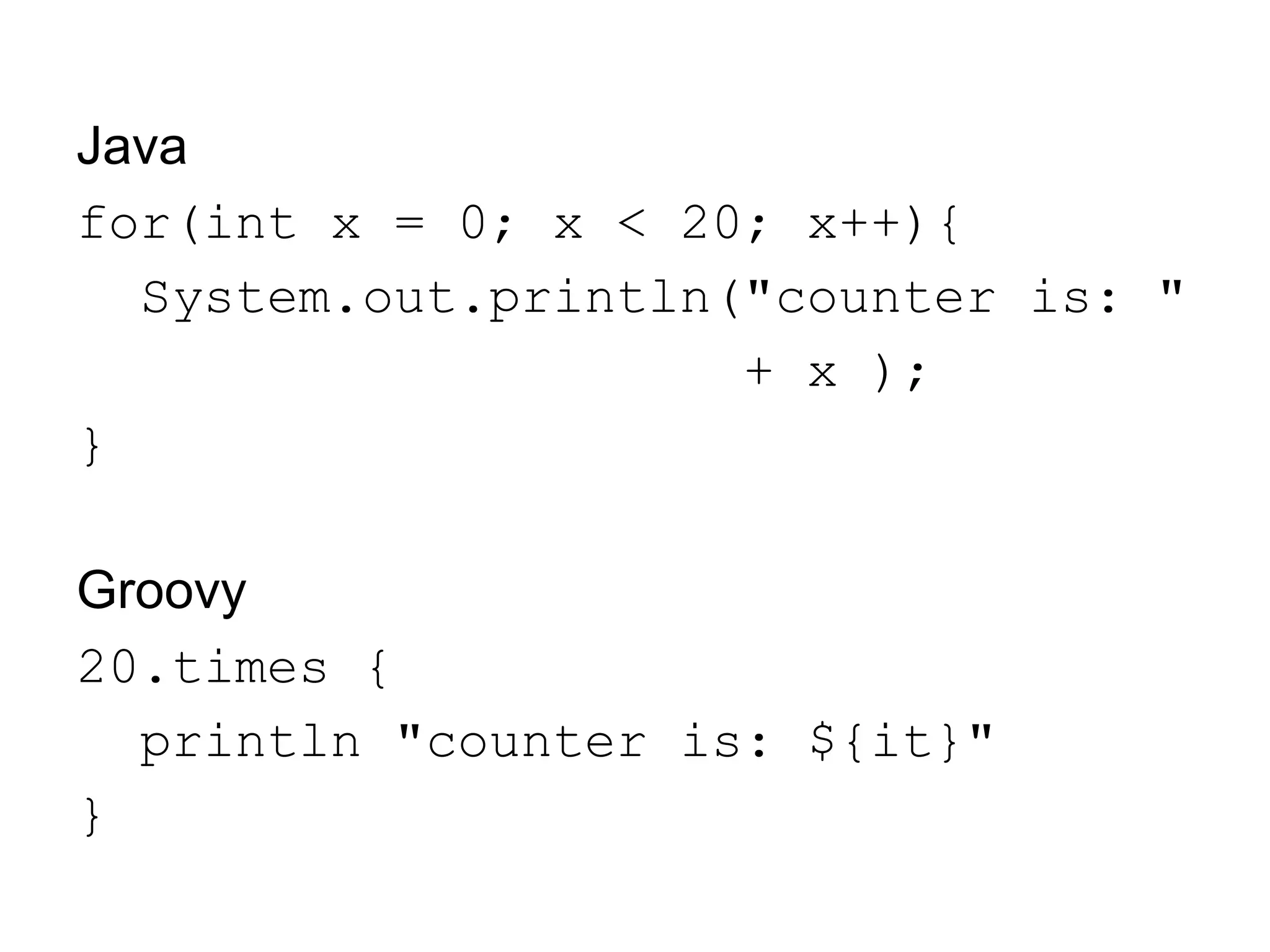
Java
for(int x = 0; x < 20; x++){
  System.out.println("counter is: "
                     + x );
}

Groovy
20.times {
  println "counter is: ${it}"
}
Running .groovy files
•  from command line groovy [file name]
•  compile and distribute as JAR/WAR
•  groovyConsole
•  online http://groovyconsole.appspot.com/
•  groovy sh
Code
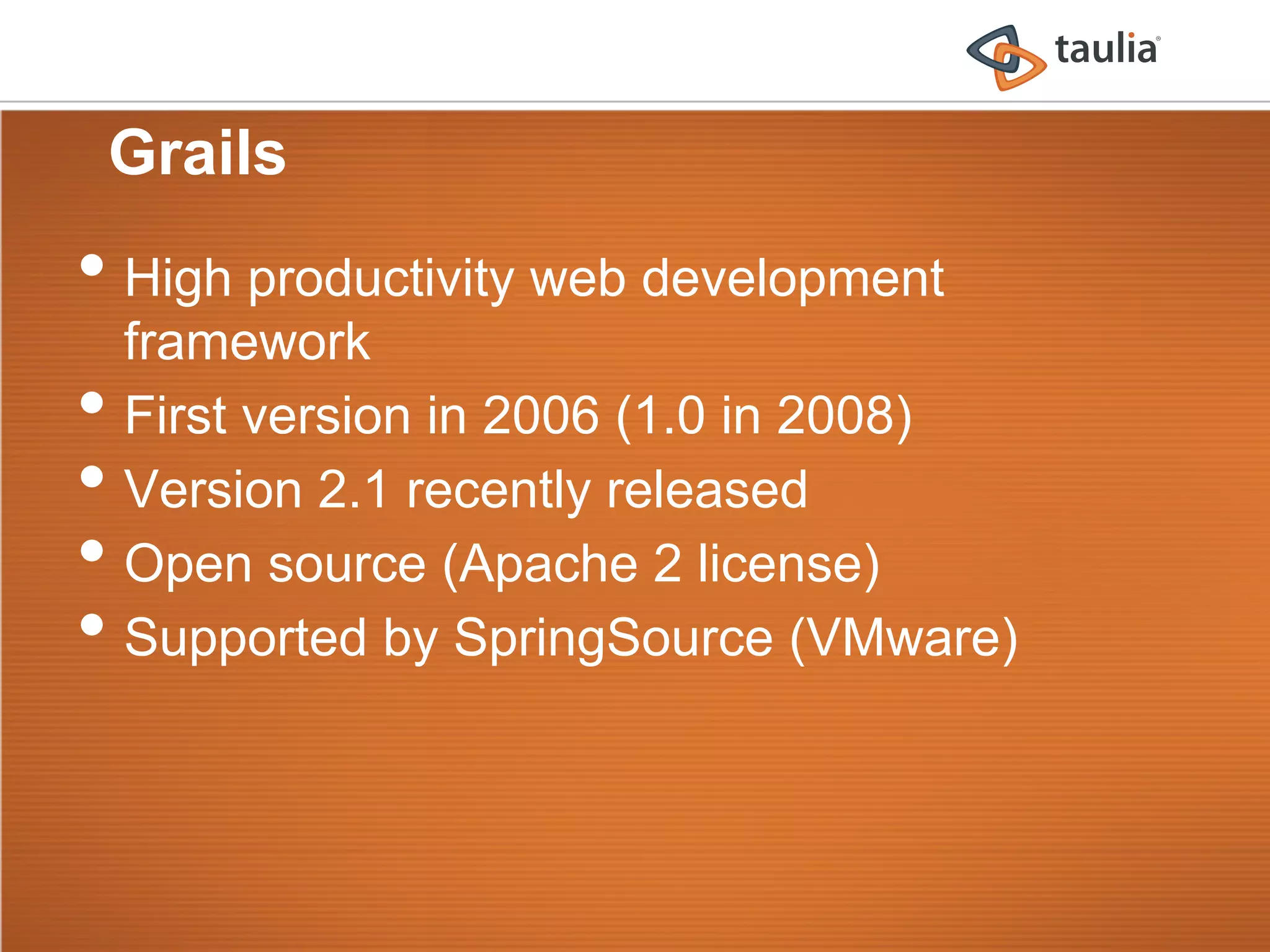
Grails
•  High productivity web development
     framework
•    First version in 2006 (1.0 in 2008)
•    Version 2.1 recently released
•    Open source (Apache 2 license)
•    Supported by SpringSource (VMware)
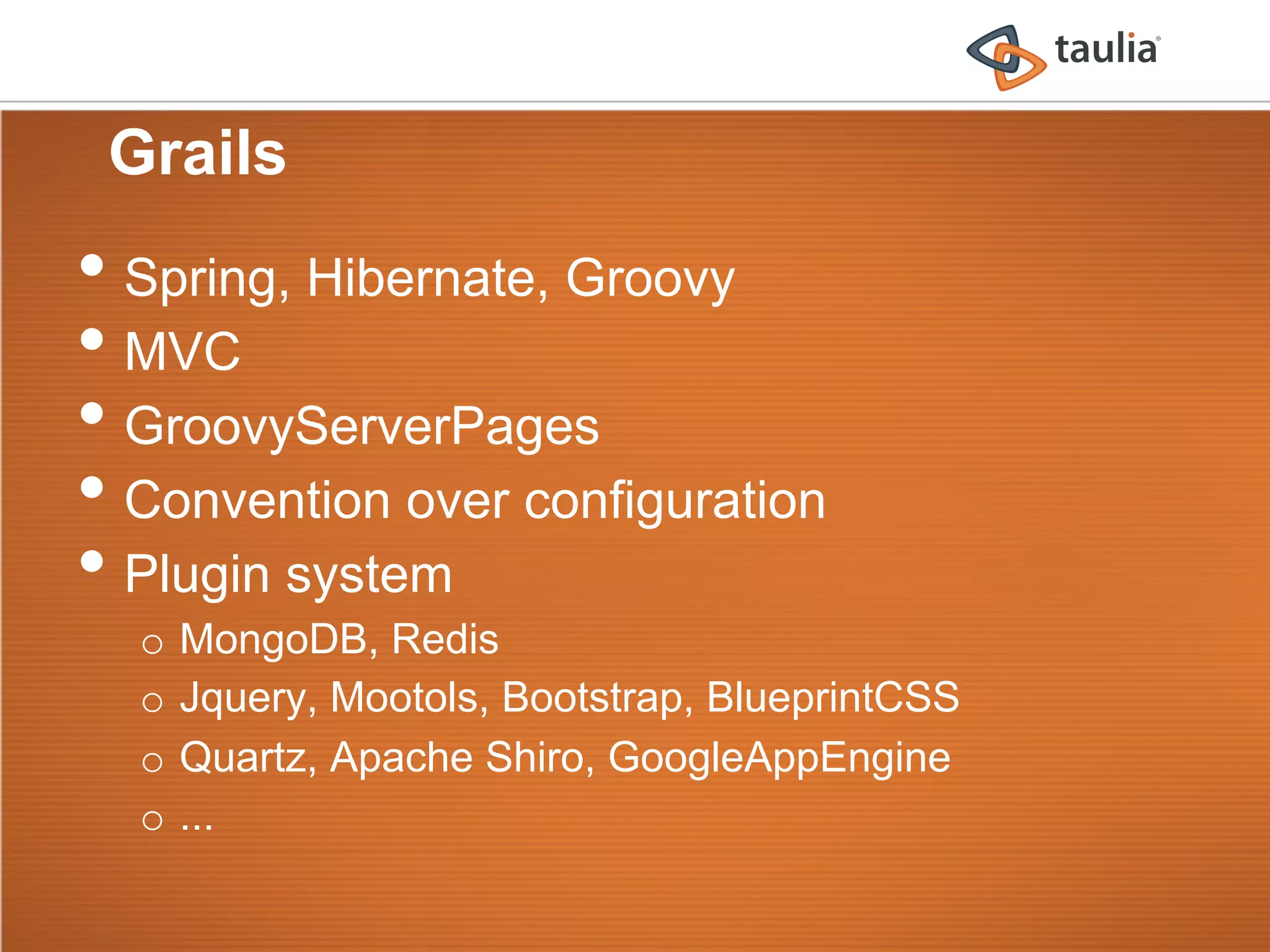
Grails
•  Spring, Hibernate, Groovy
•  MVC
•  GroovyServerPages
•  Convention over configuration
•  Plugin system
  o  MongoDB, Redis
  o  Jquery, Mootols, Bootstrap, BlueprintCSS
  o  Quartz, Apache Shiro, GoogleAppEngine
  o  ...
Code
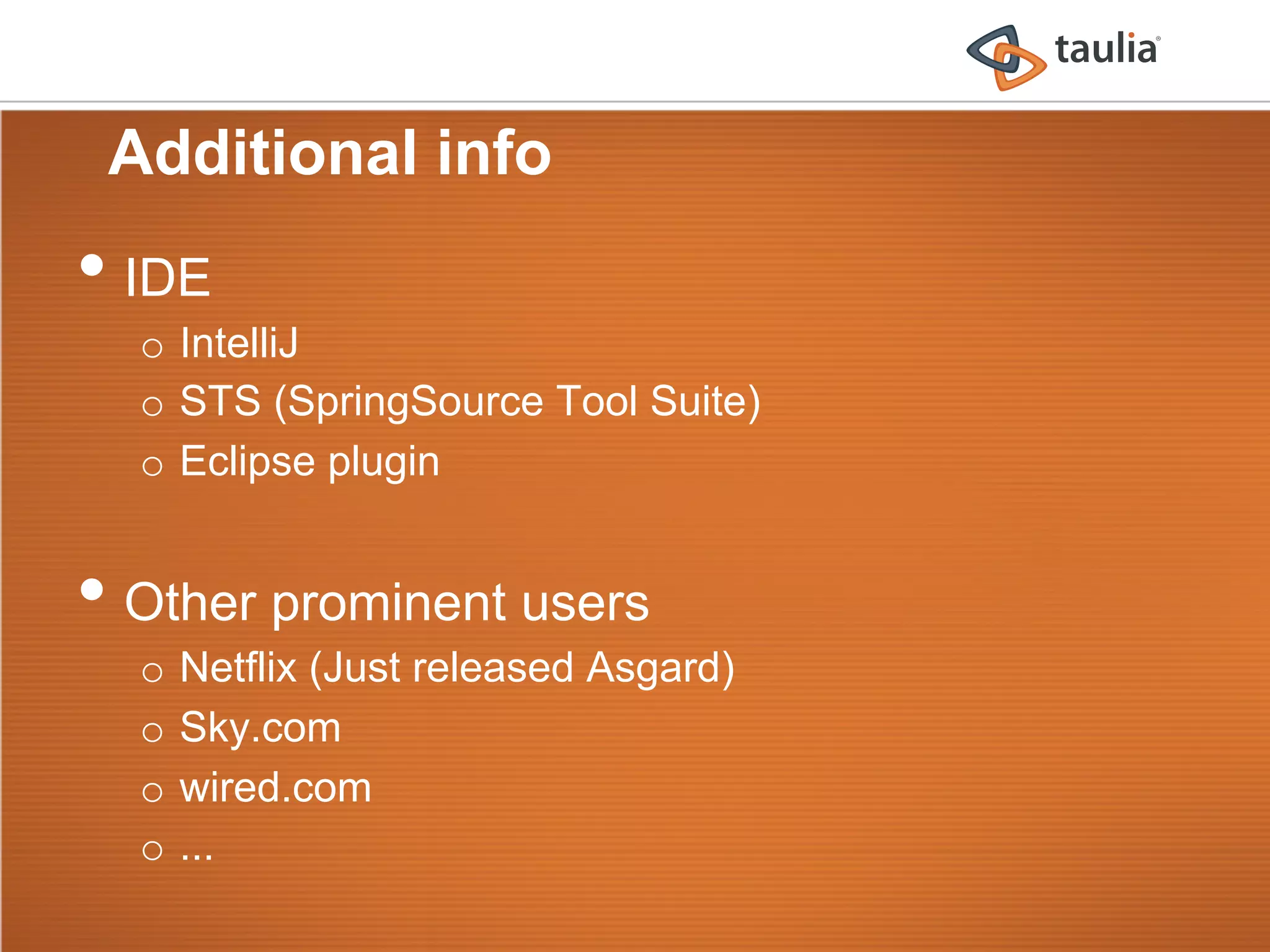
Additional info
•  IDE
  o  IntelliJ
  o  STS (SpringSource Tool Suite)
  o  Eclipse plugin


•  Other prominent users
  o  Netflix (Just released Asgard)
  o  Sky.com
  o  wired.com
  o  ...
More?
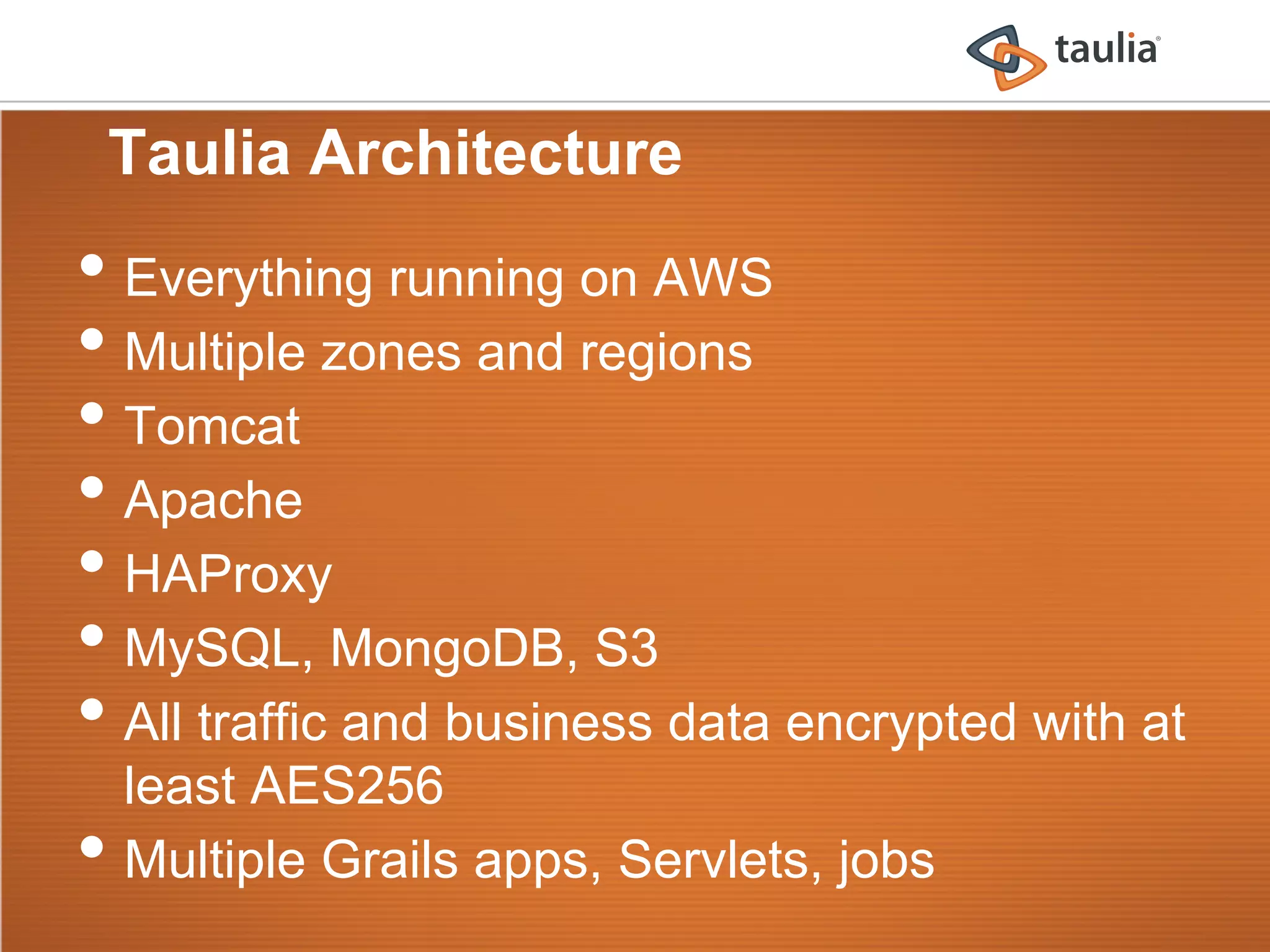
Taulia Architecture
•  Everything running on AWS
•  Multiple zones and regions
•  Tomcat
•  Apache
•  HAProxy
•  MySQL, MongoDB, S3
•  All traffic and business data encrypted with at
     least AES256
•    Multiple Grails apps, Servlets, jobs
Idea to Deployment
•  One-Pager
•  Product team:
  o  Product Manager
  o  Engineer
  o  Quality Engineer
     Meeting at least weekly with everybody involved to
     gauge progress.
•  Paper prototyping, interviews, refining
•  Everybody involved from the beginning
Idea to Deployment #2
•  Developer codes locally
•  All tests on each commit (Jenkins)
•  Auto deploys to integration environment (also
     publicly accessible for feedback and demos)
•    QE and product feedback
•    Iterate
•    Two week sprints – deploy to public QA and
     PRD
•    Using sleeping features
Thanks!


Say hi when you are in San Francisco!

p@pstehlik.com
@pstehlik
http://pstehlik.com

Philip Stehlik at TechTalks.ph - Intro to Groovy and Grails

  • 1.
    INTRODUCTION TO GROOVY ANDGRAILS AT TAULIA 2012-07-11 for TechTalks.ph Philip Stehlik
  • 2.
    About •  Entrepreneur livingin San Francisco •  Co-Founder and CTO Taulia •  Coding since teenage years (PHP, Objective- C, ABAP, JS, Java, Groovy) •  Taulia serving Fortune 2000 companies with financial software (SaaS + Add-On for SAP) •  Engineering team of ~20 people •  Almost everything in Groovy
  • 3.
    Taulia's tech stack • Groovy and Grails from day 1 (Grails 1.0) •  Completely in the cloud •  Integrating with many outside systems •  Partners (e-invoicing, orders, payment details, ...) •  Web Services •  Interfacing with 'Legacy' technologies •  Gradle, Spring, Hibernate, Jersey, Maven, ...
  • 4.
    How to interactwith our systems •  Browser •  REST •  SOAP •  XMLRPC •  File exchange (FTP(S), AS2, SSH) •  Lots of data munching and transformation
  • 5.
    Kinds of data • Invoices, Payment history, Orders •  Vendor data – address, social security, tax ID •  Messages, logins, users •  Logs •  Complete history of 2 yrs of our customers upon project launch
  • 7.
    Why we likeGroovy •  Simple, nice language •  Dynamic features (for builders, testing, ...) •  Closures •  Tight and easy integration possibilities with Java •  Open source (Apache 2 license) •  Grails
  • 8.
    Groovy •  Started developmentin 2003 •  Groovy 1.0 January 2, 2007 •  Dynamic language for the Java Virtual Machine
  • 9.
    Groovy •  Almost allvalid Java code is valid Groovy code •  Mostly dynamic typing (static typing since 2.0 in core) •  Closures •  DSLs and builders •  Object oriented •  Also 'scripting language'
  • 10.
    System.out.println("Hello, // optional semicolon World!"); // System.out, brackets, println 'Hello, World!' // main(), class defn // dynamic typing def name = 'Luke' // GString println "$name, I am your father." String yodaSays = """${name}, your // multi-line string father he is.""" // with static typing // BigDecimal equals() assert 0.5 == 1/2 def printSize(obj) { // optional duck typing print obj?.size() // safe dereferencing } // native list syntax def letters = ['a', 'b', 'c'] // closure support letters.each { letter -> // overload '<' on String // or: for (pet in pets) assert letter < 'd' }
  • 11.
    Java for(int x =0; x < 20; x++){ System.out.println("counter is: " + x ); } Groovy 20.times { println "counter is: ${it}" }
  • 12.
    Running .groovy files • from command line groovy [file name] •  compile and distribute as JAR/WAR •  groovyConsole •  online http://groovyconsole.appspot.com/ •  groovy sh
  • 13.
  • 15.
    Grails •  High productivityweb development framework •  First version in 2006 (1.0 in 2008) •  Version 2.1 recently released •  Open source (Apache 2 license) •  Supported by SpringSource (VMware)
  • 16.
    Grails •  Spring, Hibernate,Groovy •  MVC •  GroovyServerPages •  Convention over configuration •  Plugin system o  MongoDB, Redis o  Jquery, Mootols, Bootstrap, BlueprintCSS o  Quartz, Apache Shiro, GoogleAppEngine o  ...
  • 17.
  • 18.
    Additional info •  IDE o  IntelliJ o  STS (SpringSource Tool Suite) o  Eclipse plugin •  Other prominent users o  Netflix (Just released Asgard) o  Sky.com o  wired.com o  ...
  • 19.
  • 20.
    Taulia Architecture •  Everythingrunning on AWS •  Multiple zones and regions •  Tomcat •  Apache •  HAProxy •  MySQL, MongoDB, S3 •  All traffic and business data encrypted with at least AES256 •  Multiple Grails apps, Servlets, jobs
  • 21.
    Idea to Deployment • One-Pager •  Product team: o  Product Manager o  Engineer o  Quality Engineer Meeting at least weekly with everybody involved to gauge progress. •  Paper prototyping, interviews, refining •  Everybody involved from the beginning
  • 22.
    Idea to Deployment#2 •  Developer codes locally •  All tests on each commit (Jenkins) •  Auto deploys to integration environment (also publicly accessible for feedback and demos) •  QE and product feedback •  Iterate •  Two week sprints – deploy to public QA and PRD •  Using sleeping features
  • 23.
    Thanks! Say hi whenyou are in San Francisco! p@pstehlik.com @pstehlik http://pstehlik.com