DR NARENDRA KUMAR
Assistant Professor

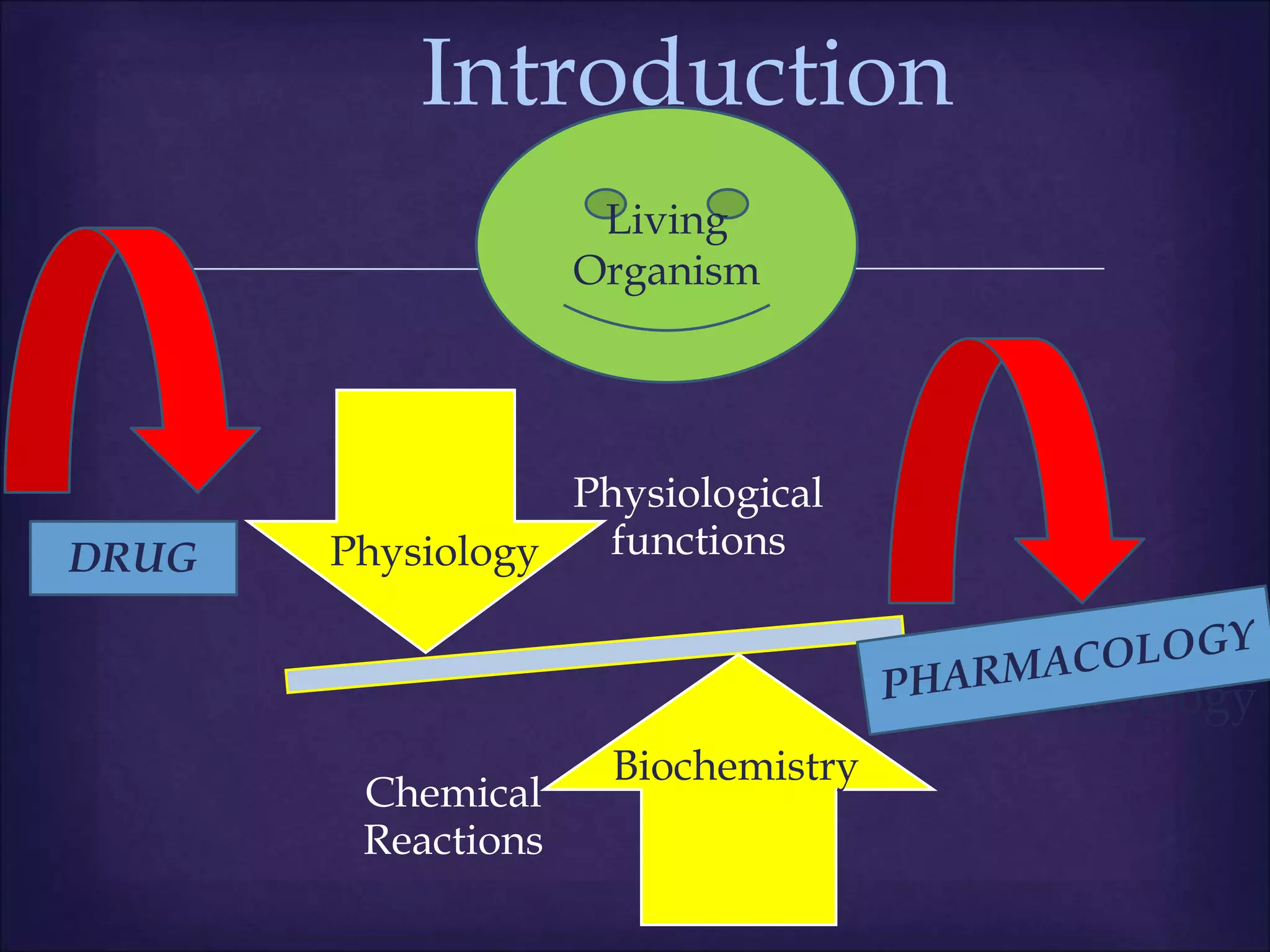
Introduction
Physiological
functions
Chemical
Reactions
Pharmacology
Living
Organism
Physiology
Biochemistry
DRUG

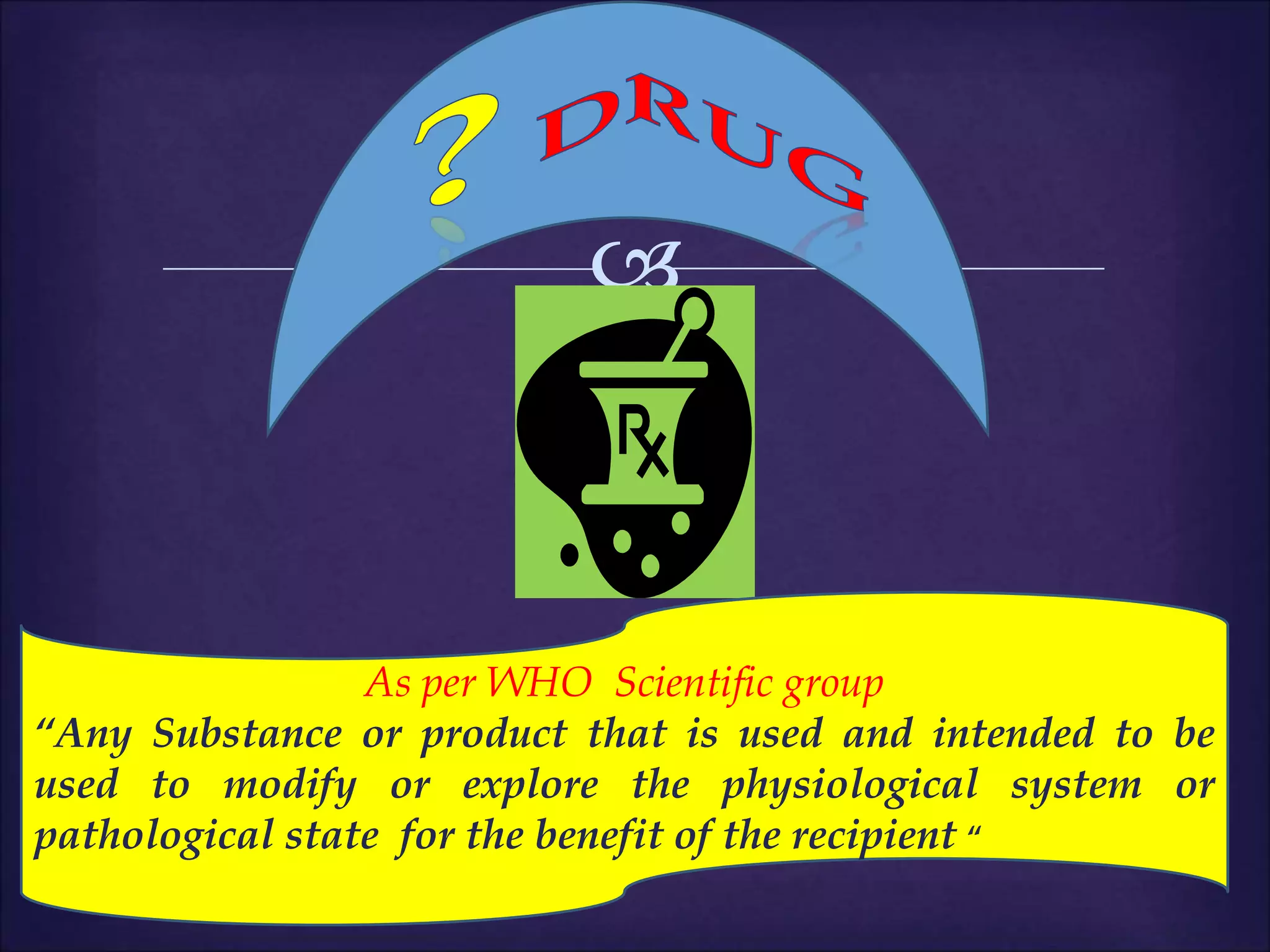
As per WHO Scientific group
“Any Substance or product that is used and intended to be
used to modify or explore the physiological system or
pathological state for the benefit of the recipient “

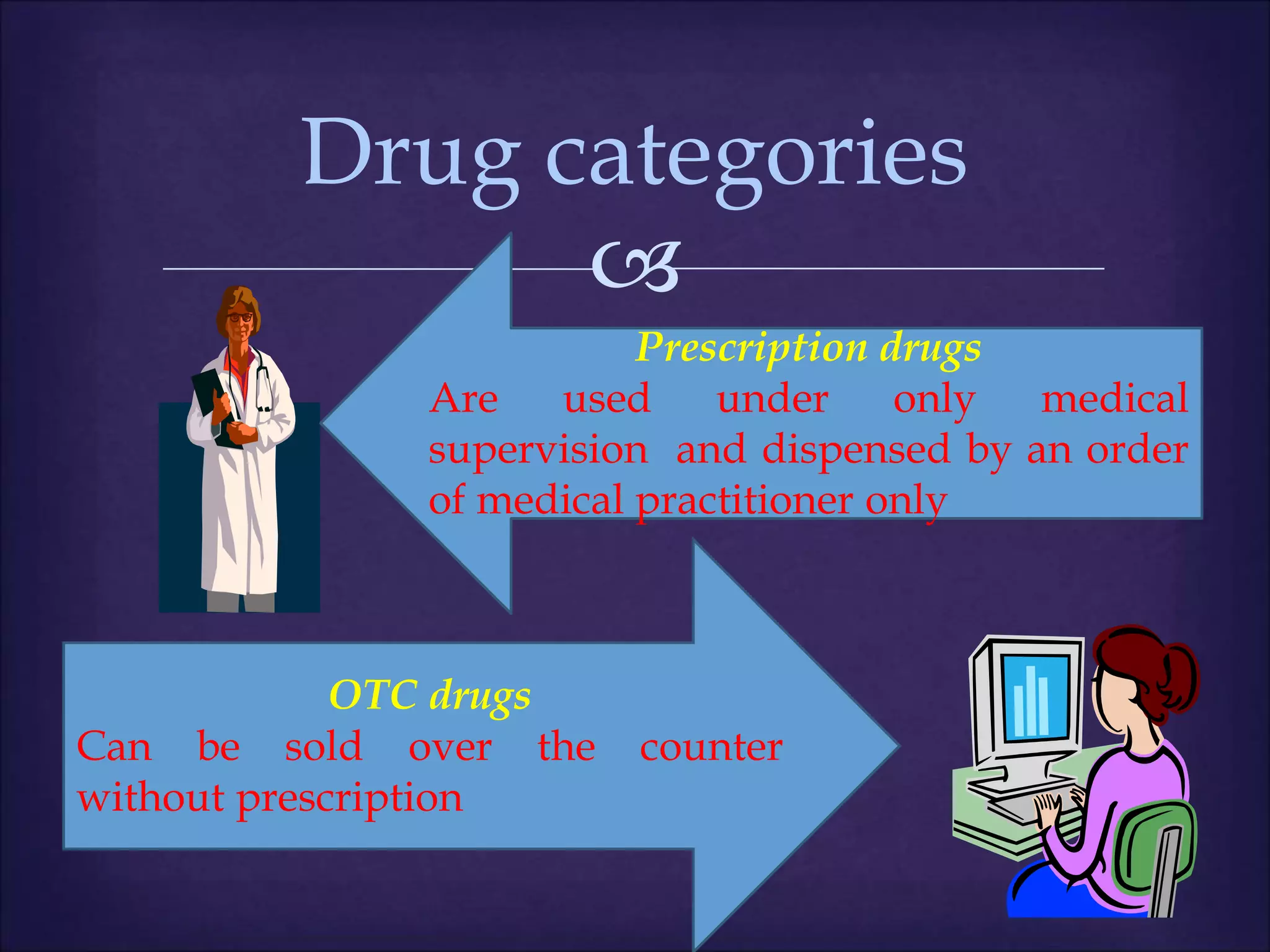
Drug categories
Prescription drugs
Are used under only medical
supervision and dispensed by an order
of medical practitioner only
OTC drugs
Can be sold over the counter
without prescription

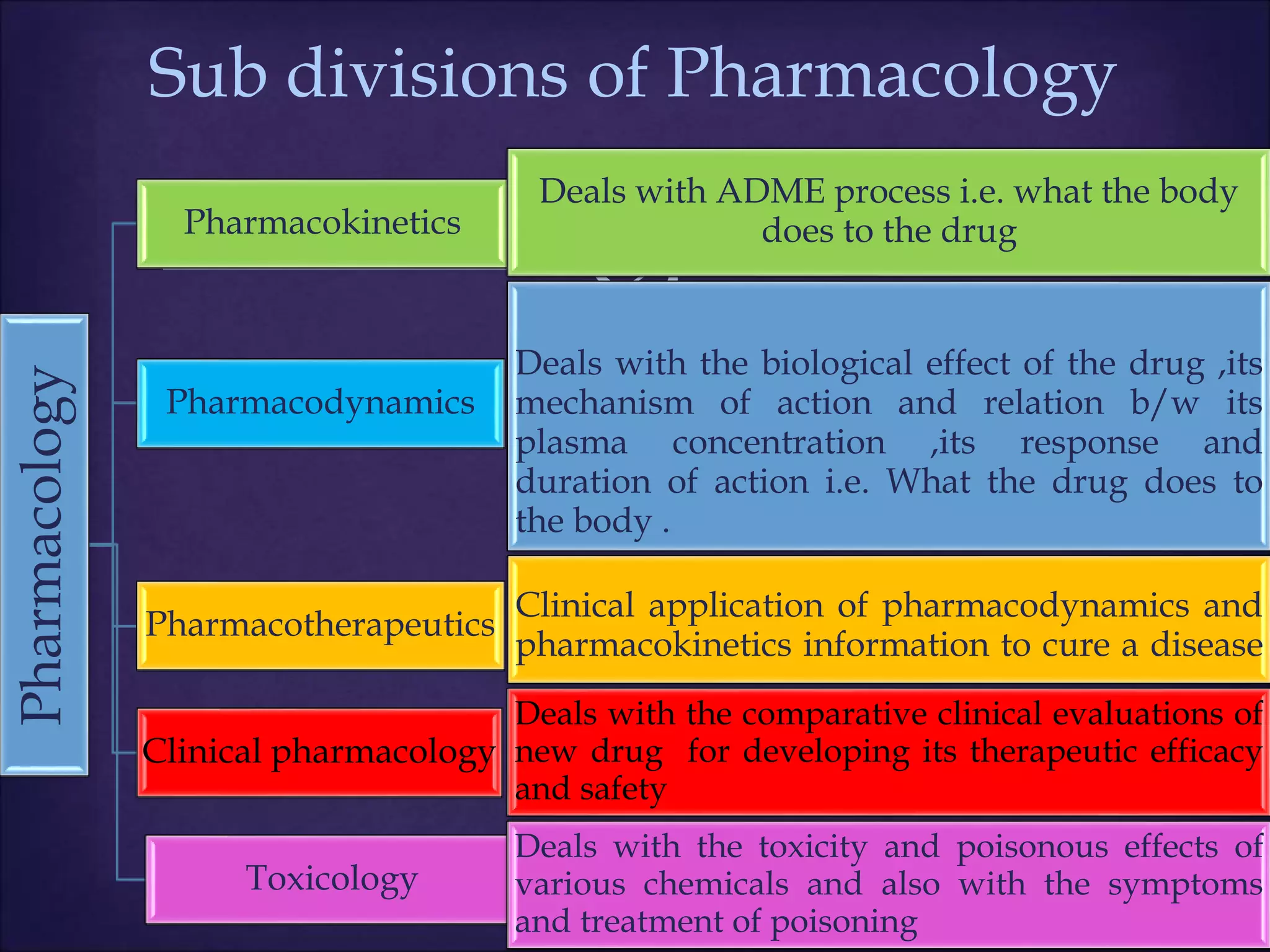
Sub divisions of Pharmacology
Pharmacology
Pharmacokinetics
Pharmacodynamics
Pharmacotherapeutics
Clinical pharmacology
Toxicology
Deals with ADME process i.e. what the body
does to the drug
Deals with the biological effect of the drug ,its
mechanism of action and relation b/w its
plasma concentration ,its response and
duration of action i.e. What the drug does to
the body .
Clinical application of pharmacodynamics and
pharmacokinetics information to cure a disease
.
Deals with the comparative clinical evaluations of
new drug for developing its therapeutic efficacy
and safety
Deals with the toxicity and poisonous effects of
various chemicals and also with the symptoms
and treatment of poisoning

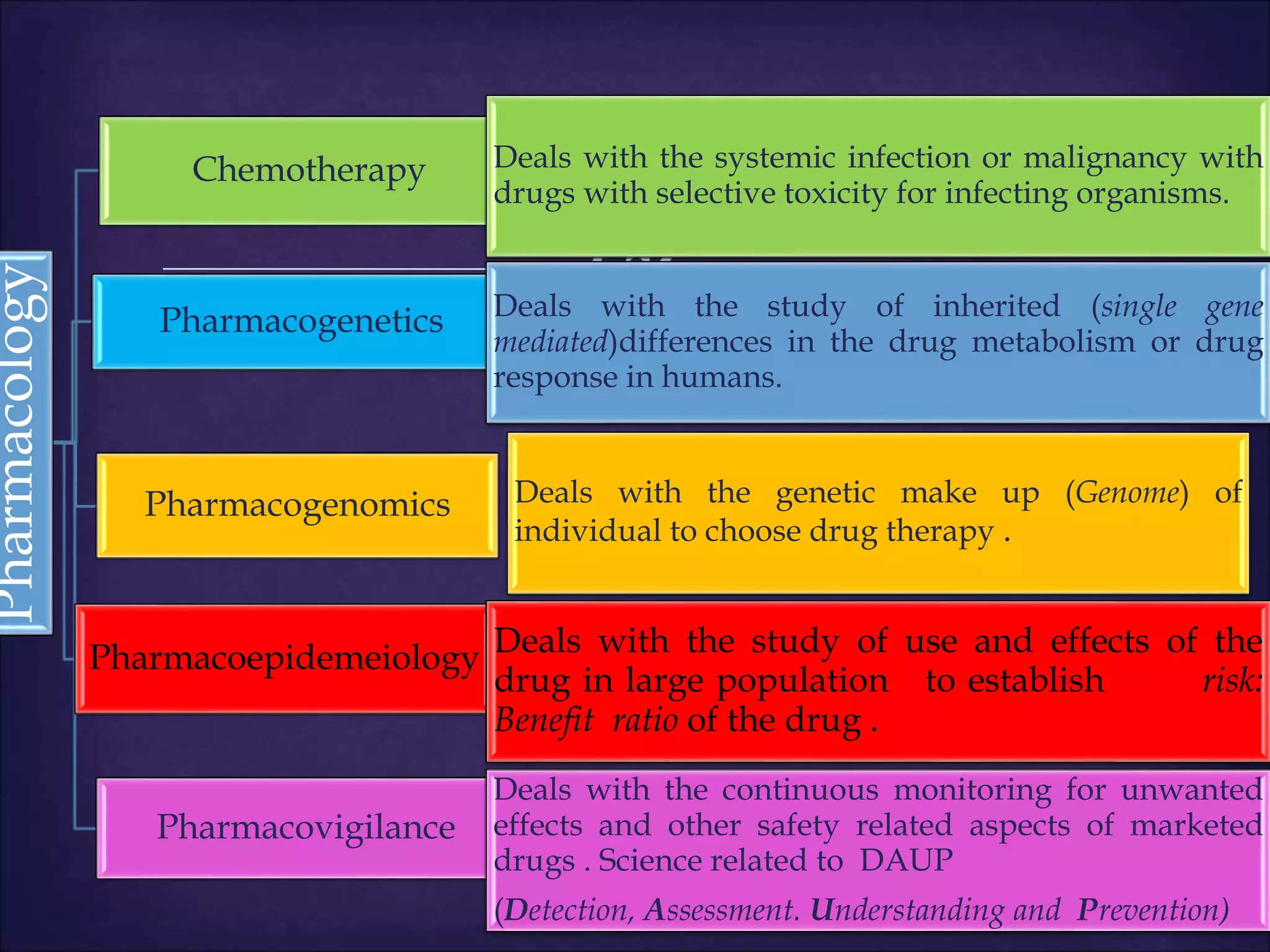
Pharmacology
Chemotherapy
Pharmacogenetics
Pharmacogenomics
Pharmacoepidemeiology
Pharmacovigilance
Deals with the systemic infection or malignancy with
drugs with selective toxicity for infecting organisms.
Deals with the study of inherited (single gene
mediated)differences in the drug metabolism or drug
response in humans.
Deals with the genetic make up (Genome) of
individual to choose drug therapy .
Deals with the study of use and effects of the
drug in large population to establish risk:
Benefit ratio of the drug .
Deals with the continuous monitoring for unwanted
effects and other safety related aspects of marketed
drugs . Science related to DAUP
(Detection, Assessment. Understanding and Prevention)

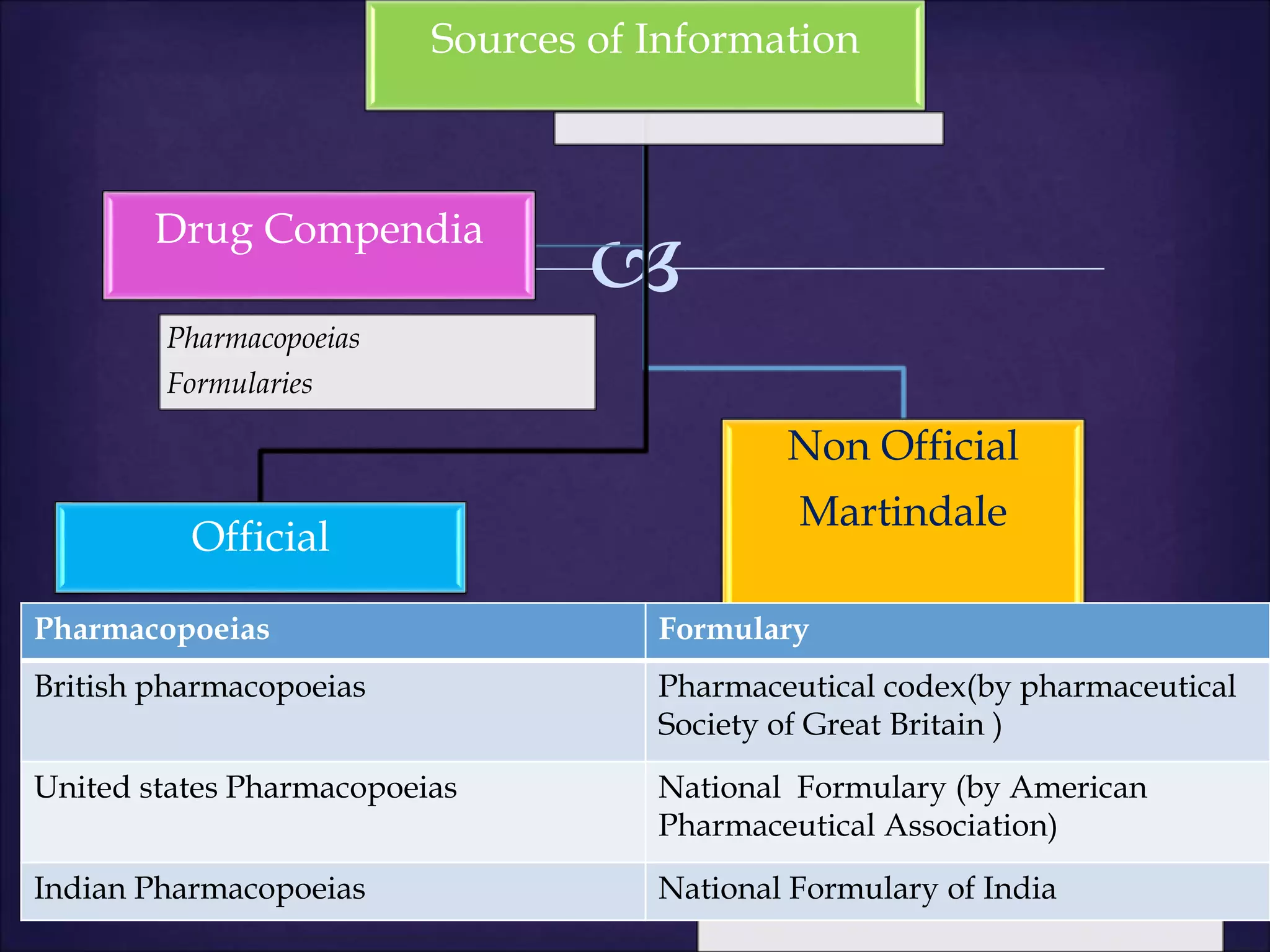
Sources of Information
Official
Non Official
Martindale
Drug Compendia
Pharmacopoeias
Formularies
Pharmacopoeias Formulary
British pharmacopoeias Pharmaceutical codex(by pharmaceutical
Society of Great Britain )
United states Pharmacopoeias National Formulary (by American
Pharmaceutical Association)
Indian Pharmacopoeias National Formulary of India

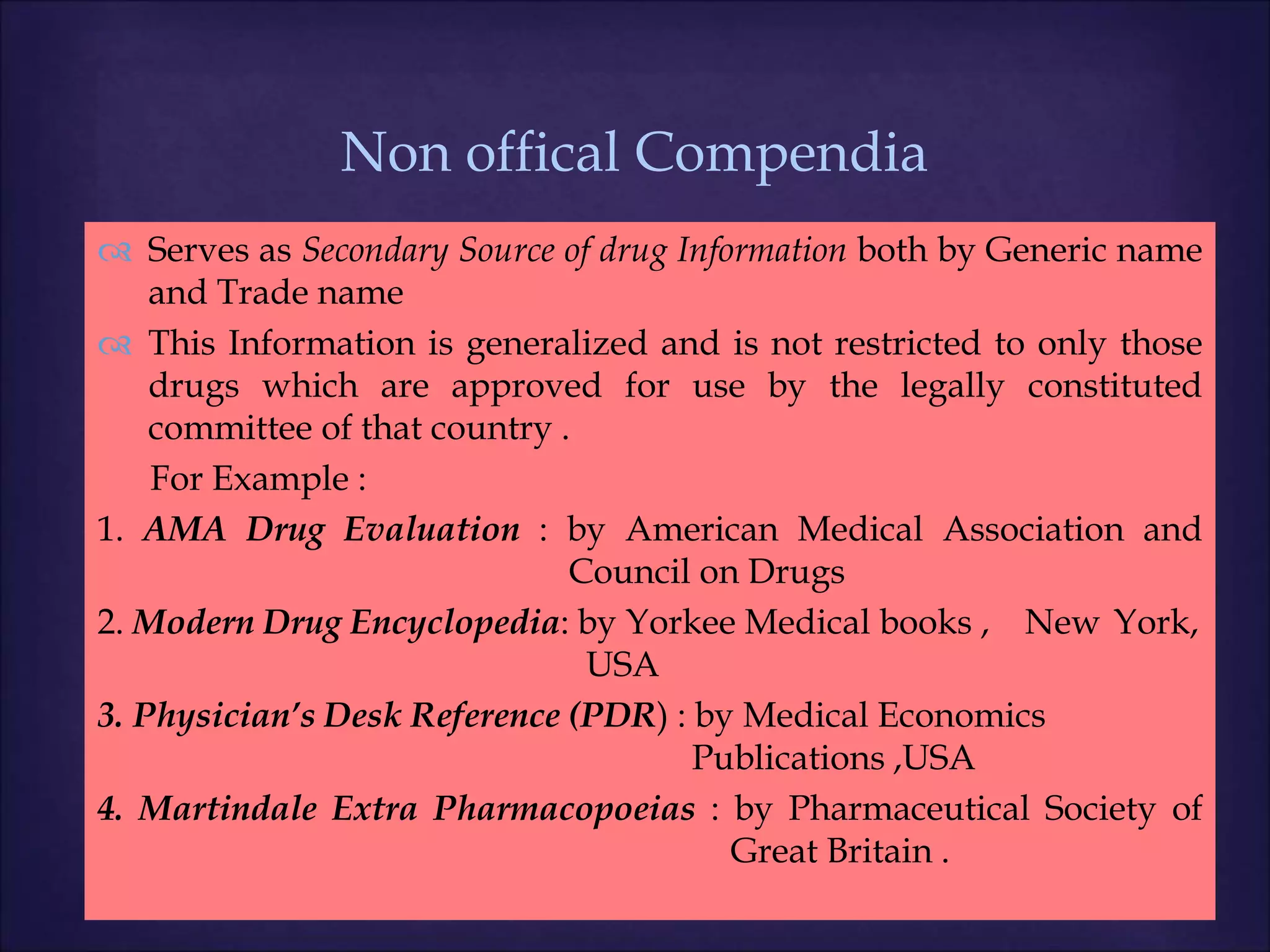
 Serves as Secondary Source of drug Information both by Generic name
and Trade name
 This Information is generalized and is not restricted to only those
drugs which are approved for use by the legally constituted
committee of that country .
For Example :
1. AMA Drug Evaluation : by American Medical Association and
Council on Drugs
2. Modern Drug Encyclopedia: by Yorkee Medical books , New York,
USA
3. Physician’s Desk Reference (PDR) : by Medical Economics
Publications ,USA
4. Martindale Extra Pharmacopoeias : by Pharmaceutical Society of
Great Britain .
Non offical Compendia

A drug generally has three categories of names:
(a)Chemical name
 It describes the substance chemically, e.g. 1-
(Isopropylamino )-3-(1-naphthyloxy) propan-2 –ol for
propranolol.
(b) Non-proprietary / official name / Approved name
 Name in the official books accepted all over the world
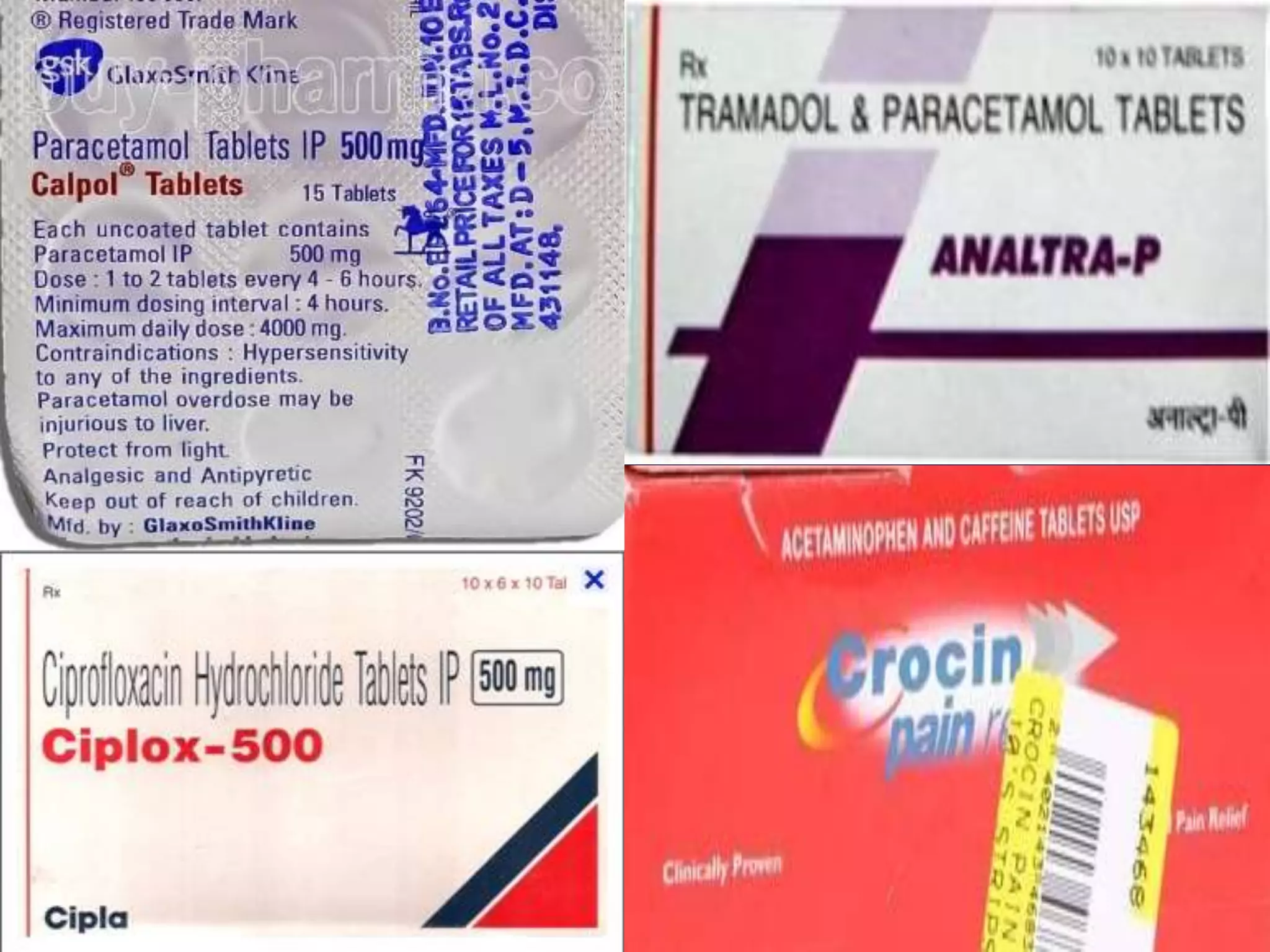
(c)Proprietary (Brand) name
 Crocin for Paracetamol
DRUG NOMENCLATURE


 Essential medicines, as defined by the WHO are
"those drugs that satisfy the health care needs of the
majority of the population; they should therefore be
available at all times in adequate amounts and in
appropriate dosage forms, at a price the community
can afford."
Essential medicines

 These are drugs or biological products for diagnosis/treatment/
prevention of a rare disease or condition, or a more common disease
(endemic only in resource poor countries) for which there is no
reasonable expectation that the cost of developing and marketing it
will be recovered from the sales of that drug.
 e.g. sodium nitrite, fomepizole, liposomal amphotericin B,,
rifabutin,, somatropin, digoxin immune Fab (digoxin
antibody), liothyronine (T3) and many more.
 Governments in developed countries offer tax benefits and other
incentives to pharmaceutical companies for developing and marketing
orphan drugs (e.g. Orphan Drug Act in USA).
Orphan Drugs

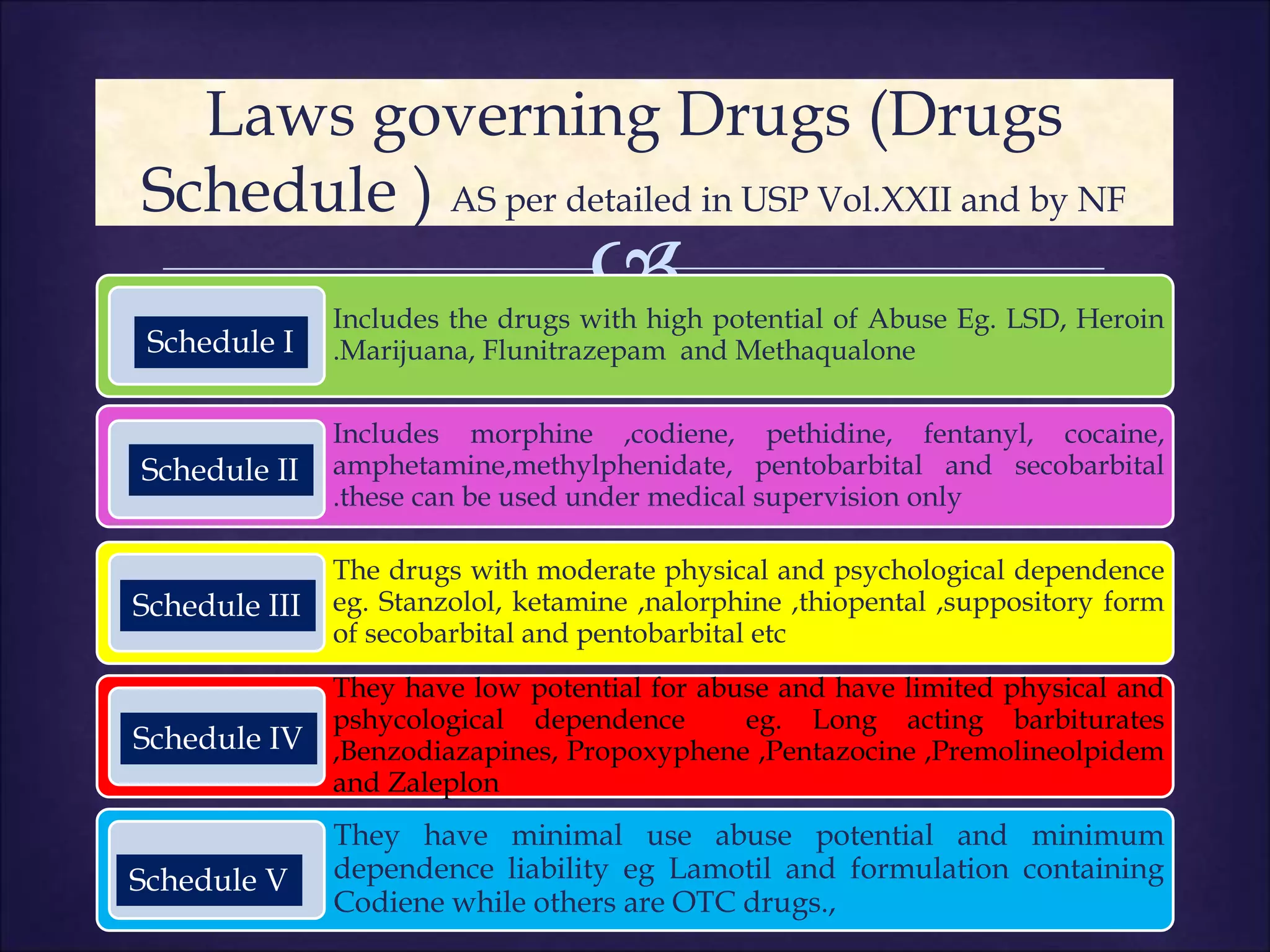
Includes the drugs with high potential of Abuse Eg. LSD, Heroin
.Marijuana, Flunitrazepam and Methaqualone
Includes morphine ,codiene, pethidine, fentanyl, cocaine,
amphetamine,methylphenidate, pentobarbital and secobarbital
.these can be used under medical supervision only
The drugs with moderate physical and psychological dependence
eg. Stanzolol, ketamine ,nalorphine ,thiopental ,suppository form
of secobarbital and pentobarbital etc
They have low potential for abuse and have limited physical and
pshycological dependence eg. Long acting barbiturates
,Benzodiazapines, Propoxyphene ,Pentazocine ,Premolineolpidem
and Zaleplon
They have minimal use abuse potential and minimum
dependence liability eg Lamotil and formulation containing
Codiene while others are OTC drugs.,
Laws governing Drugs (Drugs
Schedule ) AS per detailed in USP Vol.XXII and by NF
Schedule I
Schedule II
Schedule III
Schedule IV
Schedule V

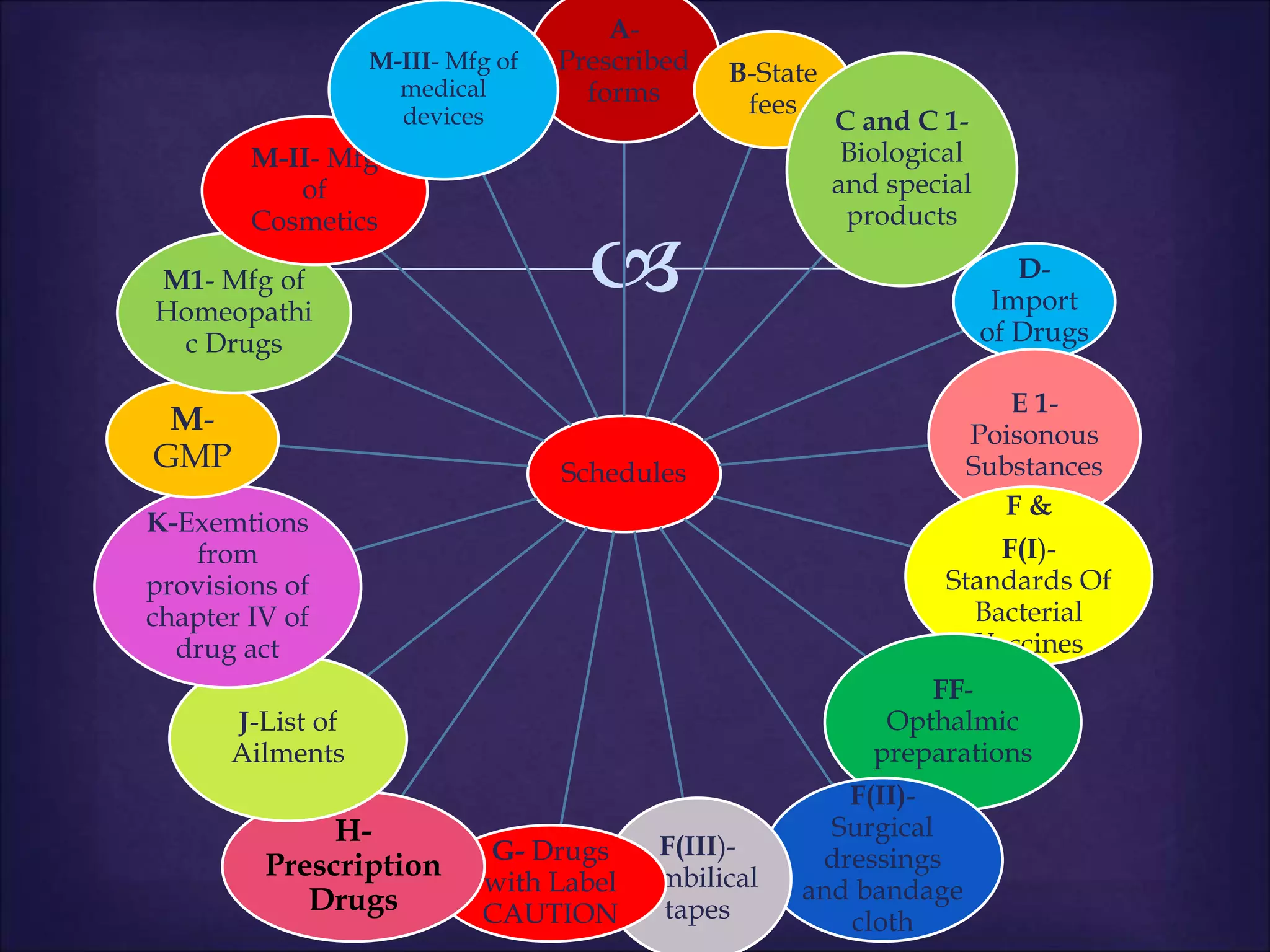
Schedules
A-
Prescribed
forms
B-State
fees
C and C 1-
Biological
and special
products
D-
Import
of Drugs
E 1-
Poisonous
Substances
F &
F(I)-
Standards Of
Bacterial
Vaccines
FF-
Opthalmic
preparations
F(II)-
Surgical
dressings
and bandage
cloth
F(III)-
Umbilical
tapes
G- Drugs
with Label
CAUTION
H-
Prescription
Drugs
J-List of
Ailments
K-Exemtions
from
provisions of
chapter IV of
drug act
M-
GMP
M1- Mfg of
Homeopathi
c Drugs
M-II- Mfg
of
Cosmetics
M-III- Mfg of
medical
devices

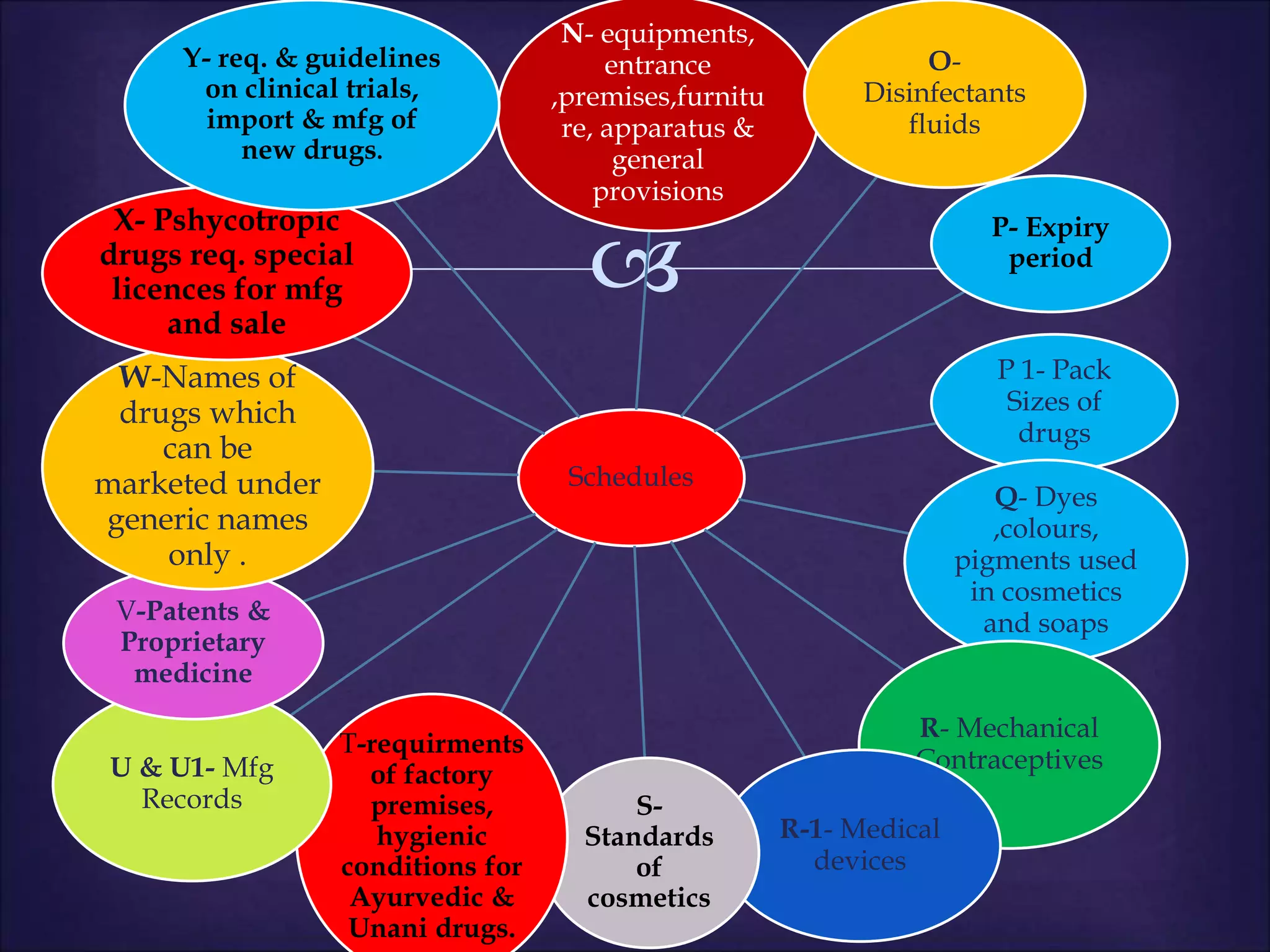
Schedules
N- equipments,
entrance
,premises,furnitu
re, apparatus &
general
provisions
O-
Disinfectants
fluids
P- Expiry
period
P 1- Pack
Sizes of
drugs
Q- Dyes
,colours,
pigments used
in cosmetics
and soaps
R- Mechanical
Contraceptives
R-1- Medical
devices
S-
Standards
of
cosmetics
T-requirments
of factory
premises,
hygienic
conditions for
Ayurvedic &
Unani drugs.
U & U1- Mfg
Records
V-Patents &
Proprietary
medicine
W-Names of
drugs which
can be
marketed under
generic names
only .
X- Pshycotropic
drugs req. special
licences for mfg
and sale
Y- req. & guidelines
on clinical trials,
import & mfg of
new drugs.

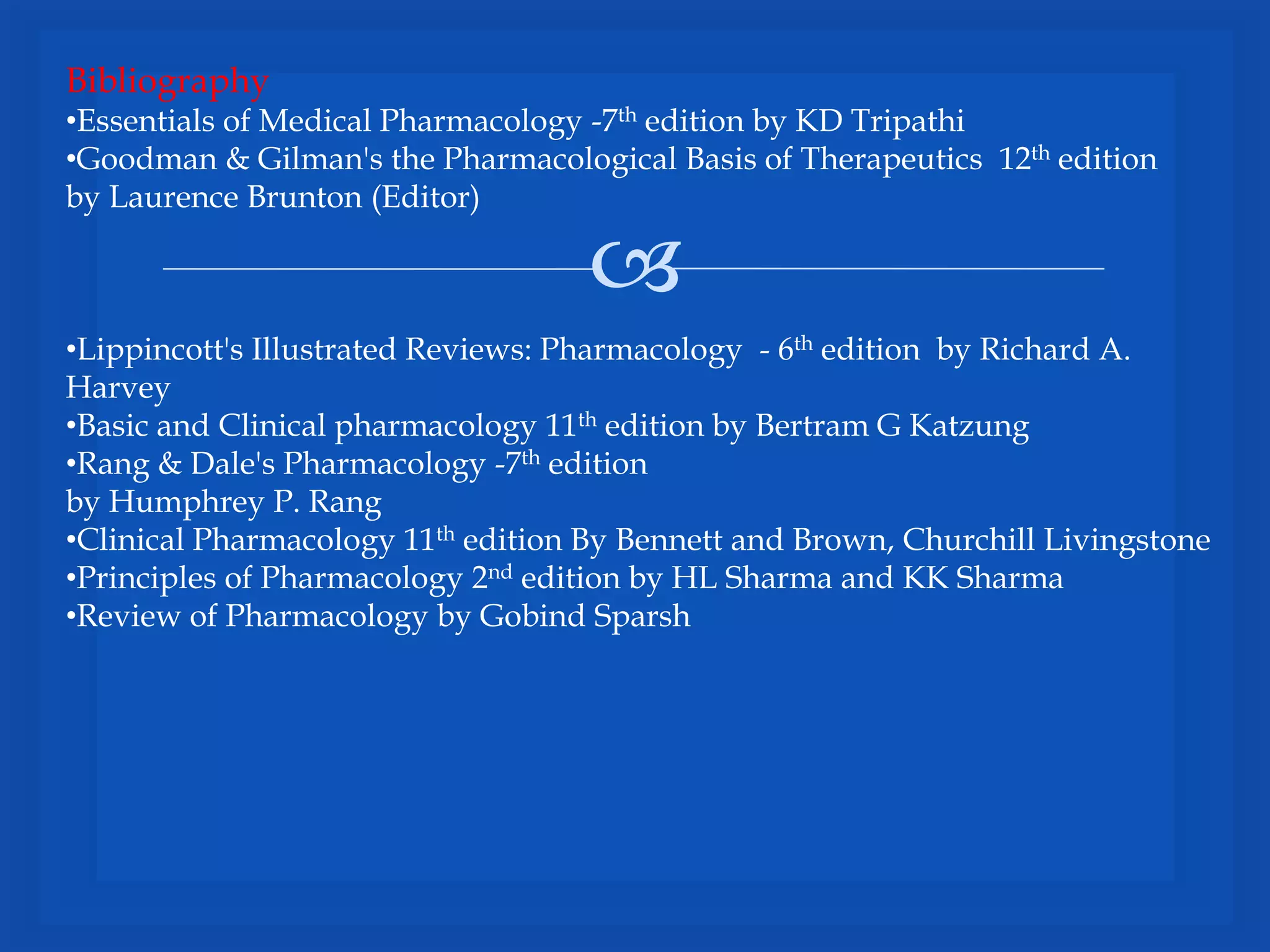
Bibliography
•Essentials of Medical Pharmacology -7th edition by KD Tripathi
•Goodman & Gilman's the Pharmacological Basis of Therapeutics 12th edition
by Laurence Brunton (Editor)
•Lippincott's Illustrated Reviews: Pharmacology - 6th edition by Richard A.
Harvey
•Basic and Clinical pharmacology 11th edition by Bertram G Katzung
•Rang & Dale's Pharmacology -7th edition
by Humphrey P. Rang
•Clinical Pharmacology 11th edition By Bennett and Brown, Churchill Livingstone
•Principles of Pharmacology 2nd edition by HL Sharma and KK Sharma
•Review of Pharmacology by Gobind Sparsh

Pharmacology_introduction.ppt

  • 1.
  • 2.
  • 3.
     As per WHOScientific group “Any Substance or product that is used and intended to be used to modify or explore the physiological system or pathological state for the benefit of the recipient “
  • 4.
     Drug categories Prescription drugs Areused under only medical supervision and dispensed by an order of medical practitioner only OTC drugs Can be sold over the counter without prescription
  • 5.
     Sub divisions ofPharmacology Pharmacology Pharmacokinetics Pharmacodynamics Pharmacotherapeutics Clinical pharmacology Toxicology Deals with ADME process i.e. what the body does to the drug Deals with the biological effect of the drug ,its mechanism of action and relation b/w its plasma concentration ,its response and duration of action i.e. What the drug does to the body . Clinical application of pharmacodynamics and pharmacokinetics information to cure a disease . Deals with the comparative clinical evaluations of new drug for developing its therapeutic efficacy and safety Deals with the toxicity and poisonous effects of various chemicals and also with the symptoms and treatment of poisoning
  • 6.
     Pharmacology Chemotherapy Pharmacogenetics Pharmacogenomics Pharmacoepidemeiology Pharmacovigilance Deals with thesystemic infection or malignancy with drugs with selective toxicity for infecting organisms. Deals with the study of inherited (single gene mediated)differences in the drug metabolism or drug response in humans. Deals with the genetic make up (Genome) of individual to choose drug therapy . Deals with the study of use and effects of the drug in large population to establish risk: Benefit ratio of the drug . Deals with the continuous monitoring for unwanted effects and other safety related aspects of marketed drugs . Science related to DAUP (Detection, Assessment. Understanding and Prevention)
  • 7.
     Sources of Information Official NonOfficial Martindale Drug Compendia Pharmacopoeias Formularies Pharmacopoeias Formulary British pharmacopoeias Pharmaceutical codex(by pharmaceutical Society of Great Britain ) United states Pharmacopoeias National Formulary (by American Pharmaceutical Association) Indian Pharmacopoeias National Formulary of India
  • 8.
      Serves asSecondary Source of drug Information both by Generic name and Trade name  This Information is generalized and is not restricted to only those drugs which are approved for use by the legally constituted committee of that country . For Example : 1. AMA Drug Evaluation : by American Medical Association and Council on Drugs 2. Modern Drug Encyclopedia: by Yorkee Medical books , New York, USA 3. Physician’s Desk Reference (PDR) : by Medical Economics Publications ,USA 4. Martindale Extra Pharmacopoeias : by Pharmaceutical Society of Great Britain . Non offical Compendia
  • 9.
     A drug generallyhas three categories of names: (a)Chemical name  It describes the substance chemically, e.g. 1- (Isopropylamino )-3-(1-naphthyloxy) propan-2 –ol for propranolol. (b) Non-proprietary / official name / Approved name  Name in the official books accepted all over the world (c)Proprietary (Brand) name  Crocin for Paracetamol DRUG NOMENCLATURE
  • 10.
  • 11.
      Essential medicines,as defined by the WHO are "those drugs that satisfy the health care needs of the majority of the population; they should therefore be available at all times in adequate amounts and in appropriate dosage forms, at a price the community can afford." Essential medicines
  • 12.
      These aredrugs or biological products for diagnosis/treatment/ prevention of a rare disease or condition, or a more common disease (endemic only in resource poor countries) for which there is no reasonable expectation that the cost of developing and marketing it will be recovered from the sales of that drug.  e.g. sodium nitrite, fomepizole, liposomal amphotericin B,, rifabutin,, somatropin, digoxin immune Fab (digoxin antibody), liothyronine (T3) and many more.  Governments in developed countries offer tax benefits and other incentives to pharmaceutical companies for developing and marketing orphan drugs (e.g. Orphan Drug Act in USA). Orphan Drugs
  • 13.
     Includes the drugswith high potential of Abuse Eg. LSD, Heroin .Marijuana, Flunitrazepam and Methaqualone Includes morphine ,codiene, pethidine, fentanyl, cocaine, amphetamine,methylphenidate, pentobarbital and secobarbital .these can be used under medical supervision only The drugs with moderate physical and psychological dependence eg. Stanzolol, ketamine ,nalorphine ,thiopental ,suppository form of secobarbital and pentobarbital etc They have low potential for abuse and have limited physical and pshycological dependence eg. Long acting barbiturates ,Benzodiazapines, Propoxyphene ,Pentazocine ,Premolineolpidem and Zaleplon They have minimal use abuse potential and minimum dependence liability eg Lamotil and formulation containing Codiene while others are OTC drugs., Laws governing Drugs (Drugs Schedule ) AS per detailed in USP Vol.XXII and by NF Schedule I Schedule II Schedule III Schedule IV Schedule V
  • 14.
     Schedules A- Prescribed forms B-State fees C and C1- Biological and special products D- Import of Drugs E 1- Poisonous Substances F & F(I)- Standards Of Bacterial Vaccines FF- Opthalmic preparations F(II)- Surgical dressings and bandage cloth F(III)- Umbilical tapes G- Drugs with Label CAUTION H- Prescription Drugs J-List of Ailments K-Exemtions from provisions of chapter IV of drug act M- GMP M1- Mfg of Homeopathi c Drugs M-II- Mfg of Cosmetics M-III- Mfg of medical devices
  • 15.
     Schedules N- equipments, entrance ,premises,furnitu re, apparatus& general provisions O- Disinfectants fluids P- Expiry period P 1- Pack Sizes of drugs Q- Dyes ,colours, pigments used in cosmetics and soaps R- Mechanical Contraceptives R-1- Medical devices S- Standards of cosmetics T-requirments of factory premises, hygienic conditions for Ayurvedic & Unani drugs. U & U1- Mfg Records V-Patents & Proprietary medicine W-Names of drugs which can be marketed under generic names only . X- Pshycotropic drugs req. special licences for mfg and sale Y- req. & guidelines on clinical trials, import & mfg of new drugs.
  • 16.
     Bibliography •Essentials of MedicalPharmacology -7th edition by KD Tripathi •Goodman & Gilman's the Pharmacological Basis of Therapeutics 12th edition by Laurence Brunton (Editor) •Lippincott's Illustrated Reviews: Pharmacology - 6th edition by Richard A. Harvey •Basic and Clinical pharmacology 11th edition by Bertram G Katzung •Rang & Dale's Pharmacology -7th edition by Humphrey P. Rang •Clinical Pharmacology 11th edition By Bennett and Brown, Churchill Livingstone •Principles of Pharmacology 2nd edition by HL Sharma and KK Sharma •Review of Pharmacology by Gobind Sparsh