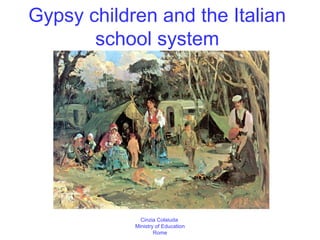
Gypsy children and the Italian
       school system


              Cinzia Colaiuda
            Ministry of Education
                    Rome
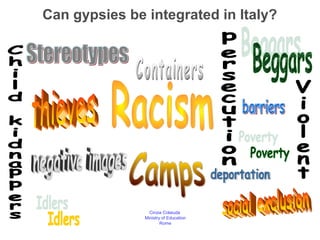
Can gypsies be integrated in Italy?


                 Cinzia Colaiuda
               Ministry of Education
                       Rome
Can gypsy children be integrated in the
       Italian school system?
   •   Decisions at European level

   •   Political trends at national level

   • Local level:
   1. Social, economical and cultural context of each
      geographical area
   2. Presence of regional/local institutions and/or communities

   •   School level: school autonomy in Italy

   •   Class level: the role of teachers


                          Cinzia Colaiuda
                        Ministry of Education
                                Rome
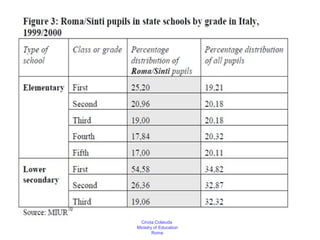
Schooling of gypsies in Italy
•   1963: several ministerial resolutions provided general directives for
    the schooling of gypsy children. The introduction of “special classes”
    («lacio drom») became official.
•   1982 – 1986: period of transition: from a “special classes” to a
    “normal classes” approach. Schools with gypsy children could count
    on additional personnel.
•    From 1986 onwards:
•   Schooling was made compulsory for all Roma children
•   Special projects were instituted by Ministerial circulars at national level.
•   The presence of gypsy children was and is now considered to be an integral
    part of the everyday reality in Italian schools.
•   Increase of teaching staff only in those cases where real learning difficulties
    were detected.
•   From 1990 onwards: intercultural elements addressing primarily
    immigrants have been gradually introduced (intercultural pedagogy).
    This means that gypsy children are considered as “foreign pupils” by
    the Italian law and they have the same rights of all other pupils.


                                     Cinzia Colaiuda
                                   Ministry of Education
                                           Rome
Cinzia Colaiuda
Ministry of Education
        Rome
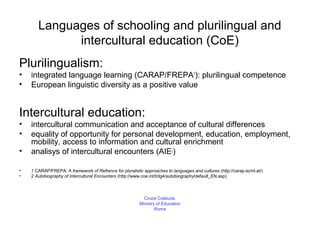
Languages of schooling and plurilingual and
             intercultural education (CoE)
Plurilingualism:
•   integrated language learning (CARAP/FREPA1): plurilingual competence
•   European linguistic diversity as a positive value


Intercultural education:
•   intercultural communication and acceptance of cultural differences
•   equality of opportunity for personal development, education, employment,
    mobility, access to information and cultural enrichment
•   analisys of intercultural encounters (AIE )                          2


•   1 CARAP/FREPA: A framework of Refrence for pluralistic approaches to languages and cultures (http://carap.ecml.at/)
•   2 Autobiography of Intercultural Encounters (http://www.coe.int/t/dg4/autobiography/default_EN.asp)


                                                           Cinzia Colaiuda
                                                         Ministry of Education
                                                                 Rome
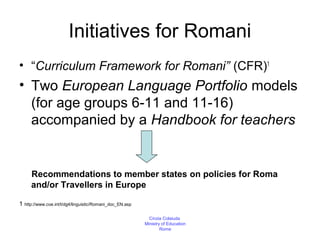
Initiatives for Romani
• “Curriculum Framework for Romani” (CFR)1
• Two European Language Portfolio models
  (for age groups 6-11 and 11-16)
  accompanied by a Handbook for teachers


     Recommendations to member states on policies for Roma
     and/or Travellers in Europe

1 http://www.coe.int/t/dg4/linguistic/Romani_doc_EN.asp

                                                            Cinzia Colaiuda
                                                          Ministry of Education
                                                                  Rome
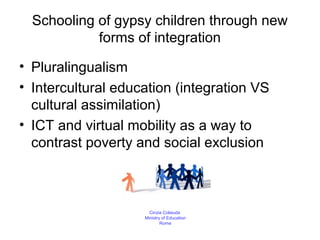
Schooling of gypsy children through new
            forms of integration

• Pluralingualism
• Intercultural education (integration VS
  cultural assimilation)
• ICT and virtual mobility as a way to
  contrast poverty and social exclusion


                      Cinzia Colaiuda
                    Ministry of Education
                            Rome
Thank you!

cinzia.colaiuda@istruzione.it
Thank you!

cinzia.colaiuda@istruzione.it

Pestalozzi gypsy

  • 1.
    Gypsy children andthe Italian school system Cinzia Colaiuda Ministry of Education Rome
  • 2.
    Can gypsies beintegrated in Italy? Cinzia Colaiuda Ministry of Education Rome
  • 3.
    Can gypsy childrenbe integrated in the Italian school system? • Decisions at European level • Political trends at national level • Local level: 1. Social, economical and cultural context of each geographical area 2. Presence of regional/local institutions and/or communities • School level: school autonomy in Italy • Class level: the role of teachers Cinzia Colaiuda Ministry of Education Rome
  • 4.
    Schooling of gypsiesin Italy • 1963: several ministerial resolutions provided general directives for the schooling of gypsy children. The introduction of “special classes” («lacio drom») became official. • 1982 – 1986: period of transition: from a “special classes” to a “normal classes” approach. Schools with gypsy children could count on additional personnel. • From 1986 onwards: • Schooling was made compulsory for all Roma children • Special projects were instituted by Ministerial circulars at national level. • The presence of gypsy children was and is now considered to be an integral part of the everyday reality in Italian schools. • Increase of teaching staff only in those cases where real learning difficulties were detected. • From 1990 onwards: intercultural elements addressing primarily immigrants have been gradually introduced (intercultural pedagogy). This means that gypsy children are considered as “foreign pupils” by the Italian law and they have the same rights of all other pupils. Cinzia Colaiuda Ministry of Education Rome
  • 5.
  • 6.
    Languages of schoolingand plurilingual and intercultural education (CoE) Plurilingualism: • integrated language learning (CARAP/FREPA1): plurilingual competence • European linguistic diversity as a positive value Intercultural education: • intercultural communication and acceptance of cultural differences • equality of opportunity for personal development, education, employment, mobility, access to information and cultural enrichment • analisys of intercultural encounters (AIE ) 2 • 1 CARAP/FREPA: A framework of Refrence for pluralistic approaches to languages and cultures (http://carap.ecml.at/) • 2 Autobiography of Intercultural Encounters (http://www.coe.int/t/dg4/autobiography/default_EN.asp) Cinzia Colaiuda Ministry of Education Rome
  • 7.
    Initiatives for Romani •“Curriculum Framework for Romani” (CFR)1 • Two European Language Portfolio models (for age groups 6-11 and 11-16) accompanied by a Handbook for teachers Recommendations to member states on policies for Roma and/or Travellers in Europe 1 http://www.coe.int/t/dg4/linguistic/Romani_doc_EN.asp Cinzia Colaiuda Ministry of Education Rome
  • 8.
    Schooling of gypsychildren through new forms of integration • Pluralingualism • Intercultural education (integration VS cultural assimilation) • ICT and virtual mobility as a way to contrast poverty and social exclusion Cinzia Colaiuda Ministry of Education Rome
  • 9.
  • 10.