From Peshawar
to Pittsburgh
Helping Veterans Make Career Transitions
Amy Armstrong, MS, NCC, MCC, LPC
December 4, 2014
Agenda
 Review the objectives for this session
 Spend a few minutes brainstorming about strategies
to use with sample cases
 Cover websites and other resources.
Objectives
 Understand basic terminology regarding military
transition to career
 Get familiar with websites that are helpful to vets in
transition
 Gather some information about the GI Bill program
and the vet’s obligations under the program
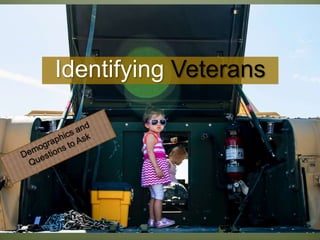
Identifying Veterans
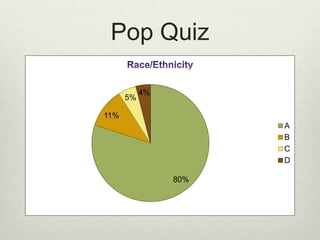
Pop Quiz
80%
11%
5%
4%
A
B
C
D
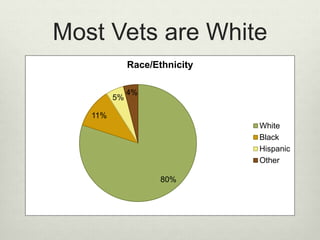
Most Vets are White
80%
11%
5%
4%
Race/Ethnicity
White
Black
Hispanic
Other
Questions to Ask
 Are you a veteran?
 Which branch did you serve with?
 What was your MOS? (Military Occupational
Specialty)
Challenges of Civilian Life
Choices, Change, and Access
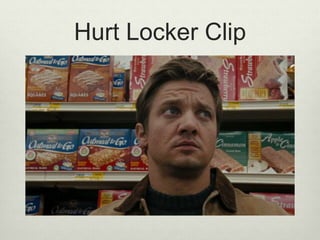
Hurt Locker Clip
Common Issues for Vets
 Divorce/loss of job
 Risk of homelessness
 Traumatic Brain Injury
(TBI)
 Post Traumatic Stress
 Suicide Risk
 Overwhelmed
[Photo via Flickr]
Self-Advocacy
 They’ve earned their benefits
 Requesting accommodations doesn’t = a free pass
to get around requirements
Educational hurdles
For Vets
Vets & College
 First Generation college students
 Training that is equivalent to college courses, CLEP
or DANTES test scores
 May require accommodations for physical or mental
impairment
 Don’t tend to be aggressive advocates for
themselves
How College-Ready Are
They?
 Ask about:
 Performance in high school classes
 Support from family and friends
 How they cope with stress
 Any medical conditions that could affect attendance
 Have other family members attended college?
 92% of veterans have a high school diploma or
higher
Grades and the GI Bill
 Withdrawals, Incompletes, and grades lower than a
“C” all can count against a student on the GI Bill
 The VA may be able to call back the money and the
student may not be eligible to use those benefits
ever again
Non-Traditional Degree
Options
• Technical Studies/Occupational
Studies
• CLEP credit
• More information available
through American Council on
Education (ACE)
Caution
Cases/Vignettes
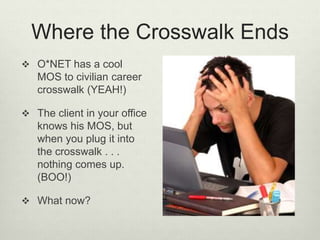
Where the Crosswalk Ends
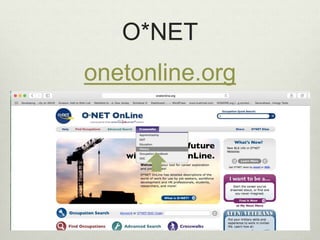
 O*NET has a cool
MOS to civilian career
crosswalk (YEAH!)
 The client in your office
knows his MOS, but
when you plug it into
the crosswalk . . .
nothing comes up.
(BOO!)
 What now?
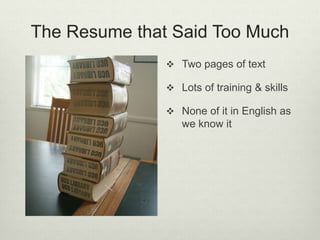
The Resume that Said Too Much
 Two pages of text
 Lots of training & skills
 None of it in English as
we know it
All is Well, BUT
 I can’t write papers
 I can’t make it to class
before noon
 I can’t make it to
evening classes on an
urban campus
Benefits & Compensation
Basic Overview
Veterans Administration
 Healthcare—largest provider of healthcare in the
United States
 Behavioral Health
 Medical and Prescription Benefits
 Optometry, etc.
 Disability Compensation—Varies by “Rating”
 Education—GI Bill
 Death Benefits (Not so relevant if the veteran made
it to your office.)
Disability Ratings
 Additional compensation based on level of disability
(10% and up)
 Any physical injury resulting from service (service-
connected) or mental health issue may make them
eligible for disability compensation
 This can be a 6 month process
Education Benefits
 Post 9/11 GI Bill
 Government pays the college/university directly
 Includes a housing allowance
 Up to $1,000/yr for books and supplies
 Yellow Ribbon Program
 Private colleges and universities allow veterans to
attend at a similar tuition rate as they would at a
public university
State & Federal Benefits
 Veterans are entitled to federal benefits through VA
 They also are entitled to state benefits where they
currently reside, and, possibly, the state where they
were born. In order to receive those benefits, they
have to apply separately.
Websites
For Vets and Career Professionals
Military.com
 Military to Civilian skills translator
 GI Bill information
 State Benefit Information
 Disability Compensation
VA Website
 GI Bill
 Enrollment for/review of Federal benefits online
 Patient Advocacy Program information
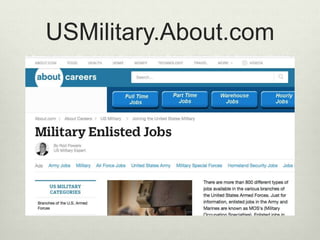
USMilitary.About.com
O*NET
onetonline.org
Thank you
 If you have additional questions, I can be reached
at
amy@amyarmstrongLPC.com
Email me if you would like a
copy of the handout. Will also
be posted on
www.amyarmstronglpc.com

Peshawar to Pittsburgh

  • 1.
    From Peshawar to Pittsburgh HelpingVeterans Make Career Transitions Amy Armstrong, MS, NCC, MCC, LPC December 4, 2014
  • 2.
    Agenda  Review theobjectives for this session  Spend a few minutes brainstorming about strategies to use with sample cases  Cover websites and other resources.
  • 3.
    Objectives  Understand basicterminology regarding military transition to career  Get familiar with websites that are helpful to vets in transition  Gather some information about the GI Bill program and the vet’s obligations under the program
  • 4.
  • 5.
  • 6.
    Most Vets areWhite 80% 11% 5% 4% Race/Ethnicity White Black Hispanic Other
  • 7.
    Questions to Ask Are you a veteran?  Which branch did you serve with?  What was your MOS? (Military Occupational Specialty)
  • 8.
    Challenges of CivilianLife Choices, Change, and Access
  • 9.
  • 10.
    Common Issues forVets  Divorce/loss of job  Risk of homelessness  Traumatic Brain Injury (TBI)  Post Traumatic Stress  Suicide Risk  Overwhelmed [Photo via Flickr]
  • 11.
    Self-Advocacy  They’ve earnedtheir benefits  Requesting accommodations doesn’t = a free pass to get around requirements
  • 12.
  • 13.
    Vets & College First Generation college students  Training that is equivalent to college courses, CLEP or DANTES test scores  May require accommodations for physical or mental impairment  Don’t tend to be aggressive advocates for themselves
  • 14.
    How College-Ready Are They? Ask about:  Performance in high school classes  Support from family and friends  How they cope with stress  Any medical conditions that could affect attendance  Have other family members attended college?  92% of veterans have a high school diploma or higher
  • 15.
    Grades and theGI Bill  Withdrawals, Incompletes, and grades lower than a “C” all can count against a student on the GI Bill  The VA may be able to call back the money and the student may not be eligible to use those benefits ever again
  • 16.
    Non-Traditional Degree Options • TechnicalStudies/Occupational Studies • CLEP credit • More information available through American Council on Education (ACE)
  • 17.
  • 18.
  • 19.
    Where the CrosswalkEnds  O*NET has a cool MOS to civilian career crosswalk (YEAH!)  The client in your office knows his MOS, but when you plug it into the crosswalk . . . nothing comes up. (BOO!)  What now?
  • 20.
    The Resume thatSaid Too Much  Two pages of text  Lots of training & skills  None of it in English as we know it
  • 21.
    All is Well,BUT  I can’t write papers  I can’t make it to class before noon  I can’t make it to evening classes on an urban campus
  • 22.
  • 23.
    Veterans Administration  Healthcare—largestprovider of healthcare in the United States  Behavioral Health  Medical and Prescription Benefits  Optometry, etc.  Disability Compensation—Varies by “Rating”  Education—GI Bill  Death Benefits (Not so relevant if the veteran made it to your office.)
  • 24.
    Disability Ratings  Additionalcompensation based on level of disability (10% and up)  Any physical injury resulting from service (service- connected) or mental health issue may make them eligible for disability compensation  This can be a 6 month process
  • 25.
    Education Benefits  Post9/11 GI Bill  Government pays the college/university directly  Includes a housing allowance  Up to $1,000/yr for books and supplies  Yellow Ribbon Program  Private colleges and universities allow veterans to attend at a similar tuition rate as they would at a public university
  • 26.
    State & FederalBenefits  Veterans are entitled to federal benefits through VA  They also are entitled to state benefits where they currently reside, and, possibly, the state where they were born. In order to receive those benefits, they have to apply separately.
  • 27.
    Websites For Vets andCareer Professionals
  • 28.
    Military.com  Military toCivilian skills translator  GI Bill information  State Benefit Information  Disability Compensation
  • 29.
    VA Website  GIBill  Enrollment for/review of Federal benefits online  Patient Advocacy Program information
  • 30.
  • 31.
  • 32.
    Thank you  Ifyou have additional questions, I can be reached at amy@amyarmstrongLPC.com Email me if you would like a copy of the handout. Will also be posted on www.amyarmstronglpc.com

Editor's Notes

  • #5 Photo courtesy of U.S. Army via Flickr.
  • #6 Which piece of the pie represents veterans who identify as: White Black Hispanic All other (Alaskan Native, Asian, etc.)
  • #7 Which piece of the pie represents veterans who identify as: White Black Hispanic All other (Alaskan Native, Asian, etc.)
  • #10 Choices and options seem great and they are, but they are also overwhelming for someone who comes from a culture that offers few options.
  • #12 A lot of vets may view applying for/requesting accommodations as seeking “special treatment” that isn’t really necessary. It can be important to point out to them that accommodations aren’t for that, but rather they exist to give every student an equal opportunity to succeed. A student with TBI just doesn’t have the same type of brain function as someone who doesn’t. A student with a hearing impairment really does need a hearing aid, a seat close to the professor and possibly, an interpreter.
  • #14 Get a citation on the first gen piece plus a number These students may attend without applying for GI Bill benefits because they don’t think to, think the government doesn’t have the money, or are intimidated by the process
  • #15 Professors usually run the show when it comes to attendance policies and many will not budge regardless of a student’s veteran status. It’s important that students realize that if they will need to be absent more often than not, it will have implications for their grades.
  • #18 Not *all* colleges accept CLEP credits. Also, while a “technical” or “occupational major” is often a terrific option for someone with a trade background to get an associates degree, it doesn’t always transfer well to a four-year college. It’s important to get an idea of what the student’s goals are for college, and to make sure they get appropriate advisement regarding articulation agreements.
  • #25 This could be very important for clients who are having trouble working full time