]PF ]RU                             Final Evaluation Report
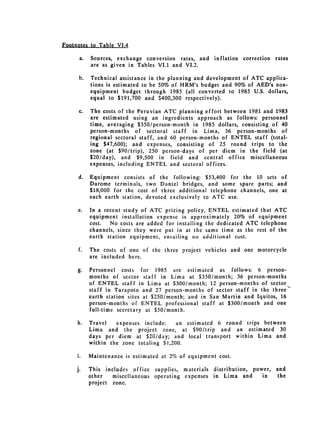
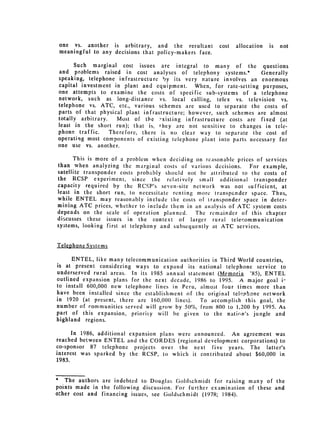
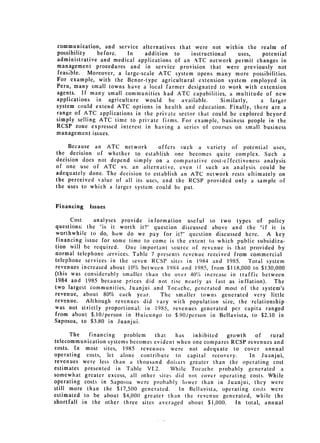
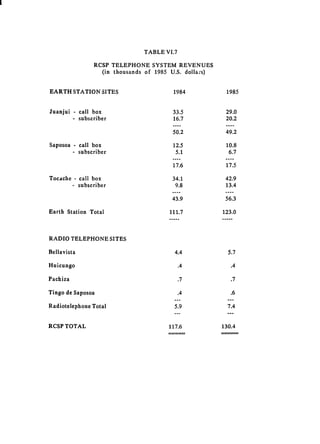
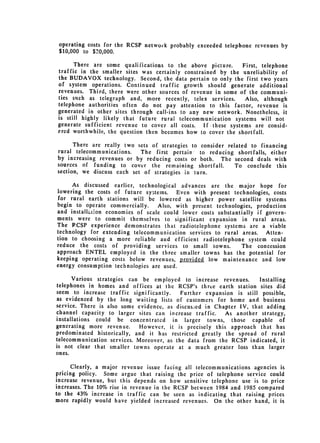
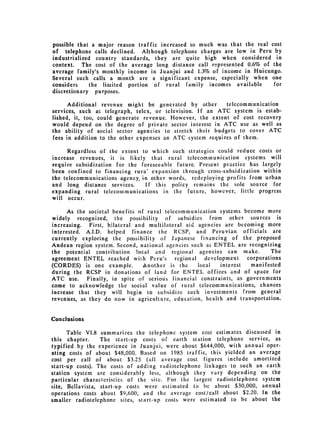
Rural
Communication
Services
Project


          Center for International Studies

            Learning Systems Institute

           The Florida State University


                  February 1987
PERU RURAL COMMUNICATION SERVICES PROJECT


                     FINAL EVALUATION REPORT


                             John K. Mayo
                             Gary R. Heald
                            Steven J. Klees
                           Martha Cruz de Yanks


                      Center for International Studies

                         Learning Systems Institute

                          Florida State University


                                February 1987


The research reported in this document was co-sponsored by the Empresa Nacional
  de Telecomunicaciones del Peru (ENTEL) and the U.S. Agency for International
    Development (A.I.D.). Financial support was provided under contract to
     A.I.D.'s Bureau for Latin America and the Caribbean and the Bureau for
                  Science and Technology, Dr. Richard R. Martin,
                    and Dr. Clifford Block, Project Managers.
The evaluation of the Rural Communication Services Project (RCSP) was
                                                                              a
 collaborative venture, one which brought together researchers from ENTEL-PERU

and Florida State University.            It could not have been completed without the

help    of many    persons in Peru             and   the    United States.           The authors    are
especially grateful to the RCSP's directors, Dr. Angel Vel~squez Abarca
                                                                        and
Ing. Hector Cossio, each of whom gave generously of his time and encouraged
                                                                            us
to raise    questions and      to     report     findings     that     ENTEL        as well   as other
telecommunication agencies would find useful in the future. Lic. Felipe
                                                                        Yanes
and Sr. Jorge Cisneros facilitated the collection of data.                          Their enthusiasm
and detailed knowledge of San Martin were appreciated throughout the
                                                                     project.
Mrs.    Diefla Pramono was indispensable to the production of this and other

reports.     The   following        staff,     advisors     and      friends   of    the   RCSP    also
contributed in important ways to the evaluation:

       Ce'sar Arias                     Elizabeth Chirinos                 Walter Penaherrera
       Angelita Campos                  Frank Dall                         Alipio Quincho
       Isabel Candia                    Brian Fields                       Carmen Reatequi
       Ruth Cardenas                    Douglas Goldschmidt                Margot Ruis
       Mildred Casanave                 Gladys Infante                     Karen Tietjen
       Ik Chin Chang                    Luis Enrique Medrano               Adriana Vergara
To each of them we express sincere thanks.
SUMMARY


     On August 31, 1979, Peruvian and U.S. government representatives signed
an agreement creating the Rural Communication Services Project (RCSP). The
RCSP was developed and administered by the Empresa Nacional de Telecomunica­
ciones del Peru (ENTEL), with substantial financial and technical assistance
from the U.S. Agency for International Development (A.I.D.). Such assista;,ce
was managed initially by the Agency's Bureau for Latin America and the
Caribbean, and subsequently by its Bureau for Science and Technology. The
RCSP provided public telephone service and audioteleconference facilities
to seven communities in the Department of San Martin, a high jungle area cast
of the Andes. Three of the communities, with an average population of 12,000,
received 6.1 meter satellite antennas and associated earth station technology.
The remaining four towns, averaging 3,400 residents, were linked via VHF
radiotelephones to one of the earth stations.     After a protracted network
design and installation period, telephone and audioteleconference (ATC) ser­
vices were inaugurated in the seven sites between July, 1983, and June, 1984.

      The RCSP experience, which was extensively documented by researchers from
 ENTEL and Florida State University, highlights the importance of early, com­
 prehensive and realistic planning. The project, initially scheduled to last
 for three years, actually took twice as long. Equipment specifications, site
 selection and system installation alone required more than three years.
 Underestimates of initial costs necessitated extensive modifications of the
original network design.      Although each of the three earth          stations
experienced technical problems during the first year of operation, the
technical quality of telephone and ATC services at the major sites improved
markedly over the course of the project.        Yet, two of the earth stations
 failed to pass INTELSAT's performance tests and were forced to operate under a
series of provisional approvals.   Neither ENTEL nor the Harris Corporation,
the earth station manufacturer, accepted primary responsibility for the sys­
tem's technical shortcomings. Their dispute underscores the need for greater
contractual specificity and clarity in technology transfers of such complexity
in the future.

     The BUDAVOX radiotelephone equipment provided by ENTEL to the four sec­
ondary sites experienced serious problems.    It was unreliable and subject to
frequent breakdowns. Nevertheless, when this technology was up and running,
it, too, provided good voice signals.       This indicates that, given highct­
quality equipment, integrated earth station/radiotelephone systems are techni­
cally viable and thus could serve as the basis for developing cost-effectivc
rural communication networks in the future.

     There was an immediate demand and a sizable market for the RCSP's tele­
phone services. During the first two and a half years of operation, 207,441
calls were completed. They generated about 272,000 dollars in revenue. Among
the heaviest callers, there was a clear pattern of system use in pursuit of
commercial and business interests.

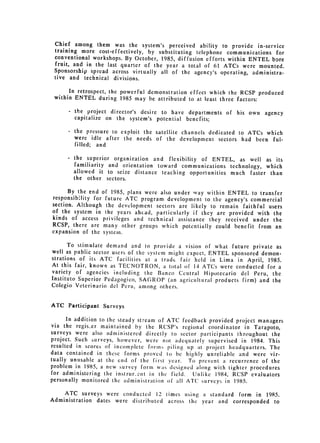
    The project's audioteleconferencing (ATC) .;ervices were developed in
cooperation with Peru's Agriculture, Health and Education ministries. They
incorporated a wide variety of administrative, training, diffusion and promo­
    tion strategies. A total of 658 ATCs were sponsored by the ministries plus
    ENTEL during 1984 and 1985, involving almost 12,000 hours of participants'
-   time.    Over the pilot period, ATCs became shorter and focused more on in­
    service t-ra-nihrg---A----H -e---anie tLfme, participants expressed a preference for
    ATC formats that involved "expert" presentations from the nation's capital.

         The health sector was the most active as well as the most successful user
    of the new telecommunication services.      Health had a stable organizational
    structure and a pressing need to function in a coordinated manner. Thus, ATC
    services were an obvious solution to this sector's communication problems.
    ENTEL itself emerged as a major user of teleconferencing in the RCSP's second
    year of operation.     This organization's flexibility, leadership and familiar­
    ity with communications technology stimulated its use of ATC services for
    training purposes. At the end of the two-year p2riod, ENTEL transferred res­
    ponsibility for future ATC program development to its commercial section, with
    plans to promote ATC usage widely among public development sectors and private
    business groups.

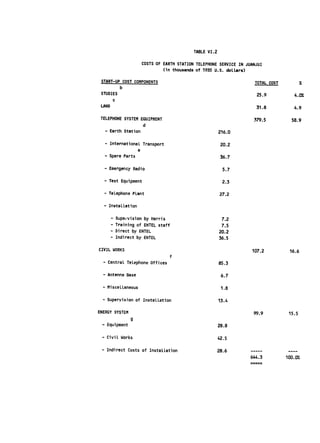
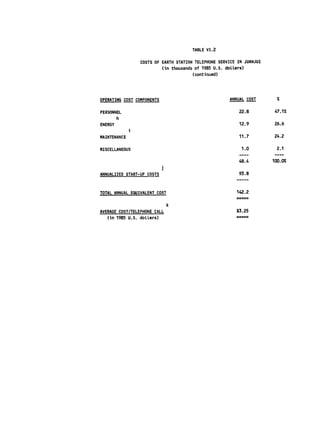
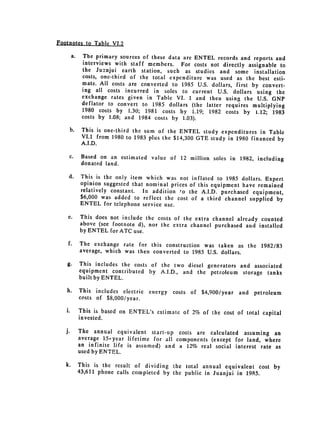
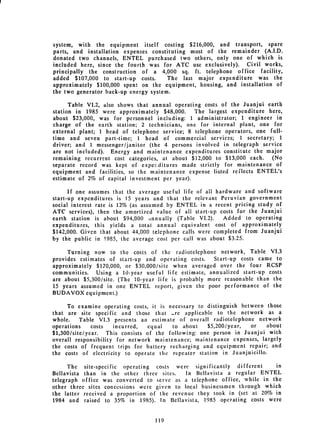
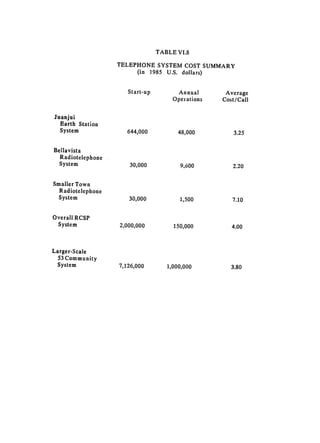
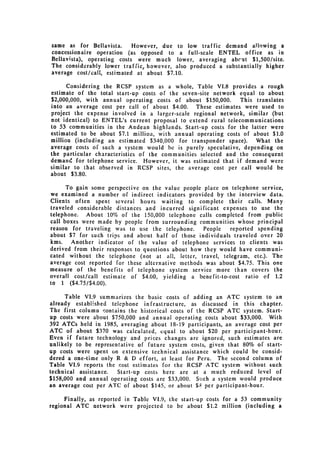
         The seven-site RCSP telephone system required an initial investment of
    about two million dollars and annual outlays of about $150,000. Most of this
    money was spent in the earth station sites. The Juanjui installation alone
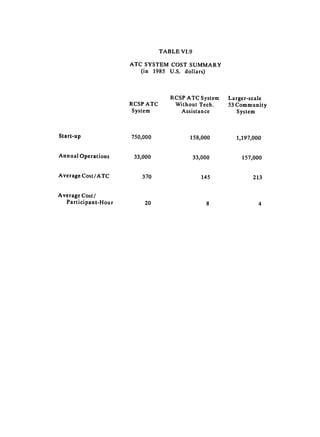
    cost almost $650,000 to start up and about $50,000/year to operate. The ATC
    network required oily minimal additional hardware investment, about 12,000
    per site, half for conferencing equipment and half for an additional telephone
    channel devoted exclusively to A rCs, but a substantial investment in planning,
    coordination, and operations. Chief among the l tter was the almost $600,000
    spent by A.I.D. on technical assistance.         A better perspective on such
    expenditures can be achieved by putting them in unit cost terms. The average
    cost per telephone call over the entire RCSP system was about $4.00, with
    variations, depending on s;:e costs and traffic, from $2.20 at the highest
    volume radiotelephone site to $3.25 at an earlh station site to $7.10 at the
    smallest volume radiotelephone sites.      If the amortized value of all the
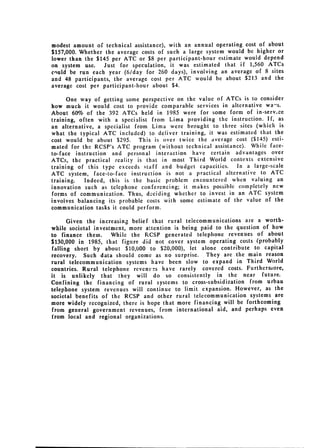
    technical assistance provided to ATC development is included, the average cost
    per audioteleconference, involving three to four sites and about 20 persons,
    was $370, or about $20 per participant-hour. It is unlikely, however, that
    future project, will require such a high level of technical assistance.
    Not including these co-.ts yields an average cost per ATC of about $145, or $8
    per participant-hour.

         The benefits to individuals and communities of the RCSP's telecommunica­
    tion services are mucl- harder to assess, and must reflect judgments about the
    value of the myriad uses to which telephones and ATCs were put. System users
    stated that, as a substitute for an average phone call, they would be willing
    to spend approximately $4.75 on inferior communication alternatives such as
    letters, telegrams, travel, etc. This amount was higher than the cost of an
    average call, indicating that the value of this one benefit exceeded system
    costs. Similarly, face-to-face instruction would cost about twice as much as
    the typical ATC seminar, not including technical assistance.

        The results of this evaluation, combined with a growing number of studies
    of other rural telecommunications initiatives, reflect and st-engthen the
    argument for greater investment in this sector in the future.    At the same
    time, the RCSP illuminates a number of issues and lessons that must be consid­
idered when developing such systems.      The transfer of sophisticated tele­
communication technology is noi, and probably will not be for the foreseeable
future, a straightforward exercise.   Even the most thorough plans require
revision, endless patience and dedication if they are to be implemented
successfully. New and innovative communication strategies require extensive
promotion as well as innovative management structures, especially when changes
in standard operating procedures are involved.

     The RCSP demonstrated that, while rural telephone traffic was far greater
than expected, revenues were unable to cover operating costs, let alone
contribute to capital recovery in the system's first two years of operation.
By the same token, the development sectors did not have adequate discretionary
budgets to sustain ambitious telecommunication initiatives on their own.
Although this picture could change in the future, as satellites and other
technologies continue to lower communication costs, the expansion of rural
telecommunication services in the Third World will require        government
assistance for some time to come.
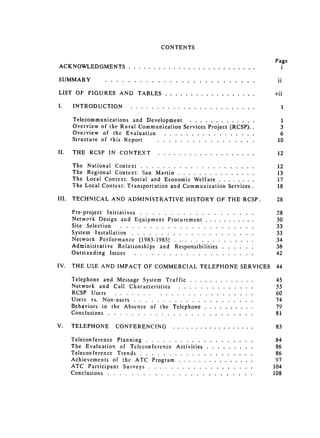
CONTENTS


                                                                                                                                        Page

ACKNOWLEDGMENTS                        ...................                                               .......                          i


SUMM ARY                  . . . . . . . . . . . . . . . . . . . . . . . . . .                                                            ii


LIST OF FIGURES AND TABLES                                           .........................                                          vii


1.      INTRODUCTION .......                                  .............................                                               1


       Telecommunications and Development              .................                                                                  1

       Overview of the Rural Communication Services Project (RCSP)..                                                                      3

       Ovefview of the Evaluation .....      ...              .................                                                           6

       Structure of this Report ....      .................                     ...                                                      10


II.    THE RCSP IN CONTEXT ....                                       ...................                           ......               12


       The National Context .....        .....................                 ......                                                    12

       The Regional Context: San Martin .......                ...............                                                           13

       The Local Context: Social and Economic Welfare ....                     ........                                                  17

       The Local Context: Transportation and Communication Services .                                                                    18


III.   TECHNICAL AND ADMINISTRATIVE HISTORY OF THE RCSP.                                                                                28


       Pre-project Initiatives ......                  ...                ...................                                           28

       Network Design and Equipment Procurement .....                                                        ...........                30

       Site Selection .......................
                                                                                          33

       System Installation ....                ......                 .....................                                             33

       Network Performance (1983-1985) ................                                                                       ......    34

       Administrative Relationships and Responsibilities ...                                                         ......             38

       Outstanding Issues ....                   ..   .....................                                          .....              42


IV.    THE USE AND IMPACT OF COMMERCIAL TELEPHONE SERVICES                                                                              44


       Telephone and Message System Traffic ......                                  .............                                       45

       Network and Call Characteristics .......                                  ..............                                         55

       RCSP Users ............                             ........................                                                     60

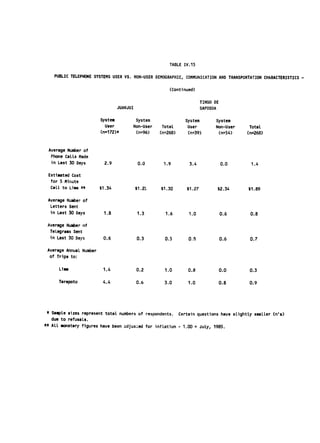
       Users vs. Non-users .......          ...               .....................                                                     74

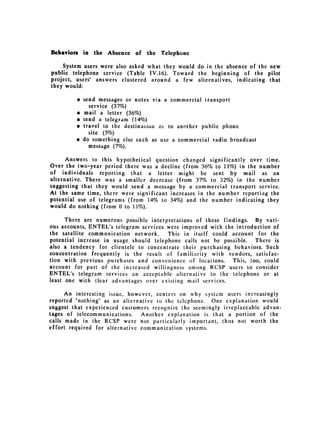
       Behaviors in the Absence of the Telephone .....                                     ..........                                   79

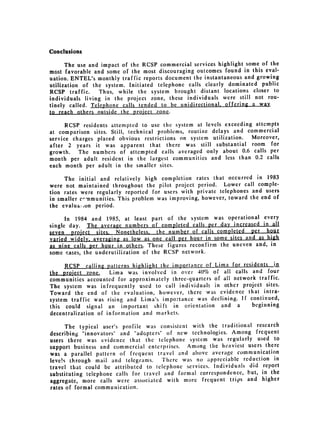
       Conclusions ........        .........................                                      .....                                 81


V.     TELEPHONE                CONFERENCING .......                                        ..................                          83


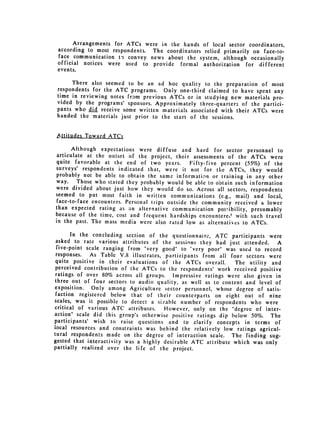
       Teleconference Planning .....                ...................                    .....                                        84

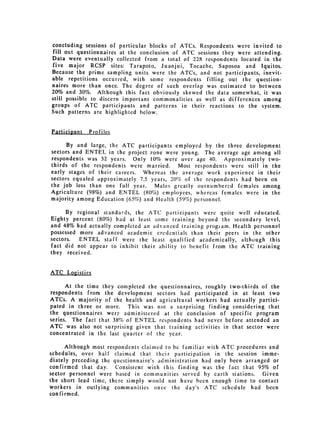
       The Evaluation of Teleconference Activities ....                             .........                                           86

       Teleconference Trends ......                 ....................                    .....                                       86

       Achievements of the ATC Program .......                           ...............                                                97

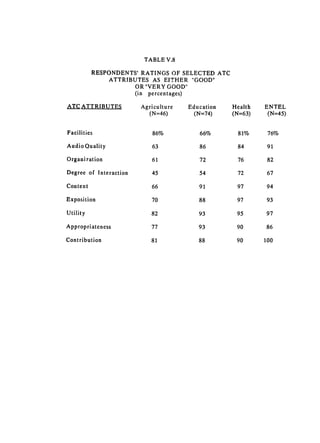
       ATC Participant Surveys .....                 ...................                   .....                                       104

       Conclusions ........          .........................                              .....                                      108
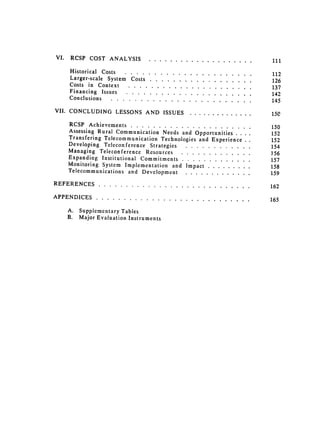
VI.    RCSP COST ANALYSIS .........                                           ....................                    111


       Historical Costs ....... 
                       ......................                                 ....     112

       Larger-scale System Costs .....                          ..................                             ....     126

       Costs in Context .......                           ...................... 
                              ....    137

       Financing Issues ...........                                        ......................                       142

       Conclusions ........ 
                      ........................                                    ....     145

VII. CONCLUDING LESSONS AND ISSUES ......                                                     ..............            15C


       RCSP Achievements ............................... 
                                                              150
       Assessing Rural Communication Needs and Opportunities . . ..                                                     152

       Transfering Telecommunication Technologies and Experience 
 ..                                                   152

       Developing Teleconference Strategies ...              ...             ............                               154

       Managing Teleconference Resources ...... 
                        .............                                 156

       Expanding Institutional Commitments ..              .............                  .....                         157

       Monitoring System Implementation and Impact ....                            .........                           158

       Telecommunications 
 and Development ...............                               .....                        159


REFERENCES........ 
 ............................ 
                                                         .....      162

APPENDICES............ 
                              ............................ 
                                   165

       A.   Supplementary Tables
       B.   Major Evaluation Instruments
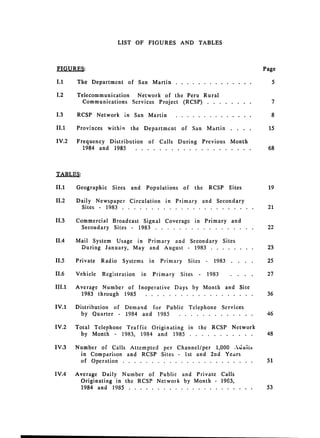
LIST OF FIGURES                  AND          TABLES


FIGURES:                                                                                                                               Page

1.1     The    Department      of San         Martin .......                           ..............                                        5

1.2     Telecommunication  Network of the Peru Rural
          Communications Services Project (RCSP) ....                                               ........                                 7

1.3     RCSP      Network   in     San Martin ......                              ..............                                         8

11.1    Provinces     within     the    Department          of       San      Martin               .    .        .             .        15

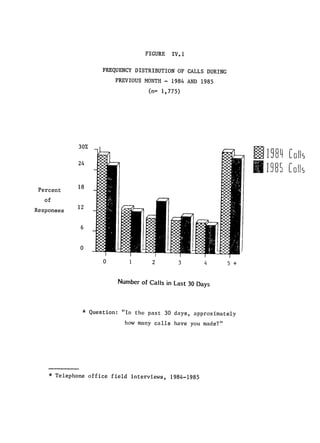
IV.2    Frequency Distribution              of    Calls During Previous                            Month
          1984 and 1985 .......                         ....................                         ....                               68


TABLES:

11.1    Geographic     Sizes     and        Populations        of      the        RCSP             Sites                                19

11.2    Daily Newspaper Circulation                 in Primary and                     Secondary
         Sites - 1983 ........                        .......................                                    ....                   21

11.3    Commercial Broadcast Signal Coverage in Primary and
         Secondary Sites - 1983 .....      ................. ....                                                                       22

11.4    Mail System Usage in Primary and                             Secondary              Sites
         During January, May and August                          -    1983 ....                  ........                               23

11.5    Private    Radio    Systems          in   Primary        Sites        -      1983          .        .        .             .    25

11.6    Vehicle     Registration       in     Primary       Sites        -    1983                 .    .            .             .    27

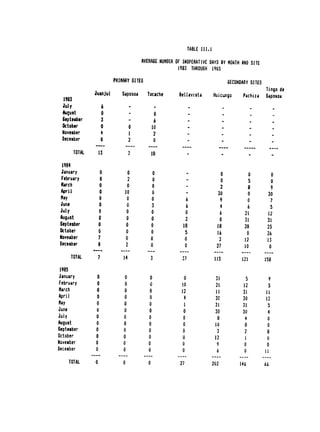
III.1   Average Number of Inoperative                   Days by Month                         and               Site
         1983 through 1985 ......                         ...................                                    ....                   36

IV.1    Distribution of Demand for Public                           Telephone              Services
          by Quarter - 1984 and 1.985 ...                              .............                                     ...            46

IV.2    Total Telephone Traffic Originating in                           the RCSP                   Network
          by Month - 1983, 1984 and 1985 ..                                ...........                 ....                             48

IV.3    Number of Calls Attempted per Channel/per 1,000 Adullb
         in Comparison and RCSP Sites - 1st and 2nd Years
         of Operation .......     ....................... ....                                                                          51

IV.4    Average Daily Number of Public and Private Calls
         Originating in the RCSP Network by Month - 1983,
         1984 and 1985 .......       ......................                                                      ....                   53
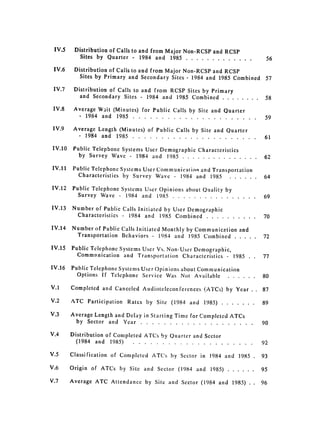
IV.5 	    Distribution of Calls to and from Major Non-RCSP and RCSP
             Sites by Quarter - 1984 and 1985 ...............        ....                          56
 IV.6 	    Distribution of Calls to and from Major Non-RCSP and RCSP
             Sites by Primary and Secondary Sites - 1984 and 1985 Combined                         57
 IV.7      Distribution of Calls to and from RCSP Sites by Primary
             and Secondary Sites - 1984 and 1985 Combined ...........                             58

 IV.8 	    Average Wait (Minutes) for Public Calls by Site and Quarter
            - 1984 and 1985 .........             ......................                          59
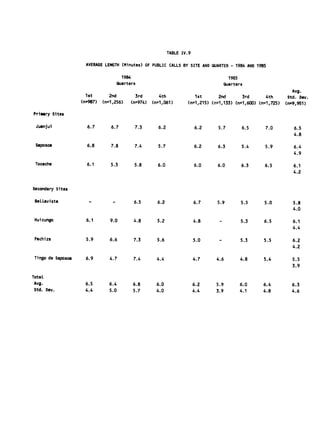
 IV.9 	    Average Length (Minutes) of Public Calls by Site and Quarter
            - 1984 and 1985 .........            ...................... 	                         61

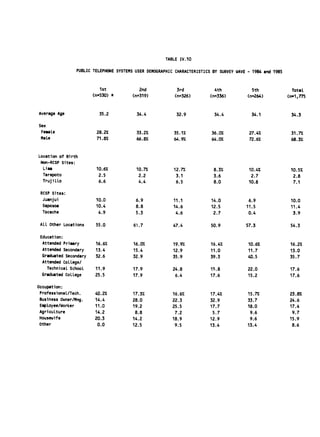
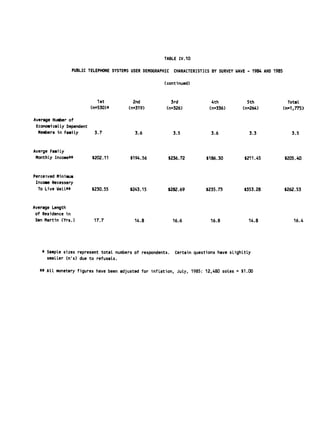
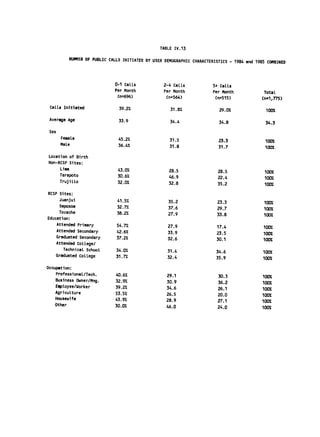
 IV.10     Public Telephone Systems User Demographic Characteristics
             by Survey Wave - 1984 and 1985 .....       ...............                           62
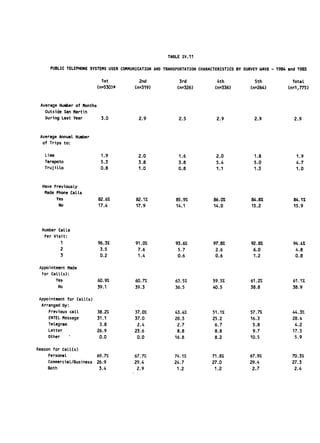
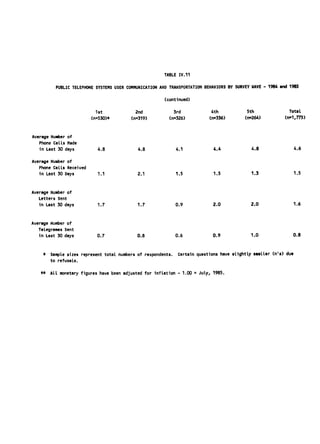
IV.11 	 Public Telephone Systems User Communication and Transportation
          Characteristics by Survey Wave - 1984 and 1985 .........                                64

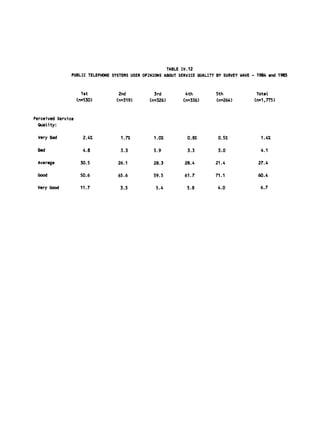
IV.12 	 Public Telephone Systems User Opinions about Quality by
          Survey Wave - 1984 and 1985 ......         ................                             69
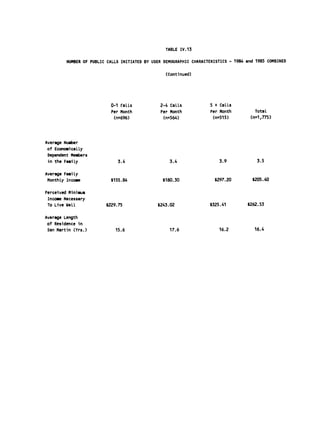
IV.13 	 Number of Public Calls Initiated by User Demographic
         Characteristics - 1984 and 1985 Combined ....                ..........                  70

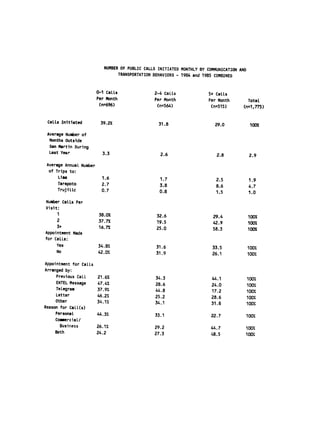
IV.14     Number of Public Calls Initiated Monthly by Communication and
           Transportation Behaviors - 1984 and 1985 Combined ..... ..                            72
IV.15     Public Telephone Systems User Vs. Non-User Demographic,
            Communication     and Transportation    Characteristics   -   1985           .   .   77

IV.16     Public Telephone Systems User Opinions about Communication
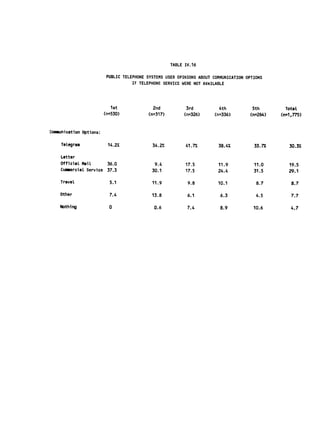
            Options If Telephone Service Was Not Available .........                             80
V.1       Completed and Canceled Audioteleconferences (ATCs) by Year..                           87
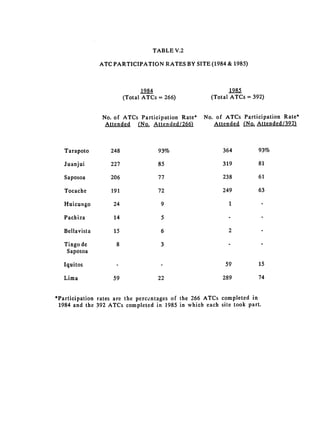
V.2       ATC Participation    Rates by Site (1984 and 1985) ..........                          89
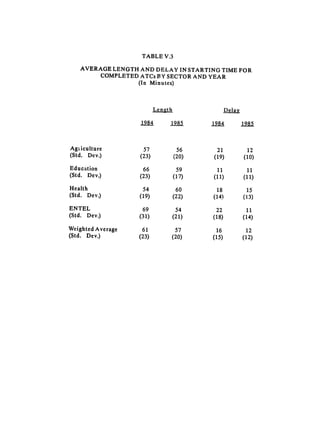
V.3       Average Length and Delay in Starting Time for Completed ATCs
           by Sector and Year ......           ....................    ...                       90
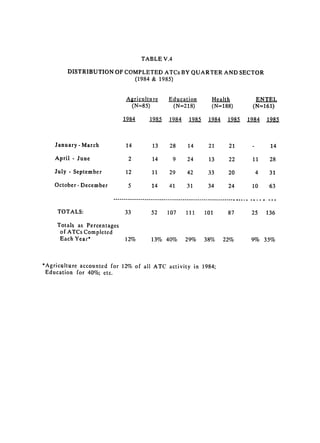
V.4       Distribution of Completed ATCs by Quarter and Sector
            (1984 and 1985) .......          .....................                 ...           92
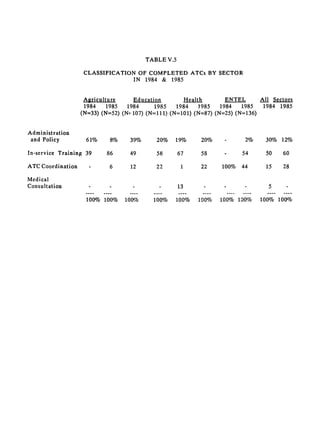
V.5       Classification of Completed ATCs by Sector in 1984 and 1985                        .   93
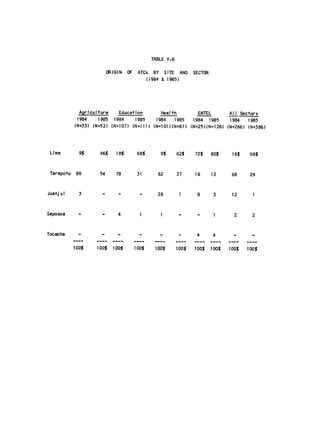
V.6       Origin of ATCs by Site and Sector (1984 and 1985) ........                             95
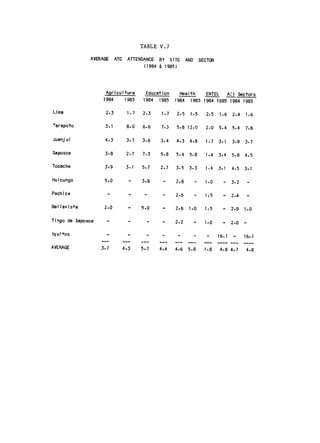
V.7       Average ATC Attendance by Site and Sector (1984 and 1985)                      . .     96
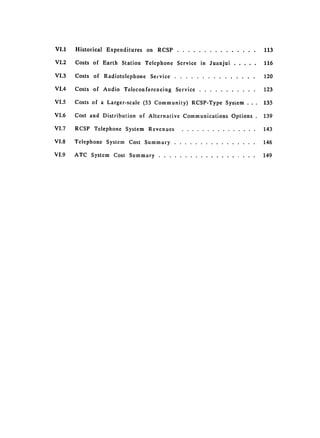
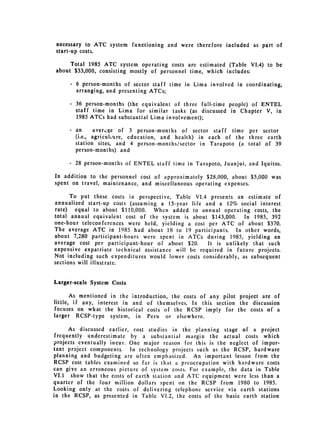
VI.1   Historical Expenditures   on RCSP ....        ...............                   ...   113

VI.2   Costs of Earth Station Telephone Service in Juanjui .......                           116

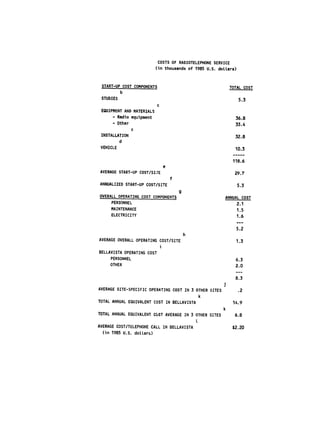
VI.3   Costs of Radiotelephone    Sevice ...    ...............                     ....     120


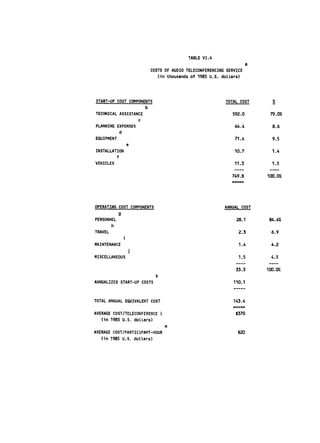
VI.4   Costs of Audio Teleconferencing Service ....                   ...........            123

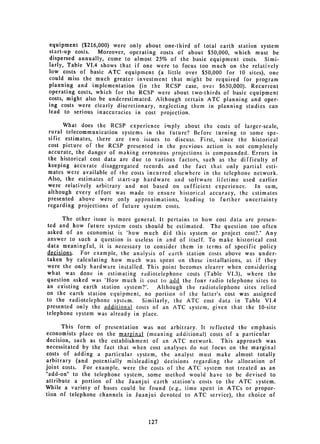
VI.5   Costs of a Larger-scale (53 Community) RCSP-Type System ...                           135


VI.6   Cost and Distribution of Alternative Communications Options.                          139

VI.7   RCSP Telephone System Revenues .....                ...............                   143

VI.8   Telephone System Cost Summary ......               ................                   146


VI.9   ATC System Cost Summary ......           ...................                          149
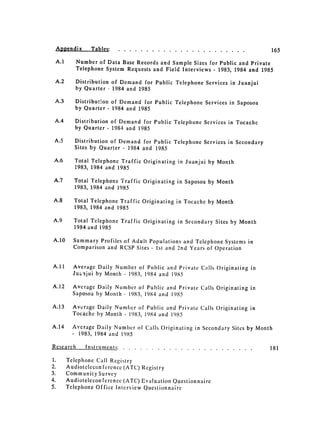
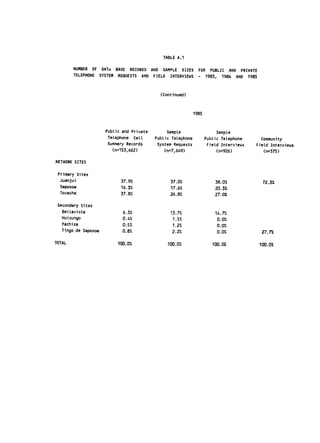
Appendix        Tables: ......             ....................... 	                        ......   165

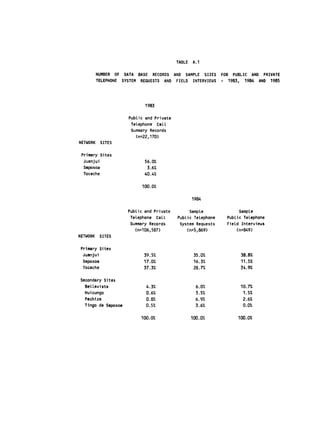
 A.1 	      Number of Data Base Records and Sample Sizes for Public and Private
            Telephone System Requests and Field Interviews - 1983, 1984 and 1985
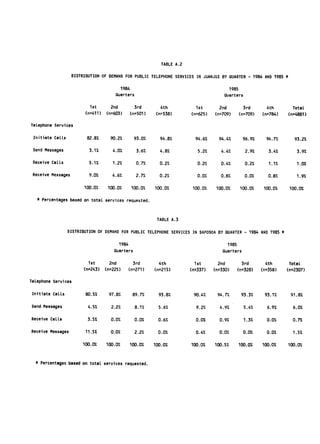
 A.2 	      Distribution of Demand for Public Telephone Services in Juanjui

            by Quarter - 1984 and 1985


 A.3 	      Distribution of Demand for Public Telephone Services in Saposoa

            by Quarter - 1984 and 1985


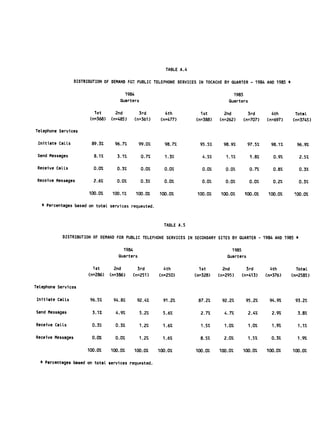
 A.4 	      Distribution of Demand for Public Telephone Services in Tocache
            by Quarter - 1984 and 1985

 A.5 	     Distribution of Demand for Public Telephone Services in Secondary

           Sites by Quarter - 1984 and 1985


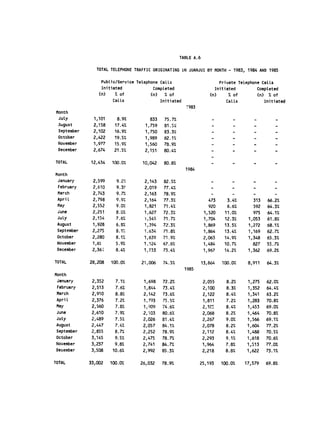
 A.6 	     Total Telephone Traffic Originating in Juanjui by Month

           1983, 1984 and 1985


A.7 	      Total Telephone Traffic Originating in Saposoa by Month

           1983, 1984 and 1985


A.8 	      Total Telephone Traffic Originating in Tocache by Month

           1983, 1984 and 1985


A.9 	      Total Telephone Traffic Originating in Secondary Sites by Month

           1984 and 1985


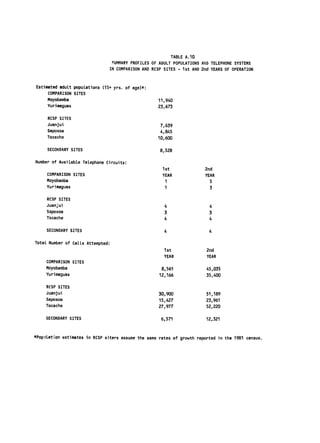
A.10 	     Summary Profiles of Adult Populations and Telephone Systems in
           Comparison and RCSP Sites - 1st and 2nd Years of Operation


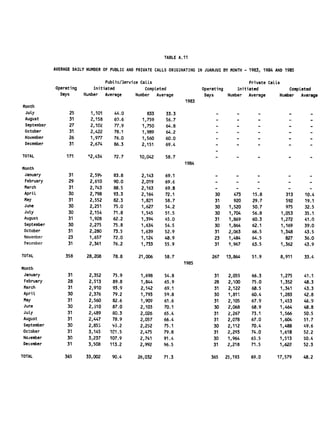
A.11 	     Average Daily Number of Public and Private Calls Originating in
           Juaijui by Month - 1983, 1984 and 1985

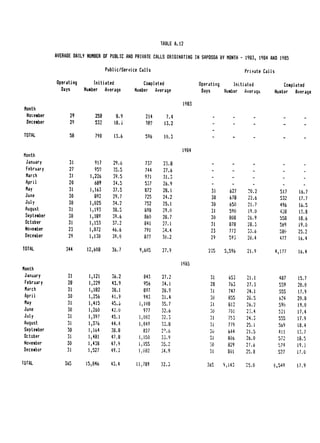
A.12 	     Average Daily Number of Public and Private Calls Originating in
           Saposoa by Month - 1983, 1984 and 1985

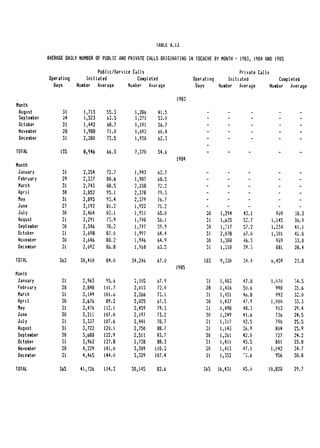
A.13 	     Average Daily Number of Public and Private Calls Originating in
           Tocache by Month - 1983, 1984 and 1985

A.14 	     Average Daily Number of Calls Originating in Secondary Sites by Month
           - 1983, 1984 and 1985


Research       Instruments: ........... 	                          .......................            181

1.       Telephone Call Registry
2.       Audiotelecon ference (ATC) Registry
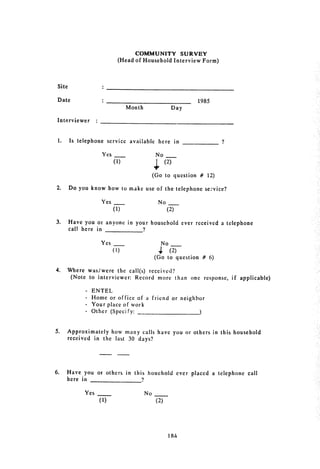
3.       CommunitySurvey
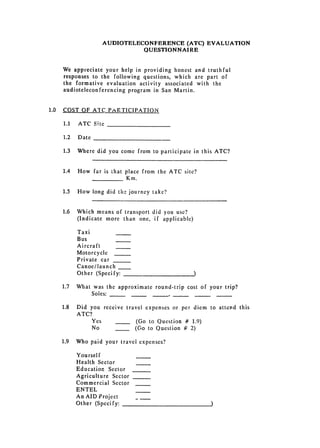
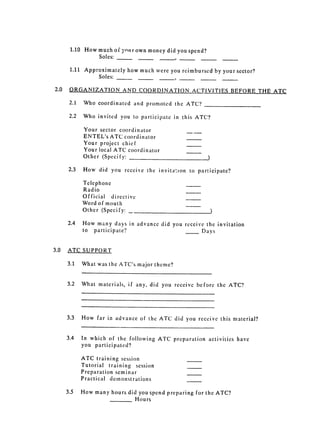
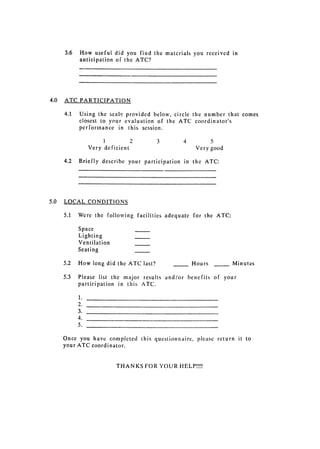
4.       Audioteleconference (ATC) Evaluation Questionnaire
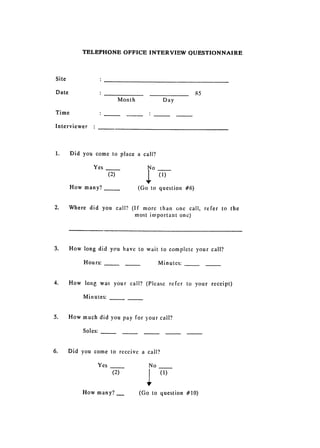
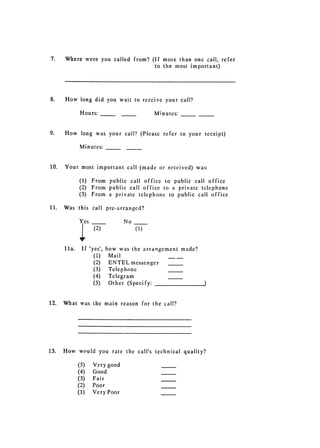
5.       Telephone Office Interview Questionnaire
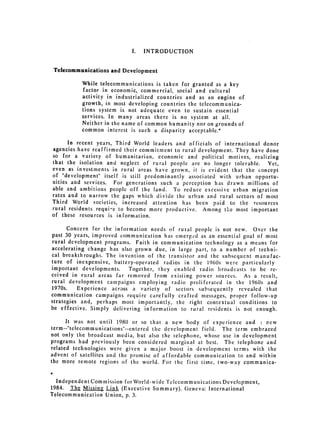
I.   INTRODUCTION


 Telecommunications and Development

          While telecommunications is taken for granted as a key
           factor in economic, commercial, social and cultural
          activity in industrialized countries and as an engine of
          growth, in most developing countries the telecommunica­
          tions system is not adequate even to sustain essential
          services. In many areas there is no system at all.
          Neither in the name of common humanity nor on grounds of
          common interest is such a disparity acceptable.*

      In recent years, Third World leaders and officials of international donor
agencies have reaffirmed their commitment to rural development. They have done
so for a variety of humanitarian, economic and political motives, realizing
that the isolation and neglect of rural people are no longer tolerable. Yet,
even as investments in rural areas have grown, it is evident that the concept
of "development" itself is still predominantly associated with urban opportu­
nities and services. For generations such a perception has drawn millions of
able and ambitious people off the land. To reduce excessive urban migration
rates and to narrow the gaps which divide the urban and rural sectors of most
Third World societies, increased attention has been paid to the resources
rural residents requi-e to become more productive. Among the most important
of these resources is information.

       Concern for the information needs of rural people is not new. Over the
past 30 years, improved communication has emerged as an essential goal of most
rural development programs. Faith in communication technology as a means for
accelerating change has also grown due, in large part, to a number of techni­
cal breakthroughs. The invention of the transistor and the subsequent manufac­
ture of inexpensive, battery-operated radios in the 1960s were particularly
important developments.     Together, they enabled radio broadcasts to be re­
ceived in rural areas far removed from existing power sources. As a result,
rural development campaigns employing radio proliferated in the 1960s and
1970s.    Experience across a variety of sectors subsequently revealed that
communication campaigns require carefully crafted messages, proper follow-up
strategies and, perhaps most importantly, the right contextual conditions to
be effective. Simply delivering information to rural residents is not enough.

      It was not until 1980 or so that a new body of experience and , Pew
term--"telecommunications"--entered the development field. The term embraced
not only the broadcast media, but also the telephone, whose use in development
programs had previously been considered marginal at best. The telephone and
related technologies were given a major boost in development terms with the
advent of satellites and the promise of affordable communication to and within
the more remote regions of the world. For the first time, two-way communica-


  Independent Commission for Wor!d-wide Telecommunications Development,
1984. The Missing Link (Executive Summary). Geneva: International
Telecommunication Union, p. 3.
tion between once isolated communities and between such communities and
larger regional centers became possible.

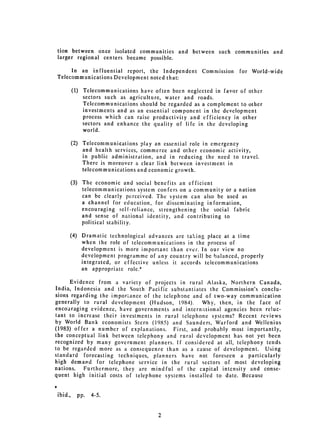
     In an influential report, the Independent          Commission   for World-wide
Telecommunications Development noted that:

         (1) 	 Telecommunications have often been neglected in favor of other
               sectors such as agriculture, water and roads.
               Telecommunications should be regarded as a complement to other
               investments and as an essential component in the development
               process which can raise productivity and efficiency in other
               sectors and enhance the quality of life in the developing
               world.

         (2) 	 Telecommunications play an essential role in emergency
               and health services, commerce and other economic activity,
               in public administration, and in reducing the need to travel.
               There is moreover a clear link between investment in
               telecommunications and economic growth.

         (3) 	 The economic and social benefits an efficient
               telecommunications system confers on a community or a nation
               can be clearly perceived. The system can also be used as
               a channel for education, for disseminating information,
               encouraging self-reliance, strengthening the social fabric
               and sense of national identity, and contributing to
               political stability.

         (4) 	 Dramatic technological advances are taking place at a time
               when the role of telecommunications in the process of
               development is more important than ever. In our view no
               development programme of any country will be balanced, properly
               integrated, or effective unless it accords telecommunications
               an appropriate role.*

      Evidence from a variety of projects in rural Alaska, Northern Canada,
India, Indonesia and the South Pacific substantiates the Commission's conclu­
sions regarding the impor.ance of the telephone and of two-way communication
generally to rural development (Hudson, 1984).     Why, then, in the face of
encouraging evidence, have governments and international agencies been reluc­
tant to increase their investments in rural telephone systems? Recent reviews
by World Bank economists Stern (1985) and Saunders, Warford and Wellenius
(1983) offer a number of explanations. First, and probably most importantly,
the conceptual link between telephony and rural development has not yet been
recognized by many government planners. If considered at all, telephony tends
to be regarded more as a consequence than as a cause of development. Using
standard forecasting techniques, planners have not foreseen a particularly
high demand for telephone service in the rural sectors of most developing
nations. Furthermore, they are mindful of the capital intensity and conse­
quent high initial costs of telephone systems installed to date. Because


ibid.,     pp.   4-5.


                                        2
there is less telephone traffic in rural areas, rural systems cost substan­
 tially more per call than do urban systems. Since phone companies typically
 depend on customer revenue to meet operating costs and to help finance new
installations, they tend to invest in urban areas where tariffed service will
be greatest.     Finally, there is a widespread view that telecommunications
agencies, both public and private, are managed inefficiently. Such ineffi­
ciency, it is argued, is a product of many forces, including the lack of
technically qualified personnel, the lack of foreign exchange reserves to
maintain plant and equipment, and tariff policies which do not promote a
proper allocation of system revenues. When such perceptions are seen in the
light of the competing demands of other sectors (e.g., agriculture, education
and health) for scarce government resources, it is evident why advocates of
expanding communication services to the rural areas have so far been fighting
an uphill battle.

      Yet, perceptions regarding the potential cost-effectiveness and develop­
mental impact of rural telecommunications, and specifically of low volume or
"thin route" telephony, have begun to change. Canada's and India's reliance
on domestic satellites has paved the way for other nations to consider assign­
ing at least a share of their internal telephone traffic to this technology.
In fact, more than 20 developing nations, including Peru, are now working with
the International Telecommunication Satellite Organization (INTELSAT) to 
 pro­
vide some percentage of their domestic communication service via satellite.


      Even though satellites have lowered communication costs within many
nations, many Third World governments still are unable to provide even
rudimentary telephone service to their rural areas. The major international
donor    agencies   have been slow to increase their       activity   in   the
telecommunications sector. What still seems to be lacking is hard evidence
and a compelling case for investment in telephony as a means of stimulating
rural development. National planners and their colleagues in the international
agencies are familiar with the economic and social b,;ncfits associated with
investments in transportation, education, health and agriculture. They lack
such information, familiarity and confidencc in telecommunications. To close
such gaps, a number of important initiatives and pilot projects have been
undertaken in recent years.      One such initiative, the Peruvian Rural
Communication Services Project (RCSP), is the subject of this report.


Overview of the Rural Communication Services Project (RCSP)

       The RCSP stemmed from a -mmitment by the Peruvian and U.S. governments
to determine whether a satellitt.. -sed communication system, incorporating a
 variety of agencies and technologies, could provide reliable and cost­
effective service to a remote region of eastern Peru.        The decision by
Peruvian and U.S. officials to undertake the RCSP was based on their positive
evaluations of other countries' efforts in this direction.     During the mid­
1970s, approximately 8.5 million people, half of Peru's population, were
without access to telephone communication.       This population was widely
scattered, suggesting that expansion of communication services by traditional
terrestrial means would be expensive. Only through an increased reliance on
satellites and associated technologies, it was argued, could the nation hope
to address its rural communication needs within the next generation.
Furthermore, Peruvian engineers believed that the cost of installing and


                                   3
maintaining small earth stations in Peru's rural areas would compare favorably
 with the alternative of gradually extending the terrestrial system.       Such
 assumptions would have to be tested in the field, however.

      The kind of thinking that prompted Peruvian communication planners to
undertake the RCSP was also gaining ground during the late 1970s within the
U.S. Agency for International Development (A.I.D.). Acting on a mandate from
the U.S. Congress to concentrate on projects of direct benefit to the rural
poor, and drawing heavily upon the experiences of NASA's Applied Technology
Satellite (ATS) experiments in education and health, A.I.D.'s policy-makers
became convinced that rural development goals might be served through the
wider application of "thin route" satellite communication. With this idea in
mind, A.I.D.'s Bureau for Science and Technology and its Bureau for Latin
America and the Caribbean developed the Rural Satellite Program (RSP), a five­
year research and development effort to demonstrate that satellite communica­
tions could provide reliable, cost-effective services to rural areas of the
Third World (Block, C. et al., 1984; Parker, E., 1978).

     At UNESCO's 20th General Conference held in Nairobi, Kenya, in November,
1978, the U.S. delegate announce, A.I.D.'s intention to assist Third World
governments     in installing small earth stations and developing related
communication infrastructures in the pursuit of rural development objectives.
Some time later, the following four objectives were spelled out for the RSP:

       1. 	 To develop and test new and potentially cost-effective models by
            which communication satellites and related technologies can help pro­
            vide development-related information to rural populations and improve
            the 	 delivery of rural services;

       2. 	   To demonstrate to the providers of satellite services and ground
              station equipment that there is an important market for satellite
              services designed to meet the needs of small rural communities:

       3. 	   To provide concrete evidence needed by investment sources such as the
              International Development Bank and the World Bank concerning the
              cost-effectiveness of communication'investments for rural areas; and

       4. 	   To support the development of national capacities for integrating
              communication investment planning with sectoral development planning.*

      The RCSP incorporated numerous technical, programmatic and administrative
innovations. On the technical side, 6.1 meter antennas were employed for the
first time within the INTELSAT system. The antennas received and transmitted
signals using the hemispheric beams provided through INTELSAT's Series IV and
V satellites.   Relatively small earth stations were linked to radiotelephones
to extend rural coverage.

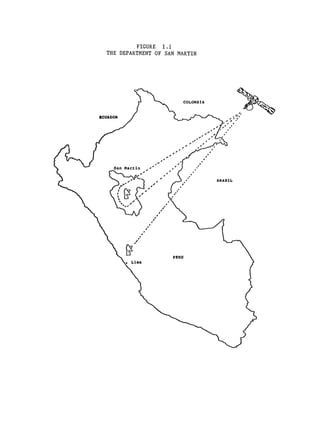
      The project was concentrated in seven rural communities in the Department
of San Martin, a high jungle area east of the Andes. (See Figure 1.1). The
three largest communities (Juanjui, Tocache, and Saposoa), with average popu­
lations of 12,000, were connected via satellite to Peru's national telephone

*   Agency for International Development, 1979. "Project Paper: Rural
    Communication Services." Washington: Department of State, p. 10.
FIGURE I.1

  THE DEPARTMENT OF SAN MARTIN


ECUADOR


                                         J
                                   s-I


                                             °
                   Is                                    °

                          #
               I                                     w
                                                 '           DRII
              /j              S


                                  COEMU
                   Lima
system. The remaining four towns (Bellavista, Huicungo, Pachiza and Tingo de
Saposoa), with average populations of just 3,400, were linked by VHF
radiotelephones to Juanjui's earth station and thus to the national network as
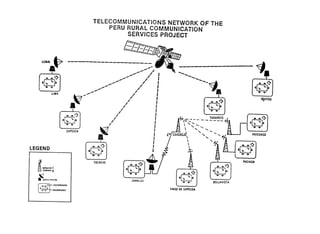
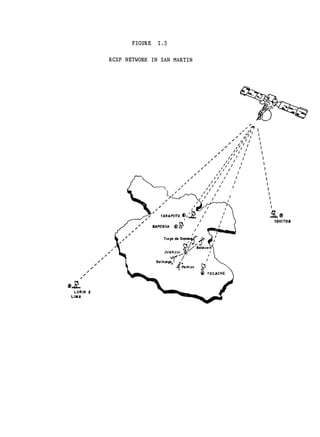
well.    Figures 1.2 and 1.3 present the RCSP's telecommunications network and
a diagram highlighting the location of each site.

      All RCSP sites were designed to provide commercial telephone service at
public call offices (PCOs) which were staffed by ENTEL personnel or by local
concessionnaries. After a protracted netwo:-k design and installation process,
service was inaugurated in the seven sites between July, 1983, and June, 1984.
Although not part of the original project plan, popular demand eventually
resulted in the installation of a limited number of telephones to homes and
offices in the three major sites. By the end of 1985, telex and television
retransmission services also were made available there.

      The RCSP was also the first experiment of its kind in the Third World to
use audioteleconferencing (ATC) in support of rural development programs. At
each of the participating ENTEL offices, an ATC room was equipped with a
conference table, chairs, six microphones and a loudspeaker. Throughout the
project, ENTEL staff, assisted by advisors supported by A.I.D., provided
extensive technical assistance to the Ministries of Agriculture, Education and
Health. From the point of view of program planning and institutional develop­
ment, the ATC component of the RCSP required substantial commitment and inno­
vation on ENTEL's part.

      During the life of the esperiment, 207,441   telephone calls were completed
in the project zone, and a total of 658 ATCs       were executed in one or more
sites. The remainder of this chapter introduces     the evaluation program which
accompanied the RCSP, highlighting the major       issues it addressed along with
the methods it employed.


Overview of the Evaluation

      The innovativeness and scale of the RCSP prompted A.I.D. and ENTEL to
earmark approximately 350,000 dollars for evaluation.      Iii June, 1982, The
Florida State University was awarded a contract by A.I.D. to work with ENTEL
on a comprehensive evaluation of the project.       The overall intent of the
evaluation was to provide development planners and donor agency officials,
both in and outside Peru, with reliable information concerning the impact and
costs of telephone and teleconferencing services in remote rural areas.

     The key topics examined in the course of the evaluation were:

    Proiect Administration

         -   the management structure that emerged to support
             the project

         -   the relationships among collaborating    institutions

         -   the feedback and reporting mechanisms that guided decision
TELECOMMUNICATIONS NETWORK OF THE
                                PERU RURAL COMMUNICATION
                                     SERVICES PROJECT


         LIMA

                       °/

                        "   "        J                   /       I

                                r"       /| -                         ,I4-TARAPOTO           AL AL


                                &                                                            &/
LEGEND                      -   1|
                maer                                             I-                  TNEST


         STATION
   i EARTH                                         JU.F-,BLXIT

                                            /ING
                                                                      Of SAISA
FIGURE     1.3


            RCSP NETWORK IN SAN MARTIN


                                                                                     /   -   /' ,


                                                                         //11/               /

                                                        -                    //I /           I
                                                            ,/           /    /                     l

                                               S            //       /           /


                               TARAPOTO        I
                                           /       //            /                                      I   TO
                            BAP030A   Fs


            -l                   JUANJUI


  LURIN I
LIMA
the role of external technical assistance in support of

                  system development and utilization

     TelephoneSystem Usage and Impaci

              -   demand and utilization of RCSP services over time

              - the frequency and purpose of calls

              - average wait-times and lengths of calls over time

              - use of the system in project communities vs. comparison sites


     User Profiles and Attitudes

          -       demographic characteristics of system users and non-users

          * users' communication and travel behaviors


          -       user evaluations of service quality


     Audiotelecon fcrencing

          -       the use and impact of teleconferencing across three

                  development sectors


          -       the evaluation and success of various teleconference formats

          - participants' opinions about the quality and value of ATC
            services


     System Costs


          -       project start-up and operating costs


          -       cost projections for larger RCSP-type systems


          . financing        issues


      The combined ENTEL-FSU evaluation effort began during the RCSP's planning
phase and continued through the first three years of project operations in San
Martin. Particular emphasis was placed on the use and impact of telephone and
teleconferencing services during the 1984 and 1985 pilot period. The evalua­
tion involved both formative and summative components. The PCSP was monitored
continuously by means of personal interviews and correspondence, review of
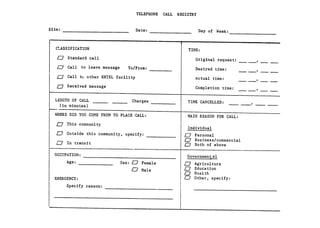
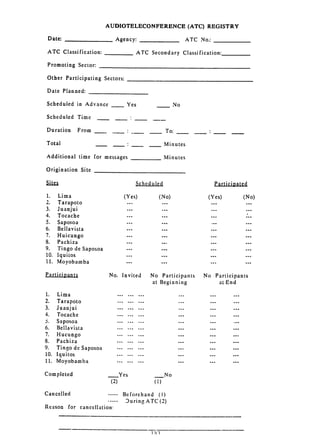
internal files, and service records.     A central register was developed to
track ATC promotional, scheduling and implementation activities. Samples of
ATC participants were asked to evaluate specific sessions immediately upon
completion.    This information was revicwed regularly to help orient and,
where necessary, modify the ATC program.
In addition to the ongoing formative evaluation effort, in-depth inter­
  views of public phone users and ATC participants were used to detect
                                                                            the
  cumulative impact of the RCSP. The summative assessment involved a variety
 of longitudinal studies.    ENTEL's monthly call records were used to track
 demand and completion rates in each community during the first 30 months
                                                                             of
 RCSP service. These comprehensive call records were compared with records
                                                                             of
 other rural communities which had received rural telephone services in Dre­
 vious years. Each month a sample was drawn at each project site of requests
 to use the public telephone system. Easy-to-complete forms were filled out
                                                                             by
 local operators at :he time calls were initiated. They documented: the desti­
 nation of all calls; travel time and costs incurred to make calls; reasons
                                                                            for
 long distance calls; and some user characteristics.    In-depth sample inter­
 views were also conducted by means of five cross-sectional surveys of public
 system users.     These in-depth surveys provided comprehensive profiles of
 clients' telephone behaviors and attitudes.

       In order to compare and contrast the communication and travel behaviors
 of users and non-users of the RCSP system, cross-sectional community surveys
 were completed among households in two communities--Juanjui and Tingo
                                                                              de
 Saposoa.   Finally, detailed cost studies were conducted throughout the pro­
 ject.    User costs were estimated through data provided by the in-depth inter­
 views. A.I.D. and ENTEL-PERU financial records were examined to document
 capital expenditures and recurring costs.


Structure of this Report

      The remainder of the report is divided into six chapters. Chapter II
examines the context of the RCSP. Baseline data were collected by ENTEL
                                                                         from
various organizations to document regional and community characteristics,
                                                                            as
well as the availability of existing communication channels such as mail,
telegraph, radio, TV, newspaper, and private message services prior to project
start-up in San Martin.

      Chapter III analyzes the project's technical and administrative history,
beginning with its design and continuing through its installation and opera­
tional phases. The emphasis here is on the institutional factors which shaped
the RCSP, and which would most likely influence replication of the system
                                                                          on a
larger scale.

      Chapter IV summarizes data that were collected on the RCSP's commercial
telephone se-vices.   Such data were collected on a sample basis across the
project's seven rural sites and were supplemented by the in-depth "intercept
interviews" of public call box users described in the previous section.
                                                                         The
results of both these longitudinal studies along with those of two cross­
sectional community surveys are reported.

      Chapter V examines the planning, implementation, results and impact
the 658 audioteleconferences conducted during the RCSP. The vast majority of
                                                                           of
the ATCs were in support of on-going development programs in agriculture,
education and health.    Each teleconference was reviewed with regard to its
specific purpose (e.g., in-service training, administration, promotion, etc.),
duration, site of origin, and level of participation. The chapter concludes
with an overall assessment of audioteleconferencing as a development tool.
Chapter VI reviews RCSP costs and their implications. Cost information
was collected from system users, from participating Peruvian agencies and from
external groups that provided technical assistance to the project.    The costs
of satellite-based telephony service, radiotelephone communication and audio­
teleconferencing were analyzed. The chapter also examines the RCSP experience
in terms of the costs, benefits and financing of larger telecommunication
systems.

    Chapler VII presents the conclusions of the five-year research effort and
a synthesis of the project's major lessons.
II.   THE RCSP IN CONTEXT


       A description of the contexts within which the RCSP operated is crucial
to understanding the purposes of this multi-faceted telecommunication develop­
ment effort as well as its results.     Accordingly, this chapter examines the
RCSP's socio-cconomic and communications background at the national, regional
and local levels. The chapter draws on a wide variety of sources.      General
statistics have been extracted from Peruvian national census reports (1983,
1984), the 1986 World Bank Development Report, and the IMF's International
Financial Statistics (1986). Regional information about the Department of San
Martin and local information about the seven project sites have been extracted
from ENTEL site reports (1981, 1982), as well as from newspaper articles and
on-site fieldwork conducted throughout the project zone.


The National Context

      During the past 20 years, Peru has been battling severe economic and
social problems. By most indicators, Peru, like many Third World countries,
has been facing deteriorating economic conditions which, in recent years, have
reached crisis proportion.     During the relatively prosperous global growth
years of 1965-1973, Peru's Gross Domestic Product ((;DP) grew at 3.5% per year,
a rate only about half that of other nations at similar income levels (Inter­
national Monetary Fund, 1986).       Since the oi. crisis of the early 1970s,
growth has been considerably slower, averaging only 1.5% per year from 1973
through 1984. The situation is more disturbing when viewed on a per capita
basis. In Peru, there has been virtually no growth in GDP/per capita over the
past 20 years.    This situation compares more closely to that of the poorest
Sub-Saharan African r:itions than to the 3% per year growth rate in GDP/per
capita averaged by .ountries with income levels similar to Peru's.      (World
Bank, 1986.)

      What little growth the nation experienced was eroded during the economic
slide of the early 1980s. GDP/per capita fell about 8%, per year to a level of
about $880 in 1984. Inflation rates tell a similar story, averaging about 10%
a year over the 1965-1973 period, and 57% a year from 1973 lo 1984.       From
1980-1985, inflation was especially severe, with the official consumer price
index increasing a little over 1(0% per year.

      As in many Third World nations, Peru's foreign debt is a        significant
 contributor to the current economic crisis. President Alan Garcia inherited a
 public sector deficit approaching 10 % of the GDP and unpaid interest bills of
 approximately $700 million on a $13.7 billion foreign debt (South, June 1985,
p. 28).     Furthermore, official projections for the next five years indicate
that Peru's debt service commitments could outstrip its total export receipts.
In the face of such difficulties, President Garcia has been at the forefront
of Third World leaders proposing restrictions on debt repayment, including
limiting them to a fixed percentage of export earnings.         Such strategies,
while perhaps necessary,      clearly pose risks.     If international ban king
authorities should declare Perui's loans "value-impaired," a step they have
been considering, the country might be forced to pay cash for most of its
imports.


                                    1-,
These economic data also have a human face. Peru's people have suffered
in recent years. In 1984 the infant mortality rate was 95 per thousand live
births, considerably higher than the 83 averaged by countries with similar
incomes.    Malnutrition is also a very serious problem as reflected in the
estimate that in 1983 Peru's total food supplies provided only 85% of the
daily calories required per capita, as compared with 106% in similar income
countries (World Bank, 1986). Peru's current population of about 20 million
is expected to grow at about 2.2% a year over the next two decades (Instituto
Nacional de Estadistica, 1984).     The workir, -age population, current!y at
about 11 million, is growing at an even faster 3% rate.     Unfortunately, job
opportunities are severely limited.    It is estimated that only one-third of
Peru's labor force is fully employed and, as indicated earlier, real incomes
have dropped to levels found 20 years ago. This employment crisis is most
acute in urban areas, which contain about 70% of the nation's populace and are
growing rapidly (Instituto Nacional ic Estadistica, 1983, Consejo Nacional de
Poblacion, 1985). From 1972-1981, [ima and Ciallao alone had a net migration
of 1.6 million new residents but relatively few new jobs.

       The dislocations and pressures associated witi the nation's       economic
crisis have fueled social unrest, no.t evident in the increased activity of
terrorist grotps such as Tupac Amaru and the Scndero Luminoso ("Shining
Path").    Peru has also achieved the dubious distinction of being one of the
",'orld's largest cultivators of coca leaf, and the druig traffic associated with
this crop is increasing. Especially unfortunate is the growing use of illicit
drugs among Peru's poor.        To the millions of unemployed, unschooled, and
unskilled children of the poor, the situation has become increasingly desper­
ate and threatening to the nation's social fabric.

      The long-range solution to the severe ecOonieC ind social problems facing
Peru is by no means clear.       Beginning in the early 19t)7s, Peru like many
Third World countries begaii (o place greater emphasis on rural development
strategies, principally thirout h attempts to irecrease airicultural productiv­
ily.     Thirty-seven percent (37 ) of the work force is currently engaged in
agriculture and relatcd indiuitries (Instituto Nacilonal de l'stadistica, 1983,
Consejo Nacional dc Poblacion. 19X,5). Over the pai,t decade Peru also has taken
steps to upgrade and diversify its, agricultural scctor by opening up new
production areais, so that existing f()od shortates c(ldtl be rectified and food
exports increased. Under the prexious Belaundc ,overnient, the Department of
San Martin, located in the "high jun;Ic" area of the country, was singled out
as one of the nation's most important agricultural fronticrs and, largely as a
consequence of this priority, it became the site of the R CSP. The Department
of San Martin is located in northeastern    P'eru, approximately 1,(001 Km from
Lima as the crow flies. It coversN slightly over 53,000 sq. Km and, at the
beginning of fhe project, it had aboul 320,1100 residents.


The Regional Context: San Martin

     Prior to and during., Ilh.: Belaunde government, various development projects
were launched in Sai        Martin, many with the assistance of international
agencies such .- A.I..    and Ihe World Bank.      It was believed that relatively
low cost land uvelopment investments held the promise of high economic
payoff.   Through the improvement of credit, extension, Iraisportation and


                                     13
communications, it was hoped that the high jungle would emerge as one of
    Peru's leading agricultural and settlement areas.

       The ambitious agricultural schemes proposed for San Martin and other
 high jungle departments soon came into conflict with the cocaine economy which
 has flourished in the same region for the past 10 years. With the profits
 from coca leaf cultivation exceeding those of traditional crops by a ratio of
 20 or 30 to 1, it is little wonder that government agents have had only
 limited success in eradicating the illicit industry or in persuading small
 farmers to grow less profitable crops.    Furthermore, the drug business has
permeated high jungle communities, including their social and political insti­
tutions, and has involved people from all walks of life. Most rural families
are either directly or indirectly involved in this shadow economy. Such an
underlying reality and the tensions it perpetuates in the zone unquestionably
influenced the development of the RCSP and the conduct of the evaluation.
Indeed, the most difficult challenge in conducting this evaluation project was
to devise field research strategies that could be conducted without unduly
risking the safety of the team or compromising the -eliability and validity of
the data.

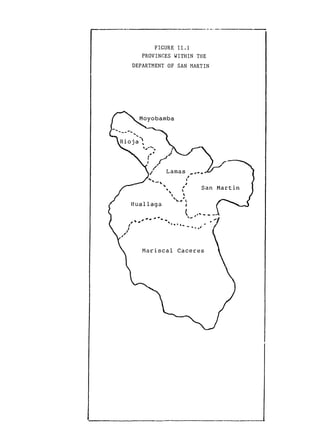
      At the beginning of the project in 1979, there were six provinces in San
Martin.* Moyobamba is the department's capital and Tarapoto its principal
commercial center. San Martin covers 53,063 sq. Km and in 1981 it had 319,751
residents (6.0 residents per so. Knl).L* From 1972 to 1981, the department's
population increased 950()0 (412.5 ' ) a 4.0%'t. annual growth rate. Such growth
was considerably above both the cumulative (25.6)          and the annual (2.5%)
growth rates experienced nationally over the same period.

      Two provinces within the department initially defined the proiect      zone
(Figure I1.1). The Huallaga Province was in fhe northern 1'art of that      zone.
Saposoa was its capital and commercial center. This province contained      8,982
sq. Km and 31,668 residents (3.5 residents per sq. Ki).        It gained    4,500
residents between 1972 and 1981.    Huallaga's 1t.6% population increase   repre­
sented a relatively low 1.7%. annual rate of growth.

      The remaining three-quarters of the project lone were situated in the
original Mariscal Caceres Province.     .Juanjui was its capital.  Commercial
activity was divided between Juanjui in the northern half of the province and
Tocache in the southern part. Mariscal Caceres covered about 24,817 sq. Km.
It had approximately 5-1,216 residents, which equaled slightly less than 2.2
residents per sq. Ki.    In the   period spanning 1972 to 1981, the province's
population grew by 17,000. This 47% population gain represents a 4.3% annual
growth rate.


*   This number was increased to nine in 1984 with the creation o
    three additional provinces: Bellavista, Tocache and Picota.


"All population data drawn from 1972 and 1981 Census reports,

 Instituto Nacional de Estadistica (1983).
FIGURE II.1

         PROVINCES WITHIN THE

   DEPARTMENT OF SAN MARTIN


     Moobamba


Rioja


               <       a m a s

           i                      s


                   %         #


   Huallaga


         Mariscal Caceres
Clearly, San Martin and the project zone were relatively large, sparsely
 populated areas. The RCSP project was situated in two provinces that consti­
 tuted 64% of the department's land area, but only 27% of the total population.
 Huallaga and Maiscal Caceres had the lowest population densities in the
 department. Their combined annual growth rates were also slightly below the
 departmental average.

      Communities in the project zone were for the most part agriculture cen­
ters (ENTEL, 1982). Sixty-six percent (66%) of their combined adult popula­
tions worked in agriculture, 14% were employed in service occupations.
Remaining sectors (industry, commerce, construction and transportation) each
employed about 5% or less of the work force. As would be expected, about
two-thirds of the gross production in the department was also centered in
agriculture. Agricultural production was concentrated in corn, rice, plantains
and cassava.    Palm oil w s also a major product in the Tocache area. As
mentioned above, coca leaves were cultivated extensively in San Martin,
particularly in the southern region of Mariscal Caceres. The total size of the
work force cultivating this crop is unknown.      However, the gross annual
production of coca leaves within the department has been estimated to exceed
20,000 tons (ENTEL, 1982).    This tonnage placed coca leaf among the major
products of the zone, second only to plantain in the view of some authorities.
Furthermore, income per ton estinates easily elevated coca to the highest
level in terms of economic importance.

      Transportation within the department, and especially in the       project
zone, has historically been quite limited.   In the whole Department of San
Martin, there were 359 automobiles, 596 pickup and panel trucks, and 316
heavy trucks registered in 1981.    This represented slightly over 1.1 automo­
biles and 1.9 pickups or panel trucks per 1,000 residents. The small number
of cars and trucks was augmented by several thousand motorcycles and private
vehicles that were cither unregistered or registered in other areas.      Still,
the availability of private transportation was restricted.      At this time,
there was also just over I regi.stered public Iransportation vehicle per 1,000
residents in the project area.

      San Martin and the RCSP zone have relatively few roads. The         entire
department contains only about 1,000 Kis. of "improved" roads, most of which
are dirt. Of this number, 844 Kms. (84%) constitute a single unpaved highway
- the Marginal.   The remaining 108 Kis. crcatc local road networks that link
some of the more remote communities with the NMarLginal. Transportation along
the Marginal and linking roads is slow under the best of conditions. During
the rainy season, the Marginal is usually navigable, while the linking roads
are frequently closed by mud or swollen strcains.       Rivers throughout the
department and zone support boat traffic in all but the driest months. Water
transportation is common, although there ,iie no major port facilities and only
minor commercial water transportation services available.

     Air transportation services have been and contiitic to be limited and
frequently unpredictable in San Martin.   Therc are three communities in the
zone with designated airports: Juanjui, SaposoI and Tocachc. These sites each
have improved dirt runways.      Beyond these established air facilities, there
are numerous communities with grass strips that can support small planes. Jet
services to Juanjui are available on a regular basis. All of the airports and
a few of the communities with grass strips are regularly served by small aero­
taxi companies.    Air services are customarily expanded during the rainy
season, when land travel is restricted.

      Prior to the introduction of the RCSP, telephone communications    were
possible only in eight towns in San Martin--Tarapoto, Moyobamba, Lamas, Nuevo
Cajamarca, Soritor, Jepelacio, Yuracyacu and Rioja. Most telephone services
and traffic were concentrated in Tarapoto.       For example, in June of 1981,
there were 22,615 telephone calls completed .in the entire department.
Tarapoto alone accounted for two-thirds of these calls (ENTEL, 1982).

      Health conditions in the Department of San Martin were also found to be
below Peruvian national standards at the outset of the project (ENTEL, 1982;
Consejo Nacional de Poblacion, 1985). The department had an annual mortality
rate of 16.2 deaths per 1,000 residents compared to 11.6 per thousand for the
nation as a whole. Infant mortality reached 114 per thousa::d J- San Martin
versus 95 per thousand nationally.     Life expectancy in thc lepartment was
about 59 years, compared to 60 years nationally and 70 years in urban areas.
There was an extensive list of documented reasons for the higher mortality and
shorter     life expectancy in the zone,       including inadequate nutrition,
dysentery, diseases due to a lack of vaccinations, and contagious diseases
such as tuberculosis. The lack of professional medical attention was also
listed as a cause of mortality.    There was only I medical doctor per 7,897
residents in San Martin and I nurse per 6,583 residents.       At the national
level, Peru had 1 medical doctor per every 1,385 residents and I professional
nurse for every 2,538 residents. The department had I hospital bed per 1,429
residents.    This stood in contrast to 3.1 public hospital and 0.8 private
hospital beds per 1,000 residents nationally.

       In terms of education, 22% (18% males; 27% females) of the population
(five years of age or older) in San Martin was officially         classified as
illiterate (ENTEL, 1982; Consejo Nacional de Poblacion, 1985). Nationally,
approximately 21% of the population was illiterate, compared to 6-7% in major
urban areas.     Approximately 114,500 school age children attended either a
public or private school in San Martin. These students were taught by about
3,000 professional teachers, yielding a ratio of I professional instructor for
every 33 students.       Schools were scattered throughout the department.
However, distances between schools limited the effectiveness of program
administration and teacher training.


The Local Context: Social and Economic Welfare

      The RCSP services were tailored to the local conditions of the seven
communities which were selected as project sites. Three of the communities,
designated "primary sites" (Juanjui, Saposoa, and Tocache), were targeted to
receive satellite earth stations which would allow them to become part of
Peru's national telephone network. Four communities, designated "c:,;ondary
sites" (Bellavista, Huicungo, Pachiza, and Tingo de Saposoa), were to be given
similar access via VHF radio links with Juaniui.
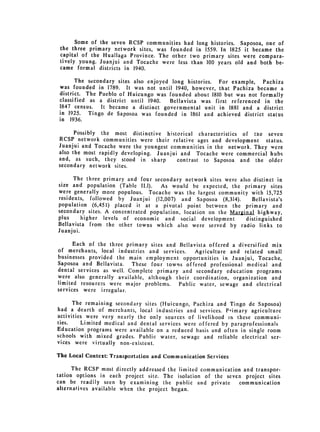
Some of the seven RCSP communities had long histories. Saposoa, one of
 the three primary network sites, was founded in 1559. In 1825 it became the
 capital of the Huallaga Province. The other two primary sites were compara­
 tively young. Juanjui and Tocache were less than 100 years old and both be­
 came formal districts in 1940.

      The secondary sites also enjoyed long histories. For example, Pachiza
was founded in 1789. It was not until 1940, however, that Pachiza became a
district. The Pueblo of Huicungo was founded about 1810 but was not formally
classified as a district until 1940.   Bellavista was first referenced in the
1847 census. It became a distinct governmental unit in 1881 and a district
in 1925.   Tingo de Saposoa was founded in 1861 and achieved district status
in 1936.

      Possibly the most distinctive historical characteristics of the seven
RCSP network communities were their relative ages and development status.
Juanjui and Tocache were the youngest communities in the network. They were
also the most rapidly developing. Juanjui and Tocache were commercial hubs
and, as such, they stood in sharp        contrast to Saposoa and the older
secondary network sites.

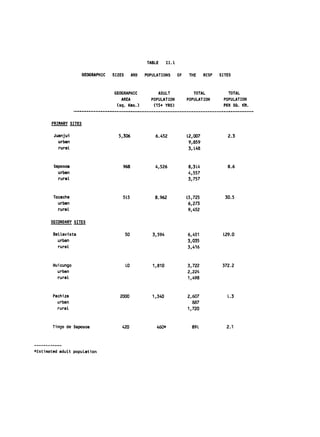
      The three primary and four secondary network sites were also distinct in
size and population (Table 11.1).  As would be expected, the primary sites
were generally more populous. Tocache was the largest community with 15,725
residents, followed by Juanjui (12,007) and Saposoa (8,314).        Bellavista's
population (6,451) placed it at a pivotal point between the primary and
secondary sites. A concentrated population, location on the Marginal highway,
plus     higher levels of economic and social development        distinguished
Bellavista from the other towns which also were served by radio links to
Juanjui.

      Each of the three primary sites and Bellavista offered a diversified mix
of merchants, local industries and services.    Agriculture and related small
businesses provided the main employment opportunities in Juanjui, Tocache,
Saposoa and Bellavista.   These four towns offered professional medical and
dental services as well. Complete primary and secondary education programs
were also generally available, although their coordination, organization and
limited resources were major problems. Public water, sewage and electrical
services were irregular.

      The remaining secondary sites (Huicungo, Pachiza and Tingo de Saposoa)
had a dearth of merchants, local industries and services. Primary agriculture
activities were very nearly the only sources of livelihood in these communi­
ties.     Limited medical and dental services were offered by paraprofessionals
Education programs were available on a reduced basis and often in single room
schools with mixed grades. Public water, sewage and reliable electrical ser­
vices were virtually non-existent.

The Local Context: Transportation and Communication Services

      The RCSP most directly addressed the limited communication and transpor­
tation options in each project site. The isolation of the seven project sites
can be readily seen by examining the public and private         communication
alternatives available when the project began.
TABLE      II.

                       GEOGRAPHIC   SIZES        AND   POPULATIONS      OF    THE     RCSP   SITES


                                    GEOGRAPHIC                 ADULT            TOTAL            TOTAL
                                       AREA              POPULATION          POPULATION       POPULATION
                                     (sq. Kms.)           (15+ YRS)                           PER SQ. 101.


       PRIMARY SITES

        Juanjui                       5,306                6.452             L2,007             2.3
          urban                                                               9,859
          rural                                                               3,L48


        Saposoa                         968                4,526             8,3L4              8.6
          urban                                                              4,557
          rural                                                              3,757


        Tocache                         5L5                8.962             15,725            30.5
          urban                                                               6,273
          ruraL                                                               9,452

       SECONDARY SITES

        BelLavista                          50            3,594              6,451            129.0
          urban                                                              3,035
          rural                                                              3,416


        Huicungo                            LO            1,810              3,722            372.2
          urban                                                              2,224
          rural                                                              1,498


        Pachiza                        2000               1,340              2,607              1.3
          urban                                                                887
          rural                                                              1,720


        Tingo de Saposoa                420                 460*               89L              2.1


*Estimated adult population
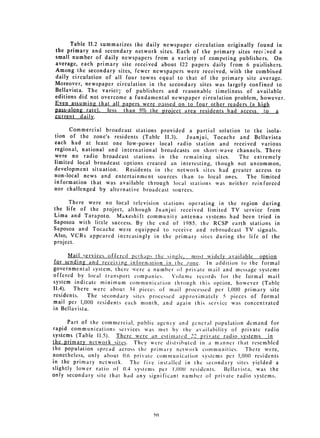
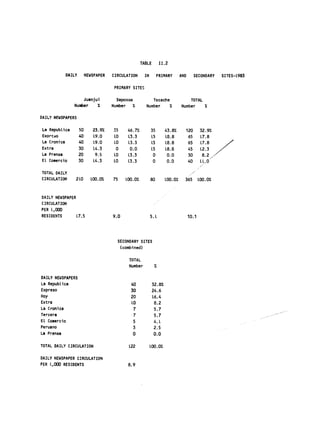
Table 11.2 summarizes the daily newspaper circulation originally found in
the primary and secondary network sites. Each of the primary sites recr ved a
small number of daily newspapers from a variety of competing publishers. On
average, each primary site received about 122 papers daily from 6 publishers.

Among the secondary sites, fewer newspapers were received, with the combined

daily circulation of all four towns equal to that of the primary site
 average.

Moreover, newspaper circulation in the secondary sites was largely confined to

Bellavista. 
 The variety of publishers and reasonable timeliness of available
editions did not overcome a fundamental newspaper circulation problem, however.
Even assuming that all papers were passed on to four other readers (a high
pass-along rate). less than 5% the project area residents had access         a...a
current daily.

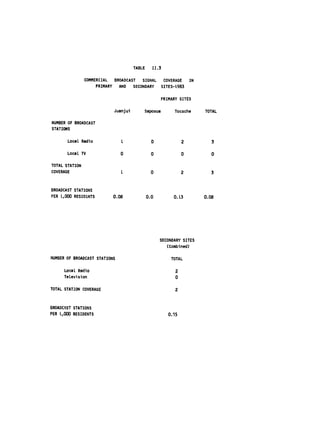
      Commercial broadcast stations provided a partial solution to the isola­
tion of the zone's residents (Table 11.3).    Juanjui, Tocache and Bellavista
each had at least one low-power local radio station and received various
regional, national and international broadcasts on short-wave channels. There
were no radio broadcast stations in the remaining sites.       The extremely
limited local broadcast options created an interesting, though not uncommon,
development situation.   Residents in the network sites had greater access to
non-local news and entertainment sources than to local ones.      The limited
information that was available through local stations was neither reinforced

nor challenged by alternative broadcast sources.


      There were no local television stations operating in the region during
the life of the project, although Juanjui received limited TV service from
Lima and Tarapoto. MaKeshift community antenna systems had been tried in
Saposoa with little success. By the end of 1985, the RCSP earth stations in
Saposoa and Tocache were equipped to receive and rebroadcast TV signals.
Also, VCRs appeared increasingly in the primary sites during the life of the
project.

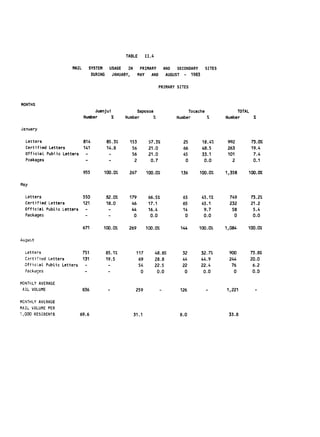
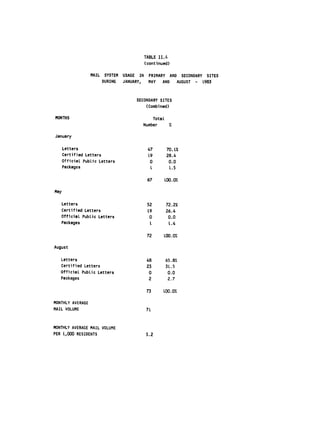
       Mail services offered perhaps the sinle   most widely available option
 for sending and receiving infornation in Ihc /one.   In addition to the formal
governmental system, there were a number of private mail and message systems
offered by local transport companies.      Volume records for the formal mail
system indicate minimum communication through this option, however (Table
II.4).  There were about 34 piecc!, of mail processed per 1,000 primary site
residents.    The secondary sites processed approximately 5 pieces of formal
mail per 1,000 residents each month, and again this service was concentrated
in Bellavista.

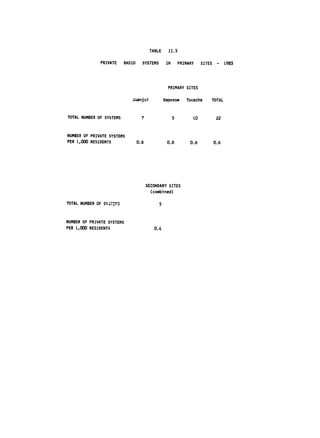
       Parl of the commercial, pu blic agcncy and general population demand for
rapid communications services was met by the availability of private radio
systems (Table 11.5).  There were an estimated 22 private radio systems      in
the primary network sites. They were distributed in a manner that resembled
the population spread across the primary network communitics.        There were,
nonetheless, only about 0.0 private conim unication sy'stems per 1,00(0 residents
in the primary network.     The five installed in the secondary sites yielded a
slightly lower ratio of 0.4 systems per 1,000 residents.     Bellavista, was the
only secondary site that had any signifi cant number of private radio systems.


                                    if)0
TABLE      11.2


           DAILY        NEWSPAPER   CIRCULATION       IN        PRIMARY    AND     SECONDARY   SITES-L983


                                     PRIMARY SITES


                   Juanjui            Saposoa             Tocache              TOTAL

               Number    %          Number %           Number     %        Number     %


DAILY NEWSPAPERS


La RepubLica       50      23.9%    35       46.7%         35      43.8%     120   32.9%

Exprcso            40      19.0     LO       L3.3          15      18.8       65   17.8

La Cronica         40      L9.0     LO       L3.3          15      L8.8       65 
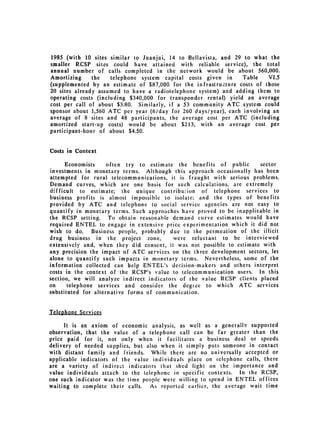
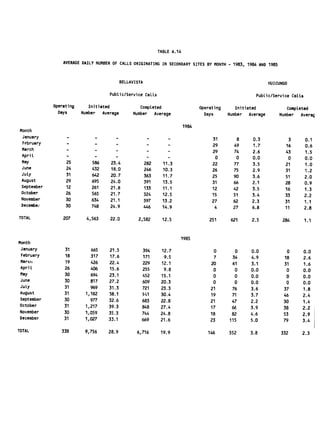
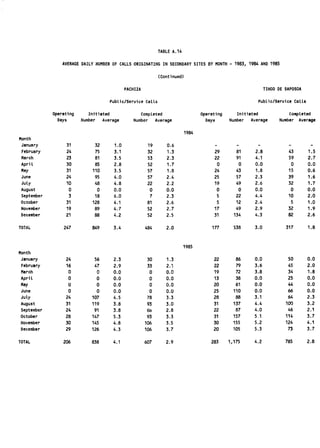
 L7.8

Extra              30      L4.3      0        0.0          15      18.8       45   12.3

La Prensa          20       9.5     LO       13.3           0       0.0       30    8.2

El Comercio        30      14.3     LO       13.3           0       0.0       40   IL.0


TOTAL DAILY

CIRCULATION    210         l00.0%   75      L00.0%         80      10.0%     365     10.0%


DAILY NEWSPAPER

CIRCULATION

PER L,000

RESIDENTS      L7.5 
               9.0                  5.1                     10.1


                                         SECONDARY SITES

                                          (combined)


                                             TOTAL

                                             Number           %


DAILY NEWSPAPERS

La Republica                                  40             32.8%

Expreso                                       30             24.6

Hoy                                           20             16.4

Extra                                         LO              8.2

La Cronica                                     7              5.7

Tercera 
                                      7              5.7

EL Comercio                                    5              4.L

Peruano                                        3              2.5

La Prensa                                      0              0.0


TOTAL DAILY CIRCULATION                      L22         10.0%


DAILY NEWSPAPER CIRCULATION

PER L,000 RESIDENTS                          8.9
TABLE     11.3

                COMMERCIAL   BROADCAST   SIGNAL         COVERAGE     IN
                     PRIMARY   AND   SECONDARY         SITES-L983


                                                       PRIMARY SITES

                            Juanjui       Saposoa            Tocache      TOTAL

NUMBER OF BROADCAST
STATIONS

       LocaL Radio              L               0                2           3

       LocaL TV                0                0                0           0

TOTAL STATION
COVERAGE                       L                0                2           3


BROADCAST STATIONS
PER L,000 RESIDENTS         0.08              0.0           O.13          0.08


                                                    SECONDARY SITES
                                                       (Combined)

NUMBER OF BROADCAST STATIONS                               TOTAL

      Local Radio                                            2
      TeLevision                                             0

TOTAL STATION COVERAGE                                       2


BROADCAST STATIONS
PER 1,000 RESIDENTS                                       0.15
TABLE          11.4


                      MAIL        SYSTEM         USAGE   IN        PRIMARY          AND   SECONDARY SITES

                                   DURING         JANUARY,        MAY   AND          AUGUST - 1983


                                                                               PRIMARY SITES


MONTHS

                                  Juanjui                    Saposoa                          Tocache             TOTAL

                             Number       %             Number       %                   Number       %      Number      %


January


  Letters                    814            85.3%         153 
         57.3%              25      18.4%      992      73.0%

  Certified Letters          141            14.8           56 
         21.0               66      48.5       263      19.4

  Official Public Letters     -              -             56           21.0               45      33.1       101       7.4

  Pcakages                    -                 -             2          0.7                 0      0.0         2       0.1


                             955        100.0%           267           100.0%              136    100.0%     1,358    100.0%


May


  Letters                    550            82.0%        179            66.5%              65      45.1%       749     73.2%

  Certified Letters          121            18.0          46            17.1               65      45.1        232     21.2

  Official Public Letters     -              -            44            16.4               14       9.7         58      5.4

  Packages                    -              -                0          0.0                0       0.0          0      0.0


                             671        100.0%           269           100.0%             144     100.0%     1,084    100.0%

August


  Letters                    751            85.1%              117         48.8%           32      32.7%       900     73.8%
  Certified Letters          131            19.5                69         28.8            44      44.9        244     20.0
  3ffic~al Public Letters     -              -                  54         22.5            22      22.4         76      6.2
  Packages                    -              -                     0           0.0          0       0.0          0      0.0

MONThLY AVERAGE
AIL VOLUME                   836            -                  259              -         126        -       1,221       -


MCNTHLY AVERAGE

MAIL VOLUME PER

1,000 RESIDENTS             69.6                              31.1                        8.0
                33.8
TABLE 11.4

                                       (continued)


                   MAIL SYSTEM USAGE IN PRIMARY AND SECONDARY SITES

                       DURING  JANUARY, MAY   AND AUGUST - L983


                                    SECONDARY SITES
                                        (Combined)

MONTHS                                     Total
                                       Number        %

January

   Letters                              47         70.L%
   Certified Letters                    19         28.4
   Official Public Letters               0          0.0
   Packages                              L          1.5

                                        67         100.0%


May


   Letters 
                            52         72.2%

   Certified Letters 
                  19         26.4

   Official Public Letters 
             0          0.0

   Packages                              L          1.4


                                        72     100.0%


August


   Letters 
                            48         65.8%

   Certified Letters 
                  23         31.5

   Official PubLic Letters 
             0          0.0

   Packages                              2          2.7


                                        73     10.0%


MONTHLY AVERAGE

MAIL VOLUME                             7L


MONTHLY AVERAGE MAIL VOLUME

PER 1,000 RESIDENTS                     5.2
TABLE      11.5


              PRIVATE       RADIO     SYSTEMS        IN       PRIMARY    SITES    -     L983


                                                      PRIMARY SITES


                               Juanjui              Saposoa      Tocache     TOTAL


TOTAL NUMBER OF SYSTEMS               7                   5         LO            22


NUMBER OF PRIVATE SYSTEMS

PER L,000 RESIDENTS                 0.6              0.6           0.6           0.6


                                          SECONDARY SITES
                                            (combined)

TOTAL NUMBER OF SY;Te3                          5


NUMBER OF PRIVATE SYSTEMS
PER L,000 RESIDENTS                          0.4
Public and private transportation offered only a partial remedy to the
isolation of the seven network sites. The viability and utility of this means
of communication were limited by the scarcity of good roads and working
vehicles. Communities not located on the region's the main artery (the
Mar2inal) were served by rough secondary roads. Road closings were common
during the rainy season which extended from December through February. The
rugged road conditions also resulted in a high rate of vehicle breakdowns.
Such factors prolonged trips for even short distances and resulted in compar­
atively high maintenance costs.

      Registration records for vehicles in the primary sites indicated minimal
public access to motorized land transportation (Table II.6).*       There were
about 5.4 private vehicles and 1.3 public vehicles per 1,000 residents.    The
size and constant daily usage of public vehicles offset, in part, their
limited number.     Nevertheless, public transportation was a scarce resource
and one where use was further limited by the need to share public vehicles
with residents outside of the primary sites.

      The final transportation option examined was commercial air service.
Transportcs Aereos de la Selva (TAS) offered frequent but unscheduled flights
in single engine aircraft between Juanjui, Tocache and major communities
outside of the network. AeroPeru provided two weekly flights linking Juanjui
with Lima and Trujillo.

      In sum, the three primary and four secondary network communities
exhibited appreciable historical,    social,  economic,   communication and
transportation variations. The diffetences, however, were minor when viewed
in absolute terms. All seven RCSP project sites were situated in an isolated
underdeveloped region of Peru.       Unquestionably, San Martin's social and
economic growth had been hindered by the lack of reliable communication and
transportation infrastructures.   Furthermore, rugged terrain and the high
jungle climate had retarded the introduction of more reliable communications
systems. The RCSP therefore represented a potentially significant step in the
development of this region.


*   Please note that these estimates did not include motorcycles,
    unregistered vehicles or vehicles registered in other areas.
TABLE          11.6

                         VEHICLE     REGISTRATION         IN       PRIMARY     SITES    -     L983

                                                               PRIMARY SITES

                           Juanjui                 Saposoa                     Tocache              TOTAL
                         Number        %       Number      %              Number     %           Number   %

VEHICLES

  Private

        Automobiles       50         58.8%      10              45.5%         65       39.4%         125    51.6%
        Pickup Trucks      5          5.9           3              13.6       62       37.6           70    28.9

   Public
     Taxis                25         29.4               5       22.7          17       10.3           22     9.1
     Trucks                5          5.9               0        0.0          12        7.3           12     5.0
     Microbuses            0          0.0               2        9.1           7        4.2            9     3.7
     Buses                 0          0.0               2        9.1           2        1.2            4     1.7

TOTAL                     85       100.0%            22        100.0%        165   100.0%            242   100.0%

Total Private Vehicles    55                         13                      127                     195
Total Public Vehicles     30                          9                       38                      47


NUMBER OF PRIVATE
VEHICLES PER 1,000
RESIDENTS                  4.6                      1.6                      8.1                     5.4

NUMBER OF PUBLIC
VEHICLES PER 1,000
RESIDENTS                  2.1                      1.1                      2.4                     1.3
III. 	   TECHNICAL AND ADMINISTRATIVE HISTORY
                              OF THE RCSP


        From the outset, 	 the evaluation paid particularly close attention to the
RCSP's technical 	 and administrative history. The multi-sectoral character of
the project, coupled with the complexity of its technology, suggested that, if
the RCSP were to 	succeed, it would require careful planning and a reliance on
novel administrative arrangements. Historically, Peruvian agencies have prov­
en no more adaptable or inclined to decentralized decision-making than their
counterparts in other nations. Yet, the diversity of development communica­
tion services projected for tOe RCSP meant that ENTEL, Peru's national tele­
communications authority, wocid be required to coordinate its activities with
established government programs in agriculture, health and education. More­
over it would have to do so both in Lima and in the remote jungle Department
of San Martin. 	 Such a challenge equaled in scale and complexity that of
installing and maintaining the RCSP's innovative communication system.

      To chart the technical and administrative history of the RCSP, and to
maintain as detailed a record as possible of the adjustments that were called
 for in different stages of the project, the evaluation team relied on a number
of sources. Foremost in importance were the reactions and recollections of
the people involved.     Throughout the project, notes were kept of the key
actors' impressions of their work. Such notes were supplemented by formal
interviews in which respondents were asked to reflect on their experiences and
to articulate the most important lessons they had learned. The insights and
recommendations contained in interviews with project leaders and their advis­
ers were supplemented by the written records contained in planning documents
and reports.    Such reports, coupled with the feasibility studies which pre­
ceded the launching of the RCSP, constituted a second major source of informa­
tion on the project's evolution and growth. Accounts of the project contained
in the Peruvian media were a third source of information.

      Although initial estimates of how quickly the project would start opera­
tions proved to be far too optimistic, it was fortuitous that evaluation
activities began in 1981, two full years before the RCSP network became opera­
tional. Such extended leadtime allowed the evaluation team to become familiar
with the people, organizations, and issues involved in establishing such an
innovative system. Relying on the variety of sources identified above, this
chapter presents a capsule history of the RCSP, beginning with the various
initiatives that preceded it and continuing with a discussion of network
design and equipment procurement, site selection and installation, network
performance (1983-85) and administrative relationships and responsibilities.
The chapter concludes with a discussion of outstanding technical and adminis­
trative issues.


Pre-project Initiatives

     As noted in Chapter 1, by the late 1970s developments in Peru and the
United States favored joint sponsorship of a rural communications project. In
May, 1978, the Instituto Geofisico del Peru hosted a seminar attended by well­


                                    28
known Peruvian and North American communication experts. One of the seminar's
 exercises was to evaluate possible locations for the establishment of a satel­
 lite-based, rural communication system.     After considering various sites in
Peru's highland and jungle areas, the participants recommended a high jungle
area located in the Department of San Martin. San Martin had a number of
appealing characteristics: it was a zone of increasing economic importance,
yet one largely lacking in telecommunications infrastructure.        Its largest
town, Tarapoto, would soon inaugurate an earth station linking it to Peru's
DOMSAT network (this would provide some technical as well as administrative
support to any new rural communication initiative); and it was the site of
major agricultural development projects supported by A.I.D. and the World
Bank. Furthermore, the Department of San Martin fell squarely within the area
east of the Andes that had long been of great interest to Fernando Belaunde
'ferry, then President of Peru.    It was here that Belaunde, an architect by
training, foresaw the best chances for development and expansion of his
country in coming generations. For lack of adequate communications and other
social infrastructure, Belaunde believed that the high jungle had never
fulfilled its development promise.    It was his hope that investment in that
zone would enhance employment opportunities, thereby encouraging new settle­
ments and diminishing the rate of migration to Peru's coastal cities.

       During this iame period A.I.D.'s Regional Bureaus were seeking promising
pilot projects that might lead to operational uses of satellite communications
in rural development, thereby building upon the Agency's AIDSAT demonstration
program that had been conducted in 1976.         A.I.D.'s Science and Technology
Bureau was also exploring possible sites for its forthcoming Rural Satellite
Program (RSP). Soon after the Lima seminar, A.I.D. and ENTEL representatives
agreed to join forces and to co-sponsor a project in Peru. It was named the
Rural Communication Services Project and was linked conceptually to the other
satellite demonstration projects being planned by A.I.D. in conjunction with
the University of the West Indies in the Caribbean region and the Eastern
Island Universities      Association in Indonesia (Block, C. et al. 1984).
Critical planning      assistance to the Peruvian project was provided by
communication experts       fielded by A.I.D.'s Latin American Bureau and the
Academy for Educational Development.

      By the time serious negotiation and planning commenced between the
Peruvian government and A.I.D. over the probable size and cost of a rural
communications project in San Martin, the center of gravity on the Peruvian
side had shifted from the Instituto Geofisico to ENTEL, the country's telecom­
munications authority.    The shift was a relatively smooth one because the
Instituto Geofisico engineers who had initially advocated such a project were
well known to ENTEL's leaders and, in fact, had served as their consultants on
numerous occasions. Furthermore, ENT3L's directors were receptive to innova­
tive project proposals that were in line with Peru's rural development priori­
ties.    By supporting the expansion of rural telephone services, they also
hoped to gain political support on other matters including tariff structure
and the expansion of the nation's television network.

      At the beginning of the project planning process, broad objectives were
set for the new system. On the technical side, the project would be designed
to demonstrate the flexibility and effectiveness of small satellite earth
stations and associated radio links in meeting rural communication needs.
The project would also demonstrate that the benefits and costs associated with


                                   29
the provision of rural communication services would be "attractive and
pertinent" to other areas of Peru, and eventually to other Latin American
countries as well.    Finally, the project would demonstrate the ability of a
satellite-based system to meet the communication needs of existing development
programs in health, education and agriculture, thereby strengthening regional
institutions and programs. To fulfill this last objective, ENTEL planners and
their A.I.D. colleagues envisioned the need for intensive involvement on the
part of selected government ministries. Only in this manner, they believed,
could the developmental significance of the project be realized and expanded
over the long term.

       Originally, a three-year tim.taLle was proposed for the RCSP; one year
 for the design, procurement, testing and installation of equipment, and two
years of actual operation. This timetable proved to be woefully inadequate,
and the horizon of activity eventually was extended an additional four years.
At the outset, it was thought that 14 communities would be included in the
RCSP, but budget constraints eventually reduced the scale of operations. Once
installed, it was proposed that the network be made available at no cost to
development projects operated by the Ministries of Health, Education and
Agriculture, although the exact terms of such access were left to be worked
out at a later date. In order to help achieve the project's ambitious list of
technical, economic and social objectives, A.I.D. initially pledged 102
person-months of technical assistance in a wide variety of areas, including
communications planning, systems engineering, management and evaluation.


Network Design and Equipment Procurement

      Although a number of feasibi!ity studies were conducted by Peruvian
engineers and A.I.D. consultants prior to the signing of RCSP Project Agree­
ment, detailed system design work did not begin in earnest until the spring of
1980.    However, following an initial period of system design activity, pro­
gress slowed dramatically.    Unquestionably, the collaborative nature of the
technology assessment process was a delaying factor. The elaboration of final
system specifications, the preparation of required documentation and propo­
sals, the review and evaluation of competitive bids, and the selection and
contracting of vendors were all conducted jointly by U.S. and Peruvian engi­
neers. The time required to accomplish such tasks and to manutfacture, ship
and install the equipment delayed start-up of the system for more than two
years beyond its original timetable.

      In the course of their preliminary consultations and feasibility studies,
ENTEL and A.I.D. administrators had been advised that the costs of small
satellite earth stations and related technologies had fallen and would hence­
 forth be within the economic reach of nations such as Peru which were eager to
provide rudimentary communication services to isolated rural populations.
Furthermore, they had been assured that affordable earth stations could be
readily assembled from "off the shelf" components.       As compelling as such
arguments appeared to be in theory, they did not stand up in practice. The
alternative systems put forward by U.S. manufacturers in response to A.I.D.'s
formal inquiries carried a total price tag approximately 600,)0(0 dollars above
initial estimates. Furthermore, each proposed system would require more time
to procure and install than had been previously planned.
The original network configuration agreed to by A.I.D. and ENTEL linked
 the Tarapoto earth station with 13 smaller communities, two of which would be
 provided with earth stations and 11 others with radiotelephone links.
 A.I.D.'s 1979 Project Paper specified subsequently that earth stations would
 be installed in Juanjui and Tocache, each with radiotelephone links to three
 to eight surrounding villages. It was planned that all hardware costs would
 be financed by A.I.D.       In order to facilitate hardware procurement and
 technical assistance, A.I.D. contracted a Washington-based consulting firm,
 Human Resource Management, Inc. (HRM), to handle the provision of these
 services.

       During the first half of 1980, ENTEL engineers, with the help of consul­
 tants from GTE's International Systems Corporation (financed by A.I.D.),
 delineated technical specifications for the hardware required under the origi­
 nal network configuration. Later that year, HRM initiated a procurement on
 the same terms. However, as mentioned above, the responses of U.S. equipment
 manufacturers indicated that RCSP's planners had underestimated hardware costs
 significantly.    For example, the original estimate for 12 village radio­
 telephones was just $50,000 (A.I.D., 1979). The lowest bid turned out to be
 almost five times that amount.     Unfortunately, the lower cost estimates had
 been used in the meantime to budget A.I.D.'s financial assistance.        Major
 additional funding was not available.      Also, it was neither in A.I.D.'s nor
 Peru's interest to fund an expensive pilot system given the project's goal of
 demonstrating     a   telecommunications    capability appropriate  for    rural
 communities.
      In light of this situation, the original equipr-r nt procurement was
suspended while ENTEL undertook a cost study of alte: native network designs.
The study recommended that the RCSP rely exclusively on satellite linkages,
since the remote repeaters needed for any terrestrial links would be costly to
construct and maintain.    This recommendation led to further discussion of
alternative network configurations, with considerable attention paid to the
possibility of having a satellite-only system, consisting of perhaps five to

eight sites.  These discussions were not resolved until 
 the middle of 1981,
and only after protracted negotiation among ENTEL, A.I.D. and the Harris
Corporation of Melbourne, Fiorida, the leading bidder on the original

procurement.


      Due both to cost considerations and the desire to include a sufficient

number of rural sites in the demonstration project,, a revised (and final)

network agreement was worked out whereby A.I.D. would provide three satellite
earth stations (with shipping and ancillary equipment) and ENTEL would connect
the earth station communities to four additional communities via radio. When
the procurement process was resumed, the Harris Corporation was again selected
as the most responsive bidder, and a contract for $704,000 for the three earth
stations and related equipment was signed on November 24, 1981. Following this
agreement in April, 1982, A.I.D. signed a contract with Johnson and Towers Co.
of Baltimore for $55,000 to provide three redundant diesel power systems to be
used at each of the earth station sites.

      Two features of standard earth station design were modified in order to
reduce project costs.   First, the equipment was designed to be essentially
non-redundant (except for the power system), in contrast to usual engineering
practice.  The justification was that for the system to be an affordable
prototype, it would be acceptable to sacrifice some degree of reliability in
 order to bring down total system costs. However, this decision forced the
 Harris Corporation to modify its standard earth station technology to meet the
 needs of the Peru project. Second, the decision was made not to request a
 "turn-key" contract from Harris, whereby that corporation would have been held
 legally responsible for the earth stations' installation and the successful
 completion of all INTELSAT acceptance tests. Turn-key contracts are often the
norm for complex, international communication technology transfers and, in­
deed, all of the nine earth stations installed previously in Peru were
contracted for by ENTEL under turn-key arrangements. Nonetheless, ENTEL
requested that RCSP equipment not be procured on that basis. The following
justifications were given:

       -   the costs of turn-key contracts are substantially higher (in this
           case, probably on the order of 50% to 100%), and the money saved
           could be used to purchase more equipment for the system;

       - ENTEL staff had considerable experience with satellite technology and
         felt capable, with the lirmited training built into the Harris con­
         tract, of installing the system;

       -   such an approach to technology transfer would provide considerably
           more opportunity for staff development, thereby increasing ENTEL's
           capabilities.

      The initial idea had been for A.I.D. to cover the telecommunications
equipment costs necessary for both the satellite sites and the radiotelephone
sites    (hereafter   referred to as the primary       and   secondary   sites,
respectively).     However,    the higher-than-forecast costs of the system
permitted A.I.D. to assume only the costs of three satellite earth stations
and the teleconferencing equipment. ENTEL agreed to provide all the equipment
necessary to add the four secondary sites to the network.

      A variety of options were considered for the secondary network. Although
at one time there seemed to be a possibility of purchasing new equipment (a
procurement was actually initiated by ENTEL in 1982, but subsequently
canceled), the decision was ultimately made to install radios manufactured by
BUDAVOX, a Hungarian firm. Peru had acquired the radios years before in a
barter arrangement with the Hungarian government. Installation of this tech­
nology was begun in the latter half of 1983, although some ENTEL and A.I.D.
staff expressed concern about the BUDAVOX radios' poor performance history.
Their objections were overridden in the interest of cost reduction.        This
turned out to be a poor decision.

      The design and procurement of audioteleconferencing (ATC) equipment was a
much simpler process than that required for the primary and secondary tele­
phone networks. Nonetheless, the process also consumed more time than origi­
nally anticipated.   It, too, was characterized by a number of difficulties.
First, the ATC equipment had to interface with the new rural telephone system
whose specifications had required so much time to work out. Second, contract
disputes between A.I.D. and HRM (which will be discussed below) als, -ontrib­
uted to the delay in ATC network design and procurement. It was not until
early 1983 that a final decision was made (again on the basis of competitive
procurement) to purchase 10 Darome teleconference terminals and 2 sets of
Dantel teleconference bridges. The 10 terminals were to be installed in the
seven RCSP sites as well as in Lima, Tarapoto, and Moyobamba, the capital of
San Martin. Moyobamba, however, was eventually dropped from the ATC network
in favor of Iquitos, ENTEL's regional headquarters and an important Amazon
port city. ENTEL assumed responsibility for ATC equipment installation.


Site   Selection

      Two RCSP sites, Juanjui and Tocache, were identified and agreed upon
early in the network design process, having been earmarked to receive earth
stations in the original 14-site plan. The two communities were selected
because of their relatively large populations, their commercial importance and
their locations vis-a-vis the proposed radio links to smaller communities.
Saposoa was eventually selected as the third earth station site, primarily
because it was a Provincial Capital and a concerted lobbying effort had been
mounted by local officials there.

      The selection of four communities for the secondary radiotelephone net­
work involved more time and additional geographic, economic and political
issues.   Given the difficulties of installing such linkages, the communities
chosen cou!d not be too far from the proposed eaith station sites nor could
they be separated by very hilly terrain which would require the installation
of costly repeater stations. After considering a variety of possibilities, it
was decided to include Huicungo, Pachiza, Tingo de Saposoa, and Bellavista,
all rural communities located within an hour's drive of Juanjui. It should be
noted that the communities of Huicungo and Pachiza are less than a mile apart,
a fact which lowered the installation and maintenance costs ENTEL incurred in
meeting its commitment to A.I.D. to add a minimum of four rural communities to
the RCSP network.


System   Installation

     Due to delays in network design and equipment procurement, installation
of the RCSP began much later than originally anticipated. However, once
contracts for the earth statiois and related equipment were signed, fabrica­
tion and shipping proceeded smoothly. By August, 1982. the antennas, equip­
ment shelters, and generators had all been delivered to Peru. Locations for
the earth stations had been selected earlier in the year, with land donated by
each of the three communities. The civil works needed to provide foundations
for the antennas and shelters were contracted for by ENTEL. Site work was
begun in each of the three communities in August and September, 1982, and
completed by mid-November. The assembly and installation of the earth station
equipment and generator systems were accomplished in a six-week period, begin­
ning in early November. ENTEL assumed full responsibility for the installa­
tion work, although represeatatives from Harris Corporation were also on hand
to "supervise" the alignment of the antennas.

       Given the non-redundant design of the earth station equipment, ENTEL
decided to install independent radio links between the three earth station
sites, Tarapoto, and Lurin (which serves Lima), for coordination and emergency
purposes. A $15,000 contract was signed for this equipment in June, 1982, and
the links were installed in fou: of the sites in February, 1983, and in
Tarapoto in November of that year. During this period ENTEL also contracted
 for the construction of a central telephone building in Juanjui and Tocache,
 and the rental of a facility in Saposoa. These constructions were undertaken
 and completed between January and May, 1983.

       The first series of INTELSAT tests, which were necessary to obtain opera­
  ting approval for the new earth stations, were held in January and February,
 1983. Moit tests were passed, but not all. After some adjustments, the three
 earth stations were retested in May and June, 1983.        Although there was
 improvement, the stations still failed to meet all of INTELSAT's stringent
 performance requii:ments.      Nonetheless, their performance was sufficiently
 improved for INTELSAT to grant temporary operating approval to all three on
 July 4, 1983. The third round of INTELSAT tests in November, 1983, resulted
 in approval of only the Tocache earth station. Juanjui and Saposoa failed a
 third time.     In fact, these two installations continued to operate under
 temporary approval throughout the remaining life of the project.

       Although the final selection of secondary sites was completed in May,
 1982, installation of radiotelephone equipment was delayed for a full year.
 The delay resulted from continued revisions of the network design and ENTEL's
 lingering doubts concerning the BUDAVOX radiotelephones. ENTEL's Division of
 Rural Communications completed work on the installations in Huicungo, Pachiza,
 Tingo de Saposoa and Bellavista in May, 1984.

       The ATC equipment arrived in Lima in July, 1983, but it did not clear
customs until the following November. From July to December, 1983, ENTEL
negotiated agreements with municipal authorities in each secondary site
whereby the latter agreed to provide suitable teleconference rooms.       Such
facilities were provided directly by ENTEL in the primary sites. By late
December, 1983, ATC equipment had been installed in the th'ce primary sites.
as well as in Tarapoto and Lima. In May and June, 1984, the ATC equipment was
installed in the four secondary sites, thereby completing the RCSP's telephone
and teleconferencing network.

      Although the RCSP telephone service was supposed to include only the
installation of public call boxes, the strong demand for private telephone
service to homes and businesses in the three primary sites led to the addition
of such service. Thus, in April, 1984, ENTEL began installation of private
telephone lines in Juanjui and Saposoa. Work was completed in only two weeks
in Saposoa. Three months were required in Juanjui due to a shortage of needed
materials. The Tocache installations were completed in two weeks in July,
1984.     By the end of 1985, Juanjui had 103 private phone subscribers, Saposoa
had 48, and Tocache 87.

Network Performance (1983-85)

      By mid-to-late 1983, each of the three primary sites had installed a 6.1
meter satellite antenna and equipment permitting the establishment of four
telephone channels in Juanjui and Tocache, and three channels in Saposoa, with
the capacity available to expand up to twelve channels at each site, if
needed. The intention was to devote one channel in each of the primary sites
exclusively     to audioteleconferencing.   Although technical     difficulties
initially required ATC users to share a channel with commercial users, exclu­
sive ATC channels became operational in Saposoa in March, 1984, and in Juanjui
and Tocache in May of that year. The radiotelephone system for the secondary
network was designed so that all four sites would interconnect to the rest of
the country through Juanjui. Three of the secondary sites were given one VHF
channel to be divided between telephone and ATC use, while Bellavista received
two VHF channels, one used exclusively for ATC.

      As with most new and sophisticated communication systems, the RCSP exper­
ienced its share of start-up problems. During the project's first 18 months,
the number of service interruptions was quite high, although the incidence of
completely lost days was confined largely to the four secondary sites, as
shown in Table 1II.1. From January 1985 onwards, none of the three primary
sites experienced technical problems severe enough to suspend a full day's
service.   However, the picture was quite different in the secondary sites
where service frequently had to be suspended for days and even weeks at a
time.    The situation was particularly acute during 1985 in Huicungo and
Pachiza where service was only unavailable 55% and 40% of the time, respec­
tively.

      As mentioned previously, neither the Juanjui nor the Saposoa earth ta­
tions passed INTELSAT's acceptance tests during the life of the project.
Although the two installations were denied full operating authority for this
reason, they each provided RCSP services under temporary approval. Failure to
meet INTELSAT requirements is a problem that was never adequately explained,
much less rectified. Competing explanations for the substandard performance
of the equipment in Juanjui and Saposoa include: (1) flaws in the design
and/or fabrication of the Harris Corporation's antennas and (2) inappropriate
positioning and/or installation of the antennas by ENTEL.

      The four transmitters (three operational units and one spare) originally
provided by Harris also created problems.      Each burned out and had to be
replaced during the first year of the project.     Again, explanations for such
difficulties varied. Some observers suggested that the design of the Harris
equipment was faulty and that a different type of transmitter should have been
employed.    Others attributed the recurrent problem to the lack of voltage
regulators at each of the installations, although the explanation should have
been relevant only to Juanjui, which relied upon that city's commercial
electricity system.   The relatively small variations in power provided by
generators should not have been sufficient to cause transmitter burnout. In
any case,      the RCSP's earth stations were kept going by substituting
transmitters from other ENTEL installations and by eventually securing Harris'
cooperation in repairing some of the damaged originals. Furthermore, voltage
regulators were installed at each earth station in 1985 to eliminate the
potentially damaging effect of power fluctuations.

      During 1984, the RCSP depended on an INTELSAT IV-A satellite for the
space segment of its communication system. As this satellite aged and exper­
ienced increasing difficulty maintaining a stationary orbit, circuit     noise
increased. To combat this problem, ENTEL engineers at the threc earth station
sites were at times forced to adjust their antennas on almost a daily basis.
Although this and other maintenance tasks were performed where possible in the
late night and early morning hours, they interfered frequently with ENTEL's
commercial services throughout 1984. In 1985, the quality and reliability of
the satellite links improved markedly when the system began using INTELSAT's
series V-A satellite.
TABLE 111.1

                                         AVERAGE NUMBER OF INOPERATIVE DAYS BY MONTH AND SITE

                                                         1963 THROUGH 1985
                           PRIMARY SITES                                                     SECONDARY SITES
                 Juanju|                                                                                        Tingo du
                              Sapasoa      Tocache       Bellavista            Huicungo              Pachiza    Saposoa
  July               6                          --                                       .                 .
  August             0                          0               -                    -                     -
  September          3              -6                          -                               -
  October            0              0           o                       -                                  -          .
  November           4              1           2                                    -                                .
 December            0              2           0                                    -                                .

         TOTAL    13                3        18-                                                           -.

 1984
 January             0              0           0                                0                         0       0
 February            0              2           0                                0                         5       0
 arcb                0              0           0                                2                         a       9
April                0          10              0              -                30                         0      30
hay               0              0          0               6                     9                     0         7
June              0              0          3               6                     4                     6         5
July              0              0          0               0                     6                   21         12
August            0              0          0               2                     0                   31         31
Septenber         0              0          0              18                    18                   28         25
October           0              0          0               5                   16                     0         26
November          7              0          0               0                     3                   12         13
December          0              2          0               0                   27                    to          0
      TOTAL       7            14           3              37                  115                   121        158
 1985
January          0             0            0              0                   31                     5          9
February         0             0            0             10                   21                    12          5
match            0             0            0             12                   11                    31         11
April            0             0            0              4                   3C                    30         13
may              0             0            0              1                   31                    31          5
June             0             0            0              0                   30                    30          4
July             0             0            0              0                    B                     4          0
August           0             0            0              0                   10                     0          0
September        0             0            0              0                    3                     2          B
October          0             0            0              0                   12                     1          0
November         0             0            0             0                     9                     0         0
December         0             0            0              0                    6                     0         11
     TOTAL       0             0            0             27                202                     146         66
Unquestionably, the weakest component of the RCSP network was the VHF
radiotelephone system developed to serve the four secondary sites.        The
BUDAVOX radios' power requirements were relatively high and their reliability
had never been adequately tested in a demanding jungle environment comparable
to San Martin's. The critics' fears were completely confirmed.     Soon after
they were inaugurated during the first six months of 1984, the 10 radio
terminals in the secondary sites and at the repeater stations began to exper­
ience problems. Servicing of the repeater units proved be especially diffi­
cult due to their remote locations and the harsh terrain which had to be
traversed in order to make repairs. For example, access to the five units at
the Cerro Cangrejo repeater station required a three-hour climb along a slip­
pery mountain trail.     These factors combined to delay repair times in the
field.

      The second major problem with the radiotelephone system can be traced to
the two large (12-volt) tractor batteries used to power the radios at each
secondary site.    During those periods when telephone and teleconferencing
services were available on a regular basis, battery recharging was required
approximately every 10 days and, in some cases, even more frequently. Al­
though battery chargers were purchased by ENTEL for each of the secondary
sites, they generated insufficient power. Therefore, recharging could be done
only in Juanjui and the batteries had to be trucked constantly back and forth.
Administrative and transport problems soon led to inadequate maintenance of
this power source, resulting in additional interruptions of service.

      The original design of the RCSP, which required each of the secondary
sites to connect to the system via the Juanjui earth station, also reduced the
quality of the service provided to the small communities. The limited channel
capacity initially available in Juanjui reduced the telephone operators'
ability to meet the demands of the secondary sites on a timely basis.
Furthermore, as demands on the system grew, there was a tendency on the part
of some Juanjui operators to pay less attention to requests for calls from the
secondary sites.    Recognizing such problems, operators were instructed to
place calls on a first come, first served basis, regardless of whether the
request cam-, from a client in Juanjui or from one in a secondary site. More­
over, in July, 1Q85, the link to Bellavista, the largest secondary site, was
switched from Ju-iijui to Saposoa (which had the least telephone traffic of the
primary sites), theieby alleviating much of the pressure on Juanjui.      Also,
the growth in demand for telephone service eventually convinced project admin­
istrators to add more channels to all the primary sites (in October 1985), an
action which alleviated congestion across the board.

      The RCSP's ATC system also experienced a variety of interference and
voice quality problems at the outset of the project. Some were traced to the
interface of the Dantel bridges and the Darome speakers and microphones with
the Harris earth station equipment.      They were solved through the diligent
effort of the RCSP's engineering staff.        Channel noise as well as other
acoustical problems at the primary sites were resolved to most users'
satisfaction. However, dti.e to fragile telephone linkages and associated main­
tenance problems, the four secondary sites were only intermittent participants
in the ATC network. Although each of the communities had been equipped with a
Dantel terminal, thereby giving them the technical capacity to initiate ATCs,
less than 1% of all teleconferences emanated from the secondary sites during
the life of the project. In fact, participation in the ATC program declined
to such a low level in the secondary sites that, with the exception of
 Bellavista, equipment associated with this component of the project eventually
 was removed and reassigned.


 Administrative Relationships and Responsibilities

       The RCSP involved not only the transfer and adaptation of complex commu­
 nication technologies to harsh jungle conditions, but also the design, imple­
 mentation and evaluation of strategies linking those technologies to the rural
 development needs of San Martin. Under terms of the project accord, ENTEL and
 A.I.D. agreed to cooperate on all aspects of the pilot program. As part of
 their agreement, a multi-year timetable was established along with what seemed
 at the time to be an ample budget for equipment and technical assistance. To
 follow through on its commitments to the program, ENTEL set up a project
 office at its headquarters in Lima. A.I.D.'s contributions were managed from
 Washington--initially by the Agency's Bureau for Latin America and the
 Caribbean, and later by its Bureau for Science and Technology.

      Project leaders at both ENTEL and A.I.D. recognized from the     beginning
 that a successful RCSP would require many more resources than their   two agen­
 cies could provide. Such resources would have to be obtained from      a variety
 of organizations, both public and private, in and outside of Peru.     Effective
 management was deemed crucial to project success.

      Whereas A.I.D. and ENTEL representatives worked in close partnership on
the technical, program and financial planning which preceded the RCSP, execu­
tive authority for all day-to-day operations rested with ENTEL once the
project began. A major innovation embodied in the RCSP was the rural develop­
ment perspective adopted by ENTEL. The goal of enhancing social services in
San Martin actually outweighed standard commercial objectives in          this
instance. Such a perspective had been suggested initially by A.I.D. communi­
cation consultants who worked with Instituto Geofisico del Peru staff in 1978.

       ENTEL is a state corporation staffed predominantly by engineers, techni­
cians, economists and accountants. Such persons are responsible for managing

and expanding communication services in a self-sustaining manner, that is, in

ways that do not require regular 
 subsidies from the nation's treasury.     In
 fact, as is the case with most telecommunications authorities in the world,
services provided by ENTEL are expected to generate some profit for the
government.     Therefore, all investment opportunities, including those for
rural telephony, are carefully scrutinized in terms of projected costs and
revenues.

      Not surprisingly, when senior ENTEL administrators began recruiting staff
for the RCSP in February, 1980, they turned initially to existing divisions of
the agency. A senior engineer, Hector Cossio Chavez, was appointed project
director. Some months later, the human resources of the project were broad­
ened considerably when three social scientists were added to Cossio's staff.
These individuals, who formed a social applications unit, were responsible for
forging links with the Ministries of Education, Agriculture and Health, for
specifying appropriate development objectives and applications for the new
network in San Martin, and for evaluating all aspects of the project as it
developed.


                                   38
In Peru's tightly structured governmental system, the kind of interminis­
terial cooperation envisioned by the RCSP's planners was not expected to
materialize overnight.     It is one thing to state the desirability of such
cooperation in general terms at the pianning stage of a project, but quite
another to effect it when jurisdictional and financial issues come to the
fore.     Such was the challenge confronting the social scientists who, although
new to ENTEL, were charged with refining the project's social objectives and
translating them into workable programs in the field.      In the Peruvian con­
text, such work required project representatives to negotiate formal agree­
ments (convenios) with each of the participating ministries. Without such
agreements, any development initiative--national,     regional or local--would
have encountered administrative bottlenecks and resistance at every turn.

      The challenge of obtaining formal agreements with various authorities
before    either the technical capabilities of the new system or the program
priorities of the agencies themselves had been specified occupied RCSP staff
for more than two years. In fact, formal agreement on even the most general
outline of project goals and responsibilities was not reached with the devel­
opment ministries until the final months of 1982, more than two years into
the project but still a year ahead of when the new communication facilities
became available.

      Under terms of the project agreement, A.I.D. agreed to purchase satellite
earth stations and related communications equipment and to provide technical
assistan'e to ENTEL for implementation and evaluation of new development
communication services. The U.S. agency's contribution to the RCSP eventually
totaled 2,081,000 dollars (cf. Chapter VI).  In order to speed up what prom­
ised to be a complicated hardware procurement and to avoid protracted con­
tract negotiations over various elements of its technical assistance package,
A.I.D. entered into two sole-source contracts totaling $1,750,000 with Human
Resources Management, Inc. (FIRM).     HRM, in turn, retained the bulk of the
hardware procurement, applications planning, project management and dissemi­
nation tasks of the aid program under its own roof, but subcontracted the
evaluation work to Florida State University.

      Beginning in the first quarter of 1980, and continuing for almost two
years, HRM represented A.I.D.'s interests in the development of a viable RCSP
in Peru.    The organization sponsored short-term consultants in every area of
the proposed system: network design, hardware procurement and applications
planning.    In the final analysis, however, the technical assistance needs of
the RCSP proved too great for HRM to manage efficiently. Faced with unex­
plained delays, budget difficulties and FIRM's inability to honor commitments
made to its consultants and subcontractors, A.I.D. canceled its contracts
with the firm in 1982. The agency was then confronted with the difficult task
of restructuring the external assistance component of the RCSP in mid-stream.
With little time to consider alternatives, A.I.D. signed two new contracts;
the first with Florida State University, to enable that institution to con­
tinue its evaluation work, and the second with the Academy for Educational
Development (AED), to provide the balance of the U.S.' technical assistance to
the RCSP. Although the Academy was required to assume major responsibility
for the RCSP on extremely short notice, as principal technical assistance
contractor on A.I.D.'s Rural Satellite Program, it already possessed appro­
priate staff and experience to take on the variety of tasks called for in
Peru.    In fact, AED staff and consultants had been major contributors to the


                                   39
feasibility studies which led directly to the RCSP, and they were well ac­
 quainted with project developments in Peru since that time.

      Through the direct contributions of its own staff and the support of two
successive full-time field advisors,   AED exerted considerable influence on
the RCSP, and especially on the development of its teleconference system,
which is described in detail in Chapter V.         On the technical side, its
influence was less evident due to the fact that, at the time AED formally
entered the project in 1982, the network design was already completed. Most
major hardware decisions (and expenditures) had already been made, and the
accountability dispute that prevented A.I.D., ENTEL and the Harris Corporation
from solving the technical problems related to the earth stations had already
surfaced.

      During the long period of system design, procurement and installation,
applications planning proceeded irregularly both in Lima and in San Martin.
Lacking definitive information concerning where the RCSP would operate and
what capabilities it would have, it was difficult for ENTEL's applications
planners and their advisors to make much headway with counterparts in the
ministries. The situation was complicated further when ENTEL's RCSP office
divested itself of responsibility for instaliation of the secondary site
network in mid-1982, opting to turn this job over to ENTEL's Rural Communica­
tion Division, which normally was in charge of such matters.

      By late 1982, when the operational parameters of the system were finally
established, the applications planners focused their attention on a series of
regional meetings and workshops in San Martin. At these gatherings sector
specialists were introduced to the RCSP and its technologies and encouraged to
identify regional development priorities that could be effectively pursued by
means of improved two-way communication and teleconferencing. Such efforts
were strengthened by the arrival of AED's first resident field adviser, Mr.
Frank Dali, in October of that year.     Nevertheless, an additional 18 months
passed between his arrival and the inauguration of telephone service in all
seven RCSP sites.

      The pace of both hardware installation and applications planning quick­
ened in 1983. The year began with a major administrative change. Dr. Angel
Vela'squez Abarca, the Director of ENTEL's Office of International Affairs, was
appointed project director. By moving the RCSP into Velgsquez' office, it
immediately gained more visibility and attention than it had           enjoyed
previously.   Continuity was assured because most of the project's staff was
retained.   Furthermore, Vel'asquez' association stretched back to his days at
the Instituto Geofisico del Peru where he had been largely responsible for
initiating the project.

       Shortly after Velsquez' appointment, a regional office was opened in
Tarapoto, the largest town in San Martin and the administrative center of
existing ENTEL activities in that department. The office was headed by a
full-time field coordinator who reported both to the Tarapoto office chief and
to the p-'oject director in Lima. Working closely with the applications plan­
ners bascd in Lima, the coordinator, Sr. Jorge Cisneros Basan, was able to set
up, monitor and follow up decisions taken at regional planning sessions. The
sessions were designed to build support for the initial round of teleconfer­
ence experiments scheduled to begin once the RCSP b:came operational.


                                   An
Limited telephone service became available in Juanjui on July 5th and in
Tocache on August 3rd, 1983. Service in Saposoa was initiated on November
12th.    The high point of the year occurred on November 5th when the three
earth stations were formally inaugurated.    This occasion was marked by an
international teleconference among government officials, most notably Peru's
Premier Vice-president, Sr. Javier Alba Orlandini, and Mr. Peter McPherson,
the Administrator of A.I.D.

       Although management procedures and lines of authority had been estab­
 lished for the seven-site network by the time the full range of new communi­
 cation services actually became available in 1984, numerous administrative
 adjustments were required during the two years of RCSP operations. As an
"international" program, the RCSP enjoyed certain freedoms within ENTEL's
bureaucracy. It commanded independent resources which ai!owed it to mount
special studies and it could recruit key staff from outside ENTEL's pool of
career service personnel. Such flexibility was extremely important during the
project's early stages. However, when the focus of RCSP activity shifted to
San Martin, other forces came into play and, for the first time, project
personnel became dependent on, and at least partially responsible to, other
ENTEL offices. For example, to provide commercial telephone service in the
seven sites, the project depended on a variety of technicians, operators and
office staff, most of whom were already ENTEL employees. At the outset of the
project, such people continued to report to regional superiors located in
Tarapoto and Iquitos.       Inevitably, jurisdictional disputes arose when the
novel requirements of the RCSP conflicted with ENTEL's standard operating
procedures in the zone. To the credit of all of the people involved, the vast
majority of administrative misunderstandings and demands generated by the RCSP
were settled through patient explanation and/or negotiation with appropriate
regional ENTEL authorities.

      Events in Juanjui, triggered a major administrative reorganization before
the end of 1984. In many ways, Juanjui was the management as well as the
technical hub of the RCSP. Key project personnel were stationed there, and it
was the connecting point for all of the system's secondary radio links. Such
responsibilities initially put enormous strain on local ENTEL employees who
were accustomed to serving the limited communication needs of one community
and to reporting to superiors based in Tarapoto. By mid-1984, the performance
and morale of the Juanjui staff had slid appreciably and lines of authority
had blurred.     Decisive action was called for and it was forthcoming, from
Lima.    In a series of actions, Velasquez reasserted his office's control over
all aspects of the project. At about the same time, the RCSP's chief field
evaluator, Felipe Yanes, was appointed director of project operations in
Juanjui.    Although Yanes was expected to continue his evaluation work
throughout the project zone, the new assignment gave him broad administrative
authority for the seven project sites as well.       It also had the effect of
concentrating local responsibility for the RCSP in the hands of an employee
closely tied to the project director in Lima.      In this manner, the RCSP's
special status was reinforced for the remainder of the contract period, and
most of the lingering jurisdictionai issues among ENTEL employees in the zone
were dissolved.
Unfortunately, the major jurisdictional issue confronting the RCSP was
 not resolved during the life of the project. It stemmed from the failure of
 the Juanjui and Saposoa earth stations to meet performance standards necessary
 to receive permanent operating approval from INTELSAT. Key project actors
 were not able to agree on the precise cause of this problem or on a way
 resolve it. While a full treatment of the complex technical issues underlying
 the ENTEL-Harris dispute over the performance of the earth stations is beyond
 the scope of this evaluation, it is clear that failure to agree on the source
 of the problem, or to accept ultimate responsibility for it, prohibited
 corrective action from being taken.

       The decision of ENTEL not to contract with Harris for a turn-key
 installation, whereby the corporation would have assumed complete responsibil­
 ity until all performance tests were passed, set the stage for the dispute.
 When the earth stations failed to perform as expected, ENTEL claimed that
 Harris' equipment was to blame. Harris counterargued that faulty installation
 by ENTEL was at the heart of the problem. ENTEL responded that, even if
 errors had been made by technicians in the field, Harris' contract with HRM
specified that the former's obligations included "supervision of the site
 installation."  Citing this clause, ENTEL's leaders believed Harris should
 have accepted more responsibility for the system's failure to perform accord­
ing to its specifications.   Although both parties appeared to be sincere in
their interpretations and to be acting in good faith, neither wished to absorb
the high political and financial costs involved in fixing the system. A.I.D.,
the principal funder, also proved unable to bring about a solution.      In the
final analysis, it had little leverage for corrective action once it made
final payment to Harris. Try as it did on a number of occasions, the Agency
was unable either to assist ENTEL and Harris to arrive at a mutually
acceptable definition of the RCSP's technical problems or to take corrective
actior toward their solution. In the final analysis, although two government
agencies and a major transnational corporation had contractual obligations to
the RCSP, no one organization, office or individual was ultimately accountable
for the performance of that system's key technology, the earth stations.

       This problem did not turn out to be as serious for the RCSP as originally
 feared since the temporary operating approvals periodically renewed by
 INTELSAT allowed the Juanjui and Saposoa earth stations to continue providing
service. Moreover, there was no noticeable difference in the quality of their
operation in comparison with the Tocache earth station, which had passed all
the tests. However, a technical change in INTELSAT requirements in 1985,
which demanded that all earth stations be converted to accept a dual-polarized
 feed, may make the RCSP's technical problems much more serious in the long
run.    ENTEL is sensibly hesitant to convert earth stations that still may riot
meet INTELSAT's performance requirements. For the same reason, firms that
ENTEL has done business with in the past have no intere.t in assuming respon­
sibility for unresolved technical problems not of their making. For a time it
seemed that ENTEL might contract with Iarris to provide the full retrofit
necessary, with the understanding that the corporation would be responsible
for getting all earth stations up to INTELSAT standards. However, Harris' bid
for such conversion work war substantially higher than expected (over $100,000
per earth station), leading ENTEL to consider the option of scrapping the
original earth stations instead of repairing them. This problem may remain in
limbo for some time to come, especially since INTELSAT wishes to remain as
responsive as possible to Peru's needs and does not wish to lose ENTEL's
business. Regardless of the eventual outcome of such problems, one lesson for
the future seems clear. In future communication technology transfers of this
kind, the parties to such transactions would be well advised to establish
precise levels of accountability as well as tighter procedures for resolving
disputes as they arise.
IV.   THE USE AND IMPACT OF COMMERCIAL TELEPHONE SERVICES


      This chapter details how the RCSP's commercial telephone services were
used in San Martin. The effects of the RCSP system on individuals and commu­
nities are also examined. Specifically, the following subsections summarize
research results pertaining to:

     e 	 telephone and message system traffic
     * 	 network and call characteristics
     * RCSP users

     e system users vs. non-users

     * 	behaviors in the absence of telephone

Data reported here are derived from five major sources:

     " official ENTEL monthly traffic records, summarizing

        all telephone calls attempted

     " monthly samples of operator reports on calls requested

     * 	longitudinal, in-depth field interviews with samples of

        public telephone users

     " a community survey of users and non-users

     " case studies of system users.


Table A.1 in Appendix A summarizes these data sources by year, highlighting
the number of cases in each data set by site.

     ENTEL's monthly traffic reports in the project zone cover July         1983
through December 1985.     There were 22,170 summary call records in       1983;
106,587 in 1984 and 153,662 in 1985. These summary traffic reports         were
examined in order to track system demand, completion rates and operating   days
in each of the project communities.

    ENTEL's official traffic reports were augmented in this evaluation by
monthly samples of operator records during February 1984 -December 1985. Each
monthly sample documented:

    * 	 long-distance call attempts
    * travel required to make calls

    e reasons for long-distance calls

    e users' profiles.


This data set represented 5,869 system requests in 1984 and 7,649 in 1985.

     In-depth field interviews were completed during five sampling periods
covering May 1984 to October 1985. A total of 849 sample interviews were
completed in 1984. In 1985, 926 field interviews were completed. These in­
depth surveys were conducted every three to four months and provided
comprehensive profiles of:

    @ public calling behaviors

    e direct and indirect costs of system use
e reasons for using the RCSP system
      * communication alternatives if the system were not available
      e users' demographic characteristics and communication behaviors.

Two cross-sectional community surveys were conducted in Nolember 1985. The
first was completed in Juanjui using a random sample of 271 househDlds; the
second was a census of 104 households in Tingo de Saposoa. Both survevs were
used to evaluate the RCSP system at the community level, examining dcmographic
characteristics and communication behaviors of system users and non-users.

     Finally, case studies were conducted throughout the 1983-1985 time
period. These involved prominent system users and included representatives of
San Martin's Agriculture, Education, Health and Commercial sectors.       This
information was gathered to enrich interpretation of the survey results and to
augment understanding of the RCSP's impact on:

     * individuals

     " public and private sectors

     * communities


Telephone and Message System Traffic

      The RCSP's public system traffic fell into four categories: telephone
calls initiated, telephone calls received, telephone messages sent, telephone
messages received.     Public calls were most often initiated in phone booths
located in ENTEL offices. A limited number of public calls were placed at
phones supervised by private concessionaires (e.g., local business owners),
especially in small towns. Individuals wishing to initiate a call went to
one of the public phone locations and placed their requests with an ENTEL
operator. These requests were arranged in sequence, awaiting an open channel.
Individuals requesting a public        call had to wait at the public booth
until their call was successfully placed or canceled. A similar pattern was
followed in order to freceive a call. Persons awaiting calls indicated
their intentions to the ENTEL operator at one of the public phone locations.
Once again, these individuals waited at the public phone booth until their
calls were received.

      Telephone messages could be sent and received to pre-arrange calls be­
tween two public booths or between a private phone and a public booth. When a
telephone message arrived in a community, ENTEL delivered the message to the
recipient's home or office.     In cases where the intended recipient lived
outside of the local community, the messages were delivered in a variety of
ways, including word-of-mouth and broadcasts over local radio stations. These
messages were usually quite brief, indicating merely that the recipient should
be at the local public phone booth on a specific date and hour in order to
receive a call. Telephone calls received at ENTEL's public phone booths were
frequently pre-arranged by messages or by previous telephone conversations.

      Table IV.1   summarizes 1984 and 1985 telephone traffic by quarter. Initi­
ated telephone     calls clearly dominated the RCSP traffic. Beginning in the
first guarter of    1984, fully8_7% of the system traffic involved calls initi­
ated in one of      the primary or secondary sites. Less than 3% of the traffic
TABLE XV.1


                      DISTRIBUTION OF DEMAND FOR PUBLIC TELEPHONE SERVICES BY QUARTER - 1984 AND 1985 *


                                         1984                                                1985

                                       Quarters                                            Quarters


                           1st          2nd        3rd 
       4th            1st         2nd         3rd         4th      Total

                        (n=1,308)   (n=1,699)   (n=1,386)   (n=1,476)     (n=1,680)   (n=1,596)   (n=2,157)    (n=2,214) (n=13,516)


Telephone Services


 Initiate Calls           87.1%      94.1X        93.8% 
    95.5%          92.4%      94.6%       96.2%       95.5%    94.0%


Send Messages              4.8%       3.7%        4.0%        3.6%           5 4%       4.1% 
     2.8%        3.1%      3.8%


Receive Calls              2.4%       0.6%        0.5%        0.5%           0.4%       0.6%       0.7%        1.0%      0.8% **


Receive Messages           5.7%       1.6%        1.7%        0.4%           1.8%       0.7%       0.3%        0.4%      1.4%

                         100.0%     100.0%      100.0%      100.0%         100.0%     100.0%      100.0%      100.0%   100.0

  * Percentages based on total services requested.

 ** Calls received and messages received are underestimated due to ENTEL's service charge and accounting

    procedures. More complete details on system usage are presented in Table IV.11 for regular system

    users and Table IV.15 for community-wide comparisons. See also the discussion on Users vs. Non-users.

      (pp. 74-76).
involved calls that were received in the zone.    Messages sent and received
 each accounted about 4% - 6% of the first quarter system traffic.

       The dominance of initiated telephone calls increased during the first two
 years, while messages sent remained a relatively constant 3% - 4% of total
 traffic. By the end of 1985, initiated calls represented slightly over 95% of
 all system traffic. During this period, use of the RCSP system to receive both
 calls and messages appears to have decreased.

      Such decreases may be attributed to the information that was recorded by
ENTEL's operators. During the first quarter of 1984, operators carefully
tracked the full range of ENTEL telephone services. As the service demand grew
,-ri began following routine patterns, the operators focused on other critical
record keeping duties. They were particularly concerned with the accuracy of
records reflecting services initiated at their specific offices. (Note: This
emphasis on recording services initiated is a system-wide procedure linked to
service charges and accounting.) The in-depth interview sample data suggest
that following the first quarter of 1984, ENTEL's rural operators noted only
about half of the calls and messages actually received. These alternative
sample data confirm that the percentage of calls and messages received did
decrease, possibly as much as 50%, during the initial two-year period.

      It should be noted at this point that the small recorded percentages of
messages initiated in the primary and secondary sites still represented a
sizable number of communications. Approximately 7,300 telephone messages were
initiated in the project zone during the two-year evaluation.

      The quarterly traffic patterns were quite similar across the primary and
secondary sites.   System usage primarily involved initiating telephone calls,
representing 92% - 97% of all recorded traffic. Telephone messages sent from
one of the project sites represented the second most common form of recorded
traffic (see Appendix A, Tables A.2 - A.5).

      Traffic patterns were somewhat more stable in the secondary sites.
Throughout 1984 and 1985, initiated telephone calls accounted for about 93% of
all recorded traffic.    Initiated messages represented 4% of the traffic.
Telephone messages originating in the secondary sites generally decreased
during the first two years. There was, however, a notable increase in message
services during the first two quarters of 1985. This coincided with a sharp
increase in technical problems and routine delays in the calls placed at the
secondary sites.

      The actual monthly telephone call traffic originating in the rural net­
work is summarized in Table IV.2. The last six months of 1983 were largely
dedicated to bringing the three primary sites into operation. In July, there
were 1,101 calls initiated. By December, the monthly number of originating
calls had grown 498% (5,486 calls). Telephone traffic attempts grew an average
of 31% jgh month during 1983. This rapid growth largely reflected the
addition of n w primary sites in August and November. During the last two
months of 1983, however, there were no new sites added. Nonetheless, the
number of calls attempted still increased another 30% from November to Decem­
ber.    This surge was attributable to seasonally high demands during the
Christmas holidays and to the steady growth in consumer use of the system.
7OAL TELEPHONE TRAFFIC ORIGINATING INTHE RCSP NETWORK 9Y MONTH 
 1983, 1984 AND 1985

                                                                        -

                     Public/Service Telephone Calls 
                    Private Telephone Calls

                     Initiated             Completed 
                 Initiated         Completed

                    (n) I    of          In) I of 
                   (n)    I of        (n) % of

                          Calls               Initiated 
                   Calls           Initiated

                                                         1913

 Month
  July             1,101      5.01        833    75.72                 -            -        -            -
  August          3,871      17.51      3,045    78.71                 -            -        -            -
  September       3,625      16.41      3,021    83.31                 -            -        -            -
  October         3,864      17.4%      3,180    82.31                 -            -        -        -
  November        4,223      19.02      3,466    82.11                 -                     -
  December        5,486      24.7%      4,463    81.41                 -

 TOTAL           22,170     100.01     18,008    81.21                 -
                                                          1984
 Month
   January        5,810       7.51      4,845    83.4%                 -
   February       6,111       7.9%      4,841    79.2Z                -
   March          6,958       8.9%      5,527   79.41                 -         -           -         -
   April          6,424       8.31     5,131    79.91                473     1.62           313    66.21
  may             7,426       9.52     5,447    73.41              1,547     5.4Z         1,109    71.72
  June           5,994        7.7%     4,647    77.52             2,198      7.61         1,507   60.62
  July           6,472       8.32      4,716    72.91             3,648     12.7%        2,458    67.41
  August         6,173       7.92      4,451    72.12             4,094     14.21        2,845    69.52
  September      6,153       7.9%      4,457    72.42             4,389     15.2%        2,961    67.52
  October        6,887       8.9%      4,920    71.42             5,019     17.42        3,238    64.51
  November       6,209       8.0%      4,373    70.42             3,644     12.72        2,396    65.82
  December       7,180       9.22      5,169    72.02             3,778     13.11        2,720    72.02

TOTAL           77,797     !00.01     58,524    75.2%            28,790    100.0%       19,547    67.9%
                                                         1985
Month
 January         71,243      7.02      5,120    70.72              4,191     8.32         2,932   67.62
 February        7,067       6.92      5,082    71.9%              4,279     8.42         2,909   68.0%
 March           7,800       7.01      5,599    71.82             4,320      8.5%         2,888   66.92
 April           6,752       6.62     5,041     74.72             4,103      8.12        2,907    70.91
 May             8,206       8.02     5,972     72.8%             4,415     8.72         2,955    66.92
 June            8,008       7.82     5,952     74.31             4,018      7.92        2,721    67.72
 July            8,463       8.22     6,369     75.32             4,337     8.52         2,911    67;11
 August          9,054       8.82     7,036     77.72             4,000     7.92         2,977    74.42
 September       8,909       8.72     6,417     72.02             4,017     7.92         2,626    65.4%
 October        10,175       9.92     7,356     72.32             4,510     8.92         2,991    66.3%
 November       10,345      10.1%     8,132     78.62             4,206     8.32         3,134    74.52
 December       10,873      10.6%     8,330     76.62             4,371     8.62         3,105    71.0%

TOTAL          102,895     100.02    76,406     74.31            50,767    100.01       34,956    68.9%
In sum, therc were 22,170 calls initiated in the last six months of 1983.
Monthly traffic went from "0" calls at the beginning of July to 5,486 at­
tempted calls in December. There was, unquestionably. a immediate demand and
a sizable market for the RCSP's commercial services.

      A particularly notable pattern emerged in 1983. Despite the novelty of
the system, the addition of network sites and the skyrocketing utilization of
telephone services, fully 81% of all    initiated calls were  completed. Of the
22,170 calls that were placed, 18,008 were successful.       Monthly completion
rates during 1983 ranged from a low of 76% to a high of 83%. Call completion
rates proved to be important indicators of system performance during the
succeeding two years.

      Originating public station telephone traffic grew to 77,797 attempted
calls in 1984. Growth in public station telephone traffic slowed to 2% month­
ly.    Much of this growth paralleled the addition of public call booths in the
secondary sites.

      The dramatic decline from over 30% monthly increases in 1983 to 6% per
month during the first quarter of 1984, and to (still high) 2% average monthly
increases throughout 1984 followed an accelerated, though predictable pattern
of marginal growth in the public call system. The rate of growth in public
call attempts decayed rapidly during the system's first nine months. This
sudden decreasing pressure on the public call system beginning in April of
1984 was due largely to the surprising addition of private telephone service.

      In April, private telephones were installed in homes, agencies and
offices located in Juanjui.    Individuals with private phones were no longer
required to place their personal and business calls at the public booths.
Private phone systems were added to Saposoa in May and Tocache in July.
Combining the public and private call usage rates gives a more accurate pic­
ture of telephone utilization.   In 1984 there were 77,797 public and   28.790
private   calls attempted (Table IV.2).   Attempted calls increased 89% during
the 12-month period (i.e., slightly over 5% per month). There     were 102.,195
public calls and 50.767 private calls in 1985. The number of attempted calls
increased 33% during this 12-month period (i.e., just over 2% per month). An
appreciable portion of this growth was concentrated during the last three
months of 1985. It was associated with the addition of two new channels in
Juanjui and one channel in Tocache.

      The utilization patterns reported for the system overall were replicated
at each of the primary and secondary sites (see Appendix A, Tables A.6 - A.9).
However, the initial growth in the RCSP system's demand and utilization can be
put in perspective by comparing the RCSP to the development of other Peruvian
telephone systems.    In this case, the services installed in Moyobamba and
Yurimaguas represent the most comparable systems.

      Moyobamba is San Martin's department capital. It is also a tourism and
commercial center. Yurimaguas is a major commercial center in the Department
of Loreto. The Huallaga river links Yurimaguas with Juanjui and Tocache. In
1981, Moyobamba had 11,940 adult residents (15 years of age or older). Its
total population included 14,376 urban and 6,736 rural resident.. October 1979
- September 1981 marked the first 24 months of telephone service in Moyobamba.
One circuit was available for calls during the initial year, four more cir­
 cuits were added the second year.

       In 1981, Yurimaguas had an adult population of 23,674, and its total
 population was comprised of 22,902 urban and 13,520 rural residents. October
 1979 - September 1981 also represented the first 24 months of telephone ser­
 vice in Yurimaguas. The Yurimaguas system similarly began operation with one
 circuit and expanded to three circuits just before the beginning of the second
 year.
    For a complete comparative summary of the first 24 operating months in
Moyobamba, Yurimaguas, Juanjui, Saposoa, Tocache and the secondary sites, see
Appendix A, Table A.10.

       During the RCSP's first 12 months of operation, residents in Juanjui and
Saposoa consistently attempted to use available telephone services more than
did residents of Moyobamba and Yurimaguas during the first 12 months of their
systems' operation (Table IV.3). During the second year of operation, the
primary proiect sites averaged two to three times the number of calls in
                                                                              the
comparison     communities.   This is especially notable given the comparison
sites' governmental, tourism and commercial importance. It is also noteworthy
that the RCSP sites each showed marked growth during the second 12-month

period, while Moyobamba and Yurimaguas had little change in utilization per

available channel.


        Several things are additionally striking concerning the final, peak
 months of the pilot project at the individual locations. The sharp increases
in utilization that paralleled additions in circuits suggest that some project
sites (i.e. Juanjui and Tocache) were working near capacity. However, looking
at per capita service demand, it is apparent that utilization was uneven and,
in some cases, actually quite limited.    This is true even when usage was
calculated on a monthly basis. Telephone service demand in Juanjui during
December 1985 equaled 750 attempted calls per 1,000 adult residents. Adjust­
ing for adult population sizes, in Saposoa the demand equaled 480 attempted
calls, Tocache had 549 attempted calls, and the four secondary sites combined
had 161 attempted calls. Thus, there was an adjusted average of 0.6 attempted
calls per adult resident per month in the three primary       sites. Utilization
was minimal to nonexistent in each of the secondary sites, reaching a December
average high of 0.2 attempted calls per adult per month across the four
secondary sites. Clearly, there was room for market growth throughout the
system.
     The initial and relatively high completion rates were not maintained
throughout the pilot proiect period, For the system, overall, the completion
rates were:

    * 	 1983 call completion rates:

        - public:    81%

        - private: n.a.


    * 	 1984 call completion rates:
        -	 public:   75%

           private: 68%
TABLE IV.3


             NUMBER OF CALLS ATTEMPTED PER CHANNEL/PER 1,000 ADULTS

         IN COrPARISON AND RCSP SITES ­ 1ST AND 2ND YEARS OF OPERATION


                                  1st YEAR                    2nd YEAR


COMPARISON SITES


    Moyobamba                          717                       754


    Yurimaguas                         514                       498


RCSP SITES


   Primary Sites


     Juanjui                         1,011 
                    1,675


     Saposoa                         1,061 
                    1,649


     Tocache                           660 
                    1,232


   Secondary Sites                     192                        361
1985 call completion rates:
          . public:   74%
          -  private: 69%
  The consistently lower completion rates among
                                                   private call system users was
  curious, though explainable. It seemed reasonable
                                                       that wealthier households,
  government agencies and businesses would be more
                                                       successful in placing calls.
  This was especially true since they were more
                                                      likely to be calling other
  households, agencies and businesses with private
                                                     phones. Public callers were
  more successful, however, due to a "squeaky wheel"
                                                         syndrome--callers waiting
  at 	 the ENTEL offices were better able to command
                                                       operator attention. Callers
  waiting at home were easier to ignore.

       With few monthly excepions completion rates at
 sistently erceeded the rates at the secondary             the primary sites. con­
                                                      call    sites.  However. com­
 pletions in Tocache declined while the secondary sites
 from 1984 to 1985;                                     show marked improvement


                                1984    1985
      @Primary sites

        - Juanjui                71%    75%

        - Saposoa                76 
    74
        - Tocache                77      70


      a Secondary sites

         - Bellavista 
         57%     69%

         - Huicungo             46 
     60
         - Pachiza              57       72

         - Tingo de Saposoa     59       67

     Taken as 	a whole, the rapid marginal growth during
                                                         1984   -   1985 was accom­
panied by:

     e appreciably higher system utilization rates in
                                                      the

        primary sites than 
 in the secondary sites

     e 	 service utilization that increased immediately
                                                         with

          the addition of new channels, indicating near capacity

          system utilization in Juanjui and 
 Tocache

     * 	 uneven, limited market utilization overall, indicating
                                                                a

         potential for substantial future growth


     # marked improvements in call conipletion rates
        in 	 Juanjui and each of the four sicondary sites

     e a deterioration over time in call completions

        in Tocache

      Table IV.4 introduces the dimension of operative
                                                        days in RCSP traffic
patterns. All or part of the system was operational
                                                       for 174 days in 1983.
TABLE IV.4


             AVERAGE DAILY NUMBER OF PUBLIC AND PRIVATE CALLS ORIGINATING INTHE RCSP NETNORK BY MONTH - 19B3, 1984 AND 1985


                                        Public/Service Calls                                        Private Calls

                   Operating         Initiated             Completed             Operating     Initiated              Completed

                     Days       Number Average         Number Average             Days     Number Average         Number Average


                                                                         1983

Month

 July                  25        1,101     44.0         833     33.3                   --                             -

 August                31        3,871    124.9       3,045     98.2                   --                             -

 September             27        3,625    134.3       3,021    111.9                   -         -.

 October               31        3,864    124.6       3,180    102.6                   --                  -          -

 November              29        4,223    145.6       3,466    119.5                  -          -                    -

 December              31        5,486    177.0       4,463    144.0                  -          -


TOTAL                 174       22,170    127.4      18,008    103.5                   -         ­
                                                                         1984
Month
 January               31        5,810   187.4        4,845    156.3                  -         -
 February              29        6,111   210.7        4,841    166.9                  -          -                                -
 March                 31        6,958   224.5        5,527    178.3                  -         -          -         -           -
  April                30        6,424   214.1       5,131     171.0                  30        473     15.8         313
    10.4

 may                  31         7,426   239.5       5,447     175.7                  31      1,547     49.9       1,10q     35.0

 June                 30         5,994    199.8      4,647     154.9                  30     2,198      73.3       1,507     50.2

 July                 30         6,472   215.7       4,716     157.2                  30     3,648     121.6      2,458      81.9

 August               31         6,173    199.1      4,451     143.6                  31     4,094     132.1      2,845
     91.6

 September            30         6,153   205.1       4,457     140.6 
                30     4,389     146.3      2,961      98.7

 October              31         6,887   222.2       4,92)     158.7                  31     5,019     161.9      3,238
    104.5

 November             30         6,209   207.0       4,373     145.8 
                30     3,644     121.5      2,396      79.9

 December             31         7,180   231.6       5,169     166.7                  31     3,778     121.9      2,720
     87.7


TOTAL                365        77,797   213.1      58,524    160.3                  274    28,790     105.1     19,547        71.3

                                                                         1985

Month

aJanuary              31         7,243   233.6       5,120    165.2 
                 31     4,191     135.2      2,832      91.4

 February             28         7,067   252.4       5,082    181.5                   28     4,279     152.8      2,909
    103.9

 March                31         7,800   251.6       5,599    180.6                   31     4,320     139.4      2,888      93.2

 April                30         6,752   225.1       5,041    169.0                   30     4,103     136.8      2,907
     96.9

 May                  31         8,206   264.7       5,972    192.6                   31     4,415     142.4      2,955      95.3

 June                 30         8,008   266.9       5,952    198.4                   30     4,018     133.9      2,721      90.7

 July                 31         8,463   273.0       6,369    205.5                   31     4,331     139.9      2,911      93.9

 August               31         9,054   292.1       7,036    227.0                   31     4,000     129.0      2,977
     96.0

 September            30         8,909   297.0       6,417    213.9 
                 30     4,017     133.9      2,626      87.5

 October              31        10,175   328.2       7,356    237.3                   31     4,510     145.5      2,991
     96.5

 November             30        10,345   344.8       8,132    271.1                   30     4,206     140.2 
    3,134     104.5

 December             31        10,873   350.7       8,330    268.7                   31     4,371     141.0      3,105
    100.2

TOTAL                365       102,895   281.9      76,406    209.3                  365    50,767     139.1     34,956        95.8

             N

             Number of days that all or part of the RCSP network was operational.
During that year, an average of          127 calls were attempted daily, and 103 were
 completed.      In 1984 and 1985.         at least part of the system was operational
 every day of the year. Average             daily call attempts (public and private) per
 operational day increased to 318         in 1984, and 421 in 1985. Average completed
 calls per day increased to 232 in         1984, and 305 in 1985.
       The sustained growth in traffic during operational days can be more fully
 understood by examining changes in each site from the first month of operation
 to December 1985 (see Appendix A, Tables A.11 - A.14 for details). Average
 public and private call traffic attempted per day during the first vs.
                                                                            last
 months of evaluation were as follows:

                                      First Month        Last Month

      " 	 Primary sites

            -    Juanjui                  44 
               185

            -    Saposoa 
                 9	                 75
            -	   Tocache                  55 	               188


      " Secondary            sites

         -       Bellavista 
             23                  33

         -       Huicungo                  0                   5

         -       Pachiza 
                 1                   4

         -       Tingo de Saposoa          3                   5

The average numbers of completed                calls per day during the first vs. last
months of evaluation were:

                                      First Month        Last Month

     e Primary          sites

        -        Juanjui                 33 
                149

        .        Saposoa 
                7	                  52
        -	       Tocache                 42 	                138


     * 	 Secondary        sites

        -  Bellavista 
                  11                   22

        -  Huicungo 
                     0                    3

        -  Pachiza                        1                    4

        -	 Tingo de Saposo,-              2                    4
In the primary sites overall, the average number of initiated calls per
                                                                        day
during the first operative months exceeded 36 calls, about 2 calls per hour.
Two years later the average number of attempted calls per operative day
                                                                        had
grown to 149. slightly over 9 calls per hour.

     Attempted traffic in the secondary sites was much lighter during the
typical operative day.    After two years,     the secondary sites overall    still
averaged ony 8 calls     _r-day, less than I call 	 per hour. A notable exception
was found in Bellavista which had approximately 22 calls attempted per operating
day in December of 1985.
Network and Call Characteristics

      A more complete picture of telephone communication patterns emerges when
the system's usage is examined in terms of connecting sites and the length of
time users spent waiting to complete calls.      Table IV.5 indicates that the
RCSP system was used predominantly to communicate with Lima, Peru's capital.
Beginning in 1984, 48% of all RCSP calls involved Lima. Slightly over
14% involved Tarapoto, San Martin's major commercial center; and 9% were
either to or from Trujillo, an important Peruvian coastal city. Lima's pre­
dominance declined somewhat over time. During the last quarter of 1985, it was
included in just under 40% of all calls. Tarapoto continued with 14%, and
Trujillo's involvement grew to 13%. No other site consistently drew more than
5% of network traffic. Juanjui's involvement did grow from less than 1% to
more than 4%. At times Juanjui represented over 5% of the network traffic.
Juanjui's growth is notable in relation to Tocache, which drew only about 1%
of the traffic throughout the pilot project.

      The network linkage patterns found in the system overall were essentially
replicated at each of the project sites (Table IV.6).     Lima, Tarapoto and
Trujillo were regularly included in a majority of all calls to and from each
primary and secondary site. In fact, these three external communities, plus
Juanjui, accounted for almost three-quarters of all network traffic. Juanjui
was a particularly important node in calls to and from the secondary sites.

     The importance of external communities to the RCSP sites is even more
apparent in Table IV.7. In each of the primary sites, over 93% of the tele­
phone calls involved communities outside of the RCSP network, A similar
orientation appeared in the secondary sites, with over 80% of their calls
representing a contact outside of the project zone. The consistency of calls
involving sites outside of the zone is all the more significant given the
delays associated with calls to external communities.

    Time spent waiting to complete a call was a persistent problem with the
RCSP (Table IV.8), and one which worsened during the system's first 12 - 18
months. Specifically, during the first quarter of 1984, public system calls
were delayed an average of 41 minutes (std. dcv. = 79 minutes). By the begin­
ning of 1985, delays had grown to an average of 60 minutes, with a standard
deviation of 78 minutes.

    Juanjui and Tocache both experienced significant increases in delay times
during 1984 - 1985. Average call waiting times in Juanjui went from 39 to 56
minutes, while delays in Tocache soared from a low of 28 minutes to a high of
128 minutes. Waiting times, however, improved noticeably during the last half
of 1985 in both of these primary sites. Saposoa had relatively short call
waiting periods, averaging only 27 minutes during the first two years.

     Delay times in the secondary sites were highly variable. In the case of
Bellavista, delay times initially averaged 89 minutes but improved to a low of
33 minutes. Pachiza was comparatively constant, w~th an average delay of 70
minutes. However, during the second quarter of 1985 no calls were completed.
Other sites such as Huicungo and Tingo dc Saposoa experienced some quarters
with call delays averaging over 100 minutes. Following the pattern reported
TABLE IV.5


                 DISTRIBUTION OF CALLS TO AND FROM MAJOR NON-RCSP AND RCSP
                                                                           SITES BY QUARTER ­ 1984 AND 1985 *


                                              1984 
                                          1985

                                            Quarters 
                                      Quarters


                         1st         2nd        3rd 
     4th          1st 
     2nd
                      (n=1,308)    (n=1,699) (n=1,385) (n=1,471)                             3rd 
     4th      Total

                                                                    (n=1,676) (n=1,596) 
 (n=2,157) (n=2,207) (n=13,499)


NON-RCSP Sites

 Lima                   48.0%      47.0%       46.3%      44.4%      46.9%       42.7%     44.6%      39.9%      44.6%
 Tarapoto               14.1%      14.1%       15.9%      15.4%      13.7%       16.5%     14.2%     14.4%       14.7%
 Trujitlo                9.2%       9.1%        7.9%       7.4%      10.9%       10.0%    13.1%      13.1%      10.4%

 Iquitos                 3.6%       4.6%        2.4%       5.0%       4.1%       3.6%      3.4%         3.5%     3.8%
 Tingo Maria            4.9%        5.9%        3.7%       3.2%       3.5%       2.5%      1.1%         2.4%     3.2%
 Huanuco                2.2%        1.2%        2.1%       2.4%       0.6%       2.0%      0.2%         1.1%     1.4%

RCSP Sites


Juanjui                 0.8%        1.3%        2.4% 
     3.4%       5.3% 
     5.5%      4.3%         4.2%     3.5%

Tocache                 0.8%       0.9% 
      2.1%        0.9        1.3%       1.0%      1.3% 
       1.1%     1.2%


ALL Other              16.4% 
    15.9%        17.2% 
    17.9%     13.7%       16.2%     17.8%     20.3%       17.2%

  Locations

                      100.0%      100.0%     100.0%      100.0%    100.0%      100.0%    100.0%     100.0%     100.0%


   SALL sites receiving or initiating a minimum of 1% of the
                                                             calls invoLving the RCSP network.
TABLE IV.6


DISTRIBUTION OF CALLS TO AND FROM MAJOR NON-RCSP AND RCSP SITES BY PRIMARY AND SECONDARY SITES 
 1984 artd 1985 COMBINED

                                                                                               -


                                   Primary Sites                                 Secondary Sites

                                                                                                   Tingo de
                         Juanjui    Saposoa    Tocache           Bellavista   Huicungo   Pachiza   Saposoa     TotaL
                         (n=4,871) (n=2,303) (n=3,741)           (n=1,395)    (n=319)    (n=492)   (n=377)    (n=13,498)

  Non-RCSP Sites

   Lima                   42.8%      38.6%         52.3%            39.7%      43.1%      49.9%     41.9        44.6%

   Tarapoto               16.2%      21.3%         7.7%            21.4%       15.0%       9.4%      8.4%       14.7%

   Trujillo               15.5%      11.6%         5.6%             6.7%        9.4%       4.1%      7.9%       10.4%

   Iquitos                 4.2%       4.9%         3.5%             1.3%        4.2%       0.3%      8.5%       3.8%

   Tingo Maria             1.9%       4.8%         4.1%             0.7%        0.9%      11.9%      2.2%       3.2%

   Huanuco                 1.1%       1.4%         2.4%             0.2%        1.5%       0.2%      0.1%       1.4%


  RCSP Sites

   Juanjui                   -        3.3%         1.0%            16.9%        6.5%       9.1%     15.0%       3.5%

   Tocache                 1.9%       1.7%           -              0.9%        1.1%       0.1%      1.1%       1.2%


   ALL Other Locations    16.4%      12.4%         23.4%           12.2%       18.3%      15.0%     14.9%       17.2%


                         100.6%     100.0%    100.0%              100.0%      100.0%     100.0%    100.0%     100.0%


     * ALL sites receiving or initiating a minimum of 1% of the calls involving the RCSP network.
TABLE IV.7

               DISTRIBUTION OF CALLS TO AND FROM RCSP SITES BY PRIMARY AND SECONDARY SITES 
 1984 AND 1985 COMBINED
                                                                                           -


                               PRIMARY SITES 
                           SECONDARY SITES


                                                                                              Tingo de

                    Juanjui     Saposoa     Tocache       BeLLavista    Huicungo   Pachiza    Saposoa        Total

                   (n=4,871)   (n=2,303)   (n=3,741) 
     (n=1,395)     (n=319)   (n=492)    (n=377)      (n=13,498)


RCSP SITES


   Juanjui                        3.3%       1.0%            16.9%         6.5%      9.1%      15.0%          3.5%

   Saposoa            1.1%         -         0.6%             1.7%         1.4%      0.8%       1.4%          0.9%

   Tocache            1.9%        1.7%           -            0.9%         1.1%      0.1%       1.1%          1.2%


   Betlavista         0.5%        0.4%       0.0% 
            -           0.2%      1.5%       1.8%          0.4%


   Huicungo           0.2%        1.4%       0.0%             0.0% 
         -       0.0%       0.3%          0.1%


   Pachiza            0.1%        0.0%       0.0% 
           0.1%         0.0%        -        0.2%          0.1%

   Tingo de

     Saposoa          0.3%        0.0%       0.0%             0.3%         0.9%      0.0%         -           0.1%


ALL OTHER

  LOCATIONS         95.9%        93.2%      98.4%           80.1%        89.9%     88.5%      80.2% 
        93.7%


                   100.0%      100.0%      100.0%          100.0%       100.0%     100.0%    100.0%         100.0%
TABLE IV.8


                    AVERAGE WAIT (Minutes) FOR PUBLIC CALLS BY SITE AND QUARTER - 1984 AND 1985


                                       1984                                         1985

                                     Quarters                                     Quarters

                                                                                                             Avg.

                      1st        2nd         3rd         4th          1st        2nd      3rd      4th     Std. Dev.

                    (n=952)   (n=1230)     (n=955)    (n=1,045)    (n=1,194) (n=1,126) (n=1,572) (n1,699) (n=9,773)


Primary Sites


 Juanjui             39.3       44.4        47.2         43.2       55.1      55.5       40.6    41.2        45.9

                                                                                                             60.7


 Saposoa             38.4       21.0        25.7         18.8 
     35.6      26.7       18.2    29.0        27.1

                                                                                                             57.5


 Tocache             28.6       28.0        38.4         72.2       83.6 
   128.4       89.1    62.0        63.6

                                                                                                             77.0


Secondary Sites


 BeLLavista           -          -          89.0        74.0        58.5      52.5       47.2    33.1        54.1
                                                                                                             90.2


 Huicungo            77.7       90.3       162.8       140.8       143.2      -          77.7   108.0       105.4
                                                                                                            149.6

 Pachiza             60.5       78.1        81.0        62.3        52.4      -          50.4    65.4 
      70.1

                                                                                                            116.9

 Tingo de Saposoa    75.4       63.1       109.5        83.3        73.2     47.5        43.6    42.2       62.3


Total

 Avg.               41.3        40.6        45.7        54.9        60.1     59.7        54.8    46.6       50.6

 Std. Dev.          79.3        80.4        73.9        85.4        78.1     83.0        66.8    58.4       75.1
for Pachiza, during the second quarter of 1985 no calls were completed in

 Huicungo.

     These highly variable and often extreme delays can be attributed to:

          -   high user demand with a limited number of available
              channels;

         -    technical and administrative staffing difficulties,
              especially in Tocache where the senior engineer
              left in early 1985;

         -    preferential attention given   to callers at primary sites;

         -    recurring system problems and power failures, especially in
              Huicungo and Pachiza.
It should be noted that Saposoa also experienced a variety of technical
problems.   However, these problems did not appreciably affect call waiting
periods due to Saposoa's limited demands on the system.

      One of the most stable patterns found during the pilot project involved
the average length of telephone calls (Table IV.9).     Overall, calls origi­
nating in the RCSP sites averaged 6.3 minutes     (std.   dev. = 4.6 minutes).
Fully 33% of all calls were 3 minutes, 65% were 6 minutes or less in length.
It must be noted that the minimum recorded period was 3 minutes. ENTEL also
charged all calls at this level.   Fewer than 10% of all calls exceeded 11
minutes.    Looking     across the 8 quarters of 1984-1985, telephone calls
consistently averaged between 5.5 and 6.8 minutes. The standard 
 deviations
ranged from 3.9 to 5.7 minutes.


      Calls originating at the primary sites were slightly longer, though this
difference was less than one minute. In several sites, calls were slightly
shorter    during    the  second   year.   Once   again, this   pattern   was
not consistent and the difference, where found, was only about one minute. No
regular cycles emerged in calling behavior, and the length of calls apparently
was not affected by recurring price increases. This apparent lack of sensitiv­
ity to price increases was likely due to the fact that ENTEL's prices lagged
behind the inflation rate. (See Chapter 6 for a complete discussion of system
and service utilization costs.)


RCSP Users

    Given the costs of telecommunication development, it becomes especially
important to understand who uses the system and how it is used as a part of
rural residents' life-styles, and especially their communication and travel
behaviors. Tables IV.10 and IV.11 contain succinct summaries of the demog­
raphic, communication and travel characteristics of individuals that used the
RCSP's public telephone system. These tables further demonstrate few changes
in user characteristics over the first 24 months of the system. In reviewing
the summary data, it should be remembered that results are based on in-depth
TABLE IV.9

                     AVERAGE LENGTH (Minutes) OF PUBLIC CALLS BY SITE AND QUARTER - 1984 AND 1985

                                       1984                                              1985
                                     Quarters                                          Quarters
                                                                                                                  Avg.
                      lst      2nd           3rd        4th              1st      2nd       3rd       4th       Std. Dev.
                    (0=987) (n=1,256)      (n=974)   (n=1,061)        (n=1,215) 00=,133) (n=1,600) (n=1,725)   (n=9,951)


Primary Sites

 Juanjui              6.7      6.7          7.3        6.2                6.2     5.7         6.5     7.0         6.5
                                                                                                                  4.8

 Saposoa              6.8      7.8          7.4        5.7                6.2     6.3         5.4     5.9         6.4
                                                                                                                  4.9

 Tocache              6.1      5.3          5.8        6.0                6.0     6.0         6.3    6.5          6.1
                                                                                                                  4.2


Secondary Sites

 BeLtavista            -        -           6.5        6.2                6.7     5.9         5.5    5.0          5.8
                                                                                                                  4.0

 Huicungo             6.1      9.0          4.8        5.2                4.8      -          5.3    6.5          6.1
                                                                                                                  4.4

 Pachiza             5.9       6.6          7.3        5.6                5.0      -          5.3    5.5          6.2
                                                                                                                  4.2

 Tingo de Saposoa    6.9       4.7          7.4        4.4                4.7    4.6          4.8    5.4         5.5
                                                                                                                 3.9

TotaL
 Avg.                6.5       6.4         6.8        6.0                 6.2    5.9          6.0    6.4         6.3
 Std. Dev.           4.4       5.0         5.7        4.0                 4.4    3.9          4.1    4.8         4.6
TABLE IV.lO


                 PUBLIC TELEPHONE SYSTEMS USER DEMOGRAPHIC CHARACTERISTICS BY SURVEY WAVE - 1984 and 1985


                           1st              2nd             3rd             4th             5th 
              TotaL
                        (n=530) *        (n=319)           (n=326)        (n=336)         (n=264)            (nul,775


Average Age               35.2            34.4             32.9            34.4            34.1               34.3

Sex

 Femate                  28.2X            33.2%           35.1%           36.0% 
          27.4%              31.7%
 MaLe                    71.8%            66.8%           64.9%           64.0%            72.6%              68.3%


Location of Birth

 Non-RCSP Sites:

  Lima                   10.6%            10.7%           12.7/.           8.3%           10.4%               10.5%
  Tarapoto                2.5              2.2             3.1             3.6             2.7                 2.8
  TrujilLo                6.6              4.4             6.5             8.0            10.8                 7.1

 RCSP Sites:

  Juanjui                10.0             6.9 
           11.1            14.0            6.9 
               10.0

  Saposoa                10.4             8.8             14.6            12.5           11.5                 11.4
  Tocache                 4.9             5.3 
            4.6             2.7 
          0.4                  3.9


 ALL Other Locations     55.0            61.7             47.4 
          50.9           57.3                 54.3


 Education:

  Attended Primary       16.6%           16.0%            19.9.           16.4%           10.6%               16.2%

  Attended Secondary     13.4            15.4             12.9            11.0            11.7                13.0
  Graduated Secondary    32.6            32.9             35.9            39.3            40.5                35.7
  Attended College/
    Technical SchooL     11.9            17.9             24.8 
          15.8            22.0                17.6

  Graduated College      25.5            17.9              6.4            17.6            15.2                17.6

Occupation:
 Professional/Tech.      40.2%           17.3%            16.6%           17.4% 
         15.7%               23.8%
 Business Owner/Mng.     14.4            28.0             22.3            32.9 
          33.7                24.6

 Employee/Worker         11.0            19.2             25.5            17.7 
          18.0                17.4

 Agriculture             14.2             8.8              7.2             5.7             9.6 
               9.7

 Housewife               20.3            14.2             18.9            12.9 
           9.6                15.9

 Other                    0.0            12.5              9.5            13.4            13.4                 8.6
TABLE IV.1O


                PUBLIC TELEPHONE SYSTEMS USER DEMOGRAPHIC    CHARACTERISTICS BY SURVEY WAVE - 1984 AND 1985


                                                       (continued)


                             1st          2nd             3rd                4th            5th              TotaL

                          (n=530)*      (n=319)         (n=326)             (n=336)       (n=264)          (n1,775)


Average Number of
 EconomicaLLy Dependent
  Members in Family        3.7             3.6               3.5             3.6             3.3               3.5


Averge FamiLy
 MonthLy Income**         $202.11        $194.56         $236.72           $186.30         $211.45         $205.40


Perceived Minimum

 Income Necessary

  To Live WeLL**          $230.55        $243.15         $282.69           $235.73         $353.28         $262.53


Average Length

 of Residence in
 San Martin (Yrs.)         17.7            14.8              16.6            16.8            14.8              16.4


    * SampLe sizes represent total numbers of respondents.    Certain questions have sLighLtLy

      smaller (n's) due to refusals.


   ** ALL monetary figures have been adjusted for infLation, July, 1985: 12,480 soles = $1.00
TABLE IV.11


     PUBLIC TELEPHONE SYSTEMS USER COMMUNICATION AND TRANSPORTATION CHARACTERISTICS BY SURVEY WAVE   -   1984 and 1985

                             1st           2nd 
            3rd             4th             5th                 Total

                           (n=530)*      (n=319)           (n=326)         (n336)         (n=264)             (n1,T75)


 Average Number of Months

   Outside San Martin

   During Last Year        3.0            2.9              2.5
             2.9            2.9                  2.9


 Average Annual Number

  of Trips to:


   Lima                     1.9           2.0              1.6             2.0
            1.8                   1.9

   Tarapoto                 5.3           3.8              3.8             5.4
            5.0                   4.7

   TrujiLLo                 0.8           1.0              0.8             1.1
            1.3                   1.0


  Have Previously

   Made Phone Calls

        Yes                82.6%         82.1%            85.9%           86.0%           84.8%                 84.1%

         No                17.4          17.9             14.1            14.0            15.2                  15.9


  Number Calls

   Per Visit:

          1                96.3%         91.0%            93.6%           97.8%
          92.8%                 94.4%

          2                 3.5           7.6              5,7             2.6
            6.0                   4.8

          3                 0.2           1.4              0.6             0.6             1.2                   0.8


 Appointment Made

  For Call(s):

        Yes                60.9%         60.7%            63.5%           59.5%           61.2%                 61.1%

         No                39.1          39.3             36.5            40.5            38.8
                 38.9


Appointment for Call(s)

 Arranged by:

    Previous call        38.2%           37.0%            43.4%           51.1%           57.7%
                44.3%

    ENTEL Message        31.1           37.0              28.3            25.2 
          16.3                  28.4

    Telegram              3.8            2.4               2.7
            6.7             5.8                   4.2

    Letter               26.9           23.6               8.8 
           8.8             9.7                  17.3

    Other                 0.0            0.0              16.8 
           8.2            10.5                   5.9


Reason for Call(s)

     Personal              69.7%        67.7% 
          74.1%           71.8%           67.9%                 70.3%

     Commercial/Business   26.9         29.4             24.7            27.0            29.4                  27.3

     Both                   3.4          2.9              1.2             1.2             2.7
                  2.4
TABLE IV.11


          PUBLIC TELEPHONE SYSTEMS USER COMMUNICATION AND TRANSPORTATION BEHAVIORS BY SURVEY WAVE     -   1964 and 1985

                                                        (continued)


                             1st            2nd             3rd               4th            5th                   TotaL
                           (n=530)*       (n=319)         (n=326)            (n=336)        (n,264)              (nml,775)


Average Number of

   Phone CalLs Made

   in Last 30 days           4.8             4.8               4.1             4.4             4.8                  4.6


Average Number of

   Phone Calts Received

   in Last 30 Days           1.1             2.1               1.5             1.5             1.3                  1.5


Average Number of
   Letters Sent

   in Last 30 days           1.7             1.7               0.9            2.0              2.0                  1.6


Average Number of
   TeLegrames Sent
   in Last 30 days           0.7            0.8                0.6            0.9              1.0                  0.8


        Sample sizes represent total numbers of respondents.    Certain questions have slightly smaLLer (n's) due
        to refusals.

    ** ALL monetary figures have been adjusted for infLation - 1.00 = July, 1985.
interviews (using five cross-sectional samples) over a two-year period.
 The interviews were conducted in ENTEL offices and thus represent regular
 stem usersa   and not the communities as a whole.

       In-depth personal interviews with public telephone system users revealed
 that the regular system user was typically male. 33-35 years of age. born
 oJsde -ofjte       project zone, was well educated and held either          a
 professional/technical position or owned/managed a business, Specifically,
 over 70% of all regular users had completed a secondary education or higher;
 18% had completed college. Approximately 24% of these system users held a
 professional/technical occupation and another 25% were business owners or
 managers. These individual user characteristics were consistent with the tra­
 ditional research profiles of "innovators" and "adopters" of new technologies.

     System usage among business owners and managers grew during the pilot
  e      Initially 14% of the regular users were business owners or managers.
This increased to 34% at the end of 1985. This pattern is especially notable
given the more favorable cost-benefit ratio reported for business users
in Chapter VI.

    The regular user had an immediate family containing three to four members,

had an adjusted average monthly family income of $203, and had lived in the

Department of San Martin 15-17 years.

      An additional set of characteristics (Table IV.11) further confirmed
expectations about the type of person requiring or at least best able to take

advantage of telephone services. Regular system 
 users were also frequent
travelers and relatively heavy users of other communication media. RCSP

clients had spent an 
 average of 2.9 months outside of the Department of San
Martin during the last year and had traveled in the past year to Tarapoto four
to five times, Lima 2 times, and Trujillo 1 time.

    Int-erviewed users   typically had made a telephone call in the past.
although across the two year period 16% reported never having made a call
before, Individuals using the system normally made only one call per visit, and
about 61% made appointments to facilitate their call attempts. The appointments
were usually made during a previous call and this pattern increased over time,
while use of ENTEL message services decreased. Most (70%) calls were personal
in nature throughout the project period. However, about 30% did represent at
least partial commercial or business usage. These regular users received one
to two calls per month.      They mailed one to two letters monthly and sent
slightly less than one telegram each month. The system users also reported
making an average of 4.6 calls per month.          Figure    IV.1    graphically
presents    the monthly call distributions for 1984      and     1985.     These
nearly    bimodal distributions demonstrate the tendency for users to make
either less than one or five or more calls per month. Average monthly call
differences between 1984 and 1985 were qmall
With very few exceptions and relatively minor variations, regular users

were quite similar over time. The few exceptions reflected changes or

differences in:


     - age

     - levels of education

     - perceived family income requirements

     - methods used to schedule call appointments


The average age among regular users remained nearly constant, averaging 34.3
years. Absence of cohort aging suggests an increasing number of younger users
over time or a turnover in users, though the change is admittedly small.
Education levels became more homogeneous among system users. At the beginning,
30% of the users had not graduated from secondary school, 33% had graduated
from a secondary school, 12% had attended college or technical school and 26%
had graduated from college.      After two years, 22% of the users had not
graduated from secondary school, 41% had graduated from a secondary school,
22% had attended college or technical school and 15% had graduated from col­
lege.   The average adjusted monthly family incomes remained stable over time,
but the perceived family incomes necessatry to live well actually increased.
Depending on the analytical approach, the percentage increase varied, but it
was at least 20%. This finding most likely reflects the psychological impact
of high inflation. Users' family incomes were staying even with inflation,
but the seemingly unlimited, unending increases fostered the impression that
it is going to take more and more money to live securely. Finally, over time
there was a clear tendency to use previous phone contacts to schedule subse­
quent als,    As calling behaviors became more routine, they were also antici­
pated and planned.

      Several additional factors are worth noting. The regular RCSP users were
asked to express their opinions about the quality of the phone service (Table
IV.12).   Looking at the two-year period overall, users were quite positive in
their evaluations of telephone services.        Slightly over two-thirds (67%)
thought the service was "good" to "very good." An additional 27% rated the
service as "average." Over time, there was a tendency for users to increasing­
ly rate the service as "good," largely at the expense of the "average" and
"very good" ratings.

      Surprisingly, there was no apparent relationship between the perceived
quality of the telephone service and the level of system use. There were,
however, several significant patterns linking calling activities to users'
demographic, communication and transportation characteristics.  Tables IV.13
and IV.14 outline these patterns.

      As indicated previously, regular system users tended to be male. More­
over, males were more likely to make a larger number of calls. Approximately
32% of the males made five or more calls monthly; this compares with 23% of
the females who used the system. Individuals with higher education levels
and those owning or managing businesses were also likely to be frequent system
users. Approximately 35% of the users with post-secondary educations and 36%
of the business executive users made at least five calls per month.
FIGURE   IV.1

                     FREQUENCY DISTRIBUTION OF CALLS DURING
                           PREVIOUS MONTH ­ 1984 AND 1985

                                      (n= 1,775)


             30%   -1984
                                                                          Col
             24                                                      1885 [oIL

 Percent     18

   of
Responses


             6


                       0               2        3        4     5 +


                            Number of Calls in Last 30 Days


              * Question:    "In the past 30 days, approximately

                              how many calls have you made?"


    * Telephone office field interviews, 1984-1985
TABLE IV.12

                PUBLIC TELEPHONE SYSTEMS USER OPINIONS ABOUT SERVICE QUALITY BY SURVEY WAVE - 1964 and 1965


                       1st          2nd            3rd          4th          5th              TotaL

                     (n=530)       (n=319)       (n=326)       (n=336)       (n=264)         (n=1,775)


Perceived Service


 QuaLity:

  Very Bad              2.4X        1.7%           1.0%          0.8%        0.5%              1.4%


 Bad                   4.8          3.3            5.9           3.3         3.0               4.1


 Average              30.5         26.1           28.3         28.4         21.4              27.4


 Good                 50.6         65.6           59.5         61.7         71.1              60.4


 Very Good            11.7          3.3             5.4         5.8          4.0               6.7
TABLE IV.13


            NUMPER OF PUBLIC CALLS INITIATED BY USER DEMOGRAPHIC
                                                                 CHARACTERISTICS 
 1984 and 1985 COMBINED

                                                                                 -


                               0-1 Calls            2-4 Calls            5+ CaLLa
                               Per Month            Per Month            Per Month              Total
                                (n=696)              (n=564)              (n=515)              (n-l,775)
 Calls Initiated                 39.2%                 31.8%                29.0%               100%

 Average Age                     33.9                  34.4                 34.8                34.3

 Sex
         Fesale                  45.2%                 31.5                 23.3                100%
         Male                    36.4%                 31.8                 31.7                100%

Location of Birth
Non-RCSP Sites:
     Lima                       43.0%                  28.5                28.5                 100%
     Tarapoto                   30.6%                  46.9                22.4                 100%
        TrujilLo                32.0%                 32.8                 35.2                 100%

RCSP Sites:
     Juanjui                    41.5%                 35.2                 23.3                100%
     Saposoa                    32.7%                 37.6                 29.7                100%
     Tocache                    38.2%                 27.9                 33.8                100%
Education:
    Attended Primary            54.7%                 27.9                 17.4                100%
    Attended Secondary          42.6%                 33.9                 23.5                100%
    Graduated Secondary         37.2%                 32.6                 30.1                100%
       Attended ColLege/
          Technical SchooL      34.0%                 31.4                 34.6                100%
       Graduated ColLege        31.7%                 32.4                 35.9                100%

Occupation:
    Professional/Tech.          40.6%                 29.1                  30.3               100%
   Business Owner/Mng.         32.9%                 30.9                  36.2                100%
   EmpLoyee/Worker             39.2%                 34.6                  26.1                100%
   AgricuLture                 53.5%                 26.5                  20.0                100%
   Housewife                   43.9%                 28.9                  27.1                100%
   Other                       30.0%                 46.0                  24.0                100%
TABLE IV.13


         NUMBER OF PUBLIC CALLS INITIATED BY USER DEMOGRAPHIC CHARACTERISTICS - 1984 and 1985 COMBINED


                                                   (Continued)


                           0-1 Calls            2-4 Calls             5 + Calls

                           Per Month            Per Month             Per Month          Total

                             (n=696)             (n=564)               (n=515)         (n=1,775)


Average Number
 of EconoicaLLy
 Dependent Memers
 in the Family                3.4                   3.4                   3.9            3.5

Average Family

 MonthLy Income            $155.84               $180.30               $297.20         $205.40


Perceived Minimum

 Income Necessary

 To Live Well            $229.75               $243.02               $325.41         $262.53


Average Length

 of Residence in

 San Martin (Yrs.)           15.6                   17.6                 16.2           16.4
NUMBER OF PUBLIC CALLS INITIATED MONTHLY BY COMMUNICATION AND

                                   TRANSPORTATION BEHAVIORS ­ 1984 and 1985 COMBINED


                         0-1 CalLs 
              2-4 Calls 
             5+ Calls

                         Per Month 
              Per Month 
             Per Month       Total

                          (n=696) 
                (n=564) 
               (n=515)      (n=1,775)


 CaLLs Initiated 
         39.2% 
                  31.8 
                  29.0              100%


 Average Number of
  Months Outside

  San Martin During

  Last Year                 3.3 
                    2.6 
                   2.8              2.9


 Average Annual Number

  of Trips to:

      Liza 
                1.6                     1.7 
                    2.5              1.9

      Tarapoto 
            2.7 
                   3.8 
                    8.6              4.7

      Trujiltc 
            0.7 
                   0.8 
                    1.5              1.0


Number Calls Per

Visit:

     1 
                  38.0% 
                  32.6 
                  29.4           100%

     2                    37.7% 
                  19.5 
                  42.9           100%
     3+ 
                 16.7% 
                  25.0 
                  58.3           100%

Appointment Made

for Calls:

     Yes 
                34.8% 
                  31.6 
                  33.5           100%

     No                   42.0%                    31.9 
                  26.1           100%


Appointment for Calls

Arranged by:

     Previous Call 
      21.6% 
                  34.3 
                  44.1           100%

     ENTEL Message 
      47.4% 
                  28.6 
                  24.0           100%

     TeLegram 
           37.9% 
                  44.8 
                  17.2           100%

     Letter 
             46.2% 
                  25.2 
                  28.6           100%

     Other 
              34.1% 
                  34.1 
                  31.8           100%

Reason for Call(s)

     Personal 
           44.3% 
                 33.1 
                   22.7           100%

     Commercial/
       Business          26.1%                    29.2                    44.7           100%
     Both                24.2                     27.3                    48.5           100%
TABLE IV.14


                         NUMBER OF PUBLIC CALLS INITIATED MONTHLY BY COMMUNICATION AND
                               TRANSPORTATION BEHAVIORS - 1984 and 1985 COMBINED

                                                    (Continued)


                        0-1 Calls              2-4 CalLs                  5 + CaLLs

                        Per Month              Per Month                  Per Month        TotaL
                         (n=696)                (n=564)                    (n=515)       (n=1,775)


Average Number of
Phone CaLLs Received

in Last 30 Days            0.3                    0.8                       3.8            1.5


Average Number 74
Letters Sent
in Last 30 Days            1.0                    1.5                       2.7            1.6


Average Number of

TeLegrames Sent
in Last 30 Days           0.5                     0.8                       1.2            0.8
r-eavy system users were apt to make multiple calls during a single
 calling session and they arranged appointments for their calls, often during
 previous telephone conversations (Table IV.14). Individuals who used
                                                                              the
 system for commercial 	 and business purposes were also more likely to make
                                                                             five
 or more calls each month. They traveled to Lima two to 	 three times each year,
 and they averaged almost nine trips to Tarapoto. Individuals who made
                                                                                at
 least five calls per month also received an average of 3.8 calls and sent
                                                                               2.7
 letters and 1.2 telegrams. Taken as a whole, these patterns profile     heavy
 system user who incorporated routine telephone calls into business activities
 along with extensive travel and above average levels of correspondence.


Users vs. Non-users

      In order to gain a clearer view of typical RCSP system users, and compar­
ative information on users and non-users, two community surveys were comple­
ted in 1985. These head-of-household interviews were conducted with a random
sample of households in Juanjui, a 	 primary site, and a census of households
                                                                              in
the secondary site of Tingo de Saposoa.

     The community sample surveys initially demonstrated high RCSP visibility,
plus general familiarity and some limited experience with the system in house­
holds across both primary and secondary sites.


     After two years of operation:

     * 97% of the heads-of-household were aware of the local telephone
        services.

     * 81% claimed knowledge of how to use the services.
     * 58% indicated that they had made a call using the system.
     * 52% reported having received a call.

Heads-of-household in Juaniui and Tingo de Saposoa were typically aware of
                                                                           the
local telephone svstems and they knew how to use them, However, residents
                                                                            in
Juanjui were more likely to have actually used the system. In Juanjui:

         * 64% had completed a call
            - 53% had completed at least 1 call in last 30 days
            - 12% had completed more than 5 calls in last 30 days


         * 	57% had received a call.
             - 38% had received at least 1 call in last 30 days
             - 8% had received more than 5 calls in last 30 days.

In 	 contrast, among Tingo de Saposoa residents:

         * 	42% had completed a call
             - 35% had completed at least 1 call in last 30 days
             -  8% had completed more than 5 calls in last 30 days

         * 	42% had received a call

             - 29% had received at least I call in last 30 days

            -   3% had received more than 5 calls in last 
 30 	 days.
Table IV.15 displays characteristics of users and non-users.   Initially,
these characteristics are notable in comparison to the regular system users
interviewed in the ENTEL offices (Tables IV.10 and IV.11). The ENTEL office
and community samples clearly indicate that while the RCSP system was used by
a broad spectrum of residents, regular system users:

     * 	were younger

         - regular users averaged 34 years of age

         - Juanjui heads-of-household averaged 45 years

        - Tingo de Saposoa heads-of-household averaged 50 years


     9 	were more educated
         -	 18% of the regular users had graduated from a university
         -	 7% of the Juanjui heads-of-household were university
            graduates
         - 2% of the Tingo de Saposoa heads-of-household were university
            graduates

     e 	 had smaller families
          -	 regular users had 3.5 economically dependent family members
         -	 Juanjui heads-of-household averaged 4.8 family members
         -	 Tingo de Saposoa heads-of-household average 4.1 family
             members

     * 	had higher family incomes

         - regular users had total family incomes averaging $203

         - Juanjui family incomes averaged $143

         - Tingo de Saposoa family incomes averaged $56


     * 	 were shorter-term residents of San Martin
         - regular users averaged 16 years in residence
         - Juanjui heads-of-household averaged 33 years
         - Tingo de Saposoa heads-of-household averaged 31 years


     * 	 traveled more frequently
          - regular users averaged each year 1.9 trips to Lima and 4.7
             trips to Tarapoto
          - Juanjui heads-of-household averaged 1.0 trip to Lima ana 3.0
             trips to Tarapoto
          -	 Tingo de Saposoa heads-of-household averaged 0.3 trip to Lima
             and 0.9 trip to Tarapoto.

Table IV.15 also reveals several consistent patterns.  RCSP users tended to
have family sizes (four to five members) very similar to non-users. However,
system users had higher family incomes. In Juanjui, users' family incomes
averaged $150 which was 14% higher than non-users. In Tingo de Saposoa. the
difference was even greater. Users had family incomes averaging $68, 42%
higher -than non-users' family incomes.

      System users also perceived a higher monthly income level as necessary to
live well.   System users in Juanjui indicated that $347 were needed to live
well.    This perceived need was 43% higher than that estimated by non-users.
Similarly, Tingo de Saposoa users estimated    that approximately   $179   were
needed, a figure 64% higher than non-users.

      As reported in the previous section, RCSP users exhibited more frequent
formal communication behaviors. sending more letters and more telegrams, They
traveled much more frequently. In Juanjui, users traveled to Lima 1.4 times
per year vs. 0.2 times among non-users, and to Tarapoto 4.4 times per year vs.
0.6 times for non-users. In Tingo de Saposoa, system users traveled to Lima
0.8 times per year vs. 0.0 times among non-users and to Tarapoto 1.0 times per
year vs. 0.8 times for non-users.

      The individuals using the system reported an average of three calls per
month. When asked to estimate the cost of a five-minute call to Lima non­
users in Tingo de Saposoa overestimated by nearly 84% actual ENTEL charges.
On average, Tingo de Saposoa's non-users estimated that the typical Lima call
would cost $2.34 which compares with (an accurate) $1.27 estimated by actual
system users. There was no appreciable difference in the charge estimates
given by non-users and users in Juanjui.

      Certainly, the differences in family incomes and perceived costs account
for part of the reduced system utilization in Tingo de Saposoa and the lack of
utilization among certain individuals overall. Additional insights into criti­
cal utilization issues, however, were derived from the answers that non-users
provided when asked what was the most important reason why they had not
initiated a call on the RCSP system. For example, in:

      " Tingo de Saposoa, non-users did not place calls because:
         - they did not know someone in another community or
            did not have a reason to call (68%)
         - calls were too expensive (11%)
        - their friends and relatives did not have phones (8%)
        - the service was of poor quality (7%).

     " Juanjui, non-users did not place calls because:
        - they did not know someone in another community or
           did not have a reason to call (43%)
        - calls were too expensive (26%)
        - their friends and relatives did not have phones (14%)
        - the service was of poor quality (11%).

      A noteworthy finding, and one supported by previous research, is that
residents of remote communities frequently do not place calls because they
simply do not know people to call in other communities. And if they do have
family members or friends in other communities, their families and friends
often do not have ready access to telephones.
TABLE IV.15


PUBLIC T2LEPHONE SYSTEMS USER VS. NON-USER DEMOGRAPHIC, COMMUNICATION AND TRANSPORTATION CHARACTERISTICS   -   1985


                                                                          TINGO DE

                                 JUANJUI                                  SAPOSOA


                       System           System                 System     System

                        User*          Non-User       Total     User     Non-User      Total

                       (n=172)          (n=96)       (n=268)   (n=39)     (n=54)       (n=93)


Used the LocaL

 Phone System                                        64.2%                             41.9%


Average Age             46.0                43.2     45.0        50.2       50.3       50.3


Education

(Head-of-Household)

Attended Primary        47.4%              46.9      47.2%      69.2%      75.9        73.1%

Attended Secondary      12.3               29.2      18.4       20.5       13.0        16.2

Graduated Secondary     24.6               18.8      22.5        0.0        9.3         5.4

Attended CoLlege/
  TechnicaL SchooL       5.8                 2.1      4.5         5.1       1.9         3.2
Graduated ColLege        9.9                 3.1      7.4         5.1       0.0         2.1

Average Number of
 EconomicaLLy

 Dependent Members

 in Family               4.7                 5.0      4.8        4.0        4.2         4.1


Average Fami Ly
 MonthLy Income**      $149.87             $131.55   $143.31    $67.52    $47.70       $56.01


Perceived Minimum
 Income Necessary

 To Live WeLl**        $347.12             $242.71   $309.72   $178.72   $109.09      $138.29

Average Length
 of Residence in

 San Martin (Yrs.)     34.2                31.6       33.2       28.1      32.4        30.6

Average Number of
 Months Outside
 San Martin During

 Last Year              1.8                 1.1        1.6        0.9       0.7        0.8

      * SampLe sizes represent total numbers of respondents.  Certain questions have slightLy

        smaLLer (n's) due to refusals.
     ** ALL monetary figures have been adjusted for inflation, July 1985: 12,480 soLes = $1.00
TABLE IV.15


    PUBLIC TELEPHONE SYSTEMS USER VS. NON-USER DEMOGRAPHIC, COMMUNICATION AND TRANSPORTATION CHARACTERISTICS
                                                                                                               ­


                                                        (Continued)


                                                                       TINGO DE

                                  JUANJUI 
                            SAPOSOA


                          System          System               System        System

                            User         Non-User    TotaL      User         Non-User    Total

                          (n=172)*        (n=96)    (n=268)     (n=39) 
      (n=54)    (n=268)


 Average Number of

  Phone Calls Made

  in Last 30 Days           2.9               0.0    1.9        3.4            0.0       1.4


 Estimated Cost
  for 5 Minute

  CaLL to Lima k*         $1.34          $1.21      $1.30      $1.27          $2.34     $1.89

 Average Number of
  Letters Sent

  in Last 30 Days          1.8            1.3         1.6       1.0            0.6 
     0.8

 Average Number nf

  Telegrams Sent

  in Last 30 Days          0.6            0.3         0.5       0.3           0.6        0.7

 Average Annual Number

  of Trips to:


      Lima                 1.4            0.2         1.0 
     0.8           0.0        0.3

      Tarapoto             4.4            0.6         3.0       1.0           0.8        0.9


 * Sample sizes represent total numbers of respondents. Certain questions have slightly smaller
                                                                                                (n's)
   due to refusals.
** ALL monetary figures have been adjuszed for inflation - 1.00 = JuLy, 1985.
Behaviors in the Absence     of the   Telephone

    System users were also asked what they would do in the absence of the new
public telephone service (Table IV.16). Toward the beginning of the pilot
project, users' answers clustered around a few alternatives, indicating that
they would:

         " send messages or notes via a commercial transport
             service (37%)
         " mail a letter (36%)
         " send a telegram (14%)
         " travel to the destination 01 to another public phone
             site (5%0)
         " do something else such as use a commercial radio broadcast
             message (7%).

      Answers to this hypothetical question changed significantly over time.
Over the two-year period there was a decline (from 36% to 11%) in the number
of individuals reporting that a letter might be sent by mail as an
alternative. There was a smaller decrease (from 37% to 32%) in the number
suggesting that they would send a message by a commercial transport service.
At the same time, there were significant increases in the number reportiag the
potential use of telegrams (from 14% to 34%) and the number indicating they
would do nothing (from 0 to 11%).

      There are numerous possible interpretations of these findings. By vari­
ous accounts, ENTEL's telegram services were improved with the introduction of
the satellite communication network.    This in itself could account for the
potential increase in usage should telephone calls not be possible.   There is
also a tendency for clientele to concentrate their purchasing behaviors. Such
concentration frequently is the result of familiarity with vendors, satisfac­
tion with previous purchases and convenience of locations. This, too, could
account for part of the increased willingness among RCSP users to consider
ENTEL's telegram services an acceptable alternative to the telephone or at
least one with clear advantages over existing mail services.

      An interesting issue, however, centers on why system users increasingly
reported "nothing" as an alternative to the telephone. One explanation would
suggest that experienced customers recognize the seemingly irreplaceable advan­
tages of telecommunications.    Another explanation is that a portion of the
calls made in the RCSP were not particularly important, thus not worth the
effort required for alternative communication systems.
TABLE IV.16


                          PUBLIC TELEPHONE SYSTEMS USER OPINIONS ABOUT COMMUNICATION OPTIONS

                                     IF TELEPHONE SERVICE WERE NOT AVAILABLE


                            lst              2nd 
          3rd          4th            5th        TotaL
                         (n=530)           (n=317)         (n=326)     (n=336)         (n=264)   (n=l,775)


Coamunication Options:

    TeLegram              14.2%              34.2%         41.7/.        38.4%          33.7%       30.3%

    Letter

    Official Mail         36.0                9.4          17.5          11.9 
         11.0        19.5
    ComerciaL Service     37.3               30.1          17.5          24.4           31.5        29.1


    Travel                 5.1 
             11.9           9.8          10.1            8.7         8.7


    Other                  7.4               13.8           6.1           6.3            4.5         7.7

    Nothing                0                  0.6           7.4           8.9           10.6         4.7
Conclusions

      The use and impact of the RCSP commercial services highlight some of the
most favorable and some of the most discouraging outcomes found in this eval­
uation. ENTEL's monthly traffic reports document the instantaneous and growing
utilization of the system. Initiated telephone calls clearly dominated public
RCSP traffic.     Thus, while the system brought distant locations closer to
individuals living in the project zone, these individuals were still not rou­
tinely called. Telephone calls tended to be unidirectional, offering a way
to reach others outside the project zone.

      RCSP residents attempted to use the system at levels exceeding attempts
at comparison sites. Still, technical problems, routine delays and commercial
service charges placed obvious restrictions on system utilization.  Moreover,
after  2 years it was apparent that there was still substantial room for
growth.   The numbers of attempted calls averaged only about 0.6 calls per
month per adult resident in the largest communities and less than 0.2 calls
each month per adult in the smaller sites.

     The initial and relatively high completion rates that occurred in 1983
were not maintained throughout the pilot project period. Lower call comple­
tion rates were regularly reported for users with private telephones and users
in smaller c'-nmunities. This problem was improving, however, toward the end of
the evalua .on period.

      In 1984 and 1985, at least part of the system was operational every
single day. The average numbers of completed calls per day increased in all
seven Dro' ct sites, Nonetheless, the number of calls completed per hour
varied widely. averaging as low as one call per hour in some sites and as high
as nine calls Rer hour in others. These figures reconfirm the uneven and, in
some cases, the underutilization of the RCSP network.

      RCSP calling patterns highlight the importance of Lima for residents in
the proiect zone.    Lima was involved in over 40% of all calls and four
communities accounted for approximately three-quarters of all network traffic.
The system was infrequently used to call individuals in other project sites.
Toward the end of the evaluation, however, there was evidence that intra­
system traffic was rising and Lima's importance was declining. If continued,
this could signal an important shift in orientation and a           beginning
decentralization of information and markets.

      The typical user's profile was consistent with the traditional research
describing "innovators" and "adopters" of new technologies. Among frequent
users there was evidence that the telephone system was regularly used to
support business and commercial enterprises. Among the heaviest users there
was a parallel pattern of frequent travel and above average communication
levc!s through mail and telegrams.     There was no appreciable reduction in
travel that could be attributed to telephone services. Individuals did report
substituting telephone calls for travel and formal correspondence, but, in the
aggregate, more calls were associated with more frequent trips and higher
rates of formal communication.
When system users and non-users were compared, it was quickly apparent
 that users had higher family incomes. Certain non-user groups greatly
                                                                         over­
estimated the costs of using the RCSP system. Their lower incomes and
                                                                        incor­
rect estimates of service costs accounted for part of their avoidance
                                                                       of the
commercial system. Additional evidence, however, suggested that the
                                                                          most
pervasive reasons for not taking advantage of telecommunication
                                                                      services
centered on the fact that many rural residents do not know someone in another
community or they really have no reason to call. In cases where individuals
in other communities were known and reasons to call existed, calls were
                                                                         still
not attempted because the friends and relatives did not have ready access
                                                                             to
phones.

      When system users were asked what they would do if the new telephone
service did not exist, their responses showed growing favorable orientations
toward telegrams. This alternative telecommunication service reflected
                                                                         favor­
ably on ENTEL's improved telegraph system, plus customer satisfaction
                                                                           with
ENTEL and its service options. The fact that a growing number of individuals
also said that nothing could be substi.uted for a telephone call is
                                                                       possibly
the best evidence that commercial telephone services were increasingly
                                                                            ac­
cepted and needed in the project zone.
V.   TELEPHONE CONFERENCING


      A key objective of the RCSP was to demonstrate the potential of small
satellite earth stations and radiotelephone links for improving and extending
rural communication services.    Feasibility studies conducted by a variety of
Peruvian and North American consultants prior to the formal launching of the
project in 1979 concluded that rural development programs sponsored by the
Ministries of Hea!th, Agriculture and Education in San Martin were severely
handicapped by a range of communication problems including:

   (1) 	   insufficient access to information and advice needed to implement and
           sustain effective development services;

   (2) 	   lengthy delays in the handling of routine administrative matters;

   (3) 	   lack of staff supervision in the field; and

   (4) 	   absence of in-service or continuing education programs.

To address such problems, a range of new communication strategies and training
programs were proposed for the original seven project sites and their adminis­
trative support headquarters in Tarapoto and Lima.

      Initial RCSP plans called for telephone and teleconferencing capabilities
to be provided to the Agriculture, Education and Health sectors in San Martin.
Phone links would allow close contact to be maintained among extension of­
fices, schools and clinics, thereby facilitating the exchange of information
and enhancing regional coordination. The phone links were to be set up between
regional hospitals and outlying rural health posts, between agricultural
extension offices and agents in the field and between the District Education
Office in Tarapoto and "nuclear" schools located in the project zone.     Most
importantly, the improved point-to-point communication capability would be
supplemented by a multi-point audioteleconfcrencing (ATC) network, permitting
simultaneous communication to occur among all sites. Such a capability was
provided by a dedicated telephone circuit which, in turn, could be used to
speed the dissemination of administrativc directives and to enhance inter-site
discussions, training and decision-making.

      The task of translating the imaginative policy rccommendations contained
in the RCSP's feasibility studies and subsequent project agreements into
workable plans and procedures fell on the shoulders of ENTEL'S RCSP staff,
particularly three social scientists hired in 1981.     "Appliations planning,"
as this activity came to be known, proved to he difficult, time-consuming
work. The initial idea was to encourage regional representatives of the three
ministries to decide how best to use the A('c system.     However, due to the
centralized character of virtually all Peruvian government operations, it
first involved establishing form01 working relationships or convenlos        with
each of the ministries in Lima. lMinistry officials agrecd that the objectives
and terms of such working relationships could only be arrived at once San
Martin's regional priorities andi nceds had been determined.       Tl'his necessi­
tated frequent trips to the project ,one for discusions with regional and
local officials.   Despite numerous trips and meetings, it was not until
December, 1982, more than a year and a hall after applications planning had
begun, that agreements between ENTEL and the ministries on the general
                                                                        terms
 of collaboration were reached.

       The efforts of AED's resident technical advisor and the convening of
  multi-sectoral training and planning sessions in San Martin during the secon~d
  half of 1982 and throughout 1983 proved to be critical.       Orientation and
 training sessions motivated the agency representatives to identify sector
 needs in terms which were conducive to communication planning. Moreover,
 without such activities to occupy people during the !ong start-up period,
                                                                               it
 is doubtful that the ENTEL staff could have maintained the interest of
                                                                             the
 local development agency representatives. Even though sector personnel in
                                                                             San
 Martin participated in numerous training workshops organized by the Lima-based
 Applications Planning team, interest in the project still waned somewhat
 during the second half of 1982 and the first quarter of 1983 for lack
                                                                              of
 tangible proof that the promised satellite system would ever materialize.
 However, once construction began at the three earth station sites, such doubts
 dissipated rapidly.

      Commercial telephone service became available in Juanjui, Tocache and
Saposoa during the second half of 1983 and in all of the secondary sites
                                                                               by
May, 1984. Still, sector officiais made only sparse use of ENTEL's new system
 for point-to-point communications during the life of the project. The cost
                                                                               of
telephone calls and the sectors' lack of discretionary funds for communica­
tions were largely to blame.      The original plan to install telephones in all
sector offices within the participating communities was not implemented
                                                                             due,
in part, to the high cost of extending lines to community clinics, schools
                                                                               or
extension facilities, many of which were not located near ENTEL's
                                                                            local

exchanges. Furthermore, ENTEL administrators hesitated to provide free
                                                                          phone

service, or at least concessionary rates, to the development ministries in
                                                                             San

Martin as originally contemplated.     They feared such services were without

precedent 
 and would possibly be abused. Still, a substantial volume of
                                                                           what

amounted to free telephone use did occur 
as part of the ATC program.

       Some health administrators were quick to realize the value of the
 phone for making diagnoses at a distance and for sp~eeding up logistical tele­
                                                                           sup­
 port.    They eventually allocated funds from their own budgets to pay for

 telephone installations in zonal hospitals and clinics.  Lacking 
 such funds,
agricultural and educational personnel were able to install telephones in
                                                                           only
one or two local offices.      For this reason, they were forced to rely on
ENTEL's standard commercial service, an alternative they could not afford
(either in time or money) on a regular basis, or to appropriate the
                                                                            few
minutes provided free of charge following each of their sectors' audiotelecon­
fcrences (ATCs). Indeed, audioteleconfcrcncing constituted the prime point-to­
point and multi-point communication strategy for education and agriculture
throughout the project's life.


Teleconference   Planning

      From its inception, the RCSP offered sonic potentially radical alterna­
tives to the ways Peruvian development agencies were accustomed to conducting
business. The protracted, lop-down, and essentially center-to-periphery forms
of communication which had characteriied leru vian institutions since colonial
times could be reversed or at least tempered by the speed, distributive power,
and interactive potential of the RCSP's communication network. For the first
time, it was possible for isolated rural individuals and communities to have
not only access, but also a means of responding to messages directed at them
from distant authorities. The essential challenge confronting ENTEL's appli­
cations planners and their advisors was therefore to spark both the imagina­
tion and the willingness of regional officials to try out new communication
strategies, employing new communication technologies, which together would be
capable of delivering services more efficiently while heightening community
involvement in the process.

      As mentioned above, nuch leadtime was required to decide how best to
organize the ATC component of the RCSP. The lack of appropriate equipment and
of experienced personnel (none of the ENTEL applications planning staff had
previously participated in an ATC) both in the zone and in Lima retarded
efforts initially.  To fill such gaps, A.I.D. provided 24 months of resident
technical assistance and 4 months of short-term of consultant help through its
contract with the Academy for Educational Development (AED). AED personnel
worked closely with ENTEL's applications staff in the organization and conduct
of the entire telephone conferencing effort.     Their work included detailed
program planning with the three development ministries as well as more than 20
pre-service and in-service training workshops for sector personnel at various
levels.

     Once the ATC equipment was installed, it was necessary for all partici­
pants--sector coordinators, planners and technical advisors alike--to learn on
the job. Simulated ATCs, using just the terminal equipment between rooms of
the same office complex, proved to be a useful and popular way for training
agency personnel in the use of the new technology.      During the first three
months of 1984, each of the sectors executed an initial round of ATCs under
the close supervision of their ENTEL colleagues. While these ATCs were valu­
able because of the hands-on experience they provided, they were later criti­
cized for being overly ambitious as well as too repetitious, lengthy and
unstructured.   Nevertheless, with 15 or more ATCs behind them, the sectors
proceeded to plan with confidence an extensive schedule of ATC activities for
the remainder of 1984.

      The momentum that was built up during the initial round of ATCs slackened
markedly when the system was interrupted repeatedly for technical reasons
during April, May and the beginning of June, 1984. The breech in service was
due largely to the technical tests which accompanied installation of the
secondary sites during this period. Poor communications between applications
staff and project engineers, combined with the uncertainties surrourding
system repairs and adjustments, produced considerable uncertainty about when
or for how long such breaks would occur.       As a result, interruptions were
often a surprise, upsetting [he rhythm of the sectors' ATC plans and programs.
Although technical difficulties intermittently forced delays and cancellations
of ATCs dur;ng the remainder of 1984, they proved to be far less disruptive to
users of the system in 1985. In fact, technical problems accounted for only
4% of the ATC cancellations in that year.
The Evaluation of Teleconference Activities

       The original RCSP Evaluation Plan called for ENTEL evaluators and FSU
 personnel to carry out formative as well as summative studies on all 
 telecon­
 ferences developed by the Health, 
 Education and Agriculture sectors in Sa-
 Martin. Based on the Application Unit's strong proprietary interest in forma­
 tive evaluation, it was decided that its staff would be responsible for
 collection and processing of all ATC usage and survey data in 1984. Unfortu­
 nately, the exacting duties of mounting the ambitious applications program,
 coupled with the logistical demands of data collection and analysis, became
 overwhelming, and eventually produced a mountain of unanalyzed, neglected and
 disorganized questionnaires. In an effort to retrieve as much useful informa­
tion as possible, representatives of the Applications and Evaluation teams
painstakingly reviewed all the returned forms at the end of the year. In this
manner,      participation    data for the first year's teleconferences were
retrieved. Regrettably, other survey results were fragmentary and were subse­
quently judged to be of only limited value for policy planning purposes.
Nevertheless, a few development trends, such as the system wide preference for
in-service training, were detected in the first year's data.

      In the wake of 1984's cxperience, a new approach for monitoring ATC
activities was developed.    The Application and Evaluation units agreed to
work together and to simplify as much as possible the data collection effort.
Accordingly, a new, single-page ATC Registration Form was developed (see
Appendix B), one which allowed the RCSP's regional coordinator in Tarapoto to
collect information on each teleconference from a central location via the ATC
network.    Such information included point of origin, site-by-site attendance
figures, duration, reasons for cancellation, where appropriate, as well as
sponsorship and classification of major themes.     This data, supplemented by
ATC participant surveys, and qualitative assessments of the RCSP's performance
gathered through observation and interviews with project participants and

advisors, are the basis for the remainder of this chapter.


Telecon feren cc Trends

       One of the most significant accomplishments of the RCSP is that 658
 audioteleconferences were conducted in the two-year pilot period: 266 in 1984,
 and 392 in 1985.      As the combined, two-year data displayed in Table V.1
 illustrate, a sizable proportion (35%) of all ATC activity was not originally
scheduled by the principal user group, that is, the three development agen­
cies plus ENTEL. In fact, the number of completed but unscheduled ATCs grew
considerably (from 58 to 174) in the project's second year.      "Scheduled" in
this context refers to those ATCs that the sectors planned far enough ahead of
time (generally six or more weeks) to be included on the RCSP's monthly ATC
guide,      known as the g_9nsolidado.     The uncerlainties surrounding such
schedules, frequently made in the absence of precise information regarding the
availability of local participants or invited experts, were partially respon­
sible for the rather large number of ATC cancellations experienced thloughout
the project (cf. Table V.1).    On the other hand, the proportion of completed
to canceled ATCs rose by 33 percent between 1984 and 1985. Furthermore, the
TABLE V.1

       COMPLETED AND CANCELED AUDIOTELECONFERENCES (ATCs)
                            BY YEAR


                              1984 	            1985           (1984 & 19851


Completed ATCs

  According to Original       208                218                 426
    Schedule*
  In addition to               58                174                 232
    Original Schedule

  Totals 	                    266                392                 658


Canceled ATCs                 160                163 	               323


          far enough in advance to be included in the RCSP's
* 	 Planned
  monthly ATC guide (consolidado)
the flexibility of each sector's applications plans and the encouragement
                                                                              of
 "unscheduled" events allowed many ATCs to be organized on a few days
                                                                      or even a
 few hours notice. This attribute encouraged spontaneity and made the
                                                                         system
 more responsive to sector needs.

        The fact that many ATCs were planned but eventually canceled may
                                                                                be
  attributed to a number of factors besides the attenuated leadtime required
 set monthly schedules.                                                        to
                            In the first year, cancellations were due mainly to
 technical problems with the RCSP's network. The technical difficulties
                                                                           exper­
 ienced at the RCSP's earth station sites were magnified at the secondary
 sites, as was documented in Chapter III.        Although Bellavista, Huicungo,
 Pachiza and Tingo de Saposoa were scheduled to participate in roughly
                                                                          half of
 the ATCs that actually look place in 1984, their actual participation
                                                                            rates
 that year were only at .oken levels (cf. Table V.2).         Furthermore, their
 participation was virtually non-existent in 1985. On the other hand,
                                                                         Iquitos,
 which did not join the network until 1985, participated in 59 ATCs that
                                                                            same
 year.     However, Iquitos' participation was limited almost exclusively to
 training ATCs organized by ENTEL.

       Even when technical problems did not result in the outright cancellation
 of scheduled ATCs, they occasionally delayed starting times or interrupted
 service. As Table V.3 illustrates, during 1984 the weighted average delay
                                                                                 in
 starting times for ATCs was about 16 minutes across the four sectors.
                                                                                Im­
 provements in all aspects of the system, programmatic as well as technical,
 lowered the average delay in starting time across the four sectors to
                                                                           just 12
 minutes in 1985. Furthermore, "technical delays" could not always be
                                                                           blamed
 on the system's hardware.      ATC participants in the first year frequently
 complained that ENTEL's technicians were not in place and ready to establish
the ATC links. This situation was corrected by the end of the year, however.
In both years, key ATC coordinators or presenters occasionally failed
                                                                                 to
appear or to appear on time. Participants naturally resented being informed
minutes after an ATC was scheduled to begin that their session would
                                                                          have to
be delayed or canceled because the invited discussion leader or expert
                                                                               had
failed to appear at the originating site. Heightened absenteeism and
                                                                            disen­
chantment with the system were by-products of such problems. However,
                                                                               the

improved reliability of 
 the RCSP's technologies and better coordination
                                                                          of ATC
activity at participating sites reduced the number of last-minute cancella­
tions in 1985 to a substantially lower level than that experienced in
                                                                             1984.
At the regional level, strikes intermittently suspended all sectoral activity,
including teleconferencing, during both 1984 and 1985.

      ENTEL's planners originally designated the morning hours for all AIC
activity and, over the course of 1984, approximately three-quarters of
                                                                        all the
ATCs were scheduled between 9 a.m. and noon. However, as time passed and
                                                                             the
system became more flexible, a number of sectors elected to hold their ATCs
                                                                               in
the afternoon.    This was particularly true for the Health sector which dis­
covered it could improve attendance at its ATCs by scheduling them at the
                                                                           noon
hour, when nurses and doctors were customarily not treating patients.
                                                                               A
similar phenomenon occurred in the Agriculture sector, whose agents discovered
that the ambitious ATC schedule adopted originally interfered with their
                                                                           field
work.    An adjustment was made in 1985 whereby their ATCs were limited to
Fridays, the day most agents customarily remained at their offices performing
miscellaneous administrative duties.
TABLE V.2

                ATC PARTICIPATION RATES BY SITE (1984 & 1985)


                               1984                        1985
                         (Total ATCs = 266)         (Total ATCs = 392)


                No. of ATCs Participation Rate*   No. of ATCs Participation Rate*
                 Attended (No. Attended/266)         Attended LNo. Attended/392)


   Tarapoto        248                 93%               364         93%


   Juanjui         227                 85                319         81


   Saposoa         206                 77                238         61


   Tocache         191                 72                249         63


   Huicungo         24                  9                  1


   Pachiza          14                  5


   Bellavista       15                  6                  2


   Tingo de          8                  3

    Saposoa


   Iquitos                                               59          15


   Lima             59                 22                289         74


*Participation rates are the perce:ntages of the 266 ATCs completed in
 1984 and the 392 ATCs completed in 1985 in which each site took part.
TABLE V.3

    AVERAGE LENGTH AND DELAY IN STARTING TIME FOR
         COMPLETED ATCs BY SECTOR AND YEAR
                  (In Minutes)


                           Length                  D   Ula"

                    1984        1985 
      1984         1985


Agiculture          57               56       21            12
(Std. Dev.)        (23)             (20)    (19)          (10)
Education           66               59 
    11               11
(Std.   Dev.)      (23)             (17)    (11)          (11)

Health               54              60 
     18            15
(Std. Dev.)        (19)             (22)    (14)          (13)

ENTEL                69              54 
     22            11
(Std. Dev.)        (31)             (21)    (18)          (14)
Weighted Average     61              57       16            12
(Std. Dev.)        (23)             (20)    (15)          (12)
There was also a tendency toward shorter and more compact ATCs as the
system evolved. During the first half of 1984, the average length of ATCs
across all sectors was 78 minutes, while in the second half average length
fell to 54 minutes (a 31% reduction).   Most of the time reductions resulted
from shorter introductory remarks and expositions made by sector coordinators
and invited presenters. By 1985, the length of ATCs in all sectors stabilized
at just under an hour (cf. Table V.3), conforming to the tighter scheduling
required to accommodate the growing demand for service in that year.

      The quarterly distribution of completed ATCs by sector for 1984 and 1985,
along with the percentage of total ATC activity associatud with each sector,
is presented in Table V.4. The data illustrate the system-wide fall off in
ATC activity which occurred for technical reasons during the second quarter of
1984.    The similar decline in the number of ATCs in the agricultural sector
during the fourth quarter in 1984 was due to a bitter strike that erupted
throughout San Martin in mid-September and continued for over a month. A
year's experience and improved coordination from Lima helped stabilize the ATC
schedules developed by the sectors in 1985. The number of ATCs increased from
1984 to 1985 in all sectors except Health, the sector most adversely affected
by the cut off of communication to the four secondary sites. The jump in
ENTEL-sponsored ATCs was the most spectacular. Seizing the same in-service
training rationale which the agency was promoting for Peru's development
ministries, ENTEL increased its own use of ATCs by almost 450% betwecr 1984
and 1985. In fact, its total of 136 completed ATCs constituted 35% of total
system use in 1985.

      Table V.5 presents a percentage b-eakdown of completed ATCs by sector in
1984 and 1985. The table contains some modifications to ENTEL's original,
three-category ATC classification scheme which included "administration," "in­
service training," and "diffusion/promotion." Such a categorization was re­
vised at the ana!ysis stage to capture those ATCs dedicated to "coordination"
and "medical consultation," whose importance was revealed on the basis of
actual ATC experience.      Furthermore, a single category, "admi.iistration and
policy," was adopted so as to capture the intra-sectoral management concerns
which were found to prevail under both the original "administration" and
"diffusion/promotion" headings.

      The first noteworthy trend documented in Table V.5 was the decline in
importance of administrative and policy ATCs in the Agriculture and Education
sectors between 1984 and 1985. Most critics of the ATC program in the first
year called attention to the unimaginative, non-interactive use of the system
by regional authorities. For example, it was common during 1984 for adminis­
trative regulations and directives to be read verbatim over the ATC network.
Such readings occasionally dragged on well beyond the scheduled end of the
ATCs and were quite tedious. Only through some personnel changes and the
persistent effort of ENTEL's ATC coordinators was this kind of administrative
monopolizing of the ATC channel curtailed in 1985. Presenters were cautioned
not to read any more than necessary and to limit whatever reading that had to
be done to but a few minutes at a time. At the same time, participants at all
sites were urged to raise questions and to comment on matters of local
concern.


      The second noteworthy trend illuminated in Table V.5 was the growing
significance of in-service training as a motive        for telecon ferencing.
TABLE V.4
        DISTRIBUTION OF COMPLETED ATCs BY QUARTER AND SECTOR
                          (1984 & 1985)


                              Agriculture          Education           Health           ENTEL
                               (N=85)               (N=218)            (N=188)         (N=161)

                             11985                 1984     1985      1984     1985   1984     1985


    January - March           14           13      28       14        21       21      -        14

    April - June               2           14        9      24        13       22      11       28
    July - September          12           11      29      42         33       20          4    31

    October - December         5           14      41      31         34       24      10       63

                         -------------------------------------------------------      ---------
    TOTALS:                   33          52      107      111      101        87      25      136

    Totals as Percentages

     of ATCs Completed

     Each Year*            12%            13% 40% 
        29%      38%      22%       9%      35%


*Agriculture accounted for 12% of all ATC activity in 1984;
 Education for 40%; etc.
TABLE V.5

                    CLASSIFICATION OF COMPLETED ATCs BY SECTOR
                                  IN 1984 & 1985


                    Agriculture      Education         Health        ENTEL      All Sectors
                    1984    1985   1984      1985   1984    1985   1984   1985   1984 1985
                   (N=33) (N=52) (N= 107) (N=111) (N=101) (N=87) (N=25) (N=136)


Administration
 and Policy          61%    8%     39%      20%      19%     20%           2%     30% 12%

In-service Training 39      86     49       58       67      58           54      50   60

ATC Coordination     -      6      12       22        1      22    100%   44      15   28

Medical
Consultation                -                -       13      -      -      -       5     -

                     100% 100%    100%     100%      100%   100%   100% 100%    100% 100%
Overall, in-service training accounted for 415 of 658 or 63% of all completed
 ATCs in 1984 and 1985. Within each of the three development sectors, the need
 to provide field workers with new information and skills was a high priority
 and one well suited to ATC communication capabilities. At a series of year-end
 ATC program reviews conducted by ENTEL's Applications Team in November, 1984,
 sector representatives were unanimous in their appeal for more in-service
 training. Furthermore, they wanted such training to be organized and, wher­
 ever possible, delivered from Lima, a recommendation which will be discussed
 in greater detail below.

       The termination of health consultations in 1985, after a successful
 beginning in 1984, was one of the major disappointments of the ATC program.
 Such consultations were originally conceived to help close the communication
 gap which existed historically between San Martin's hospitals, s-affed by
 doctors and other trained health professionals, and outlying health posts,
 staffed by health aides and midwives. To bridge the gaps in resources, knowl­
 edge and experience, the Health sector sponsored 13 ATCs in 1984 during which
 the rural workers discussed current cases with nurses and doctors attached to
 the Juanjui hospital. Customarily, patients themselves were also present and
 were asked to describe their symptoms.      Suffice it to say that all persons
involved in the consultations were highly satisfied with the experience; local
health workers because they felt they were getting the help, and at least some
of the training, they desired; patients because they felt they were getting
better care than was usually available to them; and doctors and nurses because
they felt the ATCs were allowing them to extend their coverage area in an
ininovative and efficient way. The experimental service had to be discontinued
when the radio system serving the four secondary sites proved unworkable,
forcing the latter's withdrawal from the ATC network.         Still, a promising
application of ATC technology had been found, and oie whicl: Peru's health
system could conceivably benefit from on a much broader scale in the future.

       In 1984, more than two-thirds of all ATCs originated from Tarapoto. As
 the largest town in the region, Tarapoto was the regional headquarters of the
 development agencies as well as ENTEL. Thus, it was the logical place for the
 RCSP to concentrate its initial program planning and monitoring efforts.
Accordingly, most of the network's day-to-day organizational work was assigned
to the project's Social Applications Coordinator, who was based in Tarapoto.
However, as Table V.6 illustrates, Tarapoto eventually gave way to Lima as the
prime ATC origination site. The trend was evident in all sectors by the end
of 1984, and can be explained largely by the prcference for in-service
training which, as documented above, also gained strength throughout the
project. Sensing that they were not getting the latest or most expert advice
from within the project zone, ATC participawis at the end of 1984 expressed a
preference for more direct communication ,with subject specialists affiliated
with universities or professio:al associations in Lima.    The project director
responded to this demand by assigning two additional full-time staff members
in Lima the tasks of reviewing agency needs and, subsequently, of arranging
additional ATCs directly from project headquarters. Tarapoto, although over­
shadowed by Lima as the prime program origination site in [te project's second
year, remained the key site for technical coordination and evaluation.

      Over 80% of the 675 development sector personnel and virtually all of the
147 regional ENTEL staff working in San Martin participated in the RCSP's
teleconference program. 'Fable V.7 displays average ATC attendance figures by
TABLE V.6


                           ORIGIN   OF    ATCs BY SITE AND       SECTOR

                                             (1984 & 1985)


              Agriculture    Education       Health        ENTEL       All Sectors

             1984    1985 1984     1985    1984   1985   1984 1985     1984   1985

            (N=33) (N=52) (N=107) (N=111) (N=101)(N=87) (N=25)(N=126) (N=266) (N=386)


 Lima         9%      46%     18% 
       68%        9%   62%    72%        80%     18%       68%


 Tarapoto    88      54       78          31        62    37     16         12 
    68        29


JuanJul       3        -       -           -        28       1    8          3      12         1


Saposoa       -       -        4           1         I    -       -          1       2         2


Tocache       -       -        -           ­         -            4          4      -          ­
             oo---- ---- i----
            ----                         -------                      o---- ---    -- ---­
            100%    100%     100%        100%      100%   100%   100%       100%   100%      100%
TABLE V.7


               AVERAGE     ATC    ATTENDANCE       BY       SITE     AND       SECTOR

                                          (1984 & 1985)


                    Agriculture               Education        Health            ENTEL          AkI Sectors

                    1984         1985    1984      1985       1984    1985 1984 1985 1984 1985


Lima                2.3           1.7    2.3 
      1.7       2.5     1.5        2.5     1.6      2.4       1.6


 arapoto            3.1           8.0 
 6.6        7.3        5.8 12.0           2.0     5.4      5.4       7.8


Juanjul 
           4.3           3.7    3.8       3.4        4.3     4.8        1.7     3.1     3.9    3.7


Saposoa 
           3.8           2.7    7.3       5.8        5.4     5.8        1.4     3.4     5.8    4.5


Tocache             3.9           3.1    5.7
      2.7        3.5     3.3        1.4     3.1     4.5    3.1


Hulcungo 
          5.0            -     3.8            -     2.8          -     1.0       -     3.2        -


Pachrza              ­             -      -         -         2.6          -     1.5       -     2.4        -

Bellavlsta 
        2.0            -     5.0        -         2.6     1.0        1.5       -     2.9    1.0

Tingo de Saposoa     -             ­          -     -         2.2          -     1.0       -     2.0    -

Iqultos              ..-.. 
                                                             16.1     -     16.1

                                                   --------------------------- ----
                                                               ---- ---- ---
AVERAGE            3.7           4.3 
   5.7       4.4  4.6 5.8    1.8  4.8 4.7  4.8
figures by site and sector for 1984 and 1985. Excluding data from the secon­
dary sites, which did not participate in the ATC program in 1985, the table
reveals that average attendance per ATC increased in every sector except
Agriculture during the second year.      The doubling of the Health sector's
average attendance in Tarapoto can be explained by the rekindled interest of
the medical personnel stationed there.     Most of San Martin's doctors and
trained nurses are based at the Tarapoto hospital and affiliated clinics, and
these groups proved to be enthusiastic participants in the ATCs organized by
the Colegio Medico (Peru's major medical association) from Lima. In addition,
local medical students were granted permission to attend the Colegio Medico's
ATCs, although they were not counted in the official attendance figures. An
even more spectacular jump in ATC attendance occurred within ENTEL which saw
fit to expand its own in-service training via ATCs in the second year. Com­
paring ENTEL's attendance figures in the four major project sites in San
Martin (the three earth station communitics plus Tarapoto) over two years, we
find a rise of 84%. When figures from ENTEL's lquitos office are added, that
sector's average attendance rate in 1985 climbs to more than two and a half
times the attendance level in 1984.

      Looking at the same ,jata from the perspective of site as opposed to
sector participation, it is evident that, with the exception of Tarapoto and
Iquitos, attendance figures either remained approximately thc same or declined
slightly over the two years (Table V.7). The uniform decline in attendance in
Lima (32%) across all sectors was due primarily to the restructuring of ATC
formats and the reliarce on single experts as program presenters from that
site.    Of perhaps more concern was the drop-off of 17% in attendance experi­
enced in Tocache.      This decline appears to have been due largely to the
reduced coordination efforts in Tocache which resulted, in turn, from the
insecurity and intermittent violence associated vith the community's cocaine
economy.


Achievcments of the ATC Program

       Naturally, there were major qualitative as well as quantitative differ­
ences within and between sectors with respect to the 658 audioteleconferences
completed in 1984 and 1985. From their base in Juanjui, the RCSP's evaluators
observed, with       varying levels of intensity, approximately 50% of all
ATC sessions.      The insights gained through such direct involvement were
supplemented by regular contact with ATC participants across all project
sites.    From such as,ociations, it has been possible to arrive at some
generalizations regarding: the appeal and impact of different ATC strategies;
the sectors' relative success in mastering the technologies (hardware, soft­
ware and management) involved in planning and executing effective ATCs; and,
finally the outlook for each sector's future participation in the network.
Health
       By general consensus the Health sector was the most active as well as the
 most successful in its use of ATCs, although it ranked second (behind Educa­
 tion) in total number of completed ATCs and actually underwrote fewer ATCs in
 1985 than in 1984.     At the same time, Health had a stable organizational
 structuce, one with well-defined roles and responsibiliiies, pressing time
 constraints and a need to function in a coordinated manner. In other words,
 improved communications was an obvious solution to many of the Health sector's
 problems and, after a rather uneven start, its leaders were eager to explore
 alternative uses for the system.

      Medical Consultations. Regrettably, one of the Health sector's first
most clearly service-oriented ATC initiatives, medical consultations atand    a
distance, had to be canceled late in 1984 due to persistent technical problems
in the RCSP's secondary sites. Strongly reminiscent of the "satellite honse
calls" which have become a key feature of Alaska's health care system, such
consultations bridged the distance between San Martin's regional hospitals and
the RCSP's rural sites which had only primitive medical facilities. In the
course of only 13 ATCs, doctors and nurses based in Juanjui learned a great
deal about how to assist rural hcaulh personnel and their patients via ATCs.
Much useful advice was provided,         treatments were orescribed and,    in
retrospect, all participants appreCLialed the training benefits inherent in a
system which allowed health workers at different sites to share iutormation
and experience.
       In-service Training. Continuing education and information transfer were
  the major motivations behind the 31 ATCs offered by the Colegio Medico, Peru's
  most prestigious medical association, during 1985.      Planning of the series
  began the preceding year after Health sector personnel expressed their prefer­
  ence for more contact with medical specialists in Lima. Such specialists were
  not customarily available through the Ministry of Health. The task of per­
 suading the Colegio Medico to participate in an ATC-based training program was
 assumed by an enterprising young physician who had recently begun work in San

 Martin. 
 Working with the Colegio Medico and with ENTEL's applications pln­
 ners, blocks of ATCs were eventually developed in four areas: internal mecl­
 cine, pediatrics, gynecology and obstetrics, and primary health care.      The
 ATCs were well designed and well received. Total attendance across the four
 major RCSP sites over 10 months totaled 1,134, and most of those present on a
 regular basis were nurses, nurses aides, and community health workers. Due to
 the pressure of other commitments, doctors were not consistent participants,
 even though noon was chosen as the ATC starting time in the belief that
 doctors would be available at that time. The composition of the audience thus
 created some problems for the medical specialists who were invited to lead
specific ATCs in Lima. The specialists often assumed they would be addressing
 fellow physicians and structured their presentations accordingly.     As a re­
sult, the level of the materiail presented was frequently too advanced for the
participants assembled at the local sites. The problem was compounded by the
delays experienced in the arrival of written materials developed to accompany
the ATC presentations.      In spite of such difficult;es, medical personnel at
all levels in San Martin were extremely pleased by the utility of the informa­
tion they received. They urged ENTEL to continue sponsoring the program. For
its part, the Colegio Medico was also strongly positive in its evaluation of
the program. The ATC offered the Colegio a viable alternative to its existing
programs of continuing education. These programs inevitably involved sending
doctors on extensive trips where they were able to interact with only small
numbers of health professionals, and almost never with rural health workers.

       Campaign Coordination. Prior to the start of the National Vaccination
Campaign in October, 1985, RCSP resources were requested again, this time in
devising ATCs which would help meet the campaign's objectives in San Martin.
A total ef 12 ATCs were subsequently implemented over a four-month period. In
the two months leading up the campaign, ATCs were used to coordinate the
logistics of the piogram: ordering proper amounts of vaccine, reserving addi­
tional refrigeration space, distributing syringes, etc. During the campaign,
the system was used to monitor progress in the fulfillment of coverage objec­
tives and to deal with material shortages as they arose. After the campaign,
the ATCs served a de-briefing function, allowing participants to discuss
results and to collect statistics in a faster way than had been previously
available. Throughout the experience, the emphasis was on keeping lines of
communication open. Accordingly, many of the ATCs were unscheduled. Locai
health personnel acting as campaign coordinators used ENTEL offices as commu­
nication nervecenters, knowing that from these sites they would best be able
both to monitor the pulse of the system and to solve logistical problems as
they arose.


Elucation

      The Education sector completed 218 ATCs during 1984 and 1985, the most of
any development group which entered into partnership with ENTEL during the
life of the RCSP. This volume of ATCs testifies to the enthusiasm for tele­
conferencing which was exhibited throughout the project by the Ministry of
Education's regional office in Tarapoto. The director of that office at the
time the project was launched and throughout its first operational year was a
particularly strong advocate of audiotcleconferencing. By some reports, there
were times when he may even have depended too much on the system, employing it
on tasks that might have been better dealt with via an alternative communica­
tion medium. For example, the texts of new, and frequently long, administra­
tive regulations could have been distributed by mail or messenger instead of
read verbatim over the ATC channel. Moreover, the majority of the Education
sector's ATCs in the first year lacked variety and were virtually bereft of
participant interaction.  Too many hours were consumed by the reading of
administrative rules and regulations, when the same information probably could
have been more efficiently distributed in print form. Ouestions on adminis­
trative matters could have been the basis for provocative ATCs, but only after
participants had received sonic initial familiarity with particular subjects.
The sector coordinator and his ENTEL counterparts were aware of such problems
by the end of 1984, and sonic improvement was achieved during the following
year.   Still, the   Education   sector's   approach   to teleconferencing   remained
rather unimaginative and didactic overall.      Furthermorc, technical problems
with the RCSP network, strikes, and a persistent inability to provide material
and logistical support hindered the sector's ability even to capitali/e fully
on the more promising ATC' initiatives which are suiin ariicd be low.

     In-service Training. During their preliminary ATC planning meetings with
Ministry of Education officials in Lima, ENTEL's applications staff and their
AED advisor became aware of Peru's affiliation with PROMULCAD--an
                                                                             innova­
  tive, international teacher training program.       Peru's participation in the
  program was coordinated by the nation's major teacher training organization,
  the Instituto Nacional de Investigacion y Desarrollo de ia Educacion
                                                                          (INIDE),
  in Lima. When briefed about the forthcoming ATC network in San
                                                                            Martin,
  INIDE's leaders agreed to mount an experimental program in which PROMULCAD's
  methodology would be adapted for use at a distance. Stated simply, ATCs
                                                                             would
 substitute for workshops which were the principal vehicle the PROMUI.CAD
                                                                            system
 had depended on historically. Between ATCs, participating teachers would
                                                                                 be
 encouraged to try out new methods as well as materials they had received.
                                                                               The
 success of the approach also depended on the integration of new classroom
 teaching techniques with mathematics and language arts materials
                                                                         developed
 especially for the local milieu.       The ability of regional supervisors to
 monitor teachers' progress both in their workshops and in rural schools
                                                                               was
 also judged to he of critical importance to program success.      By substituting
 local ATCs for formal workshops at the regional level, PROMULCAD's
                                                                          sponsors
 expected to save money and to reach more teachers simultaneously.

       A total of 32 PROMULCAD ATCs were completed between February
                                                                             and
 November, 1984. Three additional ATCs were executed in June, 1985.
                                                                          Atten­
 dance across all sites averaged 34 teachers per session. The three PCSP
                                                                           earth
 station communities plus Tarapoto provided virtually all the participants,
 although some teachers were drawn from outlying districts to the earth
                                                                         station
 towns for the training. Involvement of the four secondary sites was
                                                                        minimal
 due to the technical problems with the radiotelephone system.

       Although no formal evaluation of :hc PROMULCAD ATC program was under­
 taken at the time, its coordinators later judged it to be 
 only
                                                                        partially

 successful. Some of their disappointment certainly stemmed from the
                                                                         inflated

 expectations that had been generated.        Rural tachers, who were eager to

 participate initially, became disillusioned w ht-n they realized that the
                                                                             level

 of instruction was oo abstract and at too high an 
academic level
                                                                       for them.

Such reactions probably could have been offset had the quality of supervision
 and follow-up been adequate.        tlowcver, for administrative and financial

reasons, the regional educational office in Tarapoto was unable to
                                                                         provide

either the supervision or the material 
 suppoti demanded by the PROMULCAD

system on a continuing basIs. 
        For lack of such support, the program
eventually terminated short of completing all of its scheduled ATCs.
                                                                         In sum,

a promising method of distance, in-service training 
 had been identified,
                                                                               but

one which depended on more appropriate content and on better coordination
                                                                             than

regional authorities were able It provide.


      Sccial Fducation.    In response to teacher suggestions voiced throughout
San Marlin in 1984, a series of ATCs was developed in 1985 on the subject
                                                                                of
learning disabilities. The impetus for action followed a visit to the
                                                                        zone by
the director of the Ministry of Education's Office of Special E'ducation
                                                                                in
April, 19e5. During her visit, the director was introduced to the
                                                                          telecon­
ferencing system. Upon her return to Li ma, she mnade the contacts necessary
                                                                                to
secure the collaboration of' experts in the diaIgnosis and treatment of
                                                                        learning
problems in early childhood. Eventuallv 37 A'Cs were prcsented on
                                                                        the fol­
lowing themes: detection of leIrning handicaps, the construction and
                                                                         evalua­
tion of diagnostic tcsts, curricula for the educationally d ;advantagcd
                                                                              and
early detection and treaca ent of specific learning, disorders. The series was
inaugurated in July, 19,5, and ran hrough Decenmber. The tt, ree RCSP
                                                                            earth
station communities plus Tarapoto participated in the sessions which were
organized from Lima. On the average, 20 teachers attended the sessions across
the five participating sites.

      Upon completion of the series, ENTEL's ATC coordinators and evaluators in
Tarapoto and Juanjui interviewed program participants. They discovered that
not only had the special education series had a salutary effect on teachers,
but it had also had a considerable ripple effect on other groups in the
project zone. Local parent-teacher associations became better informed on the
topic after (heir representatives were invited to attend some of the ATCs at
local ENTEL offices.      Students from the Instituto Superior Pedagogico de
Taraporo, San Martin's major teacher training school, also participated as
auditors throughout the series. Through an arrangement with Radio San Martin,
the leading radio station in Tarapoto, the listening public also became aware
of the issue when a selected number of ATCs were broadcast live. During the
ATC broadcasts, listeners were encouraged to call the ENTEL office in Tarapoto
to have their own concerns or questions addressed directly by the Lima-based
experts.   Although the "patching" of listener questions into ongoing ATCs
eventually had to be discontinued for technical reasons, the experience
heightened the enthusiasm of participants and presenters alike and offered a
rich area for future ATC format development.

      The special education ATCs also produced some concrete results, particu­
larly in Juanjui. On the basis of information as well as the new diagnostic
tools they received from the experts in Lima, teachers in Juanjui mounted a
survey to determine the incidence of learning disabilities among their commu­
nity's primary school population. Using such data, they succes:ifully appealed
to the Ministry's Department of Special Education for the establishment of a
center for the treatment of language and hearing impaired children in Juanjui.

      Multi-media Teleconferences. At the initiative of the AED field advisor,
four experimental ATCs were mounted in 1984 which combined RCSP's telephone
network with San Martin's fledgling tele-vision service based in Tarapoto.
Natural science specialists assig-aed to the District Education Office produced
a model lesson on videotape entitled "La Ciencia Alcance de Todos" ("Science
for Everyone"). The same program was subsequehtly broadcast on four different
occasions.    Teacher groups within the Tarapoto station's reception irea
(Tarapoto, Juanjui, Tocache and Saposoa) vicwed the program and then met in
teleconference for the purpose of exchanging reactions to the presentation. A
total of 55 teachers participated in the sessions one or more times. As a
potential teacher training strategy, the combination of television and tele­
conferencing was rated very positively by the teachers. Television stimulated
interest and allowed pedagogical points to be pre. ented in a dramatic way.
The subsequent ATCs closed a vital feedback loop by allowing participants to
pose follow-up questions and to ask for clarification from the program's
producers. Although television was not widely enough developed to justify its
use on a continuing basis within Education or any other sector in San Martin
during the remaining life of the RCSP, rapid growth of the service is
expected along with the steady proliferation of videotape recorders.         This
suggested to ENTEL's applications     planners, as well as to their colleagues in
the sectors, that television and ATCs could be used effectively in the future
to meet training as well as other development objectives.
Aricultu re

        Of the three development sectors, Agriculture had the most difficult time
  establishing a viable ATC program in San Martin. At first, the RCSP's
                                                                          network
  and services did not adequately meet the needs and operating procedures
                                                                                  of
  INIPA (the National Institute for Agricultural Research and Promotion)
                                                                                and
  CIPA X (the Ministry of Agriculture's regional office in Tarapoto). Although
 in-service training was declared a sectoral priority in the planning
                                                                           sessions
 held before the RCSP became operational, ATCs were not judged to be
                                                                          a viable
 means for such training during the first year.        Part of the problem was
 structural in nature. The "training and visit" extension strategy promoted
                                                                                 by
 INIPA demanded that agents visit farmers continually. Therefore, agents
                                                                              were
 not available on a regular or sustained basis to participate in ATC activities
 in 1984, even though poor management and lack of resources prevented
                                                                         many of
 the agents from making many of their appointed field visits. Furthermore,
                                                                                the
 times originally sct aside for Agriculture's ATCs (10 to 11 a.m., Tuesdays
                                                                               and
 Thursdays) conflicted with the agents' scheduled field work. The sector
                                                                               also
suffered from strikes as well as poor leadership and coordination throughout
 1984.     The functions of CIPA X's administrators were changed repeatedly,
causing the southern part of the district which included Tocache to
                                                                         affiliate
with another region. Such factors combined to reduce both the quantity
                                                                               and
quality of ATCs. By year's end, Agriculture had completed only 33 ATCs,
                                                                               less
than a third of those completed by the other development sectors.
                                                                             Their
programs also suffered from poorly orgaiized presentations and a high
                                                                           cancel­
lation rate.    For all of the above reasons, morale was at a low point when
sector coordinators met in November, 1984, to review the first
                                                                            year's
experience and to plan for 1985.

     The year-end feedback sessions coupled with some important changes
                                                                          in
administration prompted a complete reformulation of the Agriculture
                                                                    Sector's
ATC program in 1985. Among the most important changes were:

     - installation of a new and more dynamic sector coordinator in Tarapoto
       who was also more interested in ATCs than his predecessor;

     - transfer of responsibility for ATC planning to Ministry of Agriculture
       offices in Lima;

     - selection of program themes more closely tied to the specific training
       needs of extension agents in San Martin; and

     -   scheduling of future ATCs at a time (Friday mornings at 11:00) which
         did not conflict with agents' field visits.

To fulfill the sector's revised training objectives, INIPA officials in
                                                                          Lima
initially proposed subjects for future ATCs.       Their selections were then
reviewed and approved or modified in the zone. When final topics
                                                                     had been
agreed upon, presenters were recruited from among the best agricultural
                                                                            re­
search institutes in Peru.  These institutes included the Agrarian University
at La Molina and the Center for Artificial Insemination in Lima. Such
                                                                       reforms
revitalized the sector's ATCs in 1985 and brought many participants back into
the network. By the end of 1985, a total of 55 agricultural ATCs were com­
pleted, a 57% increase over the previous year.

      According to informed observers, who were interviewed late in 1985, the
key figure in the improvement of Agriculture's ATCs in the second year was
INIPA's coordinator in Lima. Acting as both ATC coordinator and presenter,
this individual developed a series of eight teleconferences which, cumula­
tively, provided a model for how the system could most imaginatively be
employed. Feedback on the eight sessions highlighted the following program
attributes: clear and simple program guides distributed in advance of
particular sessions; adequate development of each program theme; balancing of
theoretical points with practical examples and experience from the field; and
skillful use of the ATC channel to solicit participant contributions and
feedback.

      In the final analysis, Agriculture still faces Jifficult obstacles as it
seeks to become a productive ATC user. Because the sector's efforts are so
dispersed and varied, it is clear that many more sites would be required
before ATCs could reach a majority of the extension agents who are in need of
advice and training on a continuing basis. With only four sites participating
regularly in San Martin, there simply never developed a critical mass during
the life of the project.     In addition, the power of the region's cocaine
economy is such that it continues to undermine even the best conceived efforts
of Peru's agricultural extension agencies. Until small farmers eschew culti­
vation of the coca plant, and presumably the financial benefits associated
with it, it is un!ikely that any diffusion or training strategy will demon­
strate much success.


ENTEL

      During 1984, ENTEL's applications planners were preoccupied with the task
of assisting the three development sectors on the initial rounds of ATCs.
The 25 ATCs sponsored exclusively by and for ENTEL personnel in that year were
confined to the RCSP's internal technical and administrative needs. However,
the picture changed markedly in 1985 when ENTEL itself emerged as the prime
ATC user. Over the course of that year, the agency completed 136 ATCs, a
total 22% higher than the most active development sector (Education) and one
equivalent to 35% of all the ATCs completed under the RCSP umbrella. Much of
the increase can be attributed to the addition of Iquitos as a project site.
ATC equipment originally destined for Moyobamba was redeployed to Iquitos, one
of ENTEL's most important regional headquarters, at the end of 1984.

      ATCs for non-project ENTEL peronnel began in May, 1985, when a 10-part
series on human relations was offered to office staff at each of the new earth
station installations plus Tarapoto and Iquitos. Average attendance per ATC
across the five sites was 77, by far the highest level attained for one
program serit- during the entire life of the project. Although the quality of
the instruction provided via the series was judged to be only mediocre, the
experience had a significant impact on ENTEL, both in the zone and at agency
headquarters in Lima. For the first time, arguments that the ploject's appli­
cations planners had used to gain sector collaboration and support were echoed
within various ENTEL offices and used to justify their expanded use of ATCs.


                                   103
Chief among them was the system's perceived ability to provide in-service
 training more cost-effectively, by substituting telephone communications for
 conventional workshops. By October, 1985, diffusion efforts within ENTEL bore
 fruit, and in the last quarter of the year a total of 61 ATCs were mounted.
 Sponsorship spread across virtually all of the agency's operating, administra­
 tive and technical divisions.

      In retrospect, the powerful demonstration effect which the RCSP produced
 within ENTEL during 1985 may be attributed to at least three factors:

      -   the project director's desire to have departments of his own agency
          capitalize on the system's potential benefits;

      .	 the pressure to exploit the satellite channels dedicated to ATCs which
         were idle after the needs of the development sectors had been ful­
         filled; and

     -    the superior organization and flexibility of ENTEL, as well as its
          familiarity and orientation toward communications technology, which
          allowed it to seize distance teaching opportunities much faster than
          the other sectors.

      By the end of 1985, plans were also under vay within ENTEL to transfer
responsibility for future ATC program development to the agency's commercial
section. Although the development sectors are likely to remain faithful users
of the system in the years ahcad, particularly if they are provided with the
kinds of access privileges and technical assistance they received under the
RCSP, there are many other groups which potentially could benefit from an
expansion of the system.

       To stimulate demand and to provide a vision of what future private as
well as public sector users of the system might expect, ENTEL sponsored demon­
strations of its ATC facilities at a trade fair held in Lima in April, 1985.
At this fair, known as TECNOTRON, a total of 14 ATCs were conducted for a
variety of agencies including the Banco Central Hipotecario del Peru, the
Instituto Superior Pedagogico, SAGROP (an agricultural products firm) and the
Colegio Veterinario del Peru, among others.


ATC Participant Surveys

      In addition to the steady stream of ATC feedback provided project managers
via the regis.er maintained by the RCSP's regional coordinator in Tarapoto,
surveys were also administered directly to sector participants throughout the
project. Such surveys, however, were not adequately supervised in 1984. This
resulted in scores of incomplete forns piling up at project headquarters. The
data contained in these forms proved to be highly unreliable and were vir­
tually unusable at the end of the first year. To prevent a recurrence of the
problem in 1985, a new survey form was designed along with tighter procedures
for administering the instrur.ont in the field. Unlike 1984, RCSP evaluators
personally monitored the administration of' all ATC survey!, in 1985.

    ATC surveys were conducted 12 times using a standard form in 1985.
Administration dates were distributed across the year and corresponded to
concluding sessions of particular blocks of ATCs. Respondents were invited to
fill out questionnaires at the conclusion of ATC sessions they were attending.
Data were eventually collected from a total of 228 respondents located in the
five major RCSP sites: Tarapoto, Juanjui, Tocache, Saposoa and Iquitos.
Because the prime sampling units were the ATCs, and not participants, inevit­
able repetitions occurred, with some respondents filling out the question­
naires more than once. The degree of such overlap was estimated to between
20% and 30%. Although this fact obviously skewed the data somewhat, it was
still possible to discern important commonalities as well as differences among
groups of ATC participants and patterns in their reactions to the system.
Such patterns are highlighted below.


Particinant   Profiles

      By and large, the ATC participants employed by the three development
sectors and ENTEL in the project zone were young. The average age among all
respondents was 32 years. Only 10% were over age 40. Approximately two­
thirds of the respondents were married. Most respondents were still in the
early stages of their careers. Whereas the average work experience in their
sectors equaled approximately 7.5 years, 20% of the respondents had been on
the job less than one full year.   Males greatly outnumbered females among
Agriculture (98%) and ENTEL (80%) employees, whereas females were in the
majority among Education (65%) and Health (59%) personnel.

      By regional standards, the ATC participants were quite well educated.
Eighty percent (80%) had at least some training beyond the secondary level,
and 48% had actually completed an advanced training progiam. Health personnel
possessed more advanced academic credentials than their peers in the other
sectors.  ENTEL staff were the least qualified academically, although this
fact did not appear to inhibit their ability to benefit from the ATC training
they received.


ATC Logistics

      At the time they completed the questionnaires, roughly two-thirds of the
respondents from the development sectors had participated in at least two
ATCs. A majority of the health and agricultural workers had actually partici­
pated in three or more. This was not a surprising finding considering that
the questionnaires were administered at the conclusion of specific program
series. The fact that 38% of ENTEL respondents had never before attended an
ATC was also not surprising given that training activities in that sector were
concentrated in the last quarter of the year.

      Although most respondents claimed to he familiar with ATC procedures and
schedules, over half claimed that their participation in the session imme­
diately preceding the questionnaire's administration had only been arranged or
confirmed that day. Consistent with this finding was the fact that 95% of
sector personnel were based in communities served by earth stations. Given
the short lead time, there simply would not have bcen enough time to contact
workers in outlying communities once the day's ATC schedule had been
confirmed.
Arrangements   for ATCs were   in the hands of local sector coordinators,
 according to most respondents. The coordinators relied primarily on face-to­
 face communication to convey news about the system, although occasionally
 official notices were used to provide formal authorization for different
 events.
      There also seemed to be an ad hoc quality to the preparation of most
 respondents for the ATC programs.    Only one-third claimed to have spent any
 time in reviewing notes from previous ATCs or in studying new materials pro­
 vided by the programs' sponsors. Approximately three-quarters of the partici­
 pants who did receive some written materials associated with their ATCs were
 handed the materials just prior to the start of the sessions.


 Attitudes Toward ATCs

      Although expectations were diffuse and hard for sector personnel to
articulate at the outset of the project, their assessments of the ATCs were
quite favorable at the end of two years.        Fifty-five percent (55%) of the
surveys' respondents indicated that, were it not for the ATCs, they would
probably not be able to obtain the same information or training in any other
way.    Those who stated they probably would be able to obtain such information
were divided about just how they would do so. Across all sectors, respondents
seemed to put most faith in written communications (e.g., mail) and local,
face-to-face encounters. Personal trips outside the community received a lower
than expected rating as an alternative communication possibility, presumably
because of the time, cost and frequent hardships encountered with such travel
in the past. The mass media were also rated low as alternatives to ATCs.

       In the concluding section of the questionnaire, ATC participants were
 asked to rate various attributes of the sessins they had just attended.      A
 five-point scale ranging from "very good" to "very poor" was used to record
 responses.   As Table V.8 illustrates, participants from all four sectors were
 quite positive in their evaluations of the ATCs overall.       The utility and
 perceived contribution of the ATCs to the respondents' work received positive
 ratings of over 80% across all groups. Impressive ratings were also given in
three out of four sectors to audio quality, as well as to content and level of
exposition.   Only among Agriculture sector personnel, whose degree of satis­
 faction registered below that of their counterparts on eight out of nine
scales, was it possible to detect a sizable number of respondents who were
critical of various ATC attributes.     However, only on the "degree of inter­
action" scale did this group's otherwise positive ratings dip below 50%. The
participants' wish to raise questions and to clarify concepts in terms of
local resources and constraints was behind the relatively low ratings agricul­
tural respondents made on the degree of interaction scale. The finding sug­
gested that interactivity was a highly desirable ATC attribute which was only
partially realized over the life of the project.
TABLE V.8


          RESPONDENTS' RATINGS OF SELECTED ATC

               ATTRIBUTES AS EITHER "GOOD"

                      OR "VERY GOOD"
                      (in percentages)


ATC ATTRIBUTES          Agriculture   Education   Health   ENTEL
                          (N=46)        (N=74)    (N=63)    (N=45)


Facilities                  86%          66%        81%     76%
AudioQuality                63 
         86 
       84      91

Organi7ation               61            72 
       76      82

Degree of Interaction      45 
          54 
      72       67

Content                    66 
          91        97       94
Exposition                 70 
          88 
      97       93

Utility                    82 
          93 
      95       97

Appropriateness            77 
          93 
      90       86

Contribution               81 
          88 
      90      100
Conclusions

     At the outset of the RCSP, few ENTEL staff and virtually no one affi­
liated with rugi1 development programs sponsored by the Ministries of Health,
Education or Agriculture in San Martin had ever participated in an audiotele­
conference. By the end of 1985, over 650 employed by these same agencies, or
by ENTEL directly, had attended one or more of the 658 ATCs executed during
the two-year pilot program.       Furthermore, registry data, supplemented by
information obtained through questionnaires and direct observations, indicated
that most ATC participants had attended at least eight or more ATCs. Total
enrollment, including repeaters, was approximately 17,000 (roughly 7,000 in
1984 and 10,000 in 1985). The cumulative impact of so many hours of ATC
activity is still not clear, however.    More time will be required to assess
what difference the RCSP's variety of training, administrative and consulta­
tive services actually made to the performance of the deveiopment agencies
and, ultimately, to the economic and social well-being of San Martin's citi­
zens. At the same time, it is important to remember that communication inter­
ventions, no matter how innovative or powerful, are rarely the sole deter­
minants of significant development gains. More often than not, they play key
complementary roles, enabling other forms of investment and innovation to
achieve their intended results. With such caveats in mind, it is possible to
summarize the technical, institutional and programmatic accomplishments of the
ATC experience in the hope of improving efforts of this kind in the future.


Technical Performance

      Satellite-facilitated ATCs proved to be technically viable in the harsh,
jungle environment of northeastern Peru.     The RCSP's three earth statons,
each equipped with 6.1 meter antennas, dedicated satellite channels, as well
as a local telephone bridges, microphones and loudspeakers, provided reliable
service and good sound quality, once residual installation and maintenance
problems were resolved mid-way through the first year. The ATC meeting rooms
which ENTEL provided free of charge at each of the major sites proved to be
readily accessible to local staff of the threc         participating ministries.
Furthermore, the sharing of such facilities proved to be a workable and cost­
effective way of enhancing the use of ENTEL's ATC resources.

      Although the four secondary sites were initially provided identical
bridging and terminal equipment as the three major sites, persistent problems
with their VHF radiolinks to the Juanji& earth station prevented them from
pa:ticipating in the ATC network on a regular basis. When reliable communica­
tion could not be provided to these communities in the project's second year,
ATC equipment wa, removed from all secondary sites except Bellavista and
reassigned to other ENTEL offices.


Institutional Arranements and Sup.port

      The ambitious ATC program motunted within the RCSP demanded a high degree
of central coordination as well as local organization and monitoring. Such
efforts began in 1981, more than two years before the technical system became
operational, when ENTEL established a social programs office staffed by
sociologists and economists at its Lima headquarters. Working with advisors


                                   108
provided by A.I.D. and the Academy for Educational Development, the new ENTEL
unit worked intensively with the three development ministries in Lima and,
subsequently, in San Martin. Frequent personnel turnovers in the ministries,
however, made the job of ATC planning extremely difficult at first.       In
retrospect, the long orientation and start-up period experienced by the
project proved to be beneficial.     It allowed    essential   planning and training
activities to take place. By the end of 1983, regional as well as local ATC
coordinators were in place within each sector, and the stage had been set for
the first round of programs.

      Diagnosis of the ministries' rural communication needs and expectations,
articulation of appropriate program themes and objectives, recruitment of
participants, scheduling of meetings and the monitoring of results all proved
to be demanding tasks for the ENTEL planners and their counterparts in the
three development ministries. However, by the middle of the second year, it
was apparent that effective ATC management procedures were in place. Of the
three sectors, Health proved to be the most competent as well as the most
creative in its use of the ATC system. This may have been because the Health
sector's communication   needs were more pressing and more directly          linked to
the kinds of se,'vices the RCSP was able to provide. Dynamic leadership within
the sector was also a factor in Health's success.


Programming

     At the outset of the RCSP, the case for audioteleconferencing           and other
forms of interactive communication was made in the belief that they would
speed up and democratize communication flows within San Martin and between San
Martin and the rest of Peru. Especially important to project planners was the
notion that two-way communication strategies would lessen the isolation of
rural development workers, allowing them to interact more frequently and more
productively than   in the past.   Such thinking    was responsible,    in   turn,   for
the variety of administrative, consultative and dissemination ATCs that were
scheduled in the first year.

      What the ATC planners failed to account for in their initial proposals
were the strong norms and expectations which governed how Peruvian bureau­
cracies communicated internally.    In short, a highly prescribed, center-to­
periphery form of communication dominated all official communications. For
example, rural teachers and supervisors customarily received their orders at
the end of long decision chains, and their requests for help characteris­
tically traveled equally long distances for review and approval.       Simply
opening new, and presumably more direct, channels by means of the ATCs was not
enough.   Improved and potentially interactive communication        facilities begged
the question of who had the authority and/or the inclination to make decisions
or commit resources. As it turned out, new links to ministry headquart.-rs in
Lima rarely involved persons of sufficient authority to make any mearingful
change possible. For the.;e reasons, the administrative ATCs developed under
the RCSP umbrella rarely addressed froblems in a manner conducive to decisive
action or innovation. Rather they tended to reinforce the views and agendas
of those already in power.

      Ironically, the effort to involve local "experts" in the provision of
training under the ATC program was challenged on the basis of the same commu­
nication norms and expectations.     Sensing that regional administrators and
supervisors were inferior to Lima-based authorities, ATC participants across
the three sectors expressed a strong preference for more centrally directed
training programs in the RCSP's second year. ENTEL coordinators in Lima
responded by downplaying administrative applications and by intensifying their
efforts to recruit the best qualified presenters possible to meet the growing
demand for distance training. Whereas the participation of many nationally
known and prestigious figures unquestionably increased the motivation of those
in the field, it also may have had the unintended effect of retarding the
equally important effort of some project administrators to enhance the sys­
tem's capacity to address local problems through more locally dependent and
interactive forms of communication.

      Reliance on ATCs grew as the system was used increasingly for in-service
training purposes in the project's second year. At the same time, the popu­
larity of in-service training programs of one kind or another highlighted the
need to organize homogeneous participant groups at the local level whenever
possible. Otherwise, presenters would have a hard time calibrating the level
of their material for specific target audiences. On numerous occasions rural
participants complained that the advice they were receiving was too abstract,
at too high an academic level, or simply inappropriate for the day-to-day
problems they faced in the field. With feedback from the field, the more able
presenters took appropriate corrective actions, simplifying their opening
remarks, offering more examples or devoting more of their sessions to
answering questions posed by participants.       Regrettably,   none of the
development agencies, even with ENTEL's logistical support, was able to
provide consi.,tently the printed materials local ATC participants required
(and requested) to embellish the information they received via the ATC
network.


Continuity

      By the end of 1985, it was evident that project personnel at ENTEL had
accumulated the understanding and experience necessary to continue mounting
effective ATC programs in the future. A commitment to do so also seemed to be
present within ENTEL's management.        Such a commitment will have to be
sustained by ENTEL for some time to come if the kinds of rural communication
initiatives launched under the RCSP are to be replicated in other regions.
The two-year RCSP experience, while positive for most of the development
ministry officials involved, was not sufficient to enable them to seize the
initiative or to take action on their own. Additional time and resources, and
perhaps an expanded scale of activity, will be required to elicit the
development ministries' cooperation on a continuing basis.         Furthermore,
commitment to future ATC activity, and to rural telecommunications generally,
is more likely to come in response to concrete sector priorities and/or
projects than it is to general appeals for more integrated communications and
development planning.
VI.   RCSP COST ANALYSIS


      Historically, cost has been a major barrier to providing telecommunica­
tion services to the rural areas of Third World nations.         The financial
demands of establishing telecommunication systems in remote regions have
exceeded the revenue that such systems could be expected to generate. More­
over, most telecommunications authorities have b,'-n expected to pay their own
way, that is, to operate without government subsidies. The principal source
of funds for rural telecommunications investment has been cross-subsidization
from revenues generated by more lucrative urban (especially long distance)
services.    Despite such historical constraints, two factors have increased
hope for greater rural telecommunication investments in the future. One factor
is the growing belief among the policy-making and research community that such
services deserve to be viewed in developmental terms, comparable to agricul­
tural, education, health, and transportation in terms of their right to
government (as opposed to user) financing. The second is the fact that tech­
nological advances have lowered significantly the costs of establishing tele­
communication facilities in rural areas.

       This chapter examines lessons learned from the RCSP about the costs and
 financing of rural telecommunication systems. Before beginning this examina­
tion, it is important to state some serious limitations regarding the kinds of
lessons which can be drawn from a pilot project like the RCSP. The costs of a
pilot project are rarely instructive in and of themselves.      They are only
useful to the extent that they shed light on the costs of future decisions.
There are reasons why the RCSP experience offers only limited guidance to the
projection of future rural telephony system costs. The first and most obvious
reason is that telecommunications technology is constantly being improved; the
costs of a system designed for Peru in 1981 and 1982 may have little bearing
on those of similar systems in the future. For example, the RCSP relied on
INTELSAT satellites which were designed primarily to provide international
service, and which required only one or two gateway earth stations per
country.     Furthermore, INTELSAT's relatively low power satellites require
expensive earth stations. This becomes a financial problem as countries begin
more intensive use of the system for internal domestic communications, since
many more earth stations are needed. Greater availability of higher powered
satellite systems, combined with advances in carth station technology, could
substantially change the cost picture presented in this chapter.       Similar
discrepancies could be caused by changes in microwave transmission capabil­
ities, power supply systems, and in other tech nological components of tele­
phony systems.

      There are other strong reasons to question the predictive value of the
RCSP's costs.    The prices of telecommunication technologies are likely to
change substantially for a variety of reasons, making RCSP prices and costs an
unreliable guide to the future.     In addition, there are usually significart
differences between the structure of costs in a small pilot project, such as
the RCSP, which served only sevcn towns, and the structure of costs in
expanded versio-s of the same project.     Another factor is the present avail­
ability of a wiuc variety :.f telephone technologies. Choices among them will
depend on a variety of context-specific factors, such as geographical terrain,
the supply of commercial power, climate, existing telephone infrastructure,
etc.   Finally, in any expanded project there are likely to be many discretion­
ary choices.    This goes beyond the previous point about choosing the "best"
technology for specific contexts. The costs of expanded RCSP-type systems, in
Peru or elsewhere, will depend on a host of specific policy decisions: which
region and towns will be covered, what kind of telecommurocation capabilities
are desired, what level of external assistance can be expected, how much
planning effort is to be expended, how intensive the use of ATCs will be, etc.

      Given the above consideral ions, [he best and perhaps only way to esti­
mate future costs responsibly is to I;. them to a specific set of objectives
and plans. This, of course, is normally done during the design phase of any
project.    Unfortunately, experience with most systems that have relied on
sophisticated communication technologies has shown that such pre-project
studies tend to underestimate costs substtntially. Even without a pro-innova­
tion bias, it is easy to inderestimate the costs of a new system because it is
so difficult in advance to delineate all that the system will entail.

      The upshot of the points raised above is not that the costs of the RCSP
are irrelevant, but that thev must to be interpcted cautiously by decision­
makers (more cautiously, for example, than cost projections for educational
radio or television systems, since the aho oe factors are more salient for
telephony systems).    In spite of' the above limitations, studies of pilot
projects such as the RCSIP can he very useful.     Given that there are so few
studies of rural telecommunication, system costs, the analysis presented in
this chapter is warranted for three reasons.        First, the R (SP  cost data
provide rough estimates of the order of maignitude of future system costs.
Second, more than the numbers themselves, the analysis highlights which
resource components of a system should be cx amined more carefully in the
future in order not to un derest'iiate: costs. And third, the RCSP provides a
real world context in which to con .idl cost and financing issues important to
telecommunication decisions.

      In this chapter, the cots ine'uirtd .turin, the life of' the RCSP are
examined first.   An attempt is madc to) sqpiric the costs of providing tele­
phone services froni Ilioe iieedcd to pr , ide a u d otclecoinferencing services.
We then consider what the R('SP expericnce implies 1'or the costs of expanding
telecommunications in Pcru or clsc hcrc. Next, these costs are discussed in a
broader context, examaiin W-,what other cmmuinieation)w mechanisms such services
may substitute for and what their cosl., imay be.     The following section looks
at the RCSP's finaiciiiig, focusing on revenues ,cncratcd by the project and
their implications.   Finally, a brief' sci ofI concluding observations is pre­
sented.


Historical   C,sts

      Table VI.I summnarizcs the costs incurred by ENTEL and A.I.D. in support
of the RCSP from 19 80( to 1985 in current U.S. dollars (not corrected for
inflation).  In total, approximately $4H million was spent on the project (in
addition to lie $3.' million reported it the lablc, approximately $125,000 was
spent by AED and ISU during 1w9)). ( 0n1crting Ihis four million dollar expen­
diture to constant 1985 dollar, (i.e., adljusting costs for inflation to their
equivalent in terms of the ptrrchi,sing power of the dollar in 1'85), adds about
TABLE VI.1

                                HISTORICAL EXPENDITURES ON RCSP
                             (in thousands of current U.S. dollars)


                      1980    1981        1982         1983    1984     1985    TOTAL

ENTEL

- Equipment
  - Earth Stations                       132.7                 52.6     87.6    272.9
  - Installation                          26.8         43.8                      70.6
  - Telephone Plant                       20.4         24.6     7.4              52.4
  - Installation                           1.4          8.4                       9.8
  - Radiotelephones                                            36.6              36.6
  - Installation                                        4.7     3.8               8.5
  - Vehicles                              18.1          2.1                      20.2
  - Misc.              5.6      9.8       33.2         19.4                      68.0

  - Sub-total                                                                   539.0    13.8%

- Civil Works
  -   Land                                 8.2                                    8.2
  -   Office Bldgs.                      138.6      93.2                        231.8
  -   Antenna Base                        45.1       5.9                         51.0
  -   Energy System                        3.5     141.0        8.3      2.4    155.2
  -   Misc.                                5.3                  1.4               6.7

  - Sub-totaL                                                                   452.9    11.6%

- Other
  - Studies           14.2     20.4        3.4         11.5       .4             49.9
  - Salaries                   46.2       96.4         92.3   125.1    103.1    463.1
  - Vehicles Op.                           3.2         18.2    11.9      3.8     37.1
  - Operations         6.0     23.1        7.9         21.2    15.5      7.2     80.9
  - Indirect                   15.9       58.3     129.8       10.5     12.7    227.2

  - Sub-total                                                                   858.2    21.9%

- Taxes                                  107.1          1.4    19.6     59.3    187.4     4.8%

- Total ENTEL         25.8    115.4      709.6     617.5      293.1    276.1   2037.5   (52.1%)
TABLE VI.1
                                          HISTORICAL EXPENDITURES ON RCSP
                                        (in thousands of current U.S. dollars)

                                                        (Continued)


                               1980     1981         1982       1983        1984       1985        TOTAL

 USAID
  - Direct
    - Equipment                         11.7        748.4                                           760.1
    - Technical Assistance    14.3                   20.0                                            34.3

   - Sub-totaL
                                                                                                    794.4    20.3%

 - HRM (Tech. Asst.)          77.0     196.0         44.7                                           317.7      8.1%

 - AED
   - Equipment                                                 60.6        6.6                       67.2
   - Technical Assistance                            84.4     153.5      119.5           61.3       418.7

   - Sub-total
                                                                                                    485.9    12.4%

 - FSU (EvaLuation)                     34.4         35.1      46.9       67.3           91.9       275.6     7.0%

 - Total USAID                91.3    242.1         932.6     261.0      193.4          153.2      1873.6   (47.8%)


GRAND TOTAL                  117.1    357.5        1642.2     878.5      486.5          429.3      3911.1   100.0%


SOURCE: 
ENTEL, USAID, AED, HRM, and FSU records. Peruvian soles were converted
                                                                                  to U.S. dollars

         using the exchange rates reported in the JuLy 1986 issue of the International
                                                                                        Monetary Fund's

         InternationaL Financial Statistics. 
 In 1980, one U.S. dollar equalled 289 soles;
                                                                                            in 1981, 422 soLes;

         in 1982, 698 soLes; in 1983, 1629 soles; 
in 1984, 3467 soles; and in 1985,
                                                                                     10,974 soles.
10% to total costs. (Except for this table, all cost calculations presented in
this chapter are in constant 1985 U.S. dollars.)

      Of the four million dollar total, about 52% was financed by ENTEL and 48%
by assistance from A.I.D. About 44% of the A.I.D. assistance went to purchase
project hardware, about 41% was spent on technical assistance, and about 15%
on evaluation. Of the approximately $2 million spent by ENTEL, Table VI.1
indicates that about 26% was spent on project hardware and installation, about
22% on civil works construction, about 42% on start-up and operations costs
(the "other" category in Table VI.1), and about 9% for tax payments to the
Peruvian governmunt on imported equipment (taxes are separated out since
economists do not consider them as costs, but as within-country transfers).

     While these figures capture the magnitude of financing necessary for a
pilot project of this nature, there are a number of limitations worth noting.
They arise principally because the data come from accounting department expen­
diture documents, which are generally incomplete indicaLors 0; costs. This is
less problematic for analysis of the A.I.D. expenditures,      ,Ance equipment
costs are easily separable, and, for the most part, each contractor focused on
a particular task (i.e., FSU on evaluation and AED on technical assistance
for the audioteleconferencing program).

      In analyzing ENTEL expenditures, normal accounting procedures make it
difficult to separate what was spent (as well as when it was spent) by site,
by earth station vs. radiotelephone network, by ATC vs. telephone, by evalua­
tion vs. ATC planning, etc.      Therefore, for example, the amounts listed in
Table VI.1 under installation of each of the equipment types shown are only
partial, with some installation expenses included in other categories such as
"studies," "operations," and "indirect costs." The latter category is espe­
cially problematic as it contains estimates of the salary and overhead
expenses of various ENTEL departments which undertook specific tasks for the
RCSP, but without any detailing of the basis on which such estimates were
made.

     Economists generally prefer an "ingredients" approach to cost analysis in
which, rather than attempting to disentangle conventional budget categories, a
cost picture is built up by looking at the physical resource ingredients that
go into each component of a project. While the scale and complexity of the
RCSP made it difficult to follow such an approach strictly, in the remainder
of this section budgetary, report, and interview data will be drawn upon to
construct an approximate picture of the start-up and operating costs of three
key sub-systems of the project: telephone service via earth stations, tele­
phone service via radio links and the ATC system.

      More complete cost information is ;,'ailable for the Juanjui earth station
than for the two others, and so ,>,e analysis of satellite-based telephone
service costs focuses on this system.   Table VI.2 provides best estimates of
the Juanjui installation's start-up and operational costs.

      The estimated start-up     costs of the Juanjui earth station were approx­
imately $644,000. Of this,      the largest expenditure was for telephone system
hardware.    It totaled about     $380,000, or 60% of start-up costs. The single
largest hardware purchase       was the earth station's three-channel telephone
TABLE VI.2

                     COSTS OF EARTH STATION TELEPHONE SERVICE IN JUANJUI
                              (inthousands of 1935 U.S. dollars)

 START-UP COST COMPONENTS                                            TOTAL COST           %
         b
 STUDIES                                                             25.9            4.0%
        C
 LAND                                                                31.8            4.9

 TELEPHONE SYSTEM EQUIPMENT                                         379.5           58.9
                     d
   - Earth Station                                      216.0

   - International Transport                             20.2
                 e
   - Spare Parts                                         36.7

  - Emergency Radio                                       5.7

  - Test Equipment                                        2.3

  - Telephone PLant                                     27.2

  - Installation

        - Supervision by Harris                          7.2
        - Training of ENTEL staff                        7.5
        - Direct by ENTEL                               20.2
        - Indirect by ENTEL                             36.5

CIVIL WORKS                                                        107.2           16.6
                                    f
  - Central Telephone Offices                           85.3

  - Antenna Base                                         6.7

  - Miscellaneous                                        1.8

  - Supervision of Installation                         13.4

ENERGY SYSTEM                                                       99.9           15.5
                g
 - Equipment                                            28.8

 - Civil Works                                          42.5

 - Indirect Costs of Installation                       28.6                       ....
                                                                   644.3          100.0%
TABLE VI.2

                  COSTS OF EARTH STATION TELEPHONE SERVICE IN JUANJUI
                           (in thousands of 1985 U.S. dolLars)
                                        (continued)


OPERATING COST COMPONENTS                              ANNUAL COST       %


PERSONNEL                                                  22.8         47.1%
       h
ENERGY                                                     12.9         26.6
              i
MAINTENANCE                                                 11.7        24.2


MISCELLANEOUS                                               1.0          2.1

                                                           48.4         100.0%
                            J
ANNUALIZED START-UP COSTS                                  93.8


TOTAL ANNUAL EQUIVALENT COST                              142.2

                                k
AVERAGE COST/TELEPHONE CALL                               $3.25
   (in 1985 U.S. dollars)
Footnotes to Table VI.2

      a. 	 The primary sources of these data are 	ENTEL records and reports and
           interviews with staff members. For costs not directly assignable to
           the Juanjui earth station, such as studies and some installation
           costs, one-third of the total expenditure was used as the best esti­
           mate. All costs are converted to 1985 U.S. dollars, first by convert­
           ing all costs incurred in soles to current U.S. dollars using the
           exchange rates given in Table VI. 1 and then using the U.S. GNP
           deflator to convert to 1985 dollars (the latter requires multiplying
           1980 costs by 1.30; 1981 costs by 1.19; 1982 costs by 1.12; 1983
           costs by 1.08; and 1984 costs by 1.03).

     b. 	 This is one-third the sum of the ENTEL study expenditures in Table
          VI.1 from 1980 to 1983 plus the $14,300 GTE study in 1980 financed by
          A.I.D.
     c. 	 Based on an estimated value of 12 million soles in 1982, including
          donated land.
     d. 	 This is the only item which was not inflated to 1985 dollars. Expert
          opinion suggested that nominal prices of this equipment have remained
          relatively constant. In addition to the A.I.D. purchased equipment,
          $6,000 was added to reflect the cost of a third channel supplied by
          ENTEL for telephone service use.

    e. 	 This does not include the costs of the extra channel already counted
         above (see footnote d), nor the extra channel purchased and installed
         by ENTEL for ATC use.
    f. 	 The exchange rate for this construction was taken as the 1982/83
         average, which was then converted to 1985 U.S. dollars.

    g. 	 This includes the costs of the two diesel generators and associated
         equipment contributed by A.I.D., and the petroleum storage tanks
         built by ENTEL.
   h. 	 This includes electric   energy   costs of $4,900/year   and   petroleum
        costs of $8,000/year.

   i. 	 This is based on ENTEL's estimate of 2% of the cost of total capital
        invested.

   j. 	   The annual equivalent start-up costs are calculated assuming an
          average 15-year lifetime for all components (except for land, where
          an infinite life is assumed) and a 12% real social interest rate as
          used by ENTEL.

   k. 	 This is the result of dividing the total annual equivalent cost by
        43,611 phone calls completed by the public in Juanjui in 1985.
system, with the equipment itself costing $216,000, and transport, spare
parts, and installation expenses constituting most of the remainder (A.I.D.
donated two channels, ENTEL purchased two others, only one of which is
included here, since the fourth was for ATC use exclusively). Civil works,
principally the construction of a 4,000 sq. ft. telephone office facility,
added $107,000 to start-up costs.      The last major expenditure was the
approximately $100,000 spent on the equipment, housing, and installation of
the two generator back-up energy system.

      Table VI.2, also shows that annual operating costs of the Juanjui earth
station in 1985 were approximately $48,000.     The largest expenditure here,
about $23,000, was for personnel including: 1 administrator; 1 engineer in
charge of the earth station; 2 technicians, one for internal plant, one for
external plant; 1 head of telephone service; 8 telephone operators, one full­
time and seven part-time; 1 head of commercial services; 1 secretary; 1
driver; and 1 messenger/janitor (the 4 persons involved in telegraph service
are not included). Energy and maintenance expenditures constitute the major
remaining recurrent cost categories, at about $12,000 to $13,000 each.   (No
separate record was kept of experditures made strictly for maintenance of
equipment and facilities, so the maintenance expense listed reflects ENTEL's
estimate of 2% of capital investment per year).

      If one assumes that the average useful life of all hardware and software
start-up expenditures is 15 years and that the relevant Peruvian government
social interest rate is 12% (as assumed by ENTEL in a recent pricing study of
ATC services), then the amortized value of all start-up costs for the Juanjui
earth station is about $94,000 innually (Table VI.2).       Added to operating
expenditures, this yields a total annual equivalent cost of approximately
$142,000. Given that about 44,000 telephone calls were completed from Juanjui
by the public in 1985, the average cost per call was about $3.25.

     Turning now to the costs of the radiotelephone network, Table VI.3
provides estimates of start-up and operating costs.    Start-up costs came to
approximately $120,000, or $30,000/site when averaged over the four RCSP
communities.   Using a 10-year useful life estimate, annualized start-up costs
are about $5,300/site. (The 10-year life is probably more reasonable than the
15 years assumed in one ENTEL report, given the poor performance of the
BUDAVOX equipment.)

     To examine operating costs, it is necessary to distinguish between those
that are site specific and those that -re applicable to the network as a
whole.    Table VI.3 presents an estimate of overall radiotelephone network
operations    costs   incurred,  equal   to about    $5,200/year,  or     about
$1,300/site/year. This consists of the following: one person in Juanjui with
overall responsibility for network maintenance; maintenance expenses, largely
the costs of frequent trips for battery recharging and equipment repair; and
the costs of electricity to operate the repeater station in Juanjuicillo.

      The site-specific operating costs were significantly different      in
Bellavista than in the other three sites.    In Bellavista a regular ENTEL
telegraph office was converted to serve as a telephone office, while in the
other three sites concessions were given to local businessmen through which
the latter received a proportion of the revenue they took in (set at 20% in
1984 and raised to 35% in 1985). In Bellavista, 1985 operating costs were


                                   119
COSTS OF RADIOTELEPHONE SERVICE

                        (in thousands of 1985 U.S. dolLars)


 START-UP COST COMPONENTS 
                               TOTAL COST

         b

 STUDIES 
                                                     5.3

                            C
 EQUIPMENT AND MATERIALS

      - Radio equipment 
                                   36.8

      - Other 
                                             33.4

              C
 INSTALLATION 
                                             32.8

         d
 VEHICLE 
                                                  10.3


                                                           118.6
                                e
 AVERAGE START-UP COST/SITE                                 29.7
                                    f
ANNUALIZED START-UP COST/SITE                                5.3

OVERALL OPERATING COST COMPONENTS 
                   ANNUAL COST

     PERSONNEL 
                                           2.1

     MAINTENANCE 
                                           1.5

     ELECTRICITY 
                                           1.6


                                                             5.2

                                        h

AVERAGE OVERALL OPERATING COST/SITE                         1.3

                           i

BELLAVISTA OPERATING COST

     PERSONNEL 
                                            6.3

     OTHER 
                                                2.0


                                                            8.3


AVERAGE SITE-SPECIFIC OPERATING COST IN 3 OTHER SITES 
        .2

                                           k

TOTAL ANNUAL EQUIVALENT COST IN BELLAVISTA 
               14.9

                                                      k

TOTAL ANNUAL EQUIVALENT COST AVERAGE IN 3 OTHER SITES 
   6.8

                                          L
AVERAGE COST/TELEPHONE CALL IN BELLAVISTA 
              $2.20

  (in 1985 U.S. doltars)
Footnotes to Table VI.3

     a. 	 Sources, exchange conversion rates, and    inflation   correction     rates
          are as given in Tables VI.1 and VI.2.

    b. 	 Based on interviews with ENTEL staff concerning the proportion of
         time and travel expenses devoted to secondary network planning.

    c. 	 Estimated by ENTEL division responsible for installation.       The
         BUDAVOX radio equipment had been in stock for some time, so the cost
         estimate was of approximate current value.

    d. 	 Three vehicles were used by the RCSP, one of which was necessary to
         the maintenance of the radiotelephone network.

    e. 	 This is total start-up costs averaged over the    four radiotelephone
         sites.

    f. 	 As in Table VI.2 a 12% real social interest rate is used, but with a
         10-year useful life instead of 15.

    g. 	 These are estimates of expenses incurred in Juanjui, where operation­
         al responsibility for the secondary network lay. Personnel consists
         of one person based in Juanjui; maii..tenance constitutes the costs of
         frequent travel to the sites for recharging batteries and repairs;
         and the ciectricity cost is that needed to operate the repeater
         station.

    h. 	 This ;s overall operating cost averagcd over the four radiotelephone
         sites.

    i. 	 In Bellavista there is a regular EN'FEL office, as opposed       to the
         concessionaire operations in the other secondary sites.

    j. 	 In Huicungo, Pachiza, and Tingo de Saposoa, concessionaires receive
         35% of total revenues to cover the costs of operation. The estimate
         shown is the average revenue received per site by concessionaires in
         1985.

    k. 	 This is the sum of annualized start-up cost/site, the average overall
         operating cost/site and the average site-specific operating cost in
         Bellavista or the other three sites.

    1. 	 This results from dividing the total annual equivalent          cost    in
         Bellavista by the 6716 phone calls made there in 1985.
approximately $8,300, while the revenue received by concessionaires in 1985 in
 the other sites (which is the site-specific cost of operations) averaged $200.

         To put these costs in perspective, for Bellavista Table VI.3 sums annual­
 ized start-up and operating costs, and then divides the result by the number
 of calls    made.    In   Bellavista   the   total   annual   equivalent   cost   estimate   is
 $14,900, yielding an average cost/call of $2.20 for the 6,700 calls made in
 1985.    Given that the other three radiotelephone sites averaged over 150 non­
operational    days each in 1985,       average cost/call calculations based on actual
traffic could be misleading. However, as a rough estimate of such costs, it
was calculated that if these three sites had been operational all year, based
on daily tr.ffic per site on operational days, an average of about 985 calls
per site would have been completed.     This would have raised concessionaire
revenue about $200, yielding a total annual equivalent cost average in the
remaining three sites of about $7,000, or an average cost/call of about $7.10.

     Since future rural telecommunication infrastructure decisions may involve
the establishment of combined satellite/radiotelephone networks, it is worth
considering the costs of the RCSP network as a whole.                  Although sufficient
data were not available to estimate accurately the capital and operating costs
of the Saposoa and Tocache earth stations, a very rough calculation indicated
that the start-up costs for the seven-site network were about two million
dollars and annual operating costs about $150,000.   Amortizing the start-up
costs over a 15-year life (at 12%) yields a total annual equivalent cost of
about $444,000. Dividing this by the approximately 111,000 calls completed in
1985 throughout the RCSP system gives an overall average costs/call of about
$1,.00.

      To conclude this section on historical RCSP costs, we turn to an examina­
tion of audioteleconferencing system costs.    Table VI.4 presents estimates of
ATC start-up and operating costs. Total start-up costs are estimated to have
been about $750,000, the largest component of which was the almost $600,000
spent by A.I.D. through HRM and AED to help in ATC planning, development, and
implementation.     Much of this was spent on providing full-time technical
advisors from 1983 through 1985, as well as a number of short-term consultants
to support on-going development activities, beginning in 1980. Peruvian ATC
planning and development expenses, estimated at about $64,000, included 136
person-months of effort:

     - 40 of agriculture, education, and health sector staff in Lima involved
       in establishing convenios and planning with ENTEL;

     -    36 of sector staff in the San Martin region, principally                  in   1983,
          involved in intensive planning and ATC workshops; and

     -   60 person-months of ENTEL staff concerned with both network design and
         applications planning.

     The 10 sets of Darome terminals, 2 Dantel bridges, and spare parts cost
about $53,000 and installation another $11,000.  Also included in equipment
are the costs of three telephone channels (about $18,000 in total), one in
each earth station site, that were dedicated to ATC use.    Finally, the costs
of one of three project vehicles and one motorcycle were considered as
TABLE VI.4

                                                                           a

                                COSTS OF AUDIO TELECONFERENCING SERVICE

                                    (inthousands of 1985 U.S. doLLars)


START-UP COST COMPONENTS                                        TOTAL COST

                               b

TECHNICAL ASSISTANCE                                               592.0         79.0%

                           C
PLANNING EXPENSES                                                  64.4           8.6

             d

EQUIPMENT                                                          71.4           9.5

                      e

INSTALLATION                                                       10.7           1.4

             f

VEHICLES                                                           11.3           1.5


                                                                  749.8         100.0%


OPERATING COST COMPONENTS                                      ANNUAL COST

             g
PERSONNEL                                                           28.1         84.4%

         h
TRAVEL                                                               2.3          6.9

                  i
MAINTENANCE                                                          1.4          4.2


MISCELLANEOUS                                                        1.5          4.5


                                                                    33.3        100.OX

                                    k

ANNUALIZED START-UP COSTS                                          110.1


TOTAL ANNUAL EQUIVALENT COST                                       143.4


AVERAGE COST/TELECONFERENCE L                                       $370

   (in1985 U.S. dollars)

                                         m

AVERAGE COST/PARTICIPANT-HOUR                                        $20

   (in1985 U.S. dollars)
Footnotes to Table VI4

      a. 	 Sources, exchange conversion rates, and     inflation correction rates
           are as given in Tables VI.1 and VI.2.

      b. 	 Technical assistance in the planning and development of ATC applica­
           tions is estimated to be 50% of HRM's budget and 90% of AED's non­
           equipment budget through 1985 (all converted to 1985 U.S. dollars,
           equal to $191,700 and $400,300 respectively).

      c. 	 The costs of the Peruvian ATC planning effort between 1981 and 1983
           are estimated using an ingredients approach as follows: personnel
           time, averaging $350/person-month in 1985 dollars, consisting of 40
           person-months of sectoral staff in Lima, 36 person-months of
           regional sectoral staff, and 60 person-months of ENTEL staff (total­
           ing $47,600); and expenses, consisting of 25 round trips to the
           zone (at $90/trip), 250 person-days of per diem in the field (at
           $20/day), and $9,500 in field and central office miscellaneous
           expenses, including ENTEL and sectoral offices.

     d. 	 Equipment consists of the following: $53,400 for the 10 sets of
          Darome terminals, two Dantel bridges, and some spare parts; and
          $18,000 for the cost of three additional telephone channels, one at
          each earth station, devoted exclusively to ATC use.

     e. 	 In a recent study of ATC pricing policy, ENTEL estimated that ATC
          equipment installation expense is approximately 20% of equipment
          cost.  No costs are added for installing the dedicated ATC telephone
          channels, since they were put in at the same time as the rest of the
          earth station equipment, entailing no additional cost.

     f. 	   The costs of one of the three project vehicles and one motorcycle
            are included here.

     g.     Personnel costs for 1985 arc estimated as follows: 6 person­
            months of sector staff in Lima at $350/month; 36 person-months
            of ENTEL staff in Lima at $300/month; 12 person-months of sector
            staff in Tarapoto and 27 person-months of sector staff in the three­
            earth station sites at $250/month; and in San Martin and Iquitos, 16
            person-months of ENTEL professional staff at $300/month and one
            full-time secretary at $50/month.

     h.     Travel   expenses include:    an estimated 6 round trips between
            Lima and the project zone, at $90/trip and an estimated 30
            days per diem at $20/day; and local transport within Lima and
            within the zone totaling $1,200.

     i.     Maintenance is estimated at 2% of equipment cost.

    j.      This includes office supplies, materials   distribution, power,   and
            other   miscellaneous operating expenses   in Lima and      in     the
            project zone.
k.   Again this amortizes start-up costs over a 15-year period at a 12%
     real social interest rate.

I.   This results from dividing   the total   annual   equivalent   cost by
     the 392 ATCs held in 1985.

m.   This results from dividing the total annual equivalent cost         by
     the 7,278 person-hours spent by those attending ATCs in 1985.
necessary to ATC system functioning and were therefore included as part of
start-up costs.

     Total 1985 ATC system operating costs are estimated (Table VI.4) to be
about $33,000, consisting mostly of personnel time, which includes:

     - 6 person-months of sector staff time in Lima involved in coordinating,
       arranging, and presenting ATCs;

     .	 36 person-months (the equivalent of three full-time people) of ENTEL
        staff time in Lima for similar tasks (as discussed in Chapter V, in
        1985 ATCs had substantial Lima involvement);

     -   an     aver,.qe of 3 person-months of sector staff time per sector
         (i.e., agriculLure, education, and health) in each of the three earth
         station sites, and 4 person-months/sector in Tarapoto (a total of 39
         person-months), and

     -	 28 person-months of ENTEL staff time in Tarapoto, Juanjui, and Iquitos.

In addition to the personnel cost of approximately $28.,000, about $5,000 was
spent on travel, maintenance, and miscellaneous operating expenses.

      To put these costs in perspective, Table VIA presents an estimate of
annualized start-up costs (assuming a 15-year life and a 12% social interest
rate) equal to about $110,000.     When added to annual operating costs, the
total annual equivalent cost of the system is about $143,000.     In 1985, 392
one-hour teleconferences were held, yielding a cost per ATC of about $370.
The average ATC in 1985 had about 18 to 19 participants. In other words,
about 7,280 participant-hours were spent in ATCs during 1985, yielding an
average cost per participant-hour of about $20.      It is unlikely that such
expensive expatriate technical assistance will be required in future projects.
Not including such expenditures would lower costs considerably, as subsequent
sections will illustrate.


Larger-scale System Costs

       As mentioned in the introduction, the costs of any pilot project are of
little, if any, interest in and of themselves. In this section the discussion
focuses on what the historical costs of the RCSP imply for the costs of a
larger RCSP-type system, in Peru or elsewhere.

      As discussed earlier, cost studies in the planning stage of a project
 frequently underestimate by a substantial margin the actual costs which
projects eventually incur. One major reason for this is the neglect of impor­
tant project components. In technology projects such as the RCSP, hardware
planning and budgeting are often emphasized. An important lesson from the
RCSP cost tables examined so far is that a preoccupation with hardware costs
can give an erroneous picture of system costs. For example., the data in Table
VI.1 show that the costs of earth station and ATC equipment were less than a
quarter of the four million dollars spent on the RCSP from 1980 to 1985.
Looking only at the costs of delivering telephone service via earth stations
in the RCSP, as presented in Table VI.2, the costs of the basic earth station
equipment ($216,000) were only about one-third of total earth station system
 start-up costs.   Moreover, operating costs of about $50,000, which must be
 dispersed annually, come to almost 25% of the basic equipment costs. Simi­
 larly, Table VIA shows that if one were to focus too much on the relatively
 low costs of basic ATC equipment (a little over $50,000 for 10 sites), one
 could miss the much greater investment that might be required for program
 planning and implementation (in the RCSP case, over $650,000). Recurrent
 operating costs, which for the RCSP were about two-thirds of basic equipment
 costs, might also be underestimated. Although certain ATC planning and oper­
 ing costs were clearly discretionary, neglecting them in planning studies can
 lead to serious inaccuracies in cost projection.

      What does the RCSP experience imply about the costs of larger-scale,
rural telecommunication systems in the future? Before turning to some spe­
sific estimates, there are two issues to discuss. First, since the historical
cost picture of the RCSP presented in the previous action is not completely
accurate, the danger of making erroneous projections is compounded. Errors in
the historical cost data are due to various factors, such as the difficulty of
keeping accurate disaggregated records and the fact that only partial esti­
mates were available of Ihe costs incurred elsewhere in the telephone network.
Also, the estimates of start-up hardware and software lifetime used earlier
were relatively arbitrary and not based on sufficient experience.      In sum,
although every effort was made to ensure historical accuracy, the estimates
presented above were only approximations, leading to further uncertainty
regarding projections of future system costs.

      The other issue is more general. It pertains to how cost data are presen­
ted and how future system costs should be estimated. The question too often
asked of an economist is "how much did this system or project cost?." Any
answer to such a question is useless in and of itself. To make historical cost
data meaningful, it is necessary to consider them in terms of specific policy
decisions.  For example, the analysis of earth station costs above was under­
taken by calculating how much was spent on these installations, as if they
were the only hardware installed. This point becomes clearer when considering
what was done in estimating radiotelephone costs (Table VI.3), where the
question asked was "How much it cost to add the four radio telephone sites to
an existing earth station system?".   Although the radiotelephone sites relied
on the earth station equipment, no portion of the latter's cost was assigned
to the radiotelephone system.    Similarly, the ATC cost data in Table VI.4
presented only the additional costs of an ATC system, given that the 10-site
telephone system was already in place.

      This form of presentation was not arbitrary. It reflected the emphasis
economists place on the marginal (meaning additional) costs of a particular
decision, such as the establishment of an ATC network.      This approach was
necessitated by the fact that when cost analyses do riot focus on the marginal
costs of adding a particular system, the analyst must make almost totally
arbitrary (and potentially misleading) decisions regarding the allocation of
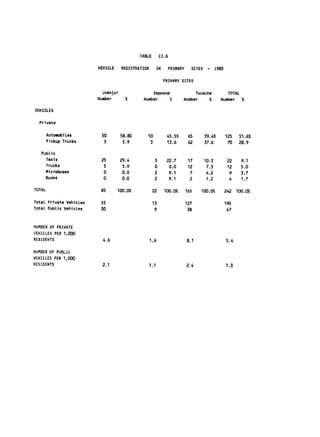
joint costs. For example, were the costs of the ATC system not treated as an
"add-on" to the telephone system, some method would have to be devised to
attribute a portion of the Juanjui earth station's costs to the ATC system.
While a variety of bases could be found (e.g., time spent in ATCs or propor­
tion of telephone channels in Juanjui devoted to ATC service), the choice of


                                   127
one vs. another is arbitrary, and the resultant        cost   allocation   is   not
 meaningful to any decisions that policy-makers face.

      Such marginal cost issues are integral to many of the questions
and problems raised in cost analyses of telephony systems.*          Generally
speaking, telephone infrastructure by its very nature involves an enormous
capital investment in plant and equipment. When, for rate-setting purposes,
one attempts to examine the costs of specific sub-systems of a telephone
network, such as long-distance vs. local calling, telex vs. television vs.
telephone vs. ATC, etc., various schemes are used to separate the costs of
parts of that physical plant infrastructure; however, such schemes are almost
totally arbitrary.   Most of the 2,xisting infrastructure costs are fixed (at
least in the short run); that is, they are not sensitive to changes in tele­
phone traffic.     Therefore, there is no clear way to separate the cost of
operating most components of existing telephone plant into parts necessary for
one use vs. another.

       This is more of a problem when deciding on reasonable prices of services
than when analyzing the marginal costs of various decisions.      For example,
satellite transponder costs probably should not be attributed to the costs of
the RCSP experiment, since the relatively small additional transponder
capacity required by the RCSP's sevcn-site network was not sufficient, at
least in the short run, to necessitate renting more transpcnder space. Thus,
while ENTEL may reasonably include the costs of transponder space in deter­
mining ATC prices, whether to include them in an analysis of ATC system costs
depends on the scale of operation planned.     The remainder of this chapter
discusses these issues in the context of larger rural telecommunication
systems, looking first at telephony and subsequently at ATC services.


Telephone Systems

      ENTEL, like many telecommunication authorities in Third World countries,
is at present considering ways to expand its national telephone service to
underserved rural areas. In its 1985 annual statement (Memoria '85), ENTEL
outlined expansion plans for the next decade, 1986 to 1995. A major goal i­
to install 600,000 new telephone lines in Peru, almost four times more than
have been installed since the establishment of the original tel,'phone network
in t920 (at present, there are 160,000 lines).   To accomplish this goal, the
number of communities served will grow by 50%, from 800 to 1,200 by 1995. As
part of this expansion, priority will be given to the natirn's jungle and
highland regions.

      In 1986, additional expansion plans were announced. An agreement was
reached between ENTEL and the CORDES (regional development corporations) to
co-sponsor 87 telephone projects over the next five years. The latter's
interest was sparked by the RCSP, to which it contributed about $60,000 in
1983.


* The authors are indebted to Douglas Goldschmidt for raising many of the
points made in the following discussion. For further examination of these and
other cost and financing issues, see Goldsclimidt (1978; 1984).
Pleased with the results of this cooperative effort, CORDES has planned to
contribute about $45 million and ENTEL about $78 million to supply or
improve telephony services in about 700 communities, almost 500 of which have
had no services to date. The projects will reach over 4 million people, in
rural areas.

      ENTEL has also formulated a proposal to develop a larger-scale, RCSP-type
system with ATC capabilities in the Andean highlands (for which they are
seeking funding from the Japanese government). The proposed system would add
10 earth stations, 3 TVRO (television, receive only) earth stations, and 23
UHF/VHF radiotelephone links to the existing (rather sparse) telecommunication
infrastructure in eight departments in the Andean region (containing about 4
million people).  How much it will cost to install and operate a system of
this scale depends on a variety of context-specific factors wbich cannot be
ascertained here. Nonetheless, we will consider a system of these dimensions
to get an approximate idea of the costs of a larger in the RCSP-type system,
for Peru or elsewhere, implied by the actual costs incurred in the RCSP.

      The start-up costs of an earth station, as experienced in Juanjui with
the RCSP, were about $645,000 (Table VI.2): $25,000 for basic system studies;
$30,000 for the land; $100,000 for the power generation system; $105,00 for
the telephone office facility and other constructions; and $380,000 for earth
station and telephone plant equipment. Were such equipment to be used in the
Andean region (and if prices were to stay the same, etc.), the costs of the
proposed new earth stations in 10 sites would be about $6.5 million.
Operating costs, judging by Juanjui's RCSP experience, vould amount to about
$50,000/site annually, or $500,000 for the system in total.

      Sometimes, pilot project experience can be used to reduce replication or
expansion costs. Perhaps expenditures on initial system studies could be
less, although a $25,000 per site estimate is below that actually spent on
RCSP system design, procurement, and negotiation. Moreover, the magnitude of
study expenses were spread over a larger number of earth stations, total costs
would not change much. Economies are possible with large-scale procurements
and installations, but there is no basis for making an estimate of such
savings here.

      Whether to go "turn-key" and the degree of redundancy to be built into
future     earth    station equipment are decisions with     significant  cost
implicatiors. As discussed earlier, this was the first time ENTEL did not go
turn-key tn an earth station, and some serious problems ensued. Nevertheless,
ENTEL managers reiterated their commitment to this strategy in future
projects, basically because turn-key arrangements can add 50% to 100% to
equipment costs.      Looking back at Table VI.2, the costs to ENTEL of
installation were about $65,000 or about 30% of basic equipment costs (of
$216,000).     Turn-key     contracts in the future could    therefore   raise
installation costs.

     The decision on how much redundancy to build into the basic earth station
equipment also has cost consequences. In the RCSP,ENTEL experimented for the


                                   129
first time with a non-redundant system in order to reduce system costs.
                                                                         ENTEL
 managers have since stated that future installations would
                                                                   include the
 redundancy normally sought by telecommunications engineers.      On the other
 hand, after initial start-up problems in 1983, there were very
                                                                  few days of
 down-time at the earth station sites in 1984 or 1985 and,
                                                                    if lack of
 redundancy could lower costs significantly, reducing it is probably
                                                                          worth
 considering in future systems.

        As reported in Table VI.3, the total start-up cost for the
                                                                              RCSP's
 radiotelephone system was about $120,000. While the BUDAVOX radio
                                                                          terminals
 clearly should not be used in future systems, the costs incurred in
                                                                         the RCSP
 may reflect the costs of current radio technology. For example, John
                                                                            Tatlock,
 a telecommunications engineer hired by AED in 1984 to examine
                                                                       the RCSP's
 technical problems, estimated that alternative VHF units could be
                                                                         purchased
 for all sites for a total of about $35,000, along with a $1,000
                                                                             battery
 charger for Bellavista (which would lower the recurrent operation
                                                                           expenses
 associated with battery charging), and $500 small solar energy
                                                                     units (which
 ENTEL has used else where to power radiolinks) for the other
                                                                       three sites.
 These costs are consistent with those estimated in Table VI.3, suggesting
                                                                                that
 $3 0 ,000/site start-up costs are not an unreasonable estimate of radiotelephone
system requirements.         Of course, actual costs will depend on a host of
context-specific factors, such as geographical terrain, the availability
                                                                                  of
power, number of channels desired, size of communities, etc. Also,
                                                                         operating
costs will depend on some of these same factors, which in the
                                                                     RCSP led to
different operating costs between Bellavista and the other three
                                                                      sites (about
$9,600 vs. $1,500 respectively).     If costs similar to those of the RCSP were
to prevail in the 23 communities proposed for radiotelephone service
                                                                             in the
Andean region, total start-up costs would be about about $700,000.
                                                                           If eight
of those sites were operated like Bellavista and the other 15 run
                                                                          like the
other three sites, RCSP experience yields an estimate of total
                                                                             annual
operating costs of a little over $100,000.

      The estimates above have not included the costs of the satellite
                                                                         segment
of the telephone network.       The costs of leasing transponder space from
INTELSAT varies over time and according to the type of transponder
                                                                          rented.
When the RCSP began, Peru was renting part of a global transponder
                                                                    beam on the
IV-A satellite, for which INTELSAT charged about one million dollars
                                                                           per 36
mhz. transponder. By the end of the project, Peru was served by the
                                                                     INTELSAT
V satellite,   using a hemispheric beam, for which INTELSAT was charging
$680,000 per 36 mhz. transponder. ENTEL estimates that, using expensive
                                                                            earth
stations, one transponder can supply 355 telephone circuits
                                                                  (each circuit
capable of holding a two-way conversation), yielding an annual
                                                                        cost per
circuit of about $1,900 at current prices. ENTEL also estimates
                                                                   that the iuse
of smaller, less expensive earth stations, as in the RCSP, reduces
                                                                    the number
of circuits available per transponder by about half, so that the
                                                                    annual cost
per circuit for a 6.1 meter earth station are double that above,
                                                                       or about
$3,800.

     Peru now has 12 earth stations in its national telephone network.
                                                                       Given
the excess transponder capacity Peru had when the RCSP began,the
                                                                  RCSP really
did not increase satellite segment cost.    However, if a large-scale system


                                    130
were to be implemented, increased satellite transponder space would be
necessary. How much more is not clear at this point. If, for example, an
average of six channels were made available in each earth station site in the
proposed Andean system, there is the potential for 600 (6 X 10 sites)
simultaneous telephone conversations between a project site and a community
elsewhere in the country.     (It should be remembered that the radio-linked
towns connect to the national network through one of the earth station sites,
so the limit is still 600 occupied circuits).  However, 600 is actually much
greater than maximum current capacity. The total channel capacity of Peru's
existing 12 earth stations is now 206 channels. If all were connected to new
Andean channels, the other 400 Andean channels would have to be connected to
each other, leading to a maximum theoretical limit of about 400 occupied
circuits. With small earth stations, ENTEL would have to rent two and a
quarter 36 mhz. transponders to satisfy peak demand. However, one curtomarily
does not lease transponder space (or build telephone plant) for maximum
capacity, so the question of transponder space costs depends on expected
traffic over the system and decisions about acceptable congestion levels at
peak periods.

       Costs likely to be incurred elsewhere in the network as a result of the
new system also deserve attention. While the small size of the RCSP precluded
the need for large additional expenditures in places like Tarapoto and Lima,
with a larger system costs elsewhere will rise. While one does not have to
match       a new system with channel-for-channel increases in the already
established network, without some increase of channel capacity in other sites
(e.g., Lima), there could be large increases in system congestion and wait
times accompanied by revenue losses due to more non-completed calls. Also, a
large-scale addition to the network would require some increase in general
administrative expenditures.

      Costs will also vary by the number of channels in each site deemed to be
necessary or desirable. In the Andean proposal, each site is to be equipped
with two channels for ATC, one for audio and one for slow-scan TV, and
probably a minimum of two additional channels for telephone, with more in the
larger sites. For most earth stations, the marginal costs of adding another
charnel are relatively small.    In the RCSP, the earth station shelters came
with racks for up to 12 channels, and each channel cost about $6,000
(although, at some point, the need for a larger power amplifier can increase
these costs). The marginal costs of adding more channels to a radiotelephone
system could be greater, although Tatlock's estimate was close to this figure.

     A final issue is whether to include home or office subscribers in the
system. When the RCSP was designed, the initial decision was to install only
public call boxes in the belief that this would provide adequate service and
keep costs down; however, the demand for telephone in homes and offices was so
great that they were eventually installed in the tree earth station sites.
The costs of that decision are not easily calculated, since only a rough
estimate of RCSP external plant costs is available (one source estimated them
at about 45,000 1985 US. dollars), and not all of the external plant costs are
due to home and office subscribers.    Even if costs reached $15,000/site for
about 100 private installations, such an investment may be worth it.        In
1985, private subscribers accounted for 26% of total calls in Tocache, 36%
                                                                             in
 Saposoa, and 40% in Juanjui. It is not certain what proportion of those calls
 would be made from public call boxes if no home or office subscribers were
 allowed. Yet , if one examines the month-by-month traffic data discussed
                                                                             in
 Chapter IV, there seemed to be little drop off in traffic at the call boxes
 when home and office telephones were installed, indicating that much of the
 additional traffic was due to such convenience. In other words, the marginal
 costs of putting in extra local lines at earth station sites may be more than
 offset by the traffic and revenue they generate.


 ATC Systems

      As a result of the RCSP experience, ENTEL has become interested in the
future of ATC services. Such interest has been manifested in a number
                                                                            of
ways: the continued participation of ENTEL's Lima and Iquitos offices in ATCs
for    administrative   and training purposes;   the transference    of   ATC
responsibility to ENTEL's commercial department in an effort to investigate
the marketability of such services to the private sector; and the provision
                                                                            of
ATC services to social sector agencies for development activities as an
integral part of its ambitious proposal for improving the telecommunications
network in the Andean region.

       The costs of future ATC systems are likely to depart significantly from
 those estimated for the RCSP in Table VI.4. The major start-up cost for the
 RCSP's ACT system was the technical assistance provided by A.I.D. contracts
                                                                              to
 HRM and AED, totaling almost $600,000. If Peru expands its ATC service for
 social development, there is now a wealth of experience to draw upon that
 would make such an extensive start-up effort unnecc satry. Whether expensive
 expatriate assistance is necessary to ATC start-up and experimentation      in
 rural settings in other interested Third World countries is an open question
and must be examined in specific contexts. While there is no doubt that the

technical assistance provided 
 through A.I.D. financing was essential to the
RCSP, it is also possible for a country to begin such a project with much more
limited help, even if there are no nationals with ATC experience to draw upon.
Without technical assistance, ATC start-up would fall from three-quarters of
                                                                               a
million dollars to a little over $150,000, yielding a substantial reduction
                                                                             in
the $370 per ATC or $20 per participant-hour per year estimate calculated
earlier, to about $145 per ATC or $8 per participant-hour per year.

      What Peru or another country would spend to plan a larger version of the
 RCSP ATC system is not certain, with or without technical assistance. The
Peruvian planning expenses of about $64,000 (estimated in Table VI.4) were
predominantly (over 70%) for 136 person-months of ENTEL and sector agency
staff time. A larger system might require substantially more planning time,
especially in the project communities. On the other hand, the RCSP planning
period probably lasted much longer than necessary due to delays in system
installation. Moreover, any cost estimate of future planning expenses is made
more uncertain because the effort to be expended on planning is almost totally
descretionary, without any clear cost-effectiveness criteria to guide it.
                                                                           (In
its Andean region proposal,      ENTEL estimated a $.000,000 cost for ATC
applications, although this may include some operating expenses in addition to
planning effort.)

     Start-up equipment costs could also be reduced in the future. ENTEL has
been experimenting with ways to provide part or all of the Dantel/Darome ATC
equipment itself. If the ATC equipment were purchased for prices similar to
those incurred in the RCSP, the cost per site would be about $5,800 installed.
To this figure would have to be added the costs of the necessary bridges,
about $1,900 each installed.

      In estimating the costs of ATC service in the RCSP (Table VI.4), the
equipment cost of an extra telephone channel at each earth station devoted to
ATC use was included in start-up costs (about $6,000/channel). This is not
the only way to approach such costing. For example, in its present efforts to
calculate a price for ATC services, ENTEL includes a proportion, based on ATC
usage, of the costs of the entire RCSP earth station-radiolink system, as well
as a proportion of the costs of the existing telecommunications infrastructure
serving Tarapoto, Iquitos, and Lima. Such calculations may be justified for
pricing purposes; however, for decision-making marginal cost thinking should
prevail. If providing ATC services is considered as a separate component that
could be added to an existing or planned telephony infrastructure, then the
marginal cost question focuses on the additional costs resulting from this
decision.    In terms of telephony equipment costs, if a channel is to be
devoted exclusively to ATC use, the cost of an additional channel seems to the
best approximation. On the other hand, if a channel at an already existing
telephone plant were to be devoted wholly or partly to ATC use, it is not the
equipment cost that should be counted, but the annual telephone revenue lost
by removing a channel from commercial telephone service.

      As mentioned earlier, the RCSP experience does not    provide an adequate
guide to the future costs of a radiotelephone system.         Thus, the costs of
including an extra channel for ATC use in a larger-scale    system are uncertain
and would have to be examined in the context of specific    requirements. Using
Tatlock's cost estimate mentioned earlier as a base, an      extra channel in a
radiotelephone might approach the $6,000 figure estimated    for an earth station
site.

      The operating costs of a larger ATC system would, of course, be larger
than those incurred in the RCSP. More personnel time would be needed, perhaps
in central planning effort (estimated at 42 person-months of staff time in the
RCSP), and especially in the project communities themselves and in regional
centers (there were about 65 person-months of regional ENTEL and sector agency
staff time devoted to ATC annual operations in the four-site RSCP operation).
Travel and maintenance zosts would also be greater in a larger system, and
some vehicles probably would have to be purchased at system start-up. Not
included in the RCSP ATC cost estimates were local facilities provided for ATC
use. In the RCSP, ATC rooms were either donated by the community or were used
for other purposed as well as ATC and did not clearly represent an add-on
expense. In one report, ENTEL estimated the value of an ATC room at the
equivalent of a $5/hour rental fee. How suitable space would be provided for
ATC conferences in an expanded system is obviously an issue that depends on
the local   context.
        The satellite segment costs of an ATC system could be very low.
                                                                          Although
 the ATC system originally used a separate circuit for each
                                                                 site, that design
 was eventually changed so that all sites together used the
                                                               same circuit. This
 required using the same uplink and downlink frequency and
                                                                the satellite itself
 as the bridge to connect them. Although such a strategy threatens
                                                                         privacy in
 site-to-site conversations, the reduction in costs is substantial.
                                                                      If ATC use
 is less than full-time, the equipment could be designed
                                                                    so that ATC
 transponder space and ATC channels are switched to commercial
                                                                     telephony use
 during non-operational hours (in which case, any extra telephone
                                                                           revenues
 could be considered an offset to equipment start-up costs).
                                                                  In a large-scale
 ATC system, however, utilization probably would be intensive
                                                                  and therefore a
 dedicated channel will likely be required.

 Summary ofAndean Region Cost Estimates

      Rough cost estimates for a project on the scale of ENTEL's
                                                                         proposed
Andean region project are displayed in Table VI.5. These
                                                             figures should not
be compared with the estimates made by ENTEL in its own
                                                                  Andean region
proposal, since that project differs in a variety of ways from
                                                                 what was done
here.    ENTEL's project envisions the use of 4.5 meter earth stations;
includes television service extension, as well as slow-scan                     it
                                                             TV as a part of
its ATC service system; and at least four telephone channels
                                                             would be supplied
to each community. In the system for which cost estimates
                                                                are provided in
Table VI.5, the following is assumed: that 10 communities are
                                                                  provided with
6.1 meter earth stations, with 6 channels each (one for
                                                                ATC); that 23
communities are provided with 2-channel radio telephone systems,
                                                                    (one channel
for ATC); that another 20 communities with existing telephone
                                                                   infrastructure
are equipped with an extra channel for ATC use; and that all
                                                                53 communities
are supplied with ATC equipment.

       Table VI.5 estimates total start-up costs for the system at
                                                                       about $8.3

 million, with annual operating expenditures equal to about
                                                              $817,000. 
 If the
establishment of the ATC system were considered as a separate
                                                                   decision from

the telephony network, 
 Table VI.5 shows that add-on co,,ts
                                                              for ATC start-up
would be about $1.2 million and annual operating costs about
                                                                 $157,000.     Not
included in these system operation costs is the rental of additional
                                                                          satellite
transponder space which would almost certainly be required.
                                                                    As discussed
earlier, how much transponder space to rent would depend
                                                              on peak use and
decisions about acccptablc congestion levels.   If, for example, ani additional
half transponder were to be leased due to the establishment
                                                                  of the system
(yielding about 90 telephone circuits), annual operating
                                                             costs (at current
prices) would increase by about $340,000. Again, very little
                                                                of this expense
should be considered part of ATC system costs, assuming
                                                                privacy is not
required and all ATCs can use the same uplink and downlink
                                                             frequencies. Also
not considered in Table VI.5 are the costs of any evaluation
                                                               effort.
      Finally, it must be emphasized that, without detailed feasibility
                                                                          study,
estimates of unit costs are highly speculative. However, if
                                                              the 53 community
telephone system were to have traffic patterns similar to those
                                                                 of the RCSP in
a

                 COSTS OF A LARGER-SCALE (53 COMMUNITY) RCSP-TYPE SYSTEM

                           (in thousands of 1985 U.S. doLLars)


START-UP                                       TOTAL COST

                         b
Earth station system                           6,443.0               77.4%
                             c
RadioteLephone system                             683.1                8.2
           d
ATC system                                      1,197.4              14.4

                                               8,323.5              100.0%


OPERATIONS                                    ANNUAL COST               %

                         e
Earth station system                             484.0               59.2%
                             f
RadioteLephone system                             176.4              21.6
             9
ATC system                                        156.9              19.2

                                                 817.3              100.0%
Footnotes to Table VI.5

     a.     The overall dimensions of the system are as follows: 6-channel, 6.1
            meter    earth station systems are installed in 10 sites;         23
            communities are provided with 2-channel radio telephone systems;
            another 20 communities with existing telephone system infrastructure
            are provided with an extra channel for ATC use; and all 53
            communities are supplied with ATC equipment.

     b. 	   This is based on replicating RCSP earth station system       start-up
            costs of $644,300, as given in Table VI.2, for 10 sites.

     c. 	   This is based on replicating the RCSP's radiotelephone       start-up
            costs of $29,700 per site (Table VI.3), for 23 sites.

    d. 	    this is based on RCSP results presented in Table VI.4, modified as
            follows: planning the ATC system is assumed to cost $200,000; ATC
            equipment costs $5,800 installed per site for each of the 53 sites;
            10 bridges are needed at $1,900/bridge installed; 53 additional
            channels, one for each site, are installed at a cost of $6,000/site;
            and 3 project cars and 3 motorcycles are needed at a total cost of
            $35,000.

    e. 	    Assumed to be the same as a Juanjui, for 10 sites.

    f. 	    This is equivalent to 14 sites with operating costs similar to
            Bellavista and 29 with costs similar to the average of the other 3
            RCSP radiolink sites.

   g.         This is based on RCSP results presented in Table VI.4, modified as
             follows:  central personnel time in Lima is doubled to 84 person­
            months; ENTEL and social sector agency staff time in the 53 Andean
            region communities averages 6 person-months/site; plus 5 full-time
            regional people, yielding a total of 378 person-months; travel and
            miscellaneous expenses are assumed to be about 6 times as great as
            in the RCSP, totaling about $15,000 and $10,000 respectively; and
            maintenance costs are estimated at 2% of equipment start-up costs.
1985 (with 10 sites similar to Juanjui, 14 to Bellavista, and 29 to what the
smaller RCSP sites could have attained with reliable service), the total
annual number of calls completed in the network would be about 560,000.
Amortizing     the   telephone system capital costs given in     Table    VI.5
(supplemented by an estimate of $87,000 for the infrastructure costs of those
20 sites already assumed to have a radiotelephone system) and adding them to
operating costs (including $340,000 for transponder rental) yield an average
cost per call of about $3.80. Similarly, if a 53 community ATC system could
sponsor about 1,560 ATC per year (6/day for 260 days/year), each involving an
average of 8 sites and 48 participants, the average cost per ATC (including
amortized start-up costs) would be about $213, with an average cost per
participant-hour of about $4.50.


Costs in Context

      Economists     often try to estimate the benefits of public      sector
investments in monetary terms. Although this approach occasionally has been
attempted for rural telecommunications, it is fraught with serious problems.
Demand curves, which are one basis for such calculations, are extremely
difficult to estimate; the unique contribution of telephone services to
business profits is almost impossible to isolate; and the types of benefits
provided by ATC and telephone to social service agencies are not easy to
quantify in monetary terms. Such approaches have proved to be inapplicable in
the RCSP setting. To obtain reasonable demand curve estimates would have
required ENTEL to engage in extensive price experimentation which it did not
wish to do. Business people, probably due to the permeation of the illicit
drug business in the project zone,         were reluctant to be interviewed
extensively and, when they did consent, it was not possible to estimate with
any precision the impact of ATC services on the three development sectors, let
alone to quantify such impacts in monetary terms. Nevertheless, some of the
information collected can help ENTEL's decision-makers and others interpret
costs in the context of the RCSP's value to telecommunication users. In this
section, we will analyze indirect indicators of the value RCSP clients placed
on     telephone services and consider the degree to which ATC services
substituted for alternative forms of communication.


Telephone Services

      It is an axiom of economic analysis, as well as a generally suppoited
observation, that the value of a telephone call can be far greater than the
price paid for it, not only when it facilitates a business deal or speeds
delivery of needed supplies, but also when it simply puts someone in contact
with distant family and friends. While there are no universally accepted or
applicable indicators of the value individuals place on ielephone calls, there
are a variety of indirect indicators that shed light on the importance and
value individuals attach to the telephone in specific contexts. In the RCSP,
one such indicator was the time people were willing to spend in ENTEL offices
waiting to complete their calls. As reported earlier, the average wait time
was 51 minutes, with a standard deviation of an hour and a quarter.
 Consequently, there were many people who waited two or more hours to complete
 a call.   Moreover, waiting time varied considerably by site, with higher
 average times reported in all the radiotelephone sites and in Tocache.
 Although the value of such waiting time is debatable, given wage and salary
 rates in the project zone and the characteristics of the clientele surveyed at
 ENTEL offices throughout the project, an hourly opportunity cost of $1.00 does
 not seem unreasonable.   Given that the price of an average call was about
 $1.15 (see the following section), one way of interpreting the opportunity
 cost estimate above is that, on average, clients valued telephone calls at
 least 70% more than what they actually paid for them.

      A second indirect indicator of the value of the telephone is the extent
to which individuals reported expending more effort than just waiting time at
ENTEL offices. Many clients, in fact, traveled from surrounding communities
in order to place calls. Of the 1,775 individuals surveyed at ENTEL offices
in 1984 and 1985, 222 or 12.5% said they had journeyed to the town in which
they were surveyed (this does not include the additional 20% of the sample
that were in transit).    Of these 222 individuals, 80% said the principal
motive of their travel was to use the telephone system. Moreover, many
traveled a considerable distance; about half reported trips of more than 20
kms.

      This behavior highlights two important aspects of the value of RCSP's
telephone services:    first, that they served surrounding communities as well
as the towns in which they were located; and second, that many individuals
made substantial efforts to use them.        If the sample percentages reported
above are representative of the system as a whole, they indicated that of the
approximately 150,000 telephone calls completed from public call boxes during
the RCSP experiment, about 19,000 were made by individuals from surrounding
communities. Moreover, the principal travel motive for approximately 15,000
of these clients was to use the telephone system, and almost 7,500 traveled
over 20 kms. to do so.         While it is difficult to place a value on such
behavior, self-reported estimates of the costs of travel averaged about $7,
indicating the high value some users placed on access to telephone services.

      A more direct indicator of the value of telephone services was derived
form answers to survey questions concerning how individuals would have
communicated were there no telephone system available. While some of this
information was reported in Chapter IV, Table VI.6 repeats summary frequencies
for the alternative communications options indicated and adds the clients'
estimations of what such alternatives would have cost. Travel (to the actual
call destination or to another public phone site) and sending a telegram were
the most expensive alternatives, but all the alternatives cost more on the
average than the $1.15 charged for the typical call. Moreover, the cost of
these alternatives, except for travel, do not include the costs of completing
the two-way communication links allowed by telephone.

      From an economics perspective, the costs displayed in Table VJ.6
represent an estimate of the resources saved due to the existence of the
telephone system.  If the "don't know" and "do nothing" alternatives imply
TABLE   VI.6


            DISTRIBUTION AND COST OF ALTERNATIVE COMMUNICATIONS OPTIONS

                                    (n = 1,775)


COMMUNICATION 
              DISTRIBUTION 
         AVERAGE REPORTED COST

  OPTIONS 
                  (in percent) 
         (in 1985 U.S. dollars)


Don't know 
                     4.2


Nothing 
                        4.7


Letter

  - Official mail 
             19.5 
                        1.25

  - Commercial service 
        29.1 
                        1.45


Telegram 
                      30.3 
                        5.05


Travel 
                         8.7 
                       28.50


Radio Message 
                  2.4 
                        1.75


Other 
                          1.1 
                        1.30
zero cost, the weighted average of the costs of these alternatives was about
$4.75 (Table VI.6).   Earlier in this chapter, the average cost per telephone
call of earth station telephone service in Juanjui was estimated to be $3.25.
Comparing these costs with the $4.75 estimated above yields a benefit-to-cost
ratio of almost 1.5 to 1 ($4.75/$3.25).    Since costs vary form site to site,
so will this ratio, but it is only in the three smaller communities that it
would be less that one. If we consider the RCSP system as a whole and rely on
the very rough estimate of the overall average cost per call of $4 made
earlier, this one benefit more than covers the cost of the system, with a
benefit-to-cost ratio of about 1.2 to 1 ($4.75/$4.00).         Moreover, for
business users the reported costs of communications alternatives         were
estimated to be substantially higher, averaging about $7.30, principally
because business users indicated they would have to travel twice as often as
the average user if there were no telephone service available. This indicated
an even higher benefit-cost ratio for this group.

      Given the unreliability of self-report estimates of alternative behaviors
and costs, too much credence on the specific numbers estimated above would be
unwarranted; however, they do provide some notion of the benefits clients
attribute to the establishment of local telephone service. Furthermore, such
benefits go well beyond the direct monetary savings associated with two-way
telephone communications per se. For example, in 1985 about 39% of business
users surveyed immediately after completing calls said that, in the absence of
telephone, it would have take two to five days to complete the communication
they had just made. Eight percent reported it would have taken more the five
days.    while it was not possible to get an estimate of the impact of such
delays on profits, they could be substantial in many cases.      Considerations
such as these, as well as the value individuals place on just staying in touch
with families and friends, make telephone service a highly demanded service
and underscore the importance governments and aid agencies are placing on the
telecommunications sector.

ATC Services

     Although ENTEL offered ATC services free of charge to three development
ministries throughout the RCSP, the latter incurred significant costs to
develop and use the ATC system. Ignoring the technical assistance provided by
AID,about 20% of the approximately $160,000 in other ATC system start-up costs
estimated in Table VI.4 were incurred by agricuiture, education, and health
sector agencies. Also, over one-third of the estimated $33,000 in 1985 annual
operating costs were personnel and support expenses assumed by these agencies.
This estimate does not include the additional effort, time, or expense
incurred by individual staff members to attend ATC sessions in various
locales.

     Since San Martin's citizens are the ultimate beneficiaries of the ATC
system, the value which agency representatives assign to ATC activity cannot
be interpreted in the same way that one can interpret the value consumers
place on telephone services.    Nonetheless, in terms of the more practical
world of policy choices, it was clear that development agencies judged ATC
services to be sufficiently valuable that they were willing to devote a


                                   140
significant amount of their own resources to developing, planning, and using
the system.

     It is also possible to examine training uses of audioteleconferencing from
the perspective of what alternative communication mechanisms might have cost
to accomplish the same goals. In 1985, about 60% of the 392 ATCs held
constituted some form of in-service training, often with a specialist from
Lima providing the instruction. The closest equivalent alternative to an ATC
o this type was traditional, face-to-face instruction, whereby a specialist
from Lima would be brought to the project zone. (Instructional radio is not
conceived to be a suitable substitute for most of this specialized training
given its lack of two-way interaction and its inappropriateness for small
audiences.)    As a rough approximation, consider the following minimal cost
estimates of bringing a Lima specialist to run single-day workshops in just
Tarapoto, Juanjui, and Tocache:

    -   Lima specialist's time (3 days at $20/day)        $ 60

    -   Air travel                                         130

    -   Per diem for specialist (3 days at $30/day)         90

    -   Miscellaneous (local   transport,   aiiport         15
        transport, etc.

                                                          $295


     In Table VI.4, the average cost per teleconference which typically
included three sites in the project zone as above, was estimated at $370.
However, this includes the amortized value of the very substantial technical
assistance devoted to the pilot project.      if we were to include amortized
start-up costs without the technical assistance component, the cost per ATC is
about $145. The latter cost estimate is probably the more reasonable point of
comparison for future ATC uses, since it is unlikely that such extensive
start-up efforts ill be devoted to future ATC projects.      if this is so, the
figures promis substantial cost savings for running instructional seminars
via ATC instead of face to face.

     However, for a number of reasons the comparison should not be taken too
far.    First, face-to-face instruction offers some advantages due to the time
available for longer sessions and for considerable more interaction with
visiting specialists.    At the same time, competing demands on specialists'
time combined with tight travel budgets limit agencies' ability to run such
face-to-face seminars. Moreover, the comparison above was made in the context
of a relatively small pilot project.     In a substantially larger ATC system,
there would be no point in comparing its costs with traditional face-to-face
formats, for the latter wouid be virtually impossible to execute.

     This fact gets at the heart of the ATC decision     question.  The
establishment of an ATC infrastructure allows for a range of education,


                                     141
communication, and service alternatives that were not within the realm of
possibility    before.  In     addition to    instructional    uses,   potential
administrative and medical applications of an A.TC network permit changes in
management procedures and in service provision that were previously not
 feasible. Moreover, a large-scale ATC system opens many more possibilities.
For example, with the Benor-type agricultural extension system employed in
Peru, many small towns have a local farmer designated to work with extension
agents. If many small communities had ATC capabilities, a multitude of new
applications in agriculture would be available.          Similarly,   a larger
system could extend ATC options in health and education. Finally, there are a
range of ATC applications in the private sector that could be explored beyord
simply selling ATC time to private firms. For example, business people in the
RCSP zone expressed interest in having a series of courses on small business
management issues.

     Because an ATC network         offers such a variety of potential uses,
the decision of whether to establish one becomes quite complex. Such a
decision does not depend simply on a comparative cost-effectiveness analysis
of one use of ATC vs. an alternative, even if such an analysis could be
adequately done. The decision to establish an ATC network rests ultimately on
the perceived value of all its uses, and the RCSP provided only a sample of
the uses to which a larger system could be put.


Financing   Issues

      Cost     analyses provide information useful to two types of policy
questions: the "is it worth it?" question discussed above and the "if it is
worthwhile to do, how do we pay for it?" question discussed here. A key
 financing issue for some time to come is the extent to which public subsidiza­
tion will be required. One important source of revenue is that provided by
normal telephone ;ervices. Table 7 presents revenue received from commercial
telephone services in the seven RCSP sites in 1984 and 1985. Total system
revenues increased about 10% between 1984 and 1985, from $118,000 to $130,000
(this was considerably smaller than the over 40% increase in traffic between
1984 and 1985 because prices did not rise nearly as fast as inflation). The
two largest communities, Juanjui and Tocache, generated most of the system's
revenue, about 80% each year.        The smaller towns generated very little
revenue.   Although revenues did vary with population size, the relationship
was not strictly proportional: in 1985, revenues generated per capita ranged
from about $.10/person in Huicungo to $.90/person in Bellavista, to $2.10 in
Saposoa, to $3.80 in Juanjui.

      The   financing   problem   that    has  inhibited   growth     of   rural
telecommunication systems becomes evident when one compares RCSP revenues and
costs. In most sites, 1985 revenues were not adequate to cover annual
operating costs, let alone contribute to capital recovery.         In Juanjui,
revenues were less than a thousand doliars greater than the operating cost
estimates presented in Table VI.2.      While Tocache probably generated a
somewhat greater excess, all other sites did not cover operating costs. While
operating costs in Saposoa were probably lower than in Juanjui, they were
still more than the $17,500 generated.     In Bellavista, operating costs were
estimated to be about $4,000 greater than the revenue generated, while the
shortfall in the other three sites averaged about $1,000.      In total, annual
TABLE VI.7

                   RCSP TELEPHONE SYSTEM REVENUES
                     (in thousands of 1985 U.S. dollars)


EARTH STATION SITES 	                      1984             1985


Juanjui   -   call box                     33.5             29.0
              subscriber                   16.7             20.2

                                           50.2 	           49.2

Saposoa 	 - call box                       12.5             10.8
         - subscriber                       5.1              6.7

                                           17.6 	           17.5

Tocache 	 - call box                       34.1             42.9
        - subscriber                        9.8             13.4

                                           43.9             56.3

Earth Station Total                       111.7            123.0


RADIO TELEPHONE SITES

Bellavista                                  4.4              5.7

Huicungo                                       .4             .4

Pachiza                                        .7             .7

Tingo de Saposoa                               .4             .6

Radiotelephone Total                        5.9              7.4


RCSP TOTAL 	                              117.6            130.4
operating costs for the RCSP netwock probably exceeded telephone revenues by
 $10,000 to $20,000.

      There are some qualifications to the above picture.      First, telephone
traffic in the smaller sites was certainly constrained by the unreliability of
the BUDAVOX technology. Second, the data pertain to only the first two years
of system operations. Continued traffic growth should generate additional
revenues. Third, there were other sources of revenue in some of the communi­
ties such as telegraph and, more recently, telex services.      Also, although
telephone authorities often do not pay attention to this factor, revenue is
generated in other sites through call-ins to any new network. Nonetheless, it
is still highly likely that future rural telecommunication systems will not
generate sufficient revenue to cover all costs. If. these systems are consid­
ered worthwhile, the question then becomes how to cover the shortfall.

      There are really two sets of strategies to consider related to financing
rural telecommunications.   The first pertain to reducing shortfalls, either
by increasing revenues or by reducing costs or both. The second deals with
sources of funding to cover the remaining shortfall.         To conclude this
section, we discuss each set of strategies in turn.

     As discussed earlier, technological advances are the major hope for
lowering the costs of future systems. Even with present technologies, costs
for rural earth stations will be lowered as higher power satellite systems
begin to operate commercially.    Also, with present technologies, production
and installaion economies of scale could lower costs substantially if govern­
ments were to commit themselves to significant expansion in rural areas.
The RCSP experience demonstrates that radiotelephone systems are a viable
technology for extending telecommunication services to rural areas. Atten­
tion to choosing a more reliable and efficient radiotelephone system could
reduce the costs of providing services to small towns.        The concession
approach ENTEL employed in the three smaller towns has the potential for
keeping operating costs below revenues, provided low maintenance and low
energy consumption technologies are used.

      Various strategies can be employed to increase revenues.        Installing
telephones in homes and offices at the RCSP's three earth station sites did
seem to increase traffic significantly.    Further expansion is still possible,
as evidenced by the long waiting lists of customers for home and business
service. There is also some evidence, as discus:ied in Chapter IV, that adding
channel capacity to larger sites can increase traffic.    As another strategy,
installations could be concentrated in larger towns, those capable of
generating more revenue.    However, it is precisely this approach that has
predominated historically, and it has restricted greatly the spread of rural
telecommunication services. Moreover, as the data from the RCSP indicated, it
is not clear that smaller towns operate at a much greater loss than larger
ones.

      Clearly, a major revenue issue facing all telecommunications agencies is
pricing policy. Some argue that raising the price of telephone service could
increase revenue, but this depends on how sensitive telephone use is to price
increases. The 10% rise in revenue in the RCSP between 1984 and 1985 compared
to the 43% increase in traffic can be seen as indicating that raising prices
more rapidly would have yielded increased revenues. On the other hand, it is
possible that a major reason traffic increased so much was that the real cost
of telephone calls declined. Although telephone charges are low in Peru by
industrialized country standards, they are quite high when considered in
context. The cost of the average long distance call represented 0.6% of the
average family's monthly income in Juanjui and 1.3% of income in Huicungo.
Several such calls a month are a significant expense, especially when one
considers     the limited portion of rural family incomes available       for
discretionary purposes.

      Additional revenue might be generated by other       telecommunication
services, such as telegraph, telex, or television. If an ATC system is estab­
lished, it, too, could generate revenue. However, the extent of cost recovery
would depend on the degree of private sector interest in ATC use as well as
the ability of social sector agencies to stretch their budgets to cover ATC
fees in addition to the other expenses an ATC system requires of them.

      Regardless of the extent to which such strategies could reduce costs or
increase revenues, it is likely that rural telecommunication systems will
require subsidization for the foreseeable future. Present practice has largely
been confined to financing rura' expansion through cross-subsidization within
the telecommunications agency, in other words, redeploying profits from urban
and long distance services.     If this policy remains the sole source for
expanding rural telecommunications in the future, however, little progress
will occur.

      As the societal benefits of rural telecommunication systems become more
widely recognized, the possibility of subsidies from other sources is
increasing. First, bilateral and multilateral aid agencies are becoming more
interested. A.I.D. helped finance the RCSP, and Peruvian officials are
currently exploring the possibility of Japanese financing of the proposed
Andean region system. Second, national agencies such as ENTEL are recognizing
the potential contribution !ocal and regional agencies can make.              The
agreement ENTEL      reached wiih Peru's regional     development    corporations
(CORDES) is one example.         Another is the    local    interest  manifested
during the RCSP in donations of land for ENTEL offices and of space for
ATC use.     Finally, in spite of serious financial constraints, as governments
come to acknowledge the social value of rural telecommunications, chances
increase that they will begin to subsidize such investments from general
revenues, as they do now in agriculture, education, health and transportation.


Conclusions

      Table VI.8 summarizes the telephone system cost estimates discussed in
this chapter.     The start-up costs of earth station telephone service, as
typified by the experience in Juanjui, were about $644,000, with annual oper­
ating costs of about $48,000. Based on 1985 traffic, this yielded an average
cost per call of about $3.25 (all average cost figures include amortized
start-up costs). The costs of adding radiotelephone linkages to such an earth
station system are considerably less, although they vary depending on the
particular characteristics of the site. For the largest radiotelephone system
site, Bellavista, start-up costs were estimated to be about $30,000, annual
operations costs about $9,600, and the average cost/call about $2.20. In the
smaller radiotelephone sites, start-up costs were estimated to be about the
TABLE VI.8

                    TELEPHONE SYSTEM COST SUMMARY
                         (in 1.985 U.S. dollars)


                       Start-up           Annual      Average
                                        Operations   Cost/Call

Juanjui

  Earth Station

  System               644,000            48,000 
       3.25


Bellavista

  Radiotelephone

 System                 30,000 
           9,600        2.20


Smaller Town
  Radiotelephone
 System                30,000              1,500        7.10


Overall RCSP
 System             2,000,000           150,000         4.00


Larger-Scale
  53 Community
  System            7,126,000         1,000,000         3.80
same as for Bellavista.     However, due to low traffic demand aJiowing a
concessionaire operation (as opposed to a full-scale ENTEL office as in
Bellavista), operating costs were much lower, averaging abc'ut $1,500/site.
The considerably lower traffic. however, also produced a substantially higher
average cost/call, estimated at about $7.10.

      Considering the RCSP system as a whole, Table VI.8 provides a rough
estimate of the total start-up costs of the seven-site network equal to about
$2,000,000, with annual operating costs of about $150,000.      This translates
into an average cost per call of about $4.00.    These estimates were used to
project the expense involved in a larger-scale regional network, similar (but
not identical) to ENTEL's current proposal to extend rural telecommunications
to 53 communities in the Andean highlands. Start-up costs for the latter were
estimated to be about $7.1 millioa, with annual operating costs of about $1.0
million (including an estimated $340,000 for transponder space).     What the
average costs of such a system would be is purely speculative, depending on
the particular characteristics of the communities selected and the consequent
demand for telephone service. However, it was estimated that if demand were
similar to that observed in RCSP sites, the average cost per call would be
about $3.80.

      To gain some perspective on the value people place on telephone service,
we examined a number of indirect indicators provided by the interview data.
Clients often spent several hours waiting to complete their calls. Many
traveled considerable distances and incurred significant expenses to use the
telephone. About 10% of the 150,000 telephone calls completed from public
call boxes were made by people from surrounding communities whose principal
reason for traveling was to use the telephone.      People  reported spending
about $7 for such trips and about half of those individuals traveled over 20
kms.    Another indicator of the value of telephone services to clients was
derived from their responses to questions about how they would have communi­
cated without the telephone (not at all, letter, travel, telegram, etc.). The
average cost reported for these alternative methods was about $4.75. This one
measure of the benefits of telephone system service more than covers the
overall cost/call estimate of $4.00, yielding a benefit-to-cost ratio of 1.2
to 1 ($4.75/$4.00).

      Table VI.9 summarizes the basic costs of adding an ATC system to an
already established telephone infrastructure, as discussed in this chapter.
The first column contains the historical costs of the RCSP ATC system. Start­
up costs were about $750,000 and annual operating costs about $33,000. With
392 ATCs held in 1985, averaging about 18-19 participants, an average cost per
ATC of about $370 was calculated, equal to about $20 per participant-hour.
Even if future technology and prices changes are ignored, such estimates are
unlikely to be representative of future system costs, given that 80% of start­
up costs were spent on extensive technical assistance which could be consid­
dered a one-time only R & D effort, at least for Peru. The second column of
Table VI.9 reports the cost estimates for the RCSP ATC system without such
technical assistance.  Start-up costs here are at a much reduced level of
$158,000 and annual operating costs are $33,000. Such a system would produce
an average cost per ATC of about $145, or about $ per participant-hour.

     Finally, as reported in Table VI.9, the start-up costs for a 53 community
regional ATC network were projected to be about $1.2 million (including a
TABLE VI.9

                     ATC SYSTEM COST SUMMARY
                        (in 1985 U.S. dollars)


                                   RCSP ATC System    Larger-scale
                     RCSP ATC       Without Tech.     53 Community
                      System          Assistance         System


Start-up             750,000             158,000        1,197,000


Annual Operations     33,000                 33,000       157,000


Average Cost/ATC         370                    145           213


Average Cost/
  Participant-Hour       20                      8              4
modest amount of technical assistance), with an annual operating cost of about
$157,000. Whether the average costs of such a large system would be higher or
lower than the $145 per ATC or $8 per participant-hour estimate would depend
on system use. Just for speculation, it was estimated that if 1,560 ATCs
cnuld be run each year (6/day for 260 days), involving an average of 8 sites
and 48 participants, the average cost per ATC would be about $213 and the
average cost per participant-hour about $4.

      One way of getting some perspective on the value of ATCs is to consider
how much it would cost to provide comparable services in alternative wa"s.
About 60% of the 392 ATCs held in 1985 were for some form of in-serv.ce
training, often with a specialist from Lima providing the instruction. If, as
an alternative, a specialist from Lima were brought to three sites (which is
what the typical ATC included) to deliver training, it was estimated that the
cost would be about $295. This is over twice the average cost ($145) esti­
mated for the RCSP's ATC program (without technical assistance). While face­
to-face instruction and personal interaction have certain advantages over
ATCs, the practical reality is that in most Third World contexts extensive
training of this type exceeds staff and budget capacities. In a large-scale
ATC system, face-to-face instruction is not a practical alternative to ATC
training.   Indeed, this is the basic problem encountered when valuing an
innovation such as telephone conferencing; it makes possible completely new
forms of communication. Thus, dOciding whether to invest in an ATC system
involves balancing its probable costs with some estimate of the value of the
communication tasks it could perform.

      Given the increasing belief that rural telecommunications are a worth­
while societal investment, more attention is being paid to the question of how
to finance them.     While the FCSP generated telephone revenues of about
$130,000 in 1985, that figure did not cover system operating costs (probably
falling short by about $10,000 to $20,000), let alone contribute to capital
recovery. Such data should come as no surprise. They are the main reason
rural telecommunication systems have been slow to expand in Third World
countries. Rural telephone revenv !s have rarely covered costs. Furthermaore,
it is unlikely that they will do so consistently in the near future.
Confining the financing of rural systems to cross-subsidization from urban
telephone system revenues will continue to limit expansion. However, as the
societal benefits of the RCSP and other rural telecommunication systems are
more widely recognized, there is hope that more financing will be forthcoming
from general government revenues, from international aid, and perhaps even
from local and regional organizations.
VII.   CONCLUDING LESSONS AND ISSUES


      Innumerable RCSP accomplishments and problems have been
                                                                      reported in
 previous chapters. What remains are a smaller number of
                                                              lessons and issues.
 Following a brief summary of the RCSP's major achievements,
                                                                     this chapter
 presents the project's major lessons in the hope that they may
                                                                  prove useful to
 the planners, administrators, evaluators and funders of
                                                            future systems.     It
 concludes with some general observations about the role of
                                                             telecommunications
 in development.


 RCSP Achievements

       Following a protracted period of procurement, installation
                                                                      and testing,
  the earth station eauipment functioned reliably throughout
                                                             the projetc. De­
 spite the problems detailed in Chapter III (e.g., transmitter
                                                                 burnout, failure
 of two installations to meet INTELSAT performance requirements,
 instability), the earth stations were only out of service                satellite
                                                           an average of eight
 days each in 1984, and no full days in 1985. Moreover,
                                                             clients' assessments
 of the technical quality of their telephone calls were consistently
                                                                         positive.
 Thus, the RCSP clearly demonstrated that, even with relatively
                                                                    low powered
 INTELSAT satellites, small earth stations can function quite
                                                                  well. Moreover,
 such equipment can be adequately maintained and operated
                                                                 in remote rural
 areas, even in towns where no commercial electricity is available.

       The chronic technical problems experienced throughout the
                                                                   RCSP's secon­
 dary network were due principally to the uneven performance
                                                             of the BUDAVOX
 radios which proved to be antiquated, unreliable and extremely
                                                                  difficult to
maintain. By the end of the project, there was general
                                                            agreement that the
hasty insertion of such equipment in 1984 had been a costly
                                                                 error. At the
same time, when the BUDAVOX equipment worked, it produced
                                                                  a good quality
signal.   This fact reinforces the view that radiotelephones linked
lite earth stations can be a technically viable and cost-effective      to satel­
                                                                      means for
expanding rural telecommunications. ENTEL has accepted such
                                                                a proposition as
the basis for expanding its rural telecommunication network
                                                             in the future.
      The RCSP also demonstrated that off-the-shelf and relatively
                                                                    inexpensive
ATC equipment could work-well as part of a rural telecommunications
                                                                       network.
The quality of the ATC audio signal was acceptable at both
                                                            earth station sites

and radiotelephone sites (when the 
 later were functional,
                                                            of course). Little
equipment maintenance was required, and system operation needed
                                                                 only moderate
technical support.

      On the programmatic side, the RCSP alsc demonstrated some
                                                                      impressive
achievements.    As a result of the pilot project, telecommunication services
were brought to seven towns in a frontier area important to
                                                             Peru's development
goals. According to previous plans, these towns would not
                                                           otherwise have been
integrated into the national telephone network until 1995.
                                                                  Moreover, the
telecommunication services that ENTEL expanded inSan Marlin
                                                                   wrg._iLiUizh
extensively. Over 200,000 telephone calls were completed from
                                                                the seven
project towns during the two and a half years of th2- demonstration.
                                                                        Demand
for telephone services grew steadily during this period, and
                                                                such growth is
likely to continue. This trend was especially notable among business owners
and managers. While the average client was generally more well-to-do than the
average resident, individuals from low-income families also made use of the
system. For example, in Juanjui, the largest RCSP site, family income of the
average telephone caller was only about 14% higher than the average family
income of those residents who had never used the system.

      Another RCSP achievement was the degree to which the ATC system was
utilized. During 1984 and 1985, 658 audioteleconferences were held, totaling
about 12,000 person-hours. About 80% of the agriculture, education, and health
agency personnel in the three earth station sites participated in some form of
ATC. Development sector workers assessed the ATCs as useful. maintained
their interest and participation, and wished for the program to continue.
A variety of innovative uses of ATCs were developed and executed and some led
to very concrete benefits, such as the establishment of a special education
center in Juanjui.

      From a longer-range perspective, the RCSP has already produced some
notable achievements. Impressed by the results of their participation in the
RCSP, the CORDES, Peru's regional development corporations, made communica­
ti'ns infrastructure a significant investment priority. In 1986, the CORDES
entered into an agreement with ENTEL to help finance 87 communications proj­
ects over the next five years in almost 700 communities. The CORDES and
ENTEL pledged 45 million and 78 million dollars to this effort, respectively.

     ENTEL      was encouraged by the RCSP's results and has proposed         a
substantially larger version of the project in Peru's southern highlands, a
region of significant development activity. A new 53-community development
network would provide telephone service to isolated Andean villages along with
regional ATC      infrastructure, perhaps   combined    with   slow-scan  TV.
Such intentions illustrate ENTEL's growing commitment to social development.

      Historicaliy, the commercial criteria against which new telecommunica­
tions investments were evaluated worked against the development of rural
systems in Peru. The RCSP involved social scientists and development special­
ists from a number of agencies. This helped ENTEL expand its rural communica­
tion experience and enlarged the agency's development perspective. ENTEL's
proposals for the post-RCSP era constitute a commitment to the expansion of
rural telecommunications systems, even when such services are not likely__to
prove financially profitablc.

      The accomplishments of the RCSP highlighted above are significant. They
demonstrate that rural telecommunication services are highly sought after and
utilized by rural people. They further show that telecommunications author­
ities can be convinced of the value of providing such services. It is impor­
tant, therefore, that ENTEL and telecommunication authorities elsewhere
become more involved in the establishment of rural systems, and that they pay
careful attention to the problems they are likely to face.          The RCSP
experience offers a number of valuable lessons and raises a number of concrete
issues with regard to establishing future systems. Many of these lessons and
issues are common to rural development initiatives, no matter        what the
sector. Still, they are  quite important, and the remainder of this chapter
is devoted to them.
Assessing Rural Communication Needs and Opportunities

       The RCSP    highlights the importance of undertaking an early and as full an
 assessment as     possible of factors most likely to affect the performance,
 durability and    budgets of new telecommunication systems. At the same time,
 the    Peruvian     case demonstrates that such factors can never be fully
 quantified, nor    even fully recognized, at the outset of a project.

       While the Peruvians' original feasibility studies provided a strong
 rationale for a satellite-based, rural telecommunications project, they
                                                                            left
 many important questions unanswered. These included: the optimal scale
                                                                         of the
 new project, its exact location with;n San Martin and, perhaps most
                                                                        impor­
 tantly, the kinds of development communication services it would
                                                                       actually
 provide. Such questions were only partially addressed before a formal
                                                                        project
 agreement was signed with A.I.D. in 1979.

      A particularly challenging task during the RCSP's formative stage was
                                                                             the
 articulation of specific development roles for its audioteleconferencing
 component. Lacking a working prototype, it was difficult qt times
                                                                        for the
ENTEL planners to relate the emerging RCSP system to the day-to-day
                                                                        concerns
and cons.traints of development workers in the field. Diagnostic efforts
 further handicapped by jurisdictional disputes within the sectors,        were
                                                                        by fre­
quent staff turnovers, and by the lack of discretionary funds with
                                                                       which
implement communication plans. In time a strong willingness to collaborate to
                                                                              was
achieved, but the exact terms and extent of collaboration had to await
                                                                              the
actual inauguration of telephone service in the project zone. Only
                                                                        then did
the planning of specific development applications assume enough urgency
                                                                                to
command the attention and resources of sector authorities.

       While the issues raised above are derived from the RCSP's experiences,
 they contain general lessons for pilot projects or larger-scale
                                                                            rural
 telecommunications systems elsewhere.       Many such projects will rely on
 external funding, including ENTEL's Andean proposal, and the RCSP illustrates
 the problems that can arise from not having clearly specified
                                                                      fully the
 programmaitic, technical, and cost dimensions of a project in advance.
                                                                             The
decision to use BUDAVOX equipment was obviously quite specific to the Peruvian
situation, but it reinforces the general point that low front-end
                                                                        cost is
not the most apropriate criterion for selecting equipment for rural areas
                                                                             where
even routine maintenar' L_may be difficul.( (or at least very- xpensive)
    .rvide. Site selection in larger-scale systems is                           to
                                                      also a key decision and,
while political considerations will always be present, the choice of
                                                                      sites must
take into account technical trade-offs along with program goals.
                                                                          Finally,
given the novelty of ATC systems, the RCSP experience indicates
                                                                     that other
countries would be well advised to implement such projects gradually
                                                                              and
preferably with a pilot project in order to gain technical and
                                                                         program
experience.


rransfering Telecommunication     Technologies   and Experience
     As is so often the case with innovative development communication
projects, RrobleMs with the transfer and performance of new technologies
                                                                         were
 f overriding - concern throughout the RCSP. Without a reliable technical
system, nothing could be demonstrated in programmatic terms. Project leaders
recognized this fact and devoted the lion's share of their resources and most
of their energies to the design, procurement, installation and maintenance of
the RCSP's hardware.

      The hard lesson of RCSP experience in the technical domain is that the
transfer of sophisticated communication technologies is not a routine exer­
cise.     The project record illuminates clearly the difficulties involved in
planning, assembling and maintaining a multi-faceted system, and especially
one comprised of parts from a number of foreign manufacturers. Due to these
difficulties, the RCSP had to postpone the inauguration of services for almost
two years, leaving the sector coordinators confused about the timing and
character of the new services they were being encouraged to plan. In retro­
spect, however, such a delay also had certain positive side effects. It gave
application planners a headstart in identifying counterparts within the sec­
tors and time to simulate, through training exercises, many of the techniques
which were later incorporated into the RCSP's audioteleconferencing programs.

     The fact that desired levels of earth station reliability took some
months to achieve highlights a lesson that complex communication projects have
demonstrated before; namely, that when introducing complex technology systems,
a slow start and initial difficulties should be expected.      Consistent with
this lesson is another: the danger of raising client expectations either too
much or too rapidly. In retrospect, because of the long delay in RCSP start­
up, promotional activities associated with the demonstration outpaced the
inauguration of service, especially in the network's four secondary sites.

      In the final analysis, many of the RCSP's technical problems can be
traced to decisions either made or deferred at the project design stage.
Without doubt, the project was among the most complex telecommunication
initiatives ever undertaken in a rural development zone. Furthermore, it
demanded the integration of various new technologies--e.g., satellite earth
stations,    radiotelephones as well as audioteleconferencing bridges and
terminal equipment--which had never been linked before, at least under such
harsh environmental conditions. For these reasons, the RCSP demanded highly
coordinated technical planning and implementation.

      There were numerous individuals and groups involved in the selection,
procurement and installation of the RCSP's technologies. Some were contrac­
tually tied to the project, others played less formal, advisory roles. Some
were based in Peru, others in the United States. Whereas ENTEL retained
formal administrative control of the system through its Special Projects
Office, it was also dependent on outside agencies, most notably A.I.D., for
both financial and technical assistance.    In this sense, ENTEL's authority
proved to be limited and, in fact, insufficient to resolve the major technical
and contractual dilemma which arose when two of the three earth stations
failed to pass INTELSAT's tests. The RCSP experience suggcsts that multi­
faceted technology transfers may expect similar disputes and deadlocks in the
hardware domain.     Projects incorporating multiple, interfaciiag technologies
would appear to be particularly susceptible to such problems.

      The fact that the Harris Corporation's contract to provide three earth
stations was with A.I.D., and not ENTEL, also limited the latter's power to
resolve the RCSP's outstanding technical issues. When A.I.D. authorized final
payment to Harris in 1985, ENTEL lost its last tangible bargaining chip. In
  more general terms, the ENTEL-Harris-A.I.D. relationship raises important
  questions about the role of external assistance agencies in complex technology
  transfers. Would the project have been better served had ENTEL been empowered
 (and financed) to enter directly into a contract with Harris?           Clearly, the
 role of intermediary is a difficult one for any aid agency to play, particu­
 larly when the locus of control on the aid side is located, as it was in this
 case, at agency headquarters abroad, and not at a local mission.            Although
 there     may    be equally severe problems in        turning   over      contracting
 responsibilities to a collaborating country, from an aid agency's perspective
 they may be worth the risk, if they can simplify the terms of future procure­
 ments and minimize subsequent disputes.
       The specification      of responsibilities and potential liabilities in any
technology transfer agreement is particularly important when the importing
partner   assumes responsibilities for the installation of equipment.  In the
RCSP, ENTEL decided against a "turn-key" relationship for the first time,
believing that Peruvian technicians were capable of installing the new equip­
ment.    Furthermore, they realized that a turn-key installation would have
elevated costs at least 50%.

      Notwithstanding the dispute that arose with the Harris Corporation
regarding performance of the RCSP's three new earth stations, ENTEL managers
concluded that the decision not to enter a turn-key relationship was a sensi­
ble one, given the training benefits and cost savings.     Of course, future
decisions of this kind will continue to be context specific and will depend
on: the particular technologies purchased, the knowledge and experience of
national staff, and the cost differences associated with different installment
strategies.


      The need to maintain sensitive electrical equipment in an area far
removed from ENTEL's major service centers highlighted the issue of system
redundancy, that is, the amount of duplication built into one's hardware.
Redundancy     of key components is usually considered essential from an
engineering standpoint.     However, redundancy inevitably increases cost.
Whereas redundancies are wholly justified in those cases where the price of
failure is unacceptable, in other cases the social policy trade-offs may be
far less clear cut.   In the particular case of rural telecommunications, the
anticipated costs of such systems relative to their perceived pay-off have

been largely responsible for their low diffusion rate.


      Lessons from the RCSP are somewhat ambiguous on the issue of system
redundancy. Reflecting on the myriad technical problems which beset the RCSP,
an influential ENTEL manager argued in favor of greater redundancy in future
installations. Other observers pointed out that, for the most part, the earth
stations functioned reliably without redundancy.    The benefits and costs of
redundancy are really quite context specific, and may therefore vary widely.
Under such circumstances, it would be foolish to establish a general rulc.


Developing   Teleconference   Strategies

     The RCSP experience in development communication underscores the need for
program developers to be realistic and patient with regard to what new
systems, no matter how powerful, can accomplish. During preliminary negotia­
tions, both in Lima and in San Martin, it was clear that the sector authori­
ties with whom ENTEL staff were negotiating had only vague ideas about what
tasks the audioteleconferencing system could perform or what would be required
to enable them to do so. Indeed, the same could be said for most of the new
ENTEL personnel. This being the case, it was clear that considerable experi­
mentation was going to be necessary during the system's first year of opera­
tion.    Fortunately, a "trial and error" spirit complemented     the detailed
planning approach which was adopted by the sector representatives. This
enabled the latter to determine for themselves which applications worked and
which ones did not.

      The fact that the RCSP was limited in scale to seven rural sites and in
time to two years also restrained expectations and commitments.       Lacking
adequate coverage to reach a critical mass of villages in San Martin, sector
officials were hesitant to pursue most of the sweeping, and more thematically
coherent, ATC applications being promoted by their ENTEL and A.I.D. counter­
parts. For this reason, it was probably unrealistic to expect the RCSP in so
short a time to demonstrate much in the way of lasting developmental impact,
particularly at the regional level.

      Collaborative planning among ENTEL and regional sector personnel resulted
in the RCSP's audioteleconferencing system being used for a wide range of
development communication tasks. Most of the ATCs were programmed in advance.
although thcre was a growing tendency in thc proiect's second year for more
spontaneous applications. The latter were frequently developed with less than
a day's notice, suggesting that the system was being used flexibly and in
response to emerging sector needs.

      The ATC technology and the facilities provided free of charge by ENTEL at
the participating sites proved to be quite "user friendly." Community workers
generally expressed high levels of satisfaction with the information they
received and with their ability to raise questions and to get answers in "real
time," instead of having to wait for days or even weeks as was their custom.
Among the numerous ATC applications tested, in-service distance education
proved to be the most popular. By the end of 1985, a strong preference for
Lima-coordinated ATCs was evident within all participating sectors, including
ENTEL itself which mounted 136 ATCs for its own employees in that year. The
popularity and demand for training applications clearly eclipsed alternative
and more regionally targeted ATCs which had been prcmoted up to that time. In
a sense, participants were saying, "We have more to gain from direct contacts
with subject specialists in Lima than we do from our superiors or our peers in
the region." Such sentiments may have been accurate, even if they flew in the
face of the project's goal of enhancing intra-regional communication and
problem-solving.     Greater emphasis on lateral, intra-regional communication
strategies would have gone against the grain of deeply rooted and highly
centralized     patterns of decision-making within Peru's public         sectors.
Ironically, in-service training grew in favor because it reinforced vertical
communication patterns which the RCSP was designed, at least in part, to
counteract.

     At the outset, no one associated with the project could have anticipated
the variety of uses to which the ATC system was eventually put. Nor could
they have forecast the popularity of distance training schemes which emerged
within every sector. These      results call attention to the   importance   of
organizational fit and to the lesson that each agency must ultimately come to
terms with communication innovations in its own way if such innovations are to
be adopted on a continuing basis. RCSP developers resisted the technological
imperative of filling a new communications channel with pre-planned activities
as soon as it became operational. The general lesson is that for new commu­
nication services to be successful, planining should proceed incrementally and
flexibly on the basis of asers' priorities.


Managing Teleconference Resources

      The challenge of developing cost-effective ATC applications for the RCSP
in San Martin was compounded by the need to manage the resources of various
public and private agencies. On the Peruvian side, the major actor was ENTEL.
Secondary roles were played by the Ministries of Education, Health and
Agriculture.    Smaller parts went to various professional associations and
university groups which participated in one or more audioteleconference prog­
rams.    On the A.I.D. side, in addition to Washington and Lima-based staff,
there were two technical assistance contractors, an evaluation contractor,
plus a host of hardware manufacturers and equipment suppliers, all based in
the United States. Coordination of so many human and material resources was
clearly one of the RCSP's major accomplishments but, at the same time, one
which illuminated difficulties future systems are likely to face.

      An issue which frequently confronts sponsors of multi-sectoral communica­
tion initiatives is where to place administrative responsibility for specific
projects. For the RCSP, ENTEL, a telecommunications agency, was chosen. One
reason for this was the historical tie between staff at the Instituto
Geofisico del Peru and ENTEL. In a bureaucratic sense, it was "natural" for
A.I.D. to work oit a project agreement with Peru's Ministry of Transport and
Communications and just as "natural" for that agency, in turn, to designate
ENTEL as the executive agency for any project involving use of the country's
telephone system. Still, it would be a mistake to conclude from the Peruvian
experience that telecommunicatiou authorities are always the best loci of
administrative control.

      In the RCSP case there were important programmatic reasons for keeping
design and operational control at ENTEL. In the first place, it avoided any
one of the participating development ministries from gaining disproportionate
control or influence over the system. More importantly, it encouraged ENTEL
itself to play a greater part in Peru's rural development efforts. The exper­
jnce of developing viable audioteleconference programs with three development
ministries was particularly effective in demonstrating to ENTEL leaders the
value of: (1) working €losely with other Peruvian agencie. to meet rural
comm .nication needs: (2) promoting telecommunications among new client groups.
private as well as public- and (3) adding a socioeconomic dimension to long­
range plannin.g_ e fforts.

      Virtually all development studies attest to the importance of leadership
as an important determinant, if not the most important determinant, of project
success. At ENTEL headquarters, project directors Ing. Hector Cossio (1979­
1982) and Dr. Angel Velasquez Abarca (1983-1986) were able to manage an
energetic team of social scientists who, along with technical advisors


                                   156
provided by A.I.D.,       translated general development objectives into an
extensive teleconferencing program. An equally important role was performed
by the project staff ENTEL maintained at each of the three new earth station
sites, and at regional headquarters in Tarapoto.

      Regrettably, neither the quality not the longevity of ENTEL's leadership
was matched in the three development sectors, either in Lima or in San Martin.
Staff turnovers were such that it proved very difficult for department agency
otficials to gain enough experience on the job to become effective telecon­
ference -planners or -administrators.   Secondly, the limited coverage of the
RCSP made it difficult for regional authorities to dedicate scarce resources
to what was perceived by some to be an experimental program with little
relevance to established sector priorities. Finally, in all sectors money was
not available to meet the materials printing and distribution costs associated
with    particular   teleconferences.  Groups espousing new      communication
technologies must realize that programs such as the RCSP invariably place
greater demands on sponsoring agencies for material support of all kinds.


Expanding Institutional Commitments

      The need of development communication projects to broaden their resource
base illuminates another important lesson of the RCSP: that pilot projects
customarily face major administrative and cost hurdles when the time comes to
integrate them with existing programs and budgets. The institutional auspices
under which a project is developed also affect its chances for survival. Not
only is the choice of sponsoring agency critical, but also the status of any
new project within that agency. When is it appropriate, for example, to grant
innovative      policy initiatives "special project" status?    When is      it
appropriate to anchor them firmly in existing departments?       No guidelines
exist in this area, although externally funded development projects more often
than not seem to enjoy "special project" treatment. This may be because such
projects, and particularly those incorporating new communication technologies,
are so radically different from existing programs. They do not fit logically
within the sponsoring agency's current structure.    Moreover, the impetus to
grant pilot projects special identities may stem from the perception that
existing management structures are inefficient and resistant to change. Such
arguments also have a self-fulfilling quality, returning to haunt program
managers when they eventually seek broader institutional support.

      'Ihe RCSP enjoyed special project status within ENTEL, and numerous
examples of the advantages and disadvantages of such an identity were evident
tLroughout its life. The project's leaders had access to the top echelons of
ENTEL management as well as high visibility throughout the agency. When
problems arose in the field, project staff were granted authority over local
telephone offices, thereby bypassing the normal chain of command. And perhaps
most importantly, project leaders were able to call upon other divisions for
logistical support in the installation and maintenance of equipment.     It is
not clear how supportive other ENTEL divisions were of the RCSP, however. The
divisions received no tangible rewards for their participation in the project,
and they may have resented being asked to disrupt their own activities in
response to the RCSP's requests.
Parallel issues of project control and institutionalization are revealed
in the relationship between ENTEL and the three development ministries which
collaborated in the audioteleconferencing program.        Insufficient attention
over     the    life   of   the project was given the subject of how best to
institutionalize ATC management tasks, which included planning, brokering and
implementing sectoral applications. In the future, control of the ATC system
may reside in ENTEL's commercial section, but it is not clear whether or not
it will be able to fill the shoes of the social scientists originally hired
for the project, or how successful the department will be in its relations
with the development ministries.        If telecommunications authorities, like
ENTEL, are willing to estalzlish ATC networks to meet sectoral development
needs, it may be preferable for them to support special units (as ENTEL did)
rather than try to attach such responsibilities to existing offices focused on
other objectives.       This becomes especially important for a larger-scale
network in which coordination tasks wi.h development agencies will be
substantial.     Furthermore, in larger ATC networks, the headquarters of
development agencies would have to become more involved than they were in the
RCSP.


Monitoring Project Implementation and Impact

      The paramount evaluation lesson of the RCSP was the need to remain flex­
ible.    Had the project employed a single communication technology to reach a
homogeneous client group with a discrete set of messages, the evaluators' task
would have been much easier. But it did not. The RCSP was rather a cluster
of technical, administrative and programmatic innovations developed to provide
new communication links to both public and private sector users. Content
variations in telephone and ATC use were virtually limitless. This meant that
it was impossible to capture fully the variety and significance of applica­
tions that users themselves devised for the new system.

      The     value    of maintaining an experimental attitude throughout     a
demonstration project is another lesson of the RCSP. Strong endorsement of
this view was evident from the earliest planning stage of the project, and it
prevailed throughout the lengthy start-up and implementation periods.        It
prompted ENTEL and A.I.D. to recruit project evaluators well before new
telecommunication services became available in San Martin. Such anticipation
permitted each sector to receive help in determining how the new system might
best meet its communication needs. Although such efforts were handicapped by
lack of equipment and audioteleconference experience, initial baseline studies
did allow project personnel to gain a rich appreciation of priorities and
problems     associated   with ongoing development programs in San Martin.
Furthermore, the rapport that was established between ENTEL's applications
planners, project evaluators and sector personnel during this period instilled
confidence and probably spared the RCSP the kinds of resistance that
centrally planned communication initiatives have experienced among local
development workers in the past.

      The Peruvian evaluators' continuing presence in the field maintained the
rhythm of the research prograrn and made it responsive tv changing circum-
 Ld&..   When evaluations are designed at a distance and implemented through
infrequent trips to the field, there is a natural tendency to lose touch with
what is happening at the grass root,.         Furthermore, projects themselves
frequently depart radically from their original programs and timetables,
leaving unprepared evaluators high and dry. Such problems are compounded when
linguistic and cultural differences are not sufficiently taken into account.
In innovative projects like the RCSP, there is no substitute for a continual
field presence of evaluators familiar with the local context.

       Unquestionably, there was some blurring of responsibilities   between
RCSP applications planners and evaluators working in the field. At the same
time,     it is doubtful that either applications development or program
evaluation could have been carried out effectively in the absence of such
collaboration. Whereas commonality of purpose and some sharing of responsi­
bilities may have biased some interpretations of the data. threats to the
evaluation's reliability and validity were probably more than offset by the
practical advantages of linking the RCSP research results to action.

        Important questions concerning ihe RCSP's developmental impact remain
 unanswered. Neither the length nor the scale of the project permitted evalua­
 tors to detect regional effects of the project except, perhaps, on ENTEL
 itself. Given the range of other forces at work, isolating the unique contri­
 bution of telecommunications to rural development would be an extremely diffi­
 cult, if not impossible task, under any circumstances. The circumstances were
complicated in San Martin by the region's heavy dependence on the cocaine
industry, and, toward the end of the project, the significant guerilla activ­
ity in the area. However, even without these factors, projects like the RCSP
are usually only one of a number of development initiatives, all of which may
effect changes in the quality of life. While it may be extremely difficult to
quantify the impact of telephone services in monetary terms, decision-makers
could benefit from more extensive qualitative information concerning how
telephone services are used and what difference they make to people.
Moreover, such studies do not have to wait for new telecommunications projects
to be inaugurated, since rural communities are constantly being added to
existing telephone networks around the world.


Telecommunications and Development

      Anthropologist Clifford Geertz has observed that in many Third World
settings "information is poor, scarce, mal-distributed, inefficiently communi­
cated, and intensely valued".* Economists argue that an inadequate flow of
information seriously hampers efficiency and growth in the production of goods
and services.   Sociologists have noted the high value individuals place on
contact with distant friends and family. Such concerns have led policy-makers
and researchers in recent years to focus more attention on telecommunication
investments, especially in previously unserved rural areas.

      Clearly, telecommunication investments are costly.   Telephone system
infrastructure for the RCSP's seven sites required an initial investment of
approximately two million dollars and an annual operating outlay of about


Geertz, C., 1978. "The Bazaar Economy: Information and Search in

Peasant Marketing." American Economic Review, 68, p. 29.
$150,000.   This translated into an overall average cost per call of approxi­
 mately $4.00. Moreover, given Third World debt problems, telecommunication
 investments are often more costly than they first appear because they
 typicilly draw upon scarce foreign exchange reserves.      Notwithstanding the
 problems of accurately estimating system costs,         the benefits of such
investments are even more difficuit to assess. Only a portion of the RCSP's
benefits were reflected in system revenues which totaled about $130,000 in
 1985.    Clearly, the benefits to the clients who completed over 111,000 calls
during 1.985 exceeded the average charge per call of $1.15 or else they would
not have made them. Businesses benefited from the RCSP's comri .nication
services. Of the 207,000 calls made in the RCSP, 60,000 to 70,000 were for
business reasons. Local businessmen and women repeatedly said how important
telephone communication was to their operations and how difficult it would be
to operate without it. New business owners in the project area indicated that
the availability of telephones was a factor iii their start-up decisions.
While such beliefs are probably backed up by increased profits, there is no
reliable way of measuring them. Still, business users did estimate that each
call saved them about $7.30 compared to alternative communication means.

     How much harder it is to estimate the non-monetary benefits that accrue
from people's use of the telephone to maintain contact with family and
friends! Such communications unquestionably yield development "benefits,"
even to economists who see telephone systems as a consumption good, valued in
their own right, as well as an investment good.      In Tingo de Saposoa, the
iCSP's smallest site, 43% of the households averaged one or more calls per
week. Clearly, a substantial number of people in that remote rural town placed
a high value on telephone service.

      Perhaps the most interesting aspect of the RCSP was its audiotelecon­
 ferencing component. Once telephone lines are installed, the hardware costs of
adding an ATC facility are relatively modest. In the RCSP, they averaged about
$6,000 per site. However, planning costs were substantial. Tile RCSP received
almost $600,000 in external technical assistance to help develop an effective
ATC program.      In future projects, it is unlikely that so much aid will be
required, and certainly not in Peru.     Without such external help, a system
comparable t,, the RCSP might cost about $145 per ATC (including amortized
start-up costs), or $8 per participant per hour.     More extensive use could
lower average costs even more.

      The benefits of an ATC network arc even more difficult to estimate than
those of a typical telephone system. During the RCSP experiment, no fees were
charged to the development agencies who used the ATC network. Consequently, no
revenue was generated. Given the limited funds these agencies have at their
disposal, it is doubtful that the system would have been used so extensively
had charges been levied.

     I             1ndic___atr ATC network's value was the sustaind use and
                       of the
9articiplion exi jAi.d by various development angencies. As one quantitative
measure of ATC value, it was estimated that face-to-face training seminars
probably would have cost about twice as much. Although face-to-face interac­
tions have some clear advantages over ATCs, the realities of Third World
development work make them an unrealistic in-service training strategy on a
large scale.  And, indeed, this is an essential consideration in deciding
whether to establish large ATC networks: they make possible a whole range of
communication activities that are not otherwise feasible. The varied uses to
which the RCSP's ATC network was put give some idea of what such a system can
do. A larger system would open up even more options.

      Where does this leave us with respect to the value of telecommunication
investments to rural development?       Clearly, telephone communication and
related services are desired and used by rural residents. But bow do such
services compare with other development investments? What is the value of
paving a village access road; of upgrading a rural health clinic; of expanding
a school; of increasing agricultural extension services? While some experts
believe cost-benefit analyses can provide precise value comparisons among such
alternatives, we do not believe this to be true. In practice, we think most
policy-makers agree with us. The difficult choices made by public officials
often are shaped by competing political interests and by intuitive jadgments
concerning the value of investment alternatives.       This study has tried to
clarify the variety of complemertary development outcomes and benefits that
iural telecommunication systems such as the RCSP can produce.

      It is unlikely that revenues from urban-oriented telephone services in
the Third World will be enough to support their expansion to rural areas in
the foreseeable future. Significant growth will depend on direct investment
from national sources, both public and private, and on a willingness of
bilateral and multilateral aid agencies to increase their activities in the
communications sector. The weight of the evidence provided by the RCSP
suggests that such policies are now warranted.
REFERENCES


 Agency for International Development (1979) "Project Paper:         Rural

   Communication Services." Washington: Department of State.


 Block, C., D. Goldschmidt, A., Hafid, G. Lalor, and A. Velasquez (1984)
    "Satellite Telecommunications for Development: The A.I.D. Rural
    Satellite Program and its Pilot Projects in Indonesia, Peru and the
    Caribbean" in Wedemeyer, D., and Harms, L. PTC '84 Proceedings.
    Honolulu: Pacific Telecommunications Council.

 Chu, G. C., C. Srivisal, Alfian, and B. Supadhiloke (1985)        "Rural

   Telephone in Indonesia and Thailand." Telecommunication         Policy

   (June): 159-169.


 Chu, G.C., C. Srivisal, and J. McDowell (1985) "Roles of Telephones
   in Development of Rural Thailand: A Sociological Analysis."
   Honolulu: East-West Center.

Consejo Nacional De Poblacion (1983) "Antecedentes de la Politica

  Peruana de Poblacion." Lima: Consejo Nacional de Poblacion.

Consejo Nacional De Poblacion (1985) Peru: Hechos  y    Cifras
   Demogrficas.   Lima: Consejo Nacional de Poblacion.

ENTEL-PERU. (1981) "Boletin Estadistico Ano 1980." Lima: ENTEL Peru.

ENTEL-PERU. (1982) "Informe Sobre Las Caracteristicas de la Zona del
  Proyccto S.C.R." Lima: ENTEL Peru.

ENTEL-PERU. (1985) "Presentacion del Comportamiento de Trafico

  Telefonico en las Localidades del Proyecto S.C.R. 1984" Lima: ENTEL

  Peru.


ENTEL-PERU. (1986) "Presentacion del Comportamiento de Trafico

  Telefonico en las Localidades del Proyccto S.C.R. 1985" Lima: ENTEL

  Peru.


Geertz, C. (May, 1978) "The Bazaar Economy: Information and Search in
  Peasant Marketing," American Economic Review, 68.

Goldschmidt, D. (1987) "An Analysis of the Costs and Revenues of Rural
  Telecommunication Systems." Washington, D.C.: Academy for Educational
  Development.

Goldschmidt, D. (1984) "Financing Telecommunications for Rural Development."
  Washington, D.C.: Academy for Educational Development.

Hudson, H. (1984) When Telephoncs Reach the Village: The Role of
  Telecommunications in Rural Development, Norwood, NJ: Ablex.
Hudson, H. E. (1978) "Methodology for Field Research on the Role of
  Telecommunications in Rural Development." Paper presented at
  ITU/OECD Seminar on Methodology for the Study of the Socio-Economic
  Impact of Telecommunications.

Independent Commission for World-wide Telecommunications Development
   (1984) The Missing Link. Geneva: International Telecommunication
   Union.

Instituto Nacional De Estadisticas. (1983) "Censos Nacionales VIII                 de
   Poblacion III de Viveinda, 12 de Julio de i981." Resultados
   Definitivos, Volumen A, Departamento de San Martin, Tomo 1.Lima:
   Instituto Nacional de Estadistica.

Instituto Nacional De Estadisticas. (1984) "La Poblacion del                Peru
   1980-2025: Su Crecimiento y Distribucion" Boletin de Analisis
   Demografico #26. Lima: Instituto Nacional de Estadistica.

International Monetary       Fund.   (1986)   International   Financial    Statistics.
   (June) 31:6.

International   Telecommunications       Satellite   Organization.   (Undated)
   "INTELSAT is ..." Washington:          International Telecommunications
   Satellite Organization.

Leff, N. (1984) "Externalities, Information Costs, and Social Benefit-
  Cost Analysis for Economic Development: An Example from
   Telecommunications," Economic Development and Cultural Change, 32,
   pp. 255-276.

Mattos, S. (1981) The Development of Communication Policies under the
  Peruvian Military Government (1968-1980). San Antonio: V. Klingensmith.

Miranda, J., M. Sato, B. Balbin, and V. Cuaresmayo (1985) "Evaluacion
   de los Servicios de Salud Maternal [nfantil y Planificacion
   Familiar en Cinco Regions de Salud." Lima: Consejo Nacional
   de Poblacion.

Nordlinger, C. W. (1984) The Economic Benefits of Telecommunication
  in a Developing Country: EvalLating i Rural Satellite System for
  Senegal.   Thesis presented to the Faculty of The Fletcher School of
  Law and Diplomacy. Medford, MA: Tufts Universiiy.

Parker, E. (1978) "Communication Satellites for Rural Development."
   Paper presented to the International Satellite Communication Seminar,
   Lima, Peru.

Pool, 1.de S. (1983) Forecasting the Telephone: A Retrospectiyv
   .Tshnplogy Assessment. Norwood, NJ: Ablex Publishing.

Saunders, R., J. Warford, and B. Wellenius (1983) Telecommunications
   and    .EconmicDevelopment. Baltimore: Johns Hopkins UniversitV
   Press.
Stern, R. (1985) "Issues in Telecommunications Technology Transfer:         A
   World Bank Perspective" in Hudson, H. (ed.), New Directions in
   Satellite Communications: Challenges for North and South,

   Washington: ARTECH.


Tyler, M. (1979) "The Planning and Justification of Investment        in

   Telecommunications." Paper 
 presented at International

   Telecommunication Union's World Telecommunication Forum.


Valdez, A. (ed.) (1985) Telecommunications and Latinos: An     Assessment
  of Issucs and 0pportunities.    Stanford: Stanford Center   for
  Chicano Research.

World Bank. (1977) "Energy, Water and Telecommunication Department
  Public Utilities Notes: Telecommunication Pricing and Investment in
  Developing Countries" P.U. Report # PUN30. Washington: World Bank.

World Bank. (1978) "Energy, Water and Telecommunication Department
  Public Utilities Notes: Telecommunications Sector Appraisal
  Handbook" P.U. Report # GAS15. Washington: World Bank.

World Bank. (1986) World   Development   Report.   New York: Oxford
  University Press.
APPENDIX A


SUPPLEMENTARY TABLES
TABLE   A.1

          NUMBER OF DATA BASE RECORDS AND SAMPLE SIZES        FOR PUBLIC AND PRIVATE
          TELEPHONE SYSTEM REQUESTS AND FIELD INTERVIEWS      - 1983, 1984 AND 1985


                             1983

                      Public and Private
                       Telephone Call
                       Summary Records
                         (n=22,170)
NETWORK    SITES

 Primary Sites
  Juanjui                   56.0%
  Saposoa                    3.6%
  Tocache                   40.4%

                            100.0%

                                                   1984


                      Public and Private        Sample               Sample
                       Telephone Call      Public Telephone     Public Telephone
                       Summary Records      System Requests     Field Interviews
                         (n=106,587)           (n=5,869)            (n=849)
NETWORK    SITES

 Primary Sites
  Juanjui                   39.5%                   35.0%            38.8%
 Saposoa                    17.0%                   16.3%            11.5%
 Tocache                    37.3%                   28.7%            34.9%

Secondary Sites
  Beltavista                 4.3%                    6.0%            10.7%
  Huicungo                   0.6%                    3.5%             1.5%
  Pachiza                    0.8%                    6.9%             2.6%
  Tingo de Saposoa           0.5%                    3.6%             0.0%

                           100.0%                  100.0%           100.0%
TABLE A.1


          NUMBER OF DATA BASE RECORDS AND SAMPLE SIZES          FOR     PUBLIC AND 
PRIVATE
          TELEPHONE SYSTEM REQUESTS AND FIELD INTERVIEWS        -     1983, 1984 AND 1985


                                             (Continued)


                                                            1985


                      PubLic and Private        Sample                   SampLe

                       Telephone Call      PubLic Telephone 
       Public Telephone        Community

                       Summary Records      System Requests          Field Interviews     Field Interviews

                         (n=153,662)           (n=7,649)                  (n=926) 
          (n=375)


NETWORK SITES


 Primary Sites

  Juanjui                   37.9% 
              37.0%                   38.0% 
               72.3%

  Saposoa                   16.3%                17.6% 
                 20.3%

  Tocache                   37.8%                26.8% 
                 27.0%


 Secondary Sites

   BelLavista 
              6.3%                13.7%                   14.7%

   Huicungo                  0.4%                 1.5% 
                  0.0%

   Pachiza 
                 0.5%                 1.2% 
                  0.0%

   Tingo de Saposoa          0.8% 
               2.2%                    0.0% 
              27.7%


TOTAL 
                    100.0%               100.0%                  100.0% 
              100.0%
TABLE A.2


                    DISTRIBUTION OF DEMAND FOR PUBLIC TELEPHONE SERVICES IN JUANJUI BY QUARTER ­ 1984 AND 1985 *


                                          1984 
                                            1985

                                        Quarters                                          Quarters


                           1st        2nd       3rd           4th            1st        2nd        3rd        4th       TotaL

                         (n=411)    (n=603)   (n=501)       (n=538) 
      (n=625)    (n=709)    (n=709)    (n=784)   (n=4881)


Telephone Services


 Initiate Calls 
         82.8%       90.2%        93.0%     94.8%           94.6%      94.4%      96.9%      94.7%      93.2%


 Send Messages             3.1%        4.0%        3.6%      4.8% 
           5.2%       4.4%        2.9%      3.4%       3.9%


 Receive Calls             5.1% 
      1.2%        0.7%      0.2%             0.2%       0.4%        0.2%      1.1%       1.0%


 Receive Messages          9.0%        4.6%        2.7%      0.2% 
           0.0%       0.8%        0.0%      0.8%       1.9%


                         100.0%      100.0%    100.0% 
    100.0%           100.0%     100.0%     100.0%     100.0%    100.0%


   * Percentages based on totaL services requested.


                                                            TABLE A.3


                  DISTRIBUTION OF DEMAND FOR PUBLIC TELEPHONE SERVICES IN SAPOSOA BY QUARTER 
 1984 AND 1985 *

                                                                                             -

                                          1984 
                                           1985

                                        Quarters                                         Quarters


                           1st        2nd       3rd          4th 
           1st        2nd        3rd        4th      Total

                         (n=243)    (n=225)   (n=271)      (n=215)         (n=337)    (n=330)    (n=328)    (n=358)   (n=2307)


Telephone Services


 Initiate Calls          80.5%       97.8%     89.7%         93.8%          90.4% 
    94.7%      93.3%      93.1%     91.8%


Send Messages              4.5% 
     2.2%         8.1%      5.6%            9.2%       4.9%       5.4%       6.9%      6.0%


Receive CalLs             3.5%        0.0%         0.0%      0.6% 
          0.0%       0.9%       1.3%       0.0%      0.7%


Receive Messages         11.5%        0.0%         2.2%      0.0%            0.4%       0.0% 
     0.0%       0.0%      1.5%


                        100.0%      100.0%    100.0%       100.0%          100.0%     100.5%     100.0%     100.0%    100.0%


  * Percentages based on total services requested.
TABLE A.4


                   DISTRIBUTION OF DEMAND FO    PUBLIC TELEPHONE SERVICES IN TOCACHE BY QUARTER ­ 1984 AND 1985 *


                                         1984                                             1985

                                       Quarters                                         Quarters


                           1st 
     2nd          3rd        4th            1st       2nd        3rd              4th        Total

                         (n=368)   (n=485)     (n=361)     (n=477) 
      (n=388)   (n=262)    (n=707)          (n=697)     (n=3745)


Telephone Services


 Initiate Calls           89.3%      96.7%        99.0%      98.7% 
        95.5%     98.9%     97.5%             98.1%       96.9%


 Send Messages 
           8.1%       3.1%        0.7%       1.3%            4.5%      1.1%         1.8%           0.9%        2.5%


 Receive Calls             0.0%       0.3% 
      0.0%      0.0%             0.0%      0.0%         0.r/           0.8%        0.3%


 Receive Messages          2.6%       0.0%        0.3%      0.0% 
           0.0%      0.0%         0.0%           0.2%        0.3%


                         100.0%     100.1%      100.0%    100.0% 
         100.0%    100.0%    100.0%            100.0%      100.%

   * Percentages based on total services requested.


                                                            TABLE A.5

            DISTRIBUTION OF DEMAND FOR PUBLIC TELEPHONE SERVICES IN SECONDARY SITES BY QUARTER             ­   1984 AND 1985 *


                                        1984 
                                            1985

                                      Quarters                                          Quarters


                           1st       2nd         3rd 
      4th             1st       2nd       3rd               4th         Total

                         (n=286)   (n=386)     (n=251)    (n=250)         (n=328)   (n=295)   (n=413)           (n=376) 
   (n=2585)


TeLephone Services


 Initiate Calls          96.5%      94.8%       92.4%       91.2% 
        87.2%     92.2%      95.2%            94.9%       93.2%


Send Messages             3.1%       4.9%         5.2%      5.6% 
          2.7%      4.7%          2.4%          2.9%        3.8%


Receive CaLls             0.3%       0.3%         1.2%
     1.6% 
          1.5%      1.0%          1.0%          1.9%        1.1%


Receive Messages          0.0%       0.0%         1.2%      1.6% 
          8.5%      2.0%          1.5%          0.3%        1.9%


                        100.0%     100.0%      100.0% 
   100.0%          100.0%    100.0%     100.0%           100.0%      100.0%


  * Percentages based on totaL services requested.
TABLE A.6


                TOTAL TELEPHONE TRAFFIC ORIGINATING IN JUANJUI BY MONTH - 1983, 1984 AND 1985


                  Public/Service Telephone Calls 
                         Private Telephone Calls

                  Initiated             Completed                      Initiated               Completed

                 (n)    % of           (n) % of                      (n)     % of              (n) % of

                       Calls               Initiated 
                      Calls                 Initiated

                                                         ,983

Month

 July         1,101     8.9%          833    75.7%                                         -              -

 August       2,158    17.4%        1,759    81.5%                    ­             -      -          -
 September    2,102    16.9%        1,750    83.3% 
                  -
            -      -          -
 October      2,422    19.5%        1,989    82.1%                    -         -          -          -
 November     1,977    15.9%        1,560    78.9% 
                  -         -          -          -
 December     2,674    21.5%        2,151    80.4%                    -         ­          -          -


TOTAL        12,434   100.0%       10,042   80.8%                     -         -          -          -
                                                         1984
Month
 January      2,599     9.2%        2,143   82.5%                    -          -          -          -
 February     2,610     9.3Y        2,019   77.4%                     -         -          -          -
 March        2,743     9.7%        2,163   78.9%                    -          -          -          -
 April        2,798     9.9%        2,164   77.3%                   473       3.4%         313     66.2%
 May          2,552     9.0%        1,821   71.4%                   920       6.6%         592     64.3%
 June         2,251     8.0%        1,627   72.3%                 1,520      11.0%         975     64.1%
 July         2,154     7.6%        1,545   71.7%                 1,704      12.3%       1,053     61.8%
 August       1,928     6.8%        1,394   72.3%                 1,869      13.5%       1,272     68.1%
 September    2,275     8.1%        1,634   71.8%                 1,864      13.4%       1,169     62.7-
 October      2,280     8.1%        1,639   71.9%                 2,063      14.9%       1,348     65.3%
 November     1,6       5.9%        1,124   67.8%                 1,484      10.7%         827     55.7%
 December     2,36;     8.4%        1,733   73.4%                 1,967      14.2%       1,362     69.2%

TOTAL        28,208   100.0%       21,006   74.5%                13,864     100.0%       8,911     64.3%
                                                       1985
Month
 January      2,352     7.1%        1,698   72.2%                 2,055       8.2%       1,275     62.0%
 February     2,513     7.6%        1,844   73.4%                 2,100       8.3%       1,352    64.4%
 March        2,910     8.8%        2,142   73.6%                 2,122       8.4%       1,341    63.2%
 April        2,376     7.2%        1,793   75.5%                 1,811       7.2%       1,283    70.8%
 May          2,560     7.8%        1,909   74.6%                 2,1C        8.4%       1,453    69.0%
June          2,610     7.9%       2,103    80.6%                2,068        8.2%      1,464     70.8%
July          2,489     7.5%       2,026    81.4%                2,267        9.0%      1,566     69.1%
August        2,447     7.4%       2,057    84.1%                2,078        8.2%      1,604     77.2%
September     2,855     8.7%       2,252    78.9%                2,112        8.4%      1,488     70.5%
October      3,145     9.5%        2,475    78.7-/.              2,293       9.1%       1,618     70.6%
November     3,237     9.8%        2,741    84.7%                1,964       7.8%       1,513     77.0%
December     3,508    10.6%        2,992    85.3%                2,218       8.8%       1,622     73.1%

TOTAL        33,002   100.0%      26,032    78.9%                25,193    100.0%       17,579    69.8%
TABLE A.7

                TOTAL TELEPHONE TRAFFIC ORIGINATING IN SAPOSOA BY MONTH - 1983, 1984 AND 1985


                  Public/Service Telephone CalLs                       Private Telephone Calls
                  Initiated             Completed                    Initiated         Completed
                 (n)    % of           (n) % of                    (n)     % of        (n) % of
                       Calls               Initiated                      Calls           Initiated

                                                       1983
Month
 November        258    32.7%         214   82.9%                   -        -
 December        532    67.3%         382   71.8%                   -        -


TOTAL            790   100.0%         596   75.4%                  -         -


                                                       1984
Month
 January        917      7.3%         737   80.4%                  -         -       -
 February       959      7.6%         744   77.6%                  -        -        -
 March        1,226      9.7/         971   79.2%                  -        -        -
 April          689      5.5%         537   77.9%                  ..                ..
 May          1,163      9.2%         872   75.0%                 627    11.2%       517   82.5%
 June           892      7.1%         725   81.3%                 678    12.1%       532   78.5%
 July         1,025      8.1%         752   73.4%                 650    11.6%       496   76.3%
 August       1,193      9.5%         898   75.3%                 590    10.5%       ,28   72.5%
 September    1,189      9.4%         860   72.3%                 808    14.4%       558   69.1%
 October      1,153      9.1%         841   72.9%                 878    15.7%       589   67.1%
 November     1,072      8.5%         791   73.8%                 772    13.8%       580   75.1%
 December     1,130      9.0%         377   77.6%                 593    10.6%       477   80.4%


TOTAL        12,608    100.0%       9,605   76.2%               5,596   100.0%      4177   74.6%

                                                       1985
Month
 January      1,121      7.1%         843   75.2%                 653     7.1%       487   74.6%
 February     1,229      7.8%         956   77.8%                 763     8.3%       559   73.3%
 March        1,182      7.5%         897   75.9%                 747     8.2%       555   74.3%
 April        1,256      7.9%         943   75.1%                 855     9.4%       624   73.0%
 May          1,415      8.9%       1,108   78.3%                 812     8.9%       590   72.7%
 June         1,260      8.0%         977   77.5%                 701     7.7%       521   74.3%
 July         1,397      8.8%       1,002   71.7%                 753     8.2%       555   73.7%
 August       1,376      8.7%       1,049   76.2%                 779     8.5%       569   73.0%
 September    1,164      7.3%         827   71.0%                 644     7.0%       411   63.8%
 October      1,481      9.3%       1,050   70.9%                 806     8.8%       572   71.0%
 November     1,438      9.1%       1,055   73.4%                 829     9.1%       579   69.8%
 December     1,527      9.6%       1,082   70.9%                 801     8.8%       527   65.8%

TOTAL        15,846    100.0%     11,789    74.4%               9,143   100.0%    6,549    71.6%
TABLE A.8


                 TOTAL TELEPHONE TRAFFIC ORIGINATING IN TOCACHE BY MONTH - 1983, 1984 AND 1985


                   PubLic/Service Telephone Calls 
                       Private Telephone Calls

                   Initiated             Completed                      Initiated 
       Completed

                  (n)    % of           (n) % of 
                    (n)     % of        (n) % of

                        Calls               Initiated 
                      Calls           Initiated


                                                          1983

 Month

  August       1,713      19.1%      1,286   75.1%   
                     -..

  September    1,523      17.0%      1,271   83.5%   
                     -              ..

  October       1,442     16.1%      1,191   82.6%   
                 -                 -         -         -
  November     1,988      22.2%      1,692   85.1%   
                                   -         -
                                                                       -                                     -
  December     2,280      25.5%      1,930   84.6%                                   ­             -
                                                                       -                                     -

TOTAL          8,946    100.0%       7,370   82.4%                     -                 -         -        -
                                                         1984
Month
 January       2,254      7.4%       1,943   86.2%                     -             -             -        -
 February      2,337      7.7%       1,987   85.0%                     -             -             -        -
 March         2,743      9.0%       2,238   81.6%                     -             -             -        -
 April         2,852      9.4%       2,378   83.4%                     -             -             -        -
 May           2,895      9.5%       2,379   82.2%                     -             -             -        -
 June          2,192      7.2%       1,922   87.7%                     -             -             -
 July          2,464      8.1%       1,951   79.2%                 1,294          13.9%            909   70.2%
 August        2,291      7.5%       1,740   75.9%                 1,635          17.5%          1,145   70.0%
 September     2,346      7.7        1,797   76.6%                 1,717          18.4%          1,234   71.9%
 October       2,698      8.9%       1,997   74.0%                 2,078          22.3%          1,301   62.6%
 November      2,646      8.7%       1,946   73.5%                 1,388          14.9%            989   71.3%
 December      2,692      8.9%       1,968   73.1%                 1,218          13.1%            881   72.3%

TOTAL         30,410    100.0%      24,246   79.7%                 9,330       100.0%            6,459   69.2%
                                                         1985
Month
 January       2,963      7.1%       2,105   71.0%                 1,483          9.0%           1,070   72.2%
 February      2,848      6.8%       2,015   70.8%                 1,416          8.6%             998   70.5%
 March         3,149      7.5%      2,266    72.0%                 1,451          8.8%             992   68.4%
 April         2,676      6.4%      2,025    75.7%                 1,437          8.7%           1,000   69.6%
 May           3,476      8.3%      2,459    70.7%                 1,498          9.1%             912   60.9%
 June          3,211      7.7%      2,197    68.4%                 1,249          7.6%             736   58.9%
JuLy          3,337       8.0%      2,441    73.1%                 1,317          8.0%             790   60.0%
August        3,722       8.9%      2,750    73.9%                 1,143          7.0%             804   70.3%
September     3,688       8.8%      2,511    68.1%                 1,261          7.7%             727   57.7%
October       3,962       9.5%      2,738    69.1%                 1,411          8.6%             801   56.8%
 November     4,229      10.1%      3,309    78.2%                 1,413          8.6%          1,042    73.7/
 December     4,465      10.7%      3,329    74.6%                 1,352          8.2%            956    70.7%

TOTAL         41,726    100.0%     30,145    72.2%                16,431       100.0%           10,828   65.9%
TABLE A.9

             TOTAL TELEPHONE TRAFFIC ORIGINATING IN SECONDARY SITES BY MONTH ­ 1984 AND 1985


                             BELLAVISTA                                               HUICUNGO

                Public/Service Telephone Calls                          Public/Service Telephone Calls
                Initiated                  Completed                    Initiated            Completed
               (n)    % of                (n) % of                      (n) % of            (n)    % of
                     Calls                    Initiated                       Calls               Initiated


                                                              1984
Month
 January        -        -                 -       -                    8      1.3%          3     37.5%
 February       -        -                 -       -                   49      7.9%        16      32.7"
 March          -        -                 -       -                   74     11.9%        43      58.1%
 April          -        -                 -       -                    0      0.0%         0       0.0%
 May           586    12.8%               282   48.1%                  77     12.4%        21      27.3%
 June          432     9.5%               246   56.9%                  75     12.1%        31      41.3%
 July          642    14.1%               363   56.5%                  90     14.5%        51      56.7%
 August        695    15.2%               391   56.3%                  66     10.6%        28      42.4%
 September     261     5.7                133   51.0%                  42      6.8%        16      38.1%
 October       565    12.4%               324   57.3%                  51      8.2%        33      64.7"
 November      634    13.9%               397   62.6%                  62     10.0%        31      50.0%
 December      748    16.4%               446   59.6%                  27      4.3%        11      40.7%

TOTAL        4,563   100.0%          2,582      56.6%                 621    100.0%       284      45.7%


                                                              1985
Month
 January       665     6.8%               394   59.2%                   0      0.0%         0       0.0%
 February      317     3.2%               171   53.9%                  34      6.2%        18      52.9%
 March         426     4.4%               229   53.8%                  61     11.1%        31      50.8%
April          406     4.2%               255   62.8%                   0      0.0%         0       0.0%
May            694     7.1%               452   65.1%                   0      0.0%         0       0.0%
June           817    8.4%                609   74.5%                   0      0.0%         0       0.0%
July           969    9.91                721   74.4%                  76     13.8%        37      48.7"
August       1,182   12.1%                941   79.6%                  71     12.9%        46      64.8%
September      977   10.0%                683   69.9%                  47      8.5%        30      63.8%
October      1,217   12.5%                848   69.7%                  66     12.0%        38      57.6%
November     1,059   10.9%                744   70.3%                  82     14.9%        53      64.6%
December     1,027   10.5%                669   65.1%                 115     20.8%        79      68.7/

TOTAL        9,756   100.0%          6,716      68.8%                 552    100.0%       332      60.1%
TABLE A.9

             TOTAL TELEPHONE TRAFFIC ORIGINATING IN SECONDARY SITES BY MONTH - 1984 AND 1985


                                                         (Continued)


                             PACHIZA                                                  TINGO DE SAPOSOA

               Public/Service Telephone Calls                                  Public/Service Telephone CaLLU
               Initiated             Completed                                 Initiated         Completed
              (n)    % of           (n) % of                                   (n) % of         (n)    % of
                    Calls                    Initiated                               Calls            Initiat


Month                                                          1984

 January       32     3.8%              19    59.4%                       -                 -         -
 February      75     8.8%              32    42.7%                       81         9.5%        43       53.1%
 March         81     9.5%              53    65.4%                       91        10.7%        59       64.8%
 April         85    10.0%              52    61.2%                        0         0.0%         0        0.0.
 May          110    13.0%              57    51.8%                       43         5.1%        15       34.9%
 June          95    11.2%              57    60.0%                       57         6.7%        39       68.4%
 July          48     5.7%              22    45.8%                       49         5.8%        32       65.3%
 August         0     0.0%               0     0.0%                        0         0.0%         0        0.0%
 September     18     2.1%               7    38.9%                       22         2.6%        10       45.5%
 October      128    15.1%              81    63.3%                       12         1.4%         5       41.7%
 November      89    10.5%              52    58.4%                       49         5.8%        32       65.3%
 December      88    10.4%              52    59.1%                      134        15.8%        82       61.2%

TOTAL        849    100.0%             484    57.0%                      538        63.4%       317       58.9%

                                                               1985
Month
 January      56      6.7               30    53.6%                       86         7.3%        50        0.0%
 February     47      5.6%              33    70.2%                       79         6.7%        45       57.0*%
 March         0      0.0%               0     0.0%                       72         6.1%        34       47.2%
 April         0     0.0%                0    0.0%                       38         3.2%         25        0.0%
 May           0     0.0%                0    0.0%                       61         5.2%         44        0.0%
 June          0     0.0%                0    0.0%                      110         9.4%         66        0.0%
 July        107    12.8%               78   72.9%                       88         7.5%         64       72.7%
 August      119    14.2%               93   78.2%                      137        11.7%        100       73.0%
 September    91    10.9                68   74.7%                       87         7.4%         46       52.9%
 October     147    17.5%               93   63.3%                      157        13.4%        114       72.6%
 November    145    17.3%              106   73.1%                      155        13.2%        124       80.0%
 December    126    15.0%              106   84.1%                      105         8.9%         73       69.5%

TOTAL        838    100.0%             6C7   72.4%                     1,175      100.0%        785       66.8%
TABLE A.1O

                                 SUMMARY PROFILES OF ADULT POPULATIONS AND TELEPHONE SYSTEMS

                                IN COMPARISON AND RCSP SITES 
 1st AND 2nd YEARS OF OPERATION
                                                             -


Estimated aduLt popuLations (15+ yrs. of age)*:

     COMPARISON SITES

     Moyobamba 
                                     11,940
     Yurimaguas 
                                    23,673

     RCSP SITES

     Juanjui 
                                        7,639
     Saposoa 
                                        4,845
     Tocache 
                                       10,600

     SECONDARY SITES 
                                8,528

Number of Available Telephone Circuits:

                                                       1st               2nd
     COMPARISON SITES 
                                YEAR              YEAR
     Moyobamba 
                                        1                  5
     Yurimaguas 
                                       1                  3

     RCSP SITES

     Juan ui 
                                         4                   4
     Saposoa 
                                         3                   3
     Tocache 
                                         4                   4

     SECONDARY SITES 
                                 4                   4

Total Number of Calls Attempted:

                                                       1st                2nd
                                                       YEAR               YEAR
     COMPARISON SITES

     Moyobamba 
                                      8,561               45,035
     Yurimaguas 
                                    12,166               35,400

     RCSP SITES

     Juanjui 
                                       30,900               51,189
     Saposoa 
                                       15,427              23,961
     Tocache 
                                       27,977              52,220

     SECONDARY SITES 
                                6,571              12,321


*Pop ilatlon estimates in RCSP siters assume the same rates of growth reported in the 1981 

                                                                                           census.
TABLE A.11


             AVERAGE DAILY NUMBER OF PUBLIC AND PRIVATE CALLS ORIGINATING IN JUANJUI BY MONTH - 1983, 1984 AND 1985


                                  Public/3ervice Calls 
                                         Private CaLls

             Operating       Initiated             CompLeted                Operating 
     Initiated             CompLeted

               Days      Number   Average      Number   Average              Days       Number   Average      Number   Average

                                                                    1983

Month
 July              25       1,101     44.0          833     33.3                           -         -
 August            31       2,158     69.6        1,759     56.7                  -        -         -
 September         27       2,102     77.9        1,750     64.8                  -        -         -            -           -
 October           31       2,422     78.1        1,989     64.2                  -        -         -            -       -
 November          26       1,977     76.0        1,560     60.0                  -        -         -            -           -
 December          31       2,674     86.3        2,151     69.4                  -        -         -            -       -


TOTAL             171      12,434     72.7       10,042     58.7                 -             -          -               -

                                                                    1984
Month
 January           31       2,59%     83.8        2,143     69.1                 -        -          -            -       -
 February          29       2,610     90.0        2,019     69.6                 -        -          -            -       -
 March             31       2,743     88.5        2,163     69.8                 -        -          -            -       -
 April             30       2,798     93.3        2,164     72.1                 30      473       15.8          313    10.4
 May               31       2,552     82.3        1,821     58.7                 31      920       29.7          592    19.1
 June              30       2,251     75.0        1,627     54.2                 30    1,520       50.7          975    32.5
 JuLy              30       2,154     71.8        1,545     51.5                 30    1,704       56.8        1,053    35.1
 August            31       1,928     62.2        1,394     45.0                 31    1,869       60.3        1,272    41.0
 September         30       2,275     75.8        1,634     54.5                 30    1,864       62.1        1,169    39.0
 October           31       2,280     73.5        1,639     52.9                 31    2,063       66.5        1,348    43.5
 November          23       1,657     72.0        1,124     48.9                 23    1,484       64.5          827    36.0
 December          31       2,361     76.2        1,733     55.9                 31    1,967       63.5        1,362    43.9

TOTAL             358      28,208     78.8       21,006     58.7                267   13,864       51.9        8,911    33.4
                                                                    1985
Month
 January          31       2,352      75.9       1,698     54.8                  31    2,055       66.3       1,275    41.1
 February         28       2,513      89.8       1,844     65.9                  28    2,100       75.0       1,352    48.3
 March            31       2,910      93.9       2,142     69.1                  31    2,122       68.5       1,341    43.3
 April            30       2,376      79.2       1,793     59.8                  30    1,811       60.4       1,283    42.8
 May              31       2,560      82.6       1,909     61.6                  31    2,105       67.9       1,453    46.9
 June             30       2,510      87.0       2,103     70.1                  30    2,068       68.9       1,464    48.8
 July             31       2,489      80.3       2,026     65.4                  31    2,267       73.1       1,566    50.5
 August           31       2,447      78.9       2,057     66.4                  31    2,078       67.0       1,604    51.7
 September        30       2,855      95.2       2,252     75.1                  30    2,112       70.4       1,488    49.6
 October          31       3,145     lC.5        2,475     79.8                  31    2,293       74.0       1,618    52.2
 November         30       3,237     107.9       2,741     91.4                  30    1,964       65.5       1,513    50.4
 December         31       3,508     113.2       2,992     96.5                  31    2,218       71.5       1,622    52.3

TOTAL            365      33,002     90.4       26,032     71.3                 365   25,193       69.0       17,579   48.2
TABLE A.12


             AVERAGE DAILY NUMBER OF PUBLIC AND PRIVATE CALLS ORIGINATING INSAPOSOA BY MONTH - 1983, 1984 AND 1985


                                    Public/Service Calls                                       Private Calls

             Operating       Initiated              Completed                Operating     Initiated               Completed
               Days      Number Average         Number Average                Days     Number Average          Number Average

                                                                      1983
 Month
  November         29         258       8.9           214     7.4                 -
  December         29         532      18.            38?    13.2                 -

 TOTAL             58         790      13.6          596     10.3                 -


                                                                      1984
Month
 January          31          917       29.6          737    23.8                 -       -        -               -      -
 February         27          959       35.5          744    27.6                 -       -        -               -      -
 March            31        1,226      39.5          971     31.3                 -       -       -                -      -
 April            20          689      34.5          537     26.9                -        -       -                -      -
 May              31        1,163      37.5          872     28.1                31      627     20.2            517    16.7
 June             30          892      29.7          725     24.2                30      678     22.6            532    17.7
 July             30        1,025      34.2          752     25.1                30      650    21.7             496    16.5
 August           31        1,193      38.5          898     29.0                31      590     19.0            428    13.8
 September        30        1,189      39.6          860     28.7                30      808    26.9             558    18.6
 October          31        1,153      37.2          841     27.1                31      878    28.3             59     i9.0
 November         23        1,072      46.6          791     34.4                23      772    33.6             58     25.2
 December         29        1,130      39.0          877     30.2                29      593    20.4             477    16.4
TOTAL            344      12,608       36.7        9,605    27.9                235    5,596    21.9           4,177    16.4

                                                                     1985
Month
 January          31        1,121     36.2          843      27.2                31      653    21.1             407   15.7
 February         28        1,229     43.9          956      34.1                28      763    27.3             559   20.0
 March            31       1,182      38.1          B97      28.9                31      747    24.1             355   17.9
 April            30       1,256      41.9          943     31.4                 30     855     28.5             624   20.8
 May              31       1,415      45.         1,10B     35.7                 31     G12    26.2              590    19.0
 June             30       1,260      42.0          977     32.6                 30      701   23.4              521    17.4
 July             31       1,391      45.1        1,002     32.3                 31     753    24.3             555    17.9
 August           31       1,376      44.4        1,049     33.0                 31     779    25,1             5b9    18.4
 September        30       1,164      38.8          827     27.6                 30     644    21.5             411    13.7
 October          31       1,481      47.8        1,050     33.9                 31     806    26.0             572    16.5
 November         30       1,438      47.9        1,055     35.2                 30     829    27.6             579    19.3
 December         31       1,527      49.3        1.082     ;4.9                 31     801    25.6             527    17.0
TOTAL            365      15,846      43.4       11,769     32.3                365   9,143    25.0            6,549   17.9
TABLE A.13


             AVERAGE DAILY NUMBER OF PUBLIC AND PRIVATE CALLS ORIGINATING INTOCACHE BY MONTH - 1983, 1984 AND 1985


                                  Public/Service Calls                                          Private Calls
             Operating       Initiated             Completed                Operating      Initiated              Completed
               Days      Number Average        Number Average                Days     Number Average          Number Average

                                                                    1983
Month
 August            31       1,713     55.3        1,266     41.5                  -          -          -
 September         24       1,523     63.5        1,271     53.0                  -          -          -
 October           21       1,442     68.7        1,191     56.7                  -          -          -
 November          28       1,988     71.0        1,692     60.4                  -          -          -
 Deceober          31       2,280     73.5        1,930     62.3                  -          -          -

TOTAL             135       8,946     66.3        7,370     54.6                  -          -      -               -      ­
                                                                    1984

Month

 January           31       2,254     72.7        1,943     62.7                             -      -       -              -
 February          29       2,337     80.6        1,987     68.5                 -           -      -               -      -
 March             31       2,743     88.5        2,238     72.2                 -           -      -               -      -
 April             30       2,852     95.1        2,378     79.3                      -             -               -      -
 May               31       2,895     93.4        2,379     76.7                 -           -      -               -      -
 June              27       2,192     81.2        1,922     71.2                 -           -      -               -      -
 July              30       2,464     82.1        1,9ai     65.0                 30       1,294   43.1             909   30.3
 Auqust            31       2,291     73.9        1,740     56.1                 31       1,635   52.7           1,145   36.9
 September         30       2,346     78.2        1,797     59.9                 30       1,717   57.2           1,234   41.1
 October           31       2,698     87.0        1,997     64.4                 31       2,078   67.0           1,301   42.0
 November          30       2,646     88.2        1,946     64.9                 30       1,38    46.3             969   33.0
 December          31       2,692     86.8        1,968     63.5                 31       1,218   39.3             881   28.4

TOTAL             362      30,410     84.0       24,246     67.0                183       9,330   34.4           6,459   23.8

                                                                    1985
Mon th 

 January           31       2,963     95.6        2,105     67.9                 31       1,483   47.8           1,070   34.5

 February          28       2,848    101.7        2,015     72.0                 28       1,416   50.6             998   35.6

 March             31       3,149    101.6        2,266     73.1                 31       1,451   46.8             992   32.0

 April             30       2,676     89.2        2,025     67.5                 30       1,437   47.9           1,(00   33.3

 May               31       3,476    112.1        2,459     79.3                 31       1,498   4B.3             912   29.4

 June              30       3,211    107.0        2,197     73.2                 30       1,249   41.6             736   24.5

 July              31       3,337    107.6        2,441     78.7                 31       1,317   42.5             790   25.5

 August            31       3,722    120.1        2,750     88.7                 31       1,143   36.9             804   25.9

 September         30       3,688    122.9        2,511     83.7                 30       1,261   42.0             727   24.2

 October           31       3,962    127.8        2,738     88.3                 31       1,411   45.5             801   25.8

 November          30       4,229    141.0        3,309    110.3                 30       1,413   47.1           1,042   34.7

 December          31       4,465    144.0        3,329    107.4                 31       1,352   '3.6             956   30.8


TOTAL             365      41,726    114.3       30,145     82.6                365   16,431      45.0          10,828   29.7
TABLE A.14


                  AVERAGE DAILY NUMBER OF CALLS ORIGINATING IN SECONDARY SITES BY MONTH ­
                                                                                          1983, 1984 AND 1985


                                             BELLAVISTA                                                         HUICUNGO

                                      Public/Service Calls                                               Public/Service Calls

              Operating      Initiated               Completed                   Operating      Initiated              Completed
                Days      Number   Average        Number   Average                 Days      Number   Average       Number   Averag

                                                                          1984
 Month
  January           -           -        -                 -        -                 31         8     0.3                 3    0.1
  February          -           -        -                 -        -                 29       49      1.7              16      0.6
  March            -            -        -                 -        -                 29       74      2.6             43       1.5
  April            -           -        -                  -        -                  0        0      0.0               0      0.0
  May              25         586     23.4                282     11.3                22       77      3.5             21       1.0
  June             24         432     18.0                246     10.3                26       75      2.9             31       1.2
  July             31         642     20.7                363     11.7                25       90      3.6             51       2.0
  August           29         695     24.0                391     13.5                31       66      2.1             28       0.9
  September        12         261     21.8                133     11.1                12       42      3.5             16       1.3
  October          26         565     21.7                324     12.5                15       51      3.4             33       2.2
  November         30         634     21.1                397     13.2                27       62      2.3             31       1.1
  Decembe,-        30         748     24.9                446     14.9                 4       27      6.8             11       2.8
TOTAL             207       4,563     22.0           2,582        12.5               251      621      2.5            284       1.1


                                                                          1985
Month
 January           31        665      21.5            394        12.7                  0       0      0.0              0       0.0
 February          18        317      17.6            171         9.5                  7      34      4.9             18       2.6
 Marct             19        426      22.4            229        12.1                 20      61      3.1             31       1.6
 April             26        406      15.6            255         9.8                  0       0      0.0              0       0.0
 May               30        694      23.1            452        15.1                  0       0      0.0              0       0.0
 June              30        817      27.2            609        20.3                  0       0      0.0              0       0.0
 July              31        969      31.3            721        23.3                 21      76      3.6             37       1.8
 August            31      1,182      38.1            941        30.4                 19      71      3.7             46       2.4
 September         30        977      32.6            683        22.8                 21      47      2.2             30       1.4
 October           31      1,217      39.3            848        27.4                 17      66      3.9             38       2.2
 November         30       1,059     35.3             744        24.8                18       82      4.6             53       2.9
 December         31       1,027     33.1             669        21.6                23      115      5.0             79       3.4

TOTAL            338       9,756     28.9           6,716        19.9               146      552      3.8            332       2.3
TABLE A.14


                 AVERAGE DAILY NUMBER OF CALLS ORIGINATING IN SECONDARY SITES BY MONTH - 1983, 1984 AND 1985


                                                             (Continued)

                                             PACHIZA                                                          TINGO DE SAPOSOA

                                     Public/Service Calls                                                 Public/Service CaLls

             Operating      Initiated              Completed                      Operating      Initiated              Completed
               Days      Number   Average       Number   Average                    Days      Number   Average      Number Average

                                                                           1984
Month
 January           31          32      1.0              19       0.6                    -        -        -             -         -

 February          24          75     3.1               32      1.3                    29        81     2.8             43       1.5
 March             23          81     3.5               53      2.3                    22        91     4.1             59       2.7
 April            30          85      2.8               52      1.7                     0         0     0.0              0       0.0
 May              31         110      3.5               57      1.8                    24        43     1.8             15       0.6
 June             24          95      4.0               57      2.4                    25        57     2.3             39       1.6
 July             10          48      4.8               22      2.2                    19        49     2.6             32       1.7
 August            0           0      0.0                0      0.0                     0         0     0.0              0       0.0
 September         3          18      6.0                7      2.3                     5        22     4.4             10       2.0
 October          31         128      4.1               81      2.6                     5        12     2.4              5       1.0
 November         19          89      4.7               52      2.7                    17        49     2.9             32       1.9
 December         21          88      4.2               52      2.5                    31       134     4.3             82       2.6

TOTAL            247         849      3.4              484      2.0                   177       538     3.0            317       1.8


                                                                           1985
Month
 January          24          56      2.3               30      1.3                    22        86     0.0             50       0.0
 February         16          47      2.9               33      2.1                    22        79     3.6             45       2.0
 March             0           0      0.0                0      0.0                    19        72     3.8             34       1.8
 April             0           0      0.0                0      0.0                    13        38     0.0             25       0.0
 May               0           0      0.0                0      0.0                    20        61     0.0             44       0.0
 June              0           0      0.0                0      0.0                    25       110     0.0             66       0.0
 July             24         107      4.5               78      3.3                    28        88     3.1             64       2.3
August            31         119      3.8               93      3.0                    31       137     4.4            100       3.2
September         24          91      3.8               6b      2.8                    22        87     4.0             46       2.1
October           28         147      5.3               93      3.3                    31       157     5.1            114       3.7
November          30         145      4.8              106      3.5                    30       155     5.2            124       4.1
December          29         126      4.3              106      3.7                    20       105     5.3             73       3.7

TOTAL            206         838      4.1              607      2.9                   283     1,175     4.2            785       2.8
APPENDIX B


RESEARCH INSTRUMENTS
TELEPHONE   CALL   REGISTRY


Site:                                      Date:                       Day of    Week:


   CLASSIFICATION                                                 TIME:
   L7      Standard call                                              Original request:    ,
    =      Call   to leave message      To/From:                      Desired time:
   L7 Call tG other ENTEL facility                                    Actual time:         ,
   Z7      Received message                                           Completion time:

  LENGTH OF CALL                         Charges                  TIME CANCELLED:
        (in minutes)
  WHERE DID YOU COME FROM TO PLACE CALL:                          MAIN REASON FOR CALL:

   Z:7     This community                                         Individual
   L7      Outside this community, specify:                      E-7 Personal

    O7 In transit                                                E7  Business/commercial
                                                                 2:7 Both of above

  OCCUPATION:                                                     Governmental
          Age:                       Sex: E7 Female               7   Agriculture
                                         £7 Male                E7 Education
                                                                £7Health
  EMERGENCY:                                                    E/- Other,     specify:
          Specify reason:
AUDIOTELECONFERENCE (ATC) REGISTRY

 Date:                       Agency:                                             ATC No.:

 ATC Classification:                         ATC Secondary Classification:

 Promoting Sector:

 Other Participating Sectors:

Date Planned:

Scheduled in Advance                Yes                                  No

Scheduled Time

Duration          From                                                 To:

Total                                                      -:Minutes


Additional time for messages                                      Minutes

Origination Site

      wcheduled                              St                                             Participated

1.  Lima                           (Yes)                      (No)                      (Yes)             (No)
2.  Tarapoto                                                   .........

3.  Juanjui                         ---......
4.  Tocache                         ---....-­
5.  Saposoa                         ---...
6.  Bellavista                                                   ---........

7.  Huicungo                        ............

8.  Pachiza                         .-..........

9.  Tingo de Saposoa                ---.........

10. Iquitos                         ---.........

11. Moyobamba                       ---...


Participants              No. Invited                     No Participants              No Participants
                                                           at Beginning                    at End

1.     Lima                  ...     ...        .......                                            ...

2.     Tarapoto                                         .........

3.     Juanjui               ...     ...        .........                                          ...

4.     Tocache                                         .......                                     ...

j.     Sa p o so a           --- .               . ..                           ....
6.     Bellavista                                 .......... 

                                                       .
7.     Hucungo               ...     ...        .........

8.     Pachiza                                         .........

9.     Tingo de Saposoa      ... ...            ............

10.    Iquitos               ... ...            ...
11.    Moyobamba             ............


Completed                   -Yes                                   No
                           (2)                             (1)

Cancelled             -----Beforehand (1)
                            During ATC (2)
Reason for cancellation:


                                                          I V1
COMMUNITY SURVEY
                                    (Head of Household Interview Form)


 Site


 Date                  :_1985

                                       Month                        Day


 Interviewer 
 :


 1. 	 Is telephone service available here in                                ?


                       Yes                           No

                               (1) 	                 ,        (2)

                                                    (Go to question # 12)

 2. 	 Do you know how to make use of the telephone service?

                       Yes 	    _                        No
                               (1) 	                           (2)

 3. 	   Have you or anyone in your household ever received a telephone

        call here in            9


                       Yes 	 _                            No
                               (1) 	                     4.
                                                         (2)
                                                    (Go to question # 6)

4. 	 Where was/were the call(s) received?
      (Note to interviewer: Record more than one response, if applicable)

              - ENTEL
              - Home or office of a friend or neighbor

              - Your place of work

              - Other (Specify: -)


5. 	    Approximately how many calls have you or others in this household
        received in the last 30 days?


6. 	    Have you or others in this houchold ever placed a telephone call
        here in __

              Yes 	                            No
                      (1) 	                          (2)


                                                                184
7. 	 Where was/were the call(s) placed?
       (Note to interviewer: Record more than one response, if applicable)

             - ENTELoffice
             - Home of office of a friend or neighbor

             - Your place of work

             - Other (Specify:


8. 	   Approximately how many calls have you or others in this household
       placed in the last 30 days?


(Note to interviewer: If the answer to 0. #8      is "4" or more,
     go to 0. # 11).

9. 	   There are many reaons why people don't use the telephone, is there
       any particular reason why you or others in your household haven't
       made many calls?

            -   No one or reason to call
            -   No telephone in the place I would like to call
            -   Too expensive, lack of money, etc.
            -   Lack of familiarity with telephone service
            -   Poor/unreliable service
            -   Don't know
            -   Other (Specify:                 )


10. 	 Which of the above reasons is the most important?


11. 	 Do you know aproximately how much a 5-minute call to Lima costs?
      (Note 	 to interviewer: Urge respondent to make an estimate

         or to guess)


            Soles:

                                                          Don't know

12. 	 In the past 30 days, how often have you or someone in your
      household sent telegrams?


13. 	 In the past 30 days, how often have you or someone in your
      household received telegrams?
14. In the past 30 days, how often have you or someone in your
     household sent letters?


15. 	 In the past 30 days, how often have you or someone in your

      household received letters?


16. 	 In the past 12 months, approxim.tely how many times have you

      travelled to:


     a)     Huanuco

     b)     Iquitos

     c)     Lima

     d)     Moyobamba

     e)     Tarapoto

     f)     Tingo de Saposoa

     g)     Trujillo
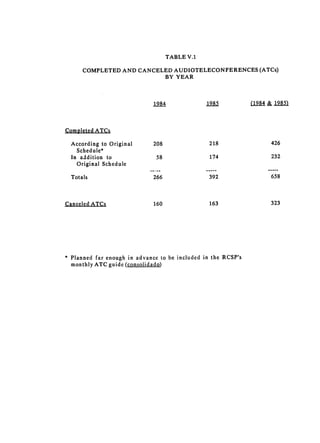

17. 	 Your principal place of residence in the past six months has been:

     (1)    Owned by you
     (2)    Rented
     (3)    Owned by your family
     (4)    A Boarding house
     (5)    Other (Specify:

18. 	 This residence has:

     (1)    Electricity
     (2)    Running water
     (3)    Flush toilet
     (4)    Out house or latrine

19. 	 Do you or your family own:

     (1)    Refrigerator
     (2)    Stereo
     (3)    TV
     (4)    Motorcycle
     (5)    Car

20. 	 Do you own a parcel(s) of land?

            Yes 	               No
                (2) 	                (1)
     20a.    How many?
21. 	 Do you own your your own business?

            Yes                 No
                  (2) 	              (1)


     21a. 	 What kind of business is it?

            (Speci fy:


22. 	 How many years have you been resident in San Martin?

                          Years


23. 	 How many of the past 12 months have you spent in San Martin?

                          Years


24. How 	many persons 18 years or older are there in your family?


25. How many persons 	under 18 years of age are there in your family?


26. Where 	 were you born?


27. Sex: (1) Female             (2) Male


28. Age:     _	           Years


29. How 	 far did you go in school?               Years


30. What 	is your occupation?


31. How many people depend on you economically?


32. 	 What is your total monthly income?

           Soles:   _,
33. 	 How much is needed monthly to live well in this community?

          Soles:         __,     _,


    Do you have any additional comments/suggestions concerning ENTEL's
    service?


                               End of Interview


                       Thank     you   very   much!!!
AUDIOTELECONFERENCE (ATC) EVALUATION
                               QUESTIONNAIRE


    We appreciate your help in providing honest and truthful
    responses 	 to the following questions, which are part of
    the 	 formative evaluation activity associated with the
    audioteleconferencing 	 program in San Martin.


1.0 	 COST OF ATC PARTICIPATION

    1.1 	   ATC Site

    1.2 	 Date

    1.3 	 Where did you come from to participate in this ATC?


    1.4 	 How far is that place from the ATC site?

                          Km.


    1.5 	   How long did the journey take?


    1.6 	 Which means of transport did you use?

          (Indicate more than one, if applicable)


            Taxi
            Bus
            Aircraft

            Motorcycle
            Private car

            Canoe/launch

            Other (Specify:


   1.7 	 What was the approximate round-trip cost of your trip?
             Soles: _,

   1.8      Did you receive 	 travel expenses or per diem to attend this
            ATC?
                Yes               (Go to Question # 1.9)
                 No               (Go to Question # 2)

   1.9 	 Who paid your travel expenses?

            Yourself
            Health Sector
            Education Sector
            Agriculture Sector
            Commercial Sector
            ENTEL

            An AID Project

            Other (Specify:
1.10 	 How much ofyour own money did you spend?

                  Soles: 
                 I
       1.11 	 Approximately how much were you rcimbursed by your sector?
                  Soles:

2.0 	 ORGANIZATION AND COORDINATION ACTIVITIES BEFORE THE ATC

       2.1   Who 	 coordinated and promoted the ATC?

       2.2   Who 	 invited you to participate in this ATC?

             Your sector coordinator
             ENTEL's ATC coordinator
             Your project chief
             Your local 	ATC coordinator
             Other (Specify: 	                            )
      2.3    How 	 did you receive the invita*ion to participate?

             Telephone

             Radio

             Official directive

             Word of mouth

             Other (Specify:                                  )

      2.4 	 How many days in advance did you receive the invitation

            to participate?                   _     Days


3.0   ATC 	SUPPORT

      3,1    What 	was the ATC's major theme?


      3.2    What 	materials, if any, did you receive before the ATC?


      3.3    How 	 far in advance of the ATC did you receive this material?


      3.4 	 In which of the following ATC preparation activities have

            you participated?


             ATC 	 training session
             Tutorial 	 training session
             Preparation seminar
             Practical 	 demonstrations

      3.5 	 How many hours did you spend preparing for the ATC?

                              Hours
3.6   How usefui did you find the materials you received in
          anticipation of the ATC?


4.0 	 ATC PARTICIPATION

    4.1 	 Using the scale provided below, circle the number that comes
          closest to your evaluation of the ATC coordinator's
          performance in this session.

                    1         2        3     4         5
               Very deficient                     Very good

    4.2 	 Briefly describe your participation in the ATC:


5.0 	 LOCAL CONDITIONS

    5.1 	 Were the following facilities adequate for the ATC:

          Space
          Lighting

          Ventilation

          Seating

    5.2 	 How long did the ATC last?             Hours          Minutes

    5.3 	 Please list the major results and/or benefits of your
          participation in this ATC.

          1.
          2.
          3.
          4.
          5.

   Once you have completed this questionnaire, please return it to
   your ATC coordinator.


                         THANKS FOR YOUR HELP!!!!!
TELEPHONE OFFICE INTERVIEW QUESTIONNAIRE


 Site
 Date                 :_85

                                  Month            Day
 Time

 Interviewer


 1. 	   Did you come to place a call?

                 Yes                         No
                            (2)                   (1)


        How many?                         (Go to question #6)


2. 	    Where did you call? (If more than one call, refer to the
                             most important one)


3. 	    How long did you have to wait to complete your call?

             Hours:                               Minutes:


4. 	    How long was your call? (Please refer to your receipt)

             Minutes:


5.      How much did you pay 	for your call?

             Soles:


6. 	    Did you come to receive a call?

                      Yes                    No
                              (2) 	           ,   (1)


            How many?                     (Go to question #10)
7. 	   Where were you called from? (If moie than one call, refer
                                     to the most important)


8.      How long did you wait to receive your call?

                Hours: 	                      Minutes:


9.      How long was your call? (Please refer to your receipt)

               Minutes:


10.     Your most important call (made or received) was:

               (1) From public call office to public call office
               (2) From public call office to a private telephone
               (3) From a private telephone to public call office

11.     Was this call pre-arranged?

                 es               No
                      (2)              (1)


        11a.     If 'yes', how was the arrangement made?
                      (1) Mail
                      (2)   ENTEL messenger
                      (3)   Telephone
                      (4)   Telegram
                      (5)   Other (Specify:


12.     What was the main reason for 	the call?


13.     How would you rate the call's technical quality?

               (5)    Very good
               (4)    Good
               (3)    Fair
               (2)    Poor
               (1)    Very Poor
14. 	 If no telephone service existed, what would you have done?


 15. 	 Approximately how much would such an alternative have cost you?


16. 	 Where did you conic from to make/receive your call(s)


     (If respondent came from the same community or was in
           transit, go to question #21)


17. 	 Was the telephone call the main reason for your trip?

          Yes                         No
                    (2) 	                  (1)


18. 	 What means of transport did you use?

      (Indicate more than one, if applicable)


          (1) 	 On foot
          (2) 	 Motorcycle
          (3) 	 Car
          (4) 	 Bus
          (5) 	    Other (Specify:


19. 	 How much did you spend in order to make the call?
      (Exclusive of the call itself)

          Soles:


20. 	 If no telephone service were available, would you have
      made the trip?

          Yes 	                       No
                   (2) 	                   (1)


21. 	 When was the last time (before this) that you placed/received
      a 	 call?

                                     Days ago
22. 	 Where did you call?/Where were you called from?


23. 	 What was the main reason for that call?


24. 	 If no telephone service had been available, what would

      you have done?


25. 	 Approximately, how much would it have cost?

          Soles:


26. 	 In the past 30 days, approximately how many calls have you made?


27. 	 In the past 30 days, approximately how many callk have you

      received?


28. 	 In the past 30 days, how many telephone messages have you left?


29. 	 In the past 30 days, how many telephone messages have
            you received?


30. 	 In the past 30 days, how many telegrams have you sent?


31. 	 In the past 30 days, how many telegrams have you received?
32. 	 In the past 30 days, how many letters have you mailed?


33. 	 In the past 30 days, how many letters have you received?


34. 	 In the past 12 months, how often have you visited:

          a)      Huanuco

          b)      Iquitos

          c)      Lima

          d)      Moyobamba

          e)      Tarapoto

          f)      TingoMaria

          g)      Tocache

          h)      Trujillo


35. 	 What has been your principal place of residence in
      the last six months?


36. 	 Your principal place of residence in the past six months is:

          (1) 	   Owned by you
          (2) 	   Rented
          (3) 	   Owned by your family
          (4) 	   A Boarding house
          (5) 	   Other (Specify:


37. 	 This residence has:

          (1) 	   Electricity
          (2) 	   Running water
          (3) 	   Flush toilet
          (4) 	   Out house or latrine


38. 	 Do you or your family own:

          (1) 	   Refrigerator
          (2) 	   Stereo
          (3)     	V
                  T
          (4) 	   Motorcycle
          (5) 	   Car
39. 	 Do you own a parcel(s) of land?


               Yes                          No

                         (2)                      (1)


       39a.      How many?


40.    How 	many hectares do you own in total?


41. 	 Do you own your own business?

               Yes                           No
                        (2) 	                     (1)

      41a. 	 What kind of business is it?

            (Specify:


42. 	 Where were you born?


43.   Sex: 	 (1) Female                             (2) Male


44. 	 Age:          -           -    Years


45. 	 How many years have you becn resident in San Martin?

                                    Years

46.   How 	many of the past 12 months have you spent in San Martin?

                                    Months


47.   What 	 is your marital status?

              (1) 	     Unmarried
              (2) 	     Widow
              (3) 	     Divorced

               4)       Married

               5)       Common law marriage

                        (If (4) or (5):  )
      47a. 	 How far did your spouse go in school?

                                   Years
47b.    What is your spouse's occupation?


48. 	 How far did you go in school?
                        Years

49.   What 	is your occupation?


50. 	 How far did your mother go in school?
                        Years

51.   What 	is/was your mother's occupation?


52. 	 How far did your father go in school?
                        Years

53.   What 	 is/was your father's occupation?


54. 	 How many people depend on you economically?


55. 	 What is your family monthly income?

             Soles:   _              ,__,

56. 	 How much do you think is needed monthly to live well
      in this communiLy?

             Soles:   .   ...	   ,                      ,


                                            End of Interview

                                      Thank you very much !!!!

Peru rural communication services project

  • 1.
    ]PF ]RU Final Evaluation Report Rural Communication Services Project Center for International Studies Learning Systems Institute The Florida State University February 1987
  • 2.
    PERU RURAL COMMUNICATIONSERVICES PROJECT FINAL EVALUATION REPORT John K. Mayo Gary R. Heald Steven J. Klees Martha Cruz de Yanks Center for International Studies Learning Systems Institute Florida State University February 1987 The research reported in this document was co-sponsored by the Empresa Nacional de Telecomunicaciones del Peru (ENTEL) and the U.S. Agency for International Development (A.I.D.). Financial support was provided under contract to A.I.D.'s Bureau for Latin America and the Caribbean and the Bureau for Science and Technology, Dr. Richard R. Martin, and Dr. Clifford Block, Project Managers.
  • 3.
    The evaluation ofthe Rural Communication Services Project (RCSP) was a collaborative venture, one which brought together researchers from ENTEL-PERU and Florida State University. It could not have been completed without the help of many persons in Peru and the United States. The authors are especially grateful to the RCSP's directors, Dr. Angel Vel~squez Abarca and Ing. Hector Cossio, each of whom gave generously of his time and encouraged us to raise questions and to report findings that ENTEL as well as other telecommunication agencies would find useful in the future. Lic. Felipe Yanes and Sr. Jorge Cisneros facilitated the collection of data. Their enthusiasm and detailed knowledge of San Martin were appreciated throughout the project. Mrs. Diefla Pramono was indispensable to the production of this and other reports. The following staff, advisors and friends of the RCSP also contributed in important ways to the evaluation: Ce'sar Arias Elizabeth Chirinos Walter Penaherrera Angelita Campos Frank Dall Alipio Quincho Isabel Candia Brian Fields Carmen Reatequi Ruth Cardenas Douglas Goldschmidt Margot Ruis Mildred Casanave Gladys Infante Karen Tietjen Ik Chin Chang Luis Enrique Medrano Adriana Vergara To each of them we express sincere thanks.
  • 4.
    SUMMARY On August 31, 1979, Peruvian and U.S. government representatives signed an agreement creating the Rural Communication Services Project (RCSP). The RCSP was developed and administered by the Empresa Nacional de Telecomunica­ ciones del Peru (ENTEL), with substantial financial and technical assistance from the U.S. Agency for International Development (A.I.D.). Such assista;,ce was managed initially by the Agency's Bureau for Latin America and the Caribbean, and subsequently by its Bureau for Science and Technology. The RCSP provided public telephone service and audioteleconference facilities to seven communities in the Department of San Martin, a high jungle area cast of the Andes. Three of the communities, with an average population of 12,000, received 6.1 meter satellite antennas and associated earth station technology. The remaining four towns, averaging 3,400 residents, were linked via VHF radiotelephones to one of the earth stations. After a protracted network design and installation period, telephone and audioteleconference (ATC) ser­ vices were inaugurated in the seven sites between July, 1983, and June, 1984. The RCSP experience, which was extensively documented by researchers from ENTEL and Florida State University, highlights the importance of early, com­ prehensive and realistic planning. The project, initially scheduled to last for three years, actually took twice as long. Equipment specifications, site selection and system installation alone required more than three years. Underestimates of initial costs necessitated extensive modifications of the original network design. Although each of the three earth stations experienced technical problems during the first year of operation, the technical quality of telephone and ATC services at the major sites improved markedly over the course of the project. Yet, two of the earth stations failed to pass INTELSAT's performance tests and were forced to operate under a series of provisional approvals. Neither ENTEL nor the Harris Corporation, the earth station manufacturer, accepted primary responsibility for the sys­ tem's technical shortcomings. Their dispute underscores the need for greater contractual specificity and clarity in technology transfers of such complexity in the future. The BUDAVOX radiotelephone equipment provided by ENTEL to the four sec­ ondary sites experienced serious problems. It was unreliable and subject to frequent breakdowns. Nevertheless, when this technology was up and running, it, too, provided good voice signals. This indicates that, given highct­ quality equipment, integrated earth station/radiotelephone systems are techni­ cally viable and thus could serve as the basis for developing cost-effectivc rural communication networks in the future. There was an immediate demand and a sizable market for the RCSP's tele­ phone services. During the first two and a half years of operation, 207,441 calls were completed. They generated about 272,000 dollars in revenue. Among the heaviest callers, there was a clear pattern of system use in pursuit of commercial and business interests. The project's audioteleconferencing (ATC) .;ervices were developed in cooperation with Peru's Agriculture, Health and Education ministries. They
  • 5.
    incorporated a widevariety of administrative, training, diffusion and promo­ tion strategies. A total of 658 ATCs were sponsored by the ministries plus ENTEL during 1984 and 1985, involving almost 12,000 hours of participants' - time. Over the pilot period, ATCs became shorter and focused more on in­ service t-ra-nihrg---A----H -e---anie tLfme, participants expressed a preference for ATC formats that involved "expert" presentations from the nation's capital. The health sector was the most active as well as the most successful user of the new telecommunication services. Health had a stable organizational structure and a pressing need to function in a coordinated manner. Thus, ATC services were an obvious solution to this sector's communication problems. ENTEL itself emerged as a major user of teleconferencing in the RCSP's second year of operation. This organization's flexibility, leadership and familiar­ ity with communications technology stimulated its use of ATC services for training purposes. At the end of the two-year p2riod, ENTEL transferred res­ ponsibility for future ATC program development to its commercial section, with plans to promote ATC usage widely among public development sectors and private business groups. The seven-site RCSP telephone system required an initial investment of about two million dollars and annual outlays of about $150,000. Most of this money was spent in the earth station sites. The Juanjui installation alone cost almost $650,000 to start up and about $50,000/year to operate. The ATC network required oily minimal additional hardware investment, about 12,000 per site, half for conferencing equipment and half for an additional telephone channel devoted exclusively to A rCs, but a substantial investment in planning, coordination, and operations. Chief among the l tter was the almost $600,000 spent by A.I.D. on technical assistance. A better perspective on such expenditures can be achieved by putting them in unit cost terms. The average cost per telephone call over the entire RCSP system was about $4.00, with variations, depending on s;:e costs and traffic, from $2.20 at the highest volume radiotelephone site to $3.25 at an earlh station site to $7.10 at the smallest volume radiotelephone sites. If the amortized value of all the technical assistance provided to ATC development is included, the average cost per audioteleconference, involving three to four sites and about 20 persons, was $370, or about $20 per participant-hour. It is unlikely, however, that future project, will require such a high level of technical assistance. Not including these co-.ts yields an average cost per ATC of about $145, or $8 per participant-hour. The benefits to individuals and communities of the RCSP's telecommunica­ tion services are mucl- harder to assess, and must reflect judgments about the value of the myriad uses to which telephones and ATCs were put. System users stated that, as a substitute for an average phone call, they would be willing to spend approximately $4.75 on inferior communication alternatives such as letters, telegrams, travel, etc. This amount was higher than the cost of an average call, indicating that the value of this one benefit exceeded system costs. Similarly, face-to-face instruction would cost about twice as much as the typical ATC seminar, not including technical assistance. The results of this evaluation, combined with a growing number of studies of other rural telecommunications initiatives, reflect and st-engthen the argument for greater investment in this sector in the future. At the same time, the RCSP illuminates a number of issues and lessons that must be consid­
  • 6.
    idered when developingsuch systems. The transfer of sophisticated tele­ communication technology is noi, and probably will not be for the foreseeable future, a straightforward exercise. Even the most thorough plans require revision, endless patience and dedication if they are to be implemented successfully. New and innovative communication strategies require extensive promotion as well as innovative management structures, especially when changes in standard operating procedures are involved. The RCSP demonstrated that, while rural telephone traffic was far greater than expected, revenues were unable to cover operating costs, let alone contribute to capital recovery in the system's first two years of operation. By the same token, the development sectors did not have adequate discretionary budgets to sustain ambitious telecommunication initiatives on their own. Although this picture could change in the future, as satellites and other technologies continue to lower communication costs, the expansion of rural telecommunication services in the Third World will require government assistance for some time to come.
  • 7.
    CONTENTS Page ACKNOWLEDGMENTS ................... ....... i SUMM ARY . . . . . . . . . . . . . . . . . . . . . . . . . . ii LIST OF FIGURES AND TABLES ......................... vii 1. INTRODUCTION ....... ............................. 1 Telecommunications and Development ................. 1 Overview of the Rural Communication Services Project (RCSP).. 3 Ovefview of the Evaluation ..... ... ................. 6 Structure of this Report .... ................. ... 10 II. THE RCSP IN CONTEXT .... ................... ...... 12 The National Context ..... ..................... ...... 12 The Regional Context: San Martin ....... ............... 13 The Local Context: Social and Economic Welfare .... ........ 17 The Local Context: Transportation and Communication Services . 18 III. TECHNICAL AND ADMINISTRATIVE HISTORY OF THE RCSP. 28 Pre-project Initiatives ...... ... ................... 28 Network Design and Equipment Procurement ..... ........... 30 Site Selection ....................... 33 System Installation .... ...... ..................... 33 Network Performance (1983-1985) ................ ...... 34 Administrative Relationships and Responsibilities ... ...... 38 Outstanding Issues .... .. ..................... ..... 42 IV. THE USE AND IMPACT OF COMMERCIAL TELEPHONE SERVICES 44 Telephone and Message System Traffic ...... ............. 45 Network and Call Characteristics ....... .............. 55 RCSP Users ............ ........................ 60 Users vs. Non-users ....... ... ..................... 74 Behaviors in the Absence of the Telephone ..... .......... 79 Conclusions ........ ......................... ..... 81 V. TELEPHONE CONFERENCING ....... .................. 83 Teleconference Planning ..... ................... ..... 84 The Evaluation of Teleconference Activities .... ......... 86 Teleconference Trends ...... .................... ..... 86 Achievements of the ATC Program ....... ............... 97 ATC Participant Surveys ..... ................... ..... 104 Conclusions ........ ......................... ..... 108
  • 8.
    VI. RCSP COST ANALYSIS ......... .................... 111 Historical Costs ....... ...................... .... 112 Larger-scale System Costs ..... .................. .... 126 Costs in Context ....... ...................... .... 137 Financing Issues ........... ...................... 142 Conclusions ........ ........................ .... 145 VII. CONCLUDING LESSONS AND ISSUES ...... .............. 15C RCSP Achievements ............................... 150 Assessing Rural Communication Needs and Opportunities . . .. 152 Transfering Telecommunication Technologies and Experience .. 152 Developing Teleconference Strategies ... ... ............ 154 Managing Teleconference Resources ...... ............. 156 Expanding Institutional Commitments .. ............. ..... 157 Monitoring System Implementation and Impact .... ......... 158 Telecommunications and Development ............... ..... 159 REFERENCES........ ............................ ..... 162 APPENDICES............ ............................ 165 A. Supplementary Tables B. Major Evaluation Instruments
  • 9.
    LIST OF FIGURES AND TABLES FIGURES: Page 1.1 The Department of San Martin ....... .............. 5 1.2 Telecommunication Network of the Peru Rural Communications Services Project (RCSP) .... ........ 7 1.3 RCSP Network in San Martin ...... .............. 8 11.1 Provinces within the Department of San Martin . . . . 15 IV.2 Frequency Distribution of Calls During Previous Month 1984 and 1985 ....... .................... .... 68 TABLES: 11.1 Geographic Sizes and Populations of the RCSP Sites 19 11.2 Daily Newspaper Circulation in Primary and Secondary Sites - 1983 ........ ....................... .... 21 11.3 Commercial Broadcast Signal Coverage in Primary and Secondary Sites - 1983 ..... ................. .... 22 11.4 Mail System Usage in Primary and Secondary Sites During January, May and August - 1983 .... ........ 23 11.5 Private Radio Systems in Primary Sites - 1983 . . . . 25 11.6 Vehicle Registration in Primary Sites - 1983 . . . . 27 III.1 Average Number of Inoperative Days by Month and Site 1983 through 1985 ...... ................... .... 36 IV.1 Distribution of Demand for Public Telephone Services by Quarter - 1984 and 1.985 ... ............. ... 46 IV.2 Total Telephone Traffic Originating in the RCSP Network by Month - 1983, 1984 and 1985 .. ........... .... 48 IV.3 Number of Calls Attempted per Channel/per 1,000 Adullb in Comparison and RCSP Sites - 1st and 2nd Years of Operation ....... ....................... .... 51 IV.4 Average Daily Number of Public and Private Calls Originating in the RCSP Network by Month - 1983, 1984 and 1985 ....... ...................... .... 53
  • 10.
    IV.5 Distribution of Calls to and from Major Non-RCSP and RCSP Sites by Quarter - 1984 and 1985 ............... .... 56 IV.6 Distribution of Calls to and from Major Non-RCSP and RCSP Sites by Primary and Secondary Sites - 1984 and 1985 Combined 57 IV.7 Distribution of Calls to and from RCSP Sites by Primary and Secondary Sites - 1984 and 1985 Combined ........... 58 IV.8 Average Wait (Minutes) for Public Calls by Site and Quarter - 1984 and 1985 ......... ...................... 59 IV.9 Average Length (Minutes) of Public Calls by Site and Quarter - 1984 and 1985 ......... ...................... 61 IV.10 Public Telephone Systems User Demographic Characteristics by Survey Wave - 1984 and 1985 ..... ............... 62 IV.11 Public Telephone Systems User Communication and Transportation Characteristics by Survey Wave - 1984 and 1985 ......... 64 IV.12 Public Telephone Systems User Opinions about Quality by Survey Wave - 1984 and 1985 ...... ................ 69 IV.13 Number of Public Calls Initiated by User Demographic Characteristics - 1984 and 1985 Combined .... .......... 70 IV.14 Number of Public Calls Initiated Monthly by Communication and Transportation Behaviors - 1984 and 1985 Combined ..... .. 72 IV.15 Public Telephone Systems User Vs. Non-User Demographic, Communication and Transportation Characteristics - 1985 . . 77 IV.16 Public Telephone Systems User Opinions about Communication Options If Telephone Service Was Not Available ......... 80 V.1 Completed and Canceled Audioteleconferences (ATCs) by Year.. 87 V.2 ATC Participation Rates by Site (1984 and 1985) .......... 89 V.3 Average Length and Delay in Starting Time for Completed ATCs by Sector and Year ...... .................... ... 90 V.4 Distribution of Completed ATCs by Quarter and Sector (1984 and 1985) ....... ..................... ... 92 V.5 Classification of Completed ATCs by Sector in 1984 and 1985 . 93 V.6 Origin of ATCs by Site and Sector (1984 and 1985) ........ 95 V.7 Average ATC Attendance by Site and Sector (1984 and 1985) . . 96
  • 11.
    VI.1 Historical Expenditures on RCSP .... ............... ... 113 VI.2 Costs of Earth Station Telephone Service in Juanjui ....... 116 VI.3 Costs of Radiotelephone Sevice ... ............... .... 120 VI.4 Costs of Audio Teleconferencing Service .... ........... 123 VI.5 Costs of a Larger-scale (53 Community) RCSP-Type System ... 135 VI.6 Cost and Distribution of Alternative Communications Options. 139 VI.7 RCSP Telephone System Revenues ..... ............... 143 VI.8 Telephone System Cost Summary ...... ................ 146 VI.9 ATC System Cost Summary ...... ................... 149
  • 12.
    Appendix Tables: ...... ....................... ...... 165 A.1 Number of Data Base Records and Sample Sizes for Public and Private Telephone System Requests and Field Interviews - 1983, 1984 and 1985 A.2 Distribution of Demand for Public Telephone Services in Juanjui by Quarter - 1984 and 1985 A.3 Distribution of Demand for Public Telephone Services in Saposoa by Quarter - 1984 and 1985 A.4 Distribution of Demand for Public Telephone Services in Tocache by Quarter - 1984 and 1985 A.5 Distribution of Demand for Public Telephone Services in Secondary Sites by Quarter - 1984 and 1985 A.6 Total Telephone Traffic Originating in Juanjui by Month 1983, 1984 and 1985 A.7 Total Telephone Traffic Originating in Saposoa by Month 1983, 1984 and 1985 A.8 Total Telephone Traffic Originating in Tocache by Month 1983, 1984 and 1985 A.9 Total Telephone Traffic Originating in Secondary Sites by Month 1984 and 1985 A.10 Summary Profiles of Adult Populations and Telephone Systems in Comparison and RCSP Sites - 1st and 2nd Years of Operation A.11 Average Daily Number of Public and Private Calls Originating in Juaijui by Month - 1983, 1984 and 1985 A.12 Average Daily Number of Public and Private Calls Originating in Saposoa by Month - 1983, 1984 and 1985 A.13 Average Daily Number of Public and Private Calls Originating in Tocache by Month - 1983, 1984 and 1985 A.14 Average Daily Number of Calls Originating in Secondary Sites by Month - 1983, 1984 and 1985 Research Instruments: ........... ....................... 181 1. Telephone Call Registry 2. Audiotelecon ference (ATC) Registry 3. CommunitySurvey 4. Audioteleconference (ATC) Evaluation Questionnaire 5. Telephone Office Interview Questionnaire
  • 13.
    I. INTRODUCTION Telecommunications and Development While telecommunications is taken for granted as a key factor in economic, commercial, social and cultural activity in industrialized countries and as an engine of growth, in most developing countries the telecommunica­ tions system is not adequate even to sustain essential services. In many areas there is no system at all. Neither in the name of common humanity nor on grounds of common interest is such a disparity acceptable.* In recent years, Third World leaders and officials of international donor agencies have reaffirmed their commitment to rural development. They have done so for a variety of humanitarian, economic and political motives, realizing that the isolation and neglect of rural people are no longer tolerable. Yet, even as investments in rural areas have grown, it is evident that the concept of "development" itself is still predominantly associated with urban opportu­ nities and services. For generations such a perception has drawn millions of able and ambitious people off the land. To reduce excessive urban migration rates and to narrow the gaps which divide the urban and rural sectors of most Third World societies, increased attention has been paid to the resources rural residents requi-e to become more productive. Among the most important of these resources is information. Concern for the information needs of rural people is not new. Over the past 30 years, improved communication has emerged as an essential goal of most rural development programs. Faith in communication technology as a means for accelerating change has also grown due, in large part, to a number of techni­ cal breakthroughs. The invention of the transistor and the subsequent manufac­ ture of inexpensive, battery-operated radios in the 1960s were particularly important developments. Together, they enabled radio broadcasts to be re­ ceived in rural areas far removed from existing power sources. As a result, rural development campaigns employing radio proliferated in the 1960s and 1970s. Experience across a variety of sectors subsequently revealed that communication campaigns require carefully crafted messages, proper follow-up strategies and, perhaps most importantly, the right contextual conditions to be effective. Simply delivering information to rural residents is not enough. It was not until 1980 or so that a new body of experience and , Pew term--"telecommunications"--entered the development field. The term embraced not only the broadcast media, but also the telephone, whose use in development programs had previously been considered marginal at best. The telephone and related technologies were given a major boost in development terms with the advent of satellites and the promise of affordable communication to and within the more remote regions of the world. For the first time, two-way communica- Independent Commission for Wor!d-wide Telecommunications Development, 1984. The Missing Link (Executive Summary). Geneva: International Telecommunication Union, p. 3.
  • 14.
    tion between onceisolated communities and between such communities and larger regional centers became possible. In an influential report, the Independent Commission for World-wide Telecommunications Development noted that: (1) Telecommunications have often been neglected in favor of other sectors such as agriculture, water and roads. Telecommunications should be regarded as a complement to other investments and as an essential component in the development process which can raise productivity and efficiency in other sectors and enhance the quality of life in the developing world. (2) Telecommunications play an essential role in emergency and health services, commerce and other economic activity, in public administration, and in reducing the need to travel. There is moreover a clear link between investment in telecommunications and economic growth. (3) The economic and social benefits an efficient telecommunications system confers on a community or a nation can be clearly perceived. The system can also be used as a channel for education, for disseminating information, encouraging self-reliance, strengthening the social fabric and sense of national identity, and contributing to political stability. (4) Dramatic technological advances are taking place at a time when the role of telecommunications in the process of development is more important than ever. In our view no development programme of any country will be balanced, properly integrated, or effective unless it accords telecommunications an appropriate role.* Evidence from a variety of projects in rural Alaska, Northern Canada, India, Indonesia and the South Pacific substantiates the Commission's conclu­ sions regarding the impor.ance of the telephone and of two-way communication generally to rural development (Hudson, 1984). Why, then, in the face of encouraging evidence, have governments and international agencies been reluc­ tant to increase their investments in rural telephone systems? Recent reviews by World Bank economists Stern (1985) and Saunders, Warford and Wellenius (1983) offer a number of explanations. First, and probably most importantly, the conceptual link between telephony and rural development has not yet been recognized by many government planners. If considered at all, telephony tends to be regarded more as a consequence than as a cause of development. Using standard forecasting techniques, planners have not foreseen a particularly high demand for telephone service in the rural sectors of most developing nations. Furthermore, they are mindful of the capital intensity and conse­ quent high initial costs of telephone systems installed to date. Because ibid., pp. 4-5. 2
  • 15.
    there is lesstelephone traffic in rural areas, rural systems cost substan­ tially more per call than do urban systems. Since phone companies typically depend on customer revenue to meet operating costs and to help finance new installations, they tend to invest in urban areas where tariffed service will be greatest. Finally, there is a widespread view that telecommunications agencies, both public and private, are managed inefficiently. Such ineffi­ ciency, it is argued, is a product of many forces, including the lack of technically qualified personnel, the lack of foreign exchange reserves to maintain plant and equipment, and tariff policies which do not promote a proper allocation of system revenues. When such perceptions are seen in the light of the competing demands of other sectors (e.g., agriculture, education and health) for scarce government resources, it is evident why advocates of expanding communication services to the rural areas have so far been fighting an uphill battle. Yet, perceptions regarding the potential cost-effectiveness and develop­ mental impact of rural telecommunications, and specifically of low volume or "thin route" telephony, have begun to change. Canada's and India's reliance on domestic satellites has paved the way for other nations to consider assign­ ing at least a share of their internal telephone traffic to this technology. In fact, more than 20 developing nations, including Peru, are now working with the International Telecommunication Satellite Organization (INTELSAT) to pro­ vide some percentage of their domestic communication service via satellite. Even though satellites have lowered communication costs within many nations, many Third World governments still are unable to provide even rudimentary telephone service to their rural areas. The major international donor agencies have been slow to increase their activity in the telecommunications sector. What still seems to be lacking is hard evidence and a compelling case for investment in telephony as a means of stimulating rural development. National planners and their colleagues in the international agencies are familiar with the economic and social b,;ncfits associated with investments in transportation, education, health and agriculture. They lack such information, familiarity and confidencc in telecommunications. To close such gaps, a number of important initiatives and pilot projects have been undertaken in recent years. One such initiative, the Peruvian Rural Communication Services Project (RCSP), is the subject of this report. Overview of the Rural Communication Services Project (RCSP) The RCSP stemmed from a -mmitment by the Peruvian and U.S. governments to determine whether a satellitt.. -sed communication system, incorporating a variety of agencies and technologies, could provide reliable and cost­ effective service to a remote region of eastern Peru. The decision by Peruvian and U.S. officials to undertake the RCSP was based on their positive evaluations of other countries' efforts in this direction. During the mid­ 1970s, approximately 8.5 million people, half of Peru's population, were without access to telephone communication. This population was widely scattered, suggesting that expansion of communication services by traditional terrestrial means would be expensive. Only through an increased reliance on satellites and associated technologies, it was argued, could the nation hope to address its rural communication needs within the next generation. Furthermore, Peruvian engineers believed that the cost of installing and 3
  • 16.
    maintaining small earthstations in Peru's rural areas would compare favorably with the alternative of gradually extending the terrestrial system. Such assumptions would have to be tested in the field, however. The kind of thinking that prompted Peruvian communication planners to undertake the RCSP was also gaining ground during the late 1970s within the U.S. Agency for International Development (A.I.D.). Acting on a mandate from the U.S. Congress to concentrate on projects of direct benefit to the rural poor, and drawing heavily upon the experiences of NASA's Applied Technology Satellite (ATS) experiments in education and health, A.I.D.'s policy-makers became convinced that rural development goals might be served through the wider application of "thin route" satellite communication. With this idea in mind, A.I.D.'s Bureau for Science and Technology and its Bureau for Latin America and the Caribbean developed the Rural Satellite Program (RSP), a five­ year research and development effort to demonstrate that satellite communica­ tions could provide reliable, cost-effective services to rural areas of the Third World (Block, C. et al., 1984; Parker, E., 1978). At UNESCO's 20th General Conference held in Nairobi, Kenya, in November, 1978, the U.S. delegate announce, A.I.D.'s intention to assist Third World governments in installing small earth stations and developing related communication infrastructures in the pursuit of rural development objectives. Some time later, the following four objectives were spelled out for the RSP: 1. To develop and test new and potentially cost-effective models by which communication satellites and related technologies can help pro­ vide development-related information to rural populations and improve the delivery of rural services; 2. To demonstrate to the providers of satellite services and ground station equipment that there is an important market for satellite services designed to meet the needs of small rural communities: 3. To provide concrete evidence needed by investment sources such as the International Development Bank and the World Bank concerning the cost-effectiveness of communication'investments for rural areas; and 4. To support the development of national capacities for integrating communication investment planning with sectoral development planning.* The RCSP incorporated numerous technical, programmatic and administrative innovations. On the technical side, 6.1 meter antennas were employed for the first time within the INTELSAT system. The antennas received and transmitted signals using the hemispheric beams provided through INTELSAT's Series IV and V satellites. Relatively small earth stations were linked to radiotelephones to extend rural coverage. The project was concentrated in seven rural communities in the Department of San Martin, a high jungle area east of the Andes. (See Figure 1.1). The three largest communities (Juanjui, Tocache, and Saposoa), with average popu­ lations of 12,000, were connected via satellite to Peru's national telephone * Agency for International Development, 1979. "Project Paper: Rural Communication Services." Washington: Department of State, p. 10.
  • 17.
    FIGURE I.1 THE DEPARTMENT OF SAN MARTIN ECUADOR J s-I ° Is ° # I w ' DRII /j S COEMU Lima
  • 18.
    system. The remainingfour towns (Bellavista, Huicungo, Pachiza and Tingo de Saposoa), with average populations of just 3,400, were linked by VHF radiotelephones to Juanjui's earth station and thus to the national network as well. Figures 1.2 and 1.3 present the RCSP's telecommunications network and a diagram highlighting the location of each site. All RCSP sites were designed to provide commercial telephone service at public call offices (PCOs) which were staffed by ENTEL personnel or by local concessionnaries. After a protracted netwo:-k design and installation process, service was inaugurated in the seven sites between July, 1983, and June, 1984. Although not part of the original project plan, popular demand eventually resulted in the installation of a limited number of telephones to homes and offices in the three major sites. By the end of 1985, telex and television retransmission services also were made available there. The RCSP was also the first experiment of its kind in the Third World to use audioteleconferencing (ATC) in support of rural development programs. At each of the participating ENTEL offices, an ATC room was equipped with a conference table, chairs, six microphones and a loudspeaker. Throughout the project, ENTEL staff, assisted by advisors supported by A.I.D., provided extensive technical assistance to the Ministries of Agriculture, Education and Health. From the point of view of program planning and institutional develop­ ment, the ATC component of the RCSP required substantial commitment and inno­ vation on ENTEL's part. During the life of the esperiment, 207,441 telephone calls were completed in the project zone, and a total of 658 ATCs were executed in one or more sites. The remainder of this chapter introduces the evaluation program which accompanied the RCSP, highlighting the major issues it addressed along with the methods it employed. Overview of the Evaluation The innovativeness and scale of the RCSP prompted A.I.D. and ENTEL to earmark approximately 350,000 dollars for evaluation. Iii June, 1982, The Florida State University was awarded a contract by A.I.D. to work with ENTEL on a comprehensive evaluation of the project. The overall intent of the evaluation was to provide development planners and donor agency officials, both in and outside Peru, with reliable information concerning the impact and costs of telephone and teleconferencing services in remote rural areas. The key topics examined in the course of the evaluation were: Proiect Administration - the management structure that emerged to support the project - the relationships among collaborating institutions - the feedback and reporting mechanisms that guided decision
  • 19.
    TELECOMMUNICATIONS NETWORK OFTHE PERU RURAL COMMUNICATION SERVICES PROJECT LIMA °/ " " J / I r" /| - ,I4-TARAPOTO AL AL & &/ LEGEND - 1| maer I- TNEST STATION i EARTH JU.F-,BLXIT /ING Of SAISA
  • 20.
    FIGURE 1.3 RCSP NETWORK IN SAN MARTIN / - /' , //11/ / - //I / I ,/ / / l S // / / TARAPOTO I / // / I TO BAP030A Fs -l JUANJUI LURIN I LIMA
  • 21.
    the role ofexternal technical assistance in support of system development and utilization TelephoneSystem Usage and Impaci - demand and utilization of RCSP services over time - the frequency and purpose of calls - average wait-times and lengths of calls over time - use of the system in project communities vs. comparison sites User Profiles and Attitudes - demographic characteristics of system users and non-users * users' communication and travel behaviors - user evaluations of service quality Audiotelecon fcrencing - the use and impact of teleconferencing across three development sectors - the evaluation and success of various teleconference formats - participants' opinions about the quality and value of ATC services System Costs - project start-up and operating costs - cost projections for larger RCSP-type systems . financing issues The combined ENTEL-FSU evaluation effort began during the RCSP's planning phase and continued through the first three years of project operations in San Martin. Particular emphasis was placed on the use and impact of telephone and teleconferencing services during the 1984 and 1985 pilot period. The evalua­ tion involved both formative and summative components. The PCSP was monitored continuously by means of personal interviews and correspondence, review of internal files, and service records. A central register was developed to track ATC promotional, scheduling and implementation activities. Samples of ATC participants were asked to evaluate specific sessions immediately upon completion. This information was revicwed regularly to help orient and, where necessary, modify the ATC program.
  • 22.
    In addition tothe ongoing formative evaluation effort, in-depth inter­ views of public phone users and ATC participants were used to detect the cumulative impact of the RCSP. The summative assessment involved a variety of longitudinal studies. ENTEL's monthly call records were used to track demand and completion rates in each community during the first 30 months of RCSP service. These comprehensive call records were compared with records of other rural communities which had received rural telephone services in Dre­ vious years. Each month a sample was drawn at each project site of requests to use the public telephone system. Easy-to-complete forms were filled out by local operators at :he time calls were initiated. They documented: the desti­ nation of all calls; travel time and costs incurred to make calls; reasons for long distance calls; and some user characteristics. In-depth sample inter­ views were also conducted by means of five cross-sectional surveys of public system users. These in-depth surveys provided comprehensive profiles of clients' telephone behaviors and attitudes. In order to compare and contrast the communication and travel behaviors of users and non-users of the RCSP system, cross-sectional community surveys were completed among households in two communities--Juanjui and Tingo de Saposoa. Finally, detailed cost studies were conducted throughout the pro­ ject. User costs were estimated through data provided by the in-depth inter­ views. A.I.D. and ENTEL-PERU financial records were examined to document capital expenditures and recurring costs. Structure of this Report The remainder of the report is divided into six chapters. Chapter II examines the context of the RCSP. Baseline data were collected by ENTEL from various organizations to document regional and community characteristics, as well as the availability of existing communication channels such as mail, telegraph, radio, TV, newspaper, and private message services prior to project start-up in San Martin. Chapter III analyzes the project's technical and administrative history, beginning with its design and continuing through its installation and opera­ tional phases. The emphasis here is on the institutional factors which shaped the RCSP, and which would most likely influence replication of the system on a larger scale. Chapter IV summarizes data that were collected on the RCSP's commercial telephone se-vices. Such data were collected on a sample basis across the project's seven rural sites and were supplemented by the in-depth "intercept interviews" of public call box users described in the previous section. The results of both these longitudinal studies along with those of two cross­ sectional community surveys are reported. Chapter V examines the planning, implementation, results and impact the 658 audioteleconferences conducted during the RCSP. The vast majority of of the ATCs were in support of on-going development programs in agriculture, education and health. Each teleconference was reviewed with regard to its specific purpose (e.g., in-service training, administration, promotion, etc.), duration, site of origin, and level of participation. The chapter concludes with an overall assessment of audioteleconferencing as a development tool.
  • 23.
    Chapter VI reviewsRCSP costs and their implications. Cost information was collected from system users, from participating Peruvian agencies and from external groups that provided technical assistance to the project. The costs of satellite-based telephony service, radiotelephone communication and audio­ teleconferencing were analyzed. The chapter also examines the RCSP experience in terms of the costs, benefits and financing of larger telecommunication systems. Chapler VII presents the conclusions of the five-year research effort and a synthesis of the project's major lessons.
  • 24.
    II. THE RCSP IN CONTEXT A description of the contexts within which the RCSP operated is crucial to understanding the purposes of this multi-faceted telecommunication develop­ ment effort as well as its results. Accordingly, this chapter examines the RCSP's socio-cconomic and communications background at the national, regional and local levels. The chapter draws on a wide variety of sources. General statistics have been extracted from Peruvian national census reports (1983, 1984), the 1986 World Bank Development Report, and the IMF's International Financial Statistics (1986). Regional information about the Department of San Martin and local information about the seven project sites have been extracted from ENTEL site reports (1981, 1982), as well as from newspaper articles and on-site fieldwork conducted throughout the project zone. The National Context During the past 20 years, Peru has been battling severe economic and social problems. By most indicators, Peru, like many Third World countries, has been facing deteriorating economic conditions which, in recent years, have reached crisis proportion. During the relatively prosperous global growth years of 1965-1973, Peru's Gross Domestic Product ((;DP) grew at 3.5% per year, a rate only about half that of other nations at similar income levels (Inter­ national Monetary Fund, 1986). Since the oi. crisis of the early 1970s, growth has been considerably slower, averaging only 1.5% per year from 1973 through 1984. The situation is more disturbing when viewed on a per capita basis. In Peru, there has been virtually no growth in GDP/per capita over the past 20 years. This situation compares more closely to that of the poorest Sub-Saharan African r:itions than to the 3% per year growth rate in GDP/per capita averaged by .ountries with income levels similar to Peru's. (World Bank, 1986.) What little growth the nation experienced was eroded during the economic slide of the early 1980s. GDP/per capita fell about 8%, per year to a level of about $880 in 1984. Inflation rates tell a similar story, averaging about 10% a year over the 1965-1973 period, and 57% a year from 1973 lo 1984. From 1980-1985, inflation was especially severe, with the official consumer price index increasing a little over 1(0% per year. As in many Third World nations, Peru's foreign debt is a significant contributor to the current economic crisis. President Alan Garcia inherited a public sector deficit approaching 10 % of the GDP and unpaid interest bills of approximately $700 million on a $13.7 billion foreign debt (South, June 1985, p. 28). Furthermore, official projections for the next five years indicate that Peru's debt service commitments could outstrip its total export receipts. In the face of such difficulties, President Garcia has been at the forefront of Third World leaders proposing restrictions on debt repayment, including limiting them to a fixed percentage of export earnings. Such strategies, while perhaps necessary, clearly pose risks. If international ban king authorities should declare Perui's loans "value-impaired," a step they have been considering, the country might be forced to pay cash for most of its imports. 1-,
  • 25.
    These economic dataalso have a human face. Peru's people have suffered in recent years. In 1984 the infant mortality rate was 95 per thousand live births, considerably higher than the 83 averaged by countries with similar incomes. Malnutrition is also a very serious problem as reflected in the estimate that in 1983 Peru's total food supplies provided only 85% of the daily calories required per capita, as compared with 106% in similar income countries (World Bank, 1986). Peru's current population of about 20 million is expected to grow at about 2.2% a year over the next two decades (Instituto Nacional de Estadistica, 1984). The workir, -age population, current!y at about 11 million, is growing at an even faster 3% rate. Unfortunately, job opportunities are severely limited. It is estimated that only one-third of Peru's labor force is fully employed and, as indicated earlier, real incomes have dropped to levels found 20 years ago. This employment crisis is most acute in urban areas, which contain about 70% of the nation's populace and are growing rapidly (Instituto Nacional ic Estadistica, 1983, Consejo Nacional de Poblacion, 1985). From 1972-1981, [ima and Ciallao alone had a net migration of 1.6 million new residents but relatively few new jobs. The dislocations and pressures associated witi the nation's economic crisis have fueled social unrest, no.t evident in the increased activity of terrorist grotps such as Tupac Amaru and the Scndero Luminoso ("Shining Path"). Peru has also achieved the dubious distinction of being one of the ",'orld's largest cultivators of coca leaf, and the druig traffic associated with this crop is increasing. Especially unfortunate is the growing use of illicit drugs among Peru's poor. To the millions of unemployed, unschooled, and unskilled children of the poor, the situation has become increasingly desper­ ate and threatening to the nation's social fabric. The long-range solution to the severe ecOonieC ind social problems facing Peru is by no means clear. Beginning in the early 19t)7s, Peru like many Third World countries begaii (o place greater emphasis on rural development strategies, principally thirout h attempts to irecrease airicultural productiv­ ily. Thirty-seven percent (37 ) of the work force is currently engaged in agriculture and relatcd indiuitries (Instituto Nacilonal de l'stadistica, 1983, Consejo Nacional dc Poblacion. 19X,5). Over the pai,t decade Peru also has taken steps to upgrade and diversify its, agricultural scctor by opening up new production areais, so that existing f()od shortates c(ldtl be rectified and food exports increased. Under the prexious Belaundc ,overnient, the Department of San Martin, located in the "high jun;Ic" area of the country, was singled out as one of the nation's most important agricultural fronticrs and, largely as a consequence of this priority, it became the site of the R CSP. The Department of San Martin is located in northeastern P'eru, approximately 1,(001 Km from Lima as the crow flies. It coversN slightly over 53,000 sq. Km and, at the beginning of fhe project, it had aboul 320,1100 residents. The Regional Context: San Martin Prior to and during., Ilh.: Belaunde government, various development projects were launched in Sai Martin, many with the assistance of international agencies such .- A.I.. and Ihe World Bank. It was believed that relatively low cost land uvelopment investments held the promise of high economic payoff. Through the improvement of credit, extension, Iraisportation and 13
  • 26.
    communications, it washoped that the high jungle would emerge as one of Peru's leading agricultural and settlement areas. The ambitious agricultural schemes proposed for San Martin and other high jungle departments soon came into conflict with the cocaine economy which has flourished in the same region for the past 10 years. With the profits from coca leaf cultivation exceeding those of traditional crops by a ratio of 20 or 30 to 1, it is little wonder that government agents have had only limited success in eradicating the illicit industry or in persuading small farmers to grow less profitable crops. Furthermore, the drug business has permeated high jungle communities, including their social and political insti­ tutions, and has involved people from all walks of life. Most rural families are either directly or indirectly involved in this shadow economy. Such an underlying reality and the tensions it perpetuates in the zone unquestionably influenced the development of the RCSP and the conduct of the evaluation. Indeed, the most difficult challenge in conducting this evaluation project was to devise field research strategies that could be conducted without unduly risking the safety of the team or compromising the -eliability and validity of the data. At the beginning of the project in 1979, there were six provinces in San Martin.* Moyobamba is the department's capital and Tarapoto its principal commercial center. San Martin covers 53,063 sq. Km and in 1981 it had 319,751 residents (6.0 residents per so. Knl).L* From 1972 to 1981, the department's population increased 950()0 (412.5 ' ) a 4.0%'t. annual growth rate. Such growth was considerably above both the cumulative (25.6) and the annual (2.5%) growth rates experienced nationally over the same period. Two provinces within the department initially defined the proiect zone (Figure I1.1). The Huallaga Province was in fhe northern 1'art of that zone. Saposoa was its capital and commercial center. This province contained 8,982 sq. Km and 31,668 residents (3.5 residents per sq. Ki). It gained 4,500 residents between 1972 and 1981. Huallaga's 1t.6% population increase repre­ sented a relatively low 1.7%. annual rate of growth. The remaining three-quarters of the project lone were situated in the original Mariscal Caceres Province. .Juanjui was its capital. Commercial activity was divided between Juanjui in the northern half of the province and Tocache in the southern part. Mariscal Caceres covered about 24,817 sq. Km. It had approximately 5-1,216 residents, which equaled slightly less than 2.2 residents per sq. Ki. In the period spanning 1972 to 1981, the province's population grew by 17,000. This 47% population gain represents a 4.3% annual growth rate. * This number was increased to nine in 1984 with the creation o three additional provinces: Bellavista, Tocache and Picota. "All population data drawn from 1972 and 1981 Census reports, Instituto Nacional de Estadistica (1983).
  • 27.
    FIGURE II.1 PROVINCES WITHIN THE DEPARTMENT OF SAN MARTIN Moobamba Rioja < a m a s i s % # Huallaga Mariscal Caceres
  • 28.
    Clearly, San Martinand the project zone were relatively large, sparsely populated areas. The RCSP project was situated in two provinces that consti­ tuted 64% of the department's land area, but only 27% of the total population. Huallaga and Maiscal Caceres had the lowest population densities in the department. Their combined annual growth rates were also slightly below the departmental average. Communities in the project zone were for the most part agriculture cen­ ters (ENTEL, 1982). Sixty-six percent (66%) of their combined adult popula­ tions worked in agriculture, 14% were employed in service occupations. Remaining sectors (industry, commerce, construction and transportation) each employed about 5% or less of the work force. As would be expected, about two-thirds of the gross production in the department was also centered in agriculture. Agricultural production was concentrated in corn, rice, plantains and cassava. Palm oil w s also a major product in the Tocache area. As mentioned above, coca leaves were cultivated extensively in San Martin, particularly in the southern region of Mariscal Caceres. The total size of the work force cultivating this crop is unknown. However, the gross annual production of coca leaves within the department has been estimated to exceed 20,000 tons (ENTEL, 1982). This tonnage placed coca leaf among the major products of the zone, second only to plantain in the view of some authorities. Furthermore, income per ton estinates easily elevated coca to the highest level in terms of economic importance. Transportation within the department, and especially in the project zone, has historically been quite limited. In the whole Department of San Martin, there were 359 automobiles, 596 pickup and panel trucks, and 316 heavy trucks registered in 1981. This represented slightly over 1.1 automo­ biles and 1.9 pickups or panel trucks per 1,000 residents. The small number of cars and trucks was augmented by several thousand motorcycles and private vehicles that were cither unregistered or registered in other areas. Still, the availability of private transportation was restricted. At this time, there was also just over I regi.stered public Iransportation vehicle per 1,000 residents in the project area. San Martin and the RCSP zone have relatively few roads. The entire department contains only about 1,000 Kis. of "improved" roads, most of which are dirt. Of this number, 844 Kms. (84%) constitute a single unpaved highway - the Marginal. The remaining 108 Kis. crcatc local road networks that link some of the more remote communities with the NMarLginal. Transportation along the Marginal and linking roads is slow under the best of conditions. During the rainy season, the Marginal is usually navigable, while the linking roads are frequently closed by mud or swollen strcains. Rivers throughout the department and zone support boat traffic in all but the driest months. Water transportation is common, although there ,iie no major port facilities and only minor commercial water transportation services available. Air transportation services have been and contiitic to be limited and frequently unpredictable in San Martin. Therc are three communities in the zone with designated airports: Juanjui, SaposoI and Tocachc. These sites each have improved dirt runways. Beyond these established air facilities, there are numerous communities with grass strips that can support small planes. Jet
  • 29.
    services to Juanjuiare available on a regular basis. All of the airports and a few of the communities with grass strips are regularly served by small aero­ taxi companies. Air services are customarily expanded during the rainy season, when land travel is restricted. Prior to the introduction of the RCSP, telephone communications were possible only in eight towns in San Martin--Tarapoto, Moyobamba, Lamas, Nuevo Cajamarca, Soritor, Jepelacio, Yuracyacu and Rioja. Most telephone services and traffic were concentrated in Tarapoto. For example, in June of 1981, there were 22,615 telephone calls completed .in the entire department. Tarapoto alone accounted for two-thirds of these calls (ENTEL, 1982). Health conditions in the Department of San Martin were also found to be below Peruvian national standards at the outset of the project (ENTEL, 1982; Consejo Nacional de Poblacion, 1985). The department had an annual mortality rate of 16.2 deaths per 1,000 residents compared to 11.6 per thousand for the nation as a whole. Infant mortality reached 114 per thousa::d J- San Martin versus 95 per thousand nationally. Life expectancy in thc lepartment was about 59 years, compared to 60 years nationally and 70 years in urban areas. There was an extensive list of documented reasons for the higher mortality and shorter life expectancy in the zone, including inadequate nutrition, dysentery, diseases due to a lack of vaccinations, and contagious diseases such as tuberculosis. The lack of professional medical attention was also listed as a cause of mortality. There was only I medical doctor per 7,897 residents in San Martin and I nurse per 6,583 residents. At the national level, Peru had 1 medical doctor per every 1,385 residents and I professional nurse for every 2,538 residents. The department had I hospital bed per 1,429 residents. This stood in contrast to 3.1 public hospital and 0.8 private hospital beds per 1,000 residents nationally. In terms of education, 22% (18% males; 27% females) of the population (five years of age or older) in San Martin was officially classified as illiterate (ENTEL, 1982; Consejo Nacional de Poblacion, 1985). Nationally, approximately 21% of the population was illiterate, compared to 6-7% in major urban areas. Approximately 114,500 school age children attended either a public or private school in San Martin. These students were taught by about 3,000 professional teachers, yielding a ratio of I professional instructor for every 33 students. Schools were scattered throughout the department. However, distances between schools limited the effectiveness of program administration and teacher training. The Local Context: Social and Economic Welfare The RCSP services were tailored to the local conditions of the seven communities which were selected as project sites. Three of the communities, designated "primary sites" (Juanjui, Saposoa, and Tocache), were targeted to receive satellite earth stations which would allow them to become part of Peru's national telephone network. Four communities, designated "c:,;ondary sites" (Bellavista, Huicungo, Pachiza, and Tingo de Saposoa), were to be given similar access via VHF radio links with Juaniui.
  • 30.
    Some of theseven RCSP communities had long histories. Saposoa, one of the three primary network sites, was founded in 1559. In 1825 it became the capital of the Huallaga Province. The other two primary sites were compara­ tively young. Juanjui and Tocache were less than 100 years old and both be­ came formal districts in 1940. The secondary sites also enjoyed long histories. For example, Pachiza was founded in 1789. It was not until 1940, however, that Pachiza became a district. The Pueblo of Huicungo was founded about 1810 but was not formally classified as a district until 1940. Bellavista was first referenced in the 1847 census. It became a distinct governmental unit in 1881 and a district in 1925. Tingo de Saposoa was founded in 1861 and achieved district status in 1936. Possibly the most distinctive historical characteristics of the seven RCSP network communities were their relative ages and development status. Juanjui and Tocache were the youngest communities in the network. They were also the most rapidly developing. Juanjui and Tocache were commercial hubs and, as such, they stood in sharp contrast to Saposoa and the older secondary network sites. The three primary and four secondary network sites were also distinct in size and population (Table 11.1). As would be expected, the primary sites were generally more populous. Tocache was the largest community with 15,725 residents, followed by Juanjui (12,007) and Saposoa (8,314). Bellavista's population (6,451) placed it at a pivotal point between the primary and secondary sites. A concentrated population, location on the Marginal highway, plus higher levels of economic and social development distinguished Bellavista from the other towns which also were served by radio links to Juanjui. Each of the three primary sites and Bellavista offered a diversified mix of merchants, local industries and services. Agriculture and related small businesses provided the main employment opportunities in Juanjui, Tocache, Saposoa and Bellavista. These four towns offered professional medical and dental services as well. Complete primary and secondary education programs were also generally available, although their coordination, organization and limited resources were major problems. Public water, sewage and electrical services were irregular. The remaining secondary sites (Huicungo, Pachiza and Tingo de Saposoa) had a dearth of merchants, local industries and services. Primary agriculture activities were very nearly the only sources of livelihood in these communi­ ties. Limited medical and dental services were offered by paraprofessionals Education programs were available on a reduced basis and often in single room schools with mixed grades. Public water, sewage and reliable electrical ser­ vices were virtually non-existent. The Local Context: Transportation and Communication Services The RCSP most directly addressed the limited communication and transpor­ tation options in each project site. The isolation of the seven project sites can be readily seen by examining the public and private communication alternatives available when the project began.
  • 31.
    TABLE II. GEOGRAPHIC SIZES AND POPULATIONS OF THE RCSP SITES GEOGRAPHIC ADULT TOTAL TOTAL AREA POPULATION POPULATION POPULATION (sq. Kms.) (15+ YRS) PER SQ. 101. PRIMARY SITES Juanjui 5,306 6.452 L2,007 2.3 urban 9,859 rural 3,L48 Saposoa 968 4,526 8,3L4 8.6 urban 4,557 rural 3,757 Tocache 5L5 8.962 15,725 30.5 urban 6,273 ruraL 9,452 SECONDARY SITES BelLavista 50 3,594 6,451 129.0 urban 3,035 rural 3,416 Huicungo LO 1,810 3,722 372.2 urban 2,224 rural 1,498 Pachiza 2000 1,340 2,607 1.3 urban 887 rural 1,720 Tingo de Saposoa 420 460* 89L 2.1 *Estimated adult population
  • 32.
    Table 11.2 summarizesthe daily newspaper circulation originally found in the primary and secondary network sites. Each of the primary sites recr ved a small number of daily newspapers from a variety of competing publishers. On average, each primary site received about 122 papers daily from 6 publishers. Among the secondary sites, fewer newspapers were received, with the combined daily circulation of all four towns equal to that of the primary site average. Moreover, newspaper circulation in the secondary sites was largely confined to Bellavista. The variety of publishers and reasonable timeliness of available editions did not overcome a fundamental newspaper circulation problem, however. Even assuming that all papers were passed on to four other readers (a high pass-along rate). less than 5% the project area residents had access a...a current daily. Commercial broadcast stations provided a partial solution to the isola­ tion of the zone's residents (Table 11.3). Juanjui, Tocache and Bellavista each had at least one low-power local radio station and received various regional, national and international broadcasts on short-wave channels. There were no radio broadcast stations in the remaining sites. The extremely limited local broadcast options created an interesting, though not uncommon, development situation. Residents in the network sites had greater access to non-local news and entertainment sources than to local ones. The limited information that was available through local stations was neither reinforced nor challenged by alternative broadcast sources. There were no local television stations operating in the region during the life of the project, although Juanjui received limited TV service from Lima and Tarapoto. MaKeshift community antenna systems had been tried in Saposoa with little success. By the end of 1985, the RCSP earth stations in Saposoa and Tocache were equipped to receive and rebroadcast TV signals. Also, VCRs appeared increasingly in the primary sites during the life of the project. Mail services offered perhaps the sinle most widely available option for sending and receiving infornation in Ihc /one. In addition to the formal governmental system, there were a number of private mail and message systems offered by local transport companies. Volume records for the formal mail system indicate minimum communication through this option, however (Table II.4). There were about 34 piecc!, of mail processed per 1,000 primary site residents. The secondary sites processed approximately 5 pieces of formal mail per 1,000 residents each month, and again this service was concentrated in Bellavista. Parl of the commercial, pu blic agcncy and general population demand for rapid communications services was met by the availability of private radio systems (Table 11.5). There were an estimated 22 private radio systems in the primary network sites. They were distributed in a manner that resembled the population spread across the primary network communitics. There were, nonetheless, only about 0.0 private conim unication sy'stems per 1,00(0 residents in the primary network. The five installed in the secondary sites yielded a slightly lower ratio of 0.4 systems per 1,000 residents. Bellavista, was the only secondary site that had any signifi cant number of private radio systems. if)0
  • 33.
    TABLE 11.2 DAILY NEWSPAPER CIRCULATION IN PRIMARY AND SECONDARY SITES-L983 PRIMARY SITES Juanjui Saposoa Tocache TOTAL Number % Number % Number % Number % DAILY NEWSPAPERS La RepubLica 50 23.9% 35 46.7% 35 43.8% 120 32.9% Exprcso 40 19.0 LO L3.3 15 18.8 65 17.8 La Cronica 40 L9.0 LO L3.3 15 L8.8 65 L7.8 Extra 30 L4.3 0 0.0 15 18.8 45 12.3 La Prensa 20 9.5 LO 13.3 0 0.0 30 8.2 El Comercio 30 14.3 LO 13.3 0 0.0 40 IL.0 TOTAL DAILY CIRCULATION 210 l00.0% 75 L00.0% 80 10.0% 365 10.0% DAILY NEWSPAPER CIRCULATION PER L,000 RESIDENTS L7.5 9.0 5.1 10.1 SECONDARY SITES (combined) TOTAL Number % DAILY NEWSPAPERS La Republica 40 32.8% Expreso 30 24.6 Hoy 20 16.4 Extra LO 8.2 La Cronica 7 5.7 Tercera 7 5.7 EL Comercio 5 4.L Peruano 3 2.5 La Prensa 0 0.0 TOTAL DAILY CIRCULATION L22 10.0% DAILY NEWSPAPER CIRCULATION PER L,000 RESIDENTS 8.9
  • 34.
    TABLE 11.3 COMMERCIAL BROADCAST SIGNAL COVERAGE IN PRIMARY AND SECONDARY SITES-L983 PRIMARY SITES Juanjui Saposoa Tocache TOTAL NUMBER OF BROADCAST STATIONS LocaL Radio L 0 2 3 LocaL TV 0 0 0 0 TOTAL STATION COVERAGE L 0 2 3 BROADCAST STATIONS PER L,000 RESIDENTS 0.08 0.0 O.13 0.08 SECONDARY SITES (Combined) NUMBER OF BROADCAST STATIONS TOTAL Local Radio 2 TeLevision 0 TOTAL STATION COVERAGE 2 BROADCAST STATIONS PER 1,000 RESIDENTS 0.15
  • 35.
    TABLE 11.4 MAIL SYSTEM USAGE IN PRIMARY AND SECONDARY SITES DURING JANUARY, MAY AND AUGUST - 1983 PRIMARY SITES MONTHS Juanjui Saposoa Tocache TOTAL Number % Number % Number % Number % January Letters 814 85.3% 153 57.3% 25 18.4% 992 73.0% Certified Letters 141 14.8 56 21.0 66 48.5 263 19.4 Official Public Letters - - 56 21.0 45 33.1 101 7.4 Pcakages - - 2 0.7 0 0.0 2 0.1 955 100.0% 267 100.0% 136 100.0% 1,358 100.0% May Letters 550 82.0% 179 66.5% 65 45.1% 749 73.2% Certified Letters 121 18.0 46 17.1 65 45.1 232 21.2 Official Public Letters - - 44 16.4 14 9.7 58 5.4 Packages - - 0 0.0 0 0.0 0 0.0 671 100.0% 269 100.0% 144 100.0% 1,084 100.0% August Letters 751 85.1% 117 48.8% 32 32.7% 900 73.8% Certified Letters 131 19.5 69 28.8 44 44.9 244 20.0 3ffic~al Public Letters - - 54 22.5 22 22.4 76 6.2 Packages - - 0 0.0 0 0.0 0 0.0 MONThLY AVERAGE AIL VOLUME 836 - 259 - 126 - 1,221 - MCNTHLY AVERAGE MAIL VOLUME PER 1,000 RESIDENTS 69.6 31.1 8.0 33.8
  • 36.
    TABLE 11.4 (continued) MAIL SYSTEM USAGE IN PRIMARY AND SECONDARY SITES DURING JANUARY, MAY AND AUGUST - L983 SECONDARY SITES (Combined) MONTHS Total Number % January Letters 47 70.L% Certified Letters 19 28.4 Official Public Letters 0 0.0 Packages L 1.5 67 100.0% May Letters 52 72.2% Certified Letters 19 26.4 Official Public Letters 0 0.0 Packages L 1.4 72 100.0% August Letters 48 65.8% Certified Letters 23 31.5 Official PubLic Letters 0 0.0 Packages 2 2.7 73 10.0% MONTHLY AVERAGE MAIL VOLUME 7L MONTHLY AVERAGE MAIL VOLUME PER 1,000 RESIDENTS 5.2
  • 37.
    TABLE 11.5 PRIVATE RADIO SYSTEMS IN PRIMARY SITES - L983 PRIMARY SITES Juanjui Saposoa Tocache TOTAL TOTAL NUMBER OF SYSTEMS 7 5 LO 22 NUMBER OF PRIVATE SYSTEMS PER L,000 RESIDENTS 0.6 0.6 0.6 0.6 SECONDARY SITES (combined) TOTAL NUMBER OF SY;Te3 5 NUMBER OF PRIVATE SYSTEMS PER L,000 RESIDENTS 0.4
  • 38.
    Public and privatetransportation offered only a partial remedy to the isolation of the seven network sites. The viability and utility of this means of communication were limited by the scarcity of good roads and working vehicles. Communities not located on the region's the main artery (the Mar2inal) were served by rough secondary roads. Road closings were common during the rainy season which extended from December through February. The rugged road conditions also resulted in a high rate of vehicle breakdowns. Such factors prolonged trips for even short distances and resulted in compar­ atively high maintenance costs. Registration records for vehicles in the primary sites indicated minimal public access to motorized land transportation (Table II.6).* There were about 5.4 private vehicles and 1.3 public vehicles per 1,000 residents. The size and constant daily usage of public vehicles offset, in part, their limited number. Nevertheless, public transportation was a scarce resource and one where use was further limited by the need to share public vehicles with residents outside of the primary sites. The final transportation option examined was commercial air service. Transportcs Aereos de la Selva (TAS) offered frequent but unscheduled flights in single engine aircraft between Juanjui, Tocache and major communities outside of the network. AeroPeru provided two weekly flights linking Juanjui with Lima and Trujillo. In sum, the three primary and four secondary network communities exhibited appreciable historical, social, economic, communication and transportation variations. The diffetences, however, were minor when viewed in absolute terms. All seven RCSP project sites were situated in an isolated underdeveloped region of Peru. Unquestionably, San Martin's social and economic growth had been hindered by the lack of reliable communication and transportation infrastructures. Furthermore, rugged terrain and the high jungle climate had retarded the introduction of more reliable communications systems. The RCSP therefore represented a potentially significant step in the development of this region. * Please note that these estimates did not include motorcycles, unregistered vehicles or vehicles registered in other areas.
  • 39.
    TABLE 11.6 VEHICLE REGISTRATION IN PRIMARY SITES - L983 PRIMARY SITES Juanjui Saposoa Tocache TOTAL Number % Number % Number % Number % VEHICLES Private Automobiles 50 58.8% 10 45.5% 65 39.4% 125 51.6% Pickup Trucks 5 5.9 3 13.6 62 37.6 70 28.9 Public Taxis 25 29.4 5 22.7 17 10.3 22 9.1 Trucks 5 5.9 0 0.0 12 7.3 12 5.0 Microbuses 0 0.0 2 9.1 7 4.2 9 3.7 Buses 0 0.0 2 9.1 2 1.2 4 1.7 TOTAL 85 100.0% 22 100.0% 165 100.0% 242 100.0% Total Private Vehicles 55 13 127 195 Total Public Vehicles 30 9 38 47 NUMBER OF PRIVATE VEHICLES PER 1,000 RESIDENTS 4.6 1.6 8.1 5.4 NUMBER OF PUBLIC VEHICLES PER 1,000 RESIDENTS 2.1 1.1 2.4 1.3
  • 40.
    III. TECHNICAL AND ADMINISTRATIVE HISTORY OF THE RCSP From the outset, the evaluation paid particularly close attention to the RCSP's technical and administrative history. The multi-sectoral character of the project, coupled with the complexity of its technology, suggested that, if the RCSP were to succeed, it would require careful planning and a reliance on novel administrative arrangements. Historically, Peruvian agencies have prov­ en no more adaptable or inclined to decentralized decision-making than their counterparts in other nations. Yet, the diversity of development communica­ tion services projected for tOe RCSP meant that ENTEL, Peru's national tele­ communications authority, wocid be required to coordinate its activities with established government programs in agriculture, health and education. More­ over it would have to do so both in Lima and in the remote jungle Department of San Martin. Such a challenge equaled in scale and complexity that of installing and maintaining the RCSP's innovative communication system. To chart the technical and administrative history of the RCSP, and to maintain as detailed a record as possible of the adjustments that were called for in different stages of the project, the evaluation team relied on a number of sources. Foremost in importance were the reactions and recollections of the people involved. Throughout the project, notes were kept of the key actors' impressions of their work. Such notes were supplemented by formal interviews in which respondents were asked to reflect on their experiences and to articulate the most important lessons they had learned. The insights and recommendations contained in interviews with project leaders and their advis­ ers were supplemented by the written records contained in planning documents and reports. Such reports, coupled with the feasibility studies which pre­ ceded the launching of the RCSP, constituted a second major source of informa­ tion on the project's evolution and growth. Accounts of the project contained in the Peruvian media were a third source of information. Although initial estimates of how quickly the project would start opera­ tions proved to be far too optimistic, it was fortuitous that evaluation activities began in 1981, two full years before the RCSP network became opera­ tional. Such extended leadtime allowed the evaluation team to become familiar with the people, organizations, and issues involved in establishing such an innovative system. Relying on the variety of sources identified above, this chapter presents a capsule history of the RCSP, beginning with the various initiatives that preceded it and continuing with a discussion of network design and equipment procurement, site selection and installation, network performance (1983-85) and administrative relationships and responsibilities. The chapter concludes with a discussion of outstanding technical and adminis­ trative issues. Pre-project Initiatives As noted in Chapter 1, by the late 1970s developments in Peru and the United States favored joint sponsorship of a rural communications project. In May, 1978, the Instituto Geofisico del Peru hosted a seminar attended by well­ 28
  • 41.
    known Peruvian andNorth American communication experts. One of the seminar's exercises was to evaluate possible locations for the establishment of a satel­ lite-based, rural communication system. After considering various sites in Peru's highland and jungle areas, the participants recommended a high jungle area located in the Department of San Martin. San Martin had a number of appealing characteristics: it was a zone of increasing economic importance, yet one largely lacking in telecommunications infrastructure. Its largest town, Tarapoto, would soon inaugurate an earth station linking it to Peru's DOMSAT network (this would provide some technical as well as administrative support to any new rural communication initiative); and it was the site of major agricultural development projects supported by A.I.D. and the World Bank. Furthermore, the Department of San Martin fell squarely within the area east of the Andes that had long been of great interest to Fernando Belaunde 'ferry, then President of Peru. It was here that Belaunde, an architect by training, foresaw the best chances for development and expansion of his country in coming generations. For lack of adequate communications and other social infrastructure, Belaunde believed that the high jungle had never fulfilled its development promise. It was his hope that investment in that zone would enhance employment opportunities, thereby encouraging new settle­ ments and diminishing the rate of migration to Peru's coastal cities. During this iame period A.I.D.'s Regional Bureaus were seeking promising pilot projects that might lead to operational uses of satellite communications in rural development, thereby building upon the Agency's AIDSAT demonstration program that had been conducted in 1976. A.I.D.'s Science and Technology Bureau was also exploring possible sites for its forthcoming Rural Satellite Program (RSP). Soon after the Lima seminar, A.I.D. and ENTEL representatives agreed to join forces and to co-sponsor a project in Peru. It was named the Rural Communication Services Project and was linked conceptually to the other satellite demonstration projects being planned by A.I.D. in conjunction with the University of the West Indies in the Caribbean region and the Eastern Island Universities Association in Indonesia (Block, C. et al. 1984). Critical planning assistance to the Peruvian project was provided by communication experts fielded by A.I.D.'s Latin American Bureau and the Academy for Educational Development. By the time serious negotiation and planning commenced between the Peruvian government and A.I.D. over the probable size and cost of a rural communications project in San Martin, the center of gravity on the Peruvian side had shifted from the Instituto Geofisico to ENTEL, the country's telecom­ munications authority. The shift was a relatively smooth one because the Instituto Geofisico engineers who had initially advocated such a project were well known to ENTEL's leaders and, in fact, had served as their consultants on numerous occasions. Furthermore, ENT3L's directors were receptive to innova­ tive project proposals that were in line with Peru's rural development priori­ ties. By supporting the expansion of rural telephone services, they also hoped to gain political support on other matters including tariff structure and the expansion of the nation's television network. At the beginning of the project planning process, broad objectives were set for the new system. On the technical side, the project would be designed to demonstrate the flexibility and effectiveness of small satellite earth stations and associated radio links in meeting rural communication needs. The project would also demonstrate that the benefits and costs associated with 29
  • 42.
    the provision ofrural communication services would be "attractive and pertinent" to other areas of Peru, and eventually to other Latin American countries as well. Finally, the project would demonstrate the ability of a satellite-based system to meet the communication needs of existing development programs in health, education and agriculture, thereby strengthening regional institutions and programs. To fulfill this last objective, ENTEL planners and their A.I.D. colleagues envisioned the need for intensive involvement on the part of selected government ministries. Only in this manner, they believed, could the developmental significance of the project be realized and expanded over the long term. Originally, a three-year tim.taLle was proposed for the RCSP; one year for the design, procurement, testing and installation of equipment, and two years of actual operation. This timetable proved to be woefully inadequate, and the horizon of activity eventually was extended an additional four years. At the outset, it was thought that 14 communities would be included in the RCSP, but budget constraints eventually reduced the scale of operations. Once installed, it was proposed that the network be made available at no cost to development projects operated by the Ministries of Health, Education and Agriculture, although the exact terms of such access were left to be worked out at a later date. In order to help achieve the project's ambitious list of technical, economic and social objectives, A.I.D. initially pledged 102 person-months of technical assistance in a wide variety of areas, including communications planning, systems engineering, management and evaluation. Network Design and Equipment Procurement Although a number of feasibi!ity studies were conducted by Peruvian engineers and A.I.D. consultants prior to the signing of RCSP Project Agree­ ment, detailed system design work did not begin in earnest until the spring of 1980. However, following an initial period of system design activity, pro­ gress slowed dramatically. Unquestionably, the collaborative nature of the technology assessment process was a delaying factor. The elaboration of final system specifications, the preparation of required documentation and propo­ sals, the review and evaluation of competitive bids, and the selection and contracting of vendors were all conducted jointly by U.S. and Peruvian engi­ neers. The time required to accomplish such tasks and to manutfacture, ship and install the equipment delayed start-up of the system for more than two years beyond its original timetable. In the course of their preliminary consultations and feasibility studies, ENTEL and A.I.D. administrators had been advised that the costs of small satellite earth stations and related technologies had fallen and would hence­ forth be within the economic reach of nations such as Peru which were eager to provide rudimentary communication services to isolated rural populations. Furthermore, they had been assured that affordable earth stations could be readily assembled from "off the shelf" components. As compelling as such arguments appeared to be in theory, they did not stand up in practice. The alternative systems put forward by U.S. manufacturers in response to A.I.D.'s formal inquiries carried a total price tag approximately 600,)0(0 dollars above initial estimates. Furthermore, each proposed system would require more time to procure and install than had been previously planned.
  • 43.
    The original networkconfiguration agreed to by A.I.D. and ENTEL linked the Tarapoto earth station with 13 smaller communities, two of which would be provided with earth stations and 11 others with radiotelephone links. A.I.D.'s 1979 Project Paper specified subsequently that earth stations would be installed in Juanjui and Tocache, each with radiotelephone links to three to eight surrounding villages. It was planned that all hardware costs would be financed by A.I.D. In order to facilitate hardware procurement and technical assistance, A.I.D. contracted a Washington-based consulting firm, Human Resource Management, Inc. (HRM), to handle the provision of these services. During the first half of 1980, ENTEL engineers, with the help of consul­ tants from GTE's International Systems Corporation (financed by A.I.D.), delineated technical specifications for the hardware required under the origi­ nal network configuration. Later that year, HRM initiated a procurement on the same terms. However, as mentioned above, the responses of U.S. equipment manufacturers indicated that RCSP's planners had underestimated hardware costs significantly. For example, the original estimate for 12 village radio­ telephones was just $50,000 (A.I.D., 1979). The lowest bid turned out to be almost five times that amount. Unfortunately, the lower cost estimates had been used in the meantime to budget A.I.D.'s financial assistance. Major additional funding was not available. Also, it was neither in A.I.D.'s nor Peru's interest to fund an expensive pilot system given the project's goal of demonstrating a telecommunications capability appropriate for rural communities. In light of this situation, the original equipr-r nt procurement was suspended while ENTEL undertook a cost study of alte: native network designs. The study recommended that the RCSP rely exclusively on satellite linkages, since the remote repeaters needed for any terrestrial links would be costly to construct and maintain. This recommendation led to further discussion of alternative network configurations, with considerable attention paid to the possibility of having a satellite-only system, consisting of perhaps five to eight sites. These discussions were not resolved until the middle of 1981, and only after protracted negotiation among ENTEL, A.I.D. and the Harris Corporation of Melbourne, Fiorida, the leading bidder on the original procurement. Due both to cost considerations and the desire to include a sufficient number of rural sites in the demonstration project,, a revised (and final) network agreement was worked out whereby A.I.D. would provide three satellite earth stations (with shipping and ancillary equipment) and ENTEL would connect the earth station communities to four additional communities via radio. When the procurement process was resumed, the Harris Corporation was again selected as the most responsive bidder, and a contract for $704,000 for the three earth stations and related equipment was signed on November 24, 1981. Following this agreement in April, 1982, A.I.D. signed a contract with Johnson and Towers Co. of Baltimore for $55,000 to provide three redundant diesel power systems to be used at each of the earth station sites. Two features of standard earth station design were modified in order to reduce project costs. First, the equipment was designed to be essentially non-redundant (except for the power system), in contrast to usual engineering practice. The justification was that for the system to be an affordable
  • 44.
    prototype, it wouldbe acceptable to sacrifice some degree of reliability in order to bring down total system costs. However, this decision forced the Harris Corporation to modify its standard earth station technology to meet the needs of the Peru project. Second, the decision was made not to request a "turn-key" contract from Harris, whereby that corporation would have been held legally responsible for the earth stations' installation and the successful completion of all INTELSAT acceptance tests. Turn-key contracts are often the norm for complex, international communication technology transfers and, in­ deed, all of the nine earth stations installed previously in Peru were contracted for by ENTEL under turn-key arrangements. Nonetheless, ENTEL requested that RCSP equipment not be procured on that basis. The following justifications were given: - the costs of turn-key contracts are substantially higher (in this case, probably on the order of 50% to 100%), and the money saved could be used to purchase more equipment for the system; - ENTEL staff had considerable experience with satellite technology and felt capable, with the lirmited training built into the Harris con­ tract, of installing the system; - such an approach to technology transfer would provide considerably more opportunity for staff development, thereby increasing ENTEL's capabilities. The initial idea had been for A.I.D. to cover the telecommunications equipment costs necessary for both the satellite sites and the radiotelephone sites (hereafter referred to as the primary and secondary sites, respectively). However, the higher-than-forecast costs of the system permitted A.I.D. to assume only the costs of three satellite earth stations and the teleconferencing equipment. ENTEL agreed to provide all the equipment necessary to add the four secondary sites to the network. A variety of options were considered for the secondary network. Although at one time there seemed to be a possibility of purchasing new equipment (a procurement was actually initiated by ENTEL in 1982, but subsequently canceled), the decision was ultimately made to install radios manufactured by BUDAVOX, a Hungarian firm. Peru had acquired the radios years before in a barter arrangement with the Hungarian government. Installation of this tech­ nology was begun in the latter half of 1983, although some ENTEL and A.I.D. staff expressed concern about the BUDAVOX radios' poor performance history. Their objections were overridden in the interest of cost reduction. This turned out to be a poor decision. The design and procurement of audioteleconferencing (ATC) equipment was a much simpler process than that required for the primary and secondary tele­ phone networks. Nonetheless, the process also consumed more time than origi­ nally anticipated. It, too, was characterized by a number of difficulties. First, the ATC equipment had to interface with the new rural telephone system whose specifications had required so much time to work out. Second, contract disputes between A.I.D. and HRM (which will be discussed below) als, -ontrib­ uted to the delay in ATC network design and procurement. It was not until early 1983 that a final decision was made (again on the basis of competitive procurement) to purchase 10 Darome teleconference terminals and 2 sets of
  • 45.
    Dantel teleconference bridges.The 10 terminals were to be installed in the seven RCSP sites as well as in Lima, Tarapoto, and Moyobamba, the capital of San Martin. Moyobamba, however, was eventually dropped from the ATC network in favor of Iquitos, ENTEL's regional headquarters and an important Amazon port city. ENTEL assumed responsibility for ATC equipment installation. Site Selection Two RCSP sites, Juanjui and Tocache, were identified and agreed upon early in the network design process, having been earmarked to receive earth stations in the original 14-site plan. The two communities were selected because of their relatively large populations, their commercial importance and their locations vis-a-vis the proposed radio links to smaller communities. Saposoa was eventually selected as the third earth station site, primarily because it was a Provincial Capital and a concerted lobbying effort had been mounted by local officials there. The selection of four communities for the secondary radiotelephone net­ work involved more time and additional geographic, economic and political issues. Given the difficulties of installing such linkages, the communities chosen cou!d not be too far from the proposed eaith station sites nor could they be separated by very hilly terrain which would require the installation of costly repeater stations. After considering a variety of possibilities, it was decided to include Huicungo, Pachiza, Tingo de Saposoa, and Bellavista, all rural communities located within an hour's drive of Juanjui. It should be noted that the communities of Huicungo and Pachiza are less than a mile apart, a fact which lowered the installation and maintenance costs ENTEL incurred in meeting its commitment to A.I.D. to add a minimum of four rural communities to the RCSP network. System Installation Due to delays in network design and equipment procurement, installation of the RCSP began much later than originally anticipated. However, once contracts for the earth statiois and related equipment were signed, fabrica­ tion and shipping proceeded smoothly. By August, 1982. the antennas, equip­ ment shelters, and generators had all been delivered to Peru. Locations for the earth stations had been selected earlier in the year, with land donated by each of the three communities. The civil works needed to provide foundations for the antennas and shelters were contracted for by ENTEL. Site work was begun in each of the three communities in August and September, 1982, and completed by mid-November. The assembly and installation of the earth station equipment and generator systems were accomplished in a six-week period, begin­ ning in early November. ENTEL assumed full responsibility for the installa­ tion work, although represeatatives from Harris Corporation were also on hand to "supervise" the alignment of the antennas. Given the non-redundant design of the earth station equipment, ENTEL decided to install independent radio links between the three earth station sites, Tarapoto, and Lurin (which serves Lima), for coordination and emergency purposes. A $15,000 contract was signed for this equipment in June, 1982, and the links were installed in fou: of the sites in February, 1983, and in
  • 46.
    Tarapoto in Novemberof that year. During this period ENTEL also contracted for the construction of a central telephone building in Juanjui and Tocache, and the rental of a facility in Saposoa. These constructions were undertaken and completed between January and May, 1983. The first series of INTELSAT tests, which were necessary to obtain opera­ ting approval for the new earth stations, were held in January and February, 1983. Moit tests were passed, but not all. After some adjustments, the three earth stations were retested in May and June, 1983. Although there was improvement, the stations still failed to meet all of INTELSAT's stringent performance requii:ments. Nonetheless, their performance was sufficiently improved for INTELSAT to grant temporary operating approval to all three on July 4, 1983. The third round of INTELSAT tests in November, 1983, resulted in approval of only the Tocache earth station. Juanjui and Saposoa failed a third time. In fact, these two installations continued to operate under temporary approval throughout the remaining life of the project. Although the final selection of secondary sites was completed in May, 1982, installation of radiotelephone equipment was delayed for a full year. The delay resulted from continued revisions of the network design and ENTEL's lingering doubts concerning the BUDAVOX radiotelephones. ENTEL's Division of Rural Communications completed work on the installations in Huicungo, Pachiza, Tingo de Saposoa and Bellavista in May, 1984. The ATC equipment arrived in Lima in July, 1983, but it did not clear customs until the following November. From July to December, 1983, ENTEL negotiated agreements with municipal authorities in each secondary site whereby the latter agreed to provide suitable teleconference rooms. Such facilities were provided directly by ENTEL in the primary sites. By late December, 1983, ATC equipment had been installed in the th'ce primary sites. as well as in Tarapoto and Lima. In May and June, 1984, the ATC equipment was installed in the four secondary sites, thereby completing the RCSP's telephone and teleconferencing network. Although the RCSP telephone service was supposed to include only the installation of public call boxes, the strong demand for private telephone service to homes and businesses in the three primary sites led to the addition of such service. Thus, in April, 1984, ENTEL began installation of private telephone lines in Juanjui and Saposoa. Work was completed in only two weeks in Saposoa. Three months were required in Juanjui due to a shortage of needed materials. The Tocache installations were completed in two weeks in July, 1984. By the end of 1985, Juanjui had 103 private phone subscribers, Saposoa had 48, and Tocache 87. Network Performance (1983-85) By mid-to-late 1983, each of the three primary sites had installed a 6.1 meter satellite antenna and equipment permitting the establishment of four telephone channels in Juanjui and Tocache, and three channels in Saposoa, with the capacity available to expand up to twelve channels at each site, if needed. The intention was to devote one channel in each of the primary sites exclusively to audioteleconferencing. Although technical difficulties initially required ATC users to share a channel with commercial users, exclu­ sive ATC channels became operational in Saposoa in March, 1984, and in Juanjui
  • 47.
    and Tocache inMay of that year. The radiotelephone system for the secondary network was designed so that all four sites would interconnect to the rest of the country through Juanjui. Three of the secondary sites were given one VHF channel to be divided between telephone and ATC use, while Bellavista received two VHF channels, one used exclusively for ATC. As with most new and sophisticated communication systems, the RCSP exper­ ienced its share of start-up problems. During the project's first 18 months, the number of service interruptions was quite high, although the incidence of completely lost days was confined largely to the four secondary sites, as shown in Table 1II.1. From January 1985 onwards, none of the three primary sites experienced technical problems severe enough to suspend a full day's service. However, the picture was quite different in the secondary sites where service frequently had to be suspended for days and even weeks at a time. The situation was particularly acute during 1985 in Huicungo and Pachiza where service was only unavailable 55% and 40% of the time, respec­ tively. As mentioned previously, neither the Juanjui nor the Saposoa earth ta­ tions passed INTELSAT's acceptance tests during the life of the project. Although the two installations were denied full operating authority for this reason, they each provided RCSP services under temporary approval. Failure to meet INTELSAT requirements is a problem that was never adequately explained, much less rectified. Competing explanations for the substandard performance of the equipment in Juanjui and Saposoa include: (1) flaws in the design and/or fabrication of the Harris Corporation's antennas and (2) inappropriate positioning and/or installation of the antennas by ENTEL. The four transmitters (three operational units and one spare) originally provided by Harris also created problems. Each burned out and had to be replaced during the first year of the project. Again, explanations for such difficulties varied. Some observers suggested that the design of the Harris equipment was faulty and that a different type of transmitter should have been employed. Others attributed the recurrent problem to the lack of voltage regulators at each of the installations, although the explanation should have been relevant only to Juanjui, which relied upon that city's commercial electricity system. The relatively small variations in power provided by generators should not have been sufficient to cause transmitter burnout. In any case, the RCSP's earth stations were kept going by substituting transmitters from other ENTEL installations and by eventually securing Harris' cooperation in repairing some of the damaged originals. Furthermore, voltage regulators were installed at each earth station in 1985 to eliminate the potentially damaging effect of power fluctuations. During 1984, the RCSP depended on an INTELSAT IV-A satellite for the space segment of its communication system. As this satellite aged and exper­ ienced increasing difficulty maintaining a stationary orbit, circuit noise increased. To combat this problem, ENTEL engineers at the threc earth station sites were at times forced to adjust their antennas on almost a daily basis. Although this and other maintenance tasks were performed where possible in the late night and early morning hours, they interfered frequently with ENTEL's commercial services throughout 1984. In 1985, the quality and reliability of the satellite links improved markedly when the system began using INTELSAT's series V-A satellite.
  • 48.
    TABLE 111.1 AVERAGE NUMBER OF INOPERATIVE DAYS BY MONTH AND SITE 1963 THROUGH 1985 PRIMARY SITES SECONDARY SITES Juanju| Tingo du Sapasoa Tocache Bellavista Huicungo Pachiza Saposoa July 6 -- . . August 0 0 - - - September 3 -6 - - October 0 0 o - - . November 4 1 2 - . December 0 2 0 - . TOTAL 13 3 18- -. 1984 January 0 0 0 0 0 0 February 0 2 0 0 5 0 arcb 0 0 0 2 a 9 April 0 10 0 - 30 0 30 hay 0 0 0 6 9 0 7 June 0 0 3 6 4 6 5 July 0 0 0 0 6 21 12 August 0 0 0 2 0 31 31 Septenber 0 0 0 18 18 28 25 October 0 0 0 5 16 0 26 November 7 0 0 0 3 12 13 December 0 2 0 0 27 to 0 TOTAL 7 14 3 37 115 121 158 1985 January 0 0 0 0 31 5 9 February 0 0 0 10 21 12 5 match 0 0 0 12 11 31 11 April 0 0 0 4 3C 30 13 may 0 0 0 1 31 31 5 June 0 0 0 0 30 30 4 July 0 0 0 0 B 4 0 August 0 0 0 0 10 0 0 September 0 0 0 0 3 2 B October 0 0 0 0 12 1 0 November 0 0 0 0 9 0 0 December 0 0 0 0 6 0 11 TOTAL 0 0 0 27 202 146 66
  • 49.
    Unquestionably, the weakestcomponent of the RCSP network was the VHF radiotelephone system developed to serve the four secondary sites. The BUDAVOX radios' power requirements were relatively high and their reliability had never been adequately tested in a demanding jungle environment comparable to San Martin's. The critics' fears were completely confirmed. Soon after they were inaugurated during the first six months of 1984, the 10 radio terminals in the secondary sites and at the repeater stations began to exper­ ience problems. Servicing of the repeater units proved be especially diffi­ cult due to their remote locations and the harsh terrain which had to be traversed in order to make repairs. For example, access to the five units at the Cerro Cangrejo repeater station required a three-hour climb along a slip­ pery mountain trail. These factors combined to delay repair times in the field. The second major problem with the radiotelephone system can be traced to the two large (12-volt) tractor batteries used to power the radios at each secondary site. During those periods when telephone and teleconferencing services were available on a regular basis, battery recharging was required approximately every 10 days and, in some cases, even more frequently. Al­ though battery chargers were purchased by ENTEL for each of the secondary sites, they generated insufficient power. Therefore, recharging could be done only in Juanjui and the batteries had to be trucked constantly back and forth. Administrative and transport problems soon led to inadequate maintenance of this power source, resulting in additional interruptions of service. The original design of the RCSP, which required each of the secondary sites to connect to the system via the Juanjui earth station, also reduced the quality of the service provided to the small communities. The limited channel capacity initially available in Juanjui reduced the telephone operators' ability to meet the demands of the secondary sites on a timely basis. Furthermore, as demands on the system grew, there was a tendency on the part of some Juanjui operators to pay less attention to requests for calls from the secondary sites. Recognizing such problems, operators were instructed to place calls on a first come, first served basis, regardless of whether the request cam-, from a client in Juanjui or from one in a secondary site. More­ over, in July, 1Q85, the link to Bellavista, the largest secondary site, was switched from Ju-iijui to Saposoa (which had the least telephone traffic of the primary sites), theieby alleviating much of the pressure on Juanjui. Also, the growth in demand for telephone service eventually convinced project admin­ istrators to add more channels to all the primary sites (in October 1985), an action which alleviated congestion across the board. The RCSP's ATC system also experienced a variety of interference and voice quality problems at the outset of the project. Some were traced to the interface of the Dantel bridges and the Darome speakers and microphones with the Harris earth station equipment. They were solved through the diligent effort of the RCSP's engineering staff. Channel noise as well as other acoustical problems at the primary sites were resolved to most users' satisfaction. However, dti.e to fragile telephone linkages and associated main­ tenance problems, the four secondary sites were only intermittent participants in the ATC network. Although each of the communities had been equipped with a Dantel terminal, thereby giving them the technical capacity to initiate ATCs, less than 1% of all teleconferences emanated from the secondary sites during the life of the project. In fact, participation in the ATC program declined
  • 50.
    to such alow level in the secondary sites that, with the exception of Bellavista, equipment associated with this component of the project eventually was removed and reassigned. Administrative Relationships and Responsibilities The RCSP involved not only the transfer and adaptation of complex commu­ nication technologies to harsh jungle conditions, but also the design, imple­ mentation and evaluation of strategies linking those technologies to the rural development needs of San Martin. Under terms of the project accord, ENTEL and A.I.D. agreed to cooperate on all aspects of the pilot program. As part of their agreement, a multi-year timetable was established along with what seemed at the time to be an ample budget for equipment and technical assistance. To follow through on its commitments to the program, ENTEL set up a project office at its headquarters in Lima. A.I.D.'s contributions were managed from Washington--initially by the Agency's Bureau for Latin America and the Caribbean, and later by its Bureau for Science and Technology. Project leaders at both ENTEL and A.I.D. recognized from the beginning that a successful RCSP would require many more resources than their two agen­ cies could provide. Such resources would have to be obtained from a variety of organizations, both public and private, in and outside of Peru. Effective management was deemed crucial to project success. Whereas A.I.D. and ENTEL representatives worked in close partnership on the technical, program and financial planning which preceded the RCSP, execu­ tive authority for all day-to-day operations rested with ENTEL once the project began. A major innovation embodied in the RCSP was the rural develop­ ment perspective adopted by ENTEL. The goal of enhancing social services in San Martin actually outweighed standard commercial objectives in this instance. Such a perspective had been suggested initially by A.I.D. communi­ cation consultants who worked with Instituto Geofisico del Peru staff in 1978. ENTEL is a state corporation staffed predominantly by engineers, techni­ cians, economists and accountants. Such persons are responsible for managing and expanding communication services in a self-sustaining manner, that is, in ways that do not require regular subsidies from the nation's treasury. In fact, as is the case with most telecommunications authorities in the world, services provided by ENTEL are expected to generate some profit for the government. Therefore, all investment opportunities, including those for rural telephony, are carefully scrutinized in terms of projected costs and revenues. Not surprisingly, when senior ENTEL administrators began recruiting staff for the RCSP in February, 1980, they turned initially to existing divisions of the agency. A senior engineer, Hector Cossio Chavez, was appointed project director. Some months later, the human resources of the project were broad­ ened considerably when three social scientists were added to Cossio's staff. These individuals, who formed a social applications unit, were responsible for forging links with the Ministries of Education, Agriculture and Health, for specifying appropriate development objectives and applications for the new network in San Martin, and for evaluating all aspects of the project as it developed. 38
  • 51.
    In Peru's tightlystructured governmental system, the kind of interminis­ terial cooperation envisioned by the RCSP's planners was not expected to materialize overnight. It is one thing to state the desirability of such cooperation in general terms at the pianning stage of a project, but quite another to effect it when jurisdictional and financial issues come to the fore. Such was the challenge confronting the social scientists who, although new to ENTEL, were charged with refining the project's social objectives and translating them into workable programs in the field. In the Peruvian con­ text, such work required project representatives to negotiate formal agree­ ments (convenios) with each of the participating ministries. Without such agreements, any development initiative--national, regional or local--would have encountered administrative bottlenecks and resistance at every turn. The challenge of obtaining formal agreements with various authorities before either the technical capabilities of the new system or the program priorities of the agencies themselves had been specified occupied RCSP staff for more than two years. In fact, formal agreement on even the most general outline of project goals and responsibilities was not reached with the devel­ opment ministries until the final months of 1982, more than two years into the project but still a year ahead of when the new communication facilities became available. Under terms of the project agreement, A.I.D. agreed to purchase satellite earth stations and related communications equipment and to provide technical assistan'e to ENTEL for implementation and evaluation of new development communication services. The U.S. agency's contribution to the RCSP eventually totaled 2,081,000 dollars (cf. Chapter VI). In order to speed up what prom­ ised to be a complicated hardware procurement and to avoid protracted con­ tract negotiations over various elements of its technical assistance package, A.I.D. entered into two sole-source contracts totaling $1,750,000 with Human Resources Management, Inc. (FIRM). HRM, in turn, retained the bulk of the hardware procurement, applications planning, project management and dissemi­ nation tasks of the aid program under its own roof, but subcontracted the evaluation work to Florida State University. Beginning in the first quarter of 1980, and continuing for almost two years, HRM represented A.I.D.'s interests in the development of a viable RCSP in Peru. The organization sponsored short-term consultants in every area of the proposed system: network design, hardware procurement and applications planning. In the final analysis, however, the technical assistance needs of the RCSP proved too great for HRM to manage efficiently. Faced with unex­ plained delays, budget difficulties and FIRM's inability to honor commitments made to its consultants and subcontractors, A.I.D. canceled its contracts with the firm in 1982. The agency was then confronted with the difficult task of restructuring the external assistance component of the RCSP in mid-stream. With little time to consider alternatives, A.I.D. signed two new contracts; the first with Florida State University, to enable that institution to con­ tinue its evaluation work, and the second with the Academy for Educational Development (AED), to provide the balance of the U.S.' technical assistance to the RCSP. Although the Academy was required to assume major responsibility for the RCSP on extremely short notice, as principal technical assistance contractor on A.I.D.'s Rural Satellite Program, it already possessed appro­ priate staff and experience to take on the variety of tasks called for in Peru. In fact, AED staff and consultants had been major contributors to the 39
  • 52.
    feasibility studies whichled directly to the RCSP, and they were well ac­ quainted with project developments in Peru since that time. Through the direct contributions of its own staff and the support of two successive full-time field advisors, AED exerted considerable influence on the RCSP, and especially on the development of its teleconference system, which is described in detail in Chapter V. On the technical side, its influence was less evident due to the fact that, at the time AED formally entered the project in 1982, the network design was already completed. Most major hardware decisions (and expenditures) had already been made, and the accountability dispute that prevented A.I.D., ENTEL and the Harris Corporation from solving the technical problems related to the earth stations had already surfaced. During the long period of system design, procurement and installation, applications planning proceeded irregularly both in Lima and in San Martin. Lacking definitive information concerning where the RCSP would operate and what capabilities it would have, it was difficult for ENTEL's applications planners and their advisors to make much headway with counterparts in the ministries. The situation was complicated further when ENTEL's RCSP office divested itself of responsibility for instaliation of the secondary site network in mid-1982, opting to turn this job over to ENTEL's Rural Communica­ tion Division, which normally was in charge of such matters. By late 1982, when the operational parameters of the system were finally established, the applications planners focused their attention on a series of regional meetings and workshops in San Martin. At these gatherings sector specialists were introduced to the RCSP and its technologies and encouraged to identify regional development priorities that could be effectively pursued by means of improved two-way communication and teleconferencing. Such efforts were strengthened by the arrival of AED's first resident field adviser, Mr. Frank Dali, in October of that year. Nevertheless, an additional 18 months passed between his arrival and the inauguration of telephone service in all seven RCSP sites. The pace of both hardware installation and applications planning quick­ ened in 1983. The year began with a major administrative change. Dr. Angel Vela'squez Abarca, the Director of ENTEL's Office of International Affairs, was appointed project director. By moving the RCSP into Velgsquez' office, it immediately gained more visibility and attention than it had enjoyed previously. Continuity was assured because most of the project's staff was retained. Furthermore, Vel'asquez' association stretched back to his days at the Instituto Geofisico del Peru where he had been largely responsible for initiating the project. Shortly after Velsquez' appointment, a regional office was opened in Tarapoto, the largest town in San Martin and the administrative center of existing ENTEL activities in that department. The office was headed by a full-time field coordinator who reported both to the Tarapoto office chief and to the p-'oject director in Lima. Working closely with the applications plan­ ners bascd in Lima, the coordinator, Sr. Jorge Cisneros Basan, was able to set up, monitor and follow up decisions taken at regional planning sessions. The sessions were designed to build support for the initial round of teleconfer­ ence experiments scheduled to begin once the RCSP b:came operational. An
  • 53.
    Limited telephone servicebecame available in Juanjui on July 5th and in Tocache on August 3rd, 1983. Service in Saposoa was initiated on November 12th. The high point of the year occurred on November 5th when the three earth stations were formally inaugurated. This occasion was marked by an international teleconference among government officials, most notably Peru's Premier Vice-president, Sr. Javier Alba Orlandini, and Mr. Peter McPherson, the Administrator of A.I.D. Although management procedures and lines of authority had been estab­ lished for the seven-site network by the time the full range of new communi­ cation services actually became available in 1984, numerous administrative adjustments were required during the two years of RCSP operations. As an "international" program, the RCSP enjoyed certain freedoms within ENTEL's bureaucracy. It commanded independent resources which ai!owed it to mount special studies and it could recruit key staff from outside ENTEL's pool of career service personnel. Such flexibility was extremely important during the project's early stages. However, when the focus of RCSP activity shifted to San Martin, other forces came into play and, for the first time, project personnel became dependent on, and at least partially responsible to, other ENTEL offices. For example, to provide commercial telephone service in the seven sites, the project depended on a variety of technicians, operators and office staff, most of whom were already ENTEL employees. At the outset of the project, such people continued to report to regional superiors located in Tarapoto and Iquitos. Inevitably, jurisdictional disputes arose when the novel requirements of the RCSP conflicted with ENTEL's standard operating procedures in the zone. To the credit of all of the people involved, the vast majority of administrative misunderstandings and demands generated by the RCSP were settled through patient explanation and/or negotiation with appropriate regional ENTEL authorities. Events in Juanjui, triggered a major administrative reorganization before the end of 1984. In many ways, Juanjui was the management as well as the technical hub of the RCSP. Key project personnel were stationed there, and it was the connecting point for all of the system's secondary radio links. Such responsibilities initially put enormous strain on local ENTEL employees who were accustomed to serving the limited communication needs of one community and to reporting to superiors based in Tarapoto. By mid-1984, the performance and morale of the Juanjui staff had slid appreciably and lines of authority had blurred. Decisive action was called for and it was forthcoming, from Lima. In a series of actions, Velasquez reasserted his office's control over all aspects of the project. At about the same time, the RCSP's chief field evaluator, Felipe Yanes, was appointed director of project operations in Juanjui. Although Yanes was expected to continue his evaluation work throughout the project zone, the new assignment gave him broad administrative authority for the seven project sites as well. It also had the effect of concentrating local responsibility for the RCSP in the hands of an employee closely tied to the project director in Lima. In this manner, the RCSP's special status was reinforced for the remainder of the contract period, and most of the lingering jurisdictionai issues among ENTEL employees in the zone were dissolved.
  • 54.
    Unfortunately, the majorjurisdictional issue confronting the RCSP was not resolved during the life of the project. It stemmed from the failure of the Juanjui and Saposoa earth stations to meet performance standards necessary to receive permanent operating approval from INTELSAT. Key project actors were not able to agree on the precise cause of this problem or on a way resolve it. While a full treatment of the complex technical issues underlying the ENTEL-Harris dispute over the performance of the earth stations is beyond the scope of this evaluation, it is clear that failure to agree on the source of the problem, or to accept ultimate responsibility for it, prohibited corrective action from being taken. The decision of ENTEL not to contract with Harris for a turn-key installation, whereby the corporation would have assumed complete responsibil­ ity until all performance tests were passed, set the stage for the dispute. When the earth stations failed to perform as expected, ENTEL claimed that Harris' equipment was to blame. Harris counterargued that faulty installation by ENTEL was at the heart of the problem. ENTEL responded that, even if errors had been made by technicians in the field, Harris' contract with HRM specified that the former's obligations included "supervision of the site installation." Citing this clause, ENTEL's leaders believed Harris should have accepted more responsibility for the system's failure to perform accord­ ing to its specifications. Although both parties appeared to be sincere in their interpretations and to be acting in good faith, neither wished to absorb the high political and financial costs involved in fixing the system. A.I.D., the principal funder, also proved unable to bring about a solution. In the final analysis, it had little leverage for corrective action once it made final payment to Harris. Try as it did on a number of occasions, the Agency was unable either to assist ENTEL and Harris to arrive at a mutually acceptable definition of the RCSP's technical problems or to take corrective actior toward their solution. In the final analysis, although two government agencies and a major transnational corporation had contractual obligations to the RCSP, no one organization, office or individual was ultimately accountable for the performance of that system's key technology, the earth stations. This problem did not turn out to be as serious for the RCSP as originally feared since the temporary operating approvals periodically renewed by INTELSAT allowed the Juanjui and Saposoa earth stations to continue providing service. Moreover, there was no noticeable difference in the quality of their operation in comparison with the Tocache earth station, which had passed all the tests. However, a technical change in INTELSAT requirements in 1985, which demanded that all earth stations be converted to accept a dual-polarized feed, may make the RCSP's technical problems much more serious in the long run. ENTEL is sensibly hesitant to convert earth stations that still may riot meet INTELSAT's performance requirements. For the same reason, firms that ENTEL has done business with in the past have no intere.t in assuming respon­ sibility for unresolved technical problems not of their making. For a time it seemed that ENTEL might contract with Iarris to provide the full retrofit necessary, with the understanding that the corporation would be responsible for getting all earth stations up to INTELSAT standards. However, Harris' bid for such conversion work war substantially higher than expected (over $100,000 per earth station), leading ENTEL to consider the option of scrapping the
  • 55.
    original earth stationsinstead of repairing them. This problem may remain in limbo for some time to come, especially since INTELSAT wishes to remain as responsive as possible to Peru's needs and does not wish to lose ENTEL's business. Regardless of the eventual outcome of such problems, one lesson for the future seems clear. In future communication technology transfers of this kind, the parties to such transactions would be well advised to establish precise levels of accountability as well as tighter procedures for resolving disputes as they arise.
  • 56.
    IV. THE USE AND IMPACT OF COMMERCIAL TELEPHONE SERVICES This chapter details how the RCSP's commercial telephone services were used in San Martin. The effects of the RCSP system on individuals and commu­ nities are also examined. Specifically, the following subsections summarize research results pertaining to: e telephone and message system traffic * network and call characteristics * RCSP users e system users vs. non-users * behaviors in the absence of telephone Data reported here are derived from five major sources: " official ENTEL monthly traffic records, summarizing all telephone calls attempted " monthly samples of operator reports on calls requested * longitudinal, in-depth field interviews with samples of public telephone users " a community survey of users and non-users " case studies of system users. Table A.1 in Appendix A summarizes these data sources by year, highlighting the number of cases in each data set by site. ENTEL's monthly traffic reports in the project zone cover July 1983 through December 1985. There were 22,170 summary call records in 1983; 106,587 in 1984 and 153,662 in 1985. These summary traffic reports were examined in order to track system demand, completion rates and operating days in each of the project communities. ENTEL's official traffic reports were augmented in this evaluation by monthly samples of operator records during February 1984 -December 1985. Each monthly sample documented: * long-distance call attempts * travel required to make calls e reasons for long-distance calls e users' profiles. This data set represented 5,869 system requests in 1984 and 7,649 in 1985. In-depth field interviews were completed during five sampling periods covering May 1984 to October 1985. A total of 849 sample interviews were completed in 1984. In 1985, 926 field interviews were completed. These in­ depth surveys were conducted every three to four months and provided comprehensive profiles of: @ public calling behaviors e direct and indirect costs of system use
  • 57.
    e reasons forusing the RCSP system * communication alternatives if the system were not available e users' demographic characteristics and communication behaviors. Two cross-sectional community surveys were conducted in Nolember 1985. The first was completed in Juanjui using a random sample of 271 househDlds; the second was a census of 104 households in Tingo de Saposoa. Both survevs were used to evaluate the RCSP system at the community level, examining dcmographic characteristics and communication behaviors of system users and non-users. Finally, case studies were conducted throughout the 1983-1985 time period. These involved prominent system users and included representatives of San Martin's Agriculture, Education, Health and Commercial sectors. This information was gathered to enrich interpretation of the survey results and to augment understanding of the RCSP's impact on: * individuals " public and private sectors * communities Telephone and Message System Traffic The RCSP's public system traffic fell into four categories: telephone calls initiated, telephone calls received, telephone messages sent, telephone messages received. Public calls were most often initiated in phone booths located in ENTEL offices. A limited number of public calls were placed at phones supervised by private concessionaires (e.g., local business owners), especially in small towns. Individuals wishing to initiate a call went to one of the public phone locations and placed their requests with an ENTEL operator. These requests were arranged in sequence, awaiting an open channel. Individuals requesting a public call had to wait at the public booth until their call was successfully placed or canceled. A similar pattern was followed in order to freceive a call. Persons awaiting calls indicated their intentions to the ENTEL operator at one of the public phone locations. Once again, these individuals waited at the public phone booth until their calls were received. Telephone messages could be sent and received to pre-arrange calls be­ tween two public booths or between a private phone and a public booth. When a telephone message arrived in a community, ENTEL delivered the message to the recipient's home or office. In cases where the intended recipient lived outside of the local community, the messages were delivered in a variety of ways, including word-of-mouth and broadcasts over local radio stations. These messages were usually quite brief, indicating merely that the recipient should be at the local public phone booth on a specific date and hour in order to receive a call. Telephone calls received at ENTEL's public phone booths were frequently pre-arranged by messages or by previous telephone conversations. Table IV.1 summarizes 1984 and 1985 telephone traffic by quarter. Initi­ ated telephone calls clearly dominated the RCSP traffic. Beginning in the first guarter of 1984, fully8_7% of the system traffic involved calls initi­ ated in one of the primary or secondary sites. Less than 3% of the traffic
  • 58.
    TABLE XV.1 DISTRIBUTION OF DEMAND FOR PUBLIC TELEPHONE SERVICES BY QUARTER - 1984 AND 1985 * 1984 1985 Quarters Quarters 1st 2nd 3rd 4th 1st 2nd 3rd 4th Total (n=1,308) (n=1,699) (n=1,386) (n=1,476) (n=1,680) (n=1,596) (n=2,157) (n=2,214) (n=13,516) Telephone Services Initiate Calls 87.1% 94.1X 93.8% 95.5% 92.4% 94.6% 96.2% 95.5% 94.0% Send Messages 4.8% 3.7% 4.0% 3.6% 5 4% 4.1% 2.8% 3.1% 3.8% Receive Calls 2.4% 0.6% 0.5% 0.5% 0.4% 0.6% 0.7% 1.0% 0.8% ** Receive Messages 5.7% 1.6% 1.7% 0.4% 1.8% 0.7% 0.3% 0.4% 1.4% 100.0% 100.0% 100.0% 100.0% 100.0% 100.0% 100.0% 100.0% 100.0 * Percentages based on total services requested. ** Calls received and messages received are underestimated due to ENTEL's service charge and accounting procedures. More complete details on system usage are presented in Table IV.11 for regular system users and Table IV.15 for community-wide comparisons. See also the discussion on Users vs. Non-users. (pp. 74-76).
  • 59.
    involved calls thatwere received in the zone. Messages sent and received each accounted about 4% - 6% of the first quarter system traffic. The dominance of initiated telephone calls increased during the first two years, while messages sent remained a relatively constant 3% - 4% of total traffic. By the end of 1985, initiated calls represented slightly over 95% of all system traffic. During this period, use of the RCSP system to receive both calls and messages appears to have decreased. Such decreases may be attributed to the information that was recorded by ENTEL's operators. During the first quarter of 1984, operators carefully tracked the full range of ENTEL telephone services. As the service demand grew ,-ri began following routine patterns, the operators focused on other critical record keeping duties. They were particularly concerned with the accuracy of records reflecting services initiated at their specific offices. (Note: This emphasis on recording services initiated is a system-wide procedure linked to service charges and accounting.) The in-depth interview sample data suggest that following the first quarter of 1984, ENTEL's rural operators noted only about half of the calls and messages actually received. These alternative sample data confirm that the percentage of calls and messages received did decrease, possibly as much as 50%, during the initial two-year period. It should be noted at this point that the small recorded percentages of messages initiated in the primary and secondary sites still represented a sizable number of communications. Approximately 7,300 telephone messages were initiated in the project zone during the two-year evaluation. The quarterly traffic patterns were quite similar across the primary and secondary sites. System usage primarily involved initiating telephone calls, representing 92% - 97% of all recorded traffic. Telephone messages sent from one of the project sites represented the second most common form of recorded traffic (see Appendix A, Tables A.2 - A.5). Traffic patterns were somewhat more stable in the secondary sites. Throughout 1984 and 1985, initiated telephone calls accounted for about 93% of all recorded traffic. Initiated messages represented 4% of the traffic. Telephone messages originating in the secondary sites generally decreased during the first two years. There was, however, a notable increase in message services during the first two quarters of 1985. This coincided with a sharp increase in technical problems and routine delays in the calls placed at the secondary sites. The actual monthly telephone call traffic originating in the rural net­ work is summarized in Table IV.2. The last six months of 1983 were largely dedicated to bringing the three primary sites into operation. In July, there were 1,101 calls initiated. By December, the monthly number of originating calls had grown 498% (5,486 calls). Telephone traffic attempts grew an average of 31% jgh month during 1983. This rapid growth largely reflected the addition of n w primary sites in August and November. During the last two months of 1983, however, there were no new sites added. Nonetheless, the number of calls attempted still increased another 30% from November to Decem­ ber. This surge was attributable to seasonally high demands during the Christmas holidays and to the steady growth in consumer use of the system.
  • 60.
    7OAL TELEPHONE TRAFFICORIGINATING INTHE RCSP NETWORK 9Y MONTH 1983, 1984 AND 1985 - Public/Service Telephone Calls Private Telephone Calls Initiated Completed Initiated Completed (n) I of In) I of (n) I of (n) % of Calls Initiated Calls Initiated 1913 Month July 1,101 5.01 833 75.72 - - - - August 3,871 17.51 3,045 78.71 - - - - September 3,625 16.41 3,021 83.31 - - - - October 3,864 17.4% 3,180 82.31 - - - - November 4,223 19.02 3,466 82.11 - - December 5,486 24.7% 4,463 81.41 - TOTAL 22,170 100.01 18,008 81.21 - 1984 Month January 5,810 7.51 4,845 83.4% - February 6,111 7.9% 4,841 79.2Z - March 6,958 8.9% 5,527 79.41 - - - - April 6,424 8.31 5,131 79.91 473 1.62 313 66.21 may 7,426 9.52 5,447 73.41 1,547 5.4Z 1,109 71.72 June 5,994 7.7% 4,647 77.52 2,198 7.61 1,507 60.62 July 6,472 8.32 4,716 72.91 3,648 12.7% 2,458 67.41 August 6,173 7.92 4,451 72.12 4,094 14.21 2,845 69.52 September 6,153 7.9% 4,457 72.42 4,389 15.2% 2,961 67.52 October 6,887 8.9% 4,920 71.42 5,019 17.42 3,238 64.51 November 6,209 8.0% 4,373 70.42 3,644 12.72 2,396 65.82 December 7,180 9.22 5,169 72.02 3,778 13.11 2,720 72.02 TOTAL 77,797 !00.01 58,524 75.2% 28,790 100.0% 19,547 67.9% 1985 Month January 71,243 7.02 5,120 70.72 4,191 8.32 2,932 67.62 February 7,067 6.92 5,082 71.9% 4,279 8.42 2,909 68.0% March 7,800 7.01 5,599 71.82 4,320 8.5% 2,888 66.92 April 6,752 6.62 5,041 74.72 4,103 8.12 2,907 70.91 May 8,206 8.02 5,972 72.8% 4,415 8.72 2,955 66.92 June 8,008 7.82 5,952 74.31 4,018 7.92 2,721 67.72 July 8,463 8.22 6,369 75.32 4,337 8.52 2,911 67;11 August 9,054 8.82 7,036 77.72 4,000 7.92 2,977 74.42 September 8,909 8.72 6,417 72.02 4,017 7.92 2,626 65.4% October 10,175 9.92 7,356 72.32 4,510 8.92 2,991 66.3% November 10,345 10.1% 8,132 78.62 4,206 8.32 3,134 74.52 December 10,873 10.6% 8,330 76.62 4,371 8.62 3,105 71.0% TOTAL 102,895 100.02 76,406 74.31 50,767 100.01 34,956 68.9%
  • 61.
    In sum, thercwere 22,170 calls initiated in the last six months of 1983. Monthly traffic went from "0" calls at the beginning of July to 5,486 at­ tempted calls in December. There was, unquestionably. a immediate demand and a sizable market for the RCSP's commercial services. A particularly notable pattern emerged in 1983. Despite the novelty of the system, the addition of network sites and the skyrocketing utilization of telephone services, fully 81% of all initiated calls were completed. Of the 22,170 calls that were placed, 18,008 were successful. Monthly completion rates during 1983 ranged from a low of 76% to a high of 83%. Call completion rates proved to be important indicators of system performance during the succeeding two years. Originating public station telephone traffic grew to 77,797 attempted calls in 1984. Growth in public station telephone traffic slowed to 2% month­ ly. Much of this growth paralleled the addition of public call booths in the secondary sites. The dramatic decline from over 30% monthly increases in 1983 to 6% per month during the first quarter of 1984, and to (still high) 2% average monthly increases throughout 1984 followed an accelerated, though predictable pattern of marginal growth in the public call system. The rate of growth in public call attempts decayed rapidly during the system's first nine months. This sudden decreasing pressure on the public call system beginning in April of 1984 was due largely to the surprising addition of private telephone service. In April, private telephones were installed in homes, agencies and offices located in Juanjui. Individuals with private phones were no longer required to place their personal and business calls at the public booths. Private phone systems were added to Saposoa in May and Tocache in July. Combining the public and private call usage rates gives a more accurate pic­ ture of telephone utilization. In 1984 there were 77,797 public and 28.790 private calls attempted (Table IV.2). Attempted calls increased 89% during the 12-month period (i.e., slightly over 5% per month). There were 102.,195 public calls and 50.767 private calls in 1985. The number of attempted calls increased 33% during this 12-month period (i.e., just over 2% per month). An appreciable portion of this growth was concentrated during the last three months of 1985. It was associated with the addition of two new channels in Juanjui and one channel in Tocache. The utilization patterns reported for the system overall were replicated at each of the primary and secondary sites (see Appendix A, Tables A.6 - A.9). However, the initial growth in the RCSP system's demand and utilization can be put in perspective by comparing the RCSP to the development of other Peruvian telephone systems. In this case, the services installed in Moyobamba and Yurimaguas represent the most comparable systems. Moyobamba is San Martin's department capital. It is also a tourism and commercial center. Yurimaguas is a major commercial center in the Department of Loreto. The Huallaga river links Yurimaguas with Juanjui and Tocache. In 1981, Moyobamba had 11,940 adult residents (15 years of age or older). Its total population included 14,376 urban and 6,736 rural resident.. October 1979 - September 1981 marked the first 24 months of telephone service in Moyobamba.
  • 62.
    One circuit wasavailable for calls during the initial year, four more cir­ cuits were added the second year. In 1981, Yurimaguas had an adult population of 23,674, and its total population was comprised of 22,902 urban and 13,520 rural residents. October 1979 - September 1981 also represented the first 24 months of telephone ser­ vice in Yurimaguas. The Yurimaguas system similarly began operation with one circuit and expanded to three circuits just before the beginning of the second year. For a complete comparative summary of the first 24 operating months in Moyobamba, Yurimaguas, Juanjui, Saposoa, Tocache and the secondary sites, see Appendix A, Table A.10. During the RCSP's first 12 months of operation, residents in Juanjui and Saposoa consistently attempted to use available telephone services more than did residents of Moyobamba and Yurimaguas during the first 12 months of their systems' operation (Table IV.3). During the second year of operation, the primary proiect sites averaged two to three times the number of calls in the comparison communities. This is especially notable given the comparison sites' governmental, tourism and commercial importance. It is also noteworthy that the RCSP sites each showed marked growth during the second 12-month period, while Moyobamba and Yurimaguas had little change in utilization per available channel. Several things are additionally striking concerning the final, peak months of the pilot project at the individual locations. The sharp increases in utilization that paralleled additions in circuits suggest that some project sites (i.e. Juanjui and Tocache) were working near capacity. However, looking at per capita service demand, it is apparent that utilization was uneven and, in some cases, actually quite limited. This is true even when usage was calculated on a monthly basis. Telephone service demand in Juanjui during December 1985 equaled 750 attempted calls per 1,000 adult residents. Adjust­ ing for adult population sizes, in Saposoa the demand equaled 480 attempted calls, Tocache had 549 attempted calls, and the four secondary sites combined had 161 attempted calls. Thus, there was an adjusted average of 0.6 attempted calls per adult resident per month in the three primary sites. Utilization was minimal to nonexistent in each of the secondary sites, reaching a December average high of 0.2 attempted calls per adult per month across the four secondary sites. Clearly, there was room for market growth throughout the system. The initial and relatively high completion rates were not maintained throughout the pilot proiect period, For the system, overall, the completion rates were: * 1983 call completion rates: - public: 81% - private: n.a. * 1984 call completion rates: - public: 75% private: 68%
  • 63.
    TABLE IV.3 NUMBER OF CALLS ATTEMPTED PER CHANNEL/PER 1,000 ADULTS IN COrPARISON AND RCSP SITES ­ 1ST AND 2ND YEARS OF OPERATION 1st YEAR 2nd YEAR COMPARISON SITES Moyobamba 717 754 Yurimaguas 514 498 RCSP SITES Primary Sites Juanjui 1,011 1,675 Saposoa 1,061 1,649 Tocache 660 1,232 Secondary Sites 192 361
  • 64.
    1985 call completionrates: . public: 74% - private: 69% The consistently lower completion rates among private call system users was curious, though explainable. It seemed reasonable that wealthier households, government agencies and businesses would be more successful in placing calls. This was especially true since they were more likely to be calling other households, agencies and businesses with private phones. Public callers were more successful, however, due to a "squeaky wheel" syndrome--callers waiting at the ENTEL offices were better able to command operator attention. Callers waiting at home were easier to ignore. With few monthly excepions completion rates at sistently erceeded the rates at the secondary the primary sites. con­ call sites. However. com­ pletions in Tocache declined while the secondary sites from 1984 to 1985; show marked improvement 1984 1985 @Primary sites - Juanjui 71% 75% - Saposoa 76 74 - Tocache 77 70 a Secondary sites - Bellavista 57% 69% - Huicungo 46 60 - Pachiza 57 72 - Tingo de Saposoa 59 67 Taken as a whole, the rapid marginal growth during 1984 - 1985 was accom­ panied by: e appreciably higher system utilization rates in the primary sites than in the secondary sites e service utilization that increased immediately with the addition of new channels, indicating near capacity system utilization in Juanjui and Tocache * uneven, limited market utilization overall, indicating a potential for substantial future growth # marked improvements in call conipletion rates in Juanjui and each of the four sicondary sites e a deterioration over time in call completions in Tocache Table IV.4 introduces the dimension of operative days in RCSP traffic patterns. All or part of the system was operational for 174 days in 1983.
  • 65.
    TABLE IV.4 AVERAGE DAILY NUMBER OF PUBLIC AND PRIVATE CALLS ORIGINATING INTHE RCSP NETNORK BY MONTH - 19B3, 1984 AND 1985 Public/Service Calls Private Calls Operating Initiated Completed Operating Initiated Completed Days Number Average Number Average Days Number Average Number Average 1983 Month July 25 1,101 44.0 833 33.3 -- - August 31 3,871 124.9 3,045 98.2 -- - September 27 3,625 134.3 3,021 111.9 - -. October 31 3,864 124.6 3,180 102.6 -- - - November 29 4,223 145.6 3,466 119.5 - - - December 31 5,486 177.0 4,463 144.0 - - TOTAL 174 22,170 127.4 18,008 103.5 - ­ 1984 Month January 31 5,810 187.4 4,845 156.3 - - February 29 6,111 210.7 4,841 166.9 - - - March 31 6,958 224.5 5,527 178.3 - - - - - April 30 6,424 214.1 5,131 171.0 30 473 15.8 313 10.4 may 31 7,426 239.5 5,447 175.7 31 1,547 49.9 1,10q 35.0 June 30 5,994 199.8 4,647 154.9 30 2,198 73.3 1,507 50.2 July 30 6,472 215.7 4,716 157.2 30 3,648 121.6 2,458 81.9 August 31 6,173 199.1 4,451 143.6 31 4,094 132.1 2,845 91.6 September 30 6,153 205.1 4,457 140.6 30 4,389 146.3 2,961 98.7 October 31 6,887 222.2 4,92) 158.7 31 5,019 161.9 3,238 104.5 November 30 6,209 207.0 4,373 145.8 30 3,644 121.5 2,396 79.9 December 31 7,180 231.6 5,169 166.7 31 3,778 121.9 2,720 87.7 TOTAL 365 77,797 213.1 58,524 160.3 274 28,790 105.1 19,547 71.3 1985 Month aJanuary 31 7,243 233.6 5,120 165.2 31 4,191 135.2 2,832 91.4 February 28 7,067 252.4 5,082 181.5 28 4,279 152.8 2,909 103.9 March 31 7,800 251.6 5,599 180.6 31 4,320 139.4 2,888 93.2 April 30 6,752 225.1 5,041 169.0 30 4,103 136.8 2,907 96.9 May 31 8,206 264.7 5,972 192.6 31 4,415 142.4 2,955 95.3 June 30 8,008 266.9 5,952 198.4 30 4,018 133.9 2,721 90.7 July 31 8,463 273.0 6,369 205.5 31 4,331 139.9 2,911 93.9 August 31 9,054 292.1 7,036 227.0 31 4,000 129.0 2,977 96.0 September 30 8,909 297.0 6,417 213.9 30 4,017 133.9 2,626 87.5 October 31 10,175 328.2 7,356 237.3 31 4,510 145.5 2,991 96.5 November 30 10,345 344.8 8,132 271.1 30 4,206 140.2 3,134 104.5 December 31 10,873 350.7 8,330 268.7 31 4,371 141.0 3,105 100.2 TOTAL 365 102,895 281.9 76,406 209.3 365 50,767 139.1 34,956 95.8 N Number of days that all or part of the RCSP network was operational.
  • 66.
    During that year,an average of 127 calls were attempted daily, and 103 were completed. In 1984 and 1985. at least part of the system was operational every day of the year. Average daily call attempts (public and private) per operational day increased to 318 in 1984, and 421 in 1985. Average completed calls per day increased to 232 in 1984, and 305 in 1985. The sustained growth in traffic during operational days can be more fully understood by examining changes in each site from the first month of operation to December 1985 (see Appendix A, Tables A.11 - A.14 for details). Average public and private call traffic attempted per day during the first vs. last months of evaluation were as follows: First Month Last Month " Primary sites - Juanjui 44 185 - Saposoa 9 75 - Tocache 55 188 " Secondary sites - Bellavista 23 33 - Huicungo 0 5 - Pachiza 1 4 - Tingo de Saposoa 3 5 The average numbers of completed calls per day during the first vs. last months of evaluation were: First Month Last Month e Primary sites - Juanjui 33 149 . Saposoa 7 52 - Tocache 42 138 * Secondary sites - Bellavista 11 22 - Huicungo 0 3 - Pachiza 1 4 - Tingo de Saposo,- 2 4 In the primary sites overall, the average number of initiated calls per day during the first operative months exceeded 36 calls, about 2 calls per hour. Two years later the average number of attempted calls per operative day had grown to 149. slightly over 9 calls per hour. Attempted traffic in the secondary sites was much lighter during the typical operative day. After two years, the secondary sites overall still averaged ony 8 calls _r-day, less than I call per hour. A notable exception was found in Bellavista which had approximately 22 calls attempted per operating day in December of 1985.
  • 67.
    Network and CallCharacteristics A more complete picture of telephone communication patterns emerges when the system's usage is examined in terms of connecting sites and the length of time users spent waiting to complete calls. Table IV.5 indicates that the RCSP system was used predominantly to communicate with Lima, Peru's capital. Beginning in 1984, 48% of all RCSP calls involved Lima. Slightly over 14% involved Tarapoto, San Martin's major commercial center; and 9% were either to or from Trujillo, an important Peruvian coastal city. Lima's pre­ dominance declined somewhat over time. During the last quarter of 1985, it was included in just under 40% of all calls. Tarapoto continued with 14%, and Trujillo's involvement grew to 13%. No other site consistently drew more than 5% of network traffic. Juanjui's involvement did grow from less than 1% to more than 4%. At times Juanjui represented over 5% of the network traffic. Juanjui's growth is notable in relation to Tocache, which drew only about 1% of the traffic throughout the pilot project. The network linkage patterns found in the system overall were essentially replicated at each of the project sites (Table IV.6). Lima, Tarapoto and Trujillo were regularly included in a majority of all calls to and from each primary and secondary site. In fact, these three external communities, plus Juanjui, accounted for almost three-quarters of all network traffic. Juanjui was a particularly important node in calls to and from the secondary sites. The importance of external communities to the RCSP sites is even more apparent in Table IV.7. In each of the primary sites, over 93% of the tele­ phone calls involved communities outside of the RCSP network, A similar orientation appeared in the secondary sites, with over 80% of their calls representing a contact outside of the project zone. The consistency of calls involving sites outside of the zone is all the more significant given the delays associated with calls to external communities. Time spent waiting to complete a call was a persistent problem with the RCSP (Table IV.8), and one which worsened during the system's first 12 - 18 months. Specifically, during the first quarter of 1984, public system calls were delayed an average of 41 minutes (std. dcv. = 79 minutes). By the begin­ ning of 1985, delays had grown to an average of 60 minutes, with a standard deviation of 78 minutes. Juanjui and Tocache both experienced significant increases in delay times during 1984 - 1985. Average call waiting times in Juanjui went from 39 to 56 minutes, while delays in Tocache soared from a low of 28 minutes to a high of 128 minutes. Waiting times, however, improved noticeably during the last half of 1985 in both of these primary sites. Saposoa had relatively short call waiting periods, averaging only 27 minutes during the first two years. Delay times in the secondary sites were highly variable. In the case of Bellavista, delay times initially averaged 89 minutes but improved to a low of 33 minutes. Pachiza was comparatively constant, w~th an average delay of 70 minutes. However, during the second quarter of 1985 no calls were completed. Other sites such as Huicungo and Tingo dc Saposoa experienced some quarters with call delays averaging over 100 minutes. Following the pattern reported
  • 68.
    TABLE IV.5 DISTRIBUTION OF CALLS TO AND FROM MAJOR NON-RCSP AND RCSP SITES BY QUARTER ­ 1984 AND 1985 * 1984 1985 Quarters Quarters 1st 2nd 3rd 4th 1st 2nd (n=1,308) (n=1,699) (n=1,385) (n=1,471) 3rd 4th Total (n=1,676) (n=1,596) (n=2,157) (n=2,207) (n=13,499) NON-RCSP Sites Lima 48.0% 47.0% 46.3% 44.4% 46.9% 42.7% 44.6% 39.9% 44.6% Tarapoto 14.1% 14.1% 15.9% 15.4% 13.7% 16.5% 14.2% 14.4% 14.7% Trujitlo 9.2% 9.1% 7.9% 7.4% 10.9% 10.0% 13.1% 13.1% 10.4% Iquitos 3.6% 4.6% 2.4% 5.0% 4.1% 3.6% 3.4% 3.5% 3.8% Tingo Maria 4.9% 5.9% 3.7% 3.2% 3.5% 2.5% 1.1% 2.4% 3.2% Huanuco 2.2% 1.2% 2.1% 2.4% 0.6% 2.0% 0.2% 1.1% 1.4% RCSP Sites Juanjui 0.8% 1.3% 2.4% 3.4% 5.3% 5.5% 4.3% 4.2% 3.5% Tocache 0.8% 0.9% 2.1% 0.9 1.3% 1.0% 1.3% 1.1% 1.2% ALL Other 16.4% 15.9% 17.2% 17.9% 13.7% 16.2% 17.8% 20.3% 17.2% Locations 100.0% 100.0% 100.0% 100.0% 100.0% 100.0% 100.0% 100.0% 100.0% SALL sites receiving or initiating a minimum of 1% of the calls invoLving the RCSP network.
  • 69.
    TABLE IV.6 DISTRIBUTION OFCALLS TO AND FROM MAJOR NON-RCSP AND RCSP SITES BY PRIMARY AND SECONDARY SITES 1984 artd 1985 COMBINED - Primary Sites Secondary Sites Tingo de Juanjui Saposoa Tocache Bellavista Huicungo Pachiza Saposoa TotaL (n=4,871) (n=2,303) (n=3,741) (n=1,395) (n=319) (n=492) (n=377) (n=13,498) Non-RCSP Sites Lima 42.8% 38.6% 52.3% 39.7% 43.1% 49.9% 41.9 44.6% Tarapoto 16.2% 21.3% 7.7% 21.4% 15.0% 9.4% 8.4% 14.7% Trujillo 15.5% 11.6% 5.6% 6.7% 9.4% 4.1% 7.9% 10.4% Iquitos 4.2% 4.9% 3.5% 1.3% 4.2% 0.3% 8.5% 3.8% Tingo Maria 1.9% 4.8% 4.1% 0.7% 0.9% 11.9% 2.2% 3.2% Huanuco 1.1% 1.4% 2.4% 0.2% 1.5% 0.2% 0.1% 1.4% RCSP Sites Juanjui - 3.3% 1.0% 16.9% 6.5% 9.1% 15.0% 3.5% Tocache 1.9% 1.7% - 0.9% 1.1% 0.1% 1.1% 1.2% ALL Other Locations 16.4% 12.4% 23.4% 12.2% 18.3% 15.0% 14.9% 17.2% 100.6% 100.0% 100.0% 100.0% 100.0% 100.0% 100.0% 100.0% * ALL sites receiving or initiating a minimum of 1% of the calls involving the RCSP network.
  • 70.
    TABLE IV.7 DISTRIBUTION OF CALLS TO AND FROM RCSP SITES BY PRIMARY AND SECONDARY SITES 1984 AND 1985 COMBINED - PRIMARY SITES SECONDARY SITES Tingo de Juanjui Saposoa Tocache BeLLavista Huicungo Pachiza Saposoa Total (n=4,871) (n=2,303) (n=3,741) (n=1,395) (n=319) (n=492) (n=377) (n=13,498) RCSP SITES Juanjui 3.3% 1.0% 16.9% 6.5% 9.1% 15.0% 3.5% Saposoa 1.1% - 0.6% 1.7% 1.4% 0.8% 1.4% 0.9% Tocache 1.9% 1.7% - 0.9% 1.1% 0.1% 1.1% 1.2% Betlavista 0.5% 0.4% 0.0% - 0.2% 1.5% 1.8% 0.4% Huicungo 0.2% 1.4% 0.0% 0.0% - 0.0% 0.3% 0.1% Pachiza 0.1% 0.0% 0.0% 0.1% 0.0% - 0.2% 0.1% Tingo de Saposoa 0.3% 0.0% 0.0% 0.3% 0.9% 0.0% - 0.1% ALL OTHER LOCATIONS 95.9% 93.2% 98.4% 80.1% 89.9% 88.5% 80.2% 93.7% 100.0% 100.0% 100.0% 100.0% 100.0% 100.0% 100.0% 100.0%
  • 71.
    TABLE IV.8 AVERAGE WAIT (Minutes) FOR PUBLIC CALLS BY SITE AND QUARTER - 1984 AND 1985 1984 1985 Quarters Quarters Avg. 1st 2nd 3rd 4th 1st 2nd 3rd 4th Std. Dev. (n=952) (n=1230) (n=955) (n=1,045) (n=1,194) (n=1,126) (n=1,572) (n1,699) (n=9,773) Primary Sites Juanjui 39.3 44.4 47.2 43.2 55.1 55.5 40.6 41.2 45.9 60.7 Saposoa 38.4 21.0 25.7 18.8 35.6 26.7 18.2 29.0 27.1 57.5 Tocache 28.6 28.0 38.4 72.2 83.6 128.4 89.1 62.0 63.6 77.0 Secondary Sites BeLLavista - - 89.0 74.0 58.5 52.5 47.2 33.1 54.1 90.2 Huicungo 77.7 90.3 162.8 140.8 143.2 - 77.7 108.0 105.4 149.6 Pachiza 60.5 78.1 81.0 62.3 52.4 - 50.4 65.4 70.1 116.9 Tingo de Saposoa 75.4 63.1 109.5 83.3 73.2 47.5 43.6 42.2 62.3 Total Avg. 41.3 40.6 45.7 54.9 60.1 59.7 54.8 46.6 50.6 Std. Dev. 79.3 80.4 73.9 85.4 78.1 83.0 66.8 58.4 75.1
  • 72.
    for Pachiza, duringthe second quarter of 1985 no calls were completed in Huicungo. These highly variable and often extreme delays can be attributed to: - high user demand with a limited number of available channels; - technical and administrative staffing difficulties, especially in Tocache where the senior engineer left in early 1985; - preferential attention given to callers at primary sites; - recurring system problems and power failures, especially in Huicungo and Pachiza. It should be noted that Saposoa also experienced a variety of technical problems. However, these problems did not appreciably affect call waiting periods due to Saposoa's limited demands on the system. One of the most stable patterns found during the pilot project involved the average length of telephone calls (Table IV.9). Overall, calls origi­ nating in the RCSP sites averaged 6.3 minutes (std. dev. = 4.6 minutes). Fully 33% of all calls were 3 minutes, 65% were 6 minutes or less in length. It must be noted that the minimum recorded period was 3 minutes. ENTEL also charged all calls at this level. Fewer than 10% of all calls exceeded 11 minutes. Looking across the 8 quarters of 1984-1985, telephone calls consistently averaged between 5.5 and 6.8 minutes. The standard deviations ranged from 3.9 to 5.7 minutes. Calls originating at the primary sites were slightly longer, though this difference was less than one minute. In several sites, calls were slightly shorter during the second year. Once again, this pattern was not consistent and the difference, where found, was only about one minute. No regular cycles emerged in calling behavior, and the length of calls apparently was not affected by recurring price increases. This apparent lack of sensitiv­ ity to price increases was likely due to the fact that ENTEL's prices lagged behind the inflation rate. (See Chapter 6 for a complete discussion of system and service utilization costs.) RCSP Users Given the costs of telecommunication development, it becomes especially important to understand who uses the system and how it is used as a part of rural residents' life-styles, and especially their communication and travel behaviors. Tables IV.10 and IV.11 contain succinct summaries of the demog­ raphic, communication and travel characteristics of individuals that used the RCSP's public telephone system. These tables further demonstrate few changes in user characteristics over the first 24 months of the system. In reviewing the summary data, it should be remembered that results are based on in-depth
  • 73.
    TABLE IV.9 AVERAGE LENGTH (Minutes) OF PUBLIC CALLS BY SITE AND QUARTER - 1984 AND 1985 1984 1985 Quarters Quarters Avg. lst 2nd 3rd 4th 1st 2nd 3rd 4th Std. Dev. (0=987) (n=1,256) (n=974) (n=1,061) (n=1,215) 00=,133) (n=1,600) (n=1,725) (n=9,951) Primary Sites Juanjui 6.7 6.7 7.3 6.2 6.2 5.7 6.5 7.0 6.5 4.8 Saposoa 6.8 7.8 7.4 5.7 6.2 6.3 5.4 5.9 6.4 4.9 Tocache 6.1 5.3 5.8 6.0 6.0 6.0 6.3 6.5 6.1 4.2 Secondary Sites BeLtavista - - 6.5 6.2 6.7 5.9 5.5 5.0 5.8 4.0 Huicungo 6.1 9.0 4.8 5.2 4.8 - 5.3 6.5 6.1 4.4 Pachiza 5.9 6.6 7.3 5.6 5.0 - 5.3 5.5 6.2 4.2 Tingo de Saposoa 6.9 4.7 7.4 4.4 4.7 4.6 4.8 5.4 5.5 3.9 TotaL Avg. 6.5 6.4 6.8 6.0 6.2 5.9 6.0 6.4 6.3 Std. Dev. 4.4 5.0 5.7 4.0 4.4 3.9 4.1 4.8 4.6
  • 74.
    TABLE IV.lO PUBLIC TELEPHONE SYSTEMS USER DEMOGRAPHIC CHARACTERISTICS BY SURVEY WAVE - 1984 and 1985 1st 2nd 3rd 4th 5th TotaL (n=530) * (n=319) (n=326) (n=336) (n=264) (nul,775 Average Age 35.2 34.4 32.9 34.4 34.1 34.3 Sex Femate 28.2X 33.2% 35.1% 36.0% 27.4% 31.7% MaLe 71.8% 66.8% 64.9% 64.0% 72.6% 68.3% Location of Birth Non-RCSP Sites: Lima 10.6% 10.7% 12.7/. 8.3% 10.4% 10.5% Tarapoto 2.5 2.2 3.1 3.6 2.7 2.8 TrujilLo 6.6 4.4 6.5 8.0 10.8 7.1 RCSP Sites: Juanjui 10.0 6.9 11.1 14.0 6.9 10.0 Saposoa 10.4 8.8 14.6 12.5 11.5 11.4 Tocache 4.9 5.3 4.6 2.7 0.4 3.9 ALL Other Locations 55.0 61.7 47.4 50.9 57.3 54.3 Education: Attended Primary 16.6% 16.0% 19.9. 16.4% 10.6% 16.2% Attended Secondary 13.4 15.4 12.9 11.0 11.7 13.0 Graduated Secondary 32.6 32.9 35.9 39.3 40.5 35.7 Attended College/ Technical SchooL 11.9 17.9 24.8 15.8 22.0 17.6 Graduated College 25.5 17.9 6.4 17.6 15.2 17.6 Occupation: Professional/Tech. 40.2% 17.3% 16.6% 17.4% 15.7% 23.8% Business Owner/Mng. 14.4 28.0 22.3 32.9 33.7 24.6 Employee/Worker 11.0 19.2 25.5 17.7 18.0 17.4 Agriculture 14.2 8.8 7.2 5.7 9.6 9.7 Housewife 20.3 14.2 18.9 12.9 9.6 15.9 Other 0.0 12.5 9.5 13.4 13.4 8.6
  • 75.
    TABLE IV.1O PUBLIC TELEPHONE SYSTEMS USER DEMOGRAPHIC CHARACTERISTICS BY SURVEY WAVE - 1984 AND 1985 (continued) 1st 2nd 3rd 4th 5th TotaL (n=530)* (n=319) (n=326) (n=336) (n=264) (n1,775) Average Number of EconomicaLLy Dependent Members in Family 3.7 3.6 3.5 3.6 3.3 3.5 Averge FamiLy MonthLy Income** $202.11 $194.56 $236.72 $186.30 $211.45 $205.40 Perceived Minimum Income Necessary To Live WeLL** $230.55 $243.15 $282.69 $235.73 $353.28 $262.53 Average Length of Residence in San Martin (Yrs.) 17.7 14.8 16.6 16.8 14.8 16.4 * SampLe sizes represent total numbers of respondents. Certain questions have sLighLtLy smaller (n's) due to refusals. ** ALL monetary figures have been adjusted for infLation, July, 1985: 12,480 soles = $1.00
  • 76.
    TABLE IV.11 PUBLIC TELEPHONE SYSTEMS USER COMMUNICATION AND TRANSPORTATION CHARACTERISTICS BY SURVEY WAVE - 1984 and 1985 1st 2nd 3rd 4th 5th Total (n=530)* (n=319) (n=326) (n336) (n=264) (n1,T75) Average Number of Months Outside San Martin During Last Year 3.0 2.9 2.5 2.9 2.9 2.9 Average Annual Number of Trips to: Lima 1.9 2.0 1.6 2.0 1.8 1.9 Tarapoto 5.3 3.8 3.8 5.4 5.0 4.7 TrujiLLo 0.8 1.0 0.8 1.1 1.3 1.0 Have Previously Made Phone Calls Yes 82.6% 82.1% 85.9% 86.0% 84.8% 84.1% No 17.4 17.9 14.1 14.0 15.2 15.9 Number Calls Per Visit: 1 96.3% 91.0% 93.6% 97.8% 92.8% 94.4% 2 3.5 7.6 5,7 2.6 6.0 4.8 3 0.2 1.4 0.6 0.6 1.2 0.8 Appointment Made For Call(s): Yes 60.9% 60.7% 63.5% 59.5% 61.2% 61.1% No 39.1 39.3 36.5 40.5 38.8 38.9 Appointment for Call(s) Arranged by: Previous call 38.2% 37.0% 43.4% 51.1% 57.7% 44.3% ENTEL Message 31.1 37.0 28.3 25.2 16.3 28.4 Telegram 3.8 2.4 2.7 6.7 5.8 4.2 Letter 26.9 23.6 8.8 8.8 9.7 17.3 Other 0.0 0.0 16.8 8.2 10.5 5.9 Reason for Call(s) Personal 69.7% 67.7% 74.1% 71.8% 67.9% 70.3% Commercial/Business 26.9 29.4 24.7 27.0 29.4 27.3 Both 3.4 2.9 1.2 1.2 2.7 2.4
  • 77.
    TABLE IV.11 PUBLIC TELEPHONE SYSTEMS USER COMMUNICATION AND TRANSPORTATION BEHAVIORS BY SURVEY WAVE - 1964 and 1985 (continued) 1st 2nd 3rd 4th 5th TotaL (n=530)* (n=319) (n=326) (n=336) (n,264) (nml,775) Average Number of Phone CalLs Made in Last 30 days 4.8 4.8 4.1 4.4 4.8 4.6 Average Number of Phone Calts Received in Last 30 Days 1.1 2.1 1.5 1.5 1.3 1.5 Average Number of Letters Sent in Last 30 days 1.7 1.7 0.9 2.0 2.0 1.6 Average Number of TeLegrames Sent in Last 30 days 0.7 0.8 0.6 0.9 1.0 0.8 Sample sizes represent total numbers of respondents. Certain questions have slightly smaLLer (n's) due to refusals. ** ALL monetary figures have been adjusted for infLation - 1.00 = July, 1985.
  • 78.
    interviews (using fivecross-sectional samples) over a two-year period. The interviews were conducted in ENTEL offices and thus represent regular stem usersa and not the communities as a whole. In-depth personal interviews with public telephone system users revealed that the regular system user was typically male. 33-35 years of age. born oJsde -ofjte project zone, was well educated and held either a professional/technical position or owned/managed a business, Specifically, over 70% of all regular users had completed a secondary education or higher; 18% had completed college. Approximately 24% of these system users held a professional/technical occupation and another 25% were business owners or managers. These individual user characteristics were consistent with the tra­ ditional research profiles of "innovators" and "adopters" of new technologies. System usage among business owners and managers grew during the pilot e Initially 14% of the regular users were business owners or managers. This increased to 34% at the end of 1985. This pattern is especially notable given the more favorable cost-benefit ratio reported for business users in Chapter VI. The regular user had an immediate family containing three to four members, had an adjusted average monthly family income of $203, and had lived in the Department of San Martin 15-17 years. An additional set of characteristics (Table IV.11) further confirmed expectations about the type of person requiring or at least best able to take advantage of telephone services. Regular system users were also frequent travelers and relatively heavy users of other communication media. RCSP clients had spent an average of 2.9 months outside of the Department of San Martin during the last year and had traveled in the past year to Tarapoto four to five times, Lima 2 times, and Trujillo 1 time. Int-erviewed users typically had made a telephone call in the past. although across the two year period 16% reported never having made a call before, Individuals using the system normally made only one call per visit, and about 61% made appointments to facilitate their call attempts. The appointments were usually made during a previous call and this pattern increased over time, while use of ENTEL message services decreased. Most (70%) calls were personal in nature throughout the project period. However, about 30% did represent at least partial commercial or business usage. These regular users received one to two calls per month. They mailed one to two letters monthly and sent slightly less than one telegram each month. The system users also reported making an average of 4.6 calls per month. Figure IV.1 graphically presents the monthly call distributions for 1984 and 1985. These nearly bimodal distributions demonstrate the tendency for users to make either less than one or five or more calls per month. Average monthly call differences between 1984 and 1985 were qmall
  • 79.
    With very fewexceptions and relatively minor variations, regular users were quite similar over time. The few exceptions reflected changes or differences in: - age - levels of education - perceived family income requirements - methods used to schedule call appointments The average age among regular users remained nearly constant, averaging 34.3 years. Absence of cohort aging suggests an increasing number of younger users over time or a turnover in users, though the change is admittedly small. Education levels became more homogeneous among system users. At the beginning, 30% of the users had not graduated from secondary school, 33% had graduated from a secondary school, 12% had attended college or technical school and 26% had graduated from college. After two years, 22% of the users had not graduated from secondary school, 41% had graduated from a secondary school, 22% had attended college or technical school and 15% had graduated from col­ lege. The average adjusted monthly family incomes remained stable over time, but the perceived family incomes necessatry to live well actually increased. Depending on the analytical approach, the percentage increase varied, but it was at least 20%. This finding most likely reflects the psychological impact of high inflation. Users' family incomes were staying even with inflation, but the seemingly unlimited, unending increases fostered the impression that it is going to take more and more money to live securely. Finally, over time there was a clear tendency to use previous phone contacts to schedule subse­ quent als, As calling behaviors became more routine, they were also antici­ pated and planned. Several additional factors are worth noting. The regular RCSP users were asked to express their opinions about the quality of the phone service (Table IV.12). Looking at the two-year period overall, users were quite positive in their evaluations of telephone services. Slightly over two-thirds (67%) thought the service was "good" to "very good." An additional 27% rated the service as "average." Over time, there was a tendency for users to increasing­ ly rate the service as "good," largely at the expense of the "average" and "very good" ratings. Surprisingly, there was no apparent relationship between the perceived quality of the telephone service and the level of system use. There were, however, several significant patterns linking calling activities to users' demographic, communication and transportation characteristics. Tables IV.13 and IV.14 outline these patterns. As indicated previously, regular system users tended to be male. More­ over, males were more likely to make a larger number of calls. Approximately 32% of the males made five or more calls monthly; this compares with 23% of the females who used the system. Individuals with higher education levels and those owning or managing businesses were also likely to be frequent system users. Approximately 35% of the users with post-secondary educations and 36% of the business executive users made at least five calls per month.
  • 80.
    FIGURE IV.1 FREQUENCY DISTRIBUTION OF CALLS DURING PREVIOUS MONTH ­ 1984 AND 1985 (n= 1,775) 30% -1984 Col 24 1885 [oIL Percent 18 of Responses 6 0 2 3 4 5 + Number of Calls in Last 30 Days * Question: "In the past 30 days, approximately how many calls have you made?" * Telephone office field interviews, 1984-1985
  • 81.
    TABLE IV.12 PUBLIC TELEPHONE SYSTEMS USER OPINIONS ABOUT SERVICE QUALITY BY SURVEY WAVE - 1964 and 1965 1st 2nd 3rd 4th 5th TotaL (n=530) (n=319) (n=326) (n=336) (n=264) (n=1,775) Perceived Service QuaLity: Very Bad 2.4X 1.7% 1.0% 0.8% 0.5% 1.4% Bad 4.8 3.3 5.9 3.3 3.0 4.1 Average 30.5 26.1 28.3 28.4 21.4 27.4 Good 50.6 65.6 59.5 61.7 71.1 60.4 Very Good 11.7 3.3 5.4 5.8 4.0 6.7
  • 82.
    TABLE IV.13 NUMPER OF PUBLIC CALLS INITIATED BY USER DEMOGRAPHIC CHARACTERISTICS 1984 and 1985 COMBINED - 0-1 Calls 2-4 Calls 5+ CaLLa Per Month Per Month Per Month Total (n=696) (n=564) (n=515) (n-l,775) Calls Initiated 39.2% 31.8% 29.0% 100% Average Age 33.9 34.4 34.8 34.3 Sex Fesale 45.2% 31.5 23.3 100% Male 36.4% 31.8 31.7 100% Location of Birth Non-RCSP Sites: Lima 43.0% 28.5 28.5 100% Tarapoto 30.6% 46.9 22.4 100% TrujilLo 32.0% 32.8 35.2 100% RCSP Sites: Juanjui 41.5% 35.2 23.3 100% Saposoa 32.7% 37.6 29.7 100% Tocache 38.2% 27.9 33.8 100% Education: Attended Primary 54.7% 27.9 17.4 100% Attended Secondary 42.6% 33.9 23.5 100% Graduated Secondary 37.2% 32.6 30.1 100% Attended ColLege/ Technical SchooL 34.0% 31.4 34.6 100% Graduated ColLege 31.7% 32.4 35.9 100% Occupation: Professional/Tech. 40.6% 29.1 30.3 100% Business Owner/Mng. 32.9% 30.9 36.2 100% EmpLoyee/Worker 39.2% 34.6 26.1 100% AgricuLture 53.5% 26.5 20.0 100% Housewife 43.9% 28.9 27.1 100% Other 30.0% 46.0 24.0 100%
  • 83.
    TABLE IV.13 NUMBER OF PUBLIC CALLS INITIATED BY USER DEMOGRAPHIC CHARACTERISTICS - 1984 and 1985 COMBINED (Continued) 0-1 Calls 2-4 Calls 5 + Calls Per Month Per Month Per Month Total (n=696) (n=564) (n=515) (n=1,775) Average Number of EconoicaLLy Dependent Memers in the Family 3.4 3.4 3.9 3.5 Average Family MonthLy Income $155.84 $180.30 $297.20 $205.40 Perceived Minimum Income Necessary To Live Well $229.75 $243.02 $325.41 $262.53 Average Length of Residence in San Martin (Yrs.) 15.6 17.6 16.2 16.4
  • 84.
    NUMBER OF PUBLICCALLS INITIATED MONTHLY BY COMMUNICATION AND TRANSPORTATION BEHAVIORS ­ 1984 and 1985 COMBINED 0-1 CalLs 2-4 Calls 5+ Calls Per Month Per Month Per Month Total (n=696) (n=564) (n=515) (n=1,775) CaLLs Initiated 39.2% 31.8 29.0 100% Average Number of Months Outside San Martin During Last Year 3.3 2.6 2.8 2.9 Average Annual Number of Trips to: Liza 1.6 1.7 2.5 1.9 Tarapoto 2.7 3.8 8.6 4.7 Trujiltc 0.7 0.8 1.5 1.0 Number Calls Per Visit: 1 38.0% 32.6 29.4 100% 2 37.7% 19.5 42.9 100% 3+ 16.7% 25.0 58.3 100% Appointment Made for Calls: Yes 34.8% 31.6 33.5 100% No 42.0% 31.9 26.1 100% Appointment for Calls Arranged by: Previous Call 21.6% 34.3 44.1 100% ENTEL Message 47.4% 28.6 24.0 100% TeLegram 37.9% 44.8 17.2 100% Letter 46.2% 25.2 28.6 100% Other 34.1% 34.1 31.8 100% Reason for Call(s) Personal 44.3% 33.1 22.7 100% Commercial/ Business 26.1% 29.2 44.7 100% Both 24.2 27.3 48.5 100%
  • 85.
    TABLE IV.14 NUMBER OF PUBLIC CALLS INITIATED MONTHLY BY COMMUNICATION AND TRANSPORTATION BEHAVIORS - 1984 and 1985 COMBINED (Continued) 0-1 Calls 2-4 CalLs 5 + CaLLs Per Month Per Month Per Month TotaL (n=696) (n=564) (n=515) (n=1,775) Average Number of Phone CaLLs Received in Last 30 Days 0.3 0.8 3.8 1.5 Average Number 74 Letters Sent in Last 30 Days 1.0 1.5 2.7 1.6 Average Number of TeLegrames Sent in Last 30 Days 0.5 0.8 1.2 0.8
  • 86.
    r-eavy system userswere apt to make multiple calls during a single calling session and they arranged appointments for their calls, often during previous telephone conversations (Table IV.14). Individuals who used the system for commercial and business purposes were also more likely to make five or more calls each month. They traveled to Lima two to three times each year, and they averaged almost nine trips to Tarapoto. Individuals who made at least five calls per month also received an average of 3.8 calls and sent 2.7 letters and 1.2 telegrams. Taken as a whole, these patterns profile heavy system user who incorporated routine telephone calls into business activities along with extensive travel and above average levels of correspondence. Users vs. Non-users In order to gain a clearer view of typical RCSP system users, and compar­ ative information on users and non-users, two community surveys were comple­ ted in 1985. These head-of-household interviews were conducted with a random sample of households in Juanjui, a primary site, and a census of households in the secondary site of Tingo de Saposoa. The community sample surveys initially demonstrated high RCSP visibility, plus general familiarity and some limited experience with the system in house­ holds across both primary and secondary sites. After two years of operation: * 97% of the heads-of-household were aware of the local telephone services. * 81% claimed knowledge of how to use the services. * 58% indicated that they had made a call using the system. * 52% reported having received a call. Heads-of-household in Juaniui and Tingo de Saposoa were typically aware of the local telephone svstems and they knew how to use them, However, residents in Juanjui were more likely to have actually used the system. In Juanjui: * 64% had completed a call - 53% had completed at least 1 call in last 30 days - 12% had completed more than 5 calls in last 30 days * 57% had received a call. - 38% had received at least 1 call in last 30 days - 8% had received more than 5 calls in last 30 days. In contrast, among Tingo de Saposoa residents: * 42% had completed a call - 35% had completed at least 1 call in last 30 days - 8% had completed more than 5 calls in last 30 days * 42% had received a call - 29% had received at least I call in last 30 days - 3% had received more than 5 calls in last 30 days.
  • 87.
    Table IV.15 displayscharacteristics of users and non-users. Initially, these characteristics are notable in comparison to the regular system users interviewed in the ENTEL offices (Tables IV.10 and IV.11). The ENTEL office and community samples clearly indicate that while the RCSP system was used by a broad spectrum of residents, regular system users: * were younger - regular users averaged 34 years of age - Juanjui heads-of-household averaged 45 years - Tingo de Saposoa heads-of-household averaged 50 years 9 were more educated - 18% of the regular users had graduated from a university - 7% of the Juanjui heads-of-household were university graduates - 2% of the Tingo de Saposoa heads-of-household were university graduates e had smaller families - regular users had 3.5 economically dependent family members - Juanjui heads-of-household averaged 4.8 family members - Tingo de Saposoa heads-of-household average 4.1 family members * had higher family incomes - regular users had total family incomes averaging $203 - Juanjui family incomes averaged $143 - Tingo de Saposoa family incomes averaged $56 * were shorter-term residents of San Martin - regular users averaged 16 years in residence - Juanjui heads-of-household averaged 33 years - Tingo de Saposoa heads-of-household averaged 31 years * traveled more frequently - regular users averaged each year 1.9 trips to Lima and 4.7 trips to Tarapoto - Juanjui heads-of-household averaged 1.0 trip to Lima ana 3.0 trips to Tarapoto - Tingo de Saposoa heads-of-household averaged 0.3 trip to Lima and 0.9 trip to Tarapoto. Table IV.15 also reveals several consistent patterns. RCSP users tended to have family sizes (four to five members) very similar to non-users. However, system users had higher family incomes. In Juanjui, users' family incomes averaged $150 which was 14% higher than non-users. In Tingo de Saposoa. the difference was even greater. Users had family incomes averaging $68, 42% higher -than non-users' family incomes. System users also perceived a higher monthly income level as necessary to live well. System users in Juanjui indicated that $347 were needed to live well. This perceived need was 43% higher than that estimated by non-users.
  • 88.
    Similarly, Tingo deSaposoa users estimated that approximately $179 were needed, a figure 64% higher than non-users. As reported in the previous section, RCSP users exhibited more frequent formal communication behaviors. sending more letters and more telegrams, They traveled much more frequently. In Juanjui, users traveled to Lima 1.4 times per year vs. 0.2 times among non-users, and to Tarapoto 4.4 times per year vs. 0.6 times for non-users. In Tingo de Saposoa, system users traveled to Lima 0.8 times per year vs. 0.0 times among non-users and to Tarapoto 1.0 times per year vs. 0.8 times for non-users. The individuals using the system reported an average of three calls per month. When asked to estimate the cost of a five-minute call to Lima non­ users in Tingo de Saposoa overestimated by nearly 84% actual ENTEL charges. On average, Tingo de Saposoa's non-users estimated that the typical Lima call would cost $2.34 which compares with (an accurate) $1.27 estimated by actual system users. There was no appreciable difference in the charge estimates given by non-users and users in Juanjui. Certainly, the differences in family incomes and perceived costs account for part of the reduced system utilization in Tingo de Saposoa and the lack of utilization among certain individuals overall. Additional insights into criti­ cal utilization issues, however, were derived from the answers that non-users provided when asked what was the most important reason why they had not initiated a call on the RCSP system. For example, in: " Tingo de Saposoa, non-users did not place calls because: - they did not know someone in another community or did not have a reason to call (68%) - calls were too expensive (11%) - their friends and relatives did not have phones (8%) - the service was of poor quality (7%). " Juanjui, non-users did not place calls because: - they did not know someone in another community or did not have a reason to call (43%) - calls were too expensive (26%) - their friends and relatives did not have phones (14%) - the service was of poor quality (11%). A noteworthy finding, and one supported by previous research, is that residents of remote communities frequently do not place calls because they simply do not know people to call in other communities. And if they do have family members or friends in other communities, their families and friends often do not have ready access to telephones.
  • 89.
    TABLE IV.15 PUBLIC T2LEPHONESYSTEMS USER VS. NON-USER DEMOGRAPHIC, COMMUNICATION AND TRANSPORTATION CHARACTERISTICS - 1985 TINGO DE JUANJUI SAPOSOA System System System System User* Non-User Total User Non-User Total (n=172) (n=96) (n=268) (n=39) (n=54) (n=93) Used the LocaL Phone System 64.2% 41.9% Average Age 46.0 43.2 45.0 50.2 50.3 50.3 Education (Head-of-Household) Attended Primary 47.4% 46.9 47.2% 69.2% 75.9 73.1% Attended Secondary 12.3 29.2 18.4 20.5 13.0 16.2 Graduated Secondary 24.6 18.8 22.5 0.0 9.3 5.4 Attended CoLlege/ TechnicaL SchooL 5.8 2.1 4.5 5.1 1.9 3.2 Graduated ColLege 9.9 3.1 7.4 5.1 0.0 2.1 Average Number of EconomicaLLy Dependent Members in Family 4.7 5.0 4.8 4.0 4.2 4.1 Average Fami Ly MonthLy Income** $149.87 $131.55 $143.31 $67.52 $47.70 $56.01 Perceived Minimum Income Necessary To Live WeLl** $347.12 $242.71 $309.72 $178.72 $109.09 $138.29 Average Length of Residence in San Martin (Yrs.) 34.2 31.6 33.2 28.1 32.4 30.6 Average Number of Months Outside San Martin During Last Year 1.8 1.1 1.6 0.9 0.7 0.8 * SampLe sizes represent total numbers of respondents. Certain questions have slightLy smaLLer (n's) due to refusals. ** ALL monetary figures have been adjusted for inflation, July 1985: 12,480 soLes = $1.00
  • 90.
    TABLE IV.15 PUBLIC TELEPHONE SYSTEMS USER VS. NON-USER DEMOGRAPHIC, COMMUNICATION AND TRANSPORTATION CHARACTERISTICS ­ (Continued) TINGO DE JUANJUI SAPOSOA System System System System User Non-User TotaL User Non-User Total (n=172)* (n=96) (n=268) (n=39) (n=54) (n=268) Average Number of Phone Calls Made in Last 30 Days 2.9 0.0 1.9 3.4 0.0 1.4 Estimated Cost for 5 Minute CaLL to Lima k* $1.34 $1.21 $1.30 $1.27 $2.34 $1.89 Average Number of Letters Sent in Last 30 Days 1.8 1.3 1.6 1.0 0.6 0.8 Average Number nf Telegrams Sent in Last 30 Days 0.6 0.3 0.5 0.3 0.6 0.7 Average Annual Number of Trips to: Lima 1.4 0.2 1.0 0.8 0.0 0.3 Tarapoto 4.4 0.6 3.0 1.0 0.8 0.9 * Sample sizes represent total numbers of respondents. Certain questions have slightly smaller (n's) due to refusals. ** ALL monetary figures have been adjuszed for inflation - 1.00 = JuLy, 1985.
  • 91.
    Behaviors in theAbsence of the Telephone System users were also asked what they would do in the absence of the new public telephone service (Table IV.16). Toward the beginning of the pilot project, users' answers clustered around a few alternatives, indicating that they would: " send messages or notes via a commercial transport service (37%) " mail a letter (36%) " send a telegram (14%) " travel to the destination 01 to another public phone site (5%0) " do something else such as use a commercial radio broadcast message (7%). Answers to this hypothetical question changed significantly over time. Over the two-year period there was a decline (from 36% to 11%) in the number of individuals reporting that a letter might be sent by mail as an alternative. There was a smaller decrease (from 37% to 32%) in the number suggesting that they would send a message by a commercial transport service. At the same time, there were significant increases in the number reportiag the potential use of telegrams (from 14% to 34%) and the number indicating they would do nothing (from 0 to 11%). There are numerous possible interpretations of these findings. By vari­ ous accounts, ENTEL's telegram services were improved with the introduction of the satellite communication network. This in itself could account for the potential increase in usage should telephone calls not be possible. There is also a tendency for clientele to concentrate their purchasing behaviors. Such concentration frequently is the result of familiarity with vendors, satisfac­ tion with previous purchases and convenience of locations. This, too, could account for part of the increased willingness among RCSP users to consider ENTEL's telegram services an acceptable alternative to the telephone or at least one with clear advantages over existing mail services. An interesting issue, however, centers on why system users increasingly reported "nothing" as an alternative to the telephone. One explanation would suggest that experienced customers recognize the seemingly irreplaceable advan­ tages of telecommunications. Another explanation is that a portion of the calls made in the RCSP were not particularly important, thus not worth the effort required for alternative communication systems.
  • 92.
    TABLE IV.16 PUBLIC TELEPHONE SYSTEMS USER OPINIONS ABOUT COMMUNICATION OPTIONS IF TELEPHONE SERVICE WERE NOT AVAILABLE lst 2nd 3rd 4th 5th TotaL (n=530) (n=317) (n=326) (n=336) (n=264) (n=l,775) Coamunication Options: TeLegram 14.2% 34.2% 41.7/. 38.4% 33.7% 30.3% Letter Official Mail 36.0 9.4 17.5 11.9 11.0 19.5 ComerciaL Service 37.3 30.1 17.5 24.4 31.5 29.1 Travel 5.1 11.9 9.8 10.1 8.7 8.7 Other 7.4 13.8 6.1 6.3 4.5 7.7 Nothing 0 0.6 7.4 8.9 10.6 4.7
  • 93.
    Conclusions The use and impact of the RCSP commercial services highlight some of the most favorable and some of the most discouraging outcomes found in this eval­ uation. ENTEL's monthly traffic reports document the instantaneous and growing utilization of the system. Initiated telephone calls clearly dominated public RCSP traffic. Thus, while the system brought distant locations closer to individuals living in the project zone, these individuals were still not rou­ tinely called. Telephone calls tended to be unidirectional, offering a way to reach others outside the project zone. RCSP residents attempted to use the system at levels exceeding attempts at comparison sites. Still, technical problems, routine delays and commercial service charges placed obvious restrictions on system utilization. Moreover, after 2 years it was apparent that there was still substantial room for growth. The numbers of attempted calls averaged only about 0.6 calls per month per adult resident in the largest communities and less than 0.2 calls each month per adult in the smaller sites. The initial and relatively high completion rates that occurred in 1983 were not maintained throughout the pilot project period. Lower call comple­ tion rates were regularly reported for users with private telephones and users in smaller c'-nmunities. This problem was improving, however, toward the end of the evalua .on period. In 1984 and 1985, at least part of the system was operational every single day. The average numbers of completed calls per day increased in all seven Dro' ct sites, Nonetheless, the number of calls completed per hour varied widely. averaging as low as one call per hour in some sites and as high as nine calls Rer hour in others. These figures reconfirm the uneven and, in some cases, the underutilization of the RCSP network. RCSP calling patterns highlight the importance of Lima for residents in the proiect zone. Lima was involved in over 40% of all calls and four communities accounted for approximately three-quarters of all network traffic. The system was infrequently used to call individuals in other project sites. Toward the end of the evaluation, however, there was evidence that intra­ system traffic was rising and Lima's importance was declining. If continued, this could signal an important shift in orientation and a beginning decentralization of information and markets. The typical user's profile was consistent with the traditional research describing "innovators" and "adopters" of new technologies. Among frequent users there was evidence that the telephone system was regularly used to support business and commercial enterprises. Among the heaviest users there was a parallel pattern of frequent travel and above average communication levc!s through mail and telegrams. There was no appreciable reduction in travel that could be attributed to telephone services. Individuals did report substituting telephone calls for travel and formal correspondence, but, in the aggregate, more calls were associated with more frequent trips and higher rates of formal communication.
  • 94.
    When system usersand non-users were compared, it was quickly apparent that users had higher family incomes. Certain non-user groups greatly over­ estimated the costs of using the RCSP system. Their lower incomes and incor­ rect estimates of service costs accounted for part of their avoidance of the commercial system. Additional evidence, however, suggested that the most pervasive reasons for not taking advantage of telecommunication services centered on the fact that many rural residents do not know someone in another community or they really have no reason to call. In cases where individuals in other communities were known and reasons to call existed, calls were still not attempted because the friends and relatives did not have ready access to phones. When system users were asked what they would do if the new telephone service did not exist, their responses showed growing favorable orientations toward telegrams. This alternative telecommunication service reflected favor­ ably on ENTEL's improved telegraph system, plus customer satisfaction with ENTEL and its service options. The fact that a growing number of individuals also said that nothing could be substi.uted for a telephone call is possibly the best evidence that commercial telephone services were increasingly ac­ cepted and needed in the project zone.
  • 95.
    V. TELEPHONE CONFERENCING A key objective of the RCSP was to demonstrate the potential of small satellite earth stations and radiotelephone links for improving and extending rural communication services. Feasibility studies conducted by a variety of Peruvian and North American consultants prior to the formal launching of the project in 1979 concluded that rural development programs sponsored by the Ministries of Hea!th, Agriculture and Education in San Martin were severely handicapped by a range of communication problems including: (1) insufficient access to information and advice needed to implement and sustain effective development services; (2) lengthy delays in the handling of routine administrative matters; (3) lack of staff supervision in the field; and (4) absence of in-service or continuing education programs. To address such problems, a range of new communication strategies and training programs were proposed for the original seven project sites and their adminis­ trative support headquarters in Tarapoto and Lima. Initial RCSP plans called for telephone and teleconferencing capabilities to be provided to the Agriculture, Education and Health sectors in San Martin. Phone links would allow close contact to be maintained among extension of­ fices, schools and clinics, thereby facilitating the exchange of information and enhancing regional coordination. The phone links were to be set up between regional hospitals and outlying rural health posts, between agricultural extension offices and agents in the field and between the District Education Office in Tarapoto and "nuclear" schools located in the project zone. Most importantly, the improved point-to-point communication capability would be supplemented by a multi-point audioteleconfcrencing (ATC) network, permitting simultaneous communication to occur among all sites. Such a capability was provided by a dedicated telephone circuit which, in turn, could be used to speed the dissemination of administrativc directives and to enhance inter-site discussions, training and decision-making. The task of translating the imaginative policy rccommendations contained in the RCSP's feasibility studies and subsequent project agreements into workable plans and procedures fell on the shoulders of ENTEL'S RCSP staff, particularly three social scientists hired in 1981. "Appliations planning," as this activity came to be known, proved to he difficult, time-consuming work. The initial idea was to encourage regional representatives of the three ministries to decide how best to use the A('c system. However, due to the centralized character of virtually all Peruvian government operations, it first involved establishing form01 working relationships or convenlos with each of the ministries in Lima. lMinistry officials agrecd that the objectives and terms of such working relationships could only be arrived at once San Martin's regional priorities andi nceds had been determined. Tl'his necessi­ tated frequent trips to the project ,one for discusions with regional and local officials. Despite numerous trips and meetings, it was not until December, 1982, more than a year and a hall after applications planning had
  • 96.
    begun, that agreementsbetween ENTEL and the ministries on the general terms of collaboration were reached. The efforts of AED's resident technical advisor and the convening of multi-sectoral training and planning sessions in San Martin during the secon~d half of 1982 and throughout 1983 proved to be critical. Orientation and training sessions motivated the agency representatives to identify sector needs in terms which were conducive to communication planning. Moreover, without such activities to occupy people during the !ong start-up period, it is doubtful that the ENTEL staff could have maintained the interest of the local development agency representatives. Even though sector personnel in San Martin participated in numerous training workshops organized by the Lima-based Applications Planning team, interest in the project still waned somewhat during the second half of 1982 and the first quarter of 1983 for lack of tangible proof that the promised satellite system would ever materialize. However, once construction began at the three earth station sites, such doubts dissipated rapidly. Commercial telephone service became available in Juanjui, Tocache and Saposoa during the second half of 1983 and in all of the secondary sites by May, 1984. Still, sector officiais made only sparse use of ENTEL's new system for point-to-point communications during the life of the project. The cost of telephone calls and the sectors' lack of discretionary funds for communica­ tions were largely to blame. The original plan to install telephones in all sector offices within the participating communities was not implemented due, in part, to the high cost of extending lines to community clinics, schools or extension facilities, many of which were not located near ENTEL's local exchanges. Furthermore, ENTEL administrators hesitated to provide free phone service, or at least concessionary rates, to the development ministries in San Martin as originally contemplated. They feared such services were without precedent and would possibly be abused. Still, a substantial volume of what amounted to free telephone use did occur as part of the ATC program. Some health administrators were quick to realize the value of the phone for making diagnoses at a distance and for sp~eeding up logistical tele­ sup­ port. They eventually allocated funds from their own budgets to pay for telephone installations in zonal hospitals and clinics. Lacking such funds, agricultural and educational personnel were able to install telephones in only one or two local offices. For this reason, they were forced to rely on ENTEL's standard commercial service, an alternative they could not afford (either in time or money) on a regular basis, or to appropriate the few minutes provided free of charge following each of their sectors' audiotelecon­ fcrences (ATCs). Indeed, audioteleconfcrcncing constituted the prime point-to­ point and multi-point communication strategy for education and agriculture throughout the project's life. Teleconference Planning From its inception, the RCSP offered sonic potentially radical alterna­ tives to the ways Peruvian development agencies were accustomed to conducting business. The protracted, lop-down, and essentially center-to-periphery forms of communication which had characteriied leru vian institutions since colonial times could be reversed or at least tempered by the speed, distributive power,
  • 97.
    and interactive potentialof the RCSP's communication network. For the first time, it was possible for isolated rural individuals and communities to have not only access, but also a means of responding to messages directed at them from distant authorities. The essential challenge confronting ENTEL's appli­ cations planners and their advisors was therefore to spark both the imagina­ tion and the willingness of regional officials to try out new communication strategies, employing new communication technologies, which together would be capable of delivering services more efficiently while heightening community involvement in the process. As mentioned above, nuch leadtime was required to decide how best to organize the ATC component of the RCSP. The lack of appropriate equipment and of experienced personnel (none of the ENTEL applications planning staff had previously participated in an ATC) both in the zone and in Lima retarded efforts initially. To fill such gaps, A.I.D. provided 24 months of resident technical assistance and 4 months of short-term of consultant help through its contract with the Academy for Educational Development (AED). AED personnel worked closely with ENTEL's applications staff in the organization and conduct of the entire telephone conferencing effort. Their work included detailed program planning with the three development ministries as well as more than 20 pre-service and in-service training workshops for sector personnel at various levels. Once the ATC equipment was installed, it was necessary for all partici­ pants--sector coordinators, planners and technical advisors alike--to learn on the job. Simulated ATCs, using just the terminal equipment between rooms of the same office complex, proved to be a useful and popular way for training agency personnel in the use of the new technology. During the first three months of 1984, each of the sectors executed an initial round of ATCs under the close supervision of their ENTEL colleagues. While these ATCs were valu­ able because of the hands-on experience they provided, they were later criti­ cized for being overly ambitious as well as too repetitious, lengthy and unstructured. Nevertheless, with 15 or more ATCs behind them, the sectors proceeded to plan with confidence an extensive schedule of ATC activities for the remainder of 1984. The momentum that was built up during the initial round of ATCs slackened markedly when the system was interrupted repeatedly for technical reasons during April, May and the beginning of June, 1984. The breech in service was due largely to the technical tests which accompanied installation of the secondary sites during this period. Poor communications between applications staff and project engineers, combined with the uncertainties surrourding system repairs and adjustments, produced considerable uncertainty about when or for how long such breaks would occur. As a result, interruptions were often a surprise, upsetting [he rhythm of the sectors' ATC plans and programs. Although technical difficulties intermittently forced delays and cancellations of ATCs dur;ng the remainder of 1984, they proved to be far less disruptive to users of the system in 1985. In fact, technical problems accounted for only 4% of the ATC cancellations in that year.
  • 98.
    The Evaluation ofTeleconference Activities The original RCSP Evaluation Plan called for ENTEL evaluators and FSU personnel to carry out formative as well as summative studies on all telecon­ ferences developed by the Health, Education and Agriculture sectors in Sa- Martin. Based on the Application Unit's strong proprietary interest in forma­ tive evaluation, it was decided that its staff would be responsible for collection and processing of all ATC usage and survey data in 1984. Unfortu­ nately, the exacting duties of mounting the ambitious applications program, coupled with the logistical demands of data collection and analysis, became overwhelming, and eventually produced a mountain of unanalyzed, neglected and disorganized questionnaires. In an effort to retrieve as much useful informa­ tion as possible, representatives of the Applications and Evaluation teams painstakingly reviewed all the returned forms at the end of the year. In this manner, participation data for the first year's teleconferences were retrieved. Regrettably, other survey results were fragmentary and were subse­ quently judged to be of only limited value for policy planning purposes. Nevertheless, a few development trends, such as the system wide preference for in-service training, were detected in the first year's data. In the wake of 1984's cxperience, a new approach for monitoring ATC activities was developed. The Application and Evaluation units agreed to work together and to simplify as much as possible the data collection effort. Accordingly, a new, single-page ATC Registration Form was developed (see Appendix B), one which allowed the RCSP's regional coordinator in Tarapoto to collect information on each teleconference from a central location via the ATC network. Such information included point of origin, site-by-site attendance figures, duration, reasons for cancellation, where appropriate, as well as sponsorship and classification of major themes. This data, supplemented by ATC participant surveys, and qualitative assessments of the RCSP's performance gathered through observation and interviews with project participants and advisors, are the basis for the remainder of this chapter. Telecon feren cc Trends One of the most significant accomplishments of the RCSP is that 658 audioteleconferences were conducted in the two-year pilot period: 266 in 1984, and 392 in 1985. As the combined, two-year data displayed in Table V.1 illustrate, a sizable proportion (35%) of all ATC activity was not originally scheduled by the principal user group, that is, the three development agen­ cies plus ENTEL. In fact, the number of completed but unscheduled ATCs grew considerably (from 58 to 174) in the project's second year. "Scheduled" in this context refers to those ATCs that the sectors planned far enough ahead of time (generally six or more weeks) to be included on the RCSP's monthly ATC guide, known as the g_9nsolidado. The uncerlainties surrounding such schedules, frequently made in the absence of precise information regarding the availability of local participants or invited experts, were partially respon­ sible for the rather large number of ATC cancellations experienced thloughout the project (cf. Table V.1). On the other hand, the proportion of completed to canceled ATCs rose by 33 percent between 1984 and 1985. Furthermore, the
  • 99.
    TABLE V.1 COMPLETED AND CANCELED AUDIOTELECONFERENCES (ATCs) BY YEAR 1984 1985 (1984 & 19851 Completed ATCs According to Original 208 218 426 Schedule* In addition to 58 174 232 Original Schedule Totals 266 392 658 Canceled ATCs 160 163 323 far enough in advance to be included in the RCSP's * Planned monthly ATC guide (consolidado)
  • 100.
    the flexibility ofeach sector's applications plans and the encouragement of "unscheduled" events allowed many ATCs to be organized on a few days or even a few hours notice. This attribute encouraged spontaneity and made the system more responsive to sector needs. The fact that many ATCs were planned but eventually canceled may be attributed to a number of factors besides the attenuated leadtime required set monthly schedules. to In the first year, cancellations were due mainly to technical problems with the RCSP's network. The technical difficulties exper­ ienced at the RCSP's earth station sites were magnified at the secondary sites, as was documented in Chapter III. Although Bellavista, Huicungo, Pachiza and Tingo de Saposoa were scheduled to participate in roughly half of the ATCs that actually look place in 1984, their actual participation rates that year were only at .oken levels (cf. Table V.2). Furthermore, their participation was virtually non-existent in 1985. On the other hand, Iquitos, which did not join the network until 1985, participated in 59 ATCs that same year. However, Iquitos' participation was limited almost exclusively to training ATCs organized by ENTEL. Even when technical problems did not result in the outright cancellation of scheduled ATCs, they occasionally delayed starting times or interrupted service. As Table V.3 illustrates, during 1984 the weighted average delay in starting times for ATCs was about 16 minutes across the four sectors. Im­ provements in all aspects of the system, programmatic as well as technical, lowered the average delay in starting time across the four sectors to just 12 minutes in 1985. Furthermore, "technical delays" could not always be blamed on the system's hardware. ATC participants in the first year frequently complained that ENTEL's technicians were not in place and ready to establish the ATC links. This situation was corrected by the end of the year, however. In both years, key ATC coordinators or presenters occasionally failed to appear or to appear on time. Participants naturally resented being informed minutes after an ATC was scheduled to begin that their session would have to be delayed or canceled because the invited discussion leader or expert had failed to appear at the originating site. Heightened absenteeism and disen­ chantment with the system were by-products of such problems. However, the improved reliability of the RCSP's technologies and better coordination of ATC activity at participating sites reduced the number of last-minute cancella­ tions in 1985 to a substantially lower level than that experienced in 1984. At the regional level, strikes intermittently suspended all sectoral activity, including teleconferencing, during both 1984 and 1985. ENTEL's planners originally designated the morning hours for all AIC activity and, over the course of 1984, approximately three-quarters of all the ATCs were scheduled between 9 a.m. and noon. However, as time passed and the system became more flexible, a number of sectors elected to hold their ATCs in the afternoon. This was particularly true for the Health sector which dis­ covered it could improve attendance at its ATCs by scheduling them at the noon hour, when nurses and doctors were customarily not treating patients. A similar phenomenon occurred in the Agriculture sector, whose agents discovered that the ambitious ATC schedule adopted originally interfered with their field work. An adjustment was made in 1985 whereby their ATCs were limited to Fridays, the day most agents customarily remained at their offices performing miscellaneous administrative duties.
  • 101.
    TABLE V.2 ATC PARTICIPATION RATES BY SITE (1984 & 1985) 1984 1985 (Total ATCs = 266) (Total ATCs = 392) No. of ATCs Participation Rate* No. of ATCs Participation Rate* Attended (No. Attended/266) Attended LNo. Attended/392) Tarapoto 248 93% 364 93% Juanjui 227 85 319 81 Saposoa 206 77 238 61 Tocache 191 72 249 63 Huicungo 24 9 1 Pachiza 14 5 Bellavista 15 6 2 Tingo de 8 3 Saposoa Iquitos 59 15 Lima 59 22 289 74 *Participation rates are the perce:ntages of the 266 ATCs completed in 1984 and the 392 ATCs completed in 1985 in which each site took part.
  • 102.
    TABLE V.3 AVERAGE LENGTH AND DELAY IN STARTING TIME FOR COMPLETED ATCs BY SECTOR AND YEAR (In Minutes) Length D Ula" 1984 1985 1984 1985 Agiculture 57 56 21 12 (Std. Dev.) (23) (20) (19) (10) Education 66 59 11 11 (Std. Dev.) (23) (17) (11) (11) Health 54 60 18 15 (Std. Dev.) (19) (22) (14) (13) ENTEL 69 54 22 11 (Std. Dev.) (31) (21) (18) (14) Weighted Average 61 57 16 12 (Std. Dev.) (23) (20) (15) (12)
  • 103.
    There was alsoa tendency toward shorter and more compact ATCs as the system evolved. During the first half of 1984, the average length of ATCs across all sectors was 78 minutes, while in the second half average length fell to 54 minutes (a 31% reduction). Most of the time reductions resulted from shorter introductory remarks and expositions made by sector coordinators and invited presenters. By 1985, the length of ATCs in all sectors stabilized at just under an hour (cf. Table V.3), conforming to the tighter scheduling required to accommodate the growing demand for service in that year. The quarterly distribution of completed ATCs by sector for 1984 and 1985, along with the percentage of total ATC activity associatud with each sector, is presented in Table V.4. The data illustrate the system-wide fall off in ATC activity which occurred for technical reasons during the second quarter of 1984. The similar decline in the number of ATCs in the agricultural sector during the fourth quarter in 1984 was due to a bitter strike that erupted throughout San Martin in mid-September and continued for over a month. A year's experience and improved coordination from Lima helped stabilize the ATC schedules developed by the sectors in 1985. The number of ATCs increased from 1984 to 1985 in all sectors except Health, the sector most adversely affected by the cut off of communication to the four secondary sites. The jump in ENTEL-sponsored ATCs was the most spectacular. Seizing the same in-service training rationale which the agency was promoting for Peru's development ministries, ENTEL increased its own use of ATCs by almost 450% betwecr 1984 and 1985. In fact, its total of 136 completed ATCs constituted 35% of total system use in 1985. Table V.5 presents a percentage b-eakdown of completed ATCs by sector in 1984 and 1985. The table contains some modifications to ENTEL's original, three-category ATC classification scheme which included "administration," "in­ service training," and "diffusion/promotion." Such a categorization was re­ vised at the ana!ysis stage to capture those ATCs dedicated to "coordination" and "medical consultation," whose importance was revealed on the basis of actual ATC experience. Furthermore, a single category, "admi.iistration and policy," was adopted so as to capture the intra-sectoral management concerns which were found to prevail under both the original "administration" and "diffusion/promotion" headings. The first noteworthy trend documented in Table V.5 was the decline in importance of administrative and policy ATCs in the Agriculture and Education sectors between 1984 and 1985. Most critics of the ATC program in the first year called attention to the unimaginative, non-interactive use of the system by regional authorities. For example, it was common during 1984 for adminis­ trative regulations and directives to be read verbatim over the ATC network. Such readings occasionally dragged on well beyond the scheduled end of the ATCs and were quite tedious. Only through some personnel changes and the persistent effort of ENTEL's ATC coordinators was this kind of administrative monopolizing of the ATC channel curtailed in 1985. Presenters were cautioned not to read any more than necessary and to limit whatever reading that had to be done to but a few minutes at a time. At the same time, participants at all sites were urged to raise questions and to comment on matters of local concern. The second noteworthy trend illuminated in Table V.5 was the growing significance of in-service training as a motive for telecon ferencing.
  • 104.
    TABLE V.4 DISTRIBUTION OF COMPLETED ATCs BY QUARTER AND SECTOR (1984 & 1985) Agriculture Education Health ENTEL (N=85) (N=218) (N=188) (N=161) 11985 1984 1985 1984 1985 1984 1985 January - March 14 13 28 14 21 21 - 14 April - June 2 14 9 24 13 22 11 28 July - September 12 11 29 42 33 20 4 31 October - December 5 14 41 31 34 24 10 63 ------------------------------------------------------- --------- TOTALS: 33 52 107 111 101 87 25 136 Totals as Percentages of ATCs Completed Each Year* 12% 13% 40% 29% 38% 22% 9% 35% *Agriculture accounted for 12% of all ATC activity in 1984; Education for 40%; etc.
  • 105.
    TABLE V.5 CLASSIFICATION OF COMPLETED ATCs BY SECTOR IN 1984 & 1985 Agriculture Education Health ENTEL All Sectors 1984 1985 1984 1985 1984 1985 1984 1985 1984 1985 (N=33) (N=52) (N= 107) (N=111) (N=101) (N=87) (N=25) (N=136) Administration and Policy 61% 8% 39% 20% 19% 20% 2% 30% 12% In-service Training 39 86 49 58 67 58 54 50 60 ATC Coordination - 6 12 22 1 22 100% 44 15 28 Medical Consultation - - 13 - - - 5 - 100% 100% 100% 100% 100% 100% 100% 100% 100% 100%
  • 106.
    Overall, in-service trainingaccounted for 415 of 658 or 63% of all completed ATCs in 1984 and 1985. Within each of the three development sectors, the need to provide field workers with new information and skills was a high priority and one well suited to ATC communication capabilities. At a series of year-end ATC program reviews conducted by ENTEL's Applications Team in November, 1984, sector representatives were unanimous in their appeal for more in-service training. Furthermore, they wanted such training to be organized and, wher­ ever possible, delivered from Lima, a recommendation which will be discussed in greater detail below. The termination of health consultations in 1985, after a successful beginning in 1984, was one of the major disappointments of the ATC program. Such consultations were originally conceived to help close the communication gap which existed historically between San Martin's hospitals, s-affed by doctors and other trained health professionals, and outlying health posts, staffed by health aides and midwives. To bridge the gaps in resources, knowl­ edge and experience, the Health sector sponsored 13 ATCs in 1984 during which the rural workers discussed current cases with nurses and doctors attached to the Juanjui hospital. Customarily, patients themselves were also present and were asked to describe their symptoms. Suffice it to say that all persons involved in the consultations were highly satisfied with the experience; local health workers because they felt they were getting the help, and at least some of the training, they desired; patients because they felt they were getting better care than was usually available to them; and doctors and nurses because they felt the ATCs were allowing them to extend their coverage area in an ininovative and efficient way. The experimental service had to be discontinued when the radio system serving the four secondary sites proved unworkable, forcing the latter's withdrawal from the ATC network. Still, a promising application of ATC technology had been found, and oie whicl: Peru's health system could conceivably benefit from on a much broader scale in the future. In 1984, more than two-thirds of all ATCs originated from Tarapoto. As the largest town in the region, Tarapoto was the regional headquarters of the development agencies as well as ENTEL. Thus, it was the logical place for the RCSP to concentrate its initial program planning and monitoring efforts. Accordingly, most of the network's day-to-day organizational work was assigned to the project's Social Applications Coordinator, who was based in Tarapoto. However, as Table V.6 illustrates, Tarapoto eventually gave way to Lima as the prime ATC origination site. The trend was evident in all sectors by the end of 1984, and can be explained largely by the prcference for in-service training which, as documented above, also gained strength throughout the project. Sensing that they were not getting the latest or most expert advice from within the project zone, ATC participawis at the end of 1984 expressed a preference for more direct communication ,with subject specialists affiliated with universities or professio:al associations in Lima. The project director responded to this demand by assigning two additional full-time staff members in Lima the tasks of reviewing agency needs and, subsequently, of arranging additional ATCs directly from project headquarters. Tarapoto, although over­ shadowed by Lima as the prime program origination site in [te project's second year, remained the key site for technical coordination and evaluation. Over 80% of the 675 development sector personnel and virtually all of the 147 regional ENTEL staff working in San Martin participated in the RCSP's teleconference program. 'Fable V.7 displays average ATC attendance figures by
  • 107.
    TABLE V.6 ORIGIN OF ATCs BY SITE AND SECTOR (1984 & 1985) Agriculture Education Health ENTEL All Sectors 1984 1985 1984 1985 1984 1985 1984 1985 1984 1985 (N=33) (N=52) (N=107) (N=111) (N=101)(N=87) (N=25)(N=126) (N=266) (N=386) Lima 9% 46% 18% 68% 9% 62% 72% 80% 18% 68% Tarapoto 88 54 78 31 62 37 16 12 68 29 JuanJul 3 - - - 28 1 8 3 12 1 Saposoa - - 4 1 I - - 1 2 2 Tocache - - - ­ - 4 4 - ­ oo---- ---- i---- ---- ------- o---- --- -- ---­ 100% 100% 100% 100% 100% 100% 100% 100% 100% 100%
  • 108.
    TABLE V.7 AVERAGE ATC ATTENDANCE BY SITE AND SECTOR (1984 & 1985) Agriculture Education Health ENTEL AkI Sectors 1984 1985 1984 1985 1984 1985 1984 1985 1984 1985 Lima 2.3 1.7 2.3 1.7 2.5 1.5 2.5 1.6 2.4 1.6 arapoto 3.1 8.0 6.6 7.3 5.8 12.0 2.0 5.4 5.4 7.8 Juanjul 4.3 3.7 3.8 3.4 4.3 4.8 1.7 3.1 3.9 3.7 Saposoa 3.8 2.7 7.3 5.8 5.4 5.8 1.4 3.4 5.8 4.5 Tocache 3.9 3.1 5.7 2.7 3.5 3.3 1.4 3.1 4.5 3.1 Hulcungo 5.0 - 3.8 - 2.8 - 1.0 - 3.2 - Pachrza ­ - - - 2.6 - 1.5 - 2.4 - Bellavlsta 2.0 - 5.0 - 2.6 1.0 1.5 - 2.9 1.0 Tingo de Saposoa - ­ - - 2.2 - 1.0 - 2.0 - Iqultos ..-.. 16.1 - 16.1 --------------------------- ---- ---- ---- --- AVERAGE 3.7 4.3 5.7 4.4 4.6 5.8 1.8 4.8 4.7 4.8
  • 109.
    figures by siteand sector for 1984 and 1985. Excluding data from the secon­ dary sites, which did not participate in the ATC program in 1985, the table reveals that average attendance per ATC increased in every sector except Agriculture during the second year. The doubling of the Health sector's average attendance in Tarapoto can be explained by the rekindled interest of the medical personnel stationed there. Most of San Martin's doctors and trained nurses are based at the Tarapoto hospital and affiliated clinics, and these groups proved to be enthusiastic participants in the ATCs organized by the Colegio Medico (Peru's major medical association) from Lima. In addition, local medical students were granted permission to attend the Colegio Medico's ATCs, although they were not counted in the official attendance figures. An even more spectacular jump in ATC attendance occurred within ENTEL which saw fit to expand its own in-service training via ATCs in the second year. Com­ paring ENTEL's attendance figures in the four major project sites in San Martin (the three earth station communitics plus Tarapoto) over two years, we find a rise of 84%. When figures from ENTEL's lquitos office are added, that sector's average attendance rate in 1985 climbs to more than two and a half times the attendance level in 1984. Looking at the same ,jata from the perspective of site as opposed to sector participation, it is evident that, with the exception of Tarapoto and Iquitos, attendance figures either remained approximately thc same or declined slightly over the two years (Table V.7). The uniform decline in attendance in Lima (32%) across all sectors was due primarily to the restructuring of ATC formats and the reliarce on single experts as program presenters from that site. Of perhaps more concern was the drop-off of 17% in attendance experi­ enced in Tocache. This decline appears to have been due largely to the reduced coordination efforts in Tocache which resulted, in turn, from the insecurity and intermittent violence associated vith the community's cocaine economy. Achievcments of the ATC Program Naturally, there were major qualitative as well as quantitative differ­ ences within and between sectors with respect to the 658 audioteleconferences completed in 1984 and 1985. From their base in Juanjui, the RCSP's evaluators observed, with varying levels of intensity, approximately 50% of all ATC sessions. The insights gained through such direct involvement were supplemented by regular contact with ATC participants across all project sites. From such as,ociations, it has been possible to arrive at some generalizations regarding: the appeal and impact of different ATC strategies; the sectors' relative success in mastering the technologies (hardware, soft­ ware and management) involved in planning and executing effective ATCs; and, finally the outlook for each sector's future participation in the network.
  • 110.
    Health By general consensus the Health sector was the most active as well as the most successful in its use of ATCs, although it ranked second (behind Educa­ tion) in total number of completed ATCs and actually underwrote fewer ATCs in 1985 than in 1984. At the same time, Health had a stable organizational structuce, one with well-defined roles and responsibiliiies, pressing time constraints and a need to function in a coordinated manner. In other words, improved communications was an obvious solution to many of the Health sector's problems and, after a rather uneven start, its leaders were eager to explore alternative uses for the system. Medical Consultations. Regrettably, one of the Health sector's first most clearly service-oriented ATC initiatives, medical consultations atand a distance, had to be canceled late in 1984 due to persistent technical problems in the RCSP's secondary sites. Strongly reminiscent of the "satellite honse calls" which have become a key feature of Alaska's health care system, such consultations bridged the distance between San Martin's regional hospitals and the RCSP's rural sites which had only primitive medical facilities. In the course of only 13 ATCs, doctors and nurses based in Juanjui learned a great deal about how to assist rural hcaulh personnel and their patients via ATCs. Much useful advice was provided, treatments were orescribed and, in retrospect, all participants appreCLialed the training benefits inherent in a system which allowed health workers at different sites to share iutormation and experience. In-service Training. Continuing education and information transfer were the major motivations behind the 31 ATCs offered by the Colegio Medico, Peru's most prestigious medical association, during 1985. Planning of the series began the preceding year after Health sector personnel expressed their prefer­ ence for more contact with medical specialists in Lima. Such specialists were not customarily available through the Ministry of Health. The task of per­ suading the Colegio Medico to participate in an ATC-based training program was assumed by an enterprising young physician who had recently begun work in San Martin. Working with the Colegio Medico and with ENTEL's applications pln­ ners, blocks of ATCs were eventually developed in four areas: internal mecl­ cine, pediatrics, gynecology and obstetrics, and primary health care. The ATCs were well designed and well received. Total attendance across the four major RCSP sites over 10 months totaled 1,134, and most of those present on a regular basis were nurses, nurses aides, and community health workers. Due to the pressure of other commitments, doctors were not consistent participants, even though noon was chosen as the ATC starting time in the belief that doctors would be available at that time. The composition of the audience thus created some problems for the medical specialists who were invited to lead specific ATCs in Lima. The specialists often assumed they would be addressing fellow physicians and structured their presentations accordingly. As a re­ sult, the level of the materiail presented was frequently too advanced for the participants assembled at the local sites. The problem was compounded by the delays experienced in the arrival of written materials developed to accompany the ATC presentations. In spite of such difficult;es, medical personnel at all levels in San Martin were extremely pleased by the utility of the informa­ tion they received. They urged ENTEL to continue sponsoring the program. For its part, the Colegio Medico was also strongly positive in its evaluation of
  • 111.
    the program. TheATC offered the Colegio a viable alternative to its existing programs of continuing education. These programs inevitably involved sending doctors on extensive trips where they were able to interact with only small numbers of health professionals, and almost never with rural health workers. Campaign Coordination. Prior to the start of the National Vaccination Campaign in October, 1985, RCSP resources were requested again, this time in devising ATCs which would help meet the campaign's objectives in San Martin. A total ef 12 ATCs were subsequently implemented over a four-month period. In the two months leading up the campaign, ATCs were used to coordinate the logistics of the piogram: ordering proper amounts of vaccine, reserving addi­ tional refrigeration space, distributing syringes, etc. During the campaign, the system was used to monitor progress in the fulfillment of coverage objec­ tives and to deal with material shortages as they arose. After the campaign, the ATCs served a de-briefing function, allowing participants to discuss results and to collect statistics in a faster way than had been previously available. Throughout the experience, the emphasis was on keeping lines of communication open. Accordingly, many of the ATCs were unscheduled. Locai health personnel acting as campaign coordinators used ENTEL offices as commu­ nication nervecenters, knowing that from these sites they would best be able both to monitor the pulse of the system and to solve logistical problems as they arose. Elucation The Education sector completed 218 ATCs during 1984 and 1985, the most of any development group which entered into partnership with ENTEL during the life of the RCSP. This volume of ATCs testifies to the enthusiasm for tele­ conferencing which was exhibited throughout the project by the Ministry of Education's regional office in Tarapoto. The director of that office at the time the project was launched and throughout its first operational year was a particularly strong advocate of audiotcleconferencing. By some reports, there were times when he may even have depended too much on the system, employing it on tasks that might have been better dealt with via an alternative communica­ tion medium. For example, the texts of new, and frequently long, administra­ tive regulations could have been distributed by mail or messenger instead of read verbatim over the ATC channel. Moreover, the majority of the Education sector's ATCs in the first year lacked variety and were virtually bereft of participant interaction. Too many hours were consumed by the reading of administrative rules and regulations, when the same information probably could have been more efficiently distributed in print form. Ouestions on adminis­ trative matters could have been the basis for provocative ATCs, but only after participants had received sonic initial familiarity with particular subjects. The sector coordinator and his ENTEL counterparts were aware of such problems by the end of 1984, and sonic improvement was achieved during the following year. Still, the Education sector's approach to teleconferencing remained rather unimaginative and didactic overall. Furthermorc, technical problems with the RCSP network, strikes, and a persistent inability to provide material and logistical support hindered the sector's ability even to capitali/e fully on the more promising ATC' initiatives which are suiin ariicd be low. In-service Training. During their preliminary ATC planning meetings with Ministry of Education officials in Lima, ENTEL's applications staff and their
  • 112.
    AED advisor becameaware of Peru's affiliation with PROMULCAD--an innova­ tive, international teacher training program. Peru's participation in the program was coordinated by the nation's major teacher training organization, the Instituto Nacional de Investigacion y Desarrollo de ia Educacion (INIDE), in Lima. When briefed about the forthcoming ATC network in San Martin, INIDE's leaders agreed to mount an experimental program in which PROMULCAD's methodology would be adapted for use at a distance. Stated simply, ATCs would substitute for workshops which were the principal vehicle the PROMUI.CAD system had depended on historically. Between ATCs, participating teachers would be encouraged to try out new methods as well as materials they had received. The success of the approach also depended on the integration of new classroom teaching techniques with mathematics and language arts materials developed especially for the local milieu. The ability of regional supervisors to monitor teachers' progress both in their workshops and in rural schools was also judged to he of critical importance to program success. By substituting local ATCs for formal workshops at the regional level, PROMULCAD's sponsors expected to save money and to reach more teachers simultaneously. A total of 32 PROMULCAD ATCs were completed between February and November, 1984. Three additional ATCs were executed in June, 1985. Atten­ dance across all sites averaged 34 teachers per session. The three PCSP earth station communities plus Tarapoto provided virtually all the participants, although some teachers were drawn from outlying districts to the earth station towns for the training. Involvement of the four secondary sites was minimal due to the technical problems with the radiotelephone system. Although no formal evaluation of :hc PROMULCAD ATC program was under­ taken at the time, its coordinators later judged it to be only partially successful. Some of their disappointment certainly stemmed from the inflated expectations that had been generated. Rural tachers, who were eager to participate initially, became disillusioned w ht-n they realized that the level of instruction was oo abstract and at too high an academic level for them. Such reactions probably could have been offset had the quality of supervision and follow-up been adequate. tlowcver, for administrative and financial reasons, the regional educational office in Tarapoto was unable to provide either the supervision or the material suppoti demanded by the PROMULCAD system on a continuing basIs. For lack of such support, the program eventually terminated short of completing all of its scheduled ATCs. In sum, a promising method of distance, in-service training had been identified, but one which depended on more appropriate content and on better coordination than regional authorities were able It provide. Sccial Fducation. In response to teacher suggestions voiced throughout San Marlin in 1984, a series of ATCs was developed in 1985 on the subject of learning disabilities. The impetus for action followed a visit to the zone by the director of the Ministry of Education's Office of Special E'ducation in April, 19e5. During her visit, the director was introduced to the telecon­ ferencing system. Upon her return to Li ma, she mnade the contacts necessary to secure the collaboration of' experts in the diaIgnosis and treatment of learning problems in early childhood. Eventuallv 37 A'Cs were prcsented on the fol­ lowing themes: detection of leIrning handicaps, the construction and evalua­ tion of diagnostic tcsts, curricula for the educationally d ;advantagcd and early detection and treaca ent of specific learning, disorders. The series was inaugurated in July, 19,5, and ran hrough Decenmber. The tt, ree RCSP earth
  • 113.
    station communities plusTarapoto participated in the sessions which were organized from Lima. On the average, 20 teachers attended the sessions across the five participating sites. Upon completion of the series, ENTEL's ATC coordinators and evaluators in Tarapoto and Juanjui interviewed program participants. They discovered that not only had the special education series had a salutary effect on teachers, but it had also had a considerable ripple effect on other groups in the project zone. Local parent-teacher associations became better informed on the topic after (heir representatives were invited to attend some of the ATCs at local ENTEL offices. Students from the Instituto Superior Pedagogico de Taraporo, San Martin's major teacher training school, also participated as auditors throughout the series. Through an arrangement with Radio San Martin, the leading radio station in Tarapoto, the listening public also became aware of the issue when a selected number of ATCs were broadcast live. During the ATC broadcasts, listeners were encouraged to call the ENTEL office in Tarapoto to have their own concerns or questions addressed directly by the Lima-based experts. Although the "patching" of listener questions into ongoing ATCs eventually had to be discontinued for technical reasons, the experience heightened the enthusiasm of participants and presenters alike and offered a rich area for future ATC format development. The special education ATCs also produced some concrete results, particu­ larly in Juanjui. On the basis of information as well as the new diagnostic tools they received from the experts in Lima, teachers in Juanjui mounted a survey to determine the incidence of learning disabilities among their commu­ nity's primary school population. Using such data, they succes:ifully appealed to the Ministry's Department of Special Education for the establishment of a center for the treatment of language and hearing impaired children in Juanjui. Multi-media Teleconferences. At the initiative of the AED field advisor, four experimental ATCs were mounted in 1984 which combined RCSP's telephone network with San Martin's fledgling tele-vision service based in Tarapoto. Natural science specialists assig-aed to the District Education Office produced a model lesson on videotape entitled "La Ciencia Alcance de Todos" ("Science for Everyone"). The same program was subsequehtly broadcast on four different occasions. Teacher groups within the Tarapoto station's reception irea (Tarapoto, Juanjui, Tocache and Saposoa) vicwed the program and then met in teleconference for the purpose of exchanging reactions to the presentation. A total of 55 teachers participated in the sessions one or more times. As a potential teacher training strategy, the combination of television and tele­ conferencing was rated very positively by the teachers. Television stimulated interest and allowed pedagogical points to be pre. ented in a dramatic way. The subsequent ATCs closed a vital feedback loop by allowing participants to pose follow-up questions and to ask for clarification from the program's producers. Although television was not widely enough developed to justify its use on a continuing basis within Education or any other sector in San Martin during the remaining life of the RCSP, rapid growth of the service is expected along with the steady proliferation of videotape recorders. This suggested to ENTEL's applications planners, as well as to their colleagues in the sectors, that television and ATCs could be used effectively in the future to meet training as well as other development objectives.
  • 114.
    Aricultu re Of the three development sectors, Agriculture had the most difficult time establishing a viable ATC program in San Martin. At first, the RCSP's network and services did not adequately meet the needs and operating procedures of INIPA (the National Institute for Agricultural Research and Promotion) and CIPA X (the Ministry of Agriculture's regional office in Tarapoto). Although in-service training was declared a sectoral priority in the planning sessions held before the RCSP became operational, ATCs were not judged to be a viable means for such training during the first year. Part of the problem was structural in nature. The "training and visit" extension strategy promoted by INIPA demanded that agents visit farmers continually. Therefore, agents were not available on a regular or sustained basis to participate in ATC activities in 1984, even though poor management and lack of resources prevented many of the agents from making many of their appointed field visits. Furthermore, the times originally sct aside for Agriculture's ATCs (10 to 11 a.m., Tuesdays and Thursdays) conflicted with the agents' scheduled field work. The sector also suffered from strikes as well as poor leadership and coordination throughout 1984. The functions of CIPA X's administrators were changed repeatedly, causing the southern part of the district which included Tocache to affiliate with another region. Such factors combined to reduce both the quantity and quality of ATCs. By year's end, Agriculture had completed only 33 ATCs, less than a third of those completed by the other development sectors. Their programs also suffered from poorly orgaiized presentations and a high cancel­ lation rate. For all of the above reasons, morale was at a low point when sector coordinators met in November, 1984, to review the first year's experience and to plan for 1985. The year-end feedback sessions coupled with some important changes in administration prompted a complete reformulation of the Agriculture Sector's ATC program in 1985. Among the most important changes were: - installation of a new and more dynamic sector coordinator in Tarapoto who was also more interested in ATCs than his predecessor; - transfer of responsibility for ATC planning to Ministry of Agriculture offices in Lima; - selection of program themes more closely tied to the specific training needs of extension agents in San Martin; and - scheduling of future ATCs at a time (Friday mornings at 11:00) which did not conflict with agents' field visits. To fulfill the sector's revised training objectives, INIPA officials in Lima initially proposed subjects for future ATCs. Their selections were then reviewed and approved or modified in the zone. When final topics had been agreed upon, presenters were recruited from among the best agricultural re­ search institutes in Peru. These institutes included the Agrarian University at La Molina and the Center for Artificial Insemination in Lima. Such reforms
  • 115.
    revitalized the sector'sATCs in 1985 and brought many participants back into the network. By the end of 1985, a total of 55 agricultural ATCs were com­ pleted, a 57% increase over the previous year. According to informed observers, who were interviewed late in 1985, the key figure in the improvement of Agriculture's ATCs in the second year was INIPA's coordinator in Lima. Acting as both ATC coordinator and presenter, this individual developed a series of eight teleconferences which, cumula­ tively, provided a model for how the system could most imaginatively be employed. Feedback on the eight sessions highlighted the following program attributes: clear and simple program guides distributed in advance of particular sessions; adequate development of each program theme; balancing of theoretical points with practical examples and experience from the field; and skillful use of the ATC channel to solicit participant contributions and feedback. In the final analysis, Agriculture still faces Jifficult obstacles as it seeks to become a productive ATC user. Because the sector's efforts are so dispersed and varied, it is clear that many more sites would be required before ATCs could reach a majority of the extension agents who are in need of advice and training on a continuing basis. With only four sites participating regularly in San Martin, there simply never developed a critical mass during the life of the project. In addition, the power of the region's cocaine economy is such that it continues to undermine even the best conceived efforts of Peru's agricultural extension agencies. Until small farmers eschew culti­ vation of the coca plant, and presumably the financial benefits associated with it, it is un!ikely that any diffusion or training strategy will demon­ strate much success. ENTEL During 1984, ENTEL's applications planners were preoccupied with the task of assisting the three development sectors on the initial rounds of ATCs. The 25 ATCs sponsored exclusively by and for ENTEL personnel in that year were confined to the RCSP's internal technical and administrative needs. However, the picture changed markedly in 1985 when ENTEL itself emerged as the prime ATC user. Over the course of that year, the agency completed 136 ATCs, a total 22% higher than the most active development sector (Education) and one equivalent to 35% of all the ATCs completed under the RCSP umbrella. Much of the increase can be attributed to the addition of Iquitos as a project site. ATC equipment originally destined for Moyobamba was redeployed to Iquitos, one of ENTEL's most important regional headquarters, at the end of 1984. ATCs for non-project ENTEL peronnel began in May, 1985, when a 10-part series on human relations was offered to office staff at each of the new earth station installations plus Tarapoto and Iquitos. Average attendance per ATC across the five sites was 77, by far the highest level attained for one program serit- during the entire life of the project. Although the quality of the instruction provided via the series was judged to be only mediocre, the experience had a significant impact on ENTEL, both in the zone and at agency headquarters in Lima. For the first time, arguments that the ploject's appli­ cations planners had used to gain sector collaboration and support were echoed within various ENTEL offices and used to justify their expanded use of ATCs. 103
  • 116.
    Chief among themwas the system's perceived ability to provide in-service training more cost-effectively, by substituting telephone communications for conventional workshops. By October, 1985, diffusion efforts within ENTEL bore fruit, and in the last quarter of the year a total of 61 ATCs were mounted. Sponsorship spread across virtually all of the agency's operating, administra­ tive and technical divisions. In retrospect, the powerful demonstration effect which the RCSP produced within ENTEL during 1985 may be attributed to at least three factors: - the project director's desire to have departments of his own agency capitalize on the system's potential benefits; . the pressure to exploit the satellite channels dedicated to ATCs which were idle after the needs of the development sectors had been ful­ filled; and - the superior organization and flexibility of ENTEL, as well as its familiarity and orientation toward communications technology, which allowed it to seize distance teaching opportunities much faster than the other sectors. By the end of 1985, plans were also under vay within ENTEL to transfer responsibility for future ATC program development to the agency's commercial section. Although the development sectors are likely to remain faithful users of the system in the years ahcad, particularly if they are provided with the kinds of access privileges and technical assistance they received under the RCSP, there are many other groups which potentially could benefit from an expansion of the system. To stimulate demand and to provide a vision of what future private as well as public sector users of the system might expect, ENTEL sponsored demon­ strations of its ATC facilities at a trade fair held in Lima in April, 1985. At this fair, known as TECNOTRON, a total of 14 ATCs were conducted for a variety of agencies including the Banco Central Hipotecario del Peru, the Instituto Superior Pedagogico, SAGROP (an agricultural products firm) and the Colegio Veterinario del Peru, among others. ATC Participant Surveys In addition to the steady stream of ATC feedback provided project managers via the regis.er maintained by the RCSP's regional coordinator in Tarapoto, surveys were also administered directly to sector participants throughout the project. Such surveys, however, were not adequately supervised in 1984. This resulted in scores of incomplete forns piling up at project headquarters. The data contained in these forms proved to be highly unreliable and were vir­ tually unusable at the end of the first year. To prevent a recurrence of the problem in 1985, a new survey form was designed along with tighter procedures for administering the instrur.ont in the field. Unlike 1984, RCSP evaluators personally monitored the administration of' all ATC survey!, in 1985. ATC surveys were conducted 12 times using a standard form in 1985. Administration dates were distributed across the year and corresponded to
  • 117.
    concluding sessions ofparticular blocks of ATCs. Respondents were invited to fill out questionnaires at the conclusion of ATC sessions they were attending. Data were eventually collected from a total of 228 respondents located in the five major RCSP sites: Tarapoto, Juanjui, Tocache, Saposoa and Iquitos. Because the prime sampling units were the ATCs, and not participants, inevit­ able repetitions occurred, with some respondents filling out the question­ naires more than once. The degree of such overlap was estimated to between 20% and 30%. Although this fact obviously skewed the data somewhat, it was still possible to discern important commonalities as well as differences among groups of ATC participants and patterns in their reactions to the system. Such patterns are highlighted below. Particinant Profiles By and large, the ATC participants employed by the three development sectors and ENTEL in the project zone were young. The average age among all respondents was 32 years. Only 10% were over age 40. Approximately two­ thirds of the respondents were married. Most respondents were still in the early stages of their careers. Whereas the average work experience in their sectors equaled approximately 7.5 years, 20% of the respondents had been on the job less than one full year. Males greatly outnumbered females among Agriculture (98%) and ENTEL (80%) employees, whereas females were in the majority among Education (65%) and Health (59%) personnel. By regional standards, the ATC participants were quite well educated. Eighty percent (80%) had at least some training beyond the secondary level, and 48% had actually completed an advanced training progiam. Health personnel possessed more advanced academic credentials than their peers in the other sectors. ENTEL staff were the least qualified academically, although this fact did not appear to inhibit their ability to benefit from the ATC training they received. ATC Logistics At the time they completed the questionnaires, roughly two-thirds of the respondents from the development sectors had participated in at least two ATCs. A majority of the health and agricultural workers had actually partici­ pated in three or more. This was not a surprising finding considering that the questionnaires were administered at the conclusion of specific program series. The fact that 38% of ENTEL respondents had never before attended an ATC was also not surprising given that training activities in that sector were concentrated in the last quarter of the year. Although most respondents claimed to he familiar with ATC procedures and schedules, over half claimed that their participation in the session imme­ diately preceding the questionnaire's administration had only been arranged or confirmed that day. Consistent with this finding was the fact that 95% of sector personnel were based in communities served by earth stations. Given the short lead time, there simply would not have bcen enough time to contact workers in outlying communities once the day's ATC schedule had been confirmed.
  • 118.
    Arrangements for ATCs were in the hands of local sector coordinators, according to most respondents. The coordinators relied primarily on face-to­ face communication to convey news about the system, although occasionally official notices were used to provide formal authorization for different events. There also seemed to be an ad hoc quality to the preparation of most respondents for the ATC programs. Only one-third claimed to have spent any time in reviewing notes from previous ATCs or in studying new materials pro­ vided by the programs' sponsors. Approximately three-quarters of the partici­ pants who did receive some written materials associated with their ATCs were handed the materials just prior to the start of the sessions. Attitudes Toward ATCs Although expectations were diffuse and hard for sector personnel to articulate at the outset of the project, their assessments of the ATCs were quite favorable at the end of two years. Fifty-five percent (55%) of the surveys' respondents indicated that, were it not for the ATCs, they would probably not be able to obtain the same information or training in any other way. Those who stated they probably would be able to obtain such information were divided about just how they would do so. Across all sectors, respondents seemed to put most faith in written communications (e.g., mail) and local, face-to-face encounters. Personal trips outside the community received a lower than expected rating as an alternative communication possibility, presumably because of the time, cost and frequent hardships encountered with such travel in the past. The mass media were also rated low as alternatives to ATCs. In the concluding section of the questionnaire, ATC participants were asked to rate various attributes of the sessins they had just attended. A five-point scale ranging from "very good" to "very poor" was used to record responses. As Table V.8 illustrates, participants from all four sectors were quite positive in their evaluations of the ATCs overall. The utility and perceived contribution of the ATCs to the respondents' work received positive ratings of over 80% across all groups. Impressive ratings were also given in three out of four sectors to audio quality, as well as to content and level of exposition. Only among Agriculture sector personnel, whose degree of satis­ faction registered below that of their counterparts on eight out of nine scales, was it possible to detect a sizable number of respondents who were critical of various ATC attributes. However, only on the "degree of inter­ action" scale did this group's otherwise positive ratings dip below 50%. The participants' wish to raise questions and to clarify concepts in terms of local resources and constraints was behind the relatively low ratings agricul­ tural respondents made on the degree of interaction scale. The finding sug­ gested that interactivity was a highly desirable ATC attribute which was only partially realized over the life of the project.
  • 119.
    TABLE V.8 RESPONDENTS' RATINGS OF SELECTED ATC ATTRIBUTES AS EITHER "GOOD" OR "VERY GOOD" (in percentages) ATC ATTRIBUTES Agriculture Education Health ENTEL (N=46) (N=74) (N=63) (N=45) Facilities 86% 66% 81% 76% AudioQuality 63 86 84 91 Organi7ation 61 72 76 82 Degree of Interaction 45 54 72 67 Content 66 91 97 94 Exposition 70 88 97 93 Utility 82 93 95 97 Appropriateness 77 93 90 86 Contribution 81 88 90 100
  • 120.
    Conclusions At the outset of the RCSP, few ENTEL staff and virtually no one affi­ liated with rugi1 development programs sponsored by the Ministries of Health, Education or Agriculture in San Martin had ever participated in an audiotele­ conference. By the end of 1985, over 650 employed by these same agencies, or by ENTEL directly, had attended one or more of the 658 ATCs executed during the two-year pilot program. Furthermore, registry data, supplemented by information obtained through questionnaires and direct observations, indicated that most ATC participants had attended at least eight or more ATCs. Total enrollment, including repeaters, was approximately 17,000 (roughly 7,000 in 1984 and 10,000 in 1985). The cumulative impact of so many hours of ATC activity is still not clear, however. More time will be required to assess what difference the RCSP's variety of training, administrative and consulta­ tive services actually made to the performance of the deveiopment agencies and, ultimately, to the economic and social well-being of San Martin's citi­ zens. At the same time, it is important to remember that communication inter­ ventions, no matter how innovative or powerful, are rarely the sole deter­ minants of significant development gains. More often than not, they play key complementary roles, enabling other forms of investment and innovation to achieve their intended results. With such caveats in mind, it is possible to summarize the technical, institutional and programmatic accomplishments of the ATC experience in the hope of improving efforts of this kind in the future. Technical Performance Satellite-facilitated ATCs proved to be technically viable in the harsh, jungle environment of northeastern Peru. The RCSP's three earth statons, each equipped with 6.1 meter antennas, dedicated satellite channels, as well as a local telephone bridges, microphones and loudspeakers, provided reliable service and good sound quality, once residual installation and maintenance problems were resolved mid-way through the first year. The ATC meeting rooms which ENTEL provided free of charge at each of the major sites proved to be readily accessible to local staff of the threc participating ministries. Furthermore, the sharing of such facilities proved to be a workable and cost­ effective way of enhancing the use of ENTEL's ATC resources. Although the four secondary sites were initially provided identical bridging and terminal equipment as the three major sites, persistent problems with their VHF radiolinks to the Juanji& earth station prevented them from pa:ticipating in the ATC network on a regular basis. When reliable communica­ tion could not be provided to these communities in the project's second year, ATC equipment wa, removed from all secondary sites except Bellavista and reassigned to other ENTEL offices. Institutional Arranements and Sup.port The ambitious ATC program motunted within the RCSP demanded a high degree of central coordination as well as local organization and monitoring. Such efforts began in 1981, more than two years before the technical system became operational, when ENTEL established a social programs office staffed by sociologists and economists at its Lima headquarters. Working with advisors 108
  • 121.
    provided by A.I.D.and the Academy for Educational Development, the new ENTEL unit worked intensively with the three development ministries in Lima and, subsequently, in San Martin. Frequent personnel turnovers in the ministries, however, made the job of ATC planning extremely difficult at first. In retrospect, the long orientation and start-up period experienced by the project proved to be beneficial. It allowed essential planning and training activities to take place. By the end of 1983, regional as well as local ATC coordinators were in place within each sector, and the stage had been set for the first round of programs. Diagnosis of the ministries' rural communication needs and expectations, articulation of appropriate program themes and objectives, recruitment of participants, scheduling of meetings and the monitoring of results all proved to be demanding tasks for the ENTEL planners and their counterparts in the three development ministries. However, by the middle of the second year, it was apparent that effective ATC management procedures were in place. Of the three sectors, Health proved to be the most competent as well as the most creative in its use of the ATC system. This may have been because the Health sector's communication needs were more pressing and more directly linked to the kinds of se,'vices the RCSP was able to provide. Dynamic leadership within the sector was also a factor in Health's success. Programming At the outset of the RCSP, the case for audioteleconferencing and other forms of interactive communication was made in the belief that they would speed up and democratize communication flows within San Martin and between San Martin and the rest of Peru. Especially important to project planners was the notion that two-way communication strategies would lessen the isolation of rural development workers, allowing them to interact more frequently and more productively than in the past. Such thinking was responsible, in turn, for the variety of administrative, consultative and dissemination ATCs that were scheduled in the first year. What the ATC planners failed to account for in their initial proposals were the strong norms and expectations which governed how Peruvian bureau­ cracies communicated internally. In short, a highly prescribed, center-to­ periphery form of communication dominated all official communications. For example, rural teachers and supervisors customarily received their orders at the end of long decision chains, and their requests for help characteris­ tically traveled equally long distances for review and approval. Simply opening new, and presumably more direct, channels by means of the ATCs was not enough. Improved and potentially interactive communication facilities begged the question of who had the authority and/or the inclination to make decisions or commit resources. As it turned out, new links to ministry headquart.-rs in Lima rarely involved persons of sufficient authority to make any mearingful change possible. For the.;e reasons, the administrative ATCs developed under the RCSP umbrella rarely addressed froblems in a manner conducive to decisive action or innovation. Rather they tended to reinforce the views and agendas of those already in power. Ironically, the effort to involve local "experts" in the provision of training under the ATC program was challenged on the basis of the same commu­
  • 122.
    nication norms andexpectations. Sensing that regional administrators and supervisors were inferior to Lima-based authorities, ATC participants across the three sectors expressed a strong preference for more centrally directed training programs in the RCSP's second year. ENTEL coordinators in Lima responded by downplaying administrative applications and by intensifying their efforts to recruit the best qualified presenters possible to meet the growing demand for distance training. Whereas the participation of many nationally known and prestigious figures unquestionably increased the motivation of those in the field, it also may have had the unintended effect of retarding the equally important effort of some project administrators to enhance the sys­ tem's capacity to address local problems through more locally dependent and interactive forms of communication. Reliance on ATCs grew as the system was used increasingly for in-service training purposes in the project's second year. At the same time, the popu­ larity of in-service training programs of one kind or another highlighted the need to organize homogeneous participant groups at the local level whenever possible. Otherwise, presenters would have a hard time calibrating the level of their material for specific target audiences. On numerous occasions rural participants complained that the advice they were receiving was too abstract, at too high an academic level, or simply inappropriate for the day-to-day problems they faced in the field. With feedback from the field, the more able presenters took appropriate corrective actions, simplifying their opening remarks, offering more examples or devoting more of their sessions to answering questions posed by participants. Regrettably, none of the development agencies, even with ENTEL's logistical support, was able to provide consi.,tently the printed materials local ATC participants required (and requested) to embellish the information they received via the ATC network. Continuity By the end of 1985, it was evident that project personnel at ENTEL had accumulated the understanding and experience necessary to continue mounting effective ATC programs in the future. A commitment to do so also seemed to be present within ENTEL's management. Such a commitment will have to be sustained by ENTEL for some time to come if the kinds of rural communication initiatives launched under the RCSP are to be replicated in other regions. The two-year RCSP experience, while positive for most of the development ministry officials involved, was not sufficient to enable them to seize the initiative or to take action on their own. Additional time and resources, and perhaps an expanded scale of activity, will be required to elicit the development ministries' cooperation on a continuing basis. Furthermore, commitment to future ATC activity, and to rural telecommunications generally, is more likely to come in response to concrete sector priorities and/or projects than it is to general appeals for more integrated communications and development planning.
  • 123.
    VI. RCSP COST ANALYSIS Historically, cost has been a major barrier to providing telecommunica­ tion services to the rural areas of Third World nations. The financial demands of establishing telecommunication systems in remote regions have exceeded the revenue that such systems could be expected to generate. More­ over, most telecommunications authorities have b,'-n expected to pay their own way, that is, to operate without government subsidies. The principal source of funds for rural telecommunications investment has been cross-subsidization from revenues generated by more lucrative urban (especially long distance) services. Despite such historical constraints, two factors have increased hope for greater rural telecommunication investments in the future. One factor is the growing belief among the policy-making and research community that such services deserve to be viewed in developmental terms, comparable to agricul­ tural, education, health, and transportation in terms of their right to government (as opposed to user) financing. The second is the fact that tech­ nological advances have lowered significantly the costs of establishing tele­ communication facilities in rural areas. This chapter examines lessons learned from the RCSP about the costs and financing of rural telecommunication systems. Before beginning this examina­ tion, it is important to state some serious limitations regarding the kinds of lessons which can be drawn from a pilot project like the RCSP. The costs of a pilot project are rarely instructive in and of themselves. They are only useful to the extent that they shed light on the costs of future decisions. There are reasons why the RCSP experience offers only limited guidance to the projection of future rural telephony system costs. The first and most obvious reason is that telecommunications technology is constantly being improved; the costs of a system designed for Peru in 1981 and 1982 may have little bearing on those of similar systems in the future. For example, the RCSP relied on INTELSAT satellites which were designed primarily to provide international service, and which required only one or two gateway earth stations per country. Furthermore, INTELSAT's relatively low power satellites require expensive earth stations. This becomes a financial problem as countries begin more intensive use of the system for internal domestic communications, since many more earth stations are needed. Greater availability of higher powered satellite systems, combined with advances in carth station technology, could substantially change the cost picture presented in this chapter. Similar discrepancies could be caused by changes in microwave transmission capabil­ ities, power supply systems, and in other tech nological components of tele­ phony systems. There are other strong reasons to question the predictive value of the RCSP's costs. The prices of telecommunication technologies are likely to change substantially for a variety of reasons, making RCSP prices and costs an unreliable guide to the future. In addition, there are usually significart differences between the structure of costs in a small pilot project, such as the RCSP, which served only sevcn towns, and the structure of costs in expanded versio-s of the same project. Another factor is the present avail­ ability of a wiuc variety :.f telephone technologies. Choices among them will depend on a variety of context-specific factors, such as geographical terrain, the supply of commercial power, climate, existing telephone infrastructure,
  • 124.
    etc. Finally, in any expanded project there are likely to be many discretion­ ary choices. This goes beyond the previous point about choosing the "best" technology for specific contexts. The costs of expanded RCSP-type systems, in Peru or elsewhere, will depend on a host of specific policy decisions: which region and towns will be covered, what kind of telecommurocation capabilities are desired, what level of external assistance can be expected, how much planning effort is to be expended, how intensive the use of ATCs will be, etc. Given the above consideral ions, [he best and perhaps only way to esti­ mate future costs responsibly is to I;. them to a specific set of objectives and plans. This, of course, is normally done during the design phase of any project. Unfortunately, experience with most systems that have relied on sophisticated communication technologies has shown that such pre-project studies tend to underestimate costs substtntially. Even without a pro-innova­ tion bias, it is easy to inderestimate the costs of a new system because it is so difficult in advance to delineate all that the system will entail. The upshot of the points raised above is not that the costs of the RCSP are irrelevant, but that thev must to be interpcted cautiously by decision­ makers (more cautiously, for example, than cost projections for educational radio or television systems, since the aho oe factors are more salient for telephony systems). In spite of' the above limitations, studies of pilot projects such as the RCSIP can he very useful. Given that there are so few studies of rural telecommunication, system costs, the analysis presented in this chapter is warranted for three reasons. First, the R (SP cost data provide rough estimates of the order of maignitude of future system costs. Second, more than the numbers themselves, the analysis highlights which resource components of a system should be cx amined more carefully in the future in order not to un derest'iiate: costs. And third, the RCSP provides a real world context in which to con .idl cost and financing issues important to telecommunication decisions. In this chapter, the cots ine'uirtd .turin, the life of' the RCSP are examined first. An attempt is madc to) sqpiric the costs of providing tele­ phone services froni Ilioe iieedcd to pr , ide a u d otclecoinferencing services. We then consider what the R('SP expericnce implies 1'or the costs of expanding telecommunications in Pcru or clsc hcrc. Next, these costs are discussed in a broader context, examaiin W-,what other cmmuinieation)w mechanisms such services may substitute for and what their cosl., imay be. The following section looks at the RCSP's finaiciiiig, focusing on revenues ,cncratcd by the project and their implications. Finally, a brief' sci ofI concluding observations is pre­ sented. Historical C,sts Table VI.I summnarizcs the costs incurred by ENTEL and A.I.D. in support of the RCSP from 19 80( to 1985 in current U.S. dollars (not corrected for inflation). In total, approximately $4H million was spent on the project (in addition to lie $3.' million reported it the lablc, approximately $125,000 was spent by AED and ISU during 1w9)). ( 0n1crting Ihis four million dollar expen­ diture to constant 1985 dollar, (i.e., adljusting costs for inflation to their equivalent in terms of the ptrrchi,sing power of the dollar in 1'85), adds about
  • 125.
    TABLE VI.1 HISTORICAL EXPENDITURES ON RCSP (in thousands of current U.S. dollars) 1980 1981 1982 1983 1984 1985 TOTAL ENTEL - Equipment - Earth Stations 132.7 52.6 87.6 272.9 - Installation 26.8 43.8 70.6 - Telephone Plant 20.4 24.6 7.4 52.4 - Installation 1.4 8.4 9.8 - Radiotelephones 36.6 36.6 - Installation 4.7 3.8 8.5 - Vehicles 18.1 2.1 20.2 - Misc. 5.6 9.8 33.2 19.4 68.0 - Sub-total 539.0 13.8% - Civil Works - Land 8.2 8.2 - Office Bldgs. 138.6 93.2 231.8 - Antenna Base 45.1 5.9 51.0 - Energy System 3.5 141.0 8.3 2.4 155.2 - Misc. 5.3 1.4 6.7 - Sub-totaL 452.9 11.6% - Other - Studies 14.2 20.4 3.4 11.5 .4 49.9 - Salaries 46.2 96.4 92.3 125.1 103.1 463.1 - Vehicles Op. 3.2 18.2 11.9 3.8 37.1 - Operations 6.0 23.1 7.9 21.2 15.5 7.2 80.9 - Indirect 15.9 58.3 129.8 10.5 12.7 227.2 - Sub-total 858.2 21.9% - Taxes 107.1 1.4 19.6 59.3 187.4 4.8% - Total ENTEL 25.8 115.4 709.6 617.5 293.1 276.1 2037.5 (52.1%)
  • 126.
    TABLE VI.1 HISTORICAL EXPENDITURES ON RCSP (in thousands of current U.S. dollars) (Continued) 1980 1981 1982 1983 1984 1985 TOTAL USAID - Direct - Equipment 11.7 748.4 760.1 - Technical Assistance 14.3 20.0 34.3 - Sub-totaL 794.4 20.3% - HRM (Tech. Asst.) 77.0 196.0 44.7 317.7 8.1% - AED - Equipment 60.6 6.6 67.2 - Technical Assistance 84.4 153.5 119.5 61.3 418.7 - Sub-total 485.9 12.4% - FSU (EvaLuation) 34.4 35.1 46.9 67.3 91.9 275.6 7.0% - Total USAID 91.3 242.1 932.6 261.0 193.4 153.2 1873.6 (47.8%) GRAND TOTAL 117.1 357.5 1642.2 878.5 486.5 429.3 3911.1 100.0% SOURCE: ENTEL, USAID, AED, HRM, and FSU records. Peruvian soles were converted to U.S. dollars using the exchange rates reported in the JuLy 1986 issue of the International Monetary Fund's InternationaL Financial Statistics. In 1980, one U.S. dollar equalled 289 soles; in 1981, 422 soLes; in 1982, 698 soLes; in 1983, 1629 soles; in 1984, 3467 soles; and in 1985, 10,974 soles.
  • 127.
    10% to totalcosts. (Except for this table, all cost calculations presented in this chapter are in constant 1985 U.S. dollars.) Of the four million dollar total, about 52% was financed by ENTEL and 48% by assistance from A.I.D. About 44% of the A.I.D. assistance went to purchase project hardware, about 41% was spent on technical assistance, and about 15% on evaluation. Of the approximately $2 million spent by ENTEL, Table VI.1 indicates that about 26% was spent on project hardware and installation, about 22% on civil works construction, about 42% on start-up and operations costs (the "other" category in Table VI.1), and about 9% for tax payments to the Peruvian governmunt on imported equipment (taxes are separated out since economists do not consider them as costs, but as within-country transfers). While these figures capture the magnitude of financing necessary for a pilot project of this nature, there are a number of limitations worth noting. They arise principally because the data come from accounting department expen­ diture documents, which are generally incomplete indicaLors 0; costs. This is less problematic for analysis of the A.I.D. expenditures, ,Ance equipment costs are easily separable, and, for the most part, each contractor focused on a particular task (i.e., FSU on evaluation and AED on technical assistance for the audioteleconferencing program). In analyzing ENTEL expenditures, normal accounting procedures make it difficult to separate what was spent (as well as when it was spent) by site, by earth station vs. radiotelephone network, by ATC vs. telephone, by evalua­ tion vs. ATC planning, etc. Therefore, for example, the amounts listed in Table VI.1 under installation of each of the equipment types shown are only partial, with some installation expenses included in other categories such as "studies," "operations," and "indirect costs." The latter category is espe­ cially problematic as it contains estimates of the salary and overhead expenses of various ENTEL departments which undertook specific tasks for the RCSP, but without any detailing of the basis on which such estimates were made. Economists generally prefer an "ingredients" approach to cost analysis in which, rather than attempting to disentangle conventional budget categories, a cost picture is built up by looking at the physical resource ingredients that go into each component of a project. While the scale and complexity of the RCSP made it difficult to follow such an approach strictly, in the remainder of this section budgetary, report, and interview data will be drawn upon to construct an approximate picture of the start-up and operating costs of three key sub-systems of the project: telephone service via earth stations, tele­ phone service via radio links and the ATC system. More complete cost information is ;,'ailable for the Juanjui earth station than for the two others, and so ,>,e analysis of satellite-based telephone service costs focuses on this system. Table VI.2 provides best estimates of the Juanjui installation's start-up and operational costs. The estimated start-up costs of the Juanjui earth station were approx­ imately $644,000. Of this, the largest expenditure was for telephone system hardware. It totaled about $380,000, or 60% of start-up costs. The single largest hardware purchase was the earth station's three-channel telephone
  • 128.
    TABLE VI.2 COSTS OF EARTH STATION TELEPHONE SERVICE IN JUANJUI (inthousands of 1935 U.S. dollars) START-UP COST COMPONENTS TOTAL COST % b STUDIES 25.9 4.0% C LAND 31.8 4.9 TELEPHONE SYSTEM EQUIPMENT 379.5 58.9 d - Earth Station 216.0 - International Transport 20.2 e - Spare Parts 36.7 - Emergency Radio 5.7 - Test Equipment 2.3 - Telephone PLant 27.2 - Installation - Supervision by Harris 7.2 - Training of ENTEL staff 7.5 - Direct by ENTEL 20.2 - Indirect by ENTEL 36.5 CIVIL WORKS 107.2 16.6 f - Central Telephone Offices 85.3 - Antenna Base 6.7 - Miscellaneous 1.8 - Supervision of Installation 13.4 ENERGY SYSTEM 99.9 15.5 g - Equipment 28.8 - Civil Works 42.5 - Indirect Costs of Installation 28.6 .... 644.3 100.0%
  • 129.
    TABLE VI.2 COSTS OF EARTH STATION TELEPHONE SERVICE IN JUANJUI (in thousands of 1985 U.S. dolLars) (continued) OPERATING COST COMPONENTS ANNUAL COST % PERSONNEL 22.8 47.1% h ENERGY 12.9 26.6 i MAINTENANCE 11.7 24.2 MISCELLANEOUS 1.0 2.1 48.4 100.0% J ANNUALIZED START-UP COSTS 93.8 TOTAL ANNUAL EQUIVALENT COST 142.2 k AVERAGE COST/TELEPHONE CALL $3.25 (in 1985 U.S. dollars)
  • 130.
    Footnotes to TableVI.2 a. The primary sources of these data are ENTEL records and reports and interviews with staff members. For costs not directly assignable to the Juanjui earth station, such as studies and some installation costs, one-third of the total expenditure was used as the best esti­ mate. All costs are converted to 1985 U.S. dollars, first by convert­ ing all costs incurred in soles to current U.S. dollars using the exchange rates given in Table VI. 1 and then using the U.S. GNP deflator to convert to 1985 dollars (the latter requires multiplying 1980 costs by 1.30; 1981 costs by 1.19; 1982 costs by 1.12; 1983 costs by 1.08; and 1984 costs by 1.03). b. This is one-third the sum of the ENTEL study expenditures in Table VI.1 from 1980 to 1983 plus the $14,300 GTE study in 1980 financed by A.I.D. c. Based on an estimated value of 12 million soles in 1982, including donated land. d. This is the only item which was not inflated to 1985 dollars. Expert opinion suggested that nominal prices of this equipment have remained relatively constant. In addition to the A.I.D. purchased equipment, $6,000 was added to reflect the cost of a third channel supplied by ENTEL for telephone service use. e. This does not include the costs of the extra channel already counted above (see footnote d), nor the extra channel purchased and installed by ENTEL for ATC use. f. The exchange rate for this construction was taken as the 1982/83 average, which was then converted to 1985 U.S. dollars. g. This includes the costs of the two diesel generators and associated equipment contributed by A.I.D., and the petroleum storage tanks built by ENTEL. h. This includes electric energy costs of $4,900/year and petroleum costs of $8,000/year. i. This is based on ENTEL's estimate of 2% of the cost of total capital invested. j. The annual equivalent start-up costs are calculated assuming an average 15-year lifetime for all components (except for land, where an infinite life is assumed) and a 12% real social interest rate as used by ENTEL. k. This is the result of dividing the total annual equivalent cost by 43,611 phone calls completed by the public in Juanjui in 1985.
  • 131.
    system, with theequipment itself costing $216,000, and transport, spare parts, and installation expenses constituting most of the remainder (A.I.D. donated two channels, ENTEL purchased two others, only one of which is included here, since the fourth was for ATC use exclusively). Civil works, principally the construction of a 4,000 sq. ft. telephone office facility, added $107,000 to start-up costs. The last major expenditure was the approximately $100,000 spent on the equipment, housing, and installation of the two generator back-up energy system. Table VI.2, also shows that annual operating costs of the Juanjui earth station in 1985 were approximately $48,000. The largest expenditure here, about $23,000, was for personnel including: 1 administrator; 1 engineer in charge of the earth station; 2 technicians, one for internal plant, one for external plant; 1 head of telephone service; 8 telephone operators, one full­ time and seven part-time; 1 head of commercial services; 1 secretary; 1 driver; and 1 messenger/janitor (the 4 persons involved in telegraph service are not included). Energy and maintenance expenditures constitute the major remaining recurrent cost categories, at about $12,000 to $13,000 each. (No separate record was kept of experditures made strictly for maintenance of equipment and facilities, so the maintenance expense listed reflects ENTEL's estimate of 2% of capital investment per year). If one assumes that the average useful life of all hardware and software start-up expenditures is 15 years and that the relevant Peruvian government social interest rate is 12% (as assumed by ENTEL in a recent pricing study of ATC services), then the amortized value of all start-up costs for the Juanjui earth station is about $94,000 innually (Table VI.2). Added to operating expenditures, this yields a total annual equivalent cost of approximately $142,000. Given that about 44,000 telephone calls were completed from Juanjui by the public in 1985, the average cost per call was about $3.25. Turning now to the costs of the radiotelephone network, Table VI.3 provides estimates of start-up and operating costs. Start-up costs came to approximately $120,000, or $30,000/site when averaged over the four RCSP communities. Using a 10-year useful life estimate, annualized start-up costs are about $5,300/site. (The 10-year life is probably more reasonable than the 15 years assumed in one ENTEL report, given the poor performance of the BUDAVOX equipment.) To examine operating costs, it is necessary to distinguish between those that are site specific and those that -re applicable to the network as a whole. Table VI.3 presents an estimate of overall radiotelephone network operations costs incurred, equal to about $5,200/year, or about $1,300/site/year. This consists of the following: one person in Juanjui with overall responsibility for network maintenance; maintenance expenses, largely the costs of frequent trips for battery recharging and equipment repair; and the costs of electricity to operate the repeater station in Juanjuicillo. The site-specific operating costs were significantly different in Bellavista than in the other three sites. In Bellavista a regular ENTEL telegraph office was converted to serve as a telephone office, while in the other three sites concessions were given to local businessmen through which the latter received a proportion of the revenue they took in (set at 20% in 1984 and raised to 35% in 1985). In Bellavista, 1985 operating costs were 119
  • 132.
    COSTS OF RADIOTELEPHONESERVICE (in thousands of 1985 U.S. dolLars) START-UP COST COMPONENTS TOTAL COST b STUDIES 5.3 C EQUIPMENT AND MATERIALS - Radio equipment 36.8 - Other 33.4 C INSTALLATION 32.8 d VEHICLE 10.3 118.6 e AVERAGE START-UP COST/SITE 29.7 f ANNUALIZED START-UP COST/SITE 5.3 OVERALL OPERATING COST COMPONENTS ANNUAL COST PERSONNEL 2.1 MAINTENANCE 1.5 ELECTRICITY 1.6 5.2 h AVERAGE OVERALL OPERATING COST/SITE 1.3 i BELLAVISTA OPERATING COST PERSONNEL 6.3 OTHER 2.0 8.3 AVERAGE SITE-SPECIFIC OPERATING COST IN 3 OTHER SITES .2 k TOTAL ANNUAL EQUIVALENT COST IN BELLAVISTA 14.9 k TOTAL ANNUAL EQUIVALENT COST AVERAGE IN 3 OTHER SITES 6.8 L AVERAGE COST/TELEPHONE CALL IN BELLAVISTA $2.20 (in 1985 U.S. doltars)
  • 133.
    Footnotes to TableVI.3 a. Sources, exchange conversion rates, and inflation correction rates are as given in Tables VI.1 and VI.2. b. Based on interviews with ENTEL staff concerning the proportion of time and travel expenses devoted to secondary network planning. c. Estimated by ENTEL division responsible for installation. The BUDAVOX radio equipment had been in stock for some time, so the cost estimate was of approximate current value. d. Three vehicles were used by the RCSP, one of which was necessary to the maintenance of the radiotelephone network. e. This is total start-up costs averaged over the four radiotelephone sites. f. As in Table VI.2 a 12% real social interest rate is used, but with a 10-year useful life instead of 15. g. These are estimates of expenses incurred in Juanjui, where operation­ al responsibility for the secondary network lay. Personnel consists of one person based in Juanjui; maii..tenance constitutes the costs of frequent travel to the sites for recharging batteries and repairs; and the ciectricity cost is that needed to operate the repeater station. h. This ;s overall operating cost averagcd over the four radiotelephone sites. i. In Bellavista there is a regular EN'FEL office, as opposed to the concessionaire operations in the other secondary sites. j. In Huicungo, Pachiza, and Tingo de Saposoa, concessionaires receive 35% of total revenues to cover the costs of operation. The estimate shown is the average revenue received per site by concessionaires in 1985. k. This is the sum of annualized start-up cost/site, the average overall operating cost/site and the average site-specific operating cost in Bellavista or the other three sites. 1. This results from dividing the total annual equivalent cost in Bellavista by the 6716 phone calls made there in 1985.
  • 134.
    approximately $8,300, whilethe revenue received by concessionaires in 1985 in the other sites (which is the site-specific cost of operations) averaged $200. To put these costs in perspective, for Bellavista Table VI.3 sums annual­ ized start-up and operating costs, and then divides the result by the number of calls made. In Bellavista the total annual equivalent cost estimate is $14,900, yielding an average cost/call of $2.20 for the 6,700 calls made in 1985. Given that the other three radiotelephone sites averaged over 150 non­ operational days each in 1985, average cost/call calculations based on actual traffic could be misleading. However, as a rough estimate of such costs, it was calculated that if these three sites had been operational all year, based on daily tr.ffic per site on operational days, an average of about 985 calls per site would have been completed. This would have raised concessionaire revenue about $200, yielding a total annual equivalent cost average in the remaining three sites of about $7,000, or an average cost/call of about $7.10. Since future rural telecommunication infrastructure decisions may involve the establishment of combined satellite/radiotelephone networks, it is worth considering the costs of the RCSP network as a whole. Although sufficient data were not available to estimate accurately the capital and operating costs of the Saposoa and Tocache earth stations, a very rough calculation indicated that the start-up costs for the seven-site network were about two million dollars and annual operating costs about $150,000. Amortizing the start-up costs over a 15-year life (at 12%) yields a total annual equivalent cost of about $444,000. Dividing this by the approximately 111,000 calls completed in 1985 throughout the RCSP system gives an overall average costs/call of about $1,.00. To conclude this section on historical RCSP costs, we turn to an examina­ tion of audioteleconferencing system costs. Table VI.4 presents estimates of ATC start-up and operating costs. Total start-up costs are estimated to have been about $750,000, the largest component of which was the almost $600,000 spent by A.I.D. through HRM and AED to help in ATC planning, development, and implementation. Much of this was spent on providing full-time technical advisors from 1983 through 1985, as well as a number of short-term consultants to support on-going development activities, beginning in 1980. Peruvian ATC planning and development expenses, estimated at about $64,000, included 136 person-months of effort: - 40 of agriculture, education, and health sector staff in Lima involved in establishing convenios and planning with ENTEL; - 36 of sector staff in the San Martin region, principally in 1983, involved in intensive planning and ATC workshops; and - 60 person-months of ENTEL staff concerned with both network design and applications planning. The 10 sets of Darome terminals, 2 Dantel bridges, and spare parts cost about $53,000 and installation another $11,000. Also included in equipment are the costs of three telephone channels (about $18,000 in total), one in each earth station site, that were dedicated to ATC use. Finally, the costs of one of three project vehicles and one motorcycle were considered as
  • 135.
    TABLE VI.4 a COSTS OF AUDIO TELECONFERENCING SERVICE (inthousands of 1985 U.S. doLLars) START-UP COST COMPONENTS TOTAL COST b TECHNICAL ASSISTANCE 592.0 79.0% C PLANNING EXPENSES 64.4 8.6 d EQUIPMENT 71.4 9.5 e INSTALLATION 10.7 1.4 f VEHICLES 11.3 1.5 749.8 100.0% OPERATING COST COMPONENTS ANNUAL COST g PERSONNEL 28.1 84.4% h TRAVEL 2.3 6.9 i MAINTENANCE 1.4 4.2 MISCELLANEOUS 1.5 4.5 33.3 100.OX k ANNUALIZED START-UP COSTS 110.1 TOTAL ANNUAL EQUIVALENT COST 143.4 AVERAGE COST/TELECONFERENCE L $370 (in1985 U.S. dollars) m AVERAGE COST/PARTICIPANT-HOUR $20 (in1985 U.S. dollars)
  • 136.
    Footnotes to TableVI4 a. Sources, exchange conversion rates, and inflation correction rates are as given in Tables VI.1 and VI.2. b. Technical assistance in the planning and development of ATC applica­ tions is estimated to be 50% of HRM's budget and 90% of AED's non­ equipment budget through 1985 (all converted to 1985 U.S. dollars, equal to $191,700 and $400,300 respectively). c. The costs of the Peruvian ATC planning effort between 1981 and 1983 are estimated using an ingredients approach as follows: personnel time, averaging $350/person-month in 1985 dollars, consisting of 40 person-months of sectoral staff in Lima, 36 person-months of regional sectoral staff, and 60 person-months of ENTEL staff (total­ ing $47,600); and expenses, consisting of 25 round trips to the zone (at $90/trip), 250 person-days of per diem in the field (at $20/day), and $9,500 in field and central office miscellaneous expenses, including ENTEL and sectoral offices. d. Equipment consists of the following: $53,400 for the 10 sets of Darome terminals, two Dantel bridges, and some spare parts; and $18,000 for the cost of three additional telephone channels, one at each earth station, devoted exclusively to ATC use. e. In a recent study of ATC pricing policy, ENTEL estimated that ATC equipment installation expense is approximately 20% of equipment cost. No costs are added for installing the dedicated ATC telephone channels, since they were put in at the same time as the rest of the earth station equipment, entailing no additional cost. f. The costs of one of the three project vehicles and one motorcycle are included here. g. Personnel costs for 1985 arc estimated as follows: 6 person­ months of sector staff in Lima at $350/month; 36 person-months of ENTEL staff in Lima at $300/month; 12 person-months of sector staff in Tarapoto and 27 person-months of sector staff in the three­ earth station sites at $250/month; and in San Martin and Iquitos, 16 person-months of ENTEL professional staff at $300/month and one full-time secretary at $50/month. h. Travel expenses include: an estimated 6 round trips between Lima and the project zone, at $90/trip and an estimated 30 days per diem at $20/day; and local transport within Lima and within the zone totaling $1,200. i. Maintenance is estimated at 2% of equipment cost. j. This includes office supplies, materials distribution, power, and other miscellaneous operating expenses in Lima and in the project zone.
  • 137.
    k. Again this amortizes start-up costs over a 15-year period at a 12% real social interest rate. I. This results from dividing the total annual equivalent cost by the 392 ATCs held in 1985. m. This results from dividing the total annual equivalent cost by the 7,278 person-hours spent by those attending ATCs in 1985.
  • 138.
    necessary to ATCsystem functioning and were therefore included as part of start-up costs. Total 1985 ATC system operating costs are estimated (Table VI.4) to be about $33,000, consisting mostly of personnel time, which includes: - 6 person-months of sector staff time in Lima involved in coordinating, arranging, and presenting ATCs; . 36 person-months (the equivalent of three full-time people) of ENTEL staff time in Lima for similar tasks (as discussed in Chapter V, in 1985 ATCs had substantial Lima involvement); - an aver,.qe of 3 person-months of sector staff time per sector (i.e., agriculLure, education, and health) in each of the three earth station sites, and 4 person-months/sector in Tarapoto (a total of 39 person-months), and - 28 person-months of ENTEL staff time in Tarapoto, Juanjui, and Iquitos. In addition to the personnel cost of approximately $28.,000, about $5,000 was spent on travel, maintenance, and miscellaneous operating expenses. To put these costs in perspective, Table VIA presents an estimate of annualized start-up costs (assuming a 15-year life and a 12% social interest rate) equal to about $110,000. When added to annual operating costs, the total annual equivalent cost of the system is about $143,000. In 1985, 392 one-hour teleconferences were held, yielding a cost per ATC of about $370. The average ATC in 1985 had about 18 to 19 participants. In other words, about 7,280 participant-hours were spent in ATCs during 1985, yielding an average cost per participant-hour of about $20. It is unlikely that such expensive expatriate technical assistance will be required in future projects. Not including such expenditures would lower costs considerably, as subsequent sections will illustrate. Larger-scale System Costs As mentioned in the introduction, the costs of any pilot project are of little, if any, interest in and of themselves. In this section the discussion focuses on what the historical costs of the RCSP imply for the costs of a larger RCSP-type system, in Peru or elsewhere. As discussed earlier, cost studies in the planning stage of a project frequently underestimate by a substantial margin the actual costs which projects eventually incur. One major reason for this is the neglect of impor­ tant project components. In technology projects such as the RCSP, hardware planning and budgeting are often emphasized. An important lesson from the RCSP cost tables examined so far is that a preoccupation with hardware costs can give an erroneous picture of system costs. For example., the data in Table VI.1 show that the costs of earth station and ATC equipment were less than a quarter of the four million dollars spent on the RCSP from 1980 to 1985. Looking only at the costs of delivering telephone service via earth stations in the RCSP, as presented in Table VI.2, the costs of the basic earth station
  • 139.
    equipment ($216,000) wereonly about one-third of total earth station system start-up costs. Moreover, operating costs of about $50,000, which must be dispersed annually, come to almost 25% of the basic equipment costs. Simi­ larly, Table VIA shows that if one were to focus too much on the relatively low costs of basic ATC equipment (a little over $50,000 for 10 sites), one could miss the much greater investment that might be required for program planning and implementation (in the RCSP case, over $650,000). Recurrent operating costs, which for the RCSP were about two-thirds of basic equipment costs, might also be underestimated. Although certain ATC planning and oper­ ing costs were clearly discretionary, neglecting them in planning studies can lead to serious inaccuracies in cost projection. What does the RCSP experience imply about the costs of larger-scale, rural telecommunication systems in the future? Before turning to some spe­ sific estimates, there are two issues to discuss. First, since the historical cost picture of the RCSP presented in the previous action is not completely accurate, the danger of making erroneous projections is compounded. Errors in the historical cost data are due to various factors, such as the difficulty of keeping accurate disaggregated records and the fact that only partial esti­ mates were available of Ihe costs incurred elsewhere in the telephone network. Also, the estimates of start-up hardware and software lifetime used earlier were relatively arbitrary and not based on sufficient experience. In sum, although every effort was made to ensure historical accuracy, the estimates presented above were only approximations, leading to further uncertainty regarding projections of future system costs. The other issue is more general. It pertains to how cost data are presen­ ted and how future system costs should be estimated. The question too often asked of an economist is "how much did this system or project cost?." Any answer to such a question is useless in and of itself. To make historical cost data meaningful, it is necessary to consider them in terms of specific policy decisions. For example, the analysis of earth station costs above was under­ taken by calculating how much was spent on these installations, as if they were the only hardware installed. This point becomes clearer when considering what was done in estimating radiotelephone costs (Table VI.3), where the question asked was "How much it cost to add the four radio telephone sites to an existing earth station system?". Although the radiotelephone sites relied on the earth station equipment, no portion of the latter's cost was assigned to the radiotelephone system. Similarly, the ATC cost data in Table VI.4 presented only the additional costs of an ATC system, given that the 10-site telephone system was already in place. This form of presentation was not arbitrary. It reflected the emphasis economists place on the marginal (meaning additional) costs of a particular decision, such as the establishment of an ATC network. This approach was necessitated by the fact that when cost analyses do riot focus on the marginal costs of adding a particular system, the analyst must make almost totally arbitrary (and potentially misleading) decisions regarding the allocation of joint costs. For example, were the costs of the ATC system not treated as an "add-on" to the telephone system, some method would have to be devised to attribute a portion of the Juanjui earth station's costs to the ATC system. While a variety of bases could be found (e.g., time spent in ATCs or propor­ tion of telephone channels in Juanjui devoted to ATC service), the choice of 127
  • 140.
    one vs. anotheris arbitrary, and the resultant cost allocation is not meaningful to any decisions that policy-makers face. Such marginal cost issues are integral to many of the questions and problems raised in cost analyses of telephony systems.* Generally speaking, telephone infrastructure by its very nature involves an enormous capital investment in plant and equipment. When, for rate-setting purposes, one attempts to examine the costs of specific sub-systems of a telephone network, such as long-distance vs. local calling, telex vs. television vs. telephone vs. ATC, etc., various schemes are used to separate the costs of parts of that physical plant infrastructure; however, such schemes are almost totally arbitrary. Most of the 2,xisting infrastructure costs are fixed (at least in the short run); that is, they are not sensitive to changes in tele­ phone traffic. Therefore, there is no clear way to separate the cost of operating most components of existing telephone plant into parts necessary for one use vs. another. This is more of a problem when deciding on reasonable prices of services than when analyzing the marginal costs of various decisions. For example, satellite transponder costs probably should not be attributed to the costs of the RCSP experiment, since the relatively small additional transponder capacity required by the RCSP's sevcn-site network was not sufficient, at least in the short run, to necessitate renting more transpcnder space. Thus, while ENTEL may reasonably include the costs of transponder space in deter­ mining ATC prices, whether to include them in an analysis of ATC system costs depends on the scale of operation planned. The remainder of this chapter discusses these issues in the context of larger rural telecommunication systems, looking first at telephony and subsequently at ATC services. Telephone Systems ENTEL, like many telecommunication authorities in Third World countries, is at present considering ways to expand its national telephone service to underserved rural areas. In its 1985 annual statement (Memoria '85), ENTEL outlined expansion plans for the next decade, 1986 to 1995. A major goal i­ to install 600,000 new telephone lines in Peru, almost four times more than have been installed since the establishment of the original tel,'phone network in t920 (at present, there are 160,000 lines). To accomplish this goal, the number of communities served will grow by 50%, from 800 to 1,200 by 1995. As part of this expansion, priority will be given to the natirn's jungle and highland regions. In 1986, additional expansion plans were announced. An agreement was reached between ENTEL and the CORDES (regional development corporations) to co-sponsor 87 telephone projects over the next five years. The latter's interest was sparked by the RCSP, to which it contributed about $60,000 in 1983. * The authors are indebted to Douglas Goldschmidt for raising many of the points made in the following discussion. For further examination of these and other cost and financing issues, see Goldsclimidt (1978; 1984).
  • 141.
    Pleased with theresults of this cooperative effort, CORDES has planned to contribute about $45 million and ENTEL about $78 million to supply or improve telephony services in about 700 communities, almost 500 of which have had no services to date. The projects will reach over 4 million people, in rural areas. ENTEL has also formulated a proposal to develop a larger-scale, RCSP-type system with ATC capabilities in the Andean highlands (for which they are seeking funding from the Japanese government). The proposed system would add 10 earth stations, 3 TVRO (television, receive only) earth stations, and 23 UHF/VHF radiotelephone links to the existing (rather sparse) telecommunication infrastructure in eight departments in the Andean region (containing about 4 million people). How much it will cost to install and operate a system of this scale depends on a variety of context-specific factors wbich cannot be ascertained here. Nonetheless, we will consider a system of these dimensions to get an approximate idea of the costs of a larger in the RCSP-type system, for Peru or elsewhere, implied by the actual costs incurred in the RCSP. The start-up costs of an earth station, as experienced in Juanjui with the RCSP, were about $645,000 (Table VI.2): $25,000 for basic system studies; $30,000 for the land; $100,000 for the power generation system; $105,00 for the telephone office facility and other constructions; and $380,000 for earth station and telephone plant equipment. Were such equipment to be used in the Andean region (and if prices were to stay the same, etc.), the costs of the proposed new earth stations in 10 sites would be about $6.5 million. Operating costs, judging by Juanjui's RCSP experience, vould amount to about $50,000/site annually, or $500,000 for the system in total. Sometimes, pilot project experience can be used to reduce replication or expansion costs. Perhaps expenditures on initial system studies could be less, although a $25,000 per site estimate is below that actually spent on RCSP system design, procurement, and negotiation. Moreover, the magnitude of study expenses were spread over a larger number of earth stations, total costs would not change much. Economies are possible with large-scale procurements and installations, but there is no basis for making an estimate of such savings here. Whether to go "turn-key" and the degree of redundancy to be built into future earth station equipment are decisions with significant cost implicatiors. As discussed earlier, this was the first time ENTEL did not go turn-key tn an earth station, and some serious problems ensued. Nevertheless, ENTEL managers reiterated their commitment to this strategy in future projects, basically because turn-key arrangements can add 50% to 100% to equipment costs. Looking back at Table VI.2, the costs to ENTEL of installation were about $65,000 or about 30% of basic equipment costs (of $216,000). Turn-key contracts in the future could therefore raise installation costs. The decision on how much redundancy to build into the basic earth station equipment also has cost consequences. In the RCSP,ENTEL experimented for the 129
  • 142.
    first time witha non-redundant system in order to reduce system costs. ENTEL managers have since stated that future installations would include the redundancy normally sought by telecommunications engineers. On the other hand, after initial start-up problems in 1983, there were very few days of down-time at the earth station sites in 1984 or 1985 and, if lack of redundancy could lower costs significantly, reducing it is probably worth considering in future systems. As reported in Table VI.3, the total start-up cost for the RCSP's radiotelephone system was about $120,000. While the BUDAVOX radio terminals clearly should not be used in future systems, the costs incurred in the RCSP may reflect the costs of current radio technology. For example, John Tatlock, a telecommunications engineer hired by AED in 1984 to examine the RCSP's technical problems, estimated that alternative VHF units could be purchased for all sites for a total of about $35,000, along with a $1,000 battery charger for Bellavista (which would lower the recurrent operation expenses associated with battery charging), and $500 small solar energy units (which ENTEL has used else where to power radiolinks) for the other three sites. These costs are consistent with those estimated in Table VI.3, suggesting that $3 0 ,000/site start-up costs are not an unreasonable estimate of radiotelephone system requirements. Of course, actual costs will depend on a host of context-specific factors, such as geographical terrain, the availability of power, number of channels desired, size of communities, etc. Also, operating costs will depend on some of these same factors, which in the RCSP led to different operating costs between Bellavista and the other three sites (about $9,600 vs. $1,500 respectively). If costs similar to those of the RCSP were to prevail in the 23 communities proposed for radiotelephone service in the Andean region, total start-up costs would be about about $700,000. If eight of those sites were operated like Bellavista and the other 15 run like the other three sites, RCSP experience yields an estimate of total annual operating costs of a little over $100,000. The estimates above have not included the costs of the satellite segment of the telephone network. The costs of leasing transponder space from INTELSAT varies over time and according to the type of transponder rented. When the RCSP began, Peru was renting part of a global transponder beam on the IV-A satellite, for which INTELSAT charged about one million dollars per 36 mhz. transponder. By the end of the project, Peru was served by the INTELSAT V satellite, using a hemispheric beam, for which INTELSAT was charging $680,000 per 36 mhz. transponder. ENTEL estimates that, using expensive earth stations, one transponder can supply 355 telephone circuits (each circuit capable of holding a two-way conversation), yielding an annual cost per circuit of about $1,900 at current prices. ENTEL also estimates that the iuse of smaller, less expensive earth stations, as in the RCSP, reduces the number of circuits available per transponder by about half, so that the annual cost per circuit for a 6.1 meter earth station are double that above, or about $3,800. Peru now has 12 earth stations in its national telephone network. Given the excess transponder capacity Peru had when the RCSP began,the RCSP really did not increase satellite segment cost. However, if a large-scale system 130
  • 143.
    were to beimplemented, increased satellite transponder space would be necessary. How much more is not clear at this point. If, for example, an average of six channels were made available in each earth station site in the proposed Andean system, there is the potential for 600 (6 X 10 sites) simultaneous telephone conversations between a project site and a community elsewhere in the country. (It should be remembered that the radio-linked towns connect to the national network through one of the earth station sites, so the limit is still 600 occupied circuits). However, 600 is actually much greater than maximum current capacity. The total channel capacity of Peru's existing 12 earth stations is now 206 channels. If all were connected to new Andean channels, the other 400 Andean channels would have to be connected to each other, leading to a maximum theoretical limit of about 400 occupied circuits. With small earth stations, ENTEL would have to rent two and a quarter 36 mhz. transponders to satisfy peak demand. However, one curtomarily does not lease transponder space (or build telephone plant) for maximum capacity, so the question of transponder space costs depends on expected traffic over the system and decisions about acceptable congestion levels at peak periods. Costs likely to be incurred elsewhere in the network as a result of the new system also deserve attention. While the small size of the RCSP precluded the need for large additional expenditures in places like Tarapoto and Lima, with a larger system costs elsewhere will rise. While one does not have to match a new system with channel-for-channel increases in the already established network, without some increase of channel capacity in other sites (e.g., Lima), there could be large increases in system congestion and wait times accompanied by revenue losses due to more non-completed calls. Also, a large-scale addition to the network would require some increase in general administrative expenditures. Costs will also vary by the number of channels in each site deemed to be necessary or desirable. In the Andean proposal, each site is to be equipped with two channels for ATC, one for audio and one for slow-scan TV, and probably a minimum of two additional channels for telephone, with more in the larger sites. For most earth stations, the marginal costs of adding another charnel are relatively small. In the RCSP, the earth station shelters came with racks for up to 12 channels, and each channel cost about $6,000 (although, at some point, the need for a larger power amplifier can increase these costs). The marginal costs of adding more channels to a radiotelephone system could be greater, although Tatlock's estimate was close to this figure. A final issue is whether to include home or office subscribers in the system. When the RCSP was designed, the initial decision was to install only public call boxes in the belief that this would provide adequate service and keep costs down; however, the demand for telephone in homes and offices was so great that they were eventually installed in the tree earth station sites. The costs of that decision are not easily calculated, since only a rough estimate of RCSP external plant costs is available (one source estimated them at about 45,000 1985 US. dollars), and not all of the external plant costs are due to home and office subscribers. Even if costs reached $15,000/site for about 100 private installations, such an investment may be worth it. In
  • 144.
    1985, private subscribersaccounted for 26% of total calls in Tocache, 36% in Saposoa, and 40% in Juanjui. It is not certain what proportion of those calls would be made from public call boxes if no home or office subscribers were allowed. Yet , if one examines the month-by-month traffic data discussed in Chapter IV, there seemed to be little drop off in traffic at the call boxes when home and office telephones were installed, indicating that much of the additional traffic was due to such convenience. In other words, the marginal costs of putting in extra local lines at earth station sites may be more than offset by the traffic and revenue they generate. ATC Systems As a result of the RCSP experience, ENTEL has become interested in the future of ATC services. Such interest has been manifested in a number of ways: the continued participation of ENTEL's Lima and Iquitos offices in ATCs for administrative and training purposes; the transference of ATC responsibility to ENTEL's commercial department in an effort to investigate the marketability of such services to the private sector; and the provision of ATC services to social sector agencies for development activities as an integral part of its ambitious proposal for improving the telecommunications network in the Andean region. The costs of future ATC systems are likely to depart significantly from those estimated for the RCSP in Table VI.4. The major start-up cost for the RCSP's ACT system was the technical assistance provided by A.I.D. contracts to HRM and AED, totaling almost $600,000. If Peru expands its ATC service for social development, there is now a wealth of experience to draw upon that would make such an extensive start-up effort unnecc satry. Whether expensive expatriate assistance is necessary to ATC start-up and experimentation in rural settings in other interested Third World countries is an open question and must be examined in specific contexts. While there is no doubt that the technical assistance provided through A.I.D. financing was essential to the RCSP, it is also possible for a country to begin such a project with much more limited help, even if there are no nationals with ATC experience to draw upon. Without technical assistance, ATC start-up would fall from three-quarters of a million dollars to a little over $150,000, yielding a substantial reduction in the $370 per ATC or $20 per participant-hour per year estimate calculated earlier, to about $145 per ATC or $8 per participant-hour per year. What Peru or another country would spend to plan a larger version of the RCSP ATC system is not certain, with or without technical assistance. The Peruvian planning expenses of about $64,000 (estimated in Table VI.4) were predominantly (over 70%) for 136 person-months of ENTEL and sector agency staff time. A larger system might require substantially more planning time, especially in the project communities. On the other hand, the RCSP planning period probably lasted much longer than necessary due to delays in system installation. Moreover, any cost estimate of future planning expenses is made more uncertain because the effort to be expended on planning is almost totally descretionary, without any clear cost-effectiveness criteria to guide it. (In its Andean region proposal, ENTEL estimated a $.000,000 cost for ATC
  • 145.
    applications, although thismay include some operating expenses in addition to planning effort.) Start-up equipment costs could also be reduced in the future. ENTEL has been experimenting with ways to provide part or all of the Dantel/Darome ATC equipment itself. If the ATC equipment were purchased for prices similar to those incurred in the RCSP, the cost per site would be about $5,800 installed. To this figure would have to be added the costs of the necessary bridges, about $1,900 each installed. In estimating the costs of ATC service in the RCSP (Table VI.4), the equipment cost of an extra telephone channel at each earth station devoted to ATC use was included in start-up costs (about $6,000/channel). This is not the only way to approach such costing. For example, in its present efforts to calculate a price for ATC services, ENTEL includes a proportion, based on ATC usage, of the costs of the entire RCSP earth station-radiolink system, as well as a proportion of the costs of the existing telecommunications infrastructure serving Tarapoto, Iquitos, and Lima. Such calculations may be justified for pricing purposes; however, for decision-making marginal cost thinking should prevail. If providing ATC services is considered as a separate component that could be added to an existing or planned telephony infrastructure, then the marginal cost question focuses on the additional costs resulting from this decision. In terms of telephony equipment costs, if a channel is to be devoted exclusively to ATC use, the cost of an additional channel seems to the best approximation. On the other hand, if a channel at an already existing telephone plant were to be devoted wholly or partly to ATC use, it is not the equipment cost that should be counted, but the annual telephone revenue lost by removing a channel from commercial telephone service. As mentioned earlier, the RCSP experience does not provide an adequate guide to the future costs of a radiotelephone system. Thus, the costs of including an extra channel for ATC use in a larger-scale system are uncertain and would have to be examined in the context of specific requirements. Using Tatlock's cost estimate mentioned earlier as a base, an extra channel in a radiotelephone might approach the $6,000 figure estimated for an earth station site. The operating costs of a larger ATC system would, of course, be larger than those incurred in the RCSP. More personnel time would be needed, perhaps in central planning effort (estimated at 42 person-months of staff time in the RCSP), and especially in the project communities themselves and in regional centers (there were about 65 person-months of regional ENTEL and sector agency staff time devoted to ATC annual operations in the four-site RSCP operation). Travel and maintenance zosts would also be greater in a larger system, and some vehicles probably would have to be purchased at system start-up. Not included in the RCSP ATC cost estimates were local facilities provided for ATC use. In the RCSP, ATC rooms were either donated by the community or were used for other purposed as well as ATC and did not clearly represent an add-on expense. In one report, ENTEL estimated the value of an ATC room at the equivalent of a $5/hour rental fee. How suitable space would be provided for ATC conferences in an expanded system is obviously an issue that depends on
  • 146.
    the local context. The satellite segment costs of an ATC system could be very low. Although the ATC system originally used a separate circuit for each site, that design was eventually changed so that all sites together used the same circuit. This required using the same uplink and downlink frequency and the satellite itself as the bridge to connect them. Although such a strategy threatens privacy in site-to-site conversations, the reduction in costs is substantial. If ATC use is less than full-time, the equipment could be designed so that ATC transponder space and ATC channels are switched to commercial telephony use during non-operational hours (in which case, any extra telephone revenues could be considered an offset to equipment start-up costs). In a large-scale ATC system, however, utilization probably would be intensive and therefore a dedicated channel will likely be required. Summary ofAndean Region Cost Estimates Rough cost estimates for a project on the scale of ENTEL's proposed Andean region project are displayed in Table VI.5. These figures should not be compared with the estimates made by ENTEL in its own Andean region proposal, since that project differs in a variety of ways from what was done here. ENTEL's project envisions the use of 4.5 meter earth stations; includes television service extension, as well as slow-scan it TV as a part of its ATC service system; and at least four telephone channels would be supplied to each community. In the system for which cost estimates are provided in Table VI.5, the following is assumed: that 10 communities are provided with 6.1 meter earth stations, with 6 channels each (one for ATC); that 23 communities are provided with 2-channel radio telephone systems, (one channel for ATC); that another 20 communities with existing telephone infrastructure are equipped with an extra channel for ATC use; and that all 53 communities are supplied with ATC equipment. Table VI.5 estimates total start-up costs for the system at about $8.3 million, with annual operating expenditures equal to about $817,000. If the establishment of the ATC system were considered as a separate decision from the telephony network, Table VI.5 shows that add-on co,,ts for ATC start-up would be about $1.2 million and annual operating costs about $157,000. Not included in these system operation costs is the rental of additional satellite transponder space which would almost certainly be required. As discussed earlier, how much transponder space to rent would depend on peak use and decisions about acccptablc congestion levels. If, for example, ani additional half transponder were to be leased due to the establishment of the system (yielding about 90 telephone circuits), annual operating costs (at current prices) would increase by about $340,000. Again, very little of this expense should be considered part of ATC system costs, assuming privacy is not required and all ATCs can use the same uplink and downlink frequencies. Also not considered in Table VI.5 are the costs of any evaluation effort. Finally, it must be emphasized that, without detailed feasibility study, estimates of unit costs are highly speculative. However, if the 53 community telephone system were to have traffic patterns similar to those of the RCSP in
  • 147.
    a COSTS OF A LARGER-SCALE (53 COMMUNITY) RCSP-TYPE SYSTEM (in thousands of 1985 U.S. doLLars) START-UP TOTAL COST b Earth station system 6,443.0 77.4% c RadioteLephone system 683.1 8.2 d ATC system 1,197.4 14.4 8,323.5 100.0% OPERATIONS ANNUAL COST % e Earth station system 484.0 59.2% f RadioteLephone system 176.4 21.6 9 ATC system 156.9 19.2 817.3 100.0%
  • 148.
    Footnotes to TableVI.5 a. The overall dimensions of the system are as follows: 6-channel, 6.1 meter earth station systems are installed in 10 sites; 23 communities are provided with 2-channel radio telephone systems; another 20 communities with existing telephone system infrastructure are provided with an extra channel for ATC use; and all 53 communities are supplied with ATC equipment. b. This is based on replicating RCSP earth station system start-up costs of $644,300, as given in Table VI.2, for 10 sites. c. This is based on replicating the RCSP's radiotelephone start-up costs of $29,700 per site (Table VI.3), for 23 sites. d. this is based on RCSP results presented in Table VI.4, modified as follows: planning the ATC system is assumed to cost $200,000; ATC equipment costs $5,800 installed per site for each of the 53 sites; 10 bridges are needed at $1,900/bridge installed; 53 additional channels, one for each site, are installed at a cost of $6,000/site; and 3 project cars and 3 motorcycles are needed at a total cost of $35,000. e. Assumed to be the same as a Juanjui, for 10 sites. f. This is equivalent to 14 sites with operating costs similar to Bellavista and 29 with costs similar to the average of the other 3 RCSP radiolink sites. g. This is based on RCSP results presented in Table VI.4, modified as follows: central personnel time in Lima is doubled to 84 person­ months; ENTEL and social sector agency staff time in the 53 Andean region communities averages 6 person-months/site; plus 5 full-time regional people, yielding a total of 378 person-months; travel and miscellaneous expenses are assumed to be about 6 times as great as in the RCSP, totaling about $15,000 and $10,000 respectively; and maintenance costs are estimated at 2% of equipment start-up costs.
  • 149.
    1985 (with 10sites similar to Juanjui, 14 to Bellavista, and 29 to what the smaller RCSP sites could have attained with reliable service), the total annual number of calls completed in the network would be about 560,000. Amortizing the telephone system capital costs given in Table VI.5 (supplemented by an estimate of $87,000 for the infrastructure costs of those 20 sites already assumed to have a radiotelephone system) and adding them to operating costs (including $340,000 for transponder rental) yield an average cost per call of about $3.80. Similarly, if a 53 community ATC system could sponsor about 1,560 ATC per year (6/day for 260 days/year), each involving an average of 8 sites and 48 participants, the average cost per ATC (including amortized start-up costs) would be about $213, with an average cost per participant-hour of about $4.50. Costs in Context Economists often try to estimate the benefits of public sector investments in monetary terms. Although this approach occasionally has been attempted for rural telecommunications, it is fraught with serious problems. Demand curves, which are one basis for such calculations, are extremely difficult to estimate; the unique contribution of telephone services to business profits is almost impossible to isolate; and the types of benefits provided by ATC and telephone to social service agencies are not easy to quantify in monetary terms. Such approaches have proved to be inapplicable in the RCSP setting. To obtain reasonable demand curve estimates would have required ENTEL to engage in extensive price experimentation which it did not wish to do. Business people, probably due to the permeation of the illicit drug business in the project zone, were reluctant to be interviewed extensively and, when they did consent, it was not possible to estimate with any precision the impact of ATC services on the three development sectors, let alone to quantify such impacts in monetary terms. Nevertheless, some of the information collected can help ENTEL's decision-makers and others interpret costs in the context of the RCSP's value to telecommunication users. In this section, we will analyze indirect indicators of the value RCSP clients placed on telephone services and consider the degree to which ATC services substituted for alternative forms of communication. Telephone Services It is an axiom of economic analysis, as well as a generally suppoited observation, that the value of a telephone call can be far greater than the price paid for it, not only when it facilitates a business deal or speeds delivery of needed supplies, but also when it simply puts someone in contact with distant family and friends. While there are no universally accepted or applicable indicators of the value individuals place on ielephone calls, there are a variety of indirect indicators that shed light on the importance and value individuals attach to the telephone in specific contexts. In the RCSP, one such indicator was the time people were willing to spend in ENTEL offices waiting to complete their calls. As reported earlier, the average wait time
  • 150.
    was 51 minutes,with a standard deviation of an hour and a quarter. Consequently, there were many people who waited two or more hours to complete a call. Moreover, waiting time varied considerably by site, with higher average times reported in all the radiotelephone sites and in Tocache. Although the value of such waiting time is debatable, given wage and salary rates in the project zone and the characteristics of the clientele surveyed at ENTEL offices throughout the project, an hourly opportunity cost of $1.00 does not seem unreasonable. Given that the price of an average call was about $1.15 (see the following section), one way of interpreting the opportunity cost estimate above is that, on average, clients valued telephone calls at least 70% more than what they actually paid for them. A second indirect indicator of the value of the telephone is the extent to which individuals reported expending more effort than just waiting time at ENTEL offices. Many clients, in fact, traveled from surrounding communities in order to place calls. Of the 1,775 individuals surveyed at ENTEL offices in 1984 and 1985, 222 or 12.5% said they had journeyed to the town in which they were surveyed (this does not include the additional 20% of the sample that were in transit). Of these 222 individuals, 80% said the principal motive of their travel was to use the telephone system. Moreover, many traveled a considerable distance; about half reported trips of more than 20 kms. This behavior highlights two important aspects of the value of RCSP's telephone services: first, that they served surrounding communities as well as the towns in which they were located; and second, that many individuals made substantial efforts to use them. If the sample percentages reported above are representative of the system as a whole, they indicated that of the approximately 150,000 telephone calls completed from public call boxes during the RCSP experiment, about 19,000 were made by individuals from surrounding communities. Moreover, the principal travel motive for approximately 15,000 of these clients was to use the telephone system, and almost 7,500 traveled over 20 kms. to do so. While it is difficult to place a value on such behavior, self-reported estimates of the costs of travel averaged about $7, indicating the high value some users placed on access to telephone services. A more direct indicator of the value of telephone services was derived form answers to survey questions concerning how individuals would have communicated were there no telephone system available. While some of this information was reported in Chapter IV, Table VI.6 repeats summary frequencies for the alternative communications options indicated and adds the clients' estimations of what such alternatives would have cost. Travel (to the actual call destination or to another public phone site) and sending a telegram were the most expensive alternatives, but all the alternatives cost more on the average than the $1.15 charged for the typical call. Moreover, the cost of these alternatives, except for travel, do not include the costs of completing the two-way communication links allowed by telephone. From an economics perspective, the costs displayed in Table VJ.6 represent an estimate of the resources saved due to the existence of the telephone system. If the "don't know" and "do nothing" alternatives imply
  • 151.
    TABLE VI.6 DISTRIBUTION AND COST OF ALTERNATIVE COMMUNICATIONS OPTIONS (n = 1,775) COMMUNICATION DISTRIBUTION AVERAGE REPORTED COST OPTIONS (in percent) (in 1985 U.S. dollars) Don't know 4.2 Nothing 4.7 Letter - Official mail 19.5 1.25 - Commercial service 29.1 1.45 Telegram 30.3 5.05 Travel 8.7 28.50 Radio Message 2.4 1.75 Other 1.1 1.30
  • 152.
    zero cost, theweighted average of the costs of these alternatives was about $4.75 (Table VI.6). Earlier in this chapter, the average cost per telephone call of earth station telephone service in Juanjui was estimated to be $3.25. Comparing these costs with the $4.75 estimated above yields a benefit-to-cost ratio of almost 1.5 to 1 ($4.75/$3.25). Since costs vary form site to site, so will this ratio, but it is only in the three smaller communities that it would be less that one. If we consider the RCSP system as a whole and rely on the very rough estimate of the overall average cost per call of $4 made earlier, this one benefit more than covers the cost of the system, with a benefit-to-cost ratio of about 1.2 to 1 ($4.75/$4.00). Moreover, for business users the reported costs of communications alternatives were estimated to be substantially higher, averaging about $7.30, principally because business users indicated they would have to travel twice as often as the average user if there were no telephone service available. This indicated an even higher benefit-cost ratio for this group. Given the unreliability of self-report estimates of alternative behaviors and costs, too much credence on the specific numbers estimated above would be unwarranted; however, they do provide some notion of the benefits clients attribute to the establishment of local telephone service. Furthermore, such benefits go well beyond the direct monetary savings associated with two-way telephone communications per se. For example, in 1985 about 39% of business users surveyed immediately after completing calls said that, in the absence of telephone, it would have take two to five days to complete the communication they had just made. Eight percent reported it would have taken more the five days. while it was not possible to get an estimate of the impact of such delays on profits, they could be substantial in many cases. Considerations such as these, as well as the value individuals place on just staying in touch with families and friends, make telephone service a highly demanded service and underscore the importance governments and aid agencies are placing on the telecommunications sector. ATC Services Although ENTEL offered ATC services free of charge to three development ministries throughout the RCSP, the latter incurred significant costs to develop and use the ATC system. Ignoring the technical assistance provided by AID,about 20% of the approximately $160,000 in other ATC system start-up costs estimated in Table VI.4 were incurred by agricuiture, education, and health sector agencies. Also, over one-third of the estimated $33,000 in 1985 annual operating costs were personnel and support expenses assumed by these agencies. This estimate does not include the additional effort, time, or expense incurred by individual staff members to attend ATC sessions in various locales. Since San Martin's citizens are the ultimate beneficiaries of the ATC system, the value which agency representatives assign to ATC activity cannot be interpreted in the same way that one can interpret the value consumers place on telephone services. Nonetheless, in terms of the more practical world of policy choices, it was clear that development agencies judged ATC services to be sufficiently valuable that they were willing to devote a 140
  • 153.
    significant amount oftheir own resources to developing, planning, and using the system. It is also possible to examine training uses of audioteleconferencing from the perspective of what alternative communication mechanisms might have cost to accomplish the same goals. In 1985, about 60% of the 392 ATCs held constituted some form of in-service training, often with a specialist from Lima providing the instruction. The closest equivalent alternative to an ATC o this type was traditional, face-to-face instruction, whereby a specialist from Lima would be brought to the project zone. (Instructional radio is not conceived to be a suitable substitute for most of this specialized training given its lack of two-way interaction and its inappropriateness for small audiences.) As a rough approximation, consider the following minimal cost estimates of bringing a Lima specialist to run single-day workshops in just Tarapoto, Juanjui, and Tocache: - Lima specialist's time (3 days at $20/day) $ 60 - Air travel 130 - Per diem for specialist (3 days at $30/day) 90 - Miscellaneous (local transport, aiiport 15 transport, etc. $295 In Table VI.4, the average cost per teleconference which typically included three sites in the project zone as above, was estimated at $370. However, this includes the amortized value of the very substantial technical assistance devoted to the pilot project. if we were to include amortized start-up costs without the technical assistance component, the cost per ATC is about $145. The latter cost estimate is probably the more reasonable point of comparison for future ATC uses, since it is unlikely that such extensive start-up efforts ill be devoted to future ATC projects. if this is so, the figures promis substantial cost savings for running instructional seminars via ATC instead of face to face. However, for a number of reasons the comparison should not be taken too far. First, face-to-face instruction offers some advantages due to the time available for longer sessions and for considerable more interaction with visiting specialists. At the same time, competing demands on specialists' time combined with tight travel budgets limit agencies' ability to run such face-to-face seminars. Moreover, the comparison above was made in the context of a relatively small pilot project. In a substantially larger ATC system, there would be no point in comparing its costs with traditional face-to-face formats, for the latter wouid be virtually impossible to execute. This fact gets at the heart of the ATC decision question. The establishment of an ATC infrastructure allows for a range of education, 141
  • 154.
    communication, and servicealternatives that were not within the realm of possibility before. In addition to instructional uses, potential administrative and medical applications of an A.TC network permit changes in management procedures and in service provision that were previously not feasible. Moreover, a large-scale ATC system opens many more possibilities. For example, with the Benor-type agricultural extension system employed in Peru, many small towns have a local farmer designated to work with extension agents. If many small communities had ATC capabilities, a multitude of new applications in agriculture would be available. Similarly, a larger system could extend ATC options in health and education. Finally, there are a range of ATC applications in the private sector that could be explored beyord simply selling ATC time to private firms. For example, business people in the RCSP zone expressed interest in having a series of courses on small business management issues. Because an ATC network offers such a variety of potential uses, the decision of whether to establish one becomes quite complex. Such a decision does not depend simply on a comparative cost-effectiveness analysis of one use of ATC vs. an alternative, even if such an analysis could be adequately done. The decision to establish an ATC network rests ultimately on the perceived value of all its uses, and the RCSP provided only a sample of the uses to which a larger system could be put. Financing Issues Cost analyses provide information useful to two types of policy questions: the "is it worth it?" question discussed above and the "if it is worthwhile to do, how do we pay for it?" question discussed here. A key financing issue for some time to come is the extent to which public subsidiza­ tion will be required. One important source of revenue is that provided by normal telephone ;ervices. Table 7 presents revenue received from commercial telephone services in the seven RCSP sites in 1984 and 1985. Total system revenues increased about 10% between 1984 and 1985, from $118,000 to $130,000 (this was considerably smaller than the over 40% increase in traffic between 1984 and 1985 because prices did not rise nearly as fast as inflation). The two largest communities, Juanjui and Tocache, generated most of the system's revenue, about 80% each year. The smaller towns generated very little revenue. Although revenues did vary with population size, the relationship was not strictly proportional: in 1985, revenues generated per capita ranged from about $.10/person in Huicungo to $.90/person in Bellavista, to $2.10 in Saposoa, to $3.80 in Juanjui. The financing problem that has inhibited growth of rural telecommunication systems becomes evident when one compares RCSP revenues and costs. In most sites, 1985 revenues were not adequate to cover annual operating costs, let alone contribute to capital recovery. In Juanjui, revenues were less than a thousand doliars greater than the operating cost estimates presented in Table VI.2. While Tocache probably generated a somewhat greater excess, all other sites did not cover operating costs. While operating costs in Saposoa were probably lower than in Juanjui, they were still more than the $17,500 generated. In Bellavista, operating costs were estimated to be about $4,000 greater than the revenue generated, while the shortfall in the other three sites averaged about $1,000. In total, annual
  • 155.
    TABLE VI.7 RCSP TELEPHONE SYSTEM REVENUES (in thousands of 1985 U.S. dollars) EARTH STATION SITES 1984 1985 Juanjui - call box 33.5 29.0 subscriber 16.7 20.2 50.2 49.2 Saposoa - call box 12.5 10.8 - subscriber 5.1 6.7 17.6 17.5 Tocache - call box 34.1 42.9 - subscriber 9.8 13.4 43.9 56.3 Earth Station Total 111.7 123.0 RADIO TELEPHONE SITES Bellavista 4.4 5.7 Huicungo .4 .4 Pachiza .7 .7 Tingo de Saposoa .4 .6 Radiotelephone Total 5.9 7.4 RCSP TOTAL 117.6 130.4
  • 156.
    operating costs forthe RCSP netwock probably exceeded telephone revenues by $10,000 to $20,000. There are some qualifications to the above picture. First, telephone traffic in the smaller sites was certainly constrained by the unreliability of the BUDAVOX technology. Second, the data pertain to only the first two years of system operations. Continued traffic growth should generate additional revenues. Third, there were other sources of revenue in some of the communi­ ties such as telegraph and, more recently, telex services. Also, although telephone authorities often do not pay attention to this factor, revenue is generated in other sites through call-ins to any new network. Nonetheless, it is still highly likely that future rural telecommunication systems will not generate sufficient revenue to cover all costs. If. these systems are consid­ ered worthwhile, the question then becomes how to cover the shortfall. There are really two sets of strategies to consider related to financing rural telecommunications. The first pertain to reducing shortfalls, either by increasing revenues or by reducing costs or both. The second deals with sources of funding to cover the remaining shortfall. To conclude this section, we discuss each set of strategies in turn. As discussed earlier, technological advances are the major hope for lowering the costs of future systems. Even with present technologies, costs for rural earth stations will be lowered as higher power satellite systems begin to operate commercially. Also, with present technologies, production and installaion economies of scale could lower costs substantially if govern­ ments were to commit themselves to significant expansion in rural areas. The RCSP experience demonstrates that radiotelephone systems are a viable technology for extending telecommunication services to rural areas. Atten­ tion to choosing a more reliable and efficient radiotelephone system could reduce the costs of providing services to small towns. The concession approach ENTEL employed in the three smaller towns has the potential for keeping operating costs below revenues, provided low maintenance and low energy consumption technologies are used. Various strategies can be employed to increase revenues. Installing telephones in homes and offices at the RCSP's three earth station sites did seem to increase traffic significantly. Further expansion is still possible, as evidenced by the long waiting lists of customers for home and business service. There is also some evidence, as discus:ied in Chapter IV, that adding channel capacity to larger sites can increase traffic. As another strategy, installations could be concentrated in larger towns, those capable of generating more revenue. However, it is precisely this approach that has predominated historically, and it has restricted greatly the spread of rural telecommunication services. Moreover, as the data from the RCSP indicated, it is not clear that smaller towns operate at a much greater loss than larger ones. Clearly, a major revenue issue facing all telecommunications agencies is pricing policy. Some argue that raising the price of telephone service could increase revenue, but this depends on how sensitive telephone use is to price increases. The 10% rise in revenue in the RCSP between 1984 and 1985 compared to the 43% increase in traffic can be seen as indicating that raising prices more rapidly would have yielded increased revenues. On the other hand, it is
  • 157.
    possible that amajor reason traffic increased so much was that the real cost of telephone calls declined. Although telephone charges are low in Peru by industrialized country standards, they are quite high when considered in context. The cost of the average long distance call represented 0.6% of the average family's monthly income in Juanjui and 1.3% of income in Huicungo. Several such calls a month are a significant expense, especially when one considers the limited portion of rural family incomes available for discretionary purposes. Additional revenue might be generated by other telecommunication services, such as telegraph, telex, or television. If an ATC system is estab­ lished, it, too, could generate revenue. However, the extent of cost recovery would depend on the degree of private sector interest in ATC use as well as the ability of social sector agencies to stretch their budgets to cover ATC fees in addition to the other expenses an ATC system requires of them. Regardless of the extent to which such strategies could reduce costs or increase revenues, it is likely that rural telecommunication systems will require subsidization for the foreseeable future. Present practice has largely been confined to financing rura' expansion through cross-subsidization within the telecommunications agency, in other words, redeploying profits from urban and long distance services. If this policy remains the sole source for expanding rural telecommunications in the future, however, little progress will occur. As the societal benefits of rural telecommunication systems become more widely recognized, the possibility of subsidies from other sources is increasing. First, bilateral and multilateral aid agencies are becoming more interested. A.I.D. helped finance the RCSP, and Peruvian officials are currently exploring the possibility of Japanese financing of the proposed Andean region system. Second, national agencies such as ENTEL are recognizing the potential contribution !ocal and regional agencies can make. The agreement ENTEL reached wiih Peru's regional development corporations (CORDES) is one example. Another is the local interest manifested during the RCSP in donations of land for ENTEL offices and of space for ATC use. Finally, in spite of serious financial constraints, as governments come to acknowledge the social value of rural telecommunications, chances increase that they will begin to subsidize such investments from general revenues, as they do now in agriculture, education, health and transportation. Conclusions Table VI.8 summarizes the telephone system cost estimates discussed in this chapter. The start-up costs of earth station telephone service, as typified by the experience in Juanjui, were about $644,000, with annual oper­ ating costs of about $48,000. Based on 1985 traffic, this yielded an average cost per call of about $3.25 (all average cost figures include amortized start-up costs). The costs of adding radiotelephone linkages to such an earth station system are considerably less, although they vary depending on the particular characteristics of the site. For the largest radiotelephone system site, Bellavista, start-up costs were estimated to be about $30,000, annual operations costs about $9,600, and the average cost/call about $2.20. In the smaller radiotelephone sites, start-up costs were estimated to be about the
  • 158.
    TABLE VI.8 TELEPHONE SYSTEM COST SUMMARY (in 1.985 U.S. dollars) Start-up Annual Average Operations Cost/Call Juanjui Earth Station System 644,000 48,000 3.25 Bellavista Radiotelephone System 30,000 9,600 2.20 Smaller Town Radiotelephone System 30,000 1,500 7.10 Overall RCSP System 2,000,000 150,000 4.00 Larger-Scale 53 Community System 7,126,000 1,000,000 3.80
  • 159.
    same as forBellavista. However, due to low traffic demand aJiowing a concessionaire operation (as opposed to a full-scale ENTEL office as in Bellavista), operating costs were much lower, averaging abc'ut $1,500/site. The considerably lower traffic. however, also produced a substantially higher average cost/call, estimated at about $7.10. Considering the RCSP system as a whole, Table VI.8 provides a rough estimate of the total start-up costs of the seven-site network equal to about $2,000,000, with annual operating costs of about $150,000. This translates into an average cost per call of about $4.00. These estimates were used to project the expense involved in a larger-scale regional network, similar (but not identical) to ENTEL's current proposal to extend rural telecommunications to 53 communities in the Andean highlands. Start-up costs for the latter were estimated to be about $7.1 millioa, with annual operating costs of about $1.0 million (including an estimated $340,000 for transponder space). What the average costs of such a system would be is purely speculative, depending on the particular characteristics of the communities selected and the consequent demand for telephone service. However, it was estimated that if demand were similar to that observed in RCSP sites, the average cost per call would be about $3.80. To gain some perspective on the value people place on telephone service, we examined a number of indirect indicators provided by the interview data. Clients often spent several hours waiting to complete their calls. Many traveled considerable distances and incurred significant expenses to use the telephone. About 10% of the 150,000 telephone calls completed from public call boxes were made by people from surrounding communities whose principal reason for traveling was to use the telephone. People reported spending about $7 for such trips and about half of those individuals traveled over 20 kms. Another indicator of the value of telephone services to clients was derived from their responses to questions about how they would have communi­ cated without the telephone (not at all, letter, travel, telegram, etc.). The average cost reported for these alternative methods was about $4.75. This one measure of the benefits of telephone system service more than covers the overall cost/call estimate of $4.00, yielding a benefit-to-cost ratio of 1.2 to 1 ($4.75/$4.00). Table VI.9 summarizes the basic costs of adding an ATC system to an already established telephone infrastructure, as discussed in this chapter. The first column contains the historical costs of the RCSP ATC system. Start­ up costs were about $750,000 and annual operating costs about $33,000. With 392 ATCs held in 1985, averaging about 18-19 participants, an average cost per ATC of about $370 was calculated, equal to about $20 per participant-hour. Even if future technology and prices changes are ignored, such estimates are unlikely to be representative of future system costs, given that 80% of start­ up costs were spent on extensive technical assistance which could be consid­ dered a one-time only R & D effort, at least for Peru. The second column of Table VI.9 reports the cost estimates for the RCSP ATC system without such technical assistance. Start-up costs here are at a much reduced level of $158,000 and annual operating costs are $33,000. Such a system would produce an average cost per ATC of about $145, or about $ per participant-hour. Finally, as reported in Table VI.9, the start-up costs for a 53 community regional ATC network were projected to be about $1.2 million (including a
  • 160.
    TABLE VI.9 ATC SYSTEM COST SUMMARY (in 1985 U.S. dollars) RCSP ATC System Larger-scale RCSP ATC Without Tech. 53 Community System Assistance System Start-up 750,000 158,000 1,197,000 Annual Operations 33,000 33,000 157,000 Average Cost/ATC 370 145 213 Average Cost/ Participant-Hour 20 8 4
  • 161.
    modest amount oftechnical assistance), with an annual operating cost of about $157,000. Whether the average costs of such a large system would be higher or lower than the $145 per ATC or $8 per participant-hour estimate would depend on system use. Just for speculation, it was estimated that if 1,560 ATCs cnuld be run each year (6/day for 260 days), involving an average of 8 sites and 48 participants, the average cost per ATC would be about $213 and the average cost per participant-hour about $4. One way of getting some perspective on the value of ATCs is to consider how much it would cost to provide comparable services in alternative wa"s. About 60% of the 392 ATCs held in 1985 were for some form of in-serv.ce training, often with a specialist from Lima providing the instruction. If, as an alternative, a specialist from Lima were brought to three sites (which is what the typical ATC included) to deliver training, it was estimated that the cost would be about $295. This is over twice the average cost ($145) esti­ mated for the RCSP's ATC program (without technical assistance). While face­ to-face instruction and personal interaction have certain advantages over ATCs, the practical reality is that in most Third World contexts extensive training of this type exceeds staff and budget capacities. In a large-scale ATC system, face-to-face instruction is not a practical alternative to ATC training. Indeed, this is the basic problem encountered when valuing an innovation such as telephone conferencing; it makes possible completely new forms of communication. Thus, dOciding whether to invest in an ATC system involves balancing its probable costs with some estimate of the value of the communication tasks it could perform. Given the increasing belief that rural telecommunications are a worth­ while societal investment, more attention is being paid to the question of how to finance them. While the FCSP generated telephone revenues of about $130,000 in 1985, that figure did not cover system operating costs (probably falling short by about $10,000 to $20,000), let alone contribute to capital recovery. Such data should come as no surprise. They are the main reason rural telecommunication systems have been slow to expand in Third World countries. Rural telephone revenv !s have rarely covered costs. Furthermaore, it is unlikely that they will do so consistently in the near future. Confining the financing of rural systems to cross-subsidization from urban telephone system revenues will continue to limit expansion. However, as the societal benefits of the RCSP and other rural telecommunication systems are more widely recognized, there is hope that more financing will be forthcoming from general government revenues, from international aid, and perhaps even from local and regional organizations.
  • 162.
    VII. CONCLUDING LESSONS AND ISSUES Innumerable RCSP accomplishments and problems have been reported in previous chapters. What remains are a smaller number of lessons and issues. Following a brief summary of the RCSP's major achievements, this chapter presents the project's major lessons in the hope that they may prove useful to the planners, administrators, evaluators and funders of future systems. It concludes with some general observations about the role of telecommunications in development. RCSP Achievements Following a protracted period of procurement, installation and testing, the earth station eauipment functioned reliably throughout the projetc. De­ spite the problems detailed in Chapter III (e.g., transmitter burnout, failure of two installations to meet INTELSAT performance requirements, instability), the earth stations were only out of service satellite an average of eight days each in 1984, and no full days in 1985. Moreover, clients' assessments of the technical quality of their telephone calls were consistently positive. Thus, the RCSP clearly demonstrated that, even with relatively low powered INTELSAT satellites, small earth stations can function quite well. Moreover, such equipment can be adequately maintained and operated in remote rural areas, even in towns where no commercial electricity is available. The chronic technical problems experienced throughout the RCSP's secon­ dary network were due principally to the uneven performance of the BUDAVOX radios which proved to be antiquated, unreliable and extremely difficult to maintain. By the end of the project, there was general agreement that the hasty insertion of such equipment in 1984 had been a costly error. At the same time, when the BUDAVOX equipment worked, it produced a good quality signal. This fact reinforces the view that radiotelephones linked lite earth stations can be a technically viable and cost-effective to satel­ means for expanding rural telecommunications. ENTEL has accepted such a proposition as the basis for expanding its rural telecommunication network in the future. The RCSP also demonstrated that off-the-shelf and relatively inexpensive ATC equipment could work-well as part of a rural telecommunications network. The quality of the ATC audio signal was acceptable at both earth station sites and radiotelephone sites (when the later were functional, of course). Little equipment maintenance was required, and system operation needed only moderate technical support. On the programmatic side, the RCSP alsc demonstrated some impressive achievements. As a result of the pilot project, telecommunication services were brought to seven towns in a frontier area important to Peru's development goals. According to previous plans, these towns would not otherwise have been integrated into the national telephone network until 1995. Moreover, the telecommunication services that ENTEL expanded inSan Marlin wrg._iLiUizh extensively. Over 200,000 telephone calls were completed from the seven project towns during the two and a half years of th2- demonstration. Demand for telephone services grew steadily during this period, and such growth is
  • 163.
    likely to continue.This trend was especially notable among business owners and managers. While the average client was generally more well-to-do than the average resident, individuals from low-income families also made use of the system. For example, in Juanjui, the largest RCSP site, family income of the average telephone caller was only about 14% higher than the average family income of those residents who had never used the system. Another RCSP achievement was the degree to which the ATC system was utilized. During 1984 and 1985, 658 audioteleconferences were held, totaling about 12,000 person-hours. About 80% of the agriculture, education, and health agency personnel in the three earth station sites participated in some form of ATC. Development sector workers assessed the ATCs as useful. maintained their interest and participation, and wished for the program to continue. A variety of innovative uses of ATCs were developed and executed and some led to very concrete benefits, such as the establishment of a special education center in Juanjui. From a longer-range perspective, the RCSP has already produced some notable achievements. Impressed by the results of their participation in the RCSP, the CORDES, Peru's regional development corporations, made communica­ ti'ns infrastructure a significant investment priority. In 1986, the CORDES entered into an agreement with ENTEL to help finance 87 communications proj­ ects over the next five years in almost 700 communities. The CORDES and ENTEL pledged 45 million and 78 million dollars to this effort, respectively. ENTEL was encouraged by the RCSP's results and has proposed a substantially larger version of the project in Peru's southern highlands, a region of significant development activity. A new 53-community development network would provide telephone service to isolated Andean villages along with regional ATC infrastructure, perhaps combined with slow-scan TV. Such intentions illustrate ENTEL's growing commitment to social development. Historicaliy, the commercial criteria against which new telecommunica­ tions investments were evaluated worked against the development of rural systems in Peru. The RCSP involved social scientists and development special­ ists from a number of agencies. This helped ENTEL expand its rural communica­ tion experience and enlarged the agency's development perspective. ENTEL's proposals for the post-RCSP era constitute a commitment to the expansion of rural telecommunications systems, even when such services are not likely__to prove financially profitablc. The accomplishments of the RCSP highlighted above are significant. They demonstrate that rural telecommunication services are highly sought after and utilized by rural people. They further show that telecommunications author­ ities can be convinced of the value of providing such services. It is impor­ tant, therefore, that ENTEL and telecommunication authorities elsewhere become more involved in the establishment of rural systems, and that they pay careful attention to the problems they are likely to face. The RCSP experience offers a number of valuable lessons and raises a number of concrete issues with regard to establishing future systems. Many of these lessons and issues are common to rural development initiatives, no matter what the sector. Still, they are quite important, and the remainder of this chapter is devoted to them.
  • 164.
    Assessing Rural CommunicationNeeds and Opportunities The RCSP highlights the importance of undertaking an early and as full an assessment as possible of factors most likely to affect the performance, durability and budgets of new telecommunication systems. At the same time, the Peruvian case demonstrates that such factors can never be fully quantified, nor even fully recognized, at the outset of a project. While the Peruvians' original feasibility studies provided a strong rationale for a satellite-based, rural telecommunications project, they left many important questions unanswered. These included: the optimal scale of the new project, its exact location with;n San Martin and, perhaps most impor­ tantly, the kinds of development communication services it would actually provide. Such questions were only partially addressed before a formal project agreement was signed with A.I.D. in 1979. A particularly challenging task during the RCSP's formative stage was the articulation of specific development roles for its audioteleconferencing component. Lacking a working prototype, it was difficult qt times for the ENTEL planners to relate the emerging RCSP system to the day-to-day concerns and cons.traints of development workers in the field. Diagnostic efforts further handicapped by jurisdictional disputes within the sectors, were by fre­ quent staff turnovers, and by the lack of discretionary funds with which implement communication plans. In time a strong willingness to collaborate to was achieved, but the exact terms and extent of collaboration had to await the actual inauguration of telephone service in the project zone. Only then did the planning of specific development applications assume enough urgency to command the attention and resources of sector authorities. While the issues raised above are derived from the RCSP's experiences, they contain general lessons for pilot projects or larger-scale rural telecommunications systems elsewhere. Many such projects will rely on external funding, including ENTEL's Andean proposal, and the RCSP illustrates the problems that can arise from not having clearly specified fully the programmaitic, technical, and cost dimensions of a project in advance. The decision to use BUDAVOX equipment was obviously quite specific to the Peruvian situation, but it reinforces the general point that low front-end cost is not the most apropriate criterion for selecting equipment for rural areas where even routine maintenar' L_may be difficul.( (or at least very- xpensive) .rvide. Site selection in larger-scale systems is to also a key decision and, while political considerations will always be present, the choice of sites must take into account technical trade-offs along with program goals. Finally, given the novelty of ATC systems, the RCSP experience indicates that other countries would be well advised to implement such projects gradually and preferably with a pilot project in order to gain technical and program experience. rransfering Telecommunication Technologies and Experience As is so often the case with innovative development communication projects, RrobleMs with the transfer and performance of new technologies were f overriding - concern throughout the RCSP. Without a reliable technical
  • 165.
    system, nothing couldbe demonstrated in programmatic terms. Project leaders recognized this fact and devoted the lion's share of their resources and most of their energies to the design, procurement, installation and maintenance of the RCSP's hardware. The hard lesson of RCSP experience in the technical domain is that the transfer of sophisticated communication technologies is not a routine exer­ cise. The project record illuminates clearly the difficulties involved in planning, assembling and maintaining a multi-faceted system, and especially one comprised of parts from a number of foreign manufacturers. Due to these difficulties, the RCSP had to postpone the inauguration of services for almost two years, leaving the sector coordinators confused about the timing and character of the new services they were being encouraged to plan. In retro­ spect, however, such a delay also had certain positive side effects. It gave application planners a headstart in identifying counterparts within the sec­ tors and time to simulate, through training exercises, many of the techniques which were later incorporated into the RCSP's audioteleconferencing programs. The fact that desired levels of earth station reliability took some months to achieve highlights a lesson that complex communication projects have demonstrated before; namely, that when introducing complex technology systems, a slow start and initial difficulties should be expected. Consistent with this lesson is another: the danger of raising client expectations either too much or too rapidly. In retrospect, because of the long delay in RCSP start­ up, promotional activities associated with the demonstration outpaced the inauguration of service, especially in the network's four secondary sites. In the final analysis, many of the RCSP's technical problems can be traced to decisions either made or deferred at the project design stage. Without doubt, the project was among the most complex telecommunication initiatives ever undertaken in a rural development zone. Furthermore, it demanded the integration of various new technologies--e.g., satellite earth stations, radiotelephones as well as audioteleconferencing bridges and terminal equipment--which had never been linked before, at least under such harsh environmental conditions. For these reasons, the RCSP demanded highly coordinated technical planning and implementation. There were numerous individuals and groups involved in the selection, procurement and installation of the RCSP's technologies. Some were contrac­ tually tied to the project, others played less formal, advisory roles. Some were based in Peru, others in the United States. Whereas ENTEL retained formal administrative control of the system through its Special Projects Office, it was also dependent on outside agencies, most notably A.I.D., for both financial and technical assistance. In this sense, ENTEL's authority proved to be limited and, in fact, insufficient to resolve the major technical and contractual dilemma which arose when two of the three earth stations failed to pass INTELSAT's tests. The RCSP experience suggcsts that multi­ faceted technology transfers may expect similar disputes and deadlocks in the hardware domain. Projects incorporating multiple, interfaciiag technologies would appear to be particularly susceptible to such problems. The fact that the Harris Corporation's contract to provide three earth stations was with A.I.D., and not ENTEL, also limited the latter's power to resolve the RCSP's outstanding technical issues. When A.I.D. authorized final
  • 166.
    payment to Harrisin 1985, ENTEL lost its last tangible bargaining chip. In more general terms, the ENTEL-Harris-A.I.D. relationship raises important questions about the role of external assistance agencies in complex technology transfers. Would the project have been better served had ENTEL been empowered (and financed) to enter directly into a contract with Harris? Clearly, the role of intermediary is a difficult one for any aid agency to play, particu­ larly when the locus of control on the aid side is located, as it was in this case, at agency headquarters abroad, and not at a local mission. Although there may be equally severe problems in turning over contracting responsibilities to a collaborating country, from an aid agency's perspective they may be worth the risk, if they can simplify the terms of future procure­ ments and minimize subsequent disputes. The specification of responsibilities and potential liabilities in any technology transfer agreement is particularly important when the importing partner assumes responsibilities for the installation of equipment. In the RCSP, ENTEL decided against a "turn-key" relationship for the first time, believing that Peruvian technicians were capable of installing the new equip­ ment. Furthermore, they realized that a turn-key installation would have elevated costs at least 50%. Notwithstanding the dispute that arose with the Harris Corporation regarding performance of the RCSP's three new earth stations, ENTEL managers concluded that the decision not to enter a turn-key relationship was a sensi­ ble one, given the training benefits and cost savings. Of course, future decisions of this kind will continue to be context specific and will depend on: the particular technologies purchased, the knowledge and experience of national staff, and the cost differences associated with different installment strategies. The need to maintain sensitive electrical equipment in an area far removed from ENTEL's major service centers highlighted the issue of system redundancy, that is, the amount of duplication built into one's hardware. Redundancy of key components is usually considered essential from an engineering standpoint. However, redundancy inevitably increases cost. Whereas redundancies are wholly justified in those cases where the price of failure is unacceptable, in other cases the social policy trade-offs may be far less clear cut. In the particular case of rural telecommunications, the anticipated costs of such systems relative to their perceived pay-off have been largely responsible for their low diffusion rate. Lessons from the RCSP are somewhat ambiguous on the issue of system redundancy. Reflecting on the myriad technical problems which beset the RCSP, an influential ENTEL manager argued in favor of greater redundancy in future installations. Other observers pointed out that, for the most part, the earth stations functioned reliably without redundancy. The benefits and costs of redundancy are really quite context specific, and may therefore vary widely. Under such circumstances, it would be foolish to establish a general rulc. Developing Teleconference Strategies The RCSP experience in development communication underscores the need for program developers to be realistic and patient with regard to what new
  • 167.
    systems, no matterhow powerful, can accomplish. During preliminary negotia­ tions, both in Lima and in San Martin, it was clear that the sector authori­ ties with whom ENTEL staff were negotiating had only vague ideas about what tasks the audioteleconferencing system could perform or what would be required to enable them to do so. Indeed, the same could be said for most of the new ENTEL personnel. This being the case, it was clear that considerable experi­ mentation was going to be necessary during the system's first year of opera­ tion. Fortunately, a "trial and error" spirit complemented the detailed planning approach which was adopted by the sector representatives. This enabled the latter to determine for themselves which applications worked and which ones did not. The fact that the RCSP was limited in scale to seven rural sites and in time to two years also restrained expectations and commitments. Lacking adequate coverage to reach a critical mass of villages in San Martin, sector officials were hesitant to pursue most of the sweeping, and more thematically coherent, ATC applications being promoted by their ENTEL and A.I.D. counter­ parts. For this reason, it was probably unrealistic to expect the RCSP in so short a time to demonstrate much in the way of lasting developmental impact, particularly at the regional level. Collaborative planning among ENTEL and regional sector personnel resulted in the RCSP's audioteleconferencing system being used for a wide range of development communication tasks. Most of the ATCs were programmed in advance. although thcre was a growing tendency in thc proiect's second year for more spontaneous applications. The latter were frequently developed with less than a day's notice, suggesting that the system was being used flexibly and in response to emerging sector needs. The ATC technology and the facilities provided free of charge by ENTEL at the participating sites proved to be quite "user friendly." Community workers generally expressed high levels of satisfaction with the information they received and with their ability to raise questions and to get answers in "real time," instead of having to wait for days or even weeks as was their custom. Among the numerous ATC applications tested, in-service distance education proved to be the most popular. By the end of 1985, a strong preference for Lima-coordinated ATCs was evident within all participating sectors, including ENTEL itself which mounted 136 ATCs for its own employees in that year. The popularity and demand for training applications clearly eclipsed alternative and more regionally targeted ATCs which had been prcmoted up to that time. In a sense, participants were saying, "We have more to gain from direct contacts with subject specialists in Lima than we do from our superiors or our peers in the region." Such sentiments may have been accurate, even if they flew in the face of the project's goal of enhancing intra-regional communication and problem-solving. Greater emphasis on lateral, intra-regional communication strategies would have gone against the grain of deeply rooted and highly centralized patterns of decision-making within Peru's public sectors. Ironically, in-service training grew in favor because it reinforced vertical communication patterns which the RCSP was designed, at least in part, to counteract. At the outset, no one associated with the project could have anticipated the variety of uses to which the ATC system was eventually put. Nor could they have forecast the popularity of distance training schemes which emerged
  • 168.
    within every sector.These results call attention to the importance of organizational fit and to the lesson that each agency must ultimately come to terms with communication innovations in its own way if such innovations are to be adopted on a continuing basis. RCSP developers resisted the technological imperative of filling a new communications channel with pre-planned activities as soon as it became operational. The general lesson is that for new commu­ nication services to be successful, planining should proceed incrementally and flexibly on the basis of asers' priorities. Managing Teleconference Resources The challenge of developing cost-effective ATC applications for the RCSP in San Martin was compounded by the need to manage the resources of various public and private agencies. On the Peruvian side, the major actor was ENTEL. Secondary roles were played by the Ministries of Education, Health and Agriculture. Smaller parts went to various professional associations and university groups which participated in one or more audioteleconference prog­ rams. On the A.I.D. side, in addition to Washington and Lima-based staff, there were two technical assistance contractors, an evaluation contractor, plus a host of hardware manufacturers and equipment suppliers, all based in the United States. Coordination of so many human and material resources was clearly one of the RCSP's major accomplishments but, at the same time, one which illuminated difficulties future systems are likely to face. An issue which frequently confronts sponsors of multi-sectoral communica­ tion initiatives is where to place administrative responsibility for specific projects. For the RCSP, ENTEL, a telecommunications agency, was chosen. One reason for this was the historical tie between staff at the Instituto Geofisico del Peru and ENTEL. In a bureaucratic sense, it was "natural" for A.I.D. to work oit a project agreement with Peru's Ministry of Transport and Communications and just as "natural" for that agency, in turn, to designate ENTEL as the executive agency for any project involving use of the country's telephone system. Still, it would be a mistake to conclude from the Peruvian experience that telecommunicatiou authorities are always the best loci of administrative control. In the RCSP case there were important programmatic reasons for keeping design and operational control at ENTEL. In the first place, it avoided any one of the participating development ministries from gaining disproportionate control or influence over the system. More importantly, it encouraged ENTEL itself to play a greater part in Peru's rural development efforts. The exper­ jnce of developing viable audioteleconference programs with three development ministries was particularly effective in demonstrating to ENTEL leaders the value of: (1) working €losely with other Peruvian agencie. to meet rural comm .nication needs: (2) promoting telecommunications among new client groups. private as well as public- and (3) adding a socioeconomic dimension to long­ range plannin.g_ e fforts. Virtually all development studies attest to the importance of leadership as an important determinant, if not the most important determinant, of project success. At ENTEL headquarters, project directors Ing. Hector Cossio (1979­ 1982) and Dr. Angel Velasquez Abarca (1983-1986) were able to manage an energetic team of social scientists who, along with technical advisors 156
  • 169.
    provided by A.I.D., translated general development objectives into an extensive teleconferencing program. An equally important role was performed by the project staff ENTEL maintained at each of the three new earth station sites, and at regional headquarters in Tarapoto. Regrettably, neither the quality not the longevity of ENTEL's leadership was matched in the three development sectors, either in Lima or in San Martin. Staff turnovers were such that it proved very difficult for department agency otficials to gain enough experience on the job to become effective telecon­ ference -planners or -administrators. Secondly, the limited coverage of the RCSP made it difficult for regional authorities to dedicate scarce resources to what was perceived by some to be an experimental program with little relevance to established sector priorities. Finally, in all sectors money was not available to meet the materials printing and distribution costs associated with particular teleconferences. Groups espousing new communication technologies must realize that programs such as the RCSP invariably place greater demands on sponsoring agencies for material support of all kinds. Expanding Institutional Commitments The need of development communication projects to broaden their resource base illuminates another important lesson of the RCSP: that pilot projects customarily face major administrative and cost hurdles when the time comes to integrate them with existing programs and budgets. The institutional auspices under which a project is developed also affect its chances for survival. Not only is the choice of sponsoring agency critical, but also the status of any new project within that agency. When is it appropriate, for example, to grant innovative policy initiatives "special project" status? When is it appropriate to anchor them firmly in existing departments? No guidelines exist in this area, although externally funded development projects more often than not seem to enjoy "special project" treatment. This may be because such projects, and particularly those incorporating new communication technologies, are so radically different from existing programs. They do not fit logically within the sponsoring agency's current structure. Moreover, the impetus to grant pilot projects special identities may stem from the perception that existing management structures are inefficient and resistant to change. Such arguments also have a self-fulfilling quality, returning to haunt program managers when they eventually seek broader institutional support. 'Ihe RCSP enjoyed special project status within ENTEL, and numerous examples of the advantages and disadvantages of such an identity were evident tLroughout its life. The project's leaders had access to the top echelons of ENTEL management as well as high visibility throughout the agency. When problems arose in the field, project staff were granted authority over local telephone offices, thereby bypassing the normal chain of command. And perhaps most importantly, project leaders were able to call upon other divisions for logistical support in the installation and maintenance of equipment. It is not clear how supportive other ENTEL divisions were of the RCSP, however. The divisions received no tangible rewards for their participation in the project, and they may have resented being asked to disrupt their own activities in response to the RCSP's requests.
  • 170.
    Parallel issues ofproject control and institutionalization are revealed in the relationship between ENTEL and the three development ministries which collaborated in the audioteleconferencing program. Insufficient attention over the life of the project was given the subject of how best to institutionalize ATC management tasks, which included planning, brokering and implementing sectoral applications. In the future, control of the ATC system may reside in ENTEL's commercial section, but it is not clear whether or not it will be able to fill the shoes of the social scientists originally hired for the project, or how successful the department will be in its relations with the development ministries. If telecommunications authorities, like ENTEL, are willing to estalzlish ATC networks to meet sectoral development needs, it may be preferable for them to support special units (as ENTEL did) rather than try to attach such responsibilities to existing offices focused on other objectives. This becomes especially important for a larger-scale network in which coordination tasks wi.h development agencies will be substantial. Furthermore, in larger ATC networks, the headquarters of development agencies would have to become more involved than they were in the RCSP. Monitoring Project Implementation and Impact The paramount evaluation lesson of the RCSP was the need to remain flex­ ible. Had the project employed a single communication technology to reach a homogeneous client group with a discrete set of messages, the evaluators' task would have been much easier. But it did not. The RCSP was rather a cluster of technical, administrative and programmatic innovations developed to provide new communication links to both public and private sector users. Content variations in telephone and ATC use were virtually limitless. This meant that it was impossible to capture fully the variety and significance of applica­ tions that users themselves devised for the new system. The value of maintaining an experimental attitude throughout a demonstration project is another lesson of the RCSP. Strong endorsement of this view was evident from the earliest planning stage of the project, and it prevailed throughout the lengthy start-up and implementation periods. It prompted ENTEL and A.I.D. to recruit project evaluators well before new telecommunication services became available in San Martin. Such anticipation permitted each sector to receive help in determining how the new system might best meet its communication needs. Although such efforts were handicapped by lack of equipment and audioteleconference experience, initial baseline studies did allow project personnel to gain a rich appreciation of priorities and problems associated with ongoing development programs in San Martin. Furthermore, the rapport that was established between ENTEL's applications planners, project evaluators and sector personnel during this period instilled confidence and probably spared the RCSP the kinds of resistance that centrally planned communication initiatives have experienced among local development workers in the past. The Peruvian evaluators' continuing presence in the field maintained the rhythm of the research prograrn and made it responsive tv changing circum- Ld&.. When evaluations are designed at a distance and implemented through infrequent trips to the field, there is a natural tendency to lose touch with what is happening at the grass root,. Furthermore, projects themselves
  • 171.
    frequently depart radicallyfrom their original programs and timetables, leaving unprepared evaluators high and dry. Such problems are compounded when linguistic and cultural differences are not sufficiently taken into account. In innovative projects like the RCSP, there is no substitute for a continual field presence of evaluators familiar with the local context. Unquestionably, there was some blurring of responsibilities between RCSP applications planners and evaluators working in the field. At the same time, it is doubtful that either applications development or program evaluation could have been carried out effectively in the absence of such collaboration. Whereas commonality of purpose and some sharing of responsi­ bilities may have biased some interpretations of the data. threats to the evaluation's reliability and validity were probably more than offset by the practical advantages of linking the RCSP research results to action. Important questions concerning ihe RCSP's developmental impact remain unanswered. Neither the length nor the scale of the project permitted evalua­ tors to detect regional effects of the project except, perhaps, on ENTEL itself. Given the range of other forces at work, isolating the unique contri­ bution of telecommunications to rural development would be an extremely diffi­ cult, if not impossible task, under any circumstances. The circumstances were complicated in San Martin by the region's heavy dependence on the cocaine industry, and, toward the end of the project, the significant guerilla activ­ ity in the area. However, even without these factors, projects like the RCSP are usually only one of a number of development initiatives, all of which may effect changes in the quality of life. While it may be extremely difficult to quantify the impact of telephone services in monetary terms, decision-makers could benefit from more extensive qualitative information concerning how telephone services are used and what difference they make to people. Moreover, such studies do not have to wait for new telecommunications projects to be inaugurated, since rural communities are constantly being added to existing telephone networks around the world. Telecommunications and Development Anthropologist Clifford Geertz has observed that in many Third World settings "information is poor, scarce, mal-distributed, inefficiently communi­ cated, and intensely valued".* Economists argue that an inadequate flow of information seriously hampers efficiency and growth in the production of goods and services. Sociologists have noted the high value individuals place on contact with distant friends and family. Such concerns have led policy-makers and researchers in recent years to focus more attention on telecommunication investments, especially in previously unserved rural areas. Clearly, telecommunication investments are costly. Telephone system infrastructure for the RCSP's seven sites required an initial investment of approximately two million dollars and an annual operating outlay of about Geertz, C., 1978. "The Bazaar Economy: Information and Search in Peasant Marketing." American Economic Review, 68, p. 29.
  • 172.
    $150,000. This translated into an overall average cost per call of approxi­ mately $4.00. Moreover, given Third World debt problems, telecommunication investments are often more costly than they first appear because they typicilly draw upon scarce foreign exchange reserves. Notwithstanding the problems of accurately estimating system costs, the benefits of such investments are even more difficuit to assess. Only a portion of the RCSP's benefits were reflected in system revenues which totaled about $130,000 in 1985. Clearly, the benefits to the clients who completed over 111,000 calls during 1.985 exceeded the average charge per call of $1.15 or else they would not have made them. Businesses benefited from the RCSP's comri .nication services. Of the 207,000 calls made in the RCSP, 60,000 to 70,000 were for business reasons. Local businessmen and women repeatedly said how important telephone communication was to their operations and how difficult it would be to operate without it. New business owners in the project area indicated that the availability of telephones was a factor iii their start-up decisions. While such beliefs are probably backed up by increased profits, there is no reliable way of measuring them. Still, business users did estimate that each call saved them about $7.30 compared to alternative communication means. How much harder it is to estimate the non-monetary benefits that accrue from people's use of the telephone to maintain contact with family and friends! Such communications unquestionably yield development "benefits," even to economists who see telephone systems as a consumption good, valued in their own right, as well as an investment good. In Tingo de Saposoa, the iCSP's smallest site, 43% of the households averaged one or more calls per week. Clearly, a substantial number of people in that remote rural town placed a high value on telephone service. Perhaps the most interesting aspect of the RCSP was its audiotelecon­ ferencing component. Once telephone lines are installed, the hardware costs of adding an ATC facility are relatively modest. In the RCSP, they averaged about $6,000 per site. However, planning costs were substantial. Tile RCSP received almost $600,000 in external technical assistance to help develop an effective ATC program. In future projects, it is unlikely that so much aid will be required, and certainly not in Peru. Without such external help, a system comparable t,, the RCSP might cost about $145 per ATC (including amortized start-up costs), or $8 per participant per hour. More extensive use could lower average costs even more. The benefits of an ATC network arc even more difficult to estimate than those of a typical telephone system. During the RCSP experiment, no fees were charged to the development agencies who used the ATC network. Consequently, no revenue was generated. Given the limited funds these agencies have at their disposal, it is doubtful that the system would have been used so extensively had charges been levied. I 1ndic___atr ATC network's value was the sustaind use and of the 9articiplion exi jAi.d by various development angencies. As one quantitative measure of ATC value, it was estimated that face-to-face training seminars probably would have cost about twice as much. Although face-to-face interac­ tions have some clear advantages over ATCs, the realities of Third World development work make them an unrealistic in-service training strategy on a large scale. And, indeed, this is an essential consideration in deciding
  • 173.
    whether to establishlarge ATC networks: they make possible a whole range of communication activities that are not otherwise feasible. The varied uses to which the RCSP's ATC network was put give some idea of what such a system can do. A larger system would open up even more options. Where does this leave us with respect to the value of telecommunication investments to rural development? Clearly, telephone communication and related services are desired and used by rural residents. But bow do such services compare with other development investments? What is the value of paving a village access road; of upgrading a rural health clinic; of expanding a school; of increasing agricultural extension services? While some experts believe cost-benefit analyses can provide precise value comparisons among such alternatives, we do not believe this to be true. In practice, we think most policy-makers agree with us. The difficult choices made by public officials often are shaped by competing political interests and by intuitive jadgments concerning the value of investment alternatives. This study has tried to clarify the variety of complemertary development outcomes and benefits that iural telecommunication systems such as the RCSP can produce. It is unlikely that revenues from urban-oriented telephone services in the Third World will be enough to support their expansion to rural areas in the foreseeable future. Significant growth will depend on direct investment from national sources, both public and private, and on a willingness of bilateral and multilateral aid agencies to increase their activities in the communications sector. The weight of the evidence provided by the RCSP suggests that such policies are now warranted.
  • 174.
    REFERENCES Agency forInternational Development (1979) "Project Paper: Rural Communication Services." Washington: Department of State. Block, C., D. Goldschmidt, A., Hafid, G. Lalor, and A. Velasquez (1984) "Satellite Telecommunications for Development: The A.I.D. Rural Satellite Program and its Pilot Projects in Indonesia, Peru and the Caribbean" in Wedemeyer, D., and Harms, L. PTC '84 Proceedings. Honolulu: Pacific Telecommunications Council. Chu, G. C., C. Srivisal, Alfian, and B. Supadhiloke (1985) "Rural Telephone in Indonesia and Thailand." Telecommunication Policy (June): 159-169. Chu, G.C., C. Srivisal, and J. McDowell (1985) "Roles of Telephones in Development of Rural Thailand: A Sociological Analysis." Honolulu: East-West Center. Consejo Nacional De Poblacion (1983) "Antecedentes de la Politica Peruana de Poblacion." Lima: Consejo Nacional de Poblacion. Consejo Nacional De Poblacion (1985) Peru: Hechos y Cifras Demogrficas. Lima: Consejo Nacional de Poblacion. ENTEL-PERU. (1981) "Boletin Estadistico Ano 1980." Lima: ENTEL Peru. ENTEL-PERU. (1982) "Informe Sobre Las Caracteristicas de la Zona del Proyccto S.C.R." Lima: ENTEL Peru. ENTEL-PERU. (1985) "Presentacion del Comportamiento de Trafico Telefonico en las Localidades del Proyecto S.C.R. 1984" Lima: ENTEL Peru. ENTEL-PERU. (1986) "Presentacion del Comportamiento de Trafico Telefonico en las Localidades del Proyccto S.C.R. 1985" Lima: ENTEL Peru. Geertz, C. (May, 1978) "The Bazaar Economy: Information and Search in Peasant Marketing," American Economic Review, 68. Goldschmidt, D. (1987) "An Analysis of the Costs and Revenues of Rural Telecommunication Systems." Washington, D.C.: Academy for Educational Development. Goldschmidt, D. (1984) "Financing Telecommunications for Rural Development." Washington, D.C.: Academy for Educational Development. Hudson, H. (1984) When Telephoncs Reach the Village: The Role of Telecommunications in Rural Development, Norwood, NJ: Ablex.
  • 175.
    Hudson, H. E.(1978) "Methodology for Field Research on the Role of Telecommunications in Rural Development." Paper presented at ITU/OECD Seminar on Methodology for the Study of the Socio-Economic Impact of Telecommunications. Independent Commission for World-wide Telecommunications Development (1984) The Missing Link. Geneva: International Telecommunication Union. Instituto Nacional De Estadisticas. (1983) "Censos Nacionales VIII de Poblacion III de Viveinda, 12 de Julio de i981." Resultados Definitivos, Volumen A, Departamento de San Martin, Tomo 1.Lima: Instituto Nacional de Estadistica. Instituto Nacional De Estadisticas. (1984) "La Poblacion del Peru 1980-2025: Su Crecimiento y Distribucion" Boletin de Analisis Demografico #26. Lima: Instituto Nacional de Estadistica. International Monetary Fund. (1986) International Financial Statistics. (June) 31:6. International Telecommunications Satellite Organization. (Undated) "INTELSAT is ..." Washington: International Telecommunications Satellite Organization. Leff, N. (1984) "Externalities, Information Costs, and Social Benefit- Cost Analysis for Economic Development: An Example from Telecommunications," Economic Development and Cultural Change, 32, pp. 255-276. Mattos, S. (1981) The Development of Communication Policies under the Peruvian Military Government (1968-1980). San Antonio: V. Klingensmith. Miranda, J., M. Sato, B. Balbin, and V. Cuaresmayo (1985) "Evaluacion de los Servicios de Salud Maternal [nfantil y Planificacion Familiar en Cinco Regions de Salud." Lima: Consejo Nacional de Poblacion. Nordlinger, C. W. (1984) The Economic Benefits of Telecommunication in a Developing Country: EvalLating i Rural Satellite System for Senegal. Thesis presented to the Faculty of The Fletcher School of Law and Diplomacy. Medford, MA: Tufts Universiiy. Parker, E. (1978) "Communication Satellites for Rural Development." Paper presented to the International Satellite Communication Seminar, Lima, Peru. Pool, 1.de S. (1983) Forecasting the Telephone: A Retrospectiyv .Tshnplogy Assessment. Norwood, NJ: Ablex Publishing. Saunders, R., J. Warford, and B. Wellenius (1983) Telecommunications and .EconmicDevelopment. Baltimore: Johns Hopkins UniversitV Press.
  • 176.
    Stern, R. (1985)"Issues in Telecommunications Technology Transfer: A World Bank Perspective" in Hudson, H. (ed.), New Directions in Satellite Communications: Challenges for North and South, Washington: ARTECH. Tyler, M. (1979) "The Planning and Justification of Investment in Telecommunications." Paper presented at International Telecommunication Union's World Telecommunication Forum. Valdez, A. (ed.) (1985) Telecommunications and Latinos: An Assessment of Issucs and 0pportunities. Stanford: Stanford Center for Chicano Research. World Bank. (1977) "Energy, Water and Telecommunication Department Public Utilities Notes: Telecommunication Pricing and Investment in Developing Countries" P.U. Report # PUN30. Washington: World Bank. World Bank. (1978) "Energy, Water and Telecommunication Department Public Utilities Notes: Telecommunications Sector Appraisal Handbook" P.U. Report # GAS15. Washington: World Bank. World Bank. (1986) World Development Report. New York: Oxford University Press.
  • 177.
  • 178.
    TABLE A.1 NUMBER OF DATA BASE RECORDS AND SAMPLE SIZES FOR PUBLIC AND PRIVATE TELEPHONE SYSTEM REQUESTS AND FIELD INTERVIEWS - 1983, 1984 AND 1985 1983 Public and Private Telephone Call Summary Records (n=22,170) NETWORK SITES Primary Sites Juanjui 56.0% Saposoa 3.6% Tocache 40.4% 100.0% 1984 Public and Private Sample Sample Telephone Call Public Telephone Public Telephone Summary Records System Requests Field Interviews (n=106,587) (n=5,869) (n=849) NETWORK SITES Primary Sites Juanjui 39.5% 35.0% 38.8% Saposoa 17.0% 16.3% 11.5% Tocache 37.3% 28.7% 34.9% Secondary Sites Beltavista 4.3% 6.0% 10.7% Huicungo 0.6% 3.5% 1.5% Pachiza 0.8% 6.9% 2.6% Tingo de Saposoa 0.5% 3.6% 0.0% 100.0% 100.0% 100.0%
  • 179.
    TABLE A.1 NUMBER OF DATA BASE RECORDS AND SAMPLE SIZES FOR PUBLIC AND PRIVATE TELEPHONE SYSTEM REQUESTS AND FIELD INTERVIEWS - 1983, 1984 AND 1985 (Continued) 1985 PubLic and Private Sample SampLe Telephone Call PubLic Telephone Public Telephone Community Summary Records System Requests Field Interviews Field Interviews (n=153,662) (n=7,649) (n=926) (n=375) NETWORK SITES Primary Sites Juanjui 37.9% 37.0% 38.0% 72.3% Saposoa 16.3% 17.6% 20.3% Tocache 37.8% 26.8% 27.0% Secondary Sites BelLavista 6.3% 13.7% 14.7% Huicungo 0.4% 1.5% 0.0% Pachiza 0.5% 1.2% 0.0% Tingo de Saposoa 0.8% 2.2% 0.0% 27.7% TOTAL 100.0% 100.0% 100.0% 100.0%
  • 180.
    TABLE A.2 DISTRIBUTION OF DEMAND FOR PUBLIC TELEPHONE SERVICES IN JUANJUI BY QUARTER ­ 1984 AND 1985 * 1984 1985 Quarters Quarters 1st 2nd 3rd 4th 1st 2nd 3rd 4th TotaL (n=411) (n=603) (n=501) (n=538) (n=625) (n=709) (n=709) (n=784) (n=4881) Telephone Services Initiate Calls 82.8% 90.2% 93.0% 94.8% 94.6% 94.4% 96.9% 94.7% 93.2% Send Messages 3.1% 4.0% 3.6% 4.8% 5.2% 4.4% 2.9% 3.4% 3.9% Receive Calls 5.1% 1.2% 0.7% 0.2% 0.2% 0.4% 0.2% 1.1% 1.0% Receive Messages 9.0% 4.6% 2.7% 0.2% 0.0% 0.8% 0.0% 0.8% 1.9% 100.0% 100.0% 100.0% 100.0% 100.0% 100.0% 100.0% 100.0% 100.0% * Percentages based on totaL services requested. TABLE A.3 DISTRIBUTION OF DEMAND FOR PUBLIC TELEPHONE SERVICES IN SAPOSOA BY QUARTER 1984 AND 1985 * - 1984 1985 Quarters Quarters 1st 2nd 3rd 4th 1st 2nd 3rd 4th Total (n=243) (n=225) (n=271) (n=215) (n=337) (n=330) (n=328) (n=358) (n=2307) Telephone Services Initiate Calls 80.5% 97.8% 89.7% 93.8% 90.4% 94.7% 93.3% 93.1% 91.8% Send Messages 4.5% 2.2% 8.1% 5.6% 9.2% 4.9% 5.4% 6.9% 6.0% Receive CalLs 3.5% 0.0% 0.0% 0.6% 0.0% 0.9% 1.3% 0.0% 0.7% Receive Messages 11.5% 0.0% 2.2% 0.0% 0.4% 0.0% 0.0% 0.0% 1.5% 100.0% 100.0% 100.0% 100.0% 100.0% 100.5% 100.0% 100.0% 100.0% * Percentages based on total services requested.
  • 181.
    TABLE A.4 DISTRIBUTION OF DEMAND FO PUBLIC TELEPHONE SERVICES IN TOCACHE BY QUARTER ­ 1984 AND 1985 * 1984 1985 Quarters Quarters 1st 2nd 3rd 4th 1st 2nd 3rd 4th Total (n=368) (n=485) (n=361) (n=477) (n=388) (n=262) (n=707) (n=697) (n=3745) Telephone Services Initiate Calls 89.3% 96.7% 99.0% 98.7% 95.5% 98.9% 97.5% 98.1% 96.9% Send Messages 8.1% 3.1% 0.7% 1.3% 4.5% 1.1% 1.8% 0.9% 2.5% Receive Calls 0.0% 0.3% 0.0% 0.0% 0.0% 0.0% 0.r/ 0.8% 0.3% Receive Messages 2.6% 0.0% 0.3% 0.0% 0.0% 0.0% 0.0% 0.2% 0.3% 100.0% 100.1% 100.0% 100.0% 100.0% 100.0% 100.0% 100.0% 100.% * Percentages based on total services requested. TABLE A.5 DISTRIBUTION OF DEMAND FOR PUBLIC TELEPHONE SERVICES IN SECONDARY SITES BY QUARTER ­ 1984 AND 1985 * 1984 1985 Quarters Quarters 1st 2nd 3rd 4th 1st 2nd 3rd 4th Total (n=286) (n=386) (n=251) (n=250) (n=328) (n=295) (n=413) (n=376) (n=2585) TeLephone Services Initiate Calls 96.5% 94.8% 92.4% 91.2% 87.2% 92.2% 95.2% 94.9% 93.2% Send Messages 3.1% 4.9% 5.2% 5.6% 2.7% 4.7% 2.4% 2.9% 3.8% Receive CaLls 0.3% 0.3% 1.2% 1.6% 1.5% 1.0% 1.0% 1.9% 1.1% Receive Messages 0.0% 0.0% 1.2% 1.6% 8.5% 2.0% 1.5% 0.3% 1.9% 100.0% 100.0% 100.0% 100.0% 100.0% 100.0% 100.0% 100.0% 100.0% * Percentages based on totaL services requested.
  • 182.
    TABLE A.6 TOTAL TELEPHONE TRAFFIC ORIGINATING IN JUANJUI BY MONTH - 1983, 1984 AND 1985 Public/Service Telephone Calls Private Telephone Calls Initiated Completed Initiated Completed (n) % of (n) % of (n) % of (n) % of Calls Initiated Calls Initiated ,983 Month July 1,101 8.9% 833 75.7% - - August 2,158 17.4% 1,759 81.5% ­ - - - September 2,102 16.9% 1,750 83.3% - - - - October 2,422 19.5% 1,989 82.1% - - - - November 1,977 15.9% 1,560 78.9% - - - - December 2,674 21.5% 2,151 80.4% - ­ - - TOTAL 12,434 100.0% 10,042 80.8% - - - - 1984 Month January 2,599 9.2% 2,143 82.5% - - - - February 2,610 9.3Y 2,019 77.4% - - - - March 2,743 9.7% 2,163 78.9% - - - - April 2,798 9.9% 2,164 77.3% 473 3.4% 313 66.2% May 2,552 9.0% 1,821 71.4% 920 6.6% 592 64.3% June 2,251 8.0% 1,627 72.3% 1,520 11.0% 975 64.1% July 2,154 7.6% 1,545 71.7% 1,704 12.3% 1,053 61.8% August 1,928 6.8% 1,394 72.3% 1,869 13.5% 1,272 68.1% September 2,275 8.1% 1,634 71.8% 1,864 13.4% 1,169 62.7- October 2,280 8.1% 1,639 71.9% 2,063 14.9% 1,348 65.3% November 1,6 5.9% 1,124 67.8% 1,484 10.7% 827 55.7% December 2,36; 8.4% 1,733 73.4% 1,967 14.2% 1,362 69.2% TOTAL 28,208 100.0% 21,006 74.5% 13,864 100.0% 8,911 64.3% 1985 Month January 2,352 7.1% 1,698 72.2% 2,055 8.2% 1,275 62.0% February 2,513 7.6% 1,844 73.4% 2,100 8.3% 1,352 64.4% March 2,910 8.8% 2,142 73.6% 2,122 8.4% 1,341 63.2% April 2,376 7.2% 1,793 75.5% 1,811 7.2% 1,283 70.8% May 2,560 7.8% 1,909 74.6% 2,1C 8.4% 1,453 69.0% June 2,610 7.9% 2,103 80.6% 2,068 8.2% 1,464 70.8% July 2,489 7.5% 2,026 81.4% 2,267 9.0% 1,566 69.1% August 2,447 7.4% 2,057 84.1% 2,078 8.2% 1,604 77.2% September 2,855 8.7% 2,252 78.9% 2,112 8.4% 1,488 70.5% October 3,145 9.5% 2,475 78.7-/. 2,293 9.1% 1,618 70.6% November 3,237 9.8% 2,741 84.7% 1,964 7.8% 1,513 77.0% December 3,508 10.6% 2,992 85.3% 2,218 8.8% 1,622 73.1% TOTAL 33,002 100.0% 26,032 78.9% 25,193 100.0% 17,579 69.8%
  • 183.
    TABLE A.7 TOTAL TELEPHONE TRAFFIC ORIGINATING IN SAPOSOA BY MONTH - 1983, 1984 AND 1985 Public/Service Telephone CalLs Private Telephone Calls Initiated Completed Initiated Completed (n) % of (n) % of (n) % of (n) % of Calls Initiated Calls Initiated 1983 Month November 258 32.7% 214 82.9% - - December 532 67.3% 382 71.8% - - TOTAL 790 100.0% 596 75.4% - - 1984 Month January 917 7.3% 737 80.4% - - - February 959 7.6% 744 77.6% - - - March 1,226 9.7/ 971 79.2% - - - April 689 5.5% 537 77.9% .. .. May 1,163 9.2% 872 75.0% 627 11.2% 517 82.5% June 892 7.1% 725 81.3% 678 12.1% 532 78.5% July 1,025 8.1% 752 73.4% 650 11.6% 496 76.3% August 1,193 9.5% 898 75.3% 590 10.5% ,28 72.5% September 1,189 9.4% 860 72.3% 808 14.4% 558 69.1% October 1,153 9.1% 841 72.9% 878 15.7% 589 67.1% November 1,072 8.5% 791 73.8% 772 13.8% 580 75.1% December 1,130 9.0% 377 77.6% 593 10.6% 477 80.4% TOTAL 12,608 100.0% 9,605 76.2% 5,596 100.0% 4177 74.6% 1985 Month January 1,121 7.1% 843 75.2% 653 7.1% 487 74.6% February 1,229 7.8% 956 77.8% 763 8.3% 559 73.3% March 1,182 7.5% 897 75.9% 747 8.2% 555 74.3% April 1,256 7.9% 943 75.1% 855 9.4% 624 73.0% May 1,415 8.9% 1,108 78.3% 812 8.9% 590 72.7% June 1,260 8.0% 977 77.5% 701 7.7% 521 74.3% July 1,397 8.8% 1,002 71.7% 753 8.2% 555 73.7% August 1,376 8.7% 1,049 76.2% 779 8.5% 569 73.0% September 1,164 7.3% 827 71.0% 644 7.0% 411 63.8% October 1,481 9.3% 1,050 70.9% 806 8.8% 572 71.0% November 1,438 9.1% 1,055 73.4% 829 9.1% 579 69.8% December 1,527 9.6% 1,082 70.9% 801 8.8% 527 65.8% TOTAL 15,846 100.0% 11,789 74.4% 9,143 100.0% 6,549 71.6%
  • 184.
    TABLE A.8 TOTAL TELEPHONE TRAFFIC ORIGINATING IN TOCACHE BY MONTH - 1983, 1984 AND 1985 PubLic/Service Telephone Calls Private Telephone Calls Initiated Completed Initiated Completed (n) % of (n) % of (n) % of (n) % of Calls Initiated Calls Initiated 1983 Month August 1,713 19.1% 1,286 75.1% -.. September 1,523 17.0% 1,271 83.5% - .. October 1,442 16.1% 1,191 82.6% - - - - November 1,988 22.2% 1,692 85.1% - - - - December 2,280 25.5% 1,930 84.6% ­ - - - TOTAL 8,946 100.0% 7,370 82.4% - - - - 1984 Month January 2,254 7.4% 1,943 86.2% - - - - February 2,337 7.7% 1,987 85.0% - - - - March 2,743 9.0% 2,238 81.6% - - - - April 2,852 9.4% 2,378 83.4% - - - - May 2,895 9.5% 2,379 82.2% - - - - June 2,192 7.2% 1,922 87.7% - - - July 2,464 8.1% 1,951 79.2% 1,294 13.9% 909 70.2% August 2,291 7.5% 1,740 75.9% 1,635 17.5% 1,145 70.0% September 2,346 7.7 1,797 76.6% 1,717 18.4% 1,234 71.9% October 2,698 8.9% 1,997 74.0% 2,078 22.3% 1,301 62.6% November 2,646 8.7% 1,946 73.5% 1,388 14.9% 989 71.3% December 2,692 8.9% 1,968 73.1% 1,218 13.1% 881 72.3% TOTAL 30,410 100.0% 24,246 79.7% 9,330 100.0% 6,459 69.2% 1985 Month January 2,963 7.1% 2,105 71.0% 1,483 9.0% 1,070 72.2% February 2,848 6.8% 2,015 70.8% 1,416 8.6% 998 70.5% March 3,149 7.5% 2,266 72.0% 1,451 8.8% 992 68.4% April 2,676 6.4% 2,025 75.7% 1,437 8.7% 1,000 69.6% May 3,476 8.3% 2,459 70.7% 1,498 9.1% 912 60.9% June 3,211 7.7% 2,197 68.4% 1,249 7.6% 736 58.9% JuLy 3,337 8.0% 2,441 73.1% 1,317 8.0% 790 60.0% August 3,722 8.9% 2,750 73.9% 1,143 7.0% 804 70.3% September 3,688 8.8% 2,511 68.1% 1,261 7.7% 727 57.7% October 3,962 9.5% 2,738 69.1% 1,411 8.6% 801 56.8% November 4,229 10.1% 3,309 78.2% 1,413 8.6% 1,042 73.7/ December 4,465 10.7% 3,329 74.6% 1,352 8.2% 956 70.7% TOTAL 41,726 100.0% 30,145 72.2% 16,431 100.0% 10,828 65.9%
  • 185.
    TABLE A.9 TOTAL TELEPHONE TRAFFIC ORIGINATING IN SECONDARY SITES BY MONTH ­ 1984 AND 1985 BELLAVISTA HUICUNGO Public/Service Telephone Calls Public/Service Telephone Calls Initiated Completed Initiated Completed (n) % of (n) % of (n) % of (n) % of Calls Initiated Calls Initiated 1984 Month January - - - - 8 1.3% 3 37.5% February - - - - 49 7.9% 16 32.7" March - - - - 74 11.9% 43 58.1% April - - - - 0 0.0% 0 0.0% May 586 12.8% 282 48.1% 77 12.4% 21 27.3% June 432 9.5% 246 56.9% 75 12.1% 31 41.3% July 642 14.1% 363 56.5% 90 14.5% 51 56.7% August 695 15.2% 391 56.3% 66 10.6% 28 42.4% September 261 5.7 133 51.0% 42 6.8% 16 38.1% October 565 12.4% 324 57.3% 51 8.2% 33 64.7" November 634 13.9% 397 62.6% 62 10.0% 31 50.0% December 748 16.4% 446 59.6% 27 4.3% 11 40.7% TOTAL 4,563 100.0% 2,582 56.6% 621 100.0% 284 45.7% 1985 Month January 665 6.8% 394 59.2% 0 0.0% 0 0.0% February 317 3.2% 171 53.9% 34 6.2% 18 52.9% March 426 4.4% 229 53.8% 61 11.1% 31 50.8% April 406 4.2% 255 62.8% 0 0.0% 0 0.0% May 694 7.1% 452 65.1% 0 0.0% 0 0.0% June 817 8.4% 609 74.5% 0 0.0% 0 0.0% July 969 9.91 721 74.4% 76 13.8% 37 48.7" August 1,182 12.1% 941 79.6% 71 12.9% 46 64.8% September 977 10.0% 683 69.9% 47 8.5% 30 63.8% October 1,217 12.5% 848 69.7% 66 12.0% 38 57.6% November 1,059 10.9% 744 70.3% 82 14.9% 53 64.6% December 1,027 10.5% 669 65.1% 115 20.8% 79 68.7/ TOTAL 9,756 100.0% 6,716 68.8% 552 100.0% 332 60.1%
  • 186.
    TABLE A.9 TOTAL TELEPHONE TRAFFIC ORIGINATING IN SECONDARY SITES BY MONTH - 1984 AND 1985 (Continued) PACHIZA TINGO DE SAPOSOA Public/Service Telephone Calls Public/Service Telephone CaLLU Initiated Completed Initiated Completed (n) % of (n) % of (n) % of (n) % of Calls Initiated Calls Initiat Month 1984 January 32 3.8% 19 59.4% - - - February 75 8.8% 32 42.7% 81 9.5% 43 53.1% March 81 9.5% 53 65.4% 91 10.7% 59 64.8% April 85 10.0% 52 61.2% 0 0.0% 0 0.0. May 110 13.0% 57 51.8% 43 5.1% 15 34.9% June 95 11.2% 57 60.0% 57 6.7% 39 68.4% July 48 5.7% 22 45.8% 49 5.8% 32 65.3% August 0 0.0% 0 0.0% 0 0.0% 0 0.0% September 18 2.1% 7 38.9% 22 2.6% 10 45.5% October 128 15.1% 81 63.3% 12 1.4% 5 41.7% November 89 10.5% 52 58.4% 49 5.8% 32 65.3% December 88 10.4% 52 59.1% 134 15.8% 82 61.2% TOTAL 849 100.0% 484 57.0% 538 63.4% 317 58.9% 1985 Month January 56 6.7 30 53.6% 86 7.3% 50 0.0% February 47 5.6% 33 70.2% 79 6.7% 45 57.0*% March 0 0.0% 0 0.0% 72 6.1% 34 47.2% April 0 0.0% 0 0.0% 38 3.2% 25 0.0% May 0 0.0% 0 0.0% 61 5.2% 44 0.0% June 0 0.0% 0 0.0% 110 9.4% 66 0.0% July 107 12.8% 78 72.9% 88 7.5% 64 72.7% August 119 14.2% 93 78.2% 137 11.7% 100 73.0% September 91 10.9 68 74.7% 87 7.4% 46 52.9% October 147 17.5% 93 63.3% 157 13.4% 114 72.6% November 145 17.3% 106 73.1% 155 13.2% 124 80.0% December 126 15.0% 106 84.1% 105 8.9% 73 69.5% TOTAL 838 100.0% 6C7 72.4% 1,175 100.0% 785 66.8%
  • 187.
    TABLE A.1O SUMMARY PROFILES OF ADULT POPULATIONS AND TELEPHONE SYSTEMS IN COMPARISON AND RCSP SITES 1st AND 2nd YEARS OF OPERATION - Estimated aduLt popuLations (15+ yrs. of age)*: COMPARISON SITES Moyobamba 11,940 Yurimaguas 23,673 RCSP SITES Juanjui 7,639 Saposoa 4,845 Tocache 10,600 SECONDARY SITES 8,528 Number of Available Telephone Circuits: 1st 2nd COMPARISON SITES YEAR YEAR Moyobamba 1 5 Yurimaguas 1 3 RCSP SITES Juan ui 4 4 Saposoa 3 3 Tocache 4 4 SECONDARY SITES 4 4 Total Number of Calls Attempted: 1st 2nd YEAR YEAR COMPARISON SITES Moyobamba 8,561 45,035 Yurimaguas 12,166 35,400 RCSP SITES Juanjui 30,900 51,189 Saposoa 15,427 23,961 Tocache 27,977 52,220 SECONDARY SITES 6,571 12,321 *Pop ilatlon estimates in RCSP siters assume the same rates of growth reported in the 1981 census.
  • 188.
    TABLE A.11 AVERAGE DAILY NUMBER OF PUBLIC AND PRIVATE CALLS ORIGINATING IN JUANJUI BY MONTH - 1983, 1984 AND 1985 Public/3ervice Calls Private CaLls Operating Initiated CompLeted Operating Initiated CompLeted Days Number Average Number Average Days Number Average Number Average 1983 Month July 25 1,101 44.0 833 33.3 - - August 31 2,158 69.6 1,759 56.7 - - - September 27 2,102 77.9 1,750 64.8 - - - - - October 31 2,422 78.1 1,989 64.2 - - - - - November 26 1,977 76.0 1,560 60.0 - - - - - December 31 2,674 86.3 2,151 69.4 - - - - - TOTAL 171 12,434 72.7 10,042 58.7 - - - - 1984 Month January 31 2,59% 83.8 2,143 69.1 - - - - - February 29 2,610 90.0 2,019 69.6 - - - - - March 31 2,743 88.5 2,163 69.8 - - - - - April 30 2,798 93.3 2,164 72.1 30 473 15.8 313 10.4 May 31 2,552 82.3 1,821 58.7 31 920 29.7 592 19.1 June 30 2,251 75.0 1,627 54.2 30 1,520 50.7 975 32.5 JuLy 30 2,154 71.8 1,545 51.5 30 1,704 56.8 1,053 35.1 August 31 1,928 62.2 1,394 45.0 31 1,869 60.3 1,272 41.0 September 30 2,275 75.8 1,634 54.5 30 1,864 62.1 1,169 39.0 October 31 2,280 73.5 1,639 52.9 31 2,063 66.5 1,348 43.5 November 23 1,657 72.0 1,124 48.9 23 1,484 64.5 827 36.0 December 31 2,361 76.2 1,733 55.9 31 1,967 63.5 1,362 43.9 TOTAL 358 28,208 78.8 21,006 58.7 267 13,864 51.9 8,911 33.4 1985 Month January 31 2,352 75.9 1,698 54.8 31 2,055 66.3 1,275 41.1 February 28 2,513 89.8 1,844 65.9 28 2,100 75.0 1,352 48.3 March 31 2,910 93.9 2,142 69.1 31 2,122 68.5 1,341 43.3 April 30 2,376 79.2 1,793 59.8 30 1,811 60.4 1,283 42.8 May 31 2,560 82.6 1,909 61.6 31 2,105 67.9 1,453 46.9 June 30 2,510 87.0 2,103 70.1 30 2,068 68.9 1,464 48.8 July 31 2,489 80.3 2,026 65.4 31 2,267 73.1 1,566 50.5 August 31 2,447 78.9 2,057 66.4 31 2,078 67.0 1,604 51.7 September 30 2,855 95.2 2,252 75.1 30 2,112 70.4 1,488 49.6 October 31 3,145 lC.5 2,475 79.8 31 2,293 74.0 1,618 52.2 November 30 3,237 107.9 2,741 91.4 30 1,964 65.5 1,513 50.4 December 31 3,508 113.2 2,992 96.5 31 2,218 71.5 1,622 52.3 TOTAL 365 33,002 90.4 26,032 71.3 365 25,193 69.0 17,579 48.2
  • 189.
    TABLE A.12 AVERAGE DAILY NUMBER OF PUBLIC AND PRIVATE CALLS ORIGINATING INSAPOSOA BY MONTH - 1983, 1984 AND 1985 Public/Service Calls Private Calls Operating Initiated Completed Operating Initiated Completed Days Number Average Number Average Days Number Average Number Average 1983 Month November 29 258 8.9 214 7.4 - December 29 532 18. 38? 13.2 - TOTAL 58 790 13.6 596 10.3 - 1984 Month January 31 917 29.6 737 23.8 - - - - - February 27 959 35.5 744 27.6 - - - - - March 31 1,226 39.5 971 31.3 - - - - - April 20 689 34.5 537 26.9 - - - - - May 31 1,163 37.5 872 28.1 31 627 20.2 517 16.7 June 30 892 29.7 725 24.2 30 678 22.6 532 17.7 July 30 1,025 34.2 752 25.1 30 650 21.7 496 16.5 August 31 1,193 38.5 898 29.0 31 590 19.0 428 13.8 September 30 1,189 39.6 860 28.7 30 808 26.9 558 18.6 October 31 1,153 37.2 841 27.1 31 878 28.3 59 i9.0 November 23 1,072 46.6 791 34.4 23 772 33.6 58 25.2 December 29 1,130 39.0 877 30.2 29 593 20.4 477 16.4 TOTAL 344 12,608 36.7 9,605 27.9 235 5,596 21.9 4,177 16.4 1985 Month January 31 1,121 36.2 843 27.2 31 653 21.1 407 15.7 February 28 1,229 43.9 956 34.1 28 763 27.3 559 20.0 March 31 1,182 38.1 B97 28.9 31 747 24.1 355 17.9 April 30 1,256 41.9 943 31.4 30 855 28.5 624 20.8 May 31 1,415 45. 1,10B 35.7 31 G12 26.2 590 19.0 June 30 1,260 42.0 977 32.6 30 701 23.4 521 17.4 July 31 1,391 45.1 1,002 32.3 31 753 24.3 555 17.9 August 31 1,376 44.4 1,049 33.0 31 779 25,1 5b9 18.4 September 30 1,164 38.8 827 27.6 30 644 21.5 411 13.7 October 31 1,481 47.8 1,050 33.9 31 806 26.0 572 16.5 November 30 1,438 47.9 1,055 35.2 30 829 27.6 579 19.3 December 31 1,527 49.3 1.082 ;4.9 31 801 25.6 527 17.0 TOTAL 365 15,846 43.4 11,769 32.3 365 9,143 25.0 6,549 17.9
  • 190.
    TABLE A.13 AVERAGE DAILY NUMBER OF PUBLIC AND PRIVATE CALLS ORIGINATING INTOCACHE BY MONTH - 1983, 1984 AND 1985 Public/Service Calls Private Calls Operating Initiated Completed Operating Initiated Completed Days Number Average Number Average Days Number Average Number Average 1983 Month August 31 1,713 55.3 1,266 41.5 - - - September 24 1,523 63.5 1,271 53.0 - - - October 21 1,442 68.7 1,191 56.7 - - - November 28 1,988 71.0 1,692 60.4 - - - Deceober 31 2,280 73.5 1,930 62.3 - - - TOTAL 135 8,946 66.3 7,370 54.6 - - - - ­ 1984 Month January 31 2,254 72.7 1,943 62.7 - - - - February 29 2,337 80.6 1,987 68.5 - - - - - March 31 2,743 88.5 2,238 72.2 - - - - - April 30 2,852 95.1 2,378 79.3 - - - - May 31 2,895 93.4 2,379 76.7 - - - - - June 27 2,192 81.2 1,922 71.2 - - - - - July 30 2,464 82.1 1,9ai 65.0 30 1,294 43.1 909 30.3 Auqust 31 2,291 73.9 1,740 56.1 31 1,635 52.7 1,145 36.9 September 30 2,346 78.2 1,797 59.9 30 1,717 57.2 1,234 41.1 October 31 2,698 87.0 1,997 64.4 31 2,078 67.0 1,301 42.0 November 30 2,646 88.2 1,946 64.9 30 1,38 46.3 969 33.0 December 31 2,692 86.8 1,968 63.5 31 1,218 39.3 881 28.4 TOTAL 362 30,410 84.0 24,246 67.0 183 9,330 34.4 6,459 23.8 1985 Mon th January 31 2,963 95.6 2,105 67.9 31 1,483 47.8 1,070 34.5 February 28 2,848 101.7 2,015 72.0 28 1,416 50.6 998 35.6 March 31 3,149 101.6 2,266 73.1 31 1,451 46.8 992 32.0 April 30 2,676 89.2 2,025 67.5 30 1,437 47.9 1,(00 33.3 May 31 3,476 112.1 2,459 79.3 31 1,498 4B.3 912 29.4 June 30 3,211 107.0 2,197 73.2 30 1,249 41.6 736 24.5 July 31 3,337 107.6 2,441 78.7 31 1,317 42.5 790 25.5 August 31 3,722 120.1 2,750 88.7 31 1,143 36.9 804 25.9 September 30 3,688 122.9 2,511 83.7 30 1,261 42.0 727 24.2 October 31 3,962 127.8 2,738 88.3 31 1,411 45.5 801 25.8 November 30 4,229 141.0 3,309 110.3 30 1,413 47.1 1,042 34.7 December 31 4,465 144.0 3,329 107.4 31 1,352 '3.6 956 30.8 TOTAL 365 41,726 114.3 30,145 82.6 365 16,431 45.0 10,828 29.7
  • 191.
    TABLE A.14 AVERAGE DAILY NUMBER OF CALLS ORIGINATING IN SECONDARY SITES BY MONTH ­ 1983, 1984 AND 1985 BELLAVISTA HUICUNGO Public/Service Calls Public/Service Calls Operating Initiated Completed Operating Initiated Completed Days Number Average Number Average Days Number Average Number Averag 1984 Month January - - - - - 31 8 0.3 3 0.1 February - - - - - 29 49 1.7 16 0.6 March - - - - - 29 74 2.6 43 1.5 April - - - - - 0 0 0.0 0 0.0 May 25 586 23.4 282 11.3 22 77 3.5 21 1.0 June 24 432 18.0 246 10.3 26 75 2.9 31 1.2 July 31 642 20.7 363 11.7 25 90 3.6 51 2.0 August 29 695 24.0 391 13.5 31 66 2.1 28 0.9 September 12 261 21.8 133 11.1 12 42 3.5 16 1.3 October 26 565 21.7 324 12.5 15 51 3.4 33 2.2 November 30 634 21.1 397 13.2 27 62 2.3 31 1.1 Decembe,- 30 748 24.9 446 14.9 4 27 6.8 11 2.8 TOTAL 207 4,563 22.0 2,582 12.5 251 621 2.5 284 1.1 1985 Month January 31 665 21.5 394 12.7 0 0 0.0 0 0.0 February 18 317 17.6 171 9.5 7 34 4.9 18 2.6 Marct 19 426 22.4 229 12.1 20 61 3.1 31 1.6 April 26 406 15.6 255 9.8 0 0 0.0 0 0.0 May 30 694 23.1 452 15.1 0 0 0.0 0 0.0 June 30 817 27.2 609 20.3 0 0 0.0 0 0.0 July 31 969 31.3 721 23.3 21 76 3.6 37 1.8 August 31 1,182 38.1 941 30.4 19 71 3.7 46 2.4 September 30 977 32.6 683 22.8 21 47 2.2 30 1.4 October 31 1,217 39.3 848 27.4 17 66 3.9 38 2.2 November 30 1,059 35.3 744 24.8 18 82 4.6 53 2.9 December 31 1,027 33.1 669 21.6 23 115 5.0 79 3.4 TOTAL 338 9,756 28.9 6,716 19.9 146 552 3.8 332 2.3
  • 192.
    TABLE A.14 AVERAGE DAILY NUMBER OF CALLS ORIGINATING IN SECONDARY SITES BY MONTH - 1983, 1984 AND 1985 (Continued) PACHIZA TINGO DE SAPOSOA Public/Service Calls Public/Service CaLls Operating Initiated Completed Operating Initiated Completed Days Number Average Number Average Days Number Average Number Average 1984 Month January 31 32 1.0 19 0.6 - - - - - February 24 75 3.1 32 1.3 29 81 2.8 43 1.5 March 23 81 3.5 53 2.3 22 91 4.1 59 2.7 April 30 85 2.8 52 1.7 0 0 0.0 0 0.0 May 31 110 3.5 57 1.8 24 43 1.8 15 0.6 June 24 95 4.0 57 2.4 25 57 2.3 39 1.6 July 10 48 4.8 22 2.2 19 49 2.6 32 1.7 August 0 0 0.0 0 0.0 0 0 0.0 0 0.0 September 3 18 6.0 7 2.3 5 22 4.4 10 2.0 October 31 128 4.1 81 2.6 5 12 2.4 5 1.0 November 19 89 4.7 52 2.7 17 49 2.9 32 1.9 December 21 88 4.2 52 2.5 31 134 4.3 82 2.6 TOTAL 247 849 3.4 484 2.0 177 538 3.0 317 1.8 1985 Month January 24 56 2.3 30 1.3 22 86 0.0 50 0.0 February 16 47 2.9 33 2.1 22 79 3.6 45 2.0 March 0 0 0.0 0 0.0 19 72 3.8 34 1.8 April 0 0 0.0 0 0.0 13 38 0.0 25 0.0 May 0 0 0.0 0 0.0 20 61 0.0 44 0.0 June 0 0 0.0 0 0.0 25 110 0.0 66 0.0 July 24 107 4.5 78 3.3 28 88 3.1 64 2.3 August 31 119 3.8 93 3.0 31 137 4.4 100 3.2 September 24 91 3.8 6b 2.8 22 87 4.0 46 2.1 October 28 147 5.3 93 3.3 31 157 5.1 114 3.7 November 30 145 4.8 106 3.5 30 155 5.2 124 4.1 December 29 126 4.3 106 3.7 20 105 5.3 73 3.7 TOTAL 206 838 4.1 607 2.9 283 1,175 4.2 785 2.8
  • 193.
  • 194.
    TELEPHONE CALL REGISTRY Site: Date: Day of Week: CLASSIFICATION TIME: L7 Standard call Original request: , = Call to leave message To/From: Desired time: L7 Call tG other ENTEL facility Actual time: , Z7 Received message Completion time: LENGTH OF CALL Charges TIME CANCELLED: (in minutes) WHERE DID YOU COME FROM TO PLACE CALL: MAIN REASON FOR CALL: Z:7 This community Individual L7 Outside this community, specify: E-7 Personal O7 In transit E7 Business/commercial 2:7 Both of above OCCUPATION: Governmental Age: Sex: E7 Female 7 Agriculture £7 Male E7 Education £7Health EMERGENCY: E/- Other, specify: Specify reason:
  • 195.
    AUDIOTELECONFERENCE (ATC) REGISTRY Date: Agency: ATC No.: ATC Classification: ATC Secondary Classification: Promoting Sector: Other Participating Sectors: Date Planned: Scheduled in Advance Yes No Scheduled Time Duration From To: Total -:Minutes Additional time for messages Minutes Origination Site wcheduled St Participated 1. Lima (Yes) (No) (Yes) (No) 2. Tarapoto ......... 3. Juanjui ---...... 4. Tocache ---....-­ 5. Saposoa ---... 6. Bellavista ---........ 7. Huicungo ............ 8. Pachiza .-.......... 9. Tingo de Saposoa ---......... 10. Iquitos ---......... 11. Moyobamba ---... Participants No. Invited No Participants No Participants at Beginning at End 1. Lima ... ... ....... ... 2. Tarapoto ......... 3. Juanjui ... ... ......... ... 4. Tocache ....... ... j. Sa p o so a --- . . .. .... 6. Bellavista .......... . 7. Hucungo ... ... ......... 8. Pachiza ......... 9. Tingo de Saposoa ... ... ............ 10. Iquitos ... ... ... 11. Moyobamba ............ Completed -Yes No (2) (1) Cancelled -----Beforehand (1) During ATC (2) Reason for cancellation: I V1
  • 196.
    COMMUNITY SURVEY (Head of Household Interview Form) Site Date :_1985 Month Day Interviewer : 1. Is telephone service available here in ? Yes No (1) , (2) (Go to question # 12) 2. Do you know how to make use of the telephone service? Yes _ No (1) (2) 3. Have you or anyone in your household ever received a telephone call here in 9 Yes _ No (1) 4. (2) (Go to question # 6) 4. Where was/were the call(s) received? (Note to interviewer: Record more than one response, if applicable) - ENTEL - Home or office of a friend or neighbor - Your place of work - Other (Specify: -) 5. Approximately how many calls have you or others in this household received in the last 30 days? 6. Have you or others in this houchold ever placed a telephone call here in __ Yes No (1) (2) 184
  • 197.
    7. Wherewas/were the call(s) placed? (Note to interviewer: Record more than one response, if applicable) - ENTELoffice - Home of office of a friend or neighbor - Your place of work - Other (Specify: 8. Approximately how many calls have you or others in this household placed in the last 30 days? (Note to interviewer: If the answer to 0. #8 is "4" or more, go to 0. # 11). 9. There are many reaons why people don't use the telephone, is there any particular reason why you or others in your household haven't made many calls? - No one or reason to call - No telephone in the place I would like to call - Too expensive, lack of money, etc. - Lack of familiarity with telephone service - Poor/unreliable service - Don't know - Other (Specify: ) 10. Which of the above reasons is the most important? 11. Do you know aproximately how much a 5-minute call to Lima costs? (Note to interviewer: Urge respondent to make an estimate or to guess) Soles: Don't know 12. In the past 30 days, how often have you or someone in your household sent telegrams? 13. In the past 30 days, how often have you or someone in your household received telegrams?
  • 198.
    14. In thepast 30 days, how often have you or someone in your household sent letters? 15. In the past 30 days, how often have you or someone in your household received letters? 16. In the past 12 months, approxim.tely how many times have you travelled to: a) Huanuco b) Iquitos c) Lima d) Moyobamba e) Tarapoto f) Tingo de Saposoa g) Trujillo 17. Your principal place of residence in the past six months has been: (1) Owned by you (2) Rented (3) Owned by your family (4) A Boarding house (5) Other (Specify: 18. This residence has: (1) Electricity (2) Running water (3) Flush toilet (4) Out house or latrine 19. Do you or your family own: (1) Refrigerator (2) Stereo (3) TV (4) Motorcycle (5) Car 20. Do you own a parcel(s) of land? Yes No (2) (1) 20a. How many?
  • 199.
    21. Doyou own your your own business? Yes No (2) (1) 21a. What kind of business is it? (Speci fy: 22. How many years have you been resident in San Martin? Years 23. How many of the past 12 months have you spent in San Martin? Years 24. How many persons 18 years or older are there in your family? 25. How many persons under 18 years of age are there in your family? 26. Where were you born? 27. Sex: (1) Female (2) Male 28. Age: _ Years 29. How far did you go in school? Years 30. What is your occupation? 31. How many people depend on you economically? 32. What is your total monthly income? Soles: _,
  • 200.
    33. Howmuch is needed monthly to live well in this community? Soles: __, _, Do you have any additional comments/suggestions concerning ENTEL's service? End of Interview Thank you very much!!!
  • 201.
    AUDIOTELECONFERENCE (ATC) EVALUATION QUESTIONNAIRE We appreciate your help in providing honest and truthful responses to the following questions, which are part of the formative evaluation activity associated with the audioteleconferencing program in San Martin. 1.0 COST OF ATC PARTICIPATION 1.1 ATC Site 1.2 Date 1.3 Where did you come from to participate in this ATC? 1.4 How far is that place from the ATC site? Km. 1.5 How long did the journey take? 1.6 Which means of transport did you use? (Indicate more than one, if applicable) Taxi Bus Aircraft Motorcycle Private car Canoe/launch Other (Specify: 1.7 What was the approximate round-trip cost of your trip? Soles: _, 1.8 Did you receive travel expenses or per diem to attend this ATC? Yes (Go to Question # 1.9) No (Go to Question # 2) 1.9 Who paid your travel expenses? Yourself Health Sector Education Sector Agriculture Sector Commercial Sector ENTEL An AID Project Other (Specify:
  • 202.
    1.10 Howmuch ofyour own money did you spend? Soles: I 1.11 Approximately how much were you rcimbursed by your sector? Soles: 2.0 ORGANIZATION AND COORDINATION ACTIVITIES BEFORE THE ATC 2.1 Who coordinated and promoted the ATC? 2.2 Who invited you to participate in this ATC? Your sector coordinator ENTEL's ATC coordinator Your project chief Your local ATC coordinator Other (Specify: ) 2.3 How did you receive the invita*ion to participate? Telephone Radio Official directive Word of mouth Other (Specify: ) 2.4 How many days in advance did you receive the invitation to participate? _ Days 3.0 ATC SUPPORT 3,1 What was the ATC's major theme? 3.2 What materials, if any, did you receive before the ATC? 3.3 How far in advance of the ATC did you receive this material? 3.4 In which of the following ATC preparation activities have you participated? ATC training session Tutorial training session Preparation seminar Practical demonstrations 3.5 How many hours did you spend preparing for the ATC? Hours
  • 203.
    3.6 How usefui did you find the materials you received in anticipation of the ATC? 4.0 ATC PARTICIPATION 4.1 Using the scale provided below, circle the number that comes closest to your evaluation of the ATC coordinator's performance in this session. 1 2 3 4 5 Very deficient Very good 4.2 Briefly describe your participation in the ATC: 5.0 LOCAL CONDITIONS 5.1 Were the following facilities adequate for the ATC: Space Lighting Ventilation Seating 5.2 How long did the ATC last? Hours Minutes 5.3 Please list the major results and/or benefits of your participation in this ATC. 1. 2. 3. 4. 5. Once you have completed this questionnaire, please return it to your ATC coordinator. THANKS FOR YOUR HELP!!!!!
  • 204.
    TELEPHONE OFFICE INTERVIEWQUESTIONNAIRE Site Date :_85 Month Day Time Interviewer 1. Did you come to place a call? Yes No (2) (1) How many? (Go to question #6) 2. Where did you call? (If more than one call, refer to the most important one) 3. How long did you have to wait to complete your call? Hours: Minutes: 4. How long was your call? (Please refer to your receipt) Minutes: 5. How much did you pay for your call? Soles: 6. Did you come to receive a call? Yes No (2) , (1) How many? (Go to question #10)
  • 205.
    7. Where were you called from? (If moie than one call, refer to the most important) 8. How long did you wait to receive your call? Hours: Minutes: 9. How long was your call? (Please refer to your receipt) Minutes: 10. Your most important call (made or received) was: (1) From public call office to public call office (2) From public call office to a private telephone (3) From a private telephone to public call office 11. Was this call pre-arranged? es No (2) (1) 11a. If 'yes', how was the arrangement made? (1) Mail (2) ENTEL messenger (3) Telephone (4) Telegram (5) Other (Specify: 12. What was the main reason for the call? 13. How would you rate the call's technical quality? (5) Very good (4) Good (3) Fair (2) Poor (1) Very Poor
  • 206.
    14. Ifno telephone service existed, what would you have done? 15. Approximately how much would such an alternative have cost you? 16. Where did you conic from to make/receive your call(s) (If respondent came from the same community or was in transit, go to question #21) 17. Was the telephone call the main reason for your trip? Yes No (2) (1) 18. What means of transport did you use? (Indicate more than one, if applicable) (1) On foot (2) Motorcycle (3) Car (4) Bus (5) Other (Specify: 19. How much did you spend in order to make the call? (Exclusive of the call itself) Soles: 20. If no telephone service were available, would you have made the trip? Yes No (2) (1) 21. When was the last time (before this) that you placed/received a call? Days ago
  • 207.
    22. Wheredid you call?/Where were you called from? 23. What was the main reason for that call? 24. If no telephone service had been available, what would you have done? 25. Approximately, how much would it have cost? Soles: 26. In the past 30 days, approximately how many calls have you made? 27. In the past 30 days, approximately how many callk have you received? 28. In the past 30 days, how many telephone messages have you left? 29. In the past 30 days, how many telephone messages have you received? 30. In the past 30 days, how many telegrams have you sent? 31. In the past 30 days, how many telegrams have you received?
  • 208.
    32. Inthe past 30 days, how many letters have you mailed? 33. In the past 30 days, how many letters have you received? 34. In the past 12 months, how often have you visited: a) Huanuco b) Iquitos c) Lima d) Moyobamba e) Tarapoto f) TingoMaria g) Tocache h) Trujillo 35. What has been your principal place of residence in the last six months? 36. Your principal place of residence in the past six months is: (1) Owned by you (2) Rented (3) Owned by your family (4) A Boarding house (5) Other (Specify: 37. This residence has: (1) Electricity (2) Running water (3) Flush toilet (4) Out house or latrine 38. Do you or your family own: (1) Refrigerator (2) Stereo (3) V T (4) Motorcycle (5) Car
  • 209.
    39. Doyou own a parcel(s) of land? Yes No (2) (1) 39a. How many? 40. How many hectares do you own in total? 41. Do you own your own business? Yes No (2) (1) 41a. What kind of business is it? (Specify: 42. Where were you born? 43. Sex: (1) Female (2) Male 44. Age: - - Years 45. How many years have you becn resident in San Martin? Years 46. How many of the past 12 months have you spent in San Martin? Months 47. What is your marital status? (1) Unmarried (2) Widow (3) Divorced 4) Married 5) Common law marriage (If (4) or (5): ) 47a. How far did your spouse go in school? Years
  • 210.
    47b. What is your spouse's occupation? 48. How far did you go in school? Years 49. What is your occupation? 50. How far did your mother go in school? Years 51. What is/was your mother's occupation? 52. How far did your father go in school? Years 53. What is/was your father's occupation? 54. How many people depend on you economically? 55. What is your family monthly income? Soles: _ ,__, 56. How much do you think is needed monthly to live well in this communiLy? Soles: . ... , , End of Interview Thank you very much !!!!