By Dr.khamael raed
supervisied by Dr.Auday Khalid
in Alkadmyian hospital
Objectives:
• Defintion & Historical background
• What is normal personality & its approches?
• Classification of personality
• Aetiology of personality disorder
• Epidemiology of personality disorder
• Tx &follow up
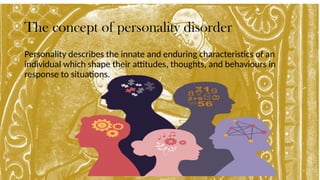
The concept of personality disorder
Personality describes the innate and enduring characteristics of an
individual which shape their attitudes, thoughts, and behaviours in
response to situations.
The following definition is based on ICD- 10 and DSM- 5.
PD are enduring, persistent, and pervasive disorders of inner
experience and behaviour that cause distress or significant
impairment in social functioning.
PD manifests as problems in cognition (ways of perceiving and
thinking about self and others), affect (range, intensity, and
appropriateness of emotional response), and behaviour (interpersonal
functioning, occupational and social functioning, and impulse control).
In general, personality disorder symptoms are ego syntonic and
alloplastic
Development of the concept
PD started in the early nineteenth century, at a time when the
main two groups of mental conditions acknowledged by
psychiatrists were insanity and idiocy
In 1801, Pinel described non- psychotic patients with disturbed
behavior and thinking as ‘manie sans délire’, insanity without
delusions
while the term ‘moral insanity’ was introduced by Prichard in
1835.
In 1927, Schneider introduced a classification system
which can be seen as a forerunner of the current
categorical approaches in DSM- 5 and ICD- 10.
He did not use a spectrum concept but saw PD as
representing maladaptive variation of normal
personality traits and used social deviance as a
diagnostic marker. Kraepelin suggested six additional
types of disturbed personalities: excitable, unstable,
eccentric, liar, swindler, and quarrelsome.
‘Normal’ personality
There are two main approaches: nomothetic and ideographic.
Nomothetic approaches
. Two subdivisions:
type (or categorical) approaches (discrete categories of personality);
and trait (or dimensional) approaches (a limited number of qualities,
or traits, account for personality variation).
Type approaches
These describe individual personality by similarity to a
variable number of predefined archetypes. These may attempt to include
all aspects of personality and behaviour— the ‘broad’ models— the ‘narrow’
models.
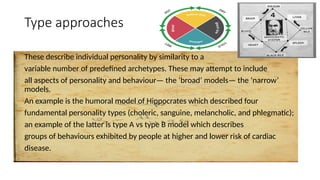
An example is the humoral model of Hippocrates which described four
fundamental personality types (choleric, sanguine, melancholic, and phlegmatic);
an example of the latter is type A vs type B model which describes
groups of behaviours exhibited by people at higher and lower risk of cardiac
disease.
Trait approaches:
Examples include;
Eysenck’s three- factor theory (neuroticism,extraversion,
psychoticism);
Costa and McCrae’s five- factor model
(neuroticism,extraversion, openness, agreeableness,
conscientiousness);
Cloninger’s seven- factor model (novelty- seeking, harm
avoidance, reward dependence, persistence, self-
directedness, cooperativeness, self- transcendence;
originally only first three factors); and Cattell’s 16- factor
theory.
Ideographic
approaches
Unlike nomothetic approaches, these emphasize individuality and seek to
understand an individual’s personality by understanding that individual and
their development, rather than by reference to common factors. Examples
are psychoanalytic, humanistic, and cognitive– behavioural approaches. The
first two have little scientific validity, and the last has compromised with
trait theorists.
Classification of personality
disorder
● The characteristic and enduring patterns of behaviour differ markedly
from
the cultural norm and in more than one of the following areas: cognition,
affectivity, control of impulses and gratification, and ways of relating to
others.
● The behaviour is inflexible, and maladaptive or dysfunctional in a broad
range of situations.
● Personal distress is caused to others and/or to self.
● The presentation is stable and long lasting, usually beginning by late
childhood or adolescence.
● The behaviour is not caused by another mental disorder, or by brain
injury,
disease, or dysfunction.
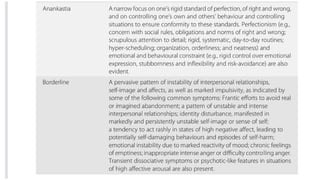
Other Categories
Narcissistic Personality Disorder
Passive Aggressive Personality Disorder
Affective personality disorders
They may be persistently gloomy (depressive personality
disorder) or habitually in a state of inappropriate elation
(hyperthymic personality disorder). A third groupalternates
between these two extremes (cycloid or cyclothymic
personality disorder).
Mixed Personality Disorders (ICD-10) and Personality Disorder
Not Otherwise Specified (DSM-IV)
Only a minority of patients can be easily placed in one of the specific
diagnostic categories outlined in the preceding sections.
Enduring Personality Changes after a
Catastrophic Experience
Although uncommon, it is now recognised that a person’s character
may change as a consequence of stressful events, particularly if the
stress was extreme.
The clinical picture is of social withdrawal, coupled with hostile or
mistrustful attitude to the world. feelings of hopelessness,
estrangement and a chronic feeling of being on edge, as if constantly
threatened.
The diagnosis lasted more than two years.
Further study is required to confirm the validity of this category of
personality disorder since it was first introduced in ICD-10 in 1992.
In ICD-11, this category is moved into complex PTSD when it occurs
after a traumatic experience.
ICD-11 has added a condition termed secondary personality change
due to a medical.
ICD-11 Proposals for Personality Disorder
The proposed changes to this category are very different from those in
ICD-10 and DSM-5,
What are termed ‘trait domain qualifiers’ or dimensions are to be
applied to identify the most prominent personality disorder
characteristics.
They are on a continuum from normal personality and personality
difficulty to personality disorder.
secondary personality change
a persistent personality disturbance that represents a change from the
individual’s previous characteristic personality pattern.
It is judged to be a direct pathophysiological consequence of a health
condition not classified under Mental and Behavioural disorders.
The diagnosis is made based on evidence from the history, physical
examination or laboratory findings.
The symptoms are not accounted for by delirium or by another mental and
behavioural disorder.
Neither are the changes a psychologically mediated response to a severe
medical condition (e.g., social withdrawal, avoidance or dependence in
response to a life-threatening diagnosis).
Severe personality disorder
• In terms of severe impact on social functioning.
• By using the PCL- R cut- off and being synonymous with
psychopathy.
• By defining severity as the presence of features
fulfilling the criteria for multiple categories of DSM- 5 or
ICD- 10 PDs (should be from at least two DSM- 5 clusters,
and perhaps that one must be from cluster B).
Aetiology of personality
disorder
Genetic
some evidence of heritability of cluster B PDs;
familial relationship between schizotypal PD and schizophrenia,
between paranoid PD and delusional disorder, and between borderline
PD and affective disorder.
There is no good evidence for a relationship between the XYY genotype
and psychopathy.
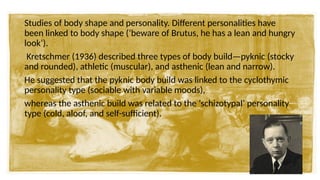
Studies of body shape and personality. Different personalities have
been linked to body shape (‘beware of Brutus, he has a lean and hungry
look’).
Kretschmer (1936) described three types of body build—pyknic (stocky
and rounded), athletic (muscular), and asthenic (lean and narrow).
He suggested that the pyknic body build was linked to the cyclothymic
personality type (sociable with variable moods),
whereas the asthenic build was related to the ‘schizotypal’ personality
type (cold, aloof, and self-sufficient).
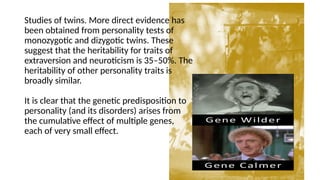
Studies of twins. More direct evidence has
been obtained from personality tests of
monozygotic and dizygotic twins. These
suggest that the heritability for traits of
extraversion and neuroticism is 35–50%. The
heritability of other personality traits is
broadly similar.
It is clear that the genetic predisposition to
personality (and its disorders) arises from
the cumulative effect of multiple genes,
each of very small effect.
Neurophysiology
• ‘Immature’ EEG (posterior temporal slow waves) in psychopathy;
• functional imaging abnormalities in psychopathy (e.g. d activity in the
amygdala during affective processing tasks);
• low 5- H T levels in impulsive, violent individuals;
autonomic abnormalities in psychopathy (slowed galvanic skin
response).
Childhood development
Difficult infant temperament may proceed to conduct disorder in
childhood and PD; ADHD may be a risk factor for later antisocial PD;
insecure attachment may predict later PD (particularly disorganized
attachment);
harsh and inconsistent parenting and family pathology are related to
conduct disorder and may therefore be related to later antisocial PD;
severe trauma in childhood (such as sexual abuse) may be a risk factor
for borderline PD and other cluster B disorders.
Psychodynamic theories
Freudian explanations of arrested development at oral, anal, and
genital stages, leading to dependent, obsessional, and histrionic
personalities;
‘borderline personality organization’ described by Kernberg (diffuse,
unfiltered reaction to experience prevents individuals from putting
adversity into perspective,leading to repeated crises);
narcissistic and borderline personalities seen as displaying primitive
defence mechanisms such as splitting and projective identification;
some see antisocial personalities as lacking aspects of superego, but a
more sophisticated explanation is in terms of a reaction to an overly
harsh superego (representing internalization of parental abuse).
Cognitive– behavioural theories
Applied behavior analysts believe that behaviour is consequences of
the environment, behaviours with positive effects being reinforced or
strengthened, those with aversive effects being weakened.
For example, suicide attempts, lashing out at others, substance abuse,
dissociation, and withdrawal may all function to avoid emotional
intimacy that has in the past led to hurt and rejection. Interventions
should be guided by experimental research on behaviour.
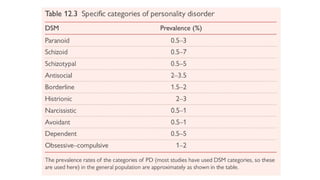
Epidemiology of personality disorder
• Community: prevalence for a diagnosis of any PD
was found to be 4.4% in a general population study of British
households.It is more prevalent in younger adults and generally
more prevalent in .
♂
• Primary care: prevalence of PD is around 10– 12%, consisting mainly of
patients presenting with depressive and somatizing symptoms.
• Psychiatric patients: 33% in general psychiatric outpatients. The
prevalence of PD rises to roughly 40% in eating disorder services, and
to 60% in substance misuse services.
• Other populations: 65% of and 42% of prisoners have a PD,
♂ ♀
predominantly antisocial.
Comorbidity between
personality disorder and
other
specific mental disorders
strong association
• Cluster B PDs and psychotic, affective, and anxiety disorders.
• Cluster C PDs and affective and anxiety disorders.
• Avoidant PD and social phobia (possibly because they both describe a
group of people with the same condition).
• Substance misuse and cluster B PDs.
• Eating disorders and cluster B and C PDs (particularly bulimia nervosa
and cluster B).
• Neurotic disorders and cluster C PDs (it has been suggested that these
individuals have a ‘general neurotic syndrome’).
• Somatoform disorders and cluster B and C PDs.
• Habit and impulse disorders and cluster B PDs (unsurprisingly).
• PTSD and borderline PD (this is not borderline PD redefined as chronic
PTSD, but it is probably due to the high rate of life events and vulnerability
of such individuals).
Moderate associations
• Schizotypal PD and schizophrenia (also a weaker association between
schizophrenia and antisocial PD).
• Depression and cluster B and C PDs.
• Delusional disorder and paranoid PD.
Assessment instruments
There is currently no accepted gold standard
measure of the assessment of personality.
Structured categorical (diagnostic) assessments
• Observer- rated structured interviews International Personality
Disorder Examination (IPDE), Diagnostic Interview for DSM- IV
Personality Disorders (DIPD- IV), Structured Interview for DSM- 5
Personality Disorders (SCID- 5- PD), Structured Clinical Interview for
DSM- IV Axis I Disorders, Personality Disorder Interview- IV.
• Self- rated questionnaires Personality Diagnostic Questionnaire,
Structured interview— other sources, Standardized Assessment of
Personality, Personality Assessment Schedule.
Structured dimensional assessments
• Observer- rated structured interview Schedule for Normal and Abnormal
Personality.
• Self- rated questionnaires Personality Assessment Inventory, Minnesota
Multiphasic Personality Inventory- 2, Millon Clinical Multi- axial Inventory-
III, Eysenck Inventory Questionnaire, NEO Five- F actor inventory- 3.
Unstructured assessments
• Interview- based Clinical interview, psychodynamic formulation.
• Other Rorschach test, Thematic Apperception Test.
Treatment
Cluster A disorders—the schizoid, eccentric, and often socially
withdrawn group—rarely seek help, and the cluster C disorders—the
anxious and obsessional—seek help for comorbidity, rarely for the
direct consequences of their personality disorder.
• Antipsychotics may be of some benefit in cluster B, particularly
borderline PD;Aripiprazole has been demonstrated to
have beneficial effects in treating impulsivity in those with borderline PD.
Both aripiprazole and olanzapine have shown some benefit in treating
patients with cognitive or perceptual symptoms, including suspiciousness
and depersonalization. Aripiprazole, olanzapine, and haloperidol may
also be useful for managing affect dysregulation.
• Antidepressants may be of benefit in impulsive, depressed, or self harming
patients (particularly borderline) and in cluster C (particularly
avoidant and obsessive– compulsive) disorders.
• Mood stabilizers, such as valproate (semisodium), lamotrigine, and
topiramate, have demonstrated some benefit in patients with affect
dysregulation.
• Dialectical behavioural therapy
• • Individual therapy
• • Group work
• Cognitive analytic therapy
• Psychodynamic therapy
• Mentalization- based therapy
• Cognitive behavioural therapy
Follow- up of individuals over time
May show some improvement in antisocial behaviour
by fifth decade. However, may just change with time from ‘overt’ criminal
r to more ‘covert’ antisocial behaviour such as domestic violence and child abuse.
Borderline A third to a half of patients fulfilling the criteria for borderline
PD do not have PD at all when followed up after 10– 20yrs. About a third
continue to have borderline PD, and others have other predominating PDs.
Poor prognostic indicators are severe, repeated self- harm and a ‘comorbid’
antisocial personality; a good prognostic indicator may be an initial presentation
with a comorbid affective disorder.
Schizotypal Generally have a poorer prognosis than borderline patients.
About 50% may develop schizophrenia.
Obsessional May worsen with age. More likely to develop depression
than OCD.
Clusters There is some evidence that cluster A traits worsen with age,
cluster B traits improve, and cluster C traits remain unchanged.
References
• Oxford Handbook of Psychiatry
• Shorter Oxford Textbook of Psychiatry
• Fish’s Clinical Psychopathology

نسخة personality disorders.pptx DSM5classifications ICD11classifications

  • 1.
    By Dr.khamael raed supervisiedby Dr.Auday Khalid in Alkadmyian hospital
  • 2.
    Objectives: • Defintion &Historical background • What is normal personality & its approches? • Classification of personality • Aetiology of personality disorder • Epidemiology of personality disorder • Tx &follow up
  • 3.
    The concept ofpersonality disorder Personality describes the innate and enduring characteristics of an individual which shape their attitudes, thoughts, and behaviours in response to situations.
  • 4.
    The following definitionis based on ICD- 10 and DSM- 5. PD are enduring, persistent, and pervasive disorders of inner experience and behaviour that cause distress or significant impairment in social functioning. PD manifests as problems in cognition (ways of perceiving and thinking about self and others), affect (range, intensity, and appropriateness of emotional response), and behaviour (interpersonal functioning, occupational and social functioning, and impulse control). In general, personality disorder symptoms are ego syntonic and alloplastic
  • 5.
    Development of theconcept PD started in the early nineteenth century, at a time when the main two groups of mental conditions acknowledged by psychiatrists were insanity and idiocy In 1801, Pinel described non- psychotic patients with disturbed behavior and thinking as ‘manie sans délire’, insanity without delusions while the term ‘moral insanity’ was introduced by Prichard in 1835.
  • 6.
    In 1927, Schneiderintroduced a classification system which can be seen as a forerunner of the current categorical approaches in DSM- 5 and ICD- 10. He did not use a spectrum concept but saw PD as representing maladaptive variation of normal personality traits and used social deviance as a diagnostic marker. Kraepelin suggested six additional types of disturbed personalities: excitable, unstable, eccentric, liar, swindler, and quarrelsome.
  • 7.
    ‘Normal’ personality There aretwo main approaches: nomothetic and ideographic.
  • 8.
    Nomothetic approaches . Twosubdivisions: type (or categorical) approaches (discrete categories of personality); and trait (or dimensional) approaches (a limited number of qualities, or traits, account for personality variation).
  • 9.
    Type approaches These describeindividual personality by similarity to a variable number of predefined archetypes. These may attempt to include all aspects of personality and behaviour— the ‘broad’ models— the ‘narrow’ models. An example is the humoral model of Hippocrates which described four fundamental personality types (choleric, sanguine, melancholic, and phlegmatic); an example of the latter is type A vs type B model which describes groups of behaviours exhibited by people at higher and lower risk of cardiac disease.
  • 10.
    Trait approaches: Examples include; Eysenck’sthree- factor theory (neuroticism,extraversion, psychoticism); Costa and McCrae’s five- factor model (neuroticism,extraversion, openness, agreeableness, conscientiousness); Cloninger’s seven- factor model (novelty- seeking, harm avoidance, reward dependence, persistence, self- directedness, cooperativeness, self- transcendence; originally only first three factors); and Cattell’s 16- factor theory.
  • 12.
    Ideographic approaches Unlike nomothetic approaches,these emphasize individuality and seek to understand an individual’s personality by understanding that individual and their development, rather than by reference to common factors. Examples are psychoanalytic, humanistic, and cognitive– behavioural approaches. The first two have little scientific validity, and the last has compromised with trait theorists.
  • 13.
  • 14.
    ● The characteristicand enduring patterns of behaviour differ markedly from the cultural norm and in more than one of the following areas: cognition, affectivity, control of impulses and gratification, and ways of relating to others. ● The behaviour is inflexible, and maladaptive or dysfunctional in a broad range of situations. ● Personal distress is caused to others and/or to self. ● The presentation is stable and long lasting, usually beginning by late childhood or adolescence. ● The behaviour is not caused by another mental disorder, or by brain injury, disease, or dysfunction.
  • 16.
  • 17.
  • 18.
    Affective personality disorders Theymay be persistently gloomy (depressive personality disorder) or habitually in a state of inappropriate elation (hyperthymic personality disorder). A third groupalternates between these two extremes (cycloid or cyclothymic personality disorder).
  • 19.
    Mixed Personality Disorders(ICD-10) and Personality Disorder Not Otherwise Specified (DSM-IV) Only a minority of patients can be easily placed in one of the specific diagnostic categories outlined in the preceding sections.
  • 20.
    Enduring Personality Changesafter a Catastrophic Experience Although uncommon, it is now recognised that a person’s character may change as a consequence of stressful events, particularly if the stress was extreme. The clinical picture is of social withdrawal, coupled with hostile or mistrustful attitude to the world. feelings of hopelessness, estrangement and a chronic feeling of being on edge, as if constantly threatened. The diagnosis lasted more than two years.
  • 21.
    Further study isrequired to confirm the validity of this category of personality disorder since it was first introduced in ICD-10 in 1992. In ICD-11, this category is moved into complex PTSD when it occurs after a traumatic experience. ICD-11 has added a condition termed secondary personality change due to a medical.
  • 22.
    ICD-11 Proposals forPersonality Disorder The proposed changes to this category are very different from those in ICD-10 and DSM-5, What are termed ‘trait domain qualifiers’ or dimensions are to be applied to identify the most prominent personality disorder characteristics. They are on a continuum from normal personality and personality difficulty to personality disorder.
  • 25.
    secondary personality change apersistent personality disturbance that represents a change from the individual’s previous characteristic personality pattern. It is judged to be a direct pathophysiological consequence of a health condition not classified under Mental and Behavioural disorders. The diagnosis is made based on evidence from the history, physical examination or laboratory findings. The symptoms are not accounted for by delirium or by another mental and behavioural disorder. Neither are the changes a psychologically mediated response to a severe medical condition (e.g., social withdrawal, avoidance or dependence in response to a life-threatening diagnosis).
  • 26.
    Severe personality disorder •In terms of severe impact on social functioning. • By using the PCL- R cut- off and being synonymous with psychopathy. • By defining severity as the presence of features fulfilling the criteria for multiple categories of DSM- 5 or ICD- 10 PDs (should be from at least two DSM- 5 clusters, and perhaps that one must be from cluster B).
  • 27.
  • 28.
    Genetic some evidence ofheritability of cluster B PDs; familial relationship between schizotypal PD and schizophrenia, between paranoid PD and delusional disorder, and between borderline PD and affective disorder. There is no good evidence for a relationship between the XYY genotype and psychopathy.
  • 29.
    Studies of bodyshape and personality. Different personalities have been linked to body shape (‘beware of Brutus, he has a lean and hungry look’). Kretschmer (1936) described three types of body build—pyknic (stocky and rounded), athletic (muscular), and asthenic (lean and narrow). He suggested that the pyknic body build was linked to the cyclothymic personality type (sociable with variable moods), whereas the asthenic build was related to the ‘schizotypal’ personality type (cold, aloof, and self-sufficient).
  • 30.
    Studies of twins.More direct evidence has been obtained from personality tests of monozygotic and dizygotic twins. These suggest that the heritability for traits of extraversion and neuroticism is 35–50%. The heritability of other personality traits is broadly similar. It is clear that the genetic predisposition to personality (and its disorders) arises from the cumulative effect of multiple genes, each of very small effect.
  • 31.
    Neurophysiology • ‘Immature’ EEG(posterior temporal slow waves) in psychopathy; • functional imaging abnormalities in psychopathy (e.g. d activity in the amygdala during affective processing tasks); • low 5- H T levels in impulsive, violent individuals; autonomic abnormalities in psychopathy (slowed galvanic skin response).
  • 32.
    Childhood development Difficult infanttemperament may proceed to conduct disorder in childhood and PD; ADHD may be a risk factor for later antisocial PD; insecure attachment may predict later PD (particularly disorganized attachment); harsh and inconsistent parenting and family pathology are related to conduct disorder and may therefore be related to later antisocial PD; severe trauma in childhood (such as sexual abuse) may be a risk factor for borderline PD and other cluster B disorders.
  • 33.
    Psychodynamic theories Freudian explanationsof arrested development at oral, anal, and genital stages, leading to dependent, obsessional, and histrionic personalities; ‘borderline personality organization’ described by Kernberg (diffuse, unfiltered reaction to experience prevents individuals from putting adversity into perspective,leading to repeated crises); narcissistic and borderline personalities seen as displaying primitive defence mechanisms such as splitting and projective identification; some see antisocial personalities as lacking aspects of superego, but a more sophisticated explanation is in terms of a reaction to an overly harsh superego (representing internalization of parental abuse).
  • 34.
    Cognitive– behavioural theories Appliedbehavior analysts believe that behaviour is consequences of the environment, behaviours with positive effects being reinforced or strengthened, those with aversive effects being weakened. For example, suicide attempts, lashing out at others, substance abuse, dissociation, and withdrawal may all function to avoid emotional intimacy that has in the past led to hurt and rejection. Interventions should be guided by experimental research on behaviour.
  • 35.
    Epidemiology of personalitydisorder • Community: prevalence for a diagnosis of any PD was found to be 4.4% in a general population study of British households.It is more prevalent in younger adults and generally more prevalent in . ♂ • Primary care: prevalence of PD is around 10– 12%, consisting mainly of patients presenting with depressive and somatizing symptoms. • Psychiatric patients: 33% in general psychiatric outpatients. The prevalence of PD rises to roughly 40% in eating disorder services, and to 60% in substance misuse services. • Other populations: 65% of and 42% of prisoners have a PD, ♂ ♀ predominantly antisocial.
  • 37.
    Comorbidity between personality disorderand other specific mental disorders
  • 38.
    strong association • ClusterB PDs and psychotic, affective, and anxiety disorders. • Cluster C PDs and affective and anxiety disorders. • Avoidant PD and social phobia (possibly because they both describe a group of people with the same condition). • Substance misuse and cluster B PDs. • Eating disorders and cluster B and C PDs (particularly bulimia nervosa and cluster B). • Neurotic disorders and cluster C PDs (it has been suggested that these individuals have a ‘general neurotic syndrome’). • Somatoform disorders and cluster B and C PDs. • Habit and impulse disorders and cluster B PDs (unsurprisingly). • PTSD and borderline PD (this is not borderline PD redefined as chronic PTSD, but it is probably due to the high rate of life events and vulnerability of such individuals).
  • 39.
    Moderate associations • SchizotypalPD and schizophrenia (also a weaker association between schizophrenia and antisocial PD). • Depression and cluster B and C PDs. • Delusional disorder and paranoid PD.
  • 40.
    Assessment instruments There iscurrently no accepted gold standard measure of the assessment of personality.
  • 41.
    Structured categorical (diagnostic)assessments • Observer- rated structured interviews International Personality Disorder Examination (IPDE), Diagnostic Interview for DSM- IV Personality Disorders (DIPD- IV), Structured Interview for DSM- 5 Personality Disorders (SCID- 5- PD), Structured Clinical Interview for DSM- IV Axis I Disorders, Personality Disorder Interview- IV. • Self- rated questionnaires Personality Diagnostic Questionnaire, Structured interview— other sources, Standardized Assessment of Personality, Personality Assessment Schedule.
  • 42.
    Structured dimensional assessments •Observer- rated structured interview Schedule for Normal and Abnormal Personality. • Self- rated questionnaires Personality Assessment Inventory, Minnesota Multiphasic Personality Inventory- 2, Millon Clinical Multi- axial Inventory- III, Eysenck Inventory Questionnaire, NEO Five- F actor inventory- 3. Unstructured assessments • Interview- based Clinical interview, psychodynamic formulation. • Other Rorschach test, Thematic Apperception Test.
  • 43.
    Treatment Cluster A disorders—theschizoid, eccentric, and often socially withdrawn group—rarely seek help, and the cluster C disorders—the anxious and obsessional—seek help for comorbidity, rarely for the direct consequences of their personality disorder.
  • 44.
    • Antipsychotics maybe of some benefit in cluster B, particularly borderline PD;Aripiprazole has been demonstrated to have beneficial effects in treating impulsivity in those with borderline PD. Both aripiprazole and olanzapine have shown some benefit in treating patients with cognitive or perceptual symptoms, including suspiciousness and depersonalization. Aripiprazole, olanzapine, and haloperidol may also be useful for managing affect dysregulation. • Antidepressants may be of benefit in impulsive, depressed, or self harming patients (particularly borderline) and in cluster C (particularly avoidant and obsessive– compulsive) disorders. • Mood stabilizers, such as valproate (semisodium), lamotrigine, and topiramate, have demonstrated some benefit in patients with affect dysregulation.
  • 45.
    • Dialectical behaviouraltherapy • • Individual therapy • • Group work • Cognitive analytic therapy • Psychodynamic therapy • Mentalization- based therapy • Cognitive behavioural therapy
  • 46.
    Follow- up ofindividuals over time May show some improvement in antisocial behaviour by fifth decade. However, may just change with time from ‘overt’ criminal r to more ‘covert’ antisocial behaviour such as domestic violence and child abuse. Borderline A third to a half of patients fulfilling the criteria for borderline PD do not have PD at all when followed up after 10– 20yrs. About a third continue to have borderline PD, and others have other predominating PDs. Poor prognostic indicators are severe, repeated self- harm and a ‘comorbid’ antisocial personality; a good prognostic indicator may be an initial presentation with a comorbid affective disorder.
  • 47.
    Schizotypal Generally havea poorer prognosis than borderline patients. About 50% may develop schizophrenia. Obsessional May worsen with age. More likely to develop depression than OCD. Clusters There is some evidence that cluster A traits worsen with age, cluster B traits improve, and cluster C traits remain unchanged.
  • 48.
    References • Oxford Handbookof Psychiatry • Shorter Oxford Textbook of Psychiatry • Fish’s Clinical Psychopathology