Personal Hygiene and You
M-DCPS
PHYSICAL EDUCATION AND
HEALTH LITERACY
Health
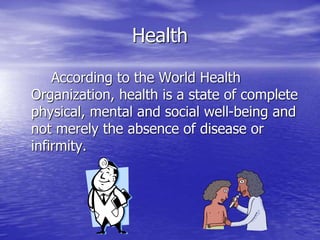
According to the World Health
Organization, health is a state of complete
physical, mental and social well-being and
not merely the absence of disease or
infirmity.
Hygiene
The definition of hygiene is healthy
habits that include bathing, keeping the
mouth clean, keeping the skin protected
from the sun and washing hands
frequently before handling edibles to
insure the safe delivery of food.
Good and Bad Hygiene
The difference between good and bad
hygiene is:
• Good hygiene keep you protected from
things, like germs and dangerous UV rays
from the sun, in the environment that can
hurt you
• Bad hygiene allows these things to affect
your body and probably make you sick
The Benefits of Good Hygiene
• According to the Centers for Disease Control and
Prevention, addressing the spread of germs in
schools is essential to the health of our youth,
our schools, and our nation
• Good hygiene prevents the spread of germs
• It also helps to give a good first impression to
others
Healthy Skin: Hand Washing
According to the Centers for Disease Control
(CDC) 22 million school days are lost each
year due to the common cold.
Some viruses and bacteria can live from 20
minutes up to 2 hours or more on surfaces
like cafeteria tables, doorknobs, and desks
How to Wash Your Hands
• Use warm running water
• Use soap
• Scrub hands together and under nails for
at least 15-20 seconds
• Dry hands on a clean cloth or paper towel
or use an automatic hand dryer if possible
Healthy Teeth and Gums
The health and cleanliness of your mouth is
important, if you don’t brush and floss…
• Cavities (holes in your teeth) may form
• Your breath will probably smell bad
• You may be at higher risk for serious
disease later in life, such as heart disease,
stroke, and diabetes
Choosing a Toothbrush and Toothpaste
Choose a toothbrush certified by the American
Dental Association (ADA)
A soft bristle brush is good, and it should fit to
your mouth
Get a new toothbrush at least every 3 or 4
months
Choose a fluoride toothpaste also certified by the
ADA
How Often and When to Brush and
Floss
• At least two times a day
• One time in the morning, and one time at
night
• Consider brushing between meals, too!
• Floss at least one time a day
• Floss if you feel food stuck in your teeth
Brushing Technique and Skills
• Place your toothbrush against the gums.
• Move the brush back and forth gently in short (tooth-wide)
strokes.
• Brush the outer tooth surfaces, the inner tooth surfaces, and the
chewing surfaces of the teeth.
• Clean the inside surfaces of the front teeth, using a gentle up-
and-down stroke.
• Brush your tongue to remove bacteria and freshen your breath.
Proper Flossing Skills
• Hold the floss tightly between your thumbs and
forefingers.
• Guide the floss between your teeth using a gentle
rubbing motion. Never snap the floss into the gums.
• When the floss reaches the gum line, curve it into a C
shape against one tooth. Gently slide it into the space
between the gum and the tooth.
Proper Flossing Skills (cont’d)
• Hold the floss tightly against the tooth. Gently
rub the side of the tooth, moving the floss
away from the gum with up and down
motions.
• Repeat this method on the rest of your teeth.
• Don't forget the back side of your last tooth.
Foods to Avoid
Bacteria in your mouth grow on sugar
Try to eat as little “junk food” as possible
=candy, chocolate, and other sweets
Avoid drinking soda and sweet tea
If you do eat these things, you may want to brush
immediately afterwards
Protection From the Sun
• Cancer researchers believe childhood
sunburns may increase a person's risk of
developing melanoma, the most serious
skin cancer.
• Most of the more than 1 million cases of
nonmelanoma skin cancer diagnosed
yearly in the United States are considered
to be sun-related.
Protection From the Sun
• 80% of the average person's lifetime sun
exposure happens before age 18.
• Skin cancer is the most common of all
cancers. It accounts for nearly half of all
cancers in the United States.
How to Protect Yourself
• Avoid the sun between 10 a.m. and 4 p.m.
• Seek shade: Look for shade, especially in
the middle of the day when the sun's rays
are strongest.
• Cover your head with a wide-brimmed
hat, shading your face, ears, and neck.
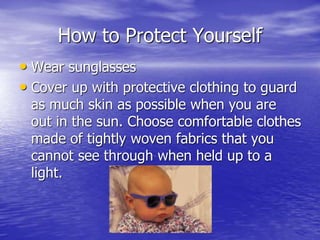
How to Protect Yourself
• Wear sunglasses
• Cover up with protective clothing to guard
as much skin as possible when you are
out in the sun. Choose comfortable clothes
made of tightly woven fabrics that you
cannot see through when held up to a
light.
Sunscreen
• Use sunscreen with a sun protection factor
(SPF) of 15 or higher.
• Apply a generous amount about a palmful
all over areas of your skin that are
exposed.
• Put it on 15-20 minutes before going out
in the sun.
Sunscreen
• Reapply after
swimming, toweling
dry, or perspiring.
• Reapply every two
hours
• Use sunscreen even
on hazy or overcast
days.
Sunscreen
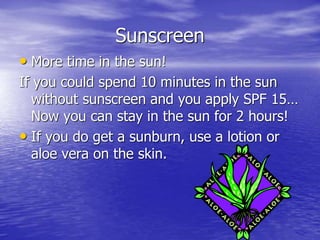
• More time in the sun!
If you could spend 10 minutes in the sun
without sunscreen and you apply SPF 15…
Now you can stay in the sun for 2 hours!
• If you do get a sunburn, use a lotion or
aloe vera on the skin.
Review
Hygiene: Lather, Rinse, Repeat.
Teeth: Brush, Floss, Rinse.
Sunscreen: Slip, Slop, Slap
Resources
• National Food Service Management Institute (2002). Wash Your Hands. Retrieved May 18, 2005
from http://www.nfsmi.org/Information/handsindex.html
• Lesson Plans (2004). Why Wash? Retrieved May 19, 2005 from
http://www.lessonplanspage.com/PEWhyWashHygieneComics2.htm
• American Dental Association (2005). Animation and Games. Retrieved May 20, 2005 from
http://www.ada.org/public/games/animation/interface.asp
• Centers for Disease Control and Prevention (2004). Stopping Germs at Home, Work, and School.
Retrieved May 26,2005 from http://www.cdc.gov/germstopper/home_work_school.htm
• World Health Organization(1948-2005). Definition of Health. Retrieved May 26, 2005 from
http://www.who.int/about/definition/en/
• American Cancer Society (2005). Skin Cancer Facts. Retrieved May 22, 2005 from
http://www.cancer.org/docroot/PED/content/ped_7_1_What_You_Need_To_Know_About_Skin_C
ancer.asp?sitearea=PED

personalhygieneandsunsafety (1).ppt

  • 1.
    Personal Hygiene andYou M-DCPS PHYSICAL EDUCATION AND HEALTH LITERACY
  • 2.
    Health According to theWorld Health Organization, health is a state of complete physical, mental and social well-being and not merely the absence of disease or infirmity.
  • 3.
    Hygiene The definition ofhygiene is healthy habits that include bathing, keeping the mouth clean, keeping the skin protected from the sun and washing hands frequently before handling edibles to insure the safe delivery of food.
  • 4.
    Good and BadHygiene The difference between good and bad hygiene is: • Good hygiene keep you protected from things, like germs and dangerous UV rays from the sun, in the environment that can hurt you • Bad hygiene allows these things to affect your body and probably make you sick
  • 5.
    The Benefits ofGood Hygiene • According to the Centers for Disease Control and Prevention, addressing the spread of germs in schools is essential to the health of our youth, our schools, and our nation • Good hygiene prevents the spread of germs • It also helps to give a good first impression to others
  • 6.
    Healthy Skin: HandWashing According to the Centers for Disease Control (CDC) 22 million school days are lost each year due to the common cold. Some viruses and bacteria can live from 20 minutes up to 2 hours or more on surfaces like cafeteria tables, doorknobs, and desks
  • 8.
    How to WashYour Hands • Use warm running water • Use soap • Scrub hands together and under nails for at least 15-20 seconds • Dry hands on a clean cloth or paper towel or use an automatic hand dryer if possible
  • 9.
    Healthy Teeth andGums The health and cleanliness of your mouth is important, if you don’t brush and floss… • Cavities (holes in your teeth) may form • Your breath will probably smell bad • You may be at higher risk for serious disease later in life, such as heart disease, stroke, and diabetes
  • 10.
    Choosing a Toothbrushand Toothpaste Choose a toothbrush certified by the American Dental Association (ADA) A soft bristle brush is good, and it should fit to your mouth Get a new toothbrush at least every 3 or 4 months Choose a fluoride toothpaste also certified by the ADA
  • 11.
    How Often andWhen to Brush and Floss • At least two times a day • One time in the morning, and one time at night • Consider brushing between meals, too! • Floss at least one time a day • Floss if you feel food stuck in your teeth
  • 12.
    Brushing Technique andSkills • Place your toothbrush against the gums. • Move the brush back and forth gently in short (tooth-wide) strokes. • Brush the outer tooth surfaces, the inner tooth surfaces, and the chewing surfaces of the teeth. • Clean the inside surfaces of the front teeth, using a gentle up- and-down stroke. • Brush your tongue to remove bacteria and freshen your breath.
  • 13.
    Proper Flossing Skills •Hold the floss tightly between your thumbs and forefingers. • Guide the floss between your teeth using a gentle rubbing motion. Never snap the floss into the gums. • When the floss reaches the gum line, curve it into a C shape against one tooth. Gently slide it into the space between the gum and the tooth.
  • 14.
    Proper Flossing Skills(cont’d) • Hold the floss tightly against the tooth. Gently rub the side of the tooth, moving the floss away from the gum with up and down motions. • Repeat this method on the rest of your teeth. • Don't forget the back side of your last tooth.
  • 15.
    Foods to Avoid Bacteriain your mouth grow on sugar Try to eat as little “junk food” as possible =candy, chocolate, and other sweets Avoid drinking soda and sweet tea If you do eat these things, you may want to brush immediately afterwards
  • 16.
    Protection From theSun • Cancer researchers believe childhood sunburns may increase a person's risk of developing melanoma, the most serious skin cancer. • Most of the more than 1 million cases of nonmelanoma skin cancer diagnosed yearly in the United States are considered to be sun-related.
  • 17.
    Protection From theSun • 80% of the average person's lifetime sun exposure happens before age 18. • Skin cancer is the most common of all cancers. It accounts for nearly half of all cancers in the United States.
  • 18.
    How to ProtectYourself • Avoid the sun between 10 a.m. and 4 p.m. • Seek shade: Look for shade, especially in the middle of the day when the sun's rays are strongest. • Cover your head with a wide-brimmed hat, shading your face, ears, and neck.
  • 19.
    How to ProtectYourself • Wear sunglasses • Cover up with protective clothing to guard as much skin as possible when you are out in the sun. Choose comfortable clothes made of tightly woven fabrics that you cannot see through when held up to a light.
  • 20.
    Sunscreen • Use sunscreenwith a sun protection factor (SPF) of 15 or higher. • Apply a generous amount about a palmful all over areas of your skin that are exposed. • Put it on 15-20 minutes before going out in the sun.
  • 21.
    Sunscreen • Reapply after swimming,toweling dry, or perspiring. • Reapply every two hours • Use sunscreen even on hazy or overcast days.
  • 22.
    Sunscreen • More timein the sun! If you could spend 10 minutes in the sun without sunscreen and you apply SPF 15… Now you can stay in the sun for 2 hours! • If you do get a sunburn, use a lotion or aloe vera on the skin.
  • 23.
    Review Hygiene: Lather, Rinse,Repeat. Teeth: Brush, Floss, Rinse. Sunscreen: Slip, Slop, Slap
  • 24.
    Resources • National FoodService Management Institute (2002). Wash Your Hands. Retrieved May 18, 2005 from http://www.nfsmi.org/Information/handsindex.html • Lesson Plans (2004). Why Wash? Retrieved May 19, 2005 from http://www.lessonplanspage.com/PEWhyWashHygieneComics2.htm • American Dental Association (2005). Animation and Games. Retrieved May 20, 2005 from http://www.ada.org/public/games/animation/interface.asp • Centers for Disease Control and Prevention (2004). Stopping Germs at Home, Work, and School. Retrieved May 26,2005 from http://www.cdc.gov/germstopper/home_work_school.htm • World Health Organization(1948-2005). Definition of Health. Retrieved May 26, 2005 from http://www.who.int/about/definition/en/ • American Cancer Society (2005). Skin Cancer Facts. Retrieved May 22, 2005 from http://www.cancer.org/docroot/PED/content/ped_7_1_What_You_Need_To_Know_About_Skin_C ancer.asp?sitearea=PED