個人化學習與績效輔助環境 Personal Learning and Performance-based Environment 報告者:陳冠廷 工程師 資策會數位教育研究所 2008.09.11.
大綱 Learning 2.0 –  Personal Learning and Performance-based Environment 以學習者為中心之環境建構 ( Learner-Centered ) 國外 PLE 架構與系統 概念與雛型系統展示 小結 討論時間
Learning 2.0 – Personal Learning and Performance-based Environment
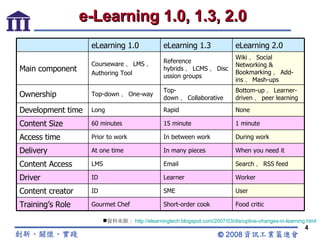
e-Learning 1.0, 1.3, 2.0 資料來源: http://elearningtech.blogspot.com/2007/03/disruptive-changes-in-learning.html Food critic Short-order cook Gourmet Chef Training’s Role User SME ID Content creator Worker Learner ID Driver Search 、 RSS feed Email LMS Content Access When you need it In many pieces At one time Delivery During work In between work Prior to work Access time 1 minute 15 minute 60 minutes Content Size None Rapid Long Development time Bottom-up 、 Learner-driven 、 peer learning Top-down 、 Collaborative Top-down 、 One-way Ownership Wiki 、 Social Networking & Bookmarking 、 Add-ins 、 Mash-ups Reference hybrids 、 LCMS 、 Discussion groups Courseware 、 LMS 、 Authoring Tool Main component eLearning 2.0 eLearning 1.3 eLearning 1.0
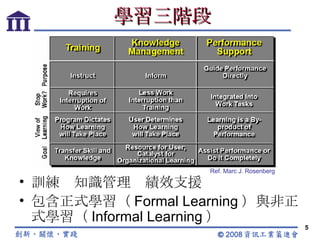
學習三階段 訓練  知識管理  績效支援 包含正式學習( Formal Learning )與非正式學習( Informal Learning ) Ref. Marc J. Rosenberg
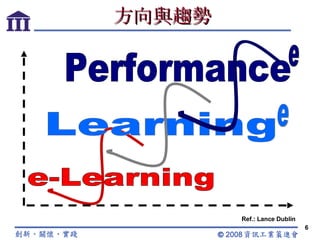
方向與趨勢 Learning e Performance e Ref.: Lance Dublin e-Learning
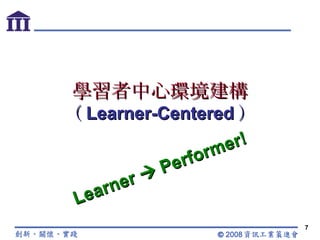
學習者中心環境建構 ( Learner-Centered ) Learner    Performer!
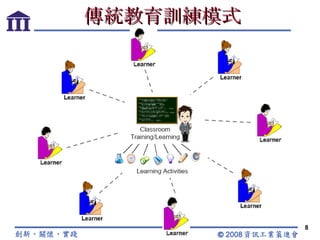
傳統教育訓練模式
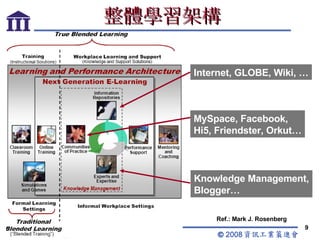
整體學習架構 Ref.: Mark J. Rosenberg Internet, GLOBE, Wiki, … MySpace, Facebook, Hi5, Friendster, Orkut… Knowledge Management, Blogger…
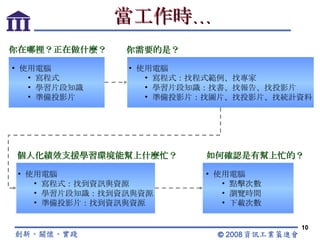
當工作時… 使用電腦 寫程式 學習片段知識 準備投影片 使用電腦 寫程式:找程式範例、找專家 學習片段知識:找書、找報告、找投影片 準備投影片:找圖片、找投影片、找統計資料 使用電腦 寫程式:找到資訊與資源 學習片段知識:找到資訊與資源 準備投影片:找到資訊與資源 使用電腦 點擊次數 瀏覽時間 下載次數 你在哪裡?正在做什麼? 你需要的是? 個人化績效支援學習環境能幫上什麼忙? 如何確認是有幫上忙的?
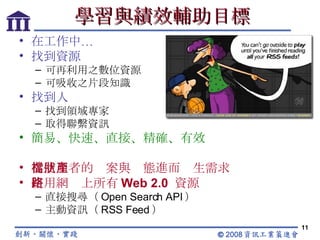
學習與績效輔助目標 在工作中… 找到資源 可再利用之數位資源 可吸收之片段知識 找到人 找到領域專家 取得聯繫資訊 簡易、快速、直接、精確、有效 從使用者的檔案與狀態進而產生需求 使用網路上所有 Web 2.0  資源 直接搜尋( Open Search API ) 主動資訊( RSS Feed )
國外 PLE 架構與系統
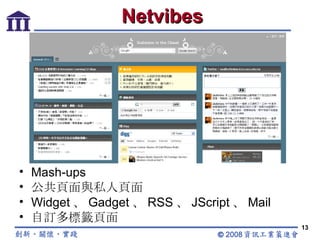
Netvibes Mash-ups 公共頁面與私人頁面 Widget 、 Gadget 、 RSS 、 JScript 、 Mail 自訂多標籤頁面
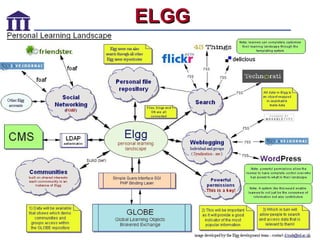
ELGG
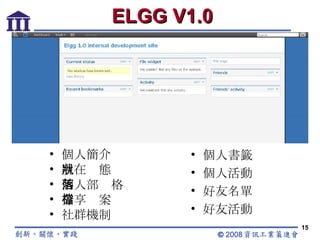
ELGG V1.0 個人簡介 現在狀態 個人部落格 分享檔案 社群機制 個人書籤 個人活動 好友名單 好友活動
概念與雛型系統展示
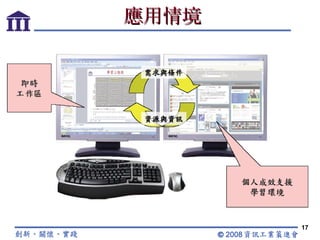
應用情境
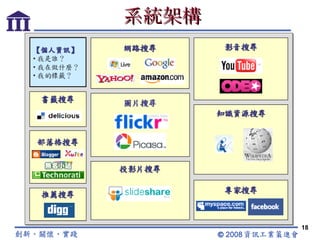
系統架構
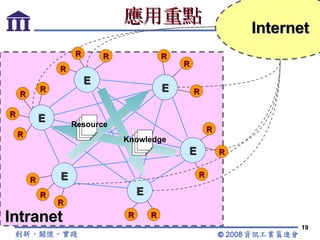
應用重點 E E E E E E Internet Intranet R R R R R R R R R R R R R R R R R R Knowledge Resource
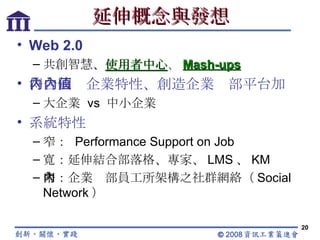
延伸概念與發想 Web 2.0 共創智慧、 使用者中心 、 Mash-ups 符合國內企業特性、創造企業內部平台加值 大企業  vs  中小企業 系統特性 窄:  Performance Support on Job 寬:延伸結合部落格、專家、 LMS 、 KM 窄:企業內部員工所架構之社群網絡( Social Network )
小結 即時解決手邊問題、完整提供相關資訊 學習、績效輔助為基礎 以 Web 2.0  精神為重點 Mash-ups User centered 未來 透過個人資料的建立,引申建構專家網絡系統,進一步著重社群( Community )經營與聯繫 自然語言處理與分析,朝 Web 3.0  目標邁進 開放性平台,直接與 Google App Engine  架接
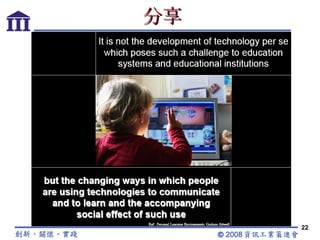
分享
End~ Thanks for your attention 數位教育研究所 數位學習中心 產業輔導組 陳冠廷工程師  02-2708-9215 ext. 8217 電子信箱: k [email_address] 個人部落格: http://skeletons.blogspot.com 企業學習 2.0 部落格: http:// elearning.iiiedu.org.tw
補充資料
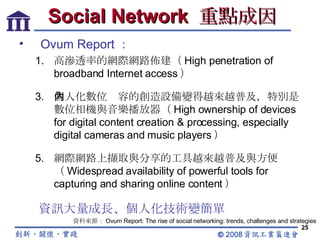
Social Network  重點成因 Ovum Report : 高滲透率的網際網路佈建( High penetration of broadband Internet access ) 個人化數位內容的創造設備變得越來越普及,特別是數位相機與音樂播放器( High ownership of devices for digital content creation & processing, especially digital cameras and music players ) 網際網路上擷取與分享的工具越來越普及與方便( Widespread availability of powerful tools for capturing and sharing online content )    資訊大量成長、個人化技術變簡單 資料來源: Ovum Report: The rise of social networking: trends, challenges and strategies
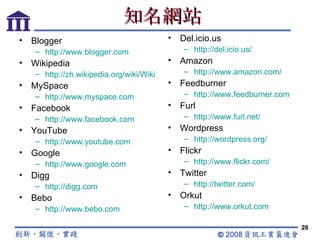
知名網站 Blogger http://www.blogger.com Wikipedia http://zh.wikipedia.org/wiki/Wiki MySpace http://www.myspace.com Facebook http://www.facebook.com YouTube http://www.youtube.com Google http://www.google.com Digg http://digg.com Bebo http:// www.bebo.com Del.icio.us http://del.icio.us/ Amazon http://www.amazon.com/ Feedburner http://www.feedburner.com Furl http://www.furl.net/ Wordpress http://wordpress.org/ Flickr http://www.flickr.com/ Twitter http://twitter.com/ Orkut http://www.orkut.com
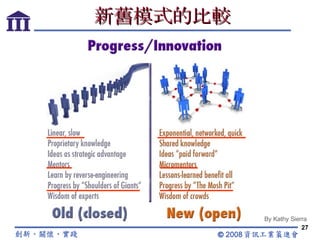
新舊模式的比較 By Kathy Sierra
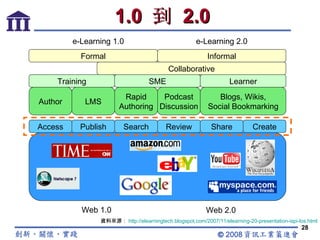
1.0  到  2.0 資料來源: http://elearningtech.blogspot.com/2007/11/elearning-20-presentation-ispi-los.html Formal Informal Collaborative Training SME Learner Author LMS Rapid Authoring Podcast Discussion Blogs, Wikis, Social Bookmarking Access Publish Search Review Share Create Web 1.0 Web 2.0 e-Learning 1.0 e-Learning 2.0
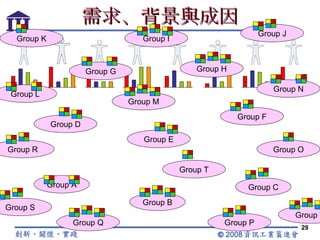
需求、背景與成因 Group A Group B Group C Group D Group E Group F Group G Group H Group I Group J Group K Group L Group M Group N Group O Group P Group Q Group R Group S Group T Group T
Personal Learning & Performance-based Environment V7

  • 1.
    個人化學習與績效輔助環境 Personal Learningand Performance-based Environment 報告者:陳冠廷 工程師 資策會數位教育研究所 2008.09.11.
  • 2.
    大綱 Learning 2.0– Personal Learning and Performance-based Environment 以學習者為中心之環境建構 ( Learner-Centered ) 國外 PLE 架構與系統 概念與雛型系統展示 小結 討論時間
  • 3.
    Learning 2.0 –Personal Learning and Performance-based Environment
  • 4.
    e-Learning 1.0, 1.3,2.0 資料來源: http://elearningtech.blogspot.com/2007/03/disruptive-changes-in-learning.html Food critic Short-order cook Gourmet Chef Training’s Role User SME ID Content creator Worker Learner ID Driver Search 、 RSS feed Email LMS Content Access When you need it In many pieces At one time Delivery During work In between work Prior to work Access time 1 minute 15 minute 60 minutes Content Size None Rapid Long Development time Bottom-up 、 Learner-driven 、 peer learning Top-down 、 Collaborative Top-down 、 One-way Ownership Wiki 、 Social Networking & Bookmarking 、 Add-ins 、 Mash-ups Reference hybrids 、 LCMS 、 Discussion groups Courseware 、 LMS 、 Authoring Tool Main component eLearning 2.0 eLearning 1.3 eLearning 1.0
  • 5.
    學習三階段 訓練 知識管理  績效支援 包含正式學習( Formal Learning )與非正式學習( Informal Learning ) Ref. Marc J. Rosenberg
  • 6.
    方向與趨勢 Learning ePerformance e Ref.: Lance Dublin e-Learning
  • 7.
  • 8.
  • 9.
    整體學習架構 Ref.: MarkJ. Rosenberg Internet, GLOBE, Wiki, … MySpace, Facebook, Hi5, Friendster, Orkut… Knowledge Management, Blogger…
  • 10.
    當工作時… 使用電腦 寫程式學習片段知識 準備投影片 使用電腦 寫程式:找程式範例、找專家 學習片段知識:找書、找報告、找投影片 準備投影片:找圖片、找投影片、找統計資料 使用電腦 寫程式:找到資訊與資源 學習片段知識:找到資訊與資源 準備投影片:找到資訊與資源 使用電腦 點擊次數 瀏覽時間 下載次數 你在哪裡?正在做什麼? 你需要的是? 個人化績效支援學習環境能幫上什麼忙? 如何確認是有幫上忙的?
  • 11.
    學習與績效輔助目標 在工作中… 找到資源可再利用之數位資源 可吸收之片段知識 找到人 找到領域專家 取得聯繫資訊 簡易、快速、直接、精確、有效 從使用者的檔案與狀態進而產生需求 使用網路上所有 Web 2.0 資源 直接搜尋( Open Search API ) 主動資訊( RSS Feed )
  • 12.
  • 13.
    Netvibes Mash-ups 公共頁面與私人頁面Widget 、 Gadget 、 RSS 、 JScript 、 Mail 自訂多標籤頁面
  • 14.
  • 15.
    ELGG V1.0 個人簡介現在狀態 個人部落格 分享檔案 社群機制 個人書籤 個人活動 好友名單 好友活動
  • 16.
  • 17.
  • 18.
  • 19.
    應用重點 E EE E E E Internet Intranet R R R R R R R R R R R R R R R R R R Knowledge Resource
  • 20.
    延伸概念與發想 Web 2.0共創智慧、 使用者中心 、 Mash-ups 符合國內企業特性、創造企業內部平台加值 大企業 vs 中小企業 系統特性 窄: Performance Support on Job 寬:延伸結合部落格、專家、 LMS 、 KM 窄:企業內部員工所架構之社群網絡( Social Network )
  • 21.
    小結 即時解決手邊問題、完整提供相關資訊 學習、績效輔助為基礎以 Web 2.0 精神為重點 Mash-ups User centered 未來 透過個人資料的建立,引申建構專家網絡系統,進一步著重社群( Community )經營與聯繫 自然語言處理與分析,朝 Web 3.0 目標邁進 開放性平台,直接與 Google App Engine 架接
  • 22.
  • 23.
    End~ Thanks foryour attention 數位教育研究所 數位學習中心 產業輔導組 陳冠廷工程師 02-2708-9215 ext. 8217 電子信箱: k [email_address] 個人部落格: http://skeletons.blogspot.com 企業學習 2.0 部落格: http:// elearning.iiiedu.org.tw
  • 24.
  • 25.
    Social Network 重點成因 Ovum Report : 高滲透率的網際網路佈建( High penetration of broadband Internet access ) 個人化數位內容的創造設備變得越來越普及,特別是數位相機與音樂播放器( High ownership of devices for digital content creation & processing, especially digital cameras and music players ) 網際網路上擷取與分享的工具越來越普及與方便( Widespread availability of powerful tools for capturing and sharing online content )  資訊大量成長、個人化技術變簡單 資料來源: Ovum Report: The rise of social networking: trends, challenges and strategies
  • 26.
    知名網站 Blogger http://www.blogger.comWikipedia http://zh.wikipedia.org/wiki/Wiki MySpace http://www.myspace.com Facebook http://www.facebook.com YouTube http://www.youtube.com Google http://www.google.com Digg http://digg.com Bebo http:// www.bebo.com Del.icio.us http://del.icio.us/ Amazon http://www.amazon.com/ Feedburner http://www.feedburner.com Furl http://www.furl.net/ Wordpress http://wordpress.org/ Flickr http://www.flickr.com/ Twitter http://twitter.com/ Orkut http://www.orkut.com
  • 27.
  • 28.
    1.0 到 2.0 資料來源: http://elearningtech.blogspot.com/2007/11/elearning-20-presentation-ispi-los.html Formal Informal Collaborative Training SME Learner Author LMS Rapid Authoring Podcast Discussion Blogs, Wikis, Social Bookmarking Access Publish Search Review Share Create Web 1.0 Web 2.0 e-Learning 1.0 e-Learning 2.0
  • 29.
    需求、背景與成因 Group AGroup B Group C Group D Group E Group F Group G Group H Group I Group J Group K Group L Group M Group N Group O Group P Group Q Group R Group S Group T Group T