Hydrothermal fabricated TiO2 heterostructure
boosts efficiency of MAPbI3 perovskite solar cells
2021/07/12
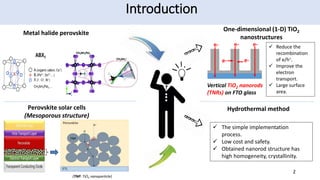
Introduction
2
Perovskite solar cells
(Mesoporous structure)
Metal halide perovskite
One-dimensional (1-D) TiO2
nanostructures
Hydrothermal method
 Reduce the
recombination
of e/h+.
 Improve the
electron
transport.
 Large surface
area.
Vertical TiO2 nanorods
(TNRs) on FTO glass
 The simple implementation
process.
 Low cost and safety.
 Obtained nanorod structure has
high homogeneity, crystallinity.
e- e- e-
e- e-
(TNP: TiO2 nanoparticle)
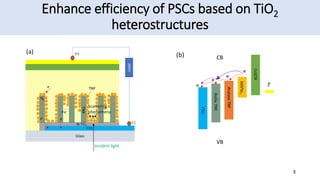
Enhance efficiency of PSCs based on TiO2
heterostructures
3
Incident light
Scattering
phenomena
CB
VB
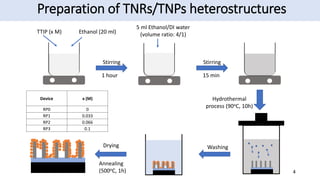
Preparation of TNRs/TNPs heterostructures
4
Drying
Stirring
1 hour 15 min
TTIP (x M) Ethanol (20 ml)
5 ml Ethanol/DI water
(volume ratio: 4/1)
Stirring
Annealing
(500oC, 1h)
Washing
Device x (M)
RP0 0
RP1 0.033
RP2 0.066
RP3 0.1
Hydrothermal
process (90oC, 10h)
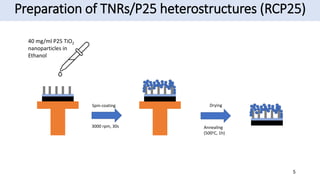
Preparation of TNRs/P25 heterostructures (RCP25)
5
40 mg/ml P25 TiO2
nanoparticles in
Ethanol
Spin-coating
3000 rpm, 30s
Drying
Annealing
(500oC, 1h)
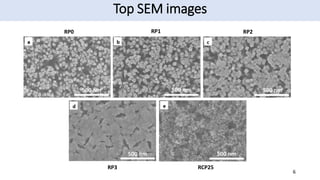
Top SEM images
6
RP0 RP1 RP2
RP3 RCP25
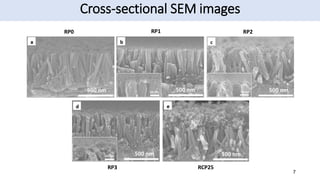
Cross-sectional SEM images
7
RP0 RP1 RP2
RP3 RCP25
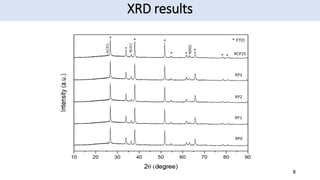
XRD results
8
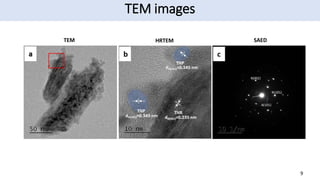
TEM images
9
10 µm
TEM HRTEM SAED
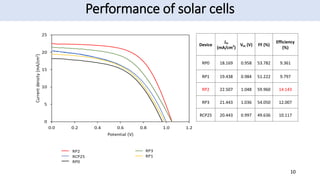
Performance of solar cells
10
Device
Jsc
(mA/cm2
)
Voc (V) FF (%)
Efficiency
(%)
RP0 18.169 0.958 53.782 9.361
RP1 19.438 0.984 51.222 9.797
RP2 22.507 1.048 59.960 14.143
RP3 21.443 1.036 54.050 12.007
RCP25 20.443 0.997 49.636 10.117
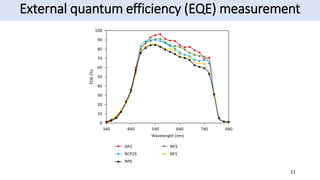
External quantum efficiency (EQE) measurement
11
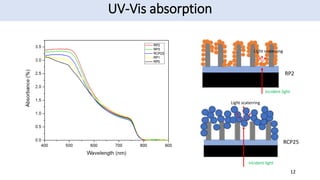
UV-Vis absorption
12
Incident light
Incident light
Light scaterring
Light scaterring
RCP25
RP2
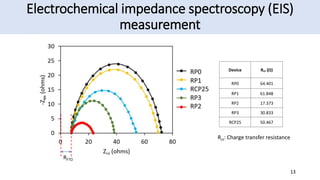
Electrochemical impedance spectroscopy (EIS)
measurement
13
Device Rct (Ω)
RP0 64.401
RP1 61.848
RP2 17.373
RP3 30.833
RCP25 50.467
Rct: Charge transfer resistance
RFTO
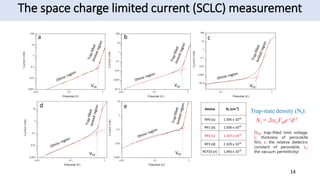
The space charge limited current (SCLC) measurement
14
Nt = 2εεoVtfte-1d-2
Device Nt (cm-3
)
RP0 (a) 1.595 x 10¹⁶
RP1 (b) 1.500 x 10¹⁶
RP2 (c) 1.107 x 10¹⁶
RP3 (d) 1.329 x 10¹⁶
RCP25 (e) 1.440 x 10¹⁶
Trap-state density (Nt):
(Vtft: trap-filled limit voltage,
L: thickness of perovskite
film, ε: the relative dielectric
constant of perovskite, εo:
the vacuum permittivity)
Conclusion
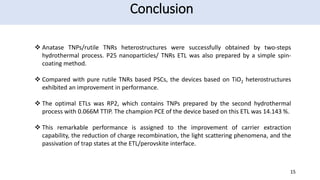
 Anatase TNPs/rutile TNRs heterostructures were successfully obtained by two-steps
hydrothermal process. P25 nanoparticles/ TNRs ETL was also prepared by a simple spin-
coating method.
 Compared with pure rutile TNRs based PSCs, the devices based on TiO2 heterostructures
exhibited an improvement in performance.
 The optimal ETLs was RP2, which contains TNPs prepared by the second hydrothermal
process with 0.066M TTIP. The champion PCE of the device based on this ETL was 14.143 %.
 This remarkable performance is assigned to the improvement of carrier extraction
capability, the reduction of charge recombination, the light scattering phenomena, and the
passivation of trap states at the ETL/perovskite interface.
15
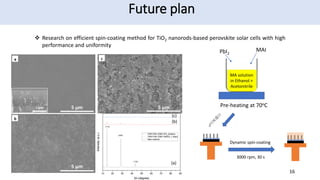
Future plan
 Research on efficient spin-coating method for TiO2 nanorods-based perovskite solar cells with high
performance and uniformity
16
10 20 30 40 50 60 70 80 90
(116)
(220)
Intensity
(a.u.)
2q (degree)
TNR-PSK (DMF-IPA_2steps)
TNR-PSK (DMF-DMSO_1 step)
New method
(110)
(a)
(b)
(c)
MAI
PbI2
MA solution
in Ethanol +
Acetonitrile
Pre-heating at 70oC
Dynamic spin-coating
3000 rpm, 30 s
Thank you for your attention !
17

perovskite

  • 1.
    Hydrothermal fabricated TiO2heterostructure boosts efficiency of MAPbI3 perovskite solar cells 2021/07/12
  • 2.
    Introduction 2 Perovskite solar cells (Mesoporousstructure) Metal halide perovskite One-dimensional (1-D) TiO2 nanostructures Hydrothermal method  Reduce the recombination of e/h+.  Improve the electron transport.  Large surface area. Vertical TiO2 nanorods (TNRs) on FTO glass  The simple implementation process.  Low cost and safety.  Obtained nanorod structure has high homogeneity, crystallinity. e- e- e- e- e- (TNP: TiO2 nanoparticle)
  • 3.
    Enhance efficiency ofPSCs based on TiO2 heterostructures 3 Incident light Scattering phenomena CB VB
  • 4.
    Preparation of TNRs/TNPsheterostructures 4 Drying Stirring 1 hour 15 min TTIP (x M) Ethanol (20 ml) 5 ml Ethanol/DI water (volume ratio: 4/1) Stirring Annealing (500oC, 1h) Washing Device x (M) RP0 0 RP1 0.033 RP2 0.066 RP3 0.1 Hydrothermal process (90oC, 10h)
  • 5.
    Preparation of TNRs/P25heterostructures (RCP25) 5 40 mg/ml P25 TiO2 nanoparticles in Ethanol Spin-coating 3000 rpm, 30s Drying Annealing (500oC, 1h)
  • 6.
    Top SEM images 6 RP0RP1 RP2 RP3 RCP25
  • 7.
  • 8.
  • 9.
  • 10.
    Performance of solarcells 10 Device Jsc (mA/cm2 ) Voc (V) FF (%) Efficiency (%) RP0 18.169 0.958 53.782 9.361 RP1 19.438 0.984 51.222 9.797 RP2 22.507 1.048 59.960 14.143 RP3 21.443 1.036 54.050 12.007 RCP25 20.443 0.997 49.636 10.117
  • 11.
    External quantum efficiency(EQE) measurement 11
  • 12.
    UV-Vis absorption 12 Incident light Incidentlight Light scaterring Light scaterring RCP25 RP2
  • 13.
    Electrochemical impedance spectroscopy(EIS) measurement 13 Device Rct (Ω) RP0 64.401 RP1 61.848 RP2 17.373 RP3 30.833 RCP25 50.467 Rct: Charge transfer resistance RFTO
  • 14.
    The space chargelimited current (SCLC) measurement 14 Nt = 2εεoVtfte-1d-2 Device Nt (cm-3 ) RP0 (a) 1.595 x 10¹⁶ RP1 (b) 1.500 x 10¹⁶ RP2 (c) 1.107 x 10¹⁶ RP3 (d) 1.329 x 10¹⁶ RCP25 (e) 1.440 x 10¹⁶ Trap-state density (Nt): (Vtft: trap-filled limit voltage, L: thickness of perovskite film, ε: the relative dielectric constant of perovskite, εo: the vacuum permittivity)
  • 15.
    Conclusion  Anatase TNPs/rutileTNRs heterostructures were successfully obtained by two-steps hydrothermal process. P25 nanoparticles/ TNRs ETL was also prepared by a simple spin- coating method.  Compared with pure rutile TNRs based PSCs, the devices based on TiO2 heterostructures exhibited an improvement in performance.  The optimal ETLs was RP2, which contains TNPs prepared by the second hydrothermal process with 0.066M TTIP. The champion PCE of the device based on this ETL was 14.143 %.  This remarkable performance is assigned to the improvement of carrier extraction capability, the reduction of charge recombination, the light scattering phenomena, and the passivation of trap states at the ETL/perovskite interface. 15
  • 16.
    Future plan  Researchon efficient spin-coating method for TiO2 nanorods-based perovskite solar cells with high performance and uniformity 16 10 20 30 40 50 60 70 80 90 (116) (220) Intensity (a.u.) 2q (degree) TNR-PSK (DMF-IPA_2steps) TNR-PSK (DMF-DMSO_1 step) New method (110) (a) (b) (c) MAI PbI2 MA solution in Ethanol + Acetonitrile Pre-heating at 70oC Dynamic spin-coating 3000 rpm, 30 s
  • 17.
    Thank you foryour attention ! 17