CONTENT WORDSCommonmistakesBraziliansmakeCentro Universitário Anhanguera SP Brigadeiro – 2011Maira C Reis Stella, Mariana L Malaquias e Paula C Carnasciali
ReferencesHolds a PhD in applied linguistics and language pedagogy. At present, he is Director of the Centre for English Teacher Training at EötvösLor´nd University, BudapestHolds an PhD in Linguistics. At present, he is a professor at  the Linguistics department of UniversidadeCatólica de São PauloHolds an MA in Teaching English to Speakers of  Other Languages. She is the founder and head trainer of Accurate English
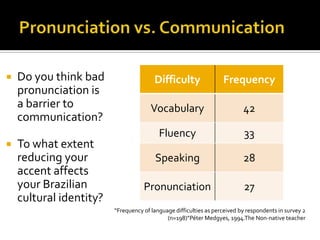
Pronunciation vs. CommunicationDo you think bad pronunciation is a barrier to communication?To what extent reducing your accent affects your Brazilian cultural identity?“Frequency of language difficulties as perceived by respondents in survey 2 (n=198)”PéterMedgyes, 1994.The Non-native teacher
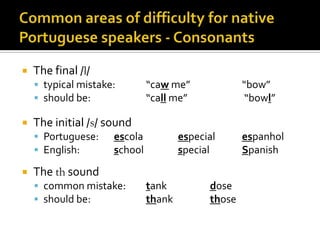
Commonareasofdifficulty for nativePortuguese speakers - ConsonantsThe final /l/typical mistake:	“caw me”		“bow”should be:		“call me”		 “bowl”The initial /s/ soundPortuguese:	escolaespecial	espanholEnglish:		school		special		Spanish		The th soundcommon mistake:	tank		doseshould be: 		thank 		those
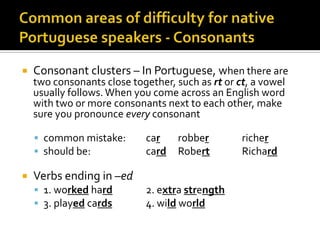
Commonareasofdifficulty for nativePortuguese speakers - ConsonantsConsonant clusters – In Portuguese, when there are two consonants close together, such as rt or ct, a vowel usually follows. When you come across an English word with two or more consonants next to each other, make sure you pronounce every consonantcommon mistake:	carrobber		richershould be:		card	Robert		RichardVerbs ending in –ed1. worked hard		2. extra strength3. played cards		4. wild world
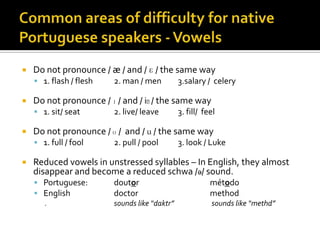
Commonareasofdifficulty for nativePortuguese speakers - VowelsDo not pronounce /æ/ and / ɛ / the same way1. flash / flesh	2. man / men 	3.salary /  celeryDo not pronounce /ɪ/ and / iː / the same way1. sit/ seat		2. live/ leave	3. fill/  feel	Do not pronounce / ʊ/  and / u / the same way1. full / fool	2. pull / pool	3. look / LukeReduced vowels in unstressed syllables – In English, they almost disappear and become a reduced schwa /ə/ sound.Portuguese:	doutormétodoEnglish		doctor			method	.			sounds like “daktr”		 sounds like “methd”
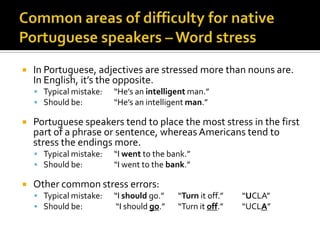
Commonareasofdifficulty for nativePortuguese speakers – Word stressIn Portuguese, adjectives are stressed more than nouns are. In English, it’s the opposite.Typical mistake:	“He’s an intelligent man.”	Should be:	“He’s an intelligent man.”Portuguese speakers tend to place the most stress in the first part of a phrase or sentence, whereas Americans tend to stress the endings more.Typical mistake:	“I went to the bank.”Should be:	“I went to the bank.”Other common stress errors:Typical mistake:	“I should go.”	“Turn it off.”	“UCLA”Should be:	 “I should go.”	“Turn it off.”	“UCLA”
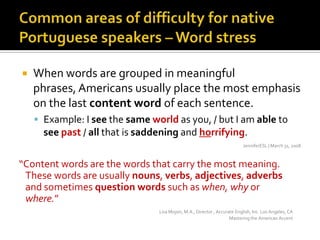
Commonareasofdifficulty for nativePortuguese speakers – Word stressWhen words are grouped in meaningful phrases, Americans usually place the most emphasis on the last content word of each sentence.Example: I see the same world as you, / but I am able to see past/ all that is saddening and horrifying.JenniferESL | March 31, 2008“Contentwords are thewordsthatcarrythemostmeaning. Thesewords are usuallynouns, verbs, adjectives, adverbsandsometimesquestionwordssuch as when, whyorwhere.”Lisa Mojsin, M.A., Director , Accurate English, Inc. Los Angeles, CAMastering the American Accent
A permanentlearner"Since we have jumped off the same springboard as our students, both in a linguistic and a cultural sense, we are intrinsically more sensitive to their difficulties than NESTs.”Peter Medgyes | The Non-Native Teacher p.61"I firmly believe that the non-NEST is (more or less) handicapped in terms of a command of English. Paradoxically, this shortcoming is her most valuable asset, quite capable of offsetting the odds of limited proficiency. It is precisely this deficit that helps her develop capacities that a NEST can never aspire to acquire.”The Non-Native Teacher p.76
Centro Universitário Anhanguera SP Brigadeiro – 2011Visit our blog andshare online resources: http://permanentlearner.blogspot.com/Maira Corvacho Reis StellaMariana LafranchiMalaquiasPaula Casellato Carnasciali

Permanent Learner - Content words

  • 1.
    CONTENT WORDSCommonmistakesBraziliansmakeCentro UniversitárioAnhanguera SP Brigadeiro – 2011Maira C Reis Stella, Mariana L Malaquias e Paula C Carnasciali
  • 2.
    ReferencesHolds a PhDin applied linguistics and language pedagogy. At present, he is Director of the Centre for English Teacher Training at EötvösLor´nd University, BudapestHolds an PhD in Linguistics. At present, he is a professor at the Linguistics department of UniversidadeCatólica de São PauloHolds an MA in Teaching English to Speakers of Other Languages. She is the founder and head trainer of Accurate English
  • 3.
    Pronunciation vs. CommunicationDoyou think bad pronunciation is a barrier to communication?To what extent reducing your accent affects your Brazilian cultural identity?“Frequency of language difficulties as perceived by respondents in survey 2 (n=198)”PéterMedgyes, 1994.The Non-native teacher
  • 4.
    Commonareasofdifficulty for nativePortuguesespeakers - ConsonantsThe final /l/typical mistake: “caw me” “bow”should be: “call me” “bowl”The initial /s/ soundPortuguese: escolaespecial espanholEnglish: school special Spanish The th soundcommon mistake: tank doseshould be: thank those
  • 5.
    Commonareasofdifficulty for nativePortuguesespeakers - ConsonantsConsonant clusters – In Portuguese, when there are two consonants close together, such as rt or ct, a vowel usually follows. When you come across an English word with two or more consonants next to each other, make sure you pronounce every consonantcommon mistake: carrobber richershould be: card Robert RichardVerbs ending in –ed1. worked hard 2. extra strength3. played cards 4. wild world
  • 6.
    Commonareasofdifficulty for nativePortuguesespeakers - VowelsDo not pronounce /æ/ and / ɛ / the same way1. flash / flesh 2. man / men 3.salary / celeryDo not pronounce /ɪ/ and / iː / the same way1. sit/ seat 2. live/ leave 3. fill/ feel Do not pronounce / ʊ/ and / u / the same way1. full / fool 2. pull / pool 3. look / LukeReduced vowels in unstressed syllables – In English, they almost disappear and become a reduced schwa /ə/ sound.Portuguese: doutormétodoEnglish doctor method . sounds like “daktr” sounds like “methd”
  • 7.
    Commonareasofdifficulty for nativePortuguesespeakers – Word stressIn Portuguese, adjectives are stressed more than nouns are. In English, it’s the opposite.Typical mistake: “He’s an intelligent man.” Should be: “He’s an intelligent man.”Portuguese speakers tend to place the most stress in the first part of a phrase or sentence, whereas Americans tend to stress the endings more.Typical mistake: “I went to the bank.”Should be: “I went to the bank.”Other common stress errors:Typical mistake: “I should go.” “Turn it off.” “UCLA”Should be: “I should go.” “Turn it off.” “UCLA”
  • 8.
    Commonareasofdifficulty for nativePortuguesespeakers – Word stressWhen words are grouped in meaningful phrases, Americans usually place the most emphasis on the last content word of each sentence.Example: I see the same world as you, / but I am able to see past/ all that is saddening and horrifying.JenniferESL | March 31, 2008“Contentwords are thewordsthatcarrythemostmeaning. Thesewords are usuallynouns, verbs, adjectives, adverbsandsometimesquestionwordssuch as when, whyorwhere.”Lisa Mojsin, M.A., Director , Accurate English, Inc. Los Angeles, CAMastering the American Accent
  • 9.
    A permanentlearner"Since wehave jumped off the same springboard as our students, both in a linguistic and a cultural sense, we are intrinsically more sensitive to their difficulties than NESTs.”Peter Medgyes | The Non-Native Teacher p.61"I firmly believe that the non-NEST is (more or less) handicapped in terms of a command of English. Paradoxically, this shortcoming is her most valuable asset, quite capable of offsetting the odds of limited proficiency. It is precisely this deficit that helps her develop capacities that a NEST can never aspire to acquire.”The Non-Native Teacher p.76
  • 10.
    Centro Universitário AnhangueraSP Brigadeiro – 2011Visit our blog andshare online resources: http://permanentlearner.blogspot.com/Maira Corvacho Reis StellaMariana LafranchiMalaquiasPaula Casellato Carnasciali