Dr Amit Pawa @amit_pawa
Peripheral Nerve Catheters
So
Th
ul
Disclosures
RA-UK President
Honoraria from GE Healthcare
Consult for B Braun Medical Ltd
@amit_pawa
Guy’s Hospital, London
I have a confession…
Editorial
Interscalene catheters - should we give them the cold shoulder?
The benefits of single-shot inter-
scalene brachial plexus blockade
(SSIB) for patients undergoing
shoulder surgery are well estab-
lished [1]. These blocks have a
consistently high success rate, the
techniques are well described [2–4]
and are suitable for the vast major-
ity of patients presenting for
shoulder surgery. Single-shot blocks
can provide excellent analgesia for
11-14 hours, which mitigates the
severe postoperative pain that can
follow shoulder surgery. In the
UK, these patients are commonly
that, at the moment, ambulatory
catheter techniques for shoulder
surgery are not widely employed,
and this may be related to logistical
and safety concerns. This seems to
be confirmed by the fact that there
are few published research papers
that have included more than
twenty patients [9]. Fredrickson
et al. should therefore be com-
mended for completing the largest
prospective observational study so
far that has investigated the safety
of such an analgesic regimen.
In approximately 1500 patients
dyspnoea during the infusion at
home, which was surprisingly high
at 27% and was in contrast to the
0.7% of patients who experienced
this symptom immediately postoper-
atively.
As anaesthetists, we are inter-
ested in pain and dyspnoea, but
patients often have different con-
cerns, and they may find numbness
just as unpleasant as pain, thus
influencing their choice of analgesic
technique. It would have been inter-
esting to learn how patients per-
ceived their recovery with
Anaesthesia 2016, 71, 359–372
houlder surgery
llow same day
ajority of cases.
eliable analgesia
ich can be pro-
se of adjuncts
ic receptor ago-
hasone, but the
of these drugs
ptake [20]. Sig-
article reported
of analgesia of
th a single dose
methasone com-
ral dexametha-
evelopment of
mulations such
caine may offer
before the branching of the supras-
capular nerve [25]. Performing a
nerve block at this level can provide
adequate analgesia for shoulder sur-
gery and may be less likely to result
in phrenic nerve palsy. Although
not commonly performed, the supe-
rior trunk block could provide a
safer target for catheter placement
because the locations of the needle
and catheter tip should be easily
visible when using ultrasound. A
recent letter by Lin et al. described
a single puncture approach to block
both the supraclavicular nerves and
the superior trunk of the brachial
plexus [26], however much more
work is required to determine the
up the level of knowledge and skill
in the wider anaesthesia community
to allow us to offer this service
safely.
Acknowledgements
No external funding and no com-
peting interests declared.
A. Pawa
Consultant
A. P. Devlin
A. Kochhar
Specialty Registrars
Department of Anaesthesia
Guy’s and St. Thomas’ Hospitals
London UK
Email: amit.pawa@gstt.nhs.uk
naesthetists of Great Britain and Ireland 361
@amit_pawa
@amit_pawa
I will Share Our Experience
@amit_pawa
In the next 30mins…
Why Catheters?
Indications
Our Practice at GSTT
Tips
@amit_pawa
Why Catheters?
First Ask…
@amit_pawa
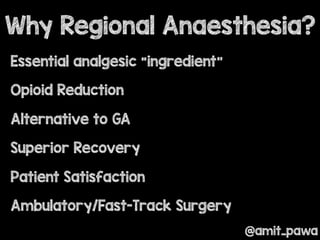
Essential analgesic “ingredient”
Opioid Reduction
Alternative to GA
Superior Recovery
Patient Satisfaction
Ambulatory/Fast-Track Surgery
Why Regional Anaesthesia?
@amit_pawa
Essential analgesic “ingredient”
Opioid Reduction
Alternative to GA
Superior Recovery
Patient Satisfaction
Ambulatory/Fast-Track Surgery
Why Catheters?
@amit_pawa
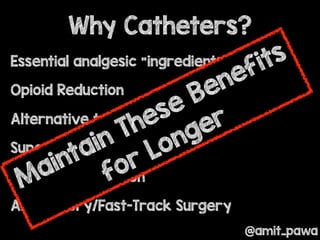
Essential analgesic “ingredient”
Opioid Reduction
Alternative to GA
Superior Recovery
Patient Satisfaction
Ambulatory/Fast-Track Surgery
Why Catheters?
Maintain These Benefits
for Longer
Goals
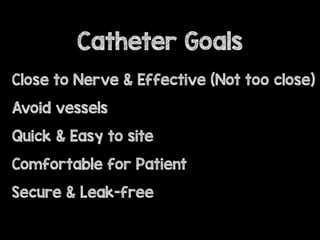
Catheter Goals
Close to Nerve & Effective (Not too close)
Avoid vessels
Quick & Easy to site
Comfortable for Patient
Secure & Leak-free
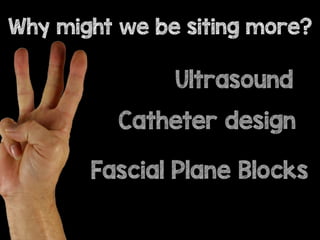
Why might we be siting more?
Catheter design
Fascial Plane Blocks
Ultrasound
Catheter-Types
Catheter-Through-Needle (C-T-N)
Catheter-Over-Needle (C-O-N)
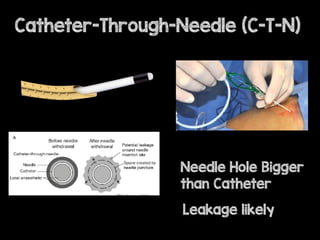
Catheter-Through-Needle (C-T-N)
Most Established
Sono
Theco
ultraso
Catheter-Through-Needle (C-T-N)
Needle Hole Bigger
than Catheter
Leakage likely
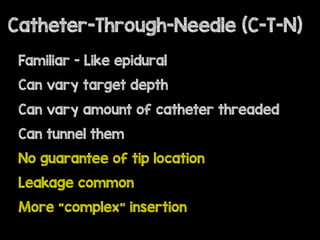
Familiar - Like epidural
Can vary target depth
Can vary amount of catheter threaded
Can tunnel them
No guarantee of tip location
Leakage common
More “complex” insertion
Catheter-Through-Needle (C-T-N)
Newer Concept
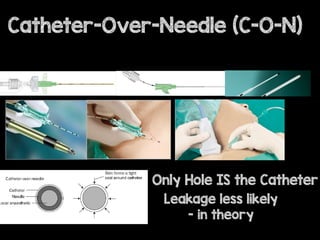
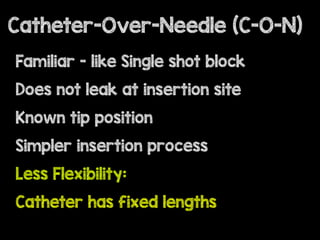
Catheter-Over-Needle (C-O-N)
Only Hole IS the Catheter
Leakage less likely
- in theory
Catheter-Over-Needle (C-O-N)
Familiar - like Single shot block
Does not leak at insertion site
Known tip position
Simpler insertion process
Less Flexibility:
Catheter has fixed lengths
Catheter-Over-Needle (C-O-N)
Fascial Plane Blocks
TAP
PECS
Serratus Plane
ESP
Fascial Plane Blocks
TAP
PECS
Serratus Plane
ESP
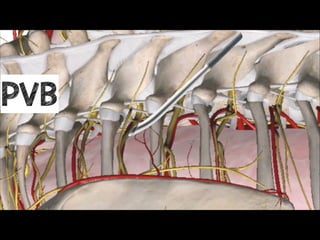
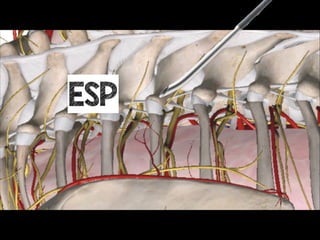
Easier/Safer/Alternative end-points?
PVB
ESP
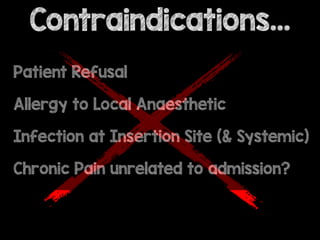
Contraindications…
Patient Refusal
Allergy to Local Anaesthetic
Infection at Insertion Site (& Systemic)
Chronic Pain unrelated to admission?
What can go wrong
with Catheters
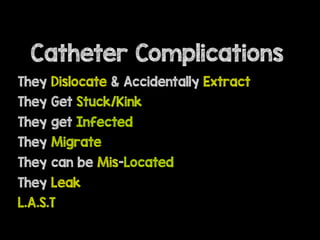
Catheter Complications
They Dislocate & Accidentally Extract
They Get Stuck/Kink
They get Infected
They Migrate
They can be Mis-Located
They Leak
L.A.S.T
Catheter Complications
They Dislocate & Accidentally Extract
They Get Stuck/Kink
They get Infected
They Migrate
They can be Mis-Located
They Leak
L.A.S.T
Despite these (rare)
risks, there is still a role
for catheters!
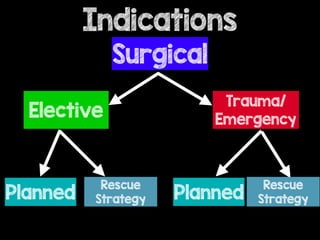
Indications
Indications
Surgical
Elective
Trauma/
Emergency
Planned
Rescue
Strategy Planned
Rescue
Strategy
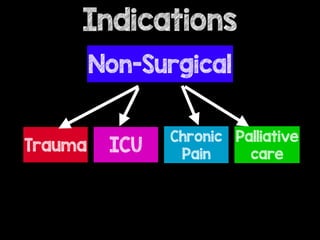
Indications
Non-Surgical
Chronic
Pain
Trauma ICU
Palliative
care
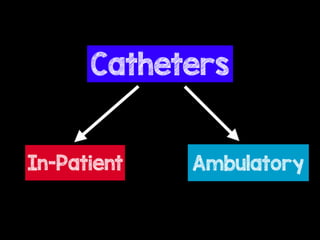
Catheters
AmbulatoryIn-Patient
Examples
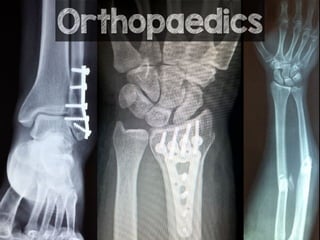
Orthopaedics
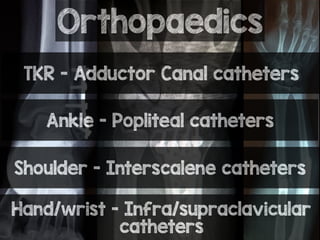
Orthopaedics
TKR - Adductor Canal catheters
Ankle - Popliteal catheters
Shoulder - Interscalene catheters
Hand/wrist - Infra/supraclavicular
catheters
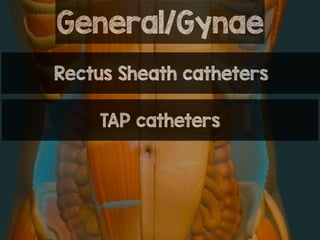
General/Gynae
General/Gynae
Rectus Sheath catheters
TAP catheters
Too
Many
TAP
Blocks?
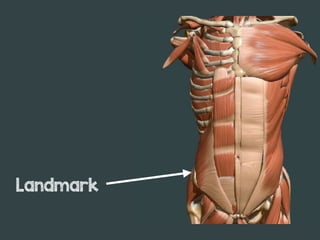
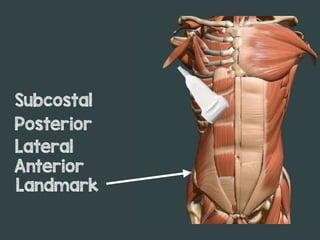
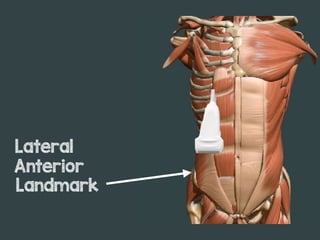
Landmark
Landmark
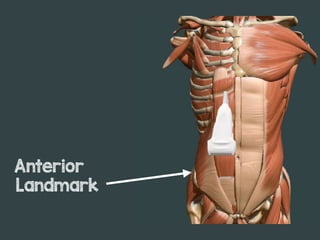
Anterior
Landmark
Anterior
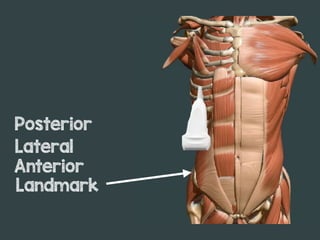
Lateral
Landmark
Anterior
Lateral
Posterior
Landmark
Anterior
Lateral
Posterior
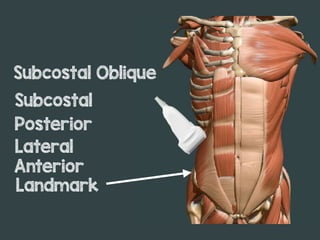
Subcostal
Landmark
Anterior
Lateral
Posterior
Subcostal
Subcostal Oblique
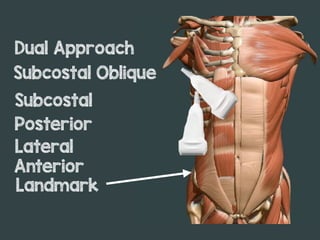
Landmark
Anterior
Lateral
Posterior
Subcostal
Subcostal Oblique
Dual Approach
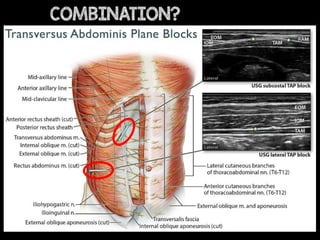
Regional Anesthesia and Pain Medicine • Volume 42, Number 2, March-Ap
COMBINATION?
General/Gynae
Rectus Sheath catheters
TAP catheters
QLB catheters
ESP catheters
Thoracics
Thoracics
Paravertebral catheters
Serratus Plane catheters
ESP catheters
Vascular
Vascular
Femoral catheters
Sciatic catheters
Brachial Plexus catheters
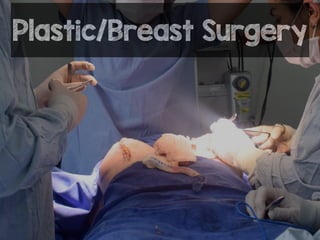
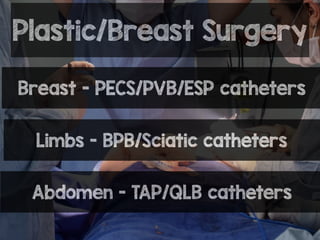
Plastic/Breast Surgery
Breast - PECS/PVB/ESP catheters
Limbs - BPB/Sciatic catheters
Abdomen - TAP/QLB catheters
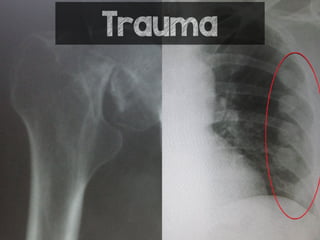
Trauma
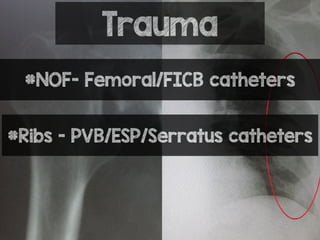
Trauma
#NOF- Femoral/FICB catheters
#Ribs - PVB/ESP/Serratus catheters
GSTT Experience
KT11 1EW
Data Collection thanks to
Dr Ann “The Red” Barron
Dr Simon “Big G’ FitzGerald
Dr Joel “Deep Mind” Lockwood
01-Jan-2018 to 31-Dec-2018
Retrospective
Patients Identified via MedChart
Data collection
- scanned anaesthetic chart
- electronic patient records (EPR)
- E-noting
- MedChart
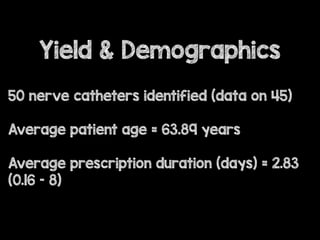
Yield & Demographics
50 nerve catheters identified (data on 45)
Average patient age = 63.89 years
Average prescription duration (days) = 2.83
(0.16 – 8)
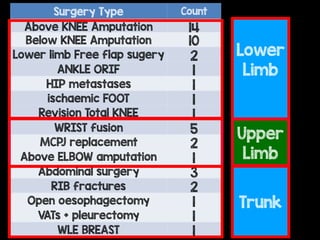
Surgery Type Count
Above KNEE Amputation 14
Below KNEE Amputation 10
Lower limb Free flap sugery 2
ANKLE ORIF 1
HIP metastases 1
ischaemic FOOT 1
Revision Total KNEE
Replacement
1
WRIST fusion 5
MCPJ replacement 2
Above ELBOW amputation 1
Abdominal surgery 3
RIB fractures 2
Open oesophagectomy 1
VATs + pleurectomy 1
WLE BREAST 1
Lower
Limb
Upper
Limb
Trunk
Wr
Ab
Fre
MC
Rib
abo
An
Hip
isch
Op
oes
Rev
VAT
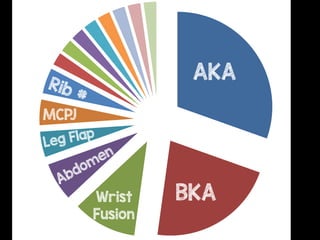
AKA
BKAWrist
Fusion
Abdom
en
Leg Flap
MCPJ
Rib #
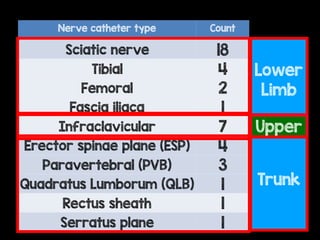
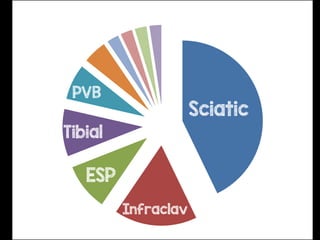
Nerve catheter type Count
Sciatic nerve 18
Tibial 4
Femoral 2
Fascia iliaca 1
Infraclavicular 7
Erector spinae plane (ESP) 4
Paravertebral (PVB) 3
Quadratus Lumborum (QLB) 1
Rectus sheath 1
Serratus plane 1
Lower
Limb
Upper
Trunk
Sciatic
Infraclav
ESP
Tibial
PVB
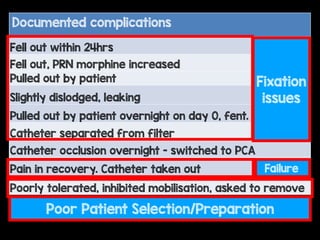
Documented complications
Fell out within 24hrs
Fell out, PRN morphine increased
Pulled out by patient
Slightly dislodged, leaking
Pulled out by patient overnight on day 0, fent. PCA
Catheter separated from filter
Catheter occlusion overnight - switched to PCA
Pain in recovery. Catheter taken out
Poorly tolerated, inhibited mobilisation, asked to remove
Fixation
issues
Failure
Poor Patient Selection/Preparation
First year data - small numbers
Lessons/Room for Improvement
Surgical Engagement = Key
Guidelines/Pathway essential
Training essential
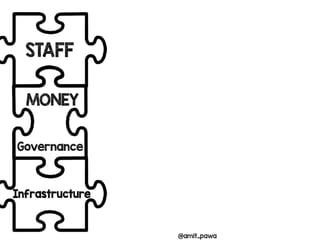
Need infrastructure…
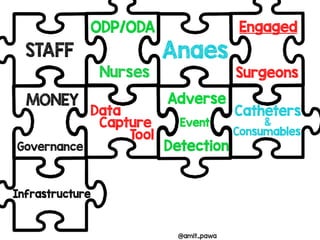
STAFF
Infrastructure
MONEY
Governance
@amit_pawa
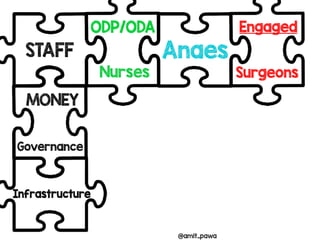
STAFF
MONEY
Governance
Infrastructure
Nurses
Anaes
Surgeons
ODP/ODA
STAFF
Engaged
Infrastructure
MONEY
Governance
@amit_pawa
STAFF
MONEY
Governance
Infrastructure
ODP/ODA
Nurses
Anaes
Engaged
Surgeons
Nurses
Anaes
Surgeons
ODP/ODA
STAFF
Engaged
Data
Capture
Tool
Adverse
Event
Detection
Catheters
Consumables
&
Infrastructure
MONEY
Governance
@amit_pawa
STAFF
MONEY
Governance
Infrastructure
ODP/ODA
Nurses
Data
Capture
Tool
Anaes
Adverse
Event
Detection
Engaged
Surgeons
Catheters
Consumables
Nurses
Anaes
Surgeons
ODP/ODA
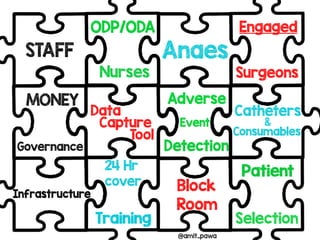
STAFF
24 Hr 

cover
Patient
Selection
Block
Room
Engaged
Data
Capture
Tool
Adverse
Event
Detection
Catheters
Consumables
&
Infrastructure
MONEY
Governance
Training
@amit_pawa
STAFF
MONEY
Governance
Infrastructure
ODP/ODA
Nurses
Data
Capture
Tool
24 Hr 

cover
Training
Anaes
Adverse
Event
Detection
Block
Room
Engaged
Surgeons
Catheters
Consumables
Patient
Selection
Improve
Tips for Success
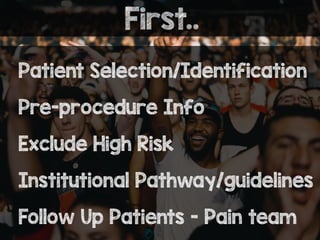
First..
Patient Selection/Identification
Pre-procedure Info
Exclude High Risk
Institutional Pathway/guidelines
Follow Up Patients - Pain team
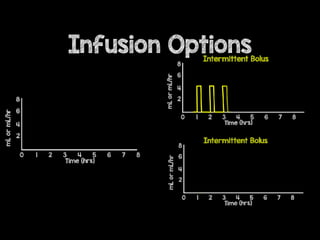
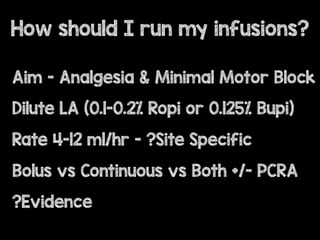
How should I run my infusions?
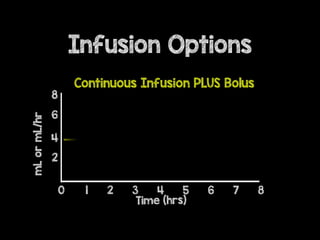
Infusion Options
Infusion Options
Infusion Options
Depends on available
equipment!
Aim - Analgesia & Minimal Motor Block
Dilute LA (0.1-0.2% Ropi or 0.125% Bupi)
Rate 4-12 ml/hr - ?Site Specific
Bolus vs Continuous vs Both +/- PCRA
?Evidence
How should I run my infusions?
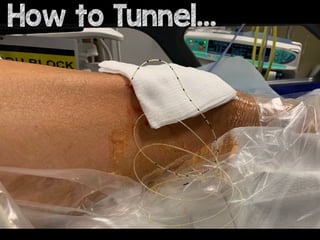
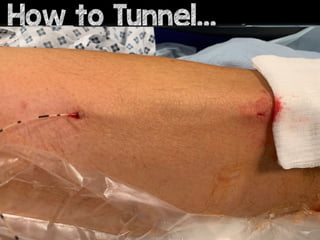
ConsiderTunnelling
To Prevent Dislocation
How to Tunnel?
How to Tunnel…
How to Tunnel?
How to Tunnel…
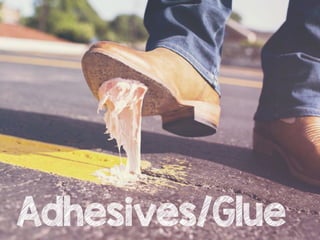
Adhesives/Glue
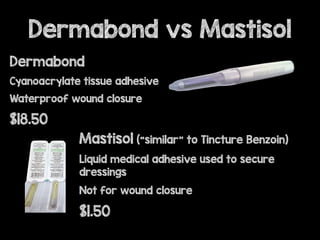
Dermabond
Cyanoacrylate tissue adhesive
Waterproof wound closure
$18.50
Dermabond vs Mastisol
Mastisol (“similar” to Tincture Benzoin)
Liquid medical adhesive used to secure
dressings
Not for wound closure
$1.50
What do most people do?
Dermabond to skin exit site
Mastisol around that
Then Steristrips
Then dressing
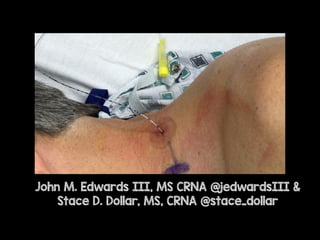
Video ——->
John M. Edwards III, MS CRNA @jedwardsIII &
Stace D. Dollar, MS, CRNA @stace_dollar
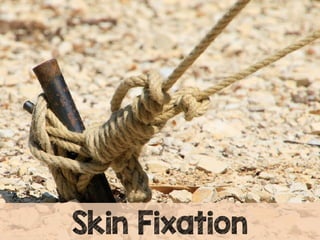
Skin Fixation
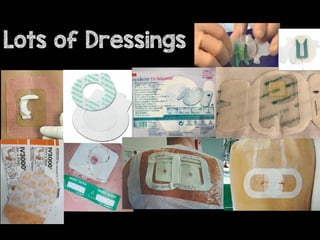
Lots of Dressings
Lots of Dressings
Does it matter what
we use?
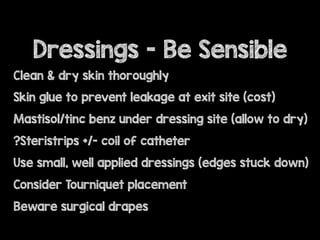
Dressings - Be Sensible
Clean & dry skin thoroughly
Skin glue to prevent leakage at exit site (cost)
Mastisol/tinc benz under dressing site (allow to dry)
?Steristrips +/- coil of catheter
Use small, well applied dressings (edges stuck down)
Consider Tourniquet placement
Beware surgical drapes
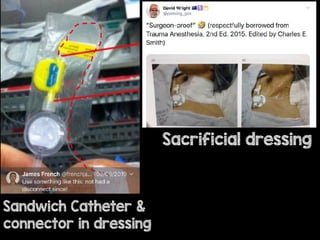
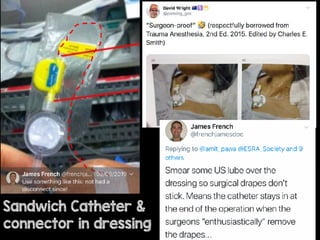
Don’t let catheters get pulled out
Sandwich Catheter &
connector in dressing
Sacrificial dressing
Sandwich Catheter &
connector in dressing
Sacrificial dressing
Multimodal Analgesia
Summary of Tips
Select Patients carefully
Guidelines for Monitoring & Follow up
Use Ultrasound to Site Your Catheters
Use a Sterile Technique
Summary 1
Familiarise yourself with available
catheters
Consider Tunnelling your catheters
Deliver your LA via your Catheter
Use a dilute LA solution in your infusion
Summary 2
If cost allows - use skin glue at exit site
Meticulous dressing
Protect against surgical extraction
Co-Prescribe Multimodal analgesia
Document Back-up/Cessation Plan
Follow ur patients up
Summary 3
amit.pawa@gstt.nhs.uk

Peripheral Nerve Catheters - an introduction