Jens Martensson
CREATE A TRAINING MOVEMENT PLAN TO BE
USED IN THEIR SPECIFIC TRAINING SESSIONS.
UNDERSTAND HOW TECHNOLOGY CAN BE
USED TO ANALYZE MOVEMENT
PERIODIZATION
OVERVIEW
BOFFIN FUNKY TUNES
1
Jens Martensson
MOVEMENT TRAINING
PROGRAMS
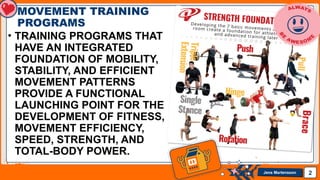
• TRAINING PROGRAMS THAT
HAVE AN INTEGRATED
FOUNDATION OF MOBILITY,
STABILITY, AND EFFICIENT
MOVEMENT PATTERNS
PROVIDE A FUNCTIONAL
LAUNCHING POINT FOR THE
DEVELOPMENT OF FITNESS,
MOVEMENT EFFICIENCY,
SPEED, STRENGTH, AND
TOTAL-BODY POWER.
2
Jens Martensson
•TRAINING SESSIONS, OR WORKOUTS,
ARE COMPRISED OF ONE OR MORE
TRAINING COMPONENTS.
• EACH COMPONENT HAS A
GENERALLY RECOMMENDED
VOLUME, INTENSITY, AND LOAD
SPECIFIC TO THE PERSON.
3
HOW TO STRUCTURE WORKOUTS
Jens Martensson
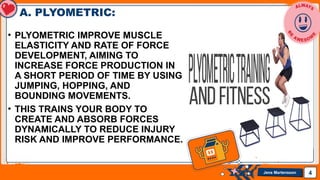
A. PLYOMETRIC:
• PLYOMETRIC IMPROVE MUSCLE
ELASTICITY AND RATE OF FORCE
DEVELOPMENT, AIMING TO
INCREASE FORCE PRODUCTION IN
A SHORT PERIOD OF TIME BY USING
JUMPING, HOPPING, AND
BOUNDING MOVEMENTS.
• THIS TRAINS YOUR BODY TO
CREATE AND ABSORB FORCES
DYNAMICALLY TO REDUCE INJURY
RISK AND IMPROVE PERFORMANCE.
4
Jens Martensson
b. Pillar preparation:
• WHICH CONSISTS OF YOUR
HIPS, TORSO, AND SHOULDERS,
IS THE FOUNDATION FOR ALL
MOVEMENT. PILLAR
PREPARATION, OR PILLAR
PREP, PRIMES CRITICAL
MUSCLES TO PREPARE THE
BODY FOR A WORKOUT,
DECREASING THE RISK OF
INJURY AND BOOSTING
PERFORMANCE
5
Jens Martensson
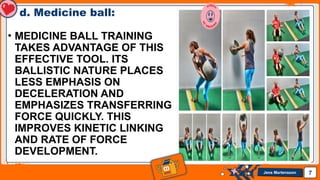
c. Movement preparation:
• MOVEMENT PREPARATION, OR
MOVEMENT PREP, IS AN
EFFICIENT AND EFFECTIVE
WARM-UP.
• IT INCLUDES DYNAMIC
STRETCHES THAT INCREASE
CORE TEMPERATURE,
PREPARE THE NERVOUS
SYSTEM FOR EXERCISE,
LENGTHEN, STRENGTHEN, AND
STABILIZE THE BODY.
6
Jens Martensson
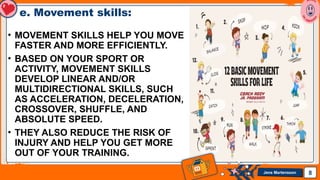
d. Medicine ball:
• MEDICINE BALL TRAINING
TAKES ADVANTAGE OF THIS
EFFECTIVE TOOL. ITS
BALLISTIC NATURE PLACES
LESS EMPHASIS ON
DECELERATION AND
EMPHASIZES TRANSFERRING
FORCE QUICKLY. THIS
IMPROVES KINETIC LINKING
AND RATE OF FORCE
DEVELOPMENT.
7
Jens Martensson
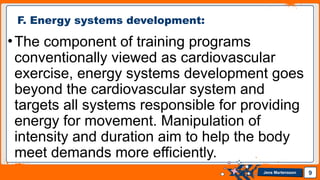
e. Movement skills:
• MOVEMENT SKILLS HELP YOU MOVE
FASTER AND MORE EFFICIENTLY.
• BASED ON YOUR SPORT OR
ACTIVITY, MOVEMENT SKILLS
DEVELOP LINEAR AND/OR
MULTIDIRECTIONAL SKILLS, SUCH
AS ACCELERATION, DECELERATION,
CROSSOVER, SHUFFLE, AND
ABSOLUTE SPEED.
• THEY ALSO REDUCE THE RISK OF
INJURY AND HELP YOU GET MORE
OUT OF YOUR TRAINING.
8
Jens Martensson
•The component of training programs
conventionally viewed as cardiovascular
exercise, energy systems development goes
beyond the cardiovascular system and
targets all systems responsible for providing
energy for movement. Manipulation of
intensity and duration aim to help the body
meet demands more efficiently.
9
F. Energy systems development:
Jens Martensson
•Regeneration relieves tension, alleviates
aches and pains, reduces stress, and
helps the body recover faster. It includes
techniques such as self-massage, cold
water immersion, and recreational
activity. Remember that you must have
1-day recovery or rest day
10
G. Regeneration
Jens Martensson
1.The best functional exercise is doing the activity, but exercises
that simulate the movement can significantly improve your
performance through frequent training bouts.
2. Include concentric, eccentric, and isometric muscle
contractions.
3. The program should be designed with careful progression
and monitoring.
4. Take your level of fitness and health into consideration.
11
8 KEYPOINTS IN CREATING A FUNCTIONAL
TRAINING PROGRAM
Jens Martensson
• 5. Determine what your functional fitness goals may be, and
tailor your functional training to what type of activities your
body does each day.
• 6. The program should include a variety of exercises that train
flexibility, strength, balance, coordination, power, and
endurance.
• 7. The exercises should include movements on multiple
planes.
• 8. Use your body weight and equipment, such as free weights
and resistance bands, instead of machines
12
8 KEYPOINTS IN CREATING A FUNCTIONAL
TRAINING PROGRAM
Jens Martensson
•An Effective functional training
workout involves a lot of
movements, focuses on key
fitness elements, and uses
simple exercise equipment.
13
FUNCTIONAL TRAINING EXERCISES
Jens Martensson
• 1. Free weights movement exercises can be used for a lot of
functional training exercises and positions which allows you to
have a more dynamic and diverse workout like dumbbells,
barbells, kettle bells and sandbags.
• 2. Plyometric Equipment these are objects or platforms you
jump on, off, or over like boxes, hurdles, stairs which improves
your jumping skills by working out your arm and leg muscles.
• 3. Workout straps or bands these can be used to perform
various exercises for different body parts that involve a lot of
pulling, pressing, and extending. Examples are suspension
straps and resistance bands.
14
Sample Equipment
Jens Martensson
• 4. Exercise Balls are perfect for functional training
routines that address muscle imbalance, and these are
also known as Swiss Balls or Physio balls.
• 5. Bodyweight exercises are strength-training exercises
that use the individual’s own weight to provide
resistance against gravity. It can enhance abilities
including strength, power, endurance, speed, flexibility,
coordination, and power. It includes squats, burpees,
pushups, lunges, hip thrusts, pull ups and planks with
all the variations
15
Sample Equipment

PERIDIZATION OVERVIEW for begginers .pptx

  • 1.
    Jens Martensson CREATE ATRAINING MOVEMENT PLAN TO BE USED IN THEIR SPECIFIC TRAINING SESSIONS. UNDERSTAND HOW TECHNOLOGY CAN BE USED TO ANALYZE MOVEMENT PERIODIZATION OVERVIEW BOFFIN FUNKY TUNES 1
  • 2.
    Jens Martensson MOVEMENT TRAINING PROGRAMS •TRAINING PROGRAMS THAT HAVE AN INTEGRATED FOUNDATION OF MOBILITY, STABILITY, AND EFFICIENT MOVEMENT PATTERNS PROVIDE A FUNCTIONAL LAUNCHING POINT FOR THE DEVELOPMENT OF FITNESS, MOVEMENT EFFICIENCY, SPEED, STRENGTH, AND TOTAL-BODY POWER. 2
  • 3.
    Jens Martensson •TRAINING SESSIONS,OR WORKOUTS, ARE COMPRISED OF ONE OR MORE TRAINING COMPONENTS. • EACH COMPONENT HAS A GENERALLY RECOMMENDED VOLUME, INTENSITY, AND LOAD SPECIFIC TO THE PERSON. 3 HOW TO STRUCTURE WORKOUTS
  • 4.
    Jens Martensson A. PLYOMETRIC: •PLYOMETRIC IMPROVE MUSCLE ELASTICITY AND RATE OF FORCE DEVELOPMENT, AIMING TO INCREASE FORCE PRODUCTION IN A SHORT PERIOD OF TIME BY USING JUMPING, HOPPING, AND BOUNDING MOVEMENTS. • THIS TRAINS YOUR BODY TO CREATE AND ABSORB FORCES DYNAMICALLY TO REDUCE INJURY RISK AND IMPROVE PERFORMANCE. 4
  • 5.
    Jens Martensson b. Pillarpreparation: • WHICH CONSISTS OF YOUR HIPS, TORSO, AND SHOULDERS, IS THE FOUNDATION FOR ALL MOVEMENT. PILLAR PREPARATION, OR PILLAR PREP, PRIMES CRITICAL MUSCLES TO PREPARE THE BODY FOR A WORKOUT, DECREASING THE RISK OF INJURY AND BOOSTING PERFORMANCE 5
  • 6.
    Jens Martensson c. Movementpreparation: • MOVEMENT PREPARATION, OR MOVEMENT PREP, IS AN EFFICIENT AND EFFECTIVE WARM-UP. • IT INCLUDES DYNAMIC STRETCHES THAT INCREASE CORE TEMPERATURE, PREPARE THE NERVOUS SYSTEM FOR EXERCISE, LENGTHEN, STRENGTHEN, AND STABILIZE THE BODY. 6
  • 7.
    Jens Martensson d. Medicineball: • MEDICINE BALL TRAINING TAKES ADVANTAGE OF THIS EFFECTIVE TOOL. ITS BALLISTIC NATURE PLACES LESS EMPHASIS ON DECELERATION AND EMPHASIZES TRANSFERRING FORCE QUICKLY. THIS IMPROVES KINETIC LINKING AND RATE OF FORCE DEVELOPMENT. 7
  • 8.
    Jens Martensson e. Movementskills: • MOVEMENT SKILLS HELP YOU MOVE FASTER AND MORE EFFICIENTLY. • BASED ON YOUR SPORT OR ACTIVITY, MOVEMENT SKILLS DEVELOP LINEAR AND/OR MULTIDIRECTIONAL SKILLS, SUCH AS ACCELERATION, DECELERATION, CROSSOVER, SHUFFLE, AND ABSOLUTE SPEED. • THEY ALSO REDUCE THE RISK OF INJURY AND HELP YOU GET MORE OUT OF YOUR TRAINING. 8
  • 9.
    Jens Martensson •The componentof training programs conventionally viewed as cardiovascular exercise, energy systems development goes beyond the cardiovascular system and targets all systems responsible for providing energy for movement. Manipulation of intensity and duration aim to help the body meet demands more efficiently. 9 F. Energy systems development:
  • 10.
    Jens Martensson •Regeneration relievestension, alleviates aches and pains, reduces stress, and helps the body recover faster. It includes techniques such as self-massage, cold water immersion, and recreational activity. Remember that you must have 1-day recovery or rest day 10 G. Regeneration
  • 11.
    Jens Martensson 1.The bestfunctional exercise is doing the activity, but exercises that simulate the movement can significantly improve your performance through frequent training bouts. 2. Include concentric, eccentric, and isometric muscle contractions. 3. The program should be designed with careful progression and monitoring. 4. Take your level of fitness and health into consideration. 11 8 KEYPOINTS IN CREATING A FUNCTIONAL TRAINING PROGRAM
  • 12.
    Jens Martensson • 5.Determine what your functional fitness goals may be, and tailor your functional training to what type of activities your body does each day. • 6. The program should include a variety of exercises that train flexibility, strength, balance, coordination, power, and endurance. • 7. The exercises should include movements on multiple planes. • 8. Use your body weight and equipment, such as free weights and resistance bands, instead of machines 12 8 KEYPOINTS IN CREATING A FUNCTIONAL TRAINING PROGRAM
  • 13.
    Jens Martensson •An Effectivefunctional training workout involves a lot of movements, focuses on key fitness elements, and uses simple exercise equipment. 13 FUNCTIONAL TRAINING EXERCISES
  • 14.
    Jens Martensson • 1.Free weights movement exercises can be used for a lot of functional training exercises and positions which allows you to have a more dynamic and diverse workout like dumbbells, barbells, kettle bells and sandbags. • 2. Plyometric Equipment these are objects or platforms you jump on, off, or over like boxes, hurdles, stairs which improves your jumping skills by working out your arm and leg muscles. • 3. Workout straps or bands these can be used to perform various exercises for different body parts that involve a lot of pulling, pressing, and extending. Examples are suspension straps and resistance bands. 14 Sample Equipment
  • 15.
    Jens Martensson • 4.Exercise Balls are perfect for functional training routines that address muscle imbalance, and these are also known as Swiss Balls or Physio balls. • 5. Bodyweight exercises are strength-training exercises that use the individual’s own weight to provide resistance against gravity. It can enhance abilities including strength, power, endurance, speed, flexibility, coordination, and power. It includes squats, burpees, pushups, lunges, hip thrusts, pull ups and planks with all the variations 15 Sample Equipment