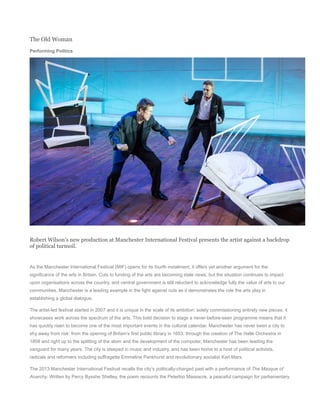
The Old Woman
Performing Politics

Robert Wilson’s new production at Manchester International Festival presents the artist against a backdrop
of political turmoil.

As the Manchester International Festival (MIF) opens for its fourth instalment, it offers yet another argument for the
significance of the arts in Britain. Cuts to funding of the arts are becoming stale news, but the situation continues to impact
upon organisations across the country, and central government is still reluctant to acknowledge fully the value of arts to our
communities. Manchester is a leading example in the fight against cuts as it demonstrates the role the arts play in
establishing a global dialogue.
The artist-led festival started in 2007 and it is unique in the scale of its ambition: solely commissioning entirely new pieces, it
showcases work across the spectrum of the arts. This bold decision to stage a never-before-seen programme means that it
has quickly risen to become one of the most important events in the cultural calendar. Manchester has never been a city to
shy away from risk: from the opening of Britain’s first public library in 1653, through the creation of The Hallé Orchestra in
1858 and right up to the splitting of the atom and the development of the computer, Manchester has been leading the
vanguard for many years. The city is steeped in music and industry, and has been home to a host of political activists,
radicals and reformers including suffragette Emmeline Pankhurst and revolutionary socialist Karl Marx.
The 2013 Manchester International Festival recalls the city’s politically-charged past with a performance of The Masque of
Anarchy. Written by Percy Bysshe Shelley, the poem recounts the Peterloo Massacre, a peaceful campaign for parliamentary
reform in 1819 which ended with death and injury at the hands of the cavalry. It is a highly emotive piece, and festival director
Alex Poots recognises that this year’s programming sees a number of works exploring political climates. This seems only
natural given the current discourse around the diminishing investment in the arts by the British government.
The festival does a good job of marrying Mancunian interests with a wider world perspective: MIF aligns itself firmly with the
city through its considerate programming and offers £12 tickets to Greater Manchester residents on a lower wage, ensuring
that the city is encouraged to participate in the festival and take ownership of the work. Its slogan reads: “Made for
Manchester. Shared with the World.” This approach lends heart to the event and sees leading international figures return
year after year to be involved. The repeated presence of certain artists at the festival is testament to its value; prior to his
2011 MIF commission, avant-garde director Robert Wilson (b. 1941) had not staged a production in the UK for five years, and
this year’s festival also welcomes world-renowned Argentinean pianist Martha Argerich to the city. A rare visitor to the UK,
Argerich’s participation in the Manchester International Festival demonstrates the power that quality art has to draw people to
the area.
Robert Wilson also returns this year with a new production. He explains what it is that appeals to him about MIF: “They only
present works that have never been seen before. The fact that they risk the production of such works is exciting. They are
doing what no-one else is doing and I salute them.” His new work, The Old Woman, is based on a novella of the same name
by Russian writer Daniil Kharms (1905-1942), and explores a writer’s inability to write. Known for his brief absurdist texts,
Kharms was a member of a number of avant-garde artistic movements in the Soviet Union before he was arrested and
incarcerated in 1941 on suspicion of treason. He died in his prison cell aged just 36 years old, and it is difficult to ignore the
political unrest that permeates his work.
The decision to stage a piece about an artist’s struggle amidst political dissidence is a fitting one; it is near impossible to
disentangle the artistic and the political, and the experience of British artists at the moment is one that is replicated to even
greater degrees across the world. It is significant that Wilson chose to collaborate with the world-renowned ballet dancer
Mikhail Baryshnikov on this project: Baryshnikov has a personal understanding of the difficulties faced by artists under
political auspices. Born in Latvia, he trained in St. Petersburg, followed by Leningrad, and danced with the Kirov Ballet before
defecting to Canada in 1974. He left the Soviet Union for artistic reasons, expressing a desire for more freedom to dance and
work with the best of his contemporaries. However, the search for creative freedom is often motivated by political constraints:
government systems have the power to limit or dismantle artistic opportunities. Although the British situation is by no means
comparable to the Soviet Union, cuts to the arts still have a disabling effect on artistic expression, and so events such as MIF
become ever more important to facilitate the creation of new and provocative work.
The Old Woman is the first major collaboration between Wilson and Baryshnikov, and also features Willem Dafoe, who
worked with Wilson in 2011 on The Life and Death of Marina Abramovic. Such collaboration is the cornerstone of MIF, which
brings together luminaries from various different backgrounds to produce inspirational productions. The introduction of artists
to one another is a pivotal part of the festival and can bring about the most unlikely of pairings, with thrilling results. Previous
festivals have brought Damon Albarn (Blur, Gorillaz) together with Felix Barrett of immersive theatre company Punchdrunk,
and this year also sees Robert Del Naja of trip-hop collective Massive Attack working with documentary filmmaker Adam
Curtis.
It is interesting that Robert Wilson and Mikhail Baryshnikov are working together on the project. Wilson has stated before that
theatre is akin to dance for him, and he explains that “Misha [Mikhail Baryshnikov], having danced abstract ballets,
understands that movement can stand on its own and be pure as dance without references to the narrative.” The abstract
nature of the story fits in with Wilson’s other works, many of which are nonsensical texts, and Baryshnikov’s performance
complements Wilson’s approach to theatre and choreography. Discussing the benefits of their collaboration, Wilson says: “All
my movements are choreographed. They are formal and learned as a theatrical language. Mikhail, as a dancer, seemed to
be a perfect choice for my work.” Baryshnikov also suggested that the story appealed to him as it offered a reflection on his
own background, and the combination of both the Soviet connection and Baryshnikov, as well as Wilson’s interest in
movement, makes the partnership a powerful and fascinating choice for this production.
Although the story of The Old Woman has multiple characters, Wilson chose to represent them through only two, played by
Mikhail Baryshnikov and Willem Dafoe. The reasoning behind this, in Wilson’s words, was that: “I see them as the author.
The two are one.” The author has a great presence in this piece: “The set is an image that has its own structure from the
music and the text. There are many references to [Daniil] Kharms. Some are taken directly from his sketches; others from
children’s books of his work at that time.” Wilson is renowned for his visionary approach to set design: his furniture designs
have been displayed in galleries, and he won the Golden Lion at the Venice Biennale in 1993 for sculpture.
The Old Woman promises to offer a visual feast and showcase the work of three leading figures in the international arts
scene. This June, Wilson’s 2011 production The Life and Death of Marina Abramovic also makes an appearance at the
Luminato Festival in Toronto, curated by Jörn Weisbrodt. The success of this work around the world once again emphasises
the importance of new commissions and cements Manchester’s position as a global cultural innovator.
The Manchester International Festival runs from 4 – 21 July at venues across the city. The Old Woman premieres at the
Palace Theatre on 4 July. For further information visit www.mif.co.uk or call +44 (0) 844 375 2013.
Bryony Byrne
- See more at: http://www.aestheticamagazine.com. Copyright Aesthetica Magazine and Bryony Byrne.

Performing Politics

  • 1.
    The Old Woman PerformingPolitics Robert Wilson’s new production at Manchester International Festival presents the artist against a backdrop of political turmoil. As the Manchester International Festival (MIF) opens for its fourth instalment, it offers yet another argument for the significance of the arts in Britain. Cuts to funding of the arts are becoming stale news, but the situation continues to impact upon organisations across the country, and central government is still reluctant to acknowledge fully the value of arts to our communities. Manchester is a leading example in the fight against cuts as it demonstrates the role the arts play in establishing a global dialogue. The artist-led festival started in 2007 and it is unique in the scale of its ambition: solely commissioning entirely new pieces, it showcases work across the spectrum of the arts. This bold decision to stage a never-before-seen programme means that it has quickly risen to become one of the most important events in the cultural calendar. Manchester has never been a city to shy away from risk: from the opening of Britain’s first public library in 1653, through the creation of The Hallé Orchestra in 1858 and right up to the splitting of the atom and the development of the computer, Manchester has been leading the vanguard for many years. The city is steeped in music and industry, and has been home to a host of political activists, radicals and reformers including suffragette Emmeline Pankhurst and revolutionary socialist Karl Marx. The 2013 Manchester International Festival recalls the city’s politically-charged past with a performance of The Masque of Anarchy. Written by Percy Bysshe Shelley, the poem recounts the Peterloo Massacre, a peaceful campaign for parliamentary
  • 2.
    reform in 1819which ended with death and injury at the hands of the cavalry. It is a highly emotive piece, and festival director Alex Poots recognises that this year’s programming sees a number of works exploring political climates. This seems only natural given the current discourse around the diminishing investment in the arts by the British government. The festival does a good job of marrying Mancunian interests with a wider world perspective: MIF aligns itself firmly with the city through its considerate programming and offers £12 tickets to Greater Manchester residents on a lower wage, ensuring that the city is encouraged to participate in the festival and take ownership of the work. Its slogan reads: “Made for Manchester. Shared with the World.” This approach lends heart to the event and sees leading international figures return year after year to be involved. The repeated presence of certain artists at the festival is testament to its value; prior to his 2011 MIF commission, avant-garde director Robert Wilson (b. 1941) had not staged a production in the UK for five years, and this year’s festival also welcomes world-renowned Argentinean pianist Martha Argerich to the city. A rare visitor to the UK, Argerich’s participation in the Manchester International Festival demonstrates the power that quality art has to draw people to the area. Robert Wilson also returns this year with a new production. He explains what it is that appeals to him about MIF: “They only present works that have never been seen before. The fact that they risk the production of such works is exciting. They are doing what no-one else is doing and I salute them.” His new work, The Old Woman, is based on a novella of the same name by Russian writer Daniil Kharms (1905-1942), and explores a writer’s inability to write. Known for his brief absurdist texts, Kharms was a member of a number of avant-garde artistic movements in the Soviet Union before he was arrested and incarcerated in 1941 on suspicion of treason. He died in his prison cell aged just 36 years old, and it is difficult to ignore the political unrest that permeates his work. The decision to stage a piece about an artist’s struggle amidst political dissidence is a fitting one; it is near impossible to disentangle the artistic and the political, and the experience of British artists at the moment is one that is replicated to even greater degrees across the world. It is significant that Wilson chose to collaborate with the world-renowned ballet dancer Mikhail Baryshnikov on this project: Baryshnikov has a personal understanding of the difficulties faced by artists under political auspices. Born in Latvia, he trained in St. Petersburg, followed by Leningrad, and danced with the Kirov Ballet before defecting to Canada in 1974. He left the Soviet Union for artistic reasons, expressing a desire for more freedom to dance and work with the best of his contemporaries. However, the search for creative freedom is often motivated by political constraints: government systems have the power to limit or dismantle artistic opportunities. Although the British situation is by no means comparable to the Soviet Union, cuts to the arts still have a disabling effect on artistic expression, and so events such as MIF become ever more important to facilitate the creation of new and provocative work. The Old Woman is the first major collaboration between Wilson and Baryshnikov, and also features Willem Dafoe, who worked with Wilson in 2011 on The Life and Death of Marina Abramovic. Such collaboration is the cornerstone of MIF, which brings together luminaries from various different backgrounds to produce inspirational productions. The introduction of artists to one another is a pivotal part of the festival and can bring about the most unlikely of pairings, with thrilling results. Previous festivals have brought Damon Albarn (Blur, Gorillaz) together with Felix Barrett of immersive theatre company Punchdrunk, and this year also sees Robert Del Naja of trip-hop collective Massive Attack working with documentary filmmaker Adam Curtis. It is interesting that Robert Wilson and Mikhail Baryshnikov are working together on the project. Wilson has stated before that theatre is akin to dance for him, and he explains that “Misha [Mikhail Baryshnikov], having danced abstract ballets, understands that movement can stand on its own and be pure as dance without references to the narrative.” The abstract nature of the story fits in with Wilson’s other works, many of which are nonsensical texts, and Baryshnikov’s performance complements Wilson’s approach to theatre and choreography. Discussing the benefits of their collaboration, Wilson says: “All my movements are choreographed. They are formal and learned as a theatrical language. Mikhail, as a dancer, seemed to
  • 3.
    be a perfectchoice for my work.” Baryshnikov also suggested that the story appealed to him as it offered a reflection on his own background, and the combination of both the Soviet connection and Baryshnikov, as well as Wilson’s interest in movement, makes the partnership a powerful and fascinating choice for this production. Although the story of The Old Woman has multiple characters, Wilson chose to represent them through only two, played by Mikhail Baryshnikov and Willem Dafoe. The reasoning behind this, in Wilson’s words, was that: “I see them as the author. The two are one.” The author has a great presence in this piece: “The set is an image that has its own structure from the music and the text. There are many references to [Daniil] Kharms. Some are taken directly from his sketches; others from children’s books of his work at that time.” Wilson is renowned for his visionary approach to set design: his furniture designs have been displayed in galleries, and he won the Golden Lion at the Venice Biennale in 1993 for sculpture. The Old Woman promises to offer a visual feast and showcase the work of three leading figures in the international arts scene. This June, Wilson’s 2011 production The Life and Death of Marina Abramovic also makes an appearance at the Luminato Festival in Toronto, curated by Jörn Weisbrodt. The success of this work around the world once again emphasises the importance of new commissions and cements Manchester’s position as a global cultural innovator. The Manchester International Festival runs from 4 – 21 July at venues across the city. The Old Woman premieres at the Palace Theatre on 4 July. For further information visit www.mif.co.uk or call +44 (0) 844 375 2013. Bryony Byrne - See more at: http://www.aestheticamagazine.com. Copyright Aesthetica Magazine and Bryony Byrne.