International Journal of Electrical and Computer Engineering (IJECE)
Vol. 13, No. 6, December 2023, pp. 6827~6835
ISSN: 2088-8708, DOI: 10.11591/ijece.v13i6.pp6827-6835  6827
Journal homepage: http://ijece.iaescore.com
Performance evaluation of botnet detection using machine
learning techniques
Sneha Padhiar, Ritesh Patel
U and P U. Patel Department of Computer Engineering, CHARUSAT University, Gujarat, India
Article Info ABSTRACT
Article history:
Received Feb 3, 2023
Revised Jul 11, 2023
Accepted Jul 17, 2023
Cybersecurity is seriously threatened by Botnets, which are controlled
networks of compromised computers. The evolving techniques used by
botnet operators make it difficult for traditional methods of botnet
identification to stay up. Machine learning has become increasingly effective
in recent years as a means of identifying and reducing these hazards. The
CTU-13 dataset, a frequently used dataset in the field of cybersecurity, is
used in this study to offer a machine learning-based method for botnet
detection. The suggested methodology makes use of the CTU-13, which is
made up of actual network traffic data that was recorded in a network
environment that had been attacked by a botnet. The dataset is used to train a
variety of machine learning algorithms to categorize network traffic as
botnet-related/benign, including decision tree, regression model, naïve
Bayes, and neural network model. We employ a number of criteria, such as
accuracy, precision, and sensitivity, to measure how well each model
performs in categorizing both known and unidentified botnet traffic patterns.
Results from experiments show how well the machine learning based
approach detects botnet with accuracy. It is potential for use in actual world
is demonstrated by the suggested system’s high detection rates and low false
positive rates.
Keywords:
Command and control (C and
C server)
CTU-13
Machine learning
Performance evaluation
Traffic detection
This is an open access article under the CC BY-SA license.
Corresponding Author:
Sneha Padhiar
U and P U. Patel Department of Computer Engineering, CHARUSAT University
Gujarat-388421, India
Email: snehapadhiar.ce@charusat.ac.in
1. INTRODUCTION
An ever-changing threat scenario is accompanied by an increasing complexity in internet
architecture. Hackers seek to discover ways to take advantage of weaknesses that may occur in a range of
contexts, including devices, data, applications, people, and places. Botnets are a serious concern. There are
three components of a botnet: the botmaster, the infected machine, and the administrative server (C and C
server). It takes two steps for a botnet to communicate: first, a botmaster sends instructions to the botnet via
remote link or directly to the bots. As a result of this, the controlled bots are able to carry out malicious
actions after receiving malicious commands [1]. The threat of botnets compromising the fundamental
principles of confidentiality, integrity, and availability is becoming increasingly clear as botnets pose an
increasing threat to network security. It is especially important to note that distributed denial of service
(DDoS) attacks can be launched using botnets that have a negative impact on the availability and
performance of a network [2].
In general, botnet detection is done from two different angles: host-based and network-based. An
abnormal use of computation resources can be identifies using the first technique. As an example, it monitors
abnormally high central processing unit (CPU) usage and memory consumption. An analysis of the bot’s
 ISSN: 2088-8708
Int J Elec & Comp Eng, Vol. 13, No. 6, December 2023: 6827-6835
6828
network and traffic conditions would be carried out using the later technique [3]. It is advantage is that it can
be applied even when communication is encrypted. In contrast, this method is more time-consuming and
requires continuous monitoring of all host’s resource utilization. The two types of network-based techniques
are signature based and anomaly based. An approach based on signature is used to apply deep packet
inspection (DPI) to internet protocol (IP) packets. Low false positive rates are a benefit of it. Identifying
known botnets is its primary use [4]. The drawback is in concern to identify new patterns of attacks;
signatures must regularly be updated. In addition, encryption techniques can conceal the signatures.
Anomaly-based techniques can be used to find anomalies based on variables like packet payload size and bot
activity. It is more challenging to identify botnet attacks as time goes on due to the frequent changes in botnet
behavior [5], [6]. Due to their abilities to detect anomalous traffic patterns, machine learning techniques have
become increasingly popular in anomaly-based methods. However, anomaly-based detection generally
caused many detection errors due to high false positive rate. Additionally, one significant drawback of
traditional machine learning methods is that they demand a lot of work and depend on a time-consuming
feature engineering procedure. These limitations have led to the recent proposal of and growing interest in
machine learning methods based on neural networks for applications in network security. With machine
learning, it is possible to independently choose the most appropriate features out of all the features [7]–[12].
As a result, machine learning approaches are excellent for handling data sets with a variety of properties. In
this paper, we use the CTU-13 dataset, a real botnet traffic dataset created in the Czech Republic at the CTU
University in 2011, to provide a study of four machine learning models, including decision tree, regression
model, naive Bayes model, and neural network models [13], [14]. An investigation of the impact of having
uneven traffic statistics is another component of this paper (i.e., a significant disparity between the volume of
benign and botnet traffic). Accuracy, precision, and sensitivity are taken into account as performance
indicators [15], [16]. We conclude by comparing the effectiveness of our machine learning based models to
that of common machine learning methods [17]–[20].
The remaining of the paper is organized as follows. In section 2, we go over earlier research on
machine learning-based botnet identification. We go over the performance indicators and machine learning
models in section 3. The results of the performance evaluation are provided in section 4 along with an
analysis. The paper’s conclusion in section 5, summarizes our key findings and outlines concepts for more
research.
2. RELATED WORK
We found several works on detection of botnets, DDoS attacks, network traffic, and other related
topics in our literature survey. The majority of research is based on machine learning. Table 1 (see in
appendix) provides a comparison of related work’s survey results. Based on their chosen methodologies,
datasets and outcomes, the author’s contributions are summarized in the Table 1. Using literature research as
a baseline Four distinct machine learning models are used, and they are carefully compared, such as decision
trees, regression models, naïve bayes models and neural network models. Table 1 summarizes the results of a
literature survey that covers these model’s previous use for anomaly detection and how they obtained
promising results.
3. PROPOSED METHOD
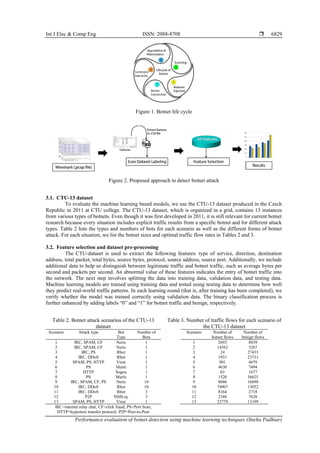
A botnet attack proceeds through several stages shown in Figure 1, such as scanning for malware,
injecting malware, connecting to a botnet, executing commands, and maintaining and upgrading the botnet. A
botnet attack begins with scanning, which is the first phase of the attack. During scanning, the proposed
methodology stops attackers from progressing further in their attacks. As a result, the suggested methodology
distinguishes between botnet attacks that are detected by both inbound and outbound DDoS attacks and those
that are prevented by detecting scanning activity.
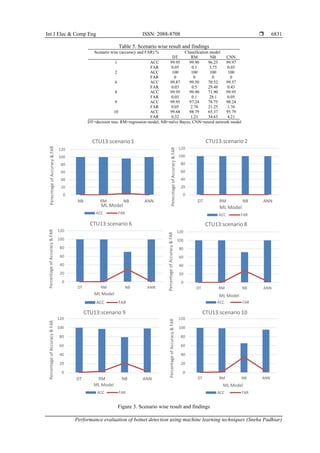
As illustrated in Figure 2, the proposed method successfully navigates the key phases of attack
detection and scanning. In order to train the machine learning models, we used the CTU-13 scanning and
DDoS attack traffic data that was acquired (in .pcap format) in the first step. The features were then retrieve
from these network packet traces (.pcap files) and stored in .csv files in the subsequent stage [21]. To further
distinguish between different types of traffic, we added labels to the dataset, such as “normal” for routine
traffic, “scan” for scanning traffic, and “DDoS” for DDoS attack traffic. In the third phase, we applied the
logistic regression (LR) feature selection technique to enhance the performance of the machine learning
model [21]. LR feature selection was chosen over feature selection techniques because of it is efficient
performance, simplicity, and low complexity. In the final step, we train machine learning (ML) models and
validate their performance against a real-time attack scenario.
Int J Elec & Comp Eng ISSN: 2088-8708 
Performance evaluation of botnet detection using machine learning techniques (Sneha Padhiar)
6829
Figure 1. Botnet life cycle
Figure 2. Proposed approach to detect botnet attack
3.1. CTU-13 dataset
To evaluate the machine learning based models, we use the CTU-13 dataset produced in the Czech
Republic in 2011 at CTU college. The CTU-13 dataset, which is organized in a grid, contains 13 instances
from various types of botnets. Even though it was first developed in 2011, it is still relevant for current botnet
research because every situation includes explicit traffic results from a specific botnet and for different attack
types. Table 2 lists the types and numbers of bots for each scenario as well as the different forms of botnet
attack. For each situation, we list the botnet sizes and optimal traffic flow rates in Tables 2 and 3.
3.2. Feature selection and dataset pre-processing
The CTU-dataset is used to extract the following features: type of service, direction, destination
address, total packet, total bytes, source bytes, protocol, source address, source port. Additionally, we include
additional data to help us distinguish between legitimate traffic and botnet traffic, such as average bytes per
second and packets per second. An abnormal value of these features indicates the entry of botnet traffic into
the network. The next step involves splitting the data into training data, validation data, and testing data.
Machine learning models are trained using training data and tested using testing data to determine how well
they predict real-world traffic patterns. In each learning round (that is, after training has been completed), we
verify whether the model was trained correctly using validation data. The binary classification process is
further enhanced by adding labels “0” and “1” for botnet traffic and benign, respectively.
Table 2. Botnet attack scenarios of the CTU-13
dataset
Scenario Attack type Bot
Type
Number of
Bots
1 IRC, SPAM, CF Neris 1
2 IRC, SPAM, CF Neris 1
3 IRC, PS Rbot 1
4 IRC, DDoS Rbot 1
5 SPAM, PS, HTTP Virut 1
6 PS Menti 1
7 HTTP Sogou 1
8 PS Murlo 1
9 IRC, SPAM, CF, PS Neris 10
10 IRC, DDoS Rbot 10
11 IRC, DDoS Rbot 3
12 P2P NSIS.ay 3
13 SPAM, PS, HTTP Virut 1
Table 3. Number of traffic flows for each scenario of
the CTU-13 dataset
Scenario Number of
botnet flows
Number of
benign flows
1 2693 8839
2 14362 5267
3 24 27433
4 1931 23731
5 901 4679
6 4630 7494
7 63 1677
8 1520 36625
9 8686 16690
10 74907 13052
11 8164 2718
12 2168 7628
13 23779 13199
IRC=internet relay chat, CF=click fraud, PS=Port Scan,
HTTP=hypertext transfer protocol, P2P=Peer-to-Peer
 ISSN: 2088-8708
Int J Elec & Comp Eng, Vol. 13, No. 6, December 2023: 6827-6835
6830
3.3. Machine learning-based botnet detection
This section discusses some background knowledge of the four different machine learning models
name decision tree, naïve Bayes, regression model and neural network model, which we used to detect
botnets malicious activity and adapt them. This machine learning algorithm has the ability to detect the
activity of Botnet with good accuracy.
a. Decision tree (DT): This model is built on a tree structure called a decision tree, where each node
represents a test on a single feature and all branches that descend from that node indicate potential values
for that feature. Training and testing datasets were randomly divided into these classes to be applied to the
dataset. After classifiers were trained, they were then tested against the testing dataset by predicting label
values [21].
b. Naïve Bayes (NB) with Gaussian probabilities: The Bayes theorem is used to calculate the probabilities
used in the classifier and this assumes conditional independence. As a result of training the class
probability, NB produces an estimate of the class probability [21].
c. Regression model: One or more independent variables are modeled by regression analysis to predict the
relationship between the dependent (target) variable and the independent (predictor). When other
independent variables are held constant, regression analysis reveals how the level of the dependent
variable changes in relation to an independent variable [21].
d. Neural network model: Artificial neural network (ANNs) are a form of deep learning algorithms and a
subset of machine learning. Each ANN consists of a layer consisting of an input layer, a hidden layer, and
an output layer. A subset of machine learning, ANNs are a type of deep learning algorithms. An input
layer, a hidden layer and an output layer make up each layer of an ANN. It is made up of nodes, or
artificial neurons, which are connected to each other and have a threshold and weight associated with
each node. A node is activated if its output exceeds the specified threshold value and data is transmitted to
the following layer of the network. Any other scenario prevents data from moving to the following tier of
the network [21], [22].
4. PERFORMANCE EVALUATION RESULTS AND ANALYSIS
4.1. Evaluation metrics
The measures used to evaluate ID’s performance are described in this section. The performance of four
machine learning models for detecting botnet attacks is assessed using the metrics accuracy and false alarm rate.
The confusion matrix entries used to determine the performance measures are displayed in Table 4.
Table 4. Confusion matrix
Actual Class
Predicated class
Attack Normal
True positive False negative
False positive True negative
Where, true positive (TP) refers to situations where the classifier categories an attack accurately.
False negative (FN) refers to situation in which the classifier incorrectly labels an attack as normal. False
positive (FP) refers to situations where the classifier incorrectly labels a typical occurrence as an attack. True
negative (TN) identifies situations where the classifier detects typical occurrences accurately. A number of
other evaluation metrics are also used by researchers, including recall, true negative, accuracy, precision and
false alarm rate. False alarm rate (FAR): the ration of samples that were mistakenly forecasted as attacks to
all other sample is known as the false positive rate. 𝐹𝐴𝑅 = 𝐹𝑃/(𝑇𝑁 + 𝐹𝑃). Accuracy: the categorization
accuracy is related to the metric accuracy. It is calculated by dividing the number of input samples by the
proportion of accurate predictions. 𝐴𝑐𝑐𝑢𝑟𝑎𝑐𝑦 = 𝑇𝑃 + 𝑇𝑁/(𝑇𝑃 + 𝑇𝑁 + 𝐹𝑃 + 𝐹𝑁).
4.2. Results and discussion
CTU-13 scenarios are divided into training, validation and testing datasets in order to determine
how well our models classify traffic from botnet attacks. Using the data from scenarios 3, 4, 5, 7, 10, 11, 12,
and 13 the author recommends partitioning it as follows: training and validation data are used for scenarios 3,
4, 5, 7, and 11 while testing data are used for scenarios 1, 2, 6, 8, and 9. In terms of training and validation of
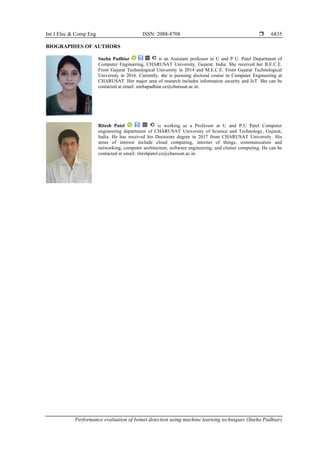
data, the split ratio remains 80:20. Table 5, Figures 3 and 4 illustrates the results of the performance
evaluation. The classifiers we used performed very well when it came to classifying botnet traffic flows.
convolution neural network (CNN) and decision tree (DT) are capable of correctly identifying on and
averages around 98% and 99% of traffic flows, respectively.
Int J Elec & Comp Eng ISSN: 2088-8708 
Performance evaluation of botnet detection using machine learning techniques (Sneha Padhiar)
6831
Table 5. Scenario wise result and findings
Scenario wise (accuracy and FAR) % Classification model
DT RM NB CNN
1 ACC 99.95 99.90 96.25 99.97
FAR 0.05 0.1 3.75 0.03
2 ACC 100 100 100 100
FAR 0 0 0 0
6 ACC 99.87 99.50 70.52 99.57
FAR 0.03 0.5 29.48 0.43
8 ACC 99.95 99.90 71.90 99.95
FAR 0.05 0.1 28.1 0.05
9 ACC 99.95 97.24 78.75 98.24
FAR 0.05 2.76 21.25 1.76
10 ACC 99.68 98.79 65.37 95.79
FAR 0.32 1.21 34.63 4.21
DT=decision tree, RM=regression model, NB=naïve Bayes, CNN=neural network model
Figure 3. Scenario wise result and findings
0
20
40
60
80
100
120
NB RM NB ANN
Perecntage
of
Accuracy
&
FAR
ML Model
CTU13:scenario 1
ACC FAR
0
20
40
60
80
100
120
DT RM NB ANN
Perecntage
of
Accuracy
&
FAR
ML Model
CTU13:scenario 2
ACC FAR
0
20
40
60
80
100
120
DT RM NB ANN
Percentage
of
Accuracy
&
FAR
ML Model
CTU13:scenario 6
ACC FAR
0
20
40
60
80
100
120
DT RM NB ANN
Percentage
of
Accuracy
&
FAR
ML Model
CTU13:scenario 8
ACC FAR
0
20
40
60
80
100
120
DT RM NB ANN
Percentage
of
Accuracy
&
FAR
ML Model
CTU13:scenario 9
ACC FAR
0
20
40
60
80
100
120
DT RM NB ANN
Percentage
of
Accuracy
&
FAR
ML Model
CTU13:scenario 10
ACC FAR
 ISSN: 2088-8708
Int J Elec & Comp Eng, Vol. 13, No. 6, December 2023: 6827-6835
6832
Figure 4. Classifier V/S accuracy and false alarm rate
4.3. Comparison with machine learning techniques
In this subsection, we contrast the effectiveness of our machine learning based methods with those
of other researcher’s previously studied machine learning methods. Only the findings of earlier research
using the CTU-13 dataset are presented here. Using samples from the CTU-13 dataset, Chen et al. [23]
assessed the effectiveness of the J48, hybrid classification and clustering, tree classifier-means clustering.
Their findings indicate that 90.2726% accuracy is maximum achievable. For the J48 tree classifier, it is
obtained. Popular machine learning methods like support vector, logistic regression, random forests, and
gradient boosting were used by Apruzzese et al. [24]. They used 2/3 of the CTU-13 dataset to train the
algorithms and 1/3 of the dataset to evaluate them (randomly chosen). According to their analysis, the neural
network and decision tree-based method works the best. The CTU-13 dataset’s scenario was used by the
authors to further assess the method of machine learning. For each CTU-13 scenario, we compared our model
to that of the prior authors, and the corresponding results are displayed in Figure 5 and Table 6.
Figure 5. Comparison with existing model
Table 6. Comparison with existing model
Authors Dataset Method Accuracy
[20]/2021 CTU13 KNN (10-cross fold) 99%
[25]/2020 CTU13 KNN 98%
[26]/2020 CTU13 Decision Tree 97.54%
[27]/2019 CTU13 Deep learning 99.08%
Proposed method CTU13 Decision tree, Regression model, Naive Bayes, Neural network model 99.95%
0
20
40
60
80
100
120
Decision Tree Regression Model Naïve Bayes Model Neural Network Model
Percentage
of
Accuracy
&
FAR
ML Model
Classifier Vs Accuracy & FAR
Accuracy FAR
99
98
97.54
99.08
99.95
96
96.5
97
97.5
98
98.5
99
99.5
100
100.5
2021 2020 2020 2019 Proposed Method
Percentage
of
Accuracy
Recent Author's work
Int J Elec & Comp Eng ISSN: 2088-8708 
Performance evaluation of botnet detection using machine learning techniques (Sneha Padhiar)
6833
5. CONCLUSION
This paper evaluates four machine learning models for detection of botnet attack using the dataset
CTU-13, which is labelled data that constitutes real flow(s) of traffic, including decision tree, regression
model, naïve Bayes and neural network models. In addition to the classification of traffic flows, we also
explore the impact of inconsistent data and the impact of known and unknown botnet attacks. Among our
models for predicting botnet traffic flows, the CNN and decision tree models produce the best results. An
accuracy rate of 98.30% and 99.95% can be achieved by it. Therefore, 99% of benign traffic flows can be
identified correctly with the model. In our future work, a real-time botnet attack detection system will be
developed by combining the deep learning models and newer deep reinforcement learning techniques.
APPENDIX
Table 1. Summary of botnet detection based on ML
Ref/Year Contribution Protocol Methods Dataset Result
[20]/2021 Analyzing host and network traffic to
identify hybrid botnets.
HTTP
IRC
P2P
DT
NB
ISCX
CTU-13
99% Accuracy
[28]/2022 In order to identify botnets, DL was
employed to study the behaviors of the
traffic generated by packet on a
network.
HTTP
IRC
LSTM_R
NN
Live data 98.36%
Accuracy
[29]/2020 Use three modules to signal P2P botnet
detection using machine learning:
Extraction, selection, and classification
of features.
P2P DT
J48
ISOT
(2012)
botnet
(2014)
98.90%
Accuracy
[30]/2020 Deep Learning-based P2P botnet
detection
P2P GNN CAIDA 98.05%
Accuracy
[31]/2020 Framework for IoT network botnet
detection using sequential ML based
detection architecture.
IRC
HTTP
P2P
ANN
J48
DT
NB
N-IoT 99%
Accuracy
[25]/2020 Investigation of DDoS botnet detection
methods based on machine learning.
IRC
HTTP
DT
ANN
NB
KDD99 98.08%
Accuracy
[26]/2020 Two-stage traffic classification is the
foundation of a novel approach.
P2P DT
NB
ANN
CTU 13 94.4%
Accuracy
[32]/2020 Scalable deep learning-based botnet
identification is addressed by DBD.
IRC
HTTP
CNN_LS
TM
Internal
Network
97.80%
Accuracy
[33]/2019 P2P traffic is classified as regular or
botnet using a multi-layer method based
on ML classifiers on network features.
P2P DT,
KNN
CTU, ISOT 98.7%
Accuracy
[34]/2019 flow-based ML ensembles for detection
of botnet
IRC
HTTP
P2P
GNB,
NN, DT
CTU-13 0.99
F1 score
[27]/2019 Botnet identification based on network
traffic analytics features and machine
learning
IRC
HTTP
J48
SVM
Real botnet
sample
collected in
their
laboratory
HTTP (accuracy
80%), IRC
(accuracy 95%)
False positive rate
HTTP (0.05% FPR),
IRC (0.025% FPR)
[35]/2018 Botshark is a proposed deep learning-
based botnet traffic analyzer.
IRC, P2P- CNN ISCX FPR:0.23
[21]/2022 Aims to find a botnet in environment of
fast network
IRC,
HTTP, P2P
RF CTU 93.6%
Accuracy
REFERENCES
[1] B. Nugraha, A. Nambiar, and T. Bauschert, “Performance Evaluation of botnet detection using deep learning techniques,” in 2020
11th International Conference on Network of the Future (NoF), Oct. 2020, pp. 141–149, doi: 10.1109/NoF50125.2020.9249198.
[2] F. Hussain et al., “A two-fold machine learning approach to prevent and detect IoT botnet attacks,” IEEE Access, vol. 9,
pp. 163412–163430, 2021, doi: 10.1109/ACCESS.2021.3131014.
[3] C. Joshi, R. K. Ranjan, and V. Bharti, “A fuzzy logic based feature engineering approach for Botnet detection using ANN,”
Journal of King Saud University-Computer and Information Sciences, vol. 34, no. 9, pp. 6872–6882, Oct. 2022, doi:
10.1016/j.jksuci.2021.06.018.
[4] A. McCarthy, E. Ghadafi, P. Andriotis, and P. Legg, “Functionality-preserving adversarial machine learning for robust
classification in cybersecurity and intrusion detection domains: a survey,” Journal of Cybersecurity and Privacy, vol. 2, no. 1,
pp. 154–190, Mar. 2022, doi: 10.3390/jcp2010010.
 ISSN: 2088-8708
Int J Elec & Comp Eng, Vol. 13, No. 6, December 2023: 6827-6835
6834
[5] R. H. Randhawa, N. Aslam, M. Alauthman, H. Rafiq, and F. Comeau, “Security hardening of botnet detectors using generative
adversarial networks,” IEEE Access, vol. 9, pp. 78276–78292, 2021, doi: 10.1109/ACCESS.2021.3083421.
[6] Z. Lin, Y. Shi, and Z. Xue, “IDSGAN: generative adversarial networks for attack generation against intrusion detection,” arXiv
preprint arXiv:1809.02077, Sep. 2018.
[7] A. A. Ahmed, W. A. Jabbar, A. S. Sadiq, and H. Patel, “Deep learning-based classification model for botnet attack detection,”
Journal of Ambient Intelligence and Humanized Computing, vol. 13, no. 7, pp. 3457–3466, Jul. 2022, doi: 10.1007/s12652-020-
01848-9.
[8] M. A. Ferrag, L. Maglaras, S. Moschoyiannis, and H. Janicke, “Deep learning for cyber security intrusion detection: approaches,
datasets, and comparative study,” Journal of Information Security and Applications, vol. 50, Feb. 2020, doi:
10.1016/j.jisa.2019.102419.
[9] P. T. Duy, L. K. Tien, N. H. Khoa, D. T. T. Hien, A. G.-T. Nguyen, and V.-H. Pham, “DIGFuPAS: Deceive IDS with GAN and
function-preserving on adversarial samples in SDN-enabled networks,” Computers and Security, vol. 109, Oct. 2021, doi:
10.1016/j.cose.2021.102367.
[10] Q. Cheng, S. Zhou, Y. Shen, D. Kong, and C. Wu, “Packet-level adversarial network traffic crafting using sequence generative
adversarial networks,” arXiv preprint arXiv:2103.04794, Mar. 2021.
[11] N. S. Alfaiz and S. M. Fati, “Enhanced credit card fraud detection model using machine learning,” Electronics, vol. 11, no. 4, Feb.
2022, doi: 10.3390/electronics11040662.
[12] J. Engelmann and S. Lessmann, “Conditional Wasserstein GAN-based oversampling of tabular data for imbalanced learning,”
arXiv preprint arXiv:2008.09202, Aug. 2020.
[13] S. Huang and K. Lei, “IGAN-IDS: An imbalanced generative adversarial network towards intrusion detection system in ad-hoc
networks,” Ad Hoc Networks, vol. 105, Aug. 2020, doi: 10.1016/j.adhoc.2020.102177.
[14] M. H. Shahriar, N. I. Haque, M. A. Rahman, and M. Alonso, “G-IDS: Generative adversarial networks assisted intrusion detection
system,” in 2020 IEEE 44th Annual Computers, Software, and Applications Conference (COMPSAC), Jul. 2020, pp. 376–385,
doi: 10.1109/COMPSAC48688.2020.0-218.
[15] Z. Mao, Z. Fang, M. Li, and Y. Fan, “EvadeRL: evading PDF malware classifiers with deep reinforcement learning,” Security and
Communication Networks, vol. 2022, pp. 1–14, Apr. 2022, doi: 10.1155/2022/7218800.
[16] R. H. Randhawa, N. Aslam, M. Alauthman, and H. Rafiq, “EVAGAN: evasion generative adversarial network for low data
regimes,” arXiv preprint arXiv:2109.08026, Sep. 2021.
[17] T. Truong-Huu et al., “An empirical study on unsupervised network anomaly detection using generative adversarial networks,” in
Proceedings of the 1st ACM Workshop on Security and Privacy on Artificial Intelligence, Oct. 2020, pp. 20–29, doi:
10.1145/3385003.3410924.
[18] T.-D. Pham, T.-L. Ho, T. Truong-Huu, T.-D. Cao, and H.-L. Truong, “MAppGraph: Mobile-App classification on encrypted
network traffic using deep graph convolution neural networks,” in Annual Computer Security Applications Conference, Dec.
2021, pp. 1025–1038, doi: 10.1145/3485832.3485925.
[19] S. Padhiar and R. Patel, “Behaviour based botnet detection with traffic analysis and flow intervals at the host level,” Indonesian
Journal of Electrical Engineering and Computer Science (IJEECS), vol. 31, no. 1, pp. 350–358, Jul. 2023, doi:
10.11591/ijeecs.v31.i1.pp350-358.
[20] W. N. H. Ibrahim et al., “Multilayer framework for botnet detection using machine learning algorithms,” IEEE Access, vol. 9,
pp. 48753–48768, 2021, doi: 10.1109/ACCESS.2021.3060778.
[21] M. S. Gadelrab, M. ElSheikh, M. A. Ghoneim, and M. Rashwan, “BotCap: machine learning approach for botnet detection based
on statistical features,” International Journal of Communication Networks and Information Security (IJCNIS), vol. 10, no. 3, Apr.
2022, doi: 10.17762/ijcnis.v10i3.3624.
[22] S. Homayoun, M. Ahmadzadeh, S. Hashemi, A. Dehghantanha, and R. Khayami, “BoTShark: A deep learning approach for
botnet traffic detection,” in Advances in Information Security, Springer International Publishing, 2018, pp. 137–153.
[23] R. Chen, W. Niu, X. Zhang, Z. Zhuo, and F. Lv, “An effective conversation-based botnet detection method,” Mathematical
Problems in Engineering, pp. 1–9, 2017, doi: 10.1155/2017/4934082.
[24] G. Apruzzese, M. Andreolini, M. Marchetti, A. Venturi, and M. Colajanni, “Deep reinforcement adversarial learning against
botnet evasion attacks,” IEEE Transactions on Network and Service Management, vol. 17, no. 4, pp. 1975–1987, Dec. 2020, doi:
10.1109/TNSM.2020.3031843.
[25] J. Zhou, Z. Xu, A. M. Rush, and M. Yu, “Automating botnet detection with graph neural networks,” arXiv preprint
arXiv:2003.06344, Mar. 2020.
[26] Y. N. Soe, Y. Feng, P. I. Santosa, R. Hartanto, and K. Sakurai, “Machine learning-based IoT-botnet attack detection with
sequential architecture,” Sensors, vol. 20, no. 16, Aug. 2020, doi: 10.3390/s20164372.
[27] R. U. Khan, X. Zhang, R. Kumar, A. Sharif, N. A. Golilarz, and M. Alazab, “An adaptive multi-layer botnet detection technique
using machine learning classifiers,” Applied Sciences, vol. 9, no. 11, Jun. 2019, doi: 10.3390/app9112375.
[28] S. Hosseini, A. E. Nezhad, and H. Seilani, “Botnet detection using negative selection algorithm, convolution neural network and
classification methods,” Evolving Systems, vol. 13, no. 1, pp. 101–115, Feb. 2022, doi: 10.1007/s12530-020-09362-1.
[29] S. Almutairi, S. Mahfoudh, S. Almutairi, and J. S. Alowibdi, “Hybrid botnet detection based on host and network analysis,”
Journal of Computer Networks and Communications, vol. 2020, pp. 1–16, Jan. 2020, doi: 10.1155/2020/9024726.
[30] W.-C. Shi and H.-M. Sun, “DeepBot: a time-based botnet detection with deep learning,” Soft Computing, vol. 24, no. 21,
pp. 16605–16616, Nov. 2020, doi: 10.1007/s00500-020-04963-z.
[31] P. Gahelot and N. Dayal, “Flow based botnet traffic detection using machine learning,” in Proceedings of ICETIT 2019, Springer
International Publishing, 2020, pp. 418–426.
[32] T. A. Tuan, H. V. Long, L. H. Son, R. Kumar, I. Priyadarshini, and N. T. K. Son, “Performance evaluation of Botnet DDoS attack
detection using machine learning,” Evolutionary Intelligence, vol. 13, no. 2, pp. 283–294, Jun. 2020, doi: 10.1007/s12065-019-
00310-w.
[33] R. U. Khan, R. Kumar, M. Alazab, and X. Zhang, “A hybrid technique to detect botnets, based on P2P traffic similarity,” in 2019
Cybersecurity and Cyberforensics Conference (CCC), May 2019, pp. 136–142, doi: 10.1109/CCC.2019.00008.
[34] R. Vinayakumar, K. P. Soman, P. Poornachandran, M. Alazab, and A. Jolfaei, “DBD: deep learning DGA-based botnet
detection,” in Deep Learning Applications for Cyber Security, Springer International Publishing, 2019, pp. 127–149.
[35] S. Ryu and B. Yang, “A comparative study of machine learning algorithms and their ensembles for botnet detection,” Journal of
Computer and Communications, vol. 6, no. 5, pp. 119–129, 2018, doi: 10.4236/jcc.2018.65010.
Int J Elec & Comp Eng ISSN: 2088-8708 
Performance evaluation of botnet detection using machine learning techniques (Sneha Padhiar)
6835
BIOGRAPHIES OF AUTHORS
Sneha Padhiar is an Assistant professor in U and P U. Patel Department of
Computer Engineering, CHARUSAT University, Gujarat, India. She received her B.E.C.E.
From Gujarat Technological University in 2014 and M.E.C.E. From Gujarat Technological
University in 2016. Currently, she is pursuing doctoral course in Computer Engineering at
CHARUSAT. Her major area of research includes information security and IoT. She can be
contacted at email: snehapadhiar.ce@charusat.ac.in.
Ritesh Patel is working as a Professor at U and P.U Patel Computer
engineering department of CHARUSAT University of Science and Technology, Gujarat,
India. He has received his Doctorate degree in 2017 from CHARUSAT University. His
areas of interest include cloud computing, internet of things, communication and
networking, computer architecture, software engineering, and cluster computing. He can be
contacted at email: riteshpatel.ce@charusat.ac.in.

Performance evaluation of botnet detection using machine learning techniques

  • 1.
    International Journal ofElectrical and Computer Engineering (IJECE) Vol. 13, No. 6, December 2023, pp. 6827~6835 ISSN: 2088-8708, DOI: 10.11591/ijece.v13i6.pp6827-6835  6827 Journal homepage: http://ijece.iaescore.com Performance evaluation of botnet detection using machine learning techniques Sneha Padhiar, Ritesh Patel U and P U. Patel Department of Computer Engineering, CHARUSAT University, Gujarat, India Article Info ABSTRACT Article history: Received Feb 3, 2023 Revised Jul 11, 2023 Accepted Jul 17, 2023 Cybersecurity is seriously threatened by Botnets, which are controlled networks of compromised computers. The evolving techniques used by botnet operators make it difficult for traditional methods of botnet identification to stay up. Machine learning has become increasingly effective in recent years as a means of identifying and reducing these hazards. The CTU-13 dataset, a frequently used dataset in the field of cybersecurity, is used in this study to offer a machine learning-based method for botnet detection. The suggested methodology makes use of the CTU-13, which is made up of actual network traffic data that was recorded in a network environment that had been attacked by a botnet. The dataset is used to train a variety of machine learning algorithms to categorize network traffic as botnet-related/benign, including decision tree, regression model, naïve Bayes, and neural network model. We employ a number of criteria, such as accuracy, precision, and sensitivity, to measure how well each model performs in categorizing both known and unidentified botnet traffic patterns. Results from experiments show how well the machine learning based approach detects botnet with accuracy. It is potential for use in actual world is demonstrated by the suggested system’s high detection rates and low false positive rates. Keywords: Command and control (C and C server) CTU-13 Machine learning Performance evaluation Traffic detection This is an open access article under the CC BY-SA license. Corresponding Author: Sneha Padhiar U and P U. Patel Department of Computer Engineering, CHARUSAT University Gujarat-388421, India Email: snehapadhiar.ce@charusat.ac.in 1. INTRODUCTION An ever-changing threat scenario is accompanied by an increasing complexity in internet architecture. Hackers seek to discover ways to take advantage of weaknesses that may occur in a range of contexts, including devices, data, applications, people, and places. Botnets are a serious concern. There are three components of a botnet: the botmaster, the infected machine, and the administrative server (C and C server). It takes two steps for a botnet to communicate: first, a botmaster sends instructions to the botnet via remote link or directly to the bots. As a result of this, the controlled bots are able to carry out malicious actions after receiving malicious commands [1]. The threat of botnets compromising the fundamental principles of confidentiality, integrity, and availability is becoming increasingly clear as botnets pose an increasing threat to network security. It is especially important to note that distributed denial of service (DDoS) attacks can be launched using botnets that have a negative impact on the availability and performance of a network [2]. In general, botnet detection is done from two different angles: host-based and network-based. An abnormal use of computation resources can be identifies using the first technique. As an example, it monitors abnormally high central processing unit (CPU) usage and memory consumption. An analysis of the bot’s
  • 2.
     ISSN: 2088-8708 IntJ Elec & Comp Eng, Vol. 13, No. 6, December 2023: 6827-6835 6828 network and traffic conditions would be carried out using the later technique [3]. It is advantage is that it can be applied even when communication is encrypted. In contrast, this method is more time-consuming and requires continuous monitoring of all host’s resource utilization. The two types of network-based techniques are signature based and anomaly based. An approach based on signature is used to apply deep packet inspection (DPI) to internet protocol (IP) packets. Low false positive rates are a benefit of it. Identifying known botnets is its primary use [4]. The drawback is in concern to identify new patterns of attacks; signatures must regularly be updated. In addition, encryption techniques can conceal the signatures. Anomaly-based techniques can be used to find anomalies based on variables like packet payload size and bot activity. It is more challenging to identify botnet attacks as time goes on due to the frequent changes in botnet behavior [5], [6]. Due to their abilities to detect anomalous traffic patterns, machine learning techniques have become increasingly popular in anomaly-based methods. However, anomaly-based detection generally caused many detection errors due to high false positive rate. Additionally, one significant drawback of traditional machine learning methods is that they demand a lot of work and depend on a time-consuming feature engineering procedure. These limitations have led to the recent proposal of and growing interest in machine learning methods based on neural networks for applications in network security. With machine learning, it is possible to independently choose the most appropriate features out of all the features [7]–[12]. As a result, machine learning approaches are excellent for handling data sets with a variety of properties. In this paper, we use the CTU-13 dataset, a real botnet traffic dataset created in the Czech Republic at the CTU University in 2011, to provide a study of four machine learning models, including decision tree, regression model, naive Bayes model, and neural network models [13], [14]. An investigation of the impact of having uneven traffic statistics is another component of this paper (i.e., a significant disparity between the volume of benign and botnet traffic). Accuracy, precision, and sensitivity are taken into account as performance indicators [15], [16]. We conclude by comparing the effectiveness of our machine learning based models to that of common machine learning methods [17]–[20]. The remaining of the paper is organized as follows. In section 2, we go over earlier research on machine learning-based botnet identification. We go over the performance indicators and machine learning models in section 3. The results of the performance evaluation are provided in section 4 along with an analysis. The paper’s conclusion in section 5, summarizes our key findings and outlines concepts for more research. 2. RELATED WORK We found several works on detection of botnets, DDoS attacks, network traffic, and other related topics in our literature survey. The majority of research is based on machine learning. Table 1 (see in appendix) provides a comparison of related work’s survey results. Based on their chosen methodologies, datasets and outcomes, the author’s contributions are summarized in the Table 1. Using literature research as a baseline Four distinct machine learning models are used, and they are carefully compared, such as decision trees, regression models, naïve bayes models and neural network models. Table 1 summarizes the results of a literature survey that covers these model’s previous use for anomaly detection and how they obtained promising results. 3. PROPOSED METHOD A botnet attack proceeds through several stages shown in Figure 1, such as scanning for malware, injecting malware, connecting to a botnet, executing commands, and maintaining and upgrading the botnet. A botnet attack begins with scanning, which is the first phase of the attack. During scanning, the proposed methodology stops attackers from progressing further in their attacks. As a result, the suggested methodology distinguishes between botnet attacks that are detected by both inbound and outbound DDoS attacks and those that are prevented by detecting scanning activity. As illustrated in Figure 2, the proposed method successfully navigates the key phases of attack detection and scanning. In order to train the machine learning models, we used the CTU-13 scanning and DDoS attack traffic data that was acquired (in .pcap format) in the first step. The features were then retrieve from these network packet traces (.pcap files) and stored in .csv files in the subsequent stage [21]. To further distinguish between different types of traffic, we added labels to the dataset, such as “normal” for routine traffic, “scan” for scanning traffic, and “DDoS” for DDoS attack traffic. In the third phase, we applied the logistic regression (LR) feature selection technique to enhance the performance of the machine learning model [21]. LR feature selection was chosen over feature selection techniques because of it is efficient performance, simplicity, and low complexity. In the final step, we train machine learning (ML) models and validate their performance against a real-time attack scenario.
  • 3.
    Int J Elec& Comp Eng ISSN: 2088-8708  Performance evaluation of botnet detection using machine learning techniques (Sneha Padhiar) 6829 Figure 1. Botnet life cycle Figure 2. Proposed approach to detect botnet attack 3.1. CTU-13 dataset To evaluate the machine learning based models, we use the CTU-13 dataset produced in the Czech Republic in 2011 at CTU college. The CTU-13 dataset, which is organized in a grid, contains 13 instances from various types of botnets. Even though it was first developed in 2011, it is still relevant for current botnet research because every situation includes explicit traffic results from a specific botnet and for different attack types. Table 2 lists the types and numbers of bots for each scenario as well as the different forms of botnet attack. For each situation, we list the botnet sizes and optimal traffic flow rates in Tables 2 and 3. 3.2. Feature selection and dataset pre-processing The CTU-dataset is used to extract the following features: type of service, direction, destination address, total packet, total bytes, source bytes, protocol, source address, source port. Additionally, we include additional data to help us distinguish between legitimate traffic and botnet traffic, such as average bytes per second and packets per second. An abnormal value of these features indicates the entry of botnet traffic into the network. The next step involves splitting the data into training data, validation data, and testing data. Machine learning models are trained using training data and tested using testing data to determine how well they predict real-world traffic patterns. In each learning round (that is, after training has been completed), we verify whether the model was trained correctly using validation data. The binary classification process is further enhanced by adding labels “0” and “1” for botnet traffic and benign, respectively. Table 2. Botnet attack scenarios of the CTU-13 dataset Scenario Attack type Bot Type Number of Bots 1 IRC, SPAM, CF Neris 1 2 IRC, SPAM, CF Neris 1 3 IRC, PS Rbot 1 4 IRC, DDoS Rbot 1 5 SPAM, PS, HTTP Virut 1 6 PS Menti 1 7 HTTP Sogou 1 8 PS Murlo 1 9 IRC, SPAM, CF, PS Neris 10 10 IRC, DDoS Rbot 10 11 IRC, DDoS Rbot 3 12 P2P NSIS.ay 3 13 SPAM, PS, HTTP Virut 1 Table 3. Number of traffic flows for each scenario of the CTU-13 dataset Scenario Number of botnet flows Number of benign flows 1 2693 8839 2 14362 5267 3 24 27433 4 1931 23731 5 901 4679 6 4630 7494 7 63 1677 8 1520 36625 9 8686 16690 10 74907 13052 11 8164 2718 12 2168 7628 13 23779 13199 IRC=internet relay chat, CF=click fraud, PS=Port Scan, HTTP=hypertext transfer protocol, P2P=Peer-to-Peer
  • 4.
     ISSN: 2088-8708 IntJ Elec & Comp Eng, Vol. 13, No. 6, December 2023: 6827-6835 6830 3.3. Machine learning-based botnet detection This section discusses some background knowledge of the four different machine learning models name decision tree, naïve Bayes, regression model and neural network model, which we used to detect botnets malicious activity and adapt them. This machine learning algorithm has the ability to detect the activity of Botnet with good accuracy. a. Decision tree (DT): This model is built on a tree structure called a decision tree, where each node represents a test on a single feature and all branches that descend from that node indicate potential values for that feature. Training and testing datasets were randomly divided into these classes to be applied to the dataset. After classifiers were trained, they were then tested against the testing dataset by predicting label values [21]. b. Naïve Bayes (NB) with Gaussian probabilities: The Bayes theorem is used to calculate the probabilities used in the classifier and this assumes conditional independence. As a result of training the class probability, NB produces an estimate of the class probability [21]. c. Regression model: One or more independent variables are modeled by regression analysis to predict the relationship between the dependent (target) variable and the independent (predictor). When other independent variables are held constant, regression analysis reveals how the level of the dependent variable changes in relation to an independent variable [21]. d. Neural network model: Artificial neural network (ANNs) are a form of deep learning algorithms and a subset of machine learning. Each ANN consists of a layer consisting of an input layer, a hidden layer, and an output layer. A subset of machine learning, ANNs are a type of deep learning algorithms. An input layer, a hidden layer and an output layer make up each layer of an ANN. It is made up of nodes, or artificial neurons, which are connected to each other and have a threshold and weight associated with each node. A node is activated if its output exceeds the specified threshold value and data is transmitted to the following layer of the network. Any other scenario prevents data from moving to the following tier of the network [21], [22]. 4. PERFORMANCE EVALUATION RESULTS AND ANALYSIS 4.1. Evaluation metrics The measures used to evaluate ID’s performance are described in this section. The performance of four machine learning models for detecting botnet attacks is assessed using the metrics accuracy and false alarm rate. The confusion matrix entries used to determine the performance measures are displayed in Table 4. Table 4. Confusion matrix Actual Class Predicated class Attack Normal True positive False negative False positive True negative Where, true positive (TP) refers to situations where the classifier categories an attack accurately. False negative (FN) refers to situation in which the classifier incorrectly labels an attack as normal. False positive (FP) refers to situations where the classifier incorrectly labels a typical occurrence as an attack. True negative (TN) identifies situations where the classifier detects typical occurrences accurately. A number of other evaluation metrics are also used by researchers, including recall, true negative, accuracy, precision and false alarm rate. False alarm rate (FAR): the ration of samples that were mistakenly forecasted as attacks to all other sample is known as the false positive rate. 𝐹𝐴𝑅 = 𝐹𝑃/(𝑇𝑁 + 𝐹𝑃). Accuracy: the categorization accuracy is related to the metric accuracy. It is calculated by dividing the number of input samples by the proportion of accurate predictions. 𝐴𝑐𝑐𝑢𝑟𝑎𝑐𝑦 = 𝑇𝑃 + 𝑇𝑁/(𝑇𝑃 + 𝑇𝑁 + 𝐹𝑃 + 𝐹𝑁). 4.2. Results and discussion CTU-13 scenarios are divided into training, validation and testing datasets in order to determine how well our models classify traffic from botnet attacks. Using the data from scenarios 3, 4, 5, 7, 10, 11, 12, and 13 the author recommends partitioning it as follows: training and validation data are used for scenarios 3, 4, 5, 7, and 11 while testing data are used for scenarios 1, 2, 6, 8, and 9. In terms of training and validation of data, the split ratio remains 80:20. Table 5, Figures 3 and 4 illustrates the results of the performance evaluation. The classifiers we used performed very well when it came to classifying botnet traffic flows. convolution neural network (CNN) and decision tree (DT) are capable of correctly identifying on and averages around 98% and 99% of traffic flows, respectively.
  • 5.
    Int J Elec& Comp Eng ISSN: 2088-8708  Performance evaluation of botnet detection using machine learning techniques (Sneha Padhiar) 6831 Table 5. Scenario wise result and findings Scenario wise (accuracy and FAR) % Classification model DT RM NB CNN 1 ACC 99.95 99.90 96.25 99.97 FAR 0.05 0.1 3.75 0.03 2 ACC 100 100 100 100 FAR 0 0 0 0 6 ACC 99.87 99.50 70.52 99.57 FAR 0.03 0.5 29.48 0.43 8 ACC 99.95 99.90 71.90 99.95 FAR 0.05 0.1 28.1 0.05 9 ACC 99.95 97.24 78.75 98.24 FAR 0.05 2.76 21.25 1.76 10 ACC 99.68 98.79 65.37 95.79 FAR 0.32 1.21 34.63 4.21 DT=decision tree, RM=regression model, NB=naïve Bayes, CNN=neural network model Figure 3. Scenario wise result and findings 0 20 40 60 80 100 120 NB RM NB ANN Perecntage of Accuracy & FAR ML Model CTU13:scenario 1 ACC FAR 0 20 40 60 80 100 120 DT RM NB ANN Perecntage of Accuracy & FAR ML Model CTU13:scenario 2 ACC FAR 0 20 40 60 80 100 120 DT RM NB ANN Percentage of Accuracy & FAR ML Model CTU13:scenario 6 ACC FAR 0 20 40 60 80 100 120 DT RM NB ANN Percentage of Accuracy & FAR ML Model CTU13:scenario 8 ACC FAR 0 20 40 60 80 100 120 DT RM NB ANN Percentage of Accuracy & FAR ML Model CTU13:scenario 9 ACC FAR 0 20 40 60 80 100 120 DT RM NB ANN Percentage of Accuracy & FAR ML Model CTU13:scenario 10 ACC FAR
  • 6.
     ISSN: 2088-8708 IntJ Elec & Comp Eng, Vol. 13, No. 6, December 2023: 6827-6835 6832 Figure 4. Classifier V/S accuracy and false alarm rate 4.3. Comparison with machine learning techniques In this subsection, we contrast the effectiveness of our machine learning based methods with those of other researcher’s previously studied machine learning methods. Only the findings of earlier research using the CTU-13 dataset are presented here. Using samples from the CTU-13 dataset, Chen et al. [23] assessed the effectiveness of the J48, hybrid classification and clustering, tree classifier-means clustering. Their findings indicate that 90.2726% accuracy is maximum achievable. For the J48 tree classifier, it is obtained. Popular machine learning methods like support vector, logistic regression, random forests, and gradient boosting were used by Apruzzese et al. [24]. They used 2/3 of the CTU-13 dataset to train the algorithms and 1/3 of the dataset to evaluate them (randomly chosen). According to their analysis, the neural network and decision tree-based method works the best. The CTU-13 dataset’s scenario was used by the authors to further assess the method of machine learning. For each CTU-13 scenario, we compared our model to that of the prior authors, and the corresponding results are displayed in Figure 5 and Table 6. Figure 5. Comparison with existing model Table 6. Comparison with existing model Authors Dataset Method Accuracy [20]/2021 CTU13 KNN (10-cross fold) 99% [25]/2020 CTU13 KNN 98% [26]/2020 CTU13 Decision Tree 97.54% [27]/2019 CTU13 Deep learning 99.08% Proposed method CTU13 Decision tree, Regression model, Naive Bayes, Neural network model 99.95% 0 20 40 60 80 100 120 Decision Tree Regression Model Naïve Bayes Model Neural Network Model Percentage of Accuracy & FAR ML Model Classifier Vs Accuracy & FAR Accuracy FAR 99 98 97.54 99.08 99.95 96 96.5 97 97.5 98 98.5 99 99.5 100 100.5 2021 2020 2020 2019 Proposed Method Percentage of Accuracy Recent Author's work
  • 7.
    Int J Elec& Comp Eng ISSN: 2088-8708  Performance evaluation of botnet detection using machine learning techniques (Sneha Padhiar) 6833 5. CONCLUSION This paper evaluates four machine learning models for detection of botnet attack using the dataset CTU-13, which is labelled data that constitutes real flow(s) of traffic, including decision tree, regression model, naïve Bayes and neural network models. In addition to the classification of traffic flows, we also explore the impact of inconsistent data and the impact of known and unknown botnet attacks. Among our models for predicting botnet traffic flows, the CNN and decision tree models produce the best results. An accuracy rate of 98.30% and 99.95% can be achieved by it. Therefore, 99% of benign traffic flows can be identified correctly with the model. In our future work, a real-time botnet attack detection system will be developed by combining the deep learning models and newer deep reinforcement learning techniques. APPENDIX Table 1. Summary of botnet detection based on ML Ref/Year Contribution Protocol Methods Dataset Result [20]/2021 Analyzing host and network traffic to identify hybrid botnets. HTTP IRC P2P DT NB ISCX CTU-13 99% Accuracy [28]/2022 In order to identify botnets, DL was employed to study the behaviors of the traffic generated by packet on a network. HTTP IRC LSTM_R NN Live data 98.36% Accuracy [29]/2020 Use three modules to signal P2P botnet detection using machine learning: Extraction, selection, and classification of features. P2P DT J48 ISOT (2012) botnet (2014) 98.90% Accuracy [30]/2020 Deep Learning-based P2P botnet detection P2P GNN CAIDA 98.05% Accuracy [31]/2020 Framework for IoT network botnet detection using sequential ML based detection architecture. IRC HTTP P2P ANN J48 DT NB N-IoT 99% Accuracy [25]/2020 Investigation of DDoS botnet detection methods based on machine learning. IRC HTTP DT ANN NB KDD99 98.08% Accuracy [26]/2020 Two-stage traffic classification is the foundation of a novel approach. P2P DT NB ANN CTU 13 94.4% Accuracy [32]/2020 Scalable deep learning-based botnet identification is addressed by DBD. IRC HTTP CNN_LS TM Internal Network 97.80% Accuracy [33]/2019 P2P traffic is classified as regular or botnet using a multi-layer method based on ML classifiers on network features. P2P DT, KNN CTU, ISOT 98.7% Accuracy [34]/2019 flow-based ML ensembles for detection of botnet IRC HTTP P2P GNB, NN, DT CTU-13 0.99 F1 score [27]/2019 Botnet identification based on network traffic analytics features and machine learning IRC HTTP J48 SVM Real botnet sample collected in their laboratory HTTP (accuracy 80%), IRC (accuracy 95%) False positive rate HTTP (0.05% FPR), IRC (0.025% FPR) [35]/2018 Botshark is a proposed deep learning- based botnet traffic analyzer. IRC, P2P- CNN ISCX FPR:0.23 [21]/2022 Aims to find a botnet in environment of fast network IRC, HTTP, P2P RF CTU 93.6% Accuracy REFERENCES [1] B. Nugraha, A. Nambiar, and T. Bauschert, “Performance Evaluation of botnet detection using deep learning techniques,” in 2020 11th International Conference on Network of the Future (NoF), Oct. 2020, pp. 141–149, doi: 10.1109/NoF50125.2020.9249198. [2] F. Hussain et al., “A two-fold machine learning approach to prevent and detect IoT botnet attacks,” IEEE Access, vol. 9, pp. 163412–163430, 2021, doi: 10.1109/ACCESS.2021.3131014. [3] C. Joshi, R. K. Ranjan, and V. Bharti, “A fuzzy logic based feature engineering approach for Botnet detection using ANN,” Journal of King Saud University-Computer and Information Sciences, vol. 34, no. 9, pp. 6872–6882, Oct. 2022, doi: 10.1016/j.jksuci.2021.06.018. [4] A. McCarthy, E. Ghadafi, P. Andriotis, and P. Legg, “Functionality-preserving adversarial machine learning for robust classification in cybersecurity and intrusion detection domains: a survey,” Journal of Cybersecurity and Privacy, vol. 2, no. 1, pp. 154–190, Mar. 2022, doi: 10.3390/jcp2010010.
  • 8.
     ISSN: 2088-8708 IntJ Elec & Comp Eng, Vol. 13, No. 6, December 2023: 6827-6835 6834 [5] R. H. Randhawa, N. Aslam, M. Alauthman, H. Rafiq, and F. Comeau, “Security hardening of botnet detectors using generative adversarial networks,” IEEE Access, vol. 9, pp. 78276–78292, 2021, doi: 10.1109/ACCESS.2021.3083421. [6] Z. Lin, Y. Shi, and Z. Xue, “IDSGAN: generative adversarial networks for attack generation against intrusion detection,” arXiv preprint arXiv:1809.02077, Sep. 2018. [7] A. A. Ahmed, W. A. Jabbar, A. S. Sadiq, and H. Patel, “Deep learning-based classification model for botnet attack detection,” Journal of Ambient Intelligence and Humanized Computing, vol. 13, no. 7, pp. 3457–3466, Jul. 2022, doi: 10.1007/s12652-020- 01848-9. [8] M. A. Ferrag, L. Maglaras, S. Moschoyiannis, and H. Janicke, “Deep learning for cyber security intrusion detection: approaches, datasets, and comparative study,” Journal of Information Security and Applications, vol. 50, Feb. 2020, doi: 10.1016/j.jisa.2019.102419. [9] P. T. Duy, L. K. Tien, N. H. Khoa, D. T. T. Hien, A. G.-T. Nguyen, and V.-H. Pham, “DIGFuPAS: Deceive IDS with GAN and function-preserving on adversarial samples in SDN-enabled networks,” Computers and Security, vol. 109, Oct. 2021, doi: 10.1016/j.cose.2021.102367. [10] Q. Cheng, S. Zhou, Y. Shen, D. Kong, and C. Wu, “Packet-level adversarial network traffic crafting using sequence generative adversarial networks,” arXiv preprint arXiv:2103.04794, Mar. 2021. [11] N. S. Alfaiz and S. M. Fati, “Enhanced credit card fraud detection model using machine learning,” Electronics, vol. 11, no. 4, Feb. 2022, doi: 10.3390/electronics11040662. [12] J. Engelmann and S. Lessmann, “Conditional Wasserstein GAN-based oversampling of tabular data for imbalanced learning,” arXiv preprint arXiv:2008.09202, Aug. 2020. [13] S. Huang and K. Lei, “IGAN-IDS: An imbalanced generative adversarial network towards intrusion detection system in ad-hoc networks,” Ad Hoc Networks, vol. 105, Aug. 2020, doi: 10.1016/j.adhoc.2020.102177. [14] M. H. Shahriar, N. I. Haque, M. A. Rahman, and M. Alonso, “G-IDS: Generative adversarial networks assisted intrusion detection system,” in 2020 IEEE 44th Annual Computers, Software, and Applications Conference (COMPSAC), Jul. 2020, pp. 376–385, doi: 10.1109/COMPSAC48688.2020.0-218. [15] Z. Mao, Z. Fang, M. Li, and Y. Fan, “EvadeRL: evading PDF malware classifiers with deep reinforcement learning,” Security and Communication Networks, vol. 2022, pp. 1–14, Apr. 2022, doi: 10.1155/2022/7218800. [16] R. H. Randhawa, N. Aslam, M. Alauthman, and H. Rafiq, “EVAGAN: evasion generative adversarial network for low data regimes,” arXiv preprint arXiv:2109.08026, Sep. 2021. [17] T. Truong-Huu et al., “An empirical study on unsupervised network anomaly detection using generative adversarial networks,” in Proceedings of the 1st ACM Workshop on Security and Privacy on Artificial Intelligence, Oct. 2020, pp. 20–29, doi: 10.1145/3385003.3410924. [18] T.-D. Pham, T.-L. Ho, T. Truong-Huu, T.-D. Cao, and H.-L. Truong, “MAppGraph: Mobile-App classification on encrypted network traffic using deep graph convolution neural networks,” in Annual Computer Security Applications Conference, Dec. 2021, pp. 1025–1038, doi: 10.1145/3485832.3485925. [19] S. Padhiar and R. Patel, “Behaviour based botnet detection with traffic analysis and flow intervals at the host level,” Indonesian Journal of Electrical Engineering and Computer Science (IJEECS), vol. 31, no. 1, pp. 350–358, Jul. 2023, doi: 10.11591/ijeecs.v31.i1.pp350-358. [20] W. N. H. Ibrahim et al., “Multilayer framework for botnet detection using machine learning algorithms,” IEEE Access, vol. 9, pp. 48753–48768, 2021, doi: 10.1109/ACCESS.2021.3060778. [21] M. S. Gadelrab, M. ElSheikh, M. A. Ghoneim, and M. Rashwan, “BotCap: machine learning approach for botnet detection based on statistical features,” International Journal of Communication Networks and Information Security (IJCNIS), vol. 10, no. 3, Apr. 2022, doi: 10.17762/ijcnis.v10i3.3624. [22] S. Homayoun, M. Ahmadzadeh, S. Hashemi, A. Dehghantanha, and R. Khayami, “BoTShark: A deep learning approach for botnet traffic detection,” in Advances in Information Security, Springer International Publishing, 2018, pp. 137–153. [23] R. Chen, W. Niu, X. Zhang, Z. Zhuo, and F. Lv, “An effective conversation-based botnet detection method,” Mathematical Problems in Engineering, pp. 1–9, 2017, doi: 10.1155/2017/4934082. [24] G. Apruzzese, M. Andreolini, M. Marchetti, A. Venturi, and M. Colajanni, “Deep reinforcement adversarial learning against botnet evasion attacks,” IEEE Transactions on Network and Service Management, vol. 17, no. 4, pp. 1975–1987, Dec. 2020, doi: 10.1109/TNSM.2020.3031843. [25] J. Zhou, Z. Xu, A. M. Rush, and M. Yu, “Automating botnet detection with graph neural networks,” arXiv preprint arXiv:2003.06344, Mar. 2020. [26] Y. N. Soe, Y. Feng, P. I. Santosa, R. Hartanto, and K. Sakurai, “Machine learning-based IoT-botnet attack detection with sequential architecture,” Sensors, vol. 20, no. 16, Aug. 2020, doi: 10.3390/s20164372. [27] R. U. Khan, X. Zhang, R. Kumar, A. Sharif, N. A. Golilarz, and M. Alazab, “An adaptive multi-layer botnet detection technique using machine learning classifiers,” Applied Sciences, vol. 9, no. 11, Jun. 2019, doi: 10.3390/app9112375. [28] S. Hosseini, A. E. Nezhad, and H. Seilani, “Botnet detection using negative selection algorithm, convolution neural network and classification methods,” Evolving Systems, vol. 13, no. 1, pp. 101–115, Feb. 2022, doi: 10.1007/s12530-020-09362-1. [29] S. Almutairi, S. Mahfoudh, S. Almutairi, and J. S. Alowibdi, “Hybrid botnet detection based on host and network analysis,” Journal of Computer Networks and Communications, vol. 2020, pp. 1–16, Jan. 2020, doi: 10.1155/2020/9024726. [30] W.-C. Shi and H.-M. Sun, “DeepBot: a time-based botnet detection with deep learning,” Soft Computing, vol. 24, no. 21, pp. 16605–16616, Nov. 2020, doi: 10.1007/s00500-020-04963-z. [31] P. Gahelot and N. Dayal, “Flow based botnet traffic detection using machine learning,” in Proceedings of ICETIT 2019, Springer International Publishing, 2020, pp. 418–426. [32] T. A. Tuan, H. V. Long, L. H. Son, R. Kumar, I. Priyadarshini, and N. T. K. Son, “Performance evaluation of Botnet DDoS attack detection using machine learning,” Evolutionary Intelligence, vol. 13, no. 2, pp. 283–294, Jun. 2020, doi: 10.1007/s12065-019- 00310-w. [33] R. U. Khan, R. Kumar, M. Alazab, and X. Zhang, “A hybrid technique to detect botnets, based on P2P traffic similarity,” in 2019 Cybersecurity and Cyberforensics Conference (CCC), May 2019, pp. 136–142, doi: 10.1109/CCC.2019.00008. [34] R. Vinayakumar, K. P. Soman, P. Poornachandran, M. Alazab, and A. Jolfaei, “DBD: deep learning DGA-based botnet detection,” in Deep Learning Applications for Cyber Security, Springer International Publishing, 2019, pp. 127–149. [35] S. Ryu and B. Yang, “A comparative study of machine learning algorithms and their ensembles for botnet detection,” Journal of Computer and Communications, vol. 6, no. 5, pp. 119–129, 2018, doi: 10.4236/jcc.2018.65010.
  • 9.
    Int J Elec& Comp Eng ISSN: 2088-8708  Performance evaluation of botnet detection using machine learning techniques (Sneha Padhiar) 6835 BIOGRAPHIES OF AUTHORS Sneha Padhiar is an Assistant professor in U and P U. Patel Department of Computer Engineering, CHARUSAT University, Gujarat, India. She received her B.E.C.E. From Gujarat Technological University in 2014 and M.E.C.E. From Gujarat Technological University in 2016. Currently, she is pursuing doctoral course in Computer Engineering at CHARUSAT. Her major area of research includes information security and IoT. She can be contacted at email: snehapadhiar.ce@charusat.ac.in. Ritesh Patel is working as a Professor at U and P.U Patel Computer engineering department of CHARUSAT University of Science and Technology, Gujarat, India. He has received his Doctorate degree in 2017 from CHARUSAT University. His areas of interest include cloud computing, internet of things, communication and networking, computer architecture, software engineering, and cluster computing. He can be contacted at email: riteshpatel.ce@charusat.ac.in.