Marketing Automation:
Conquering the Questions in 2014
A COUPLE OF HOUSEKEEPING RULES

1

We will send out the slides and a recording of the
webinar within 48 hours

2

If you have questions, add them into the chat
window. We’ll address as many as possible at the
end during the Q&A.

© Pepper, 2/5/2014, Slide 2
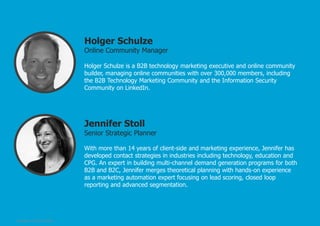
Holger Schulze

Online Community Manager
Holger Schulze is a B2B technology marketing executive and online community
builder, managing online communities with over 300,000 members, including
the B2B Technology Marketing Community and the Information Security
Community on LinkedIn.

Jennifer Stoll

Senior Strategic Planner
With more than 14 years of client-side and marketing experience, Jennifer has
developed contact strategies in industries including technology, education and
CPG. An expert in building multi-channel demand generation programs for both
B2B and B2C, Jennifer merges theoretical planning with hands-on experience
as a marketing automation expert focusing on lead scoring, closed loop
reporting and advanced segmentation.

© Pepper, 2/5/2014, Slide 3
© Pepper, 2/5/2014, Slide 4

EXPLORING
THE DATA
Security Level: Confidential
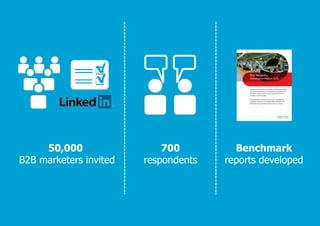
50,000
B2B marketers invited

700
respondents

Benchmark
reports developed
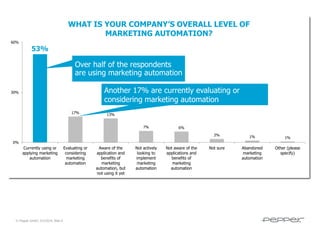
WHAT IS YOUR COMPANY’S OVERALL LEVEL OF
MARKETING AUTOMATION?
60%

53%

Over half of the respondents
are using marketing automation
Another 17% are currently evaluating or
considering marketing automation

30%

17%

13%
7%

6%
2%

1%

1%

Not sure

Abandoned
marketing
automation

Other (please
specify)

0%

Currently using or
applying marketing
automation

© Pepper GmbH, 2/5/2014, Slide 6

Evaluating or
considering
marketing
automation

Aware of the
application and
benefits of
marketing
automation, but
not using it yet

Not actively
looking to
implement
marketing
automation

Not aware of the
applications and
benefits of
marketing
automation
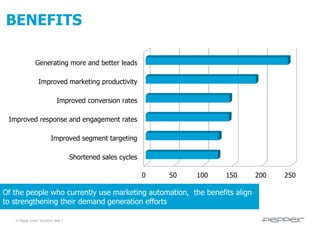
BENEFITS
Generating more and better leads
Improved marketing productivity
Improved conversion rates
Improved response and engagement rates
Improved segment targeting
Shortened sales cycles
0

50

100

150

Of the people who currently use marketing automation, the benefits align
to strengthening their demand generation efforts
© Pepper GmbH, 2/5/2014, Slide 7

200

250
SPENDING

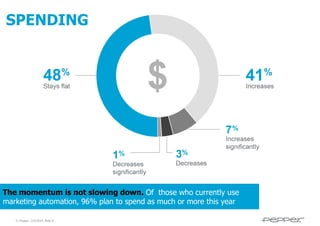
The momentum is not slowing down. Of those who currently use
marketing automation, 96% plan to spend as much or more this year
© Pepper, 2/5/2014, Slide 8
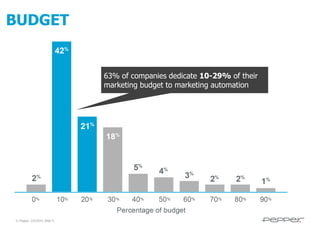
BUDGET

63% of companies dedicate 10-29% of their
marketing budget to marketing automation

© Pepper, 2/5/2014, Slide 9
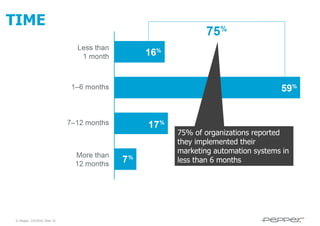
TIME

75% of organizations reported
they implemented their
marketing automation systems in
less than 6 months

© Pepper, 2/5/2014, Slide 10
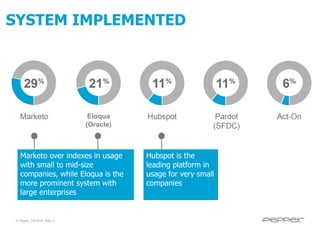
SYSTEM IMPLEMENTED

Eloqua
(Oracle)

Marketo over indexes in usage
with small to mid-size
companies, while Eloqua is the
more prominent system with
large enterprises

© Pepper, 2/5/2014, Slide 11

Hubspot is the
leading platform in
usage for very small
companies
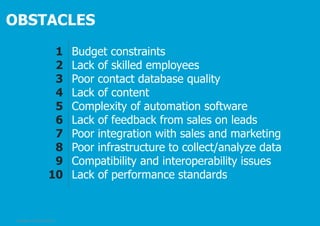
OBSTACLES
1
2
3
4
5
6
7
8
9
10

© Pepper, 2/5/2014, Slide 12

Budget constraints
Lack of skilled employees
Poor contact database quality
Lack of content
Complexity of automation software
Lack of feedback from sales on leads
Poor integration with sales and marketing
Poor infrastructure to collect/analyze data
Compatibility and interoperability issues
Lack of performance standards
SIZE MATTERS

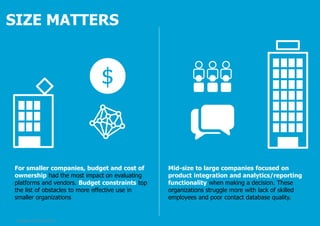
For smaller companies, budget and cost of
ownership had the most impact on evaluating
platforms and vendors. Budget constraints top
the list of obstacles to more effective use in
smaller organizations

© Pepper, 2/5/2014, Slide 13

Mid-size to large companies focused on
product integration and analytics/reporting
functionality when making a decision. These
organizations struggle more with lack of skilled
employees and poor contact database quality.
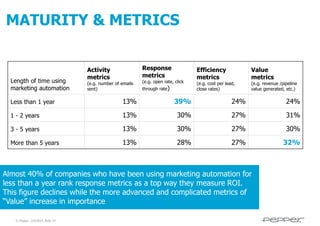
MATURITY & METRICS

Length of time using
marketing automation

Response
metrics

Activity
metrics

(e.g. number of emails
sent)

(e.g. open rate, click
through rate)

Efficiency
metrics

(e.g. cost per lead,
close rates)

Value
metrics

(e.g. revenue /pipeline
value generated, etc.)

Less than 1 year

13%

39%

24%

24%

1 - 2 years

13%

30%

27%

31%

3 - 5 years

13%

30%

27%

30%

More than 5 years

13%

28%

27%

32%

Almost 40% of companies who have been using marketing automation for
less than a year rank response metrics as a top way they measure ROI.
This figure declines while the more advanced and complicated metrics of
“Value” increase in importance
© Pepper, 2/5/2014, Slide 14
This data is great – but
what does it mean to me?

© Pepper, 2/5/2014, Slide 15
ANSWERING
THE QUESTIONS

© Pepper, 2/5/2014, Slide 16

Security Level: Confidential
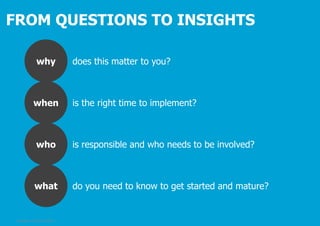
FROM QUESTIONS TO INSIGHTS
why

when

does this matter to you?

is the right time to implement?

who

is responsible and who needs to be involved?

what

do you need to know to get started and mature?

© Pepper, 2/5/2014, Slide 17
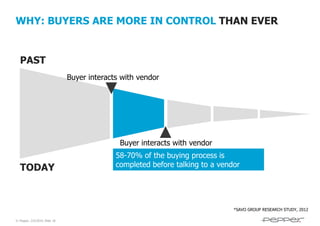
WHY: BUYERS ARE MORE IN CONTROL THAN EVER

PAST
Buyer interacts with vendor

Buyer interacts with vendor

TODAY

58-70% of the buying process is
completed before talking to a vendor

*SAVO GROUP RESEARCH STUDY, 2012
© Pepper, 2/5/2014, Slide 18
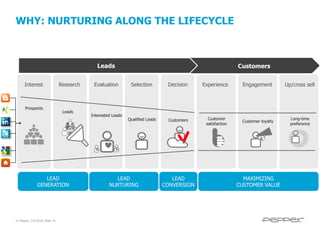
WHY: NURTURING ALONG THE LIFECYCLE

Leads
Interest

Prospects

Research

Leads

LEAD
GENERATION

© Pepper, 2/5/2014, Slide 19

Evaluation

Interested Leads

Customers
Selection

Decision

Experience

Engagement

Up/cross sell

Qualified Leads

Customers

Customer
satisfaction

Customer loyalty

Long-time
preference

LEAD
NURTURING

LEAD
CONVERSION

MAXIMIZING
CUSTOMER VALUE
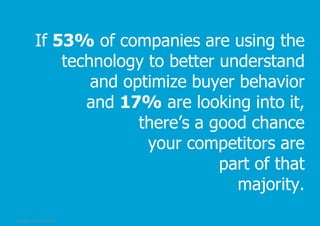
If 53% of companies are using the
technology to better understand
and optimize buyer behavior
and 17% are looking into it,
there’s a good chance
your competitors are
part of that
majority.
© Pepper, 2/5/2014, Slide 20
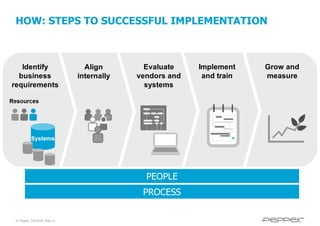
HOW: STEPS TO SUCCESSFUL IMPLEMENTATION

PEOPLE
PROCESS
© Pepper, 2/5/2014, Slide 21
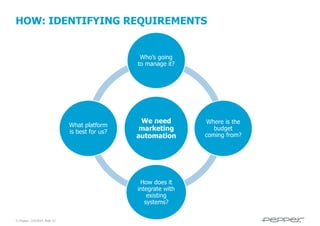
HOW: IDENTIFYING REQUIREMENTS

Who’s going
to manage it?

What platform
is best for us?

We need
marketing
automation

How does it
integrate with
existing
systems?
© Pepper, 2/5/2014, Slide 22

Where is the
budget
coming from?
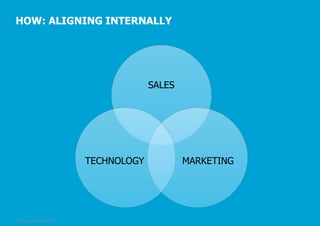
HOW: ALIGNING INTERNALLY

SALES

TECHNOLOGY

© Pepper, 2/5/2014, Slide 23

MARKETING
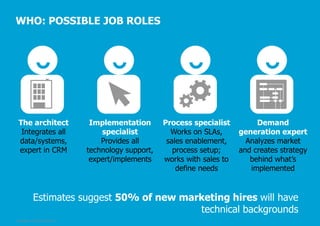
WHO: POSSIBLE JOB ROLES

The architect
Integrates all
data/systems,
expert in CRM

Implementation
specialist
Provides all
technology support,
expert/implements

Process specialist
Works on SLAs,
sales enablement,
process setup;
works with sales to
define needs

Demand
generation expert
Analyzes market
and creates strategy
behind what’s
implemented

Estimates suggest 50% of new marketing hires will have
technical backgrounds
© Pepper, 2/5/2014, Slide 24
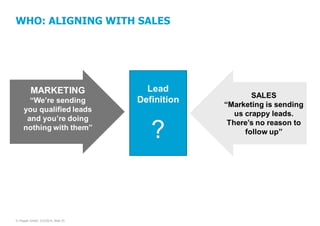
WHO: ALIGNING WITH SALES

© Pepper GmbH, 2/5/2014, Slide 25
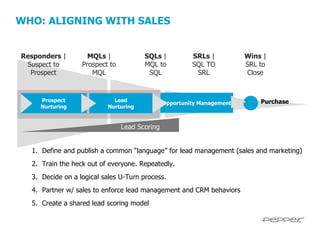
WHO: ALIGNING WITH SALES
Responders |
Suspect to
Prospect

Prospect
Nurturing

MQLs |
Prospect to
MQL

SQLs |
MQL to
SQL

Lead
Nurturing

SRLs |
SQL TO
SRL

Opportunity Management

Wins |
SRL to
Close

Purchase

Lead Scoring
1. Define and publish a common “language” for lead management (sales and marketing)
2. Train the heck out of everyone. Repeatedly.
3. Decide on a logical sales U-Turn process.
4. Partner w/ sales to enforce lead management and CRM behaviors
5. Create a shared lead scoring model
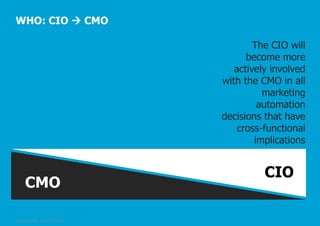
WHO: CIO  CMO
The CIO will
become more
actively involved
with the CMO in all
marketing
automation
decisions that have
cross-functional
implications

CMO
© Pepper GmbH, 2/5/2014, Slide 27

CIO
WHAT: QUESTIONS TO ASK WHEN EVALUATING
Pricing:
• Does the vendor offer scalable pricing to match company growth?
• What is the total cost of ownership?
Multichannel capabilities:
• Can you track and engage through social media?
• Is it possible to link activity to the web?
Integration of tools and databases:
• Can it integrate tools such as Salesforce or Oracle CRM?
• Are there additional efforts for programming?

© Pepper GmbH, 2/5/2014, Slide 28
WHAT: QUESTIONS TO ASK WHEN EVALUATING
Workflow management:
• How much IT involvement do you need to launch?
• How easy is it to personalize or develop assets?
Reporting:
• Is it easy to set up automated reports?
Scoring:
• Can you integrate a custom scoring model?
• Is scoring available
• based on title, role or areas of interest?

Data management:
• Can you easily define and select target groups?
• Is the tool compliant with your IT and data security policies?
© Pepper GmbH, 2/5/2014, Slide 29
Your system is
implemented.
Now what?
© Pepper, 2/5/2014, Slide 30
GROW.
EVOLVE.
MATURE.
© Pepper, 2/5/2014, Slide 31
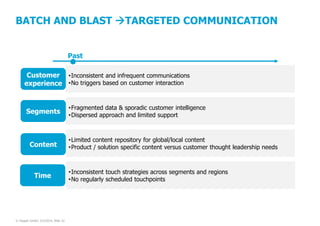
BATCH AND BLAST TARGETED COMMUNICATION
Past
Customer •Inconsistent and infrequent communications
experience •No triggers based on customer interaction

Segments

Content

Time

© Pepper GmbH, 2/5/2014, Slide 32

•Fragmented data & sporadic customer intelligence
•Dispersed approach and limited support

•Limited content repository for global/local content
•Product / solution specific content versus customer thought leadership needs

•Inconsistent touch strategies across segments and regions
•No regularly scheduled touchpoints
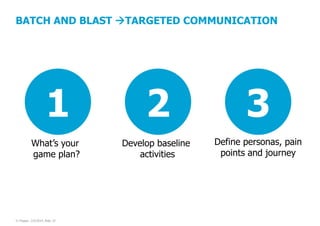
BATCH AND BLAST TARGETED COMMUNICATION

1

2

3

What’s your
game plan?

Develop baseline
activities

Define personas, pain
points and journey

© Pepper, 2/5/2014, Slide 33
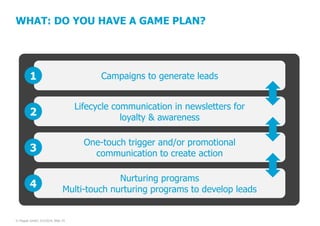
WHAT: DO YOU HAVE A GAME PLAN?

1

Campaigns to generate leads

2

Lifecycle communication in newsletters for
loyalty & awareness

3

One-touch trigger and/or promotional
communication to create action

4

Nurturing programs
Multi-touch nurturing programs to develop leads

© Pepper GmbH, 2/5/2014, Slide 34
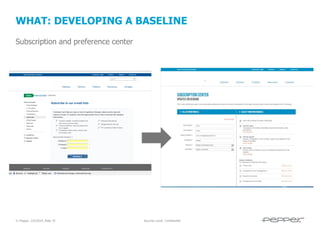
WHAT: DEVELOPING A BASELINE
Subscription and preference center

© Pepper, 2/5/2014, Slide 35

Security Level: Confidential
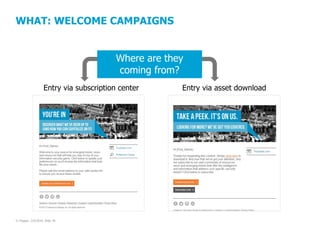
WHAT: WELCOME CAMPAIGNS
Where are they
coming from?
Entry via subscription center

© Pepper, 2/5/2014, Slide 36

Entry via asset download
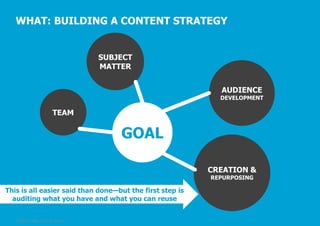
WHAT: BUILDING A CONTENT STRATEGY

SUBJECT
MATTER
AUDIENCE

DEVELOPMENT

TEAM

GOAL
CREATION &
REPURPOSING

This is all easier said than done—but the first step is
auditing what you have and what you can reuse
© Pepper GmbH, 2/5/2014, Slide 37
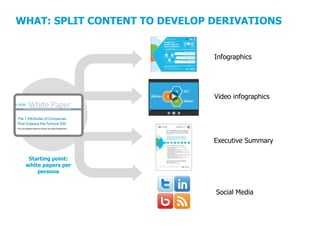
WHAT: SPLIT CONTENT TO DEVELOP DERIVATIONS

Infographics

Video infographics

Executive Summary
Starting point:
white papers per
persona

Social Media
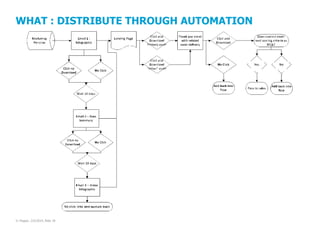
WHAT : DISTRIBUTE THROUGH AUTOMATION

© Pepper, 2/5/2014, Slide 39
WHAT: CONTENT STEPS TO SUCCESS

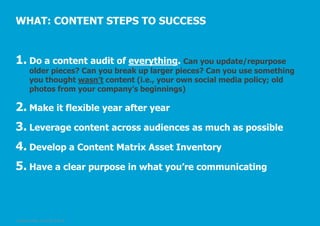
1. Do a content audit of everything. Can you update/repurpose

older pieces? Can you break up larger pieces? Can you use something
you thought wasn’t content (i.e., your own social media policy; old
photos from your company’s beginnings)

2. Make it flexible year after year
3. Leverage content across audiences as much as possible
4. Develop a Content Matrix Asset Inventory
5. Have a clear purpose in what you’re communicating

© Pepper GmbH, 2/5/2014, Slide 40
HOW: MEASURING IMPACT OF YOUR EFFORTS

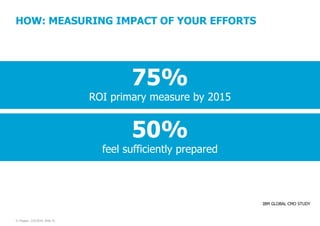
75%

ROI primary measure by 2015

50%

feel sufficiently prepared

IBM GLOBAL CMO STUDY

© Pepper, 2/5/2014, Slide 41
HOW: FOCUS ON EVOLVING YOUR MEASUREMENT

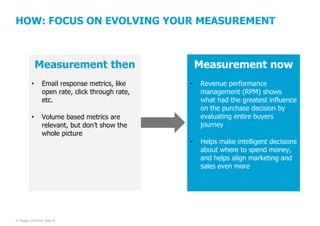
Measurement then
•

Email response metrics, like
open rate, click through rate,
etc.

•

Measurement now

Volume based metrics are
relevant, but don’t show the
whole picture

Revenue performance
management (RPM) shows
what had the greatest influence
on the purchase decision by
evaluating entire buyers
journey

•

© Pepper, 2/5/2014, Slide 42

•

Helps make intelligent decisions
about where to spend money,
and helps align marketing and
sales even more
HOW: LOOK AT CONVERSION AT EVERY STAGE
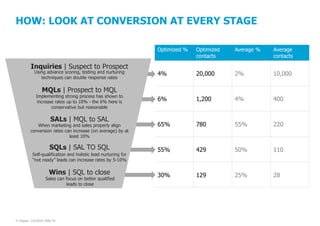
Optimized %

Inquiries | Suspect to Prospect
Using advance scoring, testing and nurturing
techniques can double response rates

Optimized
contacts

Average %

Average
contacts

4%

20,000

2%

10,000

6%

1,200

4%

400

65%

780

55%

220

55%

429

50%

110

30%

129

25%

28

MQLs | Prospect to MQL

Implementing strong process has shown to
increase rates up to 10% - the 6% here is
conservative but reasonable

SALs | MQL to SAL

When marketing and sales properly align
conversion rates can increase (on average) by at
least 10%

SQLs | SAL TO SQL
Self-qualification and holistic lead nurturing for
“not ready” leads can increase rates by 5-10%

Wins | SQL to close

Sales can focus on better qualified
leads to close

© Pepper, 2/5/2014, Slide 43
FINAL THOUGHTS
Crawl, walk, run
Marketing automation enables you—it doesn’t solve
TALK IT OUT
Know yourself
You’re not alone—you can find what you need

© Pepper GmbH, 2/5/2014, Slide 44
QUESTIONS?
© Pepper, 2/5/2014, Slide 45

Security Level: Confidential
FIND US
www.pepperglobal.com

slideshare.net/PepperGlobal
linkedin.com/company/PepperGlobal
@PepperNA OR @PepperGlobal

B2B Technology Marketing Group: linkd.in/1fNjDmC

© Pepper, 2/5/2014, Slide 46
Thank you

The contents of this presentation are confidential and may not be disclosed to third parties. All content, ideas and tools within the offer are the copyrighted
works of Pepper GmbH and subject to standard German copyright law. Any redistribution or reproduction of any materials herein is subject to approval by
Pepper GmbH. Some pictures, illustrations and photos may be subject to copyright and trademark rights of third parties and have strictly been used for
internal purposes only. All registered trademarks are the properties of their individual companies and organisations. All brand names are the intellectual
property of their owners. All registered trademarks are acknowledged, even if they have not been expressly labelled as such.

© Pepper, 2/5/2014, Slide 47

Security Level: Confidential

Marketing Automation: Conquering the Questions in 2014

  • 1.
  • 2.
    A COUPLE OFHOUSEKEEPING RULES 1 We will send out the slides and a recording of the webinar within 48 hours 2 If you have questions, add them into the chat window. We’ll address as many as possible at the end during the Q&A. © Pepper, 2/5/2014, Slide 2
  • 3.
    Holger Schulze Online CommunityManager Holger Schulze is a B2B technology marketing executive and online community builder, managing online communities with over 300,000 members, including the B2B Technology Marketing Community and the Information Security Community on LinkedIn. Jennifer Stoll Senior Strategic Planner With more than 14 years of client-side and marketing experience, Jennifer has developed contact strategies in industries including technology, education and CPG. An expert in building multi-channel demand generation programs for both B2B and B2C, Jennifer merges theoretical planning with hands-on experience as a marketing automation expert focusing on lead scoring, closed loop reporting and advanced segmentation. © Pepper, 2/5/2014, Slide 3
  • 4.
    © Pepper, 2/5/2014,Slide 4 EXPLORING THE DATA Security Level: Confidential
  • 5.
  • 6.
    WHAT IS YOURCOMPANY’S OVERALL LEVEL OF MARKETING AUTOMATION? 60% 53% Over half of the respondents are using marketing automation Another 17% are currently evaluating or considering marketing automation 30% 17% 13% 7% 6% 2% 1% 1% Not sure Abandoned marketing automation Other (please specify) 0% Currently using or applying marketing automation © Pepper GmbH, 2/5/2014, Slide 6 Evaluating or considering marketing automation Aware of the application and benefits of marketing automation, but not using it yet Not actively looking to implement marketing automation Not aware of the applications and benefits of marketing automation
  • 7.
    BENEFITS Generating more andbetter leads Improved marketing productivity Improved conversion rates Improved response and engagement rates Improved segment targeting Shortened sales cycles 0 50 100 150 Of the people who currently use marketing automation, the benefits align to strengthening their demand generation efforts © Pepper GmbH, 2/5/2014, Slide 7 200 250
  • 8.
    SPENDING The momentum isnot slowing down. Of those who currently use marketing automation, 96% plan to spend as much or more this year © Pepper, 2/5/2014, Slide 8
  • 9.
    BUDGET 63% of companiesdedicate 10-29% of their marketing budget to marketing automation © Pepper, 2/5/2014, Slide 9
  • 10.
    TIME 75% of organizationsreported they implemented their marketing automation systems in less than 6 months © Pepper, 2/5/2014, Slide 10
  • 11.
    SYSTEM IMPLEMENTED Eloqua (Oracle) Marketo overindexes in usage with small to mid-size companies, while Eloqua is the more prominent system with large enterprises © Pepper, 2/5/2014, Slide 11 Hubspot is the leading platform in usage for very small companies
  • 12.
    OBSTACLES 1 2 3 4 5 6 7 8 9 10 © Pepper, 2/5/2014,Slide 12 Budget constraints Lack of skilled employees Poor contact database quality Lack of content Complexity of automation software Lack of feedback from sales on leads Poor integration with sales and marketing Poor infrastructure to collect/analyze data Compatibility and interoperability issues Lack of performance standards
  • 13.
    SIZE MATTERS For smallercompanies, budget and cost of ownership had the most impact on evaluating platforms and vendors. Budget constraints top the list of obstacles to more effective use in smaller organizations © Pepper, 2/5/2014, Slide 13 Mid-size to large companies focused on product integration and analytics/reporting functionality when making a decision. These organizations struggle more with lack of skilled employees and poor contact database quality.
  • 14.
    MATURITY & METRICS Lengthof time using marketing automation Response metrics Activity metrics (e.g. number of emails sent) (e.g. open rate, click through rate) Efficiency metrics (e.g. cost per lead, close rates) Value metrics (e.g. revenue /pipeline value generated, etc.) Less than 1 year 13% 39% 24% 24% 1 - 2 years 13% 30% 27% 31% 3 - 5 years 13% 30% 27% 30% More than 5 years 13% 28% 27% 32% Almost 40% of companies who have been using marketing automation for less than a year rank response metrics as a top way they measure ROI. This figure declines while the more advanced and complicated metrics of “Value” increase in importance © Pepper, 2/5/2014, Slide 14
  • 15.
    This data isgreat – but what does it mean to me? © Pepper, 2/5/2014, Slide 15
  • 16.
    ANSWERING THE QUESTIONS © Pepper,2/5/2014, Slide 16 Security Level: Confidential
  • 17.
    FROM QUESTIONS TOINSIGHTS why when does this matter to you? is the right time to implement? who is responsible and who needs to be involved? what do you need to know to get started and mature? © Pepper, 2/5/2014, Slide 17
  • 18.
    WHY: BUYERS AREMORE IN CONTROL THAN EVER PAST Buyer interacts with vendor Buyer interacts with vendor TODAY 58-70% of the buying process is completed before talking to a vendor *SAVO GROUP RESEARCH STUDY, 2012 © Pepper, 2/5/2014, Slide 18
  • 19.
    WHY: NURTURING ALONGTHE LIFECYCLE Leads Interest Prospects Research Leads LEAD GENERATION © Pepper, 2/5/2014, Slide 19 Evaluation Interested Leads Customers Selection Decision Experience Engagement Up/cross sell Qualified Leads Customers Customer satisfaction Customer loyalty Long-time preference LEAD NURTURING LEAD CONVERSION MAXIMIZING CUSTOMER VALUE
  • 20.
    If 53% ofcompanies are using the technology to better understand and optimize buyer behavior and 17% are looking into it, there’s a good chance your competitors are part of that majority. © Pepper, 2/5/2014, Slide 20
  • 21.
    HOW: STEPS TOSUCCESSFUL IMPLEMENTATION PEOPLE PROCESS © Pepper, 2/5/2014, Slide 21
  • 22.
    HOW: IDENTIFYING REQUIREMENTS Who’sgoing to manage it? What platform is best for us? We need marketing automation How does it integrate with existing systems? © Pepper, 2/5/2014, Slide 22 Where is the budget coming from?
  • 23.
    HOW: ALIGNING INTERNALLY SALES TECHNOLOGY ©Pepper, 2/5/2014, Slide 23 MARKETING
  • 24.
    WHO: POSSIBLE JOBROLES The architect Integrates all data/systems, expert in CRM Implementation specialist Provides all technology support, expert/implements Process specialist Works on SLAs, sales enablement, process setup; works with sales to define needs Demand generation expert Analyzes market and creates strategy behind what’s implemented Estimates suggest 50% of new marketing hires will have technical backgrounds © Pepper, 2/5/2014, Slide 24
  • 25.
    WHO: ALIGNING WITHSALES © Pepper GmbH, 2/5/2014, Slide 25
  • 26.
    WHO: ALIGNING WITHSALES Responders | Suspect to Prospect Prospect Nurturing MQLs | Prospect to MQL SQLs | MQL to SQL Lead Nurturing SRLs | SQL TO SRL Opportunity Management Wins | SRL to Close Purchase Lead Scoring 1. Define and publish a common “language” for lead management (sales and marketing) 2. Train the heck out of everyone. Repeatedly. 3. Decide on a logical sales U-Turn process. 4. Partner w/ sales to enforce lead management and CRM behaviors 5. Create a shared lead scoring model
  • 27.
    WHO: CIO CMO The CIO will become more actively involved with the CMO in all marketing automation decisions that have cross-functional implications CMO © Pepper GmbH, 2/5/2014, Slide 27 CIO
  • 28.
    WHAT: QUESTIONS TOASK WHEN EVALUATING Pricing: • Does the vendor offer scalable pricing to match company growth? • What is the total cost of ownership? Multichannel capabilities: • Can you track and engage through social media? • Is it possible to link activity to the web? Integration of tools and databases: • Can it integrate tools such as Salesforce or Oracle CRM? • Are there additional efforts for programming? © Pepper GmbH, 2/5/2014, Slide 28
  • 29.
    WHAT: QUESTIONS TOASK WHEN EVALUATING Workflow management: • How much IT involvement do you need to launch? • How easy is it to personalize or develop assets? Reporting: • Is it easy to set up automated reports? Scoring: • Can you integrate a custom scoring model? • Is scoring available • based on title, role or areas of interest? Data management: • Can you easily define and select target groups? • Is the tool compliant with your IT and data security policies? © Pepper GmbH, 2/5/2014, Slide 29
  • 30.
    Your system is implemented. Nowwhat? © Pepper, 2/5/2014, Slide 30
  • 31.
  • 32.
    BATCH AND BLASTTARGETED COMMUNICATION Past Customer •Inconsistent and infrequent communications experience •No triggers based on customer interaction Segments Content Time © Pepper GmbH, 2/5/2014, Slide 32 •Fragmented data & sporadic customer intelligence •Dispersed approach and limited support •Limited content repository for global/local content •Product / solution specific content versus customer thought leadership needs •Inconsistent touch strategies across segments and regions •No regularly scheduled touchpoints
  • 33.
    BATCH AND BLASTTARGETED COMMUNICATION 1 2 3 What’s your game plan? Develop baseline activities Define personas, pain points and journey © Pepper, 2/5/2014, Slide 33
  • 34.
    WHAT: DO YOUHAVE A GAME PLAN? 1 Campaigns to generate leads 2 Lifecycle communication in newsletters for loyalty & awareness 3 One-touch trigger and/or promotional communication to create action 4 Nurturing programs Multi-touch nurturing programs to develop leads © Pepper GmbH, 2/5/2014, Slide 34
  • 35.
    WHAT: DEVELOPING ABASELINE Subscription and preference center © Pepper, 2/5/2014, Slide 35 Security Level: Confidential
  • 36.
    WHAT: WELCOME CAMPAIGNS Whereare they coming from? Entry via subscription center © Pepper, 2/5/2014, Slide 36 Entry via asset download
  • 37.
    WHAT: BUILDING ACONTENT STRATEGY SUBJECT MATTER AUDIENCE DEVELOPMENT TEAM GOAL CREATION & REPURPOSING This is all easier said than done—but the first step is auditing what you have and what you can reuse © Pepper GmbH, 2/5/2014, Slide 37
  • 38.
    WHAT: SPLIT CONTENTTO DEVELOP DERIVATIONS Infographics Video infographics Executive Summary Starting point: white papers per persona Social Media
  • 39.
    WHAT : DISTRIBUTETHROUGH AUTOMATION © Pepper, 2/5/2014, Slide 39
  • 40.
    WHAT: CONTENT STEPSTO SUCCESS 1. Do a content audit of everything. Can you update/repurpose older pieces? Can you break up larger pieces? Can you use something you thought wasn’t content (i.e., your own social media policy; old photos from your company’s beginnings) 2. Make it flexible year after year 3. Leverage content across audiences as much as possible 4. Develop a Content Matrix Asset Inventory 5. Have a clear purpose in what you’re communicating © Pepper GmbH, 2/5/2014, Slide 40
  • 41.
    HOW: MEASURING IMPACTOF YOUR EFFORTS 75% ROI primary measure by 2015 50% feel sufficiently prepared IBM GLOBAL CMO STUDY © Pepper, 2/5/2014, Slide 41
  • 42.
    HOW: FOCUS ONEVOLVING YOUR MEASUREMENT Measurement then • Email response metrics, like open rate, click through rate, etc. • Measurement now Volume based metrics are relevant, but don’t show the whole picture Revenue performance management (RPM) shows what had the greatest influence on the purchase decision by evaluating entire buyers journey • © Pepper, 2/5/2014, Slide 42 • Helps make intelligent decisions about where to spend money, and helps align marketing and sales even more
  • 43.
    HOW: LOOK ATCONVERSION AT EVERY STAGE Optimized % Inquiries | Suspect to Prospect Using advance scoring, testing and nurturing techniques can double response rates Optimized contacts Average % Average contacts 4% 20,000 2% 10,000 6% 1,200 4% 400 65% 780 55% 220 55% 429 50% 110 30% 129 25% 28 MQLs | Prospect to MQL Implementing strong process has shown to increase rates up to 10% - the 6% here is conservative but reasonable SALs | MQL to SAL When marketing and sales properly align conversion rates can increase (on average) by at least 10% SQLs | SAL TO SQL Self-qualification and holistic lead nurturing for “not ready” leads can increase rates by 5-10% Wins | SQL to close Sales can focus on better qualified leads to close © Pepper, 2/5/2014, Slide 43
  • 44.
    FINAL THOUGHTS Crawl, walk,run Marketing automation enables you—it doesn’t solve TALK IT OUT Know yourself You’re not alone—you can find what you need © Pepper GmbH, 2/5/2014, Slide 44
  • 45.
    QUESTIONS? © Pepper, 2/5/2014,Slide 45 Security Level: Confidential
  • 46.
    FIND US www.pepperglobal.com slideshare.net/PepperGlobal linkedin.com/company/PepperGlobal @PepperNA OR@PepperGlobal B2B Technology Marketing Group: linkd.in/1fNjDmC © Pepper, 2/5/2014, Slide 46
  • 47.
    Thank you The contentsof this presentation are confidential and may not be disclosed to third parties. All content, ideas and tools within the offer are the copyrighted works of Pepper GmbH and subject to standard German copyright law. Any redistribution or reproduction of any materials herein is subject to approval by Pepper GmbH. Some pictures, illustrations and photos may be subject to copyright and trademark rights of third parties and have strictly been used for internal purposes only. All registered trademarks are the properties of their individual companies and organisations. All brand names are the intellectual property of their owners. All registered trademarks are acknowledged, even if they have not been expressly labelled as such. © Pepper, 2/5/2014, Slide 47 Security Level: Confidential