peninsulahealth.org.au
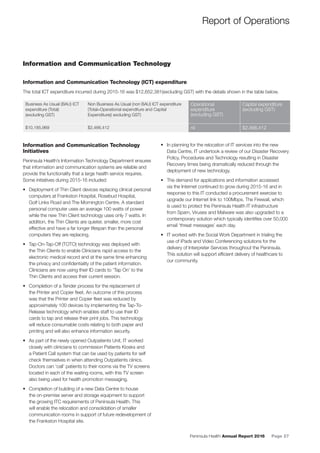
2016
Annual Report
Contents
Fast facts 2015-16
235 – average number of babies born each month
1,695 – average number of children (0-16 years) who attended our emergency
departments each month
95,169 – people attended our emergency departments
81,322 – patients were admitted to our hospitals
37,332 – people were admitted to hospital from our emergency departments
6,514 – children (0-16 years) were admitted to hospital for treatment1
18,223 – people were admitted to hospital for surgery
8,256 – average number of prescription items dispensed by our Pharmacy each month
11,983 – average number of X-rays and medical imaging procedures performed each month
33 – average number of daily Hospital in the Home visits
50,963 – dental courses of care were provided through Community Health
77,323 – hours of service were provided through the Home and Community Care Program
5,064 – hours of service were provided through our drug and alcohol program through
the Community Health and Drug Program
32,868 – hours of service were provided by our Health Independence Programs based
within Community Health (HARP, Residential Inreach, PAC)
6,146 – occasions of service were provided at our various diabetes clinics
32,406 – clients are monitored by our MEPACS personal alarm service
Introduction: Chairperson and Chief Executive 1
Report of Operations 3
Responsible Bodies Declaration 3
Our Health Service 3
Objectives and Functions of Peninsula Health 3
Services Provided by Peninsula Health 4
Governance and Organisational Structure 6
Strategic Priorities 2015-16 10
Financial Summary 17
Performance Priorities 18
Activity and Funding 21
Other Disclosures 22
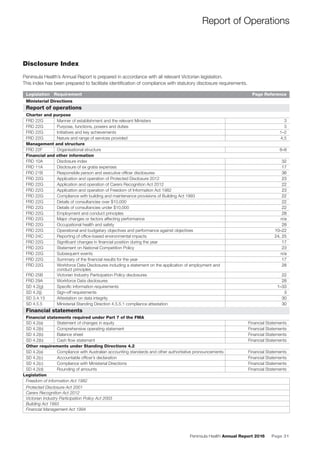
Disclosure Index 31
Financial Statements 34
1. Includes same children admitted multiple times (figure is based on monthly averages).
Front cover:
Frankston Hospital
Emergency Department
1 July 2015 – 30 June 2016
Peninsula Health Annual Report 2016 Page 1
It is with pleasure that we present the 2016 Annual Report
which informs Government, the community, our staff and
partners about Peninsula Health’s operational and financial
performance for the year ended 30 June 2016.
A highlight of the year was meeting the rigorous quality and
safety standards set by the Australian Council on Healthcare
Standards (ACHS). We are very proud of our staff and the
ACHS assessment which found that all actions have been
rated as ‘satisfactorily met’ and five actions were rated as
‘met with merit’. The ACHS commended Peninsula Health
for its efforts in continuously delivering healthcare services at
a very high standard.
The ACHS surveyors described Peninsula Health as an
organisation committed to being person-centred, with
effective and ongoing engagement with consumers.
In addition to our achievements in quality and safety, it has
been a year of building for the future with substantial progress
made on major projects.
Major Projects
In February, Peninsula Health opened two new multi-million
dollar state-of-the-art health facilities – A Hybrid Interventional
Operating Theatre, and a Rapid Assessment Chest Pain Unit.
The $5 million Hybrid Interventional Operating Theatre is
the largest and best equipped theatre of its kind in Australia
which enables surgery to be undertaken in a less invasive
manner. Patients benefit from less invasive surgery with fewer
complications and quicker recovery times.
The new 8-bed Rapid Assessment Chest Pain Unit was
officially opened by the Premier of Victoria, The Hon Daniel
Andrews MP, and Minister for Health, The Hon Jill Hennessy
MP, in February 2016.
The Unit streamlines patients presenting to the Emergency
Department with chest pain enabling them to be rapidly
assessed and treated. It is expected that more than 2,000
patients will use the service each year.
Peninsula Health’s Adult Mental Health Unit (“2 West”) will
undergo an extensive upgrade following the announcement
in April of $1.5 million in State Government funding. ‘2 West’
was built in the early 1990s but has had very little capital
improvements in the past two and a half decades.
Capital Works
There was substantial progress on capital works throughout
2015-16. Projects during the year included:
• Ambulatory Care Centre ($2.6M). The old Emergency
Department was converted into a new, purpose built
Outpatients area with internet kiosks providing self
check-in, in over 50 languages.
• Frankston Hospital Kitchen Upgrade ($1.5M). These
works involved a general ‘refresh’ of the main production
and servery areas and replacement of major equipment.
The upgrade is a significant enhancement for Frankston
Hospital which will improve the delivery of services.
• Rosebud Hospital – Bayview House, Mental Health
Outpatient facility ($485K). This project involved the
construction of a small extension to the existing facility to
include a more spacious waiting area, new toilet facilities
and a meeting room. The reception and open office area
were also reconfigured. The upgrade of Bayview House
provides a more appealing space for clients.
• Academic and Research Centre – a feasibility study
was completed to determine the scope of the project.
Construction of the $15 million Academic Centre in
partnership with Monash University will commence in 2017.
• Psychiatric Assessment and Planning Unit – a planning
process commenced for the development of a new six-
bed psychiatric assessment unit, adjacent to the Frankston
Emergency Department.
New Developments for Surgery
Peninsula Health was awarded $227,000 to reduce the wait
time for patients requiring ENT surgery at Frankston Hospital,
and a further $1.8 million to construct a dedicated day theatre
within the existing theatre complex. The additional theatre is
expected to be operational by early December. The new day
theatre will enable us to treat an additional 1,650 day cases
per year.
Innovation
In June, Peninsula Health became the first health service in
Victoria to use the revolutionary new ‘eyeConnect’ tool at
Frankston Hospital. Developed by Ingeneus in partnership
with the Royal Victorian Eye and Ear Hospital in Melbourne,
eyeConnect is an easy-to-use, ophthalmic diagnostic system.
It will allow patients to have real-time eye testing at the
Royal Victorian Eye and Ear Hospital in Melbourne from the
Frankston Hospital Emergency Department.
Also in June, Peninsula Health cardiologist Associate
Professor Jamie Layland inserted an absorbable heart stent
in a patient at Peninsula Health – a major first for the health
service. Associate Professor Layland and Peninsula Health
cardiologist Dr Robert Lew are part of a worldwide team
investigating the use of absorbable stents in patients with
heart disease.
In another first for Peninsula Health, Rosebud Hospital’s
Emergency Department opened an online kiosk where

patients can search for local GPs and pharmacists.
The online kiosk allows users to find the closest open doctor,
pharmacy, dentist or public and private hospital emergency
department.
Introduction
Page 2 Peninsula Health Annual Report 2016
The kiosk is designed to reduce the number of patients with
low acuity injuries or conditions presenting to the already busy
Rosebud Hospital Emergency Department by giving them
other options for receiving treatment. An online kiosk is also
scheduled to be installed at Frankston Hospital during 2016.
Frankston Carpark Redevelopment
Planning continued during 2015/16 for the construction of the
new three level multi-storey carpark at Frankston which will
provide 750 additional car spaces. The State Government has
given in-priciple approval for a loan for $16 million repayable
over 25 years to fund the construction of the carpark.
Construction is expected to commence in November with a
completion date of December 2017.
Volunteers
Peninsula Health’s outstanding volunteers were recognised
by the Minister for Health Volunteer Awards in May for the
seventh year in a row.
The Karingal Hub Walking Group volunteers won the award
for ‘Outstanding Achievement by a Volunteer Team’ in the
category of Improving Public Health. The Karingal Hub
Walking Group volunteers host four walks a week around the
Karingal Hub Shopping Centre benefiting participants from
many suburbs across the Mornington Peninsula catchment.
Other nominees for the 2016 Minister for Health Volunteer
Awards included:
• Shirley Wragge in the ‘Outstanding Lifetime Achievement’
Award category. Shirley was acknowledged on the Honour
Roll at the official ceremony celebrating volunteers with
50 years or more of volunteering.
• The Pet Therapy volunteer team in the ‘Outstanding
Achievement by a Volunteer: Improving the Patient
Experience’ Award category.
• The Men’s Shed volunteer group in the ‘Outstanding
Achievement by a Volunteer: Improving the Patient
Experience’ Award category.
Peninsula Health has more than 800 volunteers who provide
invaluable support and care for our patients. We are fortunate
to have such a talented and highly committed group of
people supporting our health service.
Reconciliation Action Plan
In May, Peninsula Health completed its second Reconciliation
Action Plan (Innovate). The Plan strengthens our commitment
to providing culturally appropriate health services to Aboriginal
and Torres Strait Islander peoples within our community and
demonstrates our leadership through its alignment with the
National Reconciliation Plan, the shared aspirations of the
Traditional Custodians, and the local Community.
The Plan requires all Peninsula Health staff to gain a deeper
understanding of the historical and social issues affecting
the health and well-being of Aboriginal and Torres Strait
Islander peoples, understand and respect their culture, and
commit to delivering culturally appropriate care. It aims to
further encourage and embrace constructive partnerships;
create learning opportunities for staff; promote Australia’s
unique Aboriginal and Torres Strait Islander cultures; support
Aboriginal and Torres Strait Islander employment; and
most importantly, improve health access and outcomes for
Aboriginal and Torres Strait Islander peoples.
We hope you enjoy reading our 2016 Annual Report and
learning more about our achievements of the past year.
Ms Nancy Hogan Ms Sue Williams
Chairperson Chief Executive
Peninsula Health Peninsula Health
25 August 2016 25 August 2016
Introduction
Peninsula Health Annual Report 2016 Page 3
Responsible Bodies Declaration
In accordance with the Financial Management Act 1994, we
are pleased to present the Report of Operations for Peninsula
Health for the year ending 30 June 2016.
Ms Nancy Hogan Ms Sue Williams
Chairperson Chief Executive
Peninsula Health Peninsula Health
25 August 2016 25 August 2016
Our Health Service
Our Vision
Building on our strong foundations of teamwork and
continuous improvement we will be a recognised leader
in the provision of person-centred care.
Our Mission
Building a healthy community, in partnership.
Our Values
Service
Caring for those in need; make a difference; being responsive;
person-centred; listening.
Integrity
Open; honest; just and reasonable; ethical.
Compassion
Caring for our clients, patients, carers and families, and each
other; showing empathy; being non-judgemental; accepting;
taking time; showing humility.
Respect
Walking in the shoes of others; recognising individual needs;
showing tolerance; treating others as equals; acknowledging
worth.
Excellence
Giving our best; striving for the best results; putting in that
little extra; aiming for better practice; being innovative;
professional; providing quality services.
Objectives and Functions
of Peninsula Health
Peninsula Health is one of 15 metropolitan public health
services in Victoria. We embrace an integrated and
collaborative view of health, working with the community and
service partners to promote health and healthy lifestyles and
to plan for the future needs of the local community. It was
formerly reconstituted on 1 July 2008 to amalgamate the
previous Peninsula Health (originally constituted as a public
health service in 2000) and the former Peninsula Community
Health Service.
Peninsula Health is accountable to the:
• Minister for Health
• Minister for Ageing
• Minister for Mental Health
• Minister for Community Services
• Minister for Disability and Reform
Peninsula Health comprises:
• Acute Care at Frankston Hospital and Rosebud Hospital
• Sub-Acute Care, Rehabilitation, Palliative Care
• Residential services at Mornington, Seaford, and Frankston
• Mental Health services at Frankston, Hastings and
Rosebud
• Community Health services based at Frankston, Rosebud,
Mornington and Hastings.
Our Catchment and Demographic Features
Peninsula Health consists of six main sites, close to 900
beds, two emergency departments, 24 dental chairs and
more than 90 consulting spaces located across the Frankston
and Mornington Peninsula local government areas.
The population of the combined Mornington Peninsula and
Frankston LGAs in 2011 was 279,621 and this is forecast
to grow to 330,119 by 2026-27. Eighty-one per cent of
Peninsula Health’s acute inpatients are public patients and
funded by the State and Commonwealth governments.
Peninsula Health’s catchment has some unique demographic
features including:
• low levels of forecast population growth and higher rates of
population ageing
• a mix of wealth and extreme disadvantage
• specific local indicators of disadvantage including higher
rates of vulnerable children, homelessness and family
violence
• higher risk factors such as obesity and smoking
• higher prevalence of chronic diseases
• higher rates of injury compared to the Victorian average.
Report of Operations
Page 4 Peninsula Health Annual Report 2016
High-volume Services
High-volume services provided at Peninsula Health include
dental services, community health and rehabilitation services,
maternity, orthopaedic, renal dialysis, chemotherapy and
emergency department services. Maternity and obstetric
services and orthopaedic services collectively account for
47 per cent of all acute specialist clinics provided at
Peninsula Health.
Diverse Health Conditions
Peninsula Health's emergency department performance
is influenced by a range of factors including seasonal
fluctuations in population, an elderly population, as well as
areas of wealth and disadvantage.
The diversity of patients creates challenges in providing
appropriate experiences and includes children 0-3 years,
people with mental health, alcohol and drug conditions and
people aged 85+.
Diverse conditions diagnosed on presentation include chest
pain, injuries and breaks, abdominal pain, and fainting or
collapse. More than 15 per cent of presentations are for
diagnosis linked to chronic and complex conditions and 3 per
cent relate to mental health and behavioural disorders.
Services Provided by
Peninsula Health
Peninsula Health is committed to providing high-quality
healthcare services that are integrated, easily accessible,
caring, and person-centred.
Aged Care
• Advance Care Planning
• Aged Care Assessment Service
• Cognitive, Dementia and Memory Service
• Continence Clinic
• Falls Prevention Service
• General Rehabilitation Review Clinic
• Geriatric Evaluation & Management Inpatient Services
• Geriatric Medicine
• Restorative Care
• Transition Care
Allied Health
• Audiology
• Diversional Therapy
• Exercise Physiology
• Neuropsychology
• Nutrition & Dietetics
• Occupational Therapy
• Pastoral Care and Chaplaincy
• Physiotherapy
• Podiatry
• Social Work
Community Health
• Aboriginal & Torres Strait Islander Health
• Addiction Medicine
• Aged Care Services
• Alcohol and Other Drugs Services
• Children’s Services
• Chronic Disease Services
• Community Kitchens
• Counselling
• Dental Services
• Diabetes Education
• Dietetics
• Domiciliary Care Services (Physiotherapy, Occupational
Therapy, Speech Pathology, Carpentry)
• Exercise Physiology
• Family Violence Services
• Health Promotion
• Home Care Packages
• Homeless Outreach
• Hospital Admission Risk Program (HARP)
• Needle Syringe Program
• Podiatry
• Post Acute Care
• Regional Communication Service (Adult)
• Residential In-reach
• Response Access and Discharge Service (RAD)
• Self Help and Support Groups
• Sexual Health
• Smoking Cessation
• Supporting Vulnerable Victorians in Residential Services
Community Participation
• Consumer Advisory Committee and Groups
• Volunteers Services
Emergency Medicine
• Frankston Hospital Emergency Department
• Rosebud Hospital Emergency Department
Report of Operations
Peninsula Health Annual Report 2016 Page 5
Medical Services
• Acute Care of the Elderly
• Ambulatory Services/Cardiology (heart)
• Clinical Haematology (blood)
• Endocrinology & Diabetes (hormones)
• Gastroenterology (stomach and intestines)
• General Medicine
• Hospital in the Home (HITH)
• Infectious Diseases
• Inpatient Palliative Care Services
• Intensive Care Medicine
• Medical Oncology (cancer)
• Neurology (brain and nerves)
• Pain Medicine
• Palliative Medicine
• Renal Medicine (kidneys)
Mental Health Services
• Consultation Liaison Service
• Enhanced Crisis Assessment Treatment Team and
Psychiatric Triage
• Mental Health Hospital Admission Reduction Program
(MH-HARP)
Aged Mental Health Services
• Aged Acute In-Patient Unit
• Aged Persons Mental Health Team
• Carinya Residential Aged Care Unit
• Intensive Community Treatment
Adult
• Acute Inpatient Unit
• Adult Prevention & Recovery Care Service (APARC)
Community Care Unit
• Community Mental Health Service
Youth (16 to 25 years)
• Youth Mental Health Team
• Youth Prevention & Recovery Care Service (YPARC)
MEPACS Personal Alarm Call Service
Paediatrics (Children’s Health)
• Child & Adolescent Health
• Neonates (Newborn babies)
• Home & Community Care
• Asthma Education
Pathology, Haematology and Microbiology
Radiology and Nuclear Medicine
• CT (Computerised Tomography) Fluoroscopy
• Interventional Radiology
• MRI (Magnetic Resonance Imaging) Nuclear Medicine
• Plain Film Ultrasound
Rehabilitation
• Inpatient rehabilitation services
Surgical and Anaesthetic Services
• Anaesthesia & Perioperative Medicine
• Gastrointestinal Endoscopy
• General Surgery
• Maxillo Facial Surgery
• Orthopaedic Surgery
• Otolaryngology and Head & Neck Surgery (ear, nose and
throat)
• Plastic & Reconstructive Surgery
• Skin Integrity – Wound Care
• Stomal Therapy
• Breast care
Women’s Health
• Gynaecology
• Obstetrics
Services not provided by
Peninsula Health
• Cardiac Surgery
• Child Psychiatry
• Dermatology
• Major Trauma
• Neonatal & Paediatric Intensive Care
• Neuro Surgery
• Ophthalmology
• Organ Transplantation
For further information about our services please visit:
peninsulahealth.org.au
Report of Operations
Page 6 Peninsula Health Annual Report 2016
Report of Operations
Governance and
Organisational Structure
Board Governance
Peninsula Health’s Board of Directors is appointed by the
Governor in Council on the recommendation of the Minister
for Health. Directors are usually appointed for a term of three
years, with members eligible to apply for reappointment. The
Minister for Health requires the Board to develop a Strategic
Plan for the Health Service and to ensure accountable and
efficient provision of health services.
The Board of Directors is responsible for the governance and
strategic direction of the Health Service and is committed
to ensuring that the services provided by Peninsula Health
comply with the requirements of the Health Services Act 1988
and the mission, vision and goals of the service.
During 2015/16, the Minister for Health and the Chair of
Peninsula Health signed a Statement of Priorities of agreed
funding, activity and service performance.
The Board held 11 meetings in the financial year 1 July
2015 to 30 June 2016. At these meetings, members of the
Peninsula Health Executive regularly presented reports on
their areas of responsibility.
Board of Directors as at 30 June 2015
Ms Nancy Hogan BA (Hons) Poli Sci GradDipRehab
Studies MBA FACHSE AAICD
Chairperson Appointed 1 July 2008
Executive Director Health and Aged Care Galante Business
Solutions; former CEO of public, not-for-profit organisations
and private hospitals and aged care organisations; former
President of Aged and Community Care Australia and
Australian College of Health Service Executives; former Board
Director HESTA and Industry Funds Management Advisory
Board; current Board Chair Melbourne General Practice
Network.
Professor Henry Ekert AM MBBS MD FRACP
Appointed 1 July 2011
Clinical paediatric haematologist/oncologist; former Director
Division of Medicine, Royal Children’s Hospital; Past
President Clinical Oncological Society of Australia; advisor on
haematology to Commonwealth Department of Health
and Ageing.
Mr Jonathan Tribe BA MAdmin
Appointed 1 July 2011
Former Chief Executive Western Hospital and Royal
Melbourne Hospitals; Managing Director Delaware North
Companies International; former CEO Southern Metropolitan
Cemeteries Trust; currently Chief Operating Officer, Victoria
University and currently CEO of Federation Square.
Ms Erika Wilke BA GradDipSoc DipFinPlanning CFP®
Appointed 1 July 2011
Director PrimeCare Financial Planning; experience in aged
care sector; co-author Retirement Living and Aged Care – the
Australian Master Financial Planning Guide.
Ms Bronwyn Lewis RN BA MA Admin MAICD MFIA
Appointed 1 October 2014
General Manager, Strategic Change and Development Carers
Australia, experience in administration and marketing across
government, not-for-profit and private sectors.
Mr Michael Tiernan LLB
Appointed 1 July 2008
Consultant Legal Management and OHS, Rehabilitation and
Risk Management; Legal Practice management consultant;
Member Law Institute of Victoria; nationally accredited
Specialist Mediator Law Institute of Victoria; Member Law
Institute of Victoria WorkCover Committee and Accident
Compensation Committee; Chair Law Institute of Victoria
Practice Management Committee.
Dr Nathan Pinskier MBBS, FRAGCP, FAAQHC, FAAPM,
Dip Prac Man, CPM
Appointed 15 September 2015
Dr Nathan Pinskier is Melbourne GP with a long-standing
involvement in primary health care, e-health, information
technology, accreditation and practice management. He is a
director and co-owner of a Melbourne based group of general
practices Medi7. He is the chair of the RACGP National
Standing Committee for eHealth and the Medical Director of
the Australian Locum Medical Service.
Ms Allison Smith B.Acc, GAICD, CA
(Australia and Scotland)
Appointed 26 April 2016
Named as one of the 25 Most Influential Women in Retail
in Australia by Inside Retailing, Allison Smith is a results
oriented executive. Allison has held senior retail, merchandise,
marketing, supply chain and finance roles in some of
Australia’s most influential organisations. Allison specialises
in growth and value creation agendas and has delivered
significant value to the organisations in which she has
operated.
Mr Naim Melhem Executive Certificate Public Policy
in Management
Appointed 30 June 2016
Mr Naim Melhem is a Senior Manager with Arab Bank
Australia. He has held positions of Councillor and Mayor for
the City of Greater Dandenong. He was a Board Director
for Southern Health from 2001 to 2009 where he served
as Chairman of the Community Advisory Committee. He
was also a member of Southern Health’s Audit and Finance
Committees.
Peninsula Health Annual Report 2016 Page 7
Report of Operations
Board Committees as at 30 June 2015
Nine committees provide specialist advice and support to
the Board. The committees also assist the Board and senior
management to meet all statutory, regulatory and operational
requirements for the Health Service.
Finance & Resources Committee
The Finance & Resources Committee reviews all financial
matters, management information and internal control
systems, and considers and makes recommendations to the
Board on major and minor works.
Board members: Allison Smith (Chair), Nancy Hogan,
Jonathan Tribe, Erika Wilke.
Audit & Risk Committee
The Audit & Risk Committee meets quarterly and at any
other time as requested by the Peninsula Health Board,
any Committee member, the internal auditor or the Auditor-
General. The Committee liaises with the internal and external
auditors, reviews and approves audit programs and evaluates
the adequacy and effectiveness of the overall governance
framework operating within Peninsula Health. The Committee
receives reports via the compliance monitoring framework
and monitors all risk management activities for Peninsula
Health.
Board members: Jonathan Tribe (Chair), Bronwyn Lewis,
Allison Smith.
Quality & Clinical Governance Committee
The Quality & Clinical Governance Committee meets
regularly to monitor outcomes and improve the quality and
effectiveness of the health services provided by Peninsula
Health. The Committee is also responsible for the clinical
risk management activities of Peninsula Health, which are
integrated with its quality systems.
Board members: Nancy Hogan (Acting Chair), Bronwyn
Lewis, Henry Ekert, Nathan Pinksier.
Medical Staff Association / Board Executive
The Board Executive considers clinical matters brought
forward through the Chairman of the Medical Staff
Association.
Board members: Nancy Hogan (Chair), Henry Ekert,
Jonathan Tribe.
Research Academic Committee
The Research and Academic Committee provides expert
advice to the Board of Peninsula Health on all matters
relating to research and scientific endeavours and the
academic positions required to provide research leadership.
The Committee is responsible for oversight of Peninsula
Health’s research governance framework and the ongoing
implementation and review of Peninsula Health’s Research
Strategic Plan.
Board members: Henry Ekert (Chair), Dr Nathan Pinksier
Consumer Advisory Committee
The Consumer Advisory Committee brings the voices of
the community and consumers into the decision-making
processes of Peninsula Health to ensure that the Health
Service develops services that are responsive to our diverse
community. Members provide information and advice
on needs, demands, and service developments from a
community perspective. The Committee is supported by
13 Consumer Advisory Groups.
Board member: Bronwyn Lewis
Primary Care & Population Health Committee
The Primary Care & Population Health Committee assists in
creating effective linkages between the Health Service and
other primary care providers to coordinate the delivery of care
in the community. The committee oversees catchment-wide
primary care coordination through implementation of The
Peninsula Model.
Board members: (Board Director attendance: optional)
Remuneration Committee
The Remuneration Committee meets as required to review
performance and determine remuneration of executive
management.
Board members: Nancy Hogan (Chair), Allison Smith,
Jonathan Tribe.
Senior Medical & Dental Staff Appointments
Committee
The Senior Medical & Dental Staff Appointments Committee
makes recommendations to the Board of Directors in relation
to the appointment of senior medical or dental staff.
Page 8 Peninsula Health Annual Report 2016
Report of Operations
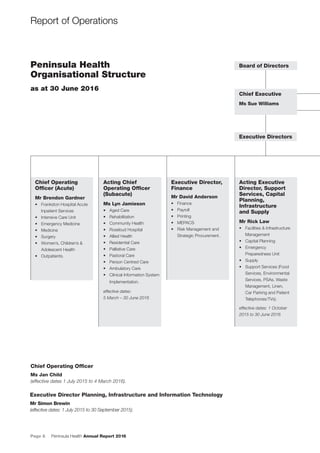
Board of Directors
Executive Directors
Chief Executive
Ms Sue Williams
Chief Operating
Officer (Acute)
Mr Brendon Gardner
• Frankston Hospital Acute
Inpatient Services
• Intensive Care Unit
• Emergency Medicine
• Medicine
• Surgery
• Women’s, Children’s &
Adolescent Health
• Outpatients.
Executive Director,
Finance
Mr David Anderson
• Finance
• Payroll
• Printing
• MEPACS
• Risk Management and
Strategic Procurement.
Acting Executive
Director, Support
Services, Capital
Planning,
Infrastructure
and Supply
Mr Rick Law
• Facilities & Infrastructure
Management
• Capital Planning
• Emergency
Preparedness Unit
• Supply
• Support Services (Food
Services, Environmental
Services, PSAs, Waste
Management, Linen,
Car Parking and Patient
Telephones/TVs).
effective dates: 1 October
2015 to 30 June 2016
Executive Director Planning, Infrastructure and Information Technology
Mr Simon Brewin
(effective dates: 1 July 2015 to 30 September 2015).
Acting Chief
Operating Officer
(Subacute)
Ms Lyn Jamieson
• Aged Care
• Rehabilitation
• Community Health
• Rosebud Hospital
• Allied Health
• Residential Care
• Palliative Care
• Pastoral Care
• Person Centred Care
• Ambulatory Care
• Clinical Information System
Implementation.
effective dates:
5 March – 30 June 2016
Chief Operating Officer
Ms Jan Child
(effective dates 1 July 2015 to 4 March 2016).
Peninsula Health
Organisational Structure
as at 30 June 2016
Peninsula Health Annual Report 2016 Page 9
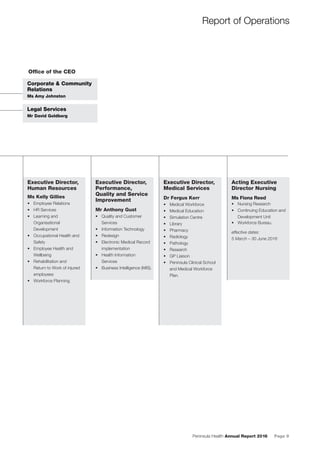
Report of Operations
Executive Director,
Human Resources
Ms Kelly Gillies
• Employee Relations
• HR Services
• Learning and
Organisational
Development
• Occupational Health and
Safety
• Employee Health and
Wellbeing
• Rehabilitation and
Return to Work of injured
employees
• Workforce Planning.
Executive Director,
Performance,
Quality and Service
Improvement
Mr Anthony Gust
• Quality and Customer
Services
• Information Technology
• Redesign
• Electronic Medical Record
implementation
• Health Information
Services
• Business Intelligence (MIS).
Executive Director,
Medical Services
Dr Fergus Kerr
• Medical Workforce
• Medical Education
• Simulation Centre
• Library
• Pharmacy
• Radiology
• Pathology
• Research
• GP Liaison
• Peninsula Clinical School
and Medical Workforce
Plan.
Acting Executive
Director Nursing
Ms Fiona Reed
• Nursing Research
• Continuing Education and
Development Unit
• Workforce Bureau.
effective dates:
5 March – 30 June 2016
Corporate & Community
Relations
Ms Amy Johnston
Legal Services
Mr David Goldberg
Office of the CEO
Page 10 Peninsula Health Annual Report 2016
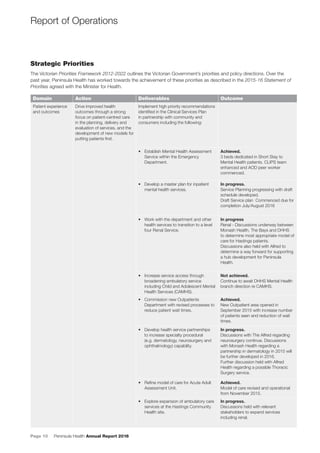
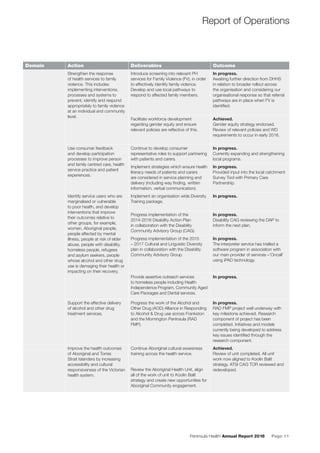
Report of Operations
Domain Action Deliverables Outcome
Patient experience
and outcomes
Drive improved health
outcomes through a strong
focus on patient-centred care
in the planning, delivery and
evaluation of services, and the
development of new models for
putting patients first.
Implement high priority recommendations
identified in the Clinical Services Plan
in partnership with community and
consumers including the following:
• Establish Mental Health Assessment
Service within the Emergency
Department.
Achieved.
3 beds dedicated in Short Stay to
Mental Health patients. CLIPS team
enhanced and AOD peer worker
commenced.
• Develop a master plan for inpatient
mental health services.
In progress.
Service Planning progressing with draft
schedule developed.
Draft Service plan Commenced due for
completion July/August 2016
• Work with the department and other
health services to transition to a level
four Renal Service.
In progress
Renal - Discussions underway between
Monash Health, The Bays and DHHS
to determine most appropriate model of
care for Hastings patients.
Discussions also held with Alfred to
determine a way forward for supporting
a hub development for Peninsula
Health.
• Increase service access through
broadening ambulatory service
including Child and Adolescent Mental
Health Services (CAMHS).
Not achieved.
Continue to await DHHS Mental Health
branch direction re CAMHS.
• Commission new Outpatients
Department with revised processes to
reduce patient wait times.
Achieved.
New Outpatient area opened in
September 2015 with increase number
of patients seen and reduction of wait
times.
• Develop health service partnerships
to increase specialty procedural
(e.g. dermatology, neurosurgery and
ophthalmology) capability.
In progress.
Discussions with The Alfred regarding
neurosurgery continue. Discussions
with Monash Health regarding a
partnership in dermatology in 2015 will
be further developed in 2016.
Further discussion held with Alfred
Health regarding a possible Thoracic
Surgery service.
• Refine model of care for Acute Adult
Assessment Unit.
Achieved.
Model of care revised and operational
from November 2015.
• Explore expansion of ambulatory care
services at the Hastings Community
Health site.
In progress.
Discussions held with relevant
stakeholders to expand services
including renal.
Strategic Priorities
The Victorian Priorities Framework 2012-2022 outlines the Victorian Government’s priorities and policy directions. Over the
past year, Peninsula Health has worked towards the achievement of these priorities as described in the 2015-16 Statement of
Priorities agreed with the Minister for Health.
Peninsula Health Annual Report 2016 Page 11
Report of Operations
Domain Action Deliverables Outcome
Strengthen the response
of health services to family
violence. This includes
implementing interventions,
processes and systems to
prevent, identify and respond
appropriately to family violence
at an individual and community
level.
Introduce screening into relevant PH
services for Family Violence (FV), in order
to effectively identify family violence.
Develop and use local pathways to
respond to affected family members.
In progress.
Awaiting further direction from DHHS
in relation to broader rollout across
the organisation and considering our
organisational response so that referral
pathways are in place when FV is
identified.
Facilitate workforce development
regarding gender equity and ensure
relevant policies are reflective of this.
Achieved.
Gender equity strategy endorsed.
Review of relevant policies and WD
requirements to occur in early 2016.
Use consumer feedback
and develop participation
processes to improve person
and family centred care, health
service practice and patient
experiences.
Continue to develop consumer
representative roles to support partnering
with patients and carers.
In progress.
Currently expanding and strengthening
local programs.
Implement strategies which ensure health
literacy needs of patients and carers
are considered in service planning and
delivery (including way finding, written
information, verbal communication).
In progress.
Provided input into the local catchment
Survey Tool with Primary Care
Partnership.
Identify service users who are
marginalised or vulnerable
to poor health, and develop
interventions that improve
their outcomes relative to
other groups, for example,
women, Aboriginal people,
people affected by mental
illness, people at risk of elder
abuse, people with disability,
homeless people, refugees
and asylum seekers, people
whose alcohol and other drug
use is damaging their health or
impacting on their recovery.
Implement an organisation wide Diversity
Training package.
In progress.
Progress implementation of the
2014-2016 Disability Action Plan
in collaboration with the Disability
Community Advisory Group (CAG).
In progress.
Disability CAG reviewing the DAP to
inform the next plan.
Progress implementation of the 2015
– 2017 Cultural and Linguistic Diversity
plan in collaboration with the Disability
Community Advisory Group.
In progress.
The interpreter service has trialled a
software program in association with
our main provider of services –‘Oncall’
using iPAD technology.
Provide assertive outreach services
to homeless people including Health
Independence Program, Community Aged
Care Packages and Dental services.
In progress.
Support the effective delivery
of alcohol and other drug
treatment services.
Progress the work of the Alcohol and
Other Drug (AOD) Alliance in Responding
to Alcohol & Drug use across Frankston
and the Mornington Peninsula (RAD
FMP).
In progress.
RAD FMP project well underway with
key milestone achieved. Research
component of project has been
completed. Initiatives and models
currently being developed to address
key issues identified through the
research component.
Improve the health outcomes
of Aboriginal and Torres
Strait Islanders by increasing
accessibility and cultural
responsiveness of the Victorian
health system.
Continue Aboriginal cultural awareness
training across the health service.
Achieved.
Review of unit completed. All unit
work now aligned to Koolin Balit
strategy. ATSI CAG TOR reviewed and
redeveloped.Review the Aboriginal Health Unit, align
all of the work of unit to Koolin Balit
strategy and create new opportunities for
Aboriginal Community engagement.
Page 12 Peninsula Health Annual Report 2016
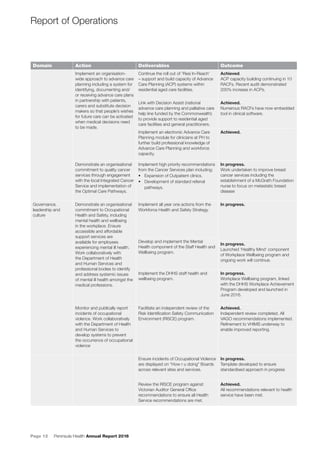
Report of Operations
Domain Action Deliverables Outcome
Implement an organisation-
wide approach to advance care
planning including a system for
identifying, documenting and/
or receiving advance care plans
in partnership with patients,
carers and substitute decision
makers so that people’s wishes
for future care can be activated
when medical decisions need
to be made.
Continue the roll out of ‘Resi In-Reach’
– support and build capacity of Advance
Care Planning (ACP) systems within
residential aged care facilities.
Achieved.
ACP capacity building continuing in 10
RACFs. Recent audit demonstrated
200% increase in ACPs.
Link with Decision Assist (national
advance care planning and palliative care
help line funded by the Commonwealth)
to provide support to residential aged
care facilities and general practitioners.
Achieved.
Numerous RACFs have now embedded
tool in clinical software.
Implement an electronic Advance Care
Planning module for clinicians at PH to
further build professional knowledge of
Advance Care Planning and workforce
capacity.
Achieved.
Demonstrate an organisational
commitment to quality cancer
services through engagement
with the local Integrated Cancer
Service and implementation of
the Optimal Care Pathways.
Implement high priority recommendations
from the Cancer Services plan including:
• Expansion of Outpatient clinics.
• Development of standard referral
pathways.
In progress.
Work undertaken to improve breast
cancer services including the
establishment of a McGrath Foundation
nurse to focus on metastatic breast
disease
Governance,
leadership and
culture
Demonstrate an organisational
commitment to Occupational
Health and Safety, including
mental health and wellbeing
in the workplace. Ensure
accessible and affordable
support services are
available for employees
experiencing mental ill health.
Work collaboratively with
the Department of Health
and Human Services and
professional bodies to identify
and address systemic issues
of mental ill health amongst the
medical professions.
Implement all year one actions from the
Workforce Health and Safety Strategy.
In progress.
Develop and implement the Mental
Health component of the Staff Health and
Wellbeing program.
In progress.
Launched ‘Healthy Mind’ component
of Workplace Wellbeing program and
ongoing work will continue.
Implement the DHHS staff health and
wellbeing program.
In progress.
Workplace Wellbeing program, linked
with the DHHS Workplace Achievement
Program developed and launched in
June 2016.
Monitor and publically report
incidents of occupational
violence. Work collaboratively
with the Department of Health
and Human Services to
develop systems to prevent
the occurrence of occupational
violence
Facilitate an independent review of the
Risk Identification Safety Communication
Environment (RISCE) program.
Achieved.
Independent review completed. All
VAGO recommendations implemented.
Refinement to VHIMS underway to
enable improved reporting.
Ensure incidents of Occupational Violence
are displayed on “How r u doing” Boards
across relevant sites and services.
In progress.
Template developed to ensure
standardised approach in progress
Review the RISCE program against
Victorian Auditor General Office
recommendations to ensure all Health
Service recommendations are met.
Achieved.
All recommendations relevant to health
service have been met.
Peninsula Health Annual Report 2016 Page 13
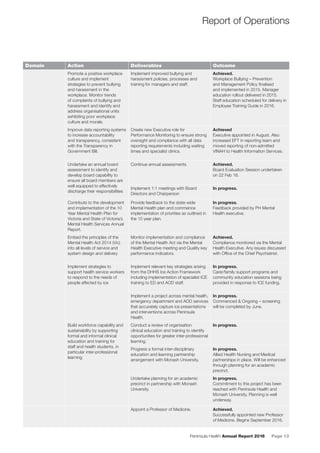
Report of Operations
Domain Action Deliverables Outcome
Promote a positive workplace
culture and implement
strategies to prevent bullying
and harassment in the
workplace. Monitor trends
of complaints of bullying and
harassment and identify and
address organisational units
exhibiting poor workplace
culture and morale.
Implement improved bullying and
harassment policies, processes and
training for managers and staff.
Achieved.
Workplace Bullying – Prevention
and Management Policy finalised
and implemented in 2015. Manager
education rollout delivered in 2015.
Staff education scheduled for delivery in
Employee Training Guide in 2016.
Improve data reporting systems
to increase accountability
and transparency, consistent
with the Transparency in
Government Bill.
Create new Executive role for
Performance Monitoring to ensure strong
oversight and compliance with all data
reporting requirements including waiting
times and specialist clinics.
Achieved
Executive appointed in August. Also
increased EFT in reporting team and
moved reporting of non-admitted
VINAH to Health Information Services.
Undertake an annual board
assessment to identify and
develop board capability to
ensure all board members are
well equipped to effectively
discharge their responsibilities
Continue annual assessments. Achieved.
Board Evaluation Session undertaken
on 22 Feb 16.
Implement 1:1 meetings with Board
Directors and Chairperson
In progress.
Contribute to the development
and implementation of the 10
Year Mental Health Plan for
Victoria and State of Victoria’s
Mental Health Services Annual
Report.
Provide feedback to the state-wide
Mental Health plan and commence
implementation of priorities as outlined in
the 10 year plan.
In progress.
Feedback provided by PH Mental
Health executive.
Embed the principles of the
Mental Health Act 2014 (Vic)
into all levels of service and
system design and delivery
Monitor implementation and compliance
of the Mental Health Act via the Mental
Health Executive meeting and Quality key
performance indicators.
Achieved.
Compliance monitored via the Mental
Health Executive. Any issues discussed
with Office of the Chief Psychiatrist.
Implement strategies to
support health service workers
to respond to the needs of
people affected by ice
Implement relevant key strategies arising
from the DHHS Ice Action Framework
including implementation of specialist ICE
training to ED and AOD staff.
In progress.
Carer/family support programs and
community education sessions being
provided in response to ICE funding.
Implement a project across mental health,
emergency department and AOD services
that accurately capture ice presentations
and interventions across Peninsula
Health.
In progress.
Commenced & Ongoing – screening
will be completed by June.
Build workforce capability and
sustainability by supporting
formal and informal clinical
education and training for
staff and health students, in
particular inter-professional
learning
Conduct a review of organisation
clinical education and training to identify
opportunities for greater inter-professional
learning.
In progress.
Progress a formal inter-disciplinary
education and learning partnership
arrangement with Monash University.
In progress.
Allied Health Nursing and Medical
partnerships in place. Will be enhanced
through planning for an academic
precinct.
Undertake planning for an academic
precinct in partnership with Monash
University.
In progress.
Commitment to this project has been
reached with Peninsula Health and
Monash University. Planning is well
underway.
Appoint a Professor of Medicine. Achieved.
Successfully appointed new Professor
of Medicine. Begins September 2016.
Page 14 Peninsula Health Annual Report 2016
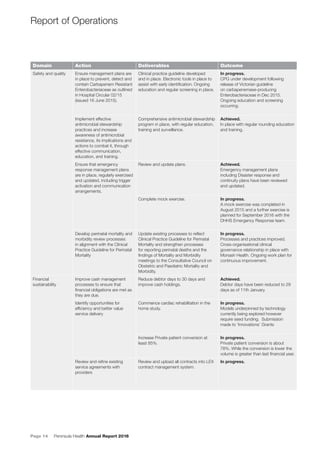
Report of Operations
Domain Action Deliverables Outcome
Safety and quality Ensure management plans are
in place to prevent, detect and
contain Carbapenem Resistant
Enterobacteriaceae as outlined
in Hospital Circular 02/15
(issued 16 June 2015).
Clinical practice guideline developed
and in place. Electronic tools in place to
assist with early identification. Ongoing
education and regular screening in place.
In progress.
CPG under development following
release of Victorian guideline
on carbapenemase-producing
Enterobacteriaceae in Dec 2015.
Ongoing education and screening
occurring.
Implement effective
antimicrobial stewardship
practices and increase
awareness of antimicrobial
resistance, its implications and
actions to combat it, through
effective communication,
education, and training.
Comprehensive antimicrobial stewardship
program in place, with regular education,
training and surveillance.
Achieved.
In place with regular rounding education
and training.
Ensure that emergency
response management plans
are in place, regularly exercised
and updated, including trigger
activation and communication
arrangements.
Review and update plans. Achieved.
Emergency management plans
including Disaster response and
continuity plans have been reviewed
and updated.
Complete mock exercise. In progress.
A mock exercise was completed in
August 2015 and a further exercise is
planned for September 2016 with the
DHHS Emergency Response team.
Develop perinatal mortality and
morbidity review processes
in alignment with the Clinical
Practice Guideline for Perinatal
Mortality
Update existing processes to reflect
Clinical Practice Guideline for Perinatal
Mortality and strengthen processes
for reporting perinatal deaths and the
findings of Mortality and Morbidity
meetings to the Consultative Council on
Obstetric and Paediatric Mortality and
Morbidity.
In progress.
Processes and practices improved.
Cross-organisational clinical
governance relationship in place with
Monash Health. Ongoing work plan for
continuous improvement.
Financial
sustainability
Improve cash management
processes to ensure that
financial obligations are met as
they are due.
Reduce debtor days to 30 days and
improve cash holdings.
Achieved.
Debtor days have been reduced to 29
days as of 11th January.
Identify opportunities for
efficiency and better value
service delivery
Commence cardiac rehabilitation in the
home study.
In progress.
Models underpinned by technology
currently being explored however
require seed funding. Submission
made to ‘Innovations’ Grants
Increase Private patient conversion at
least 85%.
In progress.
Private patient conversion is about
78%. While the conversion is lower the
volume is greater than last financial year.
Review and refine existing
service agreements with
providers
Review and upload all contracts into LEX
contract management system.
In progress.
Peninsula Health Annual Report 2016 Page 15
Report of Operations
Domain Action Deliverables Outcome
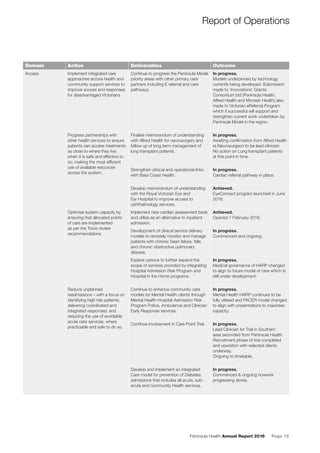
Access Implement integrated care
approaches across health and
community support services to
improve access and responses
for disadvantaged Victorians
Continue to progress the Peninsula Model
priority areas with other primary care
partners including E referral and care
pathways.
In progress.
Models underpinned by technology
currently being developed. Submission
made to ‘Innovations’ Grants.
Consortium bid (Peninsula Health,
Alfred Health and Monash Health) also
made to Victorian eReferral Program
which if successful will support and
strengthen current work undertaken by
Peninsula Model in the region.
Progress partnerships with
other health services to ensure
patients can access treatments
as close to where they live
when it is safe and effective to
so, making the most efficient
use of available resources
across the system.
Finalise memorandum of understanding
with Alfred Health for neurosurgery and
follow up of long term management of
lung transplant patients.
In progress.
Awaiting confirmation from Alfred Health
re Neurosurgeon to be lead clinician.
No action on Lung transplant patients
at this point in time.
Strengthen clinical and operational links
with Bass Coast Health.
In progress.
Cardiac referral pathway in place.
Develop memorandum of understanding
with the Royal Victorian Eye and
Ear Hospital to improve access to
ophthalmology services.
Achieved.
EyeConnect program launched in June
2016.
Optimise system capacity by
ensuring that allocated points
of care are implemented
as per the Travis review
recommendations
Implement new cardiac assessment beds
and utilise as an alternative to inpatient
admission.
Achieved.
Opened 1 February 2016.
Development of clinical service delivery
models to remotely monitor and manage
patients with chronic heart failure, falls
and chronic obstructive pulmonary
disease.
In progress.
Commenced and ongoing.
Explore options to further expand the
scope of services provided by integrating
Hospital Admission Risk Program and
Hospital in the Home programs.
In progress.
Medical governance of HARP changed
to align to future model of care which is
still under development.
Reduce unplanned
readmissions – with a focus on
identifying high risk patients;
delivering coordinated and
integrated responses; and
reducing the use of avoidable
acute care services, where
practicable and safe to do so.
Continue to enhance community care
models for Mental Health clients through
Mental Health Hospital Admission Risk
Program Police, Ambulance and Clinician
Early Response services.
In progress.
Mental Health HARP continues to be
fully utilised and PACER model changed
to align with presentations to maximise
capacity.
Continue involvement in Care Point Trial. In progress.
Lead Clinician for Trial in Southern
area seconded from Peninsula Health.
Recruitment phase of trial completed
and operation with selected clients
underway.
Ongoing to timetable.
Develop and implement an Integrated
Care model for prevention of Diabetes
admissions that includes all acute, sub-
acute and community Health services.
In progress.
Commenced & ongoing however
progressing slowly.
Page 16 Peninsula Health Annual Report 2016
Report of Operations
Domain Action Deliverables Outcome
Improve access to mental
health and drug and alcohol
services by linking in with
Aboriginal and Torres Strait
Islander organisations and
other drug and alcohol service
providers.
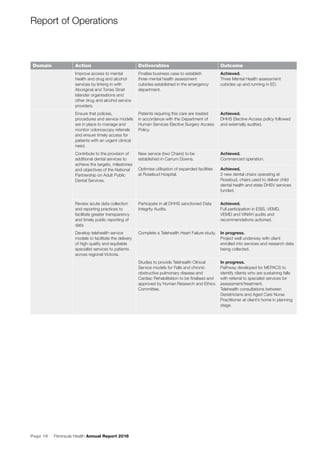
Finalise business case to establish
three mental health assessment
cubicles established in the emergency
department.
Achieved.
Three Mental Health assessment
cubicles up and running in ED.
Ensure that policies,
procedures and service models
are in place to manage and
monitor colonoscopy referrals
and ensure timely access for
patients with an urgent clinical
need.
Patients requiring this care are treated
in accordance with the Department of
Human Services Elective Surgery Access
Policy.
Achieved.
DHHS Elective Access policy followed
and externally audited.
Contribute to the provision of
additional dental services to
achieve the targets, milestones
and objectives of the National
Partnership on Adult Public
Dental Services.
New service (two Chairs) to be
established in Carrum Downs.
Achieved.
Commenced operation.
Optimise utilisation of expanded facilities
at Rosebud Hospital.
Achieved.
2 new dental chairs operating at
Rosebud, chairs used to deliver child
dental health and state DHSV services
funded.
Review acute data collection
and reporting practices to
facilitate greater transparency
and timely public reporting of
data
Participate in all DHHS sanctioned Data
Integrity Audits.
Achieved.
Full participation in ESIS, VEMD,
VEMD and VINAH audits and
recommendations actioned.
Develop telehealth service
models to facilitate the delivery
of high quality and equitable
specialist services to patients
across regional Victoria.
Complete a Telehealth Heart Failure study. In progress.
Project well underway with client
enrolled into services and research data
being collected.
Studies to provide Telehealth Clinical
Service models for Falls and chronic
obstructive pulmonary disease and
Cardiac Rehabilitation to be finalised and
approved by Human Research and Ethics
Committee.
In progress.
Pathway developed for MEPACS to
identify clients who are sustaining falls
with referral to specialist services for
assessment/treatment.
Telehealth consultations between
Geriatricians and Aged Care Nurse
Practitioner at client’s home in planning
stage.
Peninsula Health Annual Report 2016 Page 17
Report of Operations
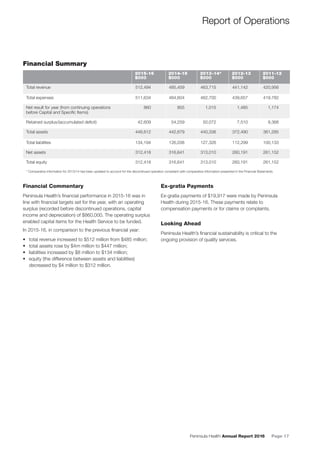
Financial Summary
2015-16
$000
2014-15
$000
2013-14*
$000
2012-13
$000
2011-12
$000
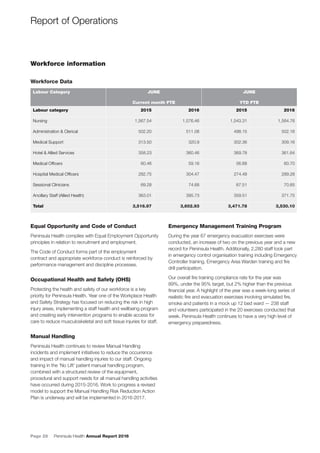
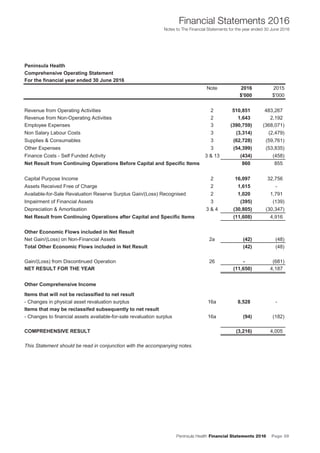
Total revenue 512,494 485,459 463,715 441,142 420,956
Total expenses 511,634 484,604 462,700 439,657 419,782
Net result for year (from continuing operations
before Capital and Specific Items)
860 855 1,015 1,485 1,174
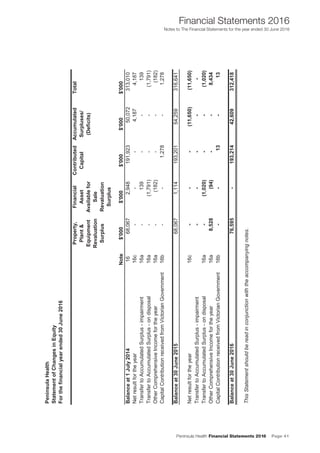
Retained surplus/(accumulated deficit) 42,609 54,259 50,072 7,510 9,368
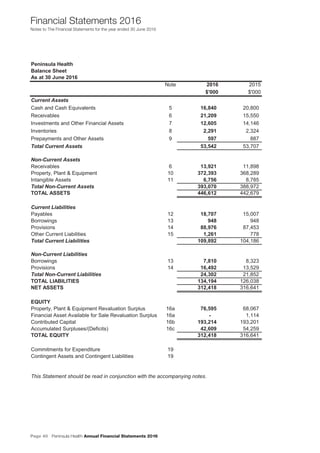
Total assets 446,612 442,679 440,336 372,490 361,285
Total liabilities 134,194 126,038 127,326 112,299 100,133
Net assets 312,418 316,641 313,010 260,191 261,152
Total equity 312,418 316,641 313,010 260,191 261,152
* Comparative information for 2013/14 has been updated to account for the discontinued operation consistent with comparative information presented in the Financial Statements
Financial Commentary
Peninsula Health’s financial performance in 2015-16 was in
line with financial targets set for the year, with an operating
surplus (recorded before discontinued operations, capital
income and depreciation) of $860,000. The operating surplus
enabled capital items for the Health Service to be funded.
In 2015-16, in comparison to the previous financial year:
• total revenue increased to $512 million from $485 million;
• total assets rose by $4m million to $447 million;
• liabilities increased by $8 million to $134 million;
• equity (the difference between assets and liabilities)
decreased by $4 million to $312 million.
Ex-gratia Payments
Ex-gratia payments of $19,917 were made by Peninsula
Health during 2015-16. These payments relate to
compensation payments or for claims or complaints.
Looking Ahead
Peninsula Health’s financial sustainability is critical to the
ongoing provision of quality services.
Page 18 Peninsula Health Annual Report 2016
Report of Operations
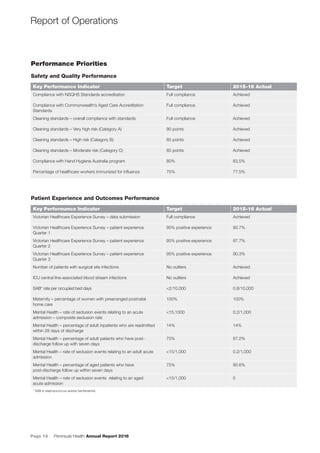
Performance Priorities
Safety and Quality Performance
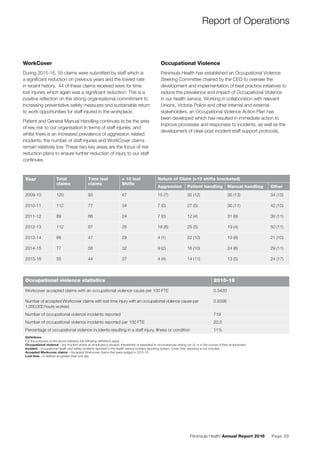
Key Performance Indicator Target 2015-16 Actual
Compliance with NSQHS Standards accreditation Full compliance Achieved
Compliance with Commonwealth’s Aged Care Accreditation
Standards
Full compliance Achieved
Cleaning standards – overall compliance with standards Full compliance Achieved
Cleaning standards – Very high risk (Category A) 90 points Achieved
Cleaning standards – High risk (Category B) 85 points Achieved
Cleaning standards – Moderate risk (Category C) 85 points Achieved
Compliance with Hand Hygiene Australia program 80% 83.5%
Percentage of healthcare workers immunized for influenza 75% 77.5%
Patient Experience and Outcomes Performance
Key Performance Indicator Target 2015-16 Actual
Victorian Healthcare Experience Survey – data submission Full compliance Achieved
Victorian Healthcare Experience Survey – patient experience
Quarter 1
95% positive experience 90.7%
Victorian Healthcare Experience Survey – patient experience
Quarter 2
95% positive experience 87.7%
Victorian Healthcare Experience Survey – patient experience
Quarter 3
95% positive experience 90.3%
Number of patients with surgical site infections No outliers Achieved
ICU central line-associated blood stream infections No outliers Achieved
SAB* rate per occupied bed days <2/10,000 0.8/10,000
Maternity – percentage of women with prearranged postnatal
home care
100% 100%
Mental Health – rate of seclusion events relating to an acute
admission – composite seclusion rate
<15,1000 0.2/1,000
Mental Health – percentage of adult inpatients who are readmitted
within 28 days of discharge
14% 14%
Mental Health – percentage of adult patients who have post-
discharge follow up with seven days
75% 87.2%
Mental Health – rate of seclusion events relating to an adult acute
admission
<15/1,000 0.2/1,000
Mental Health – percentage of aged patients who have
post-discharge follow up within seven days
75% 90.6%
Mental Health – rate of seclusion events relating to an aged
acute admission
<15/1,000 0
* SAB is staphylococcus aureus bacteraemia.
Peninsula Health Annual Report 2016 Page 19
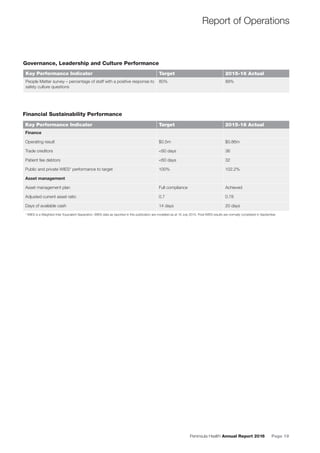
Governance, Leadership and Culture Performance
Key Performance Indicator Target 2015-16 Actual
People Matter survey – percentage of staff with a positive response to
safety culture questions
80% 89%
Financial Sustainability Performance
Key Performance Indicator Target 2015-16 Actual
Finance
Operating result $0.5m $0.86m
Trade creditors <60 days 36
Patient fee debtors <60 days 32
Public and private WIES* performance to target 100% 102.2%
Asset management
Asset management plan Full compliance Achieved
Adjusted current asset ratio 0.7 0.78
Days of available cash 14 days 20 days
* WIES is a Weighted Inter Equivalent Separation. WIES data as reported in this publication are modelled as at 16 July 2015. Final WIES results are normally completed in September.
Report of Operations
Page 20 Peninsula Health Annual Report 2016
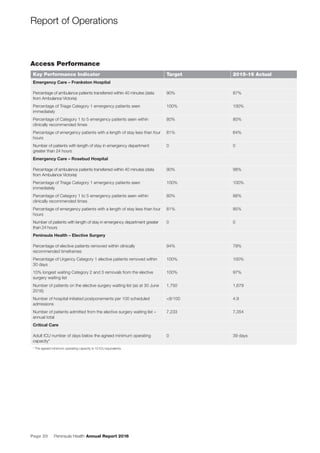
Access Performance
Key Performance Indicator Target 2015-16 Actual
Emergency Care – Frankston Hospital
Percentage of ambulance patients transferred within 40 minutes (data
from Ambulance Victoria)
90% 87%
Percentage of Triage Category 1 emergency patients seen
immediately
100% 100%
Percentage of Category 1 to 5 emergency patients seen within
clinically recommended times
80% 80%
Percentage of emergency patients with a length of stay less than four
hours
81% 64%
Number of patients with length of stay in emergency department
greater than 24 hours
0 0
Emergency Care – Rosebud Hospital
Percentage of ambulance patients transferred within 40 minutes (data
from Ambulance Victoria)
90% 98%
Percentage of Triage Category 1 emergency patients seen
immediately
100% 100%
Percentage of Category 1 to 5 emergency patients seen within
clinically recommended times
80% 88%
Percentage of emergency patients with a length of stay less than four
hours
81% 85%
Number of patients with length of stay in emergency department greater
than 24 hours
0 0
Peninsula Health – Elective Surgery
Percentage of elective patients removed within clinically
recommended timeframes
94% 79%
Percentage of Urgency Category 1 elective patients removed within
30 days
100% 100%
10% longest waiting Category 2 and 3 removals from the elective
surgery waiting list
100% 97%
Number of patients on the elective surgery waiting list (as at 30 June
2016)
1,750 1,679
Number of hospital initiated postponements per 100 scheduled
admissions
<8/100 4.9
Number of patients admitted from the elective surgery waiting list –
annual total
7,233 7,354
Critical Care
Adult ICU number of days below the agreed minimum operating
capacity*
0 39 days
* The agreed minimum operating capacity is 10 ICU equivalents.
Report of Operations
Peninsula Health Annual Report 2016 Page 21
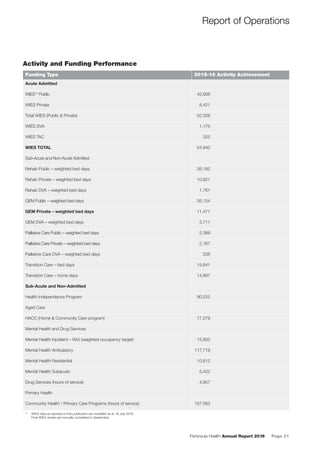
Activity and Funding Performance
Funding Type 2015-16 Activity Achievement
Acute Admitted
WIES** Public 43,906
WIES Private 8,421
Total WIES (Public & Private) 52,326
WIES DVA 1,175
WIES TAC 325
WIES TOTAL 54,940
Sub-Acute and Non-Acute Admitted
Rehab Public – weighted bed days 26,182
Rehab Private – weighted bed days 10,821
Rehab DVA – weighted bed days 1,781
GEM Public – weighted bed days 26,154
GEM Private – weighted bed days 11,471
GEM DVA – weighted bed days 3,711
Palliative Care Public – weighted bed days 5,389
Palliative Care Private – weighted bed days 2,167
Palliative Care DVA – weighted bed days 226
Transition Care – bed days 15,641
Transition Care – home days 14,897
Sub-Acute and Non-Admitted
Health Independence Program 90,525
Aged Care
HACC (Home & Community Care program) 77,279
Mental Health and Drug Services
Mental Health Inpatient – Wot (weighted occupancy target) 15,850
Mental Health Ambulatory 117,719
Mental Health Residential 10,812
Mental Health Subacute 5,422
Drug Services (hours of service) 4,957
Primary Health
Community Health / Primary Care Programs (hours of service) 157,563
** WIES data as reported in this publication are modelled as at 16 July 2016.
Final WIES results are normally completed in September.
Report of Operations
Page 22 Peninsula Health Annual Report 2016
Other Disclosures
Building Act 1993 compliance
During 2015-16, Peninsula Health complied with the building
and maintenance provisions of the Building Act 1993.
Carers Recognition Act 2012
Peninsula Health takes all practicable measures to ensure that:
• our employees and agents have an awareness and
understanding of the care relationship principles
• people who are in care relationships and who are receiving
services in relation to the care relationship from the care
support organisation have an awareness and understanding
of the care relationship principles
• our employees and agents reflect the care relationship
principles in developing, providing or evaluating support and
assistance for people in care relationships.
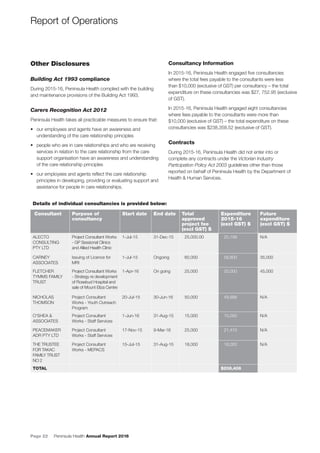
Consultancy Information
In 2015-16, Peninsula Health engaged five consultancies
where the total fees payable to the consultants were less
than $10,000 (exclusive of GST) per consultancy – the total
expenditure on these consultancies was $27, 752.95 (exclusive
of GST).
In 2015-16, Peninsula Health engaged eight consultancies
where fees payable to the consultants were more than
$10,000 (exclusive of GST) – the total expenditure on these
consultancies was $238,358.52 (exclusive of GST).
Contracts
During 2015-16, Peninsula Health did not enter into or
complete any contracts under the Victorian Industry
Participation Policy Act 2003 guidelines other than those
reported on behalf of Peninsula Health by the Department of
Health & Human Services.
Details of individual consultancies is provided below:
Consultant Purpose of
consultancy
Start date End date Total
approved
project fee
(excl GST) $
Expenditure
2015-16
(excl GST) $
Future
expenditure
(excl GST) $
ALECTO
CONSULTING
PTY LTD
Project Consultant Works
- GP Sessional Clinics
and Allied Health Clinic
1-Jul-15 31-Dec-15 25,000.00 20,199 N/A
CARNEY
ASSOCIATES
Issuing of Licence for
MRI
1-Jul-15 Ongoing 60,000 58,800 35,000
FLETCHER
TYMMS FAMILY
TRUST
Project Consultant Works
- Strategy re development
of Rosebud Hospital and
sale of Mount Eliza Centre
1-Apr-16 On going 25,000 25,000 45,000
NICHOLAS
THOMSON
Project Consultant
Works - Youth Outreach
Program
20-Jul-15 30-Jun-16 50,000 49,998 N/A
O'SHEA &
ASSOCIATES
Project Consultant
Works - Staff Services
1-Jun-16 31-Aug-15 15,000 15,000 N/A
PEACEMAKER
ADR PTY LTD
Project Consultant
Works - Staff Services
17-Nov-15 9-Mar-16 25,000 21,410 N/A
THE TRUSTEE
FOR TAKAC
FAMILY TRUST
NO 2
Project Consultant
Works - MEPACS
15-Jul-15 31-Aug-15 18,000 18,000 N/A
TOTAL $208,408
Report of Operations
Peninsula Health Annual Report 2016 Page 23
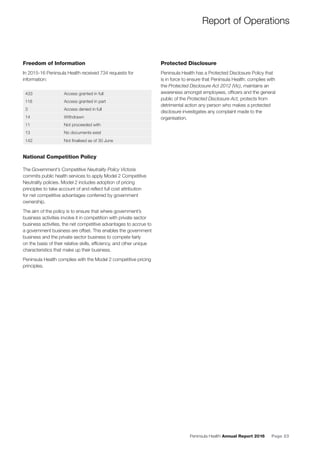
Freedom of Information
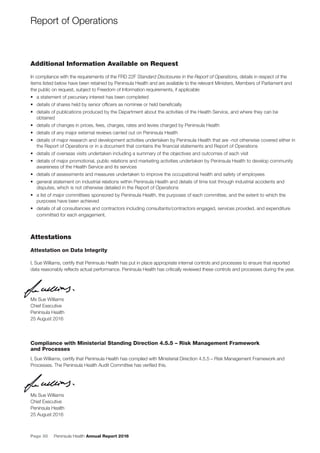
In 2015-16 Peninsula Health received 734 requests for
information:
433 Access granted in full
118 Access granted in part
3 Access denied in full
14 Withdrawn
11 Not proceeded with
13 No documents exist
142 Not finalised as of 30 June
National Competition Policy
The Government’s Competitive Neutrality Policy Victoria
commits public health services to apply Model 2 Competitive
Neutrality policies. Model 2 includes adoption of pricing
principles to take account of and reflect full cost attribution
for net competitive advantages conferred by government
ownership.
The aim of the policy is to ensure that where government’s
business activities involve it in competition with private sector
business activities, the net competitive advantages to accrue to
a government business are offset. This enables the government
business and the private sector business to compete fairly
on the basis of their relative skills, efficiency, and other unique
characteristics that make up their business.
Peninsula Health complies with the Model 2 competitive pricing
principles.
Report of Operations
Protected Disclosure
Peninsula Health has a Protected Disclosure Policy that
is in force to ensure that Peninsula Health: complies with
the Protected Disclosure Act 2012 (Vic), maintains an
awareness amongst employees, officers and the general
public of the Protected Disclosure Act, protects from
detrimental action any person who makes a protected
disclosure investigates any complaint made to the
organisation.
Page 24 Peninsula Health Annual Report 2016
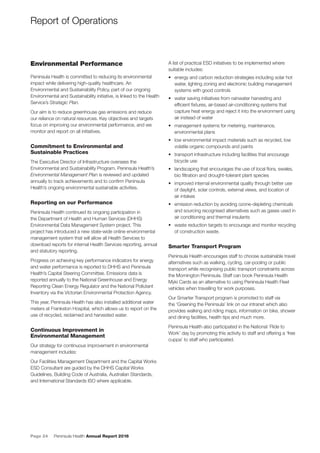
Environmental Performance
Peninsula Health is committed to reducing its environmental
impact while delivering high-quality healthcare. An
Environmental and Sustainability Policy, part of our ongoing
Environmental and Sustainability initiative, is linked to the Health
Service’s Strategic Plan.
Our aim is to reduce greenhouse gas emissions and reduce
our reliance on natural resources. Key objectives and targets
focus on improving our environmental performance, and we
monitor and report on all initiatives.
Commitment to Environmental and
Sustainable Practices
The Executive Director of Infrastructure oversees the
Environmental and Sustainability Program. Peninsula Health’s
Environmental Management Plan is reviewed and updated
annually to track achievements and to confirm Peninsula
Health’s ongoing environmental sustainable activities.
Reporting on our Performance
Peninsula Health continued its ongoing participation in
the Department of Health and Human Services (DHHS)
Environmental Data Management System project. This
project has introduced a new state-wide online environmental
management system that will allow all Health Services to
download reports for internal Health Services reporting, annual
and statutory reporting.
Progress on achieving key performance indicators for energy
and water performance is reported to DHHS and Peninsula
Health’s Capital Steering Committee. Emissions data is
reported annually to the National Greenhouse and Energy
Reporting Clean Energy Regulator and the National Pollutant
Inventory via the Victorian Environmental Protection Agency.
This year, Peninsula Health has also installed additional water
meters at Frankston Hospital, which allows us to report on the
use of recycled, reclaimed and harvested water.
Continuous Improvement in
Environmental Management
Our strategy for continuous improvement in environmental
management includes:
Our Facilities Management Department and the Capital Works
ESD Consultant are guided by the DHHS Capital Works
Guidelines, Building Code of Australia, Australian Standards,
and International Standards ISO where applicable.
A list of practical ESD initiatives to be implemented where
suitable includes:
• energy and carbon reduction strategies including solar hot
water, lighting zoning and electronic building management
systems with good controls
• water saving initiatives from rainwater harvesting and
efficient fixtures, air-based air-conditioning systems that
capture heat energy and reject it into the environment using
air instead of water
• management systems for metering, maintenance,
environmental plans
• low environmental impact materials such as recycled, low
volatile organic compounds and paints
• transport infrastructure including facilities that encourage
bicycle use
• landscaping that encourages the use of local flora, swales,
bio filtration and drought-tolerant plant species
• improved internal environmental quality through better use
of daylight, solar controls, external views, and location of
air intakes
• emission reduction by avoiding ozone-depleting chemicals
and sourcing recognised alternatives such as gases used in
air conditioning and thermal insulants
• waste reduction targets to encourage and monitor recycling
of construction waste.
Smarter Transport Program
Peninsula Health encourages staff to choose sustainable travel
alternatives such as walking, cycling, car-pooling or public
transport while recognising public transport constraints across
the Mornington Peninsula. Staff can book Peninsula Health
Myki Cards as an alternative to using Peninsula Health Fleet
vehicles when travelling for work purposes.
Our Smarter Transport program is promoted to staff via
the ‘Greening the Peninsula’ link on our intranet which also
provides walking and riding maps, information on bike, shower
and dining facilities, health tips and much more.
Peninsula Health also participated in the National ‘Ride to
Work’ day by promoting this activity to staff and offering a ‘free
cuppa’ to staff who participated.
Report of Operations
Peninsula Health Annual Report 2016 Page 25
Rate per m2
Jul Aug Sep Oct Nov Dec Jan Feb Mar Apr May Jun
2015/2016 0.020 0.020 0.019 0.020 0.019 0.020 0.020 0.019 0.020 0.018 0.019 0.019*
2014/2015 0.019 0.020 0.018 0.019 0.018 0.019 0.021 0.020 0.020 0.018 0.019 0.019
2013/2014 0.020 0.019 0.021 0.0¹8 0.018 0.018 0.019 0.018 0.019 0.018 0.019 0.019
2012/2013 0.024 0.024 0.022 0.023 0.023 0.023 0.024 0.023 0.025 0.019 0.020 0.019
Target 0.027 0.026 0.025 0.026 0.025 0.027 0.029 0.028 0.027 0.026 0.027 0.023
CO2 Emissions from Energy Consumed
Data for June 2016 estimated due to billing lag.
Energy Management, Plant and Infrastructure
Initiatives
Peninsula Health aims to manage energy effectively to reduce
demand on non-renewable natural resources.
Efficient use of plant and replacement with more efficient
high-tech options is a priority. Some of the many initiatives
implemented over the last year included:
Replacement of Chiller 6 with high energy efficiency PowerPax
Chiller and CEPEX control system in September 2015
• Upgraded Frankston Hospital Steam Boilers 1 and 2 control
system, including feeding pumps with variable speed drives,
PLS controllers, probes etc completed on January 2016.
This will provide for improved efficiency when boilers are
operating.
• Installation of external solar LED lighting and CCTV for
Peninsula Health’s Fleet Car parking area at Frankston
Hospital. This removed the requirement to run electrical and
communication cables.
Peninsula Health’s energy usage is measured against key
performance indicators and is consistently within set targets as
indicated below.
Water Management
Ongoing implementation of water saving initiatives includes
water efficient toilets, shower timers and harvested water
storage tanks. Water saving strategies are incorporated into
sustainability planning for major capital works.
Frankston Hospital uses two 100 kilolitre water tanks to
collect rain water and recycled process cooling water. This
water is pumped up into Building A and Building G water
tanks and is used for toilet flushing in both buildings.
Additional water meters have been installed and
improvements to existing water meters setup have been
completed this year. This ensures leaks can be detected
early in either potable (mains) water systems or in rain water
collection and recycled water system improving monitoring
and reporting of water usage.
Kilolitres per m2
Jul Aug Sep Oct Nov Dec Jan Feb Mar Apr May Jun
2015/2016 0.073 0.066 0.059 0.075 0.066 0.073 0.070 0.063 0.067 0.067 0.070 0.067*
2014/2015 0.085 0.084 0.074 0.079 0.069 0.076 0.079 0.078 0.069 0.063 0.071 0.070
2013/2014 0.075 0.078 0.073 0.078 0.081 0.090 0.096 0.086 0.093 0.082 0.085 0.085
2012/2013 0.088 0.082 0.083 0.091 0.089 0.085 0.098 0.082 0.097 0.072 0.077 0.068
Target 0.090 0.090 0.090 0.090 0.090 0.090 0.090 0.090 0.090 0.090 0.090 0.090
Water Consumption
Data for June 2016 estimated due to billing lag.
Report of Operations
Page 26 Peninsula Health Annual Report 2016
Fleet Fuel Data Jul Aug Sep Oct Nov Dec Jan Feb Mar Apr May Jun Total
2015/2016
Monthly Fuel kL
16.8 18.1 16.4 18.5 16.7 16.6 15.5 16.7 19.0 17.6 19.3 19.3* 210.3
2014/2015
Monthly Fuel kL
18.8 18.1 17.6 17.7 16.8 15.2 15.8 16.4 16.9 16.1 18.3 17.1 204.8
2014/2015 Fleet
Emissions
42.9 41.3 40.1 40.4 38.4 34.6 36.0 37.3 38.6 36.7 41.8 38.9 467
2013/2014
Monthly Fuel kL
19.1 19.6 18.6 18.9 18.6 17.8 18.2 19.8 18.3 17.0 20.5 17.8 224.2
2013/2014 Fleet
Emissions
43.6 44.7 42.5 43.1 42.3 40.6 41.6 45.1 41.7 38.8 46.8 40.6 511.4
2012/2013
Monthly Fuel kL
27.4 23.3 26.1 23.3 26.1 24.4 25.7 25.8 24.4 23.0 23.5 17.3 290.3
2012/2013 Fleet
Emissions
62.5 53.2 59.6 53.2 59.5 55.6 58.5 58.9 55.7 52.5 53.5 39.4 662.1
Fleet Management
Data for June 2016 estimated due to billing lag.
Report of Operations
Fleet Management
A number of fleet management strategies have been
implemented over several years which have contributed
to reduced fossil fuel consumption and minimising our
carbon footprint. Peninsula Health reduced the number
of fleet vehicles by 9.71% (17 cars). Improved utilisation
of the existing pool car fleet has seen a slight increase in
fuel consumption going from 204.48 kilolitres in 2014-15
up to 210.31 kilolitres in 2015-16 increasing emissions
by 6% (approximately 6 tonnes) when compared to the
previous year.
Car Parking Fees
Peninsula Health complies with the DHHS hospital circular
on car parking fees effective 1 February 2016 and details of
car parking fees and concession benefits can be viewed at:
http://www.peninsulahealth.org.au/wp-content/uploads/2016-
CarParkInformation.pdf
Sustainable Procurement
By participating in HPV (Health Purchasing Victoria), we are
able to incorporate environmental specifications in key service
contracts.
The Supply Department focuses on minimising waste, including
excess packaging and packaging and pallet take-back.
Packaging waste is recycled or reused where possible. The
importance of managing and minimising inventory levels is
promoted across clinical units, and they are supported with
scanning technology and periodic review of inventory levels.
Waste Management
Our waste management program includes online training
for staff, a waste management information booklet, a waste
segregation reference card for ID lanyards, and waste usage
reports which include waste costs per site by bed day.
Peninsula Health is a member of the Victorian Green Health
Round Table Group which shares environmental sustainability
initiatives. Members carry out waste benchmarking each year,
and this confirms that PVC waste is segregated in Theatre and
CSSD and collected for recycling. PVC recycling includes IV fluid
bags, oxygen masks and associated tubing.
We recycle polystyrene cups used for catering purposes and
polystyrene packaging.
Gaia Recycling Unit Initiative
Peninsula Health’s Gaia Recycling unit has been operating in
Frankston Hospital Food Services Department since early 2015.
Organic kitchen waste including meat, dairy and green waste is
placed in a sealed unit which macerates and heats the organic
waste up to 100 degrees Celsius over an eight hour period and
turns it into a sterile biomass.
Peninsula Health has confirmed through laboratory testing that
the biomass can be utilised as an organic soil amendment and
can now safely utilise in Peninsula Health gardens.
This initiative has helped reduce Peninsula Health kitchen waste
by 85 per cent – that equates to an average of 255 kilogram of
organic waste being diverted from landfill every day, and helps
improve our environmental performance by reducing greenhouse
gas emissions and waste costs.
Peninsula Health continues to:
• utilise a dedicated Pool Car booking system to improve
utilisation and identify when vehicles are under utilised to
assist in reducing Fleet Car numbers.
• utilise a diesel hybrid truck for food service deliveries
reducing fuel consumed by 40% over conventional vehicles
• use diesel vehicles within the fleet, including all passenger
buses
• continue to use a fuel-efficient Smart Car for shorter trips
with a limit of two occupants
• regular schedule services and correct tyre pressure
• provide RACV staff training sessions.
Many of these initiatives have also helped reduce unnecessary
maintenance costs.
Peninsula Health Annual Report 2016 Page 27
Report of Operations
Business As Usual (BAU) ICT
expenditure (Total)
(excluding GST)
Non Business As Usual (non BAU) ICT expenditure
(Total=Operational expenditure and Capital
Expenditure)( excluding GST)
Operational
expenditure
(excluding GST)
Capital expenditure
(excluding GST)
$10,185,969 $2,466,412 nil $2,466,412
Information and Communication Technology
Information and Communication Technology (ICT) expenditure
The total ICT expenditure incurred during 2015-16 was $12,652,381(excluding GST) with the details shown in the table below.
Information and Communication Technology
Initiatives
Peninsula Health’s Information Technology Department ensures
that information and communication systems are reliable and
provide the functionality that a large health service requires.
Some initiatives during 2015-16 included:
• Deployment of Thin Client devices replacing clinical personal
computers at Frankston Hospital, Rosebud Hospital,
Golf Links Road and The Mornington Centre. A standard
personal computer uses an average 100 watts of power
while the new Thin Client technology uses only 7 watts. In
addition, the Thin Clients are quieter, smaller, more cost
effective and have a far longer lifespan than the personal
computers they are replacing.
• Tap-On-Tap-Off (TOTO) technology was deployed with
the Thin Clients to enable Clinicians rapid access to the
electronic medical record and at the same time enhancing
the privacy and confidentiality of the patient information.
Clinicians are now using their ID cards to ‘Tap On’ to the
Thin Clients and access their current session.
• Completion of a Tender process for the replacement of
the Printer and Copier fleet. An outcome of this process
was that the Printer and Copier fleet was reduced by
approximately 100 devices by implementing the Tap-To-
Release technology which enables staff to use their ID
cards to tap and release their print jobs. This technology
will reduce consumable costs relating to both paper and
printing and will also enhance information security.
• As part of the newly opened Outpatients Unit, IT worked
closely with clinicians to commission Patients Kiosks and
a Patient Call system that can be used by patients for self
check themselves in when attending Outpatients clinics.
Doctors can ‘call’ patients to their rooms via the TV screens
located in each of the waiting rooms, with this TV screen
also being used for health promotion messaging.
• Completion of building of a new Data Centre to house
the on-premise server and storage equipment to support
the growing ITC requirements of Peninsula Health. This
will enable the relocation and consolidation of smaller
communication rooms in support of future redevelopment of
the Frankston Hospital site.
• In planning for the relocation of IT services into the new
Data Centre, IT undertook a review of our Disaster Recovery
Policy, Procedures and Technology resulting in Disaster
Recovery times being dramatically reduced through the
deployment of new technology.
• The demand for applications and information accessed
via the Internet continued to grow during 2015-16 and in
response to this IT conducted a procurement exercise to
upgrade our Internet link to 100Mbps. The Firewall, which
is used to protect the Peninsula Health IT infrastructure
from Spam, Viruses and Malware was also upgraded to a
contemporary solution which typically identifies over 50,000
email ‘threat messages’ each day.
• IT worked with the Social Work Department in trialing the
use of iPads and Video Conferencing solutions for the
delivery of Interpreter Services throughout the Peninsula.
This solution will support efficient delivery of healthcare to
our community.
Page 28 Peninsula Health Annual Report 2016
Report of Operations
Equal Opportunity and Code of Conduct
Peninsula Health complies with Equal Employment Opportunity
principles in relation to recruitment and employment.
The Code of Conduct forms part of the employment
contract and appropriate workforce conduct is reinforced by
performance management and discipline processes.
Occupational Health and Safety (OHS)
Protecting the health and safety of our workforce is a key
priority for Peninsula Health. Year one of the Workplace Health
and Safety Strategy has focused on reducing the risk in high
injury areas, implementing a staff health and wellbeing program
and creating early intervention programs to enable access for
care to reduce musculoskeletal and soft tissue injuries for staff.
Manual Handling
Peninsula Health continues to review Manual Handling
incidents and implement initiatives to reduce the occurrence
and impact of manual handling injuries to our staff. Ongoing
training in the ‘No Lift’ patient manual handling program,
combined with a structured review of the equipment,
procedural and support needs for all manual handling activities
have occurred during 2015-2016. Work to progress a revised
model to support the Manual Handling Risk Reduction Action
Plan is underway and will be implemented in 2016-2017.
Labour Category JUNE
Current month FTE
JUNE
YTD FTE
Labour category 2015 2016 2015 2016
Nursing 1,567.54 1,576.46 1,543.31 1,564.76
Administration & Clerical 502.20 511.08 498.15 502.16
Medical Support 313.50 320.9 302.36 309.16
Hotel & Allied Services 358.23 360.46 369.78 361.64
Medical Officers 60.46 59.16 56.68 60.70
Hospital Medical Officers 282.75 304.47 274.48 289.28
Sessional Clinicians 69.28 74.68 67.51 70.65
Ancillary Staff (Allied Health) 363.01 395.73 359.51 371.75
Total 3,516.97 3,602.93 3,471.78 3,530.10
Workforce Data
Workforce information
Emergency Management Training Program
During the year 67 emergency evacuation exercises were
conducted, an increase of two on the previous year and a new
record for Peninsula Health. Additionally, 2,280 staff took part
in emergency control organisation training including Emergency
Controller training, Emergency Area Warden training and fire
drill participation.
Our overall fire training compliance rate for the year was
89%, under the 95% target, but 2% higher than the previous
financial year. A highlight of the year was a week-long series of
realistic fire and evacuation exercises involving simulated fire,
smoke and patients in a mock up 12 bed ward — 238 staff
and volunteers participated in the 20 exercises conducted that
week. Peninsula Health continues to have a very high level of
emergency preparedness.
Peninsula Health Annual Report 2016 Page 29
Year Total
claims
Time lost
claims
> 10 lost
Shifts
Nature of Claim (>10 shifts bracketed)
Aggression Patient handling Manual handling Other
2009-10 120 93 47 15 (7) 35 (12) 36 (13) 34 (15)
2010-11 112 77 34 7 (0) 27 (5) 36 (11) 42 (15)
2011-12 89 66 24 7 (0) 12 (4) 31 (9) 39 (11)
2012-13 112 87 26 18 (6) 25 (5) 19 (4) 50 (11)
2013-14 66 47 29 4 (1) 22 (10) 19 (8) 21 (10)
2014-15 77 56 32 9 (2) 16 (10) 24 (8) 29 (11)
2015-16 55 44 37 4 (4) 14 (11) 13 (5) 24 (17)
Report of Operations
Occupational violence statistics 2015-16
Workcover accepted claims with an occupational violence cause per 100 FTE 0.3420
Number of accepted Workcover claims with lost time injury with an occupational violence cause per
1,000,000 hours worked.
0.8396
Number of occupational violence incidents reported 719
Number of occupational violence incidents reported per 100 FTE 20.5
Percentage of occupational violence incidents resulting in a staff injury, illness or condition 11%
Definitions
For the purposes of the above statistics the following definitions apply.
Occupational violence - any incident where an employee is abused, threatened or assaulted in circumstances arising out of, or in the course of their employment.
Incident - occupational health and safety incidents reported in the health service incident reporting system. Code Grey reporting is not included.
Accepted Workcover claims – Accepted Workcover claims that were lodged in 2015-16.
Lost time – is defined as greater than one day.
WorkCover
During 2015-16, 55 claims were submitted by staff which is
a significant reduction on previous years and the lowest rate
in recent history. 44 of these claims received were for time
lost injuries which again was a significant reduction. This is a
positive reflection on the strong organisational commitment to
increasing preventative safety measures and sustainable return
to work opportunities for staff injured in the workplace.
Patient and General Manual Handling continues to be the area
of key risk to our organisation in terms of staff injuries, and
whilst there is an increased prevalence of aggression related
incidents, the number of staff injuries and WorkCover claims
remain relatively low. These two key areas are the focus of risk
reduction plans to ensure further reduction of injury to our staff
continues.
Occupational Violence
Peninsula Health has established an Occupational Violence
Steering Committee chaired by the CEO to oversee the
development and implementation of best practice initiatives to
reduce the prevalence and impact of Occupational Violence
in our health service. Working in collaboration with relevant
Unions, Victoria Police and other internal and external
stakeholders, an Occupational Violence Action Plan has
been developed which has resulted in immediate action to
improve processes and responses to incidents, as well as the
development of clear post incident staff support protocols.
Page 30 Peninsula Health Annual Report 2016
Additional Information Available on Request
In compliance with the requirements of the FRD 22F Standard Disclosures in the Report of Operations, details in respect of the
items listed below have been retained by Peninsula Health and are available to the relevant Ministers, Members of Parliament and
the public on request, subject to Freedom of Information requirements, if applicable:
• a statement of pecuniary interest has been completed
• details of shares held by senior officers as nominee or held beneficially
• details of publications produced by the Department about the activities of the Health Service, and where they can be
obtained
• details of changes in prices, fees, charges, rates and levies charged by Peninsula Health
• details of any major external reviews carried out on Peninsula Health
• details of major research and development activities undertaken by Peninsula Health that are -not otherwise covered either in
the Report of Operations or in a document that contains the financial statements and Report of Operations
• details of overseas visits undertaken including a summary of the objectives and outcomes of each visit
• details of major promotional, public relations and marketing activities undertaken by Peninsula Health to develop community
awareness of the Health Service and its services
• details of assessments and measures undertaken to improve the occupational health and safety of employees
• general statement on industrial relations within Peninsula Health and details of time lost through industrial accidents and
disputes, which is not otherwise detailed in the Report of Operations
• a list of major committees sponsored by Peninsula Health, the purposes of each committee, and the extent to which the
purposes have been achieved
• details of all consultancies and contractors including consultants/contractors engaged, services provided, and expenditure
committed for each engagement.
Attestations
Attestation on Data Integrity
I, Sue Williams, certify that Peninsula Health has put in place appropriate internal controls and processes to ensure that reported
data reasonably reflects actual performance. Peninsula Health has critically reviewed these controls and processes during the year.
Ms Sue Williams
Chief Executive
Peninsula Health
25 August 2016
Compliance with Ministerial Standing Direction 4.5.5 – Risk Management Framework
and Processes
I, Sue Williams, certify that Peninsula Health has complied with Ministerial Direction 4.5.5 – Risk Management Framework and
Processes. The Peninsula Health Audit Committee has verified this.
Ms Sue Williams
Chief Executive
Peninsula Health
25 August 2016
Ms Sue Williams
Report of Operations
Peninsula Health Annual Report 2016 Page 31
Disclosure Index
Peninsula Health’s Annual Report is prepared in accordance with all relevant Victorian legislation.
This index has been prepared to facilitate identification of compliance with statutory disclosure requirements.
Legislation Requirement Page Reference
Ministerial Directions
Report of operations
Charter and purpose
FRD 22G Manner of establishment and the relevant Ministers 3
FRD 22G Purpose, functions, powers and duties 3
FRD 22G Initiatives and key achievements 1–2
FRD 22G Nature and range of services provided 4,5
Management and structure
FRD 22F Organisational structure 8–9
Financial and other information
FRD 10A Disclosure index 32
FRD 11A Disclosure of ex gratia expenses 17
FRD 21B Responsible person and executive officer disclosures 36
FRD 22G Application and operation of Protected Disclosure 2012 23
FRD 22G Application and operation of Carers Recognition Act 2012 22
FRD 22G Application and operation of Freedom of Information Act 1982 23
FRD 22G Compliance with building and maintenance provisions of Building Act 1993 22
FRD 22G Details of consultancies over $10,000 22
FRD 22G Details of consultancies under $10,000 22
FRD 22G Employment and conduct principles 28
FRD 22G Major changes or factors affecting performance n/a
FRD 22G Occupational health and safety 28
FRD 22G Operational and budgetary objectives and performance against objectives 10–22
FRD 24C Reporting of office-based environmental impacts 24, 25
FRD 22G Significant changes in financial position during the year 17
FRD 22G Statement on National Competition Policy 23
FRD 22G Subsequent events n/a
FRD 22G Summary of the financial results for the year 17
FRD 22G Workforce Data Disclosures including a statement on the application of employment and
conduct principles
28
FRD 25B Victorian Industry Participation Policy disclosures 22
FRD 29A Workforce Data disclosures 28
SD 4.2(g) Specific information requirements 1–33
SD 4.2(j) Sign-off requirements 3
SD 3.4.13 Attestation on data integrity 30
SD 4.5.5 Ministerial Standing Direction 4.5.5.1 compliance attestation 30
Financial statements
Financial statements required under Part 7 of the FMA
SD 4.2(a) Statement of changes in equity Financial Statements
SD 4.2(b) Comprehensive operating statement Financial Statements
SD 4.2(b) Balance sheet Financial Statements
SD 4.2(b) Cash flow statement Financial Statements
Other requirements under Standing Directions 4.2
SD 4.2(a) Compliance with Australian accounting standards and other authoritative pronouncements Financial Statements
SD 4.2(c) Accountable officer’s declaration Financial Statements
SD 4.2(c) Compliance with Ministerial Directions Financial Statements
SD 4.2(d) Rounding of amounts Financial Statements
Legislation
Freedom of Information Act 1982
Protected Disclosure Act 2001
Carers Recognition Act 2012
Victorian Industry Participation Policy Act 2003
Building Act 1993
Financial Management Act 1994
Report of Operations
Page 32 Peninsula Health Annual Report 2016
Glossary
ACHS Australian Council on Healthcare Standards – the principal independent authority that evaluates, assesses and
accredits quality improvement systems in Australian health care organisations. It is responsible for the ACHS Evaluation
and Quality Improvement Program (EQuIP) and undertakes a comprehensive EQuIP standards review and consultation
process of each health care organisation at least every four years
Acuity/acute Intensity or urgency of a patient’s condition
AQL Agreed Quality Level
DVA Department of Veterans’ Affairs – the Commonwealth department that supports people who serve or have served in the
armed forces and their families
FTE Full Time Equivalent (in relation to number of staff employed)
GEM Geriatric Evaluation & Management – sub-acute care of chronic or complex conditions associated with ageing,
cognitive dysfunction, chronic illness or disability. Patients are admitted for review, treatment and management by a
geriatrician and multidisciplinary team for a defined episode of care
HACC Home & Community Care Program – supports frail older people, younger people with disabilities and their carers by
providing basic support and maintenance to people living at home
HARP Hospital Admission Risk Program – provision of specialised person-centred medical care and care coordination in
community/ambulatory settings through an integrated response of hospital and community services to improve patient
outcomes, provide integrated seamless care within and across hospital/community sectors, reduce avoidable hospital
admissions and emergency department presentations, and ensure equitable access to healthcare
HITH Hospital in the Home – provision of acute care to public hospital patients in the comfort of their own home or other
suitable environment. Patients are regarded as hospital inpatients, and remain under the care of their hospital doctor
ICU Intensive Care Unit
MEPACS Mt Eliza Personal Alarm Call Service
OHS Occupational Health and Safety
SAB Staphylococcus aureus bacteraemia – a healthcare-associated infection
TAC Transport Accident Commission
Triage Emergency Department process that determines the order and priority of treating patients based on the severity
of their condition
Transport Accident Commission
WIES Weighted Inlier Equivalent Separations – a cost weight assigned to each patient that is dependent on the main reason
for admission and the time spent in hospital, and which determines the amount of funding received for providing care
Annual publications
Peninsula Health’s 2016 Annual Report has been prepared
in as required under the Financial Management Act 1994,
section 4.2 of the Standing Directions of the Minister for
Finance under the Act and Financial Reporting Directions.
It will be presented to the public at our Annual General
Meeting on 25 November 2016.
The Annual Report 2016 comprises two sections: Report
of Operations and Financial Statements. The Financial
Statements are provided in the back of this publication.
For a broader picture of Peninsula Health’s activities over the
past year, please see our other annual publications:
• Quality of Care report – highlights Peninsula Health’s
progress and achievements in improving clinical care and
our consumers’ experience.
• Research Report – highlights the achievements of our
many researchers and their contribution to improving
outcomes for our patients.
For further information about Peninsula Health or to download
an annual publication, please visit or website:
peninsulahealth.org.au
For printed copies, please phone the Corporate and
Community Relations Department on 9784 7777.
Report of Operations
Peninsula Health Annual Report 2016 Page 33
Report of Operations
Page 34 Peninsula Health Annual Financial Statements 2016
Financial Statements
2016
Notes to The Financial Statements for the year ended 30 June 2016
Financial Statements 2016
Peninsula Health Financial Statements 2016 Page 35
Notes to The Financial Statements for the year ended 30 June 2016
Financial Statements 2016
Table of Contents
Page
Financial Statements
Chairperson's, Chief Executive Officer's and Chief Finance & Accounting Officer's Declaration 1
Auditor-General's Report 2
Comprehensive Operating Statement 4
Balance Sheet 5
Statement of Changes in Equity 6
Cash Flow Statement 7
Notes
1 Summary of Significant Accounting Policies 8
2 Analysis of Revenue by Source 25
2a Net Gain/(Loss) on Disposal of Non Financial Assets 26
2b Assets Received Free of Charge 26
3 Analysis of Expenses by Source 27
3a Analysis of Expense and Revenue by Internally Managed and Specific Purpose Funds 28
4 Depreciation and Amortisation 28
5 Cash and Cash Equivalents 28
6 Receivables 29
7 Investments and Other Financial Assets 30
8 Inventories 30
9 Prepayments and Other Assets 30
10 Property, Plant and Equipment 31
11 Intangible Assets 35
12 Payables 35
13 Borrowings 35
14 Provisions 36
15 Other Liabilities 37
16 Equity 37
17 Reconciliation of Net Result for the Year to Net Cash Inflow/(Outflow) from Operating Activities 38
18 Financial Instruments 39
19 Commitments for Expenditure and Contingencies 44
20 Segment Reporting 45
21 Responsible Persons Disclosures 47
22 Executive Officer Disclosures 48
23 Remuneration of Auditors 48
24 Ex Gratia Payments 48
25 Subsequent Events 48
26 Discontinued Operation 49
Page 36 Peninsula Health Annual Financial Statements 2016
Notes to The Financial Statements for the year ended 30 June 2016
Financial Statements 2016
Peninsula Health Financial Statements 2016 Page 37
Notes to The Financial Statements for the year ended 30 June 2016
Auditing in the Public Interest
Financial Statements 2016
Page 38 Peninsula Health Annual Financial Statements 2016
Notes to The Financial Statements for the year ended 30 June 2016
Financial Statements 2015
Auditing in the Public Interest
Peninsula Health Financial Statements 2016 Page 39
Financial Statements 2016
Notes to The Financial Statements for the year ended 30 June 2016
Peninsula Health
Comprehensive Operating Statement
For the financial year ended 30 June 2016
Note 2016 2015
$'000 $'000
Revenue from Operating Activities 2 510,851 483,267
Revenue from Non-Operating Activities 2 1,643 2,192
Employee Expenses 3 (390,759) (368,071)
Non Salary Labour Costs 3 (3,314) (2,479)
Supplies & Consumables 3 (62,728) (59,761)
Other Expenses 3 (54,399) (53,835)
Finance Costs - Self Funded Activity 3 & 13 (434) (458)
Net Result from Continuing Operations Before Capital and Specific Items 860 855
Capital Purpose Income 2 16,097 32,756
Assets Received Free of Charge 2 1,615 -
Available-for-Sale Revaluation Reserve Surplus Gain/(Loss) Recognised 2 1,020 1,791
Impairment of Financial Assets 3 (395) (139)
Depreciation & Amortisation 3 & 4 (30,805) (30,347)
Net Result from Continuing Operations after Capital and Specific Items (11,608) 4,916
Other Economic Flows included in Net Result
Net Gain/(Loss) on Non-Financial Assets 2a (42) (48)
Total Other Economic Flows included in Net Result (42) (48)
Gain/(Loss) from Discontinued Operation 26 - (681)
NET RESULT FOR THE YEAR (11,650) 4,187
Other Comprehensive Income
Items that will not be reclassified to net result
- Changes in physical asset revaluation surplus 16a 8,528 -
Items that may be reclassifed subsequently to net result
- Changes to financial assets available-for-sale revaluation surplus 16a (94) (182)
COMPREHENSIVE RESULT (3,216) 4,005
This Statement should be read in conjunction with the accompanying notes.
Page 40 Peninsula Health Annual Financial Statements 2016
Financial Statements 2016
Notes to The Financial Statements for the year ended 30 June 2016
Peninsula Health
Balance Sheet
As at 30 June 2016
Note 2016 2015
$'000 $'000
Current Assets
Cash and Cash Equivalents 5 16,840 20,800
Receivables 6 21,209 15,550
Investments and Other Financial Assets 7 12,605 14,146
Inventories 8 2,291 2,324
Prepayments and Other Assets 9 597 887
Total Current Assets 53,542 53,707
Non-Current Assets
Receivables 6 13,921 11,898
Property, Plant & Equipment 10 372,393 368,289
Intangible Assets 11 6,756 8,785
Total Non-Current Assets 393,070 388,972
TOTAL ASSETS 446,612 442,679
Current Liabilities
Payables 12 18,707 15,007
Borrowings 13 948 948
Provisions 14 88,976 87,453
Other Current Liabilities 15 1,261 778
Total Current Liabilities 109,892 104,186
Non-Current Liabilities
Borrowings 13 7,810 8,323
Provisions 14 16,492 13,529
Total Non-Current Liabilities 24,302 21,852
TOTAL LIABILITIES 134,194 126,038
NET ASSETS 312,418 316,641
EQUITY
Property, Plant & Equipment Revaluation Surplus 16a 76,595 68,067
Financial Asset Available for Sale Revaluation Surplus 16a - 1,114
Contributed Capital 16b 193,214 193,201
Accumulated Surpluses/(Deficits) 16c 42,609 54,259
TOTAL EQUITY 312,418 316,641
Commitments for Expenditure 19
Contingent Assets and Contingent Liabilities 19
This Statement should be read in conjunction with the accompanying notes.
Peninsula Health Financial Statements 2016 Page 41
Financial Statements 2016
Notes to The Financial Statements for the year ended 30 June 2016
PeninsulaHealth
StatementofChangesinEquity
Forthefinancialyearended30June2016
Property,
Plant&
Equipment
Revaluation
Surplus
Financial
Asset
Availablefor
Sale
Revaluation
Surplus
Contributed
Capital
Accumulated
Surpluses/
(Deficits)
Total
Note$'000$'000$'000$'000$'000
Balanceat1July20141668,0672,948191,92350,072313,010
Netresultfortheyear16c---4,1874,187
TransfertoAccumulatedSurplus-impairment16a-139--139
TransfertoAccumulatedSurplus-ondisposal16a-(1,791)--(1,791)
OtherComprehensiveIncomefortheyear16a-(182)--(182)
CapitalContributionreceivedfromVictorianGovernment16b--1,278-1,278
Balanceat30June201568,0671,114193,20154,259316,641
Netresultfortheyear16c---(11,650)(11,650)
TransfertoAccumulatedSurplus-impairment-----
TransfertoAccumulatedSurplus-ondisposal16a-(1,020)--(1,020)
OtherComprehensiveIncomefortheyear16a8,528(94)--8,434
CapitalContributionreceivedfromVictorianGovernment16b--13-13
Balanceat30June201676,595-193,21442,609312,418
ThisStatementshouldbereadinconjunctionwiththeaccompanyingnotes.
Page 42 Peninsula Health Annual Financial Statements 2016
Financial Statements 2016
Notes to The Financial Statements for the year ended 30 June 2016
Peninsula Health
Cash Flow Statement
For the financial year ended 30 June 2016
Note 2016 2015
$'000 $'000
CASH FLOWS FROM OPERATING ACTIVITIES
Operating Grants from Government 426,608 409,427
Capital Grants from Government 14,590 30,809
Patient and Resident Fees Received 36,019 35,717
Commonwealth Government - Residential Aged Care Subsidy 3,094 3,474
Interest Received 871 1,134
Dividends Received 604 855
Other Capital Receipts 62 334
Donations and Bequests Received 168 203
Capital Donations and Bequests Received 1,161 1,295
Other Receipts 37,031 35,377
Total receipts 520,208 518,625
Employee Expenses Paid (385,452) (361,827)
Non Salary Labour Costs Paid (3,314) (2,481)
Payments for Supplies & Consumables (113,021) (118,129)
Finance Costs Paid (434) (458)
Total payments (502,221) (482,895)
NET CASH FLOW FROM/(USED IN) OPERATING ACTIVITIES 17 17,987 35,730
CASH FLOWS FROM INVESTING ACTIVITIES
Purchase of Investments (3,000) (11,884)
Payments for Non-Financial Assets (22,659) (45,562)
Proceeds from Sale of Michael Court Hostel 26 - 2,143
Proceeds from Sale of Non-Financial Assets 174 146
Proceeds from Sale of Investments 4,052 13,837
NET CASH FLOW FROM/(USED IN) INVESTING ACTIVITIES (21,433) (41,320)
CASH FLOWS FROM FINANCING ACTIVITIES
Proceeds from Borrowings - -
Repayment of Borrowings (514) (491)
NET CASH FLOW FROM/(USED IN) FINANCING ACTIVITIES (514) (491)
NET INCREASE/(DECREASE) IN CASH AND CASH EQUIVALENTS HELD (3,960) (6,081)
CASH AND CASH EQUIVALENTS AT BEGINNING OF YEAR 20,800 26,881
CASH AND CASH EQUIVALENTS AT END OF YEAR 5 16,840 20,800
Non-Cash Financing and Investing Activities - -
This Statement should be read in conjunction with the accompanying notes.
Peninsula Health Financial Statements 2016 Page 43
Financial Statements 2016
Notes to The Financial Statements for the year ended 30 June 2016
PPeenniinnssuullaa HHeeaalltthh AAnnnnuuaall FFiinnaanncciiaall SSttaatteemmeennttss 22001166
NNootteess ttoo TThhee FFiinnaanncciiaall SSttaatteemmeennttss ffoorr tthhee yyeeaarr eennddeedd 3300 JJuunnee 22001166
8
NNoottee 11:: SSuummmmaarryy ooff SSiiggnniiffiiccaanntt AAccccoouunnttiinngg
PPoolliicciieess
These annual financial statements represent the
audited general purpose financial statements for
Peninsula Health for the year ended 30 June 2016.
The purpose of the report is to provide users with
information about the Health Service’s stewardship of
resources entrusted to it.
((aa)) SSttaatteemmeenntt ooff ccoommpplliiaannccee
These Financial Statements are general purpose
Financial Statements which have been prepared in
accordance with the Financial Management Act 1994
and applicable Australian Accounting Standards
(AASs), which include interpretations issued by the
Australian Accounting Standards Board (AASB). They
are presented in a manner consistent with the
requirements of AASB 101 Presentation of Financial
Statements.
The Financial Statements also comply with relevant
Financial Reporting Directions (FRDs) issued by the
Department of Treasury and Finance, and relevant
Standing Directions (SDs) authorised by the Minister
for Finance.
Peninsula Health is a not-for profit entity and therefore
applies the additional Aus paragraphs applicable to
‘not-for-profit’ Health Services under the AASs.
The annual Financial Statements were authorised for
issue by the Board of Directors of Peninsula Health on
23 August 2016.
((bb)) BBaassiiss ooff aaccccoouunnttiinngg pprreeppaarraattiioonn aanndd
mmeeaassuurreemmeenntt
Accounting policies are selected and applied in a
manner which ensures that the resulting financial
information satisfies the concepts of relevance and
reliability, thereby ensuring that the substance of the
underlying transactions or other events is reported.
The accounting policies set out below have been
applied in preparing the Financial Statements for the
year ended 30 June 2016, and the comparative
information presented in these Financial Statements
for the year ended 30 June 2015.
The going concern basis was used to prepare the
Financial Statements.
These Financial Statements are presented in
Australian dollars, the functional and presentation
currency of the Health Service.
The Financial Statements, except for cash flow
information, have been prepared using the accrual
basis of accounting. Under the accrual basis, items
are recognised as assets, liabilities, equity, income or
expenses when they satisfy the definitions and
recognition criteria for those items; that is, they are
recognised in the reporting period to which they relate,
regardless of when cash is received or paid.
The Financial Statements are prepared in accordance
with the historical cost convention, except for:
• Non-current physical assets, which subsequent to
acquisition, are measured at a revalued amount
being their fair value at the date of the revaluation
less any subsequent accumulated depreciation
and subsequent impairment losses. Revaluations
are made and are re-assessed when new indices
are published by the Valuer General to ensure that
the carrying amounts do not materially differ from
their fair values;
• Available-for-sale investments which are measured
at fair value with movements reflected in equity
until the asset is derecognised; and
• The fair value of assets other than land is generally
based on their depreciated replacement value.
Historical cost is based on the fair values of the
consideration given in exchange for assets.
Judgements, estimates and assumptions are required
to be made about carrying values of assets and
liabilities that are not readily apparent from other
sources. The estimates and associated assumptions
are based on professional judgement derived from
historical experience and various other factors that are
believed to be reasonable under the circumstances.
Actual results may differ from these estimates.
The estimates and underlying assumptions are
reviewed on an ongoing basis. Revisions to
accounting estimates are recognised in the period in
which the estimate is revised and also in future
periods that are affected by the revision.
Judgements and assumptions made by management
in the application of AASs that have significant effects
on the Financial Statements and estimates relate to
the fair value of land, buildings, infrastructure, plant
and equipment (refer to Note 1(j)).
Page 44 Peninsula Health Annual Financial Statements 2016
Financial Statements 2016
Notes to The Financial Statements for the year ended 30 June 2016
PPeenniinnssuullaa HHeeaalltthh AAnnnnuuaall FFiinnaanncciiaall SSttaatteemmeennttss 22001166
NNootteess ttoo TThhee FFiinnaanncciiaall SSttaatteemmeennttss ffoorr tthhee yyeeaarr eennddeedd 3300 JJuunnee 22001166
9
Consistent with AASB 13 Fair Value Measurement,
Peninsula Health determines the policies and
procedures for both recurring fair value measurements
such as property, plant and equipment and financial
instruments, and for non-recurring fair value
measurements such as non-financial physical assets
held for sale, in accordance with the requirements of
AASB 13 and the relevant FRDs.
All assets and liabilities for which fair value is measured
or disclosed in the financial statements are categorised
within the fair value hierarchy, described as follows,
based on the lowest level input that is significant to the
fair value measurement as a whole:
• Level 1 – Quoted (unadjusted) market prices in
active markets for identical assets or liabilities
• Level 2 – Valuation techniques for which the
lowest level input that is significant to the fair value
measurement is directly or indirectly observable
• Level 3 – Valuation techniques for which the
lowest level input that is significant to the fair value
measurement is unobservable.
For the purpose of fair value disclosures, Peninsula
Health has determined classes of assets and liabilities
on the basis of the nature, characteristics and risks of
the asset or liability and the level of the fair value
hierarchy as explained above.
In addition, Peninsula Health determines whether
transfers have occurred between levels in the hierarchy
by re-assessing categorisation (based on the lowest
level input that is significant to the fair value
measurement as a whole) at the end of each reporting
period.
The Valuer-General Victoria (VGV) is Peninsula
Health’s independent valuation agency.
Peninsula Health, in conjunction with VGV monitors
the changes in the fair value of each asset and liability
through relevant data sources to determine whether
revaluation is required. Refer to Note 10 for a
description of the valuation processes used.
((cc)) RReeppoorrttiinngg EEnnttiittyy
The Financial Statements include all the controlled
activities of Peninsula Health.
Its principal address is:
Hastings Road (PO Box 52)
Frankston Victoria 3199
A description of the nature of Peninsula Health’s
operations and its principal activities are included in
the report of operations, which does not form part of
these Financial Statements.
Objectives and funding
Peninsula Health embraces an integrated and
collaborative view of health, working with community
and service partners to promote health and to plan for
the future needs of the local community of Frankston
and the Mornington Peninsula.
Peninsula Health provides acute care, sub acute care,
residential care, mental health services and community
health services, and is a major teaching centre.
Peninsula Health is predominantly funded by grants for
the provision of outputs in these areas.
((dd)) SSccooppee aanndd PPrreesseennttaattiioonn ooff FFiinnaanncciiaall
SSttaatteemmeennttss
FFuunndd AAccccoouunnttiinngg
Peninsula Health operates on a fund accounting
basis and maintains three funds: Operating, Specific
Purpose and Capital Funds. Peninsula Health’s
Capital and Specific Purpose Funds include unspent
capital donations and receipts from fund-raising
activities conducted solely in respect of these funds.
Services Supported by Health Services
Agreement and Services Supported by Hospital
and Community Initiatives
Activities classified as Services supported by Health
Services Agreement (HSA) are substantially funded
by the Department of Health and Human Services
and include Residential Aged Care Services (RACS)
which are also funded from other sources such as
the Commonwealth, patients and residents, while
Services Supported by Hospital and Community
Initiatives (H&CI) are funded by Peninsula Health’s
own activities or local initiatives and/or the
Commonwealth.
Residential Aged Care Services
Carinya Nursing Home is a part of Peninsula Health
operations and shares its resources. Where
appropriate an apportionment of land and buildings has
been made based on floor space. The results of these
operations have been segregated based on actual
revenue earned and expenditure incurred by each
operation in Note 2, Note 3 and Note 26 to the
Peninsula Health Financial Statements 2016 Page 45
Financial Statements 2016
Notes to The Financial Statements for the year ended 30 June 2016
PPeenniinnssuullaa HHeeaalltthh AAnnnnuuaall FFiinnaanncciiaall SSttaatteemmeennttss 22001166
NNootteess ttoo TThhee FFiinnaanncciiaall SSttaatteemmeennttss ffoorr tthhee yyeeaarr eennddeedd 3300 JJuunnee 22001166
10
Financial Statements. Carinya Nursing Home is
substantially funded from Commonwealth bed-day
subsidies. Residential Aged Care Services at Michael
Court Hostel were discontinued on 20 October 2014.
The individual properties were sold in May 2015.
Comprehensive Operating Statement
The Comprehensive operating statement includes the
subtotal entitled ‘Net Result from continuing
operations Before Capital & Specific Items’ to
enhance the understanding of the financial
performance of Peninsula Health. This subtotal
reports the result excluding items such as capital
grants, assets received or provided free of charge,
depreciation, expenditure using capital purpose
income and items of an unusual nature and amount
such as specific income and expenses. The exclusion
of these items is made to enhance matching of
income and expenses so as to facilitate the
comparability and consistency of results between
years and Victorian Public Health Services. The ‘Net
Result from continuing operations Before Capital &
Specific Items’ is used by the management of
Peninsula Health, the Department of Health and
Human Services and the Victorian Government to
measure the ongoing operating performance of Health
Services.
Capital and specific items, which are excluded from
this sub-total, comprise:
• Capital purpose income, which comprises all tied
grants, donations and bequests received for the
purpose of acquiring non-current assets, such as
capital works, plant and equipment or intangible
assets. It also includes donations of plant and
equipment (refer Note 1(e)). Consequently the
recognition of revenue as capital purpose income
is based on the intention of the provider of the
revenue at the time the revenue is provided;
• Specific income/expense comprises the following
items, where material:
o Write-down of inventories
o Non-current asset revaluation
o Diminution/impairment of investments;
• Impairment of financial and non-financial assets,
includes all impairment losses (and reversal of
previous impairment losses), which have been
recognised in accordance with Note 1(i) and (j);
• Depreciation and amortisation, as described in
Note 1(f);
• Assets provided or received free of charge (refer to
Notes 1 (e); and
• Expenditure using capital purpose income,
comprises expenditure which either falls below the
asset capitalisation threshold or doesn’t meet
asset recognition criteria and therefore does not
result in the recognition of an asset in the balance
sheet, where funding for that expenditure is from
capital purpose income.
• Other economic flows are changes arising from
market re-measurements. They include:
o gains and losses from disposals of non-financial
assets;
o revaluations and impairments of non-financial
physical and intangible assets; and
o fair value changes of financial instruments.
Balance sheet
Assets and liabilities are categorised either as current
or non-current (non-current being mainly those assets
or liabilities expected to be recovered/settled more
than 12 months after reporting period), are disclosed
in the notes where relevant.
Statement of Changes in Equity
The Statement of Changes in Equity presents
reconciliations of each non-owner and owner changes
in equity from opening balance at the beginning of the
reporting period to the closing balance at the end of
the reporting period. It also shows separately changes
due to amounts recognised in the comprehensive
result and amounts recognised in other
comprehensive income.
Cash Flow Statement
Cash flows are classified according to whether or not
they arise from operating activities, investing activities,
or financing activities. This classification is consistent
with requirements under AASB 107 Statement of
Cash Flows.
Comparative Information
Where necessary, figures for the previous year have
been reclassified to facilitate comparison where
requested by the applicable accounting standards.
Page 46 Peninsula Health Annual Financial Statements 2016
Financial Statements 2016
Notes to The Financial Statements for the year ended 30 June 2016
PPeenniinnssuullaa HHeeaalltthh AAnnnnuuaall FFiinnaanncciiaall SSttaatteemmeennttss 22001166
NNootteess ttoo TThhee FFiinnaanncciiaall SSttaatteemmeennttss ffoorr tthhee yyeeaarr eennddeedd 3300 JJuunnee 22001166
11
RRoouunnddiinngg ooff AAmmoouunnttss
All amounts shown in the Financial Statements are
expressed to the nearest $1,000 unless otherwise
stated.
((ee)) IInnccoommee ffrroomm ttrraannssaaccttiioonnss
Income is recognised in accordance with AASB 118
Revenue and is recognised to the extent that it is
probable that the economic benefits will flow to
Peninsula Health and the income can be reliably
measured at fair value. Unearned income at reporting
date is reported as income received in advance.
Amounts disclosed as revenue are, where applicable,
net of returns, allowances and duties and taxes.
GGoovveerrnnmmeenntt GGrraannttss aanndd ootthheerr ttrraannssffeerrss ooff iinnccoommee
((ootthheerr tthhaann ccoonnttrriibbuuttiioonnss bbyy oowwnneerrss))
In accordance with AASB 1004 Contributions,
government grants and other transfers of income
(other than contributions by owners) are recognised
as income when Peninsula Health gains control of the
underlying assets irrespective of whether conditions
are imposed on the Health Service’s use of the
contributions.
Contributions are deferred as income in advance
when the Health Service has a present obligation to
repay them and the present obligation can be reliably
measured.
IInnddiirreecctt CCoonnttrriibbuuttiioonnss ffrroomm tthhee DDeeppaarrttmmeenntt ooff
HHeeaalltthh aanndd HHuummaann SSeerrvviicceess
• Insurance is recognised as revenue following
advice from the Department of Health and Human
Services.
• Long Service Leave (LSL) – Revenue is
recognised upon finalisation of movements in LSL
liability in line with the arrangements set out in the
Hospital Circular 05/2013.
PPaattiieenntt aanndd RReessiiddeenntt FFeeeess
Patient fees are recognised as revenue at the time
invoices are raised.
PPrriivvaattee PPrraaccttiiccee FFeeeess
Private practice fees are recognised as revenue at the
time invoices are raised.
RReevveennuuee ffrroomm CCoommmmeerrcciiaall AAccttiivviittiieess
Revenue from commercial activities such as
commercial laboratory medicine is recognised at the
time invoices are raised or accrued when a service is
performed.
DDoonnaattiioonnss aanndd OOtthheerr BBeeqquueessttss
Donations and bequests are recognised as revenue
when received. If donations are for a special purpose,
they may be appropriated to a surplus, such as the
Specific Restricted Purpose Surplus.
DDiivviiddeenndd RReevveennuuee
Dividend revenue is recognised when the right to
receive payment is established. Dividends represent
the income arising from Peninsula Health’s
investments in financial assets.
IInntteerreesstt RReevveennuuee
Interest revenue is recognised on a time proportionate
basis; in that it takes into account the effective yield of
the financial asset, which allocates interest over the
relevant period.
SSaallee ooff IInnvveessttmmeennttss
The gain/loss on the sale of investments is recognised
when the investment is realised.
FFaaiirr vvaalluuee ooff AAsssseettss aanndd SSeerrvviicceess RReecceeiivveedd FFrreeee ooff
CChhaarrggee oorr ffoorr NNoommiinnaall CCoonnssiiddeerraattiioonn
Resources received free of charge or for nominal
consideration are recognised at their fair value when
the transferee obtains control over them, irrespective of
whether restrictions or conditions are imposed over the
use of the contributions, unless received from another
Health Service or agency as a consequence of a
restructuring of administrative arrangements. In the
latter case, such transfer will be recognised at carrying
value. Contributions in the form of services are only
recognised when a fair value can be reliably determined
and the service would have been purchased if not
received as a donation.
Other income
Other income includes non-property rental, forgiveness
of liabilities, and bad debt reversals.
((ff)) EExxppeennssee RReeccooggnniittiioonn
Expenses are recognised as they are incurred and
reported in the financial year to which they relate.
Peninsula Health Financial Statements 2016 Page 47
Financial Statements 2016
Notes to The Financial Statements for the year ended 30 June 2016
PPeenniinnssuullaa HHeeaalltthh AAnnnnuuaall FFiinnaanncciiaall SSttaatteemmeennttss 22001166
NNootteess ttoo TThhee FFiinnaanncciiaall SSttaatteemmeennttss ffoorr tthhee yyeeaarr eennddeedd 3300 JJuunnee 22001166
12
Cost of goods sold
Costs of goods sold are recognised when the sale of an
item occurs by transferring the cost or value of the
item/s from inventories.
Employee expenses
Employee expenses include:
• Wages and salaries;
• Leave entitlements;
• Termination payments;
• Workcover premiums; and
• Superannuation expenses, which are reported
differently depending upon whether employees are
members of defined benefit or defined contribution
plans.
Defined contribution superannuation plans
In relation to defined contribution (i.e. accumulation)
superannuation plans, the associated expense is
simply the employer contributions that are paid or
payable in respect of employees who are members of
these plans during the reporting period. Contributions
to defined contribution superannuation plans are
expensed when incurred.
Defined benefit superannuation plans
The amount charged to the comprehensive operating
statement in respect of defined benefit
superannuation plans represents the contributions
made by Peninsula Health to the superannuation
plans in respect of the services of current staff during
the reporting period. Superannuation contributions are
made to the plans based on the relevant rules of each
plan, and are based upon actuarial advice.
Employees of Peninsula Health are entitled to receive
superannuation benefits and Peninsula Health
contributes to both the defined benefit and defined
contribution plans. The defined benefit plan(s)
provide benefits based on years of service and final
average salary.
The name and details of the major employee
superannuation funds and contributions made by
Peninsula Health are as follows:
Contributions Paid or Payable for the Year
Fund 2016 2015
Defined benefit plans: $’000 $’000
Hospital Superannuation Fund 409 453
Government Superannuation
Fund 161 165
Defined contribution plans:
Hospital Superannuation Fund 18,927 18,317
Other Funds 11,399 10,013
Total 30,896 28,948
Contributions outstanding at the
end of the financial year 616 1,035
Depreciation
All infrastructure assets, buildings, plant and equipment
and other non-financial physical assets that have finite
useful lives are depreciated (i.e. excludes land assets
held for sale, and investment properties). Depreciation
begins when the asset is available for use, which is
when it is in the location and condition necessary for it
to be capable of operating in a manner intended by
management.
Intangible assets with finite lives are depreciated as an
expense from transactions on a systematic basis over
the asset’s useful life. Depreciation is generally
calculated on a straight line basis, at a rate that
allocates the asset value, less any estimated residual
value over its estimated useful life. Estimates of the
remaining useful lives, residual value and depreciation
method for all assets are reviewed at least annually,
and adjustments made where appropriate. This
depreciation charge is not funded by the Department of
Health and Human Services. Assets with a cost in
excess of $1,000 (2015: $1,000) are capitalised and
depreciation has been provided on depreciable assets
so as to allocate their cost or valuation over their
estimated useful lives.
The following table indicates the expected useful lives
(in years) of non-current assets on which the
depreciation charges are based.
Page 48 Peninsula Health Annual Financial Statements 2016
Financial Statements 2016
Notes to The Financial Statements for the year ended 30 June 2016
PPeenniinnssuullaa HHeeaalltthh AAnnnnuuaall FFiinnaanncciiaall SSttaatteemmeennttss 22001166
NNootteess ttoo TThhee FFiinnaanncciiaall SSttaatteemmeennttss ffoorr tthhee yyeeaarr eennddeedd 3300 JJuunnee 22001166
13
2016 2015
Buildings
- Structure Shell Building Fabric 45 to 60 45 to 60
- Site Engineering Services
and Central Plant
20 to 30 20 to 30
Central Plant
- Fit Out 20 to 30 20 to 30
- Trunk Reticulated Building
Systems
20 to 30 20 to 30
Plant & Equipment 5 to 10 5 to 10
Medical Equipment 3 to 10 3 to 10
Computers and Communication 3 3
Furniture and Fitting 7 to 10 7 to 10
Motor Vehicles 4 4
Leasehold Improvements 8 to 10 8 to 10
Other Equipment 5 to 10 5 to 10
As part of the Buildings valuation, building values
were componentised and each component assessed
for its useful life which is represented above.
Amortisation
Amortisation is allocated to intangible assets with
finite useful lives on a systematic (typically straight-
line) basis over the asset’s useful life. Amortisation
begins when the asset is available for use, that is,
when it is in the location and condition necessary for it
to be capable of operating in the manner intended by
management. The consumption of intangible assets
with finite useful lives is classified as amortisation.
The amortisation period and the amortisation method
for an intangible asset with a finite useful life are
reviewed at least at the end of each annual reporting
period. In addition, an assessment is made at each
reporting date to determine whether there are
indicators that the intangible asset concerned is
impaired. If so, the assets concerned are tested as to
whether their carrying value exceeds their recoverable
amount. Any excess of the carrying amount over the
recoverable amount is recognised as an impairment
loss.
Intangible assets with finite useful lives are amortised
over a three to seven year period (2015: 3 - 7 years).
Finance costs
Finance costs are recognised as expenses in the period
in which they are incurred.
Finance costs include:
• interest on bank overdrafts and short-term and
long-term borrowings (Interest expense is
recognised in the period in which it is incurred);
• amortisation of discounts or premiums relating to
borrowings; and
• amortisation of ancillary costs incurred in
connection with the arrangement of borrowings.
Other operating expenses
Other operating expenses generally represent the
day-to-day running costs incurred in normal
operations and include supplies and consumables.
Supplies and services costs are recognised as an
expense in the reporting period in which they are
incurred. The carrying amounts of any inventories
held for distribution are expensed when distributed.
Bad and doubtful debts
Refer to Note 1(i) Impairment of financial assets.
(g) Other economic flows included in net result
Other economic flows are changes in the volume or
value of assets or liabilities that do not result from
transactions.
Net gain/(loss) on non-financial assets
Net gain/(loss) on non-financial assets and liabilities
includes realised and unrealised gains and losses from
revaluation gains/(losses) of non-financial physical
assets (refer to Note 1(j)).
Net gain/(loss) on disposal of non-financial assets is
recognised at the date of disposal and is the difference
between the proceeds and the carrying value of the
asset at the time.
Net gain/(loss) on financial instruments includes:
• realised and unrealised gains and losses from
revaluations of financial instruments at fair value;
• impairment and reversal of impairment for
financial instruments at amortised cost (refer to
Note 1 (h); and
• disposals of financial assets and derecognition of
financial liabilities
Peninsula Health Financial Statements 2016 Page 49
Financial Statements 2016
Notes to The Financial Statements for the year ended 30 June 2016
PPeenniinnssuullaa HHeeaalltthh AAnnnnuuaall FFiinnaanncciiaall SSttaatteemmeennttss 22001166
NNootteess ttoo TThhee FFiinnaanncciiaall SSttaatteemmeennttss ffoorr tthhee yyeeaarr eennddeedd 3300 JJuunnee 22001166
14
Amortisation of non-produced intangible assets
Intangible non-produced assets with finite lives are
amortised as an ‘other economic flow’ on a systematic
basis over the asset’s useful life. Amortisation begins
when the asset is available for use that is when it is in
the location and condition necessary for it to be capable
of operating in the manner intended by management.
Revaluations of financial instrument at fair value
Refer to Note 1(h) Financial instruments.
(h) Financial instruments
Financial instruments arise out of contractual
agreements that give rise to a financial asset of one
entity and a financial liability or equity instrument of
another entity. Due to the nature of the Peninsula
Health’s activities, certain financial assets and financial
liabilities arise under statute rather than a contract.
Such financial assets and financial liabilities do not
meet the definition of financial instruments in AASB 132
Financial Instruments: Presentation. For example,
statutory receivables arising from taxes, fines and
penalties do not meet the definition of financial
instruments as they do not arise under contract.
Where relevant, for note disclosure purposes, a
distinction is made between those financial assets and
financial liabilities that meet the definition of financial
instruments in accordance with AASB 132 and those
that do not.
The following refers to financial instruments unless
otherwise stated.
Categories of non-derivative financial instruments
Financial assets at fair value through profit or loss
Financial assets are categorised as fair value through
profit or loss at trade date if they are classified as held
for trading or designated as such upon initial
recognition. Financial instrument assets are designated
at fair value through profit or loss on the basis that the
financial assets form part of a group of financial assets
that are managed by the Health Service concerned
based on their fair values, and have their performance
evaluated in accordance with documented risk
management and investment strategies.
Financial instruments at fair value through profit or loss
are initially measured at fair value and attributable
transaction costs are expensed as incurred.
Subsequently, any changes in fair value are recognised
in the net result as other comprehensive income. Any
dividend or interest on a financial asset is recognised in
the net result for the year.
Loans and receivables
Trade receivables, loans, term deposits with maturity
greater than three months and other receivables are
initially recognised at fair value plus any directly
attributable transaction costs. Subsequent to initial
measurement, loans and receivables are measured at
amortised cost, using the effective interest method,
less impairment. Term deposits with maturity greater
than three months are also measured at amortised
cost, using the effective interest method, less
impairment.
The effective interest method is a method of
calculating the amortised cost of a financial asset and
of allocating interest income over the relevant period.
The effective interest rate is the rate that exactly
discounts estimated future cash receipts through the
expected life of the financial asset, or, where
appropriate, a shorter period.
Held-to-maturity investments
If the Health Service has the positive intent and ability
to hold nominated investments to maturity, then such
financial assets may be classified as held-to-maturity.
Held-to-maturity financial assets are recognised initially
at fair value plus any directly attributable transaction
costs. Subsequent to initial recognition held-to-maturity
financial assets are measured at amortised cost using
the effective interest method, less any impairment
losses.
The Health Service makes limited use of this
classification because any sale or reclassification of
more than an insignificant amount of held-to-maturity
investments not close to their maturity, would result in
the whole category being reclassified as
available-for-sale. The Health Service would also be
prevented from classifying investment securities as
held-to-maturity for the current and the following two
financial years.
Available-for-sale financial assets
Available-for-sale financial instrument assets are
those designated as available-for-sale or not classified
in any other category of financial instrument asset.
Such assets are initially recognised at fair value.
Page 50 Peninsula Health Annual Financial Statements 2016
Financial Statements 2016
Notes to The Financial Statements for the year ended 30 June 2016
PPeenniinnssuullaa HHeeaalltthh AAnnnnuuaall FFiinnaanncciiaall SSttaatteemmeennttss 22001166
NNootteess ttoo TThhee FFiinnaanncciiaall SSttaatteemmeennttss ffoorr tthhee yyeeaarr eennddeedd 3300 JJuunnee 22001166
15
Subsequent to initial recognition, gains and losses
arising from changes in fair value are recognised in
‘other comprehensive income’ until the investment is
disposed of or is determined to be impaired, at which
time the cumulative gain or loss previously recognised
in equity is included in net result for the period. Fair
value is determined in the manner described in Note
18.
Financial liabilities at amortised cost
Financial instrument liabilities are initially recognised on
the date they are originated. They are initially measured
at fair value plus any directly attributable transaction
costs. Subsequent to initial recognition, these financial
instruments are measured at amortised cost with any
difference between the initial recognised amount and
the redemption value being recognised in profit and loss
over the period of the interest-bearing liability, using the
effective interest rate method.
Financial instrument liabilities measured at amortised
cost include all of the Health Service’s contractual
payables, deposits held and advances received, and
interest-bearing arrangements.
((ii)) FFiinnaanncciiaall AAsssseettss
Cash and Cash Equivalents
Cash and cash equivalents recognised on the balance
sheet comprise cash on hand and cash at bank,
deposits at call and highly liquid investments (with an
original maturity of three months or less), which are
held for the purpose of meeting short term cash
commitments rather than for investment purposes,
which are readily convertible to known amounts of
cash with an insignificant risk of changes in value. For
the cash flow statement presentation purposes, cash
and cash equivalents includes bank overdrafts, which
are included as current borrowings in the balance
sheet.
Receivables
Receivables consist of:
• Statutory receivables, which include
predominantly amounts owing from the Victorian
Government and Goods and Services Tax
(“GST”) input tax credits recoverable; and
• Contractual receivables, which includes mainly
debtors in relation to goods and services and
accrued investment income.
Trade debtors are carried at nominal amounts due,
and are due for settlement within 30 days from the
date of recognition. Collectability of debts is reviewed
on an ongoing basis, and debts which are known to
be uncollectable are written off. A provision for
doubtful debts is recognised when there is objective
evidence that the debts may not be collected and bad
debts are written off when identified.
Receivables that are contractual are classified as
financial instruments and categorised as loans and
receivables. Statutory receivables are recognised and
measured similarly to contractual receivables (except
for impairment), but are not classified as financial
instruments because they do not arise from a
contract.
Receivables are recognised initially at fair value and
subsequently measured at amortised cost, using the
effective interest method, less any accumulated
impairment.
Investments and Other Financial Assets
Investments are recognised and derecognised on
trade date where purchase or sale of an investment is
under a contract whose terms require delivery of the
investment within the timeframe established by the
market concerned, and are initially measured at fair
value, net of transaction costs.
Investments are classified in the following categories:
• Financial assets at fair value through profit or
loss;
• Held-to-maturity;
• Loans and receivables; and
• Available-for-sale financial assets.
Peninsula Health classifies its other financial assets
between current and non-current assets based on the
purpose for which the assets were acquired.
Management determines the classification of its other
financial assets at initial recognition.
Peninsula Health assesses at each reporting date
whether a financial asset or group of financial assets
is impaired.
Peninsula Health Financial Statements 2016 Page 51
Financial Statements 2016
Notes to The Financial Statements for the year ended 30 June 2016
PPeenniinnssuullaa HHeeaalltthh AAnnnnuuaall FFiinnaanncciiaall SSttaatteemmeennttss 22001166
NNootteess ttoo TThhee FFiinnaanncciiaall SSttaatteemmeennttss ffoorr tthhee yyeeaarr eennddeedd 3300 JJuunnee 22001166
16
All financial assets, except those measured at fair
value through profit or loss are subject to annual
review for impairment.
Impairment of Financial Assets
At the end of each reporting period, Peninsula Health
assesses whether there is objective evidence that a
financial asset or group of financial asset is impaired.
All financial instrument assets, except those
measured at fair value through profit or loss, are
subject to annual review for impairment.
Receivables are assessed for bad and doubtful debts
on a regular basis. Bad debts considered as written
off and allowances for doubtful receivables are
expensed. Bad debt written off by mutual consent and
the allowance for doubtful debts are classified as
‘other comprehensive income’ in the net result.
The amount of the allowance is the difference
between the financial asset’s carrying amount and the
present value of estimated future cash flows,
discounted at the effective interest rate.
Where the fair value of an investment in an equity
instrument at reporting date has reduced by 20 per
cent or more than its cost price or where its fair value
has been less than its cost price for a period of 12 or
more months, the financial asset is treated as
impaired.
In order to determine an appropriate fair value as at
30 June 2016 for its portfolio of financial assets,
Peninsula Health used the quoted market price for
each individual holding. The quoted market price has
been advised by reputable financial institutions. The
above valuation process was used to quantify the
level of impairment on the portfolio of financial assets
at year end.
In assessing impairment of statutory (non-contractual)
financial assets, which are not financial instruments,
professional judgement is applied in assessing
materiality using estimates, averages and other
computational methods in accordance with AASB 136
Impairment of Assets.
Derecognition of financial assets
A financial asset (or, where applicable, a part of a
financial asset or part of a group of similar financial
assets) is derecognised when:
• the rights to receive cash flows from the asset
have expired; or
• the Health Service retains the right to receive cash
flows from the asset, but has assumed an
obligation to pay them in full without material delay
to a third party under a ‘pass through’
arrangement; or
• the Health Service has transferred its rights to
receive cash flows from the asset and either:
(a) has transferred substantially all the risks and
rewards of the asset; or
(b) has neither transferred nor retained
substantially all the risks and rewards of the
asset, but has transferred control of the asset.
((jj)) NNoonn--FFiinnaanncciiaall AAsssseettss
Inventories
Inventories include goods and other property held
either for sale, consumption or for distribution at no or
nominal cost in the ordinary course of business
operations. It excludes depreciable assets.
Inventories held for distribution are measured at cost,
adjusted for any loss of service potential. All other
inventories, including land held for sale, are measured
at the lower of cost and net realisable value.
The basis used in assessing loss of service potential
for inventories held for distribution include current
replacement cost and technical or functional
obsolescence. Technical obsolescence occurs when
an item still functions for some or all of the tasks it
was originally acquired to do, but no longer matches
existing technologies. Functional obsolescence
occurs when an item no longer functions the way it did
when it was first acquired.
Inventories acquired for no cost or nominal
considerations are measured at current replacement
cost at the date of acquisition.
Cost for all other inventory is measured on the basis
of weighted average cost.
Property, Plant and Equipment
All non-current physical assets are measured initially
at cost and subsequently revalued at fair value less
accumulated depreciation and impairment. Where an
Page 52 Peninsula Health Annual Financial Statements 2016
Financial Statements 2016
Notes to The Financial Statements for the year ended 30 June 2016
PPeenniinnssuullaa HHeeaalltthh AAnnnnuuaall FFiinnaanncciiaall SSttaatteemmeennttss 22001166
NNootteess ttoo TThhee FFiinnaanncciiaall SSttaatteemmeennttss ffoorr tthhee yyeeaarr eennddeedd 3300 JJuunnee 22001166
17
asset is acquired for no or nominal cost, the cost is its
fair value at the date of acquisition.
More details about the valuation techniques and
inputs used in determining the fair value of non-
financial physical assets are discussed in Note 10
Property, plant and equipment.
Crown Land is measured at fair value with regard to
the property’s highest and best use after due
consideration is made for any legal or constructive
restrictions imposed on the asset, public
announcements or commitments made in relation to the
intended use of the asset. Theoretical opportunities that
may be available in relation to the asset(s) are not
taken into account until it is virtually certain that any
restrictions will no longer apply. Therefore, unless
otherwise disclosed, the current use of these non-
financial physical assets will be their highest and best
uses.
Land and Buildings are recognised initially at cost
and subsequently measured at fair value less
accumulated depreciation and impairment.
Plant, Equipment and Vehicles are recognised
initially at cost and subsequently measured at fair
value less accumulated depreciation and impairment.
Depreciated historical cost is generally a reasonable
proxy for fair value because of the short lives of the
assets concerned.
Leasehold improvements
The cost of a leasehold improvement is capitalised as
an asset and depreciated over the shorter of the
remaining term of the lease or the estimated useful life
of the improvements.
Revaluations of Non-current Physical Assets
Non-current physical assets are measured at fair value
and are revalued in accordance with FRD 103F Non-
current physical assets. This revaluation process
normally occurs at least every five years, based upon
the asset’s Government Purpose Classification, but
may occur more frequently if fair value assessments
indicate material changes in values. Independent
valuers are used to conduct these scheduled
revaluations and any interim revaluations are
determined in accordance with the requirements of the
FRDs. Revaluation increments or decrements arise
from differences between an asset’s carrying value and
fair value.
Revaluation increments are recognised in ‘other
comprehensive income’ and are credited directly in
equity to the asset revaluation surplus, except that, to
the extent that an increment reverses a revaluation
decrement in respect of that same class of asset
previously recognised as an expense in net result, the
increment is recognised as income in the net result.
Revaluation decrements are recognised in ‘other
comprehensive income’ to the extent that a credit
balance exists in the asset revaluation surplus in
respect of the same class of property, plant and
equipment.
Revaluation increases and revaluation decreases
relating to individual assets within an asset class are
offset against one another within that class but are not
offset in respect of assets in different classes.
Revaluation surplus is not normally transferred to
accumulated funds on derecognition of the relevant
asset.
In accordance with FRD 103F, Peninsula Health’s non-
current physical assets were assessed to determine
whether revaluation of the non-current physical assets
was required.
Intangible Assets
Intangible assets represent identifiable non-monetary
assets without physical substance such as computer
software and development costs (where applicable).
Intangible assets are initially recognised at cost.
Subsequently, intangible assets with finite useful lives
are carried at cost less accumulated amortisation and
accumulated impairment losses. Costs incurred
subsequent to initial acquisition are capitalised when it
is expected that additional future economic benefits
will flow to Peninsula Health.
Other non-financial assets
Prepayments
Other non-financial assets include prepayments which
represent payments in advance of receipt of goods or
services or that part of expenditure made in one
accounting period covering a term extending beyond
that period.
Peninsula Health Financial Statements 2016 Page 53
Financial Statements 2016
Notes to The Financial Statements for the year ended 30 June 2016
PPeenniinnssuullaa HHeeaalltthh AAnnnnuuaall FFiinnaanncciiaall SSttaatteemmeennttss 22001166
NNootteess ttoo TThhee FFiinnaanncciiaall SSttaatteemmeennttss ffoorr tthhee yyeeaarr eennddeedd 3300 JJuunnee 22001166
18
Disposal of Non-Financial Assets
Any gain or loss on the sale of non-financial assets is
recognised in the comprehensive operating statement.
Refer to Note 1(g) – ‘Other economic flows -
comprehensive income’.
Impairment of Non-Financial Assets
All assets of Peninsula Health are assessed annually
for indications of impairment, except for;
• inventories; and
• assets arising from construction contracts.
If there is an indication of impairment, the assets
concerned are tested as to whether their carrying
value exceeds their possible recoverable amount.
Where an asset’s carrying value exceeds its
recoverable amount, the difference is written-off as an
expense except to the extent that the write-down can
be debited to an asset revaluation surplus amount
applicable to that same class of asset.
If there is an indication that there has been a change
in the estimate of an asset’s recoverable amount
since the last impairment loss was recognised, the
carrying amount shall be increased to its recoverable
amount. This reversal of the impairment loss occurs
only to the extent that the asset’s carrying amount
does not exceed the carrying amount that would have
been determined, net of depreciation or amortisation,
if no impairment loss had been recognised in prior
years.
It is deemed that, in the event of the loss or
destruction of an asset, the future economic benefits
arising from the use of the asset will be replaced
unless a specific decision to the contrary has been
made. The recoverable amount for most assets is
measured at the higher of depreciated replacement
cost and fair value less costs to sell. Recoverable
amount for assets held primarily to generate net cash
inflows is measured at the higher of the present value
of future cash flows expected to be obtained from the
asset and fair value less costs of disposal.
((kk)) LLiiaabbiilliittiieess
Payables
Payables consist of:
• contractual payables which consist predominantly
of accounts payable representing liabilities for
goods and services provided to the Health Service
prior to the end of the financial year that are
unpaid, and arise when the Health Service
becomes obliged to make future payments in
respect of the purchase of those goods and
services. The normal credit terms for accounts
payable are usually Net 30 days.
• statutory payables, such as goods and services tax
and fringe benefits tax payables.
Contractual payables are classified as financial
instruments and are initially recognised at fair value,
and then subsequently carried at amortised cost.
Statutory payables are recognised and measured
similarly to contractual payables, but are not classified
as financial instruments and not included in the
category of financial liabilities at amortised cost,
because they do not arise from a contract.
Borrowings
All borrowings are initially recognised at fair value of
the consideration received, less directly attributable
transaction costs. The measurement basis
subsequent to initial recognition for liabilities is
amortised cost. Any difference between the initial
recognised amount and the redemption value is
recognised in net result over the period of the
borrowings using the effective interest method.
Provisions
Provisions are recognised when Peninsula Health has
a present obligation, the future sacrifice of economic
benefits is probable, and the amount of the provision
can be measured reliably.
The amount recognised as a provision is the best
estimate of the consideration required to settle the
present obligation at reporting date, taking into
account the risks and uncertainties surrounding the
obligation. Where a provision is measured using the
cash flows estimated to settle the present obligation,
its carrying amount is the present value of those cash
flows, using a discount rate that reflects the time value
of money and risks specific to the provision.
When some or all of the economic benefits required to
settle a provision are expected to be received from a
third party, the receivable is recognised as an asset if
Page 54 Peninsula Health Annual Financial Statements 2016
Financial Statements 2016
Notes to The Financial Statements for the year ended 30 June 2016
PPeenniinnssuullaa HHeeaalltthh AAnnnnuuaall FFiinnaanncciiaall SSttaatteemmeennttss 22001166
NNootteess ttoo TThhee FFiinnaanncciiaall SSttaatteemmeennttss ffoorr tthhee yyeeaarr eennddeedd 3300 JJuunnee 22001166
19
it is virtually certain that recovery will be received and
the amount of the receivable can be measured
reliably.
Employee Benefits
This provision arises for benefits accruing to employees
in respect of wages and salaries, annual leave and long
service leave for services rendered to the reporting
date.
Wages and Salaries, Annual Leave and Accrued
Days Off
Liabilities for wages and salaries, including non-
monetary benefits and annual leave are all recognised
in the provision for employee benefits as ‘current
liabilities’, because Peninsula Health does not have
an unconditional right to defer settlements of these
liabilities.
Depending on the expectation of the timing of
settlement, liabilities for wages and salaries, annual
leave and sick leave are measured at:
• Undiscounted value – if the health service expects
to wholly settle within 12 months; or
• Present value – if the health service does not
expect to wholly settle within 12 months.
Long Service Leave
The liability for long service leave (LSL) is recognised
in the provision for employee benefits.
Current Liability – unconditional LSL (representing
10 or more years of continuous service) is disclosed in
the notes to the Financial Statements as a current
liability even where Peninsula Health does not expect
to settle the liability within 12 months because it will
not have the unconditional right to defer the
settlement of the entitlement should an employee take
leave within 12 months.
The components of this current LSL liability are
measured at:
• Undiscounted value – if the health service expects to
wholly settle within 12 months; and
• Present value – if the health service does not expect
to wholly settle within 12 months.
Non-Current Liability – conditional LSL
(representing less than 10 years of continuous
service) is disclosed as a non-current liability. There
is an unconditional right to defer the settlement of the
entitlement until the employee has completed the
requisite years of service. Conditional LSL is required
to be measured at present value.
Any gain or loss followed revaluation of the present
value of non-current LSL liability is recognised as a
transaction, except to the extent that a gain or loss
arises due to changes in bond interest rates for which
it is then recognised as an other economic flow.
Termination Benefits
Termination benefits are payable when employment is
terminated before the normal retirement date or when
an employee decides to accept an offer of benefits in
exchange for termination of employment.
Peninsula Health recognises termination benefits when
it is demonstrably committed to either terminating the
employment of current employees according to a
detailed formal plan without possibility of withdrawal or
providing termination benefits as a result of an offer
made to encourage voluntary redundancy. Benefits
falling due more than 12 months after the end of the
reporting period are discounted to present value.
On-Costs related to employee expense
Employee benefit on-costs, such as workers
compensation and superannuation are recognised
together with provisions for employee benefits.
Superannuation liabilities
Peninsula Health does not recognise any unfunded
defined benefit liability in respect of the
superannuation plans because the Health Service has
no legal or constructive obligation to pay future
benefits relating to its employees; its only obligation is
to pay superannuation contributions as they fall due.
Onerous contracts
An onerous contract is considered to exist when the
Health Service has a contract under which the
unavoidable cost of meeting the contractual obligation
exceeds the estimated economic benefits to be
received. Present obligations arising under onerous
contracts are recognised as a provision to the extent
that the present obligation exceeds the estimated
economic benefits to be received.
Peninsula Health Financial Statements 2016 Page 55
Financial Statements 2016
Notes to The Financial Statements for the year ended 30 June 2016
PPeenniinnssuullaa HHeeaalltthh AAnnnnuuaall FFiinnaanncciiaall SSttaatteemmeennttss 22001166
NNootteess ttoo TThhee FFiinnaanncciiaall SSttaatteemmeennttss ffoorr tthhee yyeeaarr eennddeedd 3300 JJuunnee 22001166
20
Make good provisions
Make good provisions are recognised when Peninsula
Health has contractual obligations to remove leasehold
improvements from leased properties and restore the
leased premises to their original condition at the end of
the lease term. The related expenses of making good
such properties are recognised when leasehold
improvements are made.
Derecognition of financial liabilities
A financial liability is derecognised when the obligation
under the liability is discharged, cancelled or expires.
When an existing financial liability is replaced by
another from the same lender on substantially different
terms, or the terms of an existing liability are
substantially modified, such an exchange or
modification is treated as a derecognition of the original
liability and the recognition of a new liability. The
difference in the respective carrying amounts is
recognised as an expense in the comprehensive
operating statement.
((ll)) LLeeaasseess
A lease is a right to use an asset for an agreed period
of time in exchange for payment. Leases are classified
at their inception as either operating or finance leases
based on the economic substance of the agreement so
as to reflect the risks and rewards incidental to
ownership.
Leases of property, plant and equipment are classified
as finance leases whenever the terms of the lease
transfer substantially all the risks and rewards of
ownership to the lessee.
All other leases are classified as operating leases.
Operating Leases as a lessee
Operating lease payments, including any contingent
rentals, are recognised as an expense in the
comprehensive operating statement on a straight line
basis over the lease term, except where another
systematic basis is more representative of the time
pattern of the benefits derived from the use of the
leased asset. The leased asset is not recognised in the
balance sheet.
Lease Incentives
All incentives for the agreement of a new or renewed
operating lease are recognised as an integral part of the
net consideration agreed for the use of the leased
asset, irrespective of the incentive’s nature or form or
the timing of payments.
In the event that lease incentives are received by the
lessee to enter into operating leases, such incentives
are recognised as a liability. The aggregate benefits of
incentives are recognised as a reduction of rental
expense on a straight-line basis, except where another
systematic basis is more representative of the time
pattern in which economic benefits from the leased
asset is diminished.
Leasehold Improvements
The cost of leasehold improvements are capitalised as
an asset and depreciated over the remaining term of
the lease or the estimated useful life of the
improvements, whichever is the shorter.
((mm)) EEqquuiittyy
Contributed Capital
Consistent with Australian Accounting Interpretation
1038 Contributions by Owners Made to Wholly-
Owned Public Sector Entities and FRD 119A
Contributions by Owners, appropriations for additions
to the net asset base have been designated as
contributed capital. Other transfers that are in the
nature of contributions or distributions that have been
designated as contributed capital are also treated as
contributed capital.
Property, Plant & Equipment Revaluation Surplus
The asset revaluation surplus is used to record
increments and decrements on the revaluation of non-
current physical assets.
Financial Assets Available-for-Sale Revaluation
Surplus
The available-for-sale revaluation surplus arises on
the revaluation of available-for-sale financial assets.
Where a revalued financial asset is sold, that portion
of the surplus which relates to that financial asset is
effectively realised, and is recognised in the
comprehensive operating statement. Where a
revalued financial asset is impaired, that portion of the
Page 56 Peninsula Health Annual Financial Statements 2016
Financial Statements 2016
Notes to The Financial Statements for the year ended 30 June 2016
PPeenniinnssuullaa HHeeaalltthh AAnnnnuuaall FFiinnaanncciiaall SSttaatteemmeennttss 22001166
NNootteess ttoo TThhee FFiinnaanncciiaall SSttaatteemmeennttss ffoorr tthhee yyeeaarr eennddeedd 3300 JJuunnee 22001166
21
surplus which relates to that financial asset is
recognised in the comprehensive operating statement.
((nn)) CCoommmmiittmmeennttss
Commitments for future expenditure include operating
and capital commitments arising from contracts. These
commitments are disclosed by way of a note (refer to
Note 19) at their nominal value and are inclusive of the
GST payable. In addition, where it is considered
appropriate and provides additional relevant information
to users, the net present values of significant individual
projects are stated. These future expenditures cease to
be disclosed as commitments once the related liabilities
are recognised on the balance sheet.
((oo)) CCoonnttiinnggeenntt aasssseettss aanndd ccoonnttiinnggeenntt lliiaabbiilliittiieess
Contingent assets and contingent liabilities are not
recognised in the balance sheet, but are disclosed by
way of note and, if quantifiable, are measured at
nominal value. Contingent assets and contingent
liabilities are presented inclusive of GST receivable or
payable respectively.
((pp)) GGooooddss aanndd SSeerrvviicceess TTaaxx
Income, expenses and assets are recognised net of
the amount of associated GST, unless the GST
incurred is not recoverable from the taxation authority.
In this case it is recognised as part of the cost of
acquisition of the asset or as part of the expense.
Receivables and payables are stated inclusive of the
amount of GST receivable or payable. The net
amount of GST recoverable from, or payable to, the
taxation authority is included with other receivables or
payables in the balance sheet.
Cash flows are presented on a gross basis. The GST
components of cash flows arising from investing or
financing activities which are recoverable from, or
payable to the taxation authority, are presented as an
operating cash flow.
Commitments for expenditure and contingent assets
and liabilities are presented on a gross basis.
((qq)) CCaatteeggoorryy GGrroouuppss
Peninsula Health has used the following category
groups for reporting purposes for the current and
previous financial years.
Acute Care comprises all recurrent health
revenue/expenditure on admitted patient services,
where services are delivered in public hospitals, or
free standing day hospital facilities, or palliative care
facilities, or rehabilitation facilities. It also includes
revenue/expenditure on outpatient and emergency
department services.
Mental Health comprises all recurrent health
revenue/expenditure on specialised mental health
services (child and adolescent, general adult and
community) managed or funded by the State, and
includes: admitted patient services, outpatient
services, community based services and ambulatory
services.
Residential Aged Care comprises all recurrent
revenue/expenditure on high level and low level
residential aged care facilities.
Residential Aged Care-Mental Health referred to in
the past as psychogeriatric residential services,
comprises those Commonwealth-licensed residential
aged care services in receipt of supplementary
funding from Department of Health and Human
Services under the mental health program. It
excludes all other residential services funded under
the mental health program, such as mental health-
funded community care units.
Aged Care comprises revenue/expenditure from
Home and Community Care (HACC) programs, Allied
Health, Aged Care Assessment and support services.
This category also includes the MEPACS personal
alarm monitoring service.
MEPACS provides personal alarm services to private
clients, government funded (PAV) clients, and some
research activities. Personal Alert Victoria (PAV) is a 24
hour personal monitoring service that responds to calls
for assistance and is funded by the Victorian
Government through the Department of Health and
Human Services.
Primary, Community and Dental Health comprises
a range of home based, community based,
community, primary health and dental services
Peninsula Health Financial Statements 2016 Page 57
Financial Statements 2016
Notes to The Financial Statements for the year ended 30 June 2016
PPeenniinnssuullaa HHeeaalltthh AAnnnnuuaall FFiinnaanncciiaall SSttaatteemmeennttss 22001166
NNootteess ttoo TThhee FFiinnaanncciiaall SSttaatteemmeennttss ffoorr tthhee yyeeaarr eennddeedd 3300 JJuunnee 22001166
22
including health promotion and counselling,
physiotherapy, speech therapy, podiatry and
occupational therapy and a range of dental health
services.
Other Services not reported elsewhere - (Other)
comprises services not separately classified above,
including Health and Community Initiatives.
((rr)) EEccoonnoommiicc ddeeppeennddeennccyy
The Health Service is reliant on the Department of
Health and Human Services for a substantial part of its
revenue.
((ss)) GGooiinngg ccoonncceerrnn
Notwithstanding the operating deficit from continuing
operations for the year of $11,650,000 (2015: surplus of
$4,868,000) and working capital deficiency of
$56,350,000 (2015: $50,479,000) the Financial
Statements have been prepared on a going concern
basis.
Peninsula Health generated cash flows from operations
in the financial year of $17,987,000 (2015:
$35,730,000) and has a reporting date net asset
position of $312,418,000 (2015: $316,641,000). A
breakeven result is budgeted in the 2016/17 financial
year.
The extent to which current liabilities exceed current
assets is regularly reviewed by the Board of Directors
using an adjusted working capital ratio which reflects
the expected settlement date of employee entitlement
liabilities. This adjusted measure of liquidity further
supports the going concern basis adopted by the Board.
((tt)) DDiissccoonnttiinnuueedd ooppeerraattiioonnss
A discontinued operation is a component of the Health
Service that has been disposed of and represents a
separate major line of business. The results of
discontinued operations are presented separately in the
comprehensive operating statement.
((uu)) AAAASSss iissssuueedd tthhaatt aarree nnoott yyeett eeffffeeccttiivvee
Certain new Australian accounting standards have been
published that are not mandatory for the 30 June 2016
reporting period. DTF assesses the impact of all these
new standards and advises Peninsula Health of their
applicability and early adoption where applicable.
As at 30 June 2016, the following standards and
interpretations had been issued by the AASB but were
not yet effective. They become effective for the first
financial statements for reporting periods commencing
after the stated operative dates as detailed in the table
below. Peninsula Health has not and does not intend to
adopt these standards early.
Page 58 Peninsula Health Annual Financial Statements 2016
Financial Statements 2016
Notes to The Financial Statements for the year ended 30 June 2016
PPeenniinnssuullaa HHeeaalltthh AAnnnnuuaall FFiinnaanncciiaall SSttaatteemmeennttss 22001166
NNootteess ttoo TThhee FFiinnaanncciiaall SSttaatteemmeennttss ffoorr tthhee yyeeaarr eennddeedd 3300 JJuunnee 22001166
23
Standard/Interpretation Summary Applicable for
annual reporting
periods beginning
on
Impact on Health Service’s
Financial Statements
AASB 9 Financial
Instruments
The key changes include the simplified
requirements for the classification and
measurement of financial assets, a new
hedging accounting model and a revised
impairment loss model to recognise
impairment losses earlier, as opposed to
the current approach that recognises
impairment only when incurred.
1 Jan 2018 The assessment has identified that
the financial impact of available for
sale (AFS) assets will now be
reported through other
comprehensive income (OCI) and
no longer recycled to the profit and
loss.
While the preliminary assessment
has not identified any material
impact arising from AASB 9, it will
continue to be monitored and
assessed.
AASB 2010-7 Amendments
to Australian Accounting
Standards arising from
AASB 9 (December 2010)
The requirements for classifying and
measuring financial liabilities were added
to AASB 9. The existing requirements for
the classification of financial liabilities and
the ability to use the fair value option
have been retained. However, where the
fair value option is used for financial
liabilities the change in fair value is
accounted for as follows:
•The change in fair value attributable to
changes in credit risk is presented in
other comprehensive income (OCI); and
•Other fair value changes are presented
in profit and loss. If this approach creates
or enlarges an accounting mismatch in
the profit or loss, the effect of the changes
in credit risk are also presented in profit or
loss.
1 Jan 2018 The assessment has identified that
the amendments are likely to result
in earlier recognition of impairment
losses and at more regular
intervals.
Changes in own credit risk in
respect of liabilities designated at
fair value through profit and loss
will now be presented within other
comprehensive income (OCI).
Hedge accounting will be more
closely aligned with common risk
management practices making it
easier to have an effective hedge.
For entities with significant lending
activities, an overhaul of related
systems and processes may be
needed.
AASB 15 Revenue from
Contracts with Customers
The core principle of AASB 15 requires
an entity to recognise revenue when the
entity satisfies a performance obligation
by transferring a promised good or
service to a customer.
1 Jan 2018 The changes in revenue
recognition requirements in
AASB 15 may result in changes to
the timing and amount of revenue
recorded in the financial
statements. The Standard will also
require additional disclosures on
service revenue and contract
modifications.
A potential impact will be the
upfront recognition of revenue
from licenses that cover multiple
reporting periods. Revenue that
was deferred and amortised over a
period may now need to be
recognised immediately as a
transitional adjustment against the
opening returned earnings if there
are no former performance
obligations outstanding.
AASB 2014-5 Amendments
to Australian Accounting
Standards arising from
AASB 15
Amends the measurement of trade
receivables and the recognition of
dividends.
Trade receivables, that do not have a
significant financing component, are to be
measured at their transaction price, at
initial recognition.
Dividends are recognised in the profit and
loss only when:
•the entity’s right to receive payment of
the dividend is established;
•it is probable that the economic benefits
1 Jan 2017, except
amendments to
AASB 9 (Dec 2009)
and AASB 9 (Dec
2010) apply from
1 Jan 2018
The assessment has indicated that
there will be no significant impact
for the public sector.
Peninsula Health Financial Statements 2016 Page 59
Financial Statements 2016
Notes to The Financial Statements for the year ended 30 June 2016
PPeenniinnssuullaa HHeeaalltthh AAnnnnuuaall FFiinnaanncciiaall SSttaatteemmeennttss 22001166
NNootteess ttoo TThhee FFiinnaanncciiaall SSttaatteemmeennttss ffoorr tthhee yyeeaarr eennddeedd 3300 JJuunnee 22001166
24
Standard/Interpretation Summary Applicable for
annual reporting
periods beginning
on
Impact on Health Service’s
Financial Statements
associated with the dividend will flow to
the entity; and
•the amount can be measured reliably.
AASB 16 Leases The key changes introduced by AASB 16
include the recognition of most operating
leases (which are current not recognised)
on balance sheet.
1 Jan 2019 The assessment has indicated that
as most operating leases will come
on balance sheet, recognition of
lease assets and lease liabilities
will cause net debt to increase.
Depreciation of lease assets and
interest on lease liabilities will be
recognised in the income
statement with marginal impact on
the operating surplus.
The amounts of cash paid for the
principal portion of the lease
liability will be presented within
financing activities and the
amounts paid for the interest
portion will be presented within
operating activities in the cash flow
statement.
No change for lessors.
AASB 2015-6 Amendments
to Australian Accounting
Standards – Extending
Related Party Disclosures
to Not-for-Profit Public
Sector Entities
[AASB 10, AASB 124 &
AASB 1049]
The Amendments extend the scope of
AASB 124 Related Party Disclosures to
not-for-profit public sector entities. A
guidance has been included to assist the
application of the Standard by not-for-
profit public sector entities.
1 Jan 2016 The amending standard will result
in extended disclosures on the
entity's key management
personnel (KMP), and the related
party transactions.
AASB 2016-4 Amendments
to Australian Accounting
Standards – Recoverable
Amount of Non-Cash-
Generating Specialised
Assets of Not-for-Profit
Entities
The standard amends AASB 136
Impairment of Assets to remove
references to using depreciated
replacement cost (DRC) as a measure of
value in use for not-for-profit entities.
1 Jan 2017 The assessment has indicated that
there is minimal impact. Given the
specialised nature and restrictions
of public sector assets, the existing
use is presumed to be the highest
and best use (HBU), hence current
replacement cost under AASB 13
Fair Value Measurement is the
same as the depreciated
replacement cost concept under
AASB 136.
In addition to the new standards above, the AASB has issued a list of other amending standards that are not effective for
the 2015-16 reporting period. In general, these amending standards include editorial and references changes that are
expected to have insignificant impacts on the Health Service.
Page 60 Peninsula Health Annual Financial Statements 2016
Financial Statements 2016
Notes to The Financial Statements for the year ended 30 June 2016
Note2:AnalysisofRevenuebySource
ResidentialResidential
AcuteAcuteMentalMentalAgedCare-AgedCare-AgedAgedPrimaryPrimaryOtherOtherTotalTotal
CareCareHealthHealthMentalHthMentalHthCareCareHealthHealth
20162015201620152016201520162015201620152016201520162015
$'000$'000$'000$'000$'000$'000$'000$'000$'000$'000$'000$'000$'000$'000
Governmentgrants372,252353,63436,88034,4683,0943,01616,93417,47122,00920,731--451,169429,320
IndirectcontributionsbyDepartmentofHealthandHumanServices----------4,2882,9624,2882,962
PatientandResidentFees30,11728,122--591517452422----31,16029,061
CommercialActivities----------11,2939,69711,2939,697
OtherRevenuefromOperatingActivites4,6773,842421752--2,7803,0664,7184,31634525112,94112,227
TotalRevenuefromOperatingActivities407,046385,59837,30135,2203,6853,53320,16620,95926,72725,04715,92612,910510,851483,267
Interest----------8711,1348711,134
Dividends----------604855604855
OtherRevenuefromNon-OperatingActivites----------168203168203
TotalRevenuefromNon-OperatingActivities----------1,6432,1921,6432,192
CapitalPurposeIncome(excludinginterest)----------14,87431,12714,87431,127
CapitalDonations&Bequests----------1,1611,2951,1611,295
OtherCapitalPurposeIncome----------6233462334
TotalCapitalPurposeIncome----------16,09732,75616,09732,756
AssetsReceivedFreeofCharge(referNote2b)----------1,615-1,615-
Available-for-SaleRevaluationReserveSurplusRecognised----------1,0201,7911,0201,791
----------2,6351,7912,6351,791
TotalRevenue407,046385,59837,30135,2203,6853,53320,16620,95926,72725,04736,30149,649531,226520,006
IndirectcontributionsbytheDepartmentofHealthandHumanServices:
PeninsulaHealthAnnualFinancialStatements2016
NotestoTheFinancialStatementsforthefinancialyearended30June2016
TheDepartmentofHealthandHumanServicesmakescertainpaymentsonbehalfofPeninsulaHealth.Theseamountshavebeenbroughttoaccountindeterminingtheoperatingresultfortheyearbyrecordingthemasrevenueand
expenses.
Peninsula Health Financial Statements 2016 Page 61
Financial Statements 2016
Notes to The Financial Statements for the year ended 30 June 2016
Note 2a: Net Gain/(Loss) on Disposal of Non Financial Assets
2016 2015
$'000 $'000
Proceeds from Disposals of Non Financial Assets
Furniture & Fittings - -
Plant & Equipment - 30
Motor Vehicles 174 116
Total Proceeds from Disposal of Non Financial Assets 174 146
Less: Written Down Value of Non Financial Assets Sold
Furniture & Fittings - -
Plant & Equipment 213 193
Motor Vehicles 3 1
Total Written Down Value of Non Financial Assets Sold 216 194
Net gains/(losses) on disposal of Non Financial Assets (42) (48)
Refer to Note 26 for Non Financial Assets disposed of as part of the discontinued operation.
Note 2b: Assets Received Free of Charge
2016 2015
$'000 $'000
During the reporting period, the fair value of assets received free of
charge, was as follows:
- Plant & Equipment 1,615 -
Total 1,615 -
Peninsula Health Annual Financial Statements 2016
Notes to The Financial Statements for the financial year ended 30 June 2016
26
Page 62 Peninsula Health Annual Financial Statements 2016
Financial Statements 2016
Notes to The Financial Statements for the year ended 30 June 2016
Note3:AnalysisofExpensesbySource
20162015201620152016201520162015201620152016201520162015
ResidentialResidential
AgedCareAgedCare
AcuteAcuteMentalMentalMentalMentalAgedAgedPrimaryPrimaryOtherOtherTotalTotal
CareCareHealthHealthHealthHealthCareCareHealthHealth
$'000$'000$'000$'000$'000$'000$'000$'000$'000$'000$'000$'000$'000$'000
Employeeexpenses311,708293,33532,75231,4083,8774,06711,63910,88825,80723,6424,9764,731390,759368,071
NonSalaryLabourCosts1,6181,027572928191,4661,288846661503,3142,479
Supplies&Consumables60,73957,793241258849230314944491,1401,13862,72859,761
ClientBrokerageCosts8288972,0471,986--4,6194,7641,8461,697--9,3409,344
OtherExpenses39,15937,5251,7541,8671561401,9142,8021,0531,1861,02397145,05944,491
FinanceCosts-SelfFundedActivity(referNote13)----------434458434458
TotalExpenditurefromOperatingActivities414,052390,57736,85135,5484,1454,31819,66819,77329,28427,0407,6347,348511,634484,604
Depreciation&Amortisation(referNote4)----------30,80530,34730,80530,347
ImpairmentofFinancialAssets(referNote18c)----------395139395139
TotalOtherExpenses----------31,20030,48631,20030,486
414,052390,57736,85135,5484,1454,31819,66819,77329,28427,04038,83437,834542,834515,090TotalExpenses
PeninsulaHealthAnnualFinancialStatements2016
NotestoTheFinancialStatementsforthefinancialyearended30June2016
Peninsula Health Financial Statements 2016 Page 63
Financial Statements 2016
Notes to The Financial Statements for the year ended 30 June 2016
Note 3a: Analysis of Expense and Revenue by Internally
managed and Specific Purpose Funds
2016 2015 2016 2015
Expense Expense Revenue Revenue
$'000 $'000 $'000 $'000
Commercial Activities
Thoracic Medicine 463 673 496 544
Echo Cardiology/Angiography 1,012 1,073 807 769
Sleep Laboratory 892 951 210 359
Property Rental - - 196 200
Cafeteria & Catering Services 1,221 1,145 1,476 1,483
Car Park 891 824 3,197 2,586
Special Purpose Funds 396 380 1,265 1,256
Other Specific Purpose Funds 2,759 2,167 3,646 2,500
TOTAL 7,634 7,213 11,293 9,697
Note 4: Depreciation & Amortisation
2016 2015
$'000 $'000
Depreciation
Buildings 17,079 14,664
Plant & Equipment 8,031 6,664
Furniture & Fittings 3,512 7,134
Motor Vehicles 143 284
Total Depreciation 28,765 28,746
Amortisation
Software 2,040 1,601
Total Amortisation 2,040 1,601
Total Depreciation and Amortisation 30,805 30,347
Note 5: Cash and Cash Equivalents
For the purposes of the Cash Flow Statement, cash assets include cash on hand and in banks, and
short-term deposits which are readily convertible to cash on hand, and are subject to an insignificant risk
of change in value, net of outstanding bank overdrafts.
2016 2015
$'000 $'000
Cash on Hand 26 26
Cash at Bank 5,366 10,774
Deposits at Call 11,448 10,000
TOTAL 16,840 20,800
Represented by:
Cash for Health Service Operations (as per Cash Flow Statement) 16,840 20,800
TOTAL 16,840 20,800
Peninsula Health Annual Financial Statements 2016
Notes to The Financial Statements for the financial year ended 30 June 2016
28
Page 64 Peninsula Health Annual Financial Statements 2016
Financial Statements 2016
Notes to The Financial Statements for the year ended 30 June 2016
Note 6: Receivables
2016 2015
$'000 $'000
CURRENT
Contractual
Inter Hospital Debtors 331 235
Trade Debtors 6,676 5,120
Patient Fees 6,671 5,683
Accrued Investment Income 137 57
Less Allowance for Doubtful Debts (299) (74)
13,516 11,021
Statutory
Accrued Revenue - Department of Health and Human Services 3,158 -
Long Service Leave - Department of Health and Human Services 3,632 3,632
GST Receivable 903 897
7,693 4,529
TOTAL CURRENT RECEIVABLES 21,209 15,550
NON CURRENT
Contractual
Trade Debtors - 1,954
Statutory
Department of Health and Human Services – Long Service Leave 13,921 9,944
TOTAL NON-CURRENT RECEIVABLES 13,921 11,898
TOTAL RECEIVABLES 35,130 27,448
(a) Movement in Allowance for Doubtful Debts
2016 2015
$'000 $'000
Balance at beginning of year 74 69
Amounts written off during the year (76) (205)
Amounts recovered during the year - -
Increase/(decrease) in allowance recognised in profit or loss 301 210
Balance at end of year 299 74
(b) Ageing analysis of receivables
Please refer to Note 18(d) for the ageing analysis of receivables.
(c) Nature and extent of risk arising from receivables
Please refer to Note 18(d) for the nature and extent of credit risk from receivables.
Peninsula Health Annual Financial Statements 2016
Notes to The Financial Statements for the financial year ended 30 June 2016
29
Peninsula Health Financial Statements 2016 Page 65
Financial Statements 2016
Notes to The Financial Statements for the year ended 30 June 2016
Note 7: Investments and Other Financial Assets
Total Total
2016 2015
$'000 $'000
Equities & Managed Investments Available for Sale at Fair Value
Hybrid Securities - 2,006
Direct Equity-Shares - 2,140
VFMC Growth Fund 12,605 10,000
Total Current 12,605 14,146
Represented by:
Operating Fund
- Health Service Investments 11,344 13,368
Specific Purpose Fund
Monies Held in Trust:
- Patient Monies 7 10
- Accommodation Bonds (Refundable Entrance Fees) 1,254 768
TOTAL 12,605 14,146
(a) Ageing analysis of other financial assets
Please refer to note 18(d) for the ageing analysis of other financial assets.
(b) Nature and extent of risk arising from other financial assets
Note 8: Inventories
2016 2015
$'000 $'000
Pharmaceuticals - at cost 720 729
Catering Supplies - at cost 62 62
Housekeeping Supplies - at cost 32 47
Medical and Surgical Lines - at cost 1,473 1,468
Administration Stores - at cost 4 18
TOTAL INVENTORIES 2,291 2,324
Note 9: Prepayments and Other Assets
2016 2015
$'000 $'000
CURRENT
Prepayments 597 887
TOTAL 597 887
Please refer to note 18(d) for the nature and extent of credit risk arising from other financial assets.
Peninsula Health Annual Financial Statements 2016
Notes to The Financial Statements for the financial year ended 30 June 2016
30
Page 66 Peninsula Health Annual Financial Statements 2016
Financial Statements 2016
Notes to The Financial Statements for the year ended 30 June 2016
Note 10: Property, Plant & Equipment
(a) Gross carrying amount and accumulated depreciation 2016 2015
$'000 $'000
Land
- Land at Fair Value 71,817 63,289
Total Land 71,817 63,289
Buildings
- Buildings at Fair Value 349,495 337,696
Less Accumulated Depreciation (91,566) (74,487)
Total Buildings 257,929 263,209
Plant and Equipment
- Plant and Equipment at fair value 75,063 65,170
Less Accumulated Depreciation (42,350) (35,456)
Total Plant and Equipment 32,713 29,714
Furniture and Fittings
- Furniture and Fittings at fair value 29,614 28,107
Less Accumulated Depreciation (22,075) (18,563)
Total Furniture and Fittings 7,539 9,544
Motor Vehicles
- Motor Vehicles at fair value 4,184 4,610
Less Accumulated Depreciation (3,735) (4,263)
Total Motor Vehicles 449 347
Assets Under Construction
- Assets under construction at cost 1,946 2,186
Total Assets Under Construction 1,946 2,186
TOTAL 372,393 368,289
(b) Reconciliations of the carrying amounts of each class of asset
Land Buildings Plant & Furniture & Motor Assets Under Total
Equipment Fittings Vehicles Construction
$'000 $'000 $'000 $'000 $'000 $'000 $'000
Balance at 1 July 2014 64,644 217,203 27,664 9,659 149 38,791 358,110
Additions - 3,409 5,475 4,459 483 27,729 41,555
Disposals (1,355) (500) (183) (11) (1) - (2,050)
Assets received free of charge - - - - - - -
Transfers from Assets Under Construction - 57,761 3,422 2,571 - (63,754) -
Net Transfers to Intangible Assets (Note 11) - - - - - (580) (580)
Impairment Losses (recognised)/reversed
in Net Result - - - - - - -
Revaluation increments/(decrements) - - - - - - -
Depreciation (Note 4) - (14,664) (6,664) (7,134) (284) - (28,746)
Balance at 30 June 2015 63,289 263,209 29,714 9,544 347 2,186 368,289
Additions - 5,876 6,663 1,371 248 8,784 22,942
Disposals - - (213) - (3) - (216)
Assets received free of charge - - 1,615 - - - 1,615
Transfers from Assets Under Construction - 5,923 2,965 136 - (9,024) -
Net Transfers to Intangible Assets (Note 11) - - - - - - -
Impairment Losses (recognised)/reversed
in Net Result - - - - - - -
Revaluation increments/(decrements) 8,528 - - - - - 8,528
Depreciation (Note 4) - (17,079) (8,031) (3,512) (143) - (28,765)
Balance at 30 June 2016 71,817 257,929 32,713 7,539 449 1,946 372,393
Land and buildings carried at valuation
Between each scheduled revaluation, fair value assessments are conducted in each annual reporting period. For 30 June 2016, a material
movement occurred in the fair value of the Peninsula Health's land assets. A managerial revaluation of the carrying amount of that class of assets was
performed. The compounded movement in the relevant indicators since the last scheduled revaluation was $8,528,000.
An independent valuation of Peninsula Health's land and buildings was performed by the Valuer-General Victoria to determine the fair value of the land and
buildings. The valuation, which conforms to Australian Valuation Standards, was determined by reference to the amounts for which assets could be
exchanged between knowledgeable willing parties in an arm's length transaction. The valuation was based on independent assessments.
The effective date of the valuation was 30 June 2014.
Peninsula Health Annual Financial Statements 2016
Notes to The Financial Statements for the financial year ended 30 June 2016
31
Peninsula Health Financial Statements 2016 Page 67
Financial Statements 2016
Notes to The Financial Statements for the year ended 30 June 2016
Note 10: Property, Plant & Equipment continued
Level 1 (i)
Level 2 (i)
Level 3 (i)
Land at fair value
- Non-specialised land 3,545 - 3,545 -
- Specialised land 59,744 - - 59,744
Total of land at fair value 63,289 - 3,545 59,744
Buildings at fair value
- Specialised buildings 263,209 - - 263,209
Plant and equipment at fair value
- Plant and equipment 29,714 - - 29,714
Furniture and Fittings at fair value
- Office furniture, computers and leasehold improvements 9,544 - - 9,544
Motor Vehicles at fair value
- Vehicles (ii) 347 - - 347
366,103 - 3,545 362,558
Level 1
(i)
Level 2 (i)
Level 3 (i)
Land at fair value
- Non-specialised land 3,970 - 3,970 -
- Specialised land 67,847 - - 67,847
Total of land at fair value 71,817 - 3,970 67,847
Buildings at fair value
- Specialised buildings 257,929 - - 257,929
Plant and equipment at fair value
- Plant and equipment 32,713 - - 32,713
Furniture and Fittings at fair value
- Office furniture, computers and leasehold improvements 7,539 - - 7,539
Motor Vehicles at fair value
- Vehicles (ii) 449 - - 449
370,447 - 3,970 366,477
Note
(i) Classified in accordance with the fair value hierarchy, see Note 1
(ii) Vehicles are categorised to Level 3 assets because the depreciated replacement cost is used in estimating the fair value.
Non-specialised land and buildings
Specialised land and specialised buildings
Plant and equipment, Furniture & Fittings
Vehicles
Notes to The Financial Statements for the financial year ended 30 June 2016
For Peninsula Health, the depreciated replacement cost method is used for the majority of specialised buildings, adjusting for the associated
depreciation. As depreciation adjustments are considered as significant and unobservable inputs in nature, specialised buildings are classified
as Level 3 for fair value measurements.
Carrying amount as
at 30 June 2015
Fair value measurement at end of reporting
period using:(c) Fair value measurement hierarchy for assets as at 30 June 2015
(c) Fair value measurement hierarchy for assets as at 30 June 2016
Carrying amount as
at 30 June 2016
To the extent that non-specialised land and non-specialised buildings do not contain significant, unobservable adjustments, these assets are
classified as Level 2 under the market approach.
Non-specialised land and non-specialised buildings are valued using the market approach. Under this valuation method, the assets are
compared to recent comparable sales or sales of comparable assets which are considered to have nominal or no added improvement value.
The CSO adjustment is a reflection of the valuer’s assessment of the impact of restrictions associated with an asset to the extent that is also
equally applicable to market participants. This approach is in light of the highest and best use consideration required for fair value measurement,
and takes into account the use of the asset that is physically possible, legally permissible and financially feasible. As adjustments of CSO are
considered as significant unobservable inputs, specialised land would be classified as Level 3 assets.
Peninsula Health Annual Financial Statements 2016
An independent valuation of the Health Service’s specialised land and specialised buildings was performed by the Valuer-General Victoria. The
valuation was performed using the market approach adjusted for CSO. The effective date of the valuation was 30 June 2014.
A managerial revaluation of the carrying amount of Land assets was performed at 30 June 2016. The compounded movement in the new
indicators published by the Valuer General since the last scheduled revaluation was $8,528,000.
Plant and equipment is held at carrying value (depreciated cost). When plant and equipment is specialised in use, such that it is rarely sold other
than as part of a going concern, the depreciated replacement cost is used to estimate the fair value. Unless there is market evidence that
current replacement costs are significantly different from the original acquisition cost, it is considered unlikely that depreciated replacement cost
will be materially different from the existing carrying value.
There were no changes in valuation techniques throughout the period to 30 June 2016.
For all assets measured at fair value, the current use is considered the highest and best use.
The Health Service acquires new vehicles and at times disposes of them before completion of their economic life. The process of acquisition,
use and disposal in the market is managed by the Health Service who set relevant depreciation rates during use to reflect the consumption of
the vehicles. As a result, the fair value of vehicles does not differ materially from the carrying value (depreciated cost).
Fair value measurement at end of reporting
period using:
There have been no transfers between levels during the period.
For non-specialised land and non-specialised buildings, an independent valuation was performed by independent valuers, The Valuer-General
Victoria (VGV) determines fair value using the market approach. Valuation of the assets was determined by analysing comparable sales and
allowing for share, size, topography, location and other relevant factors specific to the asset being valued. An appropriate rate per square metre
has been applied to the subject asset.
The effective date of the valuation was 30 June 2014.
The market approach is also used for specialised land and specialised buildings although is adjusted for the community service obligation
(CSO) to reflect the specialised nature of the assets being valued. Specialised assets contain significant, unobservable adjustments; therefore
these assets are classified as Level 3 under the market based direct comparison approach.
32
Page 68 Peninsula Health Annual Financial Statements 2016
Financial Statements 2016
Notes to The Financial Statements for the year ended 30 June 2016
Note 10: Property, Plant & Equipment continued
Opening Balance at 1 July 2014 59,744 217,203 27,664 9,659 149
Purchases (sales) - 60,670 8,714 7,019 482
Transfers in (out) of Level 3 - - - - -
Gains or losses recognised in net result
- Depreciation - (14,664) (6,664) (7,134) (284)
- Impairment loss - - - - -
Subtotal 59,744 263,209 29,714 9,544 347
Items recognised in other comprehensive income
- Revaluation - - - - -
Subtotal - - - - -
59,744 263,209 29,714 9,544 347
Unrealised gains/(losses) on non-financial assets - - - - -
Closing Balance at 30 June 2015 59,744 263,209 29,714 9,544 347
Opening Balance at 1 July 2015 59,744 263,209 29,714 9,544 347
Purchases (sales) - 11,799 11,030 1,507 245
Transfers in (out) of Level 3 - - - - -
Gains or losses recognised in net result
- Depreciation - (17,079) (8,031) (3,512) (143)
- Impairment loss - - - - -
Subtotal 59,744 257,929 32,713 7,539 449
Items recognised in other comprehensive income
- Revaluation 8,103 - - - -
Subtotal 8,103 - - - -
67,847 257,929 32,713 7,539 449
Unrealised gains/(losses) on non-financial assets - - - - -
Closing Balance at 30 June 2016 67,847 257,929 32,713 7,539 449
Note
(i)
Classified in accordance with the fair value hierarchy, see Note 1
Peninsula Health Annual Financial Statements 2016
Notes to The Financial Statements for the financial year ended 30 June 2016
Furniture &
Fittings
(d) Reconciliation of Level 3 fair value at 30 June 2016(i)
(d) Reconciliation of Level 3 fair value at 30 June 2015(i) Motor
Vehicles
Motor
VehiclesLand Buildings
Plant and
Equipment
Furniture &
Fittings
Land Buildings
Plant and
Equipment
Peninsula Health Financial Statements 2016 Page 69
Financial Statements 2016
Notes to The Financial Statements for the year ended 30 June 2016
Note 10: Property, Plant & Equipment continued
e) Description of significant unobservable inputs to Level 3 valuations 30 June 2016 and 30 June 2015:
Specialised land
Specialised land Market approach Community Service Obligation (CSO) adjustment
Specialised buildings
Hospital care facilities
Residential building structures
Community Centre (Hastings)
Other sheds and halls
All Useful life of specialised buildings
Plant and equipment at fair value
Plant and equipment Depreciated replacement cost Cost per unit
Useful life of PPE
Vehicles
Motor vehicles Depreciated replacement cost Cost per unit
Useful life of Vehicles
Medical equipment at fair value
Medical equipment Depreciated replacement cost Cost per unit
Useful life of ME
Furniture and fittings at fair value
Furniture and fittings Depreciated replacement cost Cost per unit
Useful life of F&F
The significant unobservable inputs have remain unchanged from 2015.
(i) A CSO adjustment of 20% was applied to reduce the market approach value for the Health Service’s specialised land.
Valuation technique Significant unobservable inputs
(i)
Peninsula Health Annual Financial Statements 2016
Notes to The Financial Statements for the financial year ended 30 June 2016
Direct cost per square metreDepreciated replacement cost
Page 70 Peninsula Health Annual Financial Statements 2016
Financial Statements 2016
Notes to The Financial Statements for the year ended 30 June 2016
Note 11: Intangible Assets 2016 2015
$'000 $'000
Software 11,894 11,883
Less Accumulated Amortisation (5,138) (3,098)
Total Intangible Assets 6,756 8,785
2016 2015
$'000 $'000
Balance at beginning of year 8,785 9,003
Additions 11 803
Net Transfers from Assets Under Construction (Note 10) - 580
Disposals - -
Amortisation expense (Note 4) (2,040) (1,601)
Balance at end of year 6,756 8,785
Note 12: Payables 2016 2015
$'000 $'000
CURRENT
Contractual
Trade Creditors (i)
6,859 4,055
Salary Packaging 2,258 3,376
Accrued Expenses 9,590 7,009
18,707 14,440
Statutory
Department of Health and Human Services(ii)
- 567
TOTAL CURRENT 18,707 15,007
(a) Maturity analysis of payables
Please refer to Note 18(e) for the ageing analysis of payables.
(b) Nature and extent of risk arising from payables
Please refer to Note 18(e) for the nature and extent of risks arising from contractual payables.
Note 13: Borrowings 2016 2015
$'000 $'000
CURRENT
TCV borrowings 948 948
NON CURRENT
TCV borrowings 7,810 8,323
TOTAL BORROWINGS 8,758 9,271
The terms and conditions of the interest bearing borrowings include a 15 year repayment period
at a fixed interest rate of 4.795%.
- Interest on long term borrowings (recognised as a finance
cost - self funded activity) (434) (458)
(a) Maturity analysis of borrowings
Please refer to Note 18(e) for the ageing analysis of borrowings.
(b) Nature and extent of risk arising from borrowings
Please refer to Note 18(e) for the nature and extent of risks arising from borrowings.
(c) Defaults and breaches
Peninsula Health Annual Financial Statements 2016
Notes to The Financial Statements for the financial year ended 30 June 2016
Finance costs of the Health Service incurred during the year are
accounted for as follows:
Reconciliation of the carrying amounts of intangible assets at the beginning and end of the previous and
current financial year:
During the current and prior year, there were no defaults and breaches of any of the borrowings.
(i) The average credit period is 30 days. No interest is charged on the other payables for the first 30 days from the date of the invoice.
Thereafter, $nil interest was charged on the outstanding balance in 2015/16 (2014/15: $nil).
(ii) Terms and conditions of amounts payable to the Department of Health and Human Services vary according to the particular
agreement with the Department.
Software
35
Peninsula Health Financial Statements 2016 Page 71
Financial Statements 2016
Notes to The Financial Statements for the year ended 30 June 2016
Note 14: Provisions
Employee Benefits 2016 2015
$'000 $'000
CURRENT
Employee Benefits (i) (Note 14(a))
Annual Leave (Note 14(a))
- Unconditional and expected to be settled within 12 months (ii) 24,530 24,364
- Unconditional and expected to be settled after 12 months (ii) 4,128 4,060
Long Service Leave (Note 14(a))
- Unconditional and expected to be settled within 12 months (ii) 5,888 4,573
- Unconditional and expected to be settled after 12 months (ii) 36,098 34,608
Accrued Days Off (Note 14(a))
- Unconditional and expected to be settled within 12 months (ii) 894 975
- Unconditional and expected to be settled after 12 months (ii) - -
Accrued Wages and Salaries 9,874 11,632
81,412 80,212
Provisions related to Employee Benefit On-Costs
- Unconditional and expected to be settled within 12 months (ii) 3,190 3,037
- Unconditional and expected to be settled after 12 months (ii) 4,374 4,204
7,564 7,241
Total Current Provisions 88,976 87,453
NON-CURRENT
Employee Benefits (i) (Note 14(a)) 15,000 12,295
Provisions related to Employee Benefit On-Costs (Note 14(a) and Note 14(b)) 1,492 1,234
Total Non-Current Provisions 16,492 13,529
Total Provisions 105,468 100,982
(a) Employee Benefits and Related On-Costs
Current Employee Benefits and related on-costs
Annual Leave Entitlements 31,519 31,261
Unconditional Long Service Leave Entitlement 46,596 43,482
Accrued Days Off 987 1,078
Accrued Wages and Salaries 9,874 11,632
Non-Current Employee Benefits and related on-costs
Conditional Long Service Leave Entitlements 16,492 13,529
Total Employee Benefits and Related On-Costs 105,468 100,982
Notes:
(b) Movement in Long Service Leave:
Balance at start of year 57,011 51,823
Provision made during the year:
-Revaluations 2,861 293
-Expense recognising employee service 9,751 9,970
Settlement made during the year (6,535) (5,075)
Balance at end of year 63,088 57,011
Peninsula Health Annual Financial Statements 2016
(i) Employee benefits consist of annual leave and long service leave accrued by employees. On-costs such as superannuation and worker's
compensation insurance are not employee benefits and are reflected as a separate provision.
(ii) The amounts disclosed are at present values
Notes to The Financial Statements for the financial year ended 30 June 2016
36
Page 72 Peninsula Health Annual Financial Statements 2016
Financial Statements 2016
Notes to The Financial Statements for the year ended 30 June 2016
Note 15: Other Liabilities
2016 2015
$'000 $'000
CURRENT
*Trust Funds - Patient Monies held in Trust 1,261 778
1,261 778
* Total Monies Held in Trust
Represented by the following assets:
- Cash Assets Held in Trust (refer to Note 7) 7 10
- Other Financial Assets Held at Trust (refer to Note 7) 1,254 768
TOTAL 1,261 778
Note 16: Equity
2016 2015
$'000 $'000
(a) Surpluses
Property, Plant & Equipment Revaluation Surplus 1
Balance at the beginning of the reporting period 68,067 68,067
Revaluation increment/(decrement) 8,528 -
Impairment losses - -
Balance at the end of the reporting period 76,595 68,067
* Represented by:
- Buildings 47,691 47,691
- Land 28,904 20,376
76,595 68,067
Financial Asset Available-for-Sale Revaluation Surplus 2
Balance at the beginning of the reporting period 1,114 2,948
Cumulative (gain)/loss transferred to Operating Statement on
sale of financial assets (1,020) (1,791)
Cumulative (gain)/loss transferred to Operating Statement on
impairment of financial assets - 139
Valuation gain/(loss) recognised direct to equity (94) (182)
Balance at the end of the reporting period - 1,114
Total Surpluses 76,595 69,181
1. The property, plant & equipment asset revaluation surplus arises on the revaluation of property, plant & equipment.
2. The financial assets available-for-sale revaluation surplus arises on the revaluation of available-for-sale financial
assets. Where a revalued financial asset is sold, that portion of the reserve which relates to the financial asset, and is
effectively realised, is recognised in the net result. Where a revalued financial asset is impaired that portion of the
reserve which relates to that financial asset is recognised in net result.
(b) Contributed Capital
Balance at the beginning of the reporting period 193,201 191,923
Capital Contribution received from Victorian Government 13 1,278
Balance at the end of the reporting period 193,214 193,201
(c) Accumulated Surpluses/(Deficits)
Balance at the beginning of the reporting period 54,259 50,072
Net Result for the Year (11,650) 4,187
Balance at the end of the reporting period 42,609 54,259
Total Equity at the end of the reporting period 312,418 316,641
Peninsula Health Annual Financial Statements 2016
Notes to The Financial Statements for the financial year ended 30 June 2016
Peninsula Health Financial Statements 2016 Page 73
Financial Statements 2016
Notes to The Financial Statements for the year ended 30 June 2016
Note 17: Reconciliation of Net Result for the Year to Net Cash Inflow/(Outflow)
from Operating Activities
2016 2015
$'000 $'000
Net Result for the Year (11,650) 4,187
Non-cash movements
Depreciation & Amortisation 30,805 30,347
Non-Cash Department of Health Capital Grants (306) (318)
Non-Cash Assets Available for Sale (1,020) (1,791)
Non-Cash Impairment of Financial Assets 395 139
Non-Cash Revaluation/Impairment of Non Financial Assets - -
Assets received free of charge (1,615) -
Movements included in investing and financing activities
Net (Gain)/Loss from Sale of Plant and Equipment 42 48
(Gain)/Loss from Discontinued Operation - (155)
Movements in Assets & Liabilities
- Increase/(Decrease) in Payables 4,291 (4,204)
- Increase/(Decrease) in Employee Benefits 4,489 7,874
- (Increase)/Decrease in Inventories 33 (83)
- (Increase)/Decrease in Receivables (8,250) (290)
- (Increase)/Decrease in Other Non Current Assets
- (Increase)/Decrease in Prepayments 290 (225)
- Increase/(Decrease) in Other Liabilities 483 201
NET CASH INFLOW/(OUTFLOW) FROM OPERATING ACTIVITIES 17,987 35,730
Peninsula Health Annual Financial Statements 2016
Notes to The Financial Statements for the financial year ended 30 June 2016
38
Page 74 Peninsula Health Annual Financial Statements 2016
Financial Statements 2016
Notes to The Financial Statements for the year ended 30 June 2016
Notes to The Financial Statements for the financial year ended 30 June 2016
Note 18: Financial Instruments
(a) Financial Risk Management Objectives & Policies
(b) Risk management policies
(c) Categorisation of financial instruments
Carrying Carrying
Details of each category in accordance with AASB139 Amount Amount
2016 2015
Note Category $'000 $'000
Financial Assets
Cash and cash equivalents 5 16,840 20,800
Receivables 6 13,516 12,975
Other Financial Assets 7 12,605 14,146
Total Financial Assets (i) 42,961 47,921
Financial Liabilities
Payables 12 18,707 14,440
Borrowings 13 8,758 9,271
Accommodation Bonds 15 1,254 768
Other Liabilities 15 7 10
Total Financial Liabilities (ii) 28,726 24,489
(i) The total amount of financial assets disclosed here excludes statutory receivables (i.e. GST input tax credit recoverable)
(ii) The total amount of financial liabilities disclosed here excludes statutory payables (i.e. Taxes payable)
Net holding gain/(loss) on
financial instruments by category
Net
holding
gain/(loss)
Total
interest
income /
(expense)
Fee income /
(expense)
Impairment
loss Total
$'000 $'000 $'000 $'000 $'000
2016
Financial Assets
Cash and Cash Equivalents (i)
- 871 - - 871
Loans and Receivables (i)
- - - - -
Available for Sale (i)
1,114 - 604 (395) 1,323
Total Financial Assets 1,114 871 604 (395) 2,194
Financial Liabilities
At Amortised Cost (ii)
- (434) - - (434)
Total Financial Liabilities - (434) - - (434)
2015
Financial Assets
Cash and Cash Equivalents (i)
- 1,134 - - 1,134
Loans and Receivables (i) - - - - -
Available for Sale (i)
1,973 - 855 (139) 2,689
Total Financial Assets 1,973 1,134 855 (139) 3,823
Financial Liabilities
At Amortised Cost (ii)
- (458) - - (458)
Total Financial Liabilities - (458) - - (458)
(i) For cash and cash equivalents, loans or receivables and available-for-sale financial assets, the net gain or loss is calculated by taking
the movement in the fair value of the asset, interest revenue, plus or minus foreign exchange gains or losses arising from revaluation of
the financial assets, and minus any impairment recognised in the net result.
(ii) For financial liabilities measured at amortised cost, the net gain or loss is calculated by taking the interest expense, plus or minus
foreign exchange gains or losses arising from the revaluation of financial liabilities measured at amortised cost.
Financial liabilities measured at amortised cost
Loans and Receivables
Peninsula Health Annual Financial Statements 2016
This is supported by a risk register which is regularly updated in conjunction with our internal auditors.
Details of the significant accounting policies and methods adopted, including the criteria for recognition, the basis of
measurement and the basis on which income and expenses are recognised, with respect to each class of financial asset,
financial liability and equity instrument are disclosed in Note 1 to the financial statements.
The main purpose in holding financial instruments is to prudentially manage Peninsula Health's financial risks within
government policy parameters.
Available for sale financial assets
Peninsula Health's risk management framework is based on the Australian Standard and has an overarching policy with 10
policies relating to specific areas such as clinical governance, financial risk, IT risk and building and infrastructure risk.
Peninsula Health's principal financial instruments comprise of cash assets, term deposits, receivables (excluding statutory
receivables, investment in managed funds, payables (excluding statutory payables), accommodation bonds and borrowings.
Peninsula Health's main financial risks include credit risk, liquidity risk, interest rate risk and equity price risk. Peninsula
Health manages these financial risks in accordance with its financial risk management policy.
Peninsula Health uses different methods to measure and manage the different risks to which it is exposed. Primary
responsibility for the identification and management of financial risks rests with the Finance and Resources Committee of
the Health Service.
Risk management is seen as a core component of service delivery and high or extreme risks are managed at an appropriate
level of seniority. A consistent risk assessment and management tool is used across all risk areas.
39
Peninsula Health Financial Statements 2016 Page 75
Financial Statements 2016
Notes to The Financial Statements for the year ended 30 June 2016
Notes to The Financial Statements for the financial year ended 30 June 2016
Note 18: Financial Instruments Continued
(d) Credit Risk
Ageing analysis of Financial Asset as at 30 June
Less than 1
Month
1-3 Months 3 months - 1
Year
1-5 Years
2016 $'000 $'000 $'000 $'000 $'000 $'000 $'000
Financial Assets
Cash and Cash Equivalents 16,840 16,840 - - - - -
Receivables
- Trade Debtors* 13,516 11,497 1,188 456 674 - (299)
Other Financial Assets
- Managed Investments 12,605 12,605 - - - - -
Total Financial Assets (i) 42,961 40,942 1,188 456 674 - (299)
2015
Financial Assets
Cash and Cash Equivalents 20,800 20,800 - - - - -
Receivables
- Trade Debtors 12,975 8,681 2,711 634 1,023 - (74)
Other Financial Assets
- Managed Investments 14,146 14,146 - - - - -
Total Financial Assets 47,921 43,627 2,711 634 1,023 - (74)
Credit quality of contractual financial assets that are neither past due nor impaired
2016 $'000 $'000 $'000 $'000 $'000
Financial Assets
Cash and Cash Equivalents - 5,392 11,448 - 16,840
Loans and Receivables - - - 13,516 13,516
Available for sale
- Shares in Other Entities - - 12,605 - 12,605
Total Financial Assets (i) - 5,392 24,053 13,516 42,961
2015
Financial Assets
Cash and Cash Equivalents - 10,800 10,000 - 20,800
Loans and Receivables - - - 12,975 12,975
Available for sale
- Shares in Other Entities - - 10,000 4,146 14,146
Total Financial Assets (i) - 10,800 20,000 17,121 47,921
* For some trade receivables, Peninsula Health has obtained security in the form of guarantees which can be called upon if the counterparty is in
default under the agreement. There are no financial assets that have had their terms renegotiated so as to prevent them from being past due or
impaired, and they are stated at the carrying amounts as indicated. The ageing analysis table above discloses the ageing only of contractual
financial assets that are past due but not impaired. There are no material financial assets which are individually determined to be impaired.
Credit risk arises from the contractual financial assets of the Health Service, which comprise cash and deposits, non-statutory receivables and
available for sale contractual financial assets. The Health Service’s exposure to credit risk arises from the potential default of a counter party on
their contractual obligations resulting in financial loss to the Health Service. Credit risk is measured at fair value and is monitored on a regular
basis.
Credit risk associated with the Health Service’s contractual financial assets is minimal because the main debtor is the Victorian Government. For
debtors other than the Government, it is the Health Service’s policy to only deal with entities with high credit ratings of a minimum Triple-B rating
and to obtain sufficient collateral or credit enhancements, where appropriate.
In addition, the Peninsula Health does not engage in hedging for its contractual financial assets and mainly obtains contractual financial assets
that are on fixed interest, except for cash assets, which are mainly cash at bank. As with the policy for debtors, Peninsula Health’s policy is to
only deal with banks with high credit ratings.
Provision of impairment for contractual financial assets is recognised when there is objective evidence that Peninsula Health will not be able to
collect a receivable. Objective evidence includes financial difficulties of the debtor, default payments, debts which are more than 60 days
overdue, and changes in debtor credit ratings.
Except as otherwise detailed in the following table, the carrying amount of contractual financial assets recorded in the financial statements, net of
any allowances for losses, represents Peninsula Health’s maximum exposure to credit risk without taking account of the value of any collateral
obtained.
Impaired
Financial
Assets
(i) The total amounts disclosed here exclude statutory amounts (e.g. amounts owing from Victorian Government and
GST input tax credit recoverable).
Carrying
Amount
Not Past Due and
Not Impaired
Past Due But Not Impaired
Peninsula Health Annual Financial Statements 2016
Financial
institutions
(AAA credit
rating)
Financial
Institutions
(AA credit rating)
Government
agencies
(AAA credit
rating)
Other
(min BBB
credit rating)
Total
40
Page 76 Peninsula Health Annual Financial Statements 2016
Financial Statements 2016
Notes to The Financial Statements for the year ended 30 June 2016
Notes to The Financial Statements for the financial year ended 30 June 2016
Note 18: Financial Instruments continued
(e) Liquidity Risk
Carrying
Amount Nominal Amount
Less than 1
Month
1-3 Months 3 months - 1
Year
1-13 Years
2016 $'000 $'000 $'000 $'000 $'000 $'000
Financial Liabilities
At amortised cost
Payables 18,707 18,707 16,081 1,497 1,129 -
Borrowings 8,758 11,614 - 237 711 10,666
Other Financial Liabilities
- Accommodation Bonds 1,254 1,254 1,254 - - -
- Other 7 7 7 - - -
Total Financial Liabilities 28,726 31,582 17,342 1,734 1,840 10,666
2015
Financial Liabilities
At amortised cost
Payables 14,440 14,440 11,064 1,688 1,688 -
Borrowings 9,271 12,562 - 237 711 11,614
Other Financial Liabilities
- Accommodation Bonds 768 768 768 - - -
- Other 10 10 10 - - -
Total Financial Liabilities 24,489 27,780 11,842 1,925 2,399 11,614
(f) Market Risk
Currency Risk
Interest Rate Risk
Interest Rate Exposure of Financial Assets and Liabilities as at 30 June
Carrying
Amount Fixed Variable Non-interest
interest rate interest rate bearing
2016 $'000 $'000 $'000 $'000
Financial Assets
Cash and Cash Equivalents 16,840 - 16,814 26
Receivables(i)
- Trade Debtors 13,516 - - 13,516
Other Financial Assets
- Managed Investments 12,605 - - 12,605
42,961 - 16,814 26,147
Financial Liabilities
At amortised cost
Payables(i) 18,707 - - 18,707
Borrowings 8,758 8,758 - -
Other Financial Liabilities
- Accommodation Bonds 1,254 - - 1,254
- Other 7 - - 7
28,726 8,758 - 19,968
2015
Financial Assets
Cash and Cash Equivalents 20,800 - 20,774 26
Receivables(i)
- Trade Debtors 12,975 - - 12,975
Other Financial Assets
- Managed Investments 14,146 2,006 - 12,140
47,921 2,006 20,774 25,141
Financial Liabilities
At amortised cost
Payables(i) 14,440 - - 14,440
Borrowings 9,271 9,271 - -
Other Financial Liabilities
- Accommodation Bonds 768 - - 768
- Other 10 - - 10
24,489 9,271 - 15,218
-
4.79%
-
-
-
-
-
-
2.10%
4.79%
-
Peninsula Health Annual Financial Statements 2016
The following table discloses the contractual maturity analysis for Peninsula Health's financial liabilities. For interest rates applicable to each class of
liability refer to individual notes to the financial statements.
Maturity analysis of Financial Liabilities as at 30 June
Maturity Dates
Weighted average
Ageing analysis of financial liabilities excludes statutory financial liabilities (i.e GST payable).
Liquidity risk is the risk that the Health Service would be unable to meet its financial obligations as and when they fall due. Peninsula Health operates
under the Government's fair payments policy of settling financial obligations within 30 days and in the event of a dispute, making payments within 30
days from the date of resolution. The Health Service’s maximum exposure to liquidity risk is the carrying amounts of financial liabilities as disclosed in
the face of the balance sheet. Peninsula Health manages its liquidity risk through regular cash forecasts and ensuring sufficient available cash is held to
meet its obligations.
Peninsula Health's exposures to market risk are primarily through interest rate risk, and other price risks such as variability in equity markets, with only
an insignificant exposure to foreign currency price risks. Objectives, policies and processes used to manage each of these risks are disclosed in the
paragraph below.
Peninsula Health is exposed to insignificant foreign currency risk through its payables relating to purchases of supplies and consumables from overseas.
This is because of a limited amount of purchases denominated in foreign currencies and a short timeframe between commitment and settlement.
Exposure to interest rate risk might arise primarily through Peninsula Health's interest bearing financial assets. Minimisation of risk has been achieved
by using fixed rate for financial liabilities.
(i) The carrying amount excludes statutory financial assets and liabilities (i.e. GST input tax credit and GST payable).
Interest Rate Exposure
effective interest
rate (%)
2.06%
-
-
41
Peninsula Health Financial Statements 2016 Page 77
Financial Statements 2016
Notes to The Financial Statements for the year ended 30 June 2016Notes to The Financial Statements for the financial year ended 30 June 2016
Note 18: Financial Instruments continued
(g) Market Risk (continued)
Sensitivity Disclosure Analysis
- A shift of +1% and -1% in market interest rates (AUD) from year-end rates of 2.06% (2015: 2.10%);
- A movement of 5% up and down (2015: 5%) for the top ASX 200 index.
Carrying
Amount
Profit Equity Profit Equity Profit Equity Profit Equity
2016 $'000 $'000 $'000 $'000 $'000 $'000 $'000 $'000 $'000
Financial Assets
Cash and Cash Equivalents(i)
16,840 (168) (168) 168 168 - - - -
Receivables(ii)
- Trade Debtors 13,516 - - - - - - - -
Other Financial Assets
- Managed Investments 12,605 - - - - (630) (630) 630 630
Financial Liabilities
At amortised cost
Payables 18,707 - - - - - - - -
Borrowings (fixed rate) 8,758 - - - - - - - -
Other Financial Liabilities
- Accommodation Bonds 1,254 - - - - - - - -
- Other 7 - - - - - - - -
(168) (168) 168 168 (630) (630) 630 630
2015
Financial Assets
Cash and Cash Equivalents(i)
20,800 (208) (208) 208 208 - - - -
Receivables(ii)
- Trade Debtors 12,975 - - - - - - - -
Other Financial Assets
- Managed Investments 14,146 (20) (20) 20 20 (607) (607) 607 607
Financial Liabilities
At amortised cost
Payables 14,440 - - - - - - - -
Borrowings (fixed rate) 9,271 - - - - - - - -
Other Financial Liabilities
- Accommodation Bonds 768 - - - - - - - -
- Other 10 - - - - - - - -
(228) (228) 228 228 (607) (607) 607 607
+5%
Taking into account past performance, future expectations, economic forecasts, the views of external consultants, and management's
knowledge and experience of the financial markets, the Health Service believes the following movements are 'reasonably possible'
over the next 12 months (base rates are sourced from the Reserve Bank of Australia):
The following table discloses the impact on net operating result and equity for each category of financial instrument held by Peninsula
Health at year end as presented to key management personnel, if changes in the relevant risk occur.
Peninsula Health Annual Financial Statements 2016
(ii) The carrying amount excludes statutory financial assets and liabilities (i.e. GST input tax credit and GST payable).
Interest Rate Risk Other Price Risk
-1% +1%
(i) eg. Sensitivity of cash and cash equivalents to a +1% movement in interest rates.
-5%
42
Page 78 Peninsula Health Annual Financial Statements 2016
Financial Statements 2016
Notes to The Financial Statements for the year ended 30 June 2016
Notes to The Financial Statements for the financial year ended 30 June 2016
Note 18: Financial Instruments continued
(h) Fair Value
Carrying Fair Value Carrying Fair Value
Amount Amount Amount Amount
2016 2016 2015 2015
$'000 $'000 $'000 $'000
Financial Assets
Cash and cash equivalents 16,840 16,840 20,800 20,800
Receivables 13,516 13,516 12,975 12,975
Other Financial Assets 12,605 12,605 14,146 14,146
Total Financial Assets 42,961 42,961 47,921 47,921
Financial Liabilities
At amortised cost
Payables 18,707 18,707 14,440 14,440
Borrowings 8,758 10,130 9,271 10,165
Accommodation Bonds 1,254 1,254 768 768
Other Liabilities 7 7 10 10
Total Financial Liabilities 28,726 30,098 24,489 25,383
Financial Assets measured at fair value
Carrying
Amount as
at 30 June
Level 1 Level 2 Level 3
2016 $'000 $'000 $'000 $'000
Financial assets at fair value
Available for sale financial assets
- Equities and managed funds 12,605 12,605 - -
Total Financial Assets 12,605 12,605 - -
2015
Financial assets at fair value
Available for sale financial assets
- Equities and managed funds 14,146 14,146 - -
Total Financial Assets 14,146 14,146 - -
Peninsula Health Annual Financial Statements 2016
Fair value measurement at end of year
using:
The fair values and net fair values of financial instrument assets and liabilities are determined as follows:
• Level 1 - the fair value of financial instrument assets and liabilities with standard terms and conditions and
traded in active liquid markets are determined with reference to quoted market prices;
• Level 2 - the fair value is determined using inputs other than quoted prices that are observable for the financial
asset or liability, either directly or indirectly; and
• Level 3 - the fair value is determined in accordance with generally accepted pricing models based on
discounted cash flow analysis using unobservable market inputs.
There have been no transfers between levels during the period.
The financial assets include holdings in listed shares. The listed share assets are valued at fair value with
reference to a quoted (unadjusted) market price from an active market. Peninsula Health categorises these
instruments as Level 1.
Peninsula Health considers that the carrying amount of financial instrument assets and liabilities recorded in the
financial statements to be a fair approximation of their fair values, because of the short-term nature of the financial
instruments and the expectation that they will be paid in full.
Accordingly, the following table presents that the fair values of most of the contractual financial assets and
liabilities, are the same as the carrying amounts.
Comparison between carrying amount and fair value
43
Peninsula Health Financial Statements 2016 Page 79
Financial Statements 2016
Notes to The Financial Statements for the year ended 30 June 2016
Notes to The Financial Statements for the financial year ended 30 June 2016
Note 19: Commitments for Expenditure & Contingencies
2016 2015
$'000 $'000
Capital Expenditure Commitments
Payable:
- Land and Buildings 622 3,782
- Plant & Equipment - 4,144
Total Capital Commitments 622 7,926
Not later than one year 622 7,926
Later than one year and not later than 5 years - -
Total Capital commitments inclusive of GST 622 7,926
Less GST recoverable from the Australian Tax Office 57 721
Total Capital commitments exclusive of GST 565 7,205
Lease Commitments
Commitments in relation to leases contracted for
at the reporting date:
- Operating leases 707 854
Total Lease Commitments 707 854
Operating Leases
Non-Cancellable
Not later than one year 447 463
Later than one year and not later than 5 years 260 391
Later than 5 years - -
Sub-total 707 854
Total Lease commitments inclusive of GST 707 854
Less GST recoverable from the Australian Tax Office 64 78
Total Lease commitments exclusive of GST 643 777
Contingent Assets and Contingent Liabilities
Peninsula Health Annual Financial Statements 2016
As at 30 June 2016, Peninsula Health does not have any contingent assets or liabilities (2015: Nil).
44
Page 80 Peninsula Health Annual Financial Statements 2016
Financial Statements 2016
Notes to The Financial Statements for the year ended 30 June 2016
NotestoTheFinancialStatementsforthefinancialyearended30June2016
Note20:SegmentReporting
ResidentialAgedResidentialAgedPers.AlarmPers.AlarmAcuteAcuteMentalMentalAgedAgedPrimaryPrimaryOtherOtherTotalTotal
CareServicesCareServicesCallsystemsCallsystemsCareCareHealthHealthCareCareHealthHealth
2016201520162015201620152016201520162015201620152016201520162015
$'000$'000$'000$'000$'000$'000$'000$'000$'000$'000$'000$'000$'000$'000$'000$'000
REVENUE
ExternalSegmentRevenue3,6853,53311,64512,987407,046385,59837,30135,2208,5217,97226,72725,04715,92612,910510,851483,267
UnallocatedRevenue------------16,26532,95916,26532,959
TotalRevenue3,6853,53311,64512,987407,046385,59837,30135,2208,5217,97226,72725,04732,19145,869527,116516,226
EXPENSES
ExternalSegmentExpenses4,1454,3188,0238,276414,052390,57736,85135,54811,64511,49729,28427,0407,2006,890511,200484,146
UnallocatedExpense------------30,80530,34730,80530,347
TotalExpenses4,1454,3188,0238,276414,052390,57736,85135,54811,64511,49729,28427,04038,00537,237542,005514,493
NetResultfromordinaryactivities(460)(785)3,6224,711(7,006)(4,979)450(328)(3,124)(3,525)(2,557)(1,993)(5,814)8,632(14,889)1,733
InterestanddividendIncome------------1,4751,9891,4751,989
Financecosts------------(434)(458)(434)(458)
AssetsReceivedFreeofCharge------------1,615-1,615-
NetGain/(Loss)onNon-FinancialAssets------------(42)(48)(42)(48)
Gain/(Loss)fromDiscontinuedOperation-(681)-------------(681)
Available-for-SaleRevaluationReserveSurplus
recognised------------1,0201,7911,0201,791
ImpairmentofFinancialAssets------------(395)(139)(395)(139)
NetResultforYear(460)(1,466)3,6224,711(7,006)(4,979)450(328)(3,124)(3,525)(2,557)(1,993)(2,575)11,767(11,650)4,187
OTHERINFORMATION
SegmentAssets1,5841,5504,3824,124394,696391,23015,41015,0771,2981,29417,45017,74511,79211,659446,612442,679
TotalAssets1,5841,5504,3824,124394,696391,23015,41015,0771,2981,29417,45017,74511,79211,659446,612442,679
SegmentLiabilities2,1571,6262,8313,11798,88292,5479,0678,4532,0711,9136,5576,01212,62912,370134,194126,038
TotalLiabilities2,1571,6262,8313,11798,88292,5479,0678,4532,0711,9136,5576,01212,62912,370134,194126,038
Acquisitionofproperty,plantandequipment11432,0221,30520,59938,953591823247711623-61222,94241,555
AssetsReceivedFreeofCharge----1,615---------1,615-
RevaluationofNon-FinancialAssets----7,951-577-------8,528-
Depreciationexpense88881,5491,33627,86926,09544984271205711,16420880230,80530,347
PeninsulaHealthAnnualFinancialStatements2016
Peninsula Health Financial Statements 2016 Page 81
Financial Statements 2016
Notes to The Financial Statements for the year ended 30 June 2016
45
Notes to The Financial Statements for the financial year ended 30 June 2016
Note 20: Segment Reporting continued
Business Segments
Residential Aged Care Services (RACS)
The Commonwealth Government regulates and partly funds the provision of residential care for older people who
can no longer live independently in their own home. Carinya is a 30-bed purpose built Aged Persons Mental
Health Residential Care Facility designed to provide high level specialist nursing care to residents with complex
mental health diagnoses.
Personal Alarm Call Systems (MEPACS)
MEPACS provides personal alarm services to private clients as well as government funded (PAV) clients.
Personal Alert Victoria (PAV) is a 24 hour personal monitoring service that responds to calls for assistance and is
funded by the Victorian Government through the Department of Health and Human Services. This segment
reporting note excludes some corporate costs and significant capital expenditure items.
Acute Care
Peninsula Health provides inpatient and outpatient care within the areas of general and specialty medical and
surgical services, maternity, paediatric and emergency services.
Mental Health
Peninsula Mental Health Service provides a range of mental health services including aged and adult acute
inpatient services, community liaison early intervention acute and recovery services (CLEARS), consultation
liaison inpatient psychiatric services (CLIPS) and community care units (residential care).
Aged Care
Peninsula Health provides a range of inpatient, interim care and domiciliary aged care and rehabilitation services
as well as palliative care and Hospital in the Home services.
Primary Health
Peninsula Health provides support for the community in the areas of speech pathology and audiology,
counselling, dental, nutrition, podiatry, physiotherapy, occupational therapy, cardiac rehabilitation, diabetes
education, health education and health promotion.
Geographical Segment
Peninsula Health operates predominantly in Melbourne (South Eastern Suburbs and Mornington Peninsula),
Victoria. Peninsula Health's revenue, net surplus from ordinary activities and segment assets relate to operations
in that area.
Peninsula Health Annual Financial Statements 2016
46
Page 82 Peninsula Health Annual Financial Statements 2016
Financial Statements 2016
Notes to The Financial Statements for the year ended 30 June 2016
Notes to The Financial Statements for the financial year ended 30 June 2016
Note 21: Responsible Persons Disclosures
(a) Responsible Persons
Responsible Ministers
The Honourable Jill Hennessy, Minister for Health, Minister for Ambulance Services 1-Jul-2015 30-Jun-2016
The Honourable Martin Foley, Minister for Housing, Disability and Ageing, Minister for
Mental Health 1-Jul-2015 30-Jun-2016
Governing Board
Ms Nancy Hogan 1-Jul-2015 30-Jun-2016
Mr Michael Tiernan 1-Jul-2015 30-Jun-2016
Professor Henry Ekert AM 1-Jul-2015 30-Jun-2016
Mr Jonathan Tribe 1-Jul-2015 30-Jun-2016
Ms Erika Wilke 1-Jul-2015 30-Jun-2016
Ms Bronwyn Lewis 1-Jul-2015 30-Jun-2016
Dr Nathan Pinskier 8-Sep-2015 30-Jun-2016
Ms Allison Smith 26-Apr-2016 30-Jun-2016
Accountable Officer
Sue Williams 1-Jul-2015 30-Jun-2016
(b) Remuneration of Responsible Persons & Accountable Officer
2016 2015
No. No.
Income Band
$0 - $9,999 1 1
$10,000 - $19,999 2 1
$20,000 - $29,999 4 6
$40,000 - $49,999 - 1
$50,000 - $59,999 1 -
$120,000 - $129,999 - -
$340,000 - $349,999 - 1
$410,000 - $419,999 1 -
Total Numbers 9 10
$'000 $'000
Total remuneration for the reporting period for Responsible Persons included above
amounted to: 599 527
(c) Other Transactions of Responsible Persons and their Related Parties
Period
Amounts relating to Responsible Ministers are reported in the financial statements of the Department of Premier and
Cabinet. For information regarding related party transactions of ministers, the register of members’ interests is publicly
available from: www.parliament.vic.gov.au/publications/register of interests.
There were no other transactions between the Health Service and the Responsible Persons or their Related parties.
In accordance with the Ministerial Directions issued by the Minister for Finance under the Financial Management Act
1994 , the following disclosures are made regarding responsible persons for the reporting period.
The number of Responsible Persons are shown in their relevant income bands;
Peninsula Health Annual Financial Statements 2016
47
Peninsula Health Financial Statements 2016 Page 83
Financial Statements 2016
Notes to The Financial Statements for the year ended 30 June 2016
Notes to The Financial Statements for the financial year ended 30 June 2016
Note 22: Executive Officer Disclosures
Executive Officer Remuneration
The number of executive officers, other than Ministers and Accountable Officers, and their total remuneration
during the reporting period are shown in the first and third column in the table below in their relevant income bands.
The base remuneration of executive officers is shown in the second and fourth column. Base remuneration is
exclusive of bonus payments, long-service leave payments, redundancy payments and retirement benefits.
The total annualised employee equivalent provides a measure of full time equivalent executive officers over the reporting period.
TOTAL BASE TOTAL BASE
Income Band No. No. No. No.
$50,000 - $59,999 - - 2 3
$60,000 - $69,999 - - 1 -
$120,000 - $129,999 - - - 1
$140,000 - $149,999 - - 1 -
$150,000 - $159,999 - 1 - -
$160,000- $169,999 1 - - -
$170,000 - $179,999 - 1 - -
$190,000 - $199,999 1 - - -
$210,000 - $219,999 - 1 - 1
$230,000 - $239,999 - - - 1
$240,000 - $249,999 - 1 1 2
$250,000 - $259,999 1 2 - -
$270,000 - $279,999 1 - 1 -
$280,000 - $289,999 2 - 2 -
$370,000 - $379,999 - 1 - -
$390,000 - $399,999 1 - - -
Total number of executives 7 7 8 8
Total annualised employee equivalent (AEE)* 6.9 6.9 5.3 5.3
$'000 $'000 $'000 $'000
Total remuneration for the reporting period for
Executive Officers included above amounted to: 1,855 1,666 1,413 1,225
* Annualised employee equivalent is based on working 40 ordinary hours per week over the reporting period.
Note 23: Remuneration of Auditors
2016 2015
$'000 $'000
Audit fees paid or payable to the Victorian Auditor-General's
Office for audit of Peninsula Health's financial statements:
- Paid and Payable as at 30 June 107 105
Total Paid and Payable 107 105
Note 24: Ex Gratia Payments
2016 2015
$'000 $'000
Peninsula Health has made the following ex gratia payments:
- Ex gratia payments 20 25
Total Paid 20 25
Note 25: Subsequent Events
There have been no events subsequent to reporting date that require additional disclosure.
2016 Remuneration 2015 Remuneration
Peninsula Health Annual Financial Statements 2016
48
Page 84 Peninsula Health Annual Financial Statements 2016
Financial Statements 2016
Notes to The Financial Statements for the year ended 30 June 2016Notes to The Financial Statements for the financial year ended 30 June 2016
Note 26: Discontinued Operation
Financial information relating to the discontinued operation for the period to the date of disposal is set out below.
The financial performance and cashflow information presented are for the four months ended 30 October 2014
and the year ended 30 June 2015.
(a) Net result from discontinued operations
2016 2015
$'000 $'000
Revenue from ordinary activities - 547
Expenses from ordinary activities - (1,383)
Net Result - (836)
Gain/(Loss) on disposal of Operation - 155
Net Result from Discontinued Operation - (681)
Net Cash Inflow/(Outflow) from Operating Activities - (836)
Net Cash Inflow/(Outflow) from Investing Activities - 2,143
Total Cash Inflow/(Outflow) from Discontinued Operation - 1,307
(b) Details of the sale of Michael Court Hostel
Consideration received or receivable:
- Cash (net of direct selling costs) - 2,143
- Less direct selling costs - (100)
Total disposal consideration - 2,043
Carrying amounts of assets and liabilities as at the date of sale were:
- Property, plant and equipment - 1,888
Total Assets - 1,888
- Liabilities - -
Total Liabilities - -
Net Assets - 1,888
Gain/(Loss) on Disposal of Operation - 155
Peninsula Health Annual Financial Statements 2016
From August 2014, residents at Michael Court Hostel were transferred to other Residential Aged Care Facilities
and the facility was closed on 30 October 2014. The land and buildings were sold in May 2015 and the effect of
this disposal reported in these financial statements as a discontinued operation.
49
Peninsula Health
ABN 52 892 860 159
Hastings Road
(PO Box 52)
Frankston Vic 3199
Tel (03) 9784 7777
Callers outside the Melbourne
Metropolitan Area
Tel 1800 858 727
We acknowledge and pay respect to the traditional people of this region, known as the
Myone Buluk of the Boon Wurrung language group of the greater Kulin Nation. We pay our
respects to the land this organisation stands on today. We bestow the same courtesy to all
other First Peoples, past and present, who now reside in this region.
© 2016 Peninsula Health
This work is copyright. You may use material from this publication without altering it for
personal or non-commercial use only. You may not store, amend or reproduce material
for any other use or by any process without obtaining prior written permission. Requests
and enquiries concerning copyright should be addressed to: Director of Corporate and
Community Relations, Peninsula Health, PO Box 52, Frankston Vic 3199.
peninsulahealth.org.au

Peninsula_Health_Report_Aug_2016

  • 1.
  • 2.
    Contents Fast facts 2015-16 235– average number of babies born each month 1,695 – average number of children (0-16 years) who attended our emergency departments each month 95,169 – people attended our emergency departments 81,322 – patients were admitted to our hospitals 37,332 – people were admitted to hospital from our emergency departments 6,514 – children (0-16 years) were admitted to hospital for treatment1 18,223 – people were admitted to hospital for surgery 8,256 – average number of prescription items dispensed by our Pharmacy each month 11,983 – average number of X-rays and medical imaging procedures performed each month 33 – average number of daily Hospital in the Home visits 50,963 – dental courses of care were provided through Community Health 77,323 – hours of service were provided through the Home and Community Care Program 5,064 – hours of service were provided through our drug and alcohol program through the Community Health and Drug Program 32,868 – hours of service were provided by our Health Independence Programs based within Community Health (HARP, Residential Inreach, PAC) 6,146 – occasions of service were provided at our various diabetes clinics 32,406 – clients are monitored by our MEPACS personal alarm service Introduction: Chairperson and Chief Executive 1 Report of Operations 3 Responsible Bodies Declaration 3 Our Health Service 3 Objectives and Functions of Peninsula Health 3 Services Provided by Peninsula Health 4 Governance and Organisational Structure 6 Strategic Priorities 2015-16 10 Financial Summary 17 Performance Priorities 18 Activity and Funding 21 Other Disclosures 22 Disclosure Index 31 Financial Statements 34 1. Includes same children admitted multiple times (figure is based on monthly averages). Front cover: Frankston Hospital Emergency Department 1 July 2015 – 30 June 2016
  • 3.
    Peninsula Health AnnualReport 2016 Page 1 It is with pleasure that we present the 2016 Annual Report which informs Government, the community, our staff and partners about Peninsula Health’s operational and financial performance for the year ended 30 June 2016. A highlight of the year was meeting the rigorous quality and safety standards set by the Australian Council on Healthcare Standards (ACHS). We are very proud of our staff and the ACHS assessment which found that all actions have been rated as ‘satisfactorily met’ and five actions were rated as ‘met with merit’. The ACHS commended Peninsula Health for its efforts in continuously delivering healthcare services at a very high standard. The ACHS surveyors described Peninsula Health as an organisation committed to being person-centred, with effective and ongoing engagement with consumers. In addition to our achievements in quality and safety, it has been a year of building for the future with substantial progress made on major projects. Major Projects In February, Peninsula Health opened two new multi-million dollar state-of-the-art health facilities – A Hybrid Interventional Operating Theatre, and a Rapid Assessment Chest Pain Unit. The $5 million Hybrid Interventional Operating Theatre is the largest and best equipped theatre of its kind in Australia which enables surgery to be undertaken in a less invasive manner. Patients benefit from less invasive surgery with fewer complications and quicker recovery times. The new 8-bed Rapid Assessment Chest Pain Unit was officially opened by the Premier of Victoria, The Hon Daniel Andrews MP, and Minister for Health, The Hon Jill Hennessy MP, in February 2016. The Unit streamlines patients presenting to the Emergency Department with chest pain enabling them to be rapidly assessed and treated. It is expected that more than 2,000 patients will use the service each year. Peninsula Health’s Adult Mental Health Unit (“2 West”) will undergo an extensive upgrade following the announcement in April of $1.5 million in State Government funding. ‘2 West’ was built in the early 1990s but has had very little capital improvements in the past two and a half decades. Capital Works There was substantial progress on capital works throughout 2015-16. Projects during the year included: • Ambulatory Care Centre ($2.6M). The old Emergency Department was converted into a new, purpose built Outpatients area with internet kiosks providing self check-in, in over 50 languages. • Frankston Hospital Kitchen Upgrade ($1.5M). These works involved a general ‘refresh’ of the main production and servery areas and replacement of major equipment. The upgrade is a significant enhancement for Frankston Hospital which will improve the delivery of services. • Rosebud Hospital – Bayview House, Mental Health Outpatient facility ($485K). This project involved the construction of a small extension to the existing facility to include a more spacious waiting area, new toilet facilities and a meeting room. The reception and open office area were also reconfigured. The upgrade of Bayview House provides a more appealing space for clients. • Academic and Research Centre – a feasibility study was completed to determine the scope of the project. Construction of the $15 million Academic Centre in partnership with Monash University will commence in 2017. • Psychiatric Assessment and Planning Unit – a planning process commenced for the development of a new six- bed psychiatric assessment unit, adjacent to the Frankston Emergency Department. New Developments for Surgery Peninsula Health was awarded $227,000 to reduce the wait time for patients requiring ENT surgery at Frankston Hospital, and a further $1.8 million to construct a dedicated day theatre within the existing theatre complex. The additional theatre is expected to be operational by early December. The new day theatre will enable us to treat an additional 1,650 day cases per year. Innovation In June, Peninsula Health became the first health service in Victoria to use the revolutionary new ‘eyeConnect’ tool at Frankston Hospital. Developed by Ingeneus in partnership with the Royal Victorian Eye and Ear Hospital in Melbourne, eyeConnect is an easy-to-use, ophthalmic diagnostic system. It will allow patients to have real-time eye testing at the Royal Victorian Eye and Ear Hospital in Melbourne from the Frankston Hospital Emergency Department. Also in June, Peninsula Health cardiologist Associate Professor Jamie Layland inserted an absorbable heart stent in a patient at Peninsula Health – a major first for the health service. Associate Professor Layland and Peninsula Health cardiologist Dr Robert Lew are part of a worldwide team investigating the use of absorbable stents in patients with heart disease. In another first for Peninsula Health, Rosebud Hospital’s Emergency Department opened an online kiosk where patients can search for local GPs and pharmacists. The online kiosk allows users to find the closest open doctor, pharmacy, dentist or public and private hospital emergency department. Introduction
  • 4.
    Page 2 PeninsulaHealth Annual Report 2016 The kiosk is designed to reduce the number of patients with low acuity injuries or conditions presenting to the already busy Rosebud Hospital Emergency Department by giving them other options for receiving treatment. An online kiosk is also scheduled to be installed at Frankston Hospital during 2016. Frankston Carpark Redevelopment Planning continued during 2015/16 for the construction of the new three level multi-storey carpark at Frankston which will provide 750 additional car spaces. The State Government has given in-priciple approval for a loan for $16 million repayable over 25 years to fund the construction of the carpark. Construction is expected to commence in November with a completion date of December 2017. Volunteers Peninsula Health’s outstanding volunteers were recognised by the Minister for Health Volunteer Awards in May for the seventh year in a row. The Karingal Hub Walking Group volunteers won the award for ‘Outstanding Achievement by a Volunteer Team’ in the category of Improving Public Health. The Karingal Hub Walking Group volunteers host four walks a week around the Karingal Hub Shopping Centre benefiting participants from many suburbs across the Mornington Peninsula catchment. Other nominees for the 2016 Minister for Health Volunteer Awards included: • Shirley Wragge in the ‘Outstanding Lifetime Achievement’ Award category. Shirley was acknowledged on the Honour Roll at the official ceremony celebrating volunteers with 50 years or more of volunteering. • The Pet Therapy volunteer team in the ‘Outstanding Achievement by a Volunteer: Improving the Patient Experience’ Award category. • The Men’s Shed volunteer group in the ‘Outstanding Achievement by a Volunteer: Improving the Patient Experience’ Award category. Peninsula Health has more than 800 volunteers who provide invaluable support and care for our patients. We are fortunate to have such a talented and highly committed group of people supporting our health service. Reconciliation Action Plan In May, Peninsula Health completed its second Reconciliation Action Plan (Innovate). The Plan strengthens our commitment to providing culturally appropriate health services to Aboriginal and Torres Strait Islander peoples within our community and demonstrates our leadership through its alignment with the National Reconciliation Plan, the shared aspirations of the Traditional Custodians, and the local Community. The Plan requires all Peninsula Health staff to gain a deeper understanding of the historical and social issues affecting the health and well-being of Aboriginal and Torres Strait Islander peoples, understand and respect their culture, and commit to delivering culturally appropriate care. It aims to further encourage and embrace constructive partnerships; create learning opportunities for staff; promote Australia’s unique Aboriginal and Torres Strait Islander cultures; support Aboriginal and Torres Strait Islander employment; and most importantly, improve health access and outcomes for Aboriginal and Torres Strait Islander peoples. We hope you enjoy reading our 2016 Annual Report and learning more about our achievements of the past year. Ms Nancy Hogan Ms Sue Williams Chairperson Chief Executive Peninsula Health Peninsula Health 25 August 2016 25 August 2016 Introduction
  • 5.
    Peninsula Health AnnualReport 2016 Page 3 Responsible Bodies Declaration In accordance with the Financial Management Act 1994, we are pleased to present the Report of Operations for Peninsula Health for the year ending 30 June 2016. Ms Nancy Hogan Ms Sue Williams Chairperson Chief Executive Peninsula Health Peninsula Health 25 August 2016 25 August 2016 Our Health Service Our Vision Building on our strong foundations of teamwork and continuous improvement we will be a recognised leader in the provision of person-centred care. Our Mission Building a healthy community, in partnership. Our Values Service Caring for those in need; make a difference; being responsive; person-centred; listening. Integrity Open; honest; just and reasonable; ethical. Compassion Caring for our clients, patients, carers and families, and each other; showing empathy; being non-judgemental; accepting; taking time; showing humility. Respect Walking in the shoes of others; recognising individual needs; showing tolerance; treating others as equals; acknowledging worth. Excellence Giving our best; striving for the best results; putting in that little extra; aiming for better practice; being innovative; professional; providing quality services. Objectives and Functions of Peninsula Health Peninsula Health is one of 15 metropolitan public health services in Victoria. We embrace an integrated and collaborative view of health, working with the community and service partners to promote health and healthy lifestyles and to plan for the future needs of the local community. It was formerly reconstituted on 1 July 2008 to amalgamate the previous Peninsula Health (originally constituted as a public health service in 2000) and the former Peninsula Community Health Service. Peninsula Health is accountable to the: • Minister for Health • Minister for Ageing • Minister for Mental Health • Minister for Community Services • Minister for Disability and Reform Peninsula Health comprises: • Acute Care at Frankston Hospital and Rosebud Hospital • Sub-Acute Care, Rehabilitation, Palliative Care • Residential services at Mornington, Seaford, and Frankston • Mental Health services at Frankston, Hastings and Rosebud • Community Health services based at Frankston, Rosebud, Mornington and Hastings. Our Catchment and Demographic Features Peninsula Health consists of six main sites, close to 900 beds, two emergency departments, 24 dental chairs and more than 90 consulting spaces located across the Frankston and Mornington Peninsula local government areas. The population of the combined Mornington Peninsula and Frankston LGAs in 2011 was 279,621 and this is forecast to grow to 330,119 by 2026-27. Eighty-one per cent of Peninsula Health’s acute inpatients are public patients and funded by the State and Commonwealth governments. Peninsula Health’s catchment has some unique demographic features including: • low levels of forecast population growth and higher rates of population ageing • a mix of wealth and extreme disadvantage • specific local indicators of disadvantage including higher rates of vulnerable children, homelessness and family violence • higher risk factors such as obesity and smoking • higher prevalence of chronic diseases • higher rates of injury compared to the Victorian average. Report of Operations
  • 6.
    Page 4 PeninsulaHealth Annual Report 2016 High-volume Services High-volume services provided at Peninsula Health include dental services, community health and rehabilitation services, maternity, orthopaedic, renal dialysis, chemotherapy and emergency department services. Maternity and obstetric services and orthopaedic services collectively account for 47 per cent of all acute specialist clinics provided at Peninsula Health. Diverse Health Conditions Peninsula Health's emergency department performance is influenced by a range of factors including seasonal fluctuations in population, an elderly population, as well as areas of wealth and disadvantage. The diversity of patients creates challenges in providing appropriate experiences and includes children 0-3 years, people with mental health, alcohol and drug conditions and people aged 85+. Diverse conditions diagnosed on presentation include chest pain, injuries and breaks, abdominal pain, and fainting or collapse. More than 15 per cent of presentations are for diagnosis linked to chronic and complex conditions and 3 per cent relate to mental health and behavioural disorders. Services Provided by Peninsula Health Peninsula Health is committed to providing high-quality healthcare services that are integrated, easily accessible, caring, and person-centred. Aged Care • Advance Care Planning • Aged Care Assessment Service • Cognitive, Dementia and Memory Service • Continence Clinic • Falls Prevention Service • General Rehabilitation Review Clinic • Geriatric Evaluation & Management Inpatient Services • Geriatric Medicine • Restorative Care • Transition Care Allied Health • Audiology • Diversional Therapy • Exercise Physiology • Neuropsychology • Nutrition & Dietetics • Occupational Therapy • Pastoral Care and Chaplaincy • Physiotherapy • Podiatry • Social Work Community Health • Aboriginal & Torres Strait Islander Health • Addiction Medicine • Aged Care Services • Alcohol and Other Drugs Services • Children’s Services • Chronic Disease Services • Community Kitchens • Counselling • Dental Services • Diabetes Education • Dietetics • Domiciliary Care Services (Physiotherapy, Occupational Therapy, Speech Pathology, Carpentry) • Exercise Physiology • Family Violence Services • Health Promotion • Home Care Packages • Homeless Outreach • Hospital Admission Risk Program (HARP) • Needle Syringe Program • Podiatry • Post Acute Care • Regional Communication Service (Adult) • Residential In-reach • Response Access and Discharge Service (RAD) • Self Help and Support Groups • Sexual Health • Smoking Cessation • Supporting Vulnerable Victorians in Residential Services Community Participation • Consumer Advisory Committee and Groups • Volunteers Services Emergency Medicine • Frankston Hospital Emergency Department • Rosebud Hospital Emergency Department Report of Operations
  • 7.
    Peninsula Health AnnualReport 2016 Page 5 Medical Services • Acute Care of the Elderly • Ambulatory Services/Cardiology (heart) • Clinical Haematology (blood) • Endocrinology & Diabetes (hormones) • Gastroenterology (stomach and intestines) • General Medicine • Hospital in the Home (HITH) • Infectious Diseases • Inpatient Palliative Care Services • Intensive Care Medicine • Medical Oncology (cancer) • Neurology (brain and nerves) • Pain Medicine • Palliative Medicine • Renal Medicine (kidneys) Mental Health Services • Consultation Liaison Service • Enhanced Crisis Assessment Treatment Team and Psychiatric Triage • Mental Health Hospital Admission Reduction Program (MH-HARP) Aged Mental Health Services • Aged Acute In-Patient Unit • Aged Persons Mental Health Team • Carinya Residential Aged Care Unit • Intensive Community Treatment Adult • Acute Inpatient Unit • Adult Prevention & Recovery Care Service (APARC) Community Care Unit • Community Mental Health Service Youth (16 to 25 years) • Youth Mental Health Team • Youth Prevention & Recovery Care Service (YPARC) MEPACS Personal Alarm Call Service Paediatrics (Children’s Health) • Child & Adolescent Health • Neonates (Newborn babies) • Home & Community Care • Asthma Education Pathology, Haematology and Microbiology Radiology and Nuclear Medicine • CT (Computerised Tomography) Fluoroscopy • Interventional Radiology • MRI (Magnetic Resonance Imaging) Nuclear Medicine • Plain Film Ultrasound Rehabilitation • Inpatient rehabilitation services Surgical and Anaesthetic Services • Anaesthesia & Perioperative Medicine • Gastrointestinal Endoscopy • General Surgery • Maxillo Facial Surgery • Orthopaedic Surgery • Otolaryngology and Head & Neck Surgery (ear, nose and throat) • Plastic & Reconstructive Surgery • Skin Integrity – Wound Care • Stomal Therapy • Breast care Women’s Health • Gynaecology • Obstetrics Services not provided by Peninsula Health • Cardiac Surgery • Child Psychiatry • Dermatology • Major Trauma • Neonatal & Paediatric Intensive Care • Neuro Surgery • Ophthalmology • Organ Transplantation For further information about our services please visit: peninsulahealth.org.au Report of Operations
  • 8.
    Page 6 PeninsulaHealth Annual Report 2016 Report of Operations Governance and Organisational Structure Board Governance Peninsula Health’s Board of Directors is appointed by the Governor in Council on the recommendation of the Minister for Health. Directors are usually appointed for a term of three years, with members eligible to apply for reappointment. The Minister for Health requires the Board to develop a Strategic Plan for the Health Service and to ensure accountable and efficient provision of health services. The Board of Directors is responsible for the governance and strategic direction of the Health Service and is committed to ensuring that the services provided by Peninsula Health comply with the requirements of the Health Services Act 1988 and the mission, vision and goals of the service. During 2015/16, the Minister for Health and the Chair of Peninsula Health signed a Statement of Priorities of agreed funding, activity and service performance. The Board held 11 meetings in the financial year 1 July 2015 to 30 June 2016. At these meetings, members of the Peninsula Health Executive regularly presented reports on their areas of responsibility. Board of Directors as at 30 June 2015 Ms Nancy Hogan BA (Hons) Poli Sci GradDipRehab Studies MBA FACHSE AAICD Chairperson Appointed 1 July 2008 Executive Director Health and Aged Care Galante Business Solutions; former CEO of public, not-for-profit organisations and private hospitals and aged care organisations; former President of Aged and Community Care Australia and Australian College of Health Service Executives; former Board Director HESTA and Industry Funds Management Advisory Board; current Board Chair Melbourne General Practice Network. Professor Henry Ekert AM MBBS MD FRACP Appointed 1 July 2011 Clinical paediatric haematologist/oncologist; former Director Division of Medicine, Royal Children’s Hospital; Past President Clinical Oncological Society of Australia; advisor on haematology to Commonwealth Department of Health and Ageing. Mr Jonathan Tribe BA MAdmin Appointed 1 July 2011 Former Chief Executive Western Hospital and Royal Melbourne Hospitals; Managing Director Delaware North Companies International; former CEO Southern Metropolitan Cemeteries Trust; currently Chief Operating Officer, Victoria University and currently CEO of Federation Square. Ms Erika Wilke BA GradDipSoc DipFinPlanning CFP® Appointed 1 July 2011 Director PrimeCare Financial Planning; experience in aged care sector; co-author Retirement Living and Aged Care – the Australian Master Financial Planning Guide. Ms Bronwyn Lewis RN BA MA Admin MAICD MFIA Appointed 1 October 2014 General Manager, Strategic Change and Development Carers Australia, experience in administration and marketing across government, not-for-profit and private sectors. Mr Michael Tiernan LLB Appointed 1 July 2008 Consultant Legal Management and OHS, Rehabilitation and Risk Management; Legal Practice management consultant; Member Law Institute of Victoria; nationally accredited Specialist Mediator Law Institute of Victoria; Member Law Institute of Victoria WorkCover Committee and Accident Compensation Committee; Chair Law Institute of Victoria Practice Management Committee. Dr Nathan Pinskier MBBS, FRAGCP, FAAQHC, FAAPM, Dip Prac Man, CPM Appointed 15 September 2015 Dr Nathan Pinskier is Melbourne GP with a long-standing involvement in primary health care, e-health, information technology, accreditation and practice management. He is a director and co-owner of a Melbourne based group of general practices Medi7. He is the chair of the RACGP National Standing Committee for eHealth and the Medical Director of the Australian Locum Medical Service. Ms Allison Smith B.Acc, GAICD, CA (Australia and Scotland) Appointed 26 April 2016 Named as one of the 25 Most Influential Women in Retail in Australia by Inside Retailing, Allison Smith is a results oriented executive. Allison has held senior retail, merchandise, marketing, supply chain and finance roles in some of Australia’s most influential organisations. Allison specialises in growth and value creation agendas and has delivered significant value to the organisations in which she has operated. Mr Naim Melhem Executive Certificate Public Policy in Management Appointed 30 June 2016 Mr Naim Melhem is a Senior Manager with Arab Bank Australia. He has held positions of Councillor and Mayor for the City of Greater Dandenong. He was a Board Director for Southern Health from 2001 to 2009 where he served as Chairman of the Community Advisory Committee. He was also a member of Southern Health’s Audit and Finance Committees.
  • 9.
    Peninsula Health AnnualReport 2016 Page 7 Report of Operations Board Committees as at 30 June 2015 Nine committees provide specialist advice and support to the Board. The committees also assist the Board and senior management to meet all statutory, regulatory and operational requirements for the Health Service. Finance & Resources Committee The Finance & Resources Committee reviews all financial matters, management information and internal control systems, and considers and makes recommendations to the Board on major and minor works. Board members: Allison Smith (Chair), Nancy Hogan, Jonathan Tribe, Erika Wilke. Audit & Risk Committee The Audit & Risk Committee meets quarterly and at any other time as requested by the Peninsula Health Board, any Committee member, the internal auditor or the Auditor- General. The Committee liaises with the internal and external auditors, reviews and approves audit programs and evaluates the adequacy and effectiveness of the overall governance framework operating within Peninsula Health. The Committee receives reports via the compliance monitoring framework and monitors all risk management activities for Peninsula Health. Board members: Jonathan Tribe (Chair), Bronwyn Lewis, Allison Smith. Quality & Clinical Governance Committee The Quality & Clinical Governance Committee meets regularly to monitor outcomes and improve the quality and effectiveness of the health services provided by Peninsula Health. The Committee is also responsible for the clinical risk management activities of Peninsula Health, which are integrated with its quality systems. Board members: Nancy Hogan (Acting Chair), Bronwyn Lewis, Henry Ekert, Nathan Pinksier. Medical Staff Association / Board Executive The Board Executive considers clinical matters brought forward through the Chairman of the Medical Staff Association. Board members: Nancy Hogan (Chair), Henry Ekert, Jonathan Tribe. Research Academic Committee The Research and Academic Committee provides expert advice to the Board of Peninsula Health on all matters relating to research and scientific endeavours and the academic positions required to provide research leadership. The Committee is responsible for oversight of Peninsula Health’s research governance framework and the ongoing implementation and review of Peninsula Health’s Research Strategic Plan. Board members: Henry Ekert (Chair), Dr Nathan Pinksier Consumer Advisory Committee The Consumer Advisory Committee brings the voices of the community and consumers into the decision-making processes of Peninsula Health to ensure that the Health Service develops services that are responsive to our diverse community. Members provide information and advice on needs, demands, and service developments from a community perspective. The Committee is supported by 13 Consumer Advisory Groups. Board member: Bronwyn Lewis Primary Care & Population Health Committee The Primary Care & Population Health Committee assists in creating effective linkages between the Health Service and other primary care providers to coordinate the delivery of care in the community. The committee oversees catchment-wide primary care coordination through implementation of The Peninsula Model. Board members: (Board Director attendance: optional) Remuneration Committee The Remuneration Committee meets as required to review performance and determine remuneration of executive management. Board members: Nancy Hogan (Chair), Allison Smith, Jonathan Tribe. Senior Medical & Dental Staff Appointments Committee The Senior Medical & Dental Staff Appointments Committee makes recommendations to the Board of Directors in relation to the appointment of senior medical or dental staff.
  • 10.
    Page 8 PeninsulaHealth Annual Report 2016 Report of Operations Board of Directors Executive Directors Chief Executive Ms Sue Williams Chief Operating Officer (Acute) Mr Brendon Gardner • Frankston Hospital Acute Inpatient Services • Intensive Care Unit • Emergency Medicine • Medicine • Surgery • Women’s, Children’s & Adolescent Health • Outpatients. Executive Director, Finance Mr David Anderson • Finance • Payroll • Printing • MEPACS • Risk Management and Strategic Procurement. Acting Executive Director, Support Services, Capital Planning, Infrastructure and Supply Mr Rick Law • Facilities & Infrastructure Management • Capital Planning • Emergency Preparedness Unit • Supply • Support Services (Food Services, Environmental Services, PSAs, Waste Management, Linen, Car Parking and Patient Telephones/TVs). effective dates: 1 October 2015 to 30 June 2016 Executive Director Planning, Infrastructure and Information Technology Mr Simon Brewin (effective dates: 1 July 2015 to 30 September 2015). Acting Chief Operating Officer (Subacute) Ms Lyn Jamieson • Aged Care • Rehabilitation • Community Health • Rosebud Hospital • Allied Health • Residential Care • Palliative Care • Pastoral Care • Person Centred Care • Ambulatory Care • Clinical Information System Implementation. effective dates: 5 March – 30 June 2016 Chief Operating Officer Ms Jan Child (effective dates 1 July 2015 to 4 March 2016). Peninsula Health Organisational Structure as at 30 June 2016
  • 11.
    Peninsula Health AnnualReport 2016 Page 9 Report of Operations Executive Director, Human Resources Ms Kelly Gillies • Employee Relations • HR Services • Learning and Organisational Development • Occupational Health and Safety • Employee Health and Wellbeing • Rehabilitation and Return to Work of injured employees • Workforce Planning. Executive Director, Performance, Quality and Service Improvement Mr Anthony Gust • Quality and Customer Services • Information Technology • Redesign • Electronic Medical Record implementation • Health Information Services • Business Intelligence (MIS). Executive Director, Medical Services Dr Fergus Kerr • Medical Workforce • Medical Education • Simulation Centre • Library • Pharmacy • Radiology • Pathology • Research • GP Liaison • Peninsula Clinical School and Medical Workforce Plan. Acting Executive Director Nursing Ms Fiona Reed • Nursing Research • Continuing Education and Development Unit • Workforce Bureau. effective dates: 5 March – 30 June 2016 Corporate & Community Relations Ms Amy Johnston Legal Services Mr David Goldberg Office of the CEO
  • 12.
    Page 10 PeninsulaHealth Annual Report 2016 Report of Operations Domain Action Deliverables Outcome Patient experience and outcomes Drive improved health outcomes through a strong focus on patient-centred care in the planning, delivery and evaluation of services, and the development of new models for putting patients first. Implement high priority recommendations identified in the Clinical Services Plan in partnership with community and consumers including the following: • Establish Mental Health Assessment Service within the Emergency Department. Achieved. 3 beds dedicated in Short Stay to Mental Health patients. CLIPS team enhanced and AOD peer worker commenced. • Develop a master plan for inpatient mental health services. In progress. Service Planning progressing with draft schedule developed. Draft Service plan Commenced due for completion July/August 2016 • Work with the department and other health services to transition to a level four Renal Service. In progress Renal - Discussions underway between Monash Health, The Bays and DHHS to determine most appropriate model of care for Hastings patients. Discussions also held with Alfred to determine a way forward for supporting a hub development for Peninsula Health. • Increase service access through broadening ambulatory service including Child and Adolescent Mental Health Services (CAMHS). Not achieved. Continue to await DHHS Mental Health branch direction re CAMHS. • Commission new Outpatients Department with revised processes to reduce patient wait times. Achieved. New Outpatient area opened in September 2015 with increase number of patients seen and reduction of wait times. • Develop health service partnerships to increase specialty procedural (e.g. dermatology, neurosurgery and ophthalmology) capability. In progress. Discussions with The Alfred regarding neurosurgery continue. Discussions with Monash Health regarding a partnership in dermatology in 2015 will be further developed in 2016. Further discussion held with Alfred Health regarding a possible Thoracic Surgery service. • Refine model of care for Acute Adult Assessment Unit. Achieved. Model of care revised and operational from November 2015. • Explore expansion of ambulatory care services at the Hastings Community Health site. In progress. Discussions held with relevant stakeholders to expand services including renal. Strategic Priorities The Victorian Priorities Framework 2012-2022 outlines the Victorian Government’s priorities and policy directions. Over the past year, Peninsula Health has worked towards the achievement of these priorities as described in the 2015-16 Statement of Priorities agreed with the Minister for Health.
  • 13.
    Peninsula Health AnnualReport 2016 Page 11 Report of Operations Domain Action Deliverables Outcome Strengthen the response of health services to family violence. This includes implementing interventions, processes and systems to prevent, identify and respond appropriately to family violence at an individual and community level. Introduce screening into relevant PH services for Family Violence (FV), in order to effectively identify family violence. Develop and use local pathways to respond to affected family members. In progress. Awaiting further direction from DHHS in relation to broader rollout across the organisation and considering our organisational response so that referral pathways are in place when FV is identified. Facilitate workforce development regarding gender equity and ensure relevant policies are reflective of this. Achieved. Gender equity strategy endorsed. Review of relevant policies and WD requirements to occur in early 2016. Use consumer feedback and develop participation processes to improve person and family centred care, health service practice and patient experiences. Continue to develop consumer representative roles to support partnering with patients and carers. In progress. Currently expanding and strengthening local programs. Implement strategies which ensure health literacy needs of patients and carers are considered in service planning and delivery (including way finding, written information, verbal communication). In progress. Provided input into the local catchment Survey Tool with Primary Care Partnership. Identify service users who are marginalised or vulnerable to poor health, and develop interventions that improve their outcomes relative to other groups, for example, women, Aboriginal people, people affected by mental illness, people at risk of elder abuse, people with disability, homeless people, refugees and asylum seekers, people whose alcohol and other drug use is damaging their health or impacting on their recovery. Implement an organisation wide Diversity Training package. In progress. Progress implementation of the 2014-2016 Disability Action Plan in collaboration with the Disability Community Advisory Group (CAG). In progress. Disability CAG reviewing the DAP to inform the next plan. Progress implementation of the 2015 – 2017 Cultural and Linguistic Diversity plan in collaboration with the Disability Community Advisory Group. In progress. The interpreter service has trialled a software program in association with our main provider of services –‘Oncall’ using iPAD technology. Provide assertive outreach services to homeless people including Health Independence Program, Community Aged Care Packages and Dental services. In progress. Support the effective delivery of alcohol and other drug treatment services. Progress the work of the Alcohol and Other Drug (AOD) Alliance in Responding to Alcohol & Drug use across Frankston and the Mornington Peninsula (RAD FMP). In progress. RAD FMP project well underway with key milestone achieved. Research component of project has been completed. Initiatives and models currently being developed to address key issues identified through the research component. Improve the health outcomes of Aboriginal and Torres Strait Islanders by increasing accessibility and cultural responsiveness of the Victorian health system. Continue Aboriginal cultural awareness training across the health service. Achieved. Review of unit completed. All unit work now aligned to Koolin Balit strategy. ATSI CAG TOR reviewed and redeveloped.Review the Aboriginal Health Unit, align all of the work of unit to Koolin Balit strategy and create new opportunities for Aboriginal Community engagement.
  • 14.
    Page 12 PeninsulaHealth Annual Report 2016 Report of Operations Domain Action Deliverables Outcome Implement an organisation- wide approach to advance care planning including a system for identifying, documenting and/ or receiving advance care plans in partnership with patients, carers and substitute decision makers so that people’s wishes for future care can be activated when medical decisions need to be made. Continue the roll out of ‘Resi In-Reach’ – support and build capacity of Advance Care Planning (ACP) systems within residential aged care facilities. Achieved. ACP capacity building continuing in 10 RACFs. Recent audit demonstrated 200% increase in ACPs. Link with Decision Assist (national advance care planning and palliative care help line funded by the Commonwealth) to provide support to residential aged care facilities and general practitioners. Achieved. Numerous RACFs have now embedded tool in clinical software. Implement an electronic Advance Care Planning module for clinicians at PH to further build professional knowledge of Advance Care Planning and workforce capacity. Achieved. Demonstrate an organisational commitment to quality cancer services through engagement with the local Integrated Cancer Service and implementation of the Optimal Care Pathways. Implement high priority recommendations from the Cancer Services plan including: • Expansion of Outpatient clinics. • Development of standard referral pathways. In progress. Work undertaken to improve breast cancer services including the establishment of a McGrath Foundation nurse to focus on metastatic breast disease Governance, leadership and culture Demonstrate an organisational commitment to Occupational Health and Safety, including mental health and wellbeing in the workplace. Ensure accessible and affordable support services are available for employees experiencing mental ill health. Work collaboratively with the Department of Health and Human Services and professional bodies to identify and address systemic issues of mental ill health amongst the medical professions. Implement all year one actions from the Workforce Health and Safety Strategy. In progress. Develop and implement the Mental Health component of the Staff Health and Wellbeing program. In progress. Launched ‘Healthy Mind’ component of Workplace Wellbeing program and ongoing work will continue. Implement the DHHS staff health and wellbeing program. In progress. Workplace Wellbeing program, linked with the DHHS Workplace Achievement Program developed and launched in June 2016. Monitor and publically report incidents of occupational violence. Work collaboratively with the Department of Health and Human Services to develop systems to prevent the occurrence of occupational violence Facilitate an independent review of the Risk Identification Safety Communication Environment (RISCE) program. Achieved. Independent review completed. All VAGO recommendations implemented. Refinement to VHIMS underway to enable improved reporting. Ensure incidents of Occupational Violence are displayed on “How r u doing” Boards across relevant sites and services. In progress. Template developed to ensure standardised approach in progress Review the RISCE program against Victorian Auditor General Office recommendations to ensure all Health Service recommendations are met. Achieved. All recommendations relevant to health service have been met.
  • 15.
    Peninsula Health AnnualReport 2016 Page 13 Report of Operations Domain Action Deliverables Outcome Promote a positive workplace culture and implement strategies to prevent bullying and harassment in the workplace. Monitor trends of complaints of bullying and harassment and identify and address organisational units exhibiting poor workplace culture and morale. Implement improved bullying and harassment policies, processes and training for managers and staff. Achieved. Workplace Bullying – Prevention and Management Policy finalised and implemented in 2015. Manager education rollout delivered in 2015. Staff education scheduled for delivery in Employee Training Guide in 2016. Improve data reporting systems to increase accountability and transparency, consistent with the Transparency in Government Bill. Create new Executive role for Performance Monitoring to ensure strong oversight and compliance with all data reporting requirements including waiting times and specialist clinics. Achieved Executive appointed in August. Also increased EFT in reporting team and moved reporting of non-admitted VINAH to Health Information Services. Undertake an annual board assessment to identify and develop board capability to ensure all board members are well equipped to effectively discharge their responsibilities Continue annual assessments. Achieved. Board Evaluation Session undertaken on 22 Feb 16. Implement 1:1 meetings with Board Directors and Chairperson In progress. Contribute to the development and implementation of the 10 Year Mental Health Plan for Victoria and State of Victoria’s Mental Health Services Annual Report. Provide feedback to the state-wide Mental Health plan and commence implementation of priorities as outlined in the 10 year plan. In progress. Feedback provided by PH Mental Health executive. Embed the principles of the Mental Health Act 2014 (Vic) into all levels of service and system design and delivery Monitor implementation and compliance of the Mental Health Act via the Mental Health Executive meeting and Quality key performance indicators. Achieved. Compliance monitored via the Mental Health Executive. Any issues discussed with Office of the Chief Psychiatrist. Implement strategies to support health service workers to respond to the needs of people affected by ice Implement relevant key strategies arising from the DHHS Ice Action Framework including implementation of specialist ICE training to ED and AOD staff. In progress. Carer/family support programs and community education sessions being provided in response to ICE funding. Implement a project across mental health, emergency department and AOD services that accurately capture ice presentations and interventions across Peninsula Health. In progress. Commenced & Ongoing – screening will be completed by June. Build workforce capability and sustainability by supporting formal and informal clinical education and training for staff and health students, in particular inter-professional learning Conduct a review of organisation clinical education and training to identify opportunities for greater inter-professional learning. In progress. Progress a formal inter-disciplinary education and learning partnership arrangement with Monash University. In progress. Allied Health Nursing and Medical partnerships in place. Will be enhanced through planning for an academic precinct. Undertake planning for an academic precinct in partnership with Monash University. In progress. Commitment to this project has been reached with Peninsula Health and Monash University. Planning is well underway. Appoint a Professor of Medicine. Achieved. Successfully appointed new Professor of Medicine. Begins September 2016.
  • 16.
    Page 14 PeninsulaHealth Annual Report 2016 Report of Operations Domain Action Deliverables Outcome Safety and quality Ensure management plans are in place to prevent, detect and contain Carbapenem Resistant Enterobacteriaceae as outlined in Hospital Circular 02/15 (issued 16 June 2015). Clinical practice guideline developed and in place. Electronic tools in place to assist with early identification. Ongoing education and regular screening in place. In progress. CPG under development following release of Victorian guideline on carbapenemase-producing Enterobacteriaceae in Dec 2015. Ongoing education and screening occurring. Implement effective antimicrobial stewardship practices and increase awareness of antimicrobial resistance, its implications and actions to combat it, through effective communication, education, and training. Comprehensive antimicrobial stewardship program in place, with regular education, training and surveillance. Achieved. In place with regular rounding education and training. Ensure that emergency response management plans are in place, regularly exercised and updated, including trigger activation and communication arrangements. Review and update plans. Achieved. Emergency management plans including Disaster response and continuity plans have been reviewed and updated. Complete mock exercise. In progress. A mock exercise was completed in August 2015 and a further exercise is planned for September 2016 with the DHHS Emergency Response team. Develop perinatal mortality and morbidity review processes in alignment with the Clinical Practice Guideline for Perinatal Mortality Update existing processes to reflect Clinical Practice Guideline for Perinatal Mortality and strengthen processes for reporting perinatal deaths and the findings of Mortality and Morbidity meetings to the Consultative Council on Obstetric and Paediatric Mortality and Morbidity. In progress. Processes and practices improved. Cross-organisational clinical governance relationship in place with Monash Health. Ongoing work plan for continuous improvement. Financial sustainability Improve cash management processes to ensure that financial obligations are met as they are due. Reduce debtor days to 30 days and improve cash holdings. Achieved. Debtor days have been reduced to 29 days as of 11th January. Identify opportunities for efficiency and better value service delivery Commence cardiac rehabilitation in the home study. In progress. Models underpinned by technology currently being explored however require seed funding. Submission made to ‘Innovations’ Grants Increase Private patient conversion at least 85%. In progress. Private patient conversion is about 78%. While the conversion is lower the volume is greater than last financial year. Review and refine existing service agreements with providers Review and upload all contracts into LEX contract management system. In progress.
  • 17.
    Peninsula Health AnnualReport 2016 Page 15 Report of Operations Domain Action Deliverables Outcome Access Implement integrated care approaches across health and community support services to improve access and responses for disadvantaged Victorians Continue to progress the Peninsula Model priority areas with other primary care partners including E referral and care pathways. In progress. Models underpinned by technology currently being developed. Submission made to ‘Innovations’ Grants. Consortium bid (Peninsula Health, Alfred Health and Monash Health) also made to Victorian eReferral Program which if successful will support and strengthen current work undertaken by Peninsula Model in the region. Progress partnerships with other health services to ensure patients can access treatments as close to where they live when it is safe and effective to so, making the most efficient use of available resources across the system. Finalise memorandum of understanding with Alfred Health for neurosurgery and follow up of long term management of lung transplant patients. In progress. Awaiting confirmation from Alfred Health re Neurosurgeon to be lead clinician. No action on Lung transplant patients at this point in time. Strengthen clinical and operational links with Bass Coast Health. In progress. Cardiac referral pathway in place. Develop memorandum of understanding with the Royal Victorian Eye and Ear Hospital to improve access to ophthalmology services. Achieved. EyeConnect program launched in June 2016. Optimise system capacity by ensuring that allocated points of care are implemented as per the Travis review recommendations Implement new cardiac assessment beds and utilise as an alternative to inpatient admission. Achieved. Opened 1 February 2016. Development of clinical service delivery models to remotely monitor and manage patients with chronic heart failure, falls and chronic obstructive pulmonary disease. In progress. Commenced and ongoing. Explore options to further expand the scope of services provided by integrating Hospital Admission Risk Program and Hospital in the Home programs. In progress. Medical governance of HARP changed to align to future model of care which is still under development. Reduce unplanned readmissions – with a focus on identifying high risk patients; delivering coordinated and integrated responses; and reducing the use of avoidable acute care services, where practicable and safe to do so. Continue to enhance community care models for Mental Health clients through Mental Health Hospital Admission Risk Program Police, Ambulance and Clinician Early Response services. In progress. Mental Health HARP continues to be fully utilised and PACER model changed to align with presentations to maximise capacity. Continue involvement in Care Point Trial. In progress. Lead Clinician for Trial in Southern area seconded from Peninsula Health. Recruitment phase of trial completed and operation with selected clients underway. Ongoing to timetable. Develop and implement an Integrated Care model for prevention of Diabetes admissions that includes all acute, sub- acute and community Health services. In progress. Commenced & ongoing however progressing slowly.
  • 18.
    Page 16 PeninsulaHealth Annual Report 2016 Report of Operations Domain Action Deliverables Outcome Improve access to mental health and drug and alcohol services by linking in with Aboriginal and Torres Strait Islander organisations and other drug and alcohol service providers. Finalise business case to establish three mental health assessment cubicles established in the emergency department. Achieved. Three Mental Health assessment cubicles up and running in ED. Ensure that policies, procedures and service models are in place to manage and monitor colonoscopy referrals and ensure timely access for patients with an urgent clinical need. Patients requiring this care are treated in accordance with the Department of Human Services Elective Surgery Access Policy. Achieved. DHHS Elective Access policy followed and externally audited. Contribute to the provision of additional dental services to achieve the targets, milestones and objectives of the National Partnership on Adult Public Dental Services. New service (two Chairs) to be established in Carrum Downs. Achieved. Commenced operation. Optimise utilisation of expanded facilities at Rosebud Hospital. Achieved. 2 new dental chairs operating at Rosebud, chairs used to deliver child dental health and state DHSV services funded. Review acute data collection and reporting practices to facilitate greater transparency and timely public reporting of data Participate in all DHHS sanctioned Data Integrity Audits. Achieved. Full participation in ESIS, VEMD, VEMD and VINAH audits and recommendations actioned. Develop telehealth service models to facilitate the delivery of high quality and equitable specialist services to patients across regional Victoria. Complete a Telehealth Heart Failure study. In progress. Project well underway with client enrolled into services and research data being collected. Studies to provide Telehealth Clinical Service models for Falls and chronic obstructive pulmonary disease and Cardiac Rehabilitation to be finalised and approved by Human Research and Ethics Committee. In progress. Pathway developed for MEPACS to identify clients who are sustaining falls with referral to specialist services for assessment/treatment. Telehealth consultations between Geriatricians and Aged Care Nurse Practitioner at client’s home in planning stage.
  • 19.
    Peninsula Health AnnualReport 2016 Page 17 Report of Operations Financial Summary 2015-16 $000 2014-15 $000 2013-14* $000 2012-13 $000 2011-12 $000 Total revenue 512,494 485,459 463,715 441,142 420,956 Total expenses 511,634 484,604 462,700 439,657 419,782 Net result for year (from continuing operations before Capital and Specific Items) 860 855 1,015 1,485 1,174 Retained surplus/(accumulated deficit) 42,609 54,259 50,072 7,510 9,368 Total assets 446,612 442,679 440,336 372,490 361,285 Total liabilities 134,194 126,038 127,326 112,299 100,133 Net assets 312,418 316,641 313,010 260,191 261,152 Total equity 312,418 316,641 313,010 260,191 261,152 * Comparative information for 2013/14 has been updated to account for the discontinued operation consistent with comparative information presented in the Financial Statements Financial Commentary Peninsula Health’s financial performance in 2015-16 was in line with financial targets set for the year, with an operating surplus (recorded before discontinued operations, capital income and depreciation) of $860,000. The operating surplus enabled capital items for the Health Service to be funded. In 2015-16, in comparison to the previous financial year: • total revenue increased to $512 million from $485 million; • total assets rose by $4m million to $447 million; • liabilities increased by $8 million to $134 million; • equity (the difference between assets and liabilities) decreased by $4 million to $312 million. Ex-gratia Payments Ex-gratia payments of $19,917 were made by Peninsula Health during 2015-16. These payments relate to compensation payments or for claims or complaints. Looking Ahead Peninsula Health’s financial sustainability is critical to the ongoing provision of quality services.
  • 20.
    Page 18 PeninsulaHealth Annual Report 2016 Report of Operations Performance Priorities Safety and Quality Performance Key Performance Indicator Target 2015-16 Actual Compliance with NSQHS Standards accreditation Full compliance Achieved Compliance with Commonwealth’s Aged Care Accreditation Standards Full compliance Achieved Cleaning standards – overall compliance with standards Full compliance Achieved Cleaning standards – Very high risk (Category A) 90 points Achieved Cleaning standards – High risk (Category B) 85 points Achieved Cleaning standards – Moderate risk (Category C) 85 points Achieved Compliance with Hand Hygiene Australia program 80% 83.5% Percentage of healthcare workers immunized for influenza 75% 77.5% Patient Experience and Outcomes Performance Key Performance Indicator Target 2015-16 Actual Victorian Healthcare Experience Survey – data submission Full compliance Achieved Victorian Healthcare Experience Survey – patient experience Quarter 1 95% positive experience 90.7% Victorian Healthcare Experience Survey – patient experience Quarter 2 95% positive experience 87.7% Victorian Healthcare Experience Survey – patient experience Quarter 3 95% positive experience 90.3% Number of patients with surgical site infections No outliers Achieved ICU central line-associated blood stream infections No outliers Achieved SAB* rate per occupied bed days <2/10,000 0.8/10,000 Maternity – percentage of women with prearranged postnatal home care 100% 100% Mental Health – rate of seclusion events relating to an acute admission – composite seclusion rate <15,1000 0.2/1,000 Mental Health – percentage of adult inpatients who are readmitted within 28 days of discharge 14% 14% Mental Health – percentage of adult patients who have post- discharge follow up with seven days 75% 87.2% Mental Health – rate of seclusion events relating to an adult acute admission <15/1,000 0.2/1,000 Mental Health – percentage of aged patients who have post-discharge follow up within seven days 75% 90.6% Mental Health – rate of seclusion events relating to an aged acute admission <15/1,000 0 * SAB is staphylococcus aureus bacteraemia.
  • 21.
    Peninsula Health AnnualReport 2016 Page 19 Governance, Leadership and Culture Performance Key Performance Indicator Target 2015-16 Actual People Matter survey – percentage of staff with a positive response to safety culture questions 80% 89% Financial Sustainability Performance Key Performance Indicator Target 2015-16 Actual Finance Operating result $0.5m $0.86m Trade creditors <60 days 36 Patient fee debtors <60 days 32 Public and private WIES* performance to target 100% 102.2% Asset management Asset management plan Full compliance Achieved Adjusted current asset ratio 0.7 0.78 Days of available cash 14 days 20 days * WIES is a Weighted Inter Equivalent Separation. WIES data as reported in this publication are modelled as at 16 July 2015. Final WIES results are normally completed in September. Report of Operations
  • 22.
    Page 20 PeninsulaHealth Annual Report 2016 Access Performance Key Performance Indicator Target 2015-16 Actual Emergency Care – Frankston Hospital Percentage of ambulance patients transferred within 40 minutes (data from Ambulance Victoria) 90% 87% Percentage of Triage Category 1 emergency patients seen immediately 100% 100% Percentage of Category 1 to 5 emergency patients seen within clinically recommended times 80% 80% Percentage of emergency patients with a length of stay less than four hours 81% 64% Number of patients with length of stay in emergency department greater than 24 hours 0 0 Emergency Care – Rosebud Hospital Percentage of ambulance patients transferred within 40 minutes (data from Ambulance Victoria) 90% 98% Percentage of Triage Category 1 emergency patients seen immediately 100% 100% Percentage of Category 1 to 5 emergency patients seen within clinically recommended times 80% 88% Percentage of emergency patients with a length of stay less than four hours 81% 85% Number of patients with length of stay in emergency department greater than 24 hours 0 0 Peninsula Health – Elective Surgery Percentage of elective patients removed within clinically recommended timeframes 94% 79% Percentage of Urgency Category 1 elective patients removed within 30 days 100% 100% 10% longest waiting Category 2 and 3 removals from the elective surgery waiting list 100% 97% Number of patients on the elective surgery waiting list (as at 30 June 2016) 1,750 1,679 Number of hospital initiated postponements per 100 scheduled admissions <8/100 4.9 Number of patients admitted from the elective surgery waiting list – annual total 7,233 7,354 Critical Care Adult ICU number of days below the agreed minimum operating capacity* 0 39 days * The agreed minimum operating capacity is 10 ICU equivalents. Report of Operations
  • 23.
    Peninsula Health AnnualReport 2016 Page 21 Activity and Funding Performance Funding Type 2015-16 Activity Achievement Acute Admitted WIES** Public 43,906 WIES Private 8,421 Total WIES (Public & Private) 52,326 WIES DVA 1,175 WIES TAC 325 WIES TOTAL 54,940 Sub-Acute and Non-Acute Admitted Rehab Public – weighted bed days 26,182 Rehab Private – weighted bed days 10,821 Rehab DVA – weighted bed days 1,781 GEM Public – weighted bed days 26,154 GEM Private – weighted bed days 11,471 GEM DVA – weighted bed days 3,711 Palliative Care Public – weighted bed days 5,389 Palliative Care Private – weighted bed days 2,167 Palliative Care DVA – weighted bed days 226 Transition Care – bed days 15,641 Transition Care – home days 14,897 Sub-Acute and Non-Admitted Health Independence Program 90,525 Aged Care HACC (Home & Community Care program) 77,279 Mental Health and Drug Services Mental Health Inpatient – Wot (weighted occupancy target) 15,850 Mental Health Ambulatory 117,719 Mental Health Residential 10,812 Mental Health Subacute 5,422 Drug Services (hours of service) 4,957 Primary Health Community Health / Primary Care Programs (hours of service) 157,563 ** WIES data as reported in this publication are modelled as at 16 July 2016. Final WIES results are normally completed in September. Report of Operations
  • 24.
    Page 22 PeninsulaHealth Annual Report 2016 Other Disclosures Building Act 1993 compliance During 2015-16, Peninsula Health complied with the building and maintenance provisions of the Building Act 1993. Carers Recognition Act 2012 Peninsula Health takes all practicable measures to ensure that: • our employees and agents have an awareness and understanding of the care relationship principles • people who are in care relationships and who are receiving services in relation to the care relationship from the care support organisation have an awareness and understanding of the care relationship principles • our employees and agents reflect the care relationship principles in developing, providing or evaluating support and assistance for people in care relationships. Consultancy Information In 2015-16, Peninsula Health engaged five consultancies where the total fees payable to the consultants were less than $10,000 (exclusive of GST) per consultancy – the total expenditure on these consultancies was $27, 752.95 (exclusive of GST). In 2015-16, Peninsula Health engaged eight consultancies where fees payable to the consultants were more than $10,000 (exclusive of GST) – the total expenditure on these consultancies was $238,358.52 (exclusive of GST). Contracts During 2015-16, Peninsula Health did not enter into or complete any contracts under the Victorian Industry Participation Policy Act 2003 guidelines other than those reported on behalf of Peninsula Health by the Department of Health & Human Services. Details of individual consultancies is provided below: Consultant Purpose of consultancy Start date End date Total approved project fee (excl GST) $ Expenditure 2015-16 (excl GST) $ Future expenditure (excl GST) $ ALECTO CONSULTING PTY LTD Project Consultant Works - GP Sessional Clinics and Allied Health Clinic 1-Jul-15 31-Dec-15 25,000.00 20,199 N/A CARNEY ASSOCIATES Issuing of Licence for MRI 1-Jul-15 Ongoing 60,000 58,800 35,000 FLETCHER TYMMS FAMILY TRUST Project Consultant Works - Strategy re development of Rosebud Hospital and sale of Mount Eliza Centre 1-Apr-16 On going 25,000 25,000 45,000 NICHOLAS THOMSON Project Consultant Works - Youth Outreach Program 20-Jul-15 30-Jun-16 50,000 49,998 N/A O'SHEA & ASSOCIATES Project Consultant Works - Staff Services 1-Jun-16 31-Aug-15 15,000 15,000 N/A PEACEMAKER ADR PTY LTD Project Consultant Works - Staff Services 17-Nov-15 9-Mar-16 25,000 21,410 N/A THE TRUSTEE FOR TAKAC FAMILY TRUST NO 2 Project Consultant Works - MEPACS 15-Jul-15 31-Aug-15 18,000 18,000 N/A TOTAL $208,408 Report of Operations
  • 25.
    Peninsula Health AnnualReport 2016 Page 23 Freedom of Information In 2015-16 Peninsula Health received 734 requests for information: 433 Access granted in full 118 Access granted in part 3 Access denied in full 14 Withdrawn 11 Not proceeded with 13 No documents exist 142 Not finalised as of 30 June National Competition Policy The Government’s Competitive Neutrality Policy Victoria commits public health services to apply Model 2 Competitive Neutrality policies. Model 2 includes adoption of pricing principles to take account of and reflect full cost attribution for net competitive advantages conferred by government ownership. The aim of the policy is to ensure that where government’s business activities involve it in competition with private sector business activities, the net competitive advantages to accrue to a government business are offset. This enables the government business and the private sector business to compete fairly on the basis of their relative skills, efficiency, and other unique characteristics that make up their business. Peninsula Health complies with the Model 2 competitive pricing principles. Report of Operations Protected Disclosure Peninsula Health has a Protected Disclosure Policy that is in force to ensure that Peninsula Health: complies with the Protected Disclosure Act 2012 (Vic), maintains an awareness amongst employees, officers and the general public of the Protected Disclosure Act, protects from detrimental action any person who makes a protected disclosure investigates any complaint made to the organisation.
  • 26.
    Page 24 PeninsulaHealth Annual Report 2016 Environmental Performance Peninsula Health is committed to reducing its environmental impact while delivering high-quality healthcare. An Environmental and Sustainability Policy, part of our ongoing Environmental and Sustainability initiative, is linked to the Health Service’s Strategic Plan. Our aim is to reduce greenhouse gas emissions and reduce our reliance on natural resources. Key objectives and targets focus on improving our environmental performance, and we monitor and report on all initiatives. Commitment to Environmental and Sustainable Practices The Executive Director of Infrastructure oversees the Environmental and Sustainability Program. Peninsula Health’s Environmental Management Plan is reviewed and updated annually to track achievements and to confirm Peninsula Health’s ongoing environmental sustainable activities. Reporting on our Performance Peninsula Health continued its ongoing participation in the Department of Health and Human Services (DHHS) Environmental Data Management System project. This project has introduced a new state-wide online environmental management system that will allow all Health Services to download reports for internal Health Services reporting, annual and statutory reporting. Progress on achieving key performance indicators for energy and water performance is reported to DHHS and Peninsula Health’s Capital Steering Committee. Emissions data is reported annually to the National Greenhouse and Energy Reporting Clean Energy Regulator and the National Pollutant Inventory via the Victorian Environmental Protection Agency. This year, Peninsula Health has also installed additional water meters at Frankston Hospital, which allows us to report on the use of recycled, reclaimed and harvested water. Continuous Improvement in Environmental Management Our strategy for continuous improvement in environmental management includes: Our Facilities Management Department and the Capital Works ESD Consultant are guided by the DHHS Capital Works Guidelines, Building Code of Australia, Australian Standards, and International Standards ISO where applicable. A list of practical ESD initiatives to be implemented where suitable includes: • energy and carbon reduction strategies including solar hot water, lighting zoning and electronic building management systems with good controls • water saving initiatives from rainwater harvesting and efficient fixtures, air-based air-conditioning systems that capture heat energy and reject it into the environment using air instead of water • management systems for metering, maintenance, environmental plans • low environmental impact materials such as recycled, low volatile organic compounds and paints • transport infrastructure including facilities that encourage bicycle use • landscaping that encourages the use of local flora, swales, bio filtration and drought-tolerant plant species • improved internal environmental quality through better use of daylight, solar controls, external views, and location of air intakes • emission reduction by avoiding ozone-depleting chemicals and sourcing recognised alternatives such as gases used in air conditioning and thermal insulants • waste reduction targets to encourage and monitor recycling of construction waste. Smarter Transport Program Peninsula Health encourages staff to choose sustainable travel alternatives such as walking, cycling, car-pooling or public transport while recognising public transport constraints across the Mornington Peninsula. Staff can book Peninsula Health Myki Cards as an alternative to using Peninsula Health Fleet vehicles when travelling for work purposes. Our Smarter Transport program is promoted to staff via the ‘Greening the Peninsula’ link on our intranet which also provides walking and riding maps, information on bike, shower and dining facilities, health tips and much more. Peninsula Health also participated in the National ‘Ride to Work’ day by promoting this activity to staff and offering a ‘free cuppa’ to staff who participated. Report of Operations
  • 27.
    Peninsula Health AnnualReport 2016 Page 25 Rate per m2 Jul Aug Sep Oct Nov Dec Jan Feb Mar Apr May Jun 2015/2016 0.020 0.020 0.019 0.020 0.019 0.020 0.020 0.019 0.020 0.018 0.019 0.019* 2014/2015 0.019 0.020 0.018 0.019 0.018 0.019 0.021 0.020 0.020 0.018 0.019 0.019 2013/2014 0.020 0.019 0.021 0.0¹8 0.018 0.018 0.019 0.018 0.019 0.018 0.019 0.019 2012/2013 0.024 0.024 0.022 0.023 0.023 0.023 0.024 0.023 0.025 0.019 0.020 0.019 Target 0.027 0.026 0.025 0.026 0.025 0.027 0.029 0.028 0.027 0.026 0.027 0.023 CO2 Emissions from Energy Consumed Data for June 2016 estimated due to billing lag. Energy Management, Plant and Infrastructure Initiatives Peninsula Health aims to manage energy effectively to reduce demand on non-renewable natural resources. Efficient use of plant and replacement with more efficient high-tech options is a priority. Some of the many initiatives implemented over the last year included: Replacement of Chiller 6 with high energy efficiency PowerPax Chiller and CEPEX control system in September 2015 • Upgraded Frankston Hospital Steam Boilers 1 and 2 control system, including feeding pumps with variable speed drives, PLS controllers, probes etc completed on January 2016. This will provide for improved efficiency when boilers are operating. • Installation of external solar LED lighting and CCTV for Peninsula Health’s Fleet Car parking area at Frankston Hospital. This removed the requirement to run electrical and communication cables. Peninsula Health’s energy usage is measured against key performance indicators and is consistently within set targets as indicated below. Water Management Ongoing implementation of water saving initiatives includes water efficient toilets, shower timers and harvested water storage tanks. Water saving strategies are incorporated into sustainability planning for major capital works. Frankston Hospital uses two 100 kilolitre water tanks to collect rain water and recycled process cooling water. This water is pumped up into Building A and Building G water tanks and is used for toilet flushing in both buildings. Additional water meters have been installed and improvements to existing water meters setup have been completed this year. This ensures leaks can be detected early in either potable (mains) water systems or in rain water collection and recycled water system improving monitoring and reporting of water usage. Kilolitres per m2 Jul Aug Sep Oct Nov Dec Jan Feb Mar Apr May Jun 2015/2016 0.073 0.066 0.059 0.075 0.066 0.073 0.070 0.063 0.067 0.067 0.070 0.067* 2014/2015 0.085 0.084 0.074 0.079 0.069 0.076 0.079 0.078 0.069 0.063 0.071 0.070 2013/2014 0.075 0.078 0.073 0.078 0.081 0.090 0.096 0.086 0.093 0.082 0.085 0.085 2012/2013 0.088 0.082 0.083 0.091 0.089 0.085 0.098 0.082 0.097 0.072 0.077 0.068 Target 0.090 0.090 0.090 0.090 0.090 0.090 0.090 0.090 0.090 0.090 0.090 0.090 Water Consumption Data for June 2016 estimated due to billing lag. Report of Operations
  • 28.
    Page 26 PeninsulaHealth Annual Report 2016 Fleet Fuel Data Jul Aug Sep Oct Nov Dec Jan Feb Mar Apr May Jun Total 2015/2016 Monthly Fuel kL 16.8 18.1 16.4 18.5 16.7 16.6 15.5 16.7 19.0 17.6 19.3 19.3* 210.3 2014/2015 Monthly Fuel kL 18.8 18.1 17.6 17.7 16.8 15.2 15.8 16.4 16.9 16.1 18.3 17.1 204.8 2014/2015 Fleet Emissions 42.9 41.3 40.1 40.4 38.4 34.6 36.0 37.3 38.6 36.7 41.8 38.9 467 2013/2014 Monthly Fuel kL 19.1 19.6 18.6 18.9 18.6 17.8 18.2 19.8 18.3 17.0 20.5 17.8 224.2 2013/2014 Fleet Emissions 43.6 44.7 42.5 43.1 42.3 40.6 41.6 45.1 41.7 38.8 46.8 40.6 511.4 2012/2013 Monthly Fuel kL 27.4 23.3 26.1 23.3 26.1 24.4 25.7 25.8 24.4 23.0 23.5 17.3 290.3 2012/2013 Fleet Emissions 62.5 53.2 59.6 53.2 59.5 55.6 58.5 58.9 55.7 52.5 53.5 39.4 662.1 Fleet Management Data for June 2016 estimated due to billing lag. Report of Operations Fleet Management A number of fleet management strategies have been implemented over several years which have contributed to reduced fossil fuel consumption and minimising our carbon footprint. Peninsula Health reduced the number of fleet vehicles by 9.71% (17 cars). Improved utilisation of the existing pool car fleet has seen a slight increase in fuel consumption going from 204.48 kilolitres in 2014-15 up to 210.31 kilolitres in 2015-16 increasing emissions by 6% (approximately 6 tonnes) when compared to the previous year. Car Parking Fees Peninsula Health complies with the DHHS hospital circular on car parking fees effective 1 February 2016 and details of car parking fees and concession benefits can be viewed at: http://www.peninsulahealth.org.au/wp-content/uploads/2016- CarParkInformation.pdf Sustainable Procurement By participating in HPV (Health Purchasing Victoria), we are able to incorporate environmental specifications in key service contracts. The Supply Department focuses on minimising waste, including excess packaging and packaging and pallet take-back. Packaging waste is recycled or reused where possible. The importance of managing and minimising inventory levels is promoted across clinical units, and they are supported with scanning technology and periodic review of inventory levels. Waste Management Our waste management program includes online training for staff, a waste management information booklet, a waste segregation reference card for ID lanyards, and waste usage reports which include waste costs per site by bed day. Peninsula Health is a member of the Victorian Green Health Round Table Group which shares environmental sustainability initiatives. Members carry out waste benchmarking each year, and this confirms that PVC waste is segregated in Theatre and CSSD and collected for recycling. PVC recycling includes IV fluid bags, oxygen masks and associated tubing. We recycle polystyrene cups used for catering purposes and polystyrene packaging. Gaia Recycling Unit Initiative Peninsula Health’s Gaia Recycling unit has been operating in Frankston Hospital Food Services Department since early 2015. Organic kitchen waste including meat, dairy and green waste is placed in a sealed unit which macerates and heats the organic waste up to 100 degrees Celsius over an eight hour period and turns it into a sterile biomass. Peninsula Health has confirmed through laboratory testing that the biomass can be utilised as an organic soil amendment and can now safely utilise in Peninsula Health gardens. This initiative has helped reduce Peninsula Health kitchen waste by 85 per cent – that equates to an average of 255 kilogram of organic waste being diverted from landfill every day, and helps improve our environmental performance by reducing greenhouse gas emissions and waste costs. Peninsula Health continues to: • utilise a dedicated Pool Car booking system to improve utilisation and identify when vehicles are under utilised to assist in reducing Fleet Car numbers. • utilise a diesel hybrid truck for food service deliveries reducing fuel consumed by 40% over conventional vehicles • use diesel vehicles within the fleet, including all passenger buses • continue to use a fuel-efficient Smart Car for shorter trips with a limit of two occupants • regular schedule services and correct tyre pressure • provide RACV staff training sessions. Many of these initiatives have also helped reduce unnecessary maintenance costs.
  • 29.
    Peninsula Health AnnualReport 2016 Page 27 Report of Operations Business As Usual (BAU) ICT expenditure (Total) (excluding GST) Non Business As Usual (non BAU) ICT expenditure (Total=Operational expenditure and Capital Expenditure)( excluding GST) Operational expenditure (excluding GST) Capital expenditure (excluding GST) $10,185,969 $2,466,412 nil $2,466,412 Information and Communication Technology Information and Communication Technology (ICT) expenditure The total ICT expenditure incurred during 2015-16 was $12,652,381(excluding GST) with the details shown in the table below. Information and Communication Technology Initiatives Peninsula Health’s Information Technology Department ensures that information and communication systems are reliable and provide the functionality that a large health service requires. Some initiatives during 2015-16 included: • Deployment of Thin Client devices replacing clinical personal computers at Frankston Hospital, Rosebud Hospital, Golf Links Road and The Mornington Centre. A standard personal computer uses an average 100 watts of power while the new Thin Client technology uses only 7 watts. In addition, the Thin Clients are quieter, smaller, more cost effective and have a far longer lifespan than the personal computers they are replacing. • Tap-On-Tap-Off (TOTO) technology was deployed with the Thin Clients to enable Clinicians rapid access to the electronic medical record and at the same time enhancing the privacy and confidentiality of the patient information. Clinicians are now using their ID cards to ‘Tap On’ to the Thin Clients and access their current session. • Completion of a Tender process for the replacement of the Printer and Copier fleet. An outcome of this process was that the Printer and Copier fleet was reduced by approximately 100 devices by implementing the Tap-To- Release technology which enables staff to use their ID cards to tap and release their print jobs. This technology will reduce consumable costs relating to both paper and printing and will also enhance information security. • As part of the newly opened Outpatients Unit, IT worked closely with clinicians to commission Patients Kiosks and a Patient Call system that can be used by patients for self check themselves in when attending Outpatients clinics. Doctors can ‘call’ patients to their rooms via the TV screens located in each of the waiting rooms, with this TV screen also being used for health promotion messaging. • Completion of building of a new Data Centre to house the on-premise server and storage equipment to support the growing ITC requirements of Peninsula Health. This will enable the relocation and consolidation of smaller communication rooms in support of future redevelopment of the Frankston Hospital site. • In planning for the relocation of IT services into the new Data Centre, IT undertook a review of our Disaster Recovery Policy, Procedures and Technology resulting in Disaster Recovery times being dramatically reduced through the deployment of new technology. • The demand for applications and information accessed via the Internet continued to grow during 2015-16 and in response to this IT conducted a procurement exercise to upgrade our Internet link to 100Mbps. The Firewall, which is used to protect the Peninsula Health IT infrastructure from Spam, Viruses and Malware was also upgraded to a contemporary solution which typically identifies over 50,000 email ‘threat messages’ each day. • IT worked with the Social Work Department in trialing the use of iPads and Video Conferencing solutions for the delivery of Interpreter Services throughout the Peninsula. This solution will support efficient delivery of healthcare to our community.
  • 30.
    Page 28 PeninsulaHealth Annual Report 2016 Report of Operations Equal Opportunity and Code of Conduct Peninsula Health complies with Equal Employment Opportunity principles in relation to recruitment and employment. The Code of Conduct forms part of the employment contract and appropriate workforce conduct is reinforced by performance management and discipline processes. Occupational Health and Safety (OHS) Protecting the health and safety of our workforce is a key priority for Peninsula Health. Year one of the Workplace Health and Safety Strategy has focused on reducing the risk in high injury areas, implementing a staff health and wellbeing program and creating early intervention programs to enable access for care to reduce musculoskeletal and soft tissue injuries for staff. Manual Handling Peninsula Health continues to review Manual Handling incidents and implement initiatives to reduce the occurrence and impact of manual handling injuries to our staff. Ongoing training in the ‘No Lift’ patient manual handling program, combined with a structured review of the equipment, procedural and support needs for all manual handling activities have occurred during 2015-2016. Work to progress a revised model to support the Manual Handling Risk Reduction Action Plan is underway and will be implemented in 2016-2017. Labour Category JUNE Current month FTE JUNE YTD FTE Labour category 2015 2016 2015 2016 Nursing 1,567.54 1,576.46 1,543.31 1,564.76 Administration & Clerical 502.20 511.08 498.15 502.16 Medical Support 313.50 320.9 302.36 309.16 Hotel & Allied Services 358.23 360.46 369.78 361.64 Medical Officers 60.46 59.16 56.68 60.70 Hospital Medical Officers 282.75 304.47 274.48 289.28 Sessional Clinicians 69.28 74.68 67.51 70.65 Ancillary Staff (Allied Health) 363.01 395.73 359.51 371.75 Total 3,516.97 3,602.93 3,471.78 3,530.10 Workforce Data Workforce information Emergency Management Training Program During the year 67 emergency evacuation exercises were conducted, an increase of two on the previous year and a new record for Peninsula Health. Additionally, 2,280 staff took part in emergency control organisation training including Emergency Controller training, Emergency Area Warden training and fire drill participation. Our overall fire training compliance rate for the year was 89%, under the 95% target, but 2% higher than the previous financial year. A highlight of the year was a week-long series of realistic fire and evacuation exercises involving simulated fire, smoke and patients in a mock up 12 bed ward — 238 staff and volunteers participated in the 20 exercises conducted that week. Peninsula Health continues to have a very high level of emergency preparedness.
  • 31.
    Peninsula Health AnnualReport 2016 Page 29 Year Total claims Time lost claims > 10 lost Shifts Nature of Claim (>10 shifts bracketed) Aggression Patient handling Manual handling Other 2009-10 120 93 47 15 (7) 35 (12) 36 (13) 34 (15) 2010-11 112 77 34 7 (0) 27 (5) 36 (11) 42 (15) 2011-12 89 66 24 7 (0) 12 (4) 31 (9) 39 (11) 2012-13 112 87 26 18 (6) 25 (5) 19 (4) 50 (11) 2013-14 66 47 29 4 (1) 22 (10) 19 (8) 21 (10) 2014-15 77 56 32 9 (2) 16 (10) 24 (8) 29 (11) 2015-16 55 44 37 4 (4) 14 (11) 13 (5) 24 (17) Report of Operations Occupational violence statistics 2015-16 Workcover accepted claims with an occupational violence cause per 100 FTE 0.3420 Number of accepted Workcover claims with lost time injury with an occupational violence cause per 1,000,000 hours worked. 0.8396 Number of occupational violence incidents reported 719 Number of occupational violence incidents reported per 100 FTE 20.5 Percentage of occupational violence incidents resulting in a staff injury, illness or condition 11% Definitions For the purposes of the above statistics the following definitions apply. Occupational violence - any incident where an employee is abused, threatened or assaulted in circumstances arising out of, or in the course of their employment. Incident - occupational health and safety incidents reported in the health service incident reporting system. Code Grey reporting is not included. Accepted Workcover claims – Accepted Workcover claims that were lodged in 2015-16. Lost time – is defined as greater than one day. WorkCover During 2015-16, 55 claims were submitted by staff which is a significant reduction on previous years and the lowest rate in recent history. 44 of these claims received were for time lost injuries which again was a significant reduction. This is a positive reflection on the strong organisational commitment to increasing preventative safety measures and sustainable return to work opportunities for staff injured in the workplace. Patient and General Manual Handling continues to be the area of key risk to our organisation in terms of staff injuries, and whilst there is an increased prevalence of aggression related incidents, the number of staff injuries and WorkCover claims remain relatively low. These two key areas are the focus of risk reduction plans to ensure further reduction of injury to our staff continues. Occupational Violence Peninsula Health has established an Occupational Violence Steering Committee chaired by the CEO to oversee the development and implementation of best practice initiatives to reduce the prevalence and impact of Occupational Violence in our health service. Working in collaboration with relevant Unions, Victoria Police and other internal and external stakeholders, an Occupational Violence Action Plan has been developed which has resulted in immediate action to improve processes and responses to incidents, as well as the development of clear post incident staff support protocols.
  • 32.
    Page 30 PeninsulaHealth Annual Report 2016 Additional Information Available on Request In compliance with the requirements of the FRD 22F Standard Disclosures in the Report of Operations, details in respect of the items listed below have been retained by Peninsula Health and are available to the relevant Ministers, Members of Parliament and the public on request, subject to Freedom of Information requirements, if applicable: • a statement of pecuniary interest has been completed • details of shares held by senior officers as nominee or held beneficially • details of publications produced by the Department about the activities of the Health Service, and where they can be obtained • details of changes in prices, fees, charges, rates and levies charged by Peninsula Health • details of any major external reviews carried out on Peninsula Health • details of major research and development activities undertaken by Peninsula Health that are -not otherwise covered either in the Report of Operations or in a document that contains the financial statements and Report of Operations • details of overseas visits undertaken including a summary of the objectives and outcomes of each visit • details of major promotional, public relations and marketing activities undertaken by Peninsula Health to develop community awareness of the Health Service and its services • details of assessments and measures undertaken to improve the occupational health and safety of employees • general statement on industrial relations within Peninsula Health and details of time lost through industrial accidents and disputes, which is not otherwise detailed in the Report of Operations • a list of major committees sponsored by Peninsula Health, the purposes of each committee, and the extent to which the purposes have been achieved • details of all consultancies and contractors including consultants/contractors engaged, services provided, and expenditure committed for each engagement. Attestations Attestation on Data Integrity I, Sue Williams, certify that Peninsula Health has put in place appropriate internal controls and processes to ensure that reported data reasonably reflects actual performance. Peninsula Health has critically reviewed these controls and processes during the year. Ms Sue Williams Chief Executive Peninsula Health 25 August 2016 Compliance with Ministerial Standing Direction 4.5.5 – Risk Management Framework and Processes I, Sue Williams, certify that Peninsula Health has complied with Ministerial Direction 4.5.5 – Risk Management Framework and Processes. The Peninsula Health Audit Committee has verified this. Ms Sue Williams Chief Executive Peninsula Health 25 August 2016 Ms Sue Williams Report of Operations
  • 33.
    Peninsula Health AnnualReport 2016 Page 31 Disclosure Index Peninsula Health’s Annual Report is prepared in accordance with all relevant Victorian legislation. This index has been prepared to facilitate identification of compliance with statutory disclosure requirements. Legislation Requirement Page Reference Ministerial Directions Report of operations Charter and purpose FRD 22G Manner of establishment and the relevant Ministers 3 FRD 22G Purpose, functions, powers and duties 3 FRD 22G Initiatives and key achievements 1–2 FRD 22G Nature and range of services provided 4,5 Management and structure FRD 22F Organisational structure 8–9 Financial and other information FRD 10A Disclosure index 32 FRD 11A Disclosure of ex gratia expenses 17 FRD 21B Responsible person and executive officer disclosures 36 FRD 22G Application and operation of Protected Disclosure 2012 23 FRD 22G Application and operation of Carers Recognition Act 2012 22 FRD 22G Application and operation of Freedom of Information Act 1982 23 FRD 22G Compliance with building and maintenance provisions of Building Act 1993 22 FRD 22G Details of consultancies over $10,000 22 FRD 22G Details of consultancies under $10,000 22 FRD 22G Employment and conduct principles 28 FRD 22G Major changes or factors affecting performance n/a FRD 22G Occupational health and safety 28 FRD 22G Operational and budgetary objectives and performance against objectives 10–22 FRD 24C Reporting of office-based environmental impacts 24, 25 FRD 22G Significant changes in financial position during the year 17 FRD 22G Statement on National Competition Policy 23 FRD 22G Subsequent events n/a FRD 22G Summary of the financial results for the year 17 FRD 22G Workforce Data Disclosures including a statement on the application of employment and conduct principles 28 FRD 25B Victorian Industry Participation Policy disclosures 22 FRD 29A Workforce Data disclosures 28 SD 4.2(g) Specific information requirements 1–33 SD 4.2(j) Sign-off requirements 3 SD 3.4.13 Attestation on data integrity 30 SD 4.5.5 Ministerial Standing Direction 4.5.5.1 compliance attestation 30 Financial statements Financial statements required under Part 7 of the FMA SD 4.2(a) Statement of changes in equity Financial Statements SD 4.2(b) Comprehensive operating statement Financial Statements SD 4.2(b) Balance sheet Financial Statements SD 4.2(b) Cash flow statement Financial Statements Other requirements under Standing Directions 4.2 SD 4.2(a) Compliance with Australian accounting standards and other authoritative pronouncements Financial Statements SD 4.2(c) Accountable officer’s declaration Financial Statements SD 4.2(c) Compliance with Ministerial Directions Financial Statements SD 4.2(d) Rounding of amounts Financial Statements Legislation Freedom of Information Act 1982 Protected Disclosure Act 2001 Carers Recognition Act 2012 Victorian Industry Participation Policy Act 2003 Building Act 1993 Financial Management Act 1994 Report of Operations
  • 34.
    Page 32 PeninsulaHealth Annual Report 2016 Glossary ACHS Australian Council on Healthcare Standards – the principal independent authority that evaluates, assesses and accredits quality improvement systems in Australian health care organisations. It is responsible for the ACHS Evaluation and Quality Improvement Program (EQuIP) and undertakes a comprehensive EQuIP standards review and consultation process of each health care organisation at least every four years Acuity/acute Intensity or urgency of a patient’s condition AQL Agreed Quality Level DVA Department of Veterans’ Affairs – the Commonwealth department that supports people who serve or have served in the armed forces and their families FTE Full Time Equivalent (in relation to number of staff employed) GEM Geriatric Evaluation & Management – sub-acute care of chronic or complex conditions associated with ageing, cognitive dysfunction, chronic illness or disability. Patients are admitted for review, treatment and management by a geriatrician and multidisciplinary team for a defined episode of care HACC Home & Community Care Program – supports frail older people, younger people with disabilities and their carers by providing basic support and maintenance to people living at home HARP Hospital Admission Risk Program – provision of specialised person-centred medical care and care coordination in community/ambulatory settings through an integrated response of hospital and community services to improve patient outcomes, provide integrated seamless care within and across hospital/community sectors, reduce avoidable hospital admissions and emergency department presentations, and ensure equitable access to healthcare HITH Hospital in the Home – provision of acute care to public hospital patients in the comfort of their own home or other suitable environment. Patients are regarded as hospital inpatients, and remain under the care of their hospital doctor ICU Intensive Care Unit MEPACS Mt Eliza Personal Alarm Call Service OHS Occupational Health and Safety SAB Staphylococcus aureus bacteraemia – a healthcare-associated infection TAC Transport Accident Commission Triage Emergency Department process that determines the order and priority of treating patients based on the severity of their condition Transport Accident Commission WIES Weighted Inlier Equivalent Separations – a cost weight assigned to each patient that is dependent on the main reason for admission and the time spent in hospital, and which determines the amount of funding received for providing care Annual publications Peninsula Health’s 2016 Annual Report has been prepared in as required under the Financial Management Act 1994, section 4.2 of the Standing Directions of the Minister for Finance under the Act and Financial Reporting Directions. It will be presented to the public at our Annual General Meeting on 25 November 2016. The Annual Report 2016 comprises two sections: Report of Operations and Financial Statements. The Financial Statements are provided in the back of this publication. For a broader picture of Peninsula Health’s activities over the past year, please see our other annual publications: • Quality of Care report – highlights Peninsula Health’s progress and achievements in improving clinical care and our consumers’ experience. • Research Report – highlights the achievements of our many researchers and their contribution to improving outcomes for our patients. For further information about Peninsula Health or to download an annual publication, please visit or website: peninsulahealth.org.au For printed copies, please phone the Corporate and Community Relations Department on 9784 7777. Report of Operations
  • 35.
    Peninsula Health AnnualReport 2016 Page 33 Report of Operations
  • 36.
    Page 34 PeninsulaHealth Annual Financial Statements 2016 Financial Statements 2016 Notes to The Financial Statements for the year ended 30 June 2016 Financial Statements 2016
  • 37.
    Peninsula Health FinancialStatements 2016 Page 35 Notes to The Financial Statements for the year ended 30 June 2016 Financial Statements 2016 Table of Contents Page Financial Statements Chairperson's, Chief Executive Officer's and Chief Finance & Accounting Officer's Declaration 1 Auditor-General's Report 2 Comprehensive Operating Statement 4 Balance Sheet 5 Statement of Changes in Equity 6 Cash Flow Statement 7 Notes 1 Summary of Significant Accounting Policies 8 2 Analysis of Revenue by Source 25 2a Net Gain/(Loss) on Disposal of Non Financial Assets 26 2b Assets Received Free of Charge 26 3 Analysis of Expenses by Source 27 3a Analysis of Expense and Revenue by Internally Managed and Specific Purpose Funds 28 4 Depreciation and Amortisation 28 5 Cash and Cash Equivalents 28 6 Receivables 29 7 Investments and Other Financial Assets 30 8 Inventories 30 9 Prepayments and Other Assets 30 10 Property, Plant and Equipment 31 11 Intangible Assets 35 12 Payables 35 13 Borrowings 35 14 Provisions 36 15 Other Liabilities 37 16 Equity 37 17 Reconciliation of Net Result for the Year to Net Cash Inflow/(Outflow) from Operating Activities 38 18 Financial Instruments 39 19 Commitments for Expenditure and Contingencies 44 20 Segment Reporting 45 21 Responsible Persons Disclosures 47 22 Executive Officer Disclosures 48 23 Remuneration of Auditors 48 24 Ex Gratia Payments 48 25 Subsequent Events 48 26 Discontinued Operation 49
  • 38.
    Page 36 PeninsulaHealth Annual Financial Statements 2016 Notes to The Financial Statements for the year ended 30 June 2016 Financial Statements 2016
  • 39.
    Peninsula Health FinancialStatements 2016 Page 37 Notes to The Financial Statements for the year ended 30 June 2016 Auditing in the Public Interest Financial Statements 2016
  • 40.
    Page 38 PeninsulaHealth Annual Financial Statements 2016 Notes to The Financial Statements for the year ended 30 June 2016 Financial Statements 2015 Auditing in the Public Interest
  • 41.
    Peninsula Health FinancialStatements 2016 Page 39 Financial Statements 2016 Notes to The Financial Statements for the year ended 30 June 2016 Peninsula Health Comprehensive Operating Statement For the financial year ended 30 June 2016 Note 2016 2015 $'000 $'000 Revenue from Operating Activities 2 510,851 483,267 Revenue from Non-Operating Activities 2 1,643 2,192 Employee Expenses 3 (390,759) (368,071) Non Salary Labour Costs 3 (3,314) (2,479) Supplies & Consumables 3 (62,728) (59,761) Other Expenses 3 (54,399) (53,835) Finance Costs - Self Funded Activity 3 & 13 (434) (458) Net Result from Continuing Operations Before Capital and Specific Items 860 855 Capital Purpose Income 2 16,097 32,756 Assets Received Free of Charge 2 1,615 - Available-for-Sale Revaluation Reserve Surplus Gain/(Loss) Recognised 2 1,020 1,791 Impairment of Financial Assets 3 (395) (139) Depreciation & Amortisation 3 & 4 (30,805) (30,347) Net Result from Continuing Operations after Capital and Specific Items (11,608) 4,916 Other Economic Flows included in Net Result Net Gain/(Loss) on Non-Financial Assets 2a (42) (48) Total Other Economic Flows included in Net Result (42) (48) Gain/(Loss) from Discontinued Operation 26 - (681) NET RESULT FOR THE YEAR (11,650) 4,187 Other Comprehensive Income Items that will not be reclassified to net result - Changes in physical asset revaluation surplus 16a 8,528 - Items that may be reclassifed subsequently to net result - Changes to financial assets available-for-sale revaluation surplus 16a (94) (182) COMPREHENSIVE RESULT (3,216) 4,005 This Statement should be read in conjunction with the accompanying notes.
  • 42.
    Page 40 PeninsulaHealth Annual Financial Statements 2016 Financial Statements 2016 Notes to The Financial Statements for the year ended 30 June 2016 Peninsula Health Balance Sheet As at 30 June 2016 Note 2016 2015 $'000 $'000 Current Assets Cash and Cash Equivalents 5 16,840 20,800 Receivables 6 21,209 15,550 Investments and Other Financial Assets 7 12,605 14,146 Inventories 8 2,291 2,324 Prepayments and Other Assets 9 597 887 Total Current Assets 53,542 53,707 Non-Current Assets Receivables 6 13,921 11,898 Property, Plant & Equipment 10 372,393 368,289 Intangible Assets 11 6,756 8,785 Total Non-Current Assets 393,070 388,972 TOTAL ASSETS 446,612 442,679 Current Liabilities Payables 12 18,707 15,007 Borrowings 13 948 948 Provisions 14 88,976 87,453 Other Current Liabilities 15 1,261 778 Total Current Liabilities 109,892 104,186 Non-Current Liabilities Borrowings 13 7,810 8,323 Provisions 14 16,492 13,529 Total Non-Current Liabilities 24,302 21,852 TOTAL LIABILITIES 134,194 126,038 NET ASSETS 312,418 316,641 EQUITY Property, Plant & Equipment Revaluation Surplus 16a 76,595 68,067 Financial Asset Available for Sale Revaluation Surplus 16a - 1,114 Contributed Capital 16b 193,214 193,201 Accumulated Surpluses/(Deficits) 16c 42,609 54,259 TOTAL EQUITY 312,418 316,641 Commitments for Expenditure 19 Contingent Assets and Contingent Liabilities 19 This Statement should be read in conjunction with the accompanying notes.
  • 43.
    Peninsula Health FinancialStatements 2016 Page 41 Financial Statements 2016 Notes to The Financial Statements for the year ended 30 June 2016 PeninsulaHealth StatementofChangesinEquity Forthefinancialyearended30June2016 Property, Plant& Equipment Revaluation Surplus Financial Asset Availablefor Sale Revaluation Surplus Contributed Capital Accumulated Surpluses/ (Deficits) Total Note$'000$'000$'000$'000$'000 Balanceat1July20141668,0672,948191,92350,072313,010 Netresultfortheyear16c---4,1874,187 TransfertoAccumulatedSurplus-impairment16a-139--139 TransfertoAccumulatedSurplus-ondisposal16a-(1,791)--(1,791) OtherComprehensiveIncomefortheyear16a-(182)--(182) CapitalContributionreceivedfromVictorianGovernment16b--1,278-1,278 Balanceat30June201568,0671,114193,20154,259316,641 Netresultfortheyear16c---(11,650)(11,650) TransfertoAccumulatedSurplus-impairment----- TransfertoAccumulatedSurplus-ondisposal16a-(1,020)--(1,020) OtherComprehensiveIncomefortheyear16a8,528(94)--8,434 CapitalContributionreceivedfromVictorianGovernment16b--13-13 Balanceat30June201676,595-193,21442,609312,418 ThisStatementshouldbereadinconjunctionwiththeaccompanyingnotes.
  • 44.
    Page 42 PeninsulaHealth Annual Financial Statements 2016 Financial Statements 2016 Notes to The Financial Statements for the year ended 30 June 2016 Peninsula Health Cash Flow Statement For the financial year ended 30 June 2016 Note 2016 2015 $'000 $'000 CASH FLOWS FROM OPERATING ACTIVITIES Operating Grants from Government 426,608 409,427 Capital Grants from Government 14,590 30,809 Patient and Resident Fees Received 36,019 35,717 Commonwealth Government - Residential Aged Care Subsidy 3,094 3,474 Interest Received 871 1,134 Dividends Received 604 855 Other Capital Receipts 62 334 Donations and Bequests Received 168 203 Capital Donations and Bequests Received 1,161 1,295 Other Receipts 37,031 35,377 Total receipts 520,208 518,625 Employee Expenses Paid (385,452) (361,827) Non Salary Labour Costs Paid (3,314) (2,481) Payments for Supplies & Consumables (113,021) (118,129) Finance Costs Paid (434) (458) Total payments (502,221) (482,895) NET CASH FLOW FROM/(USED IN) OPERATING ACTIVITIES 17 17,987 35,730 CASH FLOWS FROM INVESTING ACTIVITIES Purchase of Investments (3,000) (11,884) Payments for Non-Financial Assets (22,659) (45,562) Proceeds from Sale of Michael Court Hostel 26 - 2,143 Proceeds from Sale of Non-Financial Assets 174 146 Proceeds from Sale of Investments 4,052 13,837 NET CASH FLOW FROM/(USED IN) INVESTING ACTIVITIES (21,433) (41,320) CASH FLOWS FROM FINANCING ACTIVITIES Proceeds from Borrowings - - Repayment of Borrowings (514) (491) NET CASH FLOW FROM/(USED IN) FINANCING ACTIVITIES (514) (491) NET INCREASE/(DECREASE) IN CASH AND CASH EQUIVALENTS HELD (3,960) (6,081) CASH AND CASH EQUIVALENTS AT BEGINNING OF YEAR 20,800 26,881 CASH AND CASH EQUIVALENTS AT END OF YEAR 5 16,840 20,800 Non-Cash Financing and Investing Activities - - This Statement should be read in conjunction with the accompanying notes.
  • 45.
    Peninsula Health FinancialStatements 2016 Page 43 Financial Statements 2016 Notes to The Financial Statements for the year ended 30 June 2016 PPeenniinnssuullaa HHeeaalltthh AAnnnnuuaall FFiinnaanncciiaall SSttaatteemmeennttss 22001166 NNootteess ttoo TThhee FFiinnaanncciiaall SSttaatteemmeennttss ffoorr tthhee yyeeaarr eennddeedd 3300 JJuunnee 22001166 8 NNoottee 11:: SSuummmmaarryy ooff SSiiggnniiffiiccaanntt AAccccoouunnttiinngg PPoolliicciieess These annual financial statements represent the audited general purpose financial statements for Peninsula Health for the year ended 30 June 2016. The purpose of the report is to provide users with information about the Health Service’s stewardship of resources entrusted to it. ((aa)) SSttaatteemmeenntt ooff ccoommpplliiaannccee These Financial Statements are general purpose Financial Statements which have been prepared in accordance with the Financial Management Act 1994 and applicable Australian Accounting Standards (AASs), which include interpretations issued by the Australian Accounting Standards Board (AASB). They are presented in a manner consistent with the requirements of AASB 101 Presentation of Financial Statements. The Financial Statements also comply with relevant Financial Reporting Directions (FRDs) issued by the Department of Treasury and Finance, and relevant Standing Directions (SDs) authorised by the Minister for Finance. Peninsula Health is a not-for profit entity and therefore applies the additional Aus paragraphs applicable to ‘not-for-profit’ Health Services under the AASs. The annual Financial Statements were authorised for issue by the Board of Directors of Peninsula Health on 23 August 2016. ((bb)) BBaassiiss ooff aaccccoouunnttiinngg pprreeppaarraattiioonn aanndd mmeeaassuurreemmeenntt Accounting policies are selected and applied in a manner which ensures that the resulting financial information satisfies the concepts of relevance and reliability, thereby ensuring that the substance of the underlying transactions or other events is reported. The accounting policies set out below have been applied in preparing the Financial Statements for the year ended 30 June 2016, and the comparative information presented in these Financial Statements for the year ended 30 June 2015. The going concern basis was used to prepare the Financial Statements. These Financial Statements are presented in Australian dollars, the functional and presentation currency of the Health Service. The Financial Statements, except for cash flow information, have been prepared using the accrual basis of accounting. Under the accrual basis, items are recognised as assets, liabilities, equity, income or expenses when they satisfy the definitions and recognition criteria for those items; that is, they are recognised in the reporting period to which they relate, regardless of when cash is received or paid. The Financial Statements are prepared in accordance with the historical cost convention, except for: • Non-current physical assets, which subsequent to acquisition, are measured at a revalued amount being their fair value at the date of the revaluation less any subsequent accumulated depreciation and subsequent impairment losses. Revaluations are made and are re-assessed when new indices are published by the Valuer General to ensure that the carrying amounts do not materially differ from their fair values; • Available-for-sale investments which are measured at fair value with movements reflected in equity until the asset is derecognised; and • The fair value of assets other than land is generally based on their depreciated replacement value. Historical cost is based on the fair values of the consideration given in exchange for assets. Judgements, estimates and assumptions are required to be made about carrying values of assets and liabilities that are not readily apparent from other sources. The estimates and associated assumptions are based on professional judgement derived from historical experience and various other factors that are believed to be reasonable under the circumstances. Actual results may differ from these estimates. The estimates and underlying assumptions are reviewed on an ongoing basis. Revisions to accounting estimates are recognised in the period in which the estimate is revised and also in future periods that are affected by the revision. Judgements and assumptions made by management in the application of AASs that have significant effects on the Financial Statements and estimates relate to the fair value of land, buildings, infrastructure, plant and equipment (refer to Note 1(j)).
  • 46.
    Page 44 PeninsulaHealth Annual Financial Statements 2016 Financial Statements 2016 Notes to The Financial Statements for the year ended 30 June 2016 PPeenniinnssuullaa HHeeaalltthh AAnnnnuuaall FFiinnaanncciiaall SSttaatteemmeennttss 22001166 NNootteess ttoo TThhee FFiinnaanncciiaall SSttaatteemmeennttss ffoorr tthhee yyeeaarr eennddeedd 3300 JJuunnee 22001166 9 Consistent with AASB 13 Fair Value Measurement, Peninsula Health determines the policies and procedures for both recurring fair value measurements such as property, plant and equipment and financial instruments, and for non-recurring fair value measurements such as non-financial physical assets held for sale, in accordance with the requirements of AASB 13 and the relevant FRDs. All assets and liabilities for which fair value is measured or disclosed in the financial statements are categorised within the fair value hierarchy, described as follows, based on the lowest level input that is significant to the fair value measurement as a whole: • Level 1 – Quoted (unadjusted) market prices in active markets for identical assets or liabilities • Level 2 – Valuation techniques for which the lowest level input that is significant to the fair value measurement is directly or indirectly observable • Level 3 – Valuation techniques for which the lowest level input that is significant to the fair value measurement is unobservable. For the purpose of fair value disclosures, Peninsula Health has determined classes of assets and liabilities on the basis of the nature, characteristics and risks of the asset or liability and the level of the fair value hierarchy as explained above. In addition, Peninsula Health determines whether transfers have occurred between levels in the hierarchy by re-assessing categorisation (based on the lowest level input that is significant to the fair value measurement as a whole) at the end of each reporting period. The Valuer-General Victoria (VGV) is Peninsula Health’s independent valuation agency. Peninsula Health, in conjunction with VGV monitors the changes in the fair value of each asset and liability through relevant data sources to determine whether revaluation is required. Refer to Note 10 for a description of the valuation processes used. ((cc)) RReeppoorrttiinngg EEnnttiittyy The Financial Statements include all the controlled activities of Peninsula Health. Its principal address is: Hastings Road (PO Box 52) Frankston Victoria 3199 A description of the nature of Peninsula Health’s operations and its principal activities are included in the report of operations, which does not form part of these Financial Statements. Objectives and funding Peninsula Health embraces an integrated and collaborative view of health, working with community and service partners to promote health and to plan for the future needs of the local community of Frankston and the Mornington Peninsula. Peninsula Health provides acute care, sub acute care, residential care, mental health services and community health services, and is a major teaching centre. Peninsula Health is predominantly funded by grants for the provision of outputs in these areas. ((dd)) SSccooppee aanndd PPrreesseennttaattiioonn ooff FFiinnaanncciiaall SSttaatteemmeennttss FFuunndd AAccccoouunnttiinngg Peninsula Health operates on a fund accounting basis and maintains three funds: Operating, Specific Purpose and Capital Funds. Peninsula Health’s Capital and Specific Purpose Funds include unspent capital donations and receipts from fund-raising activities conducted solely in respect of these funds. Services Supported by Health Services Agreement and Services Supported by Hospital and Community Initiatives Activities classified as Services supported by Health Services Agreement (HSA) are substantially funded by the Department of Health and Human Services and include Residential Aged Care Services (RACS) which are also funded from other sources such as the Commonwealth, patients and residents, while Services Supported by Hospital and Community Initiatives (H&CI) are funded by Peninsula Health’s own activities or local initiatives and/or the Commonwealth. Residential Aged Care Services Carinya Nursing Home is a part of Peninsula Health operations and shares its resources. Where appropriate an apportionment of land and buildings has been made based on floor space. The results of these operations have been segregated based on actual revenue earned and expenditure incurred by each operation in Note 2, Note 3 and Note 26 to the
  • 47.
    Peninsula Health FinancialStatements 2016 Page 45 Financial Statements 2016 Notes to The Financial Statements for the year ended 30 June 2016 PPeenniinnssuullaa HHeeaalltthh AAnnnnuuaall FFiinnaanncciiaall SSttaatteemmeennttss 22001166 NNootteess ttoo TThhee FFiinnaanncciiaall SSttaatteemmeennttss ffoorr tthhee yyeeaarr eennddeedd 3300 JJuunnee 22001166 10 Financial Statements. Carinya Nursing Home is substantially funded from Commonwealth bed-day subsidies. Residential Aged Care Services at Michael Court Hostel were discontinued on 20 October 2014. The individual properties were sold in May 2015. Comprehensive Operating Statement The Comprehensive operating statement includes the subtotal entitled ‘Net Result from continuing operations Before Capital & Specific Items’ to enhance the understanding of the financial performance of Peninsula Health. This subtotal reports the result excluding items such as capital grants, assets received or provided free of charge, depreciation, expenditure using capital purpose income and items of an unusual nature and amount such as specific income and expenses. The exclusion of these items is made to enhance matching of income and expenses so as to facilitate the comparability and consistency of results between years and Victorian Public Health Services. The ‘Net Result from continuing operations Before Capital & Specific Items’ is used by the management of Peninsula Health, the Department of Health and Human Services and the Victorian Government to measure the ongoing operating performance of Health Services. Capital and specific items, which are excluded from this sub-total, comprise: • Capital purpose income, which comprises all tied grants, donations and bequests received for the purpose of acquiring non-current assets, such as capital works, plant and equipment or intangible assets. It also includes donations of plant and equipment (refer Note 1(e)). Consequently the recognition of revenue as capital purpose income is based on the intention of the provider of the revenue at the time the revenue is provided; • Specific income/expense comprises the following items, where material: o Write-down of inventories o Non-current asset revaluation o Diminution/impairment of investments; • Impairment of financial and non-financial assets, includes all impairment losses (and reversal of previous impairment losses), which have been recognised in accordance with Note 1(i) and (j); • Depreciation and amortisation, as described in Note 1(f); • Assets provided or received free of charge (refer to Notes 1 (e); and • Expenditure using capital purpose income, comprises expenditure which either falls below the asset capitalisation threshold or doesn’t meet asset recognition criteria and therefore does not result in the recognition of an asset in the balance sheet, where funding for that expenditure is from capital purpose income. • Other economic flows are changes arising from market re-measurements. They include: o gains and losses from disposals of non-financial assets; o revaluations and impairments of non-financial physical and intangible assets; and o fair value changes of financial instruments. Balance sheet Assets and liabilities are categorised either as current or non-current (non-current being mainly those assets or liabilities expected to be recovered/settled more than 12 months after reporting period), are disclosed in the notes where relevant. Statement of Changes in Equity The Statement of Changes in Equity presents reconciliations of each non-owner and owner changes in equity from opening balance at the beginning of the reporting period to the closing balance at the end of the reporting period. It also shows separately changes due to amounts recognised in the comprehensive result and amounts recognised in other comprehensive income. Cash Flow Statement Cash flows are classified according to whether or not they arise from operating activities, investing activities, or financing activities. This classification is consistent with requirements under AASB 107 Statement of Cash Flows. Comparative Information Where necessary, figures for the previous year have been reclassified to facilitate comparison where requested by the applicable accounting standards.
  • 48.
    Page 46 PeninsulaHealth Annual Financial Statements 2016 Financial Statements 2016 Notes to The Financial Statements for the year ended 30 June 2016 PPeenniinnssuullaa HHeeaalltthh AAnnnnuuaall FFiinnaanncciiaall SSttaatteemmeennttss 22001166 NNootteess ttoo TThhee FFiinnaanncciiaall SSttaatteemmeennttss ffoorr tthhee yyeeaarr eennddeedd 3300 JJuunnee 22001166 11 RRoouunnddiinngg ooff AAmmoouunnttss All amounts shown in the Financial Statements are expressed to the nearest $1,000 unless otherwise stated. ((ee)) IInnccoommee ffrroomm ttrraannssaaccttiioonnss Income is recognised in accordance with AASB 118 Revenue and is recognised to the extent that it is probable that the economic benefits will flow to Peninsula Health and the income can be reliably measured at fair value. Unearned income at reporting date is reported as income received in advance. Amounts disclosed as revenue are, where applicable, net of returns, allowances and duties and taxes. GGoovveerrnnmmeenntt GGrraannttss aanndd ootthheerr ttrraannssffeerrss ooff iinnccoommee ((ootthheerr tthhaann ccoonnttrriibbuuttiioonnss bbyy oowwnneerrss)) In accordance with AASB 1004 Contributions, government grants and other transfers of income (other than contributions by owners) are recognised as income when Peninsula Health gains control of the underlying assets irrespective of whether conditions are imposed on the Health Service’s use of the contributions. Contributions are deferred as income in advance when the Health Service has a present obligation to repay them and the present obligation can be reliably measured. IInnddiirreecctt CCoonnttrriibbuuttiioonnss ffrroomm tthhee DDeeppaarrttmmeenntt ooff HHeeaalltthh aanndd HHuummaann SSeerrvviicceess • Insurance is recognised as revenue following advice from the Department of Health and Human Services. • Long Service Leave (LSL) – Revenue is recognised upon finalisation of movements in LSL liability in line with the arrangements set out in the Hospital Circular 05/2013. PPaattiieenntt aanndd RReessiiddeenntt FFeeeess Patient fees are recognised as revenue at the time invoices are raised. PPrriivvaattee PPrraaccttiiccee FFeeeess Private practice fees are recognised as revenue at the time invoices are raised. RReevveennuuee ffrroomm CCoommmmeerrcciiaall AAccttiivviittiieess Revenue from commercial activities such as commercial laboratory medicine is recognised at the time invoices are raised or accrued when a service is performed. DDoonnaattiioonnss aanndd OOtthheerr BBeeqquueessttss Donations and bequests are recognised as revenue when received. If donations are for a special purpose, they may be appropriated to a surplus, such as the Specific Restricted Purpose Surplus. DDiivviiddeenndd RReevveennuuee Dividend revenue is recognised when the right to receive payment is established. Dividends represent the income arising from Peninsula Health’s investments in financial assets. IInntteerreesstt RReevveennuuee Interest revenue is recognised on a time proportionate basis; in that it takes into account the effective yield of the financial asset, which allocates interest over the relevant period. SSaallee ooff IInnvveessttmmeennttss The gain/loss on the sale of investments is recognised when the investment is realised. FFaaiirr vvaalluuee ooff AAsssseettss aanndd SSeerrvviicceess RReecceeiivveedd FFrreeee ooff CChhaarrggee oorr ffoorr NNoommiinnaall CCoonnssiiddeerraattiioonn Resources received free of charge or for nominal consideration are recognised at their fair value when the transferee obtains control over them, irrespective of whether restrictions or conditions are imposed over the use of the contributions, unless received from another Health Service or agency as a consequence of a restructuring of administrative arrangements. In the latter case, such transfer will be recognised at carrying value. Contributions in the form of services are only recognised when a fair value can be reliably determined and the service would have been purchased if not received as a donation. Other income Other income includes non-property rental, forgiveness of liabilities, and bad debt reversals. ((ff)) EExxppeennssee RReeccooggnniittiioonn Expenses are recognised as they are incurred and reported in the financial year to which they relate.
  • 49.
    Peninsula Health FinancialStatements 2016 Page 47 Financial Statements 2016 Notes to The Financial Statements for the year ended 30 June 2016 PPeenniinnssuullaa HHeeaalltthh AAnnnnuuaall FFiinnaanncciiaall SSttaatteemmeennttss 22001166 NNootteess ttoo TThhee FFiinnaanncciiaall SSttaatteemmeennttss ffoorr tthhee yyeeaarr eennddeedd 3300 JJuunnee 22001166 12 Cost of goods sold Costs of goods sold are recognised when the sale of an item occurs by transferring the cost or value of the item/s from inventories. Employee expenses Employee expenses include: • Wages and salaries; • Leave entitlements; • Termination payments; • Workcover premiums; and • Superannuation expenses, which are reported differently depending upon whether employees are members of defined benefit or defined contribution plans. Defined contribution superannuation plans In relation to defined contribution (i.e. accumulation) superannuation plans, the associated expense is simply the employer contributions that are paid or payable in respect of employees who are members of these plans during the reporting period. Contributions to defined contribution superannuation plans are expensed when incurred. Defined benefit superannuation plans The amount charged to the comprehensive operating statement in respect of defined benefit superannuation plans represents the contributions made by Peninsula Health to the superannuation plans in respect of the services of current staff during the reporting period. Superannuation contributions are made to the plans based on the relevant rules of each plan, and are based upon actuarial advice. Employees of Peninsula Health are entitled to receive superannuation benefits and Peninsula Health contributes to both the defined benefit and defined contribution plans. The defined benefit plan(s) provide benefits based on years of service and final average salary. The name and details of the major employee superannuation funds and contributions made by Peninsula Health are as follows: Contributions Paid or Payable for the Year Fund 2016 2015 Defined benefit plans: $’000 $’000 Hospital Superannuation Fund 409 453 Government Superannuation Fund 161 165 Defined contribution plans: Hospital Superannuation Fund 18,927 18,317 Other Funds 11,399 10,013 Total 30,896 28,948 Contributions outstanding at the end of the financial year 616 1,035 Depreciation All infrastructure assets, buildings, plant and equipment and other non-financial physical assets that have finite useful lives are depreciated (i.e. excludes land assets held for sale, and investment properties). Depreciation begins when the asset is available for use, which is when it is in the location and condition necessary for it to be capable of operating in a manner intended by management. Intangible assets with finite lives are depreciated as an expense from transactions on a systematic basis over the asset’s useful life. Depreciation is generally calculated on a straight line basis, at a rate that allocates the asset value, less any estimated residual value over its estimated useful life. Estimates of the remaining useful lives, residual value and depreciation method for all assets are reviewed at least annually, and adjustments made where appropriate. This depreciation charge is not funded by the Department of Health and Human Services. Assets with a cost in excess of $1,000 (2015: $1,000) are capitalised and depreciation has been provided on depreciable assets so as to allocate their cost or valuation over their estimated useful lives. The following table indicates the expected useful lives (in years) of non-current assets on which the depreciation charges are based.
  • 50.
    Page 48 PeninsulaHealth Annual Financial Statements 2016 Financial Statements 2016 Notes to The Financial Statements for the year ended 30 June 2016 PPeenniinnssuullaa HHeeaalltthh AAnnnnuuaall FFiinnaanncciiaall SSttaatteemmeennttss 22001166 NNootteess ttoo TThhee FFiinnaanncciiaall SSttaatteemmeennttss ffoorr tthhee yyeeaarr eennddeedd 3300 JJuunnee 22001166 13 2016 2015 Buildings - Structure Shell Building Fabric 45 to 60 45 to 60 - Site Engineering Services and Central Plant 20 to 30 20 to 30 Central Plant - Fit Out 20 to 30 20 to 30 - Trunk Reticulated Building Systems 20 to 30 20 to 30 Plant & Equipment 5 to 10 5 to 10 Medical Equipment 3 to 10 3 to 10 Computers and Communication 3 3 Furniture and Fitting 7 to 10 7 to 10 Motor Vehicles 4 4 Leasehold Improvements 8 to 10 8 to 10 Other Equipment 5 to 10 5 to 10 As part of the Buildings valuation, building values were componentised and each component assessed for its useful life which is represented above. Amortisation Amortisation is allocated to intangible assets with finite useful lives on a systematic (typically straight- line) basis over the asset’s useful life. Amortisation begins when the asset is available for use, that is, when it is in the location and condition necessary for it to be capable of operating in the manner intended by management. The consumption of intangible assets with finite useful lives is classified as amortisation. The amortisation period and the amortisation method for an intangible asset with a finite useful life are reviewed at least at the end of each annual reporting period. In addition, an assessment is made at each reporting date to determine whether there are indicators that the intangible asset concerned is impaired. If so, the assets concerned are tested as to whether their carrying value exceeds their recoverable amount. Any excess of the carrying amount over the recoverable amount is recognised as an impairment loss. Intangible assets with finite useful lives are amortised over a three to seven year period (2015: 3 - 7 years). Finance costs Finance costs are recognised as expenses in the period in which they are incurred. Finance costs include: • interest on bank overdrafts and short-term and long-term borrowings (Interest expense is recognised in the period in which it is incurred); • amortisation of discounts or premiums relating to borrowings; and • amortisation of ancillary costs incurred in connection with the arrangement of borrowings. Other operating expenses Other operating expenses generally represent the day-to-day running costs incurred in normal operations and include supplies and consumables. Supplies and services costs are recognised as an expense in the reporting period in which they are incurred. The carrying amounts of any inventories held for distribution are expensed when distributed. Bad and doubtful debts Refer to Note 1(i) Impairment of financial assets. (g) Other economic flows included in net result Other economic flows are changes in the volume or value of assets or liabilities that do not result from transactions. Net gain/(loss) on non-financial assets Net gain/(loss) on non-financial assets and liabilities includes realised and unrealised gains and losses from revaluation gains/(losses) of non-financial physical assets (refer to Note 1(j)). Net gain/(loss) on disposal of non-financial assets is recognised at the date of disposal and is the difference between the proceeds and the carrying value of the asset at the time. Net gain/(loss) on financial instruments includes: • realised and unrealised gains and losses from revaluations of financial instruments at fair value; • impairment and reversal of impairment for financial instruments at amortised cost (refer to Note 1 (h); and • disposals of financial assets and derecognition of financial liabilities
  • 51.
    Peninsula Health FinancialStatements 2016 Page 49 Financial Statements 2016 Notes to The Financial Statements for the year ended 30 June 2016 PPeenniinnssuullaa HHeeaalltthh AAnnnnuuaall FFiinnaanncciiaall SSttaatteemmeennttss 22001166 NNootteess ttoo TThhee FFiinnaanncciiaall SSttaatteemmeennttss ffoorr tthhee yyeeaarr eennddeedd 3300 JJuunnee 22001166 14 Amortisation of non-produced intangible assets Intangible non-produced assets with finite lives are amortised as an ‘other economic flow’ on a systematic basis over the asset’s useful life. Amortisation begins when the asset is available for use that is when it is in the location and condition necessary for it to be capable of operating in the manner intended by management. Revaluations of financial instrument at fair value Refer to Note 1(h) Financial instruments. (h) Financial instruments Financial instruments arise out of contractual agreements that give rise to a financial asset of one entity and a financial liability or equity instrument of another entity. Due to the nature of the Peninsula Health’s activities, certain financial assets and financial liabilities arise under statute rather than a contract. Such financial assets and financial liabilities do not meet the definition of financial instruments in AASB 132 Financial Instruments: Presentation. For example, statutory receivables arising from taxes, fines and penalties do not meet the definition of financial instruments as they do not arise under contract. Where relevant, for note disclosure purposes, a distinction is made between those financial assets and financial liabilities that meet the definition of financial instruments in accordance with AASB 132 and those that do not. The following refers to financial instruments unless otherwise stated. Categories of non-derivative financial instruments Financial assets at fair value through profit or loss Financial assets are categorised as fair value through profit or loss at trade date if they are classified as held for trading or designated as such upon initial recognition. Financial instrument assets are designated at fair value through profit or loss on the basis that the financial assets form part of a group of financial assets that are managed by the Health Service concerned based on their fair values, and have their performance evaluated in accordance with documented risk management and investment strategies. Financial instruments at fair value through profit or loss are initially measured at fair value and attributable transaction costs are expensed as incurred. Subsequently, any changes in fair value are recognised in the net result as other comprehensive income. Any dividend or interest on a financial asset is recognised in the net result for the year. Loans and receivables Trade receivables, loans, term deposits with maturity greater than three months and other receivables are initially recognised at fair value plus any directly attributable transaction costs. Subsequent to initial measurement, loans and receivables are measured at amortised cost, using the effective interest method, less impairment. Term deposits with maturity greater than three months are also measured at amortised cost, using the effective interest method, less impairment. The effective interest method is a method of calculating the amortised cost of a financial asset and of allocating interest income over the relevant period. The effective interest rate is the rate that exactly discounts estimated future cash receipts through the expected life of the financial asset, or, where appropriate, a shorter period. Held-to-maturity investments If the Health Service has the positive intent and ability to hold nominated investments to maturity, then such financial assets may be classified as held-to-maturity. Held-to-maturity financial assets are recognised initially at fair value plus any directly attributable transaction costs. Subsequent to initial recognition held-to-maturity financial assets are measured at amortised cost using the effective interest method, less any impairment losses. The Health Service makes limited use of this classification because any sale or reclassification of more than an insignificant amount of held-to-maturity investments not close to their maturity, would result in the whole category being reclassified as available-for-sale. The Health Service would also be prevented from classifying investment securities as held-to-maturity for the current and the following two financial years. Available-for-sale financial assets Available-for-sale financial instrument assets are those designated as available-for-sale or not classified in any other category of financial instrument asset. Such assets are initially recognised at fair value.
  • 52.
    Page 50 PeninsulaHealth Annual Financial Statements 2016 Financial Statements 2016 Notes to The Financial Statements for the year ended 30 June 2016 PPeenniinnssuullaa HHeeaalltthh AAnnnnuuaall FFiinnaanncciiaall SSttaatteemmeennttss 22001166 NNootteess ttoo TThhee FFiinnaanncciiaall SSttaatteemmeennttss ffoorr tthhee yyeeaarr eennddeedd 3300 JJuunnee 22001166 15 Subsequent to initial recognition, gains and losses arising from changes in fair value are recognised in ‘other comprehensive income’ until the investment is disposed of or is determined to be impaired, at which time the cumulative gain or loss previously recognised in equity is included in net result for the period. Fair value is determined in the manner described in Note 18. Financial liabilities at amortised cost Financial instrument liabilities are initially recognised on the date they are originated. They are initially measured at fair value plus any directly attributable transaction costs. Subsequent to initial recognition, these financial instruments are measured at amortised cost with any difference between the initial recognised amount and the redemption value being recognised in profit and loss over the period of the interest-bearing liability, using the effective interest rate method. Financial instrument liabilities measured at amortised cost include all of the Health Service’s contractual payables, deposits held and advances received, and interest-bearing arrangements. ((ii)) FFiinnaanncciiaall AAsssseettss Cash and Cash Equivalents Cash and cash equivalents recognised on the balance sheet comprise cash on hand and cash at bank, deposits at call and highly liquid investments (with an original maturity of three months or less), which are held for the purpose of meeting short term cash commitments rather than for investment purposes, which are readily convertible to known amounts of cash with an insignificant risk of changes in value. For the cash flow statement presentation purposes, cash and cash equivalents includes bank overdrafts, which are included as current borrowings in the balance sheet. Receivables Receivables consist of: • Statutory receivables, which include predominantly amounts owing from the Victorian Government and Goods and Services Tax (“GST”) input tax credits recoverable; and • Contractual receivables, which includes mainly debtors in relation to goods and services and accrued investment income. Trade debtors are carried at nominal amounts due, and are due for settlement within 30 days from the date of recognition. Collectability of debts is reviewed on an ongoing basis, and debts which are known to be uncollectable are written off. A provision for doubtful debts is recognised when there is objective evidence that the debts may not be collected and bad debts are written off when identified. Receivables that are contractual are classified as financial instruments and categorised as loans and receivables. Statutory receivables are recognised and measured similarly to contractual receivables (except for impairment), but are not classified as financial instruments because they do not arise from a contract. Receivables are recognised initially at fair value and subsequently measured at amortised cost, using the effective interest method, less any accumulated impairment. Investments and Other Financial Assets Investments are recognised and derecognised on trade date where purchase or sale of an investment is under a contract whose terms require delivery of the investment within the timeframe established by the market concerned, and are initially measured at fair value, net of transaction costs. Investments are classified in the following categories: • Financial assets at fair value through profit or loss; • Held-to-maturity; • Loans and receivables; and • Available-for-sale financial assets. Peninsula Health classifies its other financial assets between current and non-current assets based on the purpose for which the assets were acquired. Management determines the classification of its other financial assets at initial recognition. Peninsula Health assesses at each reporting date whether a financial asset or group of financial assets is impaired.
  • 53.
    Peninsula Health FinancialStatements 2016 Page 51 Financial Statements 2016 Notes to The Financial Statements for the year ended 30 June 2016 PPeenniinnssuullaa HHeeaalltthh AAnnnnuuaall FFiinnaanncciiaall SSttaatteemmeennttss 22001166 NNootteess ttoo TThhee FFiinnaanncciiaall SSttaatteemmeennttss ffoorr tthhee yyeeaarr eennddeedd 3300 JJuunnee 22001166 16 All financial assets, except those measured at fair value through profit or loss are subject to annual review for impairment. Impairment of Financial Assets At the end of each reporting period, Peninsula Health assesses whether there is objective evidence that a financial asset or group of financial asset is impaired. All financial instrument assets, except those measured at fair value through profit or loss, are subject to annual review for impairment. Receivables are assessed for bad and doubtful debts on a regular basis. Bad debts considered as written off and allowances for doubtful receivables are expensed. Bad debt written off by mutual consent and the allowance for doubtful debts are classified as ‘other comprehensive income’ in the net result. The amount of the allowance is the difference between the financial asset’s carrying amount and the present value of estimated future cash flows, discounted at the effective interest rate. Where the fair value of an investment in an equity instrument at reporting date has reduced by 20 per cent or more than its cost price or where its fair value has been less than its cost price for a period of 12 or more months, the financial asset is treated as impaired. In order to determine an appropriate fair value as at 30 June 2016 for its portfolio of financial assets, Peninsula Health used the quoted market price for each individual holding. The quoted market price has been advised by reputable financial institutions. The above valuation process was used to quantify the level of impairment on the portfolio of financial assets at year end. In assessing impairment of statutory (non-contractual) financial assets, which are not financial instruments, professional judgement is applied in assessing materiality using estimates, averages and other computational methods in accordance with AASB 136 Impairment of Assets. Derecognition of financial assets A financial asset (or, where applicable, a part of a financial asset or part of a group of similar financial assets) is derecognised when: • the rights to receive cash flows from the asset have expired; or • the Health Service retains the right to receive cash flows from the asset, but has assumed an obligation to pay them in full without material delay to a third party under a ‘pass through’ arrangement; or • the Health Service has transferred its rights to receive cash flows from the asset and either: (a) has transferred substantially all the risks and rewards of the asset; or (b) has neither transferred nor retained substantially all the risks and rewards of the asset, but has transferred control of the asset. ((jj)) NNoonn--FFiinnaanncciiaall AAsssseettss Inventories Inventories include goods and other property held either for sale, consumption or for distribution at no or nominal cost in the ordinary course of business operations. It excludes depreciable assets. Inventories held for distribution are measured at cost, adjusted for any loss of service potential. All other inventories, including land held for sale, are measured at the lower of cost and net realisable value. The basis used in assessing loss of service potential for inventories held for distribution include current replacement cost and technical or functional obsolescence. Technical obsolescence occurs when an item still functions for some or all of the tasks it was originally acquired to do, but no longer matches existing technologies. Functional obsolescence occurs when an item no longer functions the way it did when it was first acquired. Inventories acquired for no cost or nominal considerations are measured at current replacement cost at the date of acquisition. Cost for all other inventory is measured on the basis of weighted average cost. Property, Plant and Equipment All non-current physical assets are measured initially at cost and subsequently revalued at fair value less accumulated depreciation and impairment. Where an
  • 54.
    Page 52 PeninsulaHealth Annual Financial Statements 2016 Financial Statements 2016 Notes to The Financial Statements for the year ended 30 June 2016 PPeenniinnssuullaa HHeeaalltthh AAnnnnuuaall FFiinnaanncciiaall SSttaatteemmeennttss 22001166 NNootteess ttoo TThhee FFiinnaanncciiaall SSttaatteemmeennttss ffoorr tthhee yyeeaarr eennddeedd 3300 JJuunnee 22001166 17 asset is acquired for no or nominal cost, the cost is its fair value at the date of acquisition. More details about the valuation techniques and inputs used in determining the fair value of non- financial physical assets are discussed in Note 10 Property, plant and equipment. Crown Land is measured at fair value with regard to the property’s highest and best use after due consideration is made for any legal or constructive restrictions imposed on the asset, public announcements or commitments made in relation to the intended use of the asset. Theoretical opportunities that may be available in relation to the asset(s) are not taken into account until it is virtually certain that any restrictions will no longer apply. Therefore, unless otherwise disclosed, the current use of these non- financial physical assets will be their highest and best uses. Land and Buildings are recognised initially at cost and subsequently measured at fair value less accumulated depreciation and impairment. Plant, Equipment and Vehicles are recognised initially at cost and subsequently measured at fair value less accumulated depreciation and impairment. Depreciated historical cost is generally a reasonable proxy for fair value because of the short lives of the assets concerned. Leasehold improvements The cost of a leasehold improvement is capitalised as an asset and depreciated over the shorter of the remaining term of the lease or the estimated useful life of the improvements. Revaluations of Non-current Physical Assets Non-current physical assets are measured at fair value and are revalued in accordance with FRD 103F Non- current physical assets. This revaluation process normally occurs at least every five years, based upon the asset’s Government Purpose Classification, but may occur more frequently if fair value assessments indicate material changes in values. Independent valuers are used to conduct these scheduled revaluations and any interim revaluations are determined in accordance with the requirements of the FRDs. Revaluation increments or decrements arise from differences between an asset’s carrying value and fair value. Revaluation increments are recognised in ‘other comprehensive income’ and are credited directly in equity to the asset revaluation surplus, except that, to the extent that an increment reverses a revaluation decrement in respect of that same class of asset previously recognised as an expense in net result, the increment is recognised as income in the net result. Revaluation decrements are recognised in ‘other comprehensive income’ to the extent that a credit balance exists in the asset revaluation surplus in respect of the same class of property, plant and equipment. Revaluation increases and revaluation decreases relating to individual assets within an asset class are offset against one another within that class but are not offset in respect of assets in different classes. Revaluation surplus is not normally transferred to accumulated funds on derecognition of the relevant asset. In accordance with FRD 103F, Peninsula Health’s non- current physical assets were assessed to determine whether revaluation of the non-current physical assets was required. Intangible Assets Intangible assets represent identifiable non-monetary assets without physical substance such as computer software and development costs (where applicable). Intangible assets are initially recognised at cost. Subsequently, intangible assets with finite useful lives are carried at cost less accumulated amortisation and accumulated impairment losses. Costs incurred subsequent to initial acquisition are capitalised when it is expected that additional future economic benefits will flow to Peninsula Health. Other non-financial assets Prepayments Other non-financial assets include prepayments which represent payments in advance of receipt of goods or services or that part of expenditure made in one accounting period covering a term extending beyond that period.
  • 55.
    Peninsula Health FinancialStatements 2016 Page 53 Financial Statements 2016 Notes to The Financial Statements for the year ended 30 June 2016 PPeenniinnssuullaa HHeeaalltthh AAnnnnuuaall FFiinnaanncciiaall SSttaatteemmeennttss 22001166 NNootteess ttoo TThhee FFiinnaanncciiaall SSttaatteemmeennttss ffoorr tthhee yyeeaarr eennddeedd 3300 JJuunnee 22001166 18 Disposal of Non-Financial Assets Any gain or loss on the sale of non-financial assets is recognised in the comprehensive operating statement. Refer to Note 1(g) – ‘Other economic flows - comprehensive income’. Impairment of Non-Financial Assets All assets of Peninsula Health are assessed annually for indications of impairment, except for; • inventories; and • assets arising from construction contracts. If there is an indication of impairment, the assets concerned are tested as to whether their carrying value exceeds their possible recoverable amount. Where an asset’s carrying value exceeds its recoverable amount, the difference is written-off as an expense except to the extent that the write-down can be debited to an asset revaluation surplus amount applicable to that same class of asset. If there is an indication that there has been a change in the estimate of an asset’s recoverable amount since the last impairment loss was recognised, the carrying amount shall be increased to its recoverable amount. This reversal of the impairment loss occurs only to the extent that the asset’s carrying amount does not exceed the carrying amount that would have been determined, net of depreciation or amortisation, if no impairment loss had been recognised in prior years. It is deemed that, in the event of the loss or destruction of an asset, the future economic benefits arising from the use of the asset will be replaced unless a specific decision to the contrary has been made. The recoverable amount for most assets is measured at the higher of depreciated replacement cost and fair value less costs to sell. Recoverable amount for assets held primarily to generate net cash inflows is measured at the higher of the present value of future cash flows expected to be obtained from the asset and fair value less costs of disposal. ((kk)) LLiiaabbiilliittiieess Payables Payables consist of: • contractual payables which consist predominantly of accounts payable representing liabilities for goods and services provided to the Health Service prior to the end of the financial year that are unpaid, and arise when the Health Service becomes obliged to make future payments in respect of the purchase of those goods and services. The normal credit terms for accounts payable are usually Net 30 days. • statutory payables, such as goods and services tax and fringe benefits tax payables. Contractual payables are classified as financial instruments and are initially recognised at fair value, and then subsequently carried at amortised cost. Statutory payables are recognised and measured similarly to contractual payables, but are not classified as financial instruments and not included in the category of financial liabilities at amortised cost, because they do not arise from a contract. Borrowings All borrowings are initially recognised at fair value of the consideration received, less directly attributable transaction costs. The measurement basis subsequent to initial recognition for liabilities is amortised cost. Any difference between the initial recognised amount and the redemption value is recognised in net result over the period of the borrowings using the effective interest method. Provisions Provisions are recognised when Peninsula Health has a present obligation, the future sacrifice of economic benefits is probable, and the amount of the provision can be measured reliably. The amount recognised as a provision is the best estimate of the consideration required to settle the present obligation at reporting date, taking into account the risks and uncertainties surrounding the obligation. Where a provision is measured using the cash flows estimated to settle the present obligation, its carrying amount is the present value of those cash flows, using a discount rate that reflects the time value of money and risks specific to the provision. When some or all of the economic benefits required to settle a provision are expected to be received from a third party, the receivable is recognised as an asset if
  • 56.
    Page 54 PeninsulaHealth Annual Financial Statements 2016 Financial Statements 2016 Notes to The Financial Statements for the year ended 30 June 2016 PPeenniinnssuullaa HHeeaalltthh AAnnnnuuaall FFiinnaanncciiaall SSttaatteemmeennttss 22001166 NNootteess ttoo TThhee FFiinnaanncciiaall SSttaatteemmeennttss ffoorr tthhee yyeeaarr eennddeedd 3300 JJuunnee 22001166 19 it is virtually certain that recovery will be received and the amount of the receivable can be measured reliably. Employee Benefits This provision arises for benefits accruing to employees in respect of wages and salaries, annual leave and long service leave for services rendered to the reporting date. Wages and Salaries, Annual Leave and Accrued Days Off Liabilities for wages and salaries, including non- monetary benefits and annual leave are all recognised in the provision for employee benefits as ‘current liabilities’, because Peninsula Health does not have an unconditional right to defer settlements of these liabilities. Depending on the expectation of the timing of settlement, liabilities for wages and salaries, annual leave and sick leave are measured at: • Undiscounted value – if the health service expects to wholly settle within 12 months; or • Present value – if the health service does not expect to wholly settle within 12 months. Long Service Leave The liability for long service leave (LSL) is recognised in the provision for employee benefits. Current Liability – unconditional LSL (representing 10 or more years of continuous service) is disclosed in the notes to the Financial Statements as a current liability even where Peninsula Health does not expect to settle the liability within 12 months because it will not have the unconditional right to defer the settlement of the entitlement should an employee take leave within 12 months. The components of this current LSL liability are measured at: • Undiscounted value – if the health service expects to wholly settle within 12 months; and • Present value – if the health service does not expect to wholly settle within 12 months. Non-Current Liability – conditional LSL (representing less than 10 years of continuous service) is disclosed as a non-current liability. There is an unconditional right to defer the settlement of the entitlement until the employee has completed the requisite years of service. Conditional LSL is required to be measured at present value. Any gain or loss followed revaluation of the present value of non-current LSL liability is recognised as a transaction, except to the extent that a gain or loss arises due to changes in bond interest rates for which it is then recognised as an other economic flow. Termination Benefits Termination benefits are payable when employment is terminated before the normal retirement date or when an employee decides to accept an offer of benefits in exchange for termination of employment. Peninsula Health recognises termination benefits when it is demonstrably committed to either terminating the employment of current employees according to a detailed formal plan without possibility of withdrawal or providing termination benefits as a result of an offer made to encourage voluntary redundancy. Benefits falling due more than 12 months after the end of the reporting period are discounted to present value. On-Costs related to employee expense Employee benefit on-costs, such as workers compensation and superannuation are recognised together with provisions for employee benefits. Superannuation liabilities Peninsula Health does not recognise any unfunded defined benefit liability in respect of the superannuation plans because the Health Service has no legal or constructive obligation to pay future benefits relating to its employees; its only obligation is to pay superannuation contributions as they fall due. Onerous contracts An onerous contract is considered to exist when the Health Service has a contract under which the unavoidable cost of meeting the contractual obligation exceeds the estimated economic benefits to be received. Present obligations arising under onerous contracts are recognised as a provision to the extent that the present obligation exceeds the estimated economic benefits to be received.
  • 57.
    Peninsula Health FinancialStatements 2016 Page 55 Financial Statements 2016 Notes to The Financial Statements for the year ended 30 June 2016 PPeenniinnssuullaa HHeeaalltthh AAnnnnuuaall FFiinnaanncciiaall SSttaatteemmeennttss 22001166 NNootteess ttoo TThhee FFiinnaanncciiaall SSttaatteemmeennttss ffoorr tthhee yyeeaarr eennddeedd 3300 JJuunnee 22001166 20 Make good provisions Make good provisions are recognised when Peninsula Health has contractual obligations to remove leasehold improvements from leased properties and restore the leased premises to their original condition at the end of the lease term. The related expenses of making good such properties are recognised when leasehold improvements are made. Derecognition of financial liabilities A financial liability is derecognised when the obligation under the liability is discharged, cancelled or expires. When an existing financial liability is replaced by another from the same lender on substantially different terms, or the terms of an existing liability are substantially modified, such an exchange or modification is treated as a derecognition of the original liability and the recognition of a new liability. The difference in the respective carrying amounts is recognised as an expense in the comprehensive operating statement. ((ll)) LLeeaasseess A lease is a right to use an asset for an agreed period of time in exchange for payment. Leases are classified at their inception as either operating or finance leases based on the economic substance of the agreement so as to reflect the risks and rewards incidental to ownership. Leases of property, plant and equipment are classified as finance leases whenever the terms of the lease transfer substantially all the risks and rewards of ownership to the lessee. All other leases are classified as operating leases. Operating Leases as a lessee Operating lease payments, including any contingent rentals, are recognised as an expense in the comprehensive operating statement on a straight line basis over the lease term, except where another systematic basis is more representative of the time pattern of the benefits derived from the use of the leased asset. The leased asset is not recognised in the balance sheet. Lease Incentives All incentives for the agreement of a new or renewed operating lease are recognised as an integral part of the net consideration agreed for the use of the leased asset, irrespective of the incentive’s nature or form or the timing of payments. In the event that lease incentives are received by the lessee to enter into operating leases, such incentives are recognised as a liability. The aggregate benefits of incentives are recognised as a reduction of rental expense on a straight-line basis, except where another systematic basis is more representative of the time pattern in which economic benefits from the leased asset is diminished. Leasehold Improvements The cost of leasehold improvements are capitalised as an asset and depreciated over the remaining term of the lease or the estimated useful life of the improvements, whichever is the shorter. ((mm)) EEqquuiittyy Contributed Capital Consistent with Australian Accounting Interpretation 1038 Contributions by Owners Made to Wholly- Owned Public Sector Entities and FRD 119A Contributions by Owners, appropriations for additions to the net asset base have been designated as contributed capital. Other transfers that are in the nature of contributions or distributions that have been designated as contributed capital are also treated as contributed capital. Property, Plant & Equipment Revaluation Surplus The asset revaluation surplus is used to record increments and decrements on the revaluation of non- current physical assets. Financial Assets Available-for-Sale Revaluation Surplus The available-for-sale revaluation surplus arises on the revaluation of available-for-sale financial assets. Where a revalued financial asset is sold, that portion of the surplus which relates to that financial asset is effectively realised, and is recognised in the comprehensive operating statement. Where a revalued financial asset is impaired, that portion of the
  • 58.
    Page 56 PeninsulaHealth Annual Financial Statements 2016 Financial Statements 2016 Notes to The Financial Statements for the year ended 30 June 2016 PPeenniinnssuullaa HHeeaalltthh AAnnnnuuaall FFiinnaanncciiaall SSttaatteemmeennttss 22001166 NNootteess ttoo TThhee FFiinnaanncciiaall SSttaatteemmeennttss ffoorr tthhee yyeeaarr eennddeedd 3300 JJuunnee 22001166 21 surplus which relates to that financial asset is recognised in the comprehensive operating statement. ((nn)) CCoommmmiittmmeennttss Commitments for future expenditure include operating and capital commitments arising from contracts. These commitments are disclosed by way of a note (refer to Note 19) at their nominal value and are inclusive of the GST payable. In addition, where it is considered appropriate and provides additional relevant information to users, the net present values of significant individual projects are stated. These future expenditures cease to be disclosed as commitments once the related liabilities are recognised on the balance sheet. ((oo)) CCoonnttiinnggeenntt aasssseettss aanndd ccoonnttiinnggeenntt lliiaabbiilliittiieess Contingent assets and contingent liabilities are not recognised in the balance sheet, but are disclosed by way of note and, if quantifiable, are measured at nominal value. Contingent assets and contingent liabilities are presented inclusive of GST receivable or payable respectively. ((pp)) GGooooddss aanndd SSeerrvviicceess TTaaxx Income, expenses and assets are recognised net of the amount of associated GST, unless the GST incurred is not recoverable from the taxation authority. In this case it is recognised as part of the cost of acquisition of the asset or as part of the expense. Receivables and payables are stated inclusive of the amount of GST receivable or payable. The net amount of GST recoverable from, or payable to, the taxation authority is included with other receivables or payables in the balance sheet. Cash flows are presented on a gross basis. The GST components of cash flows arising from investing or financing activities which are recoverable from, or payable to the taxation authority, are presented as an operating cash flow. Commitments for expenditure and contingent assets and liabilities are presented on a gross basis. ((qq)) CCaatteeggoorryy GGrroouuppss Peninsula Health has used the following category groups for reporting purposes for the current and previous financial years. Acute Care comprises all recurrent health revenue/expenditure on admitted patient services, where services are delivered in public hospitals, or free standing day hospital facilities, or palliative care facilities, or rehabilitation facilities. It also includes revenue/expenditure on outpatient and emergency department services. Mental Health comprises all recurrent health revenue/expenditure on specialised mental health services (child and adolescent, general adult and community) managed or funded by the State, and includes: admitted patient services, outpatient services, community based services and ambulatory services. Residential Aged Care comprises all recurrent revenue/expenditure on high level and low level residential aged care facilities. Residential Aged Care-Mental Health referred to in the past as psychogeriatric residential services, comprises those Commonwealth-licensed residential aged care services in receipt of supplementary funding from Department of Health and Human Services under the mental health program. It excludes all other residential services funded under the mental health program, such as mental health- funded community care units. Aged Care comprises revenue/expenditure from Home and Community Care (HACC) programs, Allied Health, Aged Care Assessment and support services. This category also includes the MEPACS personal alarm monitoring service. MEPACS provides personal alarm services to private clients, government funded (PAV) clients, and some research activities. Personal Alert Victoria (PAV) is a 24 hour personal monitoring service that responds to calls for assistance and is funded by the Victorian Government through the Department of Health and Human Services. Primary, Community and Dental Health comprises a range of home based, community based, community, primary health and dental services
  • 59.
    Peninsula Health FinancialStatements 2016 Page 57 Financial Statements 2016 Notes to The Financial Statements for the year ended 30 June 2016 PPeenniinnssuullaa HHeeaalltthh AAnnnnuuaall FFiinnaanncciiaall SSttaatteemmeennttss 22001166 NNootteess ttoo TThhee FFiinnaanncciiaall SSttaatteemmeennttss ffoorr tthhee yyeeaarr eennddeedd 3300 JJuunnee 22001166 22 including health promotion and counselling, physiotherapy, speech therapy, podiatry and occupational therapy and a range of dental health services. Other Services not reported elsewhere - (Other) comprises services not separately classified above, including Health and Community Initiatives. ((rr)) EEccoonnoommiicc ddeeppeennddeennccyy The Health Service is reliant on the Department of Health and Human Services for a substantial part of its revenue. ((ss)) GGooiinngg ccoonncceerrnn Notwithstanding the operating deficit from continuing operations for the year of $11,650,000 (2015: surplus of $4,868,000) and working capital deficiency of $56,350,000 (2015: $50,479,000) the Financial Statements have been prepared on a going concern basis. Peninsula Health generated cash flows from operations in the financial year of $17,987,000 (2015: $35,730,000) and has a reporting date net asset position of $312,418,000 (2015: $316,641,000). A breakeven result is budgeted in the 2016/17 financial year. The extent to which current liabilities exceed current assets is regularly reviewed by the Board of Directors using an adjusted working capital ratio which reflects the expected settlement date of employee entitlement liabilities. This adjusted measure of liquidity further supports the going concern basis adopted by the Board. ((tt)) DDiissccoonnttiinnuueedd ooppeerraattiioonnss A discontinued operation is a component of the Health Service that has been disposed of and represents a separate major line of business. The results of discontinued operations are presented separately in the comprehensive operating statement. ((uu)) AAAASSss iissssuueedd tthhaatt aarree nnoott yyeett eeffffeeccttiivvee Certain new Australian accounting standards have been published that are not mandatory for the 30 June 2016 reporting period. DTF assesses the impact of all these new standards and advises Peninsula Health of their applicability and early adoption where applicable. As at 30 June 2016, the following standards and interpretations had been issued by the AASB but were not yet effective. They become effective for the first financial statements for reporting periods commencing after the stated operative dates as detailed in the table below. Peninsula Health has not and does not intend to adopt these standards early.
  • 60.
    Page 58 PeninsulaHealth Annual Financial Statements 2016 Financial Statements 2016 Notes to The Financial Statements for the year ended 30 June 2016 PPeenniinnssuullaa HHeeaalltthh AAnnnnuuaall FFiinnaanncciiaall SSttaatteemmeennttss 22001166 NNootteess ttoo TThhee FFiinnaanncciiaall SSttaatteemmeennttss ffoorr tthhee yyeeaarr eennddeedd 3300 JJuunnee 22001166 23 Standard/Interpretation Summary Applicable for annual reporting periods beginning on Impact on Health Service’s Financial Statements AASB 9 Financial Instruments The key changes include the simplified requirements for the classification and measurement of financial assets, a new hedging accounting model and a revised impairment loss model to recognise impairment losses earlier, as opposed to the current approach that recognises impairment only when incurred. 1 Jan 2018 The assessment has identified that the financial impact of available for sale (AFS) assets will now be reported through other comprehensive income (OCI) and no longer recycled to the profit and loss. While the preliminary assessment has not identified any material impact arising from AASB 9, it will continue to be monitored and assessed. AASB 2010-7 Amendments to Australian Accounting Standards arising from AASB 9 (December 2010) The requirements for classifying and measuring financial liabilities were added to AASB 9. The existing requirements for the classification of financial liabilities and the ability to use the fair value option have been retained. However, where the fair value option is used for financial liabilities the change in fair value is accounted for as follows: •The change in fair value attributable to changes in credit risk is presented in other comprehensive income (OCI); and •Other fair value changes are presented in profit and loss. If this approach creates or enlarges an accounting mismatch in the profit or loss, the effect of the changes in credit risk are also presented in profit or loss. 1 Jan 2018 The assessment has identified that the amendments are likely to result in earlier recognition of impairment losses and at more regular intervals. Changes in own credit risk in respect of liabilities designated at fair value through profit and loss will now be presented within other comprehensive income (OCI). Hedge accounting will be more closely aligned with common risk management practices making it easier to have an effective hedge. For entities with significant lending activities, an overhaul of related systems and processes may be needed. AASB 15 Revenue from Contracts with Customers The core principle of AASB 15 requires an entity to recognise revenue when the entity satisfies a performance obligation by transferring a promised good or service to a customer. 1 Jan 2018 The changes in revenue recognition requirements in AASB 15 may result in changes to the timing and amount of revenue recorded in the financial statements. The Standard will also require additional disclosures on service revenue and contract modifications. A potential impact will be the upfront recognition of revenue from licenses that cover multiple reporting periods. Revenue that was deferred and amortised over a period may now need to be recognised immediately as a transitional adjustment against the opening returned earnings if there are no former performance obligations outstanding. AASB 2014-5 Amendments to Australian Accounting Standards arising from AASB 15 Amends the measurement of trade receivables and the recognition of dividends. Trade receivables, that do not have a significant financing component, are to be measured at their transaction price, at initial recognition. Dividends are recognised in the profit and loss only when: •the entity’s right to receive payment of the dividend is established; •it is probable that the economic benefits 1 Jan 2017, except amendments to AASB 9 (Dec 2009) and AASB 9 (Dec 2010) apply from 1 Jan 2018 The assessment has indicated that there will be no significant impact for the public sector.
  • 61.
    Peninsula Health FinancialStatements 2016 Page 59 Financial Statements 2016 Notes to The Financial Statements for the year ended 30 June 2016 PPeenniinnssuullaa HHeeaalltthh AAnnnnuuaall FFiinnaanncciiaall SSttaatteemmeennttss 22001166 NNootteess ttoo TThhee FFiinnaanncciiaall SSttaatteemmeennttss ffoorr tthhee yyeeaarr eennddeedd 3300 JJuunnee 22001166 24 Standard/Interpretation Summary Applicable for annual reporting periods beginning on Impact on Health Service’s Financial Statements associated with the dividend will flow to the entity; and •the amount can be measured reliably. AASB 16 Leases The key changes introduced by AASB 16 include the recognition of most operating leases (which are current not recognised) on balance sheet. 1 Jan 2019 The assessment has indicated that as most operating leases will come on balance sheet, recognition of lease assets and lease liabilities will cause net debt to increase. Depreciation of lease assets and interest on lease liabilities will be recognised in the income statement with marginal impact on the operating surplus. The amounts of cash paid for the principal portion of the lease liability will be presented within financing activities and the amounts paid for the interest portion will be presented within operating activities in the cash flow statement. No change for lessors. AASB 2015-6 Amendments to Australian Accounting Standards – Extending Related Party Disclosures to Not-for-Profit Public Sector Entities [AASB 10, AASB 124 & AASB 1049] The Amendments extend the scope of AASB 124 Related Party Disclosures to not-for-profit public sector entities. A guidance has been included to assist the application of the Standard by not-for- profit public sector entities. 1 Jan 2016 The amending standard will result in extended disclosures on the entity's key management personnel (KMP), and the related party transactions. AASB 2016-4 Amendments to Australian Accounting Standards – Recoverable Amount of Non-Cash- Generating Specialised Assets of Not-for-Profit Entities The standard amends AASB 136 Impairment of Assets to remove references to using depreciated replacement cost (DRC) as a measure of value in use for not-for-profit entities. 1 Jan 2017 The assessment has indicated that there is minimal impact. Given the specialised nature and restrictions of public sector assets, the existing use is presumed to be the highest and best use (HBU), hence current replacement cost under AASB 13 Fair Value Measurement is the same as the depreciated replacement cost concept under AASB 136. In addition to the new standards above, the AASB has issued a list of other amending standards that are not effective for the 2015-16 reporting period. In general, these amending standards include editorial and references changes that are expected to have insignificant impacts on the Health Service.
  • 62.
    Page 60 PeninsulaHealth Annual Financial Statements 2016 Financial Statements 2016 Notes to The Financial Statements for the year ended 30 June 2016 Note2:AnalysisofRevenuebySource ResidentialResidential AcuteAcuteMentalMentalAgedCare-AgedCare-AgedAgedPrimaryPrimaryOtherOtherTotalTotal CareCareHealthHealthMentalHthMentalHthCareCareHealthHealth 20162015201620152016201520162015201620152016201520162015 $'000$'000$'000$'000$'000$'000$'000$'000$'000$'000$'000$'000$'000$'000 Governmentgrants372,252353,63436,88034,4683,0943,01616,93417,47122,00920,731--451,169429,320 IndirectcontributionsbyDepartmentofHealthandHumanServices----------4,2882,9624,2882,962 PatientandResidentFees30,11728,122--591517452422----31,16029,061 CommercialActivities----------11,2939,69711,2939,697 OtherRevenuefromOperatingActivites4,6773,842421752--2,7803,0664,7184,31634525112,94112,227 TotalRevenuefromOperatingActivities407,046385,59837,30135,2203,6853,53320,16620,95926,72725,04715,92612,910510,851483,267 Interest----------8711,1348711,134 Dividends----------604855604855 OtherRevenuefromNon-OperatingActivites----------168203168203 TotalRevenuefromNon-OperatingActivities----------1,6432,1921,6432,192 CapitalPurposeIncome(excludinginterest)----------14,87431,12714,87431,127 CapitalDonations&Bequests----------1,1611,2951,1611,295 OtherCapitalPurposeIncome----------6233462334 TotalCapitalPurposeIncome----------16,09732,75616,09732,756 AssetsReceivedFreeofCharge(referNote2b)----------1,615-1,615- Available-for-SaleRevaluationReserveSurplusRecognised----------1,0201,7911,0201,791 ----------2,6351,7912,6351,791 TotalRevenue407,046385,59837,30135,2203,6853,53320,16620,95926,72725,04736,30149,649531,226520,006 IndirectcontributionsbytheDepartmentofHealthandHumanServices: PeninsulaHealthAnnualFinancialStatements2016 NotestoTheFinancialStatementsforthefinancialyearended30June2016 TheDepartmentofHealthandHumanServicesmakescertainpaymentsonbehalfofPeninsulaHealth.Theseamountshavebeenbroughttoaccountindeterminingtheoperatingresultfortheyearbyrecordingthemasrevenueand expenses.
  • 63.
    Peninsula Health FinancialStatements 2016 Page 61 Financial Statements 2016 Notes to The Financial Statements for the year ended 30 June 2016 Note 2a: Net Gain/(Loss) on Disposal of Non Financial Assets 2016 2015 $'000 $'000 Proceeds from Disposals of Non Financial Assets Furniture & Fittings - - Plant & Equipment - 30 Motor Vehicles 174 116 Total Proceeds from Disposal of Non Financial Assets 174 146 Less: Written Down Value of Non Financial Assets Sold Furniture & Fittings - - Plant & Equipment 213 193 Motor Vehicles 3 1 Total Written Down Value of Non Financial Assets Sold 216 194 Net gains/(losses) on disposal of Non Financial Assets (42) (48) Refer to Note 26 for Non Financial Assets disposed of as part of the discontinued operation. Note 2b: Assets Received Free of Charge 2016 2015 $'000 $'000 During the reporting period, the fair value of assets received free of charge, was as follows: - Plant & Equipment 1,615 - Total 1,615 - Peninsula Health Annual Financial Statements 2016 Notes to The Financial Statements for the financial year ended 30 June 2016 26
  • 64.
    Page 62 PeninsulaHealth Annual Financial Statements 2016 Financial Statements 2016 Notes to The Financial Statements for the year ended 30 June 2016 Note3:AnalysisofExpensesbySource 20162015201620152016201520162015201620152016201520162015 ResidentialResidential AgedCareAgedCare AcuteAcuteMentalMentalMentalMentalAgedAgedPrimaryPrimaryOtherOtherTotalTotal CareCareHealthHealthHealthHealthCareCareHealthHealth $'000$'000$'000$'000$'000$'000$'000$'000$'000$'000$'000$'000$'000$'000 Employeeexpenses311,708293,33532,75231,4083,8774,06711,63910,88825,80723,6424,9764,731390,759368,071 NonSalaryLabourCosts1,6181,027572928191,4661,288846661503,3142,479 Supplies&Consumables60,73957,793241258849230314944491,1401,13862,72859,761 ClientBrokerageCosts8288972,0471,986--4,6194,7641,8461,697--9,3409,344 OtherExpenses39,15937,5251,7541,8671561401,9142,8021,0531,1861,02397145,05944,491 FinanceCosts-SelfFundedActivity(referNote13)----------434458434458 TotalExpenditurefromOperatingActivities414,052390,57736,85135,5484,1454,31819,66819,77329,28427,0407,6347,348511,634484,604 Depreciation&Amortisation(referNote4)----------30,80530,34730,80530,347 ImpairmentofFinancialAssets(referNote18c)----------395139395139 TotalOtherExpenses----------31,20030,48631,20030,486 414,052390,57736,85135,5484,1454,31819,66819,77329,28427,04038,83437,834542,834515,090TotalExpenses PeninsulaHealthAnnualFinancialStatements2016 NotestoTheFinancialStatementsforthefinancialyearended30June2016
  • 65.
    Peninsula Health FinancialStatements 2016 Page 63 Financial Statements 2016 Notes to The Financial Statements for the year ended 30 June 2016 Note 3a: Analysis of Expense and Revenue by Internally managed and Specific Purpose Funds 2016 2015 2016 2015 Expense Expense Revenue Revenue $'000 $'000 $'000 $'000 Commercial Activities Thoracic Medicine 463 673 496 544 Echo Cardiology/Angiography 1,012 1,073 807 769 Sleep Laboratory 892 951 210 359 Property Rental - - 196 200 Cafeteria & Catering Services 1,221 1,145 1,476 1,483 Car Park 891 824 3,197 2,586 Special Purpose Funds 396 380 1,265 1,256 Other Specific Purpose Funds 2,759 2,167 3,646 2,500 TOTAL 7,634 7,213 11,293 9,697 Note 4: Depreciation & Amortisation 2016 2015 $'000 $'000 Depreciation Buildings 17,079 14,664 Plant & Equipment 8,031 6,664 Furniture & Fittings 3,512 7,134 Motor Vehicles 143 284 Total Depreciation 28,765 28,746 Amortisation Software 2,040 1,601 Total Amortisation 2,040 1,601 Total Depreciation and Amortisation 30,805 30,347 Note 5: Cash and Cash Equivalents For the purposes of the Cash Flow Statement, cash assets include cash on hand and in banks, and short-term deposits which are readily convertible to cash on hand, and are subject to an insignificant risk of change in value, net of outstanding bank overdrafts. 2016 2015 $'000 $'000 Cash on Hand 26 26 Cash at Bank 5,366 10,774 Deposits at Call 11,448 10,000 TOTAL 16,840 20,800 Represented by: Cash for Health Service Operations (as per Cash Flow Statement) 16,840 20,800 TOTAL 16,840 20,800 Peninsula Health Annual Financial Statements 2016 Notes to The Financial Statements for the financial year ended 30 June 2016 28
  • 66.
    Page 64 PeninsulaHealth Annual Financial Statements 2016 Financial Statements 2016 Notes to The Financial Statements for the year ended 30 June 2016 Note 6: Receivables 2016 2015 $'000 $'000 CURRENT Contractual Inter Hospital Debtors 331 235 Trade Debtors 6,676 5,120 Patient Fees 6,671 5,683 Accrued Investment Income 137 57 Less Allowance for Doubtful Debts (299) (74) 13,516 11,021 Statutory Accrued Revenue - Department of Health and Human Services 3,158 - Long Service Leave - Department of Health and Human Services 3,632 3,632 GST Receivable 903 897 7,693 4,529 TOTAL CURRENT RECEIVABLES 21,209 15,550 NON CURRENT Contractual Trade Debtors - 1,954 Statutory Department of Health and Human Services – Long Service Leave 13,921 9,944 TOTAL NON-CURRENT RECEIVABLES 13,921 11,898 TOTAL RECEIVABLES 35,130 27,448 (a) Movement in Allowance for Doubtful Debts 2016 2015 $'000 $'000 Balance at beginning of year 74 69 Amounts written off during the year (76) (205) Amounts recovered during the year - - Increase/(decrease) in allowance recognised in profit or loss 301 210 Balance at end of year 299 74 (b) Ageing analysis of receivables Please refer to Note 18(d) for the ageing analysis of receivables. (c) Nature and extent of risk arising from receivables Please refer to Note 18(d) for the nature and extent of credit risk from receivables. Peninsula Health Annual Financial Statements 2016 Notes to The Financial Statements for the financial year ended 30 June 2016 29
  • 67.
    Peninsula Health FinancialStatements 2016 Page 65 Financial Statements 2016 Notes to The Financial Statements for the year ended 30 June 2016 Note 7: Investments and Other Financial Assets Total Total 2016 2015 $'000 $'000 Equities & Managed Investments Available for Sale at Fair Value Hybrid Securities - 2,006 Direct Equity-Shares - 2,140 VFMC Growth Fund 12,605 10,000 Total Current 12,605 14,146 Represented by: Operating Fund - Health Service Investments 11,344 13,368 Specific Purpose Fund Monies Held in Trust: - Patient Monies 7 10 - Accommodation Bonds (Refundable Entrance Fees) 1,254 768 TOTAL 12,605 14,146 (a) Ageing analysis of other financial assets Please refer to note 18(d) for the ageing analysis of other financial assets. (b) Nature and extent of risk arising from other financial assets Note 8: Inventories 2016 2015 $'000 $'000 Pharmaceuticals - at cost 720 729 Catering Supplies - at cost 62 62 Housekeeping Supplies - at cost 32 47 Medical and Surgical Lines - at cost 1,473 1,468 Administration Stores - at cost 4 18 TOTAL INVENTORIES 2,291 2,324 Note 9: Prepayments and Other Assets 2016 2015 $'000 $'000 CURRENT Prepayments 597 887 TOTAL 597 887 Please refer to note 18(d) for the nature and extent of credit risk arising from other financial assets. Peninsula Health Annual Financial Statements 2016 Notes to The Financial Statements for the financial year ended 30 June 2016 30
  • 68.
    Page 66 PeninsulaHealth Annual Financial Statements 2016 Financial Statements 2016 Notes to The Financial Statements for the year ended 30 June 2016 Note 10: Property, Plant & Equipment (a) Gross carrying amount and accumulated depreciation 2016 2015 $'000 $'000 Land - Land at Fair Value 71,817 63,289 Total Land 71,817 63,289 Buildings - Buildings at Fair Value 349,495 337,696 Less Accumulated Depreciation (91,566) (74,487) Total Buildings 257,929 263,209 Plant and Equipment - Plant and Equipment at fair value 75,063 65,170 Less Accumulated Depreciation (42,350) (35,456) Total Plant and Equipment 32,713 29,714 Furniture and Fittings - Furniture and Fittings at fair value 29,614 28,107 Less Accumulated Depreciation (22,075) (18,563) Total Furniture and Fittings 7,539 9,544 Motor Vehicles - Motor Vehicles at fair value 4,184 4,610 Less Accumulated Depreciation (3,735) (4,263) Total Motor Vehicles 449 347 Assets Under Construction - Assets under construction at cost 1,946 2,186 Total Assets Under Construction 1,946 2,186 TOTAL 372,393 368,289 (b) Reconciliations of the carrying amounts of each class of asset Land Buildings Plant & Furniture & Motor Assets Under Total Equipment Fittings Vehicles Construction $'000 $'000 $'000 $'000 $'000 $'000 $'000 Balance at 1 July 2014 64,644 217,203 27,664 9,659 149 38,791 358,110 Additions - 3,409 5,475 4,459 483 27,729 41,555 Disposals (1,355) (500) (183) (11) (1) - (2,050) Assets received free of charge - - - - - - - Transfers from Assets Under Construction - 57,761 3,422 2,571 - (63,754) - Net Transfers to Intangible Assets (Note 11) - - - - - (580) (580) Impairment Losses (recognised)/reversed in Net Result - - - - - - - Revaluation increments/(decrements) - - - - - - - Depreciation (Note 4) - (14,664) (6,664) (7,134) (284) - (28,746) Balance at 30 June 2015 63,289 263,209 29,714 9,544 347 2,186 368,289 Additions - 5,876 6,663 1,371 248 8,784 22,942 Disposals - - (213) - (3) - (216) Assets received free of charge - - 1,615 - - - 1,615 Transfers from Assets Under Construction - 5,923 2,965 136 - (9,024) - Net Transfers to Intangible Assets (Note 11) - - - - - - - Impairment Losses (recognised)/reversed in Net Result - - - - - - - Revaluation increments/(decrements) 8,528 - - - - - 8,528 Depreciation (Note 4) - (17,079) (8,031) (3,512) (143) - (28,765) Balance at 30 June 2016 71,817 257,929 32,713 7,539 449 1,946 372,393 Land and buildings carried at valuation Between each scheduled revaluation, fair value assessments are conducted in each annual reporting period. For 30 June 2016, a material movement occurred in the fair value of the Peninsula Health's land assets. A managerial revaluation of the carrying amount of that class of assets was performed. The compounded movement in the relevant indicators since the last scheduled revaluation was $8,528,000. An independent valuation of Peninsula Health's land and buildings was performed by the Valuer-General Victoria to determine the fair value of the land and buildings. The valuation, which conforms to Australian Valuation Standards, was determined by reference to the amounts for which assets could be exchanged between knowledgeable willing parties in an arm's length transaction. The valuation was based on independent assessments. The effective date of the valuation was 30 June 2014. Peninsula Health Annual Financial Statements 2016 Notes to The Financial Statements for the financial year ended 30 June 2016 31
  • 69.
    Peninsula Health FinancialStatements 2016 Page 67 Financial Statements 2016 Notes to The Financial Statements for the year ended 30 June 2016 Note 10: Property, Plant & Equipment continued Level 1 (i) Level 2 (i) Level 3 (i) Land at fair value - Non-specialised land 3,545 - 3,545 - - Specialised land 59,744 - - 59,744 Total of land at fair value 63,289 - 3,545 59,744 Buildings at fair value - Specialised buildings 263,209 - - 263,209 Plant and equipment at fair value - Plant and equipment 29,714 - - 29,714 Furniture and Fittings at fair value - Office furniture, computers and leasehold improvements 9,544 - - 9,544 Motor Vehicles at fair value - Vehicles (ii) 347 - - 347 366,103 - 3,545 362,558 Level 1 (i) Level 2 (i) Level 3 (i) Land at fair value - Non-specialised land 3,970 - 3,970 - - Specialised land 67,847 - - 67,847 Total of land at fair value 71,817 - 3,970 67,847 Buildings at fair value - Specialised buildings 257,929 - - 257,929 Plant and equipment at fair value - Plant and equipment 32,713 - - 32,713 Furniture and Fittings at fair value - Office furniture, computers and leasehold improvements 7,539 - - 7,539 Motor Vehicles at fair value - Vehicles (ii) 449 - - 449 370,447 - 3,970 366,477 Note (i) Classified in accordance with the fair value hierarchy, see Note 1 (ii) Vehicles are categorised to Level 3 assets because the depreciated replacement cost is used in estimating the fair value. Non-specialised land and buildings Specialised land and specialised buildings Plant and equipment, Furniture & Fittings Vehicles Notes to The Financial Statements for the financial year ended 30 June 2016 For Peninsula Health, the depreciated replacement cost method is used for the majority of specialised buildings, adjusting for the associated depreciation. As depreciation adjustments are considered as significant and unobservable inputs in nature, specialised buildings are classified as Level 3 for fair value measurements. Carrying amount as at 30 June 2015 Fair value measurement at end of reporting period using:(c) Fair value measurement hierarchy for assets as at 30 June 2015 (c) Fair value measurement hierarchy for assets as at 30 June 2016 Carrying amount as at 30 June 2016 To the extent that non-specialised land and non-specialised buildings do not contain significant, unobservable adjustments, these assets are classified as Level 2 under the market approach. Non-specialised land and non-specialised buildings are valued using the market approach. Under this valuation method, the assets are compared to recent comparable sales or sales of comparable assets which are considered to have nominal or no added improvement value. The CSO adjustment is a reflection of the valuer’s assessment of the impact of restrictions associated with an asset to the extent that is also equally applicable to market participants. This approach is in light of the highest and best use consideration required for fair value measurement, and takes into account the use of the asset that is physically possible, legally permissible and financially feasible. As adjustments of CSO are considered as significant unobservable inputs, specialised land would be classified as Level 3 assets. Peninsula Health Annual Financial Statements 2016 An independent valuation of the Health Service’s specialised land and specialised buildings was performed by the Valuer-General Victoria. The valuation was performed using the market approach adjusted for CSO. The effective date of the valuation was 30 June 2014. A managerial revaluation of the carrying amount of Land assets was performed at 30 June 2016. The compounded movement in the new indicators published by the Valuer General since the last scheduled revaluation was $8,528,000. Plant and equipment is held at carrying value (depreciated cost). When plant and equipment is specialised in use, such that it is rarely sold other than as part of a going concern, the depreciated replacement cost is used to estimate the fair value. Unless there is market evidence that current replacement costs are significantly different from the original acquisition cost, it is considered unlikely that depreciated replacement cost will be materially different from the existing carrying value. There were no changes in valuation techniques throughout the period to 30 June 2016. For all assets measured at fair value, the current use is considered the highest and best use. The Health Service acquires new vehicles and at times disposes of them before completion of their economic life. The process of acquisition, use and disposal in the market is managed by the Health Service who set relevant depreciation rates during use to reflect the consumption of the vehicles. As a result, the fair value of vehicles does not differ materially from the carrying value (depreciated cost). Fair value measurement at end of reporting period using: There have been no transfers between levels during the period. For non-specialised land and non-specialised buildings, an independent valuation was performed by independent valuers, The Valuer-General Victoria (VGV) determines fair value using the market approach. Valuation of the assets was determined by analysing comparable sales and allowing for share, size, topography, location and other relevant factors specific to the asset being valued. An appropriate rate per square metre has been applied to the subject asset. The effective date of the valuation was 30 June 2014. The market approach is also used for specialised land and specialised buildings although is adjusted for the community service obligation (CSO) to reflect the specialised nature of the assets being valued. Specialised assets contain significant, unobservable adjustments; therefore these assets are classified as Level 3 under the market based direct comparison approach. 32
  • 70.
    Page 68 PeninsulaHealth Annual Financial Statements 2016 Financial Statements 2016 Notes to The Financial Statements for the year ended 30 June 2016 Note 10: Property, Plant & Equipment continued Opening Balance at 1 July 2014 59,744 217,203 27,664 9,659 149 Purchases (sales) - 60,670 8,714 7,019 482 Transfers in (out) of Level 3 - - - - - Gains or losses recognised in net result - Depreciation - (14,664) (6,664) (7,134) (284) - Impairment loss - - - - - Subtotal 59,744 263,209 29,714 9,544 347 Items recognised in other comprehensive income - Revaluation - - - - - Subtotal - - - - - 59,744 263,209 29,714 9,544 347 Unrealised gains/(losses) on non-financial assets - - - - - Closing Balance at 30 June 2015 59,744 263,209 29,714 9,544 347 Opening Balance at 1 July 2015 59,744 263,209 29,714 9,544 347 Purchases (sales) - 11,799 11,030 1,507 245 Transfers in (out) of Level 3 - - - - - Gains or losses recognised in net result - Depreciation - (17,079) (8,031) (3,512) (143) - Impairment loss - - - - - Subtotal 59,744 257,929 32,713 7,539 449 Items recognised in other comprehensive income - Revaluation 8,103 - - - - Subtotal 8,103 - - - - 67,847 257,929 32,713 7,539 449 Unrealised gains/(losses) on non-financial assets - - - - - Closing Balance at 30 June 2016 67,847 257,929 32,713 7,539 449 Note (i) Classified in accordance with the fair value hierarchy, see Note 1 Peninsula Health Annual Financial Statements 2016 Notes to The Financial Statements for the financial year ended 30 June 2016 Furniture & Fittings (d) Reconciliation of Level 3 fair value at 30 June 2016(i) (d) Reconciliation of Level 3 fair value at 30 June 2015(i) Motor Vehicles Motor VehiclesLand Buildings Plant and Equipment Furniture & Fittings Land Buildings Plant and Equipment
  • 71.
    Peninsula Health FinancialStatements 2016 Page 69 Financial Statements 2016 Notes to The Financial Statements for the year ended 30 June 2016 Note 10: Property, Plant & Equipment continued e) Description of significant unobservable inputs to Level 3 valuations 30 June 2016 and 30 June 2015: Specialised land Specialised land Market approach Community Service Obligation (CSO) adjustment Specialised buildings Hospital care facilities Residential building structures Community Centre (Hastings) Other sheds and halls All Useful life of specialised buildings Plant and equipment at fair value Plant and equipment Depreciated replacement cost Cost per unit Useful life of PPE Vehicles Motor vehicles Depreciated replacement cost Cost per unit Useful life of Vehicles Medical equipment at fair value Medical equipment Depreciated replacement cost Cost per unit Useful life of ME Furniture and fittings at fair value Furniture and fittings Depreciated replacement cost Cost per unit Useful life of F&F The significant unobservable inputs have remain unchanged from 2015. (i) A CSO adjustment of 20% was applied to reduce the market approach value for the Health Service’s specialised land. Valuation technique Significant unobservable inputs (i) Peninsula Health Annual Financial Statements 2016 Notes to The Financial Statements for the financial year ended 30 June 2016 Direct cost per square metreDepreciated replacement cost
  • 72.
    Page 70 PeninsulaHealth Annual Financial Statements 2016 Financial Statements 2016 Notes to The Financial Statements for the year ended 30 June 2016 Note 11: Intangible Assets 2016 2015 $'000 $'000 Software 11,894 11,883 Less Accumulated Amortisation (5,138) (3,098) Total Intangible Assets 6,756 8,785 2016 2015 $'000 $'000 Balance at beginning of year 8,785 9,003 Additions 11 803 Net Transfers from Assets Under Construction (Note 10) - 580 Disposals - - Amortisation expense (Note 4) (2,040) (1,601) Balance at end of year 6,756 8,785 Note 12: Payables 2016 2015 $'000 $'000 CURRENT Contractual Trade Creditors (i) 6,859 4,055 Salary Packaging 2,258 3,376 Accrued Expenses 9,590 7,009 18,707 14,440 Statutory Department of Health and Human Services(ii) - 567 TOTAL CURRENT 18,707 15,007 (a) Maturity analysis of payables Please refer to Note 18(e) for the ageing analysis of payables. (b) Nature and extent of risk arising from payables Please refer to Note 18(e) for the nature and extent of risks arising from contractual payables. Note 13: Borrowings 2016 2015 $'000 $'000 CURRENT TCV borrowings 948 948 NON CURRENT TCV borrowings 7,810 8,323 TOTAL BORROWINGS 8,758 9,271 The terms and conditions of the interest bearing borrowings include a 15 year repayment period at a fixed interest rate of 4.795%. - Interest on long term borrowings (recognised as a finance cost - self funded activity) (434) (458) (a) Maturity analysis of borrowings Please refer to Note 18(e) for the ageing analysis of borrowings. (b) Nature and extent of risk arising from borrowings Please refer to Note 18(e) for the nature and extent of risks arising from borrowings. (c) Defaults and breaches Peninsula Health Annual Financial Statements 2016 Notes to The Financial Statements for the financial year ended 30 June 2016 Finance costs of the Health Service incurred during the year are accounted for as follows: Reconciliation of the carrying amounts of intangible assets at the beginning and end of the previous and current financial year: During the current and prior year, there were no defaults and breaches of any of the borrowings. (i) The average credit period is 30 days. No interest is charged on the other payables for the first 30 days from the date of the invoice. Thereafter, $nil interest was charged on the outstanding balance in 2015/16 (2014/15: $nil). (ii) Terms and conditions of amounts payable to the Department of Health and Human Services vary according to the particular agreement with the Department. Software 35
  • 73.
    Peninsula Health FinancialStatements 2016 Page 71 Financial Statements 2016 Notes to The Financial Statements for the year ended 30 June 2016 Note 14: Provisions Employee Benefits 2016 2015 $'000 $'000 CURRENT Employee Benefits (i) (Note 14(a)) Annual Leave (Note 14(a)) - Unconditional and expected to be settled within 12 months (ii) 24,530 24,364 - Unconditional and expected to be settled after 12 months (ii) 4,128 4,060 Long Service Leave (Note 14(a)) - Unconditional and expected to be settled within 12 months (ii) 5,888 4,573 - Unconditional and expected to be settled after 12 months (ii) 36,098 34,608 Accrued Days Off (Note 14(a)) - Unconditional and expected to be settled within 12 months (ii) 894 975 - Unconditional and expected to be settled after 12 months (ii) - - Accrued Wages and Salaries 9,874 11,632 81,412 80,212 Provisions related to Employee Benefit On-Costs - Unconditional and expected to be settled within 12 months (ii) 3,190 3,037 - Unconditional and expected to be settled after 12 months (ii) 4,374 4,204 7,564 7,241 Total Current Provisions 88,976 87,453 NON-CURRENT Employee Benefits (i) (Note 14(a)) 15,000 12,295 Provisions related to Employee Benefit On-Costs (Note 14(a) and Note 14(b)) 1,492 1,234 Total Non-Current Provisions 16,492 13,529 Total Provisions 105,468 100,982 (a) Employee Benefits and Related On-Costs Current Employee Benefits and related on-costs Annual Leave Entitlements 31,519 31,261 Unconditional Long Service Leave Entitlement 46,596 43,482 Accrued Days Off 987 1,078 Accrued Wages and Salaries 9,874 11,632 Non-Current Employee Benefits and related on-costs Conditional Long Service Leave Entitlements 16,492 13,529 Total Employee Benefits and Related On-Costs 105,468 100,982 Notes: (b) Movement in Long Service Leave: Balance at start of year 57,011 51,823 Provision made during the year: -Revaluations 2,861 293 -Expense recognising employee service 9,751 9,970 Settlement made during the year (6,535) (5,075) Balance at end of year 63,088 57,011 Peninsula Health Annual Financial Statements 2016 (i) Employee benefits consist of annual leave and long service leave accrued by employees. On-costs such as superannuation and worker's compensation insurance are not employee benefits and are reflected as a separate provision. (ii) The amounts disclosed are at present values Notes to The Financial Statements for the financial year ended 30 June 2016 36
  • 74.
    Page 72 PeninsulaHealth Annual Financial Statements 2016 Financial Statements 2016 Notes to The Financial Statements for the year ended 30 June 2016 Note 15: Other Liabilities 2016 2015 $'000 $'000 CURRENT *Trust Funds - Patient Monies held in Trust 1,261 778 1,261 778 * Total Monies Held in Trust Represented by the following assets: - Cash Assets Held in Trust (refer to Note 7) 7 10 - Other Financial Assets Held at Trust (refer to Note 7) 1,254 768 TOTAL 1,261 778 Note 16: Equity 2016 2015 $'000 $'000 (a) Surpluses Property, Plant & Equipment Revaluation Surplus 1 Balance at the beginning of the reporting period 68,067 68,067 Revaluation increment/(decrement) 8,528 - Impairment losses - - Balance at the end of the reporting period 76,595 68,067 * Represented by: - Buildings 47,691 47,691 - Land 28,904 20,376 76,595 68,067 Financial Asset Available-for-Sale Revaluation Surplus 2 Balance at the beginning of the reporting period 1,114 2,948 Cumulative (gain)/loss transferred to Operating Statement on sale of financial assets (1,020) (1,791) Cumulative (gain)/loss transferred to Operating Statement on impairment of financial assets - 139 Valuation gain/(loss) recognised direct to equity (94) (182) Balance at the end of the reporting period - 1,114 Total Surpluses 76,595 69,181 1. The property, plant & equipment asset revaluation surplus arises on the revaluation of property, plant & equipment. 2. The financial assets available-for-sale revaluation surplus arises on the revaluation of available-for-sale financial assets. Where a revalued financial asset is sold, that portion of the reserve which relates to the financial asset, and is effectively realised, is recognised in the net result. Where a revalued financial asset is impaired that portion of the reserve which relates to that financial asset is recognised in net result. (b) Contributed Capital Balance at the beginning of the reporting period 193,201 191,923 Capital Contribution received from Victorian Government 13 1,278 Balance at the end of the reporting period 193,214 193,201 (c) Accumulated Surpluses/(Deficits) Balance at the beginning of the reporting period 54,259 50,072 Net Result for the Year (11,650) 4,187 Balance at the end of the reporting period 42,609 54,259 Total Equity at the end of the reporting period 312,418 316,641 Peninsula Health Annual Financial Statements 2016 Notes to The Financial Statements for the financial year ended 30 June 2016
  • 75.
    Peninsula Health FinancialStatements 2016 Page 73 Financial Statements 2016 Notes to The Financial Statements for the year ended 30 June 2016 Note 17: Reconciliation of Net Result for the Year to Net Cash Inflow/(Outflow) from Operating Activities 2016 2015 $'000 $'000 Net Result for the Year (11,650) 4,187 Non-cash movements Depreciation & Amortisation 30,805 30,347 Non-Cash Department of Health Capital Grants (306) (318) Non-Cash Assets Available for Sale (1,020) (1,791) Non-Cash Impairment of Financial Assets 395 139 Non-Cash Revaluation/Impairment of Non Financial Assets - - Assets received free of charge (1,615) - Movements included in investing and financing activities Net (Gain)/Loss from Sale of Plant and Equipment 42 48 (Gain)/Loss from Discontinued Operation - (155) Movements in Assets & Liabilities - Increase/(Decrease) in Payables 4,291 (4,204) - Increase/(Decrease) in Employee Benefits 4,489 7,874 - (Increase)/Decrease in Inventories 33 (83) - (Increase)/Decrease in Receivables (8,250) (290) - (Increase)/Decrease in Other Non Current Assets - (Increase)/Decrease in Prepayments 290 (225) - Increase/(Decrease) in Other Liabilities 483 201 NET CASH INFLOW/(OUTFLOW) FROM OPERATING ACTIVITIES 17,987 35,730 Peninsula Health Annual Financial Statements 2016 Notes to The Financial Statements for the financial year ended 30 June 2016 38
  • 76.
    Page 74 PeninsulaHealth Annual Financial Statements 2016 Financial Statements 2016 Notes to The Financial Statements for the year ended 30 June 2016 Notes to The Financial Statements for the financial year ended 30 June 2016 Note 18: Financial Instruments (a) Financial Risk Management Objectives & Policies (b) Risk management policies (c) Categorisation of financial instruments Carrying Carrying Details of each category in accordance with AASB139 Amount Amount 2016 2015 Note Category $'000 $'000 Financial Assets Cash and cash equivalents 5 16,840 20,800 Receivables 6 13,516 12,975 Other Financial Assets 7 12,605 14,146 Total Financial Assets (i) 42,961 47,921 Financial Liabilities Payables 12 18,707 14,440 Borrowings 13 8,758 9,271 Accommodation Bonds 15 1,254 768 Other Liabilities 15 7 10 Total Financial Liabilities (ii) 28,726 24,489 (i) The total amount of financial assets disclosed here excludes statutory receivables (i.e. GST input tax credit recoverable) (ii) The total amount of financial liabilities disclosed here excludes statutory payables (i.e. Taxes payable) Net holding gain/(loss) on financial instruments by category Net holding gain/(loss) Total interest income / (expense) Fee income / (expense) Impairment loss Total $'000 $'000 $'000 $'000 $'000 2016 Financial Assets Cash and Cash Equivalents (i) - 871 - - 871 Loans and Receivables (i) - - - - - Available for Sale (i) 1,114 - 604 (395) 1,323 Total Financial Assets 1,114 871 604 (395) 2,194 Financial Liabilities At Amortised Cost (ii) - (434) - - (434) Total Financial Liabilities - (434) - - (434) 2015 Financial Assets Cash and Cash Equivalents (i) - 1,134 - - 1,134 Loans and Receivables (i) - - - - - Available for Sale (i) 1,973 - 855 (139) 2,689 Total Financial Assets 1,973 1,134 855 (139) 3,823 Financial Liabilities At Amortised Cost (ii) - (458) - - (458) Total Financial Liabilities - (458) - - (458) (i) For cash and cash equivalents, loans or receivables and available-for-sale financial assets, the net gain or loss is calculated by taking the movement in the fair value of the asset, interest revenue, plus or minus foreign exchange gains or losses arising from revaluation of the financial assets, and minus any impairment recognised in the net result. (ii) For financial liabilities measured at amortised cost, the net gain or loss is calculated by taking the interest expense, plus or minus foreign exchange gains or losses arising from the revaluation of financial liabilities measured at amortised cost. Financial liabilities measured at amortised cost Financial liabilities measured at amortised cost Financial liabilities measured at amortised cost Financial liabilities measured at amortised cost Loans and Receivables Loans and Receivables Peninsula Health Annual Financial Statements 2016 This is supported by a risk register which is regularly updated in conjunction with our internal auditors. Details of the significant accounting policies and methods adopted, including the criteria for recognition, the basis of measurement and the basis on which income and expenses are recognised, with respect to each class of financial asset, financial liability and equity instrument are disclosed in Note 1 to the financial statements. The main purpose in holding financial instruments is to prudentially manage Peninsula Health's financial risks within government policy parameters. Available for sale financial assets Peninsula Health's risk management framework is based on the Australian Standard and has an overarching policy with 10 policies relating to specific areas such as clinical governance, financial risk, IT risk and building and infrastructure risk. Peninsula Health's principal financial instruments comprise of cash assets, term deposits, receivables (excluding statutory receivables, investment in managed funds, payables (excluding statutory payables), accommodation bonds and borrowings. Peninsula Health's main financial risks include credit risk, liquidity risk, interest rate risk and equity price risk. Peninsula Health manages these financial risks in accordance with its financial risk management policy. Peninsula Health uses different methods to measure and manage the different risks to which it is exposed. Primary responsibility for the identification and management of financial risks rests with the Finance and Resources Committee of the Health Service. Risk management is seen as a core component of service delivery and high or extreme risks are managed at an appropriate level of seniority. A consistent risk assessment and management tool is used across all risk areas. 39
  • 77.
    Peninsula Health FinancialStatements 2016 Page 75 Financial Statements 2016 Notes to The Financial Statements for the year ended 30 June 2016 Notes to The Financial Statements for the financial year ended 30 June 2016 Note 18: Financial Instruments Continued (d) Credit Risk Ageing analysis of Financial Asset as at 30 June Less than 1 Month 1-3 Months 3 months - 1 Year 1-5 Years 2016 $'000 $'000 $'000 $'000 $'000 $'000 $'000 Financial Assets Cash and Cash Equivalents 16,840 16,840 - - - - - Receivables - Trade Debtors* 13,516 11,497 1,188 456 674 - (299) Other Financial Assets - Managed Investments 12,605 12,605 - - - - - Total Financial Assets (i) 42,961 40,942 1,188 456 674 - (299) 2015 Financial Assets Cash and Cash Equivalents 20,800 20,800 - - - - - Receivables - Trade Debtors 12,975 8,681 2,711 634 1,023 - (74) Other Financial Assets - Managed Investments 14,146 14,146 - - - - - Total Financial Assets 47,921 43,627 2,711 634 1,023 - (74) Credit quality of contractual financial assets that are neither past due nor impaired 2016 $'000 $'000 $'000 $'000 $'000 Financial Assets Cash and Cash Equivalents - 5,392 11,448 - 16,840 Loans and Receivables - - - 13,516 13,516 Available for sale - Shares in Other Entities - - 12,605 - 12,605 Total Financial Assets (i) - 5,392 24,053 13,516 42,961 2015 Financial Assets Cash and Cash Equivalents - 10,800 10,000 - 20,800 Loans and Receivables - - - 12,975 12,975 Available for sale - Shares in Other Entities - - 10,000 4,146 14,146 Total Financial Assets (i) - 10,800 20,000 17,121 47,921 * For some trade receivables, Peninsula Health has obtained security in the form of guarantees which can be called upon if the counterparty is in default under the agreement. There are no financial assets that have had their terms renegotiated so as to prevent them from being past due or impaired, and they are stated at the carrying amounts as indicated. The ageing analysis table above discloses the ageing only of contractual financial assets that are past due but not impaired. There are no material financial assets which are individually determined to be impaired. Credit risk arises from the contractual financial assets of the Health Service, which comprise cash and deposits, non-statutory receivables and available for sale contractual financial assets. The Health Service’s exposure to credit risk arises from the potential default of a counter party on their contractual obligations resulting in financial loss to the Health Service. Credit risk is measured at fair value and is monitored on a regular basis. Credit risk associated with the Health Service’s contractual financial assets is minimal because the main debtor is the Victorian Government. For debtors other than the Government, it is the Health Service’s policy to only deal with entities with high credit ratings of a minimum Triple-B rating and to obtain sufficient collateral or credit enhancements, where appropriate. In addition, the Peninsula Health does not engage in hedging for its contractual financial assets and mainly obtains contractual financial assets that are on fixed interest, except for cash assets, which are mainly cash at bank. As with the policy for debtors, Peninsula Health’s policy is to only deal with banks with high credit ratings. Provision of impairment for contractual financial assets is recognised when there is objective evidence that Peninsula Health will not be able to collect a receivable. Objective evidence includes financial difficulties of the debtor, default payments, debts which are more than 60 days overdue, and changes in debtor credit ratings. Except as otherwise detailed in the following table, the carrying amount of contractual financial assets recorded in the financial statements, net of any allowances for losses, represents Peninsula Health’s maximum exposure to credit risk without taking account of the value of any collateral obtained. Impaired Financial Assets (i) The total amounts disclosed here exclude statutory amounts (e.g. amounts owing from Victorian Government and GST input tax credit recoverable). Carrying Amount Not Past Due and Not Impaired Past Due But Not Impaired Peninsula Health Annual Financial Statements 2016 Financial institutions (AAA credit rating) Financial Institutions (AA credit rating) Government agencies (AAA credit rating) Other (min BBB credit rating) Total 40
  • 78.
    Page 76 PeninsulaHealth Annual Financial Statements 2016 Financial Statements 2016 Notes to The Financial Statements for the year ended 30 June 2016 Notes to The Financial Statements for the financial year ended 30 June 2016 Note 18: Financial Instruments continued (e) Liquidity Risk Carrying Amount Nominal Amount Less than 1 Month 1-3 Months 3 months - 1 Year 1-13 Years 2016 $'000 $'000 $'000 $'000 $'000 $'000 Financial Liabilities At amortised cost Payables 18,707 18,707 16,081 1,497 1,129 - Borrowings 8,758 11,614 - 237 711 10,666 Other Financial Liabilities - Accommodation Bonds 1,254 1,254 1,254 - - - - Other 7 7 7 - - - Total Financial Liabilities 28,726 31,582 17,342 1,734 1,840 10,666 2015 Financial Liabilities At amortised cost Payables 14,440 14,440 11,064 1,688 1,688 - Borrowings 9,271 12,562 - 237 711 11,614 Other Financial Liabilities - Accommodation Bonds 768 768 768 - - - - Other 10 10 10 - - - Total Financial Liabilities 24,489 27,780 11,842 1,925 2,399 11,614 (f) Market Risk Currency Risk Interest Rate Risk Interest Rate Exposure of Financial Assets and Liabilities as at 30 June Carrying Amount Fixed Variable Non-interest interest rate interest rate bearing 2016 $'000 $'000 $'000 $'000 Financial Assets Cash and Cash Equivalents 16,840 - 16,814 26 Receivables(i) - Trade Debtors 13,516 - - 13,516 Other Financial Assets - Managed Investments 12,605 - - 12,605 42,961 - 16,814 26,147 Financial Liabilities At amortised cost Payables(i) 18,707 - - 18,707 Borrowings 8,758 8,758 - - Other Financial Liabilities - Accommodation Bonds 1,254 - - 1,254 - Other 7 - - 7 28,726 8,758 - 19,968 2015 Financial Assets Cash and Cash Equivalents 20,800 - 20,774 26 Receivables(i) - Trade Debtors 12,975 - - 12,975 Other Financial Assets - Managed Investments 14,146 2,006 - 12,140 47,921 2,006 20,774 25,141 Financial Liabilities At amortised cost Payables(i) 14,440 - - 14,440 Borrowings 9,271 9,271 - - Other Financial Liabilities - Accommodation Bonds 768 - - 768 - Other 10 - - 10 24,489 9,271 - 15,218 - 4.79% - - - - - - 2.10% 4.79% - Peninsula Health Annual Financial Statements 2016 The following table discloses the contractual maturity analysis for Peninsula Health's financial liabilities. For interest rates applicable to each class of liability refer to individual notes to the financial statements. Maturity analysis of Financial Liabilities as at 30 June Maturity Dates Weighted average Ageing analysis of financial liabilities excludes statutory financial liabilities (i.e GST payable). Liquidity risk is the risk that the Health Service would be unable to meet its financial obligations as and when they fall due. Peninsula Health operates under the Government's fair payments policy of settling financial obligations within 30 days and in the event of a dispute, making payments within 30 days from the date of resolution. The Health Service’s maximum exposure to liquidity risk is the carrying amounts of financial liabilities as disclosed in the face of the balance sheet. Peninsula Health manages its liquidity risk through regular cash forecasts and ensuring sufficient available cash is held to meet its obligations. Peninsula Health's exposures to market risk are primarily through interest rate risk, and other price risks such as variability in equity markets, with only an insignificant exposure to foreign currency price risks. Objectives, policies and processes used to manage each of these risks are disclosed in the paragraph below. Peninsula Health is exposed to insignificant foreign currency risk through its payables relating to purchases of supplies and consumables from overseas. This is because of a limited amount of purchases denominated in foreign currencies and a short timeframe between commitment and settlement. Exposure to interest rate risk might arise primarily through Peninsula Health's interest bearing financial assets. Minimisation of risk has been achieved by using fixed rate for financial liabilities. (i) The carrying amount excludes statutory financial assets and liabilities (i.e. GST input tax credit and GST payable). Interest Rate Exposure effective interest rate (%) 2.06% - - 41
  • 79.
    Peninsula Health FinancialStatements 2016 Page 77 Financial Statements 2016 Notes to The Financial Statements for the year ended 30 June 2016Notes to The Financial Statements for the financial year ended 30 June 2016 Note 18: Financial Instruments continued (g) Market Risk (continued) Sensitivity Disclosure Analysis - A shift of +1% and -1% in market interest rates (AUD) from year-end rates of 2.06% (2015: 2.10%); - A movement of 5% up and down (2015: 5%) for the top ASX 200 index. Carrying Amount Profit Equity Profit Equity Profit Equity Profit Equity 2016 $'000 $'000 $'000 $'000 $'000 $'000 $'000 $'000 $'000 Financial Assets Cash and Cash Equivalents(i) 16,840 (168) (168) 168 168 - - - - Receivables(ii) - Trade Debtors 13,516 - - - - - - - - Other Financial Assets - Managed Investments 12,605 - - - - (630) (630) 630 630 Financial Liabilities At amortised cost Payables 18,707 - - - - - - - - Borrowings (fixed rate) 8,758 - - - - - - - - Other Financial Liabilities - Accommodation Bonds 1,254 - - - - - - - - - Other 7 - - - - - - - - (168) (168) 168 168 (630) (630) 630 630 2015 Financial Assets Cash and Cash Equivalents(i) 20,800 (208) (208) 208 208 - - - - Receivables(ii) - Trade Debtors 12,975 - - - - - - - - Other Financial Assets - Managed Investments 14,146 (20) (20) 20 20 (607) (607) 607 607 Financial Liabilities At amortised cost Payables 14,440 - - - - - - - - Borrowings (fixed rate) 9,271 - - - - - - - - Other Financial Liabilities - Accommodation Bonds 768 - - - - - - - - - Other 10 - - - - - - - - (228) (228) 228 228 (607) (607) 607 607 +5% Taking into account past performance, future expectations, economic forecasts, the views of external consultants, and management's knowledge and experience of the financial markets, the Health Service believes the following movements are 'reasonably possible' over the next 12 months (base rates are sourced from the Reserve Bank of Australia): The following table discloses the impact on net operating result and equity for each category of financial instrument held by Peninsula Health at year end as presented to key management personnel, if changes in the relevant risk occur. Peninsula Health Annual Financial Statements 2016 (ii) The carrying amount excludes statutory financial assets and liabilities (i.e. GST input tax credit and GST payable). Interest Rate Risk Other Price Risk -1% +1% (i) eg. Sensitivity of cash and cash equivalents to a +1% movement in interest rates. -5% 42
  • 80.
    Page 78 PeninsulaHealth Annual Financial Statements 2016 Financial Statements 2016 Notes to The Financial Statements for the year ended 30 June 2016 Notes to The Financial Statements for the financial year ended 30 June 2016 Note 18: Financial Instruments continued (h) Fair Value Carrying Fair Value Carrying Fair Value Amount Amount Amount Amount 2016 2016 2015 2015 $'000 $'000 $'000 $'000 Financial Assets Cash and cash equivalents 16,840 16,840 20,800 20,800 Receivables 13,516 13,516 12,975 12,975 Other Financial Assets 12,605 12,605 14,146 14,146 Total Financial Assets 42,961 42,961 47,921 47,921 Financial Liabilities At amortised cost Payables 18,707 18,707 14,440 14,440 Borrowings 8,758 10,130 9,271 10,165 Accommodation Bonds 1,254 1,254 768 768 Other Liabilities 7 7 10 10 Total Financial Liabilities 28,726 30,098 24,489 25,383 Financial Assets measured at fair value Carrying Amount as at 30 June Level 1 Level 2 Level 3 2016 $'000 $'000 $'000 $'000 Financial assets at fair value Available for sale financial assets - Equities and managed funds 12,605 12,605 - - Total Financial Assets 12,605 12,605 - - 2015 Financial assets at fair value Available for sale financial assets - Equities and managed funds 14,146 14,146 - - Total Financial Assets 14,146 14,146 - - Peninsula Health Annual Financial Statements 2016 Fair value measurement at end of year using: The fair values and net fair values of financial instrument assets and liabilities are determined as follows: • Level 1 - the fair value of financial instrument assets and liabilities with standard terms and conditions and traded in active liquid markets are determined with reference to quoted market prices; • Level 2 - the fair value is determined using inputs other than quoted prices that are observable for the financial asset or liability, either directly or indirectly; and • Level 3 - the fair value is determined in accordance with generally accepted pricing models based on discounted cash flow analysis using unobservable market inputs. There have been no transfers between levels during the period. The financial assets include holdings in listed shares. The listed share assets are valued at fair value with reference to a quoted (unadjusted) market price from an active market. Peninsula Health categorises these instruments as Level 1. Peninsula Health considers that the carrying amount of financial instrument assets and liabilities recorded in the financial statements to be a fair approximation of their fair values, because of the short-term nature of the financial instruments and the expectation that they will be paid in full. Accordingly, the following table presents that the fair values of most of the contractual financial assets and liabilities, are the same as the carrying amounts. Comparison between carrying amount and fair value 43
  • 81.
    Peninsula Health FinancialStatements 2016 Page 79 Financial Statements 2016 Notes to The Financial Statements for the year ended 30 June 2016 Notes to The Financial Statements for the financial year ended 30 June 2016 Note 19: Commitments for Expenditure & Contingencies 2016 2015 $'000 $'000 Capital Expenditure Commitments Payable: - Land and Buildings 622 3,782 - Plant & Equipment - 4,144 Total Capital Commitments 622 7,926 Not later than one year 622 7,926 Later than one year and not later than 5 years - - Total Capital commitments inclusive of GST 622 7,926 Less GST recoverable from the Australian Tax Office 57 721 Total Capital commitments exclusive of GST 565 7,205 Lease Commitments Commitments in relation to leases contracted for at the reporting date: - Operating leases 707 854 Total Lease Commitments 707 854 Operating Leases Non-Cancellable Not later than one year 447 463 Later than one year and not later than 5 years 260 391 Later than 5 years - - Sub-total 707 854 Total Lease commitments inclusive of GST 707 854 Less GST recoverable from the Australian Tax Office 64 78 Total Lease commitments exclusive of GST 643 777 Contingent Assets and Contingent Liabilities Peninsula Health Annual Financial Statements 2016 As at 30 June 2016, Peninsula Health does not have any contingent assets or liabilities (2015: Nil). 44
  • 82.
    Page 80 PeninsulaHealth Annual Financial Statements 2016 Financial Statements 2016 Notes to The Financial Statements for the year ended 30 June 2016 NotestoTheFinancialStatementsforthefinancialyearended30June2016 Note20:SegmentReporting ResidentialAgedResidentialAgedPers.AlarmPers.AlarmAcuteAcuteMentalMentalAgedAgedPrimaryPrimaryOtherOtherTotalTotal CareServicesCareServicesCallsystemsCallsystemsCareCareHealthHealthCareCareHealthHealth 2016201520162015201620152016201520162015201620152016201520162015 $'000$'000$'000$'000$'000$'000$'000$'000$'000$'000$'000$'000$'000$'000$'000$'000 REVENUE ExternalSegmentRevenue3,6853,53311,64512,987407,046385,59837,30135,2208,5217,97226,72725,04715,92612,910510,851483,267 UnallocatedRevenue------------16,26532,95916,26532,959 TotalRevenue3,6853,53311,64512,987407,046385,59837,30135,2208,5217,97226,72725,04732,19145,869527,116516,226 EXPENSES ExternalSegmentExpenses4,1454,3188,0238,276414,052390,57736,85135,54811,64511,49729,28427,0407,2006,890511,200484,146 UnallocatedExpense------------30,80530,34730,80530,347 TotalExpenses4,1454,3188,0238,276414,052390,57736,85135,54811,64511,49729,28427,04038,00537,237542,005514,493 NetResultfromordinaryactivities(460)(785)3,6224,711(7,006)(4,979)450(328)(3,124)(3,525)(2,557)(1,993)(5,814)8,632(14,889)1,733 InterestanddividendIncome------------1,4751,9891,4751,989 Financecosts------------(434)(458)(434)(458) AssetsReceivedFreeofCharge------------1,615-1,615- NetGain/(Loss)onNon-FinancialAssets------------(42)(48)(42)(48) Gain/(Loss)fromDiscontinuedOperation-(681)-------------(681) Available-for-SaleRevaluationReserveSurplus recognised------------1,0201,7911,0201,791 ImpairmentofFinancialAssets------------(395)(139)(395)(139) NetResultforYear(460)(1,466)3,6224,711(7,006)(4,979)450(328)(3,124)(3,525)(2,557)(1,993)(2,575)11,767(11,650)4,187 OTHERINFORMATION SegmentAssets1,5841,5504,3824,124394,696391,23015,41015,0771,2981,29417,45017,74511,79211,659446,612442,679 TotalAssets1,5841,5504,3824,124394,696391,23015,41015,0771,2981,29417,45017,74511,79211,659446,612442,679 SegmentLiabilities2,1571,6262,8313,11798,88292,5479,0678,4532,0711,9136,5576,01212,62912,370134,194126,038 TotalLiabilities2,1571,6262,8313,11798,88292,5479,0678,4532,0711,9136,5576,01212,62912,370134,194126,038 Acquisitionofproperty,plantandequipment11432,0221,30520,59938,953591823247711623-61222,94241,555 AssetsReceivedFreeofCharge----1,615---------1,615- RevaluationofNon-FinancialAssets----7,951-577-------8,528- Depreciationexpense88881,5491,33627,86926,09544984271205711,16420880230,80530,347 PeninsulaHealthAnnualFinancialStatements2016
  • 83.
    Peninsula Health FinancialStatements 2016 Page 81 Financial Statements 2016 Notes to The Financial Statements for the year ended 30 June 2016 45 Notes to The Financial Statements for the financial year ended 30 June 2016 Note 20: Segment Reporting continued Business Segments Residential Aged Care Services (RACS) The Commonwealth Government regulates and partly funds the provision of residential care for older people who can no longer live independently in their own home. Carinya is a 30-bed purpose built Aged Persons Mental Health Residential Care Facility designed to provide high level specialist nursing care to residents with complex mental health diagnoses. Personal Alarm Call Systems (MEPACS) MEPACS provides personal alarm services to private clients as well as government funded (PAV) clients. Personal Alert Victoria (PAV) is a 24 hour personal monitoring service that responds to calls for assistance and is funded by the Victorian Government through the Department of Health and Human Services. This segment reporting note excludes some corporate costs and significant capital expenditure items. Acute Care Peninsula Health provides inpatient and outpatient care within the areas of general and specialty medical and surgical services, maternity, paediatric and emergency services. Mental Health Peninsula Mental Health Service provides a range of mental health services including aged and adult acute inpatient services, community liaison early intervention acute and recovery services (CLEARS), consultation liaison inpatient psychiatric services (CLIPS) and community care units (residential care). Aged Care Peninsula Health provides a range of inpatient, interim care and domiciliary aged care and rehabilitation services as well as palliative care and Hospital in the Home services. Primary Health Peninsula Health provides support for the community in the areas of speech pathology and audiology, counselling, dental, nutrition, podiatry, physiotherapy, occupational therapy, cardiac rehabilitation, diabetes education, health education and health promotion. Geographical Segment Peninsula Health operates predominantly in Melbourne (South Eastern Suburbs and Mornington Peninsula), Victoria. Peninsula Health's revenue, net surplus from ordinary activities and segment assets relate to operations in that area. Peninsula Health Annual Financial Statements 2016 46
  • 84.
    Page 82 PeninsulaHealth Annual Financial Statements 2016 Financial Statements 2016 Notes to The Financial Statements for the year ended 30 June 2016 Notes to The Financial Statements for the financial year ended 30 June 2016 Note 21: Responsible Persons Disclosures (a) Responsible Persons Responsible Ministers The Honourable Jill Hennessy, Minister for Health, Minister for Ambulance Services 1-Jul-2015 30-Jun-2016 The Honourable Martin Foley, Minister for Housing, Disability and Ageing, Minister for Mental Health 1-Jul-2015 30-Jun-2016 Governing Board Ms Nancy Hogan 1-Jul-2015 30-Jun-2016 Mr Michael Tiernan 1-Jul-2015 30-Jun-2016 Professor Henry Ekert AM 1-Jul-2015 30-Jun-2016 Mr Jonathan Tribe 1-Jul-2015 30-Jun-2016 Ms Erika Wilke 1-Jul-2015 30-Jun-2016 Ms Bronwyn Lewis 1-Jul-2015 30-Jun-2016 Dr Nathan Pinskier 8-Sep-2015 30-Jun-2016 Ms Allison Smith 26-Apr-2016 30-Jun-2016 Accountable Officer Sue Williams 1-Jul-2015 30-Jun-2016 (b) Remuneration of Responsible Persons & Accountable Officer 2016 2015 No. No. Income Band $0 - $9,999 1 1 $10,000 - $19,999 2 1 $20,000 - $29,999 4 6 $40,000 - $49,999 - 1 $50,000 - $59,999 1 - $120,000 - $129,999 - - $340,000 - $349,999 - 1 $410,000 - $419,999 1 - Total Numbers 9 10 $'000 $'000 Total remuneration for the reporting period for Responsible Persons included above amounted to: 599 527 (c) Other Transactions of Responsible Persons and their Related Parties Period Amounts relating to Responsible Ministers are reported in the financial statements of the Department of Premier and Cabinet. For information regarding related party transactions of ministers, the register of members’ interests is publicly available from: www.parliament.vic.gov.au/publications/register of interests. There were no other transactions between the Health Service and the Responsible Persons or their Related parties. In accordance with the Ministerial Directions issued by the Minister for Finance under the Financial Management Act 1994 , the following disclosures are made regarding responsible persons for the reporting period. The number of Responsible Persons are shown in their relevant income bands; Peninsula Health Annual Financial Statements 2016 47
  • 85.
    Peninsula Health FinancialStatements 2016 Page 83 Financial Statements 2016 Notes to The Financial Statements for the year ended 30 June 2016 Notes to The Financial Statements for the financial year ended 30 June 2016 Note 22: Executive Officer Disclosures Executive Officer Remuneration The number of executive officers, other than Ministers and Accountable Officers, and their total remuneration during the reporting period are shown in the first and third column in the table below in their relevant income bands. The base remuneration of executive officers is shown in the second and fourth column. Base remuneration is exclusive of bonus payments, long-service leave payments, redundancy payments and retirement benefits. The total annualised employee equivalent provides a measure of full time equivalent executive officers over the reporting period. TOTAL BASE TOTAL BASE Income Band No. No. No. No. $50,000 - $59,999 - - 2 3 $60,000 - $69,999 - - 1 - $120,000 - $129,999 - - - 1 $140,000 - $149,999 - - 1 - $150,000 - $159,999 - 1 - - $160,000- $169,999 1 - - - $170,000 - $179,999 - 1 - - $190,000 - $199,999 1 - - - $210,000 - $219,999 - 1 - 1 $230,000 - $239,999 - - - 1 $240,000 - $249,999 - 1 1 2 $250,000 - $259,999 1 2 - - $270,000 - $279,999 1 - 1 - $280,000 - $289,999 2 - 2 - $370,000 - $379,999 - 1 - - $390,000 - $399,999 1 - - - Total number of executives 7 7 8 8 Total annualised employee equivalent (AEE)* 6.9 6.9 5.3 5.3 $'000 $'000 $'000 $'000 Total remuneration for the reporting period for Executive Officers included above amounted to: 1,855 1,666 1,413 1,225 * Annualised employee equivalent is based on working 40 ordinary hours per week over the reporting period. Note 23: Remuneration of Auditors 2016 2015 $'000 $'000 Audit fees paid or payable to the Victorian Auditor-General's Office for audit of Peninsula Health's financial statements: - Paid and Payable as at 30 June 107 105 Total Paid and Payable 107 105 Note 24: Ex Gratia Payments 2016 2015 $'000 $'000 Peninsula Health has made the following ex gratia payments: - Ex gratia payments 20 25 Total Paid 20 25 Note 25: Subsequent Events There have been no events subsequent to reporting date that require additional disclosure. 2016 Remuneration 2015 Remuneration Peninsula Health Annual Financial Statements 2016 48
  • 86.
    Page 84 PeninsulaHealth Annual Financial Statements 2016 Financial Statements 2016 Notes to The Financial Statements for the year ended 30 June 2016Notes to The Financial Statements for the financial year ended 30 June 2016 Note 26: Discontinued Operation Financial information relating to the discontinued operation for the period to the date of disposal is set out below. The financial performance and cashflow information presented are for the four months ended 30 October 2014 and the year ended 30 June 2015. (a) Net result from discontinued operations 2016 2015 $'000 $'000 Revenue from ordinary activities - 547 Expenses from ordinary activities - (1,383) Net Result - (836) Gain/(Loss) on disposal of Operation - 155 Net Result from Discontinued Operation - (681) Net Cash Inflow/(Outflow) from Operating Activities - (836) Net Cash Inflow/(Outflow) from Investing Activities - 2,143 Total Cash Inflow/(Outflow) from Discontinued Operation - 1,307 (b) Details of the sale of Michael Court Hostel Consideration received or receivable: - Cash (net of direct selling costs) - 2,143 - Less direct selling costs - (100) Total disposal consideration - 2,043 Carrying amounts of assets and liabilities as at the date of sale were: - Property, plant and equipment - 1,888 Total Assets - 1,888 - Liabilities - - Total Liabilities - - Net Assets - 1,888 Gain/(Loss) on Disposal of Operation - 155 Peninsula Health Annual Financial Statements 2016 From August 2014, residents at Michael Court Hostel were transferred to other Residential Aged Care Facilities and the facility was closed on 30 October 2014. The land and buildings were sold in May 2015 and the effect of this disposal reported in these financial statements as a discontinued operation. 49
  • 88.
    Peninsula Health ABN 52892 860 159 Hastings Road (PO Box 52) Frankston Vic 3199 Tel (03) 9784 7777 Callers outside the Melbourne Metropolitan Area Tel 1800 858 727 We acknowledge and pay respect to the traditional people of this region, known as the Myone Buluk of the Boon Wurrung language group of the greater Kulin Nation. We pay our respects to the land this organisation stands on today. We bestow the same courtesy to all other First Peoples, past and present, who now reside in this region. © 2016 Peninsula Health This work is copyright. You may use material from this publication without altering it for personal or non-commercial use only. You may not store, amend or reproduce material for any other use or by any process without obtaining prior written permission. Requests and enquiries concerning copyright should be addressed to: Director of Corporate and Community Relations, Peninsula Health, PO Box 52, Frankston Vic 3199. peninsulahealth.org.au