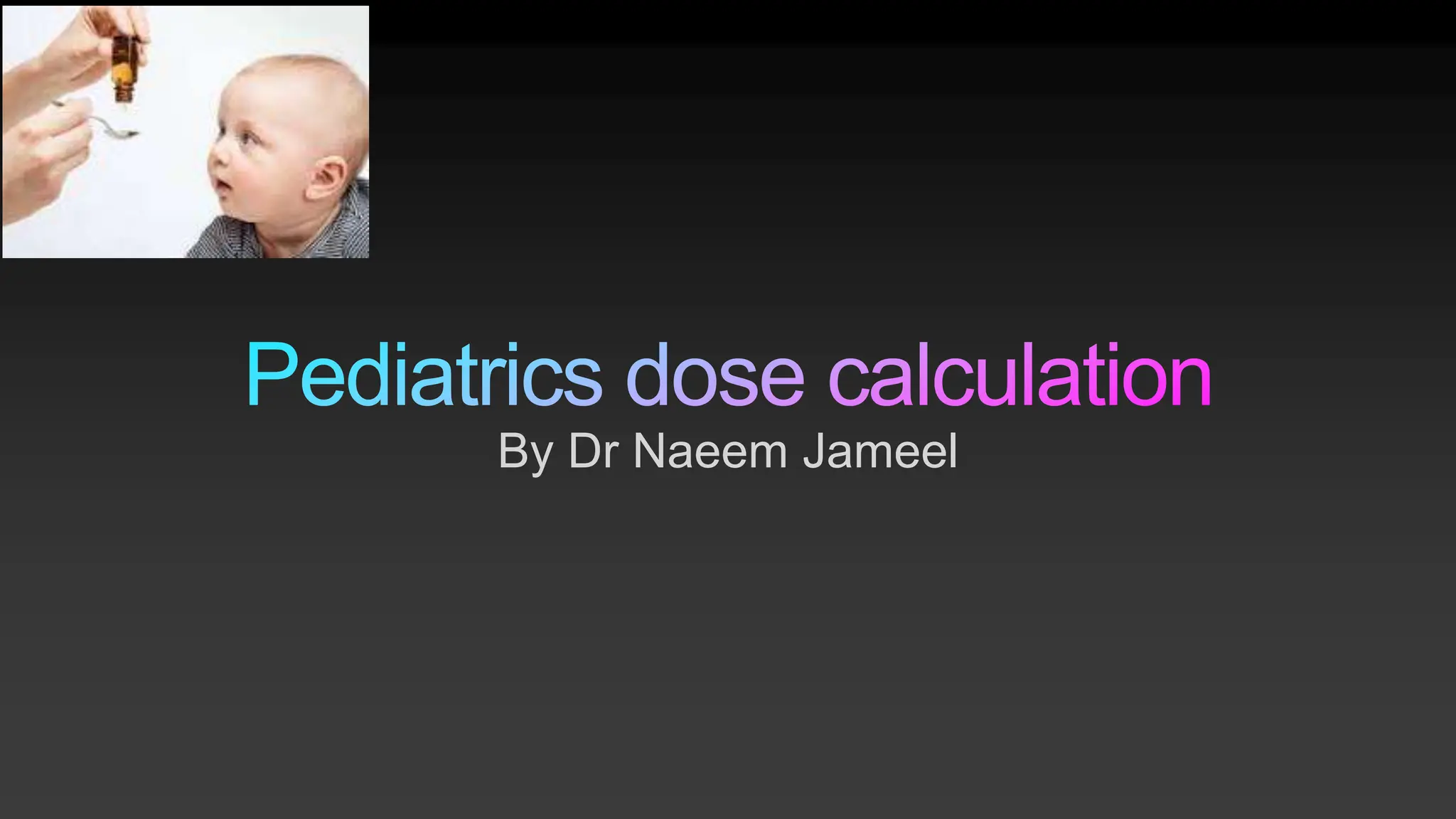
By Dr Naeem Jameel
Don’t forget how badly you once wanted what you have now
….
• The medicine doses are calculated based on child’s weight.
• It make the dose much more precise in children.
• Its very important that the child’s most recent weight must be recorded in kilograms .
1. At the end of this session , we will be able to calculate the common
doses of drugs use frequently in paediatrics and their side effects as
It is an appropriate
administration of desired
strength and quantity of drugs
to infants and neonates to
improve their health condition.
• To prevent drugs complications
• Improve child general health
condition
• Appropriate administration of
desired dose.
• Right drug
• Right child
• Right route
• Right dose
• Right time
• Right assessment
• Right approach
• Right evaluation
• Right documentation
• Right to refuse
• Right prescription
• Right nurse/ clinician
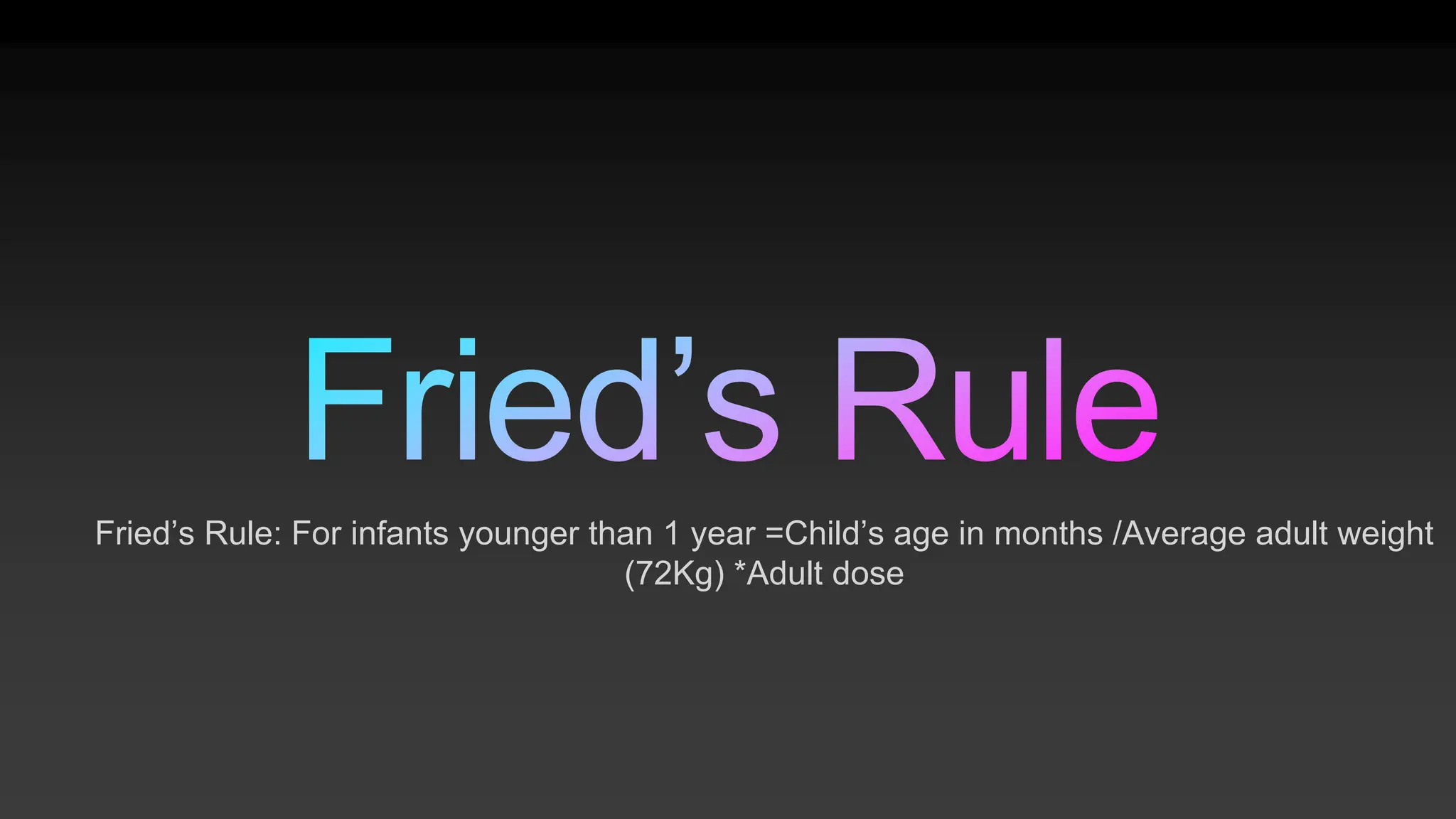
Fried’s Rule: For infants younger than 1 year =Child’s age in months /Average adult weight
(72Kg) *Adult dose
Calculate the dose for a 6months old baby where the adult dose is 500mg
GIVEN:
Age of the child =6month
Average adult dose =500mg
To find = child dose
Solution :6/70*500=40mg .
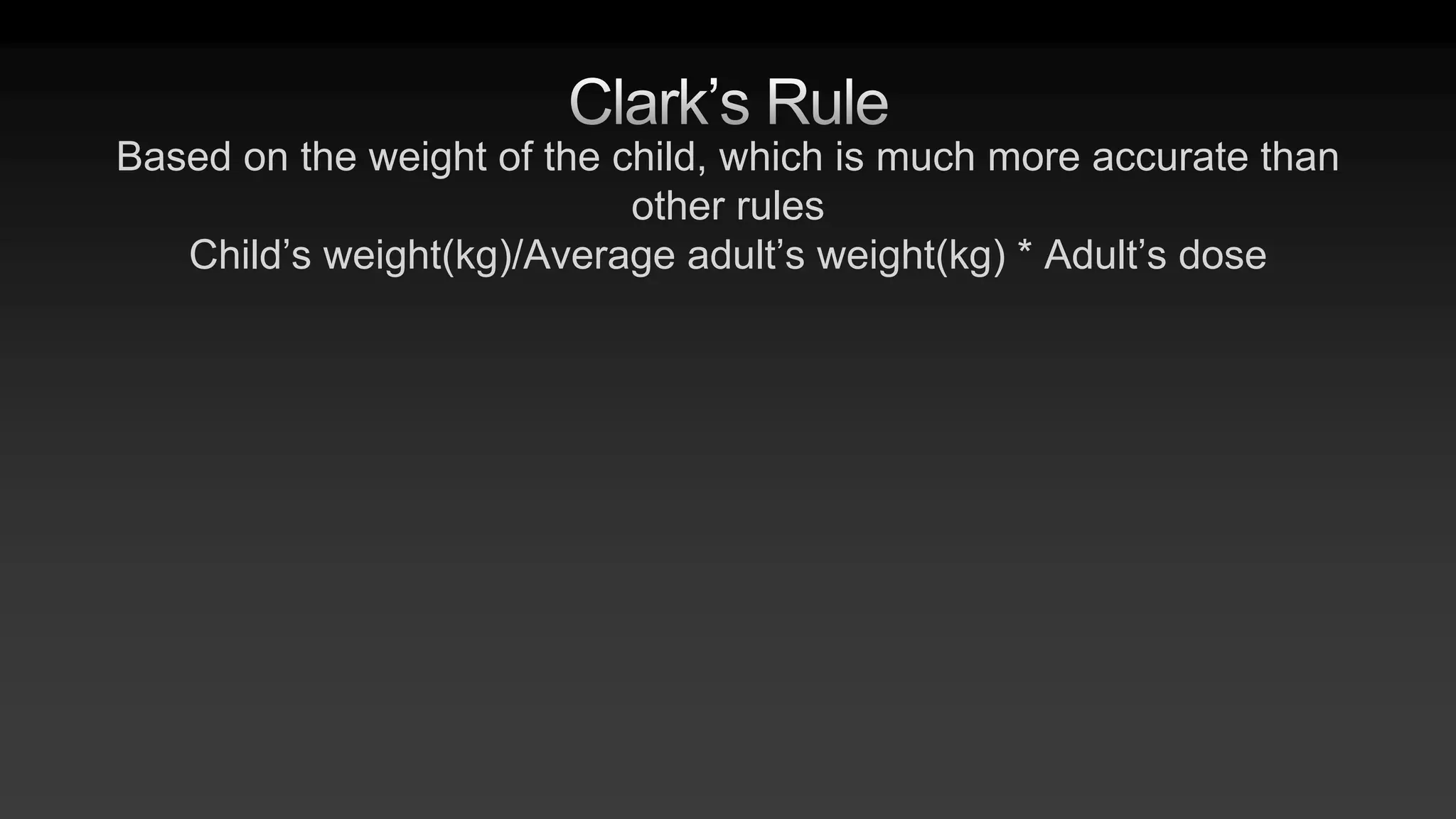
Based on the weight of the child, which is much more accurate than
other rules
Child’s weight(kg)/Average adult’s weight(kg) * Adult’s dose
WHAT WE WANT=20mg
WHAT WE HAVE = 40mg
DILUTION= 40mg OMEPRAZOL IN 5ml STERILE WATER
CALCULATING THE AMOUNT TO BE TAKEN IN ml TO ADMINISTER TO
PATIENT ?
20/40*5
=0.5*5
=2.5ml
Dose available in bottle/Rate of dilution *Dose to be administered
A 3years toddler is prescribed to be administer 2ml of paracetamol
syrup
Solution:
What we want=2ml
What we have = 5ml contains 250mg in bottle
Dose= 250/5*2
=50mg*2=100mg
No. Of drops / min= amount of fluid in (ml)* drop factor to be given in 24
hours
DROP FACTOR = 60 (micro drops) and 15 (macro drops )
Normal saline (500ml) in 4 hours
=500*60/4*60
=125drops /min
• Circulations
• Redistribution
• Biotransformation (metabolism)
• Excretion
Study of harmful effects of drugs on biological system
Adverse drugs reactions are the undesirable reaction when the drug is given .
• Rout of administrations ( IV most
effective but more serious for
ADRs)
• DOSE (85% ADRs are related to
overdose )
• Patient ( age, sex , weight , race
,…..)
• Effects as direct extension of drug
action =1: Side Effects
2: Overdose reaction.
• Effects result from altered immune
response 1: Allergy 2:
Idiosyncrasy
• Effects result from altered patient .
Undesirable effects occurs when drug given :
EX:Adrenalin - Desirable Brochodilator
Undesirable Palpitations
EX:ABx- Desirable Antibacterial
Undesirable GI upset
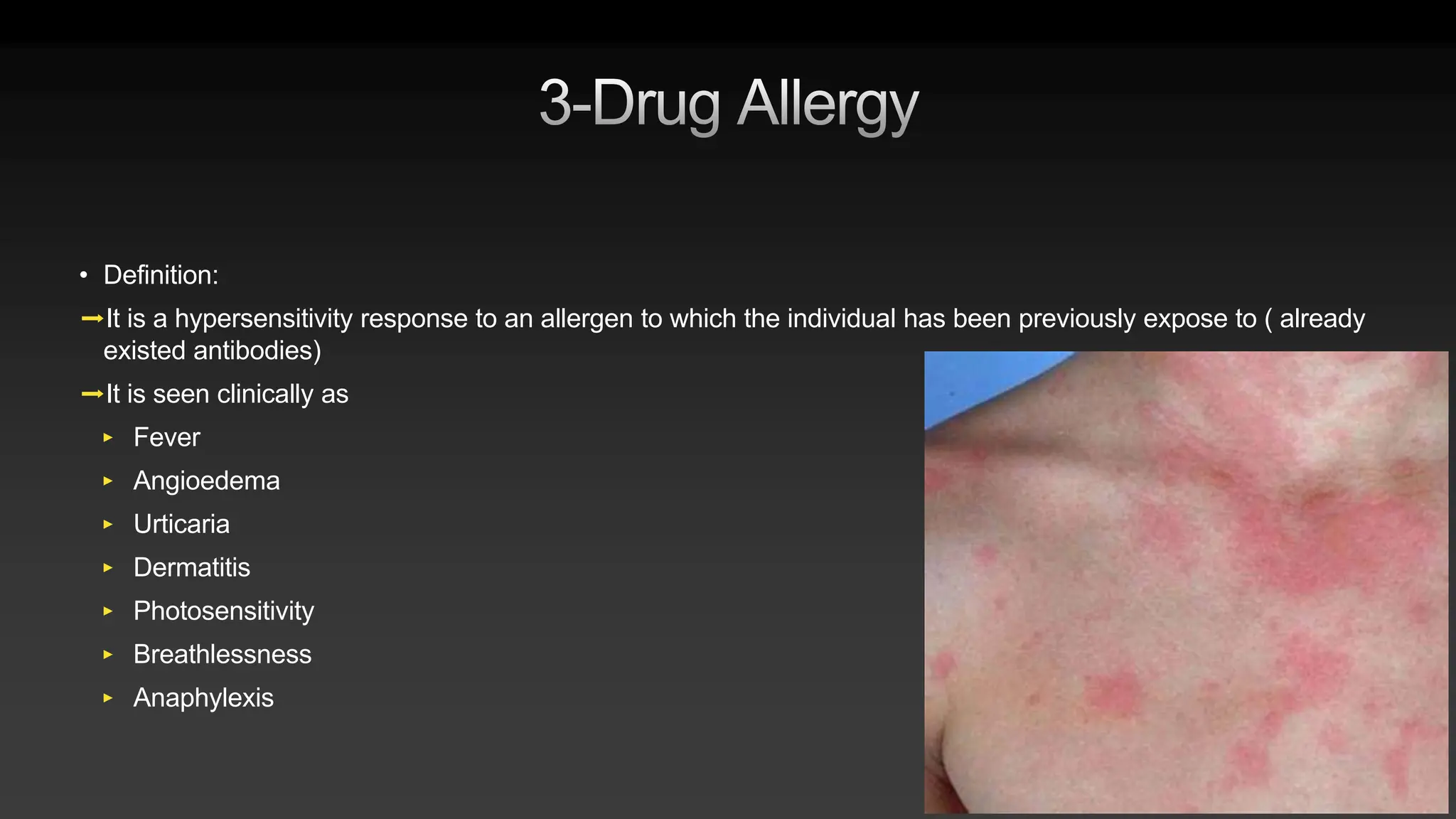
Definition: Are reactions that arises due to toxic amount of drug .
EX: Vit A norma dose usually is less than 5000IU , more than 5000IU is
toxic dose .
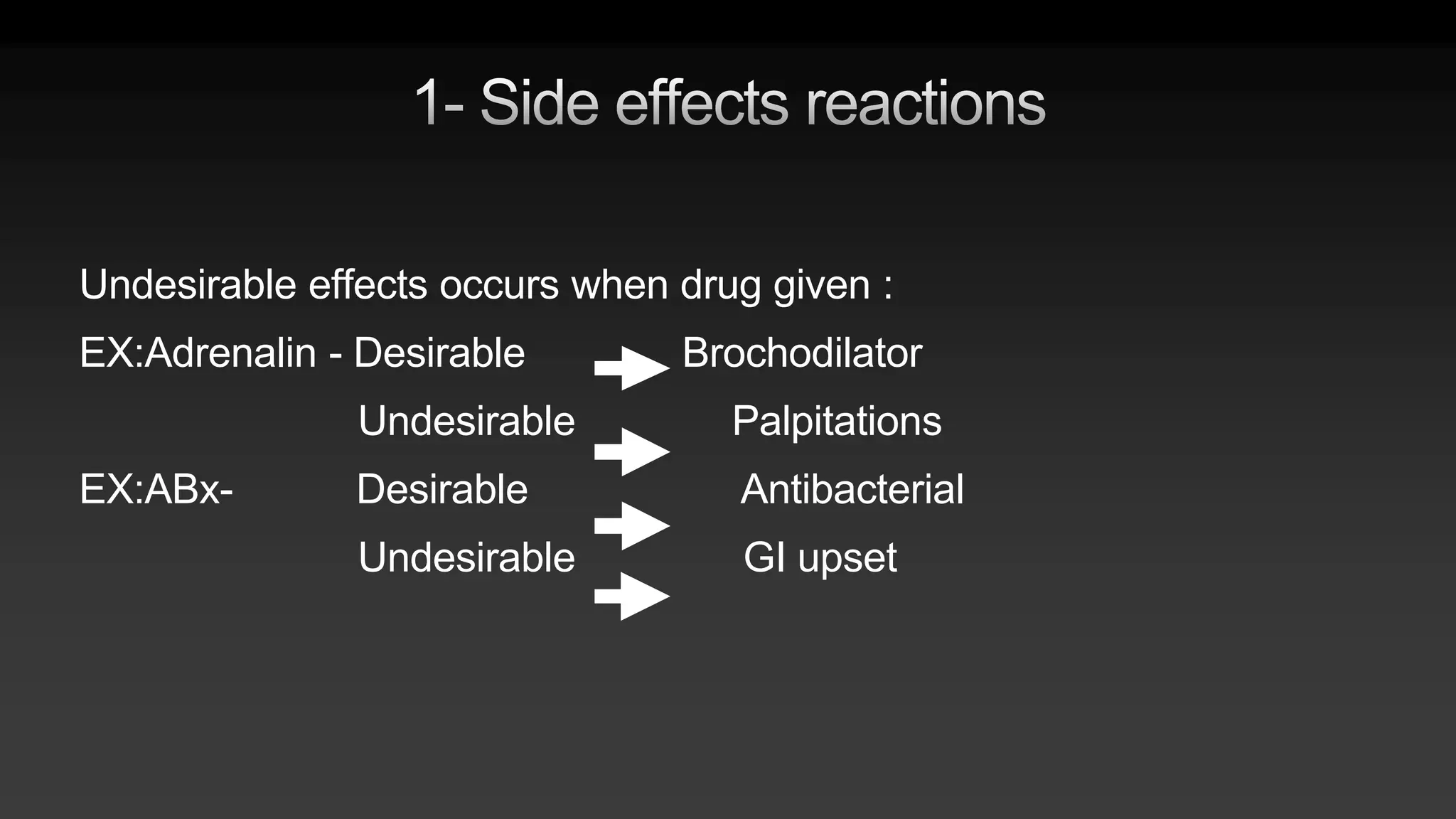
• Definition:
➡It is a hypersensitivity response to an allergen to which the individual has been previously expose to ( already
existed antibodies)
➡It is seen clinically as
‣ Fever
‣ Angioedema
‣ Urticaria
‣ Dermatitis
‣ Photosensitivity
‣ Breathlessness
‣ Anaphylexis
• Thorough Hx
• Hx of allergy from drugs, food ,
latex ,…
• Hx of any past medicines in use
✓ Complete medical evaluation
before starting any treatment
✓ Apply topical drugs on the site of
needle to see any reaction
✓ Injections must be slow
✓ Must double check the
prescription of clinician .
• https://www.slideshare.net/Gauravsharma2359/drugs-used-in-pediatrics
• https://www.slideshare.net/samghany/drug-dilutions-concentrations
• PubMed.com
• Nelson paediatrics 21 edition
• Parvaiz Akbar paediatrics
• YouTube.com
• Google scholar
The English patient
Wit

PEDIATRICS DRUG DOSES CALCULATIONS AND COMMON DRUG REACTIONS .pptx

  • 2.
  • 3.
    Don’t forget howbadly you once wanted what you have now ….
  • 4.
    • The medicinedoses are calculated based on child’s weight. • It make the dose much more precise in children. • Its very important that the child’s most recent weight must be recorded in kilograms .
  • 5.
    1. At theend of this session , we will be able to calculate the common doses of drugs use frequently in paediatrics and their side effects as
  • 6.
    It is anappropriate administration of desired strength and quantity of drugs to infants and neonates to improve their health condition.
  • 7.
    • To preventdrugs complications • Improve child general health condition • Appropriate administration of desired dose.
  • 8.
    • Right drug •Right child • Right route • Right dose • Right time • Right assessment • Right approach • Right evaluation • Right documentation • Right to refuse • Right prescription • Right nurse/ clinician
  • 12.
    Fried’s Rule: Forinfants younger than 1 year =Child’s age in months /Average adult weight (72Kg) *Adult dose
  • 14.
    Calculate the dosefor a 6months old baby where the adult dose is 500mg GIVEN: Age of the child =6month Average adult dose =500mg To find = child dose Solution :6/70*500=40mg .
  • 16.
    Based on theweight of the child, which is much more accurate than other rules Child’s weight(kg)/Average adult’s weight(kg) * Adult’s dose
  • 19.
    WHAT WE WANT=20mg WHATWE HAVE = 40mg DILUTION= 40mg OMEPRAZOL IN 5ml STERILE WATER CALCULATING THE AMOUNT TO BE TAKEN IN ml TO ADMINISTER TO PATIENT ? 20/40*5 =0.5*5 =2.5ml
  • 22.
    Dose available inbottle/Rate of dilution *Dose to be administered
  • 23.
    A 3years toddleris prescribed to be administer 2ml of paracetamol syrup Solution: What we want=2ml What we have = 5ml contains 250mg in bottle Dose= 250/5*2 =50mg*2=100mg
  • 25.
    No. Of drops/ min= amount of fluid in (ml)* drop factor to be given in 24 hours DROP FACTOR = 60 (micro drops) and 15 (macro drops )
  • 26.
    Normal saline (500ml)in 4 hours =500*60/4*60 =125drops /min
  • 29.
    • Circulations • Redistribution •Biotransformation (metabolism) • Excretion
  • 32.
    Study of harmfuleffects of drugs on biological system
  • 33.
    Adverse drugs reactionsare the undesirable reaction when the drug is given .
  • 35.
    • Rout ofadministrations ( IV most effective but more serious for ADRs) • DOSE (85% ADRs are related to overdose ) • Patient ( age, sex , weight , race ,…..)
  • 37.
    • Effects asdirect extension of drug action =1: Side Effects 2: Overdose reaction. • Effects result from altered immune response 1: Allergy 2: Idiosyncrasy • Effects result from altered patient .
  • 39.
    Undesirable effects occurswhen drug given : EX:Adrenalin - Desirable Brochodilator Undesirable Palpitations EX:ABx- Desirable Antibacterial Undesirable GI upset
  • 40.
    Definition: Are reactionsthat arises due to toxic amount of drug . EX: Vit A norma dose usually is less than 5000IU , more than 5000IU is toxic dose .
  • 41.
    • Definition: ➡It isa hypersensitivity response to an allergen to which the individual has been previously expose to ( already existed antibodies) ➡It is seen clinically as ‣ Fever ‣ Angioedema ‣ Urticaria ‣ Dermatitis ‣ Photosensitivity ‣ Breathlessness ‣ Anaphylexis
  • 44.
    • Thorough Hx •Hx of allergy from drugs, food , latex ,… • Hx of any past medicines in use
  • 45.
    ✓ Complete medicalevaluation before starting any treatment ✓ Apply topical drugs on the site of needle to see any reaction ✓ Injections must be slow ✓ Must double check the prescription of clinician .
  • 48.
    • https://www.slideshare.net/Gauravsharma2359/drugs-used-in-pediatrics • https://www.slideshare.net/samghany/drug-dilutions-concentrations •PubMed.com • Nelson paediatrics 21 edition • Parvaiz Akbar paediatrics • YouTube.com • Google scholar
  • 49.