Pedestrian Priority Zones
Safety Review (for the Gold
Coast)
Jess Peters, Senior Traffic Engineer
Peter Bilton, Director & Principal Traffic Engineer
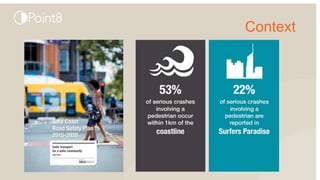
Context
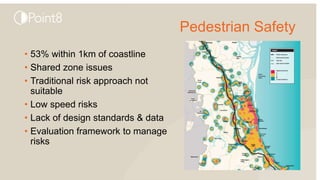
Pedestrian Safety
• 53% within 1km of coastline
• Shared zone issues
• Traditional risk approach not
suitable
• Low speed risks
• Lack of design standards & data
• Evaluation framework to manage
risks
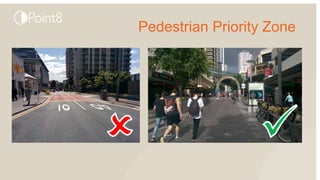
Pedestrian Priority Zone
Approaches
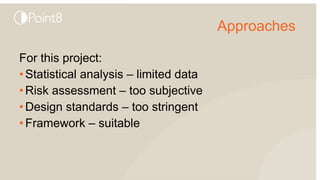
For this project:
•Statistical analysis – limited data
•Risk assessment – too subjective
•Design standards – too stringent
•Framework – suitable
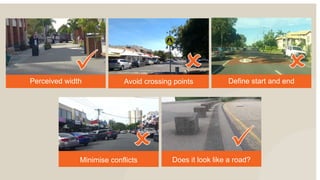
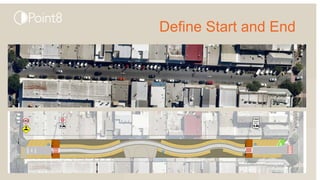
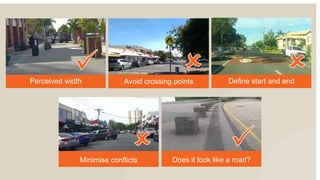
Define start and end
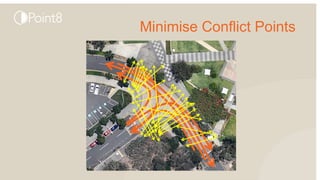
Minimise conflicts
Perceived width Avoid crossing points
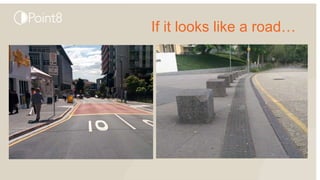
Does it look like a road?
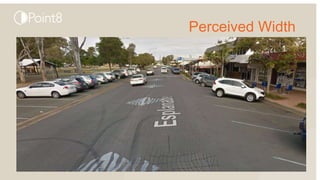
Perceived Width
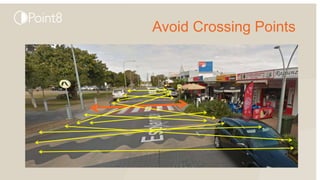
Avoid Crossing Points
Define Start and End
Minimise Conflict Points
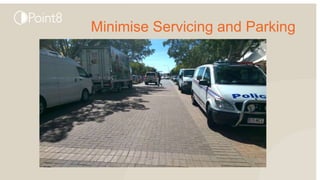
Minimise Servicing and Parking
If it looks like a road…
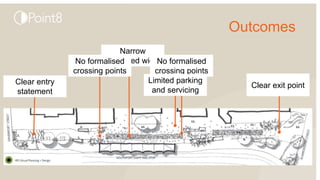
Outcomes
Clear entry
statement
Narrow
perceived widthNo formalised
crossing points
Clear exit point
Limited parking
and servicing
No formalised
crossing points
Define start and end
Minimise conflicts
Perceived width Avoid crossing points
Does it look like a road?
Contact
Peter Bilton
Principal Traffic Engineer
peter.bilton@point8.com.au
0405 246 043
Jess Peters
Senior Traffic Engineer
jess.peters@point8.com.au
0413 064 385

Pedestrian Priority Zones Safety Review

Editor's Notes

  • #3 Pete’s slide: 2-3 mins explaining relationship to Gold Coast Road Safety Plan… Suggest referencing that’s you’ve heard at lot about this plan throughout this conference, and this is an example of where the City is looking to achieve their actions and really back their targets.
  • #6 CONSIDERED APPROACHES 1 2 3 ENDED UP WITH FRAMEWORK which Weighted scoring Comparativeness FOR TODAY’s DIDN’T want to run through the scorecard as it’s easy to sue and would be boring Not talking about speed + exposure (they’re assumed) Talking more about the design principals that achieve speed reductions and conflict management So the focus of the project with the City of Gold Coast was on road safety for all road users of a pedestrian priority zone. The fundamentals for safe operations of a pedestrian priority zone is pretty easy. If you have high pedestrian volumes, low vehicle volumes and low speeds you reduced the likelihood of conflicts and have reduced the severity of any conflicts. So that’s a pretty simple goal and one that I imagine that most people here are across. However in practice it’s much harder to achieve and requires considerable thought to design these locations to encourage these fundamentals to occur. The difficulty arises in: General understanding of Shared Zones (many people thinks it’s a slow speed area where vehicles retain priority. Don’t realise pedestrians have priority). Supporting priorities. E.g. catering for cyclists is difficult. Vehicles must give way to pedestrians and cyclists, cyclists must give way to pedestrians No design guidance (pedestrian priority zones are typically bespoke, and there isn’t a one-size-fits-all solution) limited recorded information on incidents that occur with in shared zones, due to 1. likely to be less severe; 2. shared zones aren’t captured in Queensland coding of crashes which limited how much design could be guided by previous incidents. So in light of this, our work with the City of Gold Coast was to identify tangible characteristics and elements to contribute a safe pedestrian priority zone. Over the course of 3 months, 3 work stops and numerous inspections of a wide variety of pedestrian priority zones and shared zones in SEQ we developed XX functional characteristics and XX elements to achieve a design that meets the intended outcome. What we ended up doing was developing a safety score card tool to capture all these elements and define aspects that were desirable -> acceptable -> undesirable.. We also found that there is Our extended abstract covers more of the rationale for this approach, and some of the challenges we had in this area. ** FRAMEWORK OPPORTUNITIES ** But the focus of the rest of my discussion today will be on five of the more important elements that are critical in developing safe pedestrian priority zones – beyond the basics of having high pedestrian volumes and low vehicle volumes. While we ended up coming up with XX elements, if you are able to achieve these aspects, you are well on your way to something that’s much more than a shared zone.
  • #7  So these are following 5 elements were the key in working towards a successful shared zone: Create narrow perceived width Avoid formalized crossing points Minimise conflict points (Limit servicing and parking) Use flush kerb treatments and differential pavements Clearly define start and end It’s worth acknowledging, that while it would be nice, road safety is not the only factor in these projects. The locations for pedestrian priority zones have competing interests like urban amenity, commercial considerations such as parking and community perceptions.
  • #8 WIDTH + PERCIEVED WIDTH So, now coming back to some further information on the 5 key elements: create narrow perceived width This does two keys things Less width for pedestrians to cross Slows vehicle speeds Sets expectations for interactions As desireably you don’t have kerbs to define the roadway, need to use pavements and visual cues First example is, shared zone, posted at 10km/h but regularly sees vehicles at 50km/h through.
  • #9 PERCEPTION – CROSSING AT CROSSING REGULATORY – CROSSING WHEREVER Formal crossing points: Zebra crossings Midblock signals Refuge islands Counterintuitive Pedestrians: given the impression they must use the crossing points Drivers: only expect to encounter pedestrians at the crossing point only need to yield to peds at crossing point
  • #10 Don’t just stick signs up Regulatory signage needs to be complemented by design cues
  • #11 One-way one-lane is ideal Avoid intersections and complicated areas More space can lead to unwanted manoeuvres
  • #12 Parked service vehicles can severely limit sight distance Increased risk of conflicts From a road safety perspective having no parking and servicing within a pedestrian priority zone is optimal. This reduces conflicts and removes undesireably vehicle types from the area. However as I mentioned before, it’s often a balancing act and removing all servicing and parking is not likely to be palatable to many business owners. In these situations it’s worth considering available parking outside the area, investigating alternative servicing options, or if you do have to include parking and servicing within the area – then try to ensure that it is located away from the main desire lines through the area.
  • #13 One of the biggest design cues for a road space is kerbs. Removing kerbs allows for easier pedestrian permeability and reinforcement of pedestrian priority. Different pavement surfaces also contribute to the environment particularly with regards to speeds. This may be challenging in some locations due to drainage considerations
  • #14 The intent of these concepts was to apply the safety scorecard to the site and recommend specific changes to improve the safety of the pedestrian priority zone. We worked with a landscape architect to develop concepts that were more than just engineering drawings and incorporated urban design to achieve the desired outcomes. In this particular location, some of the key recommendations were made were very much along the lines of what I’ve already mentioned: Adding entry and exit statements. Despite the required regulatory signage it wasn’t clear where the zone started and ended. Some confusion also existed about whether it was driveway. At one point the area widened up significantly, so pavement treatments and additional landscaping was proposed to create the narrowing that naturally slows vehicle speeds down There were issues with service vehicles blocking both vehicle and pedestrian paths. Removing servicing wasn’t an option, so instead we included 2 formal loading bays that were located away from the major desire line to the light rail station and didn’t block the area.
  • #15 Coming back to fundamentals: high pedestrian volumes + low vehicle volumes + low speeds This list isn’t exhaustive, but wanted to give an indication of some of the obvious and not so obvious measures that should be considered when looking to create a safe pedestrian priority zone. Keep in mind the focus of the project was on Safety. There are urban design, commercial, community aspects to consider.