Quarter 1
Food Processing Grade 10
Module 1
PERSONAL ENTREPRENEURIAL
COMPETENCIES
Entrepreneurs
• are people with skills and capabilities to see and evaluate business
opportunities.
• They are individuals that can strategically identify products or
services needed by the community and deliver them at the right
time and the right place.
• Entrepreneurs are agents of economic change; they organize,
manage and assume the risks of a business.
• A good entrepreneur is an opportunity- seeker, risk- taker, goal -
setter, a planner, and problem solver. He/she is hardworking,
persistent and a committed worker.
Entrepreneurship
• on the other hand is not just a simple business activity.
• It is a strategic process of innovation and new venture
creation.
• Basically, entrepreneurship is both the art and science of
converting business ideas into marketable products or
services to improve the quality of living of individuals or a
community.
Learning Objectives:
• At the end of this module, you are expected to:
• - Identify areas for improvement, development and
growth;
• - Align your PECs according to your business/career
choice; and
• - Create a plan of action that ensures success in your
business/career choice
Pre - Assessment
• Activity 1. Matching Type
• Direction: Match the entrepreneurial competencies in
column A with their meaning in column B. Write the letter
of your choice in your notebook.
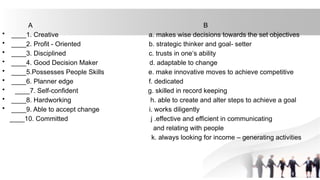
A B
• ____1. Creative a. makes wise decisions towards the set objectives
• ____2. Profit - Oriented b. strategic thinker and goal- setter
• ____3. Disciplined c. trusts in one‘s ability
• ____4. Good Decision Maker d. adaptable to change
• ____5.Possesses People Skills e. make innovative moves to achieve competitive
• ____6. Planner edge f. dedicated
• ____7. Self-confident g. skilled in record keeping
• ____8. Hardworking h. able to create and alter steps to achieve a goal
• ____9. Able to accept change i. works diligently
____10. Committed j .effective and efficient in communicating
and relating with people
k. always looking for income – generating activities
Activity 2: Guide Questions
• Direction: The following are guide questions which
encapsulate the entire module.
• Write your answers on your assignment notebook, then
share your answer with theclass.
• A. Explain why entrepreneurial activities are important to
the social development and progress of the economy.
• B. What entrepreneurial activities do you know and are
capable of doing which are related to Food (Fish)
Processing?
• C. Given the opportunity to own a business that relates
with Food (Fish) Processing, do you think you can
manage it? Explain your answer.
• D. What do you think are the most important
competencies you must possess in order to be successful
in running your chosen business?
• E. Name successful entrepreneurs from your province
whose business is related to Food (Fish) Processing. Be
able to share to the class their PECs that made them
successful.
Activity 3: Individual Activity
• Directions: Answer the following guide questions on a
separate sheet of paper. Share your answers with the
class.
• 1. Explain the importance of assessing one‘s PECs
before engaging in a particular entrepreneurial activity.
• 2. Are there other strategies or approaches where you
can assess your PECs?
• Explain how these would be useful in selecting a viable
business venture.
• 3. What are the desirable personal characteristics,
attributes, lifestyles, skills,and traits of a prospective
entrepreneur? Why do you think these are important?
• 4. How will each of the following PECs (attributes,
lifestyles, skills and traits) affect in establishing a
business?
• 5. What is the significance of evaluating PECs of a
successful entrepreneur? What helpful insights can you
draw from this activity?
Lesson 1. Develop and Strengthen Personal
Competencies and Skills (PECs)
Needed in Food (Fish) Processing
A. Assessment of Personal Entrepreneurial Competencies (PECs) and
Skills in relation to a Practicing Entrepreneur in a Province.
• The entrepreneurial competencies refer to the important
characteristics that should be possessed by an individual
in order to perform entrepreneurial functions effectively.
• In this module, you will learn some of the most important
characteristics, attributes, and skills of a successful
entrepreneur.
Below are a few important characteristics
of a good entrepreneur:
• Hardworking: One of the important characteristics of a
good entrepreneur is being hardworking. This means
habitually working diligently for a long hours. Hardworking
people keep on strive to improvetheir performance to
produce good products and/ or provide good services.
• Self-confident: Entrepreneurs are confident in their
abilities and trust their judgment. They exhibit self-
confidence in order to cope with all the risks of operating
their own business.
Disciplined: Successful entrepreneurs
always stick to the plan and fight the
temptation to do what is unimportant.
• Committed: A good entrepreneur accepts full
responsibility for everything in his/her business. He/she is
dedicated making the business successful.
• Able to accept change: Nothing is permanent but
change. Change occurs frequently. An entrepreneur
copes with and thrives on changes.
• He/she capitalizes on positive changes to make the
business grow.
• Creative: An entrepreneur should be creative and
innovative to stay inbusiness and in order to have an
edge over the competition..
• Takes Initiative: An entrepreneur takes the personal
responsibility for the failure or success of the business.
• Profit-Oriented: An entrepreneur enters into business to
generate profit or additional income. Therefore, an
entrepreneur must see to it that the business becomes
profitable.
Listed below are the
important skills of a
successful entrepreneur.
Planning
• Planning is a strategic thinking and setting of goals to
achieve objectives by carefully maximizing all the
available resources.
• A good entrepreneur develops and applies step-by-step
plans to realize goals.
• A good entrepreneur knows that planning is an effective
skill only when combined with action.
People Skills
• This is very important in order to be successful in any kind
of business.
• Possessing people skills refers to the entrepreneur‘s
ability to effectively and efficiently communicate and relate
to people working within and outside of your business.
• In day-to-day business transactions, you need to deal
with people.
• Well- developed people skills can spell the difference
between success and failure of the business.
Decision Making
• Successful entrepreneurs have the ability to think quickly
and make wise decision towards pre-determined
objectives.
• No one can deny that the ability to make decisions is an
important skill that an entrepreneur should possess.
• Sound decisions should arise from verified
facts/information and should be towards the pre-
determined objectives.
Module 2: ENVIRONMENT AND
MARKET (EM)
Learning Objectives:
• At the end of this module, you are expected to:
• - Identify what is of to the customer;
• - Identify the potential customer;
• - Explain what makes a product unique and competitive;
• - Apply creativity and innovative techniques to develop a
marketable product;
• - Employ a Unique Selling Proposition (USP) to the
product/service and
• - Explore ways of generating a business
Lesson 1: Develop a Product/ Service in
Food (Fish) Processing
• A. Product Development
• The Product development, we are referring to a process
of making a new product to be sold by a business or
enterprise to its customers.
• The Product development may involve modification of an
existing product or its presentation, or formulation of an
entirely new product that satisfies a newly defined
customer need and/or want, and/or a market place.
Product Development
• refers collectively to the entire process of identifying a
market opportunity, creating a product to appeal to the
identified market, and finally, testing, modifying and
refining the product until this will be ready for production.
• This product can be any item to be sold to the consumers.
There are basic, yet vital questions that
you can ask yourself.
• 1. For whom are the products/services?
• 2. What benefit will the customers expect from it?
• 3. How will the product differ from the existing brand? Or
from their competitor?
Needs in business are important things that every individual
cannot do without in a society. These include:
• 1. Basic commodities for consumption
• 2. Clothing and other personal belongings,
• 3. Shelter, sanitation and health
• 4. Education
ENVIRONMENT
AND MARKET (EM)
Module 2:
SWOT Analysis
• is a managerial tool to assess the business environment.
• This method gathers important information, which in turn
is used in strategic planning.
• Successful entrepreneurs must know how to take risks in
business.
Strengths and Weaknesses
• are internal in an organization.
• They relate to resources owned or lacking in an
organization, things that the entrepreneur has control
over, and as well as the extent of its marketing.
Opportunities and Threats
• exist in the external environment.
• Opportunities pertain to the market, to the development of
new technology, and external factors such as government
policies, climate, and trends, favorable to the business.
• Threats pertain to what the competition is doing as well as
legal and other constraints of the business
Develop a Product/ Service
in Food (Fish) Processing
Lesson 1:
A. Product Development
• a process of making a new product to be sold by a
business or enterprise to its customers.
• may involve modification of an existing product or its
presentation, or formulation of an entirely new product
that satisfies a newly defined customer need and/or want,
and/or a market place.
Vital questions that you can ask yourself.
• 1. For whom are the products/services?
• 2. What benefit will the customers expect from it?
• 3. How will the product differ from the existing brand? Or
from their competitor?
Needs
• 1. Basic commodities for consumption
• 2. Clothing and other personal belongings,
• 3. Shelter, sanitation and health
• 4. Education
Wants
• are desires, and luxuries that signify wealth.
• are considered above all the basic necessities of life.
• Some examples of non- basic needs are luxury cars,
jewellery, non –essential fashion accessories, shoes and
clothes, travel for leisure.
• Eating in expensive restaurants; watching movies,
• concerts, and plays are also considered luxuries for many
people.
B. Concepts of Developing a Product
• Concept development - is very critical phase in the
creation of a product.
• At this stage, the needs of the target market are identified
and competitive products are reviewed before the product
specifications are defined.
• selected along with an economic analysis to come up with
an outline of how a product is being developed.
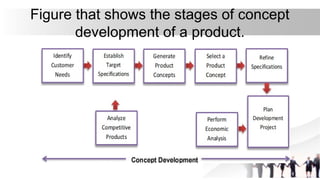
Figure that shows the stages of concept
development of a product.
The process of product development is as
follows:
• 1. Identify Customer Needs - Using surveys form,
interviews, research, focused group discussions, and
observations, an entrepreneur can easily identify
customers‘needs and wants.
• In this stage, the information gathered here can already
includeproduct specifications (performance, taste, size,
color, shape, life span of theproduct, etc.).
• This stage is very important because this determines the
product tobe produced or the service to be provided.
• 2. Establish Target Specifications - Based on
customers' needs and reviews of competitive products
and services, you may now establish target specifications
of the prospective new product and/or service.
• Target specifications are essentially a wish-list of the
consumer.
• 3. Analyze Competitive Products - It is imperative to
analyze existing competitive products to provide important
information in establishing product/servicespecifications.
• Other products may exhibit successful design attributes
that should be emulated or improved upon in the new
product/service.
• 4. Generate Product Concepts - After having gone
through the previous processes, you may now develop a
number of product concepts to illustrate what types of
product/service are both technically feasible and would
best meet the requirements of the target specifications.
• 5. Select a Product Concept - Through the process of
evaluation, a final concept is selected.
• After the final selection, additional market research can
be applied to obtain feedback from certain key customers.
• 6. Refine Product Specifications - In this stage,
product/service specifications are refined on the basis of
input from the previous activities.
• Final specifications are the result of extensive study,
expected service life, projected selling price and among
others.
• 7. Perform Economic Analysis - Throughout the
process of product development, it is very important to
always review and estimate the economic implications
regarding development expenses, manufacturing costs,
and selling price of the product/services to be
offered/provided.
• 8. Plan the Remaining Development Project - In this
final stage of concept development, you may prepare a
detailed development plan which includes a list of
activities, the necessary resources and expenses, and a
development schedule with milestones for tracking
progress.
C. Finding Value
• People buy for a reason.
• There should be something in your product/service that
would give consumers a good reason to go back and
acquire more.
• There must be something that makes you the best option
for your target customers; you must offer something to
your customers that they will make them value your
product/services.
Value Proposition
• The value that you incorporate to your product.
• is ―a believable collection of the most persuasive
reasons people should notice you and take the action you
are asking for.
• Value is created by fulfilling desires and solving problems.
• This is what gets the people to spend for your product or
service.
D. Innovation
• is the introduction of something new in your
product/service.
• This may be a new idea, a new method or a device.
• Some of the possible innovations in your products are
changes in packaging, improved taste, color, size, shape
and perhaps price.
• Some of the possible innovations in providing services
are the application of new improved methods, additional
featured services and possibly, freebies services or
products that are included for free.
Unique Selling Proposition (USP)
• is the factor or consideration presented by a seller as the
reason that one product or service is different from and
better than that of the competition.
• This is especially important when your product or service
is similar to those around you.
• USP would require a careful analysis of other businesses'
ads and marketing messages.
Here's how to discover your USP and use it
to increase your sales and profit:
• Use empathy: Put yourself in the shoes of your
customers.
• Always focus on the needs of the target customers over
and above your attachment to the product or service.
• Always remember, you are making this product or
providing this service for the target customers and
eventually to increase sales and earn a profit.
Identify what motivates your customers.
• It is very important to find out and understand what drives
and motivates your customers to buy products/services
similar to what will you offer.
• Make some effort to find out, analyze and utilize the
information you will gather.
Discover the actual reasons why customers will
buy your product instead of a competitor's.
• Information is very important in decision making.
• A competitive entrepreneur always improves his/her
products/services to provide satisfaction and, of course,
retention of customers.
• As your business grows, you should always ask your
customers for information and suggestions on how to
improve your products/services.
In screening your ideas, examine each one
in terms of the following factors:
• 1. How much capital is needed to put up the business?
• 2. How big is the demand for the product? Do many
people need this product and will continue to need it for a
long time?
• 3. How is the demand met? Who are processing the
products to meet the need (competition or demand)? How
much of the need is now being met (supply)?
• 4. Do you have the background and experience
needed to run this particular business?
• 5. Will the business be legal, not going against any
existing or foreseeable government regulation?
• 6. Is the business in line with your interest and
expertise?
C. Branding
• Branding is a marketing practice of creating a name,
symbol or design that identifies and differentiates a
product/services from other similar products/services.
• It is also a promise to your customers. It tells them what
they can expect from your product/ service.
• Your brand is who you are, who you want to be and who
people perceive you to be.
• Branding is one of the most important aspects of any
business.
• An effective brand strategy gives you a major edge in
increasingly competitive markets.
The features of a good product brand are
as follows:
• - Delivers the message clearly
• - Confirms your credibility
• - Connects your target prospects emotionally
• - Motivates the buyer
• - Concretizes user loyalty
Here are some simple tips to publicize your
brand.
• Develop a tagline. Write a meaningful unforgettable, and
easy to remember statement that captures the essence of
your brand.
• Make a great logo. Create a logo suitable to your
business and consistent with your tagline and place it
everywhere.
• Write down your brand messaging. Select key
messages you want to communicate about your brand.
• Be true to your brand. Deliver your brand promises.
• Be consistent. Be reliable and consistent every time.
Bear in mind these simple rules for a
successful SWOT analysis.
• Be realistic about the strengths and weaknesses of your
business when conducting SWOT analysis.
• SWOT analysis should distinguish between where your
business is today, and where it could be in the future.
• SWOT should always be specific. Avoid any gray areas.
• Always apply SWOT in relation to your competition i.e.
better than or worse than your competition.
• Keep your SWOT short and simple. Avoid complexity and
over analysis.
• SWOT is subjective.

PECS-Food Processing Grade 10 Entrepreneurial

  • 1.
    Quarter 1 Food ProcessingGrade 10 Module 1 PERSONAL ENTREPRENEURIAL COMPETENCIES
  • 2.
    Entrepreneurs • are peoplewith skills and capabilities to see and evaluate business opportunities. • They are individuals that can strategically identify products or services needed by the community and deliver them at the right time and the right place. • Entrepreneurs are agents of economic change; they organize, manage and assume the risks of a business. • A good entrepreneur is an opportunity- seeker, risk- taker, goal - setter, a planner, and problem solver. He/she is hardworking, persistent and a committed worker.
  • 3.
    Entrepreneurship • on theother hand is not just a simple business activity. • It is a strategic process of innovation and new venture creation. • Basically, entrepreneurship is both the art and science of converting business ideas into marketable products or services to improve the quality of living of individuals or a community.
  • 4.
    Learning Objectives: • Atthe end of this module, you are expected to: • - Identify areas for improvement, development and growth; • - Align your PECs according to your business/career choice; and • - Create a plan of action that ensures success in your business/career choice
  • 5.
    Pre - Assessment •Activity 1. Matching Type • Direction: Match the entrepreneurial competencies in column A with their meaning in column B. Write the letter of your choice in your notebook.
  • 6.
    A B • ____1.Creative a. makes wise decisions towards the set objectives • ____2. Profit - Oriented b. strategic thinker and goal- setter • ____3. Disciplined c. trusts in one‘s ability • ____4. Good Decision Maker d. adaptable to change • ____5.Possesses People Skills e. make innovative moves to achieve competitive • ____6. Planner edge f. dedicated • ____7. Self-confident g. skilled in record keeping • ____8. Hardworking h. able to create and alter steps to achieve a goal • ____9. Able to accept change i. works diligently ____10. Committed j .effective and efficient in communicating and relating with people k. always looking for income – generating activities
  • 7.
    Activity 2: GuideQuestions • Direction: The following are guide questions which encapsulate the entire module. • Write your answers on your assignment notebook, then share your answer with theclass.
  • 8.
    • A. Explainwhy entrepreneurial activities are important to the social development and progress of the economy. • B. What entrepreneurial activities do you know and are capable of doing which are related to Food (Fish) Processing? • C. Given the opportunity to own a business that relates with Food (Fish) Processing, do you think you can manage it? Explain your answer.
  • 9.
    • D. Whatdo you think are the most important competencies you must possess in order to be successful in running your chosen business? • E. Name successful entrepreneurs from your province whose business is related to Food (Fish) Processing. Be able to share to the class their PECs that made them successful.
  • 10.
    Activity 3: IndividualActivity • Directions: Answer the following guide questions on a separate sheet of paper. Share your answers with the class. • 1. Explain the importance of assessing one‘s PECs before engaging in a particular entrepreneurial activity. • 2. Are there other strategies or approaches where you can assess your PECs? • Explain how these would be useful in selecting a viable business venture.
  • 11.
    • 3. Whatare the desirable personal characteristics, attributes, lifestyles, skills,and traits of a prospective entrepreneur? Why do you think these are important? • 4. How will each of the following PECs (attributes, lifestyles, skills and traits) affect in establishing a business? • 5. What is the significance of evaluating PECs of a successful entrepreneur? What helpful insights can you draw from this activity?
  • 12.
    Lesson 1. Developand Strengthen Personal Competencies and Skills (PECs) Needed in Food (Fish) Processing
  • 13.
    A. Assessment ofPersonal Entrepreneurial Competencies (PECs) and Skills in relation to a Practicing Entrepreneur in a Province. • The entrepreneurial competencies refer to the important characteristics that should be possessed by an individual in order to perform entrepreneurial functions effectively. • In this module, you will learn some of the most important characteristics, attributes, and skills of a successful entrepreneur.
  • 14.
    Below are afew important characteristics of a good entrepreneur: • Hardworking: One of the important characteristics of a good entrepreneur is being hardworking. This means habitually working diligently for a long hours. Hardworking people keep on strive to improvetheir performance to produce good products and/ or provide good services.
  • 15.
    • Self-confident: Entrepreneursare confident in their abilities and trust their judgment. They exhibit self- confidence in order to cope with all the risks of operating their own business.
  • 16.
    Disciplined: Successful entrepreneurs alwaysstick to the plan and fight the temptation to do what is unimportant.
  • 17.
    • Committed: Agood entrepreneur accepts full responsibility for everything in his/her business. He/she is dedicated making the business successful.
  • 18.
    • Able toaccept change: Nothing is permanent but change. Change occurs frequently. An entrepreneur copes with and thrives on changes. • He/she capitalizes on positive changes to make the business grow.
  • 19.
    • Creative: Anentrepreneur should be creative and innovative to stay inbusiness and in order to have an edge over the competition..
  • 20.
    • Takes Initiative:An entrepreneur takes the personal responsibility for the failure or success of the business.
  • 21.
    • Profit-Oriented: Anentrepreneur enters into business to generate profit or additional income. Therefore, an entrepreneur must see to it that the business becomes profitable.
  • 22.
    Listed below arethe important skills of a successful entrepreneur.
  • 23.
    Planning • Planning isa strategic thinking and setting of goals to achieve objectives by carefully maximizing all the available resources. • A good entrepreneur develops and applies step-by-step plans to realize goals. • A good entrepreneur knows that planning is an effective skill only when combined with action.
  • 24.
    People Skills • Thisis very important in order to be successful in any kind of business. • Possessing people skills refers to the entrepreneur‘s ability to effectively and efficiently communicate and relate to people working within and outside of your business. • In day-to-day business transactions, you need to deal with people. • Well- developed people skills can spell the difference between success and failure of the business.
  • 25.
    Decision Making • Successfulentrepreneurs have the ability to think quickly and make wise decision towards pre-determined objectives. • No one can deny that the ability to make decisions is an important skill that an entrepreneur should possess. • Sound decisions should arise from verified facts/information and should be towards the pre- determined objectives.
  • 26.
    Module 2: ENVIRONMENTAND MARKET (EM)
  • 27.
    Learning Objectives: • Atthe end of this module, you are expected to: • - Identify what is of to the customer; • - Identify the potential customer; • - Explain what makes a product unique and competitive; • - Apply creativity and innovative techniques to develop a marketable product; • - Employ a Unique Selling Proposition (USP) to the product/service and • - Explore ways of generating a business
  • 28.
    Lesson 1: Developa Product/ Service in Food (Fish) Processing • A. Product Development • The Product development, we are referring to a process of making a new product to be sold by a business or enterprise to its customers. • The Product development may involve modification of an existing product or its presentation, or formulation of an entirely new product that satisfies a newly defined customer need and/or want, and/or a market place.
  • 29.
    Product Development • referscollectively to the entire process of identifying a market opportunity, creating a product to appeal to the identified market, and finally, testing, modifying and refining the product until this will be ready for production. • This product can be any item to be sold to the consumers.
  • 30.
    There are basic,yet vital questions that you can ask yourself. • 1. For whom are the products/services? • 2. What benefit will the customers expect from it? • 3. How will the product differ from the existing brand? Or from their competitor?
  • 31.
    Needs in businessare important things that every individual cannot do without in a society. These include: • 1. Basic commodities for consumption • 2. Clothing and other personal belongings, • 3. Shelter, sanitation and health • 4. Education
  • 32.
  • 33.
    SWOT Analysis • isa managerial tool to assess the business environment. • This method gathers important information, which in turn is used in strategic planning. • Successful entrepreneurs must know how to take risks in business.
  • 34.
    Strengths and Weaknesses •are internal in an organization. • They relate to resources owned or lacking in an organization, things that the entrepreneur has control over, and as well as the extent of its marketing.
  • 35.
    Opportunities and Threats •exist in the external environment. • Opportunities pertain to the market, to the development of new technology, and external factors such as government policies, climate, and trends, favorable to the business. • Threats pertain to what the competition is doing as well as legal and other constraints of the business
  • 36.
    Develop a Product/Service in Food (Fish) Processing Lesson 1:
  • 37.
    A. Product Development •a process of making a new product to be sold by a business or enterprise to its customers. • may involve modification of an existing product or its presentation, or formulation of an entirely new product that satisfies a newly defined customer need and/or want, and/or a market place.
  • 38.
    Vital questions thatyou can ask yourself. • 1. For whom are the products/services? • 2. What benefit will the customers expect from it? • 3. How will the product differ from the existing brand? Or from their competitor?
  • 39.
    Needs • 1. Basiccommodities for consumption • 2. Clothing and other personal belongings, • 3. Shelter, sanitation and health • 4. Education
  • 40.
    Wants • are desires,and luxuries that signify wealth. • are considered above all the basic necessities of life. • Some examples of non- basic needs are luxury cars, jewellery, non –essential fashion accessories, shoes and clothes, travel for leisure. • Eating in expensive restaurants; watching movies, • concerts, and plays are also considered luxuries for many people.
  • 41.
    B. Concepts ofDeveloping a Product • Concept development - is very critical phase in the creation of a product. • At this stage, the needs of the target market are identified and competitive products are reviewed before the product specifications are defined. • selected along with an economic analysis to come up with an outline of how a product is being developed.
  • 42.
    Figure that showsthe stages of concept development of a product.
  • 43.
    The process ofproduct development is as follows: • 1. Identify Customer Needs - Using surveys form, interviews, research, focused group discussions, and observations, an entrepreneur can easily identify customers‘needs and wants. • In this stage, the information gathered here can already includeproduct specifications (performance, taste, size, color, shape, life span of theproduct, etc.). • This stage is very important because this determines the product tobe produced or the service to be provided.
  • 44.
    • 2. EstablishTarget Specifications - Based on customers' needs and reviews of competitive products and services, you may now establish target specifications of the prospective new product and/or service. • Target specifications are essentially a wish-list of the consumer.
  • 45.
    • 3. AnalyzeCompetitive Products - It is imperative to analyze existing competitive products to provide important information in establishing product/servicespecifications. • Other products may exhibit successful design attributes that should be emulated or improved upon in the new product/service.
  • 46.
    • 4. GenerateProduct Concepts - After having gone through the previous processes, you may now develop a number of product concepts to illustrate what types of product/service are both technically feasible and would best meet the requirements of the target specifications.
  • 47.
    • 5. Selecta Product Concept - Through the process of evaluation, a final concept is selected. • After the final selection, additional market research can be applied to obtain feedback from certain key customers.
  • 48.
    • 6. RefineProduct Specifications - In this stage, product/service specifications are refined on the basis of input from the previous activities. • Final specifications are the result of extensive study, expected service life, projected selling price and among others.
  • 49.
    • 7. PerformEconomic Analysis - Throughout the process of product development, it is very important to always review and estimate the economic implications regarding development expenses, manufacturing costs, and selling price of the product/services to be offered/provided.
  • 50.
    • 8. Planthe Remaining Development Project - In this final stage of concept development, you may prepare a detailed development plan which includes a list of activities, the necessary resources and expenses, and a development schedule with milestones for tracking progress.
  • 51.
    C. Finding Value •People buy for a reason. • There should be something in your product/service that would give consumers a good reason to go back and acquire more. • There must be something that makes you the best option for your target customers; you must offer something to your customers that they will make them value your product/services.
  • 52.
    Value Proposition • Thevalue that you incorporate to your product. • is ―a believable collection of the most persuasive reasons people should notice you and take the action you are asking for. • Value is created by fulfilling desires and solving problems. • This is what gets the people to spend for your product or service.
  • 53.
    D. Innovation • isthe introduction of something new in your product/service. • This may be a new idea, a new method or a device. • Some of the possible innovations in your products are changes in packaging, improved taste, color, size, shape and perhaps price. • Some of the possible innovations in providing services are the application of new improved methods, additional featured services and possibly, freebies services or products that are included for free.
  • 54.
    Unique Selling Proposition(USP) • is the factor or consideration presented by a seller as the reason that one product or service is different from and better than that of the competition. • This is especially important when your product or service is similar to those around you. • USP would require a careful analysis of other businesses' ads and marketing messages.
  • 55.
    Here's how todiscover your USP and use it to increase your sales and profit: • Use empathy: Put yourself in the shoes of your customers. • Always focus on the needs of the target customers over and above your attachment to the product or service. • Always remember, you are making this product or providing this service for the target customers and eventually to increase sales and earn a profit.
  • 56.
    Identify what motivatesyour customers. • It is very important to find out and understand what drives and motivates your customers to buy products/services similar to what will you offer. • Make some effort to find out, analyze and utilize the information you will gather.
  • 57.
    Discover the actualreasons why customers will buy your product instead of a competitor's. • Information is very important in decision making. • A competitive entrepreneur always improves his/her products/services to provide satisfaction and, of course, retention of customers. • As your business grows, you should always ask your customers for information and suggestions on how to improve your products/services.
  • 58.
    In screening yourideas, examine each one in terms of the following factors: • 1. How much capital is needed to put up the business? • 2. How big is the demand for the product? Do many people need this product and will continue to need it for a long time? • 3. How is the demand met? Who are processing the products to meet the need (competition or demand)? How much of the need is now being met (supply)?
  • 59.
    • 4. Doyou have the background and experience needed to run this particular business? • 5. Will the business be legal, not going against any existing or foreseeable government regulation? • 6. Is the business in line with your interest and expertise?
  • 60.
    C. Branding • Brandingis a marketing practice of creating a name, symbol or design that identifies and differentiates a product/services from other similar products/services. • It is also a promise to your customers. It tells them what they can expect from your product/ service. • Your brand is who you are, who you want to be and who people perceive you to be.
  • 61.
    • Branding isone of the most important aspects of any business. • An effective brand strategy gives you a major edge in increasingly competitive markets.
  • 62.
    The features ofa good product brand are as follows: • - Delivers the message clearly • - Confirms your credibility • - Connects your target prospects emotionally • - Motivates the buyer • - Concretizes user loyalty
  • 63.
    Here are somesimple tips to publicize your brand. • Develop a tagline. Write a meaningful unforgettable, and easy to remember statement that captures the essence of your brand. • Make a great logo. Create a logo suitable to your business and consistent with your tagline and place it everywhere. • Write down your brand messaging. Select key messages you want to communicate about your brand.
  • 64.
    • Be trueto your brand. Deliver your brand promises. • Be consistent. Be reliable and consistent every time.
  • 65.
    Bear in mindthese simple rules for a successful SWOT analysis. • Be realistic about the strengths and weaknesses of your business when conducting SWOT analysis. • SWOT analysis should distinguish between where your business is today, and where it could be in the future. • SWOT should always be specific. Avoid any gray areas.
  • 66.
    • Always applySWOT in relation to your competition i.e. better than or worse than your competition. • Keep your SWOT short and simple. Avoid complexity and over analysis. • SWOT is subjective.