Parallel and Distributed
Computing
CS3006 (BCS-6E-6F)
Lecture 07
Danyal Farhat
FAST School of Computing
NUCES Lahore
2
Parallel and Distributed Computing
Dr. Haroon Mahmood
Programming Shared Address Space
Platforms using POSIX Thread API
3
Parallel and Distributed Computing
Dr. Haroon Mahmood
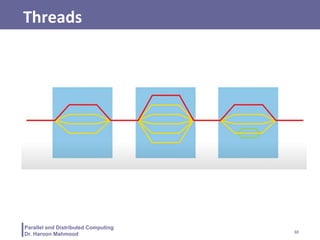
Thread
 A thread is “an independent stream of
instructions that can be scheduled to run by
the operating system”
 A thread is also a “procedure that runs
independently from its main program”
 Pthreads have been specified (for UNIX) by
IEEE POSIX 1003.1c standard (1995)
 There exist other threads libraries, such as
Java threads, Solaris threads etc.
4
Parallel and Distributed Computing
Dr. Haroon Mahmood
Multithreading
 Operating system facility that enables an
application to create threads of execution within a
process
 Many different users can run programs that
appears to be running at the same time
 However with single processing unit, they are not
running at exact same time
 Operating system switches available resources
from one running program to another
 Multiple threads exist within each process and
share resources like memory
5
Parallel and Distributed Computing
Dr. Haroon Mahmood
Pthreads
Posix thread API
 standard threads API, supported by most vendors
 Pthreads are interesting for:
 Overlapping I/O and CPU work; some threads can
block for I/O while others can continue
 Scheduling and load balancing
 Ease of programming and widespread use
 In parallel programming they can be very useful, since
communications between threads are much faster (3-5
times)
6
Parallel and Distributed Computing
Dr. Haroon Mahmood
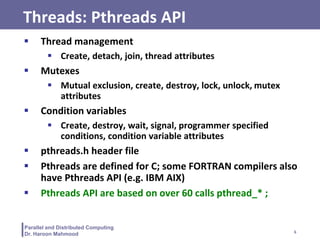
Threads: Pthreads API
 Thread management
 Create, detach, join, thread attributes
 Mutexes
 Mutual exclusion, create, destroy, lock, unlock, mutex
attributes
 Condition variables
 Create, destroy, wait, signal, programmer specified
conditions, condition variable attributes
 pthreads.h header file
 Pthreads are defined for C; some FORTRAN compilers also
have Pthreads API (e.g. IBM AIX)
 Pthreads API are based on over 60 calls pthread_* ;
7
Parallel and Distributed Computing
Dr. Haroon Mahmood
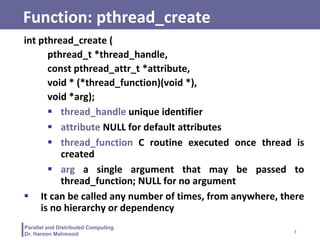
Function: pthread_create
int pthread_create (
pthread_t *thread_handle,
const pthread_attr_t *attribute,
void * (*thread_function)(void *),
void *arg);
 thread_handle unique identifier
 attribute NULL for default attributes
 thread_function C routine executed once thread is
created
 arg a single argument that may be passed to
thread_function; NULL for no argument
 It can be called any number of times, from anywhere, there
is no hierarchy or dependency
8
Parallel and Distributed Computing
Dr. Haroon Mahmood
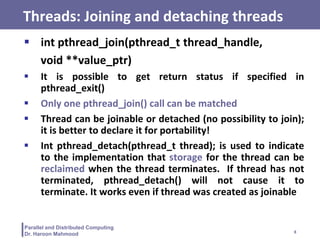
Threads: Joining and detaching threads
 int pthread_join(pthread_t thread_handle,
void **value_ptr)
 It is possible to get return status if specified in
pthread_exit()
 Only one pthread_join() call can be matched
 Thread can be joinable or detached (no possibility to join);
it is better to declare it for portability!
 Int pthread_detach(pthread_t thread); is used to indicate
to the implementation that storage for the thread can be
reclaimed when the thread terminates. If thread has not
terminated, pthread_detach() will not cause it to
terminate. It works even if thread was created as joinable
9
Parallel and Distributed Computing
Dr. Haroon Mahmood
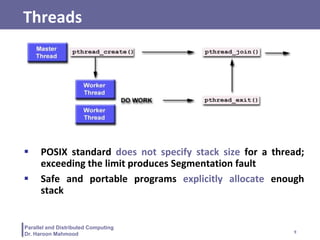
Threads
 POSIX standard does not specify stack size for a thread;
exceeding the limit produces Segmentation fault
 Safe and portable programs explicitly allocate enough
stack
10
Parallel and Distributed Computing
Dr. Haroon Mahmood
Threads
11
Parallel and Distributed Computing
Dr. Haroon Mahmood
Thread Example
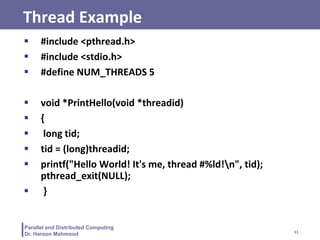
 #include <pthread.h>
 #include <stdio.h>
 #define NUM_THREADS 5
 void *PrintHello(void *threadid)
 {
 long tid;
 tid = (long)threadid;
 printf("Hello World! It's me, thread #%ld!n", tid);
pthread_exit(NULL);
 }
12
Parallel and Distributed Computing
Dr. Haroon Mahmood
Thread Example
int main (int argc, char *argv[])
{
pthread_t threads[NUM_THREADS];
int rc; long t;
for(t=0; t<NUM_THREADS; t++)
{
rc = pthread_create(&threads[t], NULL, PrintHello, (void *)t);
if (rc)
{
printf("ERROR; return code from pthread_create() is %dn", rc);
exit(-1);
}
}
}
13
Parallel and Distributed Computing
Dr. Haroon Mahmood
Synchronization problem
 Example: Bank Transactions
 Current balance = Rs. 70,000
 Check deposited = Rs. 10,000
 ATM withdrawn = Rs. 5,000
 Correct Balance after both transactions
 Balance = 75000
What if both transactions are initiated at the same time!
 Check Deposit:
 MOV A, Balance // A = 70,000
 ADD A, Deposited // A = 80,000
 ATM Withdrawal:
 MOV B, Balance // B = 70,000
 SUB B, Withdrawn // B = 65,000
14
Parallel and Distributed Computing
Dr. Haroon Mahmood
Mutual exclusion
 Mutual exclusion variables (Mutex) work like a lock
protecting access to a shared resource
 Only one thread can lock a mutex at a moment; even if
more than one thread tries to lock the mutex, only one will
be successful; this avoids race
 Sequence:
 Creation of the mutex
 More than one thread tries to lock the mutex
 Only one locks it
 The owner makes changes
 The owner unlocks it
 Another thread gets mutex (it was blocked, unblocking is
automatic) and the process repeats
 At the end mutex is destroyed
15
Parallel and Distributed Computing
Dr. Haroon Mahmood
Critical Section
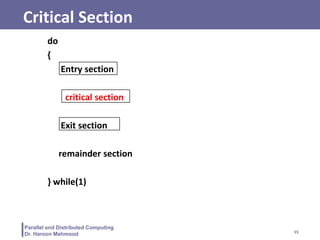
do
{
Entry section
critical section
Exit section
remainder section
} while(1)
16
Parallel and Distributed Computing
Dr. Haroon Mahmood
Mutual exclusion
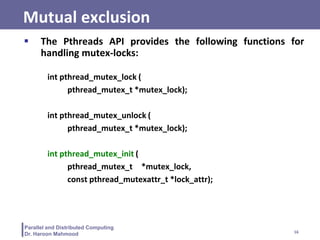
 The Pthreads API provides the following functions for
handling mutex-locks:
int pthread_mutex_lock (
pthread_mutex_t *mutex_lock);
int pthread_mutex_unlock (
pthread_mutex_t *mutex_lock);
int pthread_mutex_init (
pthread_mutex_t *mutex_lock,
const pthread_mutexattr_t *lock_attr);
17
Parallel and Distributed Computing
Dr. Haroon Mahmood
Mutual exclusion
 For example:
pthread_mutex_t total_cost_lock;
...
main() {
....
pthread_mutex_init(&total_cost_lock, NULL);
....
}
void *add_cost(void *costn) {
....
pthread_mutex_lock(&total_cost_lock);
total_cost = total_cost + costn;
/* and unlock the mutex */
pthread_mutex_unlock(&total_cost_lock);
}
18
Parallel and Distributed Computing
Dr. Haroon Mahmood
Locking overhead
 Locks represent serialization points since critical sections
must be executed by threads one after the other.
 Encapsulating large segments of the program within locks
can lead to significant performance degradation.
 It is often possible to reduce the idling overhead associated
with locks using an alternate function,
pthread_mutex_trylock.
int pthread_mutex_trylock (
pthread_mutex_t *mutex_lock);
 pthread_mutex_trylock is typically much faster than
pthread_mutex_lock on typical systems since it does not
have to deal with queues associated with locks for multiple
threads waiting on the lock.
19
Parallel and Distributed Computing
Dr. Haroon Mahmood
Trylock()
pthread_mutex_t total_cost_lock;
Int lock_status;
main() {
pthread_mutex_init(&total_cost_lock, NULL);
....
}
void *add_cost(void *costn) {
....
Lock_status pthread_mutex_trylock(&total_cost_lock);
If (lock_status == EBUSY)
addlater;
else
total_cost = total_cost + costn;
/* and unlock the mutex */
pthread_mutex_unlock(&total_cost_lock);
}
20
Parallel and Distributed Computing
Dr. Haroon Mahmood
Additional Resources
 Introduction to Parallel Computing by Ananth Grama and
Anshul Gupta
 Chapter 7: Programming Shared Address Space Platforms
21
Parallel and Distributed Computing
Dr. Haroon Mahmood
Thank You!

PDCCLECTUREE.pptx

  • 1.
    Parallel and Distributed Computing CS3006(BCS-6E-6F) Lecture 07 Danyal Farhat FAST School of Computing NUCES Lahore
  • 2.
    2 Parallel and DistributedComputing Dr. Haroon Mahmood Programming Shared Address Space Platforms using POSIX Thread API
  • 3.
    3 Parallel and DistributedComputing Dr. Haroon Mahmood Thread  A thread is “an independent stream of instructions that can be scheduled to run by the operating system”  A thread is also a “procedure that runs independently from its main program”  Pthreads have been specified (for UNIX) by IEEE POSIX 1003.1c standard (1995)  There exist other threads libraries, such as Java threads, Solaris threads etc.
  • 4.
    4 Parallel and DistributedComputing Dr. Haroon Mahmood Multithreading  Operating system facility that enables an application to create threads of execution within a process  Many different users can run programs that appears to be running at the same time  However with single processing unit, they are not running at exact same time  Operating system switches available resources from one running program to another  Multiple threads exist within each process and share resources like memory
  • 5.
    5 Parallel and DistributedComputing Dr. Haroon Mahmood Pthreads Posix thread API  standard threads API, supported by most vendors  Pthreads are interesting for:  Overlapping I/O and CPU work; some threads can block for I/O while others can continue  Scheduling and load balancing  Ease of programming and widespread use  In parallel programming they can be very useful, since communications between threads are much faster (3-5 times)
  • 6.
    6 Parallel and DistributedComputing Dr. Haroon Mahmood Threads: Pthreads API  Thread management  Create, detach, join, thread attributes  Mutexes  Mutual exclusion, create, destroy, lock, unlock, mutex attributes  Condition variables  Create, destroy, wait, signal, programmer specified conditions, condition variable attributes  pthreads.h header file  Pthreads are defined for C; some FORTRAN compilers also have Pthreads API (e.g. IBM AIX)  Pthreads API are based on over 60 calls pthread_* ;
  • 7.
    7 Parallel and DistributedComputing Dr. Haroon Mahmood Function: pthread_create int pthread_create ( pthread_t *thread_handle, const pthread_attr_t *attribute, void * (*thread_function)(void *), void *arg);  thread_handle unique identifier  attribute NULL for default attributes  thread_function C routine executed once thread is created  arg a single argument that may be passed to thread_function; NULL for no argument  It can be called any number of times, from anywhere, there is no hierarchy or dependency
  • 8.
    8 Parallel and DistributedComputing Dr. Haroon Mahmood Threads: Joining and detaching threads  int pthread_join(pthread_t thread_handle, void **value_ptr)  It is possible to get return status if specified in pthread_exit()  Only one pthread_join() call can be matched  Thread can be joinable or detached (no possibility to join); it is better to declare it for portability!  Int pthread_detach(pthread_t thread); is used to indicate to the implementation that storage for the thread can be reclaimed when the thread terminates. If thread has not terminated, pthread_detach() will not cause it to terminate. It works even if thread was created as joinable
  • 9.
    9 Parallel and DistributedComputing Dr. Haroon Mahmood Threads  POSIX standard does not specify stack size for a thread; exceeding the limit produces Segmentation fault  Safe and portable programs explicitly allocate enough stack
  • 10.
    10 Parallel and DistributedComputing Dr. Haroon Mahmood Threads
  • 11.
    11 Parallel and DistributedComputing Dr. Haroon Mahmood Thread Example  #include <pthread.h>  #include <stdio.h>  #define NUM_THREADS 5  void *PrintHello(void *threadid)  {  long tid;  tid = (long)threadid;  printf("Hello World! It's me, thread #%ld!n", tid); pthread_exit(NULL);  }
  • 12.
    12 Parallel and DistributedComputing Dr. Haroon Mahmood Thread Example int main (int argc, char *argv[]) { pthread_t threads[NUM_THREADS]; int rc; long t; for(t=0; t<NUM_THREADS; t++) { rc = pthread_create(&threads[t], NULL, PrintHello, (void *)t); if (rc) { printf("ERROR; return code from pthread_create() is %dn", rc); exit(-1); } } }
  • 13.
    13 Parallel and DistributedComputing Dr. Haroon Mahmood Synchronization problem  Example: Bank Transactions  Current balance = Rs. 70,000  Check deposited = Rs. 10,000  ATM withdrawn = Rs. 5,000  Correct Balance after both transactions  Balance = 75000 What if both transactions are initiated at the same time!  Check Deposit:  MOV A, Balance // A = 70,000  ADD A, Deposited // A = 80,000  ATM Withdrawal:  MOV B, Balance // B = 70,000  SUB B, Withdrawn // B = 65,000
  • 14.
    14 Parallel and DistributedComputing Dr. Haroon Mahmood Mutual exclusion  Mutual exclusion variables (Mutex) work like a lock protecting access to a shared resource  Only one thread can lock a mutex at a moment; even if more than one thread tries to lock the mutex, only one will be successful; this avoids race  Sequence:  Creation of the mutex  More than one thread tries to lock the mutex  Only one locks it  The owner makes changes  The owner unlocks it  Another thread gets mutex (it was blocked, unblocking is automatic) and the process repeats  At the end mutex is destroyed
  • 15.
    15 Parallel and DistributedComputing Dr. Haroon Mahmood Critical Section do { Entry section critical section Exit section remainder section } while(1)
  • 16.
    16 Parallel and DistributedComputing Dr. Haroon Mahmood Mutual exclusion  The Pthreads API provides the following functions for handling mutex-locks: int pthread_mutex_lock ( pthread_mutex_t *mutex_lock); int pthread_mutex_unlock ( pthread_mutex_t *mutex_lock); int pthread_mutex_init ( pthread_mutex_t *mutex_lock, const pthread_mutexattr_t *lock_attr);
  • 17.
    17 Parallel and DistributedComputing Dr. Haroon Mahmood Mutual exclusion  For example: pthread_mutex_t total_cost_lock; ... main() { .... pthread_mutex_init(&total_cost_lock, NULL); .... } void *add_cost(void *costn) { .... pthread_mutex_lock(&total_cost_lock); total_cost = total_cost + costn; /* and unlock the mutex */ pthread_mutex_unlock(&total_cost_lock); }
  • 18.
    18 Parallel and DistributedComputing Dr. Haroon Mahmood Locking overhead  Locks represent serialization points since critical sections must be executed by threads one after the other.  Encapsulating large segments of the program within locks can lead to significant performance degradation.  It is often possible to reduce the idling overhead associated with locks using an alternate function, pthread_mutex_trylock. int pthread_mutex_trylock ( pthread_mutex_t *mutex_lock);  pthread_mutex_trylock is typically much faster than pthread_mutex_lock on typical systems since it does not have to deal with queues associated with locks for multiple threads waiting on the lock.
  • 19.
    19 Parallel and DistributedComputing Dr. Haroon Mahmood Trylock() pthread_mutex_t total_cost_lock; Int lock_status; main() { pthread_mutex_init(&total_cost_lock, NULL); .... } void *add_cost(void *costn) { .... Lock_status pthread_mutex_trylock(&total_cost_lock); If (lock_status == EBUSY) addlater; else total_cost = total_cost + costn; /* and unlock the mutex */ pthread_mutex_unlock(&total_cost_lock); }
  • 20.
    20 Parallel and DistributedComputing Dr. Haroon Mahmood Additional Resources  Introduction to Parallel Computing by Ananth Grama and Anshul Gupta  Chapter 7: Programming Shared Address Space Platforms
  • 21.
    21 Parallel and DistributedComputing Dr. Haroon Mahmood Thank You!

Editor's Notes

  • #6 Portable Operating System Interface (Posix)
  • #7 There are over 60 thread procedures, all prefixed pthread_ and they can be categorized into three groups.
  • #8 On successful creation of a thread, a unique identifier is associated with the thread and assigned to the location pointed to by thread_handle. The thread has the attributes described by the attribute argument. When this argument is NULL, a thread with default attributes is created. The arg field specifies a pointer to the argument to function thread_function. This argument is typically used to pass the workspace and other thread-specific data to a thread. On successful creation of a thread, pthread_create returns 0; else it returns an error code.
  • #17 “init” function initializes the mutex-lock mutex_lock to an unlocked state.