In Limbo:
Dilemmas Faced by
  Undocumented
      Students
        By: Michelle Sotolongo
           Academic Advisor
           University College
  Texas State University – San Marcos
Papers
 the movie
   2009
What Is an Undocumented
        Immigrant; Student?
 Defined as a person who has entered the country
  without official authorization.

 The INA’s definition of an “alien” is any person who
  is not a citizen or a national of the United States

 An undocumented student is one who was born
  abroad and brought over at a young age,
  completing most of his or her schooling in the
  U.S.A.
Why don’t they just wait for their
 documents and enter legally, like
       “everyone else”?
 Green Card Wait Times:
    Skilled workers/professionals: currently exceeds 5 years
    Siblings of US citizens: 11-12 years or 22 years if from the Philippines
    Spouse or minor child of legal resident: 5 yrs, 7 if from Mexico


 Government fees (for HB-1 visa) have increased for hiring
  skilled foreign-born professionals, generally exceeding $3,000
  for each individual hired
    Skilled foreign nationals, particularly graduates of US universities, cannot
     work or remain in the United States without HB-1 visas
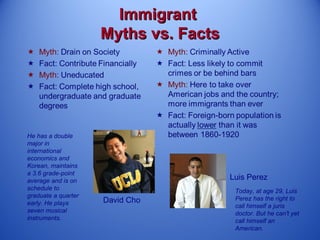
Immigrant
                     Myths vs. Facts


He has a double
major in
international
economics and
Korean, maintains
a 3.6 grade-point
average and is on                      Luis Perez
schedule to                             Today, at age 29, Luis
graduate a quarter                      Perez has the right to
early. He plays      David Cho
                                        call himself a juris
seven musical                           doctor. But he can't yet
instruments.                            call himself an
                                        American.
Psyche of an Undocumented Student

Fear of deportation
Loneliness
Depression
Frustration
Challenges Faced
 Loss of close relationships
 Housing problems
 Obtaining legal documentation
 Acculturation and/or Assimilation process
 Learning English language
 Negotiating their ethnic identity
 Changing family roles
 Adjusting to schooling experience
How the Students Cope With their
           Dilemma
Organizing protests, rallies, and voter
 registration drives
Succeeding in completing degrees
Volunteering and Community Involvement
Advocacy and Awareness
How Institutions Cope With the
                Dilemma
           FOR                                        AGAINST
   California                              ×   Alabama – complete ban
                                           ×   Georgia
    Connecticut
                                            ×   Indiana
   Illinois                                ×   South Carolina – complete ban
   Maryland
   Rhode Island, the first state in the
    nation to decide the issue as a
    matter of policy

                               UNDECIDED
             o Montana, will let voters decide in November 2012 whether
               or not to deny lower tuition rates
             o Oregon, still considering allowing in-state tuition
What Roles We Play:
           Faculty and Staff
                 ADMISSIONS
 Find out UPPS on undocumented students, or if
  one even exists
 Make students aware of their academic options for
  their specific situations and goals
 Mention accessibility of college during recruiting
  trips to junior high and high schools
What Roles We Play:
                   Faculty and Staff
                         FINANCIAL AID
 Know what and how to search for available aid that does not require a
  social security number
                             National:
      Mexican American Legal Defense Fund, Latino College Dollars,
                The East Los Angeles Community Union
                                State:
           TASFA, TEXAS Grant, Texas Public Education Grant
Texas High school graduates qualifying for state residency under Education
    Code Sections 54.052 & 54.053 (formerly House Bill 1403/Senate Bill
    1528) are eligible to apply for state financial aid as well as pay in-state
                   tuition at public colleges and universities.
What Roles We Play:
       Faculty and Staff

          FINANCIAL AID
               Private
        University/Departmental

**There are no legal ramifications for
 private organizations or individuals
      who grant scholarships to
      undocumented students**
What Roles We Play:
            Faculty and Staff
             ACADEMIC ADVISORS
 Offer guidance and support, referring to campus
  counseling services if needed
 Become knowledgeable with graduate and doctoral
  programs that accept undocumented students
 Be able to provide resources for the student to be
  involved in finding solutions, fostering self-sufficient
  behavior and increasing self-esteem
 Be honest about what happens after graduation
  and facilitate an open dialogue with students,
  encouraging them to continue one with their
  parents
What Roles We Play:
             Faculty and Staff
PROSPECTIVE STUDENTS AND COMMUNITY
 Provide information on the DREAM Act
 Make students aware of their eligibility to apply when
  passed
 Hold independent informational workshops in the
  community, during orientations or campus visitation
  days
 Source or develop a student support group
 Source or develop a scholarship fund for undocumented
  students at your campus
D   EVELOPMENT


R   ELIEF and


E   DUCATION of


A   LIEN


M   INORS
DREAM Act Criteria
 Would extend a six-year conditional legal residency
  status to undocumented youth who meet several
  criteria, including:
   – Entry into the United States before age 16
   – Continuous presence in the United States for
      five years prior to the bill’s enactment
   – Receipt of a high school diploma or its
      equivalent (GED), or admission into an
      institution of higher education
   – Must be between the ages of 12 and 35
      at the time of application
   – Demonstrated good moral character
DREAM Act Concerns
 Undocumented students would be taking seats and
  financial aid away from native-born students
  – 10 states have already passed laws allowing undocumented
    students to qualify for in-state tuition: California, Illinois,
    Kansas, Nebraska, New Mexico, New York, Oklahoma,
    Texas, Utah, and Washington
      None of these states, which are home to
       about half the nation’s undocumented
       immigrants, have experienced a large influx
       of enrollment in higher education
      Native-born students have not been
       displaced by undocumented students
      Educational systems in these states have not
       reported the undocumented students to be a
       financial drain
DREAM Act Benefits
Qualifying youth would be authorized to:
Work legally in the United States
Go to school
Join the military
DREAM Act Benefits
During the six-year conditional status, the beneficiary
would be able to transition to permanent legal resident
status, and consequently be able to apply for US
citizenship, if:
–they graduate from a two-year college
–complete two years of a four-year degree
–or serve at least two years in the US military


No longer forced to work in the cash economy as
domestic workers
day laborers
ambulatory vendors
sweatshop factory workers
           Undocumented students in higher education
                          Better jobs
           Increase tax revenues from higher salaries
               = future competitiveness as a nation
…This Just In

•June 15, 2012
Q&A
 If you have any additional questions,
concerns, or suggestions you can email
       me at ms84@txstate.edu


         Thank you!
Sources
•   Abrego, L. (2006). I can't go to college because i don't have papers. Latino Studies, 4,
    212-231.
•   Anderson, S., & Miller, D. (2006). Legal immigrants: waiting forever, an analysis of the
    green card backlogs and processing delays affecting families, skilled professionals and
    us employers. Arlington, VA: National Foundation for American Policy.
•   Assimilation. (2010). In Encyclopædia Britannica. Retrieved December 03, 2010, from
    Encyclopædia Britannica Online:
    http://www.britannica.com/EBchecked/topic/39328/assimilation
•   Basic information about the dream act legislation. (2010, July 16). Retrieved from
    http://dreamact.info/students.
•   De Leon, S. (2005). Assimilation and ambiguous experience of the resilient male
    Mexican immigrants that successfully navigate American higher education. Unpublished
    doctoral dissertation, University of Texas, Austin.
•   Diamond, L. (2011, August 18). Colleges ask proff of legal residency. The Atlanta Journal-
    Constitution. Retrieved from
    http://www.ajc.com/news/georgia-politics-elections/colleges-ask-proof-of-1119338.html
•   Dozier, S.B. (1993). Emotional concerns of undocumented and out-of-status foreign
    students. Community Review. 13,33-29.
•   Fortuny, K., Capps, R., & Passel, J.S. (2007). The characteristics of unauthorized
    immigrants in California, Los Angeles County, and the United States. Washington, DC:
    The Urban Institute.
•   From anecdotes to evidence: setting the record straight on immigrants and crime. (2008,
    September 10). Retrieved from
    http://www.immigrationpolicy.org/just-facts/anecdotes-evidence-setting-record-straight-immigrants-an
Sources continued
•   Garza, C.L. (2006, April 6). Immigrant students seek path to a dream. Houston Chronicle,
    pp. A1, A3.
•   Garza, E., Reyes, P., Trueba, E. (2004). Resiliency and success: Migrant children in the
    United States. Boulder, CO: Paradigm.
•   Gonzales, R. G. (2007). “Wasted Talent and Broken Dreams: The Lost Potential of
    undocumented students.” Immigration Policy in Focus 5: 1-11.
•   Igoa, C. (1995). The inner world of the immigrant child. Mahwah, NJ: Lawrence Erlbaum.
•   Illegal immigrant law & legal definition. (2010). Retrieved from http://definitions.uslegal.com/
    i/illegal-immigrant/
•   Macris, G. (2011, September 27). R.i. will allow undocumented students to pay in-state
    tuition. The Providence Journal. Retrieved from
    http://www.projo.com/education/content/IMMIGRANT_VOTE1_09-27-11_TAQK2V5_v13.6c526.html
•   Marcum, D. (2010, November 28). Students want the dream act to become reality. Los
    Angeles Times.
•   Ocaña, D. (2010, September). Chasing a dream. Latina Magazine, 116-121.
•   Olivas, M. (1995). Storytelling out of school: undocumented college residency, race, and
    reaction. Hastings Constitutional Law Quarterly, 22(4), 1019.
•   Papers the movie: a story of undocumented youth. (2009). [Web]. Retrieved from
    http://www.youtube.com/watch?v=eyy-obcOMiM
•   Passel, J. S. 2003. Further demographic information relating to the DREAM act.
    Washington, D.C.: The Urban Institute.
    www.nilc.org/immlawpolicy/DREAM/DREAM_Demographics.pdf
Sources continued
•   Passel, J.S. (2001). Demographic information relating to H.R. 1918, The Student
    Adjustment Act. Washington, DC: The Urban Institute.
•   Passel, J.S., Capps, R., Fix, M. (2004). Undocumented Immigrants: Facts and Figures.
    Urban Institute Immigration Studies Program.
•   Perez, W., Espinoza, R., Ramos, K., Coronado, H.M., & Cortes, R. (2009). Academic
    resilience among undocumented Latino students. Hispanic Journal of Behavioral Sciences,
    31, 150-153.
•   Perez, William. (2009). We are americans: undocumented students pursuing the American
    dream. Sterling, VA: Stylus. Xi-xxxiv.
•   Portes, A., & Rumbaut, R.G. (2001). Legacies: The story of the immigrant second
    generation. Berkley: University of California Press.
•   Strayhorn, C.K. Office of the Texas State Comptroller, (2006). Special report:
    undocumented immigrants in Texas: a financial analysis of the impact of to the state budget
    and economy (96-1224). Austin, TX: Texas Comptroller of Public Accounts.
•   Suarez-Orozco, C., & Suarez-Orozco, M. (2001). Children of immigration. Cambridge,
    MA: Harvard University Press.
•   Tobar, H. (2010, November 26). Undocumented UCLA law grad is in a legal bind. Los
    Angeles Times.
•   Vargas, J. A. (2011, June 22). My life as an undocumented immigrant. The New York
    Times. Retrieved from
    http://www.nytimes.com/2011/06/26/magazine/my-life-as-an-undocumented-immigrant.html?pagewan
•   Zhou, M. (1991). Growing up American: The challenge of immigrant children and children
    of immigrants. Annual Review of Sociology. 23, 63-95.

Pd in limbo pc

  • 1.
    In Limbo: Dilemmas Facedby Undocumented Students By: Michelle Sotolongo Academic Advisor University College Texas State University – San Marcos
  • 2.
  • 3.
    What Is anUndocumented Immigrant; Student?  Defined as a person who has entered the country without official authorization.  The INA’s definition of an “alien” is any person who is not a citizen or a national of the United States  An undocumented student is one who was born abroad and brought over at a young age, completing most of his or her schooling in the U.S.A.
  • 4.
    Why don’t theyjust wait for their documents and enter legally, like “everyone else”?  Green Card Wait Times:  Skilled workers/professionals: currently exceeds 5 years  Siblings of US citizens: 11-12 years or 22 years if from the Philippines  Spouse or minor child of legal resident: 5 yrs, 7 if from Mexico  Government fees (for HB-1 visa) have increased for hiring skilled foreign-born professionals, generally exceeding $3,000 for each individual hired  Skilled foreign nationals, particularly graduates of US universities, cannot work or remain in the United States without HB-1 visas
  • 6.
    Immigrant Myths vs. Facts He has a double major in international economics and Korean, maintains a 3.6 grade-point average and is on Luis Perez schedule to Today, at age 29, Luis graduate a quarter Perez has the right to early. He plays David Cho call himself a juris seven musical doctor. But he can't yet instruments. call himself an American.
  • 7.
    Psyche of anUndocumented Student Fear of deportation Loneliness Depression Frustration
  • 8.
    Challenges Faced  Lossof close relationships  Housing problems  Obtaining legal documentation  Acculturation and/or Assimilation process  Learning English language  Negotiating their ethnic identity  Changing family roles  Adjusting to schooling experience
  • 9.
    How the StudentsCope With their Dilemma Organizing protests, rallies, and voter registration drives Succeeding in completing degrees Volunteering and Community Involvement Advocacy and Awareness
  • 10.
    How Institutions CopeWith the Dilemma FOR AGAINST  California × Alabama – complete ban  × Georgia Connecticut × Indiana  Illinois × South Carolina – complete ban  Maryland  Rhode Island, the first state in the nation to decide the issue as a matter of policy UNDECIDED o Montana, will let voters decide in November 2012 whether or not to deny lower tuition rates o Oregon, still considering allowing in-state tuition
  • 11.
    What Roles WePlay: Faculty and Staff ADMISSIONS  Find out UPPS on undocumented students, or if one even exists  Make students aware of their academic options for their specific situations and goals  Mention accessibility of college during recruiting trips to junior high and high schools
  • 12.
    What Roles WePlay: Faculty and Staff FINANCIAL AID  Know what and how to search for available aid that does not require a social security number National: Mexican American Legal Defense Fund, Latino College Dollars, The East Los Angeles Community Union State: TASFA, TEXAS Grant, Texas Public Education Grant Texas High school graduates qualifying for state residency under Education Code Sections 54.052 & 54.053 (formerly House Bill 1403/Senate Bill 1528) are eligible to apply for state financial aid as well as pay in-state tuition at public colleges and universities.
  • 13.
    What Roles WePlay: Faculty and Staff FINANCIAL AID Private University/Departmental **There are no legal ramifications for private organizations or individuals who grant scholarships to undocumented students**
  • 14.
    What Roles WePlay: Faculty and Staff ACADEMIC ADVISORS  Offer guidance and support, referring to campus counseling services if needed  Become knowledgeable with graduate and doctoral programs that accept undocumented students  Be able to provide resources for the student to be involved in finding solutions, fostering self-sufficient behavior and increasing self-esteem  Be honest about what happens after graduation and facilitate an open dialogue with students, encouraging them to continue one with their parents
  • 15.
    What Roles WePlay: Faculty and Staff PROSPECTIVE STUDENTS AND COMMUNITY  Provide information on the DREAM Act  Make students aware of their eligibility to apply when passed  Hold independent informational workshops in the community, during orientations or campus visitation days  Source or develop a student support group  Source or develop a scholarship fund for undocumented students at your campus
  • 16.
    D EVELOPMENT R ELIEF and E DUCATION of A LIEN M INORS
  • 17.
    DREAM Act Criteria Would extend a six-year conditional legal residency status to undocumented youth who meet several criteria, including: – Entry into the United States before age 16 – Continuous presence in the United States for five years prior to the bill’s enactment – Receipt of a high school diploma or its equivalent (GED), or admission into an institution of higher education – Must be between the ages of 12 and 35 at the time of application – Demonstrated good moral character
  • 18.
    DREAM Act Concerns Undocumented students would be taking seats and financial aid away from native-born students – 10 states have already passed laws allowing undocumented students to qualify for in-state tuition: California, Illinois, Kansas, Nebraska, New Mexico, New York, Oklahoma, Texas, Utah, and Washington None of these states, which are home to about half the nation’s undocumented immigrants, have experienced a large influx of enrollment in higher education Native-born students have not been displaced by undocumented students Educational systems in these states have not reported the undocumented students to be a financial drain
  • 19.
    DREAM Act Benefits Qualifyingyouth would be authorized to: Work legally in the United States Go to school Join the military
  • 20.
    DREAM Act Benefits Duringthe six-year conditional status, the beneficiary would be able to transition to permanent legal resident status, and consequently be able to apply for US citizenship, if: –they graduate from a two-year college –complete two years of a four-year degree –or serve at least two years in the US military No longer forced to work in the cash economy as domestic workers day laborers ambulatory vendors sweatshop factory workers Undocumented students in higher education Better jobs Increase tax revenues from higher salaries = future competitiveness as a nation
  • 21.
  • 22.
    Q&A If youhave any additional questions, concerns, or suggestions you can email me at ms84@txstate.edu Thank you!
  • 23.
    Sources • Abrego, L. (2006). I can't go to college because i don't have papers. Latino Studies, 4, 212-231. • Anderson, S., & Miller, D. (2006). Legal immigrants: waiting forever, an analysis of the green card backlogs and processing delays affecting families, skilled professionals and us employers. Arlington, VA: National Foundation for American Policy. • Assimilation. (2010). In Encyclopædia Britannica. Retrieved December 03, 2010, from Encyclopædia Britannica Online: http://www.britannica.com/EBchecked/topic/39328/assimilation • Basic information about the dream act legislation. (2010, July 16). Retrieved from http://dreamact.info/students. • De Leon, S. (2005). Assimilation and ambiguous experience of the resilient male Mexican immigrants that successfully navigate American higher education. Unpublished doctoral dissertation, University of Texas, Austin. • Diamond, L. (2011, August 18). Colleges ask proff of legal residency. The Atlanta Journal- Constitution. Retrieved from http://www.ajc.com/news/georgia-politics-elections/colleges-ask-proof-of-1119338.html • Dozier, S.B. (1993). Emotional concerns of undocumented and out-of-status foreign students. Community Review. 13,33-29. • Fortuny, K., Capps, R., & Passel, J.S. (2007). The characteristics of unauthorized immigrants in California, Los Angeles County, and the United States. Washington, DC: The Urban Institute. • From anecdotes to evidence: setting the record straight on immigrants and crime. (2008, September 10). Retrieved from http://www.immigrationpolicy.org/just-facts/anecdotes-evidence-setting-record-straight-immigrants-an
  • 24.
    Sources continued • Garza, C.L. (2006, April 6). Immigrant students seek path to a dream. Houston Chronicle, pp. A1, A3. • Garza, E., Reyes, P., Trueba, E. (2004). Resiliency and success: Migrant children in the United States. Boulder, CO: Paradigm. • Gonzales, R. G. (2007). “Wasted Talent and Broken Dreams: The Lost Potential of undocumented students.” Immigration Policy in Focus 5: 1-11. • Igoa, C. (1995). The inner world of the immigrant child. Mahwah, NJ: Lawrence Erlbaum. • Illegal immigrant law & legal definition. (2010). Retrieved from http://definitions.uslegal.com/ i/illegal-immigrant/ • Macris, G. (2011, September 27). R.i. will allow undocumented students to pay in-state tuition. The Providence Journal. Retrieved from http://www.projo.com/education/content/IMMIGRANT_VOTE1_09-27-11_TAQK2V5_v13.6c526.html • Marcum, D. (2010, November 28). Students want the dream act to become reality. Los Angeles Times. • Ocaña, D. (2010, September). Chasing a dream. Latina Magazine, 116-121. • Olivas, M. (1995). Storytelling out of school: undocumented college residency, race, and reaction. Hastings Constitutional Law Quarterly, 22(4), 1019. • Papers the movie: a story of undocumented youth. (2009). [Web]. Retrieved from http://www.youtube.com/watch?v=eyy-obcOMiM • Passel, J. S. 2003. Further demographic information relating to the DREAM act. Washington, D.C.: The Urban Institute. www.nilc.org/immlawpolicy/DREAM/DREAM_Demographics.pdf
  • 25.
    Sources continued • Passel, J.S. (2001). Demographic information relating to H.R. 1918, The Student Adjustment Act. Washington, DC: The Urban Institute. • Passel, J.S., Capps, R., Fix, M. (2004). Undocumented Immigrants: Facts and Figures. Urban Institute Immigration Studies Program. • Perez, W., Espinoza, R., Ramos, K., Coronado, H.M., & Cortes, R. (2009). Academic resilience among undocumented Latino students. Hispanic Journal of Behavioral Sciences, 31, 150-153. • Perez, William. (2009). We are americans: undocumented students pursuing the American dream. Sterling, VA: Stylus. Xi-xxxiv. • Portes, A., & Rumbaut, R.G. (2001). Legacies: The story of the immigrant second generation. Berkley: University of California Press. • Strayhorn, C.K. Office of the Texas State Comptroller, (2006). Special report: undocumented immigrants in Texas: a financial analysis of the impact of to the state budget and economy (96-1224). Austin, TX: Texas Comptroller of Public Accounts. • Suarez-Orozco, C., & Suarez-Orozco, M. (2001). Children of immigration. Cambridge, MA: Harvard University Press. • Tobar, H. (2010, November 26). Undocumented UCLA law grad is in a legal bind. Los Angeles Times. • Vargas, J. A. (2011, June 22). My life as an undocumented immigrant. The New York Times. Retrieved from http://www.nytimes.com/2011/06/26/magazine/my-life-as-an-undocumented-immigrant.html?pagewan • Zhou, M. (1991). Growing up American: The challenge of immigrant children and children of immigrants. Annual Review of Sociology. 23, 63-95.

Editor's Notes

  • #3 Movie clip
  • #4 INA = immigration and nationality act, created in 1952
  • #5 (Anderson, Miller; 2006) Luis Perez’s grandmother has unsuccessfully been trying to obtain a tourist visa to visit her grandchildren for 20 years
  • #6 These are women who were featured in a nationally published magazine (Latina) and were brave enough to give full names and show their faces to support the cause
  • #7 *2006 study by the TX state comptroller found that the estimated 1.4 million undocumented immigrants in Texas in FY 2005 added $17.7 billion to the gross state product. (Strayhorn, 2006) *Undocumented immigrants produced $1.58 billion in state revenues for Texas, which exceeded the $1.16 billion in state services they received. *65,000 undocumented high school graduates each year (Passel 2001) *less likely to commit crimes or be in jail; high rates of immigration are NOT associated with higher rates of crime (Immigration Policy Center 2008) * Only 12.5% of national population (37.5 million) is foreign-born as of 2006, actually lower than population between 1860-1920 at 13.2%-14.8% (US Census 2006 and Historical census statistics of US 1850-1990) **David Cho: With no papers, Cho can attend school but not legally work, drive or receive financial aid. He sleeps on a friend's couch or sometimes at the UCLA library. He tutors SAT students 30 hours a week for cash. More than once he's depended on charitable "food closets" on campus to get something to eat. **Luis Perez: will be the first undocumented student to graduate from UCLA Law School, but until legislation is changed, he won’t be able to work as a lawyer, even if he passes the bar in january
  • #8 Dozier (1993) found 3 central emotional concerns* for undocumented college students. Reported Examples: students afraid of going to hospitals due to possibility of immigration status being questioned Staying in poor working conditions fearing inability to find another job (Dozier) In an ethnographic study of latino adolescents some students reported a drop in academic performance and felt it was difficult to stay motivated once they learned of their status, becoming disillusioned and lowering their aspirations (Abrego 2006)
  • #9 Related stressors related to migration (Garza, Reyes, & Trueba, 2004; Igoa, 1995; Portes & Rumbaut, 2001; Suarez-Orozco & Suarez Orozco, 2001; Zhou, 1997) *1982 US Supreme Court’s Plyler vs. Doe decision noted that Equal Protection Clause of the 14 th Amendment also protected undocumented immigrants, establishing the right of undocumented children to a public education. Unfortunately, that only extends to K-12. (Olivas, 1995) Acculturation: the process of adopting the cultural traits or social patterns of another group. Assimilation: individuals or groups of differing ethnic heritage are absorbed into the dominant culture of a society. The process of assimilating involves taking on the traits of the dominant culture to such a degree that the assimilating group becomes socially indistinguishable from other members of the society. As such, assimilation is the most extreme form of acculturation (encyclopedia britannica)
  • #10 A sit-in at Arizona Sen. John McCain’s office May 2010 (Latina, 2010) Protestors march 250 miles from New York to Washington D.C., in support of the DREAM Act Day 7 of a hunger strike outside of NY Sen. Chuck Schumer’s office Overall, extra curricular participation and volunteerism were the strongest predictors of academic achievement among undocumented latino students with the resilient students reporting the highest levels of these two environmental protective resources (Resilience, 2009) Jose Antonio Vargas, Pulitzer prize-winning journalist for ny times who outed himself as an undocumented immigrant Closer to home: * 22 year old UTSA student supporter of DREAM Act participated in hunger strike in november 2010 * UTPA students are planning a teach-in/walk-out on march 31, 2011 (cesar chavez day) to protest the texas higher education coordinating board’s decision to remove the mexican american studies program
  • #11 september 2011, Rhode Island Summer 2011 Maryland New total of states: 13 allow in-state tuition, 5 forbid it * Rhode Island Board of Governors for Higher Education unanimously adopted a policy that allows undocumented students to pay in-state tuition rates at public colleges, making Rhode Island the first state in the nation to decide the issue as a matter of policy * Maryland signed a bill this summer allowing in-state tuition, Connecticut will soon sign a bill similar to Maryland’s * Illinois already grants tuition breaks to undocumented students and California may soon pass a similar proposal * University of Georgia system started requiring proof of citizenship prior to registration at its 5 most competitive public schools, according to regents is “a way to assure taxpayers that students applying to the state’s most prestigious colleges are not displaced by illegal immigrants” – in response, faculty members are teaching the denied students on their own time * Indiana’s governor has signed legislation denying in-state tuition rates * Alabama’s House and Senate have passed a proposal to deny in-state tuition
  • #12 As of this date, i have yet to get a response from my campus on whether or not we have anything about undocumented students written into policy
  • #13 *Only 10% of undocumented males and 16% of undocumented females ages 18-24 are enrolled in college (Fortuny, Capps, Passel 2007) *Only 10%-20% of undocumented youth (estimated 7,000-13,000) who graduate from high school go on to college (Passel, 2003) *In fall 2005, nearly 5,100 undocumented students enrolled under the new TX in-state tuition law, up from 400 students during the program’s first year, but still account for only a small portion of the state’s 1 million+ enrolled in higher education. Nearly 80% of all undocumented students who were enrolled in 2005 attended community colleges. (Garza 2006)
  • #14 *Economic impact study by Texas Comptroller concluded that every dollar the state invested in higher education for undocumented students would yield more than five dollars for the Texas economy in the long run (Strayhorn, 2006)
  • #15 De Leon’s (2005) qualitative study of 10 undocumented male Mexican college students revealed they felt relationships with school counselors and teachers as particularly important sources of information and guidance Most of information students receive about applying to college comes from other adults in the community, as opposed to school agents
  • #16 I will get to the DREAM Act in the next slides Having student groups is extremely risky, because any exposure could potentially cause students’ deportation or raids, as in the case at UCSD where ICE (immigration & customs enforcement) federal agency created to operate away from the US/Mexico border, and took the role of detention of undocumented people over from the US Border Patrol in 2003. raided a student’s on-campus apartment. Border patrol and ICE agents have been seen in the central texas area.
  • #18 Dreamact.info
  • #19 Gonzales, R. 2007. Wasted talent and broken dreams: The lost potential of undocumented students. Immigration Policy: In focus 5:1-11.
  • #21 Apply for the DREAM Act (Since the legislation has not yet passed, there are no specific guidelines on how to apply) Once approved and granted Conditional Permanent Residency , the individual would have to do one of the following: Enroll in an institution of higher education in order to pursue a bachelor's degree or higher degree or Enlist in one of the branches of the United States Military Within 6 years of approval for conditional permanent residency, the individual must have completed at least two (2) years of one of the options outlined in the previous step Once 5 ½ years of the 6 years have passed, the individual will then be able to apply for Legal Permanent Residency (dropping the conditional part) and consequently will be able to apply for United States Citizenship Those who have already completed at least 2 years of college education towards a bachelor's degree or higher degree, will still have to wait the 5 ½ years in order to apply for Legal Permanent Residency even though you may have already obtained a degree. Students who do not complete the requirements will be disqualified .