High School PCK in Physical Science
(Physics and Chemistry)
NextGen STEM Teacher
Preparation in WA State
2019 PCK Working Group
According To NGSS (2013)
Physical sciences performance expectations at the HS level:
▶ developing and using models
▶ planning and conducting investigations
▶ analyzing and interpreting data
▶ using mathematical and computational thinking
▶ constructing explanations
▶ understanding of several engineering practices, including design and
evaluation.
p. 117
According To NGSS (2013)
High School Physical Sciences Core Ideas:
▶ HS-PS1 Matter and Its Interactions
▶ HS-PS2 Motion and Stability: Forces and Interactions
▶ HS-PS3 Energy
▶ HS-PS4 Waves and Their Applications in Technologies for Information
Transfer
p. 118
PCK Definition
Most scholars agree that PCK includes
❑ the ways of representing and formulating the subject that make it
comprehensible to others
▶ the most useful forms of representation of those ideas
▶ the most powerful analogies, illustrations, examples, explanations, and
demonstrations
❑ Understanding of preconceptions and alternate conceptions that students bring
with them to the classroom
▶ Of different ages and backgrounds
• Since the naming of pedagogical content knowledge (PCK) by Lee Shulman in 1986,
much of the last twenty years has been devoted to defining PCK and determining
ways in which to measure it.
• Subject matter knowledge for teaching and PCK influence
one another (Daehler & Shinohara, 2001; Kinach, 2001)
Pentagon model of pedagogical content
knowledge for teaching science Park, S., & Oliver, J. S. (2008b). National
board certification (NBC) as a catalyst for
teachers’
learning about teaching: The effects of
theNBCprocess on candidate
teachers’PCKdevelopment.
Journal of Research in Science Teaching,
45(7), 812–834.
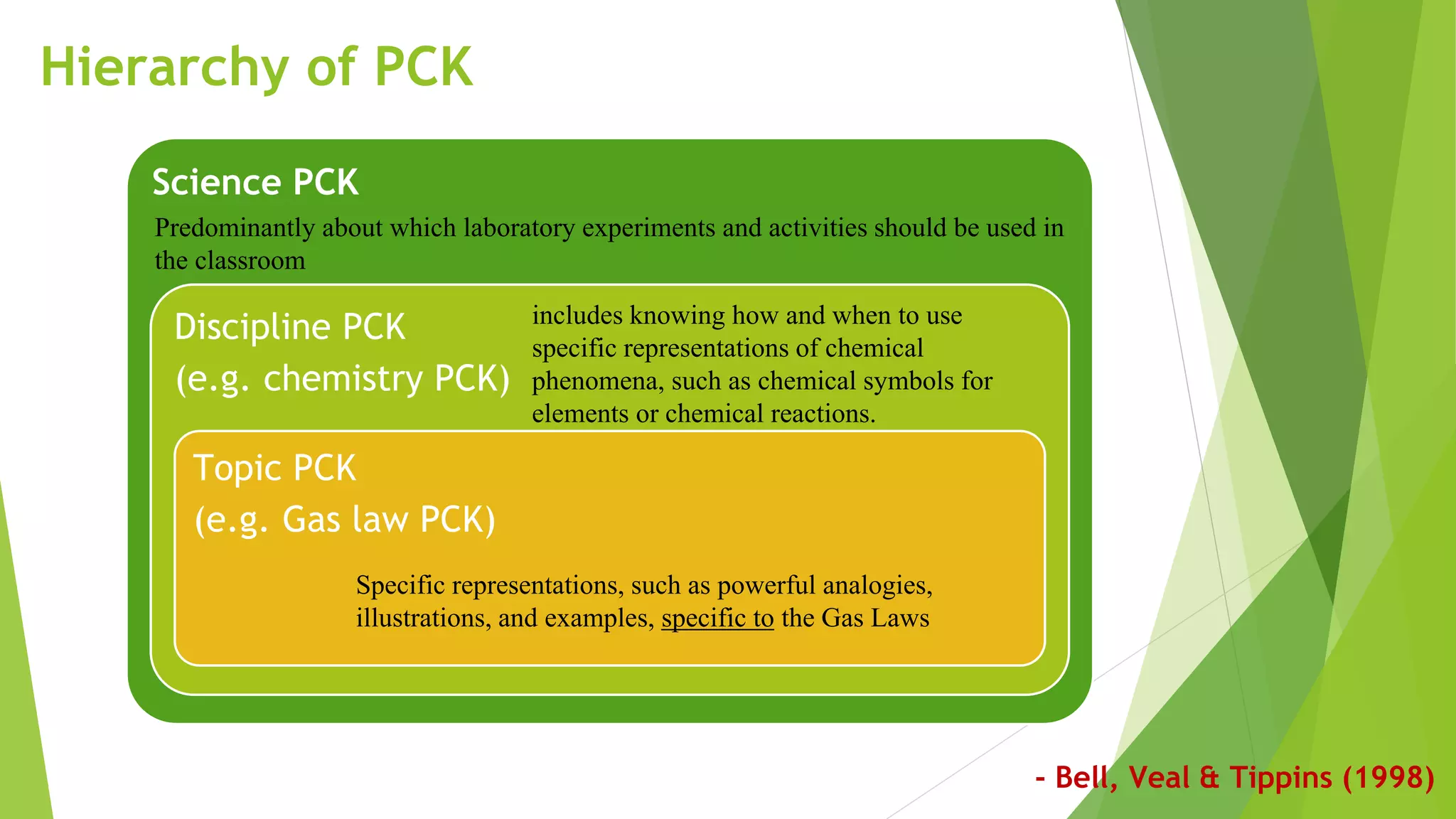
Hierarchy of PCK
Science PCK
Discipline PCK
(e.g. chemistry PCK)
Topic PCK
(e.g. Gas law PCK)
- Bell, Veal & Tippins (1998)
Predominantly about which laboratory experiments and activities should be used in
the classroom
includes knowing how and when to use
specific representations of chemical
phenomena, such as chemical symbols for
elements or chemical reactions.
Specific representations, such as powerful analogies,
illustrations, and examples, specific to the Gas Laws
▶ To speak of representations and conceptions for science or
chemistry is to talk about too broad a topic.
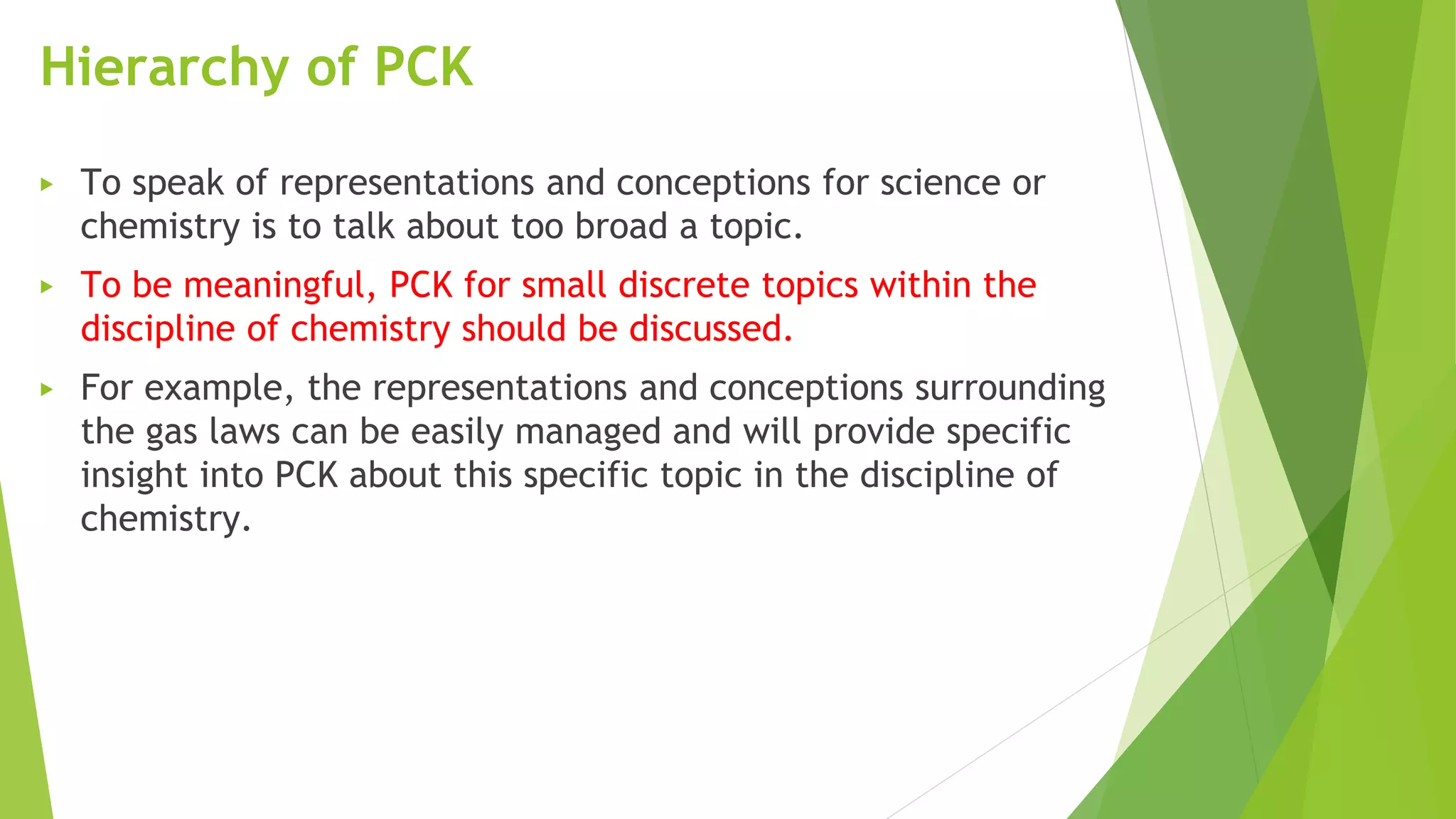
▶ To be meaningful, PCK for small discrete topics within the
discipline of chemistry should be discussed.
▶ For example, the representations and conceptions surrounding
the gas laws can be easily managed and will provide specific
insight into PCK about this specific topic in the discipline of
chemistry.
Hierarchy of PCK
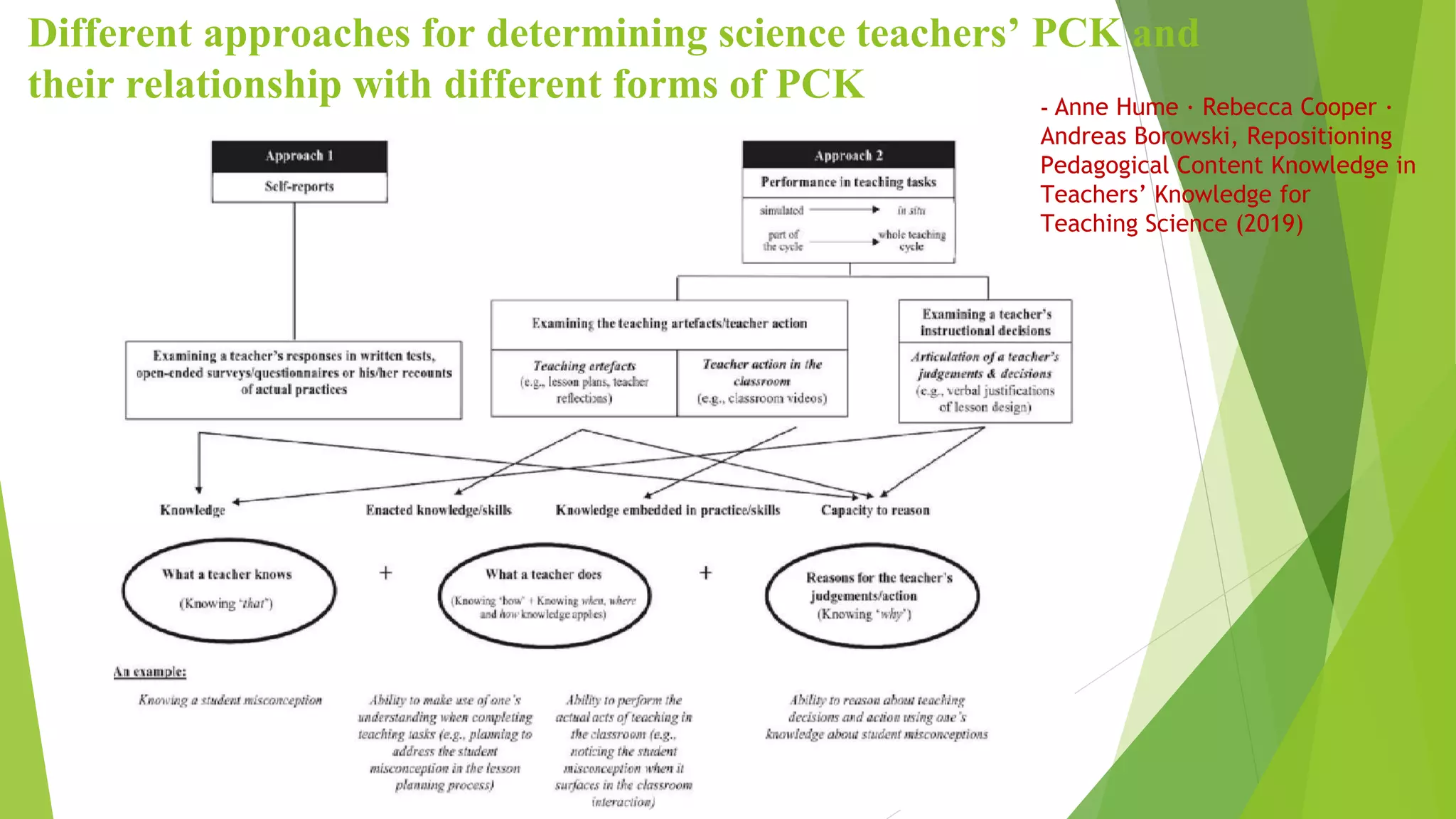
Different approaches for determining science teachers’ PCK and
their relationship with different forms of PCK - Anne Hume · Rebecca Cooper ·
Andreas Borowski, Repositioning
Pedagogical Content Knowledge in
Teachers’ Knowledge for
Teaching Science (2019)
Three Categories of
Representation in
Chemistry
Macroscopic Particulate Symbolic
- Johnstone (1991) and Gabel (1993,
1998), Sande (2010)
open to direct observation
(e.g. a balloon’s volume
increasing as the pressure inside
the balloon increases)
illustrations or drawings of
molecules, atoms, ions and
subatomic particles.
(e.g. computer simulation
of gas particles moving in a
closed container.)
symbols, equations, formula and
graphs are placed.
(e.g. P1V1 = P2V2 )
Three Categories of
Representation in
Chemistry
Macroscopic Particulate
Symbolic
Investigation of the literature about the Gas Law PCK’s practice shows
➢ weak representation and understanding of the particulate nature of matter
➢ overemphasis on symbolic representations
Representational Competency
➢ The ability to navigate between the three representations to achieve a deep understanding.
➢ Teachers’ representational competence is not well-known in the literature.
• Lin, Cheng & Lawrenz 2000, Nakhleh 1993;
Nurrenburn and Pickering 1987; Pickering
1990; Sawrey 1990, De Berg 1989
• (Gabel, 1993, Bodner, 2000, Kozma &
Russell, 1997, Levy, 2009).
• Nakhleh (1992), Kruse & Roehrig, 2005;
Lin, Cheng & Lawrenz, 2000)

PCK for High School Chemistry and Physics.pptx

  • 1.
    High School PCKin Physical Science (Physics and Chemistry) NextGen STEM Teacher Preparation in WA State 2019 PCK Working Group
  • 2.
    According To NGSS(2013) Physical sciences performance expectations at the HS level: ▶ developing and using models ▶ planning and conducting investigations ▶ analyzing and interpreting data ▶ using mathematical and computational thinking ▶ constructing explanations ▶ understanding of several engineering practices, including design and evaluation. p. 117
  • 3.
    According To NGSS(2013) High School Physical Sciences Core Ideas: ▶ HS-PS1 Matter and Its Interactions ▶ HS-PS2 Motion and Stability: Forces and Interactions ▶ HS-PS3 Energy ▶ HS-PS4 Waves and Their Applications in Technologies for Information Transfer p. 118
  • 4.
    PCK Definition Most scholarsagree that PCK includes ❑ the ways of representing and formulating the subject that make it comprehensible to others ▶ the most useful forms of representation of those ideas ▶ the most powerful analogies, illustrations, examples, explanations, and demonstrations ❑ Understanding of preconceptions and alternate conceptions that students bring with them to the classroom ▶ Of different ages and backgrounds • Since the naming of pedagogical content knowledge (PCK) by Lee Shulman in 1986, much of the last twenty years has been devoted to defining PCK and determining ways in which to measure it. • Subject matter knowledge for teaching and PCK influence one another (Daehler & Shinohara, 2001; Kinach, 2001)
  • 5.
    Pentagon model ofpedagogical content knowledge for teaching science Park, S., & Oliver, J. S. (2008b). National board certification (NBC) as a catalyst for teachers’ learning about teaching: The effects of theNBCprocess on candidate teachers’PCKdevelopment. Journal of Research in Science Teaching, 45(7), 812–834.
  • 6.
    Hierarchy of PCK SciencePCK Discipline PCK (e.g. chemistry PCK) Topic PCK (e.g. Gas law PCK) - Bell, Veal & Tippins (1998) Predominantly about which laboratory experiments and activities should be used in the classroom includes knowing how and when to use specific representations of chemical phenomena, such as chemical symbols for elements or chemical reactions. Specific representations, such as powerful analogies, illustrations, and examples, specific to the Gas Laws
  • 7.
    ▶ To speakof representations and conceptions for science or chemistry is to talk about too broad a topic. ▶ To be meaningful, PCK for small discrete topics within the discipline of chemistry should be discussed. ▶ For example, the representations and conceptions surrounding the gas laws can be easily managed and will provide specific insight into PCK about this specific topic in the discipline of chemistry. Hierarchy of PCK
  • 8.
    Different approaches fordetermining science teachers’ PCK and their relationship with different forms of PCK - Anne Hume · Rebecca Cooper · Andreas Borowski, Repositioning Pedagogical Content Knowledge in Teachers’ Knowledge for Teaching Science (2019)
  • 9.
    Three Categories of Representationin Chemistry Macroscopic Particulate Symbolic - Johnstone (1991) and Gabel (1993, 1998), Sande (2010) open to direct observation (e.g. a balloon’s volume increasing as the pressure inside the balloon increases) illustrations or drawings of molecules, atoms, ions and subatomic particles. (e.g. computer simulation of gas particles moving in a closed container.) symbols, equations, formula and graphs are placed. (e.g. P1V1 = P2V2 )
  • 10.
    Three Categories of Representationin Chemistry Macroscopic Particulate Symbolic Investigation of the literature about the Gas Law PCK’s practice shows ➢ weak representation and understanding of the particulate nature of matter ➢ overemphasis on symbolic representations Representational Competency ➢ The ability to navigate between the three representations to achieve a deep understanding. ➢ Teachers’ representational competence is not well-known in the literature. • Lin, Cheng & Lawrenz 2000, Nakhleh 1993; Nurrenburn and Pickering 1987; Pickering 1990; Sawrey 1990, De Berg 1989 • (Gabel, 1993, Bodner, 2000, Kozma & Russell, 1997, Levy, 2009). • Nakhleh (1992), Kruse & Roehrig, 2005; Lin, Cheng & Lawrenz, 2000)