PLANIFICACIÓN MICROCURRICULAR DE INGLES
PRIMER TRIMESTRE
ESCUELA DE EDUCACIÓN BÁSICA
“MARIA LUISA VITERI AGUILAR”
Amor, Estudio y Perseverancia
AÑO LECTIVO:
2023-2024
1. DATOS INFORMATIVOS:
Docente:
Lic. Ángela Rivera
Lic. Tatiana López
Ing. Gloria González
Área:
English
Asignatura: English
Grado/Curso: Segundo Paralelos: A, B y C
Trimestre Nro.:
Primero
Del: 26 de junio Hasta: 21 de julio
APRENDIZAJE DISCIPLINAR:
OBJETIVOS DE APRENDIZAJE:
O.EFL 2.1 Assess and appreciate English as an international language, as well as the five aspects of English that contribute to communicative competence.
O.EFL 2.2 Use in-class library resources and explore the use of ICT to enrich competencies in the four skills.
O.EFL 2.3 Be able to interact in English in a simple way using basic expressions and short phrases in familiar contexts to satisfy needs of a concrete type, provided others talk
slowly and clearly and are prepared to help.
Competencias:
Competencias comunicacionales Competencias matemáticas Competencias digitales Competencias socioemocionales
DESTREZAS CON
CRITERIOS DE
DESEMPEÑO
INDICADORES DE
EVALUACIÓN
ESTRATEGIAS METODOLÓGICAS ACTIVAS PARA LA
ENSEÑANZA Y APRENDIZAJE
ACTIVIDADES EVALUATIVAS
Thread 2: Oral
Communication
EFL.2.2.1. Understand
meanings expressed in
short dialogues
on familiar topics, as well
as basic spoken
instructions
and simple questions about
self, people, animals, or
things, especially when
CE.EFL.2.6. Listening for
Meaning:
Understand the main ideas in
short simple spoken texts that
include
familiar vocabulary and are
set in everyday contexts.
Present a video related to the Family
https://www.youtube.com/watch?v=TZ6eC2EMstQ
ORAL COMMUNICATION
ACTIVITY
• Talk about your family.
• Color de members that
make up your family,
• Present greetings and
short phrases in English
and Spanish
• Read and write the correct
number in the circle
spoken slowly and clearly.
(Example:
greetings, short phrases,
basic range of classroom
instructions,
common personal
information questions:
What’s
your name? etc.) CC
EFL2.2.3. Recognize familiar
names, words, and short
phrases
about simple everyday
topics whether heard in
isolation
or within short, simple
spoken texts describing
people
and objects. (Example:
vocabulary about self,
family,
friends and immediate
surroundings at school and
home,
adjectives for color and
size, etc.)
CE.EFL.2.7. Listening for
Information:
Follow short and simple
spoken texts that include
familiar
vocabulary and are set in
everyday
contexts. Identify key items
of information within the text,
and
record or act upon them.
Color the members that make up your family
Use greeting cards and short phrases.
Read and write the correct number in the circle
Thread 3: Reading
EFL 2.3.1. Demonstrate
basic reading
comprehension
skills by identifying the
meaning of individual
words,
phrases, and sentences,
including simple written
instructions. CC
CE.EFL.2.11. Identify and
understand
individual every-day words,
phrases,
and sentences, including
instructions.
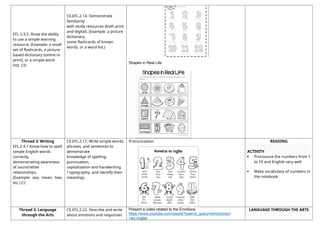
Flashcards the Shapes and Numbers
Trace and color
READING
ACTIVITY
• Check word recognition by
having learners stick stickers or
glue them next to words.
• Color the real objects in each row
that match the shape in the firs
box.
EFL 2.3.5. Show the ability
to use a simple learning
resource. (Example: a small
set of flashcards, a picture-
based dictionary (online or
print), or a simple word
list). CD
CE.EFL.2.14. Demonstrate
familiarity
with study resources (both print
and digital). (Example: a picture
dictionary,
some flashcards of known
words, or a word list.)
Shapes in Real Life
Thread 3: Writing
EFL.2.4.1 Know how to spell
simple English words
correctly,
demonstrating awareness
of sound-letter
relationships.
(Example: sea, mean, bee,
etc.) CC
CE.EFL.2.17. Write simple words,
phrases, and sentences to
demonstrate
knowledge of spelling,
punctuation,
capitalization and handwriting
/ typography, and identify their
meanings.
Pronunciation READING
ACTIVITY
 Pronounce the numbers from 1
to 10 and English very well
 Make vocabulary of numbers in
the notebook
Thread 3: Language
through the Arts
CE.EFL.2.22. Describe and write
about emotions and responses
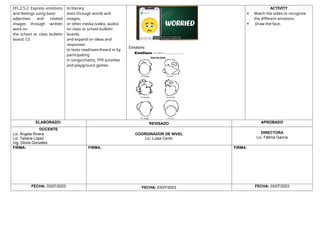
Present a video related to the Emotions.
https://www.youtube.com/results?search_query=emociones+
+en+ingles
LANGUAGE THROUGH THE ARTS
EFL.2.5.2. Express emotions
and feelings using basic
adjectives and related
images through written
work on
the school or class bulletin
board. CS
to literary
texts through words and
images,
or other media (video, audio)
on class or school bulletin
boards
and expand on ideas and
responses
to texts read/seen/heard in by
participating
in songs/chants, TPR activities
and playground games
Emotions
ACTIVITY
 Watch the video to recognize
the different emotions
 Draw the face.
ELABORADO: REVISADO APROBADO
DOCENTE
Lic. Ángela Rivera
Lic. Tatiana López
Ing. Gloria González
COORDINADOR DE NIVEL
Lic. Luisa Cerón
DIRECTORA
Lic. Fátima García
FIRMA: FIRMA: FIRMA:
FECHA: 03/07/2023 FECHA: 03/07/2023 FECHA: 03/07/2023

PLANIFICACIÓN MICROCURRICULAR DE INGLES.docx

  • 1.
    PLANIFICACIÓN MICROCURRICULAR DEINGLES PRIMER TRIMESTRE ESCUELA DE EDUCACIÓN BÁSICA “MARIA LUISA VITERI AGUILAR” Amor, Estudio y Perseverancia AÑO LECTIVO: 2023-2024 1. DATOS INFORMATIVOS: Docente: Lic. Ángela Rivera Lic. Tatiana López Ing. Gloria González Área: English Asignatura: English Grado/Curso: Segundo Paralelos: A, B y C Trimestre Nro.: Primero Del: 26 de junio Hasta: 21 de julio APRENDIZAJE DISCIPLINAR: OBJETIVOS DE APRENDIZAJE: O.EFL 2.1 Assess and appreciate English as an international language, as well as the five aspects of English that contribute to communicative competence. O.EFL 2.2 Use in-class library resources and explore the use of ICT to enrich competencies in the four skills. O.EFL 2.3 Be able to interact in English in a simple way using basic expressions and short phrases in familiar contexts to satisfy needs of a concrete type, provided others talk slowly and clearly and are prepared to help. Competencias: Competencias comunicacionales Competencias matemáticas Competencias digitales Competencias socioemocionales DESTREZAS CON CRITERIOS DE DESEMPEÑO INDICADORES DE EVALUACIÓN ESTRATEGIAS METODOLÓGICAS ACTIVAS PARA LA ENSEÑANZA Y APRENDIZAJE ACTIVIDADES EVALUATIVAS Thread 2: Oral Communication EFL.2.2.1. Understand meanings expressed in short dialogues on familiar topics, as well as basic spoken instructions and simple questions about self, people, animals, or things, especially when CE.EFL.2.6. Listening for Meaning: Understand the main ideas in short simple spoken texts that include familiar vocabulary and are set in everyday contexts. Present a video related to the Family https://www.youtube.com/watch?v=TZ6eC2EMstQ ORAL COMMUNICATION ACTIVITY • Talk about your family. • Color de members that make up your family, • Present greetings and short phrases in English and Spanish • Read and write the correct number in the circle
  • 2.
    spoken slowly andclearly. (Example: greetings, short phrases, basic range of classroom instructions, common personal information questions: What’s your name? etc.) CC EFL2.2.3. Recognize familiar names, words, and short phrases about simple everyday topics whether heard in isolation or within short, simple spoken texts describing people and objects. (Example: vocabulary about self, family, friends and immediate surroundings at school and home, adjectives for color and size, etc.) CE.EFL.2.7. Listening for Information: Follow short and simple spoken texts that include familiar vocabulary and are set in everyday contexts. Identify key items of information within the text, and record or act upon them. Color the members that make up your family Use greeting cards and short phrases. Read and write the correct number in the circle Thread 3: Reading EFL 2.3.1. Demonstrate basic reading comprehension skills by identifying the meaning of individual words, phrases, and sentences, including simple written instructions. CC CE.EFL.2.11. Identify and understand individual every-day words, phrases, and sentences, including instructions. Flashcards the Shapes and Numbers Trace and color READING ACTIVITY • Check word recognition by having learners stick stickers or glue them next to words. • Color the real objects in each row that match the shape in the firs box.
  • 3.
    EFL 2.3.5. Showthe ability to use a simple learning resource. (Example: a small set of flashcards, a picture- based dictionary (online or print), or a simple word list). CD CE.EFL.2.14. Demonstrate familiarity with study resources (both print and digital). (Example: a picture dictionary, some flashcards of known words, or a word list.) Shapes in Real Life Thread 3: Writing EFL.2.4.1 Know how to spell simple English words correctly, demonstrating awareness of sound-letter relationships. (Example: sea, mean, bee, etc.) CC CE.EFL.2.17. Write simple words, phrases, and sentences to demonstrate knowledge of spelling, punctuation, capitalization and handwriting / typography, and identify their meanings. Pronunciation READING ACTIVITY  Pronounce the numbers from 1 to 10 and English very well  Make vocabulary of numbers in the notebook Thread 3: Language through the Arts CE.EFL.2.22. Describe and write about emotions and responses Present a video related to the Emotions. https://www.youtube.com/results?search_query=emociones+ +en+ingles LANGUAGE THROUGH THE ARTS
  • 4.
    EFL.2.5.2. Express emotions andfeelings using basic adjectives and related images through written work on the school or class bulletin board. CS to literary texts through words and images, or other media (video, audio) on class or school bulletin boards and expand on ideas and responses to texts read/seen/heard in by participating in songs/chants, TPR activities and playground games Emotions ACTIVITY  Watch the video to recognize the different emotions  Draw the face. ELABORADO: REVISADO APROBADO DOCENTE Lic. Ángela Rivera Lic. Tatiana López Ing. Gloria González COORDINADOR DE NIVEL Lic. Luisa Cerón DIRECTORA Lic. Fátima García FIRMA: FIRMA: FIRMA: FECHA: 03/07/2023 FECHA: 03/07/2023 FECHA: 03/07/2023