GD Project (Steam Turbine)Paul Lam
PurposeThe purpose of this project was to see if steam could power a turbine that spins and generates energy.
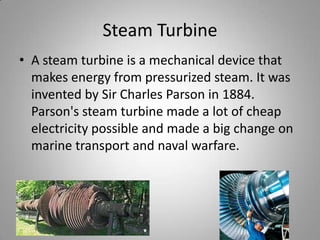
Steam TurbineA steam turbine is a mechanical device that makes energy from pressurized steam. It was invented by Sir Charles Parson in 1884. Parson's steam turbine made a lot of cheap  electricity possible and made a big change on marine transport and naval warfare.
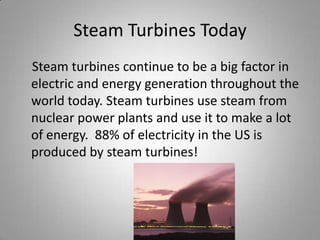
Steam Turbines Today    Steam turbines continue to be a big factor in electric and energy generation throughout the world today. Steam turbines use steam from nuclear power plants and use it to make a lot of energy.  88% of electricity in the US is produced by steam turbines!
Materials1. Thick foil food tray2. Soft drink can3. Screw Driver4. Screw5. Scissors6.BBQ Skewers7.Gas cooker
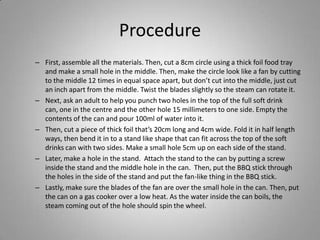
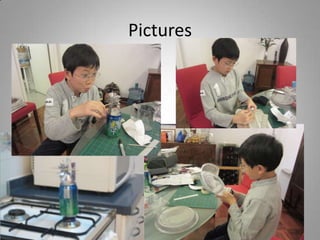
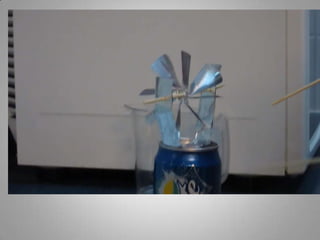
ProcedureFirst, assemble all the materials. Then, cut a 8cm circle using a thick foil food tray and make a small hole in the middle. Then, make the circle look like a fan by cutting to the middle 12 times in equal space apart, but don’t cut into the middle, just cut an inch apart from the middle. Twist the blades slightly so the steam can rotate it.Next, ask an adult to help you punch two holes in the top of the full soft drink can, one in the centre and the other hole 15 millimeters to one side. Empty the contents of the can and pour 100ml of water into it.Then, cut a piece of thick foil that’s 20cm long and 4cm wide. Fold it in half length ways, then bend it in to a stand like shape that can fit across the top of the soft drinks can with two sides. Make a small hole 5cm up on each side of the stand.Later, make a hole in the stand.  Attach the stand to the can by putting a screw inside the stand and the middle hole in the can.  Then, put the BBQ stick through the holes in the side of the stand and put the fan-like thing in the BBQ stick.Lastly, make sure the blades of the fan are over the small hole in the can. Then, put the can on a gas cooker over a low heat. As the water inside the can boils, the steam coming out of the hole should spin the wheel.
ObservationsMy 1st attempt didn’t work because my fan was not very stable or evenly spaced which made it hard tocatchenough steam. Therefore, I made a bigger hole and added more water to generate more steam. Also, I made different blades that were more stable to catch the steam, and eventually one worked! However, it was difficult to generate a continuous rotation.
Pictures
ConclusionI think this was a really fun project. I think this is important because I can harness the energy from places that emit steam and not waste it. I think this is useful to know because I can learn to save energy and be more green, and save the planet. Who knows? This may be a start for the future. There might be cars that run on steam from steam turbines in the future! That way, we could reduce the use of gas and you wouldn’t be polluting the air. There might be a steam turbine in the future that not only generates energy from the steam, but could also somehow recycle the steam into clean air! Who knows?
Thank you for listening!
Paul lamsteamturbine

Paul lamsteamturbine

  • 1.
    GD Project (SteamTurbine)Paul Lam
  • 2.
    PurposeThe purpose ofthis project was to see if steam could power a turbine that spins and generates energy.
  • 3.
    Steam TurbineA steamturbine is a mechanical device that makes energy from pressurized steam. It was invented by Sir Charles Parson in 1884. Parson's steam turbine made a lot of cheap electricity possible and made a big change on marine transport and naval warfare.
  • 4.
    Steam Turbines Today Steam turbines continue to be a big factor in electric and energy generation throughout the world today. Steam turbines use steam from nuclear power plants and use it to make a lot of energy. 88% of electricity in the US is produced by steam turbines!
  • 5.
    Materials1. Thick foilfood tray2. Soft drink can3. Screw Driver4. Screw5. Scissors6.BBQ Skewers7.Gas cooker
  • 6.
    ProcedureFirst, assemble allthe materials. Then, cut a 8cm circle using a thick foil food tray and make a small hole in the middle. Then, make the circle look like a fan by cutting to the middle 12 times in equal space apart, but don’t cut into the middle, just cut an inch apart from the middle. Twist the blades slightly so the steam can rotate it.Next, ask an adult to help you punch two holes in the top of the full soft drink can, one in the centre and the other hole 15 millimeters to one side. Empty the contents of the can and pour 100ml of water into it.Then, cut a piece of thick foil that’s 20cm long and 4cm wide. Fold it in half length ways, then bend it in to a stand like shape that can fit across the top of the soft drinks can with two sides. Make a small hole 5cm up on each side of the stand.Later, make a hole in the stand. Attach the stand to the can by putting a screw inside the stand and the middle hole in the can. Then, put the BBQ stick through the holes in the side of the stand and put the fan-like thing in the BBQ stick.Lastly, make sure the blades of the fan are over the small hole in the can. Then, put the can on a gas cooker over a low heat. As the water inside the can boils, the steam coming out of the hole should spin the wheel.
  • 7.
    ObservationsMy 1st attemptdidn’t work because my fan was not very stable or evenly spaced which made it hard tocatchenough steam. Therefore, I made a bigger hole and added more water to generate more steam. Also, I made different blades that were more stable to catch the steam, and eventually one worked! However, it was difficult to generate a continuous rotation.
  • 8.
  • 9.
    ConclusionI think thiswas a really fun project. I think this is important because I can harness the energy from places that emit steam and not waste it. I think this is useful to know because I can learn to save energy and be more green, and save the planet. Who knows? This may be a start for the future. There might be cars that run on steam from steam turbines in the future! That way, we could reduce the use of gas and you wouldn’t be polluting the air. There might be a steam turbine in the future that not only generates energy from the steam, but could also somehow recycle the steam into clean air! Who knows?
  • 10.
    Thank you forlistening!