Patients’
Rights
PRESENTOR: ALDRIN GLORIANI YL1
MODERATOR: DR. VENUS AGULLO
RESOURCE PERSON:
01 Discuss and review
patient’s rights
02
Tackle different dilemma in
protecting patient’s rights in
clinical setting
03 Resource speaker inputs
OBJECTIVES
AM, 58/M
Filipino
Roman Catholic
Previous factory worker
Yellowbell St., Malinta Valenzuela City
Admitted 1st time at our institution
Dx: Chronic Kidney Disease Stage V
secondary to Hypertensive
Nephrosclerosis
Advised for Renal Replacement
Therapy (HD or PD)
What are the
sources of the
rights of
a patients?
01 Bill of Rights
02 Hippocratic Oath
03 Code of Medical Ethics
of the Board of Medicine
04 Code of Medical Ethics
of Medical Profession from
the PMA
05 Physician-Patient
Contractual Relationship
1.RIGHT TO
GIVE CONSENT
RIGHTS OF PATIENTS
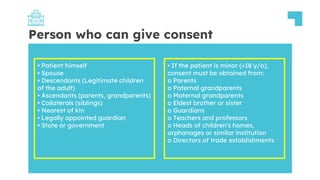
Person who can give consent
• Patient himself
• Spouse
• Descendants (Legitimate children
of the adult)
• Ascendants (parents, grandparents)
• Collaterals (siblings)
• Nearest of kin
• Legally appointed guardian
• State or government
• If the patient is minor (<18 y/o),
consent must be obtained from:
o Parents
o Paternal grandparents
o Maternal grandparents
o Eldest brother or sister
o Guardians
o Teachers and professors
o Heads of children’s homes,
orphanages or similar institution
o Directors of trade establishments
1.RIGHT TO
GIVE CONSENT
RIGHTS OF PATIENTS
2.RIGHT TO
PRIVILEGED
INFORMATION
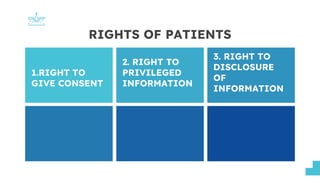
1.RIGHT TO
GIVE CONSENT
RIGHTS OF PATIENTS
2. RIGHT TO
PRIVILEGED
INFORMATION
3. RIGHT TO
DISCLOSURE
OF
INFORMATION
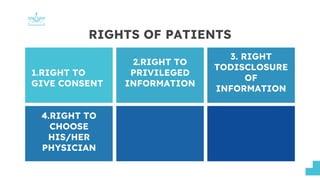
1.RIGHT TO
GIVE CONSENT
RIGHTS OF PATIENTS
2.RIGHT TO
PRIVILEGED
INFORMATION
3. RIGHT
TODISCLOSURE
OF
INFORMATION
4.RIGHT TO
CHOOSE
HIS/HER
PHYSICIAN
1.RIGHT TO
GIVE CONSENT
RIGHTS OF PATIENTS
2.RIGHT TO
PRIVILEGED
INFORMATION
3. RIGHT TO
DISCLOSURE
OF
INFORMATION
4.RIGHT TO
CHOOSE
HIS/HER
PHYSICIAN
5. RIGHT TO
PRIVACY
1.RIGHT TO
GIVE CONSENT
RIGHTS OF PATIENTS
2.RIGHT TO
PRIVILEGED
INFORMATION
3. RIGHT TO
DISCLOSURE
OF
INFORMATION
4. RIGHT TO
CHOOSE
HIS/HER
PHYSICIAN
5. RIGHT TO
PRIVACY
6. RIGHT TO
RELIGIOUS
BELIEF
7.RIGHT TO
TREATMENT
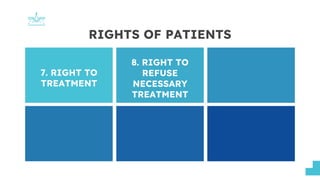
RIGHTS OF PATIENTS
7. RIGHT TO
TREATMENT
RIGHTS OF PATIENTS
8. RIGHT TO
REFUSE
NECESSARY
TREATMENT
3. Right to be
free from
mechanical
restraints
except for some
justifiable
reasons
OTHER RIGHTS OF THE PATIENTS
WHEN CONFINED IN THE HOSPITAL
4. Right to be
free from
mechanical
restraints
except for some
justifiable
reasons
1. Receive visitors
and communicate
with relatives,
public officials,
within the limit
prescribed by the
reasonable rules
and regulations of
the hospital
2. Unrestricted
right of
correspondence
REFERENCE: MEDICAL
JURISPRUDENCE BY DR. SOLIS
THANK YOU
FOR
LISTENING
QUESTIONS

PATIENT'S RIGHTS.pptx

  • 1.
    Patients’ Rights PRESENTOR: ALDRIN GLORIANIYL1 MODERATOR: DR. VENUS AGULLO RESOURCE PERSON:
  • 2.
    01 Discuss andreview patient’s rights 02 Tackle different dilemma in protecting patient’s rights in clinical setting 03 Resource speaker inputs OBJECTIVES
  • 3.
    AM, 58/M Filipino Roman Catholic Previousfactory worker Yellowbell St., Malinta Valenzuela City Admitted 1st time at our institution Dx: Chronic Kidney Disease Stage V secondary to Hypertensive Nephrosclerosis Advised for Renal Replacement Therapy (HD or PD)
  • 4.
    What are the sourcesof the rights of a patients?
  • 5.
    01 Bill ofRights 02 Hippocratic Oath 03 Code of Medical Ethics of the Board of Medicine 04 Code of Medical Ethics of Medical Profession from the PMA 05 Physician-Patient Contractual Relationship
  • 6.
  • 7.
    Person who cangive consent • Patient himself • Spouse • Descendants (Legitimate children of the adult) • Ascendants (parents, grandparents) • Collaterals (siblings) • Nearest of kin • Legally appointed guardian • State or government • If the patient is minor (<18 y/o), consent must be obtained from: o Parents o Paternal grandparents o Maternal grandparents o Eldest brother or sister o Guardians o Teachers and professors o Heads of children’s homes, orphanages or similar institution o Directors of trade establishments
  • 8.
    1.RIGHT TO GIVE CONSENT RIGHTSOF PATIENTS 2.RIGHT TO PRIVILEGED INFORMATION
  • 9.
    1.RIGHT TO GIVE CONSENT RIGHTSOF PATIENTS 2. RIGHT TO PRIVILEGED INFORMATION 3. RIGHT TO DISCLOSURE OF INFORMATION
  • 10.
    1.RIGHT TO GIVE CONSENT RIGHTSOF PATIENTS 2.RIGHT TO PRIVILEGED INFORMATION 3. RIGHT TODISCLOSURE OF INFORMATION 4.RIGHT TO CHOOSE HIS/HER PHYSICIAN
  • 11.
    1.RIGHT TO GIVE CONSENT RIGHTSOF PATIENTS 2.RIGHT TO PRIVILEGED INFORMATION 3. RIGHT TO DISCLOSURE OF INFORMATION 4.RIGHT TO CHOOSE HIS/HER PHYSICIAN 5. RIGHT TO PRIVACY
  • 12.
    1.RIGHT TO GIVE CONSENT RIGHTSOF PATIENTS 2.RIGHT TO PRIVILEGED INFORMATION 3. RIGHT TO DISCLOSURE OF INFORMATION 4. RIGHT TO CHOOSE HIS/HER PHYSICIAN 5. RIGHT TO PRIVACY 6. RIGHT TO RELIGIOUS BELIEF
  • 13.
  • 14.
    7. RIGHT TO TREATMENT RIGHTSOF PATIENTS 8. RIGHT TO REFUSE NECESSARY TREATMENT
  • 15.
    3. Right tobe free from mechanical restraints except for some justifiable reasons OTHER RIGHTS OF THE PATIENTS WHEN CONFINED IN THE HOSPITAL 4. Right to be free from mechanical restraints except for some justifiable reasons 1. Receive visitors and communicate with relatives, public officials, within the limit prescribed by the reasonable rules and regulations of the hospital 2. Unrestricted right of correspondence
  • 16.
    REFERENCE: MEDICAL JURISPRUDENCE BYDR. SOLIS THANK YOU FOR LISTENING
  • 17.

Editor's Notes

  • #4 AM, 58/M Filipino Roman Catholic Previous factory worker Yellowbell St., Malinta Valenzuela City Admitted 1st time at our institution Dx: Chronic Kidney Disease Stage V secondary to Hypertensive Nephrosclerosis Advised for Renal Replacement Therapy (HD or PD) According to NKTI, in our country it is estimated that more than 7 million have CKD stage 3 and above as of 2021 data and roughly 90% who remain undiagnosed
  • #7 RIGHT TO GIVE CONSENT Purposes of the consent >To protect the patient from unnecessary or unwarranted medical procedure applied on him without his knowledge >To protect the MD from any consequence for failure to comply with the legal requirements Ethical requisites of a valid consent: >It must be an Informed or an enlightened consent >It must be given by the patient voluntarily >Subject matter must be legal
  • #8 PERSON WHO CAN GIVE CONSENT: • Patient himself (must be legal age and of sound mind) • Spouse (must be legitimate spouse) • Descendants (Legitimate children of the adult) • Ascendants (parents, grandparents) • Collaterals (siblings) • Nearest of kin • Legally appointed guardian • State or government (Doctrine of Parens Patriae) • If the patient is minor (<18 y/o), consent must be obtained from: (in order) o Parents o Paternal grandparents o Maternal grandparents o Eldest brother or sister (provided he is or she is of age) o Guardians o Teachers and professors o Heads of children’s homes, orphanages or similar institution o Directors of trade establishments
  • #9 RIGHT TO CONFIDENTIAL OR PRIVILEGED INFORMATION All communications including all medical records is deemed sacred even after the death of the patient. A physician is not authorized to divulged such information to the third party who has no concern with the interest and welfare of the patient. This extends to the physician’s secretary, trainees and students.
  • #10 RIGHT TO DISCLOSURE OF INFORMATION Right to obtain all existing information regarding all that transpired pertaining to his/her medical management (i.e. diagnosis, ancillaries, procedures,etc.)
  • #11 RIGHT TO CHOOSE HIS/HER PHYSICIAN Cases where a patient cannot invoke his right to choose his or her own physician: 1)in a government hospital or government medical care institutions 2)patient expressly waiving his right through their HMO (health card) memberships – You will be given a doctor based on who is accredited by that HMO company 3)in a charitable medical mission 4)in cases of emergency 5)prisoners and detainees 6) when the Court appoints a physician pursuant to its order
  • #12 RIGHT TO PRIVACY This right is enclosed to the Data Privacy Act of 2012. One’s personal information is protected from public scrutiny Especially in children– under child abuse law
  • #13 RIGHT TO RELIGIOUS BELIEF One of the basic and fundamental right of any person anywhere in the world The classic example of this is a Jehovah’s witness cannot be forced to subject himself to blood transfusion even if it may mean him dying because even if the Blood came from the same patient previously stored to the blood bank, they still consider it impure.
  • #14 RIGHT TO TREATMENT Every single patient has the right to receive a proper treatment and we as a doctor cannot refuse a patient even without funds especially during emergency cases.
  • #15 RIGHT TO REFUSE NECESSARY TREATMENT Every human being of adult age and of sound mind has the right to determine what must be done in his own body
  • #16 OTHER RIGHTS OF THE PATIENTS WHEN CONFINED IN THE HOSPITAL 1. Right to receive visitors and communicate with relatives, public officials, etc. within the limit prescribed by the reasonable rules and regulations of the hospital 2. Unrestricted right of correspondence 3. Right to be free from mechanical restraints except for some justifiable reasons 4. Right to be released as soon as the condition which justified his hospitalization no longer exists