PATIENT
COUNSELLING
TOPICS
Understand
the need for
patient
counselling
Identify outcomes of effective patient
counselling
What are various communication skills
needed
Steps in this process
Which patient group needs most
counselling
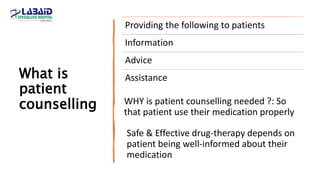
What is
patient
counselling
Providing the following to patients
Information
Advice
Assistance
Safe & Effective drug-therapy depends on
patient being well-informed about their
medication
WHY is patient counselling needed ?: So
that patient use their medication properly
What is
patient
counselling
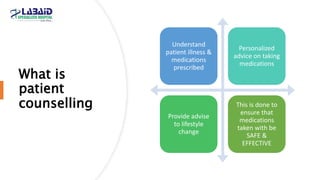
Understand
patient illness &
medications
prescribed
Personalized
advice on taking
medications
Provide advise
to lifestyle
change
This is done to
ensure that
medications
taken with be
SAFE &
EFFECTIVE
Effective
patient
counselling
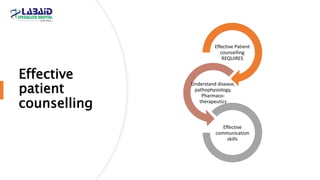
Effective Patient
counselling
REQUIRES
Understand disease,
pathophysiology,
Pharmaco-
therapeutics
Effective
communication
skills
Current state in
Bangladesh
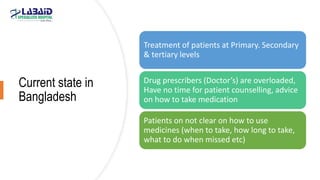
Treatment of patients at Primary. Secondary
& tertiary levels
Drug prescribers (Doctor’s) are overloaded,
Have no time for patient counselling, advice
on how to take medication
Patients on not clear on how to use
medicines (when to take, how long to take,
what to do when missed etc)
Effect of lack of counselling
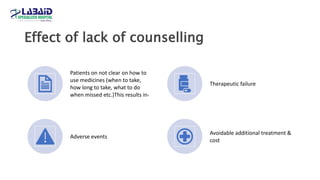
Patients on not clear on how to
use medicines (when to take,
how long to take, what to do
when missed etc.)This results in-
Therapeutic failure
Adverse events
Avoidable additional treatment &
cost
Effective
counselling
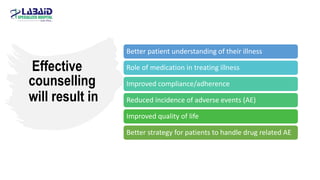
will result in
Better patient understanding of their illness
Role of medication in treating illness
Improved compliance/adherence
Reduced incidence of adverse events (AE)
Improved quality of life
Better strategy for patients to handle drug related AE
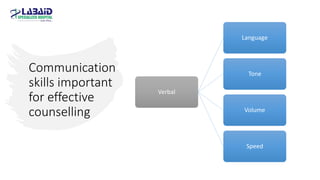
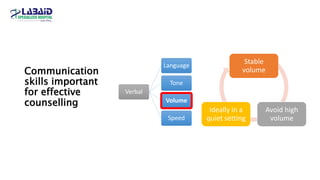
Communication
skills important
for effective
counselling
Verbal
Language
Tone
Volume
Speed
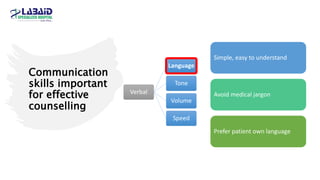
Communication
skills important
for effective
counselling
Simple, easy to understand
Avoid medical jargon
Prefer patient own language
Verbal
Language
Tone
Volume
Speed
Communication
skills important
for effective
counselling
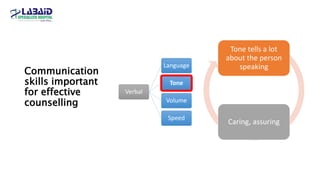
Tone tells a lot
about the person
speaking
Caring, assuring
Verbal
Language
Tone
Volume
Speed
Communication
skills important
for effective
counselling
Stable
volume
Avoid high
volume
Ideally in a
quiet setting
Verbal
Language
Tone
Volume
Speed
Communication
skills important
for effective
counselling
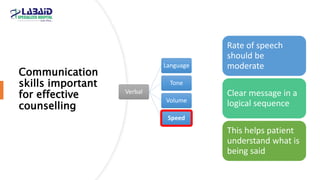
Rate of speech
should be
moderate
Clear message in a
logical sequence
This helps patient
understand what is
being said
Verbal
Language
Tone
Volume
Speed
Communication
skills important
for effective
counselling
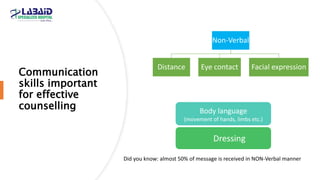
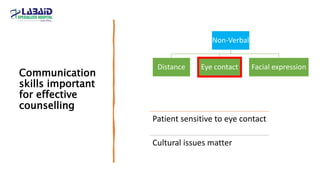
Non-Verbal
Distance Eye contact Facial expression
Body language
(movement of hands, limbs etc.)
Dressing
Did you know: almost 50% of message is received in NON-Verbal manner
Communicati
on skills
important for
effective
counselling
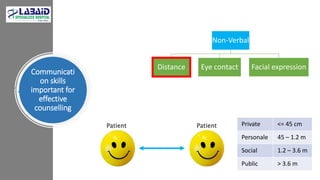
Private <= 45 cm
Personale 45 – 1.2 m
Social 1.2 – 3.6 m
Public > 3.6 m
Patient Patient
Non-Verbal
Distance Eye contact Facial expression
Communication
skills important
for effective
counselling
Patient sensitive to eye contact
Cultural issues matter
Non-Verbal
Distance Eye contact Facial expression
Communication
skills important
for effective
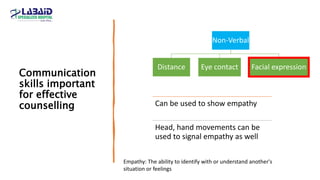
counselling Can be used to show empathy
Head, hand movements can be
used to signal empathy as well
Non-Verbal
Distance Eye contact Facial expression
Empathy: The ability to identify with or understand another's
situation or feelings
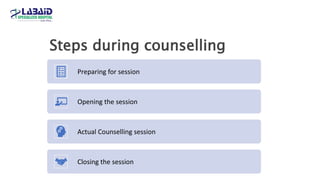
Steps during counselling
Preparing for session
Opening the session
Actual Counselling session
Closing the session
Preparing
for
counselling
session
• Success of session depends on Skill &
Knowledge of pharmacist
• Through review of patient medical history,
medication records
• Different sources can be used such as
Hospital records, community pharmacy drug
dispensing records
• Pharmacist needs to have a good
understanding of pathophysiology & drug
that are prescribed
• References such as “Drug Information
Reference” should be consulted before hand
Opening the
session
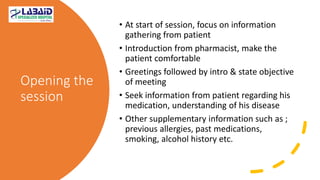
• At start of session, focus on information
gathering from patient
• Introduction from pharmacist, make the
patient comfortable
• Greetings followed by intro & state objective
of meeting
• Seek information from patient regarding his
medication, understanding of his disease
• Other supplementary information such as ;
previous allergies, past medications,
smoking, alcohol history etc.
Opening the
session How
to get
information
from
patient:
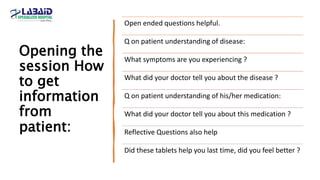
Open ended questions helpful.
Q on patient understanding of disease:
What symptoms are you experiencing ?
What did your doctor tell you about the disease ?
Q on patient understanding of his/her medication:
What did your doctor tell you about this medication ?
Reflective Questions also help
Did these tablets help you last time, did you feel better ?
Opening the
session
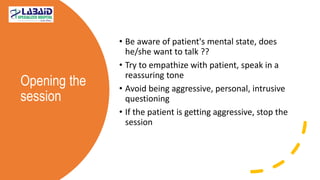
• Be aware of patient's mental state, does
he/she want to talk ??
• Try to empathize with patient, speak in a
reassuring tone
• Avoid being aggressive, personal, intrusive
questioning
• If the patient is getting aggressive, stop the
session
Counselling
content The
main part
(Heart) of
session
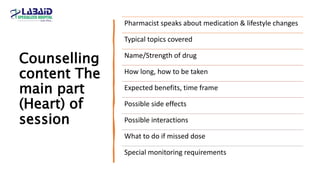
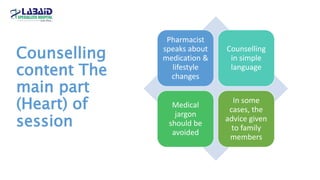
Pharmacist speaks about medication & lifestyle changes
Typical topics covered
Name/Strength of drug
How long, how to be taken
Expected benefits, time frame
Possible side effects
Possible interactions
What to do if missed dose
Special monitoring requirements
Counselling
content The
main part
(Heart) of
session
Pharmacist
speaks about
medication &
lifestyle
changes
Counselling
in simple
language
Medical
jargon
should be
avoided
In some
cases, the
advice given
to family
members
Closing the
session This
usually done
by asking
simple
questions
• Before ending, important to know patients
understanding of his medication
• This usually done by asking simple questions
Example: Which is the blood pressure drug,
how many will you take in a day , which one
after meal ?
First timers
Advisable to
listen to
sessions by
senior
pharmacists
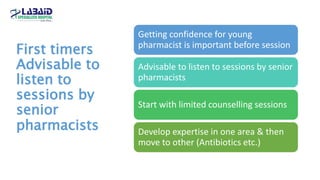
Getting confidence for young
pharmacist is important before session
Advisable to listen to sessions by senior
pharmacists
Start with limited counselling sessions
Develop expertise in one area & then
move to other (Antibiotics etc.)
Prioritize
counselling
• Most of the time, pharmacist are too busy
• They need to prioritize which category of
patients to counsel
Typically, the focus groups are-
• Special medication group
• Complex medication (TB, HIV regimens)
• Specialized delivery drugs (Rotahalers)
• Elderly patients on many drugs
(polypharmacy)
• Special medication group_ narrow TI,
antibiotics etc.
Counselling
aids Develop
teaching,
educational
aids
• In addition to live counselling
• Good for follow up reading by patients
• Medication card : useful aid, has summary of
drugs
• Easy format, patient can understand
• Pharma companies draft “Consumer Product
Info”
• Pharmacist can also draft simple product
info
THANK YOU

PATIENT COUNSELLING.pptx