Unit: III
The simple past tense
 Meaning & Use
Form (structure)
Exercise
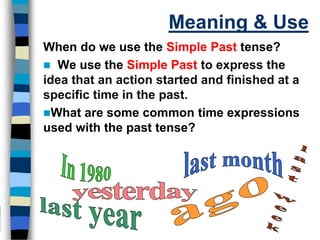
Meaning & Use
When do we use the Simple Past tense?
 We use the Simple Past to express the
idea that an action started and finished at a
specific time in the past.
What are some common time expressions
used with the past tense?
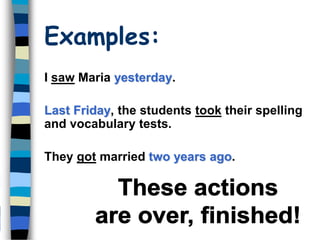
Examples:
I saw Maria yesterday.
Last Friday, the students took their spelling
and vocabulary tests.
They got married two years ago.
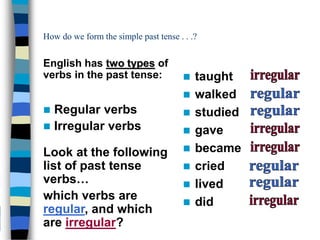
How do we form the simple past tense . . .?
English has two types of
verbs in the past tense:  taught
 walked
 studied
 gave
 became
 cried
 lived
 did
Look at the following
list of past tense
verbs…
which verbs are
regular, and which
are irregular?
 Regular verbs
 Irregular verbs
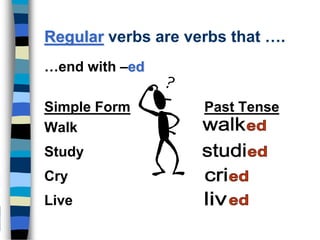
Regular verbs are verbs that ….
Simple Form Past Tense
Walk
Study
Cry
Live
…end with –ed
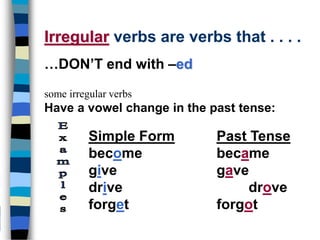
Irregular verbs are verbs that . . . .
…DON’T end with –ed
some irregular verbs
Have a vowel change in the past tense:
Simple Form Past Tense
become became
give gave
drive drove
forget forgot
other irregular verbs
Have a different kind of change:
Simple Past
teach taught
bring brought
Leave left
Hear heard
Buy bought
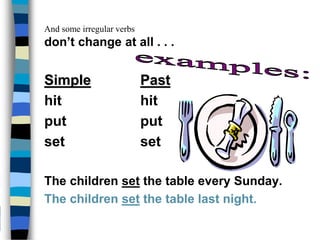
And some irregular verbs
don’t change at all . . .
Simple Past
hit hit
put put
set set
The children set the table every Sunday.
The children set the table last night.
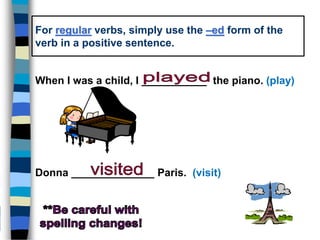
For regular verbs, simply use the –ed form of the
verb in a positive sentence.
When I was a child, I ___________ the piano. (play)
Donna ______________ Paris. (visit)
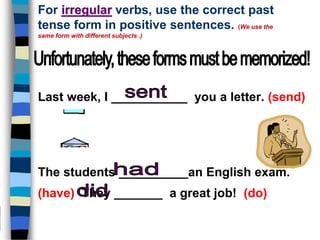
For irregular verbs, use the correct past
tense form in positive sentences. (We use the
same form with different subjects .)
Last week, I ___________ you a letter. (send)
The students __________an English exam.
(have) They _______ a great job! (do)
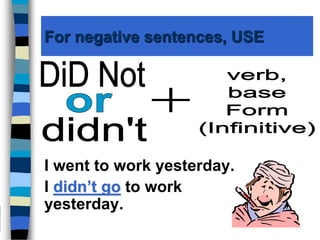
For negative sentences, USE
I went to work yesterday.
I didn’t go to work
yesterday.
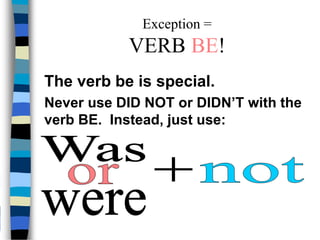
Exception =
VERB BE!
The verb be is special.
Never use DID NOT or DIDN’T with the
verb BE. Instead, just use:
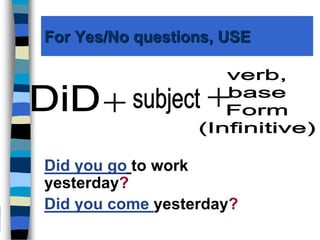
For Yes/No questions, USE
Did you go to work
yesterday?
Did you come yesterday?
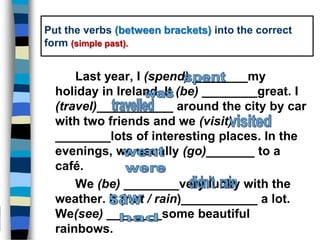
Put the verbs (between brackets) into the correct
form (simple past).
Last year, I (spend) ________my
holiday in Ireland. It (be) ________great. I
(travel)___________ around the city by car
with two friends and we (visit)
________lots of interesting places. In the
evenings, we usually (go)_______ to a
café.
We (be) ________very lucky with the
weather. It (not / rain)___________ a lot.
We(see) ________some beautiful
rainbows.
Student Practice:
Go to this website with a classmate to
practice what you have learned or
reviewed today:
http://www.quia.com/quiz/664
418.html
Sources:
 http://www.authorstream.com/Presentati
on/bbogage-11679-simple-past-tense-
education-ppt-powerpoint/
 http://www.slideshare.net/LALA28/the-
past-simple-ppt-presentation

SimplePast.ppt

  • 1.
    Unit: III The simplepast tense  Meaning & Use Form (structure) Exercise
  • 2.
    Meaning & Use Whendo we use the Simple Past tense?  We use the Simple Past to express the idea that an action started and finished at a specific time in the past. What are some common time expressions used with the past tense?
  • 3.
    Examples: I saw Mariayesterday. Last Friday, the students took their spelling and vocabulary tests. They got married two years ago.
  • 4.
    How do weform the simple past tense . . .? English has two types of verbs in the past tense:  taught  walked  studied  gave  became  cried  lived  did Look at the following list of past tense verbs… which verbs are regular, and which are irregular?  Regular verbs  Irregular verbs
  • 5.
    Regular verbs areverbs that …. Simple Form Past Tense Walk Study Cry Live …end with –ed
  • 6.
    Irregular verbs areverbs that . . . . …DON’T end with –ed some irregular verbs Have a vowel change in the past tense: Simple Form Past Tense become became give gave drive drove forget forgot
  • 7.
    other irregular verbs Havea different kind of change: Simple Past teach taught bring brought Leave left Hear heard Buy bought
  • 8.
    And some irregularverbs don’t change at all . . . Simple Past hit hit put put set set The children set the table every Sunday. The children set the table last night.
  • 9.
    For regular verbs,simply use the –ed form of the verb in a positive sentence. When I was a child, I ___________ the piano. (play) Donna ______________ Paris. (visit)
  • 10.
    For irregular verbs,use the correct past tense form in positive sentences. (We use the same form with different subjects .) Last week, I ___________ you a letter. (send) The students __________an English exam. (have) They _______ a great job! (do)
  • 11.
    For negative sentences,USE I went to work yesterday. I didn’t go to work yesterday.
  • 12.
    Exception = VERB BE! Theverb be is special. Never use DID NOT or DIDN’T with the verb BE. Instead, just use:
  • 13.
    For Yes/No questions,USE Did you go to work yesterday? Did you come yesterday?
  • 14.
    Put the verbs(between brackets) into the correct form (simple past). Last year, I (spend) ________my holiday in Ireland. It (be) ________great. I (travel)___________ around the city by car with two friends and we (visit) ________lots of interesting places. In the evenings, we usually (go)_______ to a café. We (be) ________very lucky with the weather. It (not / rain)___________ a lot. We(see) ________some beautiful rainbows.
  • 15.
    Student Practice: Go tothis website with a classmate to practice what you have learned or reviewed today: http://www.quia.com/quiz/664 418.html
  • 16.