Past Simple (Pasado simple)
The simple past in English is equivalent to the imperfect and preterite Spanish. We use the
past simple to complete actions in the past. The time period of these actions is not important
as in Spanish.


Grammatical Rules (Reglas gramaticales)


Form (Forma)


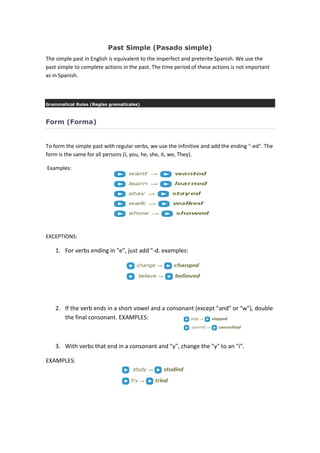
To form the simple past with regular verbs, we use the infinitive and add the ending "-ed". The
form is the same for all persons (I, you, he, she, it, we, They).

Examples:


EXCEPTIONS:

    1. For verbs ending in "e", just add "-d. examples:


    2. If the verb ends in a short vowel and a consonant (except "and" or "w"), double
       the final consonant. EXAMPLES:


    3. With verbs that end in a consonant and "y", change the "y" to an "i".

EXAMPLES:

Past simple

  • 1.
    Past Simple (Pasadosimple) The simple past in English is equivalent to the imperfect and preterite Spanish. We use the past simple to complete actions in the past. The time period of these actions is not important as in Spanish. Grammatical Rules (Reglas gramaticales) Form (Forma) To form the simple past with regular verbs, we use the infinitive and add the ending "-ed". The form is the same for all persons (I, you, he, she, it, we, They). Examples: EXCEPTIONS: 1. For verbs ending in "e", just add "-d. examples: 2. If the verb ends in a short vowel and a consonant (except "and" or "w"), double the final consonant. EXAMPLES: 3. With verbs that end in a consonant and "y", change the "y" to an "i". EXAMPLES: