Past Continuous Tense
The past continuous tense describes a past action
which was going on when another action took
places.
What?
FORMULA
PAST CONTINUOUS
We use was/were + the -ing form of the verb.
+
I, she, he, it,
you, we, they
was
were
working.
–
I, she, he, it,
you, we, they
(full form)
was not
were not
working.
I, she, he, it,
you, we, they
(short form)
wasn’t
weren’t
? +
Was
Were
I, she, he, it,
you, we, they
working?
? –
(full form)
Was
Were
I, she, he, it,
you, we, they
not
working?
(short form)
Wasn’t
I, she, he, it,
you, we, they
Ciri Khas dari Past Continuous Tense
1. Past continuous tense dibentuk dengan
auxiliary verb “be”, berupa was atau were.
2. Past continuous tense termasuk progressive tense,
maka verb yang tepat adalah present participle (Verb-ing)
EXAMPLE...
PAST CONTINUOUS: USES
1.Events happening at a particular time in the past
(talk about actions and states in progress (happening) around a particular time in the
past. It can emphasize that the action or state continued for a period of time in the
past)
A: Where was Donna last night?
B: I’m not sure. I think she was visiting her family. (action)
I remember that night. You were wearing that red dress. (state)
PAST CONTINUOUS: USES
2. Background events
When one event is more important than another in the past, we can use the
past continuous for the background event (the less important event) and
the past simple for the main event:
[background event] [main event]
*Lisa was cycling to school when she saw the accident.
[background event] [main event]
*What were you thinking about when you won the race?
PAST CONTINUOUS: USES
3. Reasons and contexts for events
We often use the past continuous to give a reason or context
for an event:
A: I can’t believe you met Fran and Dave in Portugal.
B: It was funny. They were staying in the hotel next to ours.
(giving a reason/context for meeting them)
I didn’t make the meeting last week; I was travelling to Rome.
PAST CONTINUOUS: USES
4. Ongoing and repeated events
We can use the past continuous to talk about repeated background
events in the past. It can suggest that the situation was temporary or
subject to change:
*She was feeding her neighbours’ cat every morning while they were
on holiday. Then one morning, it was gone.
*The neighbours were making so much noise, night after night. We
had to complain eventually.
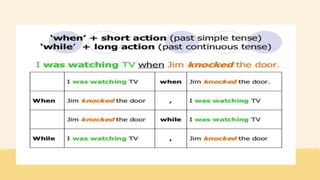
PAST CONTINUOUS WITH WHEN AND WHILE
We often use the past continuous tense with the simple past.
We use the past continuous tense to express a long action.
And we use the simple past tense to express a short action that
happens in the middle of the long action.
Example:
I was watching TV when Jim knocked the door
# Long action = watching tv (Expressed with past continuous)
# Short action= knocked (expressed with simple past)
Past Continuous Tense.pptx

Past Continuous Tense.pptx

  • 1.
  • 2.
    The past continuoustense describes a past action which was going on when another action took places. What?
  • 3.
  • 4.
    We use was/were+ the -ing form of the verb. + I, she, he, it, you, we, they was were working. – I, she, he, it, you, we, they (full form) was not were not working. I, she, he, it, you, we, they (short form) wasn’t weren’t ? + Was Were I, she, he, it, you, we, they working? ? – (full form) Was Were I, she, he, it, you, we, they not working? (short form) Wasn’t I, she, he, it, you, we, they
  • 5.
    Ciri Khas dariPast Continuous Tense 1. Past continuous tense dibentuk dengan auxiliary verb “be”, berupa was atau were. 2. Past continuous tense termasuk progressive tense, maka verb yang tepat adalah present participle (Verb-ing)
  • 6.
  • 7.
    PAST CONTINUOUS: USES 1.Eventshappening at a particular time in the past (talk about actions and states in progress (happening) around a particular time in the past. It can emphasize that the action or state continued for a period of time in the past) A: Where was Donna last night? B: I’m not sure. I think she was visiting her family. (action) I remember that night. You were wearing that red dress. (state)
  • 8.
    PAST CONTINUOUS: USES 2.Background events When one event is more important than another in the past, we can use the past continuous for the background event (the less important event) and the past simple for the main event: [background event] [main event] *Lisa was cycling to school when she saw the accident. [background event] [main event] *What were you thinking about when you won the race?
  • 9.
    PAST CONTINUOUS: USES 3.Reasons and contexts for events We often use the past continuous to give a reason or context for an event: A: I can’t believe you met Fran and Dave in Portugal. B: It was funny. They were staying in the hotel next to ours. (giving a reason/context for meeting them) I didn’t make the meeting last week; I was travelling to Rome.
  • 10.
    PAST CONTINUOUS: USES 4.Ongoing and repeated events We can use the past continuous to talk about repeated background events in the past. It can suggest that the situation was temporary or subject to change: *She was feeding her neighbours’ cat every morning while they were on holiday. Then one morning, it was gone. *The neighbours were making so much noise, night after night. We had to complain eventually.
  • 11.
    PAST CONTINUOUS WITHWHEN AND WHILE We often use the past continuous tense with the simple past. We use the past continuous tense to express a long action. And we use the simple past tense to express a short action that happens in the middle of the long action. Example: I was watching TV when Jim knocked the door # Long action = watching tv (Expressed with past continuous) # Short action= knocked (expressed with simple past)