Chapter Two
Company and Marketing
Strategy:
Partnering to Build
Customer Relationships
Roadmap: Previewing the Concepts
1. Explain companywide strategic planning and
its four steps.
2. Discuss how to design business portfolios
and growth strategies.
3. Explain marketing’s role in strategic planning
and how marketing works with its partners to
create and deliver customer value.
4. Describe the elements of a customer-driven
marketing strategy and mix, and the forces
that influence it.
5. List the marketing management functions,
including the elements of a marketing plan.
2-2
Early Days
 Characterized by “seat of
the pants” management.
 Innovative sneaker tread
drove early success.
 Technological product
superiority, big-name
endorsements and “Just
Do It” ads revolutionized
sport marketing.
 1980s – 1990s: Nike
leverages brand strength
into new product areas.
NIKE – Strategy: Then & Now
Case Study
Case Study
Late 1990s - Present
 Changes in consumer
shoe preference, declining
product innovation, and
negative PR plague Nike.
 Anti-establishment image
no longer works: brand
backlash occurs.
 Strategic planning is
embraced and Nike
focuses on innovation and
exploring new market
opportunities.
 Nike has global success.
2-3
Strategic Planning
 The process of developing and
maintaining a strategic fit between the
organization’s goals and capabilities
and its changing marketing
opportunities.
2-4
Steps in Strategic Planning
1. Defining the company mission.
2. Setting company objectives and
goals.
3. Designing the business portfolio.
4. Planning marketing and other
functional strategies.
2-5
The Mission Statement
 A statement of the organization’s
purpose.
– What it wants to accomplish in the larger
environment.
 Should be market oriented and defined
in terms of customer needs.
2-6
The Mission Statement
 Questions the mission statement
should answer include:
– What is our business?
– Who is our customer?
– What do consumers value?
– What should our business be?
2-7
The Mission Statement:
 Should be realistic.
 Should be specific.
 Should fit the market environment.
 Should be based on distinctive
competencies.
 Should be motivating.
2-8
Designing the Business Portfolio
 The business portfolio is the collection of
businesses and products that make up the
company.
 The company must:
– analyze its current business portfolio or Strategic
Business Units (SBUs),
– decide which SBUs should receive more, less, or
no investment,
– develop growth strategies for growth or
downsizing.
2-9
Portfolio Analysis
 An evaluation of the products and
business making up the company.
 Resources are directed to more
profitable businesses and weaker ones
are phased down or dropped.
2-10
Strategic Business Unit (SBU)
 A unit of the company that has a
separate mission and objectives and
that can be planned independently from
other company businesses.
 Can be a company division, a product
line within a division, or sometimes a
single product or brand.
2-11
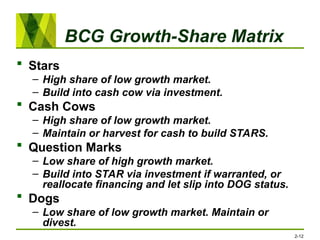
BCG Growth-Share Matrix
 Stars
– High share of low growth market.
– Build into cash cow via investment.
 Cash Cows
– High share of low growth market.
– Maintain or harvest for cash to build STARS.
 Question Marks
– Low share of high growth market.
– Build into STAR via investment if warranted, or
reallocate financing and let slip into DOG status.
 Dogs
– Low share of low growth market. Maintain or
divest.
2-12
Problems with Matrix Approaches
 Can be difficult, time consuming, and costly
to implement.
 Difficult to define SBUs and measure market
share and growth rate.
 Focus is on current businesses; gives little
help with future planning.
 Can place too much emphasis on growth.
 Can lead to poorly planned diversification.
2-13
Product/Market Expansion Grid
 Market Penetration
– Existing markets, existing products
 Market Development
– New markets, existing products
 Product Development
– Existing markets, new products
 Diversification
– New products, new markets
2-14
Planning Marketing
 Marketing plays a key role in strategic
planning:
– Provides a guiding philosophy.
• The Marketing Concept
– Provides inputs to strategic planners.
– Designs strategies to reach objectives.
2-15
Value Delivery Network
 Components include:
– Company’s value chain
• Each department is a link
– Distributors
– Suppliers
– Customers
 Improved performance in delivery value
to customers is the goal.
2-16
Market Segmentation
 The process of dividing a market into
distinct groups of buyers with different
needs, characteristics, or behavior who
might require separate products of
marketing programs.
 A market segment consists of
consumers who respond in a similar
way to a given set of marketing efforts.
2-17
Target Marketing
 Involves evaluating each market
segment’s attractiveness and selecting
one or more segments to enter.
 Target segments that can sustain
profitability.
2-18
Market Positioning
 Arranging for a product to occupy a
clear, distinctive, and desirable place
relative to competing products in the
minds of target consumers.
 Begins with differentiating the
company’s marketing offer so it gives
consumers more value.
2-19
The Marketing Mix
 The set of controllable, tactical
marketing tools that the firm blends to
produce the response it wants in the
target market.
– Product
– Price
– Place (distribution)
– Promotion
2-20
The Marketing Mix
 Product:
– Variety, quality,
design, features,
brand name,
packaging and
services.
 Promotion:
– Advertising, sales
promotion, public
relations and
personal selling.
 Place:
– Channels, coverage,
logistics, locations,
transportation,
assortments and
inventory.
 Price:
– List price, discounts,
allowances, payment
period and credit
terms.
2-21
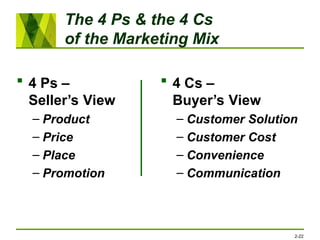
The 4 Ps & the 4 Cs
of the Marketing Mix
 4 Ps –
Seller’s View
– Product
– Price
– Place
– Promotion
 4 Cs –
Buyer’s View
– Customer Solution
– Customer Cost
– Convenience
– Communication
2-22
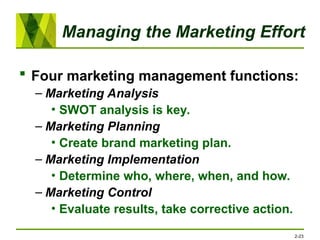
Managing the Marketing Effort
 Four marketing management functions:
– Marketing Analysis
• SWOT analysis is key.
– Marketing Planning
• Create brand marketing plan.
– Marketing Implementation
• Determine who, where, when, and how.
– Marketing Control
• Evaluate results, take corrective action.
2-23
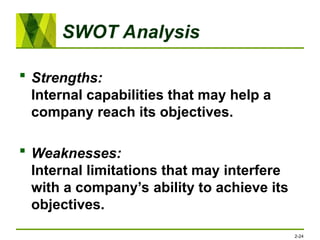
SWOT Analysis
 Strengths:
Internal capabilities that may help a
company reach its objectives.
 Weaknesses:
Internal limitations that may interfere
with a company’s ability to achieve its
objectives.
2-24
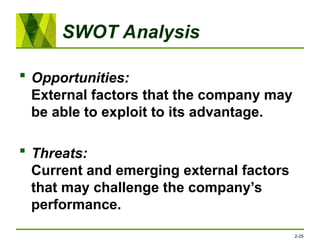
SWOT Analysis
 Opportunities:
External factors that the company may
be able to exploit to its advantage.
 Threats:
Current and emerging external factors
that may challenge the company’s
performance.
2-25
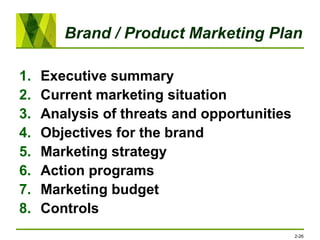
Brand / Product Marketing Plan
1. Executive summary
2. Current marketing situation
3. Analysis of threats and opportunities
4. Objectives for the brand
5. Marketing strategy
6. Action programs
7. Marketing budget
8. Controls
2-26
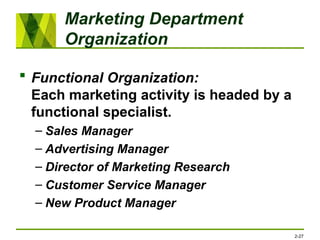
Marketing Department
Organization
 Functional Organization:
Each marketing activity is headed by a
functional specialist.
– Sales Manager
– Advertising Manager
– Director of Marketing Research
– Customer Service Manager
– New Product Manager
2-27
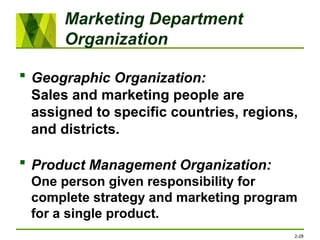
Marketing Department
Organization
 Geographic Organization:
Sales and marketing people are
assigned to specific countries, regions,
and districts.
 Product Management Organization:
One person given responsibility for
complete strategy and marketing program
for a single product.
2-28
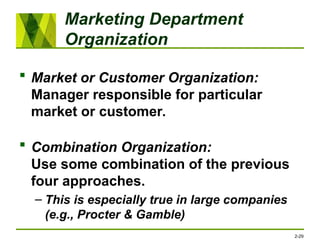
Marketing Department
Organization
 Market or Customer Organization:
Manager responsible for particular
market or customer.
 Combination Organization:
Use some combination of the previous
four approaches.
– This is especially true in large companies
(e.g., Procter & Gamble)
2-29
Marketing Control Process
 Set Goals
 Measure Performance
 Evaluate Performance
 Take Corrective Action
2-30
Marketing Control Process
 Operating Control
– Evaluates performance against the plan
and takes corrective action.
 Strategic control
– Evaluates whether strategies match
opportunities.
• The marketing audit is major tool.
2-31
Return on Marketing
 Assessed using one or more methods:
– Standard marketing performance
measures
• Brand awareness, sales, market share
– Customer-centered measures
• Customer acquisition, customer
retention, customer lifetime value
2-32
Rest Stop: Reviewing the Concepts
1. Explain companywide strategic planning and
its four steps.
2. Discuss how to design business portfolios
and growth strategies.
3. Explain marketing’s role in strategic planning
and how marketing works with its partners to
create and deliver customer value.
4. Describe the elements of a customer-driven
marketing strategy and mix, and the forces
that influence it.
5. List the marketing management functions,
including the elements of a marketing plan.
2-33

Partnering to Build Customer Relationships

  • 1.
    Chapter Two Company andMarketing Strategy: Partnering to Build Customer Relationships
  • 2.
    Roadmap: Previewing theConcepts 1. Explain companywide strategic planning and its four steps. 2. Discuss how to design business portfolios and growth strategies. 3. Explain marketing’s role in strategic planning and how marketing works with its partners to create and deliver customer value. 4. Describe the elements of a customer-driven marketing strategy and mix, and the forces that influence it. 5. List the marketing management functions, including the elements of a marketing plan. 2-2
  • 3.
    Early Days  Characterizedby “seat of the pants” management.  Innovative sneaker tread drove early success.  Technological product superiority, big-name endorsements and “Just Do It” ads revolutionized sport marketing.  1980s – 1990s: Nike leverages brand strength into new product areas. NIKE – Strategy: Then & Now NIKE – Strategy: Then & Now Case Study Case Study Late 1990s - Present  Changes in consumer shoe preference, declining product innovation, and negative PR plague Nike.  Anti-establishment image no longer works: brand backlash occurs.  Strategic planning is embraced and Nike focuses on innovation and exploring new market opportunities.  Nike has global success. 2-3
  • 4.
    Strategic Planning  Theprocess of developing and maintaining a strategic fit between the organization’s goals and capabilities and its changing marketing opportunities. 2-4
  • 5.
    Steps in StrategicPlanning 1. Defining the company mission. 2. Setting company objectives and goals. 3. Designing the business portfolio. 4. Planning marketing and other functional strategies. 2-5
  • 6.
    The Mission Statement A statement of the organization’s purpose. – What it wants to accomplish in the larger environment.  Should be market oriented and defined in terms of customer needs. 2-6
  • 7.
    The Mission Statement Questions the mission statement should answer include: – What is our business? – Who is our customer? – What do consumers value? – What should our business be? 2-7
  • 8.
    The Mission Statement: Should be realistic.  Should be specific.  Should fit the market environment.  Should be based on distinctive competencies.  Should be motivating. 2-8
  • 9.
    Designing the BusinessPortfolio  The business portfolio is the collection of businesses and products that make up the company.  The company must: – analyze its current business portfolio or Strategic Business Units (SBUs), – decide which SBUs should receive more, less, or no investment, – develop growth strategies for growth or downsizing. 2-9
  • 10.
    Portfolio Analysis  Anevaluation of the products and business making up the company.  Resources are directed to more profitable businesses and weaker ones are phased down or dropped. 2-10
  • 11.
    Strategic Business Unit(SBU)  A unit of the company that has a separate mission and objectives and that can be planned independently from other company businesses.  Can be a company division, a product line within a division, or sometimes a single product or brand. 2-11
  • 12.
    BCG Growth-Share Matrix Stars – High share of low growth market. – Build into cash cow via investment.  Cash Cows – High share of low growth market. – Maintain or harvest for cash to build STARS.  Question Marks – Low share of high growth market. – Build into STAR via investment if warranted, or reallocate financing and let slip into DOG status.  Dogs – Low share of low growth market. Maintain or divest. 2-12
  • 13.
    Problems with MatrixApproaches  Can be difficult, time consuming, and costly to implement.  Difficult to define SBUs and measure market share and growth rate.  Focus is on current businesses; gives little help with future planning.  Can place too much emphasis on growth.  Can lead to poorly planned diversification. 2-13
  • 14.
    Product/Market Expansion Grid Market Penetration – Existing markets, existing products  Market Development – New markets, existing products  Product Development – Existing markets, new products  Diversification – New products, new markets 2-14
  • 15.
    Planning Marketing  Marketingplays a key role in strategic planning: – Provides a guiding philosophy. • The Marketing Concept – Provides inputs to strategic planners. – Designs strategies to reach objectives. 2-15
  • 16.
    Value Delivery Network Components include: – Company’s value chain • Each department is a link – Distributors – Suppliers – Customers  Improved performance in delivery value to customers is the goal. 2-16
  • 17.
    Market Segmentation  Theprocess of dividing a market into distinct groups of buyers with different needs, characteristics, or behavior who might require separate products of marketing programs.  A market segment consists of consumers who respond in a similar way to a given set of marketing efforts. 2-17
  • 18.
    Target Marketing  Involvesevaluating each market segment’s attractiveness and selecting one or more segments to enter.  Target segments that can sustain profitability. 2-18
  • 19.
    Market Positioning  Arrangingfor a product to occupy a clear, distinctive, and desirable place relative to competing products in the minds of target consumers.  Begins with differentiating the company’s marketing offer so it gives consumers more value. 2-19
  • 20.
    The Marketing Mix The set of controllable, tactical marketing tools that the firm blends to produce the response it wants in the target market. – Product – Price – Place (distribution) – Promotion 2-20
  • 21.
    The Marketing Mix Product: – Variety, quality, design, features, brand name, packaging and services.  Promotion: – Advertising, sales promotion, public relations and personal selling.  Place: – Channels, coverage, logistics, locations, transportation, assortments and inventory.  Price: – List price, discounts, allowances, payment period and credit terms. 2-21
  • 22.
    The 4 Ps& the 4 Cs of the Marketing Mix  4 Ps – Seller’s View – Product – Price – Place – Promotion  4 Cs – Buyer’s View – Customer Solution – Customer Cost – Convenience – Communication 2-22
  • 23.
    Managing the MarketingEffort  Four marketing management functions: – Marketing Analysis • SWOT analysis is key. – Marketing Planning • Create brand marketing plan. – Marketing Implementation • Determine who, where, when, and how. – Marketing Control • Evaluate results, take corrective action. 2-23
  • 24.
    SWOT Analysis  Strengths: Internalcapabilities that may help a company reach its objectives.  Weaknesses: Internal limitations that may interfere with a company’s ability to achieve its objectives. 2-24
  • 25.
    SWOT Analysis  Opportunities: Externalfactors that the company may be able to exploit to its advantage.  Threats: Current and emerging external factors that may challenge the company’s performance. 2-25
  • 26.
    Brand / ProductMarketing Plan 1. Executive summary 2. Current marketing situation 3. Analysis of threats and opportunities 4. Objectives for the brand 5. Marketing strategy 6. Action programs 7. Marketing budget 8. Controls 2-26
  • 27.
    Marketing Department Organization  FunctionalOrganization: Each marketing activity is headed by a functional specialist. – Sales Manager – Advertising Manager – Director of Marketing Research – Customer Service Manager – New Product Manager 2-27
  • 28.
    Marketing Department Organization  GeographicOrganization: Sales and marketing people are assigned to specific countries, regions, and districts.  Product Management Organization: One person given responsibility for complete strategy and marketing program for a single product. 2-28
  • 29.
    Marketing Department Organization  Marketor Customer Organization: Manager responsible for particular market or customer.  Combination Organization: Use some combination of the previous four approaches. – This is especially true in large companies (e.g., Procter & Gamble) 2-29
  • 30.
    Marketing Control Process Set Goals  Measure Performance  Evaluate Performance  Take Corrective Action 2-30
  • 31.
    Marketing Control Process Operating Control – Evaluates performance against the plan and takes corrective action.  Strategic control – Evaluates whether strategies match opportunities. • The marketing audit is major tool. 2-31
  • 32.
    Return on Marketing Assessed using one or more methods: – Standard marketing performance measures • Brand awareness, sales, market share – Customer-centered measures • Customer acquisition, customer retention, customer lifetime value 2-32
  • 33.
    Rest Stop: Reviewingthe Concepts 1. Explain companywide strategic planning and its four steps. 2. Discuss how to design business portfolios and growth strategies. 3. Explain marketing’s role in strategic planning and how marketing works with its partners to create and deliver customer value. 4. Describe the elements of a customer-driven marketing strategy and mix, and the forces that influence it. 5. List the marketing management functions, including the elements of a marketing plan. 2-33