CONTRACT ACT- SCOPE &
SIGNIFICANCE
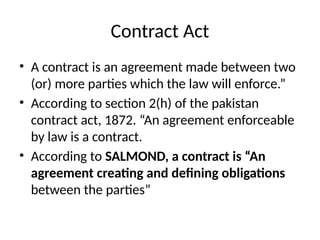
Contract Act
• A contract is an agreement made between two
(or) more parties which the law will enforce.”
• According to section 2(h) of the pakistan
contract act, 1872. “An agreement enforceable
by law is a contract.
• According to SALMOND, a contract is “An
agreement creating and defining obligations
between the parties”
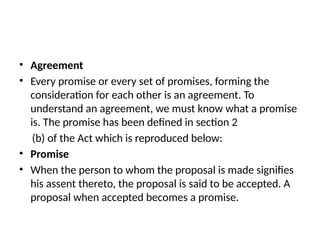
• Agreement
• Every promise or every set of promises, forming the
consideration for each other is an agreement. To
understand an agreement, we must know what a promise
is. The promise has been defined in section 2
(b) of the Act which is reproduced below:
• Promise
• When the person to whom the proposal is made signifies
his assent thereto, the proposal is said to be accepted. A
proposal when accepted becomes a promise.
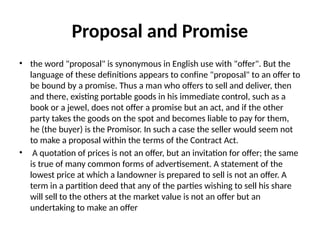
Proposal and Promise
• the word "proposal" is synonymous in English use with "offer". But the
language of these definitions appears to confine "proposal" to an offer to
be bound by a promise. Thus a man who offers to sell and deliver, then
and there, existing portable goods in his immediate control, such as a
book or a jewel, does not offer a promise but an act, and if the other
party takes the goods on the spot and becomes liable to pay for them,
he (the buyer) is the Promisor. In such a case the seller would seem not
to make a proposal within the terms of the Contract Act.
• A quotation of prices is not an offer, but an invitation for offer; the same
is true of many common forms of advertisement. A statement of the
lowest price at which a landowner is prepared to sell is not an offer. A
term in a partition deed that any of the parties wishing to sell his share
will sell to the others at the market value is not an offer but an
undertaking to make an offer
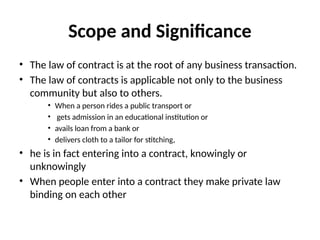
Scope and Significance
• The law of contract is at the root of any business transaction.
• The law of contracts is applicable not only to the business
community but also to others.
• When a person rides a public transport or
• gets admission in an educational institution or
• avails loan from a bank or
• delivers cloth to a tailor for stitching,
• he is in fact entering into a contract, knowingly or
unknowingly
• When people enter into a contract they make private law
binding on each other
Scope and Significance
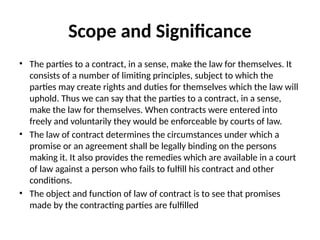
• The parties to a contract, in a sense, make the law for themselves. It
consists of a number of limiting principles, subject to which the
parties may create rights and duties for themselves which the law will
uphold. Thus we can say that the parties to a contract, in a sense,
make the law for themselves. When contracts were entered into
freely and voluntarily they would be enforceable by courts of law.
• The law of contract determines the circumstances under which a
promise or an agreement shall be legally binding on the persons
making it. It also provides the remedies which are available in a court
of law against a person who fails to fulfill his contract and other
conditions.
• The object and function of law of contract is to see that promises
made by the contracting parties are fulfilled
Scheme of the Act
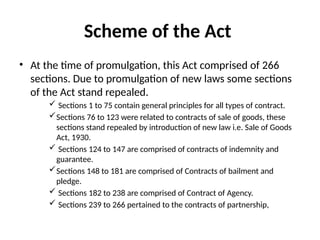
• At the time of promulgation, this Act comprised of 266
sections. Due to promulgation of new laws some sections
of the Act stand repealed.
 Sections 1 to 75 contain general principles for all types of contract.
Sections 76 to 123 were related to contracts of sale of goods, these
sections stand repealed by introduction of new law i.e. Sale of Goods
Act, 1930.
 Sections 124 to 147 are comprised of contracts of indemnity and
guarantee.
Sections 148 to 181 are comprised of Contracts of bailment and
pledge.
 Sections 182 to 238 are comprised of Contract of Agency.
 Sections 239 to 266 pertained to the contracts of partnership,
Applicability of Law of Contract
• Law applicable where Parties to a contract
belong to different countries: Where a
contract is entered into in one country and is
to be performed in another country, the
question of applicability of law shall be
decided on the following premises:
• First approach is that the law of the country
where contract is made shall be applicable.
Second approach
• in cases where contract is entered into one country and is to be
performed in another country then the law of the country
where the performance is to take place shall be applicable.
However if such a situation arises, the intention of the parties
shall be looked into to decide the question of applicability of
the law.
• In international contracts, it is up to the contracting parties to
choose the law of the country applicable in respect of such
contracts. (At the time of making the contract, it will be settled
between the parties whether the law of the country, where
contract is made shall be applicable or where contract is to be
performed).
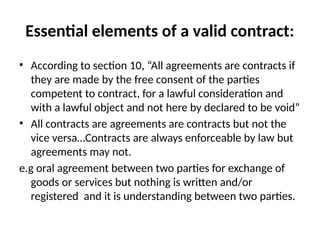
Essential elements of a valid contract:
• According to section 10, “All agreements are contracts if
they are made by the free consent of the parties
competent to contract, for a lawful consideration and
with a lawful object and not here by declared to be void”
• All contracts are agreements are contracts but not the
vice versa…Contracts are always enforceable by law but
agreements may not.
e.g oral agreement between two parties for exchange of
goods or services but nothing is written and/or
registered and it is understanding between two parties.
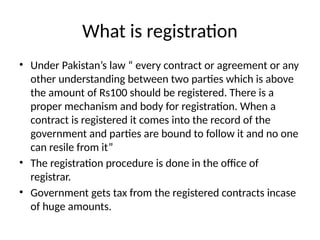
What is registration
• Under Pakistan’s law “ every contract or agreement or any
other understanding between two parties which is above
the amount of Rs100 should be registered. There is a
proper mechanism and body for registration. When a
contract is registered it comes into the record of the
government and parties are bound to follow it and no one
can resile from it”
• The registration procedure is done in the office of
registrar.
• Government gets tax from the registered contracts incase
of huge amounts.
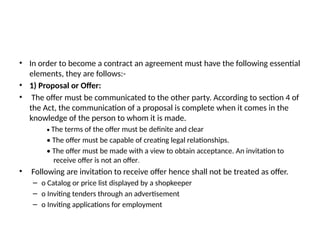
• In order to become a contract an agreement must have the following essential
elements, they are follows:-
• 1) Proposal or Offer:
• The offer must be communicated to the other party. According to section 4 of
the Act, the communication of a proposal is complete when it comes in the
knowledge of the person to whom it is made.
• The terms of the offer must be definite and clear
• The offer must be capable of creating legal relationships.
• The offer must be made with a view to obtain acceptance. An invitation to
receive offer is not an offer.
• Following are invitation to receive offer hence shall not be treated as offer.
– o Catalog or price list displayed by a shopkeeper
– o Inviting tenders through an advertisement
– o Inviting applications for employment
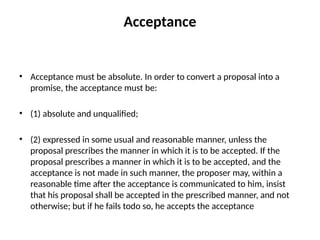
Acceptance
• Acceptance must be absolute. In order to convert a proposal into a
promise, the acceptance must be:
• (1) absolute and unqualified;
• (2) expressed in some usual and reasonable manner, unless the
proposal prescribes the manner in which it is to be accepted. If the
proposal prescribes a manner in which it is to be accepted, and the
acceptance is not made in such manner, the proposer may, within a
reasonable time after the acceptance is communicated to him, insist
that his proposal shall be accepted in the prescribed manner, and not
otherwise; but if he fails todo so, he accepts the acceptance
• Acceptance must be absolute and
unconditional
• Acceptance must be communicated to the
offeror
• Acceptance must be in prescribed manner
• Acceptance must be in response to an offer.
• Acceptance must be by the offeree or
authorized person.
2) Intention to create legal relationship:
• The parties must have intention to create legal
relationship among them.
• Generally, the agreements of social, domestic
and political nature are not a contract. E.g
nawaz & zardari understanding not to topple
each other gov
• If there is no such intention to create a legal
relationship among the parties, there is no
contract between them.
• Example: BALFOUR (vs) BALFOUR (1919)
• Facts: A husband promised to pay his wife a
household allowance of L 30 (pounds) every month.
Later the parties separated and the husband failed to
pay the amount. The wife sued for allowance.
• Judgment: Agreements such as there were outside
the realm of contract altogether. Because there is no
intention to create legal relationship among the
parties.
What is communication?
• As the words of this section stand it would seem that some
sort of communication of a proposal, etc., is made by an act
which is intended to communicate it, but in fact has not that
effect, and that such an inchoate communication fails to have
legal effect only because the specific provisions of S. 4 prevent
it from being complete.
• It would seem both simpler and more rational to say that an
act intended to communicate a proposal, etc., but failing to do
so, is not a communication at all. To get this sense from the
section before us we should have to read "and" for "or" in the
last clause. There are not any corresponding words in the
Commissioners’ draft
For example
• delivery of goods by their owner to a man
who has offered to buy them for a certain
price will be understood by every one, unless
there be some indication to the contrary, to
signify acceptance of that offer. No words are
needed, again, to explain the intent with
which a man steps into a ferryboat or a
tramcar, or drops a coin into an automatic
machine.
3) Free and Genuine consent:
• The consent of the parties to the agreement must
be free and genuine.
• Free consent is said to be absent, if the agreement
is induced by
• a)coercion,
• b)undue influence,
• c)fraud,
• d)Mis-representation,
• e)mistake.
4) Lawful Object:
• The object of the agreement must be lawful. In
other words, it means the object must not be
i. Illegal, ( Drugs )
ii. immoral, ( prostitution)
iii. opposed to public policy (pollution emission)
• If an agreement suffers from any legal flaw, it
would not be enforceable by law.
5) Lawful Consideration:
• An agreement to be enforceable by law must be
supported by consideration. e.g Real estate dealing,
so Money is consideration.
• Consideration means “an advantage or benefit”
moving from one party to other. In other words
“something in return”.
• The agreement is enforceable only when both the
parties give something and get something in return.
• The consideration must be real and lawful.
6) Capacity of parties: (Competency)
The parties to a contract should be capable of entering
into a valid contract.
• Every person is competent to contract if
1. He is the age of majority, incase of minor a guardian
will enter into a contract. Guardian will be appointed
by court.
2. He is of sound mind and
3. He is not dis-qualified from contracting by any law.
• The flaw in capacity to contract may arise from
minority, lunacy, idiocy, drunkenness, etc..,
7) Agreement not to be declared void:
• The agreements must not have been expressly
declared to be void u/s 24 to 30 of the act.
• Example: If there is stay on the property under
such sections, that it can’t be sold by the court
of law and any party contracts with another
for the sale of same property, it is declared
void.
8) Certainty:
• The meaning of the agreement must be certain
and not be vague (or) indefinite.
• · If it is vague (or) indefinite it is not possible to
ascertain its meaning.
• Example:
• ‘A’ agrees to sell to ‘B’ a hundred tones of oil.
There is nothing whatever to show what kind of
a oil intended. The agreement is void for
uncertainty
9) Possibility of performance:
• The terms of an agreement should be capable
of performance.
• The agreement to do an act impossible in
itself is void and cannot be enforceable.
• Example:
• ‘A’ agrees with ‘B’, to put life into B’s dead
wife, the agreement is void it is impossible of
performance
10) Necessary legal formalities
• According to contract Act, oral (or) written are
perfectly valid.
• · There is no provision for contracting being
written, registered and stamped.
• · But if is required by law, that it should
comply with legal formalities and then it
should be complied with all legal (or)
necessary formalities for its enforceability

Contract its Scope and Significance.pptx

  • 1.
    CONTRACT ACT- SCOPE& SIGNIFICANCE
  • 2.
    Contract Act • Acontract is an agreement made between two (or) more parties which the law will enforce.” • According to section 2(h) of the pakistan contract act, 1872. “An agreement enforceable by law is a contract. • According to SALMOND, a contract is “An agreement creating and defining obligations between the parties”
  • 3.
    • Agreement • Everypromise or every set of promises, forming the consideration for each other is an agreement. To understand an agreement, we must know what a promise is. The promise has been defined in section 2 (b) of the Act which is reproduced below: • Promise • When the person to whom the proposal is made signifies his assent thereto, the proposal is said to be accepted. A proposal when accepted becomes a promise.
  • 4.
    Proposal and Promise •the word "proposal" is synonymous in English use with "offer". But the language of these definitions appears to confine "proposal" to an offer to be bound by a promise. Thus a man who offers to sell and deliver, then and there, existing portable goods in his immediate control, such as a book or a jewel, does not offer a promise but an act, and if the other party takes the goods on the spot and becomes liable to pay for them, he (the buyer) is the Promisor. In such a case the seller would seem not to make a proposal within the terms of the Contract Act. • A quotation of prices is not an offer, but an invitation for offer; the same is true of many common forms of advertisement. A statement of the lowest price at which a landowner is prepared to sell is not an offer. A term in a partition deed that any of the parties wishing to sell his share will sell to the others at the market value is not an offer but an undertaking to make an offer
  • 5.
    Scope and Significance •The law of contract is at the root of any business transaction. • The law of contracts is applicable not only to the business community but also to others. • When a person rides a public transport or • gets admission in an educational institution or • avails loan from a bank or • delivers cloth to a tailor for stitching, • he is in fact entering into a contract, knowingly or unknowingly • When people enter into a contract they make private law binding on each other
  • 6.
    Scope and Significance •The parties to a contract, in a sense, make the law for themselves. It consists of a number of limiting principles, subject to which the parties may create rights and duties for themselves which the law will uphold. Thus we can say that the parties to a contract, in a sense, make the law for themselves. When contracts were entered into freely and voluntarily they would be enforceable by courts of law. • The law of contract determines the circumstances under which a promise or an agreement shall be legally binding on the persons making it. It also provides the remedies which are available in a court of law against a person who fails to fulfill his contract and other conditions. • The object and function of law of contract is to see that promises made by the contracting parties are fulfilled
  • 7.
    Scheme of theAct • At the time of promulgation, this Act comprised of 266 sections. Due to promulgation of new laws some sections of the Act stand repealed.  Sections 1 to 75 contain general principles for all types of contract. Sections 76 to 123 were related to contracts of sale of goods, these sections stand repealed by introduction of new law i.e. Sale of Goods Act, 1930.  Sections 124 to 147 are comprised of contracts of indemnity and guarantee. Sections 148 to 181 are comprised of Contracts of bailment and pledge.  Sections 182 to 238 are comprised of Contract of Agency.  Sections 239 to 266 pertained to the contracts of partnership,
  • 8.
    Applicability of Lawof Contract • Law applicable where Parties to a contract belong to different countries: Where a contract is entered into in one country and is to be performed in another country, the question of applicability of law shall be decided on the following premises: • First approach is that the law of the country where contract is made shall be applicable.
  • 9.
    Second approach • incases where contract is entered into one country and is to be performed in another country then the law of the country where the performance is to take place shall be applicable. However if such a situation arises, the intention of the parties shall be looked into to decide the question of applicability of the law. • In international contracts, it is up to the contracting parties to choose the law of the country applicable in respect of such contracts. (At the time of making the contract, it will be settled between the parties whether the law of the country, where contract is made shall be applicable or where contract is to be performed).
  • 10.
    Essential elements ofa valid contract: • According to section 10, “All agreements are contracts if they are made by the free consent of the parties competent to contract, for a lawful consideration and with a lawful object and not here by declared to be void” • All contracts are agreements are contracts but not the vice versa…Contracts are always enforceable by law but agreements may not. e.g oral agreement between two parties for exchange of goods or services but nothing is written and/or registered and it is understanding between two parties.
  • 11.
    What is registration •Under Pakistan’s law “ every contract or agreement or any other understanding between two parties which is above the amount of Rs100 should be registered. There is a proper mechanism and body for registration. When a contract is registered it comes into the record of the government and parties are bound to follow it and no one can resile from it” • The registration procedure is done in the office of registrar. • Government gets tax from the registered contracts incase of huge amounts.
  • 12.
    • In orderto become a contract an agreement must have the following essential elements, they are follows:- • 1) Proposal or Offer: • The offer must be communicated to the other party. According to section 4 of the Act, the communication of a proposal is complete when it comes in the knowledge of the person to whom it is made. • The terms of the offer must be definite and clear • The offer must be capable of creating legal relationships. • The offer must be made with a view to obtain acceptance. An invitation to receive offer is not an offer. • Following are invitation to receive offer hence shall not be treated as offer. – o Catalog or price list displayed by a shopkeeper – o Inviting tenders through an advertisement – o Inviting applications for employment
  • 13.
    Acceptance • Acceptance mustbe absolute. In order to convert a proposal into a promise, the acceptance must be: • (1) absolute and unqualified; • (2) expressed in some usual and reasonable manner, unless the proposal prescribes the manner in which it is to be accepted. If the proposal prescribes a manner in which it is to be accepted, and the acceptance is not made in such manner, the proposer may, within a reasonable time after the acceptance is communicated to him, insist that his proposal shall be accepted in the prescribed manner, and not otherwise; but if he fails todo so, he accepts the acceptance
  • 14.
    • Acceptance mustbe absolute and unconditional • Acceptance must be communicated to the offeror • Acceptance must be in prescribed manner • Acceptance must be in response to an offer. • Acceptance must be by the offeree or authorized person.
  • 15.
    2) Intention tocreate legal relationship: • The parties must have intention to create legal relationship among them. • Generally, the agreements of social, domestic and political nature are not a contract. E.g nawaz & zardari understanding not to topple each other gov • If there is no such intention to create a legal relationship among the parties, there is no contract between them.
  • 16.
    • Example: BALFOUR(vs) BALFOUR (1919) • Facts: A husband promised to pay his wife a household allowance of L 30 (pounds) every month. Later the parties separated and the husband failed to pay the amount. The wife sued for allowance. • Judgment: Agreements such as there were outside the realm of contract altogether. Because there is no intention to create legal relationship among the parties.
  • 17.
    What is communication? •As the words of this section stand it would seem that some sort of communication of a proposal, etc., is made by an act which is intended to communicate it, but in fact has not that effect, and that such an inchoate communication fails to have legal effect only because the specific provisions of S. 4 prevent it from being complete. • It would seem both simpler and more rational to say that an act intended to communicate a proposal, etc., but failing to do so, is not a communication at all. To get this sense from the section before us we should have to read "and" for "or" in the last clause. There are not any corresponding words in the Commissioners’ draft
  • 18.
    For example • deliveryof goods by their owner to a man who has offered to buy them for a certain price will be understood by every one, unless there be some indication to the contrary, to signify acceptance of that offer. No words are needed, again, to explain the intent with which a man steps into a ferryboat or a tramcar, or drops a coin into an automatic machine.
  • 19.
    3) Free andGenuine consent: • The consent of the parties to the agreement must be free and genuine. • Free consent is said to be absent, if the agreement is induced by • a)coercion, • b)undue influence, • c)fraud, • d)Mis-representation, • e)mistake.
  • 20.
    4) Lawful Object: •The object of the agreement must be lawful. In other words, it means the object must not be i. Illegal, ( Drugs ) ii. immoral, ( prostitution) iii. opposed to public policy (pollution emission) • If an agreement suffers from any legal flaw, it would not be enforceable by law.
  • 21.
    5) Lawful Consideration: •An agreement to be enforceable by law must be supported by consideration. e.g Real estate dealing, so Money is consideration. • Consideration means “an advantage or benefit” moving from one party to other. In other words “something in return”. • The agreement is enforceable only when both the parties give something and get something in return. • The consideration must be real and lawful.
  • 22.
    6) Capacity ofparties: (Competency) The parties to a contract should be capable of entering into a valid contract. • Every person is competent to contract if 1. He is the age of majority, incase of minor a guardian will enter into a contract. Guardian will be appointed by court. 2. He is of sound mind and 3. He is not dis-qualified from contracting by any law. • The flaw in capacity to contract may arise from minority, lunacy, idiocy, drunkenness, etc..,
  • 23.
    7) Agreement notto be declared void: • The agreements must not have been expressly declared to be void u/s 24 to 30 of the act. • Example: If there is stay on the property under such sections, that it can’t be sold by the court of law and any party contracts with another for the sale of same property, it is declared void.
  • 24.
    8) Certainty: • Themeaning of the agreement must be certain and not be vague (or) indefinite. • · If it is vague (or) indefinite it is not possible to ascertain its meaning. • Example: • ‘A’ agrees to sell to ‘B’ a hundred tones of oil. There is nothing whatever to show what kind of a oil intended. The agreement is void for uncertainty
  • 25.
    9) Possibility ofperformance: • The terms of an agreement should be capable of performance. • The agreement to do an act impossible in itself is void and cannot be enforceable. • Example: • ‘A’ agrees with ‘B’, to put life into B’s dead wife, the agreement is void it is impossible of performance
  • 26.
    10) Necessary legalformalities • According to contract Act, oral (or) written are perfectly valid. • · There is no provision for contracting being written, registered and stamped. • · But if is required by law, that it should comply with legal formalities and then it should be complied with all legal (or) necessary formalities for its enforceability