PARTNERING IN THE CLOUD
Two partners tell you how and why they work together
San Francisco, CA | October 22, 2015 – 4:30pm to 9:30pm
Jerod Powell
CEO
INFINIT CONSULTING INC
jpowell@infinitconsulting.com
@jerodpowell
Sean Patrick Tario
CEO
OPEN SPECTRUM INC
sean@openspectruminc.com
@seanptario
3
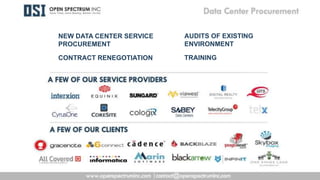
NEW DATA CENTER SERVICE
PROCUREMENT
CONTRACT RENEGOTIATION
AUDITS OF EXISTING
ENVIRONMENT
TRAINING
4
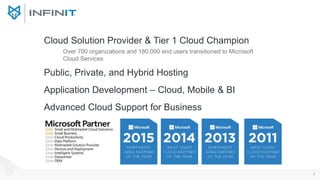
Cloud Solution Provider & Tier 1 Cloud Champion
Public, Private, and Hybrid Hosting
Over 700 organizations and 180,000 end users transitioned to Microsoft
Cloud Services
Application Development – Cloud, Mobile & BI
Advanced Cloud Support for Business
Presentation Overview
Sean and Jerod’s partnership.
3rd Platform and Digital Transformation: Brief overview, impact and a look ahead
What are the benefits of partnering?
How do you find a prospective partner?
How do you decide if this is the right partner for you?
How do you present the partnership to the client?
What are key things that need to be considered to make the engagement work?
Do you need a single project manager?
Should you expect reciprocal leads from the partner(s) you choose?
Do you need a formal partnership agreement and if so what should be included?
How do you agree a strategy when something goes wrong.
How can you develop and enhance an existing partnership?
Sean and Jerod’s Partnership
6
o Met over a datacenter deal Sean sold to
Jerod
o Immediate Synergy (Synergy is key)
o Both entrepreneurial and loved
technology and making customers happy
o 10 years later, 2 datacenters and today
good friends and business partners.
o Overlap in services although slight was
never an issue.
o Key attributes were synergy, customer
focused, integrity, respect and driven
3rd Platform & Digital Transformation Impact
o 3rd Platform is Cloud Services, Mobile, Social
& Advanced Analytics and Big Data
o Why the buzz? All 4 cornerstones of the 3rd
Platform are highly disruptive, they change
how business operates.
o Disruption combined with wild growth = mass
opportunity for those who can capitalize.
o Partnerships previously not considered will
be driven, channel partner with channel
partner, Microsoft with Facebook, IBM with
HP.
o Keep an open mind opportunity is there to
work with like minded businesses
o Find a development partner if you aren’t a
development company, you will need one.
7
What are the benefits of Partnering?
Reasons for Engaging a Partner
o Industry expertise – specific experience
o Solution-specific expertise (Cloud, Big
Data, Social, Mobile Development)
o Increase sales/marketing coverage in
current and new geographies
o Customer-specific knowledge and
expertise
o Lack of resources
Benefits of Partnering
o Increased market reputation and market
share
o Enables partners to better compete and
win deals (levels the playing field if done
right)
o Increases overall profitability
o Covers your gaps, both with resources
and solution gaps in offerings
8
How do you find a prospective partner?
o Finding a prospective partner will vary
slightly depending on the type of partner
but below here are guidelines.
o Leverage software vendor resources is
available, fill out profile on partner locator,
attend conferences and network with like
minded people…you will know when you
find them.
o Online of course, LinkedIn groups, follow
your vendors other partners as well as
your vendor.
o Leverage groups and mention you are
looking for a specific type of partner.
o Your distributor is a great potential
resource (e.g., Ingram Micro, Tech Data,
etc.)
o My last major partnership was landed this way
o Conferences can be a great place to find
partners if you are diligent and put in time
to do the networking.
o Advisory council’s are another great place
to meet partners
o My favorite way…organically, keep your
eyes open, let your existing contacts
know, be patient opportunities will
present.
9
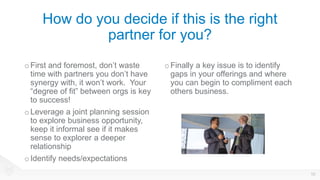
How do you decide if this is the right
partner for you?
o First and foremost, don’t waste
time with partners you don’t have
synergy with, it won’t work. Your
“degree of fit” between orgs is key
to success!
o Leverage a joint planning session
to explore business opportunity,
keep it informal see if it makes
sense to explorer a deeper
relationship
o Identify needs/expectations
oFinally a key issue is to identify
gaps in your offerings and where
you can begin to compliment each
others business.
10
How do you present the partnership to
the client?
oBe upfront and honest, never
try and hide the fact you have
a partner.
oPresent the partnership as a
true value add to the
customer
oExplain new capabilities that
are advantages for the
customer
11
oBe confident, if you feel you
are doing something wrong
so will the client.
oStart with customers you have
the best relationship with to
gain confidence.
oDiscuss success stories as a
result of partnering.
Key things to consider to make the
engagement work?
oHave hard talks out of the
way, it is go time.
oEnsure talks about money are
resolved.
oWho is the point
person/leader on the
engagement?
oWhat is each partners
commitment to the
engagement.
oCommunications, a daily
huddle of 5-10 minutes goes
a long way, meeting for a
minimum of 30 minutes one
per week.
oLeave your ego at the door, it
is about engagement success
not you.
oEnjoy it!
12
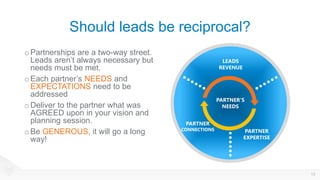
Should leads be reciprocal?
o Partnerships are a two-way street.
Leads aren’t always necessary but
needs must be met.
o Each partner’s NEEDS and
EXPECTATIONS need to be
addressed
o Deliver to the partner what was
AGREED upon in your vision and
planning session.
o Be GENEROUS, it will go a long
way!
13
LEADS
REVENUE
PARTNER
EXPERTISE
PARTNER
CONNECTIONS
PARTNER’S
NEEDS
Is a formal partnership agreement
needed? What should it include?
14
o Formal agreements are needed, plenty of handshake agreements have gone
fine but the ones that don’t are painful.
o An agreement typically contains pricing, compensation, response time to
customers, training of personnel, investment in marketing, and ownership of
intellectual property.
o The disgruntled partner that leaves a partnership isn’t the same partner as
when they formed the partnership.
o To be safe it is best to document the relationship and expectations and/or
deliverables in writing and agree to it.
How do you agree on a strategy when
something goes wrong?
15
oLevel heads will prevail, at all costs control anger and be
calm.
oBe proactive in working towards a resolution.
oCommunicate, you must set aside time to talk about the
business.
oDiscuss action’s you’re each willing to take.
oCreate a plan for change.
oHold each other accountable by setting a timeframe for
evaluation.
oBe honest with yourselves, if it is a wrong fit continuing will
only complicate matters.
How do you enhance an existing
partnership?
16
o You move from what is considered a proactive to a dynamic
partnership (deeper integration between companies)
o You might share a joint CRM system for managing leads
generated by partnership efforts.
o Formal certification plans to meet goals and objectives.
o No fault customer support, both partners handle it.
o Perhaps co-development of intellectual property.
o Continuous improvement
o Be engaged and put in effort – no substitute for engagement
Partnering in the Cloud

Partnering in the Cloud

  • 2.
    PARTNERING IN THECLOUD Two partners tell you how and why they work together San Francisco, CA | October 22, 2015 – 4:30pm to 9:30pm Jerod Powell CEO INFINIT CONSULTING INC jpowell@infinitconsulting.com @jerodpowell Sean Patrick Tario CEO OPEN SPECTRUM INC sean@openspectruminc.com @seanptario
  • 3.
    3 NEW DATA CENTERSERVICE PROCUREMENT CONTRACT RENEGOTIATION AUDITS OF EXISTING ENVIRONMENT TRAINING
  • 4.
    4 Cloud Solution Provider& Tier 1 Cloud Champion Public, Private, and Hybrid Hosting Over 700 organizations and 180,000 end users transitioned to Microsoft Cloud Services Application Development – Cloud, Mobile & BI Advanced Cloud Support for Business
  • 5.
    Presentation Overview Sean andJerod’s partnership. 3rd Platform and Digital Transformation: Brief overview, impact and a look ahead What are the benefits of partnering? How do you find a prospective partner? How do you decide if this is the right partner for you? How do you present the partnership to the client? What are key things that need to be considered to make the engagement work? Do you need a single project manager? Should you expect reciprocal leads from the partner(s) you choose? Do you need a formal partnership agreement and if so what should be included? How do you agree a strategy when something goes wrong. How can you develop and enhance an existing partnership?
  • 6.
    Sean and Jerod’sPartnership 6 o Met over a datacenter deal Sean sold to Jerod o Immediate Synergy (Synergy is key) o Both entrepreneurial and loved technology and making customers happy o 10 years later, 2 datacenters and today good friends and business partners. o Overlap in services although slight was never an issue. o Key attributes were synergy, customer focused, integrity, respect and driven
  • 7.
    3rd Platform &Digital Transformation Impact o 3rd Platform is Cloud Services, Mobile, Social & Advanced Analytics and Big Data o Why the buzz? All 4 cornerstones of the 3rd Platform are highly disruptive, they change how business operates. o Disruption combined with wild growth = mass opportunity for those who can capitalize. o Partnerships previously not considered will be driven, channel partner with channel partner, Microsoft with Facebook, IBM with HP. o Keep an open mind opportunity is there to work with like minded businesses o Find a development partner if you aren’t a development company, you will need one. 7
  • 8.
    What are thebenefits of Partnering? Reasons for Engaging a Partner o Industry expertise – specific experience o Solution-specific expertise (Cloud, Big Data, Social, Mobile Development) o Increase sales/marketing coverage in current and new geographies o Customer-specific knowledge and expertise o Lack of resources Benefits of Partnering o Increased market reputation and market share o Enables partners to better compete and win deals (levels the playing field if done right) o Increases overall profitability o Covers your gaps, both with resources and solution gaps in offerings 8
  • 9.
    How do youfind a prospective partner? o Finding a prospective partner will vary slightly depending on the type of partner but below here are guidelines. o Leverage software vendor resources is available, fill out profile on partner locator, attend conferences and network with like minded people…you will know when you find them. o Online of course, LinkedIn groups, follow your vendors other partners as well as your vendor. o Leverage groups and mention you are looking for a specific type of partner. o Your distributor is a great potential resource (e.g., Ingram Micro, Tech Data, etc.) o My last major partnership was landed this way o Conferences can be a great place to find partners if you are diligent and put in time to do the networking. o Advisory council’s are another great place to meet partners o My favorite way…organically, keep your eyes open, let your existing contacts know, be patient opportunities will present. 9
  • 10.
    How do youdecide if this is the right partner for you? o First and foremost, don’t waste time with partners you don’t have synergy with, it won’t work. Your “degree of fit” between orgs is key to success! o Leverage a joint planning session to explore business opportunity, keep it informal see if it makes sense to explorer a deeper relationship o Identify needs/expectations oFinally a key issue is to identify gaps in your offerings and where you can begin to compliment each others business. 10
  • 11.
    How do youpresent the partnership to the client? oBe upfront and honest, never try and hide the fact you have a partner. oPresent the partnership as a true value add to the customer oExplain new capabilities that are advantages for the customer 11 oBe confident, if you feel you are doing something wrong so will the client. oStart with customers you have the best relationship with to gain confidence. oDiscuss success stories as a result of partnering.
  • 12.
    Key things toconsider to make the engagement work? oHave hard talks out of the way, it is go time. oEnsure talks about money are resolved. oWho is the point person/leader on the engagement? oWhat is each partners commitment to the engagement. oCommunications, a daily huddle of 5-10 minutes goes a long way, meeting for a minimum of 30 minutes one per week. oLeave your ego at the door, it is about engagement success not you. oEnjoy it! 12
  • 13.
    Should leads bereciprocal? o Partnerships are a two-way street. Leads aren’t always necessary but needs must be met. o Each partner’s NEEDS and EXPECTATIONS need to be addressed o Deliver to the partner what was AGREED upon in your vision and planning session. o Be GENEROUS, it will go a long way! 13 LEADS REVENUE PARTNER EXPERTISE PARTNER CONNECTIONS PARTNER’S NEEDS
  • 14.
    Is a formalpartnership agreement needed? What should it include? 14 o Formal agreements are needed, plenty of handshake agreements have gone fine but the ones that don’t are painful. o An agreement typically contains pricing, compensation, response time to customers, training of personnel, investment in marketing, and ownership of intellectual property. o The disgruntled partner that leaves a partnership isn’t the same partner as when they formed the partnership. o To be safe it is best to document the relationship and expectations and/or deliverables in writing and agree to it.
  • 15.
    How do youagree on a strategy when something goes wrong? 15 oLevel heads will prevail, at all costs control anger and be calm. oBe proactive in working towards a resolution. oCommunicate, you must set aside time to talk about the business. oDiscuss action’s you’re each willing to take. oCreate a plan for change. oHold each other accountable by setting a timeframe for evaluation. oBe honest with yourselves, if it is a wrong fit continuing will only complicate matters.
  • 16.
    How do youenhance an existing partnership? 16 o You move from what is considered a proactive to a dynamic partnership (deeper integration between companies) o You might share a joint CRM system for managing leads generated by partnership efforts. o Formal certification plans to meet goals and objectives. o No fault customer support, both partners handle it. o Perhaps co-development of intellectual property. o Continuous improvement o Be engaged and put in effort – no substitute for engagement

Editor's Notes

  • #9 So when does it make sense to partner with other partners? The answer is more often than you think. Create compelling solutions by partnering with partners with specific industry experience in a market you want to serve.
  • #10 Finding a partner varies by partner type really but much of it is the same, great information on the IDC site and studies about this.
  • #11 Calling It Quits When should we call it quits? Ineffectually performing partnerships require intervention to get things back on track, such as: reevaluating collective goals, demonstrating a willingness to be flexible, or involving executive leadership. If both parties agree measures to resuscitate the partnership have been unsuccessful, it should be amicably dissolved.