THE FED, BITCOINS, AND
INFLATION
3. GOLD, BITCOINS, AND
INFLATION
Dale R. DeBoer, PhD
Department of Economics, UCCS
Core functions of money
 Medium of exchange
 Unit of account
 Store of value
 Standard of deferred payment
Ideal functions?
 Full Employment and Balanced
Growth Act (1978)
 Humphrey-Hawkins Act
 Monetary requirements
 Full employment
 Growth
 Price stability
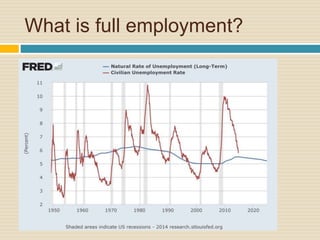
What is full employment?
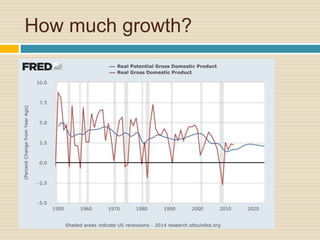
How much growth?
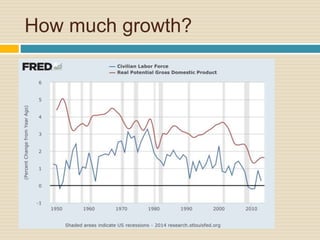
How much growth?
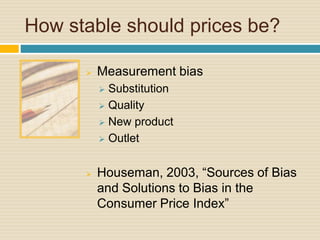
How stable should prices be?
 Measurement bias
 Substitution
 Quality
 New product
 Outlet
 Houseman, 2003, “Sources of Bias
and Solutions to Bias in the
Consumer Price Index”
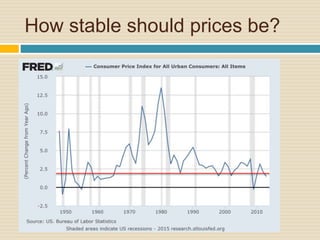
How stable should prices be?
What works best?
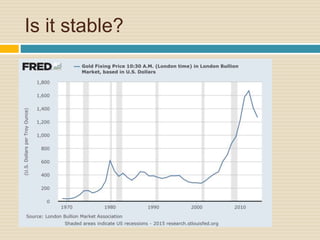
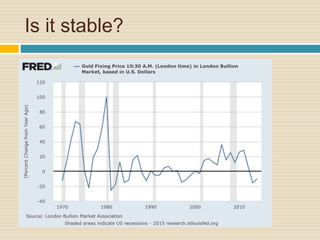
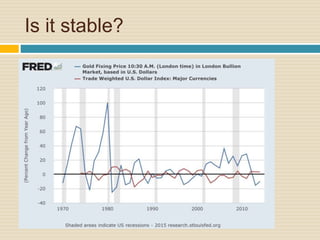
 Stable value
 Stable growth
Fiat money
 Pro
 Easy to get stable growth
 Costless to make more
Fiat money
 Pro
 Con
 Easy to grow too fast
 Trust can be lost
 Someone (or something) must control
it
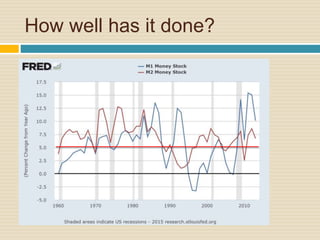
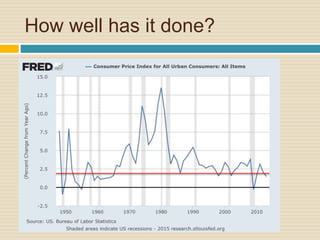
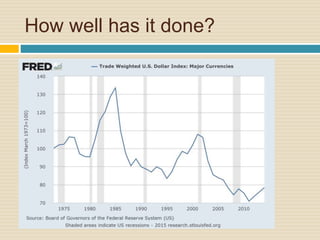
How well has it done?
Gold as money
 Pro
 Easier to maintain trust
 Could be run without external control
Gold as money
 Pro
 Con
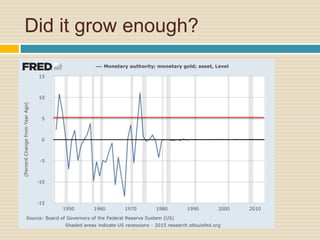
 Hard to grow at the “required” rate
(5%)
 Costly to use as money
 Still have fractional reserves
 Trust still an issue
Did it grow enough?
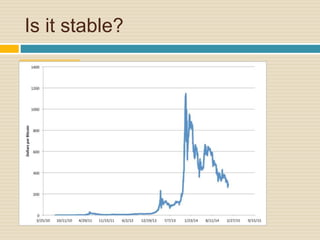
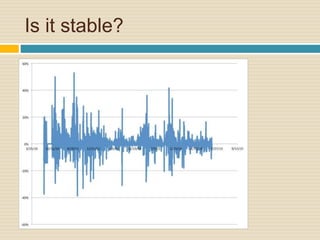
Is it stable?
Is it stable?
Is it stable?
Bitcoins: a modern alternative
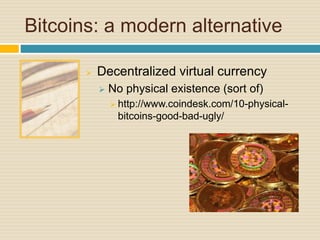
 Decentralized virtual currency
 No physical existence (sort of)
 http://www.coindesk.com/10-physical-
bitcoins-good-bad-ugly/
Bitcoins: a modern alternative
 Decentralized virtual currency
 No physical existence (sort of)
 No central authority (sort of)
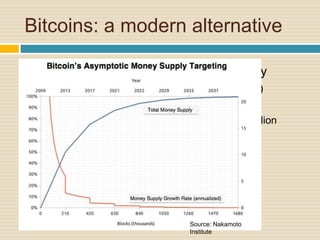
 Algorithm limits supply to 21 million
Bitcoins: a modern alternative
 Decentralized virtual currency
 No physical existence (sort of)
 No central authority (sort of)
 Algorithm limits supply to 21 million
Source: Nakamoto
Institute
Bitcoins: a modern alternative
 Decentralized virtual currency
 No physical existence (sort of)
 No central authority (sort of)
 Algorithm limits supply to 21 million
 Mt. Gox intermediated 69% of
transactions in 2013
 Bitcoin China intermediated 74% of
transactions in 2014
Bitcoins: a modern alternative
 Decentralized virtual currency
 Disintermediates formal banking
sector
Bitcoins: a modern alternative
 Decentralized virtual currency
 Disintermediates formal banking
sector
 Offers anonymous transactions
Bitcoins: a modern alternative
 Decentralized virtual currency
 Disintermediates formal banking
sector
 Offers anonymous transactions
 Eliminates fractional reserve
banking
Bitcoins: a modern alternative
 Pros
 100% reserve requirement
 Eliminates central control
 Anonymous
 Eliminates “middle-man” costs
Bitcoins: a modern alternative
 Pros
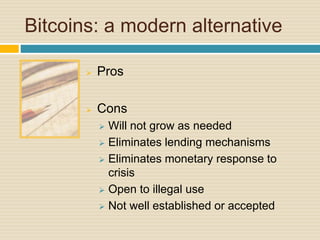
 Cons
 Will not grow as needed
 Eliminates lending mechanisms
 Eliminates monetary response to
crisis
 Open to illegal use
 Not well established or accepted
Is it stable?
Is it stable?
Is it really new?

Part 3, The Fed, Bitcoins, and Inflation

  • 1.
    THE FED, BITCOINS,AND INFLATION 3. GOLD, BITCOINS, AND INFLATION Dale R. DeBoer, PhD Department of Economics, UCCS
  • 2.
    Core functions ofmoney  Medium of exchange  Unit of account  Store of value  Standard of deferred payment
  • 3.
    Ideal functions?  FullEmployment and Balanced Growth Act (1978)  Humphrey-Hawkins Act  Monetary requirements  Full employment  Growth  Price stability
  • 4.
    What is fullemployment?
  • 5.
  • 6.
  • 7.
    How stable shouldprices be?  Measurement bias  Substitution  Quality  New product  Outlet  Houseman, 2003, “Sources of Bias and Solutions to Bias in the Consumer Price Index”
  • 8.
  • 9.
    What works best? Stable value  Stable growth
  • 10.
    Fiat money  Pro Easy to get stable growth  Costless to make more
  • 11.
    Fiat money  Pro Con  Easy to grow too fast  Trust can be lost  Someone (or something) must control it
  • 12.
    How well hasit done?
  • 13.
    How well hasit done?
  • 14.
    How well hasit done?
  • 15.
    Gold as money Pro  Easier to maintain trust  Could be run without external control
  • 16.
    Gold as money Pro  Con  Hard to grow at the “required” rate (5%)  Costly to use as money  Still have fractional reserves  Trust still an issue
  • 17.
    Did it growenough?
  • 18.
  • 19.
  • 20.
  • 21.
    Bitcoins: a modernalternative  Decentralized virtual currency  No physical existence (sort of)  http://www.coindesk.com/10-physical- bitcoins-good-bad-ugly/
  • 22.
    Bitcoins: a modernalternative  Decentralized virtual currency  No physical existence (sort of)  No central authority (sort of)  Algorithm limits supply to 21 million
  • 23.
    Bitcoins: a modernalternative  Decentralized virtual currency  No physical existence (sort of)  No central authority (sort of)  Algorithm limits supply to 21 million Source: Nakamoto Institute
  • 24.
    Bitcoins: a modernalternative  Decentralized virtual currency  No physical existence (sort of)  No central authority (sort of)  Algorithm limits supply to 21 million  Mt. Gox intermediated 69% of transactions in 2013  Bitcoin China intermediated 74% of transactions in 2014
  • 25.
    Bitcoins: a modernalternative  Decentralized virtual currency  Disintermediates formal banking sector
  • 26.
    Bitcoins: a modernalternative  Decentralized virtual currency  Disintermediates formal banking sector  Offers anonymous transactions
  • 27.
    Bitcoins: a modernalternative  Decentralized virtual currency  Disintermediates formal banking sector  Offers anonymous transactions  Eliminates fractional reserve banking
  • 28.
    Bitcoins: a modernalternative  Pros  100% reserve requirement  Eliminates central control  Anonymous  Eliminates “middle-man” costs
  • 29.
    Bitcoins: a modernalternative  Pros  Cons  Will not grow as needed  Eliminates lending mechanisms  Eliminates monetary response to crisis  Open to illegal use  Not well established or accepted
  • 30.
  • 31.
  • 32.

Editor's Notes