BUILDING A
BUSINESS
Laurie M. Lee, Esq.
Business Attorney
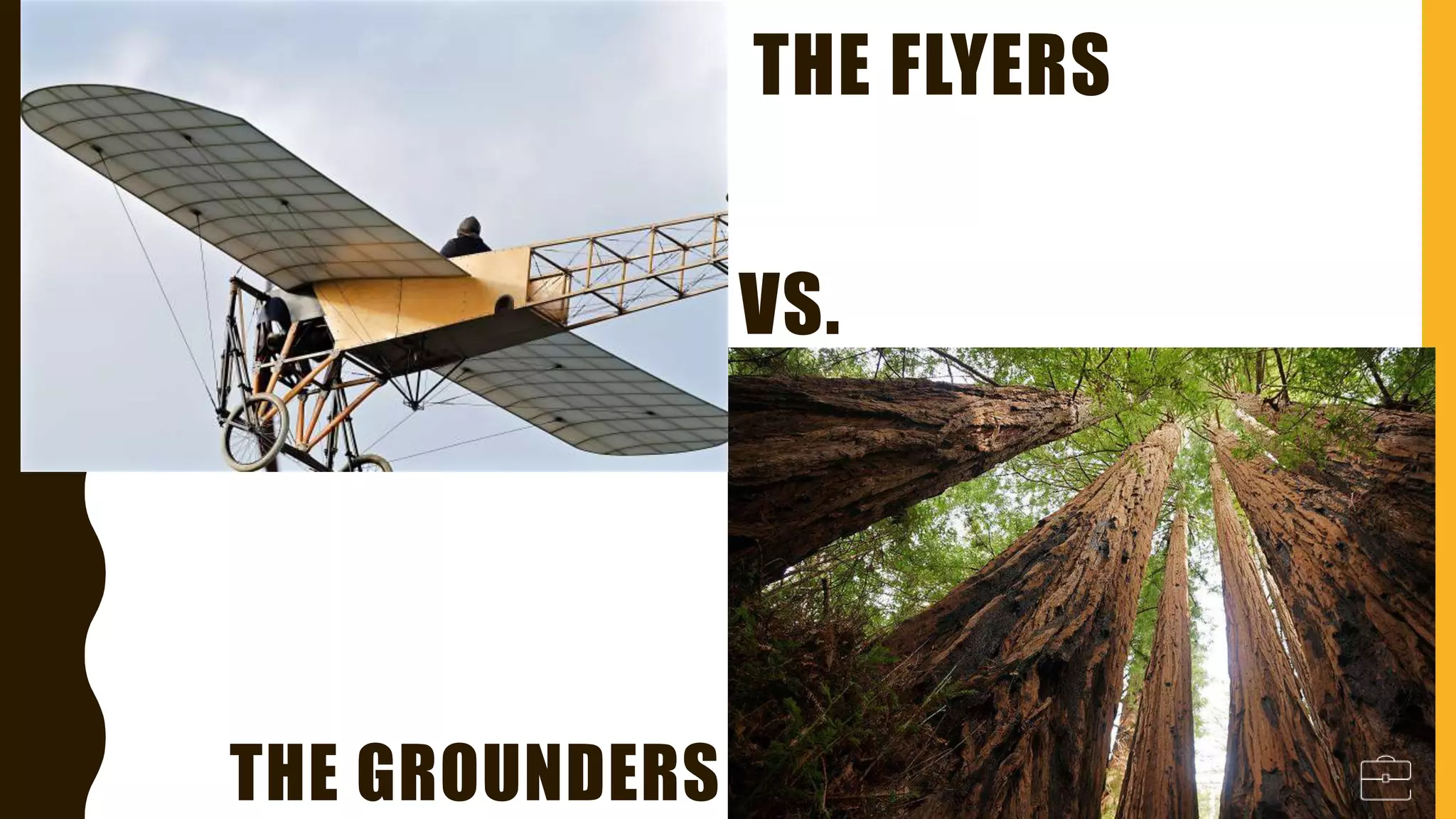
THE FLYERS
THE GROUNDERS
VS.
Photo of a strongly built house
YOU NEED A PLANE.
G
O
V
E
R
N
M
E
N
T
R
U
L
E
S
ENTITY
STRUCTURE
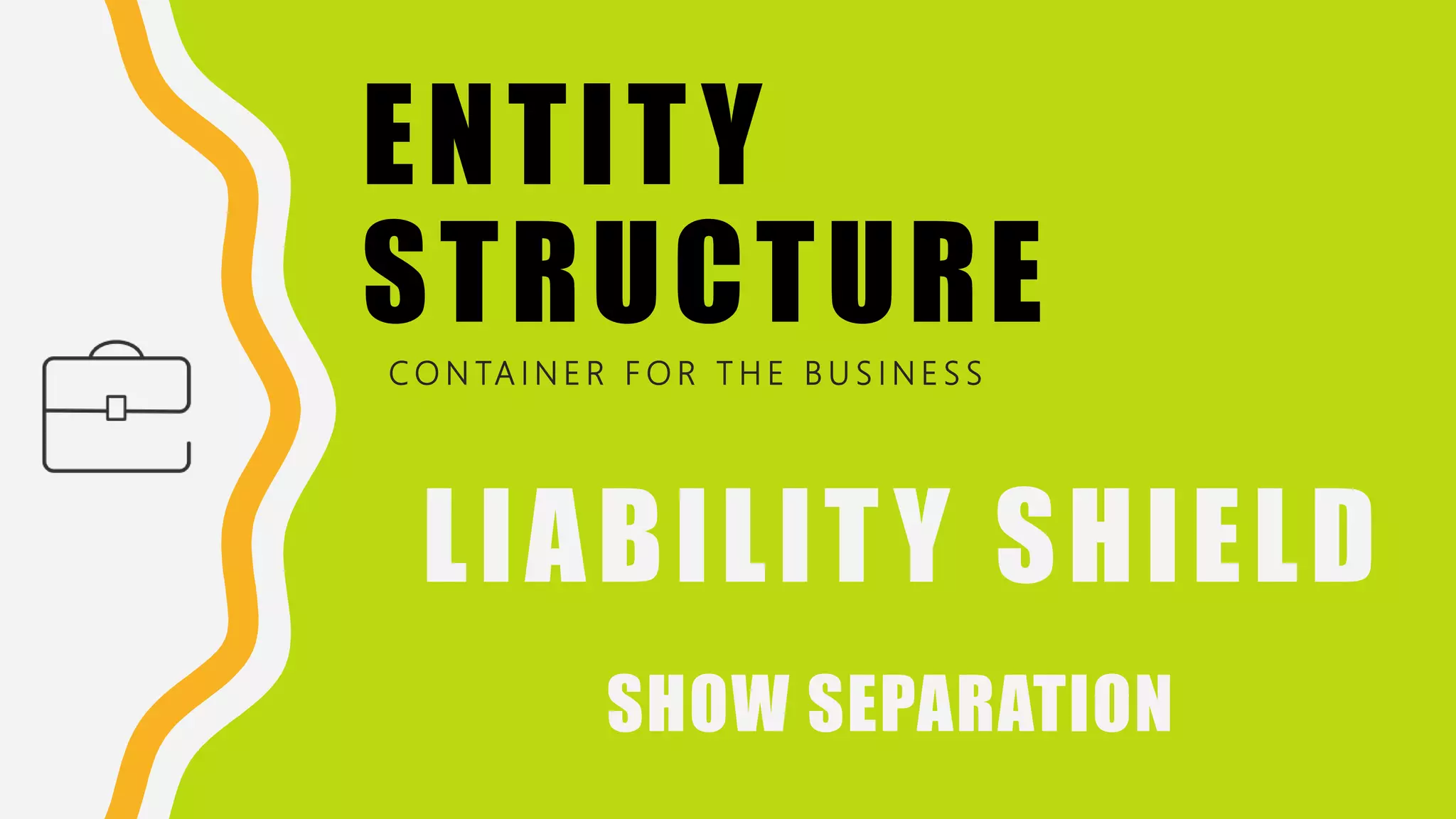
C O N TA I N E R F O R T H E B U S I N E S S
LIABILITY SHIELD
SHOW SEPARATION
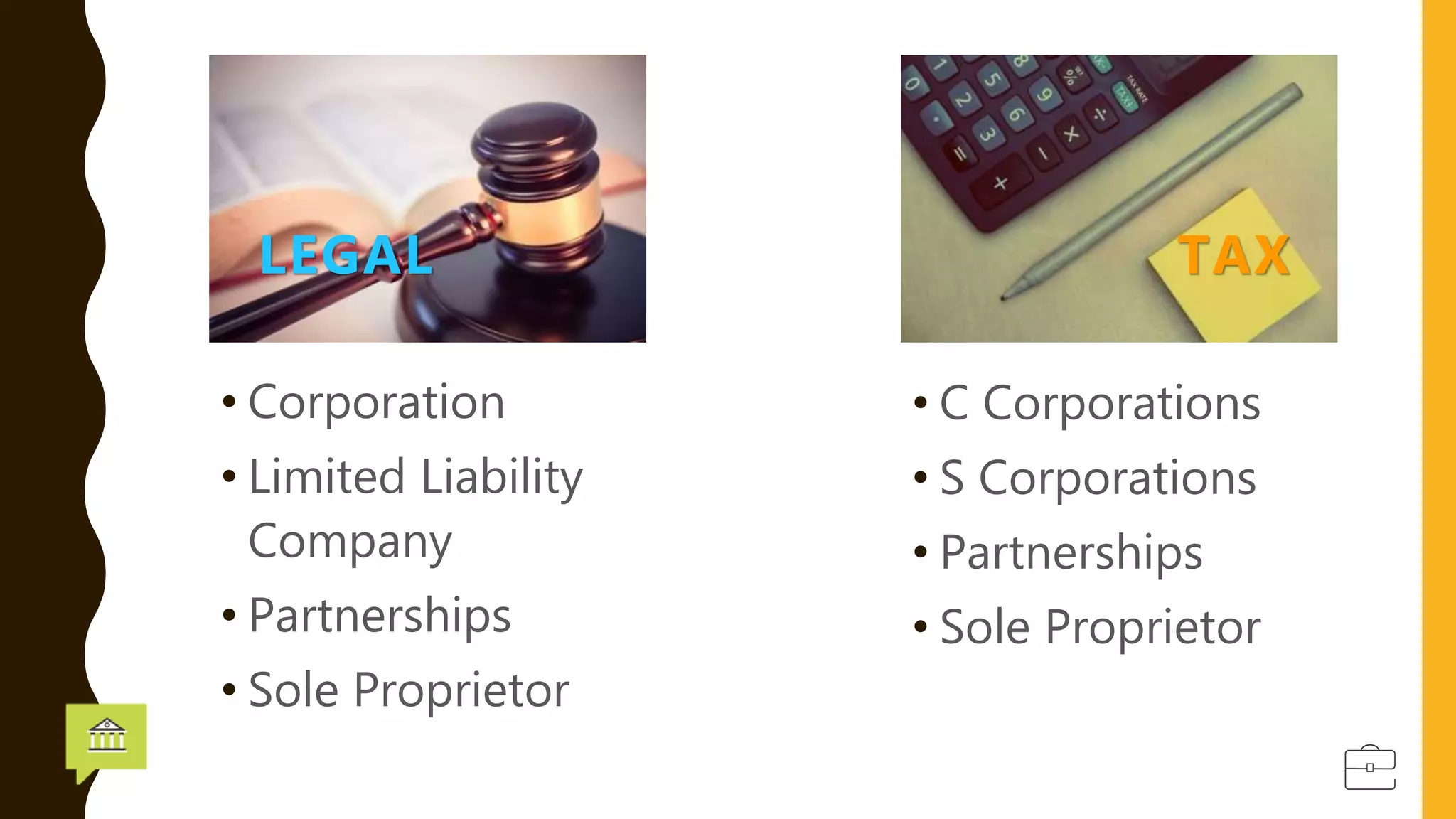
• Corporation
• Limited Liability
Company
• Partnerships
• Sole Proprietor
• C Corporations
• S Corporations
• Partnerships
• Sole Proprietor
LEGAL TAX
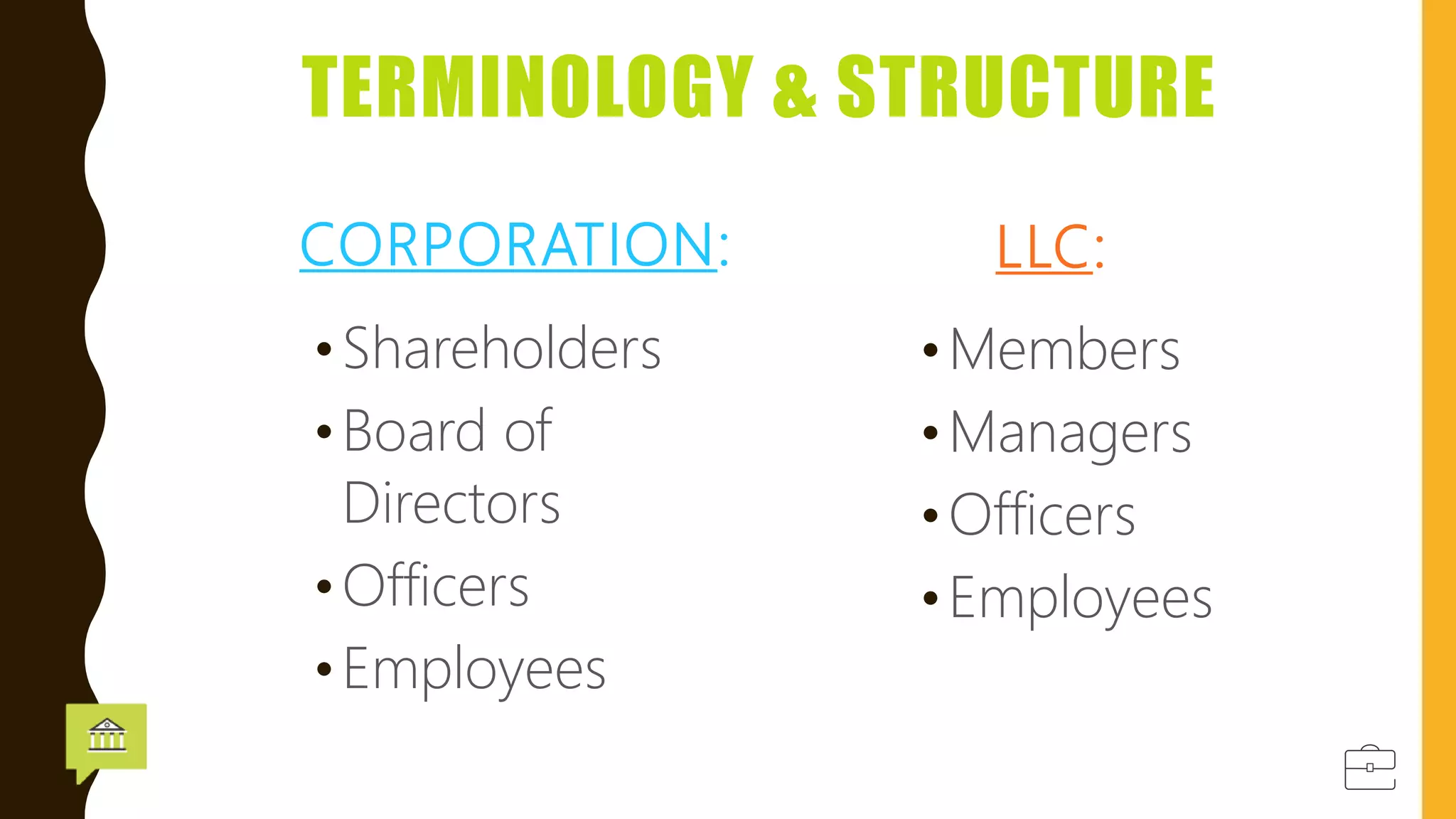
TERMINOLOGY & STRUCTURE
CORPORATION:
•Shareholders
•Board of
Directors
•Officers
•Employees
LLC:
•Members
•Managers
•Officers
•Employees
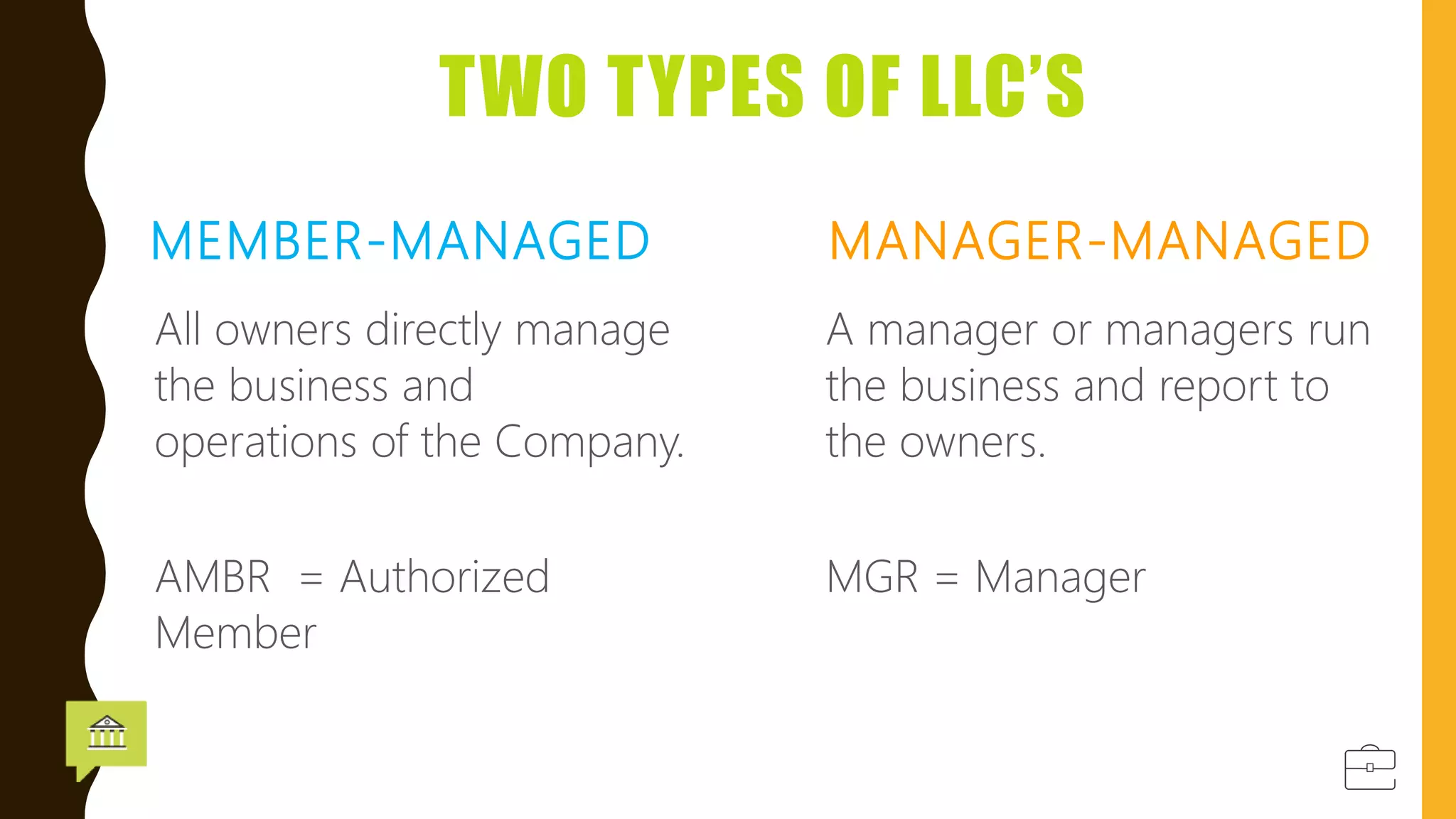
TWO TYPES OF LLC’S
MEMBER-MANAGED
All owners directly manage
the business and
operations of the Company.
MANAGER-MANAGED
A manager or managers run
the business and report to
the owners.
AMBR = Authorized
Member
MGR = Manager
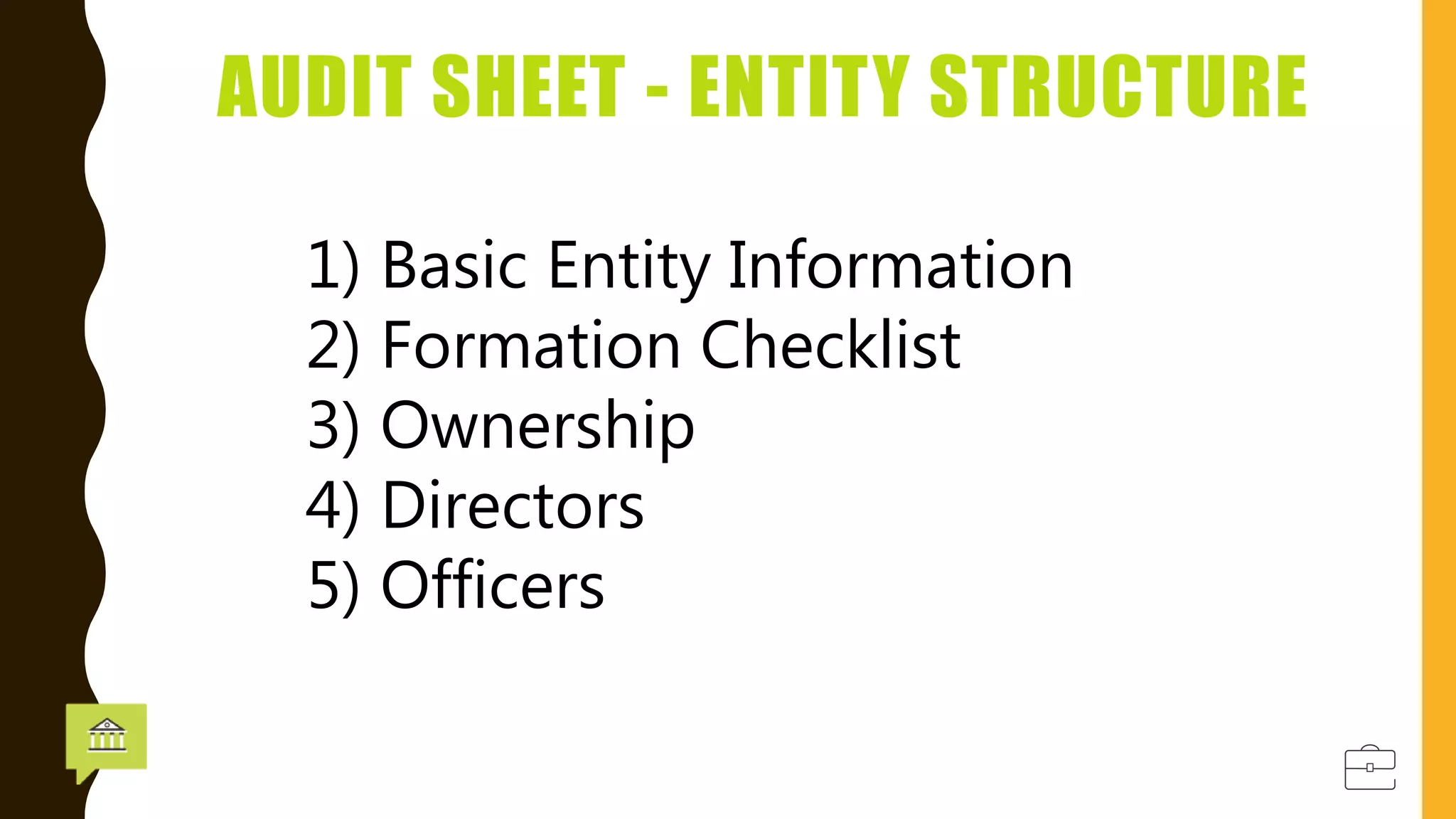
AUDIT SHEET - ENTITY STRUCTURE
1) Basic Entity Information
2) Formation Checklist
3) Ownership
4) Directors
5) Officers
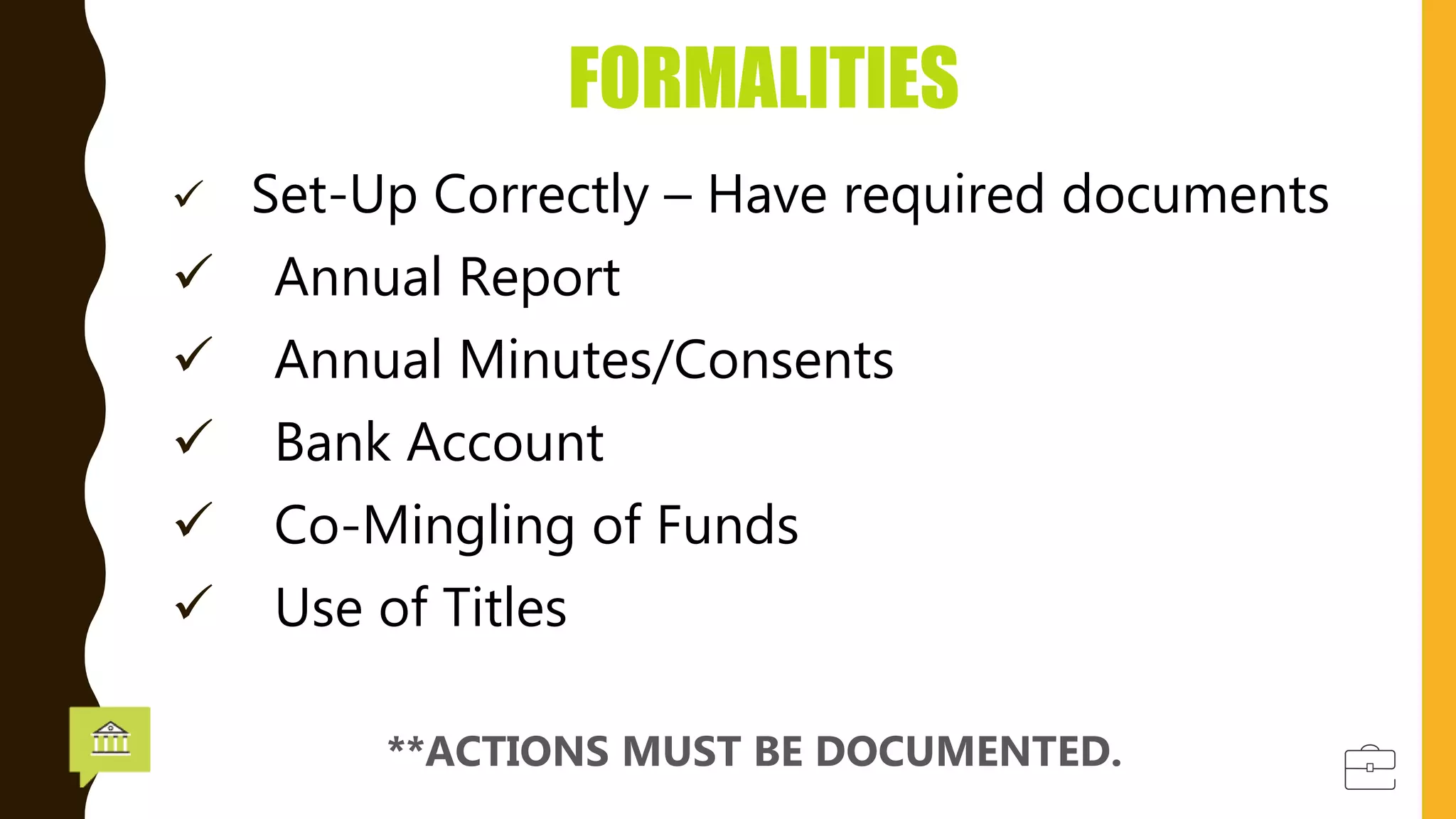
 Set-Up Correctly – Have required documents
 Annual Report
 Annual Minutes/Consents
 Bank Account
 Co-Mingling of Funds
 Use of Titles
FORMALITIES
**ACTIONS MUST BE DOCUMENTED.
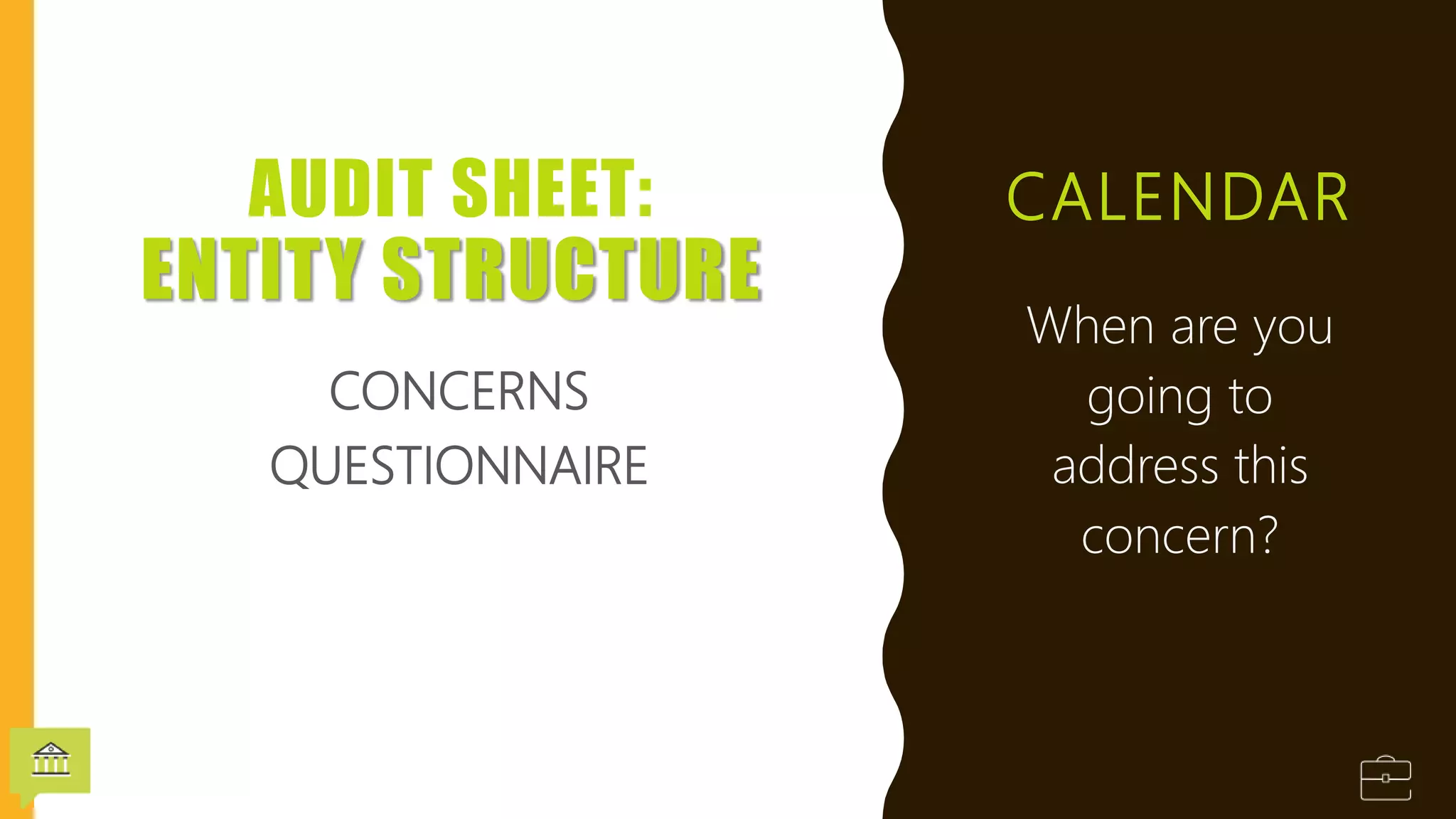
CALENDAR
When are you
going to
address this
concern?
AUDIT SHEET:
ENTITY STRUCTURE
CONCERNS
QUESTIONNAIRE
REGULATORY
COMPLIANCE
G O V E R N M E N T R U L E S & L I C E N S E S
TYPES
LEVELS
• Federal Government
• State Government
• Local Government
• Professional Regulation
• Location-Based Regulation
• Activity Regulation
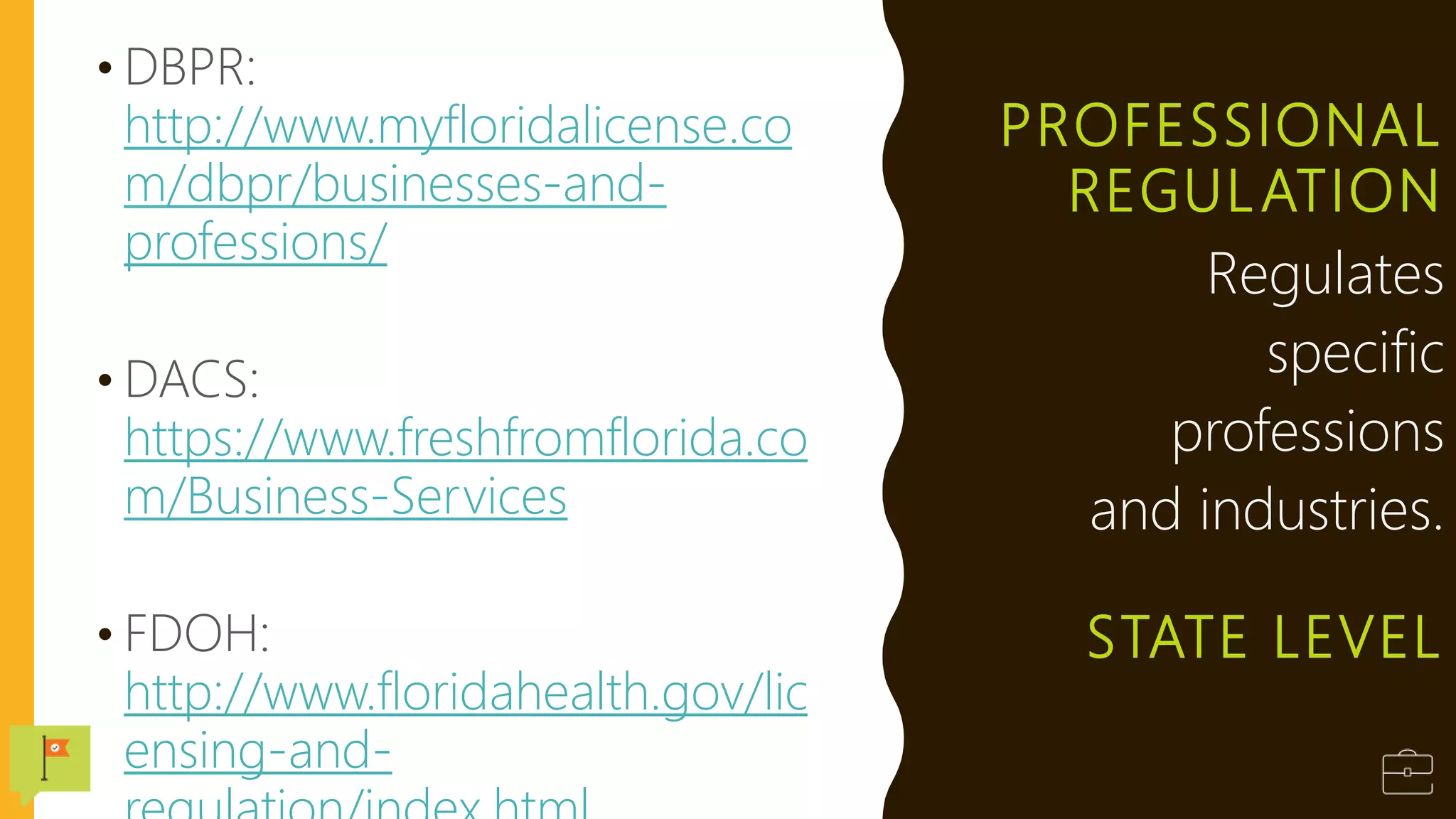
PROFESSIONAL
REGULATION
• DBPR:
http://www.myfloridalicense.co
m/dbpr/businesses-and-
professions/
• DACS:
https://www.freshfromflorida.co
m/Business-Services
• FDOH:
http://www.floridahealth.gov/lic
ensing-and-
Regulates
specific
professions
and industries.
STATE LEVEL
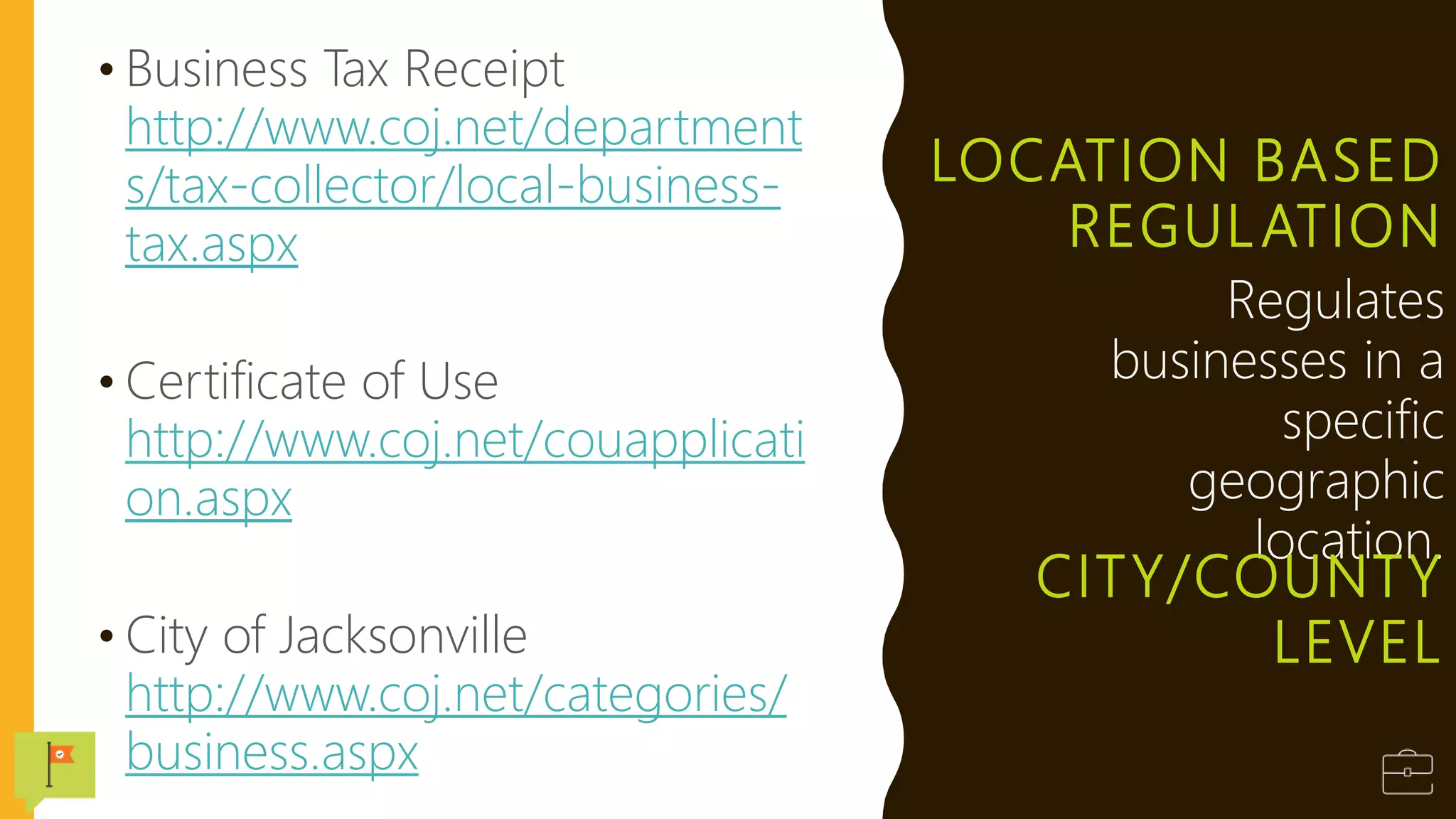
LOCATION BASED
REGULATION
• Business Tax Receipt
http://www.coj.net/department
s/tax-collector/local-business-
tax.aspx
• Certificate of Use
http://www.coj.net/couapplicati
on.aspx
• City of Jacksonville
http://www.coj.net/categories/
business.aspx
Regulates
businesses in a
specific
geographic
location.
CITY/COUNTY
LEVEL
ACTIVITY
REGULATION
• FTC: https://www.ftc.gov/tips-
advice/business-center/selected-
industries
• US DOL:
https://www.dol.gov/general/dol-
agencies
• EPA:
https://www.epa.gov/regulatory-
information-sector
• SBA:
https://www.sba.gov/business-
guide/launch-your-
Regulates
specific
business
activities.
FEDERAL
LEVEL
ACTIVITY
REGULATION
• Data Security
http://myfloridalegal.com/page
s.nsf/Main/53D4216591361BCD
85257F77004BE16C Regulates
specific
business
activities.
STATE
LEVEL
CALENDAR
When are you
going to
address this
concern?
AUDIT SHEET:
REGULATORY
COMPLIANCE
CONCERNS
QUESTIONNAIRE
I
N
T
E
R
N
A
L
R
E
L
A
T
I
O
N
S
H
I
P
S
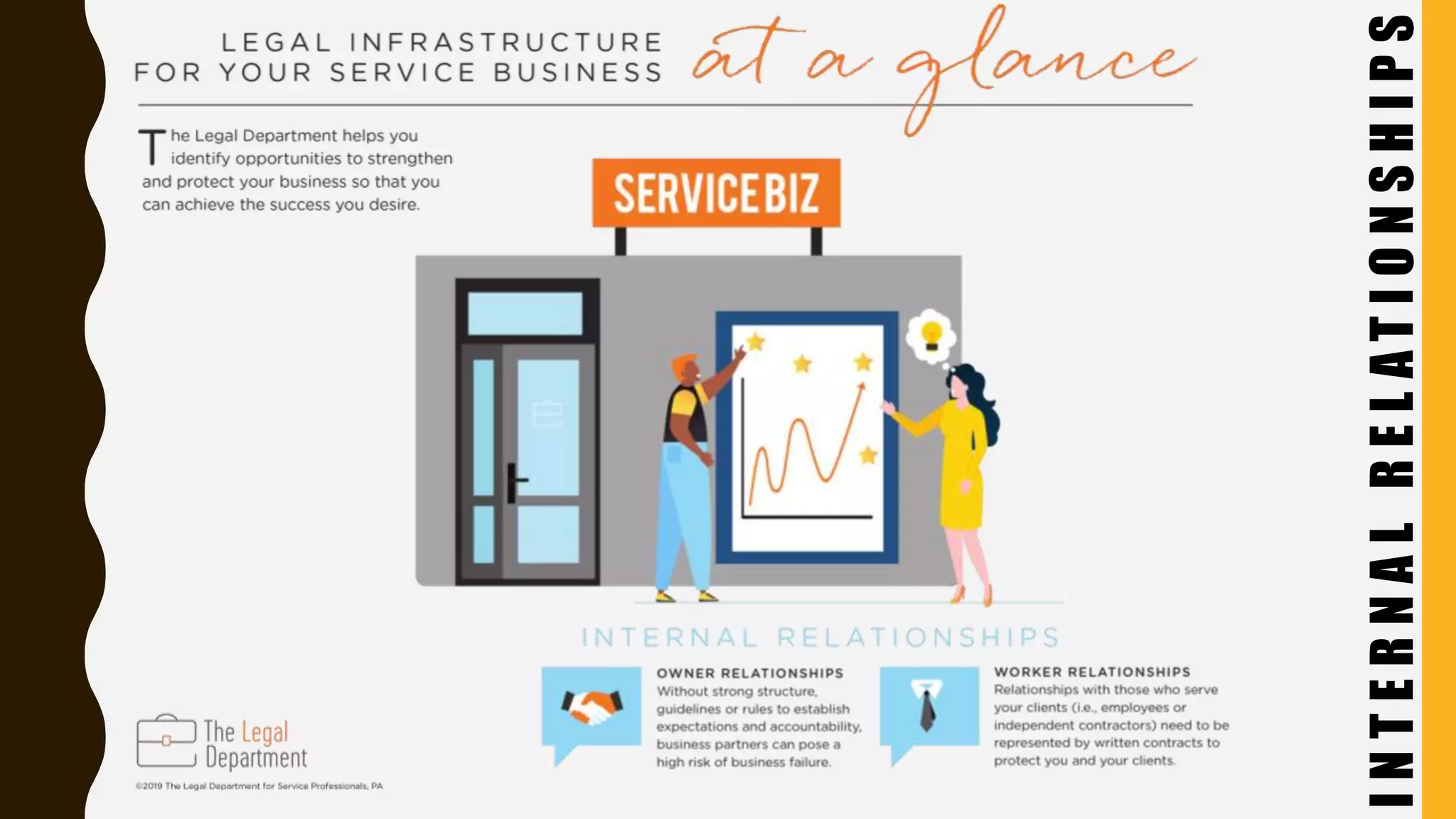
OWNER
RELATIONSHIPS
LIKE A MARRIAGE BUT NOT
DEFAULT RULES:
CAN ONLY BE CHANGED IF YOU HAVE A WRITTEN AGREEMENT
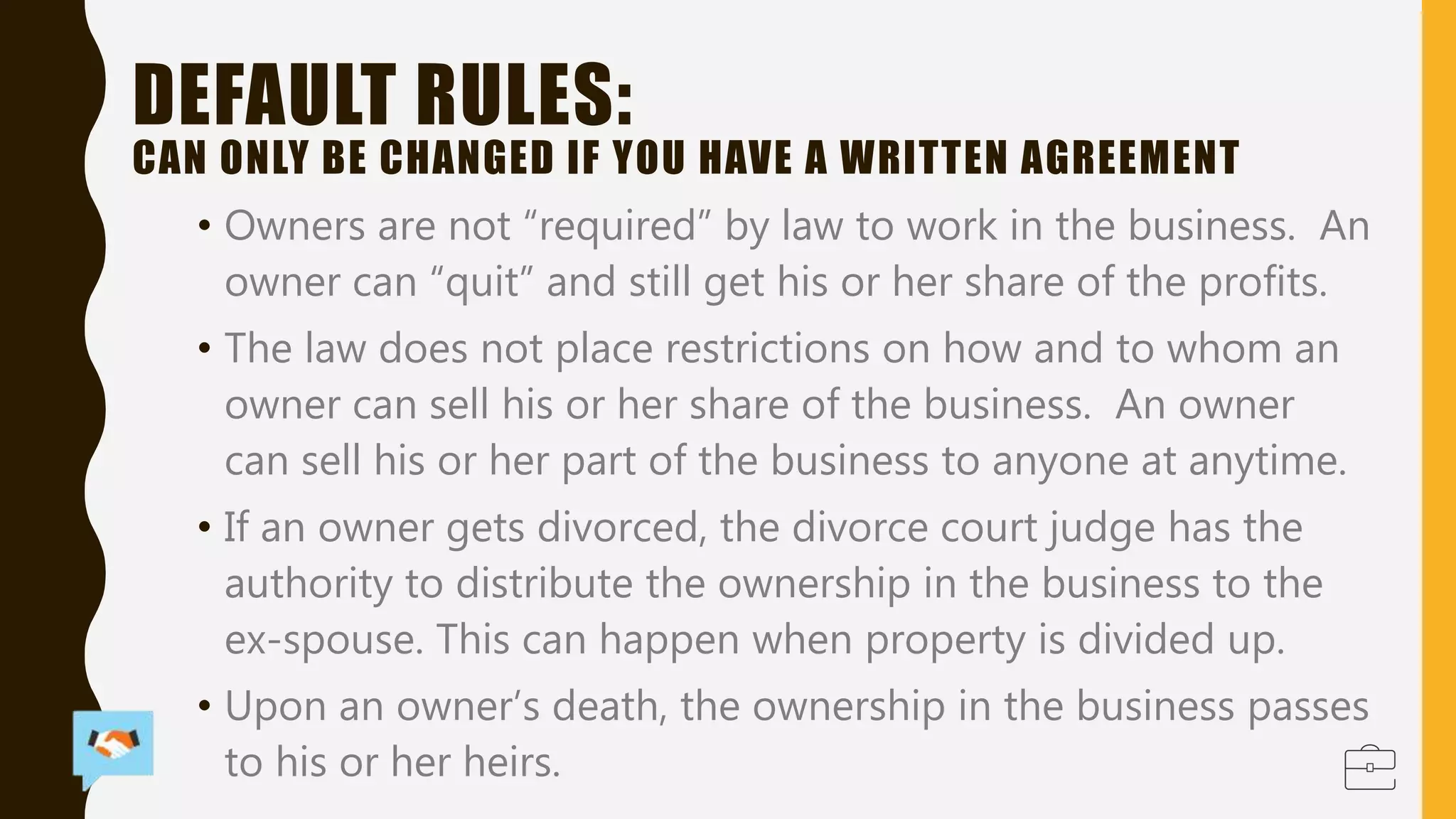
• Owners are not “required” by law to work in the business. An
owner can “quit” and still get his or her share of the profits.
• The law does not place restrictions on how and to whom an
owner can sell his or her share of the business. An owner
can sell his or her part of the business to anyone at anytime.
• If an owner gets divorced, the divorce court judge has the
authority to distribute the ownership in the business to the
ex-spouse. This can happen when property is divided up.
• Upon an owner’s death, the ownership in the business passes
to his or her heirs.
DEFAULT RULES:
CAN ONLY BE CHANGED IF YOU HAVE A WRITTEN AGREEMENT
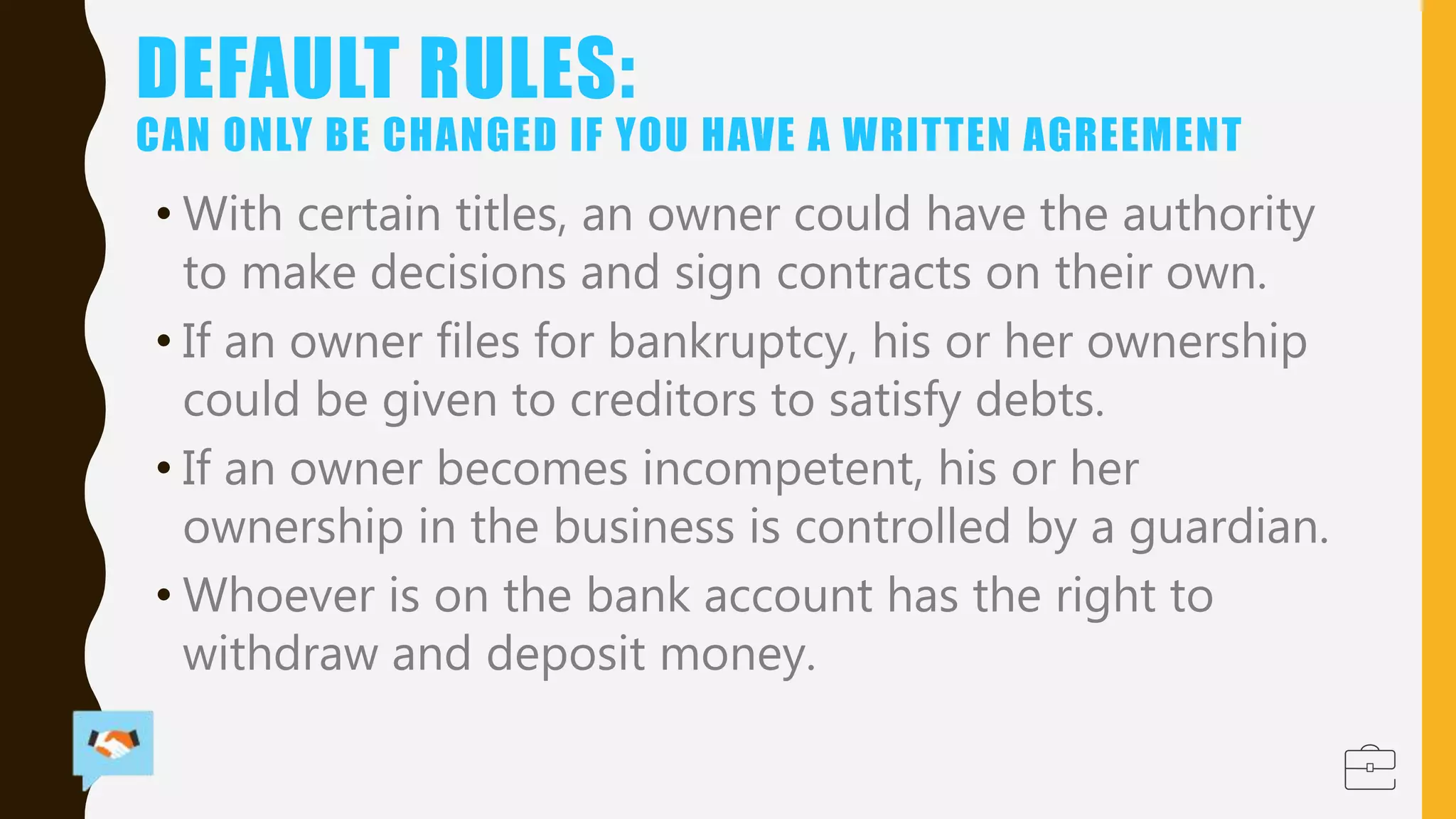
• With certain titles, an owner could have the authority
to make decisions and sign contracts on their own.
• If an owner files for bankruptcy, his or her ownership
could be given to creditors to satisfy debts.
• If an owner becomes incompetent, his or her
ownership in the business is controlled by a guardian.
• Whoever is on the bank account has the right to
withdraw and deposit money.
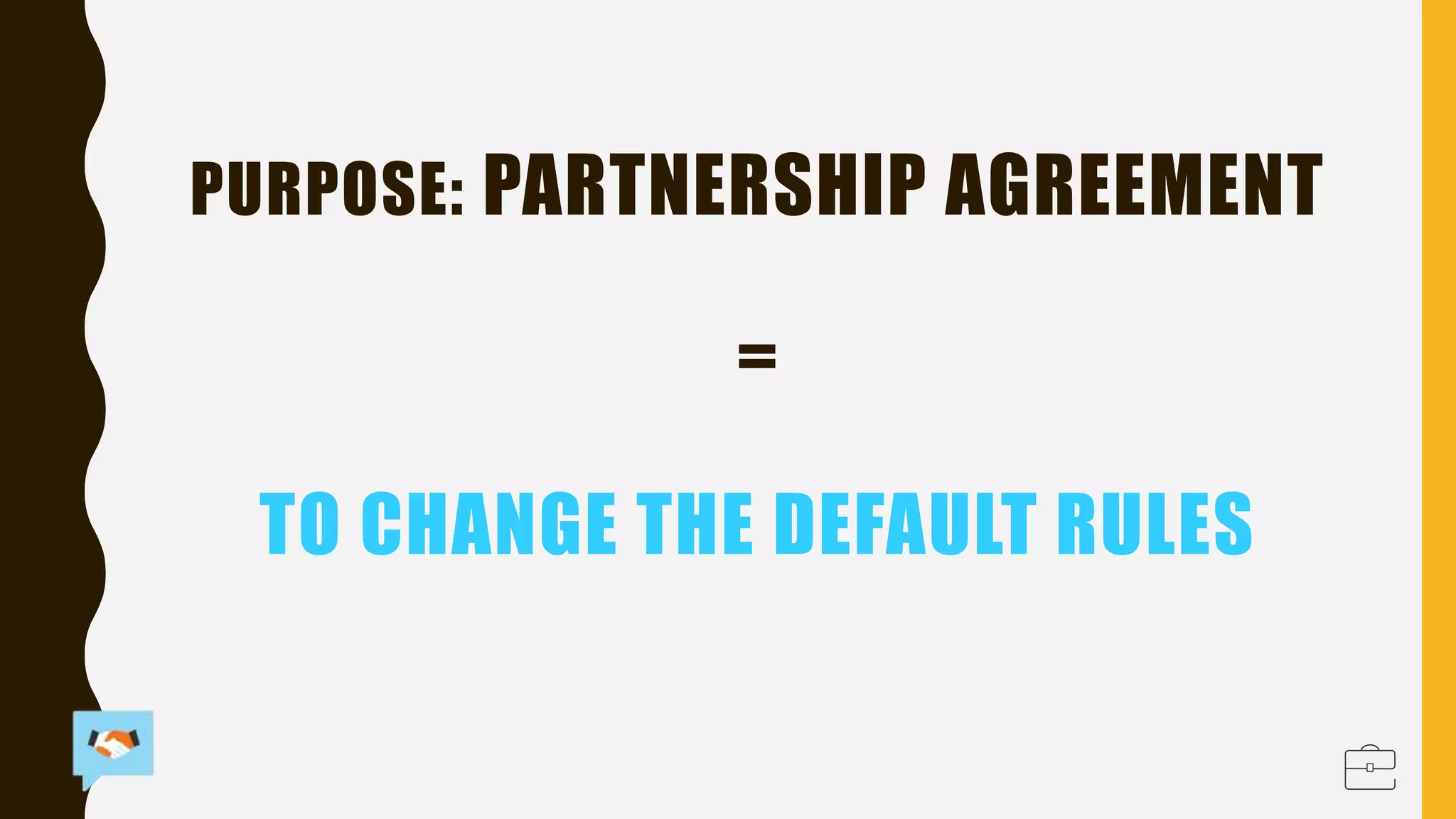
PURPOSE: PARTNERSHIP AGREEMENT
=
TO CHANGE THE DEFAULT RULES
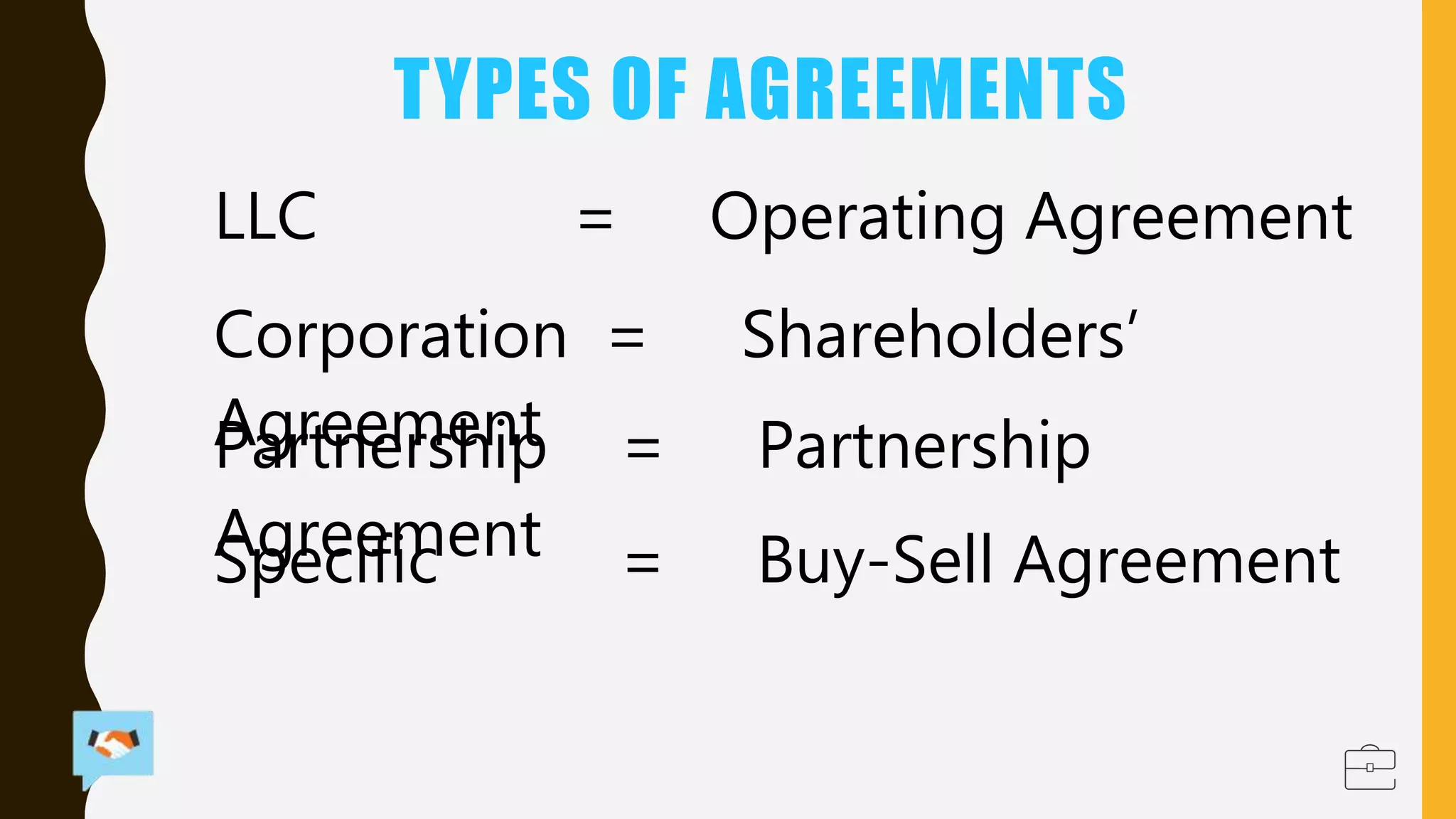
LLC = Operating Agreement
Corporation = Shareholders’
Agreement
Partnership = Partnership
Agreement
Specific = Buy-Sell Agreement
TYPES OF AGREEMENTS
THE BEST TIME TO DO AN OWNERSHIP
AGREEMENT?
When everything is perfect and
you’re getting along well.
CALENDAR
CONCERNS
QUESTIONNAIRE
When are you
going to
address this
concern?
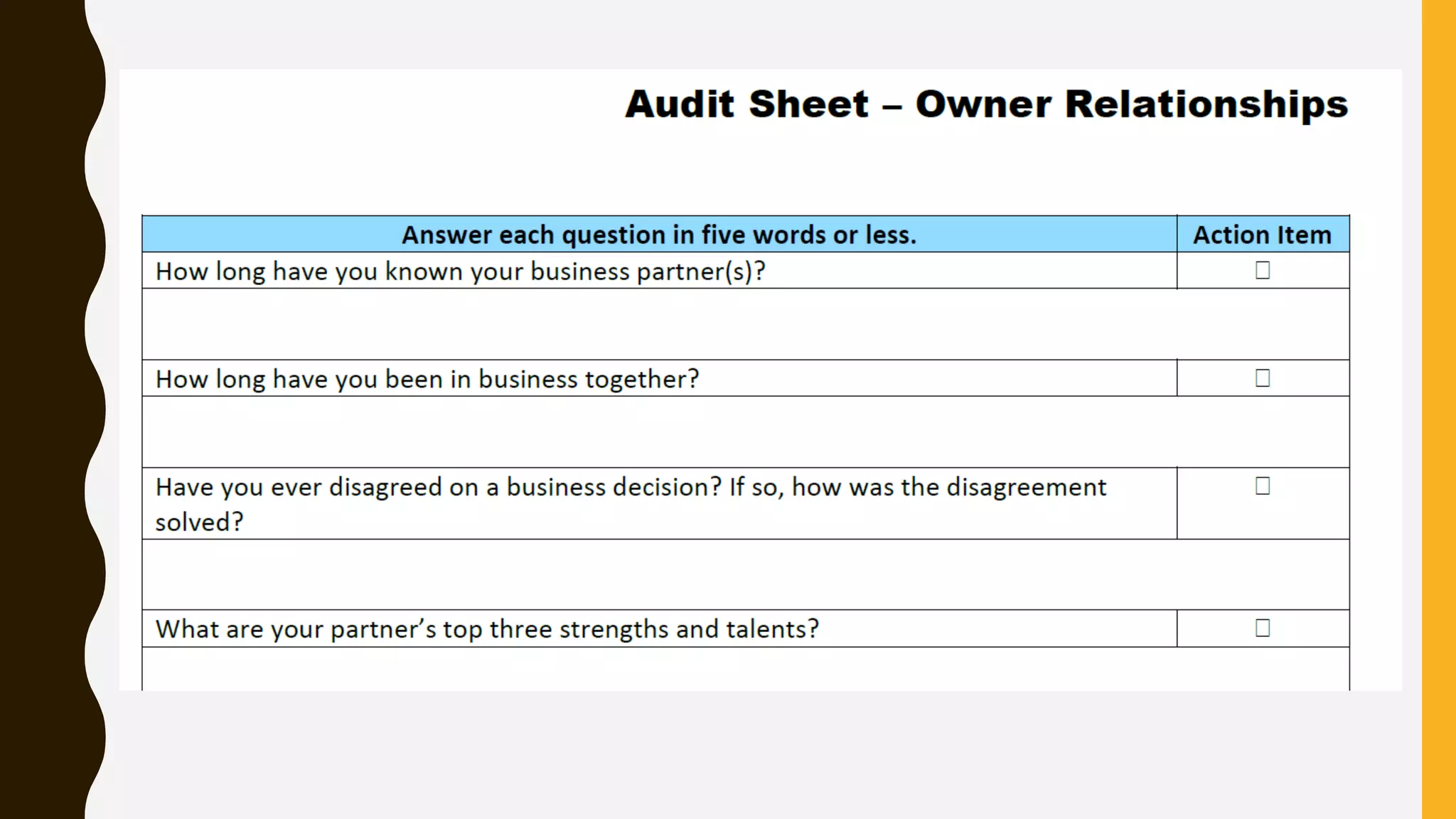
AUDIT SHEET:
OWNER RELATIONSHIPS
Q&A
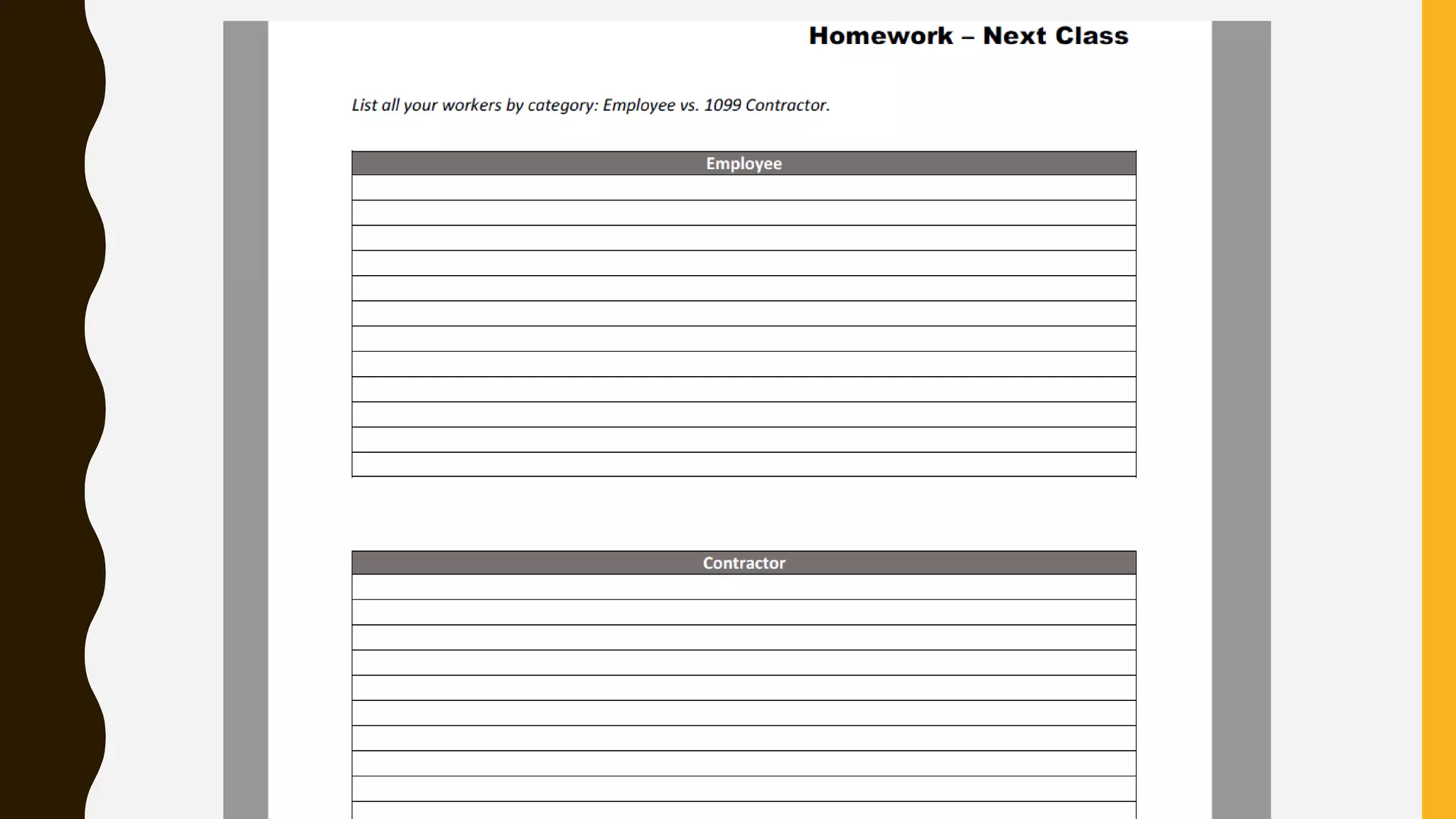
HOMEWORK
BUILDING A
BUSINESS

Part 1 of 3.slides.building a stronger business.govt regs + owner

Editor's Notes

  • #4 The Established Flyers: Most of our clients come to us once they’ve been in business for several years. They started their firms and took a lot of risks at the beginning. They were comfortable figuring things out as they went along – but they knew there were things they didn’t know. The challenge was that there was so much to focus on that they had to choose the priority that made them money. They knew that they needed to do things legally sound but there wasn’t resources to put everything in place. Now they want to stabilize and they know it’s time to put some foundations in place. No more building with toothpicks and bandaids – they know their growth needs to be supported by strong infrastructure. So they come to us to help them put that structure in place. They can then continue to grow without fear of collapse. The Start-Off the Grounders: Just a few of our clients are start-ups. But they are special start-ups – the kind that know they need to build infrastructure and they want it in place before (or shortly after) they start. They don’t accept as much risk. These are the types of personalities who like to have everything lined up so they don’t have to worry. They want to build from the ground up. These are the only start-ups we serve because they know that the structure we offer is important and they are willing to prioritize getting it done.
  • #5 Why Should You Build Infrastructure? It builds strength in your foundation so your business can support growth. It promotes good business by creating successful business relationships (through solid and honest contracts). It allows you to avoid problems, and for those that are unavoidable it can help you find an easier resolution. It increases the value of the business, which is great for when it’s time to make a transition. You’ll be drinking from a fire hose in this class. It will be a lot of information. You will experience some overwhelm and discouragement. It’s important to know what needs to be done. Not that you have to run out and do it all at one time. You’ll have a list of issues you will need to address. I want you to pick ONE THING to tackle before this class ends. The other issues on your list will go on your calendar. You’ll pick them up and deal with them at certain points in the future. You’ll make your decisions on what to do first based on your own priorities and circumstances.   Terminology Client vs. Customer Contract vs. Agreement Company vs. Business
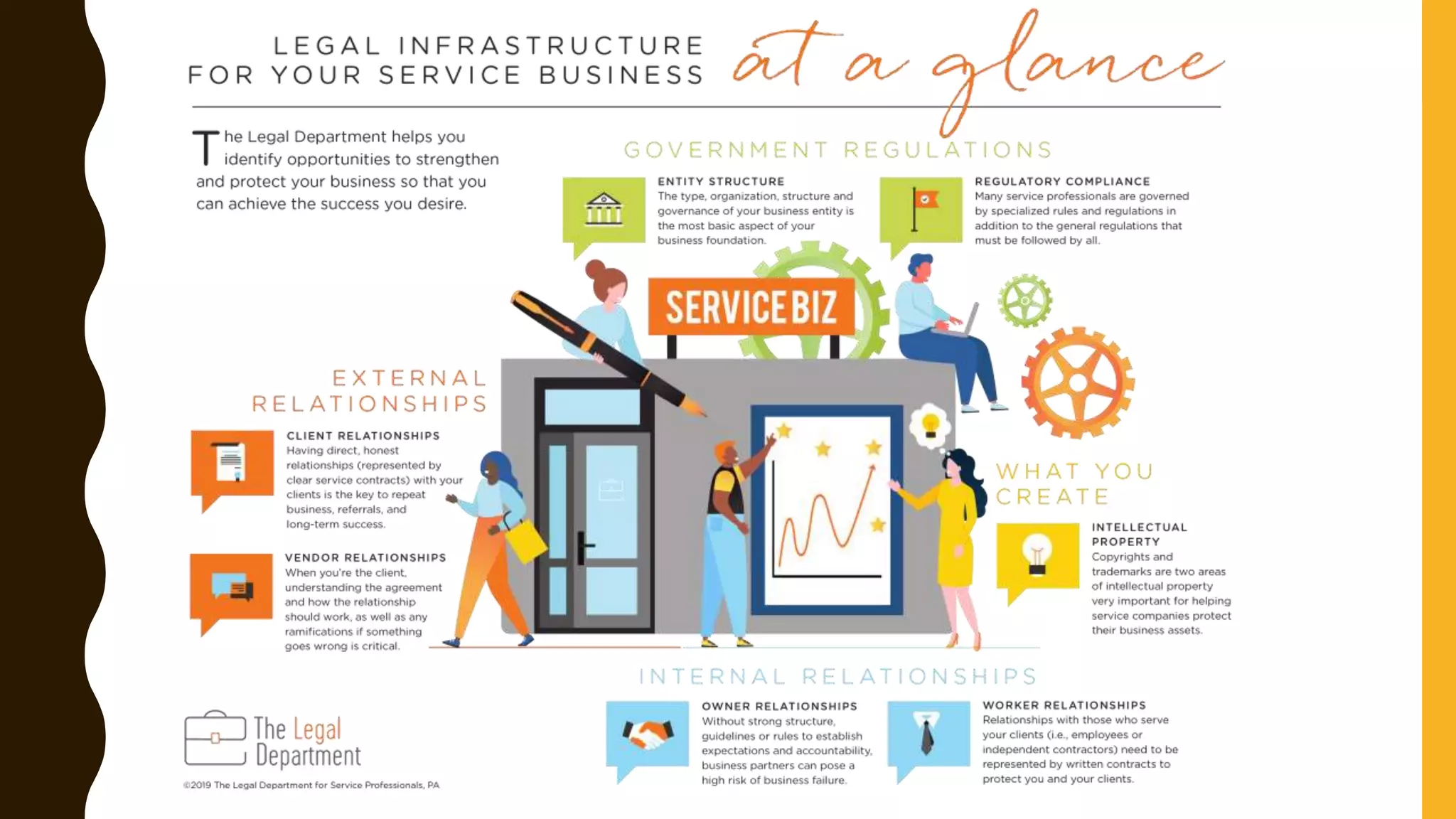
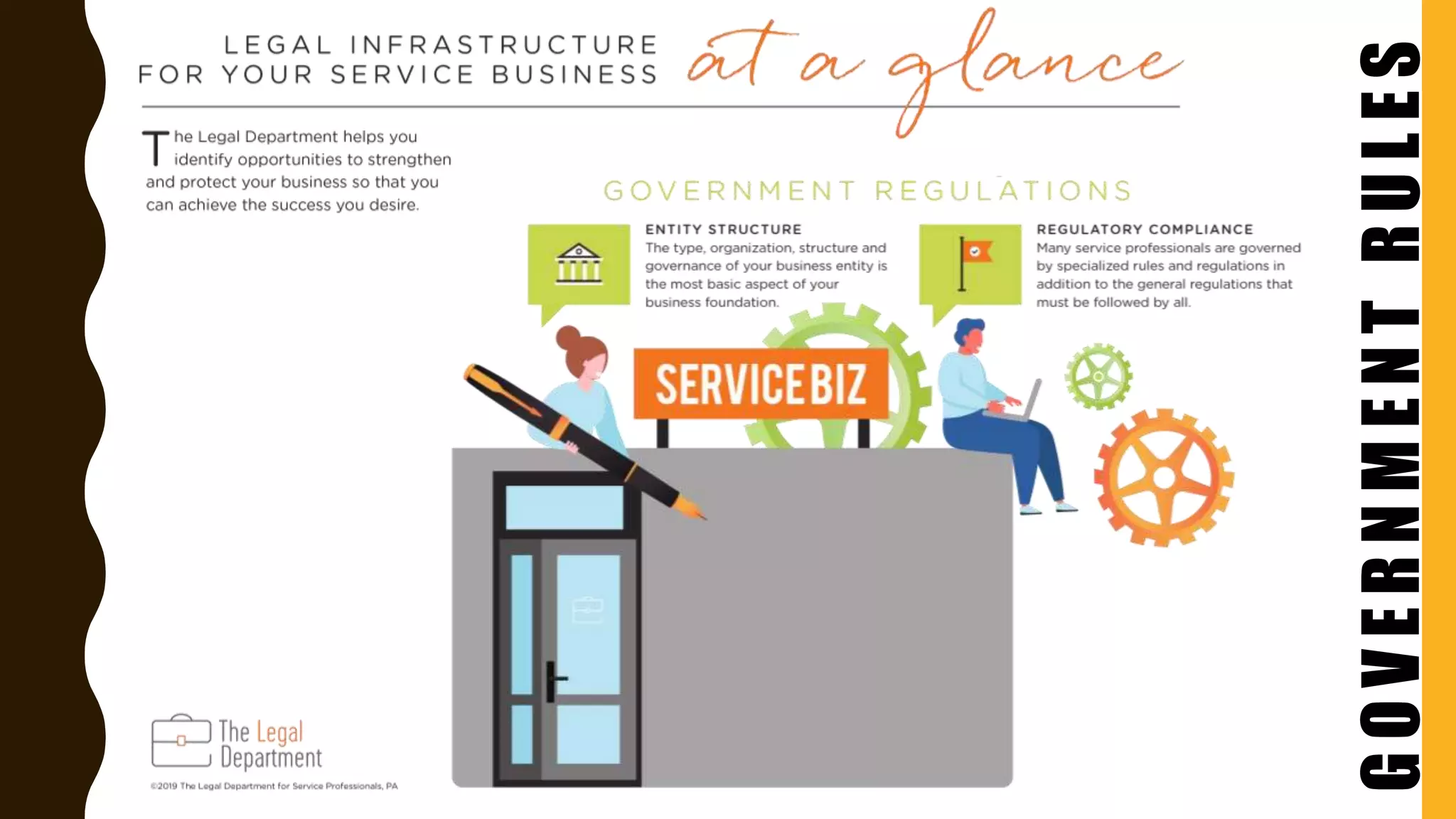
  • #7 Government makes rules that all businesses must follow. Government could be the States, the Federal Government, or local governments (counties and cities). We’re going to talk about these first. Not the most fun – but probably the most critical. You’ll find out why. This area of infrastructure is to make sure that your business complies with all the regulations that apply to you. It’s daunting, no doubt. There are many rules to follow and determining which ones apply to you isn’t always easy.   No matter your philosophical view of the regulation of businesses, the reality is that businesses have multiple layers of rules to follow. And we all must follow them whether we like them or not. Most professional service providers want to follow the rules – they just have trouble determining what they are, or they misunderstand what they mean. This is where a knowledgeable business attorney can help you sort it out.  
  • #8 At the state level – we have the creation of business entities. Each state is different – with different rules. The purpose of these rules is to allow people to have a “container” for their business. I say “container” because it truly contains the business inside it. It contains the good – and it contains the bad. Flip chart – Draw box. Draw owners. The container protects the owners from any liability from the business. We call this the “liability shield”. If you set up your entity correctly- and you maintain it correctly – your entity will have a liability shield in place to protect you.
  • #15 Most businesses have some level of regulatory compliance. How much you may have depends on where you are located and what type of services you provide.    If you add all of those up, it’s a lot. Small businesses frequently complain about all they need to learn and the lack of public resources to help them. Most of the time the information is freely available. However, finding your specific answer and then understanding the language of the rules – well that’s a different story.
  • #23 I meet a lot of business owners who don’t have an ownership agreement with their business partners. Partnership agreements can be called different things, depending on the type of entity structure, but common ones are Shareholders’ Agreements, Operating Agreements or Buy-Sell Agreements.   I also meet a lot of people who are considering going into business with a new partner. This is what I tell them – going into business with someone is like getting married to them but without all the fun stuff. And the divorce can be so much worse.   So many times over the years I’ve seen great businesses, successful businesses, shut their doors or otherwise fail because the business owners can’t get along. It breaks my heart. All that work to get the business started and even more work to make it successful, all for nothing. That’s why this is a passion area for me.   The beginning of a business partnership is the most critical and important time. It’s when the relationship gets defined – and it’s the easiest and best time to do that. When everyone is getting along and is optimistic about the future – that’s the best time to put a partnership agreement in place.