SALALE UNIVERSITY COLLEGE OF HEALTH SCIENCE
DEPARTMENT OF ADULT HEALTH NURSING ,MATERNITY
AND PEDIATRICS
.
PATHOPHYSIOLOGY ASSIGNMENT
TITLE: PAROXYSMAL DISORDERS (SEIZURES )
SUBMITTED TO :DR.AYANA(PATHOLOGIST )
March 2023
FICHE
10/25/2023 Group 4 1
S.N Name ID
1 Tolesa Nigussie
2 Mulunesh Mosisa
3 Merga Wekwaya
4 Yadeta Kebede
5 Azazhu Abate
6 Geleto Hinika
7 Sufa Mengistu
8 Amansisa Dabasa
9 Worku Daba
Group members (G-4)
10/25/2023 2
Group 4
Course outlines
• Paroxysmal disorders
• Seizures vs. Epilepsy
• Type of Seizure
• Pathophysiology
• Clinical manifestation of seizures
• Complications of seizures
10/25/2023 Group 4 3
Paroxysmal disorders:
• Paroxysmal; is derived from Greek word
paroxysmos or paroxyno meaning to sharpen
or irritate.
• Abrupt onset of a clinical episode that tends
to be stereotyped and repetitive , lasts
seconds or minutes (rarely hours ), and ends
abruptly.
10/25/2023 Group 4 4
Types of Paroxysmal disorders
• Seizure
• Movement disorder
• Migraine
10/25/2023 Group 4 5
Seizure :
• A seizure is “a brief, temporary disturbance in the
electrical activity of the brain” and may affect:
• Muscle control and movement
• Speech
• Vision and/or eye movement
• Awareness and/or behavior
• Seizures can be:
Convulsive or non-convulsive
Vary in frequency and severity
10/25/2023 Group 4 6
Signs of a Seizure
• Extended blank stare
• "Empty" look in eyes
• Rapid blinking
• Eyes rolling upward
• Periods of
unresponsiveness
• Inability to pay attention
• Repetitive (tic-like)
movements of body
parts, usually head, arms,
legs
• Uncontrollable jerking
body movements
• Mouth movements with a
dazed look
• Frothing at mouth
• Loss of consciousness
• Loss of body control
• Dazed walking
• Temporary confusion
10/25/2023 Group 4 7
Seizures vs. Epilepsy
• Seizures
• Often symptoms of
another health
problem: Provoking
factors : fever ,infection,
syncope, hypoxia,
toxins, head trauma,
stress,fatigue, cardiac
arrhythmias
• Epilepsy
• is the occurrence of two
or more unprovoked
seizures at an interval >
24 hours
10/25/2023 Group 4 8
Types of Seizures
Focal (partial)
GENERALIZED
10/25/2023 Group 4 9
Focal (partial)Type of Seizure
• Partial (Only a portion of the brain)(Focal Seizures) :
common, 80 % patients
• Simple partial(do not cause loss of consciousness)
o Simple with motor signs- convulsive jerking, chewing
motions, lip smacking
o Simple with sensory signs- Paresthesias, auras
o Autonomic: abdominal epilepsy
o Psychic :dejavu,fear,…
• Complex(Impaired consciousness)
psychomotor seizures or temporal lobe epilepsy or limbic
Aggressive behavior (Violence)
Visual, auditory, or olfactory hallucinations
10/25/2023 Group 4 10
Generalized Seizures
• Absence Seizures (Petit mal)- alterations of
consciousness (absence) last10-30sec
• Tonic- sudden stiffness in the arms and body, which
can cause falls and injuries.
• Clonic- Sustained muscle contractions alternating with
relaxations
• Tonic/Clonic (Grand mal)-A sequence of a brief tonic
episode followed by an atonic seizure
• Atonic Seizures (Drop attacks)- sudden loss of body
tone that results in collapsing, often with injuries.
• Myoclonic Seizures: Sudden, involuntary jerking of
facial, limb or trunk muscles, in rhthmic manner.
10/25/2023 Group 4 11
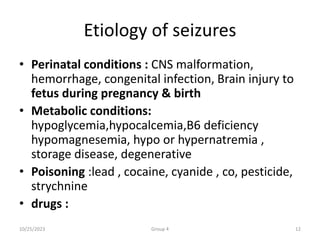
Etiology of seizures
• Perinatal conditions : CNS malformation,
hemorrhage, congenital infection, Brain injury to
fetus during pregnancy & birth
• Metabolic conditions:
hypoglycemia,hypocalcemia,B6 deficiency
hypomagnesemia, hypo or hypernatremia ,
storage disease, degenerative
• Poisoning :lead , cocaine, cyanide , co, pesticide,
strychnine
• drugs :
10/25/2023 Group 4 12
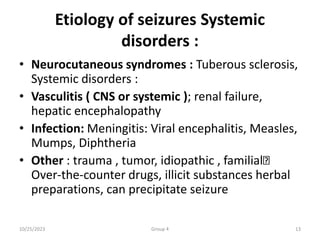
Etiology of seizures Systemic
disorders :
• Neurocutaneous syndromes : Tuberous sclerosis,
Systemic disorders :
• Vasculitis ( CNS or systemic ); renal failure,
hepatic encephalopathy
• Infection: Meningitis: Viral encephalitis, Measles,
Mumps, Diphtheria
• Other : trauma , tumor, idiopathic , familial
Over-the-counter drugs, illicit substances herbal
preparations, can precipitate seizure
10/25/2023 Group 4 13
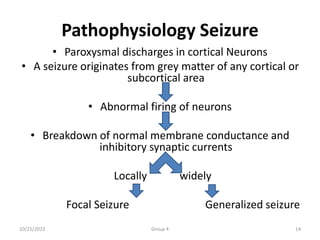
Pathophysiology Seizure
• Paroxysmal discharges in cortical Neurons
• A seizure originates from grey matter of any cortical or
subcortical area
• Abnormal firing of neurons
• Breakdown of normal membrane conductance and
inhibitory synaptic currents
Locally widely
Focal Seizure Generalized seizure
10/25/2023 Group 4 14
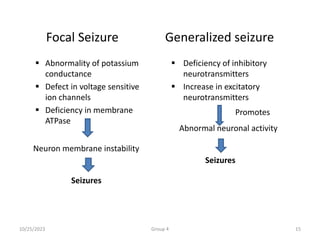
Focal Seizure Generalized seizure
 Abnormality of potassium
conductance
 Defect in voltage sensitive
ion channels
 Deficiency in membrane
ATPase
Neuron membrane instability
Seizures
 Deficiency of inhibitory
neurotransmitters
 Increase in excitatory
neurotransmitters
Promotes
Abnormal neuronal activity
Seizures
10/25/2023 Group 4 15
Pathophysiology of Epilepsy
Cortical cell membrane level
Instability of the nerve cell membrane
Polarization abnormalities (excessive
polarization ,hypopolarization , or lapses in
repolarization), allowing the cell to be more
susceptible to activation Hypersensitive
neurons with lowered thresholds for firing and
firing excessively , related to
10/25/2023 Group 4 16
Cont.…
1- Excess of Excaitatory ( acetylecholine- or
Glutamate –related activity )
2- Decreased inhibitory ( GABA –related
activity)Together leading to instability of cell-
membrane & lowered threshold for exciatation
excessive polarization, hypopolarization allowing
the cell to be more susceptible to activation
spontaneously or by any ionic imbalances in the
immediate chemical environment of neurons
10/25/2023 Group 4 17
Complication:
• Hypoxemia and acidosis Hyperglycemia &
hypoglycemia
• Hyper tension & hypotension
• IICP and cerebral herniation
• Hyperpyrexia
• Hyperkalemia
• Myoglobinuria
• Non cardiogenic pulmonary edema
• Leukocytosis(60%)
• CSF pleocytosis(13%)
• Aspiration pneumonia
10/25/2023 Group 4 18
References
1. Harvey S, King MD and Gorman KM(2021)
Paroxysmal Movement Disorders. Front. Neurol.
12:659064.doi: 10.3389/fneur.2021.659064.
2. https://images.app.goo.gl/bCYjzmZ6bVLcBZUN9
3. https://www.hopkinsmedicine.org/health/condi
tions-and-diseases/epilepsy/types-of-seizures.
4. https://images.app.goo.gl/rBcx4sSrUXKivKM28.
5. https://www.slideshare.net/SachinDwivedi15/se
izures-152346588
10/25/2023 Group 4 19
Thank You!
10/25/2023 Group 4 20

PAROXYSMAL DISORDERS (SEIZURES ).pptx

  • 1.
    SALALE UNIVERSITY COLLEGEOF HEALTH SCIENCE DEPARTMENT OF ADULT HEALTH NURSING ,MATERNITY AND PEDIATRICS . PATHOPHYSIOLOGY ASSIGNMENT TITLE: PAROXYSMAL DISORDERS (SEIZURES ) SUBMITTED TO :DR.AYANA(PATHOLOGIST ) March 2023 FICHE 10/25/2023 Group 4 1
  • 2.
    S.N Name ID 1Tolesa Nigussie 2 Mulunesh Mosisa 3 Merga Wekwaya 4 Yadeta Kebede 5 Azazhu Abate 6 Geleto Hinika 7 Sufa Mengistu 8 Amansisa Dabasa 9 Worku Daba Group members (G-4) 10/25/2023 2 Group 4
  • 3.
    Course outlines • Paroxysmaldisorders • Seizures vs. Epilepsy • Type of Seizure • Pathophysiology • Clinical manifestation of seizures • Complications of seizures 10/25/2023 Group 4 3
  • 4.
    Paroxysmal disorders: • Paroxysmal;is derived from Greek word paroxysmos or paroxyno meaning to sharpen or irritate. • Abrupt onset of a clinical episode that tends to be stereotyped and repetitive , lasts seconds or minutes (rarely hours ), and ends abruptly. 10/25/2023 Group 4 4
  • 5.
    Types of Paroxysmaldisorders • Seizure • Movement disorder • Migraine 10/25/2023 Group 4 5
  • 6.
    Seizure : • Aseizure is “a brief, temporary disturbance in the electrical activity of the brain” and may affect: • Muscle control and movement • Speech • Vision and/or eye movement • Awareness and/or behavior • Seizures can be: Convulsive or non-convulsive Vary in frequency and severity 10/25/2023 Group 4 6
  • 7.
    Signs of aSeizure • Extended blank stare • "Empty" look in eyes • Rapid blinking • Eyes rolling upward • Periods of unresponsiveness • Inability to pay attention • Repetitive (tic-like) movements of body parts, usually head, arms, legs • Uncontrollable jerking body movements • Mouth movements with a dazed look • Frothing at mouth • Loss of consciousness • Loss of body control • Dazed walking • Temporary confusion 10/25/2023 Group 4 7
  • 8.
    Seizures vs. Epilepsy •Seizures • Often symptoms of another health problem: Provoking factors : fever ,infection, syncope, hypoxia, toxins, head trauma, stress,fatigue, cardiac arrhythmias • Epilepsy • is the occurrence of two or more unprovoked seizures at an interval > 24 hours 10/25/2023 Group 4 8
  • 9.
    Types of Seizures Focal(partial) GENERALIZED 10/25/2023 Group 4 9
  • 10.
    Focal (partial)Type ofSeizure • Partial (Only a portion of the brain)(Focal Seizures) : common, 80 % patients • Simple partial(do not cause loss of consciousness) o Simple with motor signs- convulsive jerking, chewing motions, lip smacking o Simple with sensory signs- Paresthesias, auras o Autonomic: abdominal epilepsy o Psychic :dejavu,fear,… • Complex(Impaired consciousness) psychomotor seizures or temporal lobe epilepsy or limbic Aggressive behavior (Violence) Visual, auditory, or olfactory hallucinations 10/25/2023 Group 4 10
  • 11.
    Generalized Seizures • AbsenceSeizures (Petit mal)- alterations of consciousness (absence) last10-30sec • Tonic- sudden stiffness in the arms and body, which can cause falls and injuries. • Clonic- Sustained muscle contractions alternating with relaxations • Tonic/Clonic (Grand mal)-A sequence of a brief tonic episode followed by an atonic seizure • Atonic Seizures (Drop attacks)- sudden loss of body tone that results in collapsing, often with injuries. • Myoclonic Seizures: Sudden, involuntary jerking of facial, limb or trunk muscles, in rhthmic manner. 10/25/2023 Group 4 11
  • 12.
    Etiology of seizures •Perinatal conditions : CNS malformation, hemorrhage, congenital infection, Brain injury to fetus during pregnancy & birth • Metabolic conditions: hypoglycemia,hypocalcemia,B6 deficiency hypomagnesemia, hypo or hypernatremia , storage disease, degenerative • Poisoning :lead , cocaine, cyanide , co, pesticide, strychnine • drugs : 10/25/2023 Group 4 12
  • 13.
    Etiology of seizuresSystemic disorders : • Neurocutaneous syndromes : Tuberous sclerosis, Systemic disorders : • Vasculitis ( CNS or systemic ); renal failure, hepatic encephalopathy • Infection: Meningitis: Viral encephalitis, Measles, Mumps, Diphtheria • Other : trauma , tumor, idiopathic , familial Over-the-counter drugs, illicit substances herbal preparations, can precipitate seizure 10/25/2023 Group 4 13
  • 14.
    Pathophysiology Seizure • Paroxysmaldischarges in cortical Neurons • A seizure originates from grey matter of any cortical or subcortical area • Abnormal firing of neurons • Breakdown of normal membrane conductance and inhibitory synaptic currents Locally widely Focal Seizure Generalized seizure 10/25/2023 Group 4 14
  • 15.
    Focal Seizure Generalizedseizure  Abnormality of potassium conductance  Defect in voltage sensitive ion channels  Deficiency in membrane ATPase Neuron membrane instability Seizures  Deficiency of inhibitory neurotransmitters  Increase in excitatory neurotransmitters Promotes Abnormal neuronal activity Seizures 10/25/2023 Group 4 15
  • 16.
    Pathophysiology of Epilepsy Corticalcell membrane level Instability of the nerve cell membrane Polarization abnormalities (excessive polarization ,hypopolarization , or lapses in repolarization), allowing the cell to be more susceptible to activation Hypersensitive neurons with lowered thresholds for firing and firing excessively , related to 10/25/2023 Group 4 16
  • 17.
    Cont.… 1- Excess ofExcaitatory ( acetylecholine- or Glutamate –related activity ) 2- Decreased inhibitory ( GABA –related activity)Together leading to instability of cell- membrane & lowered threshold for exciatation excessive polarization, hypopolarization allowing the cell to be more susceptible to activation spontaneously or by any ionic imbalances in the immediate chemical environment of neurons 10/25/2023 Group 4 17
  • 18.
    Complication: • Hypoxemia andacidosis Hyperglycemia & hypoglycemia • Hyper tension & hypotension • IICP and cerebral herniation • Hyperpyrexia • Hyperkalemia • Myoglobinuria • Non cardiogenic pulmonary edema • Leukocytosis(60%) • CSF pleocytosis(13%) • Aspiration pneumonia 10/25/2023 Group 4 18
  • 19.
    References 1. Harvey S,King MD and Gorman KM(2021) Paroxysmal Movement Disorders. Front. Neurol. 12:659064.doi: 10.3389/fneur.2021.659064. 2. https://images.app.goo.gl/bCYjzmZ6bVLcBZUN9 3. https://www.hopkinsmedicine.org/health/condi tions-and-diseases/epilepsy/types-of-seizures. 4. https://images.app.goo.gl/rBcx4sSrUXKivKM28. 5. https://www.slideshare.net/SachinDwivedi15/se izures-152346588 10/25/2023 Group 4 19
  • 20.