PARLIMENTARY
BILLS
INTRODUCTION
TO BILLS
“Introduction of new Billls
The parliament can introduce new
laws and change the old ones.
A law is first introduced in the form of
a bill.
A bill is the draft of the proposed draft.
3
TYPES OF BILLS
Money Bill
Ordinary Bill
Constitutional
Amendment Bills
4
Now Can anyone of u tell what is the
purpose of a bill?
5
❓
Money Bill
○ #The concept of money bills in India
came to the forefront during the
enactment of the Aadhar Act, 2016. In
spite of resistance by the opposition, the
Aadhaar Bill was certified as a ‘money bill’
by the Speaker of the Lower House.
○ #These bills are certified as Money Bills by
the Speaker of the Lok Sabha.
○ #Money Bills can be introduced only in
Lok Sabha.
6
₹
Ordinary Bills
7
Ordinary Bill are for ordinary laws
Difference in a Money Bill
and Ordinary Bill
A Money Bill van be delayed for 14 days but An
Ordinary Bill can be delayed for 3 months.
An Ordinary Bill can be introduced in any of the
Houses of Parliament while Money bill can only be
introduced in the Lok Sabha.
8
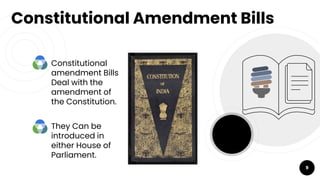
Constitutional
amendment Bills
Deal with the
amendment of
the Constitution.
They Can be
introduced in
either House of
Parliament.
Constitutional Amendment Bills
9
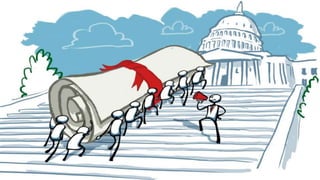
From Bill To Law
There are a
certain stages
that a bill has to
pass through
before it
becomes a law.
10
11
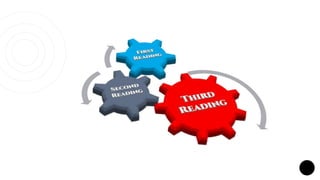
FIRST READING
13
The legislative process starts with the
introduction of a bill in either House of
Parliament - Lok Sabha or Rajya Sabha.
The person Who Introduces the bill,
delivers a speech to explain the purpose
and importance of the bill.
Copies of the bill are distributed among
All members.
Fact : About 5,000
bills are
introduced in The
Congress every
year but only
about 150
are signed into
law!!!
SECOND READING
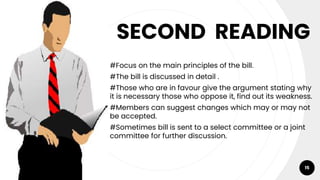
#Focus on the main principles of the bill.
#The bill is discussed in detail .
#Those who are in favour give the argument stating why
it is necessary those who oppose it, find out its weakness.
#Members can suggest changes which may or may not
be accepted.
#Sometimes bill is sent to a select committee or a joint
committee for further discussion.
15
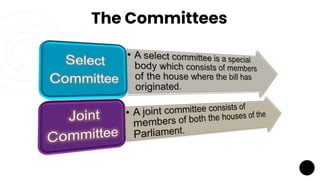
The Committees
THIRD READING
In this stage, the final form of the bill is
put before the house. Final Discussion
takes place and the bill is put to vote if
more than 50% of the members vote in
favour, the bill is passed. Next the bill is
sent to the other house where it goes to
the same procedure. The other house
may pass the bill or May send it back
with some suggestion.
Can
You
Tell ?
Joint SittingJoint Sitting
A situation of deadlock arises if a bill is written
by the other house with some suggestion but the
house where it originated does not accept those
suggestions the president then summons a joint
setting of the two houses of Parliament. such a
joint sitting is presided over by the speaker .the
decisions at the joint sitting is taken by a
majority of the total number of members of both
the houses of Parliament present and voting
At the End
Once both the Houses pass the bill, it is sent to the
President for approval. The president may also suggest
some changes and send the bill back. However, the
Parliament may or may not accept these changes and send
the bill back to the President. In such a case, the president
has to sign the bill. After this, the bill becomes a law.
Credit -
Name -Riya Vishwakarma
Class/Section -8th B
Subject -Social Science
Part -Civics
Subject Teacher -Ms. Monisha Bhatia
21
Thanks!

Parlimentary bills.Riya vishwakarma 8th

  • 1.
  • 2.
  • 3.
    “Introduction of newBillls The parliament can introduce new laws and change the old ones. A law is first introduced in the form of a bill. A bill is the draft of the proposed draft. 3
  • 4.
    TYPES OF BILLS MoneyBill Ordinary Bill Constitutional Amendment Bills 4
  • 5.
    Now Can anyoneof u tell what is the purpose of a bill? 5 ❓
  • 6.
    Money Bill ○ #Theconcept of money bills in India came to the forefront during the enactment of the Aadhar Act, 2016. In spite of resistance by the opposition, the Aadhaar Bill was certified as a ‘money bill’ by the Speaker of the Lower House. ○ #These bills are certified as Money Bills by the Speaker of the Lok Sabha. ○ #Money Bills can be introduced only in Lok Sabha. 6 ₹
  • 7.
    Ordinary Bills 7 Ordinary Billare for ordinary laws
  • 8.
    Difference in aMoney Bill and Ordinary Bill A Money Bill van be delayed for 14 days but An Ordinary Bill can be delayed for 3 months. An Ordinary Bill can be introduced in any of the Houses of Parliament while Money bill can only be introduced in the Lok Sabha. 8
  • 9.
    Constitutional amendment Bills Deal withthe amendment of the Constitution. They Can be introduced in either House of Parliament. Constitutional Amendment Bills 9
  • 10.
    From Bill ToLaw There are a certain stages that a bill has to pass through before it becomes a law. 10
  • 11.
  • 13.
    FIRST READING 13 The legislativeprocess starts with the introduction of a bill in either House of Parliament - Lok Sabha or Rajya Sabha. The person Who Introduces the bill, delivers a speech to explain the purpose and importance of the bill. Copies of the bill are distributed among All members.
  • 14.
    Fact : About5,000 bills are introduced in The Congress every year but only about 150 are signed into law!!!
  • 15.
    SECOND READING #Focus onthe main principles of the bill. #The bill is discussed in detail . #Those who are in favour give the argument stating why it is necessary those who oppose it, find out its weakness. #Members can suggest changes which may or may not be accepted. #Sometimes bill is sent to a select committee or a joint committee for further discussion. 15
  • 16.
  • 17.
    THIRD READING In thisstage, the final form of the bill is put before the house. Final Discussion takes place and the bill is put to vote if more than 50% of the members vote in favour, the bill is passed. Next the bill is sent to the other house where it goes to the same procedure. The other house may pass the bill or May send it back with some suggestion.
  • 18.
  • 19.
    Joint SittingJoint Sitting Asituation of deadlock arises if a bill is written by the other house with some suggestion but the house where it originated does not accept those suggestions the president then summons a joint setting of the two houses of Parliament. such a joint sitting is presided over by the speaker .the decisions at the joint sitting is taken by a majority of the total number of members of both the houses of Parliament present and voting
  • 20.
    At the End Onceboth the Houses pass the bill, it is sent to the President for approval. The president may also suggest some changes and send the bill back. However, the Parliament may or may not accept these changes and send the bill back to the President. In such a case, the president has to sign the bill. After this, the bill becomes a law.
  • 21.
    Credit - Name -RiyaVishwakarma Class/Section -8th B Subject -Social Science Part -Civics Subject Teacher -Ms. Monisha Bhatia 21
  • 22.