WELCOME TO OUR STUDY SKILLS
PARENTS’ EVENING
TO EXPLORE SOME WAYS IN WHICH YOU
CAN SUPPORT YOUR CHILD AS HE/SHE
PREPARES FOR THE NATIONAL EXAMS.
We hope by the end of our discussion you will be aware of a variety of
practical tips you can use at home to support your child to study
effectively.
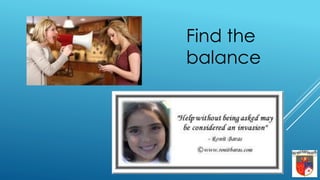
Find the
balance
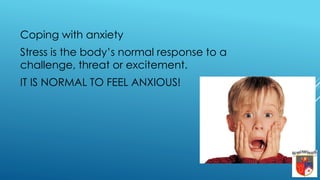
Coping with anxiety
Stress is the body’s normal response to a
challenge, threat or excitement.

IT IS NORMAL TO FEEL ANXIOUS!
Joe as student before his exam- distressed, worried , negative, feeling of failure
Joe an athlete before a competition- imagining success, motivating, believing, psyching
himself up.
Self Talk
Adrenaline increases your heart rate, elevates your blood pressure and boosts energy supplies.
Cortisol, the primary stress hormone, increases sugars (glucose) in the bloodstream,
enhances your brain's use of glucose
Communication is the key
Reassure.
Normalise and help your child reframe.
Contain their anxiety- do not feed it
Message-With preparation you will still feel
nervous on the day but you will be able to
channel it to help you perform well.
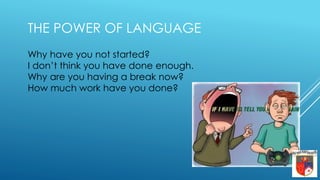
Why have you not started?
I don’t think you have done enough.
Why are you having a break now?
How much work have you done?
THE POWER OF LANGUAGE
What are you planning to do tonight?
Do you want me to shout up when you’ve
worked for an hour, so you can have a
break?
Are you happy with what you have
covered tonight?
Do you want me to let you know when its
8.30 so you can get started again?
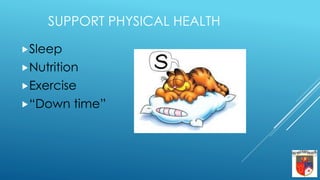
SUPPORT PHYSICAL HEALTH
Sleep
Nutrition
Exercise
“Down time”
TO BE SUCCESSFUL YOUR CHILD
NEEDS TO
Get organised.
Study effectively.
Be prepared for the day.
GET ORGANISED
 Know when the exams are- have a copy somewhere accessible.
Be aware of start times- personalised timetables issued
 Draw up a realistic study plan- ensure all subjects are covered.
Build in “down time”.
 Organise notes by topic- identify gaps in notes as early as
possible
 Have exam questions, revision guides etc. available
 Highlighter pens, felts, coloured post-its, postcards
etc. are all potentially useful
 Agree where your child will study. It should be warm
and well lit.
 Encourage use of Masterclasses.
Memory is fundamentally linked to critical
thinking skills
Memory is the residual of thought- the more
we think about something, the more we will
remember it
We understand new things in the context of
what we know
Proficiency requires practice
THINKING ABOUT MEMORY AND
LEARNING
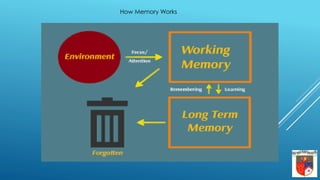
How Memory Works
 We don’t control what is stored - wanting to remember doesn’t
have much bearing on whether you will remember it.
 Retrieval is dependent on the quality of cues - cues are the
starting point for retrieval.
 People tend to think their learning is more complete than it is.
EFFECTIVE STUDYING IS ABOUT:
Forming memories
Creating cues
Retrieving memories
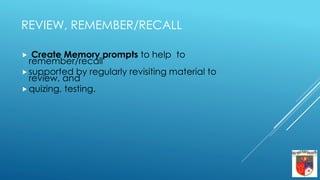
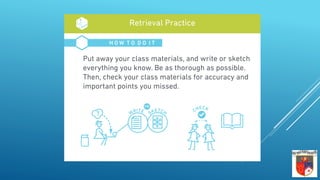
REVIEW, REMEMBER/RECALL
Review- hardest, most crucial part.
Active process of breaking down
information.
Effective note-taking, key words,
diagrams, summaries, visual prompts.
REVIEW, REMEMBER/RECALL
 Create Memory prompts to help to
remember/recall
 supported by regularly revisiting material to
review, and
 quizing, testing.
USE EXAM QUESTIONS
Knowing or recalling material is not enough-
higher level thinking skills-
understand,
apply,
analyse,
evaluate,
 create.
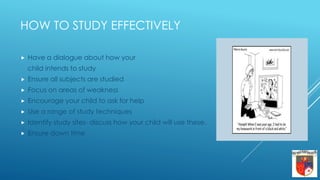
HOW TO STUDY EFFECTIVELY
 Have a dialogue about how your
child intends to study
 Ensure all subjects are studied
 Focus on areas of weakness
 Encourage your child to ask for help
 Use a range of study techniques
 Identify study sites- discuss how your child will use these.
 Ensure down time
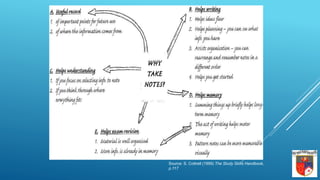
Source: S. Cottrell (1999) The Study Skills Handbook,
p.117
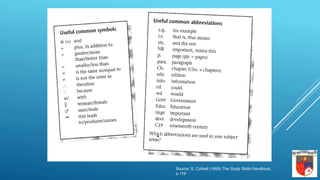
Source: S. Cottrell (1999) The Study Skills Handbook,
p.119
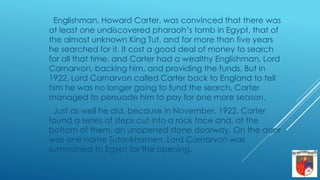
Englishman, Howard Carter, was convinced that there was
at least one undiscovered pharaoh’s tomb in Egypt, that of
the almost unknown King Tut, and for more than five years
he searched for it. It cost a good deal of money to search
for all that time, and Carter had a wealthy Englishman, Lord
Carnarvon, backing him, and providing the funds. But in
1922, Lord Carnarvon called Carter back to England to tell
him he was no longer going to fund the search. Carter
managed to persuade him to pay for one more season.
Just as well he did, because in November, 1922, Carter
found a series of steps cut into a rock face and, at the
bottom of them, an unopened stone doorway. On the door
was one name Tutankhamen. Lord Carnarvon was
summoned to Egypt for the opening.
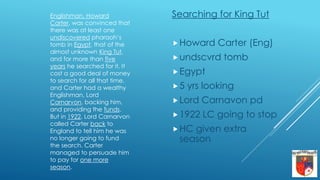
Searching for King Tut
Howard Carter (Eng)
undscvrd tomb
Egypt
5 yrs looking
Lord Carnavon pd
1922 LC going to stop
HC given extra
season
Englishman, Howard
Carter, was convinced that
there was at least one
undiscovered pharaoh’s
tomb in Egypt, that of the
almost unknown King Tut,
and for more than five
years he searched for it. It
cost a good deal of money
to search for all that time,
and Carter had a wealthy
Englishman, Lord
Carnarvon, backing him,
and providing the funds.
But in 1922, Lord Carnarvon
called Carter back to
England to tell him he was
no longer going to fund
the search. Carter
managed to persuade him
to pay for one more
season.
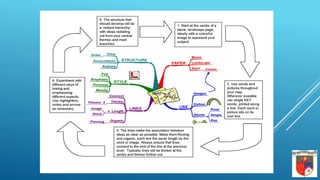
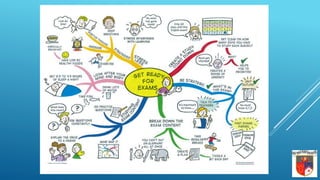
WHAT IS A MIND MAP FOR?
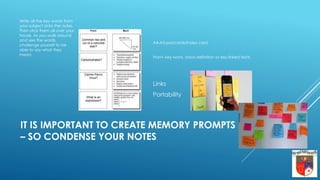
IT IS IMPORTANT TO CREATE MEMORY PROMPTS
– SO CONDENSE YOUR NOTES
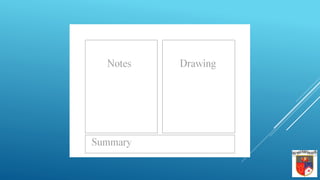
A4-A5-postcards/index card
Front- key word, back-definition or key linked facts
Write all the key words from
your subject onto the notes.
Then stick them all over your
house. As you walk around
and see the words,
challenge yourself to be
able to say what they
mean.
Links
Portability
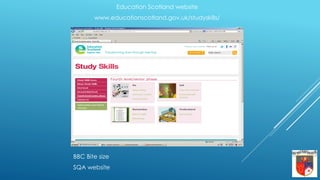
Education Scotland website
www.educationscotland.gov.uk/studyskills/
BBC Bite size
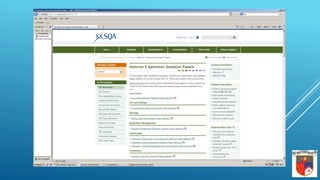
SQA website
QUESTIONS ARE AN ESSENTIAL TOOL
 Ensure your child is familiar with the types of
questions, layout of sections, marks awarded and
time allocated- teachers will be doing this
 Offer to time your child as he/she completes
questions
 Discuss marking scheme and results
 Best way to learn is to teach- encourage your
child to explain concepts/content
to you.
BE PREPARED FOR THE DAY
 Know when the exam is
 Agree what time you will make an alarm call
 Encourage your son/daughter to pack bag the night before
 Do a verbal check list with him/her- calculator etc
 Take snack and water
 Make sure breakfast (or lunch) is available
 Think about issues that cause stress in the mornings and try to
 minimise these
AFTER THE EXAM
 Encourage dialogue about it but help your child
avoid ruminating on perceived difficulties move
on to next exam.
 Help him/her to keep things in perspective.
 Positive thinking is a very effective tool and if your
child is feeling negative, try to help reframe
his/her thinking by using positive language and by
reaffirming that you recognise his/her efforts.
 Avoid criticism.
.
Accept that no matter what
you say- it will probably be
the wrong thing!

Parents' guide to study skills

  • 1.
    WELCOME TO OURSTUDY SKILLS PARENTS’ EVENING
  • 2.
    TO EXPLORE SOMEWAYS IN WHICH YOU CAN SUPPORT YOUR CHILD AS HE/SHE PREPARES FOR THE NATIONAL EXAMS. We hope by the end of our discussion you will be aware of a variety of practical tips you can use at home to support your child to study effectively.
  • 3.
  • 5.
    Coping with anxiety Stressis the body’s normal response to a challenge, threat or excitement. IT IS NORMAL TO FEEL ANXIOUS!
  • 7.
    Joe as studentbefore his exam- distressed, worried , negative, feeling of failure Joe an athlete before a competition- imagining success, motivating, believing, psyching himself up. Self Talk Adrenaline increases your heart rate, elevates your blood pressure and boosts energy supplies. Cortisol, the primary stress hormone, increases sugars (glucose) in the bloodstream, enhances your brain's use of glucose
  • 8.
    Communication is thekey Reassure. Normalise and help your child reframe. Contain their anxiety- do not feed it Message-With preparation you will still feel nervous on the day but you will be able to channel it to help you perform well.
  • 9.
    Why have younot started? I don’t think you have done enough. Why are you having a break now? How much work have you done? THE POWER OF LANGUAGE
  • 10.
    What are youplanning to do tonight? Do you want me to shout up when you’ve worked for an hour, so you can have a break? Are you happy with what you have covered tonight? Do you want me to let you know when its 8.30 so you can get started again?
  • 11.
  • 12.
    TO BE SUCCESSFULYOUR CHILD NEEDS TO Get organised. Study effectively. Be prepared for the day.
  • 13.
    GET ORGANISED  Knowwhen the exams are- have a copy somewhere accessible. Be aware of start times- personalised timetables issued  Draw up a realistic study plan- ensure all subjects are covered. Build in “down time”.  Organise notes by topic- identify gaps in notes as early as possible  Have exam questions, revision guides etc. available  Highlighter pens, felts, coloured post-its, postcards etc. are all potentially useful  Agree where your child will study. It should be warm and well lit.  Encourage use of Masterclasses.
  • 14.
    Memory is fundamentallylinked to critical thinking skills Memory is the residual of thought- the more we think about something, the more we will remember it We understand new things in the context of what we know Proficiency requires practice THINKING ABOUT MEMORY AND LEARNING
  • 15.
  • 16.
     We don’tcontrol what is stored - wanting to remember doesn’t have much bearing on whether you will remember it.  Retrieval is dependent on the quality of cues - cues are the starting point for retrieval.  People tend to think their learning is more complete than it is.
  • 17.
    EFFECTIVE STUDYING ISABOUT: Forming memories Creating cues Retrieving memories
  • 18.
    REVIEW, REMEMBER/RECALL Review- hardest,most crucial part. Active process of breaking down information. Effective note-taking, key words, diagrams, summaries, visual prompts.
  • 21.
    REVIEW, REMEMBER/RECALL  CreateMemory prompts to help to remember/recall  supported by regularly revisiting material to review, and  quizing, testing.
  • 23.
    USE EXAM QUESTIONS Knowingor recalling material is not enough- higher level thinking skills- understand, apply, analyse, evaluate,  create.
  • 24.
    HOW TO STUDYEFFECTIVELY  Have a dialogue about how your child intends to study  Ensure all subjects are studied  Focus on areas of weakness  Encourage your child to ask for help  Use a range of study techniques  Identify study sites- discuss how your child will use these.  Ensure down time
  • 25.
    Source: S. Cottrell(1999) The Study Skills Handbook, p.117
  • 26.
    Source: S. Cottrell(1999) The Study Skills Handbook, p.119
  • 27.
    Englishman, Howard Carter,was convinced that there was at least one undiscovered pharaoh’s tomb in Egypt, that of the almost unknown King Tut, and for more than five years he searched for it. It cost a good deal of money to search for all that time, and Carter had a wealthy Englishman, Lord Carnarvon, backing him, and providing the funds. But in 1922, Lord Carnarvon called Carter back to England to tell him he was no longer going to fund the search. Carter managed to persuade him to pay for one more season. Just as well he did, because in November, 1922, Carter found a series of steps cut into a rock face and, at the bottom of them, an unopened stone doorway. On the door was one name Tutankhamen. Lord Carnarvon was summoned to Egypt for the opening.
  • 28.
    Searching for KingTut Howard Carter (Eng) undscvrd tomb Egypt 5 yrs looking Lord Carnavon pd 1922 LC going to stop HC given extra season Englishman, Howard Carter, was convinced that there was at least one undiscovered pharaoh’s tomb in Egypt, that of the almost unknown King Tut, and for more than five years he searched for it. It cost a good deal of money to search for all that time, and Carter had a wealthy Englishman, Lord Carnarvon, backing him, and providing the funds. But in 1922, Lord Carnarvon called Carter back to England to tell him he was no longer going to fund the search. Carter managed to persuade him to pay for one more season.
  • 30.
    WHAT IS AMIND MAP FOR?
  • 33.
    IT IS IMPORTANTTO CREATE MEMORY PROMPTS – SO CONDENSE YOUR NOTES A4-A5-postcards/index card Front- key word, back-definition or key linked facts Write all the key words from your subject onto the notes. Then stick them all over your house. As you walk around and see the words, challenge yourself to be able to say what they mean. Links Portability
  • 34.
  • 36.
    QUESTIONS ARE ANESSENTIAL TOOL  Ensure your child is familiar with the types of questions, layout of sections, marks awarded and time allocated- teachers will be doing this  Offer to time your child as he/she completes questions  Discuss marking scheme and results  Best way to learn is to teach- encourage your child to explain concepts/content to you.
  • 39.
    BE PREPARED FORTHE DAY  Know when the exam is  Agree what time you will make an alarm call  Encourage your son/daughter to pack bag the night before  Do a verbal check list with him/her- calculator etc  Take snack and water  Make sure breakfast (or lunch) is available  Think about issues that cause stress in the mornings and try to  minimise these
  • 40.
    AFTER THE EXAM Encourage dialogue about it but help your child avoid ruminating on perceived difficulties move on to next exam.  Help him/her to keep things in perspective.  Positive thinking is a very effective tool and if your child is feeling negative, try to help reframe his/her thinking by using positive language and by reaffirming that you recognise his/her efforts.  Avoid criticism.
  • 41.
    . Accept that nomatter what you say- it will probably be the wrong thing!