ENTERPRISE  2.0 Paramount Web Solutions
What is Enterprise 2.0 Enterprise 2.0 is  the “use of emergent social software platforms within companies or between companies and their partners or customers Enterprise 2.0  means the use of an entire suite of emergent technologies—wikis, blogs, tagging, and social networking tools—both within and beyond the four walls of an enterprise. Enterprise social software, also known as  Enterprise 2.0 , is a term describing  social software  used in "enterprise" (business) contexts. It includes social and networked modifications to company  intranets  and other classic software platforms used by large companies to organize their communication
How does Web 2.0 integrate to make it Enterprise 2.0 ?. Enterprise 2.0 is a business focused extension of what is happening on the web. Web 2.0 is much more than just pasting a new user interface onto an old application E 2.0 gives a new perspective on the entire business of software—from concept  through delivery, from marketing through support.
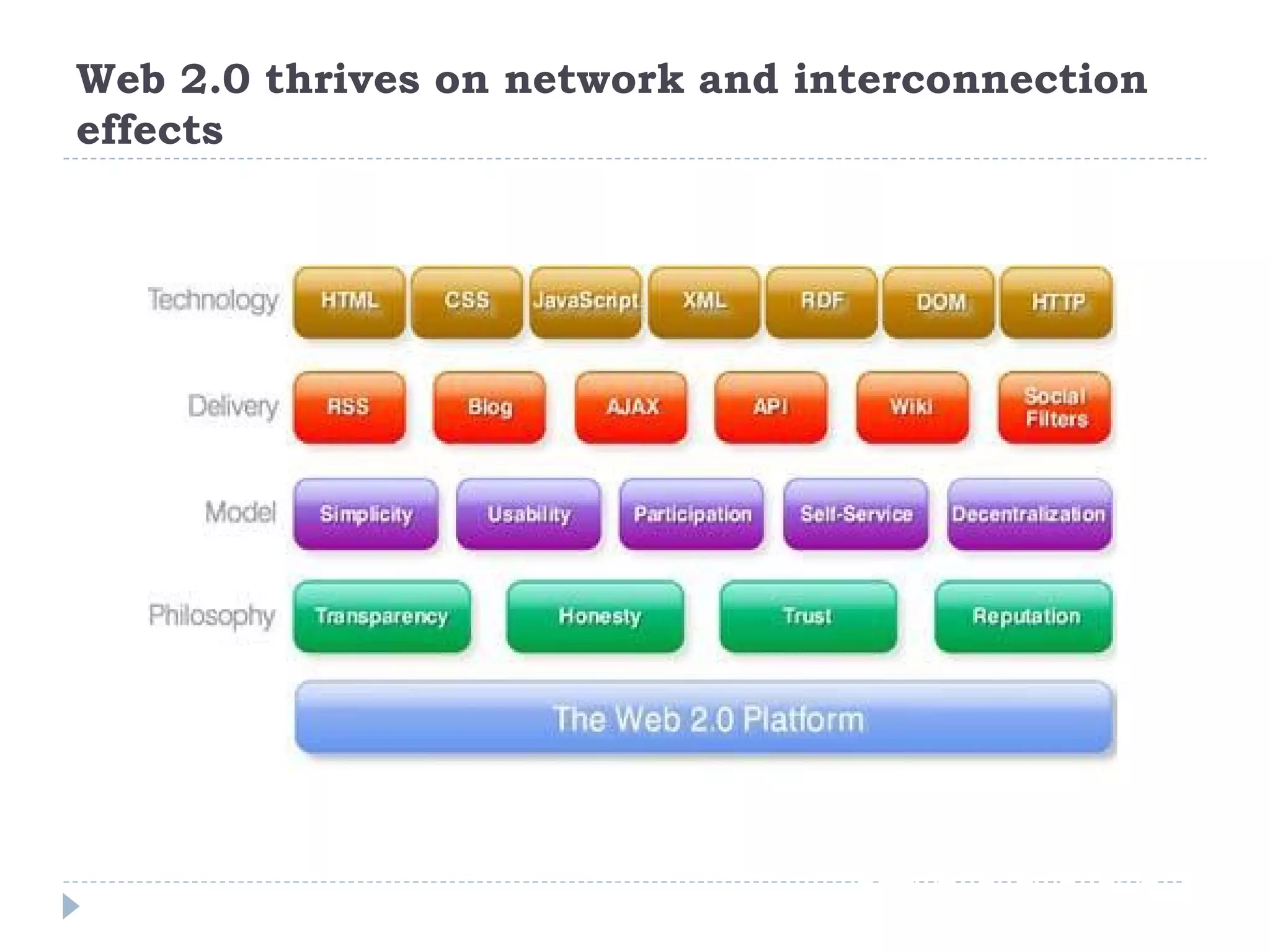
Web 2.0 thrives on network and interconnection effects
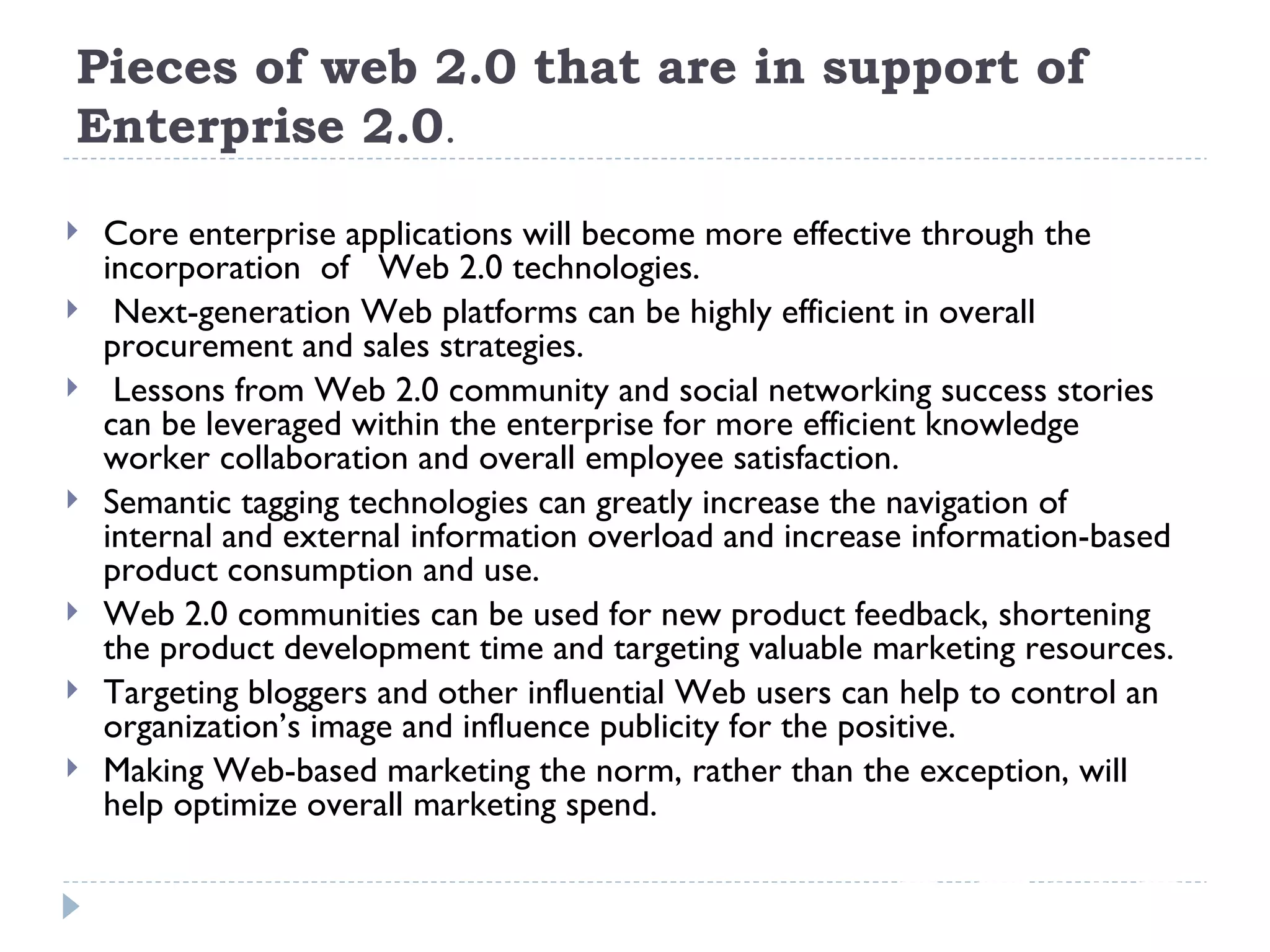
Pieces of web 2.0 that are in support of Enterprise 2.0 . Core enterprise applications will become more effective through the incorporation  of  Web 2.0 technologies. Next-generation Web platforms can be highly efficient in overall procurement and sales strategies. Lessons from Web 2.0 community and social networking success stories can be leveraged within the enterprise for more efficient knowledge worker collaboration and overall employee satisfaction. Semantic tagging technologies can greatly increase the navigation of internal and external information overload and increase information-based product consumption and use. Web 2.0 communities can be used for new product feedback, shortening the product development time and targeting valuable marketing resources. Targeting bloggers and other influential Web users can help to control an organization’s image and influence publicity for the positive. Making Web-based marketing the norm, rather than the exception, will help optimize overall marketing spend.
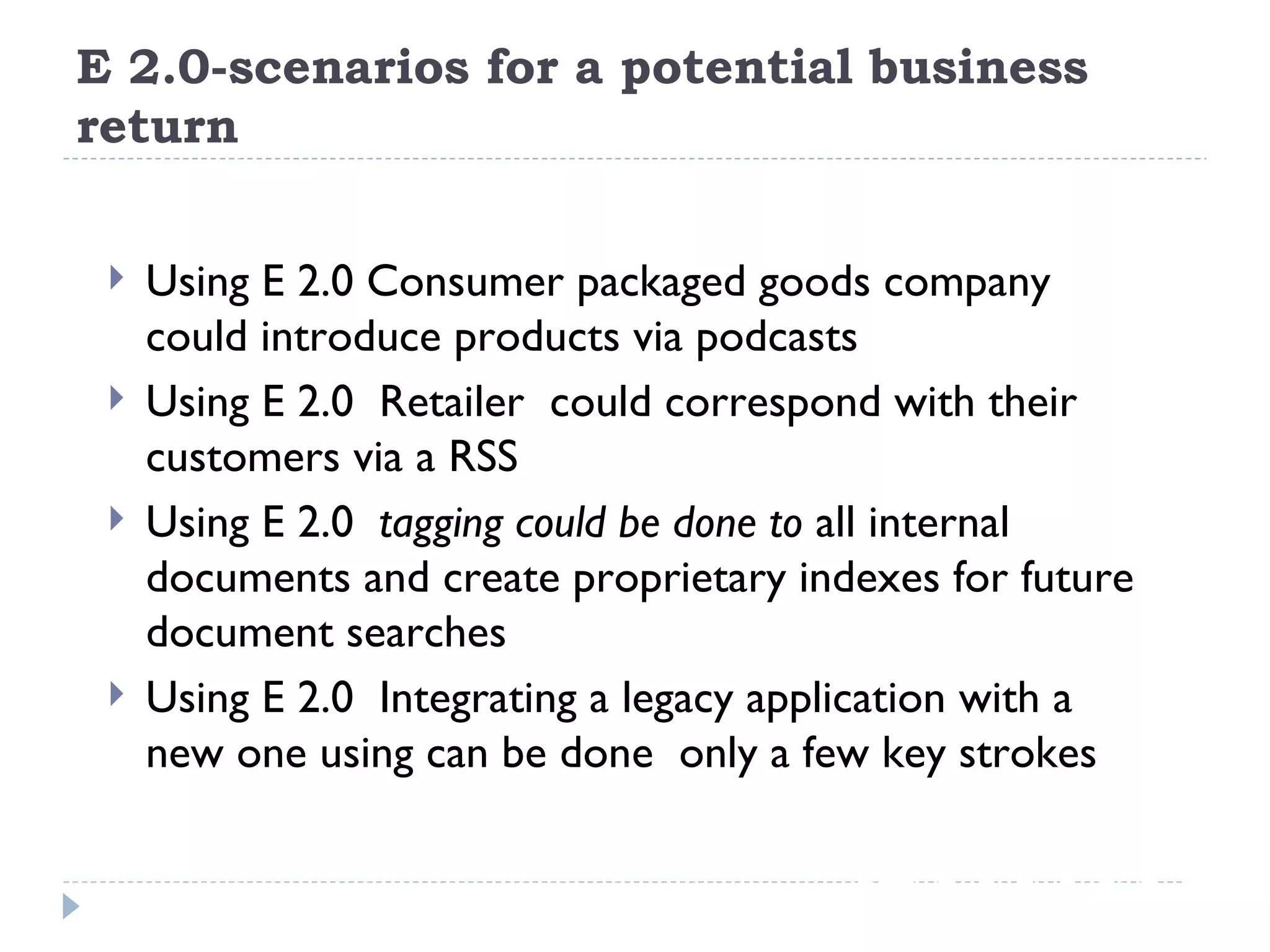
E 2.0-scenarios for a potential business return Using E 2.0 Consumer packaged goods company could introduce products via podcasts Using E 2.0  Retailer  could correspond with their customers via a RSS Using E 2.0  tagging could be done to  all internal documents and create proprietary indexes for future document searches Using E 2.0  Integrating a legacy application with a new one using can be done  only a few key strokes
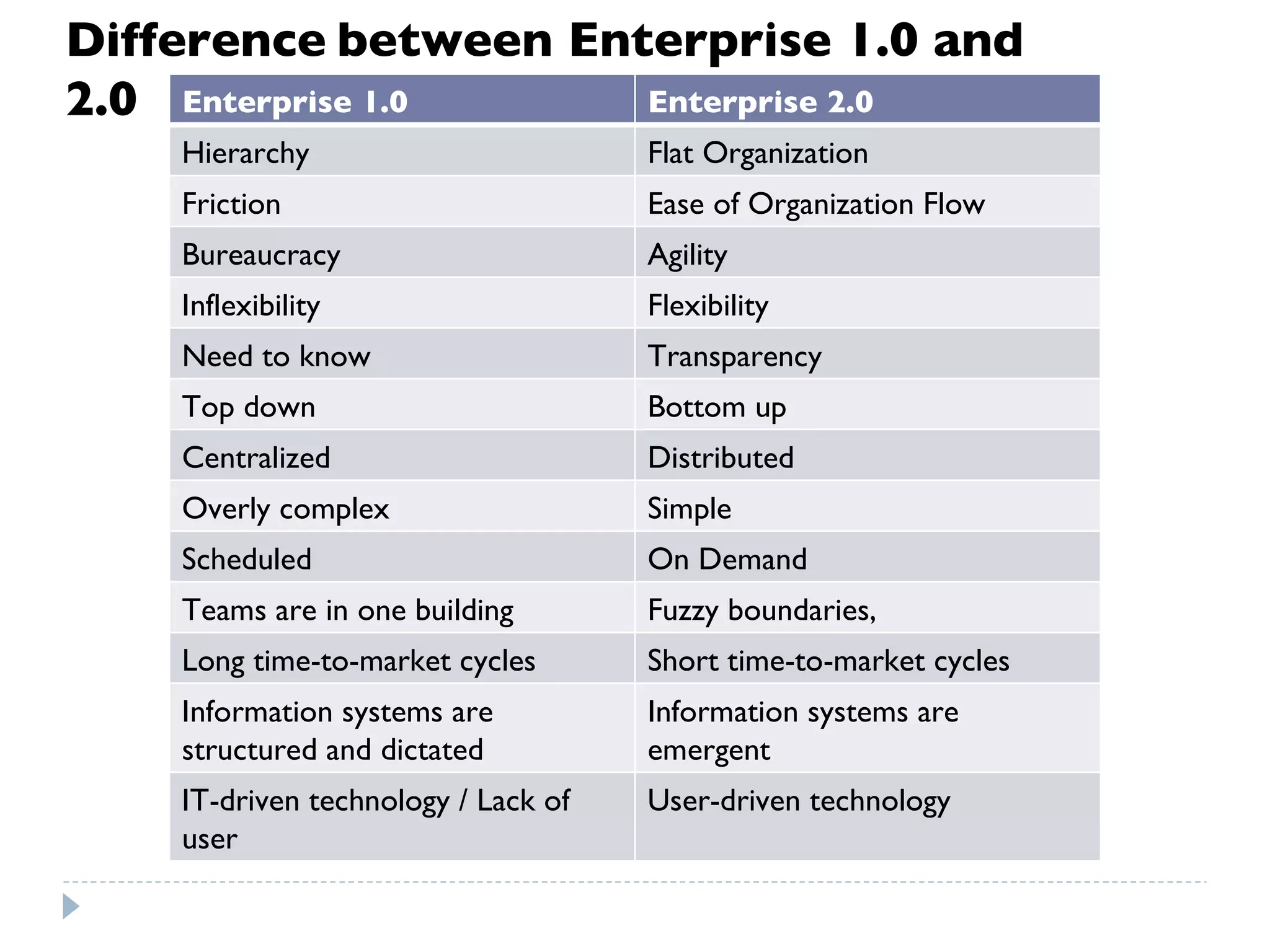
Difference   between Enterprise 1.0 and 2.0 Enterprise 1.0 Enterprise 2.0 Hierarchy Flat Organization Friction Ease of Organization Flow Bureaucracy Agility Inflexibility Flexibility Need to know Transparency Top down Bottom up Centralized Distributed Overly complex Simple Scheduled On Demand Teams are in one building  Fuzzy boundaries, Long time-to-market cycles  Short time-to-market cycles  Information systems are structured and dictated Information systems are emergent IT-driven technology / Lack of user User-driven technology
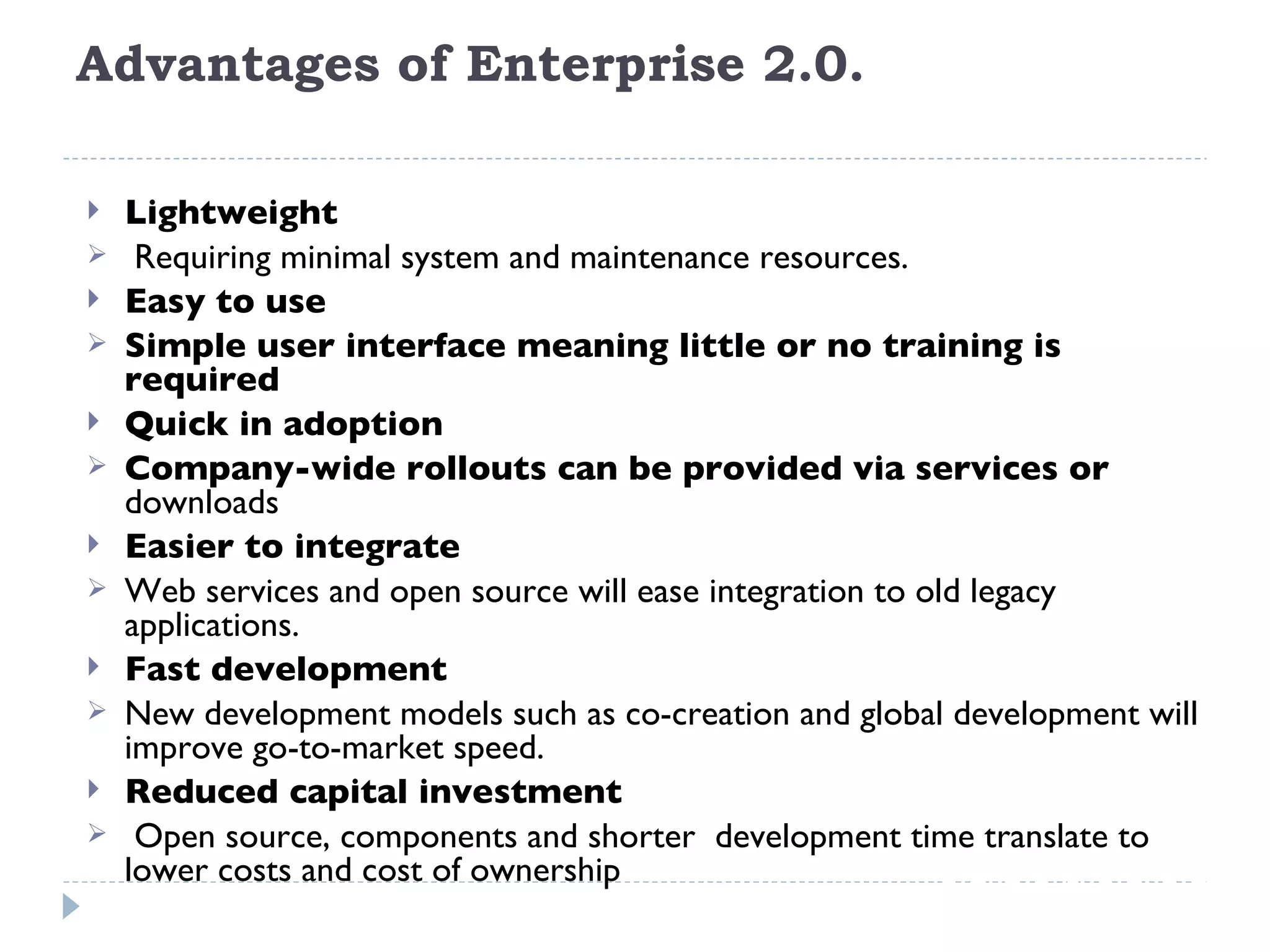
Advantages of Enterprise 2.0.  Lightweight Requiring minimal system and maintenance resources. Easy to use Simple user interface meaning little or no training is required Quick in adoption Company-wide rollouts can be provided via services or  downloads Easier to integrate Web services and open source will ease integration to old legacy applications. Fast development New development models such as co-creation and global development will improve go-to-market speed. Reduced capital investment  Open source, components and shorter  development time translate to lower costs and cost of ownership
Conclusion Although the Enterprise 2.0 requires more and different technology the focus can now be turned to applications for better operational performance within the organization and increased customer satisfaction Enterprise 2.0 technology will flatten the organization's management  structure, highlight good ideas, create an environment  that is more of a meritocracy, make a company more nimble  More customer focused and most importantly increase the pace of innovation. In the face of these business benefits, the risks are minor.
  Thanks   for your time  [email_address] -www.paramountws.com

Paramount Web Solutions Enterprise 2.0

  • 1.
    ENTERPRISE 2.0Paramount Web Solutions
  • 2.
    What is Enterprise2.0 Enterprise 2.0 is the “use of emergent social software platforms within companies or between companies and their partners or customers Enterprise 2.0 means the use of an entire suite of emergent technologies—wikis, blogs, tagging, and social networking tools—both within and beyond the four walls of an enterprise. Enterprise social software, also known as Enterprise 2.0 , is a term describing social software used in "enterprise" (business) contexts. It includes social and networked modifications to company intranets and other classic software platforms used by large companies to organize their communication
  • 3.
    How does Web2.0 integrate to make it Enterprise 2.0 ?. Enterprise 2.0 is a business focused extension of what is happening on the web. Web 2.0 is much more than just pasting a new user interface onto an old application E 2.0 gives a new perspective on the entire business of software—from concept through delivery, from marketing through support.
  • 4.
    Web 2.0 thriveson network and interconnection effects
  • 5.
    Pieces of web2.0 that are in support of Enterprise 2.0 . Core enterprise applications will become more effective through the incorporation of Web 2.0 technologies. Next-generation Web platforms can be highly efficient in overall procurement and sales strategies. Lessons from Web 2.0 community and social networking success stories can be leveraged within the enterprise for more efficient knowledge worker collaboration and overall employee satisfaction. Semantic tagging technologies can greatly increase the navigation of internal and external information overload and increase information-based product consumption and use. Web 2.0 communities can be used for new product feedback, shortening the product development time and targeting valuable marketing resources. Targeting bloggers and other influential Web users can help to control an organization’s image and influence publicity for the positive. Making Web-based marketing the norm, rather than the exception, will help optimize overall marketing spend.
  • 6.
    E 2.0-scenarios fora potential business return Using E 2.0 Consumer packaged goods company could introduce products via podcasts Using E 2.0 Retailer could correspond with their customers via a RSS Using E 2.0 tagging could be done to all internal documents and create proprietary indexes for future document searches Using E 2.0 Integrating a legacy application with a new one using can be done only a few key strokes
  • 7.
    Difference between Enterprise 1.0 and 2.0 Enterprise 1.0 Enterprise 2.0 Hierarchy Flat Organization Friction Ease of Organization Flow Bureaucracy Agility Inflexibility Flexibility Need to know Transparency Top down Bottom up Centralized Distributed Overly complex Simple Scheduled On Demand Teams are in one building Fuzzy boundaries, Long time-to-market cycles Short time-to-market cycles Information systems are structured and dictated Information systems are emergent IT-driven technology / Lack of user User-driven technology
  • 8.
    Advantages of Enterprise2.0. Lightweight Requiring minimal system and maintenance resources. Easy to use Simple user interface meaning little or no training is required Quick in adoption Company-wide rollouts can be provided via services or downloads Easier to integrate Web services and open source will ease integration to old legacy applications. Fast development New development models such as co-creation and global development will improve go-to-market speed. Reduced capital investment Open source, components and shorter development time translate to lower costs and cost of ownership
  • 9.
    Conclusion Although theEnterprise 2.0 requires more and different technology the focus can now be turned to applications for better operational performance within the organization and increased customer satisfaction Enterprise 2.0 technology will flatten the organization's management structure, highlight good ideas, create an environment that is more of a meritocracy, make a company more nimble More customer focused and most importantly increase the pace of innovation. In the face of these business benefits, the risks are minor.
  • 10.
    Thanks for your time [email_address] -www.paramountws.com