Download to read offline


![11Shaghayegh Sahebi (Sherry)
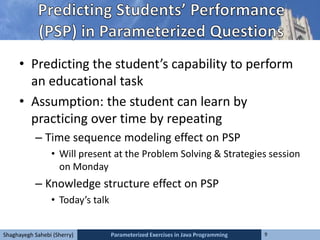
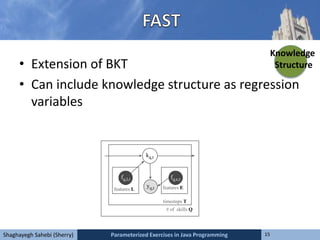
• Considering knowledge structure in PSP
– Feature-Aware Knowledge Tracing (FAST) [González-Brenes
et al., ‘13]
– Our suggestion: Tensor Factorization Methods](https://image.slidesharecdn.com/itsworkshop14pitttemplate-150528001229-lva1-app6891/85/Parameterized-Exercises-in-Java-Programming-using-Knowledge-Structure-for-Performance-Prediction-11-320.jpg)
![17Shaghayegh Sahebi (Sherry)
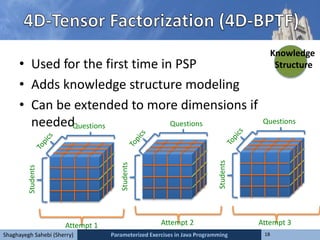
• Used successfully in PSP for traditional PSP
• No knowledge structure
• We use Bayesian Probabilistic Tensor
Factorization Model (3D-BPTF) [Xiong et al., 2010]
Students
Questions/ topics
…
Knowledge
Structure](https://image.slidesharecdn.com/itsworkshop14pitttemplate-150528001229-lva1-app6891/85/Parameterized-Exercises-in-Java-Programming-using-Knowledge-Structure-for-Performance-Prediction-17-320.jpg)

![37Shaghayegh Sahebi (Sherry)
• EM algorithm for BKT and set the initial
parameters as follows: p(L0) = 0:5 , p(G) = 0:2 ,
p(S) = 0:1 , p(T) = 0:3 . For running PFA, we use
• the implementation of logistic regression in
WEKA [3]. For BPTF and BPMF,
• we utilize the Matlab code prepared by Xiong et.
al. We experimented with different latent space
dimensions for BPTF and BPMF (5, 10, 20 and 30)
and chose the best one, which has the latent
space dimension of 10](https://image.slidesharecdn.com/itsworkshop14pitttemplate-150528001229-lva1-app6891/85/Parameterized-Exercises-in-Java-Programming-using-Knowledge-Structure-for-Performance-Prediction-37-320.jpg)
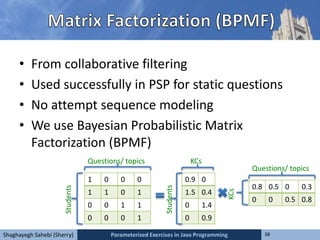
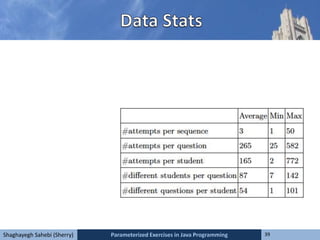
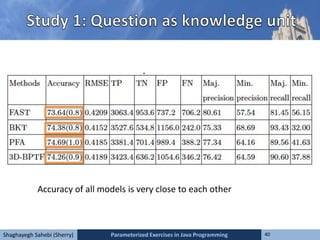
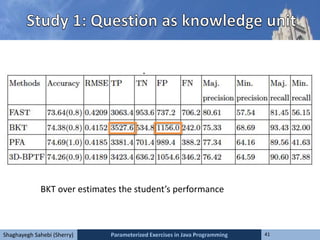
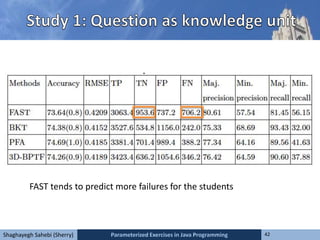
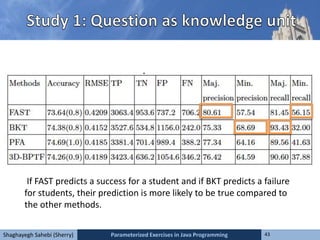
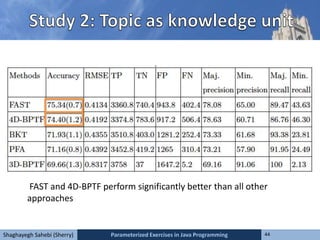
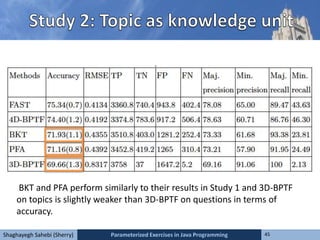

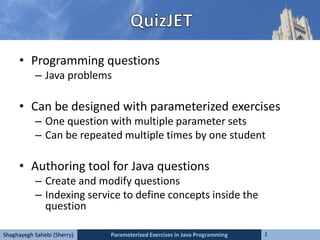
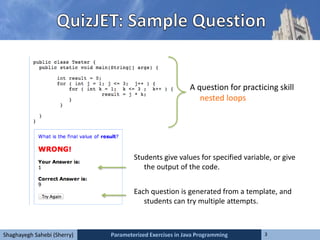
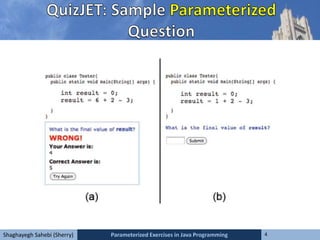
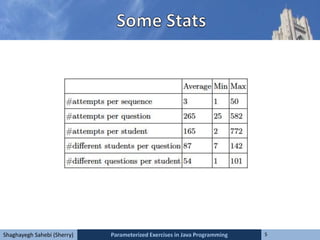
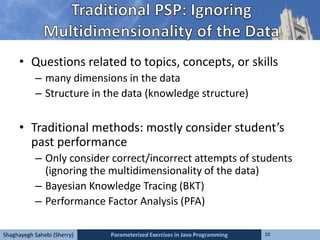
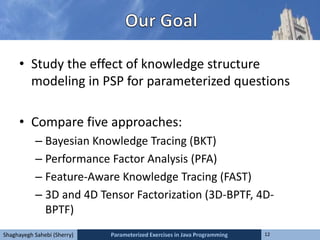
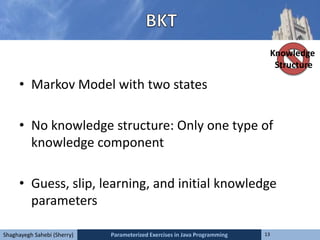
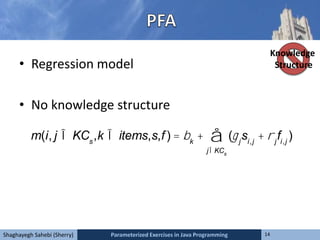
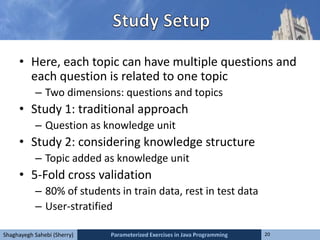
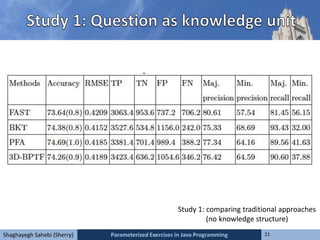
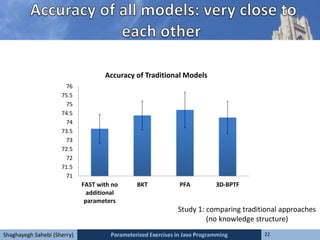
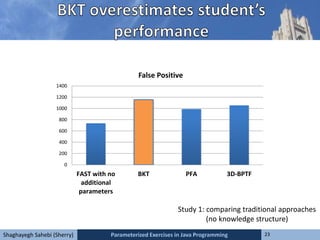
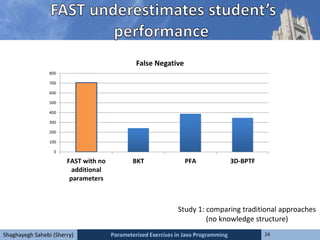
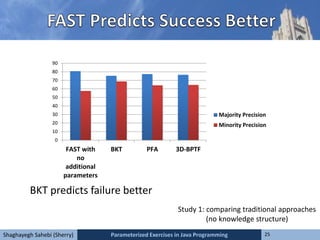
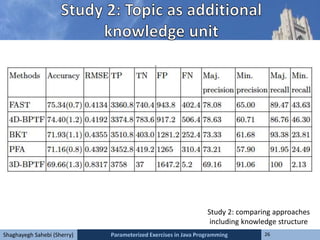
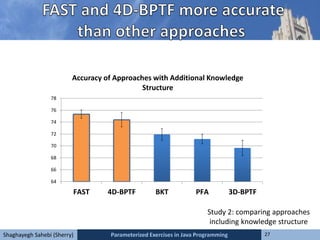
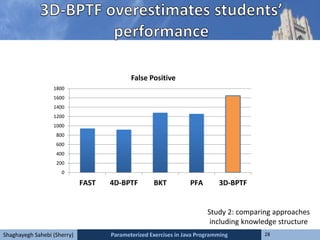
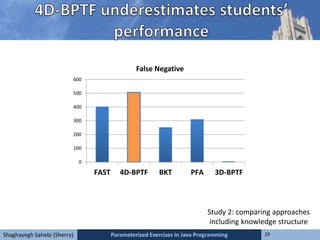
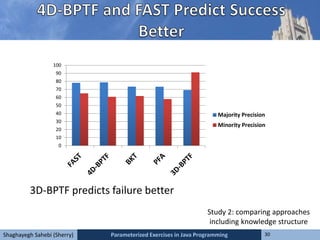
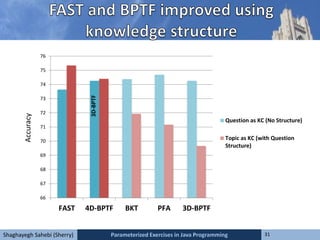
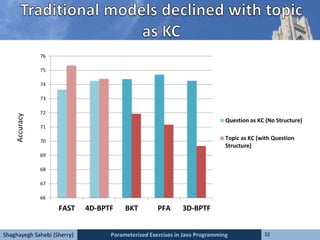
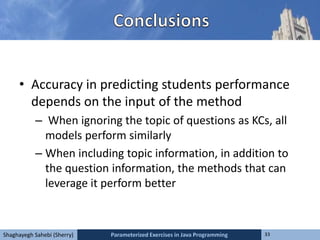
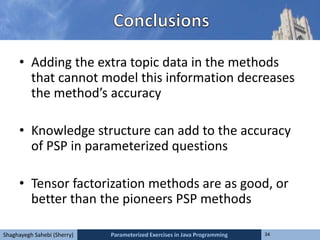
The document discusses a Java programming educational system that utilizes parameterized exercises and personalized guidance to enhance student problem-solving skills. It compares various approaches for predicting student performance based on knowledge structure, including Bayesian Knowledge Tracing (BKT) and tensor factorization methods, revealing that incorporating knowledge structure improves accuracy in performance predictions. The findings suggest that advanced models like fast and 4D-BPTF outperform traditional methods in predicting outcomes, emphasizing the importance of considering multiple dimensions in educational data.


![7.__Developing_a_Research_Proposal[1].pptx](https://cdn.slidesharecdn.com/ss_thumbnails/7-260131073037-df92dd7d-thumbnail.jpg?width=640&height=640&fit=bounds)


![Hacking-Uncovered-How-People-Get-Hacked-and-How-to-Stay-Safe[1].pptx](https://cdn.slidesharecdn.com/ss_thumbnails/hacking-uncovered-how-people-get-hacked-and-how-to-stay-safe1-260130170011-4883a9c7-thumbnail.jpg?width=640&height=640&fit=bounds)


![제 23회 보아즈(BOAZ) 빅데이터 컨퍼런스 - [MBOAX] : ABSA를 활용한 소비자 반응 분석 기반 운영 효율화 대시보드 설계](https://cdn.slidesharecdn.com/ss_thumbnails/3-1boaz23rdconferencemboax-260203102709-9d519923-thumbnail.jpg?width=640&height=640&fit=bounds)


