EVERYTHING YOU NEED TO
KNOW ABOUT OPEN RAN
www.parallelwireless.com
© 2020 Parallel Wireless. All rights reserved.
2
Introduction ..............................................................................................6
Open RAN, OpenRAN or ORAN?.............................................................6
Open RAN Summary ................................................................................7
Open RAN Groups....................................................................................7
Telecom Infra Project (TIP)..................................................................................... 7
O-RAN Alliance ....................................................................................................... 8
TIP vs O-RAN Alliance? .........................................................................10
The O-RAN Alliance.............................................................................................. 10
TIP.......................................................................................................................... 10
Other Key Open RAN Groups................................................................10
C-RAN, Virtual RAN (vRAN) and OpenRAN ..........................................12
C-RAN.................................................................................................................... 13
vRAN...................................................................................................................... 13
Virtualized RAN (VRAN) versus OpenRAN.......................................................... 14
Open RAN ............................................................................................................. 14
O-RAN Groups Summary.......................................................................15
The Need for Open Interfaces................................................................15
3GPP Interfaces .................................................................................................... 15
X2 Interface ........................................................................................................... 16
The Interface Options for MNOs to Create an Open RAN Network .....17
Open Interfaces Summary .....................................................................18
Open RAN Components and RAN Functional Splits............................18
RU, CU and DU .......................................................................................18
Table of Contents
www.parallelwireless.com
© 2020 Parallel Wireless. All rights reserved.
3
Components and Functional Splits Summary......................................20
Deep Dive into RU, DU, CU ....................................................................20
RAN Functional Split 6...........................................................................22
RAN Functional Split 7...........................................................................22
RAN Functional Split 8...........................................................................23
RU, DU, CU Summary.............................................................................24
RAN Automation with CI/CD ..................................................................25
Virtualization: VNFs and Containers .....................................................25
CI/CD Overview ......................................................................................26
DevOps.................................................................................................................. 26
Real Life Examples of CD/CI Deployments in Telecom........................28
Internet Para Todos (IpT) CI/CD.............................................................29
TIP CI/CD.................................................................................................29
CI/CD Summary ......................................................................................29
Role of RAN Intelligent Controller (RIC)................................................30
O-RAN Alliance Groups Working on RIC ..............................................31
Working Group 1 ................................................................................................... 32
Near Real-Time RAN Intelligent Controller (Near-RT RIC).................................. 32
Non-Real-Time RAN Intelligent Controller (Non-RT RIC).................................... 33
RIC Overview..........................................................................................34
Multi-RAT CU Protocol Stack Function................................................................. 34
The Near-RT RIC .................................................................................................. 34
Bringing It All Together:......................................................................................... 35
RIC Implementations in Real Life: Nokia, Parallel Wireless.................35
RIC Platform Summary ..........................................................................39
Integration of Open RAN and Beyond...................................................40
www.parallelwireless.com
© 2020 Parallel Wireless. All rights reserved.
4
Challenges of Open RAN Integration ....................................................40
Integration Opportunities....................................................................................... 41
Open RAN Ecosystem Integration........................................................................ 42
System Integration of the Open RAN Software.................................................... 42
Implementation Stage ............................................................................43
Maintenance Stage.................................................................................44
Operator Tasks in Integration................................................................44
Role of Managed Service Providers in Integration...............................47
Role of Hardware and Software Vendors in Integration.......................47
Role of Integrators .................................................................................48
Open RAN Integration Real Life Examples ...........................................48
Model 1 (MNO Integrates Themselves)................................................................ 48
Model 2 (A Hardware Vendor Integrates)............................................................. 48
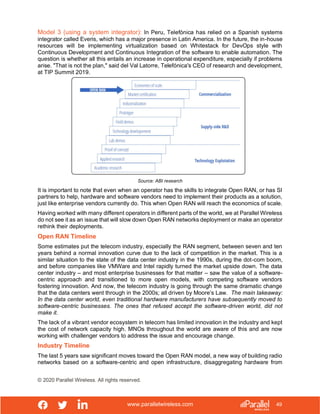
Model 3 (Using a System Integrator).................................................................... 49
Open RAN Timeline................................................................................49
Industry Timeline....................................................................................49
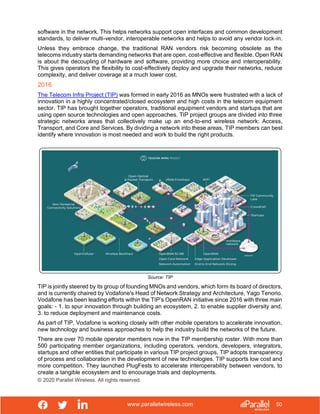
2016....................................................................................................................... 50
2017....................................................................................................................... 51
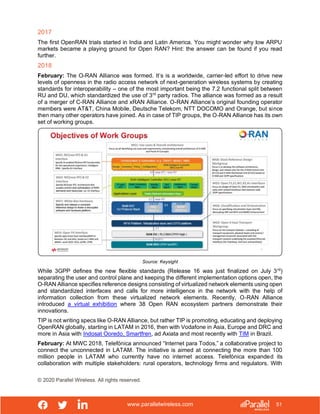
2018....................................................................................................................... 51
2019....................................................................................................................... 52
2020....................................................................................................................... 52
Open RAN and Beyond Summary .........................................................53
Global Open RAN Adoption...................................................................55
Emerging and Developed Economies...................................................55
In Emerging Economies........................................................................................ 55
In Developed Economies ...................................................................................... 56
www.parallelwireless.com
© 2020 Parallel Wireless. All rights reserved.
5
Urban Versus Rural................................................................................56
Europe ................................................................................................................... 56
Africa...................................................................................................................... 57
Latin America......................................................................................................... 58
APAC ..................................................................................................................... 59
U.S. ........................................................................................................................ 59
Analyst Predictions................................................................................60
About Parallel Wireless..........................................................................62
www.parallelwireless.com
© 2020 Parallel Wireless. All rights reserved.
6
Introduction
2020 is the year of Open RAN. Each week seems to bring some new announcement about the
technology. While there is a lot of information, there is also confusion, incomplete stories, half-
truths and even outright misinformation. In this paper, our goal is to simplify the world of Open
RAN for readers.
Before we begin, it is important to note that Open RAN started as a movement that applies to all
generations (or ALL Gs) of mobile technology. That is to say, Open RAN applies to 2G, 3G, 4G,
5G and all future Gs.
Open RAN, OpenRAN or ORAN?
When people talk about Open RAN, you hear “Open” and “RAN,” but when they write about it, you
may see it in a variety of ways. You may also often see different hashtags used on social media,
such as #oran and #OpenRAN. This can be very confusing when it comes
to understanding which terms to use and when.
“Open RAN” is the movement in wireless telecommunications to disaggregate hardware and
software and to create open interfaces between them.
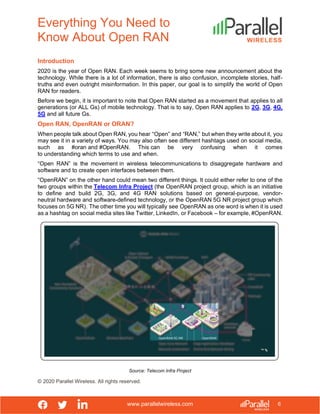
“OpenRAN” on the other hand could mean two different things. It could either refer to one of the
two groups within the Telecom Infra Project (the OpenRAN project group, which is an initiative
to define and build 2G, 3G, and 4G RAN solutions based on general-purpose, vendor-
neutral hardware and software-defined technology, or the OpenRAN 5G NR project group which
focuses on 5G NR). The other time you will typically see OpenRAN as one word is when it is used
as a hashtag on social media sites like Twitter, LinkedIn, or Facebook – for example, #OpenRAN.
Source: Telecom Infra Project
Everything You Need to
Know About Open RAN
www.parallelwireless.com
© 2020 Parallel Wireless. All rights reserved.
7
Next up are “O-RAN” and “ORAN.” O-RAN with the hyphen refers to the O-RAN Alliance,
which publishes new RAN specifications, releases open software for the RAN, and supports its
members in integration and testing of their implementations. “ORAN” can also be used to refer to
the Open RAN movement; however, O-RAN with the hyphen always refers to the O-RAN Alliance.
#oRAN or #ORAN are also used as hashtags on social networks to refer to either the O-RAN
Alliance or to the Open RAN movement.
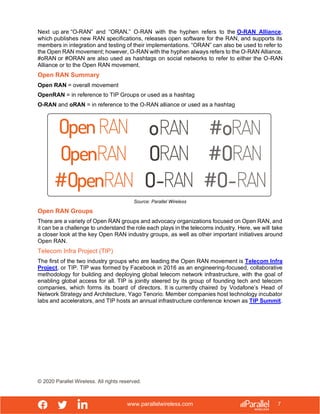
Open RAN Summary
Open RAN = overall movement
OpenRAN = in reference to TIP Groups or used as a hashtag
O-RAN and oRAN = in reference to the O-RAN alliance or used as a hashtag
Source: Parallel Wireless
Open RAN Groups
There are a variety of Open RAN groups and advocacy organizations focused on Open RAN, and
it can be a challenge to understand the role each plays in the telecoms industry. Here, we will take
a closer look at the key Open RAN industry groups, as well as other important initiatives around
Open RAN.
Telecom Infra Project (TIP)
The first of the two industry groups who are leading the Open RAN movement is Telecom Infra
Project, or TIP. TIP was formed by Facebook in 2016 as an engineering-focused, collaborative
methodology for building and deploying global telecom network infrastructure, with the goal of
enabling global access for all. TIP is jointly steered by its group of founding tech and telecom
companies, which forms its board of directors. It is currently chaired by Vodafone’s Head of
Network Strategy and Architecture, Yago Tenorio. Member companies host technology incubator
labs and accelerators, and TIP hosts an annual infrastructure conference known as TIP Summit.
www.parallelwireless.com
© 2020 Parallel Wireless. All rights reserved.
8
Source: Parallel Wireless
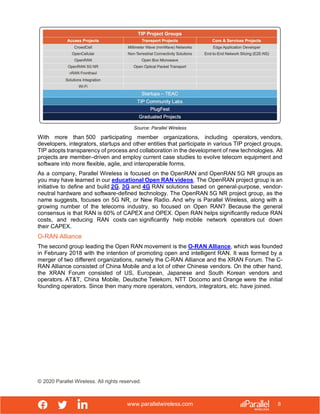
With more than 500 participating member organizations, including operators, vendors,
developers, integrators, startups and other entities that participate in various TIP project groups,
TIP adopts transparency of process and collaboration in the development of new technologies. All
projects are member–driven and employ current case studies to evolve telecom equipment and
software into more flexible, agile, and interoperable forms.
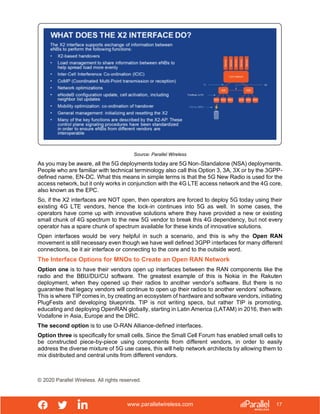
As a company, Parallel Wireless is focused on the OpenRAN and OpenRAN 5G NR groups as
you may have learned in our educational Open RAN videos. The OpenRAN project group is an
initiative to define and build 2G, 3G and 4G RAN solutions based on general-purpose, vendor-
neutral hardware and software-defined technology. The OpenRAN 5G NR project group, as the
name suggests, focuses on 5G NR, or New Radio. And why is Parallel Wireless, along with a
growing number of the telecoms industry, so focused on Open RAN? Because the general
consensus is that RAN is 60% of CAPEX and OPEX. Open RAN helps significantly reduce RAN
costs, and reducing RAN costs can significantly help mobile network operators cut down
their CAPEX.
O-RAN Alliance
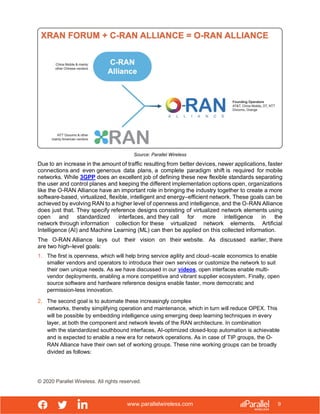
The second group leading the Open RAN movement is the O-RAN Alliance, which was founded
in February 2018 with the intention of promoting open and intelligent RAN. It was formed by a
merger of two different organizations, namely the C-RAN Alliance and the XRAN Forum. The C-
RAN Alliance consisted of China Mobile and a lot of other Chinese vendors. On the other hand,
the XRAN Forum consisted of US, European, Japanese and South Korean vendors and
operators. AT&T, China Mobile, Deutsche Telekom, NTT Docomo and Orange were the initial
founding operators. Since then many more operators, vendors, integrators, etc. have joined.
www.parallelwireless.com
© 2020 Parallel Wireless. All rights reserved.
9
Source: Parallel Wireless
Due to an increase in the amount of traffic resulting from better devices, newer applications, faster
connections and even generous data plans, a complete paradigm shift is required for mobile
networks. While 3GPP does an excellent job of defining these new flexible standards separating
the user and control planes and keeping the different implementation options open, organizations
like the O-RAN Alliance have an important role in bringing the industry together to create a more
software-based, virtualized, flexible, intelligent and energy–efficient network. These goals can be
achieved by evolving RAN to a higher level of openness and intelligence, and the O-RAN Alliance
does just that. They specify reference designs consisting of virtualized network elements using
open and standardized interfaces, and they call for more intelligence in the
network through information collection for these virtualized network elements. Artificial
Intelligence (AI) and Machine Learning (ML) can then be applied on this collected information.
The O-RAN Alliance lays out their vision on their website. As discussed earlier, there
are two high–level goals:
1. The first is openness, which will help bring service agility and cloud–scale economics to enable
smaller vendors and operators to introduce their own services or customize the network to suit
their own unique needs. As we have discussed in our videos, open interfaces enable multi-
vendor deployments, enabling a more competitive and vibrant supplier ecosystem. Finally, open
source software and hardware reference designs enable faster, more democratic and
permission-less innovation.
2. The second goal is to automate these increasingly complex
networks, thereby simplifying operation and maintenance, which in turn will reduce OPEX. This
will be possible by embedding intelligence using emerging deep learning techniques in every
layer, at both the component and network levels of the RAN architecture. In combination
with the standardized southbound interfaces, AI-optimized closed-loop automation is achievable
and is expected to enable a new era for network operations. As in case of TIP groups, the O-
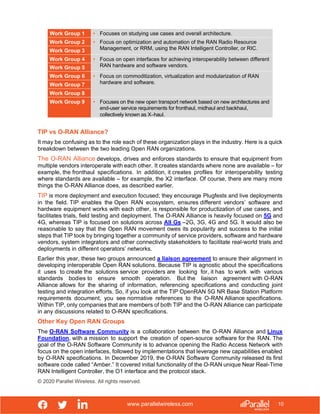
RAN Alliance have their own set of working groups. These nine working groups can be broadly
divided as follows:
www.parallelwireless.com
© 2020 Parallel Wireless. All rights reserved.
10
TIP vs O-RAN Alliance?
It may be confusing as to the role each of these organization plays in the industry. Here is a quick
breakdown between the two leading Open RAN organizations.
The O-RAN Alliance develops, drives and enforces standards to ensure that equipment from
multiple vendors interoperate with each other. It creates standards where none are available – for
example, the fronthaul specifications. In addition, it creates profiles for interoperability testing
where standards are available – for example, the X2 interface. Of course, there are many more
things the O-RAN Alliance does, as described earlier.
TIP is more deployment and execution focused; they encourage Plugfests and live deployments
in the field. TIP enables the Open RAN ecosystem, ensures different vendors’ software and
hardware equipment works with each other, is responsible for productization of use cases, and
facilitates trials, field testing and deployment. The O-RAN Alliance is heavily focused on 5G and
4G, whereas TIP is focused on solutions across All Gs –2G, 3G, 4G and 5G. It would also be
reasonable to say that the Open RAN movement owes its popularity and success to the initial
steps that TIP took by bringing together a community of service providers, software and hardware
vendors, system integrators and other connectivity stakeholders to facilitate real-world trials and
deployments in different operators’ networks.
Earlier this year, these two groups announced a liaison agreement to ensure their alignment in
developing interoperable Open RAN solutions. Because TIP is agnostic about the specifications
it uses to create the solutions service providers are looking for, it has to work with various
standards bodies to ensure smooth operation. But the liaison agreement with O-RAN
Alliance allows for the sharing of information, referencing specifications and conducting joint
testing and integration efforts. So, if you look at the TIP OpenRAN 5G NR Base Station Platform
requirements document, you see normative references to the O-RAN Alliance specifications.
Within TIP, only companies that are members of both TIP and the O-RAN Alliance can participate
in any discussions related to O-RAN specifications.
Other Key Open RAN Groups
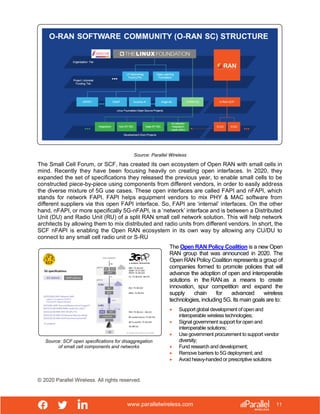
The O-RAN Software Community is a collaboration between the O-RAN Alliance and Linux
Foundation, with a mission to support the creation of open-source software for the RAN. The
goal of the O-RAN Software Community is to advance opening the Radio Access Network with
focus on the open interfaces, followed by implementations that leverage new capabilities enabled
by O-RAN specifications. In December 2019, the O-RAN Software Community released its first
software code called “Amber.” It covered initial functionality of the O-RAN unique Near Real-Time
RAN Intelligent Controller, the O1 interface and the protocol stack.
Work Group 1 • Focuses on studying use cases and overall architecture.
Work Group 2 • Focus on optimization and automation of the RAN Radio Resource
Management, or RRM, using the RAN Intelligent Controller, or RIC.
Work Group 3
Work Group 4 • Focus on open interfaces for achieving interoperability between different
RAN hardware and software vendors.
Work Group 5
Work Group 6 • Focus on commoditization, virtualization and modularization of RAN
hardware and software.
Work Group 7
Work Group 8
Work Group 9 • Focuses on the new open transport network based on new architectures and
end-user service requirements for fronthaul, midhaul and backhaul,
collectively known as X–haul.
www.parallelwireless.com
© 2020 Parallel Wireless. All rights reserved.
11
Source: Parallel Wireless
The Small Cell Forum, or SCF, has created its own ecosystem of Open RAN with small cells in
mind. Recently they have been focusing heavily on creating open interfaces. In 2020, they
expanded the set of specifications they released the previous year, to enable small cells to be
constructed piece-by-piece using components from different vendors, in order to easily address
the diverse mixture of 5G use cases. These open interfaces are called FAPI and nFAPI, which
stands for network FAPI. FAPI helps equipment vendors to mix PHY & MAC software from
different suppliers via this open FAPI interface. So, FAPI are ‘internal’ interfaces. On the other
hand, nFAPI, or more specifically 5G-nFAPI, is a ‘network’ interface and is between a Distributed
Unit (DU) and Radio Unit (RU) of a split RAN small cell network solution. This will help network
architects by allowing them to mix distributed and radio units from different vendors. In short, the
SCF nFAPI is enabling the Open RAN ecosystem in its own way by allowing any CU/DU to
connect to any small cell radio unit or S-RU
Source: SCF open specifications for disaggregation
of small cell components and networks
The Open RAN Policy Coalition is a new Open
RAN group that was announced in 2020. The
Open RAN Policy Coalition represents a group of
companies formed to promote policies that will
advance the adoption of open and interoperable
solutions in the RAN as a means to create
innovation, spur competition and expand the
supply chain for advanced wireless
technologies, including 5G. Its main goals are to:
• Support global development of open and
interoperable wireless technologies;
• Signal government support for open and
interoperable solutions;
• Use government procurement to support vendor
diversity;
• Fund research and development;
• Remove barriers to 5G deployment; and
• Avoid heavy-handed or prescriptive solutions
www.parallelwireless.com
© 2020 Parallel Wireless. All rights reserved.
12
C-RAN, Virtual RAN (vRAN) and OpenRAN
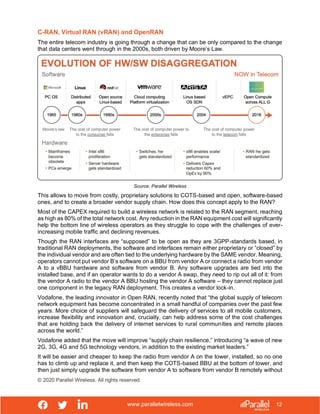
The entire telecom industry is going through a change that can be only compared to the change
that data centers went through in the 2000s, both driven by Moore’s Law.
Source: Parallel Wireless
This allows to move from costly, proprietary solutions to COTS-based and open, software-based
ones, and to create a broader vendor supply chain. How does this concept apply to the RAN?
Most of the CAPEX required to build a wireless network is related to the RAN segment, reaching
as high as 80% of the total network cost. Any reduction in the RAN equipment cost will significantly
help the bottom line of wireless operators as they struggle to cope with the challenges of ever-
increasing mobile traffic and declining revenues.
Though the RAN interfaces are “supposed” to be open as they are 3GPP-standards based, in
traditional RAN deployments, the software and interfaces remain either proprietary or “closed” by
the individual vendor and are often tied to the underlying hardware by the SAME vendor. Meaning,
operators cannot put vendor B’s software on a BBU from vendor A or connect a radio from vendor
A to a vBBU hardware and software from vendor B. Any software upgrades are tied into the
installed base, and if an operator wants to do a vendor A swap, they need to rip out all of it: from
the vendor A radio to the vendor A BBU hosting the vendor A software – they cannot replace just
one component in the legacy RAN deployment. This creates a vendor lock-in.
Vodafone, the leading innovator in Open RAN, recently noted that “the global supply of telecom
network equipment has become concentrated in a small handful of companies over the past few
years. More choice of suppliers will safeguard the delivery of services to all mobile customers,
increase flexibility and innovation and, crucially, can help address some of the cost challenges
that are holding back the delivery of internet services to rural communities and remote places
across the world.”
Vodafone added that the move will improve “supply chain resilience,” introducing “a wave of new
2G, 3G, 4G and 5G technology vendors, in addition to the existing market leaders.”
It will be easier and cheaper to keep the radio from vendor A on the tower, installed, so no one
has to climb up and replace it, and then keep the COTS-based BBU at the bottom of tower, and
then just simply upgrade the software from vendor A to software from vendor B remotely without
www.parallelwireless.com
© 2020 Parallel Wireless. All rights reserved.
13
going to a site. This is exactly what Open RAN enables: the mixing and matching of software and
hardware (radios and COTS servers) without the need to rip and replace. This, however, is not to
be confused with C-RAN or vRAN. Let us explain why.
C-RAN
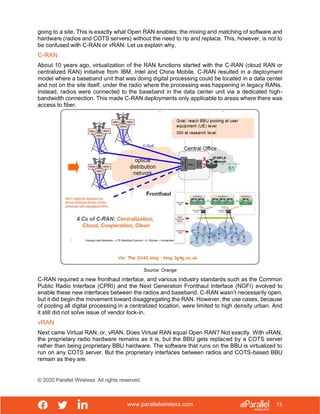
About 10 years ago, virtualization of the RAN functions started with the C-RAN (cloud RAN or
centralized RAN) initiative from IBM, Intel and China Mobile. C-RAN resulted in a deployment
model where a baseband unit that was doing digital processing could be located in a data center
and not on the site itself, under the radio where the processing was happening in legacy RANs.
Instead, radios were connected to the baseband in the data center unit via a dedicated high-
bandwidth connection. This made C-RAN deployments only applicable to areas where there was
access to fiber.
Source: Orange
C-RAN required a new fronthaul interface, and various industry standards such as the Common
Public Radio Interface (CPRI) and the Next Generation Fronthaul Interface (NGFI) evolved to
enable these new interfaces between the radios and baseband. C-RAN wasn’t necessarily open,
but it did begin the movement toward disaggregating the RAN. However, the use cases, because
of pooling all digital processing in a centralized location, were limited to high density urban. And
it still did not solve issue of vendor lock-in.
vRAN
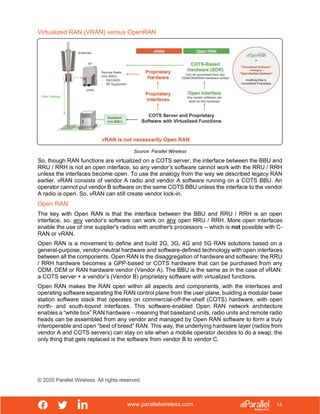
Next came Virtual RAN, or, vRAN. Does Virtual RAN equal Open RAN? Not exactly. With vRAN,
the proprietary radio hardware remains as it is, but the BBU gets replaced by a COTS server
rather than being proprietary BBU hardware. The software that runs on the BBU is virtualized to
run on any COTS server. But the proprietary interfaces between radios and COTS-based BBU
remain as they are.
www.parallelwireless.com
© 2020 Parallel Wireless. All rights reserved.
14
Virtualized RAN (VRAN) versus OpenRAN
Source: Parallel Wireless
So, though RAN functions are virtualized on a COTS server, the interface between the BBU and
RRU / RRH is not an open interface, so any vendor’s software cannot work with the RRU / RRH
unless the interfaces become open. To use the analogy from the way we described legacy RAN
earlier, vRAN consists of vendor A radio and vendor A software running on a COTS BBU. An
operator cannot put vendor B software on the same COTS BBU unless the interface to the vendor
A radio is open. So, vRAN can still create vendor lock-in.
Open RAN
The key with Open RAN is that the interface between the BBU and RRU / RRH is an open
interface, so, any vendor’s software can work on any open RRU / RRH. More open interfaces
enable the use of one supplier's radios with another's processors – which is not possible with C-
RAN or vRAN.
Open RAN is a movement to define and build 2G, 3G, 4G and 5G RAN solutions based on a
general-purpose, vendor-neutral hardware and software-defined technology with open interfaces
between all the components. Open RAN Is the disaggregation of hardware and software: the RRU
/ RRH hardware becomes a GPP-based or COTS hardware that can be purchased from any
ODM, OEM or RAN hardware vendor (Vendor A). The BBU is the same as in the case of vRAN:
a COTS server + a vendor’s (Vendor B) proprietary software with virtualized functions.
Open RAN makes the RAN open within all aspects and components, with the interfaces and
operating software separating the RAN control plane from the user plane, building a modular base
station software stack that operates on commercial-off-the-shelf (COTS) hardware, with open
north- and south-bound interfaces. This software-enabled Open RAN network architecture
enables a “white box” RAN hardware – meaning that baseband units, radio units and remote radio
heads can be assembled from any vendor and managed by Open RAN software to form a truly
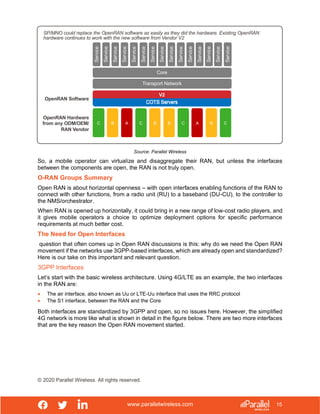
interoperable and open “best of breed” RAN. This way, the underlying hardware layer (radios from
vendor A and COTS servers) can stay on site when a mobile operator decides to do a swap; the
only thing that gets replaced is the software from vendor B to vendor C.
www.parallelwireless.com
© 2020 Parallel Wireless. All rights reserved.
15
Source: Parallel Wireless
So, a mobile operator can virtualize and disaggregate their RAN, but unless the interfaces
between the components are open, the RAN is not truly open.
O-RAN Groups Summary
Open RAN is about horizontal openness – with open interfaces enabling functions of the RAN to
connect with other functions, from a radio unit (RU) to a baseband (DU-CU), to the controller to
the NMS/orchestrator.
When RAN is opened up horizontally, it could bring in a new range of low-cost radio players, and
it gives mobile operators a choice to optimize deployment options for specific performance
requirements at much better cost.
The Need for Open Interfaces
question that often comes up in Open RAN discussions is this: why do we need the Open RAN
movement if the networks use 3GPP-based interfaces, which are already open and standardized?
Here is our take on this important and relevant question.
3GPP Interfaces
Let’s start with the basic wireless architecture. Using 4G/LTE as an example, the two interfaces
in the RAN are:
• The air interface, also known as Uu or LTE-Uu interface that uses the RRC protocol
• The S1 interface, between the RAN and the Core
Both interfaces are standardized by 3GPP and open, so no issues here. However, the simplified
4G network is more like what is shown in detail in the figure below. There are two more interfaces
that are the key reason the Open RAN movement started.
SP/MNO could replace the OpenRAN software as easily as they did the hardware. Existing OpenRAN
hardware continues to work with the new software from Vendor V2
OpenRAN Hardware
from any ODM/OEM/
RAN Vendor
C B A C B B C A B C
V2
Service
Service
Service
Service
Service
Service
Service
Service
Service
Service
Service
Service
Service
Service
Service
OpenRAN Software
Core
Transport Network
www.parallelwireless.com
© 2020 Parallel Wireless. All rights reserved.
16
Source: Parallel Wireless
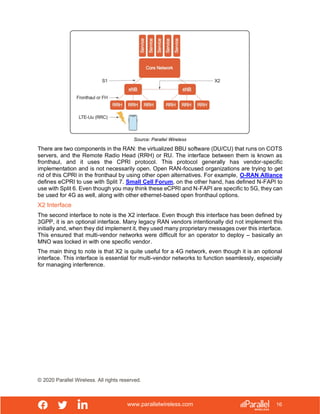
There are two components in the RAN: the virtualized BBU software (DU/CU) that runs on COTS
servers, and the Remote Radio Head (RRH) or RU. The interface between them is known as
fronthaul, and it uses the CPRI protocol. This protocol generally has vendor-specific
implementation and is not necessarily open. Open RAN-focused organizations are trying to get
rid of this CPRI in the fronthaul by using other open alternatives. For example, O-RAN Alliance
defines eCPRI to use with Split 7. Small Cell Forum, on the other hand, has defined N-FAPI to
use with Split 6. Even though you may think these eCPRI and N-FAPI are specific to 5G, they can
be used for 4G as well, along with other ethernet-based open fronthaul options.
X2 Interface
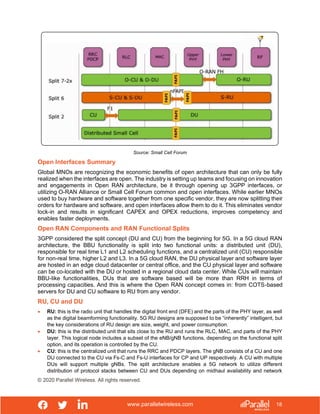
The second interface to note is the X2 interface. Even though this interface has been defined by
3GPP, it is an optional interface. Many legacy RAN vendors intentionally did not implement this
initially and, when they did implement it, they used many proprietary messages over this interface.
This ensured that multi-vendor networks were difficult for an operator to deploy – basically an
MNO was locked in with one specific vendor.
The main thing to note is that X2 is quite useful for a 4G network, even though it is an optional
interface. This interface is essential for multi-vendor networks to function seamlessly, especially
for managing interference.
www.parallelwireless.com
© 2020 Parallel Wireless. All rights reserved.
17
Source: Parallel Wireless
As you may be aware, all the 5G deployments today are 5G Non-Standalone (NSA) deployments.
People who are familiar with technical terminology also call this Option 3, 3A, 3X or by the 3GPP-
defined name, EN-DC. What this means in simple terms is that the 5G New Radio is used for the
access network, but it only works in conjunction with the 4G LTE access network and the 4G core,
also known as the EPC.
So, if the X2 interfaces are NOT open, then operators are forced to deploy 5G today using their
existing 4G LTE vendors, hence the lock-in continues into 5G as well. In some cases, the
operators have come up with innovative solutions where they have provided a new or existing
small chunk of 4G spectrum to the new 5G vendor to break this 4G dependency, but not every
operator has a spare chunk of spectrum available for these kinds of innovative solutions.
Open interfaces would be very helpful in such a scenario, and this is why the Open RAN
movement is still necessary even though we have well defined 3GPP interfaces for many different
connections, be it air interface or connecting to the core and to the outside word.
The Interface Options for MNOs to Create an Open RAN Network
Option one is to have their vendors open up interfaces between the RAN components like the
radio and the BBU/DU/CU software. The greatest example of this is Nokia in the Rakuten
deployment, when they opened up their radios to another vendor’s software. But there is no
guarantee that legacy vendors will continue to open up their radios to another vendors’ software.
This is where TIP comes in, by creating an ecosystem of hardware and software vendors, initiating
PlugFests and developing blueprints. TIP is not writing specs, but rather TIP is promoting,
educating and deploying OpenRAN globally, starting in Latin America (LATAM) in 2016, then with
Vodafone in Asia, Europe and the DRC.
The second option is to use O-RAN Alliance-defined interfaces.
Option three is specifically for small cells. Since the Small Cell Forum has enabled small cells to
be constructed piece-by-piece using components from different vendors, in order to easily
address the diverse mixture of 5G use cases, this will help network architects by allowing them to
mix distributed and central units from different vendors.
www.parallelwireless.com
© 2020 Parallel Wireless. All rights reserved.
18
Source: Small Cell Forum
Open Interfaces Summary
Global MNOs are recognizing the economic benefits of open architecture that can only be fully
realized when the interfaces are open. The industry is setting up teams and focusing on innovation
and engagements in Open RAN architecture, be it through opening up 3GPP interfaces, or
utilizing O-RAN Alliance or Small Cell Forum common and open interfaces. While earlier MNOs
used to buy hardware and software together from one specific vendor, they are now splitting their
orders for hardware and software, and open interfaces allow them to do it. This eliminates vendor
lock-in and results in significant CAPEX and OPEX reductions, improves competency and
enables faster deployments.
Open RAN Components and RAN Functional Splits
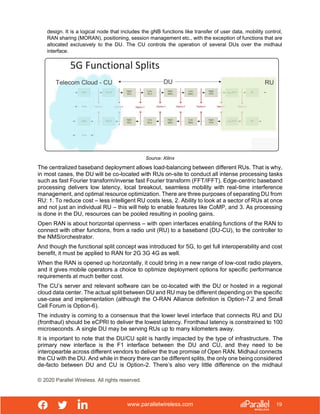
3GPP considered the split concept (DU and CU) from the beginning for 5G. In a 5G cloud RAN
architecture, the BBU functionality is split into two functional units: a distributed unit (DU),
responsible for real time L1 and L2 scheduling functions, and a centralized unit (CU) responsible
for non-real time, higher L2 and L3. In a 5G cloud RAN, the DU physical layer and software layer
are hosted in an edge cloud datacenter or central office, and the CU physical layer and software
can be co-located with the DU or hosted in a regional cloud data center. While CUs will maintain
BBU-like functionalities, DUs that are software based will be more than RRH in terms of
processing capacities. And this is where the Open RAN concept comes in: from COTS-based
servers for DU and CU software to RU from any vendor.
RU, CU and DU
• RU: this is the radio unit that handles the digital front end (DFE) and the parts of the PHY layer, as well
as the digital beamforming functionality. 5G RU designs are supposed to be “inherently” intelligent, but
the key considerations of RU design are size, weight, and power consumption.
• DU: this is the distributed unit that sits close to the RU and runs the RLC, MAC, and parts of the PHY
layer. This logical node includes a subset of the eNB/gNB functions, depending on the functional split
option, and its operation is controlled by the CU.
• CU: this is the centralized unit that runs the RRC and PDCP layers. The gNB consists of a CU and one
DU connected to the CU via Fs-C and Fs-U interfaces for CP and UP respectively. A CU with multiple
DUs will support multiple gNBs. The split architecture enables a 5G network to utilize different
distribution of protocol stacks between CU and DUs depending on midhaul availability and network
www.parallelwireless.com
© 2020 Parallel Wireless. All rights reserved.
19
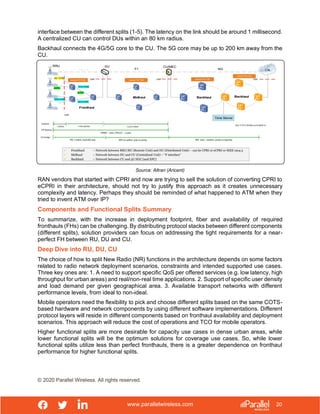
design. It is a logical node that includes the gNB functions like transfer of user data, mobility control,
RAN sharing (MORAN), positioning, session management etc., with the exception of functions that are
allocated exclusively to the DU. The CU controls the operation of several DUs over the midhaul
interface.
Source: Xilinx
The centralized baseband deployment allows load-balancing between different RUs. That is why,
in most cases, the DU will be co-located with RUs on-site to conduct all intense processing tasks
such as fast Fourier transform/inverse fast Fourier transform (FFT/IFFT). Edge-centric baseband
processing delivers low latency, local breakout, seamless mobility with real-time interference
management, and optimal resource optimization. There are three purposes of separating DU from
RU: 1. To reduce cost – less intelligent RU costs less, 2. Ability to look at a sector of RUs at once
and not just an individual RU – this will help to enable features like CoMP, and 3. As processing
is done in the DU, resources can be pooled resulting in pooling gains.
Open RAN is about horizontal openness – with open interfaces enabling functions of the RAN to
connect with other functions, from a radio unit (RU) to a baseband (DU-CU), to the controller to
the NMS/orchestrator.
And though the functional split concept was introduced for 5G, to get full interoperability and cost
benefit, it must be applied to RAN for 2G 3G 4G as well.
When the RAN is opened up horizontally, it could bring in a new range of low-cost radio players,
and it gives mobile operators a choice to optimize deployment options for specific performance
requirements at much better cost.
The CU’s server and relevant software can be co-located with the DU or hosted in a regional
cloud data center. The actual split between DU and RU may be different depending on the specific
use-case and implementation (although the O-RAN Alliance definition is Option-7.2 and Small
Cell Forum is Option-6).
The industry is coming to a consensus that the lower level interface that connects RU and DU
(fronthaul) should be eCPRI to deliver the lowest latency. Fronthaul latency is constrained to 100
microseconds. A single DU may be serving RUs up to many kilometers away.
It is important to note that the DU/CU split is hardly impacted by the type of infrastructure. The
primary new interface is the F1 interface between the DU and CU, and they need to be
interopearble across different vendors to deliver the true promise of Open RAN. Midhaul connects
the CU with the DU. And while in theory there can be different splits, the only one being considered
de-facto between DU and CU is Option-2. There’s also very little difference on the midhaul
www.parallelwireless.com
© 2020 Parallel Wireless. All rights reserved.
20
interface between the different splits (1-5). The latency on the link should be around 1 millisecond.
A centralized CU can control DUs within an 80 km radius.
Backhaul connects the 4G/5G core to the CU. The 5G core may be up to 200 km away from the
CU.
Source: Altran (Aricent)
RAN vendors that started with CPRI and now are trying to sell the solution of converting CPRI to
eCPRI in their architecture, should not try to justify this approach as it creates unnecessary
complexity and latency. Perhaps they should be reminded of what happened to ATM when they
tried to invent ATM over IP?
Components and Functional Splits Summary
To summarize, with the increase in deployment footprint, fiber and availability of required
fronthauls (FHs) can be challenging. By distributing protocol stacks between different components
(different splits), solution providers can focus on addressing the tight requirements for a near-
perfect FH between RU, DU and CU.
Deep Dive into RU, DU, CU
The choice of how to split New Radio (NR) functions in the architecture depends on some factors
related to radio network deployment scenarios, constraints and intended supported use cases.
Three key ones are: 1. A need to support specific QoS per offered services (e.g. low latency, high
throughput for urban areas) and real/non-real time applications. 2. Support of specific user density
and load demand per given geographical area. 3. Available transport networks with different
performance levels, from ideal to non-ideal.
Mobile operators need the flexibility to pick and choose different splits based on the same COTS-
based hardware and network components by using different software implementations. Different
protocol layers will reside in different components based on fronthaul availability and deployment
scenarios. This approach will reduce the cost of operations and TCO for mobile operators.
Higher functional splits are more desirable for capacity use cases in dense urban areas, while
lower functional splits will be the optimum solutions for coverage use cases. So, while lower
functional splits utilize less than perfect fronthauls, there is a greater dependence on fronthaul
performance for higher functional splits.
www.parallelwireless.com
© 2020 Parallel Wireless. All rights reserved.
21
Source: Parallel Wireless
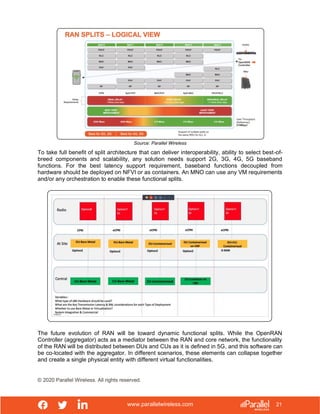
To take full benefit of split architecture that can deliver interoperability, ability to select best-of-
breed components and scalability, any solution needs support 2G, 3G, 4G, 5G baseband
functions. For the best latency support requirement, baseband functions decoupled from
hardware should be deployed on NFVI or as containers. An MNO can use any VM requirements
and/or any orchestration to enable these functional splits.
The future evolution of RAN will be toward dynamic functional splits. While the OpenRAN
Controller (aggregator) acts as a mediator between the RAN and core network, the functionality
of the RAN will be distributed between DUs and CUs as it is defined in 5G, and this software can
be co-located with the aggregator. In different scenarios, these elements can collapse together
and create a single physical entity with different virtual functionalities.
www.parallelwireless.com
© 2020 Parallel Wireless. All rights reserved.
22
Different RAN functional splits work for different use cases. One split might not fit it all. A solution
that can support many technologies including not just 4G and 5G, but also 2G and 3G, is the most
attractive to MNOs as it will simplify network management and the overall TCO.
RAN Functional Split 6
The Small Cell Forum (SCF) nFAPI (network FAPI) interface in split 6 is enabling the Open RAN
ecosystem in its own way by allowing any small cell CU/DU to connect to any small cell radio unit
or S-RU. With 5G FAPI, competition and innovation are encouraged among suppliers of small cell
platform hardware, platform software and application software by providing a common API around
which suppliers of each component can compete. These interfaces will help network architects
by allowing them to mix distributed and central units from different vendors. By doing this, SCF
provides an interchangeability of parts ensuring the system vendors can take advantage of the
latest innovations in silicon and software with minimum barriers to entry, and the least amount of
custom re-engineering.
RAN Functional Split 7
In case of requirements for more delay-sensitive service, based on appropriate fronthaul
availability, the MAC-PHY split will be the preferred solution. Option 7 Split architecture is where
the DU handles the RRC/PDCP/RLC/MAC and higher PHY functions, whereas the RU handles
the lower PHY and RF functions. CU functionality may be embedded with the DU on the same
server, or it can be pushed up the network as a virtualized aggregation entity, along with an Open
RAN Controller or aggregator. Option 7 allows operators to take advantage of sharing or pooling
gains while maintaining the lowest processing utilizations on both the DU and RU – leading to a
very cost-effective solution with a low TCO and an ideal option for a distributed RAN deployment,
including Massive MIMOs.
Source: Parallel Wireless
For 5G, this is still being discussed as a potentially valid option in some use cases. Higher splits,
as in 7.x, will be the best approach going forward for deploying future mobile networks in different
deployment scenarios. It is ideal for 4G and 5G and can support traffic in dense urban areas.
www.parallelwireless.com
© 2020 Parallel Wireless. All rights reserved.
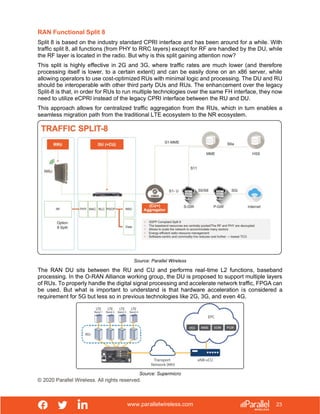
23
RAN Functional Split 8
Split 8 is based on the industry standard CPRI interface and has been around for a while. With
traffic split 8, all functions (from PHY to RRC layers) except for RF are handled by the DU, while
the RF layer is located in the radio. But why is this split gaining attention now?
This split is highly effective in 2G and 3G, where traffic rates are much lower (and therefore
processing itself is lower, to a certain extent) and can be easily done on an x86 server, while
allowing operators to use cost-optimized RUs with minimal logic and processing. The DU and RU
should be interoperable with other third party DUs and RUs. The enhancement over the legacy
Split-8 is that, in order for RUs to run multiple technologies over the same FH interface, they now
need to utilize eCPRI instead of the legacy CPRI interface between the RU and DU.
This approach allows for centralized traffic aggregation from the RUs, which in turn enables a
seamless migration path from the traditional LTE ecosystem to the NR ecosystem.
Source: Parallel Wireless
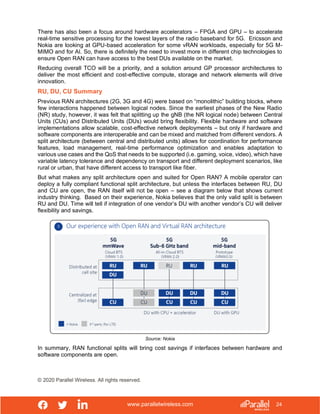
The RAN DU sits between the RU and CU and performs real-time L2 functions, baseband
processing. In the O-RAN Alliance working group, the DU is proposed to support multiple layers
of RUs. To properly handle the digital signal processing and accelerate network traffic, FPGA can
be used. But what is important to understand is that hardware acceleration is considered a
requirement for 5G but less so in previous technologies like 2G, 3G, and even 4G.
Source: Supermicro
www.parallelwireless.com
© 2020 Parallel Wireless. All rights reserved.
24
There has also been a focus around hardware accelerators – FPGA and GPU – to accelerate
real-time sensitive processing for the lowest layers of the radio baseband for 5G. Ericsson and
Nokia are looking at GPU-based acceleration for some vRAN workloads, especially for 5G M-
MIMO and for AI. So, there is definitely the need to invest more in different chip technologies to
ensure Open RAN can have access to the best DUs available on the market.
Reducing overall TCO will be a priority, and a solution around GP processor architectures to
deliver the most efficient and cost-effective compute, storage and network elements will drive
innovation.
RU, DU, CU Summary
Previous RAN architectures (2G, 3G and 4G) were based on “monolithic” building blocks, where
few interactions happened between logical nodes. Since the earliest phases of the New Radio
(NR) study, however, it was felt that splitting up the gNB (the NR logical node) between Central
Units (CUs) and Distributed Units (DUs) would bring flexibility. Flexible hardware and software
implementations allow scalable, cost-effective network deployments – but only if hardware and
software components are interoperable and can be mixed and matched from different vendors. A
split architecture (between central and distributed units) allows for coordination for performance
features, load management, real-time performance optimization and enables adaptation to
various use cases and the QoS that needs to be supported (i.e. gaming, voice, video), which have
variable latency tolerance and dependency on transport and different deployment scenarios, like
rural or urban, that have different access to transport like fiber.
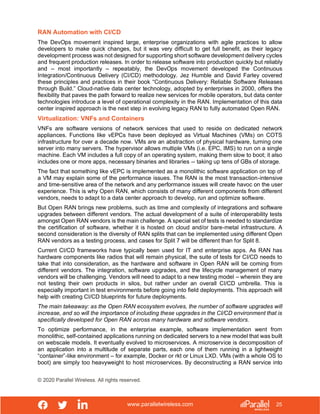
But what makes any split architecture open and suited for Open RAN? A mobile operator can
deploy a fully compliant functional split architecture, but unless the interfaces between RU, DU
and CU are open, the RAN itself will not be open – see a diagram below that shows current
industry thinking. Based on their experience, Nokia believes that the only valid split is between
RU and DU. Time will tell if integration of one vendor’s DU with another vendor’s CU will deliver
flexibility and savings.
Source: Nokia
In summary, RAN functional splits will bring cost savings if interfaces between hardware and
software components are open.
www.parallelwireless.com
© 2020 Parallel Wireless. All rights reserved.
25
RAN Automation with CI/CD
The DevOps movement inspired large, enterprise organizations with agile practices to allow
developers to make quick changes, but it was very difficult to get full benefit, as their legacy
development process was not designed for supporting short software development delivery cycles
and frequent production releases. In order to release software into production quickly but reliably
and – most importantly – repeatably, the DevOps movement developed the Continuous
Integration/Continuous Delivery (CI/CD) methodology. Jez Humble and David Farley covered
these principles and practices in their book “Continuous Delivery: Reliable Software Releases
through Build.” Cloud-native data center technology, adopted by enterprises in 2000, offers the
flexibility that paves the path forward to realize new services for mobile operators, but data center
technologies introduce a level of operational complexity in the RAN. Implementation of this data
center inspired approach is the next step in evolving legacy RAN to fully automated Open RAN.
Virtualization: VNFs and Containers
VNFs are software versions of network services that used to reside on dedicated network
appliances. Functions like vEPCs have been deployed as Virtual Machines (VMs) on COTS
infrastructure for over a decade now. VMs are an abstraction of physical hardware, turning one
server into many servers. The hypervisor allows multiple VMs (i.e. EPC, IMS) to run on a single
machine. Each VM includes a full copy of an operating system, making them slow to boot; it also
includes one or more apps, necessary binaries and libraries -- taking up tens of GBs of storage.
The fact that something like vEPC is implemented as a monolithic software application on top of
a VM may explain some of the performance issues. The RAN is the most transaction-intensive
and time-sensitive area of the network and any performance issues will create havoc on the user
experience. This is why Open RAN, which consists of many different components from different
vendors, needs to adapt to a data center approach to develop, run and optimize software.
But Open RAN brings new problems, such as time and complexity of integrations and software
upgrades between different vendors. The actual development of a suite of interoperability tests
amongst Open RAN vendors is the main challenge. A special set of tests is needed to standardize
the certification of software, whether it is hosted on cloud and/or bare-metal infrastructure. A
second consideration is the diversity of RAN splits that can be implemented using different Open
RAN vendors as a testing process, and cases for Split 7 will be different than for Split 8.
Current CI/CD frameworks have typically been used for IT and enterprise apps. As RAN has
hardware components like radios that will remain physical, the suite of tests for CI/CD needs to
take that into consideration, as the hardware and software in Open RAN will be coming from
different vendors. The integration, software upgrades, and the lifecycle management of many
vendors will be challenging. Vendors will need to adapt to a new testing model – wherein they are
not testing their own products in silos, but rather under an overall CI/CD umbrella. This is
especially important in test environments before going into field deployments. This approach will
help with creating CI/CD blueprints for future deployments.
The main takeaway: as the Open RAN ecosystem evolves, the number of software upgrades will
increase, and so will the importance of including these upgrades in the CI/CD environment that is
specifically developed for Open RAN across many hardware and software vendors.
To optimize performance, in the enterprise example, software implementation went from
monolithic, self-contained applications running on dedicated servers to a new model that was built
on webscale models. It eventually evolved to microservices. A microservice is decomposition of
an application into a multitude of separate parts, each one of them running in a lightweight
“container”-like environment – for example, Docker or rkt or Linux LXD. VMs (with a whole OS to
boot) are simply too heavyweight to host microservices. By deconstructing a RAN service into
www.parallelwireless.com
© 2020 Parallel Wireless. All rights reserved.
26
microservices, it’s easy to address any performance issue by spinning up multiple instances of
the RAN microservice that might be creating a performance issue.
Open RAN software doesn’t have to be just *one* big monolithic service like a vEPC, as different
RAN function components can be implemented as separate microservices and can be scaled up
in any way required to optimize the RAN function’s performance.
A microservices architecture also has several other very important benefits. One of them is the
ability to continuously innovate by embracing an agile DevOps model. A mobile operator can push
out any RAN upgrades without taking down the entire site or sites, as testing a microservice
involves a very few test cases; testing an entire monolithic (though virtualized) application takes
many days of testing.
Source: Parallel Wireless
CI/CD Overview
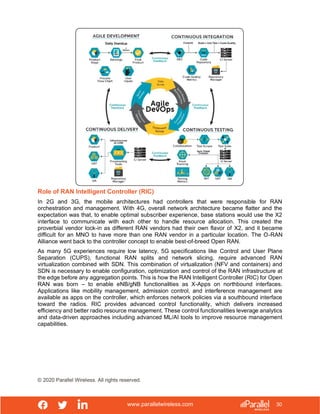
Implementing the following four data center principles will help make Open RAN be responsive
and high performing. Principle 1 ensures that each RAN function component is deployed as a
microservice. Principle 2 advocates for a very responsive container environment that should be
used and not legacy-based infrastructure. Principle 3 promotes a DevOps method to be adopted
for the software to be delivered frequently. And lastly, Principle 4 highlights that using CI/CD is
key for automation: 1000 sites can be upgraded whenever desired.
Each microservice can be deployed, upgraded, scaled, and restarted independently of other
microservices in the RAN application, using an automated system, enabling frequent updates to
live applications without impacting end-user experience. Under the hood, a microservice is hosted
in a container and exposing APIs to access the service it offers. A particular microservice runs in
a container. Then Kubernetes orchestrates the dynamic instantiation of several of those
containers in pods, according to performance, resilience and security requirements.
A container image is a lightweight, standalone, executable package of a piece of software that
includes everything needed to run it: code, runtime, system tools, system libraries, environment.
These capabilities are key for the ever-changing RAN environment. Multiple containers can run
on the same machine and share the OS kernel with other containers. Containers take up less
space than VMs (container images are typically tens of MBs in size), and containers can start
almost instantly. Containers offer both efficiency and speed compared with standard virtual
machines. Using operating system level virtualization, a single OS instance is dynamically divided
among one or more isolated containers, each with a unique writable file system and resource
quota.
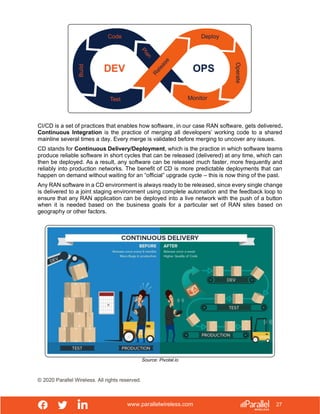
DevOps is a set of practices developed for IT that combines software development (Dev) and
information-technology operations (Ops) which aims to shorten the systems development
lifecycle and provide continuous delivery with high software quality.
www.parallelwireless.com
© 2020 Parallel Wireless. All rights reserved.
27
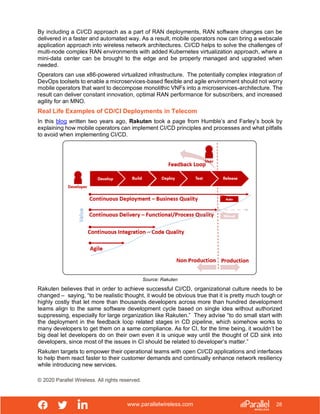
CI/CD is a set of practices that enables how software, in our case RAN software, gets delivered.
Continuous Integration is the practice of merging all developers’ working code to a shared
mainline several times a day. Every merge is validated before merging to uncover any issues.
CD stands for Continuous Delivery/Deployment, which is the practice in which software teams
produce reliable software in short cycles that can be released (delivered) at any time, which can
then be deployed. As a result, any software can be released much faster, more frequently and
reliably into production networks. The benefit of CD is more predictable deployments that can
happen on demand without waiting for an “official” upgrade cycle – this is now thing of the past.
Any RAN software in a CD environment is always ready to be released, since every single change
is delivered to a joint staging environment using complete automation and the feedback loop to
ensure that any RAN application can be deployed into a live network with the push of a button
when it is needed based on the business goals for a particular set of RAN sites based on
geography or other factors.
Source: Pivotal.io
www.parallelwireless.com
© 2020 Parallel Wireless. All rights reserved.
28
By including a CI/CD approach as a part of RAN deployments, RAN software changes can be
delivered in a faster and automated way. As a result, mobile operators now can bring a webscale
application approach into wireless network architectures. CI/CD helps to solve the challenges of
multi-node complex RAN environments with added Kubernetes virtualization approach, where a
mini-data center can be brought to the edge and be properly managed and upgraded when
needed.
Operators can use x86-powered virtualized infrastructure. The potentially complex integration of
DevOps toolsets to enable a microservices-based flexible and agile environment should not worry
mobile operators that want to decompose monolithic VNFs into a microservices-architecture. The
result can deliver constant innovation, optimal RAN performance for subscribers, and increased
agility for an MNO.
Real Life Examples of CD/CI Deployments in Telecom
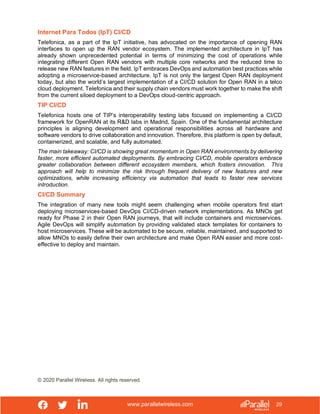
In this blog written two years ago, Rakuten took a page from Humble’s and Farley’s book by
explaining how mobile operators can implement CI/CD principles and processes and what pitfalls
to avoid when implementing CI/CD.
Source: Rakuten
Rakuten believes that in order to achieve successful CI/CD, organizational culture needs to be
changed – saying, “to be realistic thought, it would be obvious true that it is pretty much tough or
highly costly that let more than thousands developers across more than hundred development
teams align to the same software development cycle based on single idea without authorized
suppressing, especially for large organization like Rakuten.” They advise “to do small start with
the deployment in the feedback loop related stages in CD pipeline, which somehow works to
many developers to get them on a same compliance. As for CI, for the time being, it wouldn’t be
big deal let developers do on their own even it is unique way until the thought of CD sink into
developers, since most of the issues in CI should be related to developer’s matter.”
Rakuten targets to empower their operational teams with open CI/CD applications and interfaces
to help them react faster to their customer demands and continually enhance network resiliency
while introducing new services.
www.parallelwireless.com
© 2020 Parallel Wireless. All rights reserved.
29
Internet Para Todos (IpT) CI/CD
Telefonica, as a part of the IpT initiative, has advocated on the importance of opening RAN
interfaces to open up the RAN vendor ecosystem. The implemented architecture in IpT has
already shown unprecedented potential in terms of minimizing the cost of operations while
integrating different Open RAN vendors with multiple core networks and the reduced time to
release new RAN features in the field. IpT embraces DevOps and automation best practices while
adopting a microservice-based architecture. IpT is not only the largest Open RAN deployment
today, but also the world’s largest implementation of a CI/CD solution for Open RAN in a telco
cloud deployment. Telefonica and their supply chain vendors must work together to make the shift
from the current siloed deployment to a DevOps cloud-centric approach.
TIP CI/CD
Telefonica hosts one of TIP’s interoperability testing labs focused on implementing a CI/CD
framework for OpenRAN at its R&D labs in Madrid, Spain. One of the fundamental architecture
principles is aligning development and operational responsibilities across all hardware and
software vendors to drive collaboration and innovation. Therefore, this platform is open by default,
containerized, and scalable, and fully automated.
The main takeaway: CI/CD is showing great momentum in Open RAN environments by delivering
faster, more efficient automated deployments. By embracing CI/CD, mobile operators embrace
greater collaboration between different ecosystem members, which fosters innovation. This
approach will help to minimize the risk through frequent delivery of new features and new
optimizations, while increasing efficiency via automation that leads to faster new services
introduction.
CI/CD Summary
The integration of many new tools might seem challenging when mobile operators first start
deploying microservices-based DevOps CI/CD-driven network implementations. As MNOs get
ready for Phase 2 in their Open RAN journeys, that will include containers and microservices.
Agile DevOps will simplify automation by providing validated stack templates for containers to
host microservices. These will be automated to be secure, reliable, maintained, and supported to
allow MNOs to easily define their own architecture and make Open RAN easier and more cost-
effective to deploy and maintain.
www.parallelwireless.com
© 2020 Parallel Wireless. All rights reserved.
30
Role of RAN Intelligent Controller (RIC)
In 2G and 3G, the mobile architectures had controllers that were responsible for RAN
orchestration and management. With 4G, overall network architecture became flatter and the
expectation was that, to enable optimal subscriber experience, base stations would use the X2
interface to communicate with each other to handle resource allocation. This created the
proverbial vendor lock-in as different RAN vendors had their own flavor of X2, and it became
difficult for an MNO to have more than one RAN vendor in a particular location. The O-RAN
Alliance went back to the controller concept to enable best-of-breed Open RAN.
As many 5G experiences require low latency, 5G specifications like Control and User Plane
Separation (CUPS), functional RAN splits and network slicing, require advanced RAN
virtualization combined with SDN. This combination of virtualization (NFV and containers) and
SDN is necessary to enable configuration, optimization and control of the RAN infrastructure at
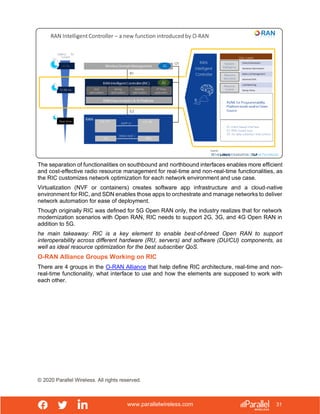
the edge before any aggregation points. This is how the RAN Intelligent Controller (RIC) for Open
RAN was born – to enable eNB/gNB functionalities as X-Apps on northbound interfaces.
Applications like mobility management, admission control, and interference management are
available as apps on the controller, which enforces network policies via a southbound interface
toward the radios. RIC provides advanced control functionality, which delivers increased
efficiency and better radio resource management. These control functionalities leverage analytics
and data-driven approaches including advanced ML/AI tools to improve resource management
capabilities.
www.parallelwireless.com
© 2020 Parallel Wireless. All rights reserved.
31
The separation of functionalities on southbound and northbound interfaces enables more efficient
and cost-effective radio resource management for real-time and non-real-time functionalities, as
the RIC customizes network optimization for each network environment and use case.
Virtualization (NVF or containers) creates software app infrastructure and a cloud-native
environment for RIC, and SDN enables those apps to orchestrate and manage networks to deliver
network automation for ease of deployment.
Though originally RIC was defined for 5G Open RAN only, the industry realizes that for network
modernization scenarios with Open RAN, RIC needs to support 2G, 3G, and 4G Open RAN in
addition to 5G.
he main takeaway: RIC is a key element to enable best-of-breed Open RAN to support
interoperability across different hardware (RU, servers) and software (DU/CU) components, as
well as ideal resource optimization for the best subscriber QoS.
O-RAN Alliance Groups Working on RIC
There are 4 groups in the O-RAN Alliance that help define RIC architecture, real-time and non-
real-time functionality, what interface to use and how the elements are supposed to work with
each other.
www.parallelwireless.com
© 2020 Parallel Wireless. All rights reserved.
32
Source: O-RAN Alliance
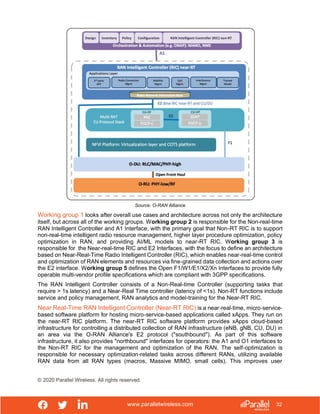
Working group 1 looks after overall use cases and architecture across not only the architecture
itself, but across all of the working groups. Working group 2 is responsible for the Non-real-time
RAN Intelligent Controller and A1 Interface, with the primary goal that Non-RT RIC is to support
non-real-time intelligent radio resource management, higher layer procedure optimization, policy
optimization in RAN, and providing AI/ML models to near-RT RIC. Working group 3 is
responsible for the Near-real-time RIC and E2 Interfaces, with the focus to define an architecture
based on Near-Real-Time Radio Intelligent Controller (RIC), which enables near-real-time control
and optimization of RAN elements and resources via fine-grained data collection and actions over
the E2 interface. Working group 5 defines the Open F1/W1/E1/X2/Xn Interfaces to provide fully
operable multi-vendor profile specifications which are compliant with 3GPP specifications.
The RAN Intelligent Controller consists of a Non-Real-time Controller (supporting tasks that
require > 1s latency) and a Near-Real Time controller (latency of <1s). Non-RT functions include
service and policy management, RAN analytics and model-training for the Near-RT RIC.
Near Real-Time RAN Intelligent Controller (Near-RT RIC) is a near‐real‐time, micro‐service‐
based software platform for hosting micro-service-based applications called xApps. They run on
the near-RT RIC platform. The near-RT RIC software platform provides xApps cloud-based
infrastructure for controlling a distributed collection of RAN infrastructure (eNB, gNB, CU, DU) in
an area via the O-RAN Alliance's E2 protocol ("southbound"). As part of this software
infrastructure, it also provides "northbound" interfaces for operators: the A1 and O1 interfaces to
the Non-RT RIC for the management and optimization of the RAN. The self-optimization is
responsible for necessary optimization-related tasks across different RANs, utilizing available
RAN data from all RAN types (macros, Massive MIMO, small cells). This improves user
www.parallelwireless.com
© 2020 Parallel Wireless. All rights reserved.
33
experience and increases network resource utilization, key for consistent experience on data-
intensive 5G networks.
Source: O-RAN Alliance
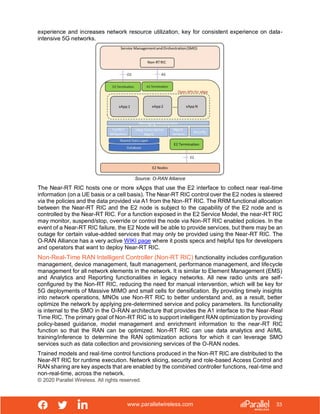
The Near-RT RIC hosts one or more xApps that use the E2 interface to collect near real-time
information (on a UE basis or a cell basis). The Near-RT RIC control over the E2 nodes is steered
via the policies and the data provided via A1 from the Non-RT RIC. The RRM functional allocation
between the Near-RT RIC and the E2 node is subject to the capability of the E2 node and is
controlled by the Near-RT RIC. For a function exposed in the E2 Service Model, the near-RT RIC
may monitor, suspend/stop, override or control the node via Non-RT RIC enabled policies. In the
event of a Near-RT RIC failure, the E2 Node will be able to provide services, but there may be an
outage for certain value-added services that may only be provided using the Near-RT RIC. The
O-RAN Alliance has a very active WIKI page where it posts specs and helpful tips for developers
and operators that want to deploy Near-RT RIC.
Non-Real-Time RAN Intelligent Controller (Non-RT RIC) functionality includes configuration
management, device management, fault management, performance management, and lifecycle
management for all network elements in the network. It is similar to Element Management (EMS)
and Analytics and Reporting functionalities in legacy networks. All new radio units are self-
configured by the Non-RT RIC, reducing the need for manual intervention, which will be key for
5G deployments of Massive MIMO and small cells for densification. By providing timely insights
into network operations, MNOs use Non-RT RIC to better understand and, as a result, better
optimize the network by applying pre-determined service and policy parameters. Its functionality
is internal to the SMO in the O-RAN architecture that provides the A1 interface to the Near-Real
Time RIC. The primary goal of Non-RT RIC is to support intelligent RAN optimization by providing
policy-based guidance, model management and enrichment information to the near-RT RIC
function so that the RAN can be optimized. Non-RT RIC can use data analytics and AI/ML
training/inference to determine the RAN optimization actions for which it can leverage SMO
services such as data collection and provisioning services of the O-RAN nodes.
Trained models and real-time control functions produced in the Non-RT RIC are distributed to the
Near-RT RIC for runtime execution. Network slicing, security and role-based Access Control and
RAN sharing are key aspects that are enabled by the combined controller functions, real-time and
non-real-time, across the network.
www.parallelwireless.com
© 2020 Parallel Wireless. All rights reserved.
34
To summarize, the Near-RT RIC is responsible for creating a software platform for a set of xApps
for the RAN; non-RT RIC provides configuration, management and analytics functionality. For
Open RAN deployments to be successful, both functions need to work together.
RIC Overview
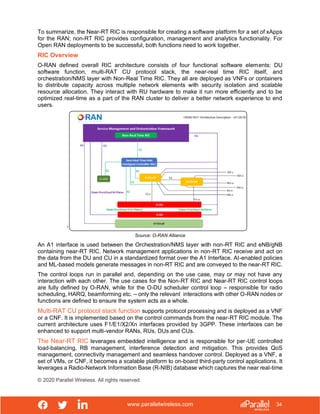
O-RAN defined overall RIC architecture consists of four functional software elements: DU
software function, multi-RAT CU protocol stack, the near-real time RIC itself, and
orchestration/NMS layer with Non-Real Time RIC. They all are deployed as VNFs or containers
to distribute capacity across multiple network elements with security isolation and scalable
resource allocation. They interact with RU hardware to make it run more efficiently and to be
optimized real-time as a part of the RAN cluster to deliver a better network experience to end
users.
Source: O-RAN Alliance
An A1 interface is used between the Orchestration/NMS layer with non-RT RIC and eNB/gNB
containing near-RT RIC. Network management applications in non-RT RIC receive and act on
the data from the DU and CU in a standardized format over the A1 Interface. AI-enabled policies
and ML-based models generate messages in non-RT RIC and are conveyed to the near-RT RIC.
The control loops run in parallel and, depending on the use case, may or may not have any
interaction with each other. The use cases for the Non-RT RIC and Near-RT RIC control loops
are fully defined by O-RAN, while for the O-DU scheduler control loop – responsible for radio
scheduling, HARQ, beamforming etc. – only the relevant interactions with other O-RAN nodes or
functions are defined to ensure the system acts as a whole.
Multi-RAT CU protocol stack function supports protocol processing and is deployed as a VNF
or a CNF. It is implemented based on the control commands from the near-RT RIC module. The
current architecture uses F1/E1/X2/Xn interfaces provided by 3GPP. These interfaces can be
enhanced to support multi-vendor RANs, RUs, DUs and CUs.
The Near-RT RIC leverages embedded intelligence and is responsible for per-UE controlled
load-balancing, RB management, interference detection and mitigation. This provides QoS
management, connectivity management and seamless handover control. Deployed as a VNF, a
set of VMs, or CNF, it becomes a scalable platform to on-board third-party control applications. It
leverages a Radio-Network Information Base (R-NIB) database which captures the near real-time
www.parallelwireless.com
© 2020 Parallel Wireless. All rights reserved.
35
state of the underlying network and feeds RAN data to train the AI/ML models, which are then fed
to the Near-RT RIC to facilitate radio resource management for subscribers. Near-RT RIC
interacts with Non-RT RIC via the A1 interface to receive the trained models and execute them to
improve the network conditions.
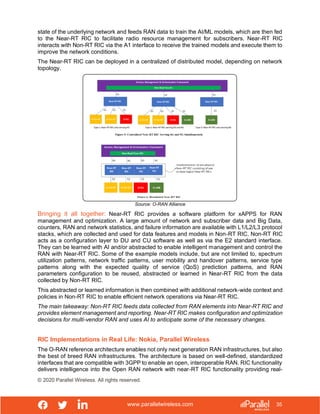
The Near-RT RIC can be deployed in a centralized of distributed model, depending on network
topology.
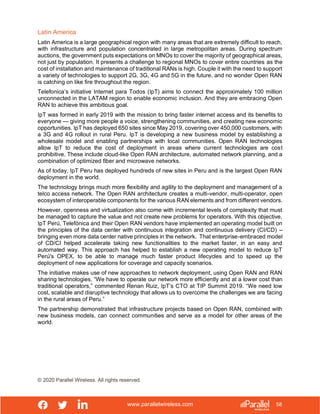
Source: O-RAN Alliance
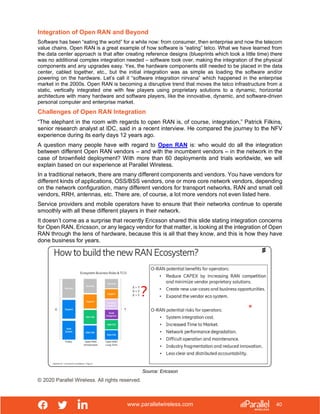
Bringing it all together: Near-RT RIC provides a software platform for xAPPS for RAN
management and optimization. A large amount of network and subscriber data and Big Data,
counters, RAN and network statistics, and failure information are available with L1/L2/L3 protocol
stacks, which are collected and used for data features and models in Non-RT RIC. Non-RT RIC
acts as a configuration layer to DU and CU software as well as via the E2 standard interface.
They can be learned with AI and/or abstracted to enable intelligent management and control the
RAN with Near-RT RIC. Some of the example models include, but are not limited to, spectrum
utilization patterns, network traffic patterns, user mobility and handover patterns, service type
patterns along with the expected quality of service (QoS) prediction patterns, and RAN
parameters configuration to be reused, abstracted or learned in Near-RT RIC from the data
collected by Non-RT RIC.
This abstracted or learned information is then combined with additional network-wide context and
policies in Non-RT RIC to enable efficient network operations via Near-RT RIC.
The main takeaway: Non-RT RIC feeds data collected from RAN elements into Near-RT RIC and
provides element management and reporting. Near-RT RIC makes configuration and optimization
decisions for multi-vendor RAN and uses AI to anticipate some of the necessary changes.
RIC Implementations in Real Life: Nokia, Parallel Wireless
The O-RAN reference architecture enables not only next generation RAN infrastructures, but also
the best of breed RAN infrastructures. The architecture is based on well-defined, standardized
interfaces that are compatible with 3GPP to enable an open, interoperable RAN. RIC functionality
delivers intelligence into the Open RAN network with near-RT RIC functionality providing real-
www.parallelwireless.com
© 2020 Parallel Wireless. All rights reserved.
36
time optimization for mobility and handover management, and non-RT RIC providing not only
visibility into the network, but also AI-based feeds and recommendations to near-RT RIC, working
together to deliver optimal network performance for optimal subscriber experience.
Recently, ATT and Nokia tested the RAN E2 interface and xApp management and control,
collected live network data using the Measurement Campaign xApp, neighbor relation
management using the Automated Neighbor Relation (ANR) xApp, and tested RAN control via
the Admission Control xApp – all over the live commercial network.
Source: Nokia
AT&T and Nokia ran a series of xApps at the edge of AT&T’s live 5G mmWave network on an
Akraino-based Open Cloud Platform. The xApps used in the trial were designed to improve
spectrum efficiency, as well as offer geographical and use case-based customization and rapid
feature onboarding in the RAN.
AT&T and Nokia are planning to officially release the RIC into open source, so that other
companies and developers can help develop the RIC code.
Parallel Wireless is another vendor that has developed RIC, near-RT and non-RT. What makes
their approach different is that the controller works not only for 5G, but also for legacy Gs: 2G,
3G, and 4G. Their xApps or microservices are virtualized functions of BSC for 2G, RNC for 3G,
x2 gateway for 4G among others.
www.parallelwireless.com
© 2020 Parallel Wireless. All rights reserved.
37
Source: Parallel Wireless
As a result of having 2G, 3G, 4G, and 5G related xApps, 5G-like features can be delivered today
to 2G, 3G, and 4G networks utilizing this RIC including: 1. Ultra-low latency and high reliability for
coverage or capacity use cases. 2. Ultra-high throughput for consumer applications such as real-
time gaming. 3. Scaling from millions to billions of transactions, with voice and data handling that
seamlessly scales up from gigabytes to petabytes in real-time, with consistent end-user
experience for all types of traffic. The solution is a pre-standard near real-time RAN Intelligent
Controller (RIC) and will adapt O-RAN open interfaces with the required enhancements and can
be upgraded to them via a software upgrade. This will enable real-time radio resource
management capabilities to be delivered as applications on the platform.
In early August of 2020, Intel and VMware announced that that they will work with an ecosystem
of telecom equipment manufacturers, original equipment manufacturers and RAN software
vendors build programmable open interfaces that leverage Intel’s FlexRAN software reference
architecture and a VMware RAN Intelligent Controller (RIC), to enable development of innovative
radio network functions using AI/ML learning for real time resource management, traffic steering
and dynamic slicing. Both companies believe that this will assist in optimized QoE for rollout of
new 5G vertical use cases. In a statement associated with the Intel/VMware announcement,
Vodafone Group’s Yago Tenorio, head of network architecture, said, “Seeing VMware and Intel
work together to enhance the performance of general purpose computing platforms to run
uncompromised RAN workflows, and to help simplify the complexities of product integration, has
the potential to ensure Open RAN matures more quickly. It is also an enabler for faster
developments in the [RIC] area. This move is central to the Vodafone initial Open RAN vision of
partners that excel in our area, as well as benefit the wider community.”
At the end of August 2020, the Open Networking Foundation (ONF) has introduced a Software
Defined Radio Access Network (SD-RAN) project, supported by AT&T, China Mobile, China
Unicom, Deutsche Telekom and NTT, to develop, as an initial focus, an open source Near Real-
Time RAN Intelligent Controller (nRT-RIC) that is compatible with the O-RAN architecture.
Named µONOS-RIC, it is a microservices-based SDN controller based on a version of ONOS
(Open Network Operating System), the ONF’s SDN controller that is already being deployed
globally: i.e. Comcast’s next-gen access network and SK Telecom’s 5G core.
The µONOS-RIC is supposed to conform to O-RAN Alliance architectures, with the E2 interface
used between the µONOS-RIC and multivendor RAN elements (RU/DU/CU). This will eventually
www.parallelwireless.com
© 2020 Parallel Wireless. All rights reserved.
38
pull out all the SON and resource management from the RAN where it used to sit in the legacy
RAN to xApps in the new, O-RAN based RIC architecture.
Google is involved in this project and plans to provide the cloud platform on which functionality
such as the open NRT-RIC and xApps might potentially run. In addition, Intel and Facebook are
providing the underlying technology to be used for the project’s developments to have it ready for
trial in 2021.
Ericsson, as part of a blog released in August, indicated that the programmability of RAN can be
done both within the framework of 3GPP and within the complementary specifications of O-RAN.
Ericsson only sees value of the NRT RIC, which sits higher up in the network technology stack
and takes an overall view of the network and hereby “can access a larger pool of RAN data as
well as external data sources such as weather, traffic, first responder events etc. to provide policy
guidance to RAN on radio resource allocation and the 1 second control loop is short enough to
capture almost all possible use-cases.” Ericsson doesn’t think that the O-RAN extensions to
existing 3GPP radio control and optimization protocols are necessary and believes that they
overlap considerably with functionality that Ericsson already delivers. Hence, they currently focus
its R&D efforts on the Non-RT RIC, as opposed to the Near-RT RIC.
In September 2020, Samsung and KDDI demonstrated network slicing involving a RIC to
manage radio resources to guarantee required service levels. The companies managed network
slicing on a network using Samsung’s virtualized core, RAN, and orchestration.
Source: Samsung
Moving to Open RAN helps create a more innovative and cost-effective RAN environment, based
on cloud economics. RIC is an essential component for delivering apps and services over a
wireless network.
www.parallelwireless.com
© 2020 Parallel Wireless. All rights reserved.
39
RIC Platform Summary
The RIC platform provides a set of functions via xApps and using pre-defined interfaces that allow
for increased optimizations in Near-RT RIC through policy-driven, closed loop automation, which
leads to faster and more flexible service deployments and programmability within the RAN. It also
helps strengthen a multi-vendor open ecosystem of interoperable components for a
disaggregated and truly open RAN.
www.parallelwireless.com
© 2020 Parallel Wireless. All rights reserved.
40
Integration of Open RAN and Beyond
Software has been “eating the world” for a while now: from consumer, then enterprise and now the telecom
value chains. Open RAN is a great example of how software is “eating” telco. What we have learned from
the data center approach is that after creating reference designs (blueprints which took a little time) there
was no additional complex integration needed – software took over, making the integration of the physical
components and any upgrades easy. Yes, the hardware components still needed to be placed in the data
center, cabled together, etc., but the initial integration was as simple as loading the software and/or
powering on the hardware. Let’s call it “software integration nirvana” which happened in the enterprise
market in the 2000s. Open RAN is becoming a disruptive trend that moves the telco infrastructure from a
static, vertically integrated one with few players using proprietary solutions to a dynamic, horizontal
architecture with many hardware and software players, like the innovative, dynamic, and software-driven
personal computer and enterprise market.
Challenges of Open RAN Integration
“The elephant in the room with regards to open RAN is, of course, integration,” Patrick Filkins,
senior research analyst at IDC, said in a recent interview. He compared the journey to the NFV
experience during its early days 12 years ago.
A question many people have with regard to Open RAN is: who would do all the integration
between different Open RAN vendors – and with the incumbent vendors – in the network in the
case of brownfield deployment? With more than 60 deployments and trials worldwide, we will
explain based on our experience at Parallel Wireless.
In a traditional network, there are many different components and vendors. You have vendors for
different kinds of applications, OSS/BSS vendors, one or more core network vendors, depending
on the network configuration, many different vendors for transport networks, RAN and small cell
vendors, RRH, antennas, etc. There are, of course, a lot more vendors not even listed here.
Service providers and mobile operators have to ensure that their networks continue to operate
smoothly with all these different players in their network.
It doesn’t come as a surprise that recently Ericsson shared this slide stating integration concerns
for Open RAN. Ericsson, or any legacy vendor for that matter, is looking at the integration of Open
RAN through the lens of hardware, because this is all that they know, and this is how they have
done business for years.
Source: Ericsson
www.parallelwireless.com
© 2020 Parallel Wireless. All rights reserved.
41
We cannot expect that a hardware-centric and vertically integrated company of 144 years that
uses system integrated principles of 50+ years will readily embrace how MNOs can integrate
Open RAN components in the new software-driven world …
To integrate Open RAN, a new approach is needed, not from vertically integrated and hardware-
centric companies, but from a software-driven, open and open-minded ecosystem of hardware
vendors software vendors, system integrators, tower companies, real estate owners, regulators,
industry bodies and mobile operators. Integration of Open RAN needs to be built for a software-
centric world where software talks to all physical components, at any time, to deliver scalability,
innovation and changing the game for how open networks are integrated.
Source: Viavi
What is not going to change is how physical components (towers, antennas, batteries, servers)
are installed. What will change is that software will make those components smarter and
interoperable and will help those components to be integrated and maintained, in most cases
remotely with just a software upgrade, no tower climbing required. As we can see, integration
principles that are applied to traditional RAN cannot be applied to a software-driven one.
Integration Opportunities
Nokia’s view on Open RAN integration is to "Integrate what you have to, open what you can." The
industry’s consensus is that interfaces between RU and DU/CU need to be open. We anticipate
that open radios will be very capable within the next 2 years; DU infrastructure will evolve to be
cost-effective as well.
Open RAN is of course about horizontal openness – with open interfaces enabling functions of
the RAN to connect with other functions, from a radio unit to a baseband hosting DU/CU, or to
the RIC (controller) element to the NMS/orchestrator and then to OSS/BSS system. Physical
components will be located on-site and in the data center. What will make this horizontal system
work is open interfaces between different components.
www.parallelwireless.com
© 2020 Parallel Wireless. All rights reserved.
42
Source: Parallel Wireless
If we look at how RAN has been historically integrated, we can see three clear models: 1.
Integrated and managed by an operator themselves, 2. Integrated and managed by one of the
leading RAN hardware vendors (an example in the enterprise world would be IBM) and 3.
Integrated and managed by a system integrator.
The RAN market in recent years has consolidated, and the three legacy vendors are not only
dictating the hardware strategy, but also whether an operator decides to go with model 2, the
integration strategy.
There are two levels of integration required when integrating Open RAN networks:
Open RAN ecosystem integration – the actual integration of the hardware and software with
site and data centers infrastructure. In this case, the systems integrator (SI) will be responsible
for integrating across the entire solution, including integrating open radios and the BBU software.
The old model of RAN hardware vendors like Ericsson and Nokia being integrators might not work
in the new world. “Asking vendors to integrate on behalf of their competitors did not pan out,”
Filkins said in the same above-mentioned interview. The bulk of the system integration for the
RAN is between the radio and the baseband, and if it comes from two different (competing)
vendors, it might create issues. This is where TIP, the O-RAN Alliance with lab testing, and
PlugFest will come in – a true community effort. To ensure the ecosystem thrives, if an MNO
decides to go the system integrator route, a chosen SI must be impartial and not aligned or
associated with a specific hardware or software vendor.
System integration of the Open RAN software on COTS hardware. This level of integration is
similar to what happens in the data center environment. In fact, many of the same DevOps tools
and CD/CI principles are used, which further simplifies Open RAN integration through automation.
This can be done for an MNO itself or a main SI that is responsible for a site build out. While
some global system integrators are ready to become neutral integrators, the responsibility
between different vendors still needs to be figured out.
Source: TIP
www.parallelwireless.com
© 2020 Parallel Wireless. All rights reserved.
43
In the past, software was tied to a physical element from a particular vendor, which created a
vendor lock-in and required a hardware swap with any vendor changes. Today, hardware is
COTS-based, and software can be not only remotely upgraded, but also swapped. So, ease of
integration is enabled through open interfaces.
Implementation Stage
As Open RAN steps in into the commercialization stage, it is clear that the implementation stage
has been driven by the ecosystem and includes solution planning and design, supply chain
management, shipping logistics, component testing, RF optimization and drive testing. Radio
access products have much smaller tolerances than in the core network and require extensive
testing before deployments. Open RAN introduces a very foreign concept to MNOs -- a “best of
breed” RAN. Open RAN is that “best of breed” RAN.
Creating one is a work in progress, and this is where TIP and O-RAN Alliance and their members
come in: to fulfill system integration, testing, and verification to create approved blueprints and
reference designs, so operators can go out there and deploy tested, verified, “best of breed” RAN
solutions. Vodafone is hoping that TIP can help steer the industry toward a more uniform approach
to systems integration by creating a “central hub,” coordinated by TIP, which would allow mobile
operators to share experiences. “This is one of our learnings from [TIP] trials”, said Tenorio in the
above-mentioned webinar.
AT&T has been hosting the O-RAN Alliance Plugfests and proof of concept activities to demonstrate
the multi-vendor compatible configuration, performance, and fault management capabilities. The O-
RAN Alliance, for its part, publishes test and interoperability specifications alongside every interface it
develops and is investing in open integration labs where different vendors and operators can come
together to achieve interoperability goals to create “best of breed” RAN.
TIP and O-RAN Plugfests help hardware vendors, software vendors and system integrators to
combine their integration efforts and get ready for field deployments.
While collaborative efforts continue, the success of Open RAN depends on the ecosystem’s ability to
develop and execute a test and integration model. A Samsung paper states that many service providers
believe that nearly 80 percent of the verification tasks are common across all MNOs.
www.parallelwireless.com
© 2020 Parallel Wireless. All rights reserved.
44
In the past, the majority of contracts for integration or maintenance went to RAN suppliers, as they were
specialists. As software makes network integration easier, we will see SIs that were in the past responsible
for site build outs mostly of physical components, becoming software integrators as well. Near off-the-shelf,
plug-and-play compatibility with mainstream deployments, tech maturity, and adoption of Open RAN
standards helps to give that power to SIs and simplify the deployments.
Maintenance Stage
In the maintenance stage, a single RAN vendor is an easy solution for support and can provide
maintenance based on the service SLA to do performance monitoring, field services, and lifecycle
support. But in Open RAN, any time a network failure occurs, it falls back on multiple parties: from
the system integrator to suppliers of different hardware and software elements. There is no one
neck to choke.
Software-based RAN and CD/CI implementation allows for more rapid deployment of upgraded
features, thereby allowing the operator fine tune performance features for their network and roll
out advanced new features like carrier-aggregation to boost performance. A DevOps approach
with CD/CI can push updates quickly to many different sites, all automated and orchestrated.
Also, mobile operators will begin implementing more flexible processes and operational models
to take advantage of Open RAN with a migration plan that will include changing the way RAN is
being procured, new software tools, OSSs, and upskilling workforce to manage software-enabled
“best of breed” RAN.
By getting reference designs and blueprints resulting from testing in the integrated Open Test and
Integration Center (OTIC) environments and field trials, MNOs can gain more confidence in multi-vendor
interoperability and focus their live network efforts on accelerating their Open RAN deployments by making
“best of breed” RAN easier to purchase, deploy and maintain.
Operator Tasks in Integration
At a very high level, we can say that operators perform the following important tasks.
• Service Strategy – All operators have
to focus on who they are targeting with
their network, and how. This is generally
the first step before the network is even
launched and is also a continuous
process as service providers must
continuously re-evaluate their strategies.
• A mobile network cannot exist without
spectrum, so the purchase of spectrum
is another important task.
• Even before the spectrum has been
purchased, operators must start evaluating
vendors based on their strategy, vision and
what spectrum they are likely to purchase.
Once the spectrum has been purchased,
they have to select vendors and purchase
equipment.
• Then there are activities we refer to as
“Network Business as Usual.” These
are the tasks that go on continuously.
These include: leasing and/or building
sites; deploying and configuring equipment;
optimization & drive testing of the deployed
sites; maintenance to make sure all existing
sites continue to work smoothly; fault
management in case of issues; and, finally,
upgrades which could be related to
equipment, technology, backhaul, power,
etc.
• One of the important but often-overlooked
activities in a network is digital, sales &
marketing. Any network has to make sure it
appeals to different types of people, and this
is where these activities play a big role.
• Billing & Operations ensures that end
users are billed correctly and consistently so
there is flow of money inwards. Operations
covers a very wide area including order
capture, order management, customer
relationship management, inventory
management, smooth operation of the
network, etc.
www.parallelwireless.com
© 2020 Parallel Wireless. All rights reserved.
45
• Finally, customer support is another key area. While many operators are transitioning from
CSPs to DSPs, there is still a role for call center-based customer support services in
addition to web support, support on social networks like Twitter and Facebook, chat support
via SMS, app or website, etc.
It is estimated that RAN is 60% of CAPEX and OPEX and, hence, the most important cost factor
to focus on in telecom.
Going back to the high-level operator tasks, many operators outsource the task of leasing and/or
building sites to Towercos and Infracos. These Towercos and Infracos could be pureplay
independent companies or operator-led, as is becoming common. Similarly, when it comes to
many of the Network Business as Usual tasks, many operators and service providers outsource
these to a Managed Services company. It is estimated that around 80% of the mobile networks
worldwide use a Managed Services Provider for some tasks. In fact, some of the incumbent
network equipment vendors make most of their money by offering services in this way.
Coming back to our topic of Open RAN Integration, we can roughly say that there will be RU
vendors, COTS vendors, and DU and CU Software vendors. A well-known incumbent network
equipment vendor recently discussed the long-term cost issues associated with Open RAN. We
will take their slide as a reference and try to separate fact from fiction.
Source: Parallel Wireless
If we look at networks today, we can roughly say that the integration cost of the system is the
RAN System cost, which includes both hardware and software costs, the support costs and,
finally, the services costs. When Open RAN equipment is introduced in the network, there is a
separate RAN hardware and software cost, as RAN is now disaggregated and most likely has
different vendors for hardware and software as well. In addition, there will be support and services
cost like in the case of traditional networks. In the long term, node and network integrators may
be required in the network, which can increase the cost and complexity. The incumbent network
equipment vendor asks if the costs of traditional RAN networks will be lower or if the costs of
Open RAN deployment in the long term will be less. While this picture provides everyone with a
food for thought, it does not apply to every scenario and can be misleading.
www.parallelwireless.com
© 2020 Parallel Wireless. All rights reserved.
46
Source: Parallel Wireless
There are many cases of operators with strong in-house technical know-how, that are more than
capable of managing the integration between different Open RAN components and vendors
themselves. With operators managing the integration, we believe the long-term costs would be
far lower as compared to those of vendors selling proprietary kits. In addition, the operators would
benefit from continuous innovation in the hardware and servers, driven by the openness in the
ecosystem. There are many cases where the operator would rather outsource their business as
usual activities to a managed services provider and focus on service innovation. In this case, the
managed services provider would be responsible for the integration of different Open RAN kits
for different vendors.
Source: Parallel Wireless
www.parallelwireless.com
© 2020 Parallel Wireless. All rights reserved.
47
Role of Managed Service Providers in Integration
Managed Services providers (MSPs) are experts in dealing with kits from various vendors. They
have access to experienced people, which enables them to quickly grasp the basics of new
technologies and continue providing their services without interruption. In addition, during the
introduction phase, it is assumed that all vendors would be willing to provide insights about their
products, thereby transferring the essential knowledge to MSP staff. Here as well, we believe the
long-term costs for an operator would be far lower as compared to those of vendors selling
proprietary kits and at the same time they will benefit from continuous innovation in the ecosystem.
Source: Parallel Wireless
Role of Hardware and Software Vendors in Integration
Another possible approach with Open RAN Integration is that a software or hardware vendor
becomes responsible for integration and would work with all other Open RAN partners for the
operator to deliver the Open RAN network. This approach would be cheaper and more effective
for the operator, but many smaller vendors would not necessarily be willing to take this approach.
It is nevertheless common, at least while introducing Open RAN into a network.
Source: Parallel Wireless
www.parallelwireless.com
© 2020 Parallel Wireless. All rights reserved.
48
Role of Integrators
The final approach, which you are likely to hear the most about, is that an integrator manages the
Open RAN network. In many cases, these integrators would be the ones submitting RFIs (request
for information) and RFPs (request for proposal) and signing the contract with the operators. This
would also provide them with the flexibility to change the hardware or software vendors as long
as they are providing the agreed services. In this case, the long-term savings for the operator
would not be as much as in earlier cases but would still be more as compared to deployment with
proprietary equipment from the traditional vendors.
Open RAN Integration Real Life Examples
Are we there yet? To quote Santiago Tenorio, Head of Network Strategy & Architecture, Vodafone
who said in a recent webinar, “We haven’t even scratched the surface of system integration
challenges.” Furthermore, a GSMAi mobile operator survey stated that 55% of responders see
integration issues as the second largest challenge when asked about the major obstacles to
introducing Open RAN.
Open RAN is being currently deployed in multiple markets by multiple MNOs around the world
and is entering commercialization stage. The pattern of innovation in Open RAN is similar to the
Netflix model (below) -- it puts the industry adoption of Open RAN at stage 2 – iterate and improve
– and this is where integration comes in.
Here’s how are some of the early adopters of Open RAN have evolved traditional integration
models:
Model 1 (MNO integrates themselves): Rakuten and Vodafone have proven to the world that
overcoming Open RAN challenges is possible but requires strong and active operator involvement
-- the in-house vision, skills and capabilities are necessary for integrating new technologies
successfully.
Model 2 (a hardware vendor integrates): Dish expects Fujitsu to provide support for radio and
antenna integration and to ensure that the radio units and distributed units are fully interoperable.
www.parallelwireless.com
© 2020 Parallel Wireless. All rights reserved.
49
Model 3 (using a system integrator): In Peru, Telefónica has relied on a Spanish systems
integrator called Everis, which has a major presence in Latin America. In the future, the in-house
resources will be implementing virtualization based on Whitestack for DevOps style with
Continuous Development and Continuous Integration of the software to enable automation. The
question is whether all this entails an increase in operational expenditure, especially if problems
arise. "That is not the plan," said del Val Latorre, Telefónica's CEO of research and development,
at TIP Summit 2019.
Source: ABI research
It is important to note that even when an operator has the skills to integrate Open RAN, or has SI
partners to help, hardware and software vendors need to implement their products as a solution,
just like enterprise vendors currently do. This when Open RAN will reach the economics of scale.
Having worked with many different operators in different parts of the world, we at Parallel Wireless
do not see it as an issue that will slow down Open RAN networks deployment or make an operator
rethink their deployments.
Open RAN Timeline
Some estimates put the telecom industry, especially the RAN segment, between seven and ten
years behind a normal innovation curve due to the lack of competition in the market. This is a
similar situation to the state of the data center industry in the 1990s, during the dot-com boom,
and before companies like VMWare and Intel rapidly turned the market upside down. The data
center industry – and most enterprise businesses for that matter – saw the value of a software-
centric approach and transitioned to more open models, with competing software vendors
fostering innovation. And now, the telecom industry is going through the same dramatic change
that the data centers went through in the 2000s; all driven by Moore’s Law. The main takeaway:
In the data center world, even traditional hardware manufacturers have subsequently moved to
software-centric businesses. The ones that refused accept the software-driven world, did not
make it.
The lack of a vibrant vendor ecosystem in telecom has limited innovation in the industry and kept
the cost of network capacity high. MNOs throughout the world are aware of this and are now
working with challenger vendors to address the issue and encourage change.
Industry Timeline
The last 5 years saw significant moves toward the Open RAN model, a new way of building radio
networks based on a software-centric and open infrastructure, disaggregating hardware from
www.parallelwireless.com
© 2020 Parallel Wireless. All rights reserved.
50
software in the network. This helps networks support open interfaces and common development
standards, to deliver multi-vendor, interoperable networks and helps to avoid any vendor lock-in.
Unless they embrace change, the traditional RAN vendors risk becoming obsolete as the
telecoms industry starts demanding networks that are open, cost-effective and flexible. Open RAN
is about the decoupling of hardware and software, providing more choice and interoperability.
This gives operators the flexibility to cost-effectively deploy and upgrade their networks, reduce
complexity, and deliver coverage at a much lower cost.
2016
The Telecom Infra Project (TIP) was formed in early 2016 as MNOs were frustrated with a lack of
innovation in a highly concentrated/closed ecosystem and high costs in the telecom equipment
sector. TIP has brought together operators, traditional equipment vendors and startups that are
using open source technologies and open approaches. TIP project groups are divided into three
strategic networks areas that collectively make up an end-to-end wireless network: Access,
Transport, and Core and Services. By dividing a network into these areas, TIP members can best
identify where innovation is most needed and work to build the right products.
Source: TIP
TIP is jointly steered by its group of founding MNOs and vendors, which form its board of directors,
and is currently chaired by Vodafone's Head of Network Strategy and Architecture, Yago Tenorio.
Vodafone has been leading efforts within the TIP’s OpenRAN initiative since 2016 with three main
goals: - 1. to spur innovation through building an ecosystem, 2. to enable supplier diversity and,
3. to reduce deployment and maintenance costs.
As part of TIP, Vodafone is working closely with other mobile operators to accelerate innovation,
new technology and business approaches to help the industry build the networks of the future.
There are over 70 mobile operator members now in the TIP membership roster. With more than
500 participating member organizations, including operators, vendors, developers, integrators,
startups and other entities that participate in various TIP project groups, TIP adopts transparency
of process and collaboration in the development of new technologies. TIP supports low cost and
more competition. They launched PlugFests to accelerate interoperability between vendors, to
create a tangible ecosystem and to encourage trials and deployments.
www.parallelwireless.com
© 2020 Parallel Wireless. All rights reserved.
51
2017
The first OpenRAN trials started in India and Latin America. You might wonder why low ARPU
markets became a playing ground for Open RAN? Hint: the answer can be found if you read
further.
2018
February: The O-RAN Alliance was formed. It’s is a worldwide, carrier-led effort to drive new
levels of openness in the radio access network of next-generation wireless systems by creating
standards for interoperability – one of the most important being the 7.2 functional split between
RU and DU, which standardized the use of 3rd
party radios. The alliance was formed as a result
of a merger of C-RAN Alliance and xRAN Alliance. O-RAN Alliance’s original founding operator
members were AT&T, China Mobile, Deutsche Telekom, NTT DOCOMO and Orange, but since
then many other operators have joined. As in case of TIP groups, the O-RAN Alliance has its own
set of working groups.
Source: Keysight
While 3GPP defines the new flexible standards (Release 16 was just finalized on July 3rd
)
separating the user and control plane and keeping the different implementation options open, the
O-RAN Alliance specifies reference designs consisting of virtualized network elements using open
and standardized interfaces and calls for more intelligence in the network with the help of
information collection from these virtualized network elements. Recently, O-RAN Alliance
introduced a virtual exhibition where 38 Open RAN ecosystem partners demonstrate their
innovations.
TIP is not writing specs like O-RAN Alliance, but rather TIP is promoting, educating and deploying
OpenRAN globally, starting in LATAM in 2016, then with Vodafone in Asia, Europe and DRC and
more in Asia with Indosat Ooredo, Smartfren, ad Axiata and most recently with TIM in Brazil.
February: At MWC 2018, Telefónica announced “Internet para Todos,” a collaborative project to
connect the unconnected in LATAM. The initiative is aimed at connecting the more than 100
million people in LATAM who currently have no internet access. Telefónica expanded its
collaboration with multiple stakeholders: rural operators, technology firms and regulators. With
www.parallelwireless.com
© 2020 Parallel Wireless. All rights reserved.
52
"Internet para Todos," Telefónica is expanding connectivity with an ecosystem approach,
incorporating a broad range of partners and stakeholders to solve the rural connectivity challenge.
June: Vodafone and Telefónica announced a joint RFI to evaluate Open RAN technologies that
are software-based and that run on top of commoditized hardware.
October: At TIP Summit 2018, Telefónica and Vodafone announced the vendors they chose for
their Open RAN pilot deployments. Vodafone and Telefónica expressed the importance of
disaggregating hardware and software to make networks open, easy and cost-effective to deploy
and maintain. Both operators also highlighted the necessity of software-based network solutions
being able to support ALL Gs (2G/3G/4G/5G). Both operators were aligned on the need to scale
these solutions in their rural footprint as one of the levers for success.
2019
February: Rakuten announces world’s first virtualized, cloud-native greenfield 4G network. It has
become a poster child for Open RAN though it doesn’t use O-RAN Alliance defined “open”
interfaces. What interfaces do they use? Rakuten’s radio vendor (Nokia) opened up their X2
interfaces to the software from another vendor. This proves our point that openness = open
interfaces between different component vendors.
July: The Small Cell Forum (SCF) has enabled a small cell Open RAN ecosystem by defining
the PHY API that provides an open and interoperable interface between the physical layer and
the MAC layer. 3G and LTE versions are already used in most small cells today. SCF expanded
the set of specifications to enable small cells to be constructed using components from different
hardware and software vendors to address the diverse mixture of 5G use cases.
October: At TIP Summit 2019, Telefónica cited the example of its Internet para Todos (IpT)
project to showcase the benefits of Open RAN. IpT opened talks to bring a second operator on
board after connecting more than 650 sites since May 2019 and covering 800,000 people
(450,000 actual customers) with a 3G and 4G rollout in rural Peru. IpT looks to achieve economic
sustainability through partnerships with local communities and by using OpenRAN technologies
that will reduce the cost of deployment in areas where current technologies are cost prohibitive.
These include cloud-like architectures, automated network planning, open radio access solutions
and a combination of optimized fiber and microwave networks.
Vodafone made even a bolder move when they opened up their whole European operations to
Open RAN. Vodafone’s tender covered more than 100,000 sites and 400 million people across
14 countries. “Right now, this is the biggest tender in this industry in the world,” Yago Tenorio,
head of Network Strategy and Architecture at Vodafone said at TIP Summit 2019. “It’s a really big
opportunity for OpenRAN to scale. We are ready to swap out sites if we have to. Our ambition is
to have modern, up-to-date, lower-cost kit in every site.”
2020
February: TIP and the Open RAN ecosystem launches an Evenstar program, which is focused
on building general-purpose RAN reference designs for 4G/5G networks in the Open RAN
ecosystem that are aligned with 3GPP and O-RAN specifications. Vodafone, Deutsche Telekom,
Mavenir, Parallel Wireless, MTI, AceAxis, Facebook Connectivity and additional partners unveiled
the Evenstar RRU (Remote Radio Units). RRHs, distribution units, and control unit software have
traditionally been only available as a packaged unit. By decoupling the RRU hardware from DU
and CU software, mobile network operators will have the ability to select best-of-breed
components and the flexibility to deploy solutions from an increasing number of technology
partners. The intention is to contribute the proposed solution into TIP’s OpenRAN Project Group
to help accelerate adoption. The Evenstar family is expected to eventually include multiple
Remote Radio Head (RRH) product SKUs. The RRH architecture is based on O-RAN Alliance
fronthaul specifications based on Split 7.2.
www.parallelwireless.com
© 2020 Parallel Wireless. All rights reserved.
53
February: O-RAN Alliance and TIP announced a partnership agreement to ensure their alignment
in developing and deploying interoperable Open RAN solutions. As TIP is agnostic about the
specifications it uses for the solutions service providers need, it has to work with various standards
bodies to ensure smooth deployment. This new agreement with O-RAN Alliance allows for the
sharing of information, referencing specifications and conducting joint testing and integration
efforts. This was an important move to ensure both organizations align in the development of 5G
RAN solutions to avoid duplication, while lowering costs and sharing resources. In a blog, Attilio
Zani, executive director at TIP, provided an update on the group’s activities, while revealing the
partnership between the pair.
May: O-RAN Alliance and GSMA announced they have joined forces to accelerate the adoption
of Open RAN to take advantage of new open virtualized architectures, software and hardware to
accelerate 5G adoption globally. The press release stated the organizations will work together to
harmonize the open networking ecosystem and agree on an industry roadmap for network
solutions, consequently making access networks as open and flexible as possible for new market
entrants and resulting in better connectivity for all.
May: The Open RAN Policy Coalition was launched. It represents a group of companies formed
to promote policies that will advance the adoption of open and interoperable solutions in the RAN
as a means to create innovation, spur competition and expand the supply chain for advanced
wireless technologies including 5G. Its main goal is to educate governments around open
technologies and the benefits.
July: Nokia and Samsung announce Open RAN product availability for 5G. Ericsson and Huawei
have not made any Open RAN announcements (as of yet). However, Ericsson is a member of
the O-RAN Alliance.
An interesting observation is that Nokia’s and Samsung’s announcements were around Open
RAN for 5G, leaving other Gs behind… We believe that if a mobile operator only deploys Open
RAN for 5G, they will have the challenge of managing two networks: a vertical one with legacy
equipment and the new one with distributed, Open RAN architecture. While the operator might
have flexibility and will avoid vendor lock-in for 5G, the legacy 2G, 3G and 4G network will still
rely on closed RAN components.
Open RAN is now mainstream, with not only industry organizations joining forces to drive the
Open RAN movement forward, but also legacy vendors opening up their RAN – but for 5G only.
September: Mavenir acquires a small cell specialist ip.access to expand their OpenRAN femtocell
portfolio to support ALL G. The second main objective for the deal is that Mavenir wants a small
cell capability to address the private networks opportunity, from 5G to CBRS.
October: Speaking during the third quarter earnings call on Wednesday, Ericsson’s CEO Börje
Ekholm noted, in response to a question from an investment analyst, that “we see a lot of
discussions about Open RAN and the pros and cons. What is important to remember is that we
have said we're a key contributor to O-RAN [it joined in February 2019] and we will continue to
be so. We believe this is something that clearly is going to happen, so we’re going to make sure
we're well positioned. That's also why we need to transition more towards software revenues as
well.” But he sees Open RAN impacting revenues and business models after 2022.
Open RAN and Beyond Summary
It is not a surprise that Open RAN started in rural areas, as that is the most challenging market
for MNOs and vendors to address – the user penetration is low, the ARPU is low, and the site
and backhaul infrastructure is non-existent. With an ALL G Open RAN solution, MNOs can
address cost and deployment challenges of rural markets globally. Minimizing CAPEX/OPEX is
important in these low-density areas where there is high uncertainty regarding return on
investment. High operational cost and deployment complexity of low-density deployments have
www.parallelwireless.com
© 2020 Parallel Wireless. All rights reserved.
54
prevented MNOs from bringing coverage to those areas in the past. Traditional 2G voice-only and
broadband 3G or 4G networks require high-cost and often bulky equipment to deploy and operate.
These types of equipment need large spaces to store, have a short life cycle and consume energy.
Hardware-based networks are also difficult to upgrade. By shifting networks to virtual Open RAN
architectures, telecom operators can overcome all these problems and deliver coverage at a
much lower cost.
Now that Open RAN has been deployed and proven in those low-density areas for 5+ years,
MNOs have started deploying Open RAN in urban locations for network modernization and for
5G. This will allow global mobile operators to have greater buying power as they continue shaping
the Open RAN ecosystem.
www.parallelwireless.com
© 2020 Parallel Wireless. All rights reserved.
55
Global Open RAN Adoption
Most of the CAPEX required to build a wireless network is related to the RAN segment, reaching
as high as 80% of the total network cost. Any reduction in the RAN equipment cost will significantly
help the bottom line of wireless operators as they struggle to cope with the challenges of ever-
increasing mobile traffic, flat revenues and rising costs to maintain their networks.
Two of the biggest challenges that networks face today is the cost to deploy and maintain
networks due to vendor lock-in and network complexity as networks need to support 2G, 3G, 4G
and eventually get ready for 5G. These challenges become especially apparent in low ARPU
markets, rural areas, or developing markets like Latin America, APAC or Africa. That is why we
see Open RAN adoption happening faster in those regions, as Open RAN innovation gives those
operators the ability to choose any RAN vendor thus reducing the deployment cost in those
challenging deployment areas.
Open RAN first was deployed in rural areas. Why you might ask? Not only because it was an area
where operators could test new and yet unproven technologies, but also from an investment and
maintenance standpoint, rural areas are the most challenging ones. If a solution is low-cost
enough for rural markets and can economically support the very limited number of users, it will
have even better TCO in urban markets. If rural sites can be upgraded remotely with a software
push to the edge, maintenance cost will be reduced as well and will make any urban deployments
easy to upgrade as well.
Rural Open RAN no more – in the recent investor briefing, Vodafone CEO Nick Read spoke about
Open RAN getting ready for urban. "We think we'll have a rural open RAN ready for 2021 and we
are looking to an urban, which is a more complex execution, in 2022, but we need government
and we need operators to scale this to improve functionality and efficiency going forward," he
said. This statement highlights the importance of the “village,” or an ecosystem that has been
establishing itself for the last few years: from MNOs, vendors, hardware and software, to system
integrators, governments and regulators, in every region of the world: from emerging markets all
the way to developed markets like Europe and the US.
The main takeaway: after many years of proving 2G 3G 4G Open RAN in rural areas, leading
Open RAN innovators like Vodafone are ready to take Open RAN to urban locations.
Emerging and Developed Economies
It is important to emphasize here that 2G and 3G networks are not going away anytime soon.
Some countries are switching off 2G, some are switching off 3G, but the majority of the world will
still have a combination of 2G, 3G, 4G, and 5G networks for years to come. The GSMA mobile
economy report 2020 mentioned that 5% of the global population will still use 2G in 2025. That
still amounts to over 360 million users. 4G will still dominate technology in 2025 as well.
In emerging economies, specifically across Africa, parts of Europe and Latin America, many
operators still utilize substantial 2G and 3G investments. The migration from legacy to 4G and 5G
networks will be a key challenge in those regions since the telecom industries there are still
emerging, and an implementation of 4G and 5G could prove very costly because it will require
running old legacy non-IP networks and new all IP (4G and 5G) at the same time. In many of the
regions across Africa and Latin America, the replacement rate of cellular devices is much lower
than in other regions of the world. As mobile phones that are compliant with legacy 2G and 3G
tend to be used more in emerging regions, the operators require a solution that can support both
2G and 3G solutions while simultaneously preparing for the deployment of faster 4G and 5G
networks. Open RAN solutions that support 2G, 3G, 4G and 5G will cost-effectively enable
connectivity in those markets by simplifying installation and providing technological flexibility and
sustainability.
www.parallelwireless.com
© 2020 Parallel Wireless. All rights reserved.
56
For each operator, the landscape of technologies they must support is very heterogeneous; one
solution will not fit all scenarios. A sustainable mobile broadband will become widely available
with Open RAN, reducing the cost structure and delivering flexibility by design to sustainably
evolve and adapt the network to user demand: 2G and 3G today, 4G and 5G in the future.
In developed economies, U.S. mobile operators were looking at Open RAN for rural at first, but
current geopolitics around Chinese vendors have created a much bigger opportunity for Open
RAN. The Open RAN Policy coalition, looks to educate the US government on Open RAN as a
viable alternative to Chinese vendors. Dish is planning on building their network by 2023, based
on Open RAN. And there are smaller U.S. operators like Inland Cellular that are already
expanding their 4G networks with Open RAN, proving that it is a strong contender for any RAN
replacements.
In Europe, Vodafone is leading the Open RAN pack, considering deploying it all across their
European operations.
The main takeaway: Open RAN that supports 2G, 3G, 4G and 5G is an attractive option for global
MNOs.
Urban versus Rural
In the past, the deployment focus for MNOs was placed on addressing urban issues to increase
capacity or spectrum efficiency for densification. Uncertainty in the rural business case on the
demand side, and operational complexity on the cost side, and competitive pressure in urban
markets resulted in MNOs deprioritizing investment in rural in favor of urban. The rural challenge
is now being solved across the globe with Open RAN delivering a new business approach. As
Open RAN has proven itself in the most challenging rural locations, now it is getting ready for
prime time in urban markets.
Monolithic solutions of the past that provide a single access technology (i.e. 2G) prevent business
sustainability as they require additional investments as the demand evolves (3G, 4G). Now, Open
RAN can support 2G, 3G, 4G and 5G, extending the deployment investment.
The main takeaway: As Open RAN proven itself in the most challenging rural locations, now it is
getting ready for prime time in urban markets.
Europe
While mobile operators’ interest in open RAN technologies has been growing for a couple of
years, Vodafone has been on the journey for over five years. Vodafone was the first operator to
move the technology out of a lab environment and into a field trial in their emerging markets and
rural areas (Turkey and DRC). Vodafone didn’t hold back on its intentions to use Open RAN to
help expand its supplier base. CEO Nick Read said at the end of 2019 that the operator was
“pleased with trials of OpenRAN and are ready to fast track it into Europe, as we seek to actively
expand our vendor ecosystem.” Recently, Yago Tenorio, Vodafone's head of network strategy,
confirmed that "we have had trials taking commercial traffic for about a year now," and "It is a 2G,
3G and 4G trial and it is live and the KPIs (key performance indicators) are really good and in
some cases better than the incumbent."
www.parallelwireless.com
© 2020 Parallel Wireless. All rights reserved.
57
Source: Vodafone
Now, Vodafone has set an even more aggressive timeline to use Open RAN for urban.
Africa
The African continent poses a unique commercial and moral challenge for telecom service
providers. A large number of the African population is still out of the telecom network – it remains
one of the most under-penetrated regions in the world, with the primary 2G network yet to reach
over 110 million people (as per the GSMA report). In addition, the Average Revenue Per Unit
(ARPU) continues to be extremely low, and the telecom service providers have a tough challenge
listing out their priorities. And this is where Open RAN can help and is set to play a vital role in
the connectivity race as the regions that are connected are largely dependent on legacy
infrastructure, with 2G and 3G, and 4G still in its infancy.
African MNOs need to optimize their previous G investments, especially 4G as those deployments
were delayed due to the ability of end users to pay more for 4G services. At the same time, MNOs
in Africa are looking to Open RAN for any new 2G or 3G or 4G deployments: vendor choice,
lowest TCO, easy upgradability – will help African MNOs to bring connectivity to more end users.
In addition, it will help them to realize network ROI much faster– and that is why 4G-based on
Open RAN will become a leading technology in Africa in the years to come as more users get
access to 4G devices.
An All G OpenRAN solution was attractive to MTN because of easy upgradability to any G,
allowing MTN to keep building 2G networks in areas untouched by wireless connectivity, while at
the same time continuing to allocate resources and time to expand their 3G or 4G networks with
the same investment. MTN is set to deploy 5,000 Open RAN sites across their 21 operations.
Orange has recently joined the Open RAN movement and is planning on starting its Open RAN
journey in Africa with the goal to roll it out across all of their operations.
And although there are capabilities to deploy 5G, Africa-based operators will require the ability to
run 5G alongside their existing 2G, 3G and 4G networks. At present, that can only be solved with
either erecting new infrastructure or deploying Open RAN, which can run alongside existing
infrastructure. It’s a no brainer really …
www.parallelwireless.com
© 2020 Parallel Wireless. All rights reserved.
58
Latin America
Latin America is a large geographical region with many areas that are extremely difficult to reach,
with infrastructure and population concentrated in large metropolitan areas. During spectrum
auctions, the government puts expectations on MNOs to cover the majority of geographical areas,
not just by population. It presents a challenge to regional MNOs to cover entire countries as the
cost of installation and maintenance of traditional RANs is high. Couple it with the need to support
a variety of technologies to support 2G, 3G, 4G and 5G in the future, and no wonder Open RAN
is catching on like fire throughout the region.
Telefonica’s initiative Internet para Todos (IpT) aims to connect the approximately 100 million
unconnected in the LATAM region to enable economic inclusion. And they are embracing Open
RAN to achieve this ambitious goal.
IpT was formed in early 2019 with the mission to bring faster internet access and its benefits to
everyone — giving more people a voice, strengthening communities, and creating new economic
opportunities. IpT has deployed 650 sites since May 2019, covering over 450,000 customers, with
a 3G and 4G rollout in rural Peru. IpT is developing a new business model by establishing a
wholesale model and enabling partnerships with local communities. Open RAN technologies
allow IpT to reduce the cost of deployment in areas where current technologies are cost
prohibitive. These include cloud-like Open RAN architecture, automated network planning, and a
combination of optimized fiber and microwave networks.
As of today, IpT Peru has deployed hundreds of new sites in Peru and is the largest Open RAN
deployment in the world.
The technology brings much more flexibility and agility to the deployment and management of a
telco access network. The Open RAN architecture creates a multi-vendor, multi-operator, open
ecosystem of interoperable components for the various RAN elements and from different vendors.
However, openness and virtualization also come with incremental levels of complexity that must
be managed to capture the value and not create new problems for operators. With this objective,
IpT Perú, Telefónica and their Open RAN vendors have implemented an operating model built on
the principles of the data center with continuous integration and continuous delivery (CI/CD) –
bringing even more data center native principles in the network. That enterprise-embraced model
of CD/CI helped accelerate taking new functionalities to the market faster, in an easy and
automated way. This approach has helped to establish a new operating model to reduce IpT
Perú's OPEX, to be able to manage much faster product lifecycles and to speed up the
deployment of new applications for coverage and capacity scenarios.
The initiative makes use of new approaches to network deployment, using Open RAN and RAN
sharing technologies. “We have to operate our network more efficiently and at a lower cost than
traditional operators,” commented Renan Ruiz, IpT’s CTO at TIP Summit 2019. “We need low
cost, scalable and disruptive technology that allows us to overcome the challenges we are facing
in the rural areas of Peru.”
The partnership demonstrated that infrastructure projects based on Open RAN, combined with
new business models, can connect communities and serve as a model for other areas of the
world.
www.parallelwireless.com
© 2020 Parallel Wireless. All rights reserved.
59
IpT: the world’s largest Open RAN deployment, Source: Parallel Wireless
As part of the new partnership, IpT Peru will connect rural communities throughout Peru by
enabling any mobile network operator to use its 3G and 4G infrastructure to deliver high quality
retail mobile communication services, said the partners, who are hoping the success of the
venture in Peru will pave the way to replicate this type of business model in other countries in
Latin America and the Caribbean region.
APAC
In APAC, we see Open RAN gaining momentum for greenfield deployment with Rakuten.
Smartfren, Ooredo among others plan on using Open RAN under the TIP umbrella for brownfield
as well. These operators are using deployment learnings from TIP, Vodafone and plan to use
Open RAN in variety of scenarios.
U.S.
In the U.S., regional provider Inland Cellular has been in the news lately for pioneering the use of
Open RAN technology that might give the United States an advantage in its battle against Huawei.
Asked by The Lewiston Tribune, Richard Jackson, vice president of network operations, explained
why Open RAN: “It drops the cost of each cell site by about 40 percent. That’s important because
we need more sites per square mile to serve our region than in companies that operate where
the terrain is flatter. It was price and features. Before, we were locked in. We had to pay what our
suppliers asked if we wanted to expand our network or add services. They were driving the
network, not us.”
www.parallelwireless.com
© 2020 Parallel Wireless. All rights reserved.
60
Dish is planning on deploying their network based on Open RAN.
With smaller U.S. operators, required to remove Huawei from their networks in a few years, the
last thing they want is to be locked into another RAN supplier that will be “driving their networks.”
This echoes the sentiment that started the Open RAN movement.
More and more operators see Open RAN as the only alternative to get them into the driver’s seat
to deploy and manage their networks.
Analyst Predictions
Overall capital expenditure on wireless infrastructure is about $150 billion annually, says Dell’Oro
Group, and the RAN accounts for only about a fifth of the total.
There are many more major operators looking to add Open RAN technology to their production
networks, including AT&T, BT, the three major Chinese operators, Deutsche Telekom, Dish
Network, NTT DoCoMo, Orange, Reliance Jio, SK Telecom, Telus, TIM, Turkcell, Verizon,
Vodafone, MTN, Orange, Etisalat and Tier 2 and 3in the US.
That’s likely why industry analysts are becoming much more bullish about the prospects for the
Open RAN market.
Dell'Oro Group predicts that by 2024, operators will spend somewhere north of $3 billion on
Open RAN products, which is a double-digit share of the market in the next five years,
Source: Dell’Oro Group
ABI Research expects significant CAPEX to be heading towards Open RAN vendors by the end
of this decade. By 2026, ABI Research predicts that for public outdoor networks, sales of Open
RAN products that year will reach $40.7 billion, or 45% share, by 2026. These figures do not
include any capital expenditure projections for the transport or core networks. But they do include
tower rental charges and labor expenses. This RAN outlook also reflects a 5G spending increase
in China, where operators are putting up hundreds of thousands of 5G base stations (including
Massive MIMOs) this year alone. In China, construction fees and electricity-related costs are
adding substantial amounts to the 5G base station costs.
www.parallelwireless.com
© 2020 Parallel Wireless. All rights reserved.
61
RAN Research, part of Rethink Technology Research, expects Open RAN to “account for 58%
of total RAN CAPEX (for Open RAN hardware, software and services) spending at $32.3 billion
and to be deployed at 65% of all sites by 2026.” Secondly, according to Rethink's projections,
traditional RAN sales will be declining, to just $23.4 billion in 2026. Thirdly, they predict that in
2020-2023, only 17% of established (brownfield) MNOs will deploy Open RAN, while 39% of
alternative and greenfield operators that have no legacy technologies will adopt it fully in this early
phase.
Source: Rethink Research
CCS Insights predicts wide adoption of
Open RAN globally.
Source: CCS Insight
Secondly, they see global Huawei bans as
an opportunity for RAN competition with
Open RAN in a very consolidated vendor
market.
Source: CCS Insights
www.parallelwireless.com
© 2020 Parallel Wireless. All rights reserved.
62
About Parallel Wireless
Parallel Wireless is the first U.S.-based company challenging the world’s legacy vendors with the
industry’s first unified ALL G (5G/4G/3G/2G) software-enabled Open RAN macro solution. Its
cloud-native network software reimagines network economics for global mobile operators in both
coverage and capacity deployments, while also paving the way to 5G. The company is engaged
with 50+ leading operators worldwide. Parallel Wireless's innovation and excellence in multi-
technology, open virtualized RAN solutions have been recognized with 75+ industry awards. For
more information, visit: www.parallelwireless.com. Connect with Parallel Wireless on LinkedIn and
Twitter.

Parallel-Wireless-e-Book-Everything-You-Need-to-Know-about-Open-RAN.pdf

  • 1.
    EVERYTHING YOU NEEDTO KNOW ABOUT OPEN RAN www.parallelwireless.com
  • 2.
    www.parallelwireless.com © 2020 ParallelWireless. All rights reserved. 2 Introduction ..............................................................................................6 Open RAN, OpenRAN or ORAN?.............................................................6 Open RAN Summary ................................................................................7 Open RAN Groups....................................................................................7 Telecom Infra Project (TIP)..................................................................................... 7 O-RAN Alliance ....................................................................................................... 8 TIP vs O-RAN Alliance? .........................................................................10 The O-RAN Alliance.............................................................................................. 10 TIP.......................................................................................................................... 10 Other Key Open RAN Groups................................................................10 C-RAN, Virtual RAN (vRAN) and OpenRAN ..........................................12 C-RAN.................................................................................................................... 13 vRAN...................................................................................................................... 13 Virtualized RAN (VRAN) versus OpenRAN.......................................................... 14 Open RAN ............................................................................................................. 14 O-RAN Groups Summary.......................................................................15 The Need for Open Interfaces................................................................15 3GPP Interfaces .................................................................................................... 15 X2 Interface ........................................................................................................... 16 The Interface Options for MNOs to Create an Open RAN Network .....17 Open Interfaces Summary .....................................................................18 Open RAN Components and RAN Functional Splits............................18 RU, CU and DU .......................................................................................18 Table of Contents
  • 3.
    www.parallelwireless.com © 2020 ParallelWireless. All rights reserved. 3 Components and Functional Splits Summary......................................20 Deep Dive into RU, DU, CU ....................................................................20 RAN Functional Split 6...........................................................................22 RAN Functional Split 7...........................................................................22 RAN Functional Split 8...........................................................................23 RU, DU, CU Summary.............................................................................24 RAN Automation with CI/CD ..................................................................25 Virtualization: VNFs and Containers .....................................................25 CI/CD Overview ......................................................................................26 DevOps.................................................................................................................. 26 Real Life Examples of CD/CI Deployments in Telecom........................28 Internet Para Todos (IpT) CI/CD.............................................................29 TIP CI/CD.................................................................................................29 CI/CD Summary ......................................................................................29 Role of RAN Intelligent Controller (RIC)................................................30 O-RAN Alliance Groups Working on RIC ..............................................31 Working Group 1 ................................................................................................... 32 Near Real-Time RAN Intelligent Controller (Near-RT RIC).................................. 32 Non-Real-Time RAN Intelligent Controller (Non-RT RIC).................................... 33 RIC Overview..........................................................................................34 Multi-RAT CU Protocol Stack Function................................................................. 34 The Near-RT RIC .................................................................................................. 34 Bringing It All Together:......................................................................................... 35 RIC Implementations in Real Life: Nokia, Parallel Wireless.................35 RIC Platform Summary ..........................................................................39 Integration of Open RAN and Beyond...................................................40
  • 4.
    www.parallelwireless.com © 2020 ParallelWireless. All rights reserved. 4 Challenges of Open RAN Integration ....................................................40 Integration Opportunities....................................................................................... 41 Open RAN Ecosystem Integration........................................................................ 42 System Integration of the Open RAN Software.................................................... 42 Implementation Stage ............................................................................43 Maintenance Stage.................................................................................44 Operator Tasks in Integration................................................................44 Role of Managed Service Providers in Integration...............................47 Role of Hardware and Software Vendors in Integration.......................47 Role of Integrators .................................................................................48 Open RAN Integration Real Life Examples ...........................................48 Model 1 (MNO Integrates Themselves)................................................................ 48 Model 2 (A Hardware Vendor Integrates)............................................................. 48 Model 3 (Using a System Integrator).................................................................... 49 Open RAN Timeline................................................................................49 Industry Timeline....................................................................................49 2016....................................................................................................................... 50 2017....................................................................................................................... 51 2018....................................................................................................................... 51 2019....................................................................................................................... 52 2020....................................................................................................................... 52 Open RAN and Beyond Summary .........................................................53 Global Open RAN Adoption...................................................................55 Emerging and Developed Economies...................................................55 In Emerging Economies........................................................................................ 55 In Developed Economies ...................................................................................... 56
  • 5.
    www.parallelwireless.com © 2020 ParallelWireless. All rights reserved. 5 Urban Versus Rural................................................................................56 Europe ................................................................................................................... 56 Africa...................................................................................................................... 57 Latin America......................................................................................................... 58 APAC ..................................................................................................................... 59 U.S. ........................................................................................................................ 59 Analyst Predictions................................................................................60 About Parallel Wireless..........................................................................62
  • 6.
    www.parallelwireless.com © 2020 ParallelWireless. All rights reserved. 6 Introduction 2020 is the year of Open RAN. Each week seems to bring some new announcement about the technology. While there is a lot of information, there is also confusion, incomplete stories, half- truths and even outright misinformation. In this paper, our goal is to simplify the world of Open RAN for readers. Before we begin, it is important to note that Open RAN started as a movement that applies to all generations (or ALL Gs) of mobile technology. That is to say, Open RAN applies to 2G, 3G, 4G, 5G and all future Gs. Open RAN, OpenRAN or ORAN? When people talk about Open RAN, you hear “Open” and “RAN,” but when they write about it, you may see it in a variety of ways. You may also often see different hashtags used on social media, such as #oran and #OpenRAN. This can be very confusing when it comes to understanding which terms to use and when. “Open RAN” is the movement in wireless telecommunications to disaggregate hardware and software and to create open interfaces between them. “OpenRAN” on the other hand could mean two different things. It could either refer to one of the two groups within the Telecom Infra Project (the OpenRAN project group, which is an initiative to define and build 2G, 3G, and 4G RAN solutions based on general-purpose, vendor- neutral hardware and software-defined technology, or the OpenRAN 5G NR project group which focuses on 5G NR). The other time you will typically see OpenRAN as one word is when it is used as a hashtag on social media sites like Twitter, LinkedIn, or Facebook – for example, #OpenRAN. Source: Telecom Infra Project Everything You Need to Know About Open RAN
  • 7.
    www.parallelwireless.com © 2020 ParallelWireless. All rights reserved. 7 Next up are “O-RAN” and “ORAN.” O-RAN with the hyphen refers to the O-RAN Alliance, which publishes new RAN specifications, releases open software for the RAN, and supports its members in integration and testing of their implementations. “ORAN” can also be used to refer to the Open RAN movement; however, O-RAN with the hyphen always refers to the O-RAN Alliance. #oRAN or #ORAN are also used as hashtags on social networks to refer to either the O-RAN Alliance or to the Open RAN movement. Open RAN Summary Open RAN = overall movement OpenRAN = in reference to TIP Groups or used as a hashtag O-RAN and oRAN = in reference to the O-RAN alliance or used as a hashtag Source: Parallel Wireless Open RAN Groups There are a variety of Open RAN groups and advocacy organizations focused on Open RAN, and it can be a challenge to understand the role each plays in the telecoms industry. Here, we will take a closer look at the key Open RAN industry groups, as well as other important initiatives around Open RAN. Telecom Infra Project (TIP) The first of the two industry groups who are leading the Open RAN movement is Telecom Infra Project, or TIP. TIP was formed by Facebook in 2016 as an engineering-focused, collaborative methodology for building and deploying global telecom network infrastructure, with the goal of enabling global access for all. TIP is jointly steered by its group of founding tech and telecom companies, which forms its board of directors. It is currently chaired by Vodafone’s Head of Network Strategy and Architecture, Yago Tenorio. Member companies host technology incubator labs and accelerators, and TIP hosts an annual infrastructure conference known as TIP Summit.
  • 8.
    www.parallelwireless.com © 2020 ParallelWireless. All rights reserved. 8 Source: Parallel Wireless With more than 500 participating member organizations, including operators, vendors, developers, integrators, startups and other entities that participate in various TIP project groups, TIP adopts transparency of process and collaboration in the development of new technologies. All projects are member–driven and employ current case studies to evolve telecom equipment and software into more flexible, agile, and interoperable forms. As a company, Parallel Wireless is focused on the OpenRAN and OpenRAN 5G NR groups as you may have learned in our educational Open RAN videos. The OpenRAN project group is an initiative to define and build 2G, 3G and 4G RAN solutions based on general-purpose, vendor- neutral hardware and software-defined technology. The OpenRAN 5G NR project group, as the name suggests, focuses on 5G NR, or New Radio. And why is Parallel Wireless, along with a growing number of the telecoms industry, so focused on Open RAN? Because the general consensus is that RAN is 60% of CAPEX and OPEX. Open RAN helps significantly reduce RAN costs, and reducing RAN costs can significantly help mobile network operators cut down their CAPEX. O-RAN Alliance The second group leading the Open RAN movement is the O-RAN Alliance, which was founded in February 2018 with the intention of promoting open and intelligent RAN. It was formed by a merger of two different organizations, namely the C-RAN Alliance and the XRAN Forum. The C- RAN Alliance consisted of China Mobile and a lot of other Chinese vendors. On the other hand, the XRAN Forum consisted of US, European, Japanese and South Korean vendors and operators. AT&T, China Mobile, Deutsche Telekom, NTT Docomo and Orange were the initial founding operators. Since then many more operators, vendors, integrators, etc. have joined.
  • 9.
    www.parallelwireless.com © 2020 ParallelWireless. All rights reserved. 9 Source: Parallel Wireless Due to an increase in the amount of traffic resulting from better devices, newer applications, faster connections and even generous data plans, a complete paradigm shift is required for mobile networks. While 3GPP does an excellent job of defining these new flexible standards separating the user and control planes and keeping the different implementation options open, organizations like the O-RAN Alliance have an important role in bringing the industry together to create a more software-based, virtualized, flexible, intelligent and energy–efficient network. These goals can be achieved by evolving RAN to a higher level of openness and intelligence, and the O-RAN Alliance does just that. They specify reference designs consisting of virtualized network elements using open and standardized interfaces, and they call for more intelligence in the network through information collection for these virtualized network elements. Artificial Intelligence (AI) and Machine Learning (ML) can then be applied on this collected information. The O-RAN Alliance lays out their vision on their website. As discussed earlier, there are two high–level goals: 1. The first is openness, which will help bring service agility and cloud–scale economics to enable smaller vendors and operators to introduce their own services or customize the network to suit their own unique needs. As we have discussed in our videos, open interfaces enable multi- vendor deployments, enabling a more competitive and vibrant supplier ecosystem. Finally, open source software and hardware reference designs enable faster, more democratic and permission-less innovation. 2. The second goal is to automate these increasingly complex networks, thereby simplifying operation and maintenance, which in turn will reduce OPEX. This will be possible by embedding intelligence using emerging deep learning techniques in every layer, at both the component and network levels of the RAN architecture. In combination with the standardized southbound interfaces, AI-optimized closed-loop automation is achievable and is expected to enable a new era for network operations. As in case of TIP groups, the O- RAN Alliance have their own set of working groups. These nine working groups can be broadly divided as follows:
  • 10.
    www.parallelwireless.com © 2020 ParallelWireless. All rights reserved. 10 TIP vs O-RAN Alliance? It may be confusing as to the role each of these organization plays in the industry. Here is a quick breakdown between the two leading Open RAN organizations. The O-RAN Alliance develops, drives and enforces standards to ensure that equipment from multiple vendors interoperate with each other. It creates standards where none are available – for example, the fronthaul specifications. In addition, it creates profiles for interoperability testing where standards are available – for example, the X2 interface. Of course, there are many more things the O-RAN Alliance does, as described earlier. TIP is more deployment and execution focused; they encourage Plugfests and live deployments in the field. TIP enables the Open RAN ecosystem, ensures different vendors’ software and hardware equipment works with each other, is responsible for productization of use cases, and facilitates trials, field testing and deployment. The O-RAN Alliance is heavily focused on 5G and 4G, whereas TIP is focused on solutions across All Gs –2G, 3G, 4G and 5G. It would also be reasonable to say that the Open RAN movement owes its popularity and success to the initial steps that TIP took by bringing together a community of service providers, software and hardware vendors, system integrators and other connectivity stakeholders to facilitate real-world trials and deployments in different operators’ networks. Earlier this year, these two groups announced a liaison agreement to ensure their alignment in developing interoperable Open RAN solutions. Because TIP is agnostic about the specifications it uses to create the solutions service providers are looking for, it has to work with various standards bodies to ensure smooth operation. But the liaison agreement with O-RAN Alliance allows for the sharing of information, referencing specifications and conducting joint testing and integration efforts. So, if you look at the TIP OpenRAN 5G NR Base Station Platform requirements document, you see normative references to the O-RAN Alliance specifications. Within TIP, only companies that are members of both TIP and the O-RAN Alliance can participate in any discussions related to O-RAN specifications. Other Key Open RAN Groups The O-RAN Software Community is a collaboration between the O-RAN Alliance and Linux Foundation, with a mission to support the creation of open-source software for the RAN. The goal of the O-RAN Software Community is to advance opening the Radio Access Network with focus on the open interfaces, followed by implementations that leverage new capabilities enabled by O-RAN specifications. In December 2019, the O-RAN Software Community released its first software code called “Amber.” It covered initial functionality of the O-RAN unique Near Real-Time RAN Intelligent Controller, the O1 interface and the protocol stack. Work Group 1 • Focuses on studying use cases and overall architecture. Work Group 2 • Focus on optimization and automation of the RAN Radio Resource Management, or RRM, using the RAN Intelligent Controller, or RIC. Work Group 3 Work Group 4 • Focus on open interfaces for achieving interoperability between different RAN hardware and software vendors. Work Group 5 Work Group 6 • Focus on commoditization, virtualization and modularization of RAN hardware and software. Work Group 7 Work Group 8 Work Group 9 • Focuses on the new open transport network based on new architectures and end-user service requirements for fronthaul, midhaul and backhaul, collectively known as X–haul.
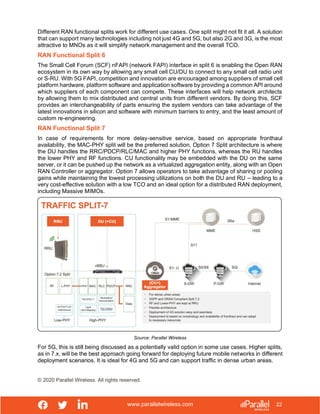
  • 11.
    www.parallelwireless.com © 2020 ParallelWireless. All rights reserved. 11 Source: Parallel Wireless The Small Cell Forum, or SCF, has created its own ecosystem of Open RAN with small cells in mind. Recently they have been focusing heavily on creating open interfaces. In 2020, they expanded the set of specifications they released the previous year, to enable small cells to be constructed piece-by-piece using components from different vendors, in order to easily address the diverse mixture of 5G use cases. These open interfaces are called FAPI and nFAPI, which stands for network FAPI. FAPI helps equipment vendors to mix PHY & MAC software from different suppliers via this open FAPI interface. So, FAPI are ‘internal’ interfaces. On the other hand, nFAPI, or more specifically 5G-nFAPI, is a ‘network’ interface and is between a Distributed Unit (DU) and Radio Unit (RU) of a split RAN small cell network solution. This will help network architects by allowing them to mix distributed and radio units from different vendors. In short, the SCF nFAPI is enabling the Open RAN ecosystem in its own way by allowing any CU/DU to connect to any small cell radio unit or S-RU Source: SCF open specifications for disaggregation of small cell components and networks The Open RAN Policy Coalition is a new Open RAN group that was announced in 2020. The Open RAN Policy Coalition represents a group of companies formed to promote policies that will advance the adoption of open and interoperable solutions in the RAN as a means to create innovation, spur competition and expand the supply chain for advanced wireless technologies, including 5G. Its main goals are to: • Support global development of open and interoperable wireless technologies; • Signal government support for open and interoperable solutions; • Use government procurement to support vendor diversity; • Fund research and development; • Remove barriers to 5G deployment; and • Avoid heavy-handed or prescriptive solutions
  • 12.
    www.parallelwireless.com © 2020 ParallelWireless. All rights reserved. 12 C-RAN, Virtual RAN (vRAN) and OpenRAN The entire telecom industry is going through a change that can be only compared to the change that data centers went through in the 2000s, both driven by Moore’s Law. Source: Parallel Wireless This allows to move from costly, proprietary solutions to COTS-based and open, software-based ones, and to create a broader vendor supply chain. How does this concept apply to the RAN? Most of the CAPEX required to build a wireless network is related to the RAN segment, reaching as high as 80% of the total network cost. Any reduction in the RAN equipment cost will significantly help the bottom line of wireless operators as they struggle to cope with the challenges of ever- increasing mobile traffic and declining revenues. Though the RAN interfaces are “supposed” to be open as they are 3GPP-standards based, in traditional RAN deployments, the software and interfaces remain either proprietary or “closed” by the individual vendor and are often tied to the underlying hardware by the SAME vendor. Meaning, operators cannot put vendor B’s software on a BBU from vendor A or connect a radio from vendor A to a vBBU hardware and software from vendor B. Any software upgrades are tied into the installed base, and if an operator wants to do a vendor A swap, they need to rip out all of it: from the vendor A radio to the vendor A BBU hosting the vendor A software – they cannot replace just one component in the legacy RAN deployment. This creates a vendor lock-in. Vodafone, the leading innovator in Open RAN, recently noted that “the global supply of telecom network equipment has become concentrated in a small handful of companies over the past few years. More choice of suppliers will safeguard the delivery of services to all mobile customers, increase flexibility and innovation and, crucially, can help address some of the cost challenges that are holding back the delivery of internet services to rural communities and remote places across the world.” Vodafone added that the move will improve “supply chain resilience,” introducing “a wave of new 2G, 3G, 4G and 5G technology vendors, in addition to the existing market leaders.” It will be easier and cheaper to keep the radio from vendor A on the tower, installed, so no one has to climb up and replace it, and then keep the COTS-based BBU at the bottom of tower, and then just simply upgrade the software from vendor A to software from vendor B remotely without
  • 13.
    www.parallelwireless.com © 2020 ParallelWireless. All rights reserved. 13 going to a site. This is exactly what Open RAN enables: the mixing and matching of software and hardware (radios and COTS servers) without the need to rip and replace. This, however, is not to be confused with C-RAN or vRAN. Let us explain why. C-RAN About 10 years ago, virtualization of the RAN functions started with the C-RAN (cloud RAN or centralized RAN) initiative from IBM, Intel and China Mobile. C-RAN resulted in a deployment model where a baseband unit that was doing digital processing could be located in a data center and not on the site itself, under the radio where the processing was happening in legacy RANs. Instead, radios were connected to the baseband in the data center unit via a dedicated high- bandwidth connection. This made C-RAN deployments only applicable to areas where there was access to fiber. Source: Orange C-RAN required a new fronthaul interface, and various industry standards such as the Common Public Radio Interface (CPRI) and the Next Generation Fronthaul Interface (NGFI) evolved to enable these new interfaces between the radios and baseband. C-RAN wasn’t necessarily open, but it did begin the movement toward disaggregating the RAN. However, the use cases, because of pooling all digital processing in a centralized location, were limited to high density urban. And it still did not solve issue of vendor lock-in. vRAN Next came Virtual RAN, or, vRAN. Does Virtual RAN equal Open RAN? Not exactly. With vRAN, the proprietary radio hardware remains as it is, but the BBU gets replaced by a COTS server rather than being proprietary BBU hardware. The software that runs on the BBU is virtualized to run on any COTS server. But the proprietary interfaces between radios and COTS-based BBU remain as they are.
  • 14.
    www.parallelwireless.com © 2020 ParallelWireless. All rights reserved. 14 Virtualized RAN (VRAN) versus OpenRAN Source: Parallel Wireless So, though RAN functions are virtualized on a COTS server, the interface between the BBU and RRU / RRH is not an open interface, so any vendor’s software cannot work with the RRU / RRH unless the interfaces become open. To use the analogy from the way we described legacy RAN earlier, vRAN consists of vendor A radio and vendor A software running on a COTS BBU. An operator cannot put vendor B software on the same COTS BBU unless the interface to the vendor A radio is open. So, vRAN can still create vendor lock-in. Open RAN The key with Open RAN is that the interface between the BBU and RRU / RRH is an open interface, so, any vendor’s software can work on any open RRU / RRH. More open interfaces enable the use of one supplier's radios with another's processors – which is not possible with C- RAN or vRAN. Open RAN is a movement to define and build 2G, 3G, 4G and 5G RAN solutions based on a general-purpose, vendor-neutral hardware and software-defined technology with open interfaces between all the components. Open RAN Is the disaggregation of hardware and software: the RRU / RRH hardware becomes a GPP-based or COTS hardware that can be purchased from any ODM, OEM or RAN hardware vendor (Vendor A). The BBU is the same as in the case of vRAN: a COTS server + a vendor’s (Vendor B) proprietary software with virtualized functions. Open RAN makes the RAN open within all aspects and components, with the interfaces and operating software separating the RAN control plane from the user plane, building a modular base station software stack that operates on commercial-off-the-shelf (COTS) hardware, with open north- and south-bound interfaces. This software-enabled Open RAN network architecture enables a “white box” RAN hardware – meaning that baseband units, radio units and remote radio heads can be assembled from any vendor and managed by Open RAN software to form a truly interoperable and open “best of breed” RAN. This way, the underlying hardware layer (radios from vendor A and COTS servers) can stay on site when a mobile operator decides to do a swap; the only thing that gets replaced is the software from vendor B to vendor C.
  • 15.
    www.parallelwireless.com © 2020 ParallelWireless. All rights reserved. 15 Source: Parallel Wireless So, a mobile operator can virtualize and disaggregate their RAN, but unless the interfaces between the components are open, the RAN is not truly open. O-RAN Groups Summary Open RAN is about horizontal openness – with open interfaces enabling functions of the RAN to connect with other functions, from a radio unit (RU) to a baseband (DU-CU), to the controller to the NMS/orchestrator. When RAN is opened up horizontally, it could bring in a new range of low-cost radio players, and it gives mobile operators a choice to optimize deployment options for specific performance requirements at much better cost. The Need for Open Interfaces question that often comes up in Open RAN discussions is this: why do we need the Open RAN movement if the networks use 3GPP-based interfaces, which are already open and standardized? Here is our take on this important and relevant question. 3GPP Interfaces Let’s start with the basic wireless architecture. Using 4G/LTE as an example, the two interfaces in the RAN are: • The air interface, also known as Uu or LTE-Uu interface that uses the RRC protocol • The S1 interface, between the RAN and the Core Both interfaces are standardized by 3GPP and open, so no issues here. However, the simplified 4G network is more like what is shown in detail in the figure below. There are two more interfaces that are the key reason the Open RAN movement started. SP/MNO could replace the OpenRAN software as easily as they did the hardware. Existing OpenRAN hardware continues to work with the new software from Vendor V2 OpenRAN Hardware from any ODM/OEM/ RAN Vendor C B A C B B C A B C V2 Service Service Service Service Service Service Service Service Service Service Service Service Service Service Service OpenRAN Software Core Transport Network
  • 16.
    www.parallelwireless.com © 2020 ParallelWireless. All rights reserved. 16 Source: Parallel Wireless There are two components in the RAN: the virtualized BBU software (DU/CU) that runs on COTS servers, and the Remote Radio Head (RRH) or RU. The interface between them is known as fronthaul, and it uses the CPRI protocol. This protocol generally has vendor-specific implementation and is not necessarily open. Open RAN-focused organizations are trying to get rid of this CPRI in the fronthaul by using other open alternatives. For example, O-RAN Alliance defines eCPRI to use with Split 7. Small Cell Forum, on the other hand, has defined N-FAPI to use with Split 6. Even though you may think these eCPRI and N-FAPI are specific to 5G, they can be used for 4G as well, along with other ethernet-based open fronthaul options. X2 Interface The second interface to note is the X2 interface. Even though this interface has been defined by 3GPP, it is an optional interface. Many legacy RAN vendors intentionally did not implement this initially and, when they did implement it, they used many proprietary messages over this interface. This ensured that multi-vendor networks were difficult for an operator to deploy – basically an MNO was locked in with one specific vendor. The main thing to note is that X2 is quite useful for a 4G network, even though it is an optional interface. This interface is essential for multi-vendor networks to function seamlessly, especially for managing interference.
  • 17.
    www.parallelwireless.com © 2020 ParallelWireless. All rights reserved. 17 Source: Parallel Wireless As you may be aware, all the 5G deployments today are 5G Non-Standalone (NSA) deployments. People who are familiar with technical terminology also call this Option 3, 3A, 3X or by the 3GPP- defined name, EN-DC. What this means in simple terms is that the 5G New Radio is used for the access network, but it only works in conjunction with the 4G LTE access network and the 4G core, also known as the EPC. So, if the X2 interfaces are NOT open, then operators are forced to deploy 5G today using their existing 4G LTE vendors, hence the lock-in continues into 5G as well. In some cases, the operators have come up with innovative solutions where they have provided a new or existing small chunk of 4G spectrum to the new 5G vendor to break this 4G dependency, but not every operator has a spare chunk of spectrum available for these kinds of innovative solutions. Open interfaces would be very helpful in such a scenario, and this is why the Open RAN movement is still necessary even though we have well defined 3GPP interfaces for many different connections, be it air interface or connecting to the core and to the outside word. The Interface Options for MNOs to Create an Open RAN Network Option one is to have their vendors open up interfaces between the RAN components like the radio and the BBU/DU/CU software. The greatest example of this is Nokia in the Rakuten deployment, when they opened up their radios to another vendor’s software. But there is no guarantee that legacy vendors will continue to open up their radios to another vendors’ software. This is where TIP comes in, by creating an ecosystem of hardware and software vendors, initiating PlugFests and developing blueprints. TIP is not writing specs, but rather TIP is promoting, educating and deploying OpenRAN globally, starting in Latin America (LATAM) in 2016, then with Vodafone in Asia, Europe and the DRC. The second option is to use O-RAN Alliance-defined interfaces. Option three is specifically for small cells. Since the Small Cell Forum has enabled small cells to be constructed piece-by-piece using components from different vendors, in order to easily address the diverse mixture of 5G use cases, this will help network architects by allowing them to mix distributed and central units from different vendors.
  • 18.
    www.parallelwireless.com © 2020 ParallelWireless. All rights reserved. 18 Source: Small Cell Forum Open Interfaces Summary Global MNOs are recognizing the economic benefits of open architecture that can only be fully realized when the interfaces are open. The industry is setting up teams and focusing on innovation and engagements in Open RAN architecture, be it through opening up 3GPP interfaces, or utilizing O-RAN Alliance or Small Cell Forum common and open interfaces. While earlier MNOs used to buy hardware and software together from one specific vendor, they are now splitting their orders for hardware and software, and open interfaces allow them to do it. This eliminates vendor lock-in and results in significant CAPEX and OPEX reductions, improves competency and enables faster deployments. Open RAN Components and RAN Functional Splits 3GPP considered the split concept (DU and CU) from the beginning for 5G. In a 5G cloud RAN architecture, the BBU functionality is split into two functional units: a distributed unit (DU), responsible for real time L1 and L2 scheduling functions, and a centralized unit (CU) responsible for non-real time, higher L2 and L3. In a 5G cloud RAN, the DU physical layer and software layer are hosted in an edge cloud datacenter or central office, and the CU physical layer and software can be co-located with the DU or hosted in a regional cloud data center. While CUs will maintain BBU-like functionalities, DUs that are software based will be more than RRH in terms of processing capacities. And this is where the Open RAN concept comes in: from COTS-based servers for DU and CU software to RU from any vendor. RU, CU and DU • RU: this is the radio unit that handles the digital front end (DFE) and the parts of the PHY layer, as well as the digital beamforming functionality. 5G RU designs are supposed to be “inherently” intelligent, but the key considerations of RU design are size, weight, and power consumption. • DU: this is the distributed unit that sits close to the RU and runs the RLC, MAC, and parts of the PHY layer. This logical node includes a subset of the eNB/gNB functions, depending on the functional split option, and its operation is controlled by the CU. • CU: this is the centralized unit that runs the RRC and PDCP layers. The gNB consists of a CU and one DU connected to the CU via Fs-C and Fs-U interfaces for CP and UP respectively. A CU with multiple DUs will support multiple gNBs. The split architecture enables a 5G network to utilize different distribution of protocol stacks between CU and DUs depending on midhaul availability and network
  • 19.
    www.parallelwireless.com © 2020 ParallelWireless. All rights reserved. 19 design. It is a logical node that includes the gNB functions like transfer of user data, mobility control, RAN sharing (MORAN), positioning, session management etc., with the exception of functions that are allocated exclusively to the DU. The CU controls the operation of several DUs over the midhaul interface. Source: Xilinx The centralized baseband deployment allows load-balancing between different RUs. That is why, in most cases, the DU will be co-located with RUs on-site to conduct all intense processing tasks such as fast Fourier transform/inverse fast Fourier transform (FFT/IFFT). Edge-centric baseband processing delivers low latency, local breakout, seamless mobility with real-time interference management, and optimal resource optimization. There are three purposes of separating DU from RU: 1. To reduce cost – less intelligent RU costs less, 2. Ability to look at a sector of RUs at once and not just an individual RU – this will help to enable features like CoMP, and 3. As processing is done in the DU, resources can be pooled resulting in pooling gains. Open RAN is about horizontal openness – with open interfaces enabling functions of the RAN to connect with other functions, from a radio unit (RU) to a baseband (DU-CU), to the controller to the NMS/orchestrator. And though the functional split concept was introduced for 5G, to get full interoperability and cost benefit, it must be applied to RAN for 2G 3G 4G as well. When the RAN is opened up horizontally, it could bring in a new range of low-cost radio players, and it gives mobile operators a choice to optimize deployment options for specific performance requirements at much better cost. The CU’s server and relevant software can be co-located with the DU or hosted in a regional cloud data center. The actual split between DU and RU may be different depending on the specific use-case and implementation (although the O-RAN Alliance definition is Option-7.2 and Small Cell Forum is Option-6). The industry is coming to a consensus that the lower level interface that connects RU and DU (fronthaul) should be eCPRI to deliver the lowest latency. Fronthaul latency is constrained to 100 microseconds. A single DU may be serving RUs up to many kilometers away. It is important to note that the DU/CU split is hardly impacted by the type of infrastructure. The primary new interface is the F1 interface between the DU and CU, and they need to be interopearble across different vendors to deliver the true promise of Open RAN. Midhaul connects the CU with the DU. And while in theory there can be different splits, the only one being considered de-facto between DU and CU is Option-2. There’s also very little difference on the midhaul
  • 20.
    www.parallelwireless.com © 2020 ParallelWireless. All rights reserved. 20 interface between the different splits (1-5). The latency on the link should be around 1 millisecond. A centralized CU can control DUs within an 80 km radius. Backhaul connects the 4G/5G core to the CU. The 5G core may be up to 200 km away from the CU. Source: Altran (Aricent) RAN vendors that started with CPRI and now are trying to sell the solution of converting CPRI to eCPRI in their architecture, should not try to justify this approach as it creates unnecessary complexity and latency. Perhaps they should be reminded of what happened to ATM when they tried to invent ATM over IP? Components and Functional Splits Summary To summarize, with the increase in deployment footprint, fiber and availability of required fronthauls (FHs) can be challenging. By distributing protocol stacks between different components (different splits), solution providers can focus on addressing the tight requirements for a near- perfect FH between RU, DU and CU. Deep Dive into RU, DU, CU The choice of how to split New Radio (NR) functions in the architecture depends on some factors related to radio network deployment scenarios, constraints and intended supported use cases. Three key ones are: 1. A need to support specific QoS per offered services (e.g. low latency, high throughput for urban areas) and real/non-real time applications. 2. Support of specific user density and load demand per given geographical area. 3. Available transport networks with different performance levels, from ideal to non-ideal. Mobile operators need the flexibility to pick and choose different splits based on the same COTS- based hardware and network components by using different software implementations. Different protocol layers will reside in different components based on fronthaul availability and deployment scenarios. This approach will reduce the cost of operations and TCO for mobile operators. Higher functional splits are more desirable for capacity use cases in dense urban areas, while lower functional splits will be the optimum solutions for coverage use cases. So, while lower functional splits utilize less than perfect fronthauls, there is a greater dependence on fronthaul performance for higher functional splits.
  • 21.
    www.parallelwireless.com © 2020 ParallelWireless. All rights reserved. 21 Source: Parallel Wireless To take full benefit of split architecture that can deliver interoperability, ability to select best-of- breed components and scalability, any solution needs support 2G, 3G, 4G, 5G baseband functions. For the best latency support requirement, baseband functions decoupled from hardware should be deployed on NFVI or as containers. An MNO can use any VM requirements and/or any orchestration to enable these functional splits. The future evolution of RAN will be toward dynamic functional splits. While the OpenRAN Controller (aggregator) acts as a mediator between the RAN and core network, the functionality of the RAN will be distributed between DUs and CUs as it is defined in 5G, and this software can be co-located with the aggregator. In different scenarios, these elements can collapse together and create a single physical entity with different virtual functionalities.
  • 22.
    www.parallelwireless.com © 2020 ParallelWireless. All rights reserved. 22 Different RAN functional splits work for different use cases. One split might not fit it all. A solution that can support many technologies including not just 4G and 5G, but also 2G and 3G, is the most attractive to MNOs as it will simplify network management and the overall TCO. RAN Functional Split 6 The Small Cell Forum (SCF) nFAPI (network FAPI) interface in split 6 is enabling the Open RAN ecosystem in its own way by allowing any small cell CU/DU to connect to any small cell radio unit or S-RU. With 5G FAPI, competition and innovation are encouraged among suppliers of small cell platform hardware, platform software and application software by providing a common API around which suppliers of each component can compete. These interfaces will help network architects by allowing them to mix distributed and central units from different vendors. By doing this, SCF provides an interchangeability of parts ensuring the system vendors can take advantage of the latest innovations in silicon and software with minimum barriers to entry, and the least amount of custom re-engineering. RAN Functional Split 7 In case of requirements for more delay-sensitive service, based on appropriate fronthaul availability, the MAC-PHY split will be the preferred solution. Option 7 Split architecture is where the DU handles the RRC/PDCP/RLC/MAC and higher PHY functions, whereas the RU handles the lower PHY and RF functions. CU functionality may be embedded with the DU on the same server, or it can be pushed up the network as a virtualized aggregation entity, along with an Open RAN Controller or aggregator. Option 7 allows operators to take advantage of sharing or pooling gains while maintaining the lowest processing utilizations on both the DU and RU – leading to a very cost-effective solution with a low TCO and an ideal option for a distributed RAN deployment, including Massive MIMOs. Source: Parallel Wireless For 5G, this is still being discussed as a potentially valid option in some use cases. Higher splits, as in 7.x, will be the best approach going forward for deploying future mobile networks in different deployment scenarios. It is ideal for 4G and 5G and can support traffic in dense urban areas.
  • 23.
    www.parallelwireless.com © 2020 ParallelWireless. All rights reserved. 23 RAN Functional Split 8 Split 8 is based on the industry standard CPRI interface and has been around for a while. With traffic split 8, all functions (from PHY to RRC layers) except for RF are handled by the DU, while the RF layer is located in the radio. But why is this split gaining attention now? This split is highly effective in 2G and 3G, where traffic rates are much lower (and therefore processing itself is lower, to a certain extent) and can be easily done on an x86 server, while allowing operators to use cost-optimized RUs with minimal logic and processing. The DU and RU should be interoperable with other third party DUs and RUs. The enhancement over the legacy Split-8 is that, in order for RUs to run multiple technologies over the same FH interface, they now need to utilize eCPRI instead of the legacy CPRI interface between the RU and DU. This approach allows for centralized traffic aggregation from the RUs, which in turn enables a seamless migration path from the traditional LTE ecosystem to the NR ecosystem. Source: Parallel Wireless The RAN DU sits between the RU and CU and performs real-time L2 functions, baseband processing. In the O-RAN Alliance working group, the DU is proposed to support multiple layers of RUs. To properly handle the digital signal processing and accelerate network traffic, FPGA can be used. But what is important to understand is that hardware acceleration is considered a requirement for 5G but less so in previous technologies like 2G, 3G, and even 4G. Source: Supermicro
  • 24.
    www.parallelwireless.com © 2020 ParallelWireless. All rights reserved. 24 There has also been a focus around hardware accelerators – FPGA and GPU – to accelerate real-time sensitive processing for the lowest layers of the radio baseband for 5G. Ericsson and Nokia are looking at GPU-based acceleration for some vRAN workloads, especially for 5G M- MIMO and for AI. So, there is definitely the need to invest more in different chip technologies to ensure Open RAN can have access to the best DUs available on the market. Reducing overall TCO will be a priority, and a solution around GP processor architectures to deliver the most efficient and cost-effective compute, storage and network elements will drive innovation. RU, DU, CU Summary Previous RAN architectures (2G, 3G and 4G) were based on “monolithic” building blocks, where few interactions happened between logical nodes. Since the earliest phases of the New Radio (NR) study, however, it was felt that splitting up the gNB (the NR logical node) between Central Units (CUs) and Distributed Units (DUs) would bring flexibility. Flexible hardware and software implementations allow scalable, cost-effective network deployments – but only if hardware and software components are interoperable and can be mixed and matched from different vendors. A split architecture (between central and distributed units) allows for coordination for performance features, load management, real-time performance optimization and enables adaptation to various use cases and the QoS that needs to be supported (i.e. gaming, voice, video), which have variable latency tolerance and dependency on transport and different deployment scenarios, like rural or urban, that have different access to transport like fiber. But what makes any split architecture open and suited for Open RAN? A mobile operator can deploy a fully compliant functional split architecture, but unless the interfaces between RU, DU and CU are open, the RAN itself will not be open – see a diagram below that shows current industry thinking. Based on their experience, Nokia believes that the only valid split is between RU and DU. Time will tell if integration of one vendor’s DU with another vendor’s CU will deliver flexibility and savings. Source: Nokia In summary, RAN functional splits will bring cost savings if interfaces between hardware and software components are open.
  • 25.
    www.parallelwireless.com © 2020 ParallelWireless. All rights reserved. 25 RAN Automation with CI/CD The DevOps movement inspired large, enterprise organizations with agile practices to allow developers to make quick changes, but it was very difficult to get full benefit, as their legacy development process was not designed for supporting short software development delivery cycles and frequent production releases. In order to release software into production quickly but reliably and – most importantly – repeatably, the DevOps movement developed the Continuous Integration/Continuous Delivery (CI/CD) methodology. Jez Humble and David Farley covered these principles and practices in their book “Continuous Delivery: Reliable Software Releases through Build.” Cloud-native data center technology, adopted by enterprises in 2000, offers the flexibility that paves the path forward to realize new services for mobile operators, but data center technologies introduce a level of operational complexity in the RAN. Implementation of this data center inspired approach is the next step in evolving legacy RAN to fully automated Open RAN. Virtualization: VNFs and Containers VNFs are software versions of network services that used to reside on dedicated network appliances. Functions like vEPCs have been deployed as Virtual Machines (VMs) on COTS infrastructure for over a decade now. VMs are an abstraction of physical hardware, turning one server into many servers. The hypervisor allows multiple VMs (i.e. EPC, IMS) to run on a single machine. Each VM includes a full copy of an operating system, making them slow to boot; it also includes one or more apps, necessary binaries and libraries -- taking up tens of GBs of storage. The fact that something like vEPC is implemented as a monolithic software application on top of a VM may explain some of the performance issues. The RAN is the most transaction-intensive and time-sensitive area of the network and any performance issues will create havoc on the user experience. This is why Open RAN, which consists of many different components from different vendors, needs to adapt to a data center approach to develop, run and optimize software. But Open RAN brings new problems, such as time and complexity of integrations and software upgrades between different vendors. The actual development of a suite of interoperability tests amongst Open RAN vendors is the main challenge. A special set of tests is needed to standardize the certification of software, whether it is hosted on cloud and/or bare-metal infrastructure. A second consideration is the diversity of RAN splits that can be implemented using different Open RAN vendors as a testing process, and cases for Split 7 will be different than for Split 8. Current CI/CD frameworks have typically been used for IT and enterprise apps. As RAN has hardware components like radios that will remain physical, the suite of tests for CI/CD needs to take that into consideration, as the hardware and software in Open RAN will be coming from different vendors. The integration, software upgrades, and the lifecycle management of many vendors will be challenging. Vendors will need to adapt to a new testing model – wherein they are not testing their own products in silos, but rather under an overall CI/CD umbrella. This is especially important in test environments before going into field deployments. This approach will help with creating CI/CD blueprints for future deployments. The main takeaway: as the Open RAN ecosystem evolves, the number of software upgrades will increase, and so will the importance of including these upgrades in the CI/CD environment that is specifically developed for Open RAN across many hardware and software vendors. To optimize performance, in the enterprise example, software implementation went from monolithic, self-contained applications running on dedicated servers to a new model that was built on webscale models. It eventually evolved to microservices. A microservice is decomposition of an application into a multitude of separate parts, each one of them running in a lightweight “container”-like environment – for example, Docker or rkt or Linux LXD. VMs (with a whole OS to boot) are simply too heavyweight to host microservices. By deconstructing a RAN service into
  • 26.
    www.parallelwireless.com © 2020 ParallelWireless. All rights reserved. 26 microservices, it’s easy to address any performance issue by spinning up multiple instances of the RAN microservice that might be creating a performance issue. Open RAN software doesn’t have to be just *one* big monolithic service like a vEPC, as different RAN function components can be implemented as separate microservices and can be scaled up in any way required to optimize the RAN function’s performance. A microservices architecture also has several other very important benefits. One of them is the ability to continuously innovate by embracing an agile DevOps model. A mobile operator can push out any RAN upgrades without taking down the entire site or sites, as testing a microservice involves a very few test cases; testing an entire monolithic (though virtualized) application takes many days of testing. Source: Parallel Wireless CI/CD Overview Implementing the following four data center principles will help make Open RAN be responsive and high performing. Principle 1 ensures that each RAN function component is deployed as a microservice. Principle 2 advocates for a very responsive container environment that should be used and not legacy-based infrastructure. Principle 3 promotes a DevOps method to be adopted for the software to be delivered frequently. And lastly, Principle 4 highlights that using CI/CD is key for automation: 1000 sites can be upgraded whenever desired. Each microservice can be deployed, upgraded, scaled, and restarted independently of other microservices in the RAN application, using an automated system, enabling frequent updates to live applications without impacting end-user experience. Under the hood, a microservice is hosted in a container and exposing APIs to access the service it offers. A particular microservice runs in a container. Then Kubernetes orchestrates the dynamic instantiation of several of those containers in pods, according to performance, resilience and security requirements. A container image is a lightweight, standalone, executable package of a piece of software that includes everything needed to run it: code, runtime, system tools, system libraries, environment. These capabilities are key for the ever-changing RAN environment. Multiple containers can run on the same machine and share the OS kernel with other containers. Containers take up less space than VMs (container images are typically tens of MBs in size), and containers can start almost instantly. Containers offer both efficiency and speed compared with standard virtual machines. Using operating system level virtualization, a single OS instance is dynamically divided among one or more isolated containers, each with a unique writable file system and resource quota. DevOps is a set of practices developed for IT that combines software development (Dev) and information-technology operations (Ops) which aims to shorten the systems development lifecycle and provide continuous delivery with high software quality.
  • 27.
    www.parallelwireless.com © 2020 ParallelWireless. All rights reserved. 27 CI/CD is a set of practices that enables how software, in our case RAN software, gets delivered. Continuous Integration is the practice of merging all developers’ working code to a shared mainline several times a day. Every merge is validated before merging to uncover any issues. CD stands for Continuous Delivery/Deployment, which is the practice in which software teams produce reliable software in short cycles that can be released (delivered) at any time, which can then be deployed. As a result, any software can be released much faster, more frequently and reliably into production networks. The benefit of CD is more predictable deployments that can happen on demand without waiting for an “official” upgrade cycle – this is now thing of the past. Any RAN software in a CD environment is always ready to be released, since every single change is delivered to a joint staging environment using complete automation and the feedback loop to ensure that any RAN application can be deployed into a live network with the push of a button when it is needed based on the business goals for a particular set of RAN sites based on geography or other factors. Source: Pivotal.io
  • 28.
    www.parallelwireless.com © 2020 ParallelWireless. All rights reserved. 28 By including a CI/CD approach as a part of RAN deployments, RAN software changes can be delivered in a faster and automated way. As a result, mobile operators now can bring a webscale application approach into wireless network architectures. CI/CD helps to solve the challenges of multi-node complex RAN environments with added Kubernetes virtualization approach, where a mini-data center can be brought to the edge and be properly managed and upgraded when needed. Operators can use x86-powered virtualized infrastructure. The potentially complex integration of DevOps toolsets to enable a microservices-based flexible and agile environment should not worry mobile operators that want to decompose monolithic VNFs into a microservices-architecture. The result can deliver constant innovation, optimal RAN performance for subscribers, and increased agility for an MNO. Real Life Examples of CD/CI Deployments in Telecom In this blog written two years ago, Rakuten took a page from Humble’s and Farley’s book by explaining how mobile operators can implement CI/CD principles and processes and what pitfalls to avoid when implementing CI/CD. Source: Rakuten Rakuten believes that in order to achieve successful CI/CD, organizational culture needs to be changed – saying, “to be realistic thought, it would be obvious true that it is pretty much tough or highly costly that let more than thousands developers across more than hundred development teams align to the same software development cycle based on single idea without authorized suppressing, especially for large organization like Rakuten.” They advise “to do small start with the deployment in the feedback loop related stages in CD pipeline, which somehow works to many developers to get them on a same compliance. As for CI, for the time being, it wouldn’t be big deal let developers do on their own even it is unique way until the thought of CD sink into developers, since most of the issues in CI should be related to developer’s matter.” Rakuten targets to empower their operational teams with open CI/CD applications and interfaces to help them react faster to their customer demands and continually enhance network resiliency while introducing new services.
  • 29.
    www.parallelwireless.com © 2020 ParallelWireless. All rights reserved. 29 Internet Para Todos (IpT) CI/CD Telefonica, as a part of the IpT initiative, has advocated on the importance of opening RAN interfaces to open up the RAN vendor ecosystem. The implemented architecture in IpT has already shown unprecedented potential in terms of minimizing the cost of operations while integrating different Open RAN vendors with multiple core networks and the reduced time to release new RAN features in the field. IpT embraces DevOps and automation best practices while adopting a microservice-based architecture. IpT is not only the largest Open RAN deployment today, but also the world’s largest implementation of a CI/CD solution for Open RAN in a telco cloud deployment. Telefonica and their supply chain vendors must work together to make the shift from the current siloed deployment to a DevOps cloud-centric approach. TIP CI/CD Telefonica hosts one of TIP’s interoperability testing labs focused on implementing a CI/CD framework for OpenRAN at its R&D labs in Madrid, Spain. One of the fundamental architecture principles is aligning development and operational responsibilities across all hardware and software vendors to drive collaboration and innovation. Therefore, this platform is open by default, containerized, and scalable, and fully automated. The main takeaway: CI/CD is showing great momentum in Open RAN environments by delivering faster, more efficient automated deployments. By embracing CI/CD, mobile operators embrace greater collaboration between different ecosystem members, which fosters innovation. This approach will help to minimize the risk through frequent delivery of new features and new optimizations, while increasing efficiency via automation that leads to faster new services introduction. CI/CD Summary The integration of many new tools might seem challenging when mobile operators first start deploying microservices-based DevOps CI/CD-driven network implementations. As MNOs get ready for Phase 2 in their Open RAN journeys, that will include containers and microservices. Agile DevOps will simplify automation by providing validated stack templates for containers to host microservices. These will be automated to be secure, reliable, maintained, and supported to allow MNOs to easily define their own architecture and make Open RAN easier and more cost- effective to deploy and maintain.
  • 30.
    www.parallelwireless.com © 2020 ParallelWireless. All rights reserved. 30 Role of RAN Intelligent Controller (RIC) In 2G and 3G, the mobile architectures had controllers that were responsible for RAN orchestration and management. With 4G, overall network architecture became flatter and the expectation was that, to enable optimal subscriber experience, base stations would use the X2 interface to communicate with each other to handle resource allocation. This created the proverbial vendor lock-in as different RAN vendors had their own flavor of X2, and it became difficult for an MNO to have more than one RAN vendor in a particular location. The O-RAN Alliance went back to the controller concept to enable best-of-breed Open RAN. As many 5G experiences require low latency, 5G specifications like Control and User Plane Separation (CUPS), functional RAN splits and network slicing, require advanced RAN virtualization combined with SDN. This combination of virtualization (NFV and containers) and SDN is necessary to enable configuration, optimization and control of the RAN infrastructure at the edge before any aggregation points. This is how the RAN Intelligent Controller (RIC) for Open RAN was born – to enable eNB/gNB functionalities as X-Apps on northbound interfaces. Applications like mobility management, admission control, and interference management are available as apps on the controller, which enforces network policies via a southbound interface toward the radios. RIC provides advanced control functionality, which delivers increased efficiency and better radio resource management. These control functionalities leverage analytics and data-driven approaches including advanced ML/AI tools to improve resource management capabilities.
  • 31.
    www.parallelwireless.com © 2020 ParallelWireless. All rights reserved. 31 The separation of functionalities on southbound and northbound interfaces enables more efficient and cost-effective radio resource management for real-time and non-real-time functionalities, as the RIC customizes network optimization for each network environment and use case. Virtualization (NVF or containers) creates software app infrastructure and a cloud-native environment for RIC, and SDN enables those apps to orchestrate and manage networks to deliver network automation for ease of deployment. Though originally RIC was defined for 5G Open RAN only, the industry realizes that for network modernization scenarios with Open RAN, RIC needs to support 2G, 3G, and 4G Open RAN in addition to 5G. he main takeaway: RIC is a key element to enable best-of-breed Open RAN to support interoperability across different hardware (RU, servers) and software (DU/CU) components, as well as ideal resource optimization for the best subscriber QoS. O-RAN Alliance Groups Working on RIC There are 4 groups in the O-RAN Alliance that help define RIC architecture, real-time and non- real-time functionality, what interface to use and how the elements are supposed to work with each other.
  • 32.
    www.parallelwireless.com © 2020 ParallelWireless. All rights reserved. 32 Source: O-RAN Alliance Working group 1 looks after overall use cases and architecture across not only the architecture itself, but across all of the working groups. Working group 2 is responsible for the Non-real-time RAN Intelligent Controller and A1 Interface, with the primary goal that Non-RT RIC is to support non-real-time intelligent radio resource management, higher layer procedure optimization, policy optimization in RAN, and providing AI/ML models to near-RT RIC. Working group 3 is responsible for the Near-real-time RIC and E2 Interfaces, with the focus to define an architecture based on Near-Real-Time Radio Intelligent Controller (RIC), which enables near-real-time control and optimization of RAN elements and resources via fine-grained data collection and actions over the E2 interface. Working group 5 defines the Open F1/W1/E1/X2/Xn Interfaces to provide fully operable multi-vendor profile specifications which are compliant with 3GPP specifications. The RAN Intelligent Controller consists of a Non-Real-time Controller (supporting tasks that require > 1s latency) and a Near-Real Time controller (latency of <1s). Non-RT functions include service and policy management, RAN analytics and model-training for the Near-RT RIC. Near Real-Time RAN Intelligent Controller (Near-RT RIC) is a near‐real‐time, micro‐service‐ based software platform for hosting micro-service-based applications called xApps. They run on the near-RT RIC platform. The near-RT RIC software platform provides xApps cloud-based infrastructure for controlling a distributed collection of RAN infrastructure (eNB, gNB, CU, DU) in an area via the O-RAN Alliance's E2 protocol ("southbound"). As part of this software infrastructure, it also provides "northbound" interfaces for operators: the A1 and O1 interfaces to the Non-RT RIC for the management and optimization of the RAN. The self-optimization is responsible for necessary optimization-related tasks across different RANs, utilizing available RAN data from all RAN types (macros, Massive MIMO, small cells). This improves user
  • 33.
    www.parallelwireless.com © 2020 ParallelWireless. All rights reserved. 33 experience and increases network resource utilization, key for consistent experience on data- intensive 5G networks. Source: O-RAN Alliance The Near-RT RIC hosts one or more xApps that use the E2 interface to collect near real-time information (on a UE basis or a cell basis). The Near-RT RIC control over the E2 nodes is steered via the policies and the data provided via A1 from the Non-RT RIC. The RRM functional allocation between the Near-RT RIC and the E2 node is subject to the capability of the E2 node and is controlled by the Near-RT RIC. For a function exposed in the E2 Service Model, the near-RT RIC may monitor, suspend/stop, override or control the node via Non-RT RIC enabled policies. In the event of a Near-RT RIC failure, the E2 Node will be able to provide services, but there may be an outage for certain value-added services that may only be provided using the Near-RT RIC. The O-RAN Alliance has a very active WIKI page where it posts specs and helpful tips for developers and operators that want to deploy Near-RT RIC. Non-Real-Time RAN Intelligent Controller (Non-RT RIC) functionality includes configuration management, device management, fault management, performance management, and lifecycle management for all network elements in the network. It is similar to Element Management (EMS) and Analytics and Reporting functionalities in legacy networks. All new radio units are self- configured by the Non-RT RIC, reducing the need for manual intervention, which will be key for 5G deployments of Massive MIMO and small cells for densification. By providing timely insights into network operations, MNOs use Non-RT RIC to better understand and, as a result, better optimize the network by applying pre-determined service and policy parameters. Its functionality is internal to the SMO in the O-RAN architecture that provides the A1 interface to the Near-Real Time RIC. The primary goal of Non-RT RIC is to support intelligent RAN optimization by providing policy-based guidance, model management and enrichment information to the near-RT RIC function so that the RAN can be optimized. Non-RT RIC can use data analytics and AI/ML training/inference to determine the RAN optimization actions for which it can leverage SMO services such as data collection and provisioning services of the O-RAN nodes. Trained models and real-time control functions produced in the Non-RT RIC are distributed to the Near-RT RIC for runtime execution. Network slicing, security and role-based Access Control and RAN sharing are key aspects that are enabled by the combined controller functions, real-time and non-real-time, across the network.
  • 34.
    www.parallelwireless.com © 2020 ParallelWireless. All rights reserved. 34 To summarize, the Near-RT RIC is responsible for creating a software platform for a set of xApps for the RAN; non-RT RIC provides configuration, management and analytics functionality. For Open RAN deployments to be successful, both functions need to work together. RIC Overview O-RAN defined overall RIC architecture consists of four functional software elements: DU software function, multi-RAT CU protocol stack, the near-real time RIC itself, and orchestration/NMS layer with Non-Real Time RIC. They all are deployed as VNFs or containers to distribute capacity across multiple network elements with security isolation and scalable resource allocation. They interact with RU hardware to make it run more efficiently and to be optimized real-time as a part of the RAN cluster to deliver a better network experience to end users. Source: O-RAN Alliance An A1 interface is used between the Orchestration/NMS layer with non-RT RIC and eNB/gNB containing near-RT RIC. Network management applications in non-RT RIC receive and act on the data from the DU and CU in a standardized format over the A1 Interface. AI-enabled policies and ML-based models generate messages in non-RT RIC and are conveyed to the near-RT RIC. The control loops run in parallel and, depending on the use case, may or may not have any interaction with each other. The use cases for the Non-RT RIC and Near-RT RIC control loops are fully defined by O-RAN, while for the O-DU scheduler control loop – responsible for radio scheduling, HARQ, beamforming etc. – only the relevant interactions with other O-RAN nodes or functions are defined to ensure the system acts as a whole. Multi-RAT CU protocol stack function supports protocol processing and is deployed as a VNF or a CNF. It is implemented based on the control commands from the near-RT RIC module. The current architecture uses F1/E1/X2/Xn interfaces provided by 3GPP. These interfaces can be enhanced to support multi-vendor RANs, RUs, DUs and CUs. The Near-RT RIC leverages embedded intelligence and is responsible for per-UE controlled load-balancing, RB management, interference detection and mitigation. This provides QoS management, connectivity management and seamless handover control. Deployed as a VNF, a set of VMs, or CNF, it becomes a scalable platform to on-board third-party control applications. It leverages a Radio-Network Information Base (R-NIB) database which captures the near real-time
  • 35.
    www.parallelwireless.com © 2020 ParallelWireless. All rights reserved. 35 state of the underlying network and feeds RAN data to train the AI/ML models, which are then fed to the Near-RT RIC to facilitate radio resource management for subscribers. Near-RT RIC interacts with Non-RT RIC via the A1 interface to receive the trained models and execute them to improve the network conditions. The Near-RT RIC can be deployed in a centralized of distributed model, depending on network topology. Source: O-RAN Alliance Bringing it all together: Near-RT RIC provides a software platform for xAPPS for RAN management and optimization. A large amount of network and subscriber data and Big Data, counters, RAN and network statistics, and failure information are available with L1/L2/L3 protocol stacks, which are collected and used for data features and models in Non-RT RIC. Non-RT RIC acts as a configuration layer to DU and CU software as well as via the E2 standard interface. They can be learned with AI and/or abstracted to enable intelligent management and control the RAN with Near-RT RIC. Some of the example models include, but are not limited to, spectrum utilization patterns, network traffic patterns, user mobility and handover patterns, service type patterns along with the expected quality of service (QoS) prediction patterns, and RAN parameters configuration to be reused, abstracted or learned in Near-RT RIC from the data collected by Non-RT RIC. This abstracted or learned information is then combined with additional network-wide context and policies in Non-RT RIC to enable efficient network operations via Near-RT RIC. The main takeaway: Non-RT RIC feeds data collected from RAN elements into Near-RT RIC and provides element management and reporting. Near-RT RIC makes configuration and optimization decisions for multi-vendor RAN and uses AI to anticipate some of the necessary changes. RIC Implementations in Real Life: Nokia, Parallel Wireless The O-RAN reference architecture enables not only next generation RAN infrastructures, but also the best of breed RAN infrastructures. The architecture is based on well-defined, standardized interfaces that are compatible with 3GPP to enable an open, interoperable RAN. RIC functionality delivers intelligence into the Open RAN network with near-RT RIC functionality providing real-
  • 36.
    www.parallelwireless.com © 2020 ParallelWireless. All rights reserved. 36 time optimization for mobility and handover management, and non-RT RIC providing not only visibility into the network, but also AI-based feeds and recommendations to near-RT RIC, working together to deliver optimal network performance for optimal subscriber experience. Recently, ATT and Nokia tested the RAN E2 interface and xApp management and control, collected live network data using the Measurement Campaign xApp, neighbor relation management using the Automated Neighbor Relation (ANR) xApp, and tested RAN control via the Admission Control xApp – all over the live commercial network. Source: Nokia AT&T and Nokia ran a series of xApps at the edge of AT&T’s live 5G mmWave network on an Akraino-based Open Cloud Platform. The xApps used in the trial were designed to improve spectrum efficiency, as well as offer geographical and use case-based customization and rapid feature onboarding in the RAN. AT&T and Nokia are planning to officially release the RIC into open source, so that other companies and developers can help develop the RIC code. Parallel Wireless is another vendor that has developed RIC, near-RT and non-RT. What makes their approach different is that the controller works not only for 5G, but also for legacy Gs: 2G, 3G, and 4G. Their xApps or microservices are virtualized functions of BSC for 2G, RNC for 3G, x2 gateway for 4G among others.
  • 37.
    www.parallelwireless.com © 2020 ParallelWireless. All rights reserved. 37 Source: Parallel Wireless As a result of having 2G, 3G, 4G, and 5G related xApps, 5G-like features can be delivered today to 2G, 3G, and 4G networks utilizing this RIC including: 1. Ultra-low latency and high reliability for coverage or capacity use cases. 2. Ultra-high throughput for consumer applications such as real- time gaming. 3. Scaling from millions to billions of transactions, with voice and data handling that seamlessly scales up from gigabytes to petabytes in real-time, with consistent end-user experience for all types of traffic. The solution is a pre-standard near real-time RAN Intelligent Controller (RIC) and will adapt O-RAN open interfaces with the required enhancements and can be upgraded to them via a software upgrade. This will enable real-time radio resource management capabilities to be delivered as applications on the platform. In early August of 2020, Intel and VMware announced that that they will work with an ecosystem of telecom equipment manufacturers, original equipment manufacturers and RAN software vendors build programmable open interfaces that leverage Intel’s FlexRAN software reference architecture and a VMware RAN Intelligent Controller (RIC), to enable development of innovative radio network functions using AI/ML learning for real time resource management, traffic steering and dynamic slicing. Both companies believe that this will assist in optimized QoE for rollout of new 5G vertical use cases. In a statement associated with the Intel/VMware announcement, Vodafone Group’s Yago Tenorio, head of network architecture, said, “Seeing VMware and Intel work together to enhance the performance of general purpose computing platforms to run uncompromised RAN workflows, and to help simplify the complexities of product integration, has the potential to ensure Open RAN matures more quickly. It is also an enabler for faster developments in the [RIC] area. This move is central to the Vodafone initial Open RAN vision of partners that excel in our area, as well as benefit the wider community.” At the end of August 2020, the Open Networking Foundation (ONF) has introduced a Software Defined Radio Access Network (SD-RAN) project, supported by AT&T, China Mobile, China Unicom, Deutsche Telekom and NTT, to develop, as an initial focus, an open source Near Real- Time RAN Intelligent Controller (nRT-RIC) that is compatible with the O-RAN architecture. Named µONOS-RIC, it is a microservices-based SDN controller based on a version of ONOS (Open Network Operating System), the ONF’s SDN controller that is already being deployed globally: i.e. Comcast’s next-gen access network and SK Telecom’s 5G core. The µONOS-RIC is supposed to conform to O-RAN Alliance architectures, with the E2 interface used between the µONOS-RIC and multivendor RAN elements (RU/DU/CU). This will eventually
  • 38.
    www.parallelwireless.com © 2020 ParallelWireless. All rights reserved. 38 pull out all the SON and resource management from the RAN where it used to sit in the legacy RAN to xApps in the new, O-RAN based RIC architecture. Google is involved in this project and plans to provide the cloud platform on which functionality such as the open NRT-RIC and xApps might potentially run. In addition, Intel and Facebook are providing the underlying technology to be used for the project’s developments to have it ready for trial in 2021. Ericsson, as part of a blog released in August, indicated that the programmability of RAN can be done both within the framework of 3GPP and within the complementary specifications of O-RAN. Ericsson only sees value of the NRT RIC, which sits higher up in the network technology stack and takes an overall view of the network and hereby “can access a larger pool of RAN data as well as external data sources such as weather, traffic, first responder events etc. to provide policy guidance to RAN on radio resource allocation and the 1 second control loop is short enough to capture almost all possible use-cases.” Ericsson doesn’t think that the O-RAN extensions to existing 3GPP radio control and optimization protocols are necessary and believes that they overlap considerably with functionality that Ericsson already delivers. Hence, they currently focus its R&D efforts on the Non-RT RIC, as opposed to the Near-RT RIC. In September 2020, Samsung and KDDI demonstrated network slicing involving a RIC to manage radio resources to guarantee required service levels. The companies managed network slicing on a network using Samsung’s virtualized core, RAN, and orchestration. Source: Samsung Moving to Open RAN helps create a more innovative and cost-effective RAN environment, based on cloud economics. RIC is an essential component for delivering apps and services over a wireless network.
  • 39.
    www.parallelwireless.com © 2020 ParallelWireless. All rights reserved. 39 RIC Platform Summary The RIC platform provides a set of functions via xApps and using pre-defined interfaces that allow for increased optimizations in Near-RT RIC through policy-driven, closed loop automation, which leads to faster and more flexible service deployments and programmability within the RAN. It also helps strengthen a multi-vendor open ecosystem of interoperable components for a disaggregated and truly open RAN.
  • 40.
    www.parallelwireless.com © 2020 ParallelWireless. All rights reserved. 40 Integration of Open RAN and Beyond Software has been “eating the world” for a while now: from consumer, then enterprise and now the telecom value chains. Open RAN is a great example of how software is “eating” telco. What we have learned from the data center approach is that after creating reference designs (blueprints which took a little time) there was no additional complex integration needed – software took over, making the integration of the physical components and any upgrades easy. Yes, the hardware components still needed to be placed in the data center, cabled together, etc., but the initial integration was as simple as loading the software and/or powering on the hardware. Let’s call it “software integration nirvana” which happened in the enterprise market in the 2000s. Open RAN is becoming a disruptive trend that moves the telco infrastructure from a static, vertically integrated one with few players using proprietary solutions to a dynamic, horizontal architecture with many hardware and software players, like the innovative, dynamic, and software-driven personal computer and enterprise market. Challenges of Open RAN Integration “The elephant in the room with regards to open RAN is, of course, integration,” Patrick Filkins, senior research analyst at IDC, said in a recent interview. He compared the journey to the NFV experience during its early days 12 years ago. A question many people have with regard to Open RAN is: who would do all the integration between different Open RAN vendors – and with the incumbent vendors – in the network in the case of brownfield deployment? With more than 60 deployments and trials worldwide, we will explain based on our experience at Parallel Wireless. In a traditional network, there are many different components and vendors. You have vendors for different kinds of applications, OSS/BSS vendors, one or more core network vendors, depending on the network configuration, many different vendors for transport networks, RAN and small cell vendors, RRH, antennas, etc. There are, of course, a lot more vendors not even listed here. Service providers and mobile operators have to ensure that their networks continue to operate smoothly with all these different players in their network. It doesn’t come as a surprise that recently Ericsson shared this slide stating integration concerns for Open RAN. Ericsson, or any legacy vendor for that matter, is looking at the integration of Open RAN through the lens of hardware, because this is all that they know, and this is how they have done business for years. Source: Ericsson
  • 41.
    www.parallelwireless.com © 2020 ParallelWireless. All rights reserved. 41 We cannot expect that a hardware-centric and vertically integrated company of 144 years that uses system integrated principles of 50+ years will readily embrace how MNOs can integrate Open RAN components in the new software-driven world … To integrate Open RAN, a new approach is needed, not from vertically integrated and hardware- centric companies, but from a software-driven, open and open-minded ecosystem of hardware vendors software vendors, system integrators, tower companies, real estate owners, regulators, industry bodies and mobile operators. Integration of Open RAN needs to be built for a software- centric world where software talks to all physical components, at any time, to deliver scalability, innovation and changing the game for how open networks are integrated. Source: Viavi What is not going to change is how physical components (towers, antennas, batteries, servers) are installed. What will change is that software will make those components smarter and interoperable and will help those components to be integrated and maintained, in most cases remotely with just a software upgrade, no tower climbing required. As we can see, integration principles that are applied to traditional RAN cannot be applied to a software-driven one. Integration Opportunities Nokia’s view on Open RAN integration is to "Integrate what you have to, open what you can." The industry’s consensus is that interfaces between RU and DU/CU need to be open. We anticipate that open radios will be very capable within the next 2 years; DU infrastructure will evolve to be cost-effective as well. Open RAN is of course about horizontal openness – with open interfaces enabling functions of the RAN to connect with other functions, from a radio unit to a baseband hosting DU/CU, or to the RIC (controller) element to the NMS/orchestrator and then to OSS/BSS system. Physical components will be located on-site and in the data center. What will make this horizontal system work is open interfaces between different components.
  • 42.
    www.parallelwireless.com © 2020 ParallelWireless. All rights reserved. 42 Source: Parallel Wireless If we look at how RAN has been historically integrated, we can see three clear models: 1. Integrated and managed by an operator themselves, 2. Integrated and managed by one of the leading RAN hardware vendors (an example in the enterprise world would be IBM) and 3. Integrated and managed by a system integrator. The RAN market in recent years has consolidated, and the three legacy vendors are not only dictating the hardware strategy, but also whether an operator decides to go with model 2, the integration strategy. There are two levels of integration required when integrating Open RAN networks: Open RAN ecosystem integration – the actual integration of the hardware and software with site and data centers infrastructure. In this case, the systems integrator (SI) will be responsible for integrating across the entire solution, including integrating open radios and the BBU software. The old model of RAN hardware vendors like Ericsson and Nokia being integrators might not work in the new world. “Asking vendors to integrate on behalf of their competitors did not pan out,” Filkins said in the same above-mentioned interview. The bulk of the system integration for the RAN is between the radio and the baseband, and if it comes from two different (competing) vendors, it might create issues. This is where TIP, the O-RAN Alliance with lab testing, and PlugFest will come in – a true community effort. To ensure the ecosystem thrives, if an MNO decides to go the system integrator route, a chosen SI must be impartial and not aligned or associated with a specific hardware or software vendor. System integration of the Open RAN software on COTS hardware. This level of integration is similar to what happens in the data center environment. In fact, many of the same DevOps tools and CD/CI principles are used, which further simplifies Open RAN integration through automation. This can be done for an MNO itself or a main SI that is responsible for a site build out. While some global system integrators are ready to become neutral integrators, the responsibility between different vendors still needs to be figured out. Source: TIP
  • 43.
    www.parallelwireless.com © 2020 ParallelWireless. All rights reserved. 43 In the past, software was tied to a physical element from a particular vendor, which created a vendor lock-in and required a hardware swap with any vendor changes. Today, hardware is COTS-based, and software can be not only remotely upgraded, but also swapped. So, ease of integration is enabled through open interfaces. Implementation Stage As Open RAN steps in into the commercialization stage, it is clear that the implementation stage has been driven by the ecosystem and includes solution planning and design, supply chain management, shipping logistics, component testing, RF optimization and drive testing. Radio access products have much smaller tolerances than in the core network and require extensive testing before deployments. Open RAN introduces a very foreign concept to MNOs -- a “best of breed” RAN. Open RAN is that “best of breed” RAN. Creating one is a work in progress, and this is where TIP and O-RAN Alliance and their members come in: to fulfill system integration, testing, and verification to create approved blueprints and reference designs, so operators can go out there and deploy tested, verified, “best of breed” RAN solutions. Vodafone is hoping that TIP can help steer the industry toward a more uniform approach to systems integration by creating a “central hub,” coordinated by TIP, which would allow mobile operators to share experiences. “This is one of our learnings from [TIP] trials”, said Tenorio in the above-mentioned webinar. AT&T has been hosting the O-RAN Alliance Plugfests and proof of concept activities to demonstrate the multi-vendor compatible configuration, performance, and fault management capabilities. The O- RAN Alliance, for its part, publishes test and interoperability specifications alongside every interface it develops and is investing in open integration labs where different vendors and operators can come together to achieve interoperability goals to create “best of breed” RAN. TIP and O-RAN Plugfests help hardware vendors, software vendors and system integrators to combine their integration efforts and get ready for field deployments. While collaborative efforts continue, the success of Open RAN depends on the ecosystem’s ability to develop and execute a test and integration model. A Samsung paper states that many service providers believe that nearly 80 percent of the verification tasks are common across all MNOs.
  • 44.
    www.parallelwireless.com © 2020 ParallelWireless. All rights reserved. 44 In the past, the majority of contracts for integration or maintenance went to RAN suppliers, as they were specialists. As software makes network integration easier, we will see SIs that were in the past responsible for site build outs mostly of physical components, becoming software integrators as well. Near off-the-shelf, plug-and-play compatibility with mainstream deployments, tech maturity, and adoption of Open RAN standards helps to give that power to SIs and simplify the deployments. Maintenance Stage In the maintenance stage, a single RAN vendor is an easy solution for support and can provide maintenance based on the service SLA to do performance monitoring, field services, and lifecycle support. But in Open RAN, any time a network failure occurs, it falls back on multiple parties: from the system integrator to suppliers of different hardware and software elements. There is no one neck to choke. Software-based RAN and CD/CI implementation allows for more rapid deployment of upgraded features, thereby allowing the operator fine tune performance features for their network and roll out advanced new features like carrier-aggregation to boost performance. A DevOps approach with CD/CI can push updates quickly to many different sites, all automated and orchestrated. Also, mobile operators will begin implementing more flexible processes and operational models to take advantage of Open RAN with a migration plan that will include changing the way RAN is being procured, new software tools, OSSs, and upskilling workforce to manage software-enabled “best of breed” RAN. By getting reference designs and blueprints resulting from testing in the integrated Open Test and Integration Center (OTIC) environments and field trials, MNOs can gain more confidence in multi-vendor interoperability and focus their live network efforts on accelerating their Open RAN deployments by making “best of breed” RAN easier to purchase, deploy and maintain. Operator Tasks in Integration At a very high level, we can say that operators perform the following important tasks. • Service Strategy – All operators have to focus on who they are targeting with their network, and how. This is generally the first step before the network is even launched and is also a continuous process as service providers must continuously re-evaluate their strategies. • A mobile network cannot exist without spectrum, so the purchase of spectrum is another important task. • Even before the spectrum has been purchased, operators must start evaluating vendors based on their strategy, vision and what spectrum they are likely to purchase. Once the spectrum has been purchased, they have to select vendors and purchase equipment. • Then there are activities we refer to as “Network Business as Usual.” These are the tasks that go on continuously. These include: leasing and/or building sites; deploying and configuring equipment; optimization & drive testing of the deployed sites; maintenance to make sure all existing sites continue to work smoothly; fault management in case of issues; and, finally, upgrades which could be related to equipment, technology, backhaul, power, etc. • One of the important but often-overlooked activities in a network is digital, sales & marketing. Any network has to make sure it appeals to different types of people, and this is where these activities play a big role. • Billing & Operations ensures that end users are billed correctly and consistently so there is flow of money inwards. Operations covers a very wide area including order capture, order management, customer relationship management, inventory management, smooth operation of the network, etc.
  • 45.
    www.parallelwireless.com © 2020 ParallelWireless. All rights reserved. 45 • Finally, customer support is another key area. While many operators are transitioning from CSPs to DSPs, there is still a role for call center-based customer support services in addition to web support, support on social networks like Twitter and Facebook, chat support via SMS, app or website, etc. It is estimated that RAN is 60% of CAPEX and OPEX and, hence, the most important cost factor to focus on in telecom. Going back to the high-level operator tasks, many operators outsource the task of leasing and/or building sites to Towercos and Infracos. These Towercos and Infracos could be pureplay independent companies or operator-led, as is becoming common. Similarly, when it comes to many of the Network Business as Usual tasks, many operators and service providers outsource these to a Managed Services company. It is estimated that around 80% of the mobile networks worldwide use a Managed Services Provider for some tasks. In fact, some of the incumbent network equipment vendors make most of their money by offering services in this way. Coming back to our topic of Open RAN Integration, we can roughly say that there will be RU vendors, COTS vendors, and DU and CU Software vendors. A well-known incumbent network equipment vendor recently discussed the long-term cost issues associated with Open RAN. We will take their slide as a reference and try to separate fact from fiction. Source: Parallel Wireless If we look at networks today, we can roughly say that the integration cost of the system is the RAN System cost, which includes both hardware and software costs, the support costs and, finally, the services costs. When Open RAN equipment is introduced in the network, there is a separate RAN hardware and software cost, as RAN is now disaggregated and most likely has different vendors for hardware and software as well. In addition, there will be support and services cost like in the case of traditional networks. In the long term, node and network integrators may be required in the network, which can increase the cost and complexity. The incumbent network equipment vendor asks if the costs of traditional RAN networks will be lower or if the costs of Open RAN deployment in the long term will be less. While this picture provides everyone with a food for thought, it does not apply to every scenario and can be misleading.
  • 46.
    www.parallelwireless.com © 2020 ParallelWireless. All rights reserved. 46 Source: Parallel Wireless There are many cases of operators with strong in-house technical know-how, that are more than capable of managing the integration between different Open RAN components and vendors themselves. With operators managing the integration, we believe the long-term costs would be far lower as compared to those of vendors selling proprietary kits. In addition, the operators would benefit from continuous innovation in the hardware and servers, driven by the openness in the ecosystem. There are many cases where the operator would rather outsource their business as usual activities to a managed services provider and focus on service innovation. In this case, the managed services provider would be responsible for the integration of different Open RAN kits for different vendors. Source: Parallel Wireless
  • 47.
    www.parallelwireless.com © 2020 ParallelWireless. All rights reserved. 47 Role of Managed Service Providers in Integration Managed Services providers (MSPs) are experts in dealing with kits from various vendors. They have access to experienced people, which enables them to quickly grasp the basics of new technologies and continue providing their services without interruption. In addition, during the introduction phase, it is assumed that all vendors would be willing to provide insights about their products, thereby transferring the essential knowledge to MSP staff. Here as well, we believe the long-term costs for an operator would be far lower as compared to those of vendors selling proprietary kits and at the same time they will benefit from continuous innovation in the ecosystem. Source: Parallel Wireless Role of Hardware and Software Vendors in Integration Another possible approach with Open RAN Integration is that a software or hardware vendor becomes responsible for integration and would work with all other Open RAN partners for the operator to deliver the Open RAN network. This approach would be cheaper and more effective for the operator, but many smaller vendors would not necessarily be willing to take this approach. It is nevertheless common, at least while introducing Open RAN into a network. Source: Parallel Wireless
  • 48.
    www.parallelwireless.com © 2020 ParallelWireless. All rights reserved. 48 Role of Integrators The final approach, which you are likely to hear the most about, is that an integrator manages the Open RAN network. In many cases, these integrators would be the ones submitting RFIs (request for information) and RFPs (request for proposal) and signing the contract with the operators. This would also provide them with the flexibility to change the hardware or software vendors as long as they are providing the agreed services. In this case, the long-term savings for the operator would not be as much as in earlier cases but would still be more as compared to deployment with proprietary equipment from the traditional vendors. Open RAN Integration Real Life Examples Are we there yet? To quote Santiago Tenorio, Head of Network Strategy & Architecture, Vodafone who said in a recent webinar, “We haven’t even scratched the surface of system integration challenges.” Furthermore, a GSMAi mobile operator survey stated that 55% of responders see integration issues as the second largest challenge when asked about the major obstacles to introducing Open RAN. Open RAN is being currently deployed in multiple markets by multiple MNOs around the world and is entering commercialization stage. The pattern of innovation in Open RAN is similar to the Netflix model (below) -- it puts the industry adoption of Open RAN at stage 2 – iterate and improve – and this is where integration comes in. Here’s how are some of the early adopters of Open RAN have evolved traditional integration models: Model 1 (MNO integrates themselves): Rakuten and Vodafone have proven to the world that overcoming Open RAN challenges is possible but requires strong and active operator involvement -- the in-house vision, skills and capabilities are necessary for integrating new technologies successfully. Model 2 (a hardware vendor integrates): Dish expects Fujitsu to provide support for radio and antenna integration and to ensure that the radio units and distributed units are fully interoperable.
  • 49.
    www.parallelwireless.com © 2020 ParallelWireless. All rights reserved. 49 Model 3 (using a system integrator): In Peru, Telefónica has relied on a Spanish systems integrator called Everis, which has a major presence in Latin America. In the future, the in-house resources will be implementing virtualization based on Whitestack for DevOps style with Continuous Development and Continuous Integration of the software to enable automation. The question is whether all this entails an increase in operational expenditure, especially if problems arise. "That is not the plan," said del Val Latorre, Telefónica's CEO of research and development, at TIP Summit 2019. Source: ABI research It is important to note that even when an operator has the skills to integrate Open RAN, or has SI partners to help, hardware and software vendors need to implement their products as a solution, just like enterprise vendors currently do. This when Open RAN will reach the economics of scale. Having worked with many different operators in different parts of the world, we at Parallel Wireless do not see it as an issue that will slow down Open RAN networks deployment or make an operator rethink their deployments. Open RAN Timeline Some estimates put the telecom industry, especially the RAN segment, between seven and ten years behind a normal innovation curve due to the lack of competition in the market. This is a similar situation to the state of the data center industry in the 1990s, during the dot-com boom, and before companies like VMWare and Intel rapidly turned the market upside down. The data center industry – and most enterprise businesses for that matter – saw the value of a software- centric approach and transitioned to more open models, with competing software vendors fostering innovation. And now, the telecom industry is going through the same dramatic change that the data centers went through in the 2000s; all driven by Moore’s Law. The main takeaway: In the data center world, even traditional hardware manufacturers have subsequently moved to software-centric businesses. The ones that refused accept the software-driven world, did not make it. The lack of a vibrant vendor ecosystem in telecom has limited innovation in the industry and kept the cost of network capacity high. MNOs throughout the world are aware of this and are now working with challenger vendors to address the issue and encourage change. Industry Timeline The last 5 years saw significant moves toward the Open RAN model, a new way of building radio networks based on a software-centric and open infrastructure, disaggregating hardware from
  • 50.
    www.parallelwireless.com © 2020 ParallelWireless. All rights reserved. 50 software in the network. This helps networks support open interfaces and common development standards, to deliver multi-vendor, interoperable networks and helps to avoid any vendor lock-in. Unless they embrace change, the traditional RAN vendors risk becoming obsolete as the telecoms industry starts demanding networks that are open, cost-effective and flexible. Open RAN is about the decoupling of hardware and software, providing more choice and interoperability. This gives operators the flexibility to cost-effectively deploy and upgrade their networks, reduce complexity, and deliver coverage at a much lower cost. 2016 The Telecom Infra Project (TIP) was formed in early 2016 as MNOs were frustrated with a lack of innovation in a highly concentrated/closed ecosystem and high costs in the telecom equipment sector. TIP has brought together operators, traditional equipment vendors and startups that are using open source technologies and open approaches. TIP project groups are divided into three strategic networks areas that collectively make up an end-to-end wireless network: Access, Transport, and Core and Services. By dividing a network into these areas, TIP members can best identify where innovation is most needed and work to build the right products. Source: TIP TIP is jointly steered by its group of founding MNOs and vendors, which form its board of directors, and is currently chaired by Vodafone's Head of Network Strategy and Architecture, Yago Tenorio. Vodafone has been leading efforts within the TIP’s OpenRAN initiative since 2016 with three main goals: - 1. to spur innovation through building an ecosystem, 2. to enable supplier diversity and, 3. to reduce deployment and maintenance costs. As part of TIP, Vodafone is working closely with other mobile operators to accelerate innovation, new technology and business approaches to help the industry build the networks of the future. There are over 70 mobile operator members now in the TIP membership roster. With more than 500 participating member organizations, including operators, vendors, developers, integrators, startups and other entities that participate in various TIP project groups, TIP adopts transparency of process and collaboration in the development of new technologies. TIP supports low cost and more competition. They launched PlugFests to accelerate interoperability between vendors, to create a tangible ecosystem and to encourage trials and deployments.
  • 51.
    www.parallelwireless.com © 2020 ParallelWireless. All rights reserved. 51 2017 The first OpenRAN trials started in India and Latin America. You might wonder why low ARPU markets became a playing ground for Open RAN? Hint: the answer can be found if you read further. 2018 February: The O-RAN Alliance was formed. It’s is a worldwide, carrier-led effort to drive new levels of openness in the radio access network of next-generation wireless systems by creating standards for interoperability – one of the most important being the 7.2 functional split between RU and DU, which standardized the use of 3rd party radios. The alliance was formed as a result of a merger of C-RAN Alliance and xRAN Alliance. O-RAN Alliance’s original founding operator members were AT&T, China Mobile, Deutsche Telekom, NTT DOCOMO and Orange, but since then many other operators have joined. As in case of TIP groups, the O-RAN Alliance has its own set of working groups. Source: Keysight While 3GPP defines the new flexible standards (Release 16 was just finalized on July 3rd ) separating the user and control plane and keeping the different implementation options open, the O-RAN Alliance specifies reference designs consisting of virtualized network elements using open and standardized interfaces and calls for more intelligence in the network with the help of information collection from these virtualized network elements. Recently, O-RAN Alliance introduced a virtual exhibition where 38 Open RAN ecosystem partners demonstrate their innovations. TIP is not writing specs like O-RAN Alliance, but rather TIP is promoting, educating and deploying OpenRAN globally, starting in LATAM in 2016, then with Vodafone in Asia, Europe and DRC and more in Asia with Indosat Ooredo, Smartfren, ad Axiata and most recently with TIM in Brazil. February: At MWC 2018, Telefónica announced “Internet para Todos,” a collaborative project to connect the unconnected in LATAM. The initiative is aimed at connecting the more than 100 million people in LATAM who currently have no internet access. Telefónica expanded its collaboration with multiple stakeholders: rural operators, technology firms and regulators. With
  • 52.
    www.parallelwireless.com © 2020 ParallelWireless. All rights reserved. 52 "Internet para Todos," Telefónica is expanding connectivity with an ecosystem approach, incorporating a broad range of partners and stakeholders to solve the rural connectivity challenge. June: Vodafone and Telefónica announced a joint RFI to evaluate Open RAN technologies that are software-based and that run on top of commoditized hardware. October: At TIP Summit 2018, Telefónica and Vodafone announced the vendors they chose for their Open RAN pilot deployments. Vodafone and Telefónica expressed the importance of disaggregating hardware and software to make networks open, easy and cost-effective to deploy and maintain. Both operators also highlighted the necessity of software-based network solutions being able to support ALL Gs (2G/3G/4G/5G). Both operators were aligned on the need to scale these solutions in their rural footprint as one of the levers for success. 2019 February: Rakuten announces world’s first virtualized, cloud-native greenfield 4G network. It has become a poster child for Open RAN though it doesn’t use O-RAN Alliance defined “open” interfaces. What interfaces do they use? Rakuten’s radio vendor (Nokia) opened up their X2 interfaces to the software from another vendor. This proves our point that openness = open interfaces between different component vendors. July: The Small Cell Forum (SCF) has enabled a small cell Open RAN ecosystem by defining the PHY API that provides an open and interoperable interface between the physical layer and the MAC layer. 3G and LTE versions are already used in most small cells today. SCF expanded the set of specifications to enable small cells to be constructed using components from different hardware and software vendors to address the diverse mixture of 5G use cases. October: At TIP Summit 2019, Telefónica cited the example of its Internet para Todos (IpT) project to showcase the benefits of Open RAN. IpT opened talks to bring a second operator on board after connecting more than 650 sites since May 2019 and covering 800,000 people (450,000 actual customers) with a 3G and 4G rollout in rural Peru. IpT looks to achieve economic sustainability through partnerships with local communities and by using OpenRAN technologies that will reduce the cost of deployment in areas where current technologies are cost prohibitive. These include cloud-like architectures, automated network planning, open radio access solutions and a combination of optimized fiber and microwave networks. Vodafone made even a bolder move when they opened up their whole European operations to Open RAN. Vodafone’s tender covered more than 100,000 sites and 400 million people across 14 countries. “Right now, this is the biggest tender in this industry in the world,” Yago Tenorio, head of Network Strategy and Architecture at Vodafone said at TIP Summit 2019. “It’s a really big opportunity for OpenRAN to scale. We are ready to swap out sites if we have to. Our ambition is to have modern, up-to-date, lower-cost kit in every site.” 2020 February: TIP and the Open RAN ecosystem launches an Evenstar program, which is focused on building general-purpose RAN reference designs for 4G/5G networks in the Open RAN ecosystem that are aligned with 3GPP and O-RAN specifications. Vodafone, Deutsche Telekom, Mavenir, Parallel Wireless, MTI, AceAxis, Facebook Connectivity and additional partners unveiled the Evenstar RRU (Remote Radio Units). RRHs, distribution units, and control unit software have traditionally been only available as a packaged unit. By decoupling the RRU hardware from DU and CU software, mobile network operators will have the ability to select best-of-breed components and the flexibility to deploy solutions from an increasing number of technology partners. The intention is to contribute the proposed solution into TIP’s OpenRAN Project Group to help accelerate adoption. The Evenstar family is expected to eventually include multiple Remote Radio Head (RRH) product SKUs. The RRH architecture is based on O-RAN Alliance fronthaul specifications based on Split 7.2.
  • 53.
    www.parallelwireless.com © 2020 ParallelWireless. All rights reserved. 53 February: O-RAN Alliance and TIP announced a partnership agreement to ensure their alignment in developing and deploying interoperable Open RAN solutions. As TIP is agnostic about the specifications it uses for the solutions service providers need, it has to work with various standards bodies to ensure smooth deployment. This new agreement with O-RAN Alliance allows for the sharing of information, referencing specifications and conducting joint testing and integration efforts. This was an important move to ensure both organizations align in the development of 5G RAN solutions to avoid duplication, while lowering costs and sharing resources. In a blog, Attilio Zani, executive director at TIP, provided an update on the group’s activities, while revealing the partnership between the pair. May: O-RAN Alliance and GSMA announced they have joined forces to accelerate the adoption of Open RAN to take advantage of new open virtualized architectures, software and hardware to accelerate 5G adoption globally. The press release stated the organizations will work together to harmonize the open networking ecosystem and agree on an industry roadmap for network solutions, consequently making access networks as open and flexible as possible for new market entrants and resulting in better connectivity for all. May: The Open RAN Policy Coalition was launched. It represents a group of companies formed to promote policies that will advance the adoption of open and interoperable solutions in the RAN as a means to create innovation, spur competition and expand the supply chain for advanced wireless technologies including 5G. Its main goal is to educate governments around open technologies and the benefits. July: Nokia and Samsung announce Open RAN product availability for 5G. Ericsson and Huawei have not made any Open RAN announcements (as of yet). However, Ericsson is a member of the O-RAN Alliance. An interesting observation is that Nokia’s and Samsung’s announcements were around Open RAN for 5G, leaving other Gs behind… We believe that if a mobile operator only deploys Open RAN for 5G, they will have the challenge of managing two networks: a vertical one with legacy equipment and the new one with distributed, Open RAN architecture. While the operator might have flexibility and will avoid vendor lock-in for 5G, the legacy 2G, 3G and 4G network will still rely on closed RAN components. Open RAN is now mainstream, with not only industry organizations joining forces to drive the Open RAN movement forward, but also legacy vendors opening up their RAN – but for 5G only. September: Mavenir acquires a small cell specialist ip.access to expand their OpenRAN femtocell portfolio to support ALL G. The second main objective for the deal is that Mavenir wants a small cell capability to address the private networks opportunity, from 5G to CBRS. October: Speaking during the third quarter earnings call on Wednesday, Ericsson’s CEO Börje Ekholm noted, in response to a question from an investment analyst, that “we see a lot of discussions about Open RAN and the pros and cons. What is important to remember is that we have said we're a key contributor to O-RAN [it joined in February 2019] and we will continue to be so. We believe this is something that clearly is going to happen, so we’re going to make sure we're well positioned. That's also why we need to transition more towards software revenues as well.” But he sees Open RAN impacting revenues and business models after 2022. Open RAN and Beyond Summary It is not a surprise that Open RAN started in rural areas, as that is the most challenging market for MNOs and vendors to address – the user penetration is low, the ARPU is low, and the site and backhaul infrastructure is non-existent. With an ALL G Open RAN solution, MNOs can address cost and deployment challenges of rural markets globally. Minimizing CAPEX/OPEX is important in these low-density areas where there is high uncertainty regarding return on investment. High operational cost and deployment complexity of low-density deployments have
  • 54.
    www.parallelwireless.com © 2020 ParallelWireless. All rights reserved. 54 prevented MNOs from bringing coverage to those areas in the past. Traditional 2G voice-only and broadband 3G or 4G networks require high-cost and often bulky equipment to deploy and operate. These types of equipment need large spaces to store, have a short life cycle and consume energy. Hardware-based networks are also difficult to upgrade. By shifting networks to virtual Open RAN architectures, telecom operators can overcome all these problems and deliver coverage at a much lower cost. Now that Open RAN has been deployed and proven in those low-density areas for 5+ years, MNOs have started deploying Open RAN in urban locations for network modernization and for 5G. This will allow global mobile operators to have greater buying power as they continue shaping the Open RAN ecosystem.
  • 55.
    www.parallelwireless.com © 2020 ParallelWireless. All rights reserved. 55 Global Open RAN Adoption Most of the CAPEX required to build a wireless network is related to the RAN segment, reaching as high as 80% of the total network cost. Any reduction in the RAN equipment cost will significantly help the bottom line of wireless operators as they struggle to cope with the challenges of ever- increasing mobile traffic, flat revenues and rising costs to maintain their networks. Two of the biggest challenges that networks face today is the cost to deploy and maintain networks due to vendor lock-in and network complexity as networks need to support 2G, 3G, 4G and eventually get ready for 5G. These challenges become especially apparent in low ARPU markets, rural areas, or developing markets like Latin America, APAC or Africa. That is why we see Open RAN adoption happening faster in those regions, as Open RAN innovation gives those operators the ability to choose any RAN vendor thus reducing the deployment cost in those challenging deployment areas. Open RAN first was deployed in rural areas. Why you might ask? Not only because it was an area where operators could test new and yet unproven technologies, but also from an investment and maintenance standpoint, rural areas are the most challenging ones. If a solution is low-cost enough for rural markets and can economically support the very limited number of users, it will have even better TCO in urban markets. If rural sites can be upgraded remotely with a software push to the edge, maintenance cost will be reduced as well and will make any urban deployments easy to upgrade as well. Rural Open RAN no more – in the recent investor briefing, Vodafone CEO Nick Read spoke about Open RAN getting ready for urban. "We think we'll have a rural open RAN ready for 2021 and we are looking to an urban, which is a more complex execution, in 2022, but we need government and we need operators to scale this to improve functionality and efficiency going forward," he said. This statement highlights the importance of the “village,” or an ecosystem that has been establishing itself for the last few years: from MNOs, vendors, hardware and software, to system integrators, governments and regulators, in every region of the world: from emerging markets all the way to developed markets like Europe and the US. The main takeaway: after many years of proving 2G 3G 4G Open RAN in rural areas, leading Open RAN innovators like Vodafone are ready to take Open RAN to urban locations. Emerging and Developed Economies It is important to emphasize here that 2G and 3G networks are not going away anytime soon. Some countries are switching off 2G, some are switching off 3G, but the majority of the world will still have a combination of 2G, 3G, 4G, and 5G networks for years to come. The GSMA mobile economy report 2020 mentioned that 5% of the global population will still use 2G in 2025. That still amounts to over 360 million users. 4G will still dominate technology in 2025 as well. In emerging economies, specifically across Africa, parts of Europe and Latin America, many operators still utilize substantial 2G and 3G investments. The migration from legacy to 4G and 5G networks will be a key challenge in those regions since the telecom industries there are still emerging, and an implementation of 4G and 5G could prove very costly because it will require running old legacy non-IP networks and new all IP (4G and 5G) at the same time. In many of the regions across Africa and Latin America, the replacement rate of cellular devices is much lower than in other regions of the world. As mobile phones that are compliant with legacy 2G and 3G tend to be used more in emerging regions, the operators require a solution that can support both 2G and 3G solutions while simultaneously preparing for the deployment of faster 4G and 5G networks. Open RAN solutions that support 2G, 3G, 4G and 5G will cost-effectively enable connectivity in those markets by simplifying installation and providing technological flexibility and sustainability.
  • 56.
    www.parallelwireless.com © 2020 ParallelWireless. All rights reserved. 56 For each operator, the landscape of technologies they must support is very heterogeneous; one solution will not fit all scenarios. A sustainable mobile broadband will become widely available with Open RAN, reducing the cost structure and delivering flexibility by design to sustainably evolve and adapt the network to user demand: 2G and 3G today, 4G and 5G in the future. In developed economies, U.S. mobile operators were looking at Open RAN for rural at first, but current geopolitics around Chinese vendors have created a much bigger opportunity for Open RAN. The Open RAN Policy coalition, looks to educate the US government on Open RAN as a viable alternative to Chinese vendors. Dish is planning on building their network by 2023, based on Open RAN. And there are smaller U.S. operators like Inland Cellular that are already expanding their 4G networks with Open RAN, proving that it is a strong contender for any RAN replacements. In Europe, Vodafone is leading the Open RAN pack, considering deploying it all across their European operations. The main takeaway: Open RAN that supports 2G, 3G, 4G and 5G is an attractive option for global MNOs. Urban versus Rural In the past, the deployment focus for MNOs was placed on addressing urban issues to increase capacity or spectrum efficiency for densification. Uncertainty in the rural business case on the demand side, and operational complexity on the cost side, and competitive pressure in urban markets resulted in MNOs deprioritizing investment in rural in favor of urban. The rural challenge is now being solved across the globe with Open RAN delivering a new business approach. As Open RAN has proven itself in the most challenging rural locations, now it is getting ready for prime time in urban markets. Monolithic solutions of the past that provide a single access technology (i.e. 2G) prevent business sustainability as they require additional investments as the demand evolves (3G, 4G). Now, Open RAN can support 2G, 3G, 4G and 5G, extending the deployment investment. The main takeaway: As Open RAN proven itself in the most challenging rural locations, now it is getting ready for prime time in urban markets. Europe While mobile operators’ interest in open RAN technologies has been growing for a couple of years, Vodafone has been on the journey for over five years. Vodafone was the first operator to move the technology out of a lab environment and into a field trial in their emerging markets and rural areas (Turkey and DRC). Vodafone didn’t hold back on its intentions to use Open RAN to help expand its supplier base. CEO Nick Read said at the end of 2019 that the operator was “pleased with trials of OpenRAN and are ready to fast track it into Europe, as we seek to actively expand our vendor ecosystem.” Recently, Yago Tenorio, Vodafone's head of network strategy, confirmed that "we have had trials taking commercial traffic for about a year now," and "It is a 2G, 3G and 4G trial and it is live and the KPIs (key performance indicators) are really good and in some cases better than the incumbent."
  • 57.
    www.parallelwireless.com © 2020 ParallelWireless. All rights reserved. 57 Source: Vodafone Now, Vodafone has set an even more aggressive timeline to use Open RAN for urban. Africa The African continent poses a unique commercial and moral challenge for telecom service providers. A large number of the African population is still out of the telecom network – it remains one of the most under-penetrated regions in the world, with the primary 2G network yet to reach over 110 million people (as per the GSMA report). In addition, the Average Revenue Per Unit (ARPU) continues to be extremely low, and the telecom service providers have a tough challenge listing out their priorities. And this is where Open RAN can help and is set to play a vital role in the connectivity race as the regions that are connected are largely dependent on legacy infrastructure, with 2G and 3G, and 4G still in its infancy. African MNOs need to optimize their previous G investments, especially 4G as those deployments were delayed due to the ability of end users to pay more for 4G services. At the same time, MNOs in Africa are looking to Open RAN for any new 2G or 3G or 4G deployments: vendor choice, lowest TCO, easy upgradability – will help African MNOs to bring connectivity to more end users. In addition, it will help them to realize network ROI much faster– and that is why 4G-based on Open RAN will become a leading technology in Africa in the years to come as more users get access to 4G devices. An All G OpenRAN solution was attractive to MTN because of easy upgradability to any G, allowing MTN to keep building 2G networks in areas untouched by wireless connectivity, while at the same time continuing to allocate resources and time to expand their 3G or 4G networks with the same investment. MTN is set to deploy 5,000 Open RAN sites across their 21 operations. Orange has recently joined the Open RAN movement and is planning on starting its Open RAN journey in Africa with the goal to roll it out across all of their operations. And although there are capabilities to deploy 5G, Africa-based operators will require the ability to run 5G alongside their existing 2G, 3G and 4G networks. At present, that can only be solved with either erecting new infrastructure or deploying Open RAN, which can run alongside existing infrastructure. It’s a no brainer really …
  • 58.
    www.parallelwireless.com © 2020 ParallelWireless. All rights reserved. 58 Latin America Latin America is a large geographical region with many areas that are extremely difficult to reach, with infrastructure and population concentrated in large metropolitan areas. During spectrum auctions, the government puts expectations on MNOs to cover the majority of geographical areas, not just by population. It presents a challenge to regional MNOs to cover entire countries as the cost of installation and maintenance of traditional RANs is high. Couple it with the need to support a variety of technologies to support 2G, 3G, 4G and 5G in the future, and no wonder Open RAN is catching on like fire throughout the region. Telefonica’s initiative Internet para Todos (IpT) aims to connect the approximately 100 million unconnected in the LATAM region to enable economic inclusion. And they are embracing Open RAN to achieve this ambitious goal. IpT was formed in early 2019 with the mission to bring faster internet access and its benefits to everyone — giving more people a voice, strengthening communities, and creating new economic opportunities. IpT has deployed 650 sites since May 2019, covering over 450,000 customers, with a 3G and 4G rollout in rural Peru. IpT is developing a new business model by establishing a wholesale model and enabling partnerships with local communities. Open RAN technologies allow IpT to reduce the cost of deployment in areas where current technologies are cost prohibitive. These include cloud-like Open RAN architecture, automated network planning, and a combination of optimized fiber and microwave networks. As of today, IpT Peru has deployed hundreds of new sites in Peru and is the largest Open RAN deployment in the world. The technology brings much more flexibility and agility to the deployment and management of a telco access network. The Open RAN architecture creates a multi-vendor, multi-operator, open ecosystem of interoperable components for the various RAN elements and from different vendors. However, openness and virtualization also come with incremental levels of complexity that must be managed to capture the value and not create new problems for operators. With this objective, IpT Perú, Telefónica and their Open RAN vendors have implemented an operating model built on the principles of the data center with continuous integration and continuous delivery (CI/CD) – bringing even more data center native principles in the network. That enterprise-embraced model of CD/CI helped accelerate taking new functionalities to the market faster, in an easy and automated way. This approach has helped to establish a new operating model to reduce IpT Perú's OPEX, to be able to manage much faster product lifecycles and to speed up the deployment of new applications for coverage and capacity scenarios. The initiative makes use of new approaches to network deployment, using Open RAN and RAN sharing technologies. “We have to operate our network more efficiently and at a lower cost than traditional operators,” commented Renan Ruiz, IpT’s CTO at TIP Summit 2019. “We need low cost, scalable and disruptive technology that allows us to overcome the challenges we are facing in the rural areas of Peru.” The partnership demonstrated that infrastructure projects based on Open RAN, combined with new business models, can connect communities and serve as a model for other areas of the world.
  • 59.
    www.parallelwireless.com © 2020 ParallelWireless. All rights reserved. 59 IpT: the world’s largest Open RAN deployment, Source: Parallel Wireless As part of the new partnership, IpT Peru will connect rural communities throughout Peru by enabling any mobile network operator to use its 3G and 4G infrastructure to deliver high quality retail mobile communication services, said the partners, who are hoping the success of the venture in Peru will pave the way to replicate this type of business model in other countries in Latin America and the Caribbean region. APAC In APAC, we see Open RAN gaining momentum for greenfield deployment with Rakuten. Smartfren, Ooredo among others plan on using Open RAN under the TIP umbrella for brownfield as well. These operators are using deployment learnings from TIP, Vodafone and plan to use Open RAN in variety of scenarios. U.S. In the U.S., regional provider Inland Cellular has been in the news lately for pioneering the use of Open RAN technology that might give the United States an advantage in its battle against Huawei. Asked by The Lewiston Tribune, Richard Jackson, vice president of network operations, explained why Open RAN: “It drops the cost of each cell site by about 40 percent. That’s important because we need more sites per square mile to serve our region than in companies that operate where the terrain is flatter. It was price and features. Before, we were locked in. We had to pay what our suppliers asked if we wanted to expand our network or add services. They were driving the network, not us.”
  • 60.
    www.parallelwireless.com © 2020 ParallelWireless. All rights reserved. 60 Dish is planning on deploying their network based on Open RAN. With smaller U.S. operators, required to remove Huawei from their networks in a few years, the last thing they want is to be locked into another RAN supplier that will be “driving their networks.” This echoes the sentiment that started the Open RAN movement. More and more operators see Open RAN as the only alternative to get them into the driver’s seat to deploy and manage their networks. Analyst Predictions Overall capital expenditure on wireless infrastructure is about $150 billion annually, says Dell’Oro Group, and the RAN accounts for only about a fifth of the total. There are many more major operators looking to add Open RAN technology to their production networks, including AT&T, BT, the three major Chinese operators, Deutsche Telekom, Dish Network, NTT DoCoMo, Orange, Reliance Jio, SK Telecom, Telus, TIM, Turkcell, Verizon, Vodafone, MTN, Orange, Etisalat and Tier 2 and 3in the US. That’s likely why industry analysts are becoming much more bullish about the prospects for the Open RAN market. Dell'Oro Group predicts that by 2024, operators will spend somewhere north of $3 billion on Open RAN products, which is a double-digit share of the market in the next five years, Source: Dell’Oro Group ABI Research expects significant CAPEX to be heading towards Open RAN vendors by the end of this decade. By 2026, ABI Research predicts that for public outdoor networks, sales of Open RAN products that year will reach $40.7 billion, or 45% share, by 2026. These figures do not include any capital expenditure projections for the transport or core networks. But they do include tower rental charges and labor expenses. This RAN outlook also reflects a 5G spending increase in China, where operators are putting up hundreds of thousands of 5G base stations (including Massive MIMOs) this year alone. In China, construction fees and electricity-related costs are adding substantial amounts to the 5G base station costs.
  • 61.
    www.parallelwireless.com © 2020 ParallelWireless. All rights reserved. 61 RAN Research, part of Rethink Technology Research, expects Open RAN to “account for 58% of total RAN CAPEX (for Open RAN hardware, software and services) spending at $32.3 billion and to be deployed at 65% of all sites by 2026.” Secondly, according to Rethink's projections, traditional RAN sales will be declining, to just $23.4 billion in 2026. Thirdly, they predict that in 2020-2023, only 17% of established (brownfield) MNOs will deploy Open RAN, while 39% of alternative and greenfield operators that have no legacy technologies will adopt it fully in this early phase. Source: Rethink Research CCS Insights predicts wide adoption of Open RAN globally. Source: CCS Insight Secondly, they see global Huawei bans as an opportunity for RAN competition with Open RAN in a very consolidated vendor market. Source: CCS Insights
  • 62.
    www.parallelwireless.com © 2020 ParallelWireless. All rights reserved. 62 About Parallel Wireless Parallel Wireless is the first U.S.-based company challenging the world’s legacy vendors with the industry’s first unified ALL G (5G/4G/3G/2G) software-enabled Open RAN macro solution. Its cloud-native network software reimagines network economics for global mobile operators in both coverage and capacity deployments, while also paving the way to 5G. The company is engaged with 50+ leading operators worldwide. Parallel Wireless's innovation and excellence in multi- technology, open virtualized RAN solutions have been recognized with 75+ industry awards. For more information, visit: www.parallelwireless.com. Connect with Parallel Wireless on LinkedIn and Twitter.