Parallel Testing — A comprehensive guide
© 2022 HeadSpin. All Rights Reserved
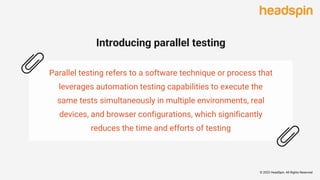
Introducing parallel testing
Parallel testing refers to a software technique or process that
leverages automation testing capabilities to execute the
same tests simultaneously in multiple environments, real
devices, and browser configurations, which significantly
reduces the time and efforts of testing
© 2022 HeadSpin. All Rights Reserved
Entry-level criteria
The Exit level criteria
Parallel testing in Selenium
Selenium Grid enables users to run tests in multiple environments and
browsers concurrently, assisting in performing automated cross
browser testing across several browsers There is a two-level criterion
for executing parallel testing in Selenium:
There is a two-level criterion for
executing parallel testing in Selenium:
© 2022 HeadSpin. All Rights Reserved
1
3
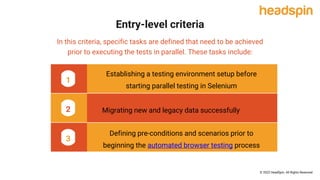
Establishing a testing environment setup before
starting parallel testing in Selenium
2 Migrating new and legacy data successfully
Defining pre-conditions and scenarios prior to
beginning the automated browser testing process
Entry-level criteria
In this criteria, specific tasks are defined that need to be achieved
prior to executing the tests in parallel. These tasks include:
© 2022 HeadSpin. All Rights Reserved
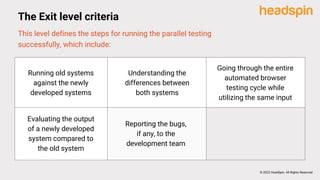
The Exit level criteria
This level defines the steps for running the parallel testing
successfully, which include:
Running old systems
against the newly
developed systems
Understanding the
differences between
both systems
Going through the entire
automated browser
testing cycle while
utilizing the same input
Evaluating the output
of a newly developed
system compared to
the old system
Reporting the bugs,
if any, to the
development team
© 2022 HeadSpin. All Rights Reserved
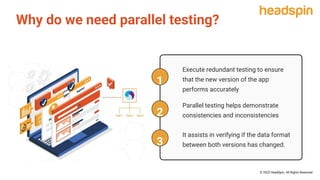
Execute redundant testing to ensure
that the new version of the app
performs accurately
It assists in verifying if the data format
between both versions has changed.
Why do we need parallel testing?
1
Parallel testing helps demonstrate
consistencies and inconsistencies
2
3
© 2022 HeadSpin. All Rights Reserved
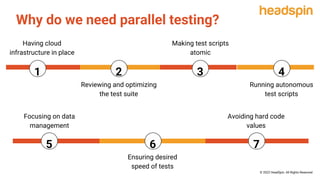
Why do we need parallel testing?
Having cloud
infrastructure in place
Reviewing and optimizing
the test suite
Making test scripts
atomic
Running autonomous
test scripts
Focusing on data
management
Ensuring desired
speed of tests
Avoiding hard code
values
1 2 3 4
5 6 7
© 2022 HeadSpin. All Rights Reserved
Why do we need parallel testing?
1
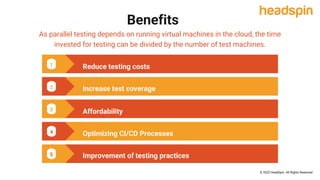
Benefits
As parallel testing depends on running virtual machines in the cloud, the time
invested for testing can be divided by the number of test machines.
2
3
4
5
Reduce testing costs
Increase test coverage
Affordability
Optimizing CI/CD Processes
Improvement of testing practices
© 2022 HeadSpin. All Rights Reserved
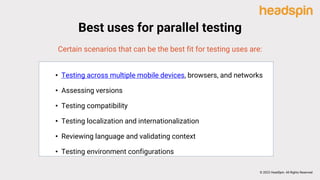
Best uses for parallel testing
Certain scenarios that can be the best fit for testing uses are:
• Testing across multiple mobile devices, browsers, and networks
• Assessing versions
• Testing compatibility
• Testing localization and internationalization
• Reviewing language and validating context
• Testing environment configurations
© 2022 HeadSpin. All Rights Reserved
Parallel testing has been identified as one of the most efficient techniques that enable
developers and testers to create a more effective CI/CD pipeline and minimize risks,
efforts, and costs.Parallelization has also been a key to cutting QA expenses and running
cases at high concurrency, and constantly improving scripts to get more accurate results.
Today's market has opened doors to plentiful parallel testing toolkits to help leverage the
benefits of this testing approach and streamline the entire SDLC.
Conclusion
Reference URL : https://www.headspin.io/blog/parallel-testing-a-comprehensive-guide
© 2022 HeadSpin. All Rights Reserved
Thank You
Why is End-to-End Testing Crucial
for Banking Apps?
How to Test Your Mobile Apps
From Anywhere
Checkout our other Interesting PPTs
© 2022 HeadSpin. All Rights Reserved

Parallel Testing — A comprehensive guide

  • 1.
    Parallel Testing —A comprehensive guide © 2022 HeadSpin. All Rights Reserved
  • 2.
    Introducing parallel testing Paralleltesting refers to a software technique or process that leverages automation testing capabilities to execute the same tests simultaneously in multiple environments, real devices, and browser configurations, which significantly reduces the time and efforts of testing © 2022 HeadSpin. All Rights Reserved
  • 3.
    Entry-level criteria The Exitlevel criteria Parallel testing in Selenium Selenium Grid enables users to run tests in multiple environments and browsers concurrently, assisting in performing automated cross browser testing across several browsers There is a two-level criterion for executing parallel testing in Selenium: There is a two-level criterion for executing parallel testing in Selenium: © 2022 HeadSpin. All Rights Reserved
  • 4.
    1 3 Establishing a testingenvironment setup before starting parallel testing in Selenium 2 Migrating new and legacy data successfully Defining pre-conditions and scenarios prior to beginning the automated browser testing process Entry-level criteria In this criteria, specific tasks are defined that need to be achieved prior to executing the tests in parallel. These tasks include: © 2022 HeadSpin. All Rights Reserved
  • 5.
    The Exit levelcriteria This level defines the steps for running the parallel testing successfully, which include: Running old systems against the newly developed systems Understanding the differences between both systems Going through the entire automated browser testing cycle while utilizing the same input Evaluating the output of a newly developed system compared to the old system Reporting the bugs, if any, to the development team © 2022 HeadSpin. All Rights Reserved
  • 6.
    Execute redundant testingto ensure that the new version of the app performs accurately It assists in verifying if the data format between both versions has changed. Why do we need parallel testing? 1 Parallel testing helps demonstrate consistencies and inconsistencies 2 3 © 2022 HeadSpin. All Rights Reserved
  • 7.
    Why do weneed parallel testing? Having cloud infrastructure in place Reviewing and optimizing the test suite Making test scripts atomic Running autonomous test scripts Focusing on data management Ensuring desired speed of tests Avoiding hard code values 1 2 3 4 5 6 7 © 2022 HeadSpin. All Rights Reserved Why do we need parallel testing?
  • 8.
    1 Benefits As parallel testingdepends on running virtual machines in the cloud, the time invested for testing can be divided by the number of test machines. 2 3 4 5 Reduce testing costs Increase test coverage Affordability Optimizing CI/CD Processes Improvement of testing practices © 2022 HeadSpin. All Rights Reserved
  • 9.
    Best uses forparallel testing Certain scenarios that can be the best fit for testing uses are: • Testing across multiple mobile devices, browsers, and networks • Assessing versions • Testing compatibility • Testing localization and internationalization • Reviewing language and validating context • Testing environment configurations © 2022 HeadSpin. All Rights Reserved
  • 10.
    Parallel testing hasbeen identified as one of the most efficient techniques that enable developers and testers to create a more effective CI/CD pipeline and minimize risks, efforts, and costs.Parallelization has also been a key to cutting QA expenses and running cases at high concurrency, and constantly improving scripts to get more accurate results. Today's market has opened doors to plentiful parallel testing toolkits to help leverage the benefits of this testing approach and streamline the entire SDLC. Conclusion Reference URL : https://www.headspin.io/blog/parallel-testing-a-comprehensive-guide © 2022 HeadSpin. All Rights Reserved
  • 11.
    Thank You Why isEnd-to-End Testing Crucial for Banking Apps? How to Test Your Mobile Apps From Anywhere Checkout our other Interesting PPTs © 2022 HeadSpin. All Rights Reserved