Parallel Programming
Hands-On
·G
oals
·Parallelize a Java application
·Work as a team
·Tackle one phase, or several
·Perform experiments
·Small and large data sets
·Dual­
core Intel workstations – 1 per person
·Eight­
core (64 HW thread) Sun blades – 1 per team
·Present your results (tomorrow)
·10 minutes + 5 minutes of Q&A
·Explanation is more important than speedup
·But first ... some Java
details
·How does one run code on a separate thread?
·Manually spawn a new thread (java.lang, since 1.0)
·Extend Thread, overriding run()
·Implement Runnable, pass it to Thread constructor
·Use a thread pool (java.util.concurrent, since 1.5)
·Implement Runnable, pass to Executor.execute()
·Lower overhead, less work for the operating system
·Use a thread pool to create a Future
·Implement Runnable or Callable, pass to
ExecutorService.submit()
·Task can return a value to the caller, caller can wait for task
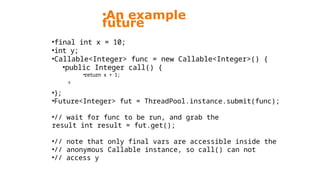
•An example
future
•final int x = 10;
•int y;
•Callable<Integer> func = new Callable<Integer>() {
•public Integer call() {
•return x + 1;
•}
•};
•Future<Integer> fut = ThreadPool.instance.submit(func);
•// wait for func to be run, and grab the
result int result = fut.get();
•// note that only final vars are accessible inside the
•// anonymous Callable instance, so call() can not
•// access y

Parallel Programming Hands-On Presentation

  • 1.
  • 2.
    ·G oals ·Parallelize a Javaapplication ·Work as a team ·Tackle one phase, or several ·Perform experiments ·Small and large data sets ·Dual­ core Intel workstations – 1 per person ·Eight­ core (64 HW thread) Sun blades – 1 per team ·Present your results (tomorrow) ·10 minutes + 5 minutes of Q&A ·Explanation is more important than speedup
  • 3.
    ·But first ...some Java details ·How does one run code on a separate thread? ·Manually spawn a new thread (java.lang, since 1.0) ·Extend Thread, overriding run() ·Implement Runnable, pass it to Thread constructor ·Use a thread pool (java.util.concurrent, since 1.5) ·Implement Runnable, pass to Executor.execute() ·Lower overhead, less work for the operating system ·Use a thread pool to create a Future ·Implement Runnable or Callable, pass to ExecutorService.submit() ·Task can return a value to the caller, caller can wait for task
  • 4.
    •An example future •final intx = 10; •int y; •Callable<Integer> func = new Callable<Integer>() { •public Integer call() { •return x + 1; •} •}; •Future<Integer> fut = ThreadPool.instance.submit(func); •// wait for func to be run, and grab the result int result = fut.get(); •// note that only final vars are accessible inside the •// anonymous Callable instance, so call() can not •// access y