Dilip Sundarraj
Parallel
&
Asynchronous Programming
In
Modern Java
About Me
• Dilip
• Building Software’s since 2008
• Teaching in UDEMY Since 2016
What's Covered ?
• Need for Parallel and Asynchronous Programming
• Covers the ParallelStreams and CompletableFuture API
• Techniques to write Fast Performing Code using Functional Style Concurrency
APIs in Java
• Covers Best Practices using ParallelStreams/CompletableFuture API in your code
• NonBlocking RestFul API Client using CompletableFuture API
• Testing ParallelStreams and CompletableFuture API Using JUnit5
Targeted Audience
• Experienced Java Developers
• Developers who has the need to write code that executes faster
• Developers who has the need to write code that executes in Parallel
• Developer who has the need to write asynchronous/non-blocking code
Source Code
Thank You!
Prerequisites
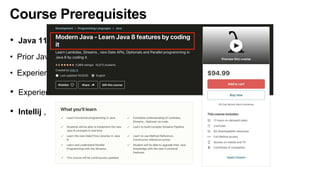
Course Prerequisites
• Java 11 or Higher is needed
• Prior Java knowledge is needed
• Experience working with Lambdas, Streams , Method References
• Experience writing JUnit tests
• Intellij , Eclipse or any other IDE is needed
Why Parallel and Asynchronous
Programming ?
Why Parallel and Asynchronous
Programming?
• We are living in a fast paced environment
• In Software Programming:
• Code that we write should execute faster
• Goal of Asynchronous and Parallel Programming
• Provide Techniques to improve the performance of the code
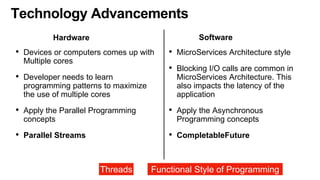
Technology Advancements
• Devices or computers comes up with
Multiple cores
• Developer needs to learn
programming patterns to maximize
the use of multiple cores
• Apply the Parallel Programming
concepts
• Parallel Streams
• MicroServices Architecture style
• Blocking I/O calls are common in
MicroServices Architecture. This
also impacts the latency of the
application
• Apply the Asynchronous
Programming concepts
• CompletableFuture
Hardware Software
Functional Style of Programming
Threads
Evolution
of
Concurrency and Parallelism
APIs
in Java
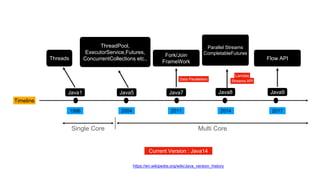
Timeline
1996 2004 2011 2014 2017
Threads
Java1
Single Core Multi Core
Java5
ThreadPool,
ExecutorService,Futures,
ConcurrentCollections etc.,
Java7
Fork/Join
FrameWork
Data Parallelism
Parallel Streams
CompletableFutures
Java8
Lamdas
Streams API
Java9
Flow API
Current Version : Java14
https://en.wikipedia.org/wiki/Java_version_history
Concurrency
vs
Parallelism
Concurrency
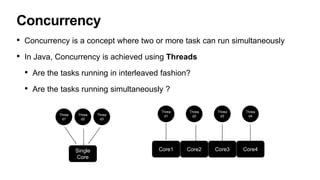
• Concurrency is a concept where two or more task can run simultaneously
• In Java, Concurrency is achieved using Threads
• Are the tasks running in interleaved fashion?
• Are the tasks running simultaneously ?
Single
Core
Threa
d2
Threa
d1
Threa
d3
Core1 Core2 Core3 Core4
MultiCore
Threa
d1
Threa
d2
Threa
d3
Threa
d4
Concurrency Example
public class HelloWorldThreadExample {
private static String result="";
private static void hello(){
delay(500);
result = result.concat("Hello");
}
private static void world(){
delay(600);
result = result.concat(“ World");
}
public static void main(String[] args) throws InterruptedException {
Thread helloThread = new Thread(()-> hello());
Thread worldThread = new Thread(()-> world());
//Starting the thread
helloThread.start();
worldThread.start();
//Joining the thread (Waiting for the threads to finish)
helloThread.join();
worldThread.join();
System.out.println("Result is : " + result);
}
} Hello World
} Threads
1
2
3
• In a real application, Threads normally need to
interact with one another
• Shared Objects or Messaging Queues
• Issues:
• Race Condition
• DeadLock and more
• Tools to handle these issues:
• Synchronized Statements/Methods
• Reentrant Locks, Semaphores
• Concurrent Collections
• Conditional Objects and More
0
0
Parallelism
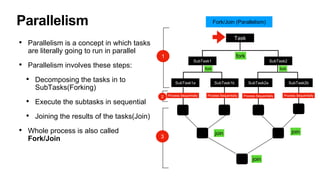
• Parallelism is a concept in which tasks
are literally going to run in parallel
• Parallelism involves these steps:
• Decomposing the tasks in to
SubTasks(Forking)
• Execute the subtasks in sequential
• Joining the results of the tasks(Join)
• Whole process is also called
Fork/Join
1
join
Task
SubTask1 SubTask2
SubTask1a SubTask1b SubTask2a SubTask2b
join
join
Process Sequentially Process Sequentially Process Sequentially Process Sequentially
Fork/Join (Parallelism)
fork
fork fork
3
2
Parallelism Example
UseCase: Transform to UpperCase
[Bob, Jamie, Jill, Rick] -> [BOB, JAMIE, JILL, RICK] 1
3
2
join
Bob, Jamie, Jill, Rick
[Bob,Jamie] [Jill,Rick]
Bob Jamie Jill Rick
BOB
JAMI
E JILL RICK
join
join
Process Sequentially Process Sequentially Process Sequentially Process Sequentially
Fork/Join (Parallelism)
fork
fork fork
BOB, JAMIE, JILL, RICK
[BOB,
JAMIE]
[JILL, RICK]
Bob Jamie Jill Rick
Core1 Core2 Core3 Core4
BOB JAMIE JILL RICK
uppercase uppercase uppercase uppercase
Parallelism Example
public class ParallelismExample {
public static void main(String[] args) {
List<String> namesList = List.of("Bob", "Jamie", "Jill", "Rick");
System.out.println("namesList : " + namesList);
List<String> namesListUpperCase = namesList
.parallelStream()
.map(String::toUpperCase)
.collect(Collectors.toList());
System.out.println("namesListUpperCase : " + namesListUpperCase);
}
}
Concurrency vs Parallelism
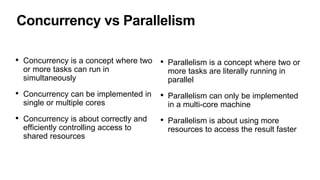
• Concurrency is a concept where two
or more tasks can run in
simultaneously
• Concurrency can be implemented in
single or multiple cores
• Concurrency is about correctly and
efficiently controlling access to
shared resources
• Parallelism is a concept where two or
more tasks are literally running in
parallel
• Parallelism can only be implemented
in a multi-core machine
• Parallelism is about using more
resources to access the result faster
Course Project Setup
Section Overview
Section Overview
• Covers Asynchronous and Parallel Programming prior Java 8
• Threads, Futures and ForkJoin Framework and its limitations
• Covers Theory and Hands On
Overview
of the
Product Service
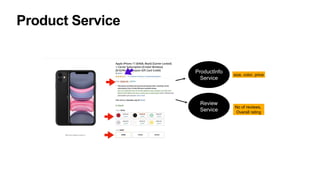
Product Service
Product Service
Client
ProductInfo
Service
Review
Service
ProductId
Product
Product
size, color, price
No of reviews,
Overall rating
Threads
Threads API
• Threads API got introduced in Java1
• Threads are basically used to offload the blocking tasks as
background tasks
• Threads allowed the developers to write asynchronous style of
code
Thread API Limitations
• Requires a lot of code to introduce asynchrony
• Runnable, Thread
• Require additional properties in Runnable
• Start and Join the thread
• Low level
• Easy to introduce complexity in to our code
ThreadPool,
ExecutorService
&
Future
Limitations Of Thread
• Limitations of Thread:
• Create the thread
• Start the thread
• Join the thread
• Threads are expensive
• Threads have their own runtime-stack, memory, registers and more
Thread Pool was created specifically to solve this problem
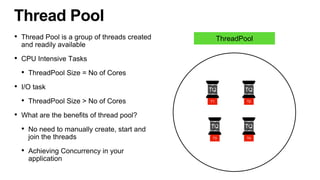
• Thread Pool is a group of threads created
and readily available
• CPU Intensive Tasks
• ThreadPool Size = No of Cores
• I/O task
• ThreadPool Size > No of Cores
• What are the benefits of thread pool?
• No need to manually create, start and
join the threads
• Achieving Concurrency in your
application
Thread Pool
TQ
T1
TQ
T2
TQ
T3
TQ
T4
ThreadPool
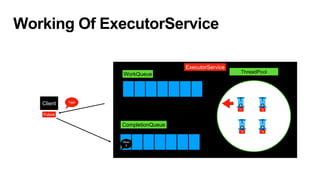
ExecutorService
• Released as part of Java5
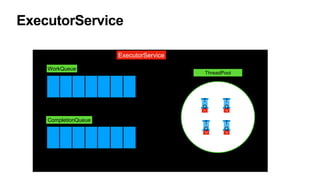
• ExecutorService in Java is an Asynchronous Task Execution Engine
• It provides a way to asynchronously execute tasks and provides the results in
a much simpler way compared to threads
• This enabled coarse-grained task based parallelism in Java
ExecutorService
ExecutorService
WorkQueue
CompletionQueue
T
Q
T1
T
Q
T2
T
Q
T3
T
Q
T4
ThreadPool
Working Of ExecutorService
T
Q
T1
T
Q
T2
T
Q
T3
T
Q
T4
ThreadPool
WorkQueue
CompletionQueue
Client Task
Resu
lt
Future
ExecutorService
Limitations of ExecutorService
• Designed to Block the Thread
• No better way to combine futures
ProductInfo productInfo = productInfoFuture.get();
Review review = reviewFuture.get();
return new Product(productId, productInfo, review);
ProductInfo productInfo = productInfoFuture.get();
Review review = reviewFuture.get();
Fork/Join Framework
Fork/Join Framework
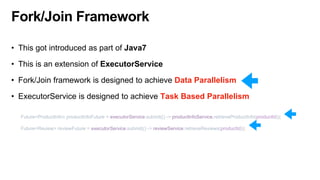
• This got introduced as part of Java7
• This is an extension of ExecutorService
• Fork/Join framework is designed to achieve Data Parallelism
• ExecutorService is designed to achieve Task Based Parallelism
Future<ProductInfo> productInfoFuture = executorService.submit(() -> productInfoService.retrieveProductInfo(productId));
Future<Review> reviewFuture = executorService.submit(() -> reviewService.retrieveReviews(productId));
What is Data Parallelism ?
• Data Parallelism is a concept where a
given Task is recursively split in to
SubTasks until it reaches it leaset
possible size and execute those tasks
in parallel
• Basically it uses the divide and
conquer approach
1
3
2
join
Bob, Jamie, Jill, Rick
[Bob,Jamie] [Jill,Rick]
Bob Jamie Jill Rick
BOB
JAMI
E JILL RICK
join
join
Process Sequentially Process Sequentially Process Sequentially Process Sequentially
Fork/Join (Parallelism)
fork
fork fork
BOB, JAMIE, JILL, RICK
[BOB,
JAMIE]
[JILL, RICK]
Watch "Concurrency vs Parallelism”
How does Fork/Join Framework Works ?
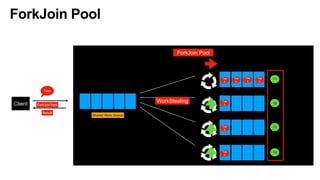
ForkJoin Pool to support Data Parallelism
ForkJoin Pool
ForkJoin Pool
Shared Work Queue
Client
Task
T1
T2
T3
T4
Double Ended Work Queue(deck)
Worker Threads
Tas
k
Tas
k
ForkJoinTask
Tas
k
WorkStealing
Tas
k
Tas
k
Tas
k
Tas
k
Result
ForkJoin Task
• ForkJoin Task represents part of the data
and its computation
• Type of tasks to submit to ForkJoin Pool
• ForkJoinTask
• RecursiveTask -> Task that returns a
value
• RecursiveAction -> Task that does
not return a value
join
Bob, Jamie, Jill, Rick
[Bob,Jamie] [Jill,Rick]
Bob Jamie Jill Rick
BOB
JAMI
E JILL RICK
join
join
Process Sequentially Process Sequentially Process Sequentially Process Sequentially
Fork/Join (Parallelism)
fork
fork fork
BOB, JAMIE, JILL, RICK
[BOB,
JAMIE]
[JILL, RICK]
Fork/Join
Task
Fork/Join Example
ForkJoin - UseCase
[Bob, Jamie, Jill, Rick] -> [3 - Bob, 5 - Jamie, 4 - Jill, 4 - Rick]
Input Output
Streams API
&
Parallel Streams
Streams API
• Streams API got introduced in Java 8
• Streams API is used to process a collection of Objects
• Streams in Java are created by using the stream() method
1
2
3
]Pipeline
Pipeline
Intermediate
Terminal
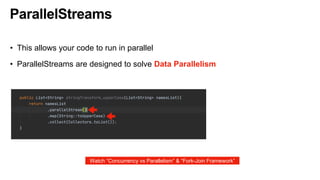
ParallelStreams
• This allows your code to run in parallel
• ParallelStreams are designed to solve Data Parallelism
Watch “Concurrency vs Parallelism” & “Fork-Join Framework”
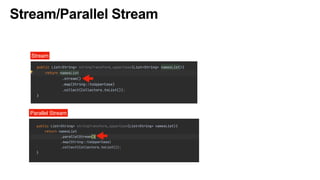
Stream/Parallel Stream
Stream
Parallel Stream
Parallel Streams - UseCase
[Bob, Jamie, Jill, Rick] -> [3 - Bob, 5 - Jamie, 4 - Jill, 4 - Rick]
Input Output
Unit Testing
Parallel Streams
Using
JUnit5
Why Unit Tests ?
• Unit Testing allows you to programmatically test your code
• Manual Testing slows down the development and delivery
• Unit Testing allows the developer or the app team to make enhancements to the
existing code easily and faster
Sequential/Parallel
Functions
in
Streams API
sequential() and parallel()
• Streams API are sequential by default
• sequential() -> Executes the stream in sequential
• parallel() -> Executes the stream in parallel
• Both the functions() changes the behavior of the whole pipeline
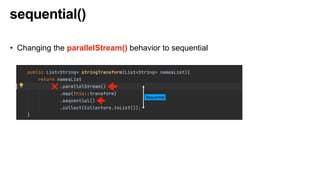
sequential()
• Changing the parallelStream() behavior to sequential
Sequential
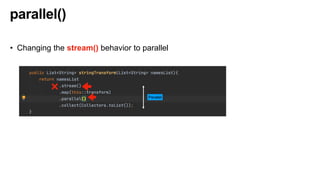
parallel()
• Changing the stream() behavior to parallel
Parallel
When to use sequential() and parallel() ?
Used these functions when I would like to evaluate between sequential() and
parallel()
Overview of the
Retail
Checkout
Service
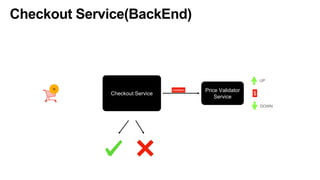
Checkout Service(BackEnd)
Checkout Service
N
Price Validator
Service
CartItem
$
UP
DOWN
ParallelStreams
How it works ?
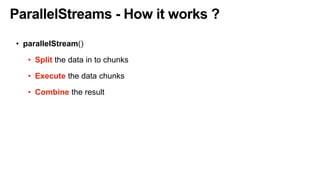
ParallelStreams - How it works ?
• parallelStream()
• Split the data in to chunks
• Execute the data chunks
• Combine the result
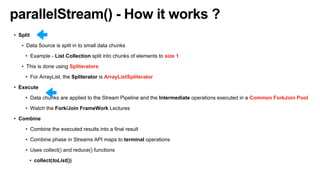
parallelStream() - How it works ?
• Split
• Data Source is split in to small data chunks
• Example - List Collection split into chunks of elements to size 1
• This is done using Spliterators
• For ArrayList, the Spliterator is ArrayListSpliterator
• Execute
• Data chunks are applied to the Stream Pipeline and the Intermediate operations executed in a Common ForkJoin Pool
• Watch the Fork/Join FrameWork Lectures
• Combine
• Combine the executed results into a final result
• Combine phase in Streams API maps to terminal operations
• Uses collect() and reduce() functions
• collect(toList())
parallelStream() - How it works ?
combine
Exe
cute
cartItemsList
cartItemsSplit cartItemsSplit
cartItem cartItem cartItem cartItem
combine
combine
Process Sequentially Process Sequentially Process Sequentially Process Sequentially
parallelStreams()
Split
Split Split
cartItemsList
[cartItem,
cartitem]
[cartItem,
cartitem]
CheckoutService
1
Split
2
Execute Common ForkJoinPool
3
combine
List<CartItem> priceValidationList = cart.getCartItemList()
//.stream()
.parallelStream()
.map(cartItem -> {
boolean isPriceValid = priceValidatorService.isCartItemInvalid(cartItem);
cartItem.setExpired(isPriceValid);
return cartItem;
})
.filter(CartItem::isExpired)
.collect(toList());
Comparing
ArrayList vs LinkedList
ParallelStreams
Performance
Spliterator in ParallelStreams
• Data source is split in to multiple chunks by the Spliterator
• Each and every collection has a different Spliterator Implementation
• Performance differ based on the implementation
Multiply each value in the
collection by a user passed value
[ 1, 2, 3, 4 ] -> [2, 4, 6, 8]
Value * 2
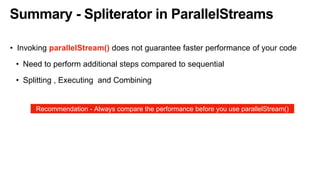
Summary - Spliterator in ParallelStreams
• Invoking parallelStream() does not guarantee faster performance of your code
• Need to perform additional steps compared to sequential
• Splitting , Executing and Combining
Recommendation - Always compare the performance before you use parallelStream()
Parallel Streams
Final Computation Result Order
Parallel Streams - Final Computation Result Order
[Bob, Jamie, Jill, Rick]
[3 - Bob, 5 - Jamie, 4 - Jill, 4 - Rick]
90
90
90
90
Parallel Streams - Final Computation Result Order
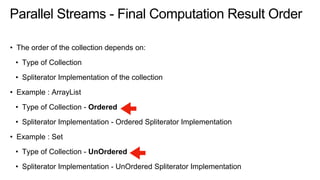
• The order of the collection depends on:
• Type of Collection
• Spliterator Implementation of the collection
• Example : ArrayList
• Type of Collection - Ordered
• Spliterator Implementation - Ordered Spliterator Implementation
• Example : Set
• Type of Collection - UnOrdered
• Spliterator Implementation - UnOrdered Spliterator Implementation
Collect
&
Reduce
Collect( ) vs Reduce( )
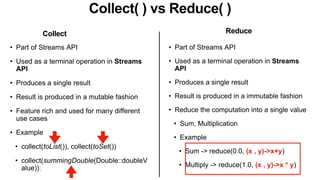
• Part of Streams API
• Used as a terminal operation in Streams
API
• Produces a single result
• Result is produced in a mutable fashion
• Feature rich and used for many different
use cases
• Example
• collect(toList()), collect(toSet())
• collect(summingDouble(Double::doubleV
alue));
• Part of Streams API
• Used as a terminal operation in Streams
API
• Produces a single result
• Result is produced in a immutable fashion
• Reduce the computation into a single value
• Sum, Multiplication
• Example
• Sum -> reduce(0.0, (x , y)->x+y)
• Multiply -> reduce(1.0, (x , y)->x * y)
Collect Reduce
How reduce() works ?
10
[ 1 ,2 ,3 ,4 ]
0+1 => 1
1+2 => 3
3+3 => 6
6+4 10
=>
identity
The reduce( ) function performs an immutable computation throughout in each and every step.
How reduce() with ParallelStream works ?
Sum of N numbers - reduce() and parallelStream()
36
[1,2,3,4,5,6,7,8]
[ 1 ,2 ,3 ,4 ] [ 5 ,6 ,7 ,8 ]
[ 1 ,2 ] [ 3 ,4 ] [ 5 ,6 ] [ 7 ,8 ]
3 7 11 15
10 26
36
Sum of N numbers
Process Sequentially Process Sequentially Process Sequentially Process Sequentially
Split Split
Split Split Split Split
reduce()
reduce()
reduce() reduce()
1
1
3
2
1 Spliterator
2 ForkJoinPool
3 Reduce
0 0 0 0
Want to learn more ?
Collect() & Reduce()
Hands-On
Identity in reduce()
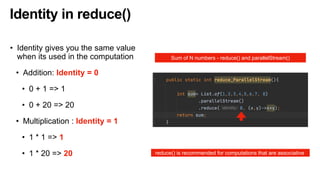
• Identity gives you the same value
when its used in the computation
• Addition: Identity = 0
• 0 + 1 => 1
• 0 + 20 => 20
• Multiplication : Identity = 1
• 1 * 1 => 1
• 1 * 20 => 20
Sum of N numbers - reduce() and parallelStream()
reduce() is recommended for computations that are associative
Parallel Stream Operations
&
Poor Performance
Parallel Stream Operations & Poor Performance
• Stream Operations that perform poor
• Impact of Boxing and UnBoxing when it comes to parallel Streams
• Boxing -> Converting a Primitive Type to Wrapper class equivalent
• 1 -> new Integer(1)
• UnBoxing -> Converting a Wrapper class to Primitive equivalent
• new Integer(1) -> 1
Common ForkJoin Pool
Execution Engine for Parallel Streams
parallelStream() - How it works ?
combine
Exe
cute
cartItemsList
cartItemsSplit cartItemsSplit
cartItem cartItem cartItem cartItem
combine
combine
Process Sequentially Process Sequentially Process Sequentially Process Sequentially
parallelStreams()
Split
Split Split
cartItemsList
[cartItem,
cartitem]
[cartItem,
cartitem]
CheckoutService
1
Split
2
Execute Common ForkJoinPool
3
combine
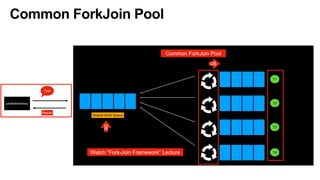
Common ForkJoin Pool
Shared Work Queue
T1
T2
T3
T4
Double Ended Work Queue(deck)
Worker Threads
parallelStreams()
Task
Result
90
90
Watch “Fork-Join Framework” Lecture
Common ForkJoin Pool
• Common ForkJoin Pool is used by:
• ParallelStreams
• CompletableFuture
• Completable Future have options to use a User-defined ThreadPools
• Common ForkJoin Pool is shared by the whole process
Parallelism
&
Threads in
Common ForkJoinPool
Parallelism & Threads in Common
ForkJoinPool
• parallelStreams()
• Runs your code in parallel
• Improves the performance of the code
• Is there a way to look in to parallelism and threads involved ?
• Yes
Modifying
Default parallelism
in
Parallel Streams
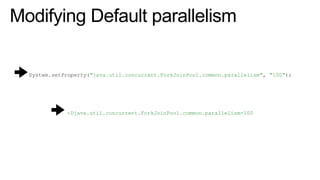
Modifying Default parallelism
System.setProperty("java.util.concurrent.ForkJoinPool.common.parallelism", "100");
-Djava.util.concurrent.ForkJoinPool.common.parallelism=100
OR
Parallel Streams - Summary
Parallel Streams - When to use them ?
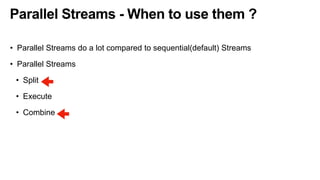
• Parallel Streams do a lot compared to sequential(default) Streams
• Parallel Streams
• Split
• Execute
• Combine
Parallel Streams - When to use them ?
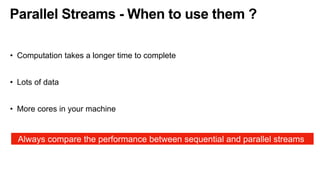
• Computation takes a longer time to complete
• Lots of data
• More cores in your machine
Always compare the performance between sequential and parallel streams
Parallel Streams - When to use them ?
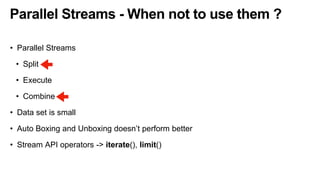
Parallel Streams - When not to use them ?
• Parallel Streams
• Split
• Execute
• Combine
• Data set is small
• Auto Boxing and Unboxing doesn’t perform better
• Stream API operators -> iterate(), limit()
CompletableFuture
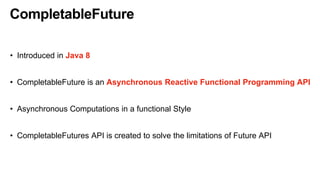
CompletableFuture
• Introduced in Java 8
• CompletableFuture is an Asynchronous Reactive Functional Programming API
• Asynchronous Computations in a functional Style
• CompletableFutures API is created to solve the limitations of Future API
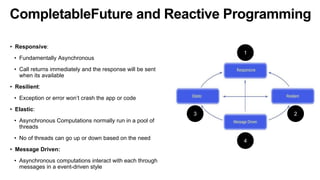
CompletableFuture and Reactive Programming
• Responsive:
• Fundamentally Asynchronous
• Call returns immediately and the response will be sent
when its available
• Resilient:
• Exception or error won’t crash the app or code
• Elastic:
• Asynchronous Computations normally run in a pool of
threads
• No of threads can go up or down based on the need
• Message Driven:
• Asynchronous computations interact with each through
messages in a event-driven style
1
2
3
4
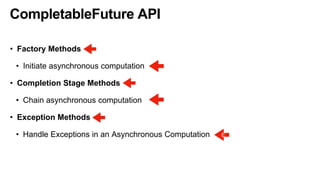
CompletableFuture API
• Factory Methods
• Initiate asynchronous computation
• Completion Stage Methods
• Chain asynchronous computation
• Exception Methods
• Handle Exceptions in an Asynchronous Computation E
Lets Write
our
First CompletableFuture
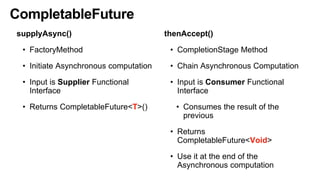
CompletableFuture
supplyAsync()
• FactoryMethod
• Initiate Asynchronous computation
• Input is Supplier Functional
Interface
• Returns CompletableFuture<T>()
thenAccept()
• CompletionStage Method
• Chain Asynchronous Computation
• Input is Consumer Functional
Interface
• Consumes the result of the
previous
• Returns
CompletableFuture<Void>
• Use it at the end of the
Asynchronous computation
thenApply()
thenApply()
• Completion Stage method
• Transform the data from one form to another
• Input is Function Functional Interface
• Returns CompletableFuture<T>
CompletableFuture
]Pipeline
Pipeline
1
2
3
Unit Testing
CompletableFuture
Combing independent
Async Tasks
using
“thenCombine"
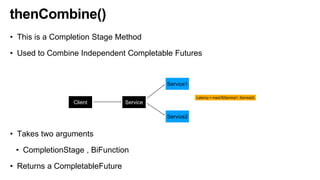
thenCombine()
• This is a Completion Stage Method
• Used to Combine Independent Completable Futures
• Takes two arguments
• CompletionStage , BiFunction
• Returns a CompletableFuture
Client Service
Service1
Service2
Latency = maxOf(Service1, Service2)
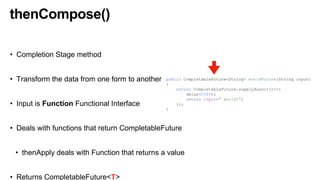
thenCompose
thenCompose()
• Completion Stage method
• Transform the data from one form to another
• Input is Function Functional Interface
• Deals with functions that return CompletableFuture
• thenApply deals with Function that returns a value
• Returns CompletableFuture<T>
public CompletableFuture<String> worldFuture(String input)
{
return CompletableFuture.supplyAsync(()->{
delay(1000);
return input+" world!";
});
}
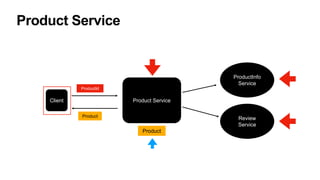
Product Service
Product Service
Client
ProductInfo
Service
Review
Service
ProductId
Product
Product
Combining
Streams
&
CompletableFuture
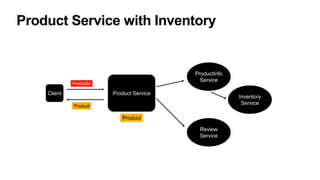
Product Service with Inventory
Product Service
Client
ProductInfo
Service
Review
Service
ProductId
Product
Product
Inventory
Service
Exception
Handling
In
CompletableFuture
Exception Handling in Java
• Exception Handling in Java is available since the inception of Java
]
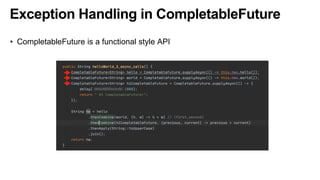
Exception Handling in CompletableFuture
• CompletableFuture is a functional style API
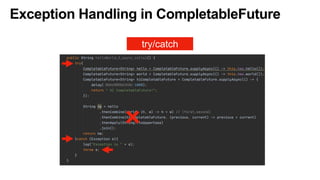
Exception Handling in CompletableFuture
try/catch
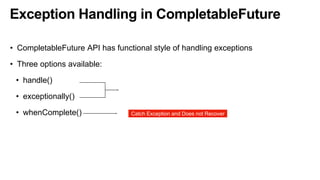
Exception Handling in CompletableFuture
• CompletableFuture API has functional style of handling exceptions
• Three options available:
• handle()
• exceptionally()
• whenComplete()
Catch Exception and Recover
Catch Exception and Does not Recover
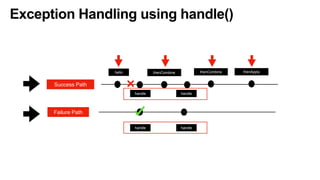
Exception Handling using handle()
Success Path
hello thenCombine thenCombine thenApply
handle handle
handle handle
Failure Path
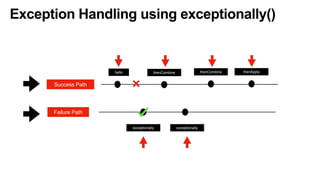
Exception Handling using exceptionally()
Success Path
hello thenCombine thenCombine thenApply
exceptionally
Failure Path
exceptionally
whenHandle()
whenHandle()
• Exception handler in CompletableFuture API
• Catches the Exception but does not recover from the exception
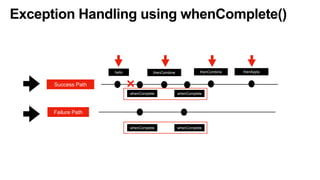
Exception Handling using whenComplete()
Success Path
hello thenCombine thenCombine thenApply
whenComplete whenComplete
Failure Path
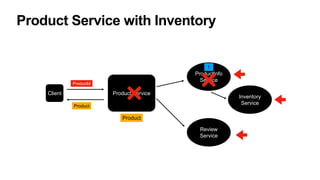
Product Service with Inventory
Product Service
Client
ProductInfo
Service
Review
Service
ProductId
Product
Product
Inventory
Service
!
CompletableFuture
Default ThreadPool
CompletableFuture - ThreadPool
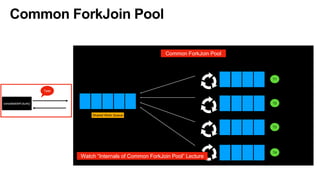
• By default, CompletableFuture uses the Common ForkJoinPool
• The no of threads in the pool == number of cores
Common ForkJoin Pool
Shared Work Queue
T1
T2
T3
T4
Double Ended Work Queue(deck)
Worker Threads
completableFuture()
Task
Result
Watch “Internals of Common ForkJoin Pool” Lecture
CompletableFuture
&
User Defined ThreadPool
using
ExecutorService
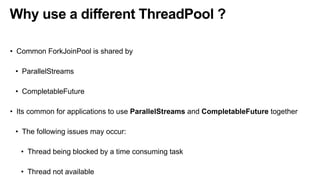
Why use a different ThreadPool ?
• Common ForkJoinPool is shared by
• ParallelStreams
• CompletableFuture
• Its common for applications to use ParallelStreams and CompletableFuture together
• The following issues may occur:
• Thread being blocked by a time consuming task
• Thread not available
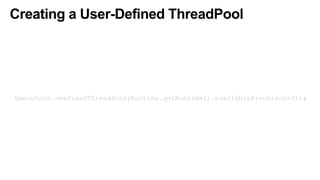
Creating a User-Defined ThreadPool
Executors.newFixedThreadPool(Runtime.getRuntime().availableProcessors());
Threads
In
CompletableFuture
Async()
Overloaded Functions
In
CompletableFuture
Async Overloaded Functions
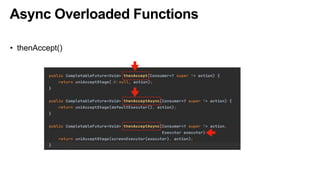
• thenAccept()
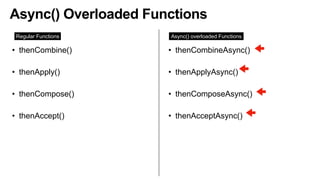
Async() Overloaded Functions
• thenCombine()
• thenApply()
• thenCompose()
• thenAccept()
• thenCombineAsync()
• thenApplyAsync()
• thenComposeAsync()
• thenAcceptAsync()
Regular Functions Async() overloaded Functions
Async() Overloaded Functions
• Using async() functions allows you to change the thread of execution
• Use this when you have blocking operations in your Completablefuture pipeline
Introduction to
Spring WebClient
and
Overview of the GitHub Jobs API
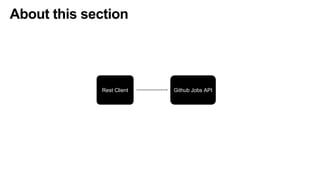
About this section
Rest Client Github Jobs API
Build Restful API
Using
Spring WebClient
Why Spring WebClient?
• Spring is one of the popular framework in the Java Community
• Spring WebClient is a rest client library that’s got released as part of Spring 5
• Spring WebClient is a functional style RestClient
• Spring WebClient can be used as a blocking or non blocking Rest Client
Github Jobs API
allOf()
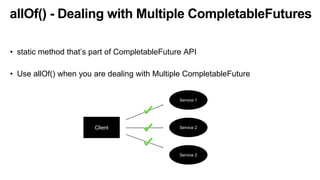
allOf() - Dealing with Multiple CompletableFutures
• static method that’s part of CompletableFuture API
• Use allOf() when you are dealing with Multiple CompletableFuture
Client
Service 1
Service 2
Service 2
anyOf()
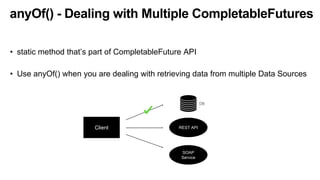
anyOf() - Dealing with Multiple CompletableFutures
• static method that’s part of CompletableFuture API
• Use anyOf() when you are dealing with retrieving data from multiple Data Sources
Client REST API
SOAP
Service
DB
TimeOuts
In
CompletableFuture
Timeouts in CompletableFuture
• Asynchronous tasks may run indefinitely
• Used to timeout a task in CompletableFuture
• orTimeout() in CompletableFutureAPI

parallel-asynchronous-programming-java.pptx

  • 1.
  • 2.
    About Me • Dilip •Building Software’s since 2008 • Teaching in UDEMY Since 2016
  • 3.
    What's Covered ? •Need for Parallel and Asynchronous Programming • Covers the ParallelStreams and CompletableFuture API • Techniques to write Fast Performing Code using Functional Style Concurrency APIs in Java • Covers Best Practices using ParallelStreams/CompletableFuture API in your code • NonBlocking RestFul API Client using CompletableFuture API • Testing ParallelStreams and CompletableFuture API Using JUnit5
  • 4.
    Targeted Audience • ExperiencedJava Developers • Developers who has the need to write code that executes faster • Developers who has the need to write code that executes in Parallel • Developer who has the need to write asynchronous/non-blocking code
  • 5.
  • 6.
  • 7.
  • 8.
    Course Prerequisites • Java11 or Higher is needed • Prior Java knowledge is needed • Experience working with Lambdas, Streams , Method References • Experience writing JUnit tests • Intellij , Eclipse or any other IDE is needed
  • 9.
    Why Parallel andAsynchronous Programming ?
  • 10.
    Why Parallel andAsynchronous Programming? • We are living in a fast paced environment • In Software Programming: • Code that we write should execute faster • Goal of Asynchronous and Parallel Programming • Provide Techniques to improve the performance of the code
  • 11.
    Technology Advancements • Devicesor computers comes up with Multiple cores • Developer needs to learn programming patterns to maximize the use of multiple cores • Apply the Parallel Programming concepts • Parallel Streams • MicroServices Architecture style • Blocking I/O calls are common in MicroServices Architecture. This also impacts the latency of the application • Apply the Asynchronous Programming concepts • CompletableFuture Hardware Software Functional Style of Programming Threads
  • 12.
  • 13.
    Timeline 1996 2004 20112014 2017 Threads Java1 Single Core Multi Core Java5 ThreadPool, ExecutorService,Futures, ConcurrentCollections etc., Java7 Fork/Join FrameWork Data Parallelism Parallel Streams CompletableFutures Java8 Lamdas Streams API Java9 Flow API Current Version : Java14 https://en.wikipedia.org/wiki/Java_version_history
  • 14.
  • 15.
    Concurrency • Concurrency isa concept where two or more task can run simultaneously • In Java, Concurrency is achieved using Threads • Are the tasks running in interleaved fashion? • Are the tasks running simultaneously ? Single Core Threa d2 Threa d1 Threa d3 Core1 Core2 Core3 Core4 MultiCore Threa d1 Threa d2 Threa d3 Threa d4
  • 16.
    Concurrency Example public classHelloWorldThreadExample { private static String result=""; private static void hello(){ delay(500); result = result.concat("Hello"); } private static void world(){ delay(600); result = result.concat(“ World"); } public static void main(String[] args) throws InterruptedException { Thread helloThread = new Thread(()-> hello()); Thread worldThread = new Thread(()-> world()); //Starting the thread helloThread.start(); worldThread.start(); //Joining the thread (Waiting for the threads to finish) helloThread.join(); worldThread.join(); System.out.println("Result is : " + result); } } Hello World } Threads 1 2 3 • In a real application, Threads normally need to interact with one another • Shared Objects or Messaging Queues • Issues: • Race Condition • DeadLock and more • Tools to handle these issues: • Synchronized Statements/Methods • Reentrant Locks, Semaphores • Concurrent Collections • Conditional Objects and More 0 0
  • 17.
    Parallelism • Parallelism isa concept in which tasks are literally going to run in parallel • Parallelism involves these steps: • Decomposing the tasks in to SubTasks(Forking) • Execute the subtasks in sequential • Joining the results of the tasks(Join) • Whole process is also called Fork/Join 1 join Task SubTask1 SubTask2 SubTask1a SubTask1b SubTask2a SubTask2b join join Process Sequentially Process Sequentially Process Sequentially Process Sequentially Fork/Join (Parallelism) fork fork fork 3 2
  • 18.
    Parallelism Example UseCase: Transformto UpperCase [Bob, Jamie, Jill, Rick] -> [BOB, JAMIE, JILL, RICK] 1 3 2 join Bob, Jamie, Jill, Rick [Bob,Jamie] [Jill,Rick] Bob Jamie Jill Rick BOB JAMI E JILL RICK join join Process Sequentially Process Sequentially Process Sequentially Process Sequentially Fork/Join (Parallelism) fork fork fork BOB, JAMIE, JILL, RICK [BOB, JAMIE] [JILL, RICK] Bob Jamie Jill Rick Core1 Core2 Core3 Core4 BOB JAMIE JILL RICK uppercase uppercase uppercase uppercase
  • 19.
    Parallelism Example public classParallelismExample { public static void main(String[] args) { List<String> namesList = List.of("Bob", "Jamie", "Jill", "Rick"); System.out.println("namesList : " + namesList); List<String> namesListUpperCase = namesList .parallelStream() .map(String::toUpperCase) .collect(Collectors.toList()); System.out.println("namesListUpperCase : " + namesListUpperCase); } }
  • 20.
    Concurrency vs Parallelism •Concurrency is a concept where two or more tasks can run in simultaneously • Concurrency can be implemented in single or multiple cores • Concurrency is about correctly and efficiently controlling access to shared resources • Parallelism is a concept where two or more tasks are literally running in parallel • Parallelism can only be implemented in a multi-core machine • Parallelism is about using more resources to access the result faster
  • 21.
  • 22.
  • 23.
    Section Overview • CoversAsynchronous and Parallel Programming prior Java 8 • Threads, Futures and ForkJoin Framework and its limitations • Covers Theory and Hands On
  • 24.
  • 25.
  • 26.
  • 27.
    Threads API • ThreadsAPI got introduced in Java1 • Threads are basically used to offload the blocking tasks as background tasks • Threads allowed the developers to write asynchronous style of code
  • 28.
    Thread API Limitations •Requires a lot of code to introduce asynchrony • Runnable, Thread • Require additional properties in Runnable • Start and Join the thread • Low level • Easy to introduce complexity in to our code
  • 29.
  • 30.
    Limitations Of Thread •Limitations of Thread: • Create the thread • Start the thread • Join the thread • Threads are expensive • Threads have their own runtime-stack, memory, registers and more Thread Pool was created specifically to solve this problem
  • 31.
    • Thread Poolis a group of threads created and readily available • CPU Intensive Tasks • ThreadPool Size = No of Cores • I/O task • ThreadPool Size > No of Cores • What are the benefits of thread pool? • No need to manually create, start and join the threads • Achieving Concurrency in your application Thread Pool TQ T1 TQ T2 TQ T3 TQ T4 ThreadPool
  • 32.
    ExecutorService • Released aspart of Java5 • ExecutorService in Java is an Asynchronous Task Execution Engine • It provides a way to asynchronously execute tasks and provides the results in a much simpler way compared to threads • This enabled coarse-grained task based parallelism in Java
  • 33.
  • 34.
  • 35.
    Limitations of ExecutorService •Designed to Block the Thread • No better way to combine futures ProductInfo productInfo = productInfoFuture.get(); Review review = reviewFuture.get(); return new Product(productId, productInfo, review); ProductInfo productInfo = productInfoFuture.get(); Review review = reviewFuture.get();
  • 36.
  • 37.
    Fork/Join Framework • Thisgot introduced as part of Java7 • This is an extension of ExecutorService • Fork/Join framework is designed to achieve Data Parallelism • ExecutorService is designed to achieve Task Based Parallelism Future<ProductInfo> productInfoFuture = executorService.submit(() -> productInfoService.retrieveProductInfo(productId)); Future<Review> reviewFuture = executorService.submit(() -> reviewService.retrieveReviews(productId));
  • 38.
    What is DataParallelism ? • Data Parallelism is a concept where a given Task is recursively split in to SubTasks until it reaches it leaset possible size and execute those tasks in parallel • Basically it uses the divide and conquer approach 1 3 2 join Bob, Jamie, Jill, Rick [Bob,Jamie] [Jill,Rick] Bob Jamie Jill Rick BOB JAMI E JILL RICK join join Process Sequentially Process Sequentially Process Sequentially Process Sequentially Fork/Join (Parallelism) fork fork fork BOB, JAMIE, JILL, RICK [BOB, JAMIE] [JILL, RICK] Watch "Concurrency vs Parallelism”
  • 39.
    How does Fork/JoinFramework Works ? ForkJoin Pool to support Data Parallelism
  • 40.
    ForkJoin Pool ForkJoin Pool SharedWork Queue Client Task T1 T2 T3 T4 Double Ended Work Queue(deck) Worker Threads Tas k Tas k ForkJoinTask Tas k WorkStealing Tas k Tas k Tas k Tas k Result
  • 41.
    ForkJoin Task • ForkJoinTask represents part of the data and its computation • Type of tasks to submit to ForkJoin Pool • ForkJoinTask • RecursiveTask -> Task that returns a value • RecursiveAction -> Task that does not return a value join Bob, Jamie, Jill, Rick [Bob,Jamie] [Jill,Rick] Bob Jamie Jill Rick BOB JAMI E JILL RICK join join Process Sequentially Process Sequentially Process Sequentially Process Sequentially Fork/Join (Parallelism) fork fork fork BOB, JAMIE, JILL, RICK [BOB, JAMIE] [JILL, RICK] Fork/Join Task
  • 42.
  • 43.
    ForkJoin - UseCase [Bob,Jamie, Jill, Rick] -> [3 - Bob, 5 - Jamie, 4 - Jill, 4 - Rick] Input Output
  • 44.
  • 45.
    Streams API • StreamsAPI got introduced in Java 8 • Streams API is used to process a collection of Objects • Streams in Java are created by using the stream() method 1 2 3 ]Pipeline Pipeline Intermediate Terminal
  • 47.
    ParallelStreams • This allowsyour code to run in parallel • ParallelStreams are designed to solve Data Parallelism Watch “Concurrency vs Parallelism” & “Fork-Join Framework”
  • 48.
  • 49.
    Parallel Streams -UseCase [Bob, Jamie, Jill, Rick] -> [3 - Bob, 5 - Jamie, 4 - Jill, 4 - Rick] Input Output
  • 50.
  • 51.
    Why Unit Tests? • Unit Testing allows you to programmatically test your code • Manual Testing slows down the development and delivery • Unit Testing allows the developer or the app team to make enhancements to the existing code easily and faster
  • 52.
  • 53.
    sequential() and parallel() •Streams API are sequential by default • sequential() -> Executes the stream in sequential • parallel() -> Executes the stream in parallel • Both the functions() changes the behavior of the whole pipeline
  • 54.
    sequential() • Changing theparallelStream() behavior to sequential Sequential
  • 55.
    parallel() • Changing thestream() behavior to parallel Parallel
  • 56.
    When to usesequential() and parallel() ? Used these functions when I would like to evaluate between sequential() and parallel()
  • 57.
  • 58.
    Checkout Service(BackEnd) Checkout Service N PriceValidator Service CartItem $ UP DOWN
  • 59.
  • 60.
    ParallelStreams - Howit works ? • parallelStream() • Split the data in to chunks • Execute the data chunks • Combine the result
  • 61.
    parallelStream() - Howit works ? • Split • Data Source is split in to small data chunks • Example - List Collection split into chunks of elements to size 1 • This is done using Spliterators • For ArrayList, the Spliterator is ArrayListSpliterator • Execute • Data chunks are applied to the Stream Pipeline and the Intermediate operations executed in a Common ForkJoin Pool • Watch the Fork/Join FrameWork Lectures • Combine • Combine the executed results into a final result • Combine phase in Streams API maps to terminal operations • Uses collect() and reduce() functions • collect(toList())
  • 62.
    parallelStream() - Howit works ? combine Exe cute cartItemsList cartItemsSplit cartItemsSplit cartItem cartItem cartItem cartItem cartItem cartItem cartItem cartItem combine combine Process Sequentially Process Sequentially Process Sequentially Process Sequentially parallelStreams() Split Split Split cartItemsList [cartItem, cartitem] [cartItem, cartitem] CheckoutService 1 Split 2 Execute Common ForkJoinPool 3 combine List<CartItem> priceValidationList = cart.getCartItemList() //.stream() .parallelStream() .map(cartItem -> { boolean isPriceValid = priceValidatorService.isCartItemInvalid(cartItem); cartItem.setExpired(isPriceValid); return cartItem; }) .filter(CartItem::isExpired) .collect(toList());
  • 63.
  • 64.
    Spliterator in ParallelStreams •Data source is split in to multiple chunks by the Spliterator • Each and every collection has a different Spliterator Implementation • Performance differ based on the implementation
  • 65.
    Multiply each valuein the collection by a user passed value [ 1, 2, 3, 4 ] -> [2, 4, 6, 8] Value * 2
  • 66.
    Summary - Spliteratorin ParallelStreams • Invoking parallelStream() does not guarantee faster performance of your code • Need to perform additional steps compared to sequential • Splitting , Executing and Combining Recommendation - Always compare the performance before you use parallelStream()
  • 67.
  • 68.
    Parallel Streams -Final Computation Result Order [Bob, Jamie, Jill, Rick] [3 - Bob, 5 - Jamie, 4 - Jill, 4 - Rick] 90 90 90 90
  • 69.
    Parallel Streams -Final Computation Result Order • The order of the collection depends on: • Type of Collection • Spliterator Implementation of the collection • Example : ArrayList • Type of Collection - Ordered • Spliterator Implementation - Ordered Spliterator Implementation • Example : Set • Type of Collection - UnOrdered • Spliterator Implementation - UnOrdered Spliterator Implementation
  • 70.
  • 71.
    Collect( ) vsReduce( ) • Part of Streams API • Used as a terminal operation in Streams API • Produces a single result • Result is produced in a mutable fashion • Feature rich and used for many different use cases • Example • collect(toList()), collect(toSet()) • collect(summingDouble(Double::doubleV alue)); • Part of Streams API • Used as a terminal operation in Streams API • Produces a single result • Result is produced in a immutable fashion • Reduce the computation into a single value • Sum, Multiplication • Example • Sum -> reduce(0.0, (x , y)->x+y) • Multiply -> reduce(1.0, (x , y)->x * y) Collect Reduce
  • 72.
    How reduce() works? 10 [ 1 ,2 ,3 ,4 ] 0+1 => 1 1+2 => 3 3+3 => 6 6+4 10 => identity The reduce( ) function performs an immutable computation throughout in each and every step.
  • 73.
    How reduce() withParallelStream works ? Sum of N numbers - reduce() and parallelStream() 36 [1,2,3,4,5,6,7,8] [ 1 ,2 ,3 ,4 ] [ 5 ,6 ,7 ,8 ] [ 1 ,2 ] [ 3 ,4 ] [ 5 ,6 ] [ 7 ,8 ] 3 7 11 15 10 26 36 Sum of N numbers Process Sequentially Process Sequentially Process Sequentially Process Sequentially Split Split Split Split Split Split reduce() reduce() reduce() reduce() 1 1 3 2 1 Spliterator 2 ForkJoinPool 3 Reduce 0 0 0 0
  • 74.
  • 75.
  • 76.
  • 77.
    Identity in reduce() •Identity gives you the same value when its used in the computation • Addition: Identity = 0 • 0 + 1 => 1 • 0 + 20 => 20 • Multiplication : Identity = 1 • 1 * 1 => 1 • 1 * 20 => 20 Sum of N numbers - reduce() and parallelStream() reduce() is recommended for computations that are associative
  • 78.
  • 79.
    Parallel Stream Operations& Poor Performance • Stream Operations that perform poor • Impact of Boxing and UnBoxing when it comes to parallel Streams • Boxing -> Converting a Primitive Type to Wrapper class equivalent • 1 -> new Integer(1) • UnBoxing -> Converting a Wrapper class to Primitive equivalent • new Integer(1) -> 1
  • 80.
  • 81.
    Common ForkJoin Pool ExecutionEngine for Parallel Streams
  • 82.
    parallelStream() - Howit works ? combine Exe cute cartItemsList cartItemsSplit cartItemsSplit cartItem cartItem cartItem cartItem cartItem cartItem cartItem cartItem combine combine Process Sequentially Process Sequentially Process Sequentially Process Sequentially parallelStreams() Split Split Split cartItemsList [cartItem, cartitem] [cartItem, cartitem] CheckoutService 1 Split 2 Execute Common ForkJoinPool 3 combine
  • 83.
    Common ForkJoin Pool CommonForkJoin Pool Shared Work Queue T1 T2 T3 T4 Double Ended Work Queue(deck) Worker Threads parallelStreams() Task Result 90 90 Watch “Fork-Join Framework” Lecture
  • 84.
    Common ForkJoin Pool •Common ForkJoin Pool is used by: • ParallelStreams • CompletableFuture • Completable Future have options to use a User-defined ThreadPools • Common ForkJoin Pool is shared by the whole process
  • 85.
  • 86.
    Parallelism & Threadsin Common ForkJoinPool • parallelStreams() • Runs your code in parallel • Improves the performance of the code • Is there a way to look in to parallelism and threads involved ? • Yes
  • 87.
  • 88.
    Modifying Default parallelism System.setProperty("java.util.concurrent.ForkJoinPool.common.parallelism","100"); -Djava.util.concurrent.ForkJoinPool.common.parallelism=100 OR
  • 89.
  • 90.
    Parallel Streams -When to use them ?
  • 91.
    Parallel Streams -When to use them ? • Parallel Streams do a lot compared to sequential(default) Streams • Parallel Streams • Split • Execute • Combine
  • 92.
    Parallel Streams -When to use them ? • Computation takes a longer time to complete • Lots of data • More cores in your machine Always compare the performance between sequential and parallel streams
  • 93.
    Parallel Streams -When to use them ?
  • 94.
    Parallel Streams -When not to use them ? • Parallel Streams • Split • Execute • Combine • Data set is small • Auto Boxing and Unboxing doesn’t perform better • Stream API operators -> iterate(), limit()
  • 95.
  • 96.
    CompletableFuture • Introduced inJava 8 • CompletableFuture is an Asynchronous Reactive Functional Programming API • Asynchronous Computations in a functional Style • CompletableFutures API is created to solve the limitations of Future API
  • 97.
    CompletableFuture and ReactiveProgramming • Responsive: • Fundamentally Asynchronous • Call returns immediately and the response will be sent when its available • Resilient: • Exception or error won’t crash the app or code • Elastic: • Asynchronous Computations normally run in a pool of threads • No of threads can go up or down based on the need • Message Driven: • Asynchronous computations interact with each through messages in a event-driven style 1 2 3 4
  • 98.
    CompletableFuture API • FactoryMethods • Initiate asynchronous computation • Completion Stage Methods • Chain asynchronous computation • Exception Methods • Handle Exceptions in an Asynchronous Computation E
  • 99.
  • 100.
    CompletableFuture supplyAsync() • FactoryMethod • InitiateAsynchronous computation • Input is Supplier Functional Interface • Returns CompletableFuture<T>() thenAccept() • CompletionStage Method • Chain Asynchronous Computation • Input is Consumer Functional Interface • Consumes the result of the previous • Returns CompletableFuture<Void> • Use it at the end of the Asynchronous computation
  • 101.
  • 102.
    thenApply() • Completion Stagemethod • Transform the data from one form to another • Input is Function Functional Interface • Returns CompletableFuture<T>
  • 103.
  • 104.
  • 105.
  • 106.
    thenCombine() • This isa Completion Stage Method • Used to Combine Independent Completable Futures • Takes two arguments • CompletionStage , BiFunction • Returns a CompletableFuture Client Service Service1 Service2 Latency = maxOf(Service1, Service2)
  • 107.
  • 108.
    thenCompose() • Completion Stagemethod • Transform the data from one form to another • Input is Function Functional Interface • Deals with functions that return CompletableFuture • thenApply deals with Function that returns a value • Returns CompletableFuture<T> public CompletableFuture<String> worldFuture(String input) { return CompletableFuture.supplyAsync(()->{ delay(1000); return input+" world!"; }); }
  • 109.
  • 110.
  • 111.
    Product Service withInventory Product Service Client ProductInfo Service Review Service ProductId Product Product Inventory Service
  • 112.
  • 113.
    Exception Handling inJava • Exception Handling in Java is available since the inception of Java ]
  • 114.
    Exception Handling inCompletableFuture • CompletableFuture is a functional style API
  • 115.
    Exception Handling inCompletableFuture try/catch
  • 116.
    Exception Handling inCompletableFuture • CompletableFuture API has functional style of handling exceptions • Three options available: • handle() • exceptionally() • whenComplete() Catch Exception and Recover Catch Exception and Does not Recover
  • 117.
    Exception Handling usinghandle() Success Path hello thenCombine thenCombine thenApply handle handle handle handle Failure Path
  • 118.
    Exception Handling usingexceptionally() Success Path hello thenCombine thenCombine thenApply exceptionally Failure Path exceptionally
  • 119.
  • 120.
    whenHandle() • Exception handlerin CompletableFuture API • Catches the Exception but does not recover from the exception
  • 121.
    Exception Handling usingwhenComplete() Success Path hello thenCombine thenCombine thenApply whenComplete whenComplete whenComplete whenComplete Failure Path
  • 122.
    Product Service withInventory Product Service Client ProductInfo Service Review Service ProductId Product Product Inventory Service !
  • 123.
  • 124.
    CompletableFuture - ThreadPool •By default, CompletableFuture uses the Common ForkJoinPool • The no of threads in the pool == number of cores
  • 125.
    Common ForkJoin Pool CommonForkJoin Pool Shared Work Queue T1 T2 T3 T4 Double Ended Work Queue(deck) Worker Threads completableFuture() Task Result Watch “Internals of Common ForkJoin Pool” Lecture
  • 126.
  • 127.
    Why use adifferent ThreadPool ? • Common ForkJoinPool is shared by • ParallelStreams • CompletableFuture • Its common for applications to use ParallelStreams and CompletableFuture together • The following issues may occur: • Thread being blocked by a time consuming task • Thread not available
  • 128.
    Creating a User-DefinedThreadPool Executors.newFixedThreadPool(Runtime.getRuntime().availableProcessors());
  • 129.
  • 130.
  • 131.
  • 132.
    Async() Overloaded Functions •thenCombine() • thenApply() • thenCompose() • thenAccept() • thenCombineAsync() • thenApplyAsync() • thenComposeAsync() • thenAcceptAsync() Regular Functions Async() overloaded Functions
  • 133.
    Async() Overloaded Functions •Using async() functions allows you to change the thread of execution • Use this when you have blocking operations in your Completablefuture pipeline
  • 134.
  • 135.
    About this section RestClient Github Jobs API
  • 136.
  • 137.
    Why Spring WebClient? •Spring is one of the popular framework in the Java Community • Spring WebClient is a rest client library that’s got released as part of Spring 5 • Spring WebClient is a functional style RestClient • Spring WebClient can be used as a blocking or non blocking Rest Client
  • 138.
  • 139.
  • 140.
    allOf() - Dealingwith Multiple CompletableFutures • static method that’s part of CompletableFuture API • Use allOf() when you are dealing with Multiple CompletableFuture Client Service 1 Service 2 Service 2
  • 141.
  • 142.
    anyOf() - Dealingwith Multiple CompletableFutures • static method that’s part of CompletableFuture API • Use anyOf() when you are dealing with retrieving data from multiple Data Sources Client REST API SOAP Service DB
  • 143.
  • 144.
    Timeouts in CompletableFuture •Asynchronous tasks may run indefinitely • Used to timeout a task in CompletableFuture • orTimeout() in CompletableFutureAPI