-------------------------------------------- 
Al- 
Jannah 
wa 
An-Naar 
In The Light of the Qur'aan and Sunnah 
Based on the Book by Dr. Umar Sulaiman al- 
Ashqar
-------------------------------------------- 
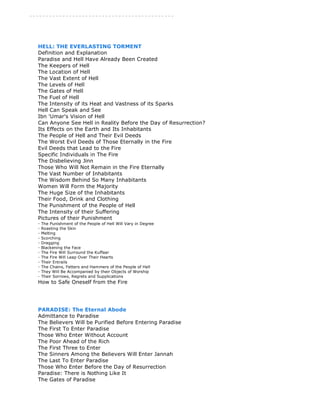
HELL: THE EVERLASTING TORMENT 
Definition and Explanation 
Paradise and Hell Have Already Been Created 
The Keepers of Hell 
The Location of Hell 
The Vast Extent of Hell 
The Levels of Hell 
The Gates of Hell 
The Fuel of Hell 
The Intensity of its Heat and Vastness of its Sparks 
Hell Can Speak and See 
Ibn 'Umar's Vision of Hell 
Can Anyone See Hell in Reality Before the Day of Resurrection? 
Its Effects on the Earth and Its Inhabitants 
The People of Hell and Their Evil Deeds 
The Worst Evil Deeds of Those Eternally in the Fire 
Evil Deeds that Lead to the Fire 
Specific Individuals in The Fire 
The Disbelieving Jinn 
Those Who Will Not Remain in the Fire Eternally 
The Vast Number of Inhabitants 
The Wisdom Behind So Many Inhabitants 
Women Will Form the Majority 
The Huge Size of the Inhabitants 
Their Food, Drink and Clothing 
The Punishment of the People of Hell 
The Intensity of their Suffering 
Pictures of their Punishment 
- The Punishment of the People of Hell Will Vary in Degree 
- Roasting the Skin 
- Melting 
- Scorching 
- Dragging 
- Blackening the Face 
- The Fire Will Surround the Kuffaar 
- The Fire Will Leap Over Their Hearts 
- Their Entrails 
- The Chains, Fetters and Hammers of the People of Hell 
- They Will Be Accompanied by their Objects of Worship 
- Their Sorrows, Regrets and Supplications 
How to Safe Oneself from the Fire 
PARADISE: The Eternal Abode 
Admittance to Paradise 
The Believers Will be Purified Before Entering Paradise 
The First To Enter Paradise 
Those Who Enter Without Account 
The Poor Ahead of the Rich 
The First Three to Enter 
The Sinners Among the Believers Will Enter Jannah 
The Last To Enter Paradise 
Those Who Enter Before the Day of Resurrection 
Paradise: There is Nothing Like It 
The Gates of Paradise
-------------------------------------------- 
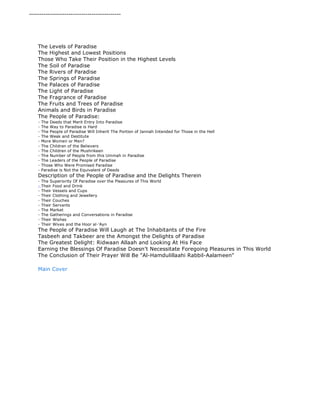
The Levels of Paradise 
The Highest and Lowest Positions 
Those Who Take Their Position in the Highest Levels 
The Soil of Paradise 
The Rivers of Paradise 
The Springs of Paradise 
The Palaces of Paradise 
The Light of Paradise 
The Fragrance of Paradise 
The Fruits and Trees of Paradise 
Animals and Birds in Paradise 
The People of Paradise: 
- The Deeds that Merit Entry Into Paradise 
- The Way to Paradise is Hard 
- The People of Paradise Will Inherit The Portion of Jannah Intended for Those in the Hell 
- The Weak and Destitute 
- More Women or Men? 
- The Children of the Believers 
- The Children of the Mushrikeen 
- The Number of People from this Ummah in Paradise 
- The Leaders of the People of Paradise 
- Those Who Were Promised Paradise 
- Paradise is Not the Equivalent of Deeds 
Description of the People of Paradise and the Delights Therein 
- The Superiority Of Paradise over the Pleasures of This World 
- Their Food and Drink 
- Their Vessels and Cups 
- Their Clothing and Jewellery 
- Their Couches 
- Their Servants 
- The Market 
- The Gatherings and Conversations in Paradise 
- Their Wishes 
- Their Wives and the Hoor al-'Ayn 
The People of Paradise Will Laugh at The Inhabitants of the Fire 
Tasbeeh and Takbeer are the Amongst the Delights of Paradise 
The Greatest Delight: Ridwaan Allaah and Looking At His Face 
Earning the Blessings Of Paradise Doesn't Necessitate Foregoing Pleasures in This World 
The Conclusion of Their Prayer Will Be "Al-Hamdulillaahi Rabbil-Aalameen" 
Main Cover
-------------------Al-Jannah wa An-Naar------------------------- 
Innal-Hamdalillah was-Salaatu was-Salaam `alaa Rasoolillah 
as-Salaamu `alaykum wa-rahmatullaahi wa-barakaatuhu 
Bi'idhnillaah a very important series begins on the list today, concerned with the subject of al-Jannah and an 
and the Hell-Fire. One of these two will be the end destination, moreover the eternal abode, for each and every Therefore it is crucial for us to reflect on what Allaah has prepared for mankind - for those who are obedient and favours, and for those who reject His sins and rebel against Him. 
It is my intention with these posts, after seeking the pleasure of Allaah azza wa jall, to touch the hearts of each you, as the book, on which this series is based - "The Final Day: Paradise and Hell" by Dr. 'Umar Sulaiman al 
the College of Shariah, University of Jordan - touched mine. To fill your hearts with fear of Allaah's punishment mine; To fill your hearts as mine was filled with Love for Allaah subhaanahu wa ta'ala and an incredible yearning and bliss of al-Jinaan, the Gardens; and insha'Allaah to put this dunyaa in perspective and thus to inspire us to the cause of Allaah and His Deen, to work to save our heels from even feeling the heat of the Hell-fire. 
So I ask Allaah, for the sake of our own souls, that we read each word carefully, and deeply reflect upon the Aayaat the sayings of His Messenger, so that insha'Allaah we will live our lives, as if we could see the Fire on one side Garden on the other. Surely, as the Prophet sallallaahu 'alayhi was-sallam said, there is no life but the life of al
-------------------Al-Jannah wa An-Naar------------------------- 
Definition and Explanation 
Hell is the abode which Allaah (swt) has prepared for those who do not believe in Him (swt), those who rebel against laws and disbelieve in His Messengers. It is the punishment for His (swt) enemies, the prison for evildoers. 
It is the ultimate humiliation and loss; there is nothing worse: 
"Our Lord! Verily, whom You admit to the Fire, indeed, You have disgraced him, and never will the Dhaalimoon 
[polytheists and wrongdoers] find any helpers" (3:192) 
"Know they not that whoever opposes and shows hostility to Allaah and His Messenger, certainly for fire of Hell to abide therein? That is extreme disgrace". (9:63) 
"The losers are those who will lose themselves and their families on the Day of Resurrection. Verily, manifest loss!" (39:15) 
How could Hell be other than we have described, when it is full of utterly indescribable torment, pain and grief? its inhabitants will remain there forever. Allaah (swt) has condemned them and their place in the Fire: 
"Evil indeed it [Hell] is as an abode and as a place to dwell" (25:66) 
"This is so! And for the Tagheen [transgressors] - will be an evil final return - Hell! Where they will [indeed] is that place to rest!" (38:55-6) 
Paradise and Hell Have Already Been Created 
at-Tahhaawi said, in his book on al-'Aqeedah al-Salafiyyah (correct belief in accordance with that of the early generations Islaam) that is known as al-'Aqeedah al-Tahhaawiyyah. 
"Paradise and Hell have already been created. They will never come to an end or cease to exist. Allaah (swt) created Hell before the rest of creation, and He (swt) created inhabitants for each of them. Whoever He (swt) wishes (by His grace and mercy, and whoever He (swt) wishes (will enter Hell) as a result of His (swt) justice. Every person according to that for which he was created, and his destiny will be that for which he was created; good deeds and foreordained for all men". 
Muhammad ibn Muhammad ibn Abul-'Izz al-Hanafi remarked, in his commentary on this text: 
"With regard to his saying that Paradise and Hell have already been created, Ahl as-Sunnah agree that Paradise been created and are in existence at the present moment. Ahlus-Sunnah continued to hold this view, until some Mu'tazilah and Qaadariyyah came along, which denied that. These groups said: "Allaah will create them (ie Paradise the Day of Resurrection." They said this because of their false arguments by means of which they seek to improve what Allaah (swt) should do; (they say) it befits Allaah (swt) to do this, or it does not befit Allaah (swt) to do that. Him to His creation and their actions. This is a kind of anthropomorphism with regard to deeds; they have allowed Jahmiyyah (a sect of Mu'tazilah named after the deviant, Jahm ibn Safwan) to creep into their thinking, and have mu'attalah (those who deny that Allaah can see). They said, "It does not make sense for Paradise to be created reward, because it will not be used or inhabited for a very long time. They rejected the aayaat and reports that false notions they seek to project onto Allaah (swt). They misinterpreted the texts and accused those who disagreed going astray and concocting bid'ah". 
Proofs from the Qur'aan and Hadeeth in support of this are, for example:
-------------------Al-Jannah wa An-Naar------------------------- 
al-Bukhaari and Muslim also report from 'Abdullaah ibn 'Umar (ra) that the Messenger of Allaah (saw) said, 
you dies, he will be shown his position morning and evening. If he is one of the people of Paradise then one of the people of Paradise, and if he is one of the people of Hell, then he will be one of the people "Race with one another in hastening towards forgiveness from your Lord, and Paradise the width whereof width of the heaven and the earth, prepared for those who believe in Allaah and His Messengers. That Allaah, which He bestows on whom He is pleased with. And Allaah is the Owner of Great Bounty". 
"...for Paradise as wide as are the heavens and the earth, prepared for al-Muttaqun" (3:133) 
"And fear the fire, which is prepared for the disbelievers" (3:131) 
"And indeed he (Muhammad) saw him (Jibreel) at a second descent (ie another time), near Sidrat al 
tree of the utmost boundary (beyond which none can pass), near it is the Paradise of Abode" 
The Prophet (saw) saw Sidrat al-Muntahaa, a tree in Heaven, and near it, Paradise, as is mention in al 
the hadith of Anas (ra). At the end of this narrative of al-Israa, the Prophet (saw) said, "Then Jibreel brought Muntahaa which was veiled in colours indescribable. Then I entered Paradise, and its lights were of soil was musk". 
Muslim, Abu Dawud and Imaam Ahmad report from Abu Hurayrah (ra) that the Messenger (saw) said, 
created Paradise and Hell, He sent Jibreel to Paradise, saying "Go and look at it and at what I have for its inhabitants". So he went and looked at it and at what Allaah had prepared therein for its inhabitants.... He sent him to Hellfire saying, "Go and look at it and what I have prepared therein for its inhabitants" at it and saw that it was in layers, one above the other...." 
Muslim reports from Aishah (ra) that there was a solar eclipse in the time of the Messenger (saw) and he said, standing here I saw everything that you have been promised, I even saw myself picking some of the Paradise, when you saw me stepping forward. And I saw Hellfire, parts of it consuming other parts, me stepping backward". 
al-Bukhaari and Muslim report from Ibn 'Abbas the same incident, "I saw Paradise and I tried to take a bunch I had managed to do so, you would have eaten from it until the end of time. And I saw the Fire of Hell, never seen anything so horrific or terrifying. I saw that the majority of its inhabitants are women." 
Muslim also reports from Anas that the Prophet (Saw) said, "By the One in Whose Hand is my soul, if you saw, you would laugh little and cry much." They said, "What did you see, O Messenger of Allaah?", Paradise and Hell". 
The Prophet (saw) also ascended into jannah on the night of Mi'raj in his 'Isra (night journey): for example 
* "...I saw four rivers flowing out from beneath Sidrat al-Muntahaa, two visible and two hidden." 
Imaan, Baab al-'Israa, 1/150, no.164) * "Whilst I was walking in Paradise I saw a river whose banks were hollow pearls and I asked, "What is this, O Jibreel?" He said, "This is al-Kawthar which your Rabb has (from Anas ibn Maalik, Sahih al-Bukhaari, Kitaab ar-Riqaaq, Baab fil-Hawd, Fath al-Baari, 11/464) 
* al-Bukhaari and Muslim report from Jaabir that the Messenger of Allaah said, "I entered Paradise where I Rumaysa, the wife of Abu Talhah. And I heard footsteps and asked, "Who is that?" He (Jibreel) said, And I saw a palace with women in its courtyard. I asked, "Whose is this?" They said, It is for 'Umar Khattab" (Mishkaat al-Masaabih, 3/226) 
Imaam Ahmed, Ibn Hibbaan and al-Haakim report from Abu Hurayrah that the Prophet (saw) said, "The children believers are in Paradise, being cared for by Ibraahim (as) [and in the narration of Abu Nu'aym, ad 
Asakir it adds- "and Sarah, until they give them back to their parents on the day of Resurrection"
-------------------Al-Jannah wa An-Naar------------------------- 
will be told, "This is your position, until Allaah (swt) resurrects you on the Day of Resurrection". 
According to al-Muwatta of Imaam Maalik and as-Sunaan, Abu Dawood, "Ka'b ibn Maalik said the Messenger of "Verily the soul of the believer is a bird hanging on to the trees of Paradise, until Allaah Swt returns the day of Resurrection" 
This makes it clear that souls will enter Paradise before the Day of Resurrection. 
As for the specious arguments of those who say that Hell has not been created yet, they say: If it was already it would of necessity have to come to an end of the Day of Resurrection and everyone in it would have to perish says: "And We have set none but angels as guardians of the Fire, and We have fixed their numbers [19] only "Everything will perish save His Face" (28:88) and "Everyone shall taste death.." (3:185) The response you mean that Paradise does not exist until the Trumpet is blown and people are resurrected from their graves, incorrect and is refuted by the evidence quoted above and other proofs which we have not mentioned here. If Allaah (swt) has not yet completed the creation of everything that He will prepare for the inhabitants of Paradise still creating more and more things in it, and that when the believers enter Paradise, Allaah (swt) will create even it, then this is true and cannot be refuted, and the evidence that you give can only mean this, but when you use "Everything will perish save His Face" - as evidence, your problem is that you misinterpret this aayah. Using Paradise and Hell do not yet exist is like your colleagues using it to prove that they will both be destroyed and will all perish! You and your scholars did not understand the aayah properly; only the leaders (great scholars) of understood it properly. They say that "everything" for which Allaah (swt) has decreed destruction and oblivion Paradise and Hell have been created to last forever and never pass away, as has the Throne, which forms the roof "It was suggested that it meant that everything would perish except His dominion, or whatever was done for His suggestion was that when Allaah (swt) revealed the word: "Whatever is on it will perish" - the angels said, "The are doomed", and hoped that they would remain. Allaah said that the people of heaven and earth would perish invoke not any other ilaah along with Allaah, Laa ilaaha illaa Huwaa. Everything will perish save His because He is the Living and does not die. The angels realise that they too were destined to die. Their words should the light of and reconciled with other clear and unambiguous reports that prove that both Paradise and Hell are (Sharh at-Tahaawiyyah, p.479, see also Siddeeq Hasan Khan, Yaqadhah ula al-'i'tibaar, p. 37 and 'Aqeedah as 
The Keepers of Hell 
Standing over Hell are MIGHTY and STERN angels who never disobey Allaah subhaanahu wa ta'ala Who has created do whatever He commands them, as Allaah subhaanahu wa ta'ala says: 
"O you who believe! Save yourselves and your families from a Fire whose fuel is men and stones, over [appointed] angels stern [and] severe, who flinch not [from executing] the Commands they receive do [precisely what] they are commanded." (66:6) 
Their number is nineteen as Allaah (swt) says: 
"Soon I will cast him into Hellfire. And what will explain to you what Hellfire is? Naught does it permit and naught does it leave alone! Darkening and changing the colour of man! Over it are nineteen [angels guardians and keepers of Hell]" (74:26-30) 
This number was a challenge to the kuffaar who thought that they would easily overcome such a small number, realise that one of these angels has the strength to confront the whole of mankind on his own. For this reason, in the next aayah:
-------------------Al-Jannah wa An-Naar------------------------- 
the disbelievers.." (74:31) 
Ibn Rajab said, "What is known and well-established among the earlier and later generations (as-Salaf wal 
came about when the number of angels was mentioned and the kuffaar thought that it was possible to kill them. that they would be able to fight and resist them. They did not know that humankind in its entireity would not be even ONE of them." (at-Takhweef min an-Naar, p.174) 
These angels are the ones whom Allaah subhaanahu wa ta'ala called the 
guardians of Hell: 
"Those in the Fire will say to the keepers [angels] of Hell: "Call upon your Rabb to lighten for us the day!" (40:49) 
The Location of Hell 
The scholars differ as to where Hell is located at present. Some say that it is in the lower Earth, other say that heavens, and yet others refrain from discussing the matter at all. This last group is correct, because there are reports that define the location of Hell. One of those who prefer not to discuss the matter at all is al 
as-Suyuti who said, "Do not discuss Hell, i.e. do not discuss where it is locaetd, for none knows this except Allaah know of no hadeeth that I could rely on with regard to this issue". (Siddiq Hasan Khan, Yaqazah uli al 
Sheikh Waliullaah ad-Dahlawee says in, his 'Aqeedah, "There is no clear text which states their location (of Paradise They are wherever Allaah (swt) wishes them to be, and we cannot comprehend all the universes created by Allaah p.47). Siddeeq Hasan Khan says, commenting on these words, "I say, that is the best and most cautious of opinions, 
inshaa'Allaah" (ibid). 
The Vast Extent of Hell 
Hell is huge and vast and immensely deep, as is proven by several things: 
(1) Those who will enter Hell are innumerable, yet one of them will be so huge that his molars will be as big as the distance between his shoulders will be equivalent to three days walking. Nevertheless, Hell will accommodate number of Kuffaar and evildoers who have existed throughout history, in spite of their huge size, and there will more, as Allaah says in the Qur'aan: 
"On the Day when We will say to Hell: "Are you filled?" It will say: "Are there any more to come?" 
The Fire of Hell is like a mill to which are brought thousands upon thousands of tons of grain, which it grinds tirelessly done, then waits for more. In the hadith that describes the debate between Paradise and Hell, it says that Allaah Hell, "You are My Punishment; I will punish in you whomsoever I will". Both Paradise and Hell will be will not be filled until Allaah (swt) places His foot in it and it will say, "Enough, enough!". Then it will different parts will come closer to one another. Allaah (swt) will not wrong any one of His Creation. Reported by Muslim from Abu Hurayrah (ra) (Jaami' al-Usool, 10/544). [See the narration from Anas in al-Bukhaari, Muslim Masaabeeh, 3/109 with a similar meaning]. 
(2) Another indication of its vast depth is the fact that a stone thrown from the top of Hell takes a very long time bottom. Muslim reports that Abu Hurayrah (ra) said: 
"We were with the Messenger of Allaah (saw) and we heard the sound of something falling. The Prophet "Do you know what that was?" We said, "Allaah and His Messenger know best". He said, "That was thrown into Hell seventy years ago and it was falling through Hell until now". (Muslim, Kitaab al 
haar an-naar, 4/2184 no. 2844)
-------------------Al-Jannah wa An-Naar------------------------- 
Haakim reports from Abu Hurayrah, and Tabaraani from Mu'aadh and Abu Umamah (ra) that the Prophet (Saw) was a huge stone as big as seven khalifaat stones, and it was thrown from the edge of Hell it would seventy years before it reached the bottom". (Saheeh al-Jaami' as-Sagheer, 5/58, no. 5124, Its isnaad is (3) The great number of angels who will bring Hell forth on the Day of Resurrection. 
'Abdur-Rahmaan ibn Zayd ibn Aslam said, "The levels of paradise go up and the levels of Hell go down" 
min an-Naar, p.5]. It was reported from some of the Salaf that the sinners amongst the monotheists who enter the first level, the Jews would be in the second level, the Christians in the third level, the Sabians in the fourth in the fifth level, the polytheist Arabs in the sixth level and the hypocrites in the seventh level (1) Some books these levels: the first is called Jahanam, the second Ladhaa, the third al-Hutamah, the fourth as-Sa'eer, the fifth The Messenger (saw) described how Hell will be brought forth on the Day of Resurrection, concerning which Allaah "And Hell will be brought near that Day". (89:23) 
The Prophet (saw) said, 
"Hell will be brought forth that Day by means of seventy thousand ropes, each of which will be held thousand angels." (reported by Muslim from 'Abdullaah ibn Mas'ud, 4/2184 no.2842) 
We can only image the vastness of this terrifying creation that requires such a huge number of strong and powerful strength is known only to Allaah! 
(4) Another indication of the vastness of Hell is the fact that two great creations like the sun and moon will be in Hell. at-Tahhaawee reports, in Mishkil al-Aathaar, that Salamah ibn 'Abdur-Rahman said, "Abu Hurayrah told Prophet (saw) said: 
"The sun and moon will be two rolled-up bulls in Hell on the Day of Resurrection" al-Bayhaqi also reported Ba'th wal-Nushur", as did al-Bazzaar, al-Isma'ili and al-Khattaabi, with an isnaad that is saheeh according to the Bukhaari, who reported in al-Saheeh al-Mukhtasar, with the wording "The sun and moon will be rolled up in of Resurrection". (Sheikh Naasir ud-Deen al-Albaani narrated this hadeeth in Silsilah al-ahadeeth as 
no:124) 
The Levels of Hell 
There are variations in the degrees of heat in Hell, and in the levels of punishment which Allaah (swt) has prepared inhabitants; there is not just one level. 
As Allaah says: 
"Verily the hypocrites will be in the lowest depths [grade] of the Fire" (4:145) 
It is said that both Paradise and Hell have different levels; the lower the level in Hell, the greater the intensity hypocrites will suffer the worst punishment, and so they will be in the lowest level of Hell. 
Allaah (swt) refers to the levels of Paradise and Hell in the Qur'aan: 
"For all there will be degrees [or ranks] according to what they did" (6:132) 
"Is then one who follows [seeks] the good pleasure of Allaah like the one who draws on himself the Allaah? His abode is Hell - and worst, indeed, is that destination! They are in varying grades with Allaah, is All-Seer of what they do". (3:162-3)
-------------------Al-Jannah wa An-Naar------------------------- 
al-Jaheem, and the seventh al-Hawiyah. 
There is no proof for this division of the inhabitants of Hell or the names that have been attributed to the various is that all of these names - Jahanam, Ladhaa, al-Hutamah, etc - are alternative names by which Hell in its entirety they are not applied to one part or another of it. It is also known that people will be placed in different levels of the extent of their kufr and sins. 
Footnotes 
(1) If this division is based on our understanding of the texts that indicate the evil of the various groups, then revised, for the Magians who worship fire are no less sinners than the Arab polytheists. It is better not to engage about matters that were not discussed in the nusoos (texts). 
The Gates of Hell 
Allaah has told us that Hell has seven gates, as He (swt) said: 
"And surely, Hell is the promised place for them all. It [Hell] has seven gates, for each of these gates class [of sinners] assigned". (15:43-44) 
Ibn Katheer commenting on this aayah, said: "This means that each gate has been allotted its share of the followers who will enter it, and the will not be able to avoid it. May Allaah (swt) protect us from it. Each will enter a gate deeds, and will be assigned to a level of Hell according to his deeds." 
It was reported from 'Ali ibn Abi Taalib (ra) that he said, during a khutbah (sermon): "The gates of Hell are such Harun said, "They are in layers, one above the other". It is reported that he also said, "The gates of Hell number above the other. The first will be filled, then the second, then the third, until all of them are filled." (Tafseer Ibn When the disbelievers come to Hell, its gates will be opened, and they will enter it, to remain there forever: 
"And those who disbelieved will be driven to Hell in groups, till, when they reach it, the gates thereof [suddenly like a prison at the arrival of the prisoners]. And its keepers will say, "Did not the Messengers you from yourselves - reciting to you the Verses of your Rabb, and warning you of the Meeting of this They will say, "Yes" but the Word of torment has been justified against the disbelievers". (39:71) 
After they are admitted, they will be told: 
"Enter you the gates of Hell, to abide therein. And [indeed] what an evil abode of the arrogant!" 
These gates will be shut upon the evildoers, and they will have no hope of ever escaping from them after that, says, 
"But those who reject Our Signs, they are the [unhappy] Companions of the Left Hand. On them will over [all round]." (90:19-20) 
Ibn 'Abbaas said, "vaulted" (literally: "shut over them") means that the gates will be locked". al-Mujaahid pointed word used (mu'sadah) is the word used in the dialect of Quraysh to mean "locked" or shut" (Tafseer Ibn Katheer In the Qur'aan Allaah (swt) says: 
"Woe to every [kind of] scandalmonger and backbiter, who piles up wealth and lays it by. Thinking would make him last forever! By no means! He will be sure to be thrown into that which Breaks to Pieces. will explain to you that which breaks to pieces? The Fire of [the wrath of] Allaah, kindled [to a blaze],
-------------------Al-Jannah wa An-Naar------------------------- 
[right] to the heart. It shall be made into a vault over them, in columns outstretched." (104:1 
"And those on the left hand - who will be those on the Left Hand? In fierce hot wind and boiling water. Allaah (swt) states that the gates of Hell will be locked behind them. Ibn Abbaas said, "In columns outstretched" gates will be stretched out". 'Atiyah said, "It is a pillar of iron". Muqaatil said, "The gates will be closed firmly behind locked with a bolt of iron, so that the pain and heat will be intensified. The expression "stretched forth" applies meaning that the bolts with which the gates are locked will be very long, because a long bolt is stronger than a Rajab, at-Takhweef min an-Naar, p.61) 
The gates of Hell may be opened and closed before the Day of Judgement. The Prophet (Saw) told us that the locked during the month of Ramadhan. at-Tirmidhi reported that Abu Hurayrah said the Prophet (saw) said: 
night of Ramadhan comes, the Shayaateen and evil jinns are chained up. The gates of Hell are closed them is opened. The gates of Paradise are opened and not one of them is closed." (Ibid, p.66) 
The Fuel of Hell 
Stones and the rebellious disbelievers are the fuel of Hell, as Allaah says: 
"O you who believe! Save yourselves and your families from a Fire whose fuel is men and stones!" 
"...then fear the Fire [hell] whose fuel is men and stones, prepared for the disbelievers" (2:24) 
What is meant by the people who will be fuel for the Fire is the disbelievers and polytheists. As for the type of the Fire, Allaah (swt) knows best what it really is. Some of the Salaf thought that this stone was brimstone or sulphur. ibn Mas'oud said, "It is a stone of sulphur which Allaah (swt) created in the first heaven the day He created the and prepared it for the disbelievers". This was reported by Ibn Jareer, Ibn Abi Haatim and Haakim in al 
Mujaahid and Ibn Juryayj were also of this opinion. (Tafseer Ibn Katheer, 1/107) 
If this opinion was based on something that the Prophet (saw) had said then we could accept it without hesitation it is the matter of ijtihaad, based on knowledge of the nature and qualities of stones, then we cannot accept it There may be other stones that are superior to sulphur in strength and flammability. The first Muslims saw that qualities that do not exist in other stones, so they thought that it would be the fuel of Hell. Ibn Rajab said, "Most mufassireen suggest that what is meant by stones is sulphur, with which the Fire of Hell will be fuelled. It was five kinds of torment that are not found in other stones: it catches fire quickly, it has an unpleasant odour, it produces smoke, it sticks to flesh, and it is very hot when it is heated" (Ibn Rajab, at-Takhweef min an-Naar, p.107). Allaah other kinds of stones that are superior to sulphur, and we can be sure that whatever exists in the Hereafter will this world. 
Another fuel for the Fire will be the gods, which were worshipped instead of Allaah (swt); 
"Certainly! You [disbelievers] and that which you are worshipping now besides Allah, are [but] fuel you will enter it. Had these [idols etc] been aaliha [gods] they would not have entered there [Hell] will abide therein." (21:98-99) 
"al-Jawhaari said, "Everything that is used to feed the Fire or increase it is its fuel". Abu Ubaydah said, " 
into the Fire is fuel for it" (Yaqazah uli al-i'tibaar, p.61) 
The Intensity of Its Heat 
and the Vastness of Its Smoke and Sparks 
Allaah (swt) says:
-------------------Al-Jannah wa An-Naar------------------------- 
of black smoke, [that shadow] neither cool, nor [even] good". (56:41-44) 
This aayah includes all of the things that people avail themselves of in this world when it is too hot; these three air and shade. But the aayah states that these three things will be of no help whatsoever to the people of Hell. al-Sumoom, which is an intensely hot wind; its water is al-Hameem, boiling water; its shade is al-Yahmoom, which the smoke of Hell. (at-Takhweef min an-Naar, p.85) 
Just as this aayah emphasises the horrifying position of those on the Left Hand, who are the people of Hell, another emphasises the horror of Hell itself. Allaah (swt) says: 
"But he whose balance [of good deeds] will be [found] light, will have his home in a [bottomless] pit. explain to you what this is? [It is] a Fire blazing fiercely!" (101:8-11) 
The shade referred to in the aayah 
"and the shadow of black smoke" (56:43) 
is the shade cast by the smoke of Hell. Shade usually makes one feel cool and comfortable, and people love to shade [in Hell] will neither be cool nor pleasant; it is the shadow of black smoke. 
The Qur'aan tells us that this shade is the smoke of Hell which rises above the Fire: 
"Depart you to a shadow [of smoke ascending] in three columns, [which yields] no shade of coolness use against the Fierce Blaze". Indeed! It [Hell] throws about sparks [huge] as forts, as if there were yellow camels [marching swiftly]." (77:30-33) 
This aayah states that the smoke that rises from Hell is so great that it is divided into three columns. It gives shade, cooling and it offers no protection from the Raging Fire. The sparks that fly from this Fire are like huge castles, likened to yellow or black camels. 
Allaah (swt) explained how strong this Fire is, and how it affects the tormented: 
"Soon I will cast him into Hellfire. And what will explain to you exactly what Hellfire is? Naught does endure, and naught does it leave alone! Darkening and changing the colour of man!" (74:26 
The Fire consumes all, destroying everything and leaving nothing untouched. It burns skin, reaching to the bone, contents of the stomach and exposing what is innermost. 
The Prophet (saw) told us: "Fire as we know it is one-seventieth part of the Fire of Hell." Someone said, of Allaah (saw), it is enough as it is!" He said, "It [the fire of Hell] is as if sixty nine equal portions were fire as we know it." (al-Bukhaari) 
This Fire never dies down, no matter how much time passes: 
"So taste you [the results of your evil actions]; no increase shall We give you, except in torment" 
"...whenever it abates, We shall increase for them the fierceness of the Fire". (17:97) 
The disbelievers will not taste the luxury of respite, and the torment will not be lessened for them no matter how "Their torment shall not be lightened nor shall they be helped". (2:86)
-------------------Al-Jannah wa An-Naar------------------------- 
The Fire is rekindled every day as is stated in the hadith reported by Muslim from 'Amr ibn 'Absah (ra) who said: 
"The Prophet (saw) said, "Pray salaat as-subh (the early morning prayer) then stop praying when the it is fully up, for it rises between the horns of Shaytaan and the disbelievers prostrate to the sun at pray, for the prayer is witnessed (by the angels) until the shadow becomes the length of a lance. Then for at that time Hell is heated up. Then when the shadow moves forward, pray.." 
al-Bukhaari and Muslim report from Abu Hurayrah (ra) that the Prophet said, "When it becomes very hot, wait down to pray, because the intense heat is a breeze from Hell". 
The Fire of Hell will be further refuelled on the Day of Resurrection when it receives its inhabitants: 
"And when Hellfire shall be kindled to a fierce blaze, and when Paradise shall be brought near". 
Hell can Speak and See 
Whoever reads the descriptions of Hell in the Qur'aan and hadiths will discover that it is a creation that can see, complain. The Qur'aan tells us that Hell will be able to see its people from afar when they are coming towards utter terrifying cries that will indicate how much anger and hatred it feels towards these evildoers: 
"When it [Hell] sees them from a far place, they will hear its raging and roaring". (25:12) 
Ibn Jareer reports that Ibn 'Abbaas said: 
"A man will be dragged towards Hell, which will shrink into itself. Allaah (swt) will say: "What is the matter with "He is seeking refuge with you from me". He will say, "Release My slave". Another man will be dragged towards send out a gust of air like a mule snorting at a camel, then it will take in a gust of air and there will be no 
terrify him". (Ibn Katheer quoted this report in an-Nihaayah, 2/21, and said that its isnaad is saheeh). 
Imaam Ahmad and at-Tirmidhi report from Abu Salih from Abu Hurayrah (ra) that the Prophet (saw) said: 
"I saw Paradise and I reached out to take a bunch of its fruits. If I had managed to do so you would it until the end of time. And I saw Hell, and I have never seen anything more terrifying. I saw that most "On the Day of Resurrection a neck will stretch forth from Hell; it will have two eyes to see, two ears tongue to speak. It will say, "I have been appointed to take care of three types of people: every arrogant every person who called on some deity other than Allaah (swt) and those who made pictures" 
this hadith was saheeh - at-Takhweef min an-Naar, p.179, See also Jaami' al-Usool, 10/518, the editor said its Ibn 'Umar's Vision of Hell 
al-Bukhaari and Muslim report that Ibn 'Umar said, "I saw in a dream that two angels came to me. Each of them whip of iron in his hand. Then I met (another) angel who was also holding a whip of iron in his hand. They said, you are a good man; we just wish that you prayed more at night". They took me to the edge of Hell, which looked horns: between every two horns stood an angel holding a whip of iron. I saw men hanging upside-down, held with recognised some men of Quraysh. Then they led me away, towards the right. I told Hafsah about my dream, and Messenger of Allaah (saw) who said, "Abdullaah is a righteous man". (at-Takhweef min an-Naar, p.51) 
Does Anybody See Hell in Reality 
Before the Day of Resurrection? 
We know that our Prophet (saw) saw Hell, just as he saw Paradise during his lifetime. al-Bukhaari and Muslim 'Abdullaah ibn 'Abbaas that the Prophet (saw) said concerning Salaat al-Khusf (eclipse prayer):
-------------------Al-Jannah wa An-Naar------------------------- 
inhabitants are women". (Mishkaat al-Masabeeh, 1/480) 
Imaam Ahmad reports from al-Mugheerah ibn Shu'bah that the Messenger of Allaah (saw) said: 
"Hell was brought so close to me that I tried to blow its heat away from my face. I saw there the man with the crooked end, and one who had tended al-Baheerah (a she-camel let loose for pasture for idols, nothing was allowed to be carried), and the man of Humayr and the woman who had imprisoned the Jaami', 2/181 #1968) 
Muslim reports from Jaabir (ra) that the Prophet (saw) said: 
"Paradise and Hell were shown to me. Paradise was brought close to me, so that I tried to take fruit could not reach it. Hell was shown to me, and was brought so close that I stepped back for fear that me. I saw a Humayr woman who was tall and black, being punished on account of a cat that she owned: tied it up, not giving it anything to eat or drink, or allowing it to eat of the vermin of the earth. I also Thumaamah 'Umar ibn Maalik being dragged by his trachea through Hell". (Saheeh al-Jaami', 2/298, #After people die they are shown, in al-Barzakh (the period between death and Judgement) their position in Paradise believers) or Hell (If they are disbelievers). 
How Hell Affects this Earth and its Inhabitants 
al-Bukhaari reports in his saheeh that Abu Hurayrah said: 
"Hell complained to its Rabb, saying "O my Rabb, some parts of me have consumed others." So He allowed exhale twice, once in the winter and once in the summer. That is why you find extreme heat (in the extreme cold (in the winter)". 
al-Bukhaari also narrated from Abu Sa'eed (ra) that the Prophet (saw) said: 
"Delay your prayers until it cools down, for the intensity of heat is from the exhaled air of Hell". 
Kitaab Bad' al-Khalq, Baab Siffaat an-naar wa annaha makhluqah and Fath al-Baari 6/330. The author of Jaami' attributed these two reports to al-Bukhaari, Muslim and at-Tirmidhi). 
The Evil Deeds that Lead One to Hell 
Sheikh al-Islaam Ibn Taymiyyah, may Allaah (swt) have mercy on him, was asked: "What are the deeds of the what are the deeds of the people of Paradise?" He replied, "The deeds of the people of Hell are: 
* associating partners in worship with Allaah (swt) 
* disbelieving in His Messenger 
* kufr (ingratitude, disbelief) 
* hasad (malicious envy) 
* lying 
* treachery 
* oppression and wrongdoing (dhulm) 
* promiscuity 
* backstabbing 
* cutting off the ties of kinship 
* cowardice at the time of jihaad 
* miserliness 
* inconsistency between what is in one's heart and the face one shows to people 
* despairing of the mercy of Allaah (swt)
-------------------Al-Jannah wa An-Naar------------------------- 
* feeling secure from the plan of Allaah (swt) 
* panicking blindly at the time of crisis 
* pride and extravagance at the time of plenty 
* abandoning one's duties towards Allaah (swt) 
* transgressing His limits 
* violating His sanctity 
* fearing a created being instead of the Creator 
* showing off 
* going against the Qur'aan and Sunnah in word or deed 
* obeying a created being in some act of disobedience to the Creator 
* blindly supporting falsehood 
* mocking the signs of Allaah (swt) 
* rejecting the truth 
* withholding knowledge and testimony that should be revealed 
* witchcraft and magic 
* disobeying one's parents 
* killing any soul forbidden by Allaah (swt) except for reasons of justice 
* consuming the wealth of the orphan 
* riba (usury) 
* desertion from the battlefield 
* slandering the reputation of innocent, chaste, believing women" (Yaqadhat uli al-I'tibar, p.222) 
The Messenger of Allaah (saw) mentioned all the sins that will lead one to Hell. Muslim reports from 'Iyadh bin Messenger of Allaah (saw) said, during a lengthy khutbah: 
Another of them is 'Amr ibn 'Aamir al-Khuzaa'i, whom the Prophet (saw) being disembowelled in Hell (sahih hadith "..the people of Hell are five: the weak who lack the power to (avoid evil); the (carefree) who pursue irrespective of whether it is good or evil) and who have no concern for their families or their wealth; people whose greed cannot be concealed even in the case of minor things; and those who betray you, evening, with regard to your family and your property. He also mentioned misers, liars and those who habit of abusing people and using obscene, foul language". (Muslim in Kitaab al-Jannah wa Sifaat Na'imihaa allaatee yu'raf bihaa fid-dunyaa ahl al-Jannah wa ahl an-Naar, 4/2197 no. 2865) 
Specific People Who Will Be In Hell 
The kuffaar and mushikreen will be in Hell, no doubt about it, but the Qur'aan and hadith also mention specific in the Fire. One of them is the Pharaoh who ruled at the time of Musa (as): 
"He [Pharaoh] will go before his people on the Day of Judgement, and will lead them into the Fire.. 
Also included are the wives of Nuh (as) and Lut (as): 
"Allaah sets forth for an example to the unbelievers, the wife of Nuh and the wife of Lut. They were under two of Our righteous slaves, but they were false to their [husbands] and they profited nothing on their account, but were told: "Enter the Fire, along with those who enter!" (66:10) 
Abu Lahab and his wife are also among those mentioned specifically: 
"Perish the hands of the Father of Flame [Abu Lahab]! Perish he! No profit to him from all his wealth gains! Burnt soon will he be in a Fire of blazing flames! His wife shall carry the [crackling] wood, as rope of palm fibre round her [own] neck!" (111:1-5)
-------------------Al-Jannah wa An-Naar------------------------- 
Bukhaari, Muslim, Ahmad); and the one who killed 'Ammar and plundered his possessions. A report with a Saheeh in Mu'jam at-Tabaraani from 'Amr ibn al-'Aas, and his son states that the Prophet (saw) said, "The one who killed and plundered his possessions will be in Hell". (Saheeh al-Jaami', 4/110, #4170) 
The Disbelievers Among the Jinn Will Be In Hell 
The disbelievers among the jinn will enter Hell just like the disbelievers among mankind, for the jinn are held their actions just as human beings are: 
"And I have only created jinns and men that they may worship Me [alone]" (51:56) 
On the Day of Resurrection, the jinn and mankind will be gathered alike: 
"And on the Day when He will gather them [all] together, [and say]: "O assembly of jinns! Many did men" (6:128) 
"So by your Rabb, without doubt, We shall gather them together, and [also] the Evil Ones [with them], shall bring them forth on their knees round about Hell. Then shall We certainly drag out from every who were worst in obstinate rebellion against Allaah the All-Gracious. And certainly We know best most worthy of being burned therein". (19:68-70) 
Then Allaah (swt) will tell the disbelieving jinn: 
"Enter in the company of nations who passed away before you, of men and jinns into the Fire" 
Then they will be thrown on their faces in Hell: 
"Then they will be thrown headlong into the [Fire], they and those straying in evil. And the whole hosts together". (26:94-95) 
Thus Allaah's promise that Hell will be filled with the disbelievers among the jinn and mankind will be fulfilled: 
"..And the word of your Rabb shall be fulfilled: "Surely I will fill Hell with jinns and men all together" 
"And the Sentence among the previous generations of jinns and men that had passed away is proved then.." (41:25) 
Those Who Will Not Remain in Hell Forever 
(1) Definition: Those who will enter Hell and be brought forth at a later time are the monotheists who did not anything with Allaah (swt) but they committed many sins that far outweigh their good deeds. They will enter Hell known only to Allaah (swt), then they will be brought forth through the intercession of those who intercede, and bring forth, through His Mercy, people who never did any good at all. 
(2) The Sins for which Allaah (swt) has promised Hell - 
Here we will mention some of the sins which the Qur'aan and Hadeeth state will earn the punishment of Hell: 
(i) Following groups and sects that go against the Sunnah 
Abu Dawood, ad-Daarami, Ahmad, al-Haakim and others narrate that Mu'awiyah ibn Abi Sufyan said: 
"The Messenger of Allaah (swt) stood up among us and said: "There were some among the People of the who divided into seventy-two sects. This nation will divide into seventy-three sects, seventy
-------------------Al-Jannah wa An-Naar------------------------- 
Hellfire, and only one in Paradise. (This group) is al-Jamaa'ah" 
This is a sahih hadith. After mentioning its various asaanid (chain of narrator), al-Haakim remarked, "These asaanid this hadith is sahih". Adh-Dhahabi agreed with him. Sheikh al-Islaam Ibn Taymiyyah said, "It is a mashhoor sahih Shatibee said in al-I'tisaam that it is sahih. Sheikh Naasir ud-Deen al-Albaani listed its asaanid and stated that doubt sahih. (See Silsilat al-Ahadith as-Saheehah, hadith no. 204) 
Siddeeq Hasan Khan suggested that the extra wording in the hadith, "all of them are doomed except one 
are in the Fire", was a da'eef addition. He transmitted this opinion from his Shaykh, ash-Shawkaani, who narrated al-Wazeer and Ibn Hazm before him. He approved the opinion of one who said, "This addition is one of the fabrications atheists because it puts people off Islaam and scares them away from embracing it." (Yaqadhaat ul al 
Sheikh Naasir ud-Deen al-Albaani refuted the opinion that this addition is da'eef on two counts: 
(a) Scholarly critical examination of the hadith indicates that this addition is Sahih so the opinion that it is da'eef weight. 
(b) Those who say that it is sahih are greater in number and more knowledgeable than Ibn Hazm, who is well 
scholars for being extremely strict in his criticism. His opinion should not be taken as evidence if he is the only even if there is no conflict, so how can it be taken as evidence when it differs from everyone else's view? 
Ibn al-Wazeer rejects the hadith on the grounds of its meaning rather than its isnaad. Siddeeq Hasan Khan spoke Yaqadhaat uli al-I'tibaar explaining that the indication of this addition is that those of this ummah who will enter in number, whereas well-proven Sahih texts indicate that those of this ummah who will enter Paradise are very that they will be half the population of Paradise: 
This may be reconciled in the following ways: 
a) Dividing the ummah into seventy-three sects does not mean that most of this ummah will be in Hell, because ummah are `awaam ("rank and file") who are not counted among those sects. Those who deviated and established contradict the Sunnah are few in number when compared to those who avoided falling into that trap. 
(b) Not everyone who differs from Ahl as-Sunnah is SOME issue is counted as contradicting the Sunnah. What people who adopted rules that made them a separate, independent group and caused them to abandon many texts and Sunnah, like the Khawaarij, the Mu'tazilah and Rawaafidh. 
As for those who adopt the Qur'aan and Sunnah and do not deviate from them, if they differ in some matter it they are counted as one of the (doomed) sects. 
(c) This addition indicates that all other sects will enter Hell, but that does not necessarily mean that they will abide forever. 
It is well known that some of these sects are kuffar and will abide eternally in Hell, like the extreme Baatinis who faith whilst concealing kufr in their hearts, and the Ismaa'ilis, Druze, Nusayris and so on. 
There are others who differ from Ahl as-Sunnah in some serious issues, but that does not mean they are kuffaar. definite guarantee of entering Paradise. Allaah (swt) may forgive them or punish them as He wills. They made deeds that will save them from Hell, or they may be saved by the intercession of those who intercede, or they remain there for as long as Allaah (swt) wills, then be brought forth through the intercession of those who intercede Mercy of the Most Merciful. 
(ii) Refusing to Migrate for the Sake of Allaah
-------------------Al-Jannah wa An-Naar------------------------- 
Muslims are not permitted to remain in Daar al-Kufr if there are Muslim countries to which they could migrate (becomes waajib on them to make hijrah) especially when staying in Daar al-Kufr exposes them to trials and temptations. (swt) will not accept any excuse from those who refused to migrate: 
"When the angels take the souls of those who die in sin against their souls, they say: "In what [plight] They reply, "Weak and oppressed were we in the earth". They [the angels] say: "Was not the earth spacious enough for you to move yourselves away from evil?" Such men will find their abode in Hell 
refuge [or destination]! Except those who are really weak and oppressed - men, women and children, means in their power, nor [a guide post] to direct their way". (4:97-98) 
Allaah (swt) will not excuse any of them (NB: upon whom hijrah was OBLIGATORY) except those weak and oppressed had no means of migrating and could find no way of moving to Islaamic lands. 
(iii) Judging Unjustly 
Allaah (swt) revealed the Shari'ah to establish justice among mankind, and He commanded His slaves to be Just: 
"Verily Allaah commands the justice [and] the doing of good.." (16:90) 
He has made it obligatory for rulers and judges to be just and never to be unfair: 
"Allaah commands you to render back your trusts to those to whom they are due; and when you judge and man, that you judge with justice". (4:58) 
Allaah (swt) threatens Hell to those who do not judge with justice. Buraydah ibn al-Husayb narrated that the Messenger (saw) said, 
"There are three types of judges: one will be in Paradise and the other two in Hell. The one who will the one who knows the truth and judges according to it. As for the one who knows the truth but is unjust judgement, he will be in Hell, as will the one who judges between people without understanding or Dawood - Jaami' al-Usool, 10/168) 
(iv) Lying about [falsely attributing words to] the Messenger of Allaah (saw) 
Ibn al-Ithir included in his famous book, Jaami' al-Usool a chapter in which he quoted many hadith that warn against the Prophet (saw). These include the report by al-Bukhaari, Muslim and at-Tirmidhi from 'Ali ibn Abi Taalib who Messenger of Allaah (saw) said to me: "Do not lie about me (or falsely attribute anything to me) for whoever me will enter Hell". 
al-Bukhaari reported that Salaman ibn al-Akwa' said: "I heard the Messenger of Allaah (saw) say: "Whoever attributes words that I did not say, let him take his place in Hell". 
al-Bukhaari and Abu Dawood reported that 'Abdullaah ibn az-Zubayr narrated from his father, az-Zubayr ibn al 
heard the Messenger of Allaah (saw) say: "Whoever lies about me deliberately, let him take his place in al-Bukhaari and Muslim narrated from al-Mughirah ibn Shu'bah, "The Messenger of Allaah (saw) said 
like lying about anybody else. Whoever lies about me, let him take his place in Hell". (Jaami al 
(v) Pride 
One of the major sins, al-Kabaa'ir, is pride. Abu Hurayrah (ra) narrated: "The Messenger of Allaah (saw) said that said, "Pride is My cloak and greatness is My robe. Whoever competes with Me in respect of either of admit him to Hellfire". (according to another report, "I will make him taste Hellfire") - Muslim.
-------------------Al-Jannah wa An-Naar------------------------- 
Ibn Mas'ud said: "The Messenger of Allaah (saw) said, "No one who has an atom's weight of pride in his heart Paradise". A man said, "But what if a man likes his clothes and shoes to look good?" He said, "Allaah loves beauty. Pride is rejecting the truth and looking down on people". (Muslim). 
(vi) Killing a person for no legitimate reason 
Allaah says: "If a man kills a believer intentionally, his recompense is Hell to abide therein [forever] and the Curse of Allaah are upon him, and a dreadful Penalty is prepared for him". (4:93) 
It is not permitted for a Muslim to kill another except in three cases, as explained in the hadith narrated by al 
Muslim from Ibn Mas'ud (ra) who said that the Messenger of Allaah (saw) said: "It is not permitted to shed Muslim person who testifies that there is no god but Allaah (swt) and that I am His Prophet, except soul for a soul (i.e in the case of murder), the married man who commits adultery, and the one who religion and abandons the jamaa'ah". (Tafseer Ibn Katheer, 2/355) 
al-Bukhaari narrates from Ibn 'Umar that the Messenger of Allaah (saw) said: "The believer has a chance so not spill blood that it is forbidden to spill". Ibn Umar (ra) said, "One of the situations from which there is no one who falls into it is the shedding of blood for no legitimate reason". (Sahih al-Bukhaari, Kitaab ad 
ta'ala wa man yaqtul mu'minan muta'ammidan, Fath ul-Baari, 12/187) 
The Prophet (saw) warned the Muslims against fighting one another and stated that the killer and his victim will Abu Bakrah said: "The Messenger of Allaah (saw) said, "If two Muslims face one another with swords, both the slain will be in Hell". I asked, or it was asked, "O Messenger of Allaah (it is clear about) the slayer, but what slain?" He said, "He was trying hard to kill his counterpart". (Muslim, Kitaab al-Fitan, Baab idhaa tuwajaha sayfayhimaa 4/2213) 
Hence the righteous slave of Allaah (swt) refuses to fight his brother, for fear that he may be among the people slayer will carry his own sins and those of his slain brother: 
"Recite to them the truth of the story of the two sons of Aadam. behold, they each presented a sacrifice it was accepted from one but not from the other. Said the latter: "Be sure I will slay you". Said the does not accept the sacrifice of those who are righteous. If you do stretch your hand against me to for me to stretch my hand against you to slay you, for I fear Allaah, the Cherisher of the Worlds. For let you draw on yourself my sin as well as yours, for you will be among the Companions [or dwellers] that is the reward of those who do wrong". (5:27-29) 
(vii) Consuming Ribaa 
One of the sins that will condemn a person to Hell is consuming ribaa. Allaah (swt) says of those who indulge in have come to know that He has forbidden it: 
"The Messenger of Allaah (saw) said, "Avoid the seven sins that will condemn the one who commits them asked, "What are they, O Messenger of Allaah (saw)?" He said, "Associating anything in worship with magic and witchcraft; killing anyone whose killing Allaah (swt) has forbidden, except in the course consuming ribaa; consuming the wealth of the orphan; running away from the battlefield; and slandering "..but those who repeat the offence (ribaa) are Companions (dwellers) of the Fire - they will abide therein 
[forever]" (2:275) 
"O you who believe! Devour not [interest, ribaa] doubled and multiplied, but fear Allaah that you may prosper. Fear the Fire, which is prepared for those who reject Faith". (3:130-131) 
According to a hadith whose authenticity is agreed upon, the Prophet (saw) counted ribaa as one of the seven doom the one who committed them to Hell. al-Bukhaari and Muslim report that Abu Hurayrah (ra) said:
-------------------Al-Jannah wa An-Naar------------------------- 
reputation of innocent, chaste believing women". 
(viii) Consuming people's wealth or property unjustly 
As Allaah says: "O you who believe! Eat not up your property among yourselves in vanities; but let there you traffic and trade by mutual good will. Nor kill [or destroy] yourselves, for verily Allaah has been Merciful. If any do that in rancour and injustice, soon shall We cast him into the Fire, and easy is it 30) 
Another type of person who will enter Hell is the corrupt woman who makes a display of herself and tempts men 
phenomenon has never been quite so widespread as it is now - and never obeys Allaah (swt). Abu 
Hurayrah (ra) reported that the Prophet (saw) said: "There are two types of people of Hell that I have never with whips like the tails of cattle, with which they strike the people, and women who are dressed but walking with an enticing gait, with their heads looking like the humps of camels, leaning to one side. The one who consumes the wealth of people unjustly also consumes the property of orphans unjustly. Allaah (swt) mention of the property of orphans because of their weak position and the ease which their property may be consumed, particular ugliness of this sin: 
"Those who unjustly eat up the property of orphans, eat up a Fire into their own bellies, and they will enduring a blazing Fire! (4:10) 
(ix) Those Who Make Images of Animate Beings 
The people who will be most severely punished on the Day of Resurrection are those who make images and seek creation of Allaah (swt). al-Bukhaari and Muslim narrate that 'Abdullaah ibn Mas'ud said, "I heard the Messenger said, "The people who will be most severely punished on the Day of Resurrection are those who make (Mishkaat al-Masaabeeh, 2/505) 
Ibn 'Abbaas said, "I heard the Messenger of Allaah (saw) say, "Every maker of images will be in the Fire, image he made Allaah (swt) will create for him a soul [i.e. so that the punishment will be multiplied and Allaah (swt) will punish him in Hell." (al-Bukhaari and Muslim). 
'Aaishah reported that the Prophet (saw) said, concerning a pillow that had pictures on it, "The makers of these be punished on the Day of Resurrection. It will be said to them: "Give life to that which you have created". 
Bukhaari and Muslim). 
'Aaishah also reported that the Prophet (saw) said "Those who will be most severely punished are those creation of Allaah (swt)" (Mishkaat al-Masaabeeh) 
Abu Hurayrah (ra) said, "I heard the Messenger of Allaah says, "Allaah (swt) said, "Who is a greater wrongdoer the one who tries to create something like My creation? Let them create a grain or let them create a of barely" (al-Bukhaari and Muslim). 
(x) Inclining to Those Who Do Wrong 
One of the reasons why people will enter Hell is inclining towards and supporting those who do wrong, the enemies (swt); 
"And incline not to those who do wrong, or the Fire will seize you, and you have no protectors other shall you be helped". (11:113) 
(xi) Women Who Are Dressed But Appear Naked, and Those Who Whip the Backs of People
-------------------Al-Jannah wa An-Naar------------------------- 
enter Paradise, nor even smell its fragrance, although its fragrance can be discerned from such and distance". (Muslim, al-Bayhaqi, and Ahmad - Silsilat al-Ahadith as-Saheehah, 3/316, no. 1326) 
Concerning those who have whips like the tails of cattle, al-Qurtubee said, "This type of whip can be seen among until now." Commenting on al-Qurtubee's remark, Siddeeq Hasan Khan said, "Indeed it can be seen in every time it is increasing day by day among the leaders. We seek refuge in Allaah (swt) from all that Allaah (swt) despises". 
al-I'tibaar p.113) 
And I say: we still see such people in many places, striking the people. May they and their like perish. 
(xii) Those Who Torture Living Beings 
Muslim reports in his Saheeh from Jaabir that the Messenger of Allaah (saw) said, 
"I was shown Hell and I saw a woman of Banu Israa'eel who was being punished because of a cat that owned. She tied it up and did not feed it, or let it eat of the vermin of the earth, until it died of hunger." 
Masaabeeh, 3/688) 
If this is the case for one who tormented a cat, then how will it be for those who use all kinds of methods to torture beings, especially when it is the righteous who are being tortured for their faith and their Islaam? May Allaah curse torture the believers - be it in the lands of Chechnya, Kashmir, Maluku, Philippines, Palestine, or in the jails of (xiii) Insincerity in Seeking Knowledge 
'Abdullaah ibn Hubaysh (ra) said, The Messenger of Allaah (saw) said, "Whoever cuts down shade trees, Allaah al-Haafidh al-Mundhiri mentions many hadiths that warn the person who seeks knowledge for a cause other than Allaah (swt). We will quote a few of them here. Abu Hurayrah (ra) said, the Messenger of Allaah (saw) said, " 
knowledge that should be sought only for the sake of Allaah (swt) but seeks it purely for some worldly not smell the fragrance of Paradise on the Day of Resurrection". It was reported by Abu Dawud and Ibn Hibbaan in his Saheeh and by al-Haakim who said, "It is saheeh according to the conditions of al-Bukhaari and Jaabir said, The Messenger of Allaah (saw) said, "Do not seek knowledge in order to compete with the knowledgeable, to win arguments with the ignorant, or to show off in gatherings. Whoever does any of that will be reported by Ibn Maajah (ra), by Ibn Hibbaan in his Saheeh and al-Bayhaqi. 
Ibn 'Umar (ra) said that the Messenger of Allaah (saw) said, "Whoever seeks knowledge for a reason other sake of Allaah (swt), then let him take his place in Hell." It was reported by at-Tirmidhi and Ibn Maajah 'Umar via Khaalid ibn Durayk who did not hear it directly from him; the men in their isnaads are thiqaah." 
Targheeb wat-Tarheeb by al-Mundhiri 1/91) 
(xiv) Those Who Drink From Vessels of Gold and Silver 
al-Bukhaari and Muslim report from Umm Salamah that the Messenger of Allaah (saw) said "The one who drinks vessel/utensil of god and silver is pouring the fire of Hell into his stomach". According to a report narrated the wording is "The one who eats and drinks from vessels of gold and silver.." (Mishkaat al-Masaabeeh, Hudhayfah (ra) said, I heard the Messenger of Allaah (saw) say, "Do not wear silk or brocade, do not drink gold and silver, and do not eat from such platters, for these belong to them [the kuffaar] in this world, the Hereafter" (al-Bukhaari and Muslim). 
(xv) The One Who Cuts Down Trees that Offer Shade To People
-------------------Al-Jannah wa An-Naar------------------------- 
cast him head first into Hell". (Abu Dawud, Mishkaat al-Masaabeeh, 2/125. Sheikh Naasir ud-Deen al 
Saheeh al-Jaami' 5/431, hadith no. 6352 and ascribed it to Abu Dawud an ad-Diyaa, al-Mukhtarah.) 
al-Bayhaqi reported, with a saheeh isnad from 'Aaishah that the Messenger of Allaah (saw) said, "Those who trees will be thrown on their heads in Hell." (al-Bayhaqi in Saheeh al-Jaami' 2/88, al-Albaani said it is saheeh) 
(xvi) Those Who Commit Suicide 
al-Bukhaari and Muslim report from Abu Hurayrah that the Prophet (saw) said, "Whoever kills himself with instrument) then his iron will be in his hand, and he will be stabbing himself in the stomach with it Fire of Hell. Whoever kills himself with poison, then he will be drinking that poison forever in the Fire Whoever throws himself from a mountain and kills himself, he will be throwing himself down forever Hell". (at-Tawkheef min an-Naar, p. 148) 
al-Bukhaari reports from Abu Hurayrah that the Prophet (saw) said, "The one who strangles himself will be himself in Hell, and the one who stabs himself will be stabbing himself in Hell". (Saheeh al- 
The Vast Number of People in Hell 
Many texts indicate the large numbers of the children of Aadam will enter Hell, and the few who will enter Paradise. says: 
"Yet no faith will the greater part of mankind have, however ardently you desire it." (12:103) 
An indication of the large numbers of kuffaar and mushrikeen who rejected the call of the Messengers is the fact will come on the Day of Resurrection some with a small group (of less than ten), others with one or two and some followers at all. Muslim reports from Ibn 'Abbaas that the Prophet (saw) aid: 
"I was shown the nations and I saw a Prophet accompanied by a small group, another accompanied men, and another with no companions at all.." (Saheeh Muslim, 1/198, no.220) 
Many texts indicate that nine hundred and ninety-nine out of every thousand of the children of Aadam will enter one (in a thousand) will enter Paradise. 
al-Bukhaari narrates from Abu Sa'eed that the Prophet (saw) said: Allaah will say, "O Aadam!" Aadam will respond to Your call, I am obedient to Your commands, and all good is in Your hands." Then Allaah Aadam, "Send forth the people of the Fire". Aadam will say, "How many are the people of the Fire?!" will say, "Out of every thousand, take nine hundred and ninety-nine". At that time, children's hair will every pregnant female will spontaneously abort and you will see the people looking as if they are drunk, they are not, but Allaah's punishment will be most severe". This speech distressed his Companions Messenger of Allaah (saw), who amongst us will be that man (one in a thousand)?" He said, "Be of thousand will be from Ya'juj and Ma'juj (Gog and Magog) and the one will be from among you". Then Him in Whose hand is my soul, I hope that you will be one third of the people of Paradise." We praised Allaah (swt) and then he said, "By Him in Whose Hand is my soul, I hope that you will be half of the paradise, as you are among the nations like a white hair on the hide of a black bull or a round hairless foreleg of a donkey". (al-Bukhaari, Kitaab ar-Raqaaq, Baab Qawl Allaah Azza wa jalla, innaa zalzalat al 
'Adheem, Fath al-Baari, 11/388; see also Tafseer Ibn Katheer, 4/610, Musnad Ahmad 4/435). 
It might be asked: how can we reconcile between these hadith and the report from Abu Hurayrah in Saheeh al 
the Prophet (saw) said that Allaah (swt) said to Aadam ('alayhis-salaam) - "Send forth [into Hell] ninety 
hundred [of your descendants]". It is obvious that these reports do not contradict the other Saheeh reports quoted above, because these figures are referring to different groups. The hadith that mention a ratio of nine hundred nine may be interpreted as referring to all the progeny of Aadam, whilst the hadith of al-Bukhaari that mentions nine may be interpreted as referring to the progeny of Aadam excluding Ya'juj and Ma'juj. This reconciliation is
-------------------Al-Jannah wa An-Naar------------------------- 
correct - as Ibn Hajar suggests - because Ya'juj and Ma'juj are mentioned in the hadith of Abu Sa'eed whereas mentioned in the hadith of Abu Hurayrah. It may be said that the first hadith refers to all of creation, so the ratio admitted to Hell when all nations are taken into account is 999 in every thousand. The latter hadith of al 
ratio of people who will enter Hell from this ummah alone. Ibn Hajar (said) "This interpretation is supported by Sahabah in the hadith of Abu Hurayrah (ra): "If ninety-nine out of every hundred are taken from us, what will division of people could happen twice: once involving all the nations, when one in a thousand will enter Paradise, time involving this ummah alone, when ten out of every thousand will enter Paradise". (Fath al-Baari, 11/390). 
The Wisdom Behind There Being So Many People In Hell 
The reason why there will be so many people in Hell is not that the truth failed to reach them all, wherever or whenever lived. Allaah does not blame anyone whom His call did not reach: 
"..Nor would We punish with Our Wrath until We had sent a Messenger [to give warning]." 
"..And there never was a people, without a Warner having lived among them [in the past]" 
The reason behind it is the fact that those who responded to the Messengers were few in number, while those were great. Furthermore, many of those who responded were not pure and sincere in faith. 
In his book, at-Takhweef min an-Naar, Ibn Rajab discussed the reason why so few people will enter Paradise and enter Hell: "These hadith and other similar reports prove that most of the children of Aadam will enter Hell, and of the Messengers are few in number when compared to the rest of mankind. Those who did not follow the Messengers Hell, except for those whom the Message did not reach, or who 
could not understand it because of the garbled form in which they heard it. Many of those who claim to be followers Messengers are in fact adhering to a distorted religion and an altered book, and they too will be among the people Allaah (swt) says: 
"...But those of the sects that reject it [the Qur'aan] the Fire will be their promised meeting 
As for those who claim to follow the Book and Law of Allaah (swt) the true religion, many of them will also enter the Munaafiqoon (the hypocrites) who will be in the lowest level of the Fire. Many of those who 
claim to follow it openly and in secret will be tested by ambiguities and doubts - these are the misguided inventors of bid'ah (reprehensible innovations, heresies). Several hadith have been narrated which state that the ummah seventy-odd sects, all of which will be in the Hell except for one. Many people will also be tested with forbidden the promised punishment is Hellfire, although in this case it is not necessarily an eternal punishment. No one from will be saved from the Fire, or deserve the absolute promise of Paradise, apart from the one sect or group, who example and practice of the Prophet (saw) and his Companions openly and in secret, and are saved from the temptation trials of desires and doubts. Such are very few indeed, especially in latter times". (at-Takhweef min an 
The main reason why so many follow their desires is that the love of such things is deeply rooted in the human "Fair in the eyes of men is the love of things they covet: women and children; heaved-up hoards of [wealth]; horses branded [for blood and excellence]; and [wealth of] cattle and well-tilled land. Such possessions of this world's life.." (3:14) 
Many people want to fulfill these desires in whatever way they wish, without paying attention to the revealed laws and by adhering to the customs of their forefathers in ways that contradict these laws: 
"Just in the same way, whenever We sent a Warner before you [Muhammad] to any people, the wealthy them said: "We found our fathers following a certain religion, and we will certainly follow in their footsteps". Warner] said: "What! Even if I brought you better guidance than that which you found your fathers said, "For us, we deny that you [Prophets] are sent [on a mission at all]". (43:23-24)
-------------------Al-Jannah wa An-Naar------------------------- 
Loving the ways of one's forefathers to the point of sanctifying them is a disease which many nations are suffering effects on the deeply-rooted desires of men are no less, if it is not counted as a desire in 
itself. 
at-Tirmidhi, Abu Dawud, and an-Nasaa'ee report from Abu Hurayrah (ra) that the messenger of Allaah (saw) said, 
(swt) created Hell, He told Jibreel, "Go and look at it." Jibreel went and looked at it, and when he came "By Your Glory, I fear that no-one who hears of it will enter it". So He surrounded it with desires, and look at it." Jibreel went and looked at it, and when he came back, he said, "By Your Glory, I fear that no-one left who does not enter it". (the version narrated by an-Nasaa'ee adds the words, "and at what I have inhabitants in it".) [Jaami al-Usool, 10/250, # 8068. at-Tirmidhi described it as sahih hasan]. 
al-Bukhaari and Muslim narrated from Abu Hurayrah that the Prophet (saw) said, "Hell is veiled in desires and veiled in hardships". 
Siddeeq Hasan Khan said, "What is meant by desires is the things that people want and enjoy". al-Qurtubee said, 
those things that people like and towards which they are inclined, and surrounding a thing means placing something so that it cannot be reached without going through it". (Yaqadhat uli al-I'tibar, p.220) 
Most of Those Who Enter Hell Will be Women 
Most of the sinners amongst the monotheists who enter Hell will be women, as is reported in as-Saheehayn, via the khutbah given during a solar eclipse, the Prophet (saw) said, "I saw Hell and I saw that most of its inhabitants women". 
al-Bukhaari and Muslim report from Abu Sa'eed al-Khudri that the Prophet (saw) said, "O women give in charity, seen that you form the majority of the people of Hell." They asked, "Why is that so, O Messenger of Allaah "Because you curse too much and are ungrateful for good treatment". 
al-Bukhaari and Muslim report from Usaamah ibn Zayd that the Prophet (saw) said "I stood at the gate of Hell, most of those who entered were women". 
Muslim reports from 'Imraan ibn Husayn (ra) that the Prophet (saw) said, "Few of the inhabitants of paradise This does not contradict the fact that every man in Paradise will have more than one wife. What is referred to by will be the majority of the inhabitants of Hell is women who are descendants of Aadam: the inhabitants of Paradise wives from among al-Hoor al-'Iyn. 
"Women will be few among the inhabitants of Paradise because in most cases they prefer the immediate pleasures they are less wise and unable to keep the Hereafter in mind. They are too weak to strive and prepare themselves more inclined towards this world. In spite of all this, they are the strongest factor in this world that distracts men Hereafter, because men are inclined to desire them and they are not concerned with the Hereafter. They are quick who call them to deviate from Islaam, and reluctant to follow those pious people who call them to the Hereafter, deeds". (al-Qurtubee, at-Tadhkirah, 1/369) 
In spite of all this, there are many righteous women among them, who stay within the limits set by Allaah (swt), laws, and obey Allaah (swt) and His Messenger. Many of these women will enter Paradise, and many of them excel their faith and righteous deeds. 
The Huge Size of the People of Hell 
When the People of Hell enter the Fire they will be huge in size, in a form that none can comprehend, except the Created them.
-------------------Al-Jannah wa An-Naar------------------------- 
According to a hadith narrated by Abu Hurayrah, the Messenger of Allaah (saw) said: "The distance between the Kaafir in Hell will be like three day's travelling for a fast rider" (Muslim, 4/290) 
Abu Hurayrah reported that the Messenger of Allaah (saw) said: "The molar of the kaafir or the eye 
be like Uhud, and the thickness of his skin will be like a journey of three (days)". (Muslim, 4/2189, at 
Haakim, Ibn Maajah and Ahmad) 
Zayd ibn Arqam said, "The man who is destined for Hell will become huge in preparation for it, so that one of his big as Mount Uhud". 
This is narrated by Ahmad, who attributes it to the Prophet (saw) but Zayd did not state that he heard it from (Silsilat al-Ahadith as-Sahihah, 4/131, al-Albaani said its isnaad is saheeh according to Ibn Maajah and Ahmad) 
Abu Hurayrah reported that the Prophet (saw) said: "The kaafir's skin will be forty-two cubits thick and his like Uhud and the space he occupies will be as wide as the distance between Makkah and Madinah." 
(Mishkaat al-Masaabeeh 3/103, sahih hasan) 
Abu Hurayrah (ra) reported that the Prophet (saw) said: "The molar of the kaafir on the Day of Resurrection Uhud, and the thickness of his skin will be seventy cubits. His upper arm will be like al-Bayda', his thigh Warqaan and the space he occupies will be like the distance between me and ar-Rabdhah" (al 
Silsilah al-Ahadith as-Sahihah, 4/94. al-Baydaa` could be the name of a mountain or it may refer to the well 
Morocco) 
This increasing of the kaafir's body size will increase his suffering and torment. Commenting on the hadith narrated this subject, an-Nawawi said, "All of this is in order to intensify the suffering, and all of this is possible for Allaah believe in it, because the truthful (Prophet) has told us about it" [Sharh an-Nawawi 'alaa Muslim, 17/186]. Ibn comment on these hadith said, "So that their punishment and suffering may be more severe, as Allaah (swt) the punishment says: 
"...that they may taste the Penalty". (4:46) 
[Ibn Katheer, an-Nihayah, 2/139] 
The Food, Drink and Clothing 
of the People of Hell 
The food of the people of Hell is ad-Daree and az-Zaqqum, and their drink is al-Hameem, al-Ghasleen and al 
Allaah (swt) says: 
"No food will there be for them but a bitter Daree obnoxious thorny plant, which will neither nourish hunger". (88:6-7) 
ad-Daree is a thorny plant know as ash-Shubruq that grows in the Hijaaz. Ibn 'Abbaas said, "It is a low 
when it grows tall it is called daree". Qataadah said, "It is one of the very worst types of food" (Ibn Rajab, at 
Naar, p.115). This food of the people of Hell will be of no benefit whatsoever to them, and they will not enjoy it one of the forms of punishment that they will suffer. Allaah (swt) says: 
"Verily the tree of Zaqqum will be the food of the sinful, like molten brass, it will boil in their insides, of scalding water." (44:43-46). 
The Tree of Zaqqum is described in another aayah:
-------------------Al-Jannah wa An-Naar------------------------- 
"Is that [Paradise] the better entertainment or the tree of Zaqqum [a horrible tree in Hell]? For We it [as] a trial for the wrongdoers. For it is a tree that springs out of the bottom of Hellfire, The shoots stalks are like the heads of devils; Truly they will eat thereof and fill their bellies therewith. Then on will be given to drink a mixture made of boiling water. Then, shall their return by to the blazing Fire 68) 
Elsewhere in the Qur'aan, Allaah (swt) says: 
"Then, will you truly - O you that go wrong, and treat [Truth] as Falsehood]! You will surely taste of Zaqqum. Then you will fill your insides therewith, and drinkboiling water on top of it. Indeed you will diseased camels raging with thirst! Such will be their entertainment on the Day of Requital!" 
What we may understand from these aayaat is that this tree is a repulsive tree, whose roots go deep into the bottom whose branches stretch forth all over. Its fruits are so ugly that they are likened to the heads of devils, so that easily understand just how ugly they are, even though they have never seen them. Although this tree is so vile the people of Hell will become so hungry that they will have no 
choice but to eat from it until they are full. When they have filled their bellies, this food will start to churn like boiling will cause a great deal of suffering to them. At that point they will rush to drink al-Hameem, which is an extremely they will drink it like camels that drink and drink but their thirst is never quenched because of some disease. Then innards: 
"..[they] will be given to drink, boiling water, so that it cuts up their bowels [to pieces]" (47:15) 
This is the hospitality that will be offered to them on that awesome Day. May Allaah (swt) protect us from this Mercy. 
When the people of Hell eat this vile food of ad-Daree and az-Zaqqum, they will choke because of its foulness: 
"Verily with Us are fetters [to bind them] and a raging Fire [to burn them], And a food that chokes grievous". (73:12-13) 
The food that makes people choke is the food that sticks in the throat. 
The Prophet (saw) portrayed for us the ugly and terrifying nature of az-Zaqqum: 
"If one drop from az-Zaqqum were to land on this world, the people of earth and all their means of would be destroyed. So how must it be for the one who must eat it?" It was reported by at-Tirmidhi, who hasan hadith. [Mishkaat al-Masaabeeh, 3/105, narrated by Ibn 'Abbaas] 
Another kind of food that will be eaten by the people of Hell is al-Ghasleen. Allaah (swt) says: 
"So no friend has he here this Day, Nor has he any food except corruption [or filth] from the washing Ghasleen], which none do eat but those in sin". (69:35-37) 
"Yea, such! - Then shall they taste it - a boiling fluid and a fluid dark, murky, intensely cold [ghassaaq]! penalties of a similar kind - to match them!" (38:57-58) 
al-Ghasleen and al-Ghassaaq mean the same thing, which is the festering pus that oozes out of the skin of the was suggested that it refers to the offensive discharge that flows from the private parts of adulterous women, skin and flesh of the kuffaar. al-Qurtubee said, "It is the juice of the people of Hell" [Yaqhadhat uli al 
Allaah tells us that al-Ghasleen is just one of many similarly obnoxious punishments.
-------------------Al-Jannah wa An-Naar------------------------- 
The drink of the people of Hell will be al-Hameem. Allaah (swt) says: 
"...and if they implore relief, they will be granted water like melted brass that will scald their faces. the drink! How uncomfortable a couch to recline on!" (18:29) 
"...and he will be made to drink boiling, festering water. He will sip it unwillingly, and he will find great swallowing it.." (14:16-17) 
These aayaat mention four kinds of drink that the people of Hell have to endure: 
(1) al-Hameem: an extremely hot water. 
As Allaah says: "In its midst and in the midst of the boiling hot water will they wander round!" 
This was explained as being ultra-hot water. And Allaah (swt) says: "They will be given to drink from a boiling spring." (88:5) 
(2) al-Ghassaaq: as discussed above. 
This pitch or tar is melted copper. According to a hadith narrated by Muslim from Abu Maalik al-Ash'ari, the Prophet "The woman who wails for the dead, if she does not repent before she dies, she will be resurrected (3) al-Sadeed (pus): what flows from the flesh and skin of the Kaafir. Muslim reports from Jaabir that the Prophet "Anyone who drinks intoxicants will be made to drink the mud of khabaal". They asked, "O Messenger the mud of khabaal?" He said, "The sweat of the people of Hell", or "the juice of the people of Hell". 
(4) al-Muhl: according to the hadith of Abu Sa'eed al-Khudri narrated by Ahmad and at-Tirmidhi the Prophet "It is like boiling oil, and when it is brought near a person's face, the skin of the face falls off into it" 
said, "It is like very thick oil". 
Some of the sinners will be fed the burning coals of Hell as an appropriate punishment: 
"Those who unjustly eat up the property of orphans, eat us a Fire into their own bellies, and they will enduring a blazing Fire!" (4:10) 
"Those who conceal Allaah's revelations in the Book, and purchase for them a miserable profit 
themselves naught but Fire.." (2:174) 
As for the dress of the people of Hell, Allaah (swt) has told us that garments of fire will be tailor-made for them, Qur'aan: 
"..But for those who deny [their Rabb] for them will be cut out a garment of Fire; over their heads will boiling water" (22:19) 
When Ibraaheem at-Taymi recited this Aayah he used to say, "Glory be to Allaah, Who has created garments out Takhweef min an-Naar, p.126) 
Allaah (swt) says, 
"And you will see the sinners that Day bound together in fetters. Their garments of liquid pitch and covered with Fire". (14:49-50)
-------------------Al-Jannah wa An-Naar------------------------- 
Resurrection, wearing a shirt of tar and a shield of scabs." Ibn Maajah reported this with the wording, 
wails over the dead, who does not repent before she dies, Allaah (swt) will cut out for her a garment shield of scabs". 
The Punishment of the People of Hell: 
The Intensity of the Suffering of the People of Hell 
The Fire is an intense punishment, in which there are different types of torment, to escape which people would possessions that they own: 
"As for those who reject Faith, and die rejecting - never would be accepted from any such as much contains, though they should offer it for ransom. For such is [in store] a penalty grievous and they helpers". (3:91) 
"As to those who reject faith - if they had everything on earth and twice repeated, to give as ransom of the Day of Judgement, it would never be accepted of them. Theirs would be a grievous Penalty 
Muslim reports from Anas ibn Maalik that the Messenger of Allaah (saw) said: "One of the people of Hell who pleasure in the life of this world will be brought forth on the Day of Resurrection, and will be dipped Hell. Then he will be asked: O son of Aadam, have you ever seen anything good? Have you ever enjoyed pleasure?" He will say, "No, by Allaah (swt), O Rabb"" (Muslim, Mishkaat al-Masaabeeh, 3/102). 
Just a few short moments will make the kuffaar forget all the good times and pleasure that they had enjoyed. Muslim report from Anas ibn Maalik that the Messenger of Allaah (saw) said, "On the Day of Resurrection, Allaah one whose punishment in the Fire is the lightest, "If you had whatever you wanted on earth, would save yourself?" He will say, "Yes". Allaah (swt) will say, "I wanted less than that from you: when you the loins of Aadam, I asked you not to associate anything in worship with Me, but you insisted on associating in worship with Me"". (al-Bukhaari, in Kitaab ar-Raqaaq, Baab Sifaat al-Jannah wan-Naar, Fath al 
Mishkaat al-Masaabeeh, 3/102) 
The horror and intensity of the Fire will make a man lose his mind, and he would give up everything he holds dear but he will never be able to: 
"..the sinner's desire will be: would that he could redeem himself from the Penalty of that Day by [sacrificing] children, his wife and his brother, his kindred who sheltered him, and all, all that is on earth, so that him. By no means! For it would be the Fire of Hell! Plucking out [his being] right to the skull" 
This horrendous ongoing punishment will make the life of these evildoers one of continual sorrow and pain. 
Pictures of Their Punishments 
(1) The Punishment of the People of Hell Will Vary in Degree 
As Hell has various levels, in some of which the torment and horror is greater than in others, so the people of Hell different levels of punishment. According to a hadith narrated by Muslim and Ahmad from Samurah, the Prophet concerning the people of Hell:"There are some whom the Fire will take up to their ankles, others up to others up to their waists, and others up to their collarbones". According to another report, "up to their necks" Kitaab al-Jannah wa Sifaat Na'imihaa, Baab Shiddat Harr an-Naar, 4/2185) 
The Messenger of Allaah (saw) has told us about those who will receive the lightest punishment in Hell. al 
al-Nu'maan ibn Basheer who said:
-------------------Al-Jannah wa An-Naar------------------------- 
"I heard the Messenger of Allaah (saw) say, "The person who will have the least punishment among the the Day of Resurrection will be a man under the arch of whose feet will be placed a smouldering ember, brains will boil because of it." 
In another report also narrated by al-Bukhaari from an-Nu'maan ibn Basheer, the Prophet (saw) said, 
have the least punishment among the people of Hell on the Day of Resurrection will be a man under whose feet will be placed two smouldering embers, because of which his brains will boil like water [copper vessel] or qumqum [narrow-necked vessel]." (al-Bukhaari in Sahih, Kitaab ar-Raqaaq, Baab Sifaat Naar, Fath al-Baari, 11/417, and Muslim in his Sahih, Kitaab al-Imaan, 1/196, no. 363) 
According to a report narrated from an-Nu'man ibn Basheer by Muslim, the Prophet (Saw) said: The person who least punishment among the people of Hell on the Day of Resurrection is a man who will be given shoes fire, because of which his brains will boil like water in a mirjal (copper vessel). He will not think that be more severely punished than himself, yet he will be the one with the lightest punishment". 
Imaan, 1/196, no. 364; Muslim also reports from Abu Sa'eed al-Khudri in the same chapter, no. 361) 
al-Bukhaari and Muslim both narrate from Abu Sa'eed al-Khudri that he heard the Messenger of Allaah (saw) say, Abu Taalib was mentioned: "Maybe my intercession will help him on the Day of Resurrection, so that he shallow part of Hell, with fire reaching to his ankles and causing his brain to boil". (al-Bukhaari in Kitaab Baab Sifaat al-Jannah wan-Naar, Fath al-Baari, 11/417 and Muslim in Kitaab al-Imaam, Baab Shifa'at an 
Taalib, 1/195, hadith no. 360) 
Many aayaat confirm the different levels of punishment that will be given to the people of Hell: 
"The hypocrites will be in the lowest depths of the Fire.." (4:145) 
The Fire of the Almighty will burn the skin of the kuffaar. The skin is the site of sensation, where the pain of burning for this reason, Allaah (swt) will replace the burnt skin with a new one, to be burnt anew, and this will be repeated "..and [the Sentence will be] on the Day that Judgement will be established [it will be said to the angels]: people of Pharaoh into the severest Penalty!" (40:46) 
"Those who reject Allaah and hinder [men] from the Path of Allaah, for them will We add penalty to they used to spread mischief [or corruption]". (16:88) 
al-Qurtubi said, "This topic indicates that the kufr of the person who simply disbelieves is not like the kufr of a oppresses, disbelieves, rebels and disobeys. There is no doubt that the kuffaar will suffer different levels of punishment is known from Qur'aan and Sunnah. We know for certain that the punishment of those who oppressed and killed Muslims, and spread corruption and disbelief on earth, will not be the same as the punishment of those who simply but treated the Prophets and Muslims well. Do you not see Abu Taalib, how the Prophet (Saw) will bring him up of Hell, because he helped him, protected him and treated him well? The hadith narrated by Muslim from Samurah interpreted as referring to the kuffaar, as there is a hadith about Abu Taalib, or it may be interpreted as referring monotheists who will be punished". (at-Tadhkirah, p. 409) 
Ibn Rajab said, "Know that the different levels of punishment suffered by the people of Hell will be according to deeds for which they entered Hell". Then he quotes the evidence for that, such as the words of Ibn 'Abbaas, "The those who were extreme in their disbelief and spread corruption on earth, calling others to kufr, will not be like those who did not do such things". Then Ibn Rajab says, "Similarly, the punishments of the monotheists in Hell levels, according to their deeds. The punishment of those who were guilty of major sins (kabaa'ir) will not be like who were guilty of minor sins (saghaa'ir). The punishment may be reduced for some of them because of other whatever reason Allaah (swt) wills. Hence some of them may die in the Fire". (at-Takhweef min an- 
(2) Roasting of the Skin
-------------------Al-Jannah wa An-Naar------------------------- 
"Those who reject Our Signs, We shall soon cast them into the Fire. As often as their skins are roasted shall change them for fresh skins, that they may taste the penalty. For Allaah is Exalted in Power, All 
(3) Melting 
One of the kinds of torment will be the pouring of al-Hameem over their heads. al-Hameem is ultra-extreme 
heat, it will melt their innards and everything inside: 
"... then as for those who disbelieve, garments of fire will be cut out for them, boiling water will be over their heads. With it will melt or vanish away what is within their bellies, as well as [their] skins" 
at-Tirmidhi reported from Abu Hurayrah (ra) that the Prophet (saw) said: 
"al-Hameem will be poured on their heads and will dissolve through until it reaches their sides and will drop out, until it comes out of his feet, and everything is melted, then he will be restored as he Tirmidhi) said, "It is a sahih ghareeb hasan hadith". (at-Takhweef min an-Naar, p.145, Jaami' al-Usool, 10/540) 
(4) Scorching (the face). 
The noblest and most dignified part of a person is the face, hence the Prophet (saw) forbade us to strike the face. ways in which Allaah (swt) will humiliate the people of Hell is by gathering them on their faces, blind, deaf and of Resurrection: 
"..We shall gather them together prone on their faces, blind, dumb, and deaf; their abode will be Hell; shows abatement, We shall increase for them the Fierceness of the Fire". (17:97) 
Then they will be thrown on their faces in the Fire: 
"And if any do evil, their faces will be thrown headlong into the Fire; "Do you receive a reward other you have earned by your deeds?" (27:90) 
The Fire will burn and cover their faces forever, with no barrier between them and it: 
"If only the unbelievers knew [the time] when they will not be able to ward off the Fire from their faces, from their backs, and [when] no help can reach them!" (21:39) 
"The Fire will burn their faces and they will therein grin, with their lips displaced" (23:104) 
"Their garments of liquid pitch, and their faces covered with fire". (14:50) 
"Is then one who has to fear the brunt of the penalty on the Day of Judgement [and receive it on] his guarded therefrom]?" (39:24) 
Look at this horrific scene that makes one shudder! 
"The Day that their faces will be turned upside down in the Fire, they will say, "Woe to us! Would that obeyed Allaah and obeyed the Messenger." (33:66) 
Do you not see that just as meat and fish are turned over when they are cooked, so their faces will be turned over Hell. We seek refuge with Allaah (swt) from the punishment of the people of Hell.
-------------------Al-Jannah wa An-Naar------------------------- 
(5) Dragging 
Another of the painful torments that the Kuffaar will suffer is being dragged on their faces into Hell: 
"Truly those in sin are the ones straying in mind, and mad. The Day they will be dragged through the faces [they will hear]: "Taste the touch of Hell." (54:47-48) 
Their pain at being dragged will be increased by the fact that they will be tied up in chains and fetters: 
"...But soon shall they know - when the yokes [shall be] round their necks, and the chains, they shall along, in the boiling fetid fluid, then shall they be burned". (40:70-72) 
Qataadah said, "They will be dragged once in the Fire, and once in al-Hameem." (Ibn Rajab, at-Takhweef min an 
(6) Blackening of the faces. 
Allaah (swt) will blacken the faces of the people of Hell in the Hereafter: 
"On the Day when the torment [Hellfire] shall cover them from above them and from underneath their "On the Day when some faces will be [lit up with] white and some faces will be [in the gloom of] black; who faces will be black [it will be said]: "Did you reject Faith after accepting it? Taste then the Penalty Faith". (3:106) 
This is intense blackness, as if the darkness of night had covered their faces 
"But those who have earned evil will have a reward of like evil, and ignominy will cover their faces. they have from [the wrath of] Allaah. Their faces will be covered, as it were, with pieces from the darkness They are Companions [or dwellers] of the Fire, they will abide therein [for aye!] (10:27) 
(7) The Fire Will Surround the Kuffaar 
The people of Hell are the Kuffaar whose sins and disobedience surround them, leaving no hasanah for them. Allaah response to the Jews who claimed that the Fire would only touch them for a certain length of time: 
"Nay, those who seek gain in evil and are girt round by their sins - they are companions [or dwellers] therein shall they abide [forever]" (2:81) 
No one will be in such a state unless he is a kaafir and a mushrik. Siddeeq Hasan Khan says, "What is referred deeds is a certain type of deed, the reasons for which should be overwhelming, with no way out or means of achieving Eternity in Hell is for the kuffaar and mushrikeen, so evil and sin in this aayah has to be interpreted as meaning Thus the arguments of the Mu'tazilah and Khawaarij are shown to be false by the proven mutawaatir reports that sinners among the monotheists will eventually be brought forth from Hell." 
Sins and evil deeds surround the Kuffaar like a bracelet around the wrist, so their punishment should fit their crimes. Fire will surround the Kuffaar on all sides, as Allaah (swt) says: 
"There will be a bed of Hell [Fire] and over them coverings [of Hellfire]" (7:41) 
The "bed" is what comes under them, and the "coverings" are what come over them. What is meant is that fires them from above and below, as Allaah (swt) says:
-------------------Al-Jannah wa An-Naar------------------------- 
"They shall have coverings of Fire above them, and coverings of Fire beneath them". (39:16) 
Some of the Salaf interpreted the "Bed" (al-Mihaad) as meaning a mattress and the "cover" (al-Ghawaash) as (Tafseer Ibn Katheer, 3/168) 
The "surrounding" may be interpreted in another way, which is that Hell will have a wall to surround the kuffaar never be able to get out or escape form it, as Allaah (swt) says: 
"..Verily We have prepared for the wrongdoers a Fire whose [smoke and flames] like the walls and hem them in; If they implore relief, they will be granted water like melted brass, that will scald their dreadful the drink! How uncomfortable a couch to recline on!" (18:29) 
(8) The Fire Will Leap Up Over Their Hearts 
We have already explained that the physical bodies of the people of Hell will be made huge in size. In spite of that, penetrate their bodies until it reaches their innermost depths: 
"Soon will I cast him into Hellfire! And what will explain to you what Hellfire is? Naught does it permit naught does it leave alone, Darkening and changing the colour of man!" (74:26-29) 
Some of the Salaf said concerning the phrase, "naught does it leave alone" that it meant, "it eats bones and flesh does not leave anything untouched" (Ibn Rajab, at-Takhweef min an-Naar, p.146) 
Allaah (swt) says: 
"By no means! He will be sure to be thrown into that which Breaks to Pieces. And what will explain which Breaks to Pieces is? [It is] the Fire of the [wrath of] Allaah, kindled [to a blaze], that which mourns the hearts". (104:4-6) 
Muhammad ibn Ka'b al-Qurtubee said, "The Fire eats into him until it reaches his heart, then his body will be created reported that when Thaabit al-Bananee read this aayah, he said, "The Fire will burn them until it reaches their are still alive; this is how great their suffering is!" Then he wept." (at-Takhweef min an-Naar, p.146) 
(9) Their entrails will be spilled out in the Fire 
al-Bukhaari and Muslim report from Usaamah ibn Zayd that the Prophet (saw) said: "A man will be brought of Resurrection and thrown into the Fire. Then his entrails will be spilled out into the Fire, and he will walk around and around like a donkey in a treadmill. The people of Hell will gather around him and so, what is wrong with you? Did you not enjoin us to do good and forbid us to do evil?" He will say, you to do good, but I did not do it, and I used to forbid you to do evil, but I used to do it." Then he will and around like a donkey in a treadmill" (al-Bukhaari and Muslim, Mishkaat al-Masaabeeh, 2/642, hadith no. One of the people whose entrails will be spilled out in Hell is 'Amr ibn Lahay who was the first to change the religion The Prophet (saw) saw him dragging his own entrails in Hell. Muslim reports from Jaabir ibn Abdullaah that the said, "I saw 'Amr ibn 'Aamir al-Khuza'ee dragging his own entrails in Hell, and he was the first one to Saa'ibah (a she-camel turned loose for free pasture for the sake of idols, upon which nothing was allowed carried". (Mishkaat al-Masaabeeh, 2/642) 
(10) The Chains, Fetters and Hammers of the People of Hell 
Allaah (swt) has promised that the people of Hell will have chains fetters and hammers in the Fire: 
"For the Rejecters We have prepared iron chains, yokes and a blazing Fire". (76:4)
-------------------Al-Jannah wa An-Naar------------------------- 
"With Us are fetters [to bind them] and a Fire [to burn them] and a food that chokes, and a penalty (73:12-13) 
The yokes will be placed around their necks: 
"...We shall put yokes on the necks of the unbelievers. It would only be a requital for their ill [or evil] (34:33) 
"When yokes [shall be] round their necks, and the chains, they shall be dragged along." (40:71) 
The chains or fetters are something with which Allah (swt) will punish them: 
"With Us are fetters..." (73:12) 
For the same reason, the Kuffaar and their devils will be gathered together, so as to make the punishment more "And if anyone withdraws himself from the remembrance of [Allaah] All-Gracious, We appoint for him The chains are another kind of punishment, with which the wrongdoers will be tied up, just as criminals are chained world. See how the Qur'aan describes them: 
"The stern command will say, "Seize him and bind him, and burn him in the blazing Fire, further, make a chain, whereof the length is seventy cubits". (69:30-32) 
Allaah (swt) has promised the people of Hell hooked rods of iron which are like hammers with which the evildoers when they try to escape from the Fire, and they will be thrown ever deeper into Hell: 
"And for them are hooked rods of iron [to punish them]. Every time they seek to get away therefrom, they will be driven back therein, and [it will be] said to them: "taste the torment of burning!" 
(11) They will be accompanied by their objects of worship and their devils in Hell 
The Kuffaar and Mushrikeen used to glorify the false deities that they worshipped instead of Allaah (swt); they and give of themselves and their wealth in their worshipping. On the Day of Resurrection, Allaah (swt) will cause that they used to worship instead of Him to enter the Fire, as a source of humiliation and shame for them, so that that they were misled and that they worshipped something that has no power either to benefit them or to harm "Verily, you [disbelievers] and the [false] gods that you worship besides Allaah are [but] fuel for Hell! [surely] come! If these had been gods, they would not have got there! But each one will abide therein." 
Ibn Rajab says, "Because the Kuffaar worship their gods instead of Allaah (swt) and believe that they will intercede Allaah (swt) and will bring them closer to Him, they will be punished by having these gods in Hell with them as humiliation and shame, and to make them feel deep sorrow and regret. Because when a punishment is accompanied that was the reason for the punishment, the pain and sorrow becomes more intense." (at-Takhweef min an 
For this reason the sun and moon will be thrown into Hell, and will be fuel for it, to punish those wrongdoers who them instead of Allaah. As the hadith says, "The sun and moon will be rolled up in Hell". (al-Bayhaqi in Shu'ab al-Bazzar, al-Isma'eelee and al-Khattabee, see Silsilat al-Hadith as-Saheehah, 1/32) 
al-Qurtubee says, "They will be placed in Hell, because they were worshipped instead of Allaah (swt). It is not them, because they are inanimate, but that will be done in order to increase the sorrow and shame of the Kaafireen. was said by some of the scholars." (al-Qurtubee, at-Tadhkirah, p.392)
-------------------Al-Jannah wa An-Naar------------------------- 
After that the people of Hell will call upon the keepers of Hell: "Pray to your Rabb to lighten us the be an intimate companion to him. Such evil ones really hinder them from the Path, but they think that guided aright! At length, when [such a one] comes to Us, he says, [to his evil companion], "Would that and you were the distance of east and west". Ah, evil is the companion indeed! When you have done avail you nothing, that Day that you shall be partners in punishment". (43:36-39) 
(12) Their sorrow, regret and supplications 
When the Kuffaar see Hell, they will be filled with intense regret, at a time when regret will be of no avail: 
"...they would declare [their] repentance when they see the penalty but the judgement between them justice, and no wrong will be done unto them." (10:54) 
When the Kuffaar looks at the record of his deeds, and sees his kufr and shirk, for which he deserves eternal Hell, oblivion and death: 
"But he who is given his Record behind his back, soon will he cry for perdition, and he will enter a blazing (84:10-12) 
They will repeat their prayer for oblivion when they are thrown into the Fire and its heat touches them: 
"And when they are cast, bound together, into a constricted place therein, they will plead for destruction then! This Day plead not for a single destruction: plead for destruction oft-repeated". (25:13 
Their screams will grow louder and more desperate and they will call on their Rabb, hoping that He (swt) will take Fire: 
"Therein will they cry aloud [for assistance]: "Our Rabb! Bring us out, we shall work righteousness, we used to do." (35:37) 
At that time, they will come to realise the error and foolishness of their kufr: 
"They will further say: "Had we but listened or used our intelligence we would not [now] be among of the blazing Fire". (67:10) 
"They will say, "Our Rabb! Twice have You made us without life and twice have you given us life! Now recognised our sins: Is there any way out [of this]?" (40:11) 
But their prayer will be harshly refused, and they will be answered as animals deserve to be answered: 
"They will say, "Our Rabb! Our misfortune overwhelmed us, and we became a people astray. Our Rabb! of this; if ever we return [to evil] then shall we be wrongdoers indeed!" He [Allaah] will say, "Be driven ignominy! And speak not to Me!" (23:106-108) 
The promise will come true, and they will reach a destination where no prayer will benefit them and there will be "If only you could see when the guilty ones will bend low their heads before their Rabb [saying], "Our have seen and we have heard; now then send us back [to the world], we will work righteousness for [now] believe". If We had so willed, surely We could certainly have brought every soul its true guidance, Word from Me will come true: I will fill Hell with jinns and men all together. Taste you then 
Meeting of this Day of yours, and We too will forget you - taste the penalty of eternity for your [evil] 14)
-------------------Al-Jannah wa An-Naar------------------------- 
(1) Sheikh Naasir ud-Deen al-Albaani narrated these two hadiths in Silsilat al-Hadith as-Saheehah, 4/245, no. attributed the first hadith to al-Haakim in al-Mustadrak. al-Haakim said "It is a hadith whose isnaad is saheeh". agreed with him. Sheikh Naasir said, "He should have added: according to the conditions of al-Bukhaari and Muslim. of its isnaad are men who narrated the hadith they (al-Bukhaari and Muslim) recorded. He mentioned that one Nu'man, whose nickname was 'Aarim had become confused. Sheikh Naasir quoted the second hadith in support [at least]! They will say, "Did there not come to you your Messengers with clear signs?" They will say, will reply, "Then pray [as you like]! But the prayer of those without faith is nothing but [futile wandering] of] error". (40:49-50) 
Then they will ask for intercession so that their Rabb might annihilate them: 
"And they will cry, "O Malik [Guard of Hell]! Would that your Rabb put an end to us". He will say, "Nay, abide"" (43:77) 
Everything they ask for will be refused. There will be no coming out of the Fire, no reduction in the torment, and Rather it is ongoing, eternal punishment, and at that time they will be told: 
"...and whether you are patient of it, or impatient of it, it is all the same. You are only being requited used to do." (52:16) 
Then their wailing will increase, and they will weep for a long time: 
"Let them laugh a little: much will they weep: a recompense for the [evil] that they do". (9:82) 
They will weep until no tears are left, then they will weep blood, and their tears will leave traces on their faces cut into rock by water. In al-Mustadrak by al-Haakim there is a report from 'Abdullaah ibn Qays that the Messenger (saw) said: "The people of Hell will weep so much that if ships were placed in their tears, they would will weep blood - meaning, instead of tears" 
Anas ibn Maalik reported that the Prophet (saw) said: "The people of Hell will be made to weep, and they they have no tears left. Then they will weep blood until they have as it were channels in their faces, put in them, they would float". (1) 
Those evildoers lost their own souls and their families when they preferred kufr to eemaan. Listen to the wailing they are punished: 
"The Day when their faces will be turned upside down in the Fire, they will say, "Woe to us! Would obeyed Allaah and obeyed the Messenger!" And they would say, "Our Rabb, verily we obeyed our chiefs great ones, and they misled us from the (right) Path. Our Rabb, give them double penalty and curse very great curse!" (33:66-68) 
Listen to how Allaah (swt) described their condition [we seek refuge with Allaah (swt) from that]: 
"As for those who are wretched, they will be in the fire, sighing in a high and low tone. They will dwell the time that the heavens and earth endure, except as your Rabb wills.." (11:106-107) 
az-Zajjaj said, "The high tone (az-Zafeer) is because of the intensity of their groaning and it is very high. It was az-Zafeer means the panting of the breath in the chest due to extreme fear, so that the ribs become swollen. The tone" (ash-Shaheeq) is a long drawn-out breath, or an intake of breath; in either case it is an indication of the their grief and anguish. Their situation is likened to that of the one whose heart was overwhelmed by heat and surrounded by it. al-Layth said, "az-Zafeer means that a man will take deep breaths because of his intense grief, Shaheeq refers to his exhaling" (Siddeeq Hasan Khan, Yaqadhat uli al-I'tibaar p.72)
-------------------Al-Jannah wa An-Naar------------------------- 
attributed it to Ibn Maajah, and Ibn Abi-Dunyaa; Yazeed al-Raqqas one of the narrators, is da'eef, but the rest those from whom al-Bukhaari and Muslim narrated. 
How to Save Oneself From the Fire 
As it is kufr that will condemn a person to eternal Hell, the way to be saved from Hell is through eemaan and righteous the Muslims pray to their Rabb with faith to save them from the Fire: 
"Those who say, "Our Rabb! We have indeed believed, forgive us then, our sins and save us from the Fire". (3:16) 
"...Our Rabb! Not for naught have You created [all] this, glory to You! Give us salvation from the torment Our Rabb! Any whom You admit to the Fire, truly You cover with shame, and never will wrongdoers Our Rabb! We have heard the call of one calling [us] to faith: "Believe in your Rabb," and we have believed. Rabb! Forgive us our sins and blot out from us our inequities, and take to Yourself our souls in the company righteous [al-Abraar]. Our Rabb! Grant us what You did promise unto us through Your Messengers shame on the Day of Judgement, for You never break Your Promise". (3:191-194) 
Many ahadith speak in detail about this matter and describe the deeds that will protect one from the Fire, for example, Allaah (swt). In al-Haakim's al-Mustadrak, and Ahmad's al-Musnad, a report from Anas ibn Maalik (ra) states, Allaah (saw) said, "By Allaah (swt), Allaah will never thrown one whom He loves into the Fire" 
Jaami' 6/104) 
Fasting is also a source of protection from the Fire, as Ahmad reports in al-Musnad and al-Bayhaqi in Shu'ab al 
hasan isnaad from Jaabir ibn 'Abdullaah: "The Prophet (saw) said, "Allaah (swt) says, "Fasting is a shield with protect oneself from the Fire". (Sahih al-Jaami, 4/114) 
In Shu'ab al-Imaan, al-Bayhaqi reports from 'Uthmaan ibn Abil-Aas that the Prophet (saw) said, "Fasting is a punishment of Allaah (swt)" It was reported by Ahmad, an-Nasaa'ee, Ibn Maajah and Ibn Khuzaymah and (Sahih al-Jaami' 3/264). 
If fasting is accomplished at the time of jihaad against the enemy, then that is a great victory, as it was reported al-Khudree that the Messenger of Allaah (saw) said: "Whoever fasts for one day when he is engaged in jihaad of Allaah, Allaah will remove him [lit. his face] seventy years distance from the Fire". (Ahmad, al 
Tirmidhi and an-Nasaa'ee - Sahih al-Jaami' 5/310) 
Other means of salvation from the Fire are fear of Allaah and jihaad for His sake: 
"But for him who fears the standing before his Rabb, there will be two gardens [ie in Paradise]" 
at-Tirmidhi and an-Nasaa'ee reported from Abu Hurayrah (ra) that the Messenger of Allaah(saw) said: 
of fear of Allaah will enter Hell until the milk goes back into the breast [i.e. never] and a man will never the dust from fighting in the way of Allaah (swt) and the smoke of Hell". (Mishkaat al-Masaabeeh, 2/356, isnaad is sahih) 
al-Bukhaari reports from Abu 'Abs that the Messenger of Allaah (saw) said, "No two feet that get dusty for (swt) will never meet in the Fire of Hell". (Mishkaat al-Masaabeeh, 2/349, no. 3794) 
Muslim reports from Abu Hurayrah (ra) that the Messenger of Allaah (saw) said, "A Kaafir and the one who never meet in the Fire of Hell." (Mishkaat al-Masaabeeh, 2/349, no. 3795) 
We may also be shielded from the Fire by seeking protection with Allaah from it:
-------------------Al-Jannah wa An-Naar------------------------- 
"Those who say, "our Rabb! Avert from us the wrath of Hell, for its wrath is indeed an affliction grievous." indeed is it as an abode and as a place to rest in". (25:64-65) 
Ahmad, Ibn Maajah, Ibn Hibbaan, and al-Haakim report with a sahih isnaad from Anas, that the Messenger of Allaah "No one asks Allaah (swt)) for Paradise three times, but Paradise will say, "O Allaah (swt) admit him And no Muslim asks Allaah for protection from Hell three times, but Hell will say, "O Allaah save him me"" (Sahih al-Jaami, 5/145, no.5506) 
al-Bukhaari and Muslim report from Abu Hurayrah (ra) that when the Prophet (saw) was discussing the angels gatherings of dhikr he said, "Allaah (swt) asks them and He knows best, "What are they seeking protection They tell Him, "From the Fire". He asks, "And have they seen it." They say, "No, by Allaah, O Rabb, seen it." He says, "How would it be if they had seen it?" They say, "They would be even more afraid escape it". He (swt) says, "Bear witness that I have forgiven them"". (Sahih al-Jaami', 2/233, no. 2169) 
Paradise: the Eternal Abode 
Paradise is the tremendous reward which Allaah (swt) has prepared for His beloved (awliyaa) and those who obey complete joy and pleasure, where nothing is lacking and nothing can disturb its purity. What Allaah (swt) and His told us about it makes out heads spin because our minds are not able to comprehend the greatness of such blessings. 
Listen to the words of Allaah (swt) in this hadith qudsi: 
"I have prepared for My righteous slaves that which no eye has seen, no ear has heard and has never mind of any human being". 
Then the Prophet (saw) said, "Recite, if you wish: "No person knows what is kept hidden for them of joy for what they used to do". (32:17) 
The joys of Paradise are far greater than the pleasures of this world, which pale into insignificance in comparison. reports from Sahl ibn Sa'd as-Sa'idee that the Messenger of Allaah (saw) said: "A space the size of a whip in better than this world and al that is in it". (Fath al-Baari, 6/319, an-Nawawi's commentary on Muslim 17/166) 
Because admittance to Paradise and salvation from the Fire are according to Allaah's will and judgement, it is a tremendous success, as Allaah (swt) says: 
"Only he who is saved far from the Fire and admitted to the Garden, will have indeed attained the object been successful]" (3:185) 
"Allaah has promised to believers - men and women - Gardens under which rivers flow, to dwell therein and beautiful mansions in Gardens of everlasting bliss. But the greatest bliss is the Good Pleasure of the supreme felicity [or success]". (9:72)
-------------------Al-Jannah wa An-Naar------------------------- 
Abu Dawood reports from Abu Hurayrah (ra) that the Prophet (saw) said, "Jibreel came to me, and showed "...and those who obey Allaah and His Messenger will be admitted to Gardens with rivers flowing underneath, abide therein [forever] and that will be the supreme achievement". (4:13) 
Admittance to Paradise 
There is no doubt that the joy of the believers will be incomparable when they are led, group by honourable group, Gardens of Paradise. 
When they reach Paradise its gates will be opened for them, and they will be welcomed by noble angels congratulating their safe arrival after suffering so much hardship and witnessing so much horror: 
"And those who feared their Rabb will be led to the garden in crowds, until, behold, they arrive there; be opened and its keepers will say "Peace be upon you! Well have you done! Enter here, to dwell therein". 
In other words, your words, thoughts and deeds were good so your hearts and souls became pure and for that Paradise. 
The Believers Will Be Purified 
Before They Enter Paradise 
After the Believers have passed over as-Siraat (the bridge over Hell), they will be kept on a bridge between Paradise where they will be purified by means of their settling any wrongs that existed between any of them in this world. enter paradise they will be pure and clean, none of them bearing any ill-will towards another or demanding anything another.al-Bukhaari reported from Abu Sa'eed al-Khudri (ra) that the Messenger of Allaah (saw) said: 
"The believers will be saved from the Fire then they will be kept on a bridge between Paradise and settle their accounts with one another for any wrongs that existed between them in this world, until purified and cleansed, and will be permitted to enter Paradise. By the One in Whose hand is the soul each of them will know his dwelling in Paradise better than he knew his dwelling in this world" 
Kitaab ar-Riqaaq, Baab al-Qisas Yawm al-Qiyamah, Fath al-Baari, 11/395) 
Our Prophet (saw) will be the first to ask for the gates of paradise to be opened, after Aadam, the father of mankind, other great Prophets refuse this task. 
The First People to Enter Paradise 
The first of mankind to enter Paradise will be our Prophet Muhammad (saw) and the first nation to enter Paradise ummah. The first member of this ummah to enter will be Abu Bakr as-Siddiq (ra). 
Ibn Katheer quotes a number of Hadith [an-Nihayah, 2/213] that state this such as the report of Muslim from Anas to which the Messenger of Allaah (saw) said, "I will be the first one to knock at the gates of Paradise". 
Muslim also reported from Anas that the Messenger of Allaah (saw) said: "I will come to the gates of paradise to be opened. The gatekeeper will ask, "Who are you?" I will say, "Muhammad". The gatekeeper will ordered not to open the gate for anyone else before you"". 
al-Bukhaari, Muslim and an-Nasaa'ee report from Abu Hurayrah (ra) that the Prophet (saw) said: "We are the be the first on the Day of Resurrection. We will be the first of mankind to enter Paradise".
-------------------Al-Jannah wa An-Naar------------------------- 
Paradise through which my ummah will enter". Abu Bakr said, "O Messenger of Allaah (saw), would that to see it!". The Messenger of Allaah (saw) "But you, O Abu Bakr, will be the first of my ummah to enter Those Who Will Enter Paradise Without Being Called to Account 
The first group of this ummah who will enter Paradise will be those who were pre-eminent in their imaan, taqwaa, and adherence to the true religion. They will enter Paradise in one rank: the first of them will not enter until the enters, and they will be as beautiful as the full moon. 
Al-Bukhaari reports from Abu Hurayrah (ra) that the Messenger of Allaah (saw) said: 
"The first group to enter Paradise will be as beautiful as the full moon. They will not spit, blow their excrete. Their vessels will be of gold, their combs of gold and silver, their incense o aloe, and their sweat Each of them will have two wives, the marrow of whose leg-bones will be visible through their flesh extreme beauty. There will be no differences or hatred among them (the people of Paradise); their one, and they will glorify Allaah (swt) morning and evening". (Kitaab Bid' al-Khalq, Baab Ma Jaa' fi Sifaat al-Baari, 6/318; Muslim, at-Tirmidhi) 
al-Bukhaari reports from Sahl ibn Sa'd (ra) that the Messenger of Allaah (saw) said: "Seventy thousand 
thousand - of my ummah will enter Paradise; the first of them will not enter until the last of them does faces will look like the full moon". (Fath al-Baari, 6/319) 
It is true that with each one of these seventy, Allaah (swt) will give His Prophet seventy thousand. Ahmad reports isnaad from Abu Bakr (ra) that the Messenger of Allaah (saw) said: 
"I have been given seventy thousand of my ummah, who will enter Paradise without being called to faces will be like the full moon, and their hearts will be as one. I asked my Rabb, may He be glorified, He gave me, along with each of them, seventy thousand more". (Saheeh al-Jaami', 1/350, no. 1068) 
Ahmad, at-Tirmidhi, and Ibn Hibbaan report with a saheeh isnaad from Abu Umaamah that the Messenger of Allaah "My Rabb promised me that seventy thousand of my ummah would enter Paradise without being called and without being punished, and with each one will be seventy thousand, and three handfuls of people my Rabb [i.e. it will be a great number]". (Saheeh al-Jaami' 6/108, no. 2988). 
The Prophet (saw) described the characteristics of these seventy thousand. 
al-Bukhaari reports from Ibn 'Abbaas that the Prophet (saw) said, "I was shown the nations, and I saw a Prophet with a group of his people, and another with a band of his people, another with only ten, another with another on his own (with no followers). Then I looked and saw a large crowd of people. I asked, "O these my ummah?" He said, "No, but look at the horizon." So I looked, and saw a huge multitude of said, "These are your ummah, and those seventy thousand in front will not be called to account or punished." 
"Why?" He said, "They did not treat themselves with branding (cauterisation) or with ruqyaa (charms) not see evil omens in things (i.e they were not superstitious): they put their trust only in their Rabb"". 
Mihsan stood up and said, "Pray to Allaah (swt) to make me one of them". The Prophet (saw) said, "O Allaah one of them". Then another man stood up and said, "Ask Allaah (swt) to make me one of them". The Prophet 'Ukaasha has preceded you". (Saheeh al-Bukhaari, Kitaab ar-Riqaaq, Baab Yadhkul al-Jannah Sab'un Alfan Fath al-Baari, 11/405) 
These may be the ones whom Allaah (swt) has called al-Muqarraboon (those nearest to Allaah swt): 
"And those foremost [in faith] will be foremost [in the Hereafter]. These will be those nearest to Allaah Muqarraboon], in the Gardens of Bliss". (56:10-12) 
More of them will come from the early generations than from the later generations:
-------------------Al-Jannah wa An-Naar------------------------- 
"A multitude of those [foremost] will be from the first generations [who embraced Islaam], and a few [foremost] will be from the later generations". (56:13-14) 
The Poor Will Enter Jannah Ahead of the Rich 
Muslim reports from 'Abdullaah ibn 'Amr (ra) that the Messenger of Allaah (saw) said "The poor of the Muhajireen Paradise forty years ahead of the rich". (Mishkaat al-Masaabeeh, 2/663, no. 5235) 
at-Tirmidhi reported from Abu Sa'eed, and Ahmad, at-Tirmidhi and Ibn Maajah reported from Abu Hurayrah, that of Allaah (saw) said: "The poor of the Muhajireen will enter Paradise five hundred years ahead of the Muhajireen" (Saheeh al-Jaami' 4/90, no.4104). 
Elsewhere the Prophet (saw) explained that these are the people who have nothing to be brought account for, addition to their jihaad and virtue. al-Haakim reported from 'Abdullaah ibn 'Amr that the Messenger of Allaah (know who will be the first of my ummah to enter Paradise?" I said, "Allaah and His Messenger know "The poor of the Muhajireen. They will come to the gate of Paradise on the Day of Resurrection and opened. The gatekeepers will say to them, "Have you been brought to account?" They will say, "What be brought to account for? We were carrying our swords and fighting for the sake of Allaah (swt) until Then the gates will be opened for them and they will stay there for forty years before anyone else enters". 
Hadith as-Saheehah, 2/532, no. 853, al-Haakim said it is sahih according to the conditions of al-Bukhaari and Muslim). 
al-Bukhaari reports from Usaamah ibn Zayd that the Prophet (saw) said, "I stood by the gate of Paradise and majority of those who entered were the poor and wretched. The rich [Muslims] were detained while Hell were ordered to be taken to Hell". (Sahih al-Bukhaari, Kitaab ar-Riqaaq, BAab Sifaat al-Jannah, wan 
2/345) 
Some of the hadith quoted above stated that the poor will enter Paradise forty years ahead of other people while the difference will be five hundred years. The two statements may be reconciled by pointing out that the poor a neither are the rich. As al-Qurtubee suggested (at-Tadhkirah, p.470) the poor vary in the strength of their imaan achievements, and the same applies to the rich. If we think in terms of the first of the poor and the last of the Paradise then the time-span will be five hundred years, but if we are thinking of the last of the poor and the first the time span is forty years. And Allaah knows best." (Ibn Katheer, an-Nihaayah, 2/345) 
The First Three to Enter Jannah 
at-Tirmidhi reported with a hasan isnaad from Abu Hurayrah that the Prophet (saw) said: 
"I was shown the first three to enter Paradise: the Shaheed (the martyr); the one who is chaste and slave who worships Allaah (swt) with devotion and is faithful and sincere towards his master 
10/535, attributed to Ahmad, al-Haakim and al-Bayhaqi) 
The Sinners Among the Believers Will Enter Paradise 
(i) They will be brought forth from Hell and will enter Paradise by means of intercession. 
Muslim reports from Abu Sa'eed that the Messenger of Allaah (saw) said: 
"The people of Hell will remain there, never dying, and never living. But there are people who will enter of their sins, and will be killed therein, so that they become like coals. Permission will be granted for be made, and they will be brought forth in groups and spread on rivers of Paradise, and it will be said, Paradise, pour water on them. Then they will grow like seeds in the silt left by a flood". [Muslim, Kitaab as-Shafa'ah wa Ikhraaj al-Muwahiddin min an-Naar, 1/172]
-------------------Al-Jannah wa An-Naar------------------------- 
Muslim also reports from Jaabir ibn 'Abdullaah that the Messenger of Allaah (saw) said, "Some people will be the Fire, having been burnt all over except for their faces, and they will enter Paradise". [Muslim, Kitaab Baab adna Ahl al-Jannah Manzilatan, 1/178] 
The people of Paradise will call these people who are brought out of Hell and admitted to Paradise, al 
Bukhaari reports from 'Imraan ibn Husayn (ra) that the Prophet (saw) said, "Some people will be brought out the intercession of Muhammad (saw). They will enter Paradise and will be known as al-Jahannamiyyoon." 
Bukhaari, Kitaab ar-Riqaaq, Baab Sifaat al-Jannah wan-Naar, Fath al-Baari, 11/418. They are also mentioned in from Jaabir by Muslim, 1/179 and al-Bukhaari from Anas, Fath al-Baari 11/416] 
According to another sahih hadith narrated by Jaabir: "The Prophet (saw) said, "They will be brought out of intercession, as if they are tha'areer". I asked, "What are tha'areer?" He said, "Daghabis [snake cucumbers]"" 
Bukhaari, Kitaab ar-Riqaaq, Baab Sifaah al-Jannah wan-Naar, Fath al-Baari, 11/416] 
Muslim reports a lengthy hadith from Abu Hurayrah, in which the Prophet (saw) describes the Hereafter, and in "...When Allaah (swt) has finished judging mankind, and wants to bring whomever He wills out of Hell He will order angels to bring forth those upon who He wishes to bestow His mercy of the people who associated anything in worship with Allaah (swt), and who said, "Laa ilaaha illaah Allaah". The angels them in Hell, and will known them by the mark of sujood on their foreheads. The Fire will consume except the mark of sujood which Allaah (swt) has forbidden the Fire to consume. They will be brought been burned in the Fire, the water of life will be poured on then, and they will grow like seeds left by flood". [Saheeh Muslim, Kitaab al-Imaan, Baab ar-Ru'yah, 1/299, no. 182] 
It was reported in more than one hadith that Allaah (swt) will bring forth from hell whoever has a dinaar's weight heart, or even half a dinaar's weight or an atom's weight. Moreover, people will be brought forth who never did all. Abu Sa'eed al-Khudri reported that the Messenger of Allaah (saw) said, "Allaah (swt) will admit the people to Paradise and He will admit whomsoever He will by His Mercy. And He will admit the people of Hell will say, "Look for anyone who has the weight of a mustard seed of faith in his heart, and bring him Muslim, Kitaab al-Imaan, Baab Ithbat ash-Shafa'ah wa Ikhraaj al-Muwwahhadeen, 1/172] 
One of the reports about Hell is the hadeeth narrated by Jaabir ibn 'Abdullaah (ra) concerning entering Hellfire: 
"Then intercession will be permitted and they will interceded until whoever says Laa ilaaha illa Allaah barley grain's worth of goodness in his heart will be brought forth. They will be made to stand in the paradise and the people of Paradise will start to pour water over them, until they begin to grow like after a flood. All traces of the Fire will disappear, then he [the person who was brought out of Hell] until he is given the equivalent of this world and ten times more". [Sahih Muslim, Baab adna Ahl al 
1/178] 
Anas ibn Maalik reported that the Prophet (saw) said: "Whoever says Laa ilaaha illaa Allaah and has a barely weight of goodness in his heart will be brought out of the Fire. Then whoever says, "Laa ilaaha illaa a wheat grains weight of goodness in his heart will be brought out of the Fire. Then whoever says, Laa Allaah and has an atom's-weight of goodness in his heart will be brought out of the Fire". 
Imaan, Baab adna Ahl al-Jannah Manzilatan, 1/182] 
There are many hadiths that discuss this matter. 
(ii) Opinions of different groups on intercession. 
The Khawaarij and Mu'tazilah deny that there will be any intercession to protect those who are guilty of major ordered to enter Hell from doing so, or to bring forth those who have already entered. 
al-Qurtubee said, "This intercession was denied by the innovators, Khawaarij and Mu'tazilah. Their denial is based principles, which are based on what they saw as rational thinking". [1]
-------------------Al-Jannah wa An-Naar------------------------- 
These reprehensible ideas which go against the muttawaatir sahih hadith, emerged while the Sahabah were still reports in his sahih from Yazeed al-Faqeer, who says: "I was infatuated with one of the ideas of the Khawaarij, of us went out, intending to go for Hajj and then go out to fight the people. We came to Madinah, where we found 'Abdullaah sitting by a pillar, narrated hadith to the people. When he mentioned al-Jahannamiyyoon, I said, " 
Messenger of Allaah, what is this that you are narrating, when Allaah (swt) says: "And who You admit to the cover with shame." [3:192] and "....everytime they wish to get away therefrom, they will be put back 
thereto.." [32:20] So what is it that you are saying?" He said, "Have you read the Qur'aan?" I said, "Yes." He heard about the [exalted] position of Muhammad [i.e. the position to which Allaah swt would raise him] 
"That is the honoured position of Muhammad by which Allaah (swt) will bring out whosoever He wishes to bring described as-Siraat [the bridge over Hell] and the passing of the people over it, then said, "I am afraid that I may remembered exactly what he said. But he said that people would be brought out of Hell after entering it. He meant would come out looking like the wood of the ebony tree; they would enter one of the rivers of paradise and bathe would come out looking [white] like sheets of paper". We turned back and said, "Woe to you! Do you think this lies about the Messenger of Allaah (saw)? We turned back [from the views of the Khawaarij] and by Allaah (swt) abandoned this group except for one man". [Sahih Muslim, Kitaab al-Imaan, Baab adna Ahl al-Jannah Manzilatan, The Khawaarij and Mu'tazilah went ot extremes with their claim that people guilty of major sins [al-Kabaair] would out of Hell, and that the intercession of those who interceded would be of no avail for them. The Murji'ah went extreme by stating that no-one who was guilty of major sins would necessarily enter Hell, and believing that all would enter Paradise without being punished at all. Both groups are in conflict with the well-known muttawaatir the consensus of the Salaf and Imaams of this ummah. Allaah (swt) has guided Ahl as-Sunnah wal-matter 
where others have erred, by His Will. They [Ahl as-Sunnah] believe that hose who are guilty of major sins the will of Allaah (swt); if He wills, He will forgive them, out of mercy, and If He wills, He will punish them for His them to Paradise by His Mercy. 
"Allaah forgives not that partners should be set up with Him, but He forgives anything else, to whom pleases." (4:48) 
"Say: O My Slaves who have transgressed against themselves [by committing evil deeds and sins]! the Mercy of Allaah, verily Allaah forgives all sins. Truly He is Oft-forgiving, All-Merciful". (39:53) 
Shirk will not be forgiven, but any other sin is subject to the Will of Allaah. The one who repents will be as if he aayaat that the Khawaarij use to prove that intercession will not be accepted actually refers to the kinds of intercession in by the mushrikeen. They think that interceding with Allaah is like interceding with rulers or authorities on earth, person may intercede with someone (an authority figure) without that person's permission and even if the one displeased with the one on whose half intercession is made. This is not so in the case of Allaah (swt) may He be texts reject this type of intercession, for example: 
"Then guard yourselves against A Day when one soul shall not avail another, nor shall intercession him nor will compensation be taken from him nor shall anyone be helped [from outside]" (2:48) 
"Then will no intercession of [any] intercessors profit them". (74:48) 
"..No intimate friend, nor intercessor will the wrongdoers have, who could be listened to". 
Several texts explain that no-one can intercede with Allaah except with His permission and unless He is pleased intercessor and the one for whom he seeks to intercede: 
"Who is he that can intercede with Him except with His permission?" (2:255) 
"and they cannot interceded except for him with whom He is pleased" (21:28) 
"And there are many angels in the heavens, whose intercession will avail nothing except after Allaah for whom He wills and pleases". (53:26).
-------------------Al-Jannah wa An-Naar------------------------- 
Allaah (swt) also says about the angels: 
"He knows what is before them and what is behind them, and they cannot intercede except for him pleased. And they stand in awe for fear of him". (21:28) 
"No intercession can avail in His presence, except for those to whom He has granted permission". 
These aayaat reject and refute the kind of intercession believed in by the mushrikeen, i.e. intercession via angels, righteous people, ("saints"), and confirm only that intercession which takes place with the permission of Allaah is pleased with both the intercessor and the one on whose behalf he intercedes. Allaah (swt) is not pleased with mushrikeen. As for the disobedient monotheists, intercessors will interceded for them, but they will not intercede al-Bukhaari narrated that Abu Hurayrah (ra) said, "I said, "O Messenger of Allaah, who will be the most happy intercession on the Day of Resurrection?" He said, "I thought, O Abu Hurayrah, that no one would ask me before you, because I have seen that you are so eager to learn hadith. The one who will be the most intercession on the Day of Resurrection will be the one who says Laa ilaaha illaa Allaah sincerely and heart"". [al-Bukhaari, Kitaab ar-Riqaaq, Baab Sifaat al-Jannah wan-Naar, Fath al-Baari, 11/418] 
(ii) 'Abdullaah ibn Mas'oud reported that the Messenger of Allaah (Saw) said: "The last person to enter paradise man who will alternately walk, stagger and be touched by the Fire. Once he has passed out of the Fire, to face it and say, "Blessed be He Who has saved me from you. Allaah (swt) has given me something give to the earlier and later generations. Then a tree will be raised up for him, and he will say, "O my closer to this tree so that I may enjoy its shade and drink of its water". Allaah (swt) will say, "O son perhaps if I grant you this, you will ask Me for something else?" He will say, "No, O Rabb, I promise ask for anything else". Allaah (swt) will excuse him because he is seeing something that he has no so he will bring him closer and he will enjoy its shade and drink its water. Then another tree, better will be raised up for him and he will say, "O my Rabb, bring me near to this tree so that I may drink enjoy its shade, then I will not ask you for anything more". Allaah (swt) will say, "O son of Aadam did promise Me that you would not ask me for anything else? Perhaps if I bring you closer to this tree you more?" So the man will promise not to ask for any more, and Allaah will excuse him because he is seeing that he has no patience to resist, so He will bring him closer and he will enjoy its shade and drink its third tree will be raised up at the gate of paradise, and it will be better than the first two. The man Rabb, bring me closer to this [tree] so that I may enjoy its shade and drink its water, and I will not [1] al-Khawaarij are a sect that emerged after the battle of Siffin; they denounced 'Alee and Mu'awiyah, and whoever them, as kaafirs, and claimed that whoever was disobedient to Allaah (swt) would remain forever in Hell. The Mu'tazilah followers of Waasil ibn 'Ataa' who believe in the Mu'tazili doctrine that whoever commits major sins will remain but does not judge their position in this life. 
The Last Person to Enter Paradise 
The Prophet (saw) has told us about the last man who will be brought out of Hell and into Paradise and the conversation take place between him and his Rabb, and the incredibly great honour that Allaah (swt) will bestow upon him. collected all the hadith on this topic in Jami' al-Usool from which we will quote the following: 
(i) 'Abdullaah ibn Mas'oud (ra) said:"The Messenger of Allaah (saw) said, "I know the last of the people of Hell brought forth from it, and the last of the people of Paradise to enter it. It is a man who will come out on all fours." Allaah will say to him, "Go and enter Paradise". So he will come to it and will suppose will go back and say, "My Rabb, I found it full". Allaah (swt) will say, "Go and enter Paradise for there something like the world and ten times over [or you have something ten times better than the world]. "Are you making fun of me - or laughing at me - and You are the Sovereign of all?" I ['Abdullaah] saw of Allaah (saw) smiling so broadly that his back teeth were visible. He used to say, "That is the one status of the people of Paradise". [al-Bukhaari, 11/386, ar-Riqaaq, at-Tawheed Baab Kalaam ar-qiyamah 
ma'a al-anbiyaa wa ghayrihim; and Muslim, with slight variation, no. 186, Baab aakhir Ahl an 
Tirmidhi, no. 2598 in Safah Jahanam, Ch. 10]
-------------------Al-Jannah wa An-Naar------------------------- 
He said, "We asked about that too, and the Prophet (saw) said, "Their souls are in the bellies of green birds, lights suspended from the Throne. They wander about in Paradise wherever they wish, then they take those lights. Their Rabb will suddenly come to them and ask," Do you desire anything?" They will say, could we wish for when we can wander wherever we wish in Paradise?" Allaah will come and ask this more." Allaah will say, "O son of Aadam, did you not promise Me that you would not ask Me for anything will say, "Yes, O Rabb, I will not ask you for anything more." His Rabb, may He be glorified, will excuse he is seeing something which he has no patience to resist, so He will bring him closer. When he is brought will hear the voices of the people of Paradise, and will say, "O my Rabb, admit me to it." Allaah (swt) of Aadam what do you want so that you will never ask Me for anything else? Will it please you if I give and as much again?" He will say, "O Rabb, are You making fun of me when You are the Rabb al 
Mas'oud smiled and said, "Why do you not ask me why I am smiling?" They asked, "Why are you smiling?" "Because the Messenger of Allaah (saw) smiled". They asked, "Why are you smiling, O Messenger of He said, "Because the Rabb of the Worlds will smile when He is asked, "Are You making fun of me when Rabb of the Worlds?" He will say, "I am not making fun of you, but I am able to do whatever I will""". 
187, Kitaab al-Imaan, Baab aakhir an-Naar khurujan] 
And in the version of Abu Sa'eed, he adds, "Allaah (swt) will tell him, "ask for such and such" and when his wishes, Allaah (swt) will say, "You will have them and ten times more". Then he will enter his house Paradise] and his two wives from among al-hoor al-'eeyn will enter and say, "Praise be to Allaah (swt) created you for us and created us for you". He will say, "No one has ever been given anything like that been given." [reported by Muslim, no.188 Kitaab al-Imaan, Baab adna Ahl al-Jannah manzilatan] 
Those Who Will Enter Paradise 
Before the Day of Resurrection 
The first human being ever to enter Paradise was the father of mankind, Aadam (as), 
"O Aadam! Dwell you and your wife in the Garden and enjoy [its good things] as you wish, but approach or you run into harm and transgression". (7:19) 
But Aadam (as) disobeyed Allaah by eating from the tree which Allaah (swt) had forbidden him to eat from, so him down from the Garden of Paradise to this world of distress and misery: 
"We had already, beforehand, taken the covenant of Aadam, but he forgot, and We found on his part power. When We said to the angels, "Prostrate yourselves to Aadam". They prostrated themselves refused. Then we said, "O Aadam! Verily, this is an enemy to you and your wife. So let him not get you the Garden, so that you are landed in misery. There is in it [enough provision] for you not to go hungry naked, Nor to suffer from thirst nor from the sun's heat". But Shaytaan whispered evil to him, he said, Shall I lead you to the Tree of Eternity and to a kingdom that never decays?" As a result they both ate so their nakedness appeared to them, and they began to sew together leaves from the Garden for their Thus did Aadam disobey his Rabb and allow himself to be seduced. But his Rabb chose him [for His turned to him with forgiveness, and gave him guidance. He [Allaah] said, "Get you down, both of you 
from the Garden, with enmity one to another." [20:115-123] 
The Messenger of Allaah (saw) also saw Paradise. al-Bukhaari reports from 'Imraan ibn Husayn that the Prophet have seen Paradise and I saw that its inhabitants are the poor.." [Sahih Bukhaari, Kitaab Bad' al 
Sifaat al-jannah, Fath al-Baari, 6/318] 
Among those who will enter paradise before the Day of Resurrection are ash-Shuhadaa [the martyrs]. Muslim reports said, "We asked Abdullaah ibn Mas'oud about this aayah: 
"Think not of those who are slain in Allaah's way as dead. Nay, they live, finding their sustenance in their Rabb" (3:169)
-------------------Al-Jannah wa An-Naar------------------------- 
When they see that they will not be allowed to giver no reply, they will say, "O Rabb, would that we bodies and be killed for Your sake one more time." When Allaah (swt) sees that they have no wants will be left alone"". (Mishkaat al-Masaabeeh, 2/351, no. 3804) 
Whoever dies will be shown his position in Paradise or Hell morning and evening. Muslim reports from Ibn 'Umar Messenger of Allaah (saw) said: 
"When any one of you dies, he will be shown his position morning and evening. If he is one of the people Paradise, then he will be one of the people of Paradise, and if he is one of the people of Hell, then he the people of Hell and he will be told, "This is your position until Allaah (swt) resurrects you to it on Resurrection"". [Muslim, see Muslim bi sharh an-Nawawi, 17/300] 
Paradise: There is Nothing Like It 
The delights of Paradise surpass the imagination and defy description. They are like nothing known to the people matter how advanced we may become, what we achieve is as nothing in comparison with the joys of the Hereafter. mentioned in several reports, there is nothing like Paradise: 
"It is sparkling light, aromatic plants, a lofty palace, a flowing river, ripe fruit, a beautiful wife and clothing, in an eternal abode of radiant joy, in beautiful soundly-constructed high houses". 
Kitaab az-Zuhd, Baab Sifaat al-Jannah, 2/1448, no. 4332. Ibn Hibbaan narrated it in his saheeh] 
The Sahabah asked the Prophet (saw) about the buildings of Paradise and he replied with a wonderful description: 
"Bricks of gold and silver, and mortar of fragrant musk, pebbles of pearl and sapphire, and soil of saffron. enters it is filled with joy and will never feel miserable; he will live there forever and never die; their never wear out and their youth will never fade." [Ahmad, at-Tirmidhi, ad-Daarimee, Mishkaat al 
Allaah (swt) indeed spoke the truth when He (swt) said: "And when you look there [in Paradise] you will [that cannot be imagined]. and a great dominion" [76:20] 
What Allaah (swt) has kept hidden from us the delights of Paradise is beyond our ability to comprehend: al 
from Abu Hurayrah (ra) that the Prophet (saw) said that Allaah (swt) said, "I have prepared for My slaves what seen, no ear has heard and no human heart can imagine". Recite if you wish, "No person know what is them of joy as a reward for what they used to do." (32:17). 
In the version reported by Muslim from Abu Hurayrah, there is the addition, "Never mind what Allaah has told has not told you is EVEN greater". 
The Gates of Paradise 
Paradise has gates through which the believers, like the angels, will enter: 
"'Adn [Eden - everlasting gardens] of Paradise, whose doors will open for them" [38:50] 
"...And angels shall enter unto them from every gate [with the salutation]: "Peace be unto you for that persevered in patience! How excellent is the final home!" [13:23-24] 
Allaah (swt) has told us that these gates will be opened when the believers reach them, and they will be welcomed with greetings of peace: 
"...til, when they reach it, its gates will be opened, and its keepers will say, "Salaamun 'alaykum! You well, so enter here to abide therein." [39:73]
-------------------Al-Jannah wa An-Naar------------------------- 
The number of gates in Paradise is eight, one of which is called ar-Rayyaan, which is exclusively for those who al-Bukhaari and Muslim report from Sahl ibn Sa'eedi that the Messenger of Allaah (saw) said, 
"In Paradise there are eight gates, one of which is called ar-Rayyaan. No one will enter it except those when they have entered it will be locked behind them and no one else will enter it". [Ibn Katheer, an 
In addition to ar-Rayyaan, there are also gates for those who pray much, those who give in charity and those who Abu Hurayrah (ra) reported that the Prophet (saw) said, "Whoever spends a pair [of anything] from his wealth sake of Allaah (swt) will be called from the gates of Paradise, and Paradise has eight agates. Whoever [regularly and properly] will be called from the gate of prayer; whoever use to give in charity will be gate of charity' whoever used to fight in jihaad will be called from the gate of jihaad, and whoever used [regularly] will be called from the gate of fasting". Abu Bakr (ra) said, "By Allaah, it would not matter if a from any of them but will anyone be called from all of them, O Messenger of Allaah (saw)?" He said, 
will be one of them". [saheeh, Ibn Katheer, an-Nihaayah, 2/214] 
The Prophet (saw) also said, "Whoever performs wudhu and does it properly, then lifts his gaze to the "Ashhadu an laa ilaaha illa Allaah, wahdahu laa shareeka lah, wa ashhadu anna Muhammadan 'abdahu the eight gates of Paradise will be opened to him, and he will enter it through whichever one he wishes". 
Ahmad and others on the authority of 'Umar, an-Nihaayah, 2/219] 
The Prophet (saw) told us that there is a gate, which is only for those who will not be called to account: this is of Paradise. Everyone else will enter Paradise with the rest of the nations through the other gates. In a hadith Shafaa'ah (intercession) whose authenticity is agreed upon, Abu Hurayrah reported that the Prophet (saw) said, say, "O Muhammad, admit those of your ummah who do not need to be brought to account through gate and the others will enter through the other gates like the rest of the people."" 
In the same hadith, the Prophet (saw) described the width of the gates of Paradise: 
"By the One in Whose Hand is the soul of Muhammad, the distance between two panesl of the gates between the two gateposts, is liek the distance between Makkaah and Hajar, or between Makkah and Nihaayah, 2/221] 
The Prophet (saw) has told us that the gates of Paradise are opened during Ramadhaan. al-Bukhaari, Muslim, and from Abu Hurayrah that the Messenger of Allaah (saw) said, "When the month of Ramadhan comes, the gates are opened". 
In some reports it states that the distance between the two gate-panels when they are open is that of a forty year The Messenger of Allaah (saw) said, "The distance between the two gate-panels of one of the gates of Paradise distance of forty-year's walking, but there will come a time when it is very crowded". [Ahmad in al 
in al-Hilyah, from Haakim ibn Mu'aawiyah from Mu'aawiyah, sahih; see also Muslim and Ahmad on the authority Ghazwaan] 
And in the narration of at-Tabaraani reported in al-Mu'jam al-Kabeer from 'Abdullaah ibn Salaam, it is said 
will become as crowded as a drinking-trough surrounded by thirsty camels". 
The Levels of Paradise 
(i) Evidence that Paradise has various levels and its inhabitants will be in different categories 
Paradise consists of levels, some of which are above others, and its people will be of differing levels and categories their position in Paradise. Allaah (swt) says:
-------------------Al-Jannah wa An-Naar------------------------- 
"Is one who is obedient to Allaah prostrating himself or standing [in prayer]during the hours of the "Whoever wishes for the quick passing [transitory enjoyment of this world] we readily grant him what whom We like. Then afterwards, We have appointed for him Hell, he will burn therein disgraced and away from Allaah's Mercy]. And whoever desires the Hereafter and strives for it, with the necessary [i.e. righteous deeds of obedience to Allaah] while he is a believer [in tawheed] then such are the ones striving shall be appreciated, thanked and rewarded [by Allaah]. To each - these as well as those 
the bounties of your Rabb. And the bounties of your Rabb can never be forbidden" [17:18- 
Allaah (swt) explains how He gives more of His bounty in this world or the next, as He (swt) wills, and His Bounty [forbidden] from either the righteous or the sinful. Then He (swt) says: 
"See how We prefer one above another [in this world] and verily, the Hereafter will be greater in degrees greater in preference." [17:21] 
Allaah (swt) explains that the differences between people in the Hereafter will be greater than the differences between this life, and the difference between the levels or ranks of the Hereafter is greater than the differences here in (swt) also differentiates between His Prophets as He does between the rest of His believing slaves. Allaah (swt) "Those Messengers! We preferred some to others; to some of them Allaah spoke [directly]; others He degrees of [honour]; and to 'Eesa the son of Maryam, We gave clear proofs and evidence, and supported Ruh al-Quddus [Jibreel]..." [2:253] 
and 
"...And indeed We have preferred some of the Prophets above others.." [17:55] 
Muslim reports from Abu Hurayrah (ra) that the Prophet (saw) said "A strong believer is better and more beloved (swt) than a weak one although both are good..." and al-Bukhaari and Muslim report from Abu Hurayrah Aas that the Prophet (saw) said, "If a judge seeks to form an independent judgement [ijtihaad] and is have two rewards; if he seeks to form an independent judgement and is wrong, he will have one reward." 
Allaah, subhaanahu wa ta'ala, says: 
"Not equal among you are those who spent and fought before the conquest [of Makkah] [with those did so later]. Such are higher in degree that those who spent and fought afterwards. But to all, Allaah the best [reward]." [57:10] 
And 
"Not equal are those of the believers who sit [at home] except those who are disabled [by injury or lame, etc] and those who strive hard and fight in the Cause of Allaah with their wealth and their lives. preferred in grades those who strive hard and fight with their wealth and their lives above those who Unto each, Allaah has promised good [Paradise] but Allaah has preferred those who strive hard and those who sit [at home] by a huge reward; degrees of [higher] grades from Him, and Forgiveness and Allaah is Ever Oft-Forgiving, All-Merciful". [4:95-96] 
"Do you consider the providing of drinking water to the pilgrims and the maintenance of al 
Makkah] as equal to the worth of those who believe in Allaah and the Last Day, and strive hard and Cause of Allaah? They are not equal before Allaah. And Allaah guides not those people who are the Those who believed and emigrated and strove hard and fought in Allaah's Cause with their wealth and far higher in degree with Allaah. They are the successful. Their Rabb gives them glad tidings of a Mercy and that He is pleased and of Gardens for them wherein are everlasting delights. They will dwell therein Verily, with Allaah is a great reward". [9:19-22]
-------------------Al-Jannah wa An-Naar------------------------- 
the Hereafter and hoping for the mercy of his Rabb [like one who disbelievers]? Say: "Are those who those who know not?" It is only men of understanding who will remember [i.e. learn a lesson from Signs]" [39:9] 
Here Allaah mentioned the highest chambers or dwellings of Paradise and states that they will not be attained and children, but through faith and righteous deeds then they will have a double reward. Their place will be the which tells you that this is faith that gives one tranquility and certainty, and fills the heart. A person with such matter what happens to him, and in all situations and circumstances. If he does a good deed, he does not mix opposite, which are evil deeds. Good deeds that are uncontaminated with evil deeds cannot be achieved except imaan is very great and who is content and has no doubts, no matter what his circumstances. The faith and deeds whose good deeds are contaminated are not like that, so his status will be lower" [al-Qurtubee, at-Tadhkirah, p. The inhabitants of the highest levels of Paradise will enjoy greater pleasures than the people below them. Allaah The Prophet (saw) said, narrated by al-Bukhaari from Abu Hurayrah, "...Paradise has one hundred levels which reserved for the mujaahideen who fight in His Cause and the distance between each of the two grades distance between the heavens and the earth. So when you ask Allaah for something, ask for al 
best and highest part of Paradise. Above it is the throne of the Most Merciful, and from it originate the Paradise". [al-Bukhaari in as-Saheeh, Kitaab al-Jihaad, Baab Darajat al-Mujaahideen fi Sabeelillaah, Fath al 
al-Bukhaari also reports from Anas that Umm Harithah came to the Prophet (saw) when her son Harithah had been Badr, killed by an arrow. She said, "O Messenger of Allaah, you know how dear Harithah was to my heart. If he will not weep over him, but if he is not there, you will see what I do". He said, "Is there only one Paradise? Paradises and he is in al-Firdaws, the Highest." [Saheeh al-Bukhaari, Kitaab ar-Riqaaq, Baab Sifaat al 
Fath al-Baari, 11/418] 
Differences between the Levels of al-Jannah 
The Prophet (saw) explained that the people will be in different levels in Paradise according to their status. al 
Muslim report from Abu Sa'eed al-Khudri that the Prophet (saw) said, "The people of Paradise will look at the dwelling in the chambers above them in the same way that people look at a brilliant star shining far horizon, in the East or West, because of their superiority [in reward] over them." The people asked, 
Allaah, are these the dwellings of the Prophets which no one else can attain?" He replied, "No by the One in Whose my soul, they are for the men who believed in Allaah, and also in His Messengers." [Saheeh al 
Khalq, Baab Sifaat al-Jannah wan-Naar, Fath al-Baari, 6/220; Saheeh Muslim Kitaab al-Jannah, Baab tara'i Ahl Ghuraf, 4/2177, no. 2831] 
Ahmad, at-Tirmidhi, Ibn Maajah and Ibn Hibbaan reported from Abu Sa'eed that the Prophet (saw) said," 
higher levels will be seen by those below them as if they were looking at a star rising on the horizon. 'Umar will be among them; what good people they are!" [Saheeh al-Jaami' as-Sagheer, 2/187, no. 2026] 
al-Qurtubee said, "Know that these chambers will differ in height, and appearance according to the deeds of their Some of them will be higher than others. When the Prophet (saw) said, "No by the One is Whose Hand is my soul, the men who believed in Allaah (swt) and also in His Messengers; he did not mention deeds or anything other belief in the Messengers, with no doubts or questions. Otherwise, how could these chambers be reached through belief of the ordinary people? If that were the case, then all the Muslims would reach these highest levels, and as Allaah says, "Those will be rewarded with the highest place [in Paradise] because of their patience.." 
This patience often involved self sacrifice and being steadfast for the sake of Allaah, focussing on Him, being a These are the attributes of al-Muqarraboon, as Allaah (swt) says: 
"And it is not your wealth, nor your children that bring you nearer to Us, but only he [will please Us] and does righteous deeds; for such there will be twofold reward for what they did, and they will reside dwellings [Paradise] in peace and security". [34:37]
-------------------Al-Jannah wa An-Naar------------------------- 
promised two gardens to those who fear Him: 
"But for him who fears the standing before his Rabb, there will be two gardens" [55:46] 
Allaah (swt) described these Gardens, then He (swt) said, 
"And besides these two, there are two other Gardens [i.e. in Paradise]" [55:62] 
These two gardens will be lower in status. Whoever thinks of the characteristics of the two gardens which Allaah second will realise that they are lower than the first two, because the first two are for the muqarraboon [those Allaah], whilst the second two are for ashaab al-yameen [those of the Right Hand] as Ibn 'Abbaas and Abu Musa [at-Tadhkirah, 440]. 
al-Qurtubee said: 
"When He described the two pairs of gardens, He referred to the difference between them. Describing the first them [both] will be two springs flowing free" [55:50] whereas in the second two "..will be two springs water" [55:66]. Gushing or bubbling water is not the same as flowing water; bubbling is of a lesser degree than Allaah says that in the first two gardens "..will be every kind of fruit in pairs" [55:52] - all kinds of fruit, well moist and dry; this is a general statement. But in the second two gardens "..will be fruits, date palms and 
pomegranates" [55:68] Allaah does not say that there would be every kind of fruit in pairs. 
In the first two gardens the people will be "reclining upon the couches lined with silk brocade" 
two gardens they will be "reclining on green cushions and rich beautiful mattresses" [55:76] which means embroidered, and there is no doubt that a couch lined with silk brocade is superior to an embroidered cushion. 
The Hoor al-'Eeyn in the first two gardens are described as 
"like rubies and coral" [55:58] 
whilst those in the second two gardens are described as 
"fair [wives] good and beautiful" [55:70] 
not everything that is beautiful is as beautiful as rubies and coral. 
The first two gardens are described as 
"with spreading branches" [55:48] 
while the second two are 
"dark green [in colour]" [55:64] 
so intensely green that it is almost black. The first two clearly have many bushes and trees, whilst the second simply as being green" [at-Tadkhirah, p. 440] 
al-Bukhaari and Muslim report from Abu Musa al-Ash'ari that the Messenger of Allaah (saw) said, "Two gardens vessels and everything in them and two gardens of gold, their vessels and everything in them, and nothing between the people and their seeing Allaah, except the garment of pride over His Face in the 'Adn" [Jaami' al-Usool, 10/498, no. 8029]
-------------------Al-Jannah wa An-Naar------------------------- 
Allaah (swt) described the drink of the pious in Paradise: 
The Messenger of Allaah (saw) said, "al-Waseelah is a rank above which there is no other in the sight of "Verily the Abraar [pious, who fear Allaah and avoid evil] will drink a cup [of wine] mixed with water in Paradise called Kafoor" [76:5] 
"And they will be given to drink there a cup [of wine] mixed with Zanjabeel [ginger]" [76:17] 
It seems - and Allaah Knows Best - that this is for Ahl al-Yameen. Elsewhere Allaah (swt) says 
"It [that wine] will be mixed with tasneem, A spring whereof drink those nearest to Allaah" 
Ahl al-Yameen will drink something mixed with Tasneem, whilst al-Muqarraboon will drink a pure drink of Tasneem. the name of a spring in Paradise. 
The Highest and Lowest Positions in Paradise 
Muslim reports from al-Mugheerah ibn Shu'bah that the Messenger of Allaah (saw) said: 
"Musaa asked his Rabb, "Who will have the lowest position in Paradise?" Allaah said, "A man who will come of Paradise have entered Paradise. He will be told, "Enter Paradise", and he will say, "O my Rabb, how? have already taken their places." He will be asked, "Will you not be content if you could have the equivalent kingdom on earth?" He will say, "Yes, my Rabb". So he will be told, "You will have that and as much much again, and as much again, and as much again." On the fifth time, he will say, "I am content with Rabb". He will be told, "You will have all that and ten times more; you will have whatever your heart whatever will delight your eyes." The man will say, "I am content with that". 
Musaa asked, "My Rabb, who will have the highest status in Paradise?" Allaah said, "They are those whom I establish their honour with My own hand and then set a seal over it, [and they will be blessed with no eye has seen, no ear has heard and no human mind can comprehend."" This confirmed by the words be glorified and exalted, "No person knows what is kept hidden for them of joy as a reward for what they [32:17] 
The Highest Position in Paradise 
The highest position in Paradise which will be attained by only one person is called al-Waseelah. It will be attained, by the Chosen Prophet, the best of Allaah's creation, our Prophet Muhammad (saw). 
This is narrated in a hadith narrated by al-Bukhaari from Jaabir ibn 'Abdullaah according to which the Prophet ("Whoever says, when he hears the call to prayer, "Allaahumma Rabba hadhihi-da'wati-tammah, was 
qaa'imah, aati muhammadan al-waseelata wal-fadeelata, wab'aththu maqaaman mahmoodan alladhi Allaah, Lord of this Perfect Call and the Prayer to be Offered, grant Muhammad al-Waseelah 
Paradise - and also the eminence and resurrect him to the praised position You have promised], intercession will be granted on the Day of Resurrection." 
Muslim reported that 'Abdullaah ibn 'Amr al-'Aas said, "I heard the Messenger of Allaah (saw) say, "When you muaddhin call, say what he says, then send blessings on me, for whoever sends blessings on me, Allaah return it to him tenfold. Then ask Allaah to grant me al-Waseelah, for whoever asks Allaah (swt) to Waseelah intercession will be granted for him."" 
The Sahaabah asked the Prophet (saw) "What is al-Waseelah?" He said, "It is the highest level of Paradise, man will reach, and I hope that I will be the one". [Ahmad from Abu Hurayrah]
-------------------Al-Jannah wa An-Naar------------------------- 
Ask Allaah (swt) to grant me al-Waseelah" [Ahmad from Abu Sa'eed, See Ibn Katheer, an-Nihaayah, 2/2332] 
Those Who Take their Positions in the Highest Levels 
Among those who will occupy the highest levels in Paradise are the shuhaadaa, the best of whom are those who ranks and never turn away until they are killed. Ahmad and at-Tabaraani report with a saheeh isnaad from Na'eem that the Prophet (saw) said, "The best of the Shuhaadaa are those who fight in the first rank, and do not facesaway until they are killed. They will have the pleasure of occupying the highest dwellings in Paradise. Rabb will smile at them, and whenever your Rabb smiles upon any of His Slaves, that person will not account". [Musnad Ahmad, Kitaab az-Zuhd, Baab al-Ihsaan ila al-armila wal-masaakeen wal-yateem 2/2286, The one who helps widows and the destitute will have the status of a mujaahid in Paradise. Muslim reports from that the Prophet (saw) said, "The one who helps widows and the destitute is like one who fights in jihaad of Allaah (swt)." I [the narrator] think he said, "And he is like the one who stands all night in prayer and and like the one who fasts continually and never breaks his fast". [Saheeh Muslim, Kitaab az 
armilah wal-miskeen wal-yateem, 2/2286, no. 2982] 
The one who sponsors an orphan will be close to the Prophet (saw) in Paradise. Muslim reports from Abu Hurayrah Prophet (saw) said, "The one who sponsors an orphan, whether from his own wealth or from the orphan's and he will be like these two in Paradise," - and Maalik [the narrator] gestured with his forefinger and middle Muslim, Kitaab az-Zuhd, 2/2286, no. 2982; "lahu aw ghayrihi" - whether from his own wealth or from the orphan's means whether he supports him from his own wealth or is a legal guardian over the orphan and the orphan's wealth] 
Allaah (swt) will raise the status of parents by the blessing of their children's du'aa. Ahmad reports from Abu Hurayrah the Messenger of Allaah (saw) said, "Allaah (swt) will raise the status of His righteous slave in Paradise, say, "O my Rabb, how could I deserve this?" He will say, "Because your child sought forgiveness for Ibn Katheer said, "This is a saheeh isnaad although none of the authors of the six books reported it. But there report in Saheeh Muslim from Abu Hurayrah (ra), according to which the Prophet (saw) said, "When a son of good works come to an end, except for three: Sadaqah Jaariyah [ongoing charity], beneficial knowledge discovered or propogated], and a righteous son who will pray for him." [Ibn Katheer, an-Nihaayah, 2/340] 
Allaah (swt), may He be Blessed and Exalted, has told us that rivers flow from beneath Paradise: 
"And give glad tidings to those who believe and do righteous good deeds, that for them will be Gardens rivers flow.." [2:25] 
"For them will be Gardens of Eternity: beneath them rivers will flow" [18:31] 
The Prophet (saw) told us clearly about the rivers of Paradise. He said that during his Israa' (Night Journey): 
rivers flowing out from beneath Sidrat al-Muntahaa, two visible and two hidden. He asked, "O Jibreel, these rivers?" He said, "The two hidden rivers are rivers of Paradise, and the two visible rivers are Euphrates". [Muslim, Kitaab al-Imaan, Baab al-Israa', 1/150, no. 164; al-Bukhaari reports the same from Anas Jaami' al-Usool, 10/507, narrated bt Abu Awanah, al-Isma'eelee and at-Tabaranee in as-Sagheer] 
Muslim reports from Abu Hurayrah that the Messenger of Allaah (saw) said, "Sihran, Jihran, the Euphrates all from the rivers of Paradise". [Sahih Muslim, Kitaab al-Jannah, Baab ma fid-dunyaa min anhaar al 
2839, al-Albaani attributed it, in Silsilat al-Hadith as-Saheehah 1/6, to Muslim, Ahmad, al-Ajirri and al 
Sheikh Naasir ud-Deen al-Albaani said, "Perhaps what is meant is that these rivers originated in Paradise just as this hadith does not contradict the well-established fact that these rivers spring forth from known sources on earth. in fact the meaning of this hadith, then it is one of the matters of al-Ghayb [the Unseen], which we must believe because the Prophet (saw) has told us about it". [Silsilat al-Hadith as-Saheehah, 1/18]
-------------------Al-Jannah wa An-Naar------------------------- 
al-Qaree' said, "These four rivers are considered to be among the rivers of paradise because they are so fresh contain blessings from Allaah, and were honoured by the fact that the Prophets came to them and drank from by al-Albaani in his footnotes on Mishkaat al-Masaabeeh, 3/80] 
Another of the rivers of Paradise is al-Kawthar, which Allaah has given to His Messenger (saw): 
"Verily We have granted you [O Muhammad] al-Kawthar [a river in Paradise]" [108:1] 
Ibn 'Abbaas narrated that the Messenger of Allaah (saw) said, "The shuhadaa [martyrs] are in a green dome The Prophet (saw) saw it and told us about it. al-Bukhaari reported from Anas ibn Maalik that the Prophet (saw) "Whilst I was walking in Paradise I saw a river whose banks were domes of hollow pearls, and I asked, this, O Jibreel?" He said, "This is al-Kawthar which your Rabb has given to you". And its scent 
fragrant musk". 
Hudbah [one of the narrators] was not sure if he said tib [scent] or teen [mud]. [Sahih al-Bukhaari, Kitaab ar 
Hawd, Fath al-Baari, 11/464] 
Ibn 'Abbaas explained, "al-Kawthar means the abundant blessings which Allaah has bestowed upon His Messenger Abu Bishr said to Sa'eed ibn Jaabir, who reported this comment from Ibn 'Abbaas, "There are people who claim Paradise". Sa'eed said, "The river in Paradise is one of the blessings that Allaah has bestowed upon him" 
Kitaab ar-Riqaaq, Baab fil-Hawd, Fath al-Baari, 11/463] 
al-Haafidh ibn Katheer compiled a number of hadith [an-Nihaayah, 2/246] in which the Prophet (saw) spoke about such as the report narrated by Muslim from Anas, which states that when the aayah "Verily We have granted Kawthar" [108] was revealed, the Prophet (saw) said, "Do you know what al-Kawthar is?" They said, "Allaah Messenger know best". He said, "It is a river that Allaah (swt) has promised me and in it is much goodness". 
He also quoted the hadith narrated by Ahmad from Anas, according to which the Prophet (Saw) said, 
Kawthar, which is a river flowing across the face of the earth; its banks are domes of pearl and it is touched its mud with my hand, and found that it was fragrant musk and its pebbles were pearls". 
Also narrated by Ahmad from Anas, the Prophet (saw) said, "It is a river that Allaah (swt) has given to me mud is musk and its water is whiter than milk, and sweeter than honey. Birds with necks like the necks drink from it." 
The rivers of Paradise do not just contain water. There are rivers of water, of milk, of wine and of clear honey. 
Allaah (swt) says: 
"The description of Paradise which the Muttaqoon have been promised is that in it are rivers of water smell of which are not changed; rivers of milk of which the taste never changes; rivers of wine delicious who drink; and rivers of clarified honey [clear and pure].." [47:15] 
at-Tirmidhi reports, with a sahih isnaad, from Haakim ibn Mu'aawiyah that the Messenger of Allaah (saw) said, 
there is a sea of honey, a sea of wine, a sea of milk and a sea of water, and the rivers flow out of these al-Usool, 10/508] 
He also told us of a river called Baariq, which flows by the gate of Paradise. During the period of al-Barzakh [the death and the day of Judgement] the shuhadaa are beside this river:
-------------------Al-Jannah wa An-Naar------------------------- 
river of Baariq, near the gate of Paradise, from which provision comes to them morning and evening." 
Jaami' as-Sagheer, 3/235, no. 3636] 
The Springs of Paradise 
In Paradise there are many springs that provide drinks of different tastes: 
"Truly al-Muttaqoon [the pious and righteous] will be amidst Gardens and Water-springs" 
"Verily al-Muttaqoon shall be amidst shades and springs." [77:41] 
Concerning the two Gardens which Allaah (swt) has prepared for those who fear their Rabb, Allaah (swt) said, 
will be two springs flowing [free]." [55:50] 
And concerning the two Gardens beneath them, He said, 
"In them [both] will be two springs gushing forth water." [55:66] 
In Paradise there are two springs from which al-Muqarraboon will drink pure and undiluted, whilst the Abraar will mixed with something else. The first is the spring of Kafoor, as Allaah (swt) says: 
"Verily the Abraar [the pious, those who fear Allaah and avoid evil], shall drink a cup [of wine] mixed from a spring in Paradise called Kafoor, A spring wherefrom the slaves of Allaah will drink, causing abundantly." [76:5-6] 
He tells us that the pious will drink from it mixed with something else, whilst those close to Allaah will drink it pure The second spring is of Tasneem, as Allaah (swt) says: 
"Verily al-Abraar will be in delight [Paradise], On thrones, looking [at all things]. You will recognise the brightness of delight. They will b given to drink pure sealed wine, the last thereof [that wine] will musk, and for this let [all] those who strive who want to strive [i.e. hasten earnestly to the obedience [that wine] will be mixed with Tasneem, a spring whereof drink those nearest to Allaah." [83:22 
Another of the springs of Paradise is called al-Salsabeel as Allaah (swt) says: 
"And they will be given to drink there a cup [of wine] mixed with zanjabeel [ginger], a spring there, Salsabeel". [76:17-18] 
This is probably the same spring as that mentioned above, i.e. Kafoor. 
The Palaces and Tents of Paradise 
Allaah (swt) will build good and beautiful dwellings for the people of Paradise: 
"and beautiful mansions in Gardens of everlasting bliss" [9:72] 
In some places in the Qur'aan, Allaah (swt) described these dwellings as ghurafaat [chambers or dwellings]: 
"and they will reside in the high dwellings [Paradise] in peace and security." [34:37]
-------------------Al-Jannah wa An-Naar------------------------- 
The reward for the slaves of the all-Merciful will be: 
"Those will be rewarded with the highest place [in Paradise] because of their patience. Therein they with greetings and the word of peace and respect" [25:75] 
Allaah (swt) described these Ghurafaat: 
"But for those who fear Allaah and keep their duty to their Rabb [Allaah], for them are built lofty rooms, the other, under which rivers flow. [This is] the Promise of Allaah, and Allaah does not fail in [His] Ibn Katheer said: "Allaah has told us about His blessed slaves who will have rooms [or dwellings] in Paradise: these palaces, "lofty rooms, one above another - story upon story, well-constructed, strong and decorated. The Prophet these palaces to us. According to a hadith narrated by Ahmad, and Ibn Hibbaan from Abu Maalik al-from 
'Ali (ra) the Prophet (saw) said: 
"In Paradise there are dwellings whose inside can be seen from the outside, and the outside can be Allaah [swt] has prepared them for those who feed the hungry, and speak softly and gently, fast continuously pray at night whilst the people are asleep." [Saheeh al-Jaami' as-Sagheer, 2/220, no. 2119] 
Allaah (swt) has told us that there are tents or pavilions in Paradise: 
"Houris [beautiful, fair females] restrained in pavilions" [55:72] 
These pavilions are wondrous tents, made of pearls, each one is made from a single, hollowed-out pearl. They high; according to some reports they are sixty miles wide. al-Bukhaari reports from 'Abdullaah ibn Qays that the Allaah (saw) said, "The tent is a hollowed out pearl, thirty miles high; in each corner of it the believer whom no one else can see". Abu 'Abdus-Samad and al-Haarith reported from Abu 'Imraan that the wording high" [Sahih al-Bukhaari, Kitaab Bid' al-Khalq, Baab Sifaat al-Jannah, Fath al-Baari, 6/318] 
Muslim reported from 'Abdullaah ibn Qays that the Prophet (saw) said: 
"The believer in Paradise will have a tent made out of a single, hollowed-out pearl, sixty miles long, have [a number of] wives, whom he will visit in turn, none of whom will see the others". [see also Muslim, Jannah, Baab fi Sifaat Khiyaam al-Jannah, 4/2182, no. 2838] 
The Prophet (saw) told us about the characteristics of the palaces of some of his wives and companions. al 
report that Abu Hurayrah (ra) said, "Jibreel came to the Prophet (saw) said, "O Messenger of Allaah, Khadeejah carrying a container of food. When she comes to you, convey to her greetings of peace from her Rabb and give her the glad tidings of a house in Paradise made of brocade, in which there is no noise or 
exhaustion."" [Mishkaat al-Masaabeeh, 3/266] 
al-Bukhaari and Muslim report from Jaabir that the Messenger of Allaah (saw) said, "I entered Paradise, where Rumaysa', the wife of Abu Talhah. And I heard footsteps and asked, "Who is that?" He [Jibreel] said, And I saw a palace with women in its courtyard. I asked, "Whose is this?" They said, "It is for 'Umar I had wanted to go in and look at it, but I remembered your jealousy [where women are concerned]." 
"May my mother and father be sacrificed for you, O Messenger of Allaah (saw), would I feel jealous from you?" 
Masaabeeh, 3/226] 
The Prophet (saw) has told us of the way in which the believer may acquire more than one house in Paradise: 
Ahmad reports with a saheeh isnaad from Ibn 'Abbaas that the Prophet (saw) said, "Whoever builds a masjid if it is as small as the nestling-place scratched out by the sane grouse for its eggs, Allaah (swt) will him in Paradise". [Saheeh al-Jaami' as-Sagheer, 5/265, no. 6005]
-------------------Al-Jannah wa An-Naar------------------------- 
Ahmad, al-Bukhaari, Muslim, at-Tirmidhi and Ibn Maajah report from 'Uthmaan that the Messenger of Allaah (saw) "Whoever builds a mosque for Allaah (swt), Allaah (swt) will build something similar for him in Paradise". 
al-Jaami' as-Sagheer, 5/265, no. 6007] 
Muslim, Abu Dawud, Ahmad, an-Nasaa'ee, and Ibn Maajah report from Umm Habeebah that the Messenger of "Whoever prays twelve extra [supererogatory] rak'ahs every day, Allaah (swt) will build for him a house Paradise." [Saheeh al-Jaami', 5/316, no. 6234] 
The Light of Paradise 
al-Qurtubee said, "The scholars said there is no night and day in Paradise, rather they will be in eternal everlasting know when night comes because curtains or screens will be put up and doors will be closed, and they will know because the curtains or screens will be taken down and the doors will be opened. This was mentioned by Abul 
Jawzee" [al-Qurtubee, at-Tadhkirah, p. 504] 
Ibn Katheer in his commentary on the aayah: "And they will have therein their sustenance, morning and the Paradise, which We shall give as an inheritance to those of Our slave who have been al 
righteous]" [19:62-63] said, "This means something approximate to the times of day and night, it does not mean be a day and night there. They will know the passing of time by the changes in the light" [Tafseer Ibn Katheer, On the same subject, Ibn Taymiyyah said, "There is no sun and moon in Paradise, and no day or night, but they morning and evening from a light that shines from the direction of the Throne" [Majmu' Fataawa Shaikh al 
The Fragrance of Paradise 
Paradise is filled with a pure and beautiful fragrance, which the believers will be able to discern from a great distance. Nasaa'ee, Ibn Maajah and al-Haakim report with a saheeh isnaad that the Messenger (saw) said, "Whoever kills ad-Dhimmah [non-Muslims living under Islaamic rule] will not smell the fragrance of Paradise, even fragrance can be discerned from a distance of forty years' travelling." [Saheeh al-Jaami as-Sagheer, 5/5/337 no. 6333] 
The Trees and Fruits of Paradise 
(i) Its trees and fruits are of many kinds and everlasting 
The trees of Paradise are abundant and good and of many kinds. Allaah has told us that there are grapevines, pomegranate trees in Paradise, as well as lotus trees and acacia trees: 
"Verily, for the muttaqoon, there will be a success [Paradise], gardens and grape yards" [78:31 
"in them [both will be fruits, date palms and pomegranates" [55:68] 
"And those on the Right Hand - who will be those on the Right Hand? [They will be] among thornless Among Talh trees with fruits piled one above another, In shade long-extended, By water flowing constantly, fruit in plenty" [56:27-32] 
The lotus tree [ad-Sidr] is a thorny plant, but in Paradise it will be thornless. at-Talh [acacia tree] is a tree of Hijaaz, 'idah [a fair sized thorny shrub], but in Paradise its fruits will be ready to eat, with no effort required. 
What Allaah (swt) has told us about the trees of Paradise is only a small part of what Paradise contains. Hence "In them [both] will be every kind of fruit in pairs" [55:52]
-------------------Al-Jannah wa An-Naar------------------------- 
Because of its abundance, people will be able to leave what they want and take what they want: 
"...and therein they will call for fruits in abundance and drinks". [38:51] 
"With fruits, any that they may select" [56:20] 
"Verily the Muttaqoon shall be amidst shades and springs, And fruits - such as they desire" 
In short, Paradise contains all kinds of fruits and other joys that one's heart could desire: 
"Trays of gold and cups will be passed round them, [there will be] therein all that one's soul could desire, the eyes could delight in, and you will abide therein forever" [43:71] 
Ibn Katheer spoke very cleverly about the greatness of the fruits of Paradise, and concluded that by means of Allaah (swt) conveyed the abundance and greatness of those fruits. He said, "The lotus tree [as-Sidr] does not other than some insignificant, inferior fruits, and it is thorny. The acacia tree [at-Talh] is only used for shade in fruit] but in Paradise there will be many of them, growing beautifully, and bearing such abundant fruit that a single seventy kinds of taste and colour that resemble one another. 
So how do you think the trees that are grown for their fruit on earth will be in Paradise, like apple trees, date palms, and so on? How do you think the flowers will be? In short, there will be what no eye has seen, no ear has heard heart can comprehend and we ask Allaah (swt) to grant us some of this, by His Grace" [an-Nihaayah, 2/262] 
The trees of Paradise bear fruit constantly, unlike the trees of this world, which bear fruit only at certain times trees of Paradise always bear fruit and offer shade: 
"The description of the Paradise which the Muttaqoon have been promised! -Underneath it rivers flow, is eternal and so is its shade" [13:55] 
"And fruit in plenty, whose season is not limited, and their supply will not be cut off" [56:32 
The supply is continuous and the people of Paradise are never denied. one of the delights that the people of Paradise finding that its fruits are similar in appearance, but different in taste: 
"Everytime they will be provided with a fruit therefrom, they will say, "This is what we were provided and they will be given things in resemblance [i.e. in the same form but different in taste]" [2:25] 
The trees of Paradise are of rich and lush foliage – 
"With spreading branches" [55:48] 
and they are intensely green – 
"dark and green [in colour]" [55:64] 
The intensity of the colour is because of the density of the trees in Paradise. 
The fruits of the trees will be low-hanging, in easy reach of the people of Paradise: 
"Reclining upon the couches lined with silk brocade, and the fruits of the two Gardens will be near at The shade of these trees will be as Allaah (swt) says:
-------------------Al-Jannah wa An-Naar------------------------- 
"..and We shall admit them to shades wide and ever deepening". [4:57] 
"In shade long-extended" [56:30] 
(ii) Some of the trees of Paradise 
The Messenger of Allaah (saw) told us wondrous things about some of the trees of paradise which indicates that amazingly huge that trying to imagine them makes one's head spin. We shall quote some examples here: 
(a) A tree whose shadow it takes one hundred years to cross. 
This is a huge tree, whose true size is known only to its Creator. The Prophet (saw) conveyed an impression of said that "In Paradise there is a tree which the rider of a swift horse would need one hundred years beneath" [al-Bukhaari, Kitaab ar-Riqaaq, Baab Sifaat al-Jannah, Fath al-Baari, 11/416; Muslim, Kitaab al 
Jannah Shajarah, 2/2176, no. 2828, from Abu Sa'eed al-Khudri; see also al-Bukhaari, Kitaab Bid' al-al- 
Jannah, Fath al-Baari, 6/319] 
And in the narration of Muslim from Abu Hurayrah and Sahl ibn Sa'd it is said that "In Paradise there is a tree shade a traveller could travel for one hundred years and not reach the edge of it" [Muslim, Kitaab al 
Jannah Shajarah Yaseer al-Raakib fi dhiliha mi'ah 'aam, hadith no 2826, 2827] 
(b) Sidrat al-Muntaha 
There is a tree in paradise which Allaah has mentioned in a clear and unambiguous revelation. Allaah (swt) told Prophet Muhammad (saw) saw Jibreel in the form in which Allaah created him at that tree. He also told us that something known only to Allaah (swt) when the Prophet (saw) saw it: 
Narrated by Ahmad from 'Abdullaah ibn 'Amr, who said, "A man came to the Prophet (saw) and asked, "O Messenger tell us about the clothes of the people of Paradise; are they created or are they woven?" Some of the people laughed. Messenger of Allaah (saw) said, "Why are you laughing? Because someone who does not know has asked does know?" Then he turned and asked, "Where is the one who asked the question?" The man said, "Here I am, "And indeed he [Muhammad] saw him [Jibreel] at a second descent [i.e. a second time] near Sidrat Lote-tree of the utmost boundary beyond which none may pass] near it is the Paradise of Abode. When the lote-tree which covered it! The sight of [Muhammad] turned not aside [right or left], nor did it transgress 
beyond [the] limit [ordained for it]" [53:13-18] 
The Prophet (saw) told us about what he saw of this tree: 
"Then I was taken up until I reached Sidrat al-Muntaha and I saw its Nabq [fruits] which looked like Hajar, its leaves were like the ears of elephants, and one of these leaves could cover the whole of this was veiled in colours indescribable. Then I entered Paradise, and its lights were pearls and its soil was [Saheeh al-Jaami' as-Sagheer, 4/82, no. 4075, al-Bukhaari and Muslim; see also al-Bukhaari, Ahmad, at 
Saheeh al-Jaami', 3/18, no. 2861] 
(c) Tooba. 
This is a huge tree which produces the fabric for the clothing of the people of Paradise. Ahmad Ibn Jareer and Ibn from Abu Sa'eed 
al-Khudri that the Messenger of Allaah (saw) said, "Tooba is a tree in Paradise, as big as a hundred year's clothes of the people of Paradise comes from its calyces [the outer parts of its flowers]" [Silsilat al 
Saheehah, 4/639, no. 1985, the isnaad is hasan]
-------------------Al-Jannah wa An-Naar------------------------- 
Allaah". He said, "No, they are produced by the fruits of Paradise" three times" [Silsilat al-Hadith as 
(iii) The best aromatic plants in Paradise 
Allaah told us that in Paradise there are aromatic plants: 
The Qur'aan often states that the people of Paradise are the believers who do righteous deeds, to quote one of "[there is for him] rest and provision [Rayhaan - literally - sweet smelling plants, here used as symbolical complete satisfaction and delight]" [56:89] 
In Mu'jam at-Tabaraanee al-Kabeer, a report from 'Abdullaah ibn 'Amr whose isnaad is saheeh according to the Bukhaari and Muslim states that the Prophet (saw) said, "The best of the aromatic plants of Paradise is henna." 
as-Saheehah, 3/407, no. 1420] 
(iv) The trunks of the trees of Paradise are of Gold 
One of the wondrous things that the Messenger of Allaah (saw) told us is that the trunks of the trees are gold: 
"There is no tree in Paradise that does not have a trunk made of gold" [Ibn Hibbaan, at-Tirmidhi, al 
Hurayrah, Saheeh al-Jaami' as-Sagheer 5/150 saheeh] 
(v) How can the Believer increase his share of the trees of Paradise? 
al-Khaleel ar-Rahmaan and the Father of the Prophets, Ibraaheem (as) asked our Prophet Muhammad (saw) on Israa' to convey his greetings to this ummah and to tell them the way in which they could increase their share Paradise. at-Tirmidhi reported with a hasan isnaad from Ibn Mas'oud that the Messenger of Allaah (saw) said: 
"I met Ibraaheem...and he said, "O Muhammad, tell your ummah that Paradise is a a land whose soil water is sweet. It is an empty plain, which will be planted with SubhaanAllaah, al-Hamdulillaah, and Akbar" [Saheeh al-Jaami' as-Sagheer, 5/34, no. 5028] 
The Animals and Birds of Paradise 
The kinds of birds and animals that exist in Paradise are known only to Allaah. He ta'ala told us that among the by the people of Paradise will be: 
"..and the flesh of fowls any that they may desire" [56:21] 
at-Tirmidhi reports from Anas that the Messenger of Allaah (saw) was asked, "What is al-Kawthar?" He said, 
that Allaah has given me... and in it are birds with necks like the necks of camels". 'Umar said, These bliss". The Messenger of Allaah (saw) said, "Those who eat them will be more blissful"". [Mishkaat al 
al-Haakim and Abu Na'eem reported from Ibn Mas'oud that "a man brought a haltered she-camel and said, "O Allaah, this she-camel is for the sake of Allaah". He said, "You will have seven hundred haltered she 
Paradise" [Silsilat as-Saheehah, 2/228 no. 634; a similar report is narrated by Muslim, Mishkaat al 
The People of Paradise 
The Deeds for Which People Will Deserve to Enter Paradise 
The people of Paradise are the believers and strict monotheists. All those who associate others with Allaah or disbelieve deny any of the principles of faith will not be allowed to enter Paradise. Their destination will be Hellfire.
-------------------Al-Jannah wa An-Naar------------------------- 
"But whoever comes to Him as a believer [in tawheed] and has done righteous good deeds, for such ranks [in the Hereafter] - 'Adn [Eden] Paradise [everlasting gardens [under which rivers flow, wherein abide forever: such is the reward of those who purify themselves". [20:75-76] 
* Believers may earn Paradise through their eemaan and Islaam: 
"My worshippers! No fear shall be on you this Day, nor shall you grieve - [you] who believed in Our Muslims, enter Paradise you and your wives in happiness" [43:68-70] 
* Or because they were sincere in their devotion to Allaah: 
"Save the chosen slaves of Allaah [al-Mukhliseen]. For them there will be a known provision, fruits honoured, in the gardens of delight." [37:40-43] 
* Or for the strength of their relationship with Allaah, their longing for Him and worship of Him: 
"Only those who believe in our aayaat who, when they are reminded of them fall down prostrate, and praises of their rabb, and they are not proud. Their sides forsake their beds, to invoke their Rabb in and they spend [charity in Allaah's Cause] our of what We have bestowed on them". [32:15 
* Or for their patience and reliance upon Allaah: 
"..Excellent is the reward of the workers, those who are patient and put their trust [only] in their Rabb 
* Or for their steadfastness in faith: 
Some aayaat discuss in detail the righteous deeds for which a person may deserve Paradise; for example, Surah "But it is only the men of understanding who pay heed, those who fulfill the Covenant of Allaah and mithaaq, those who join that which Allaah has commanded to be joined, [i.e. good to relatives and ties of kinship], fear their Rabb and dread the terrible reckoning, and those who remain patient, seeking Rabb's Countenance, perform as-Salaat, and spend out of that which We have bestowed on them, secretly openly, and defend evil with good, for such there is a good end 'Adn [Eden] Paradise which they shall [also] those who acted righteously from among their fathers and their wives, and their offspring. And "Verily those who say "Our Rabb is Allaah" and remain firm [on that path], on them shall be no fear, grieve. Such shall be the Companions of the Garden dwelling therein: a recompense for their good deeds". 
* Or for their humility: 
"Verily those who believe and do righteous deeds and humble themselves [in repentance and obedience] their Rabb - they will be dwellers of Paradise to dwell therein forever" [11:23] 
* Or for their fear of Allaah: 
"But for him who fears standing before his Rabb there will be two Gardens" [55:46] 
* Or for their hatred of the kuffaar and mushrikeen and their refusal to befriend them: 
"You will not find any people who believe in Allaah and the Last Day, making friendship with those Allaah and His messenger, even though they were their fathers, or their sons, or their brothers, or their [people]. For such He has written Faith in their hearts, and strengthened them with Ruh [proof, light from Himself. And We will admit them to Gardens under which rivers flow, to dwell therein [forever]. pleased with them and they with Him". [58:22]
-------------------Al-Jannah wa An-Naar------------------------- 
enter unto them from every gate [saying] Salaamun ''alaykum for that you persevered in patience! is the final home!" [13:19-24] 
And at the beginning of Surah al-Mu'minoon, Allaah explains that success is for the believers and then described will qualify them for success: 
"There is no one among you who does not have two positions, one in Paradise and one in Hell. The a house built for him in Paradise, and his house in Hell will be demolished". A similar report was narrated "Successful indeed are the believers, those who offer their salaah with khushoo', and those who turn laghw [dirty, false, evil, vain talk, falsehood and all that Allaah has forbidden], and those who pay the those who guard their chastity, except from their wives or those whom their right hands possess, for free from blame; but whoever seeks beyond that then those are the transgressors; those who are faithfully their amaanah [all duties that Allaah has ordained: honesty, moral responsibility, and trusts] and to and those who strictly guard their prayers [at the fixed times]. These are indeed the inheritors who Firdaws. They shall dwell therein forever" [23:11] 
The Prophet (saw) also said, "The people of Paradise are three: a ruler who is fair and just; a man who compassionate and gentle towards every relative and Muslim; and a man with a large family who is not beg" [Muslim, see Sharh an-Nawawi 'alaa Muslim, 17/198] 
The Way to Paradise is Very Hard 
Paradise is very high, and ascending lofty places takes a great deal of effort. The way to Paradise is filled with against human wishes and inclinations. This needs strong determination and willpower. In a hadith narrated by Muslim from Abu Hurayrah (ra) the Messenger of Allaah (saw) said, 
"Hell has been veiled with desires, and Paradise has been veiled with [surrounded by] hardships." 
an-Nasaa'ee, at-Tirmidhi, and Abu Dawud report from Abu Hurayrah (ra) that the Messenger of Allaah (saw) said, 
created Paradise, He told Jibreel, "Go look at it". So he went and looked at it, then he came back and Glory, no-one will hear of it but he will enter it". So He surrounded it with hardships and said, "Go and he went and looked at it, then came back and said, "By Your Glory, I fear that no-one will enter it"" 
10/520, 8068] 
an-Nawawi commented on the first hadith: 
"This is an example of the beautiful, eloquent and concise speech which the Prophet (saw) was capable, in which beautiful analogy. It means that nothing will help you to reach Paradise except going through hardships, and nothing to Hell, but whims and desires. Both are veiled as described, and whoever tears down the veil will reach what was it. The veil of Paradise is torn down by going through hardships and the veil of Hell is torn down by giving in to desires. Hardship including striving consistently and patiently in worship, restraining one's anger, forgiving, being in charity, being kind to those who mistreat you, resisting physical desires, etc" [Sharh an-Nawawi 'ala Muslim, The People of Paradise Will Inherit The Portion of Paradise That Would Have Gone to the People of Hell 
Allaah has given two positions to every descendent of Aadam: a position in Jannah and a position in Jahanam. destined to damnation of the kuffaar and mushrikeen will inherit the positions in Hell that had been allocated to Paradise, and those of the people of Paradise for whom eternal bliss is decreed will inherit the portions of Paradise allocated to the people of Hell. After describing the good deeds that would earn Paradise for the successful believers, "These are indeed the inheritors, who shall inherit the Fridays" 
Ibn Katheer said in his commentary on this aayah: "Ibn Abi Haatim said - and he quoted to the isnaad going back Hurayrah (ra) that the Messenger of Allaah (saw) said:
-------------------Al-Jannah wa An-Naar------------------------- 
Jubayr. 
The believers will inherit the positions of the kuffaar, because those positions were created for those who worship alone and do not associate anything in worship with Him, because they did what they were commanded to do as concerned, whilst the kuffaar neglected the duty for which they had been created. So the believers gained the kuffaar would have gained if they had obeyed Allaah (swt) and they will gain even more than that. Muslim reported Burdah from Abu Musaa that the Prophet (saw) said: "Some people amongst the Muslims will come on the Resurrection with sins as great as a mountain. Allaah will forgive them, and will pass [the burden of and Christians". According to another version of this hadith, the Prophet (saw) said, "When the Day of Judgement Allaah (swt) will allocate a Jew or Christian for every Muslim and will say, "This is your ransom from hadith reflects the words of Allaah (swt): 
"Such is the Paradise which We shall give as an inheritance to those of Our slaves who have been al 
Muttaqoon" [19:63] 
and 
"This is the Paradise which you have been made to inherit because of your deeds which you used to this world]" [43:72] 
[Tafseer Ibn Katheer, 5/10] 
The Weak and Destitute Will Form the Majority in Paradise 
Most of those who will enter Paradise will be the weak and destitute, whom people tend to ignore and care little sight of Allaah (swt) they are important, becuse they fear Him and worship Him faithfully and with humility. al 
Muslim report from Hareethah ibn Wahb that the Messenger of Allaah (saw) said: 
"Shall I not tell you about the people of Paradise? They said, "Of course". He said, "Every weak and person; if he were to implore Allaah for anything, He would grant it to him." [Jaami' al-Usool, 10/535] 
An-Nawawi said, commenting on this hadith: "It refers to those who others despise, scorn and oppress because position in this world. What is meant is that most of the people of Paradise will be of this type, but it does not meant them will be". [Sharh an-Nawawi alaa Muslim, 17/187] 
al-Bukhaari, Ahmad and Muslim reported from Usaamah ibn Zayd that the Messenger of Allaah (saw) said: 
of Paradise and saw that most of those who entered were the poor and destitute. The people of means back, whilst the people of Hell had been ordered into the Fire. I stood by the gate of Hell, and saw that who entered it were women". [Mishkaat al-Masaabih, 2/663 no 5233] 
Will There Be More Men or Women in Paradise? 
Men and women engaged in this dispute when the Sahaabah were still alive. Muslim reports from Ibn Sireen: 
"Men and women disputed as to which of them would form the majority in Paradise. According to another report, competing, or they were discussing, whether there would be more men or women in Paradise. They consulted said that women would form the majority, on the basis of the words of the Prophet (saw): 
"The first group to enter Paradise will be as beautiful as the full moon, and the group that follows them the brightest shining stars in the sky: each man of them will have two wives, the marrow of whose visible through the flesh because of their extreme beauty. There will be no one who is unmarried in Muslim, Kitaab al-Jannah, Baab awwal zumrah tadhkul al-Jannah, 4/2179, hadith no. 2834]
-------------------Al-Jannah wa An-Naar------------------------- 
According to a hadith narrated by al-Baraa' (saw), "When [the Prophet's son] Ibraaheem, died, the Messenger This hadith clearly indicates that there will be more women than men in Paradise. Some others though that there men, because of the hadith, "I saw that they [women] formed the majority of the people of Hell". The response that women will form the majority of the inhabitants of Hell does not necessarily mean that they will be a minority Ibn Hajar al-'Asqalaani said [Fath al-Baari 6/325] 
The two hadiths may be reconciled by stating that women will be in the majority in both Paradise and Hell, just women than men in this world. We could say that the hadith narrated by Abu Hurayrah indicates that the total in paradise, including women of this world and al-Hoor al-'Eeyn will outnumber men. The question then is, who number in Paradise: the men of this world or the women? al-Qurtubee reconciled between these two hadiths by women will form the majority of the inhabitants of Hell before the Shafaa'ah [intercession], when the sinners from muwwahideen will be brought out of Hell. Thereafter women will form the majority of the people of Paradise. [at 
Qurtubee, p. 475] 
The small number of women in Paradise is indicated in a report narrated by Ahmad and Abu Ya'laa from 'Amr ibn said, "Whilst we were with the Messenger of Allaah (saw) on this mountain path, he said, "Look, can you see anything?" "We see crows, and one of them stands out because its beak and feet are red". The Messenger of Allaah (saw) will enter Paradise except those who are as rare among them as this crow is among the others"" 
Saheehah, 4/466, no. 1851] 
ThoseWho Die Before the Age of Legal Capacity 
(i) The Children of the Believers 
The children of the Believers who die before reaching the age of puberty will be in Paradise, insha'Allaah, by the of Allaah. He (swt) says: 
"And those who believe and whose offspring follow them in faith - to them shall We join their offspring, shall not decrease the reward of their deeds in anything. Every person is a pledge for that which he earned" [52:21] 
'Ali ibn Abi Taalib understood this aayah - "Every person is a pledge for what he has earned" [74:38] 
children of the believers would be in Paradise, because they did not earn anything for which they would be considered [at-Tadkhirah, p. 511] 
al-Bukhaari included a chapter in his Saheeh entitled "The virtue of one whose child dies and he bears it with patience sake of Allaah", in which he quoted the hadith of Anas who said that, "A Muslim whose three children die before the age of puberty will be admitted to Paradise by Allaah out of Mercy towards them." 
According to a hadith narrated by Abu Sa'eed the women asked the Prophet (Saw) "Set aside a day for us". So them and said, "Any woman whose three children die will be shielded from the Fire by them." 
about two?" He said, "And if two [die]." [Saheeh al-Bukhaari, Kitaab al-Janaa'iz, Baab fadl man mata lahu walad Fath al-Baari, 3/118]
-------------------Al-Jannah wa An-Naar------------------------- 
said, "There is a wet nurse for him in Paradise"". [Saheeh al-Bukhaari, Kitaab al-Janaa'iz, Baab ma qila fi Muslimeen, Fath al-Baari, 3/244] 
The conclusion that may be drawn from this hadith is that the children of the believers will be in Paradise as Ibn one who is the reason for his parents being shielded from the Fire should be protected himself, because he is the cause of mercy". [Fath al-Baari, 3/244] 
A number of reports clearly indicate this for example, "The Muslims and the children will be in Paradise" 
quoted by 'Abdullaah ibn Ahmad in Ziyaadat al-Musnad] 
"A Muslim couple whose three children die before reaching the age of puberty will be admitted by Allaah they and their children, by His Grace and Mercy" [Fath al-Baari, 2/245] 
From Abu Hurayrah that the Messenger of Allaah (saw) said: "Their little ones are the pageboys of Paradise. will meet his father - or his parents - and take hold of his clothes - or his hand - just as I am taking of your garment, and he will not let go" Or he said," And he will not let go until Allaah admits him to 
Paradise." [Silsilat al-Hadith as-Saheehah, 1/184, no. 342] 
"The children of the believers will be in Paradise, being cared for by Ibraaheem and Sarah until they to their parents on the Day of Resurrection". [narrated by Abu Na'eem, ad-Daylami and Ibn 'Asaakir from Silsilat al-Hadith as-Saheehah, 3/451 no. 1467; see also 2/156 no. 603 narrated by Ahmad, Ibn Hibbaan, al 
an-Nawawi referred to the ijmaa'' of reliable Muslim scholars that any Muslim child who dies will be in Paradise. 3/244]. al-Qurtubee stated that Hammaad ibn Zayd, Hammad ibn Salamah and Ishaaq ibn Rahawayh refrained opinion [at-Tadhkirah, p.511]. an-Nawawi said, "Some of them refrained from giving an opinion because of the which was reported by Muslim with the wording, "A boy of the Ansaar died, and I said, "It is good for him, because or know any evil". The Prophet (saw) said, "You should not say that because Allaah (swt) has created its Paradise.." The response to that is that he was most likely rebuking her for hastening to say something so decisive proof, or else he said that before he knew that the children of the Muslims would be in Paradise." [Fath al 
I suggest that the best opinion is that this hadith indicates that it is not permitted to state definitely that any one is one of the people of Paradise, even if we know that in general they will be in Paradise. 
The second point is that we should not be hasty in such matters, so that people will not dare to do what happens nowadays, when the bereaved claim that their departed loved one is in Paradise, even though he was the worst Taymiyyah said, "We should not say every single child of the believers that he is in Paradise, but we accept that general." [Majmu' Fataawa Shaykh al-Islaam, 4/281] 
(ii) The Children of the Mushrikeen 
The Messenger of Allaah (saw) was asked about the children of the Mushrikeen and he said, "Allaah who created best what they would have done". [on the authority of Ibn 'Abbaas, Saheeh al-Bukhaari, Kitaab al 
awlaad al-Mushrikeen, Fath al-Baari, 3/246]
-------------------Al-Jannah wa An-Naar------------------------- 
Some scholars such as Hammaad ibn Zayd, Hammaad ibn Salamah, Ibn al-Mubaarak and Ishaaq, say that they will of Allaah. It was also transmitted by al-Bayhaqee in al-I'tiqaad from ash-Shaaf'iee. Ibn 'Abdul-Barr said "This Abu Hurayrah (ra) reported that the Prophet (saw) said, "Every child is born in a state of fitrah [the natural and his parents make him a Jew or a Christian, or a Magian, just as an animal produces a perfect baby you find it mutilated?" [Saheeh al-Bukhaari, Kitaab al-Janaa'iz, Baab ma qilaa fi awlaad al-Mushrikeen, Fath As Ibn Hajar said, "al-Bukhaari may Allaah have mercy on him, indicated that he was refraining from giving an children of the mushrikeen. 
Later in his Saheeh, in the tafseer of Surat ar-Rum, he indicates that he favoured the suggestion that they are also organised the hadith in this chapter in such a way that shows this was his favoured opinion. He starts with indicates that we cannot say one way or the other, then quotes a hadith which indicates that they are in Paradise, that with a hadith that clearly states that this is the case: 
"As for the children around him, they are the children of mankind." In another version, "As for the two children child is born in a state of fitrah." Some of the Muslims asked, "Even the children of the Mushrikeen?" He said, "of the mushrikeen" 
Ibn Hajar said, "This is supported by the hadith of Anas reported by Abu Ya'la, in which the Prophet (saw) said, Rabb for the laheen [those who play or those who are unaware] of the children of mankind, that they punished, and that was granted to me." [its isnaad is hasan] Laheen was explained as meaning children, because hadith of ibn 'Abbaas narrated by al-Bazzar. Ahmad reported from al-Khansaa bint Mu'aawiyah ibn Suraym from who said, "I said, "O Messenger of Allaah, who is in Paradise?" He said, "Prophets are in Paradise, martyrs and newborn babies are in Paradise". Its isnaad is hasan. [Fath al-Baari, 3/246] 
They also took as evidence the hadith, "The children of the mushrikeen are servants of the people of Paradise" 
Mandah in al-Ma'rifah, Abu Na'eem in al-Hilyah, Abu Ya'la in al-Musnad and al-Albaani deemed it saheeh by the Silsilat al-Hadith as-Saheehah, 3/452, no. 1468] 
The idea that they are in Paradise is the opinion of some scholars, such as favoured by Abul-Faraj Ibn al 
Fataawa, 24/382, 4/303] an-Nawawi said of this opinion, "This is the correct position favoured by those who study Allaah, 
"..And We never punish until We have sent a Messenger [to give warning]" [17:15]" 
[Fath al-Baari, 3/247] 
al-Qurtubee also considered this the most likely t be corrected, reconciling the apparently conflicting reports by Prophet (saw) initially said they would be in Hell with their parents, then he refrained from passing any judgement "Allaah knows best what they would have done", then it was revealed to him that no one would be punished for another [17:15] so he stated that the would be in Paradise [at-Tadhkirah, p.515]. The trouble with this way of Ibn Hajar said, is that this is not a matter that can be subjected to study and examination. It is a matter of al 
only be known through revelation. And Allaah knows best.
-------------------Al-Jannah wa An-Naar------------------------- 
opinion of Maalik, although there is no written evidence for that" [Majmu' Fatawah, 4/281-404, 24/372] and Abul 
Ash'ari attributed this opinion to Ahlus-Sunnah wal-Jama'ah, [Majmu' Fatawah, 24/372]. 
This is also the favoured view of Ibn Taymiyyah, who suggested that they will be tested of the day of Resurrection 
view is what was said concerning them, Allaah knows best what they would have done". We cannot say of any individual that he will be in Paradise or Hell. A number of hadiths state that on the Day of Resurrection they will arena of judgement: they will be given commands and prohibitions and those who obey will enter Paradise, whilst disobey will be sent to Hell." He attributed this to Imaam Ahmad and Abul-Hasan al-Ash'ari who attributed it to [Majmu' Fataawa, 24/372, 4/303, 4/281]. 
Ibn Hajar also stated that they would be tested in the Hereafter by being shown the Fire: whoever enters it will safe, but whoever refuses to enter it will be punished. Ahadeeth to this effect were reported by al-Bazzar from Sa'eed and by at-Tabaraani from Mu'aadh ibn Jabal. It has been proven through saheeh asaanid that the insane lived between the time of Jesus (as) and Muhammad (saw) will also be tested in the Hereafter. al-Bayhaqee stated that this is the correct opinion. [Fath al-Baari 3/246]. 
The soundness of this opinion is indicated by the clear unambiguous aayaat of the Qur'aan which tells the story slave whom Musa (as) travelled to meet at the junction of the two seas. Explaining the reason why he killed the "And as for the boy, his parents were believers, and we feared lest he should oppress them by rebellion disbelief" [18:80]. 
Muslim reports from Ibn 'Abbaas (ra) "The Messenger of Allaah (saw) said, concerning the boy was killed by al 
decreed from the beginning to be a kaafir and if he had been left, he would have oppressed his parents rebellion and disbelief." Commenting on this hadith, Ibn Taymiyyah said "It means that Allaah decreed it in [the Register Book in Jannah] i.e. it was written that he would be a kaafir and if he had lived he would have been indeed." 
al-Qurtubee said, in at-Tadhkirah [p.514]: "What makes this idea [that they will be tested in the Hereafter] weak the Hereafter is not the place of testing; it is the place of recompense - reward of punishment. al-Hulaymee said not proven to be sound, and it contradicts the basic beliefs of the Muslims, because the Hereafter is not the place Everyone will inevitably know about Allaah, and there is no test when a thing is inevitable." 
This is incorrect and was refuted by Shaykh al-Islaam Ibn Taymiyyah who said, "Responsibility only ceases when abode of recompense, which is either Paradise or Hell. In the arena of judgement they will be tested just as they Barzakh. The individual will be asked, "Who is your Rabb? What is your deen? Who is your Prophet?" 
"[Remember] the Day when the Shin shall be laid bare and they shall be called to prostrate to Allaah [hypocrites] will not be able to do so" [68:42]..." 
[Majmu' Fataawa, 24/ 372] 
Testing will only cease when a person enters Paradise or Hell. al-Qurtubee's suggestion that everyone will inevitably on that Day is correct, but the testing will take the form of orders and prohibitions as is reported in a number of
-------------------Al-Jannah wa An-Naar------------------------- 
(swt) will test them by ordering them to enter the Fire: whoever obeys will be blessed, whilst whoever disobeyed The People of Paradise 
The Number of People from This Ummah 
Who Will Enter Paradise 
Many people from this ummah will enter Paradise, but only Allaah knows their exact number. al-Bukhaari reports Jubayr who said, "Ibn 'Abbaas told me that the Prophet (saw) said, "I was shown the nations, and I saw a by with his ummah, another with a band of followers, another with ten followers, another with five, who was alone. I looked and saw a huge crowd of people, and I asked, "O Jibreel, are these my ummah?" "No look at the horizon." I looked and saw a vast multitude. He said,"These are your ummah, and the thousand in front will not be brought to account or be punished." [al-Bukhaari, Kitaab ar-Riqaaq, Baab Sab'oona Alfaan, Fath al-Baari, 11/406] 
The first crowd which the Prophet (Saw) thought was his ummah was in fact the Children of Israel as is stated saheeh reports, "I hoped that this would be my ummah, but I was told that this was Musa and his people." 
Baari, 11/407]. 
Concerning the words "a vast multitude" Ibn Hajar said, "A report from Sa'eed ibn Mansoor says, "huge" [Adheem] was said to me, "look at the horizon" So I looked and I saw a huge multitude. Then I was told, "Look horizon, it is just like the first one."" According to a report given by Ibn Faadil, "[I saw] a multitude horizon and it was said to me "Look here and here, all across the horizon". According to a version narrated Ahmad, "I saw my ummah filling the plains and the mountains, and I was amazed at the numbers and appearance. I was asked, "Are you pleased O Muhammad?" and I said, "Yes O Rabb."" [Fath al 
Some hadiths state that along with every thousand of the seventy thousand will be another seventy thousand plus added by Allaah. 
Our Prophet (saw) hoped that this ummah would constitute half of the population of Paradise. In a hadith whose agreed upon, Abu Sa'eed al-Khudri said that when the Messenger of Allaah (saw) was speaking about who would he said, "By the One in Whose Hand is my soul, I hope that you will be half of the people of Paradise. people you are no more than a black hair on the hide of a white bull.." [Mishkaat al-Masaabeeh, 3/8] 
Some hadith state that this ummah will constitute two thirds of the population of Paradise. at-Tirmidhi reports isnaad and ad-Daarimee and al-Bayhaqee also report, from Buraydah, that the Messenger of Allaah (saw) said, 
Paradise are one hundred and twenty ranks, eight from this ummah and forth from the rest of the nations." 
al-Masaabeeh, 3/92, no. 5644] 
Muslim reports from Anas (ra) that the Messenger of Allaah (saw) said, "I will be the first intercessor in Paradise. Prophet was believed in as I was believed in. Among the Prophets is one who was believed in by only man." [Mishkaat al-Masaabeeh, 3/124, no. 5744]. 
The reason why so many people of this ummah believed is because of the great miracle of the Messenger of Allaah was a recited revelation which is addressed to hearts and minds. It is a miracle that is preserved and will remain Judgement. al-Bukhaari and Muslim report from Abu Hurayrah (ra) that the Messenger of Allaah (saw) said, 
"There is no Prophet who was not given a sign [or miracle] in which people believed and followed him. have been given is a Revelation from Allaah and I hope that I will have the greatest number of followers of Resurrection." [Mishkaat al-Masaabeeh, 3/142, 5746] 
The Leaders of the People of Paradise 
(i) The Leaders of the Men
-------------------Al-Jannah wa An-Naar------------------------- 
Faatimah az-Zahraa, the daughter of the Prophet (saw) was patient and forbearing, and feared Allaah. She was A number of the Sahaabah, including 'Ali ibn Abi Taalib, Anas ibn Maalik, Abu Hudhayfah, Jaabir ibn 'Abdullaah, al-Khudri reported that the Messenger (saw) said, "Abu Bakr and 'Umar will be the leaders of men of Paradise earlier and later generations." [Silsilat al-Hadith as-Saheehah, 12/487, no. 824] 
(ii) The Leaders of the Youth 
at-Tirmidhi, al-Haakim, at-Tabaraani, Ahmad and others reported that Abu Sa'eed al-Khudri said, that the Messenger (saw) said, "Hasan and Husayn are the leaders of the youth of Paradise". This is proven by so many reports level of tawatur. [see also the narration from Hudhayfah and from 'Abdullaah ibn 'Umar in Ibn 'Asaakir 
Saheehah, no. 797] 
(iii) The Leaders of the Women 
The true female leader is the one with whom her Rabb is pleased and whose deeds He accepts. The best women attain the Paradise of delights. The women of Paradise are of different levels, and the Messenger (saw) told us leaders: 
"The Messenger of Allaah (saw) drew four lines and said, "Do you know what these are?" They said, "Allaah and know best." He said, "The best women of Paradise are Khadeejah bint Khuwaylid, Faatimah bint Muhammad, bint 'Imraan and Aasiyah bin Muzahim, the wife of Fir'awn" [Silsilat al-Hadith as-Saheehah, 4/13, no. 1508, at-Tahhaawi, al-Haakim from Ibn 'Abbaas, saheeh] 
Maryam and Khadeejah are the best of the four - "The best of its women is Maryam and the best of its women Khadeejah" [from 'Ali in al-Bukhaari, Kitaab Manaaqib al-Ansaar, Fath al-Baari, 7/133] - and Maryam is the "leaders of the women of Paradise, AFTER Maryam bint 'Imraan will be.." [Silsilat al-Hadith as-Saheehah, 3/410, Jaabir in at-Tabaraani, saheeh]. The reason why Maryam is considered the best of all women is clearly stated in "Behold! the angels said, "O Maryam! Allaah has chosen you and purified you, chosen you above the nations." [3:42] 
How could she not be the best of women when Allaah has clearly stated that, 
"..her Rabb accepted her with a goodly acceptance. He made her to grow in a good manner". 
These four women are beautiful examples of perfect, righteous women. Maryam, the daughter of 'Imraan, is praised the Qur'aan: 
"And Maryam, daughter of Imraan, who guarded her chastity; and We breather into [the sleeve of her 
shirt/garment] through Our Ruh [i.e. Jibreel] and she testified to the truth of the Words of her Rabb, believed in] His Scriptures and she was one of the Qaaniteen [obedient to Allah]" [66:12] 
Khadeejah as-Siddeeqah believed in the Messenger (saw) without hesitation; she consoled him and supported Her Rabb gave her the good news, during her lifetime, of a place in Paradise in which there would be no noise Bukhaari, Kitaab al-Manaaqib, Fath al-Baari, 7/133] 
Aasiyah the wife of Fir'awn, despised the power and luxuries of this world and rejected Pharaoh and his false claims her husband tortured her until her soul departed to her Creator: 
"And Allaah sets forth an example for those who believe, the wife of Pharaoh, when she said, "My Rabb! a home with You in Paradise, and save me from Pharaoh and his works, and save me from the Dhaalimoon that do wrong]" [66:11].
-------------------Al-Jannah wa An-Naar------------------------- 
pure tree, brought up by the educator of humanity. 
The Ten Who Were Given Glad Tidings of Paradise 
The Messenger (saw) clearly stated that ten of his Companions would be in Paradise: 
"Abu Bakr will be in Paradise, 'Umar will be in Paradise, 'Uthmaan will be in Paradise, 'Ali will be in will be in Paradise, az-Zubayr will be in Paradise, 'Abdur-Rahmaan ibn 'Awf will be in Paradise, Sa'd will be in Paradise, Sa'eed ibn Zayd will be in Paradise and Abu 'Ubaydah ibn al-Jarraah will be in Paradise." 
Ahmad from Sa'eed ibn Zayd, at-Tirmidhi from 'Abdur-Rahmaan ibn 'Awf, Saheeh al-Jaami' as-Sagheer, 1/70, "Ten will be in Paradise: the Prophet will be in Paradise. Abu Bakr will be in Paradise, 'Umar will be 'Uthmaan will be in Paradise, 'Ali will be in Paradise, Talhah will be in Paradise, az-Zubayr ibn al 
Paradise, 'Sa'd ibn Maalik will be in Paradise, Abdur-Rahmaan ibn 'Awf will be in Paradise, and Sa'eed be in Paradise." [sahih, Ahmad, Abu Dawood, Ibn Maajah, ad-Diyaa, from Sa'eed ibn Zayd Saheeh al 
no. 3905] 
The Books of the Sunnah tell us that one day the Prophet (saw) was sitting at the well of 'Arees, with Abu Musa as his gatekeeper. Abu Bakr as-Siddeeq came and asked permission to see him, and the Messenger of Allaah (him in, and give him the glad tidings of Paradise". Then 'Umar came and he said, "Let him in and give tidings of Paradise". Then 'Uthmaan came and he said, "Let him in, and give him the glad tidings of Paradise an affliction that will befall him" [al-Bukhaari, Muslim and at-Tirmidhi. Jaami' al-Usool, 8/562, no. 6372] 
Ibn 'Asaakir reported with a saheeh isnaad from Ibn Mas'oud that the Prophet (saw) said, "My successor will his successor will be in Paradise, and the third and fourth will be in Paradise." [namely, the Khulafaa al-Jaami as-Sagheer, 4/149, no. 4311] 
at-Tirmidhi and al-Haakim reported with a saheeh isnaad from 'Aa'ishah that the Prophet (saw) said to Abu Bakr, from the Fire." [Saheeh al-Jaami' as-Sagheer, 2/24, no. 1494] 
Others Who It Was Reported Will Be In Paradise 
Ja'far ibn Abi Taalib and Hamzah ibn 'Abdul-Muttaalib 
Abu Hurayrah reported that the Messenger of Allaah (saw) said "I saw Ja'far ibn Abi Taalib flying like an angel wings in Paradise" [at-Tirmidhi, Abu Ya'laa, al-Haakim and others, saheeh] 
Ibn 'Abbaas narrated that the Prophet (saw) said "I entered Paradise yesterday and looked at it, and saw with the angels, and I saw Hamzah reclining on a couch" [at-Tabaraani, Ibn 'Adiyy, al-Haakim, Saheeh al 
no. 3358] 
In a saheeh hadith the Prophet (saw) said, "The leader of the martyrs is Hamzah ibn 'Abdul-Muttaalib" 
3/219, no. 3569] 
* 'Abdullaah ibn Salaam 
From Mu'aadh that the Messenger of Allaah (saw) said, "'Abdullaah ibn Salaam is the tenth of the first ten Paradise" [Saheeh al-Jaami' as-Sagheer, 4/25, no. 3870, Ahmad, at-Tabaraani, al-Haakim] 
* Zayd ibn Harithah 
ar-Rawayanee and ad-Diyaa reported from Buraydah that the Prophet (saw) said, "I entered Paradise and I by a young girl. I asked, "Who do you belong to?" She said, "To Zayd ibn Harithah" [Saheeh al
-------------------Al-Jannah wa An-Naar------------------------- 
no. 3361] 
* Zayd ibn 'Amr ibn Nufayl 
From 'Aa'ishah (ra) that the Messenger of Allaah (saw) said, "I entered Paradise and I saw that Zayd ibn had two levels." [Saheeh al-Jaami as-Sagheer, 3/141, no. 3362. Ibn 'Asaakir] 
This Zayd used to preach tawheed at the time of Jaahileeyyah; he was a Haneef, a follower of the way of Ibraaheem. 
* Harithah ibn al-Nu'maan 
at-Tirmidhi and al-Haakim narrated from 'Aa'ishah that the Messenger of Allaah (saw) said, "I entered Paradise someone reciting. I asked, "Who is that?" They said, "Harithah ibn al-Nu'maan; this is the righteous al-Jaami as-Sagheer, 3/142, no. 3366] 
* Bilaal ibn Abi Rabah 
at-Tabaraani and Ibn 'Adiyya report with a saheeh isnaad from Abu Umamah that the Prophet (saw) said, 
and heard footsteps ahead of me. I asked, "What is this sound?" I was told, "This is Bilaal, walking you"" [Saheeh al-Jaami' as-Sagheer, 3/142, no. 3364] 
Ahmad reported with a saheeh isnaad from Ibn 'Abbaas that the Prophet (saw) said, "I entered Paradise on Israa' and I heard an indistinct sound from the side. I asked "What is this, O Jibreel?" He said, "Bilaal, muadhin" [Saheeh al-jaami' as-Sagheer, 3/142, no. 3367] 
* Abud-Dardah 
Muslim, Abu Dawood, at-Tirmidhi and Ahmad reported from Jaabir ibn Samurah that the Messenger (saw) said, bunches of dates are hanging for Abud-Dardah is Paradise!" 
This is the one who gave his garden called Bayrahaa, the best garden in Madinah, in charity when he heard that revealed, 
"Who is he that will lend to Allaah a goodly loan so that He may multiply it to him many times?" 
* Waraqah ibn Nawfal 
al-Haakim reported with a saheeh isnaad from 'Aa'ishah that the Messenger (saw) said, "Do not slander Waraqah for I have seen that he will have one or two gardens in Paradise" [Saheeh al-Jaami as-Sagheer, 6/1534, Waraqah believed in the Prophet (saw) when Khadeejah brought him to him at the beginning of his Call; he had let him live until he saw His Messenger so that he could support him. 
Paradise is Not the Equivalent of Deeds 
Paradise is something of immense value; a person cannot earn it by virtue of his deeds alone - Muslim reported Hurayrah (ra) that the Prophet (saw) said, 
"No one of you will enter Paradise by his deeds alone." They asked, "Not even you, O Messenger of "Not even me, unless Allaah covers me with His Grace and Mercy" [Saheeh Muslim, 4/2170, no. 2816] 
The fact that some texts indicate that Paradise is the equivalent reward for deeds could be problematic, for example:
-------------------Al-Jannah wa An-Naar------------------------- 
The pleasures of this world are tangible and present, whilst the delights of Paradise are as-yet unseen promises. "No person knows what is kept hidden for them of joy as reward for they used to do." [32:17]. 
However there is no conflict between these aayaat and the meaning of the hadith. The 
aayaat indicate that good deeds will be a reason, not the price, for admission to Paradise. The hadith say that good the price. 
Two groups were misled in this matter: The Jabaariyyah, who took the hadith to mean that the reward is not connected because man has nothing to do with deeds [i.e. everything is foreordained]; and the Qaadariyyah who took the that Paradise was the equivalent of good deeds, and man has the right to enter by virtue of his good deeds. 
The commentator on at-Tahhaawiyyah said, "As for the idea that recompense results directly from one's deeds, and the Qaadariyyah are misled, and Allaah has guided Ahl as-Sunnah. The ba' of negation [nafyi] is not like the affirmation. The negation in the hadith "No one will enter Paradise by virtue of his deeds" [bi' amaalihi] is substitution or exchange, as if good deeds were not the price of a man's admission to Paradise. This is like the claim that good deeds will give a person the right to enter Paradise, whereas the truth is that admission to Paradise Grace and Mercy of Allaah. The bi' in the aayah "a reward for what they used to do [jazaa'an bi maa kanoo 
ya'maloon]" [32:17] is known in Arabic grammar as the bi' of causation, i.e. because of their deeds. But Allaah Cause and Effect, so everything is referred back to His Grace and Mercy" [Sharh at-Tahhaawiyyah, 495] 
Description of the People of Paradise 
and the Delights They Enjoy Therein 
The people of Paradise will enter in the most perfect and beautiful form, in the image of their father, Aadam (as), human form more perfect and beautiful than that of Aadam, whom Allaah (swt) created very tall. He was as tall tree, sixty cubits tall. Muslim reports from Abu Hurayrah (ra) that the Messenger of Allaah (saw) said, 
"Allaah, Subhaanahu wa ta'aala, created Aadam in his own image, sixty cubits tall... everyone who will be in the image of Aadam, sixty cubits tall. People kept getting shorter and shorter after the time Aadam." [Saheeh Muslim, Kitaab al-Jannah, Baab Yadkhul al-Jannah Aqwam Af'idatuhum mithl af'idatah at 
2841] 
Their external appearance will be in harmony, and their hearts will be as one. Their hearts and souls will be clean Muslim reports from Abu Hurayrah (ra) a hadith in which the Prophet describes people entering Paradise including light will be like the full moon. He (saw) said, "Their form will be that of a single person, after the image Aadam, sixty cubits tall." [Saheeh Muslim, Kitaab al-Jannah, Baab Awwal zumrah yadkhuluna al- 
Another aspect of their beauty is that they will have no body hair, and will look as if their eyes are anointed with them will enter Paradise aged thirty-three, the age of strength, vitality and youth. Ahmad and at-Tirmidhi report ibn Jabal that the Messenger of Allaah (saw) said, "The people of Paradise will enter Paradise hairless, looking eyes are ringed with kohl, aged thirty three." [Saheeh al-Jaami' 6/337, no. 7928] 
As reported in the hadith narrated by al-Bukhaari and Muslim, from Abu Hurayrah (ra), the people of Paradise 
blow their noses or excrete". 
The people of Paradise will not sleep. Jaabir ibn 'Abdullaah and 'Abdullaah ibn Abi Awfaa reported that the Messenger (saw) said, "Sleep is the brother of death; the people of Paradise will not sleep" [Silsilat al-Hadith as 
1087, al-Kaamil of Ibn 'Adiyy, al-Hilyah of Abu Na'eem, Taareekh Isbahaan, by Abul-Sheikh] 
The Delights of the People of Paradise: 
The Superiority of Paradise Over the Pleasures of This World
-------------------Al-Jannah wa An-Naar------------------------- 
readily influenced by what they can see and know instantly; it is hard enough for them to forgo something that for the sake of something else that is in the future, so how much harder it is if the promise will not be attained So Allaah (swt) drew a comparison between the pleasures of this world and the joys of Paradise, and explained of Paradise are far superior to this world's pleasures. The Qur'aan speaks at length denouncing this world of instant, pleasures and stating that the rewards with Allaah as far better, to encourage man to strive hard for success in "And strain not your eyes in longing for the things We have given them for enjoyment to various groups [mushrikeen and kuffaar] the splendour of this life that We may test them thereby. But the provision in the Hereafter] of your Rabb is better and more lasting" [20:131] 
And "Beautified for men is the love of things they covet: women, children, much of gold and silver [beautiful horses, cattle and well-tilled land. This is the pleasure of the present world's life but Allaah excellent return with Him. Say: "Shall I inform you of things far better than those? For al- 
Gardens with their Rabb, under which rivers flow. Therein [is their] eternal [home] and Azwaajun mutahharatun 
[purified mates or wives], and Allaah will be pleased with them. And Allaah is All-Seer of [His] Slaves 
There are many reasons why the delights of Paradise are superior to the pleasures of this dunyaa; Amongst them: 
(i) The Pleasures of this Dunyaa are Fleeting: 
"Say: Short is the enjoyment of this world. The Hereafter is [far] better for him who fears Allaah.." 
The Prophet (saw) illustrated the inferiority of this dunyaa by comparing it to what Allaah has prepared in Paradise, this world in comparison with the Hereafter is nothing more than as if one of you put his finger" 
with his forefinger - "in the sea; let him see how much water he would retrieve" [Saheeh Muslim, 4/2193, finger dipped in the ocean would not even pick up one drop; this is how little this world is worth when compared Aakhirah. 
Because these pleasures are so insignificant, Allaah (swt) has rebuked those who prefer the pleasures of this world the Aakhirah: 
"O you who believe! What is the matter with you, that when you are asked to go forth in the Cause [Jihaad] you cling heavily to this earth? Do you prefer the life of this world to the Hereafter? But little of this life, as compared with the Hereafter" [9:38] 
We have already quoted numerous texts that indicate the inexhaustible abundance of the blessings and joys of (ii) The Hereafter is also better from the perspective of quality. 
The clothing, food, drink, jewellery and palaces of the people of Paradise will be far superior to their counterparts There is in fact no room for comparison, as even the smallest space in Paradise is better than this world and all Bukhaari and Muslim report from Abu Hurayrah (ra) that the Messenger of Allaah (saw) said, "The space of a is better than this world and everything in it" [Mishkaat al-Masaabeeh, 3/85, no. 5613] 
Also narrated by al-Bukhaari and Muslim from Abu Hurayrah that the Prophet (saw) said, "The space of the bow you in Paradise is better than all that the sun rises upon" [Mishkaat al-Masaabeeh, 3/85, no. 5615] 
The comparison between the women of Paradise and the women of this earth serves to demonstrate the superiority is in Paradise. al-Bukhaari reports from Anas that the Messenger of Allaah (saw) said, 
"If a woman from the people of Paradise were to look at this earth, she would light up everything between it with her fragrance; the veil on her head is better than this world and all that is in it" [Mishkaat al 
no. 5614]
-------------------Al-Jannah wa An-Naar------------------------- 
(iii) Paradise is free from all the impurities and disappointments of this world. 
Eating and drinking in this life results in the need for excretion and its associated unpleasant odours. If a person this world, he loses his mind. Women in this world menstruate and give birth, which are sources of pain and hurt. from all of these discomforts: its people will not urinate, defecate, spit or suffer from catarrh. The wine of Paradise, by its Creator, is: 
"Crystal-white, delicious to those who drink [thereof], free from intoxication, nor will they suffer intoxication 
therefrom" [37:46-47] 
The water of Paradise does not become brackish, and its milk never changes in flavour: 
"..rivers of water incorruptible; rivers of milk of which the taste never changes.." [47:15] 
The women of Paradise are pure and free from menstruation, nifaas [postnatal bleeding] and all the other impurities women in this world, as Allaah (swt) says: 
"...and they shall have therein Azwaajun Muttaharatun [Purified mates having no menses, urine, stools, The hearts of the people of Paradise will be pure, their speech will be good, their deeds righteous. There will be upsetting, offensive or provocative talk there, for Paradise is free of all worthless words and deeds: 
"...free from any laghw [dirty, false, evil, vague talk], and free from sin" [52:23] 
The only speech that is heard there is good, sincere and pure, free from all the shameful shortcomings of earthly "No Laghw [dirty, false, evil talk] will they hear therein, nor lying" [78:35] 
"They shall not hear therein any Laghw, but only salaam [salutations of peace]" [19:62] 
"Where they shall hear neither harmful speech nor falsehood" [88:11] 
Paradise is the abode of purity and peace, "No laghw will they hear therein, nor any sinful speech [like backbiting, But only the saying of Salaam! Salaam! [greetings with peace]" [56:25] 
For this reason, when the people of Paradise have been saved from the Fire, they will be detained of a bridge between and Hell, where they will be purified by settling any wrongs that may be outstanding, so that they may enter Paradise, heart and soul, free from any resentment, envy or other negative emotions of this world. al-Bukhaari and Muslim when the people of Paradise enter Paradise, "There will be no hatred of resentment among them, their hearts one, and they will glorify Allaah, morning and evening" [al-Bukhaari from Abu Hurayrah, in Kitaab bid' al 
jaa'a fi Sifaat al-Jannah, Fath al-Baari, 6/318] 
Allaah indeed spoke the truth when He (swt) said, 
"And We shall remove from their breasts any lurking sense of injury: [they will be] brothers [joyfully] other on thrones [of dignity]" [15:47] 
A "sense of injury" is hatred. It was reported from Ibn 'Abbaas and 'Ali ibn Abi Taalib that when the people of paradise Paradise they will drink from one spring, and Allaah (swt) will remove all sense of injury or hatred from their hearts, drink from another spring, and their faces will become pure and bright [al-Qurtubee, at-Tadhkirah, p. 499]. This is meant by the aayah, "And their Rabb will give them a pure drink" [76:21] 
(iv) The Pleasures of This World are Transient Whilst the Joys of the Hereafter are Lasting and Eternal
-------------------Al-Jannah wa An-Naar------------------------- 
One of the drinks that Allaah will bestow on the people of Paradise will be wine. The wine of Paradise is free of problems that characterise the wine of this world, which makes people lose their minds, and causes headaches, This is why Allaah (swt) calls the pleasures of this world "temporary conveniences" because they are enjoyed for then come to an end, but the joys of al-Aakhirah have no end: 
"What is with you, must vanish, and what is with Allaah will endure.." [16:96] 
"[It will be said to them]: This is Our Provision, which will never finish" [38:54] 
"...its provision is eternal and so is its shade.." [13:35] 
Allaah (swt) gave an example of how quickly this world will pass away: 
"And put forward for them the example of the life of this world, it is like the water [rain] which We the sky, and the vegetation of the earth mingles with it, and becomes fresh and green. But [later] it and broken pieces, which the winds scatter. And Allaah is Able to do everything. Wealth and children adornment of the life of this world. But the good righteous deeds that last are better with your Rabb better in respect of hope" [18:45-46] 
Allaah (swt) likened this life to the rain that falls from the sky and causes plants to grow and flower and bear fruit. only a short time, before they shrivel and are blown away by the wind. Such are the luxuries of this life, such as sons, lands and fields. All of this passes away; youth fades, health and vitality are replaced by sickness and old children may disappear, a man may be taken from his family and wealth, but the Hereafter will never vanish or "...And excellent indeed will be the home of the Muttaqoon, 'Adn Paradise which they will enter, under flow.." [16:30-31] 
(v) Seeking to Enjoy the Pleasures of this World and Neglecting the Hereafter Will be Followed By Regret and Sorrow Enters the Fire of Hell 
"Everyone shall taste death. And only on the Day of Resurrection will you be paid your wages in full. removed away from the Fire and admitted to Paradise, he indeed is successful. The life of this world enjoyment of deception [a deceiving thing]" [3:185] 
The Food and Drink of the People of Paradise 
We have already discussed the trees and fruits of Paradise, including the ripe fruits, which hang within easy reach, people of Paradise may pick whichever fruits they desire. The people will also have whatever food and drink they "Any fruit [any] that they may choose, And the flesh of fowls that they desire" [56:20-21] 
"...there will be there all that the souls could desire, all that the eyes could delight in.." [43:71] 
Allaah (swt) will permit them to take whatever they want of the good food and drink of Paradise: 
"Eat and drink at ease for that which you have sent on before you in days past!" [69:24] 
We have also mentioned above that in Paradise there will be a sea of water, a sea of wine, a sea of milk and a the rivers of Paradise will flow out of these seas. There will be also many springs in Paradise, and its people will seas, rivers and springs. 
(i) The Wine of the People of Paradise
-------------------Al-Jannah wa An-Naar------------------------- 
and other physical disorders, or which may have something wrong in the way it is made, or its colour, etc. But Paradise is free from all such faults; it is pure and beautiful: 
"Round them will be passed a cup of pure wine; white, delicious to the drinkers. Neither will they have kind of hurt, abdominal pain, headache, etc] from that, nor will they suffer intoxication therefrom" 
Allaah described the beauty of its white colour, then explained that its drinker enjoy it very much, without is affecting "..rivers of wine delicious to those who drink.." [47:15] 
And they will never be adversely affected by drinking it: 
"..nor will they suffer intoxication therefrom" [37:47] 
Elsewhere in the Qur'aan, Allaah describes the wine of Paradise, 
"They will be served by immortal boys, With cups and jugs, and a glass from the flowing wine, Wherefrom get neither any aching of the head, nor any intoxication" [56:17-19] 
Commenting on this passage, Ibn Katheer said, "it does not cause their heads to ache or their minds to be fogged; although it still contains the ingredients that make it a delight to the drinker. ad-Dahhaak narrated that Ibn 'Abbaas produces four things: drunkenness, headache, vomit and urine. Allaah (saw) has mentioned the wine of Paradise, purified it of all these things." [Tafseer Ibn Katheer, 6/514] 
In another part of the Qur'aan, Allaah (swt) says: 
"They will be given to drink pure sealed wine, the last thereof will be the smell of musk.." [83:25 
This wine is sealed or covered, and at the end of it, the drinker will find the scent of musk. 
(ii) The first food of the people of Paradise 
The first food which Allaah (swt) will present to the people of Paradise will be the caudate [extra] lobe of fish 
and Muslim report from Abu Sa'eed al-Khudri (ra) that the Messenger of Allaah (saw) said, 
"On the Day of Resurrection, the earth will be like one loaf of bread, which Allaah will turn around in as any of you prepares bread whilst he is travelling, to offer it as food to the people of Paradise." 
and said, "May the Most Merciful bless you, O Abul-Qaasim. Shall I not tell you what food [nuzul] will be offered Paradise on the Day of Resurrection?" The Prophet (saw) said, "Of course." The Jew said that the earth would be bread, just as the Prophet (saw) has said. The Prophet (saw) looked at us and smiled so broadly that his back then he said, "Shall I not tell you of their food? Balam and noon [a large fish]". They asked, "What is that?" He noon seventy thousand people will eat from the caudate [extra] lobes of their livers" [Mishkaat al 
an-Nawawi's comments on this hadith may be summarised as follows: "Nuzul is the food prepared for a guest upon Turning the bread around in one's hands means kneading it and tossing it from hand to hand, until it is flat and The meaning of the hadith is that Allaah (swt) will make the earth like a huge loaf of bread to feed the people of a whale or large fish; balam is a Hebrew word that means "bull"; the caudate [extra] lobe of a fish liver is the best it." [Sharh an-Nawawi 'alaa Muslim, 17/136] 
al-Bukhaari reports that 'Abdullaah ibn Salaam asked the Prophet (saw) a number of questions when he first came one of which was, "What is the first thing that the people of Paradise will eat?" He said, "The caudate fish liver" [Ibn Katheer, an-Nihaayah, 2/270]
-------------------Al-Jannah wa An-Naar------------------------- 
Muslim reports from Thawban that a Jew asked that the Prophet (saw), "What will they be presented with when Paradise?" He said, "The caudate [extra] lobe of fish liver." The Jew asked, "What will they eat after that?" The said, "The bull, which is grazing now in Paradise, will be slaughtered for them." The Jew asked, "What after that?" He said, "From a spring called Salsaabeel." The Jew said, "You have spoken the truth." [Ibn Katheer, Nihaayah, 2/270] 
(iii) The food and drink of the people of Paradise does not produce any impure excrement. 
It might cross one's mind that the food and drink of Paradise might produce the same as the food and drink of excrement, urine, mucus, saliva, and so on. But this is not the case. Paradise is a place that is free from all impurities, people are free of all the blemishes of people of this world. A hadith reported by al-Bukhaari and Muslim from Abu clearly rejects such a nation: the Prophet (saw) said, "The first group to enter Paradise will be as beautiful moon; they will not spit or blow their noses." [al-Bukhaari, Kitaab Bad' al-Khalq, Baab Maa jaa'a fi Sifaat Baari, 6/317, also Muslim in Kitaab al-Jannah, Baab Awwal Zumrah Tadhkul al-Jannah, 4/2178, no. 2834] 
This does not only apply to the first group to enter Paradise, all those who enter will be similarly pure. Muslim Hurayrah that the Messenger of Allaah (saw) said, "The first group of my ummah to enter Paradise will be the full moon and those that come after them will be like the brightest shining star, and those that be ranked according to their status. They will not defecate, urinate or blow their noses or spit." 
Jannah, Baab awwal zumrah tadkhul al-Jannah, 4/2188, no. 2834] 
It might be asked where will the waste produces go? This question was posed to the Prophet (saw) by his Sahabah replied, "[It will come out as] burps which are like musk." [Muslim in 4/2180, no. 2835]. Other parts the turned into sweat like musk that will come out of their bodies. 
(iv) Why Will the People of Paradise Eat and Drink and Comb their Hair? 
If the people of Paradise are to abide there forever, and it is free form all discomfort, pain and sickness, if there thirst there, and no impurities or dirt, then why will the people of Paradise eat and drink, and wear perfume and al-Qurtubee answered this question in at-Tadhkirah [p. 475, see also al-Fath, 6/325]: "The luxuries and clothing Paradise will not be for the purpose of warding off potential pains; they will not eat because of hunger or drink or wear perfume because of some offensive odour, because Paradise is a never-ending succession of delight and remember the words of Allaah (swt) to Aadam? 
"Verily you have [a promise from Us] that you will never be hungry therein nor naked. And you [will] thirst therein nor from the sun's heat." [20:118-119] 
The wisdom behind it [food and drink, etc] is so that Allaah will introduce Paradise to them in ways similar to the they enjoyed on earth, but He will increase it in ways known only to Him." 
(v) The Vessels and Cups of the People of Paradise 
The vessels from which the people of Paradise will eat and drink will be of gold and silver. Allaah (swt) says: 
"Trays of gold and cups will be passed round them.." [43:71] i.e. cups of gold. 
And Allaah (swt) says, "And amongst them, will be passed round vessels of silver and cups of crystal, made of silver. They will determine the measure thereof according to their wishes." [76:15] i.e it will of crystal with the whiteness of silver. 
al-Bukhaari and Muslim reported from Abu Musaa al-Ash'ari that the Messenger of Allaah (saw) said, 
will have a tent made of a hollowed out pearl.. and two gardens of silver, their vessels and everything two gardens of gold, their vessels and everything in them." [Mishkaat al-Masaabeeh, 3/86]
-------------------Al-Jannah wa An-Naar------------------------- 
Among the vessels from which they will drink will be cups and jugs and glasses: 
"They will be served by immortal boys, with cups, and jugs and a glass from the flowing wine." 
The "cup" [koob] is something that has no handle or spout, the "jug" [ibreeq] has a handle and a spout and the a cup that is filled with drink. 
The Clothing, Jewellery and Incense-Burners 
Of the People of Paradise 
The people of Paradise will wear the most luxurious clothes, amongst other things, garments of silk and bracelets and pearls. Allaah (swt) says: 
"And their recompense will be Paradise, and silken garments, because they were patient." 
"...wherein they will be adorned with bracelets of gold and pearls, and their garments will be of silk." 
"'Adn Paradise they will enter, therein will they be adorned with bracelets of gold and pearls, and their there will be of silk." [35:33] 
"...They will be adorned with bracelets of silver, and their Rabb will give them a pure drink." 
Their clothes will be colourful, including garments of green silk and brocade: 
"..They will be adorned therein with bracelets of gold, and they will wear green garments of fine silk brocade. They will recline therein on raised thrones. How good the recompense! How beautiful a couch on." [18:31] 
"Their garments will be of fine green silk, and gold embroidery. They will be adorned with bracelets silver.." [76:21] 
Their clothing will be far superior to any man-made garment. al-Barraa ibn 'Aadhib said, "A silken garment was the Messenger (saw) and we began to admire its beauty and softness." The Messenger of Allaah (saw) handkerchiefs of Sa'd ibn Mu'aadh are better than this." [al-Bukhaari, Kitaab Bid' al-Khalq, Baab Maa Jaa'a Jannah wan-Naar, Fath al-Baari, 6/319] 
The Prophet (saw) also told us that the people of Paradise will have combs of gold and silver, and that they will themselves with 'Ud at-Teeb, even though the scent of musk will be emanating from their pure bodies. al 
Abu Hurayrah that the Prophet (saw) said of those who will enter Paradise: 
"Their vessels will be of gold and silver, their combs will be of gold and the coals of their incense 
aloe-wood [Abul-Yaman said, "of 'Ud at-Teeb] and their sweat will be musk." [al-Bukhaari, Kitaab Bid' Maa Jaa'a fi Sifat al-Jannah wan-Naar, Fath al-Baari, 6/319] 
Their jewellery will include crowns. at-Tirmidhi and Ibn Maajah report from al-Miqdaam ibn Ma'd Yakrib that among bestowed upon the martyr will be: "..there will be placed upon his head a crown of dignity, one ruby of than this world and all that is in it." [Mishkaat al-Masaabeeh, 3/358, no. 3834, Saheeh Muslim, saheeh] 
The clothing and jewellery of the people of Paradise will never wear out or fade. Muslim reports from Abu Hurayrah Prophet (saw) said, "Whoever enters Paradise is blessed, and will never be miserable, his clothes will and his youth will never fade away." [Saheeh Muslim, Kitaab al-Jannah, Baab fi Dawam Na'eem al 
The Couches of the People of Paradise
-------------------Al-Jannah wa An-Naar------------------------- 
"In Paradise there is a market to which the people will come every Friday, then a wind will come from blow on their faces, and clothes, and they will increase in beauty. Then they will return to their wives, have increased in beauty. Their wives will say to them, "By Allaah, you increased in beauty after you The palaces of Paradise have been prepared, and in their gardens are places to sit and recline, beautiful couches colours and high beds whose interiors are lined with silk brocade, let alone how magnificent their outward appearance There are cushions and splendid carpets laid out in the most delightful fashion. Allaah (swt) says: 
"Therein will be thrones raised high, And cups set at hand, and cushions set in rows, and rich carpets out]" [88:13-16] 
"They will recline [with ease] on thrones arranged in ranks. And We shall marry them to Houris [female with wide lovely eyes." [52:20] 
"A multitude of those [foremost] will be from the first generations [who embraced Islaam] and a few [foremost] will be from the later time [generations]. [They will be] on thrones woven with gold and stones,reclining thereon, face to face." [56:13-16] 
This reclining on those thrones and couches will be one of the luxuries that the people of Paradise will enjoy when together, as Allaah (swt) says, 
"And we shall remove from their breasts any lurking sense of injury; [they will be like] brothers [joyfully] each other on thrones [of dignity]." [15:47] 
"Reclining on green cushions and rich beautiful mattresses" [55:76} 
"Reclining upon the couches lined with silk brocade" [55:54] 
The Servants of the People of Paradise 
The People of Paradise will be served by boys whom Allaah (swt) will create to serve them and who will be most perfect in form: 
"They will be served by immortal boys, With cups, and jugs, and a glass from the flowing wine." 
"And round about them will [serve] boys of everlasting youth. If you see them, you would think them pearls." [76:19] 
Ibn Katheer, may Allaah have mercy on him, said, "Boys of eternal youth will go around to serve people of Paradise, remain in that youthful form forever, never changing or advancing in age. It was said that they will be wearing emphasise their youth, because such a thing is appropriate for young people, but it does not befit those who are (swt) said [76:19] i.e. if you saw them going around to attend to the needs of their masters, with their beautiful splendid colourful clothes and jewellery, you would think that they were scattered pearls. There is no more beautiful than the picture of pearls scattered in a place of beauty." [Tafseer Ibn Katheer, 7/184] 
Some scholars suggested that these boys are the children of the Muslims and Mushrikeen who die in childhood, refuted by al-'Allaamah Ibn Taymiyyah (ra), who explained that these boys of eternal youth are part of the creation "..they are not the children of this world. When the children of this world enter Paradise, they will do so in a perfect the other people of Paradise, in the form of their father, Aadam." [Majmu' al-Fatawa, 4/279, 4/311] 
The Market of the People of Paradise 
Muslim reported from Anas ibn Maalik that the Messenger of Allaah (saw) said;
-------------------Al-Jannah wa An-Naar------------------------- 
In Taareekh ar-Raqqah, Abu 'Ali al-Hurani reported from Maymun ibn Mahran that "Mu'aawiyah ibn Abi Sufyan Umm ad-Darda' but she refused to marry him, saying, "I heard Abud-Dardaa' say that the Messenger of Allaah they will say, "And you too, by Allaah, you have increased in beauty since you left us." [Saheeh Muslim, Jannah, Baab fi Sooq al-Jannah, 4/2178, no. 2833] 
an-Nawawi commented on this hadith, "What is meant by a market is a gathering place where the people will come as they gather in marketplaces in this world. Gathering together every Friday means that they will meet once a approximates to once a week; there will be no real weeks there, as there will be no sun or moon or days. The wind was described specifically as being the north winds, because for the Arabs this is the wind that brings rain, coming direction of Syria, so they always hoped for a wind coming from the north. In the hadith this wind is called al 
something that carries things, because it will blow the sand or dust of Paradise into their faces, which is musk." 
Nawawi ala Muslim, 17/170] 
The Gatherings and Conversations of the People of Paradise 
The people of Paradise will visit one another, in delightful gatherings where they will remember their lives in this Allaah (swt) has blessed them by admitting them to Paradise. Allaah (swt) described the gatherings of the people "And We shall remove from their breasts any lurking sense of injury, [they will be like] brothers, [joyfully] each other on thrones [of dignity]." [15:47] 
Allaah (swt) has also described some of the kinds of conversation that will take place in their gatherings: 
"And some of them draw near to others, questioning, saying, "Aforetime we were afraid with our families punishment of Allaah], but Allaah has been gracious to us, and has saved us from the torment of the used to invoke Him [Alone and none else] before. Verily He is Al-Barr, the All-Merciful." [52:25 
The Wishes of the People of Paradise 
Some of the People of Paradise will wish for things that will be fulfilled in the strangest ways, unlike anything that world. The Messenger (saw) told of some of these and how they will be fulfilled. 
Abu Hurayrah said that the Prophet (saw) was speaking and a bedouin man was present. The Prophet (saw) said: 
the people of Paradise will ask his Rabb for permission to grow things. Allaah will ask him, "Do you you want?" He will say, "Of course, but I love to grow things." So he will sow the seeds and in the blinking the plant will grow and its fruit will ripen and become like mountains. Allaah (swt) will say, "Here it Aadam nothing satisfies you!" The Bedouin said, "By Allaah! you won’t find him except he is from Quraysh Ansaar for these are the people that love to grow things. As for us, we don't grow anything!" The Messenger Allaah (saw) laughed." [Mishkaat al-Masaabeeh, 3/95, no. 5653] 
The Wives of the People of Paradise 
(i) The Wife Of The Believer In This World Will Be His Wife In The Hereafter If She Is Righteous 
"Gardens of 'Adn, which they shall enter, and [also] those who act righteously from among their fathers, wives and their offspring..." [13:23] 
"They and their wives will be in pleasant shade, reclining on thrones." [36:56] 
"Enter Paradise, you and your wives, in happiness" [43:70] 
(ii) A Woman [Who Was Married More Than Once] Will Be With The Last of Her Husbands
-------------------Al-Jannah wa An-Naar------------------------- 
"In them will be [maidens] restraining their glances, whom no man or jinn has touched before them, woman will be with the last of her husbands."" The men in its isnaad are trustworthy apart from al 
whose biography is unknown. Abul-Shaykh reported it in at-Taareek with a saheeh isnaad only quoting the marfoo' at-Tabaraani reported it with a da'eef isnaad in al-Mu'jam al-Awsat but taking both isnaads into account strengthens marfoo' version is saheeh, and it also has two corroborating reports that are mawqoof. 
The first of these was reported by Ibn 'Asaakir from 'Ikrimah: 
"Asmaa bint Abi Bakr was married to az-Zubayr ibn al-'Awwaam who was harsh towards her. She came to her complained to him, and he said, "O my daughter, have patience, for if a woman has a righteous husband, and does not remarry after his death, they will be reunited in Paradise." [The men of its isnaad are thiqaat [trustworthy] mursaal because 'Ikrimah never met Abu Bakr; he only heard it from Asmaa] 
The second report was narrated by al-Bayhaqee in as-Sunan, where he says that Hudhayfah said to his wife, 
my wife in Paradise, do not remarry after I die, for the woman in Paradise will be with the last of her husbands For this reason, Allaah forbade the wives of the Prophet (saw) to remarry after his death, because they will be Hereafter. 
(iii) al-Hoor al-'Eeyn 
Allaah (swt) will marry the believers in Paradise to beautiful women who were not their wives in this world, as "So [it will be] and We shall marry them to Houris with wide lovely eyes." [44:54] 
al-Hoor is the plural of Hooraa', which is a woman, the white parts of her eyes intensely white, and the black is al-'Eeyn is the plural fo 'Aynaa, which is the woman whose eyes are wide. 
The Qur'aan describes al-Hoor al-'Eeyn as being firm and full-breasted: 
"Verily, for al-Muttaqoon, there will be a success; gardens and grapeyards and young full-maidens 
of equal age." [78:31-33] 
Al-Hoor al-'Eeyn are creatures that Allaah (swt) has made especially for Paradise, and has made them virgins: 
"Verily, We have created [their companions] of special creation, and made them virgin-pure [and undefiled], 
beloved [by nature], equal in age." [56:35-37] 
The fact that they are virgins means that no-one has ever married them before: 
"...whom no man or jinn has touched before them." [55:56] 
This refutes the idea that the wives that Allaah (swt) will create for them in Paradise will be their wives from this again after old age had overtaken them. That idea if correct in that Allaah (swt) will admit the believing women their youth restored but they are not al-Hoor al-'Eeyn whom Allaah created in Paradise. 
The Qur'an also speaks of the beauty of the women of al-Jannah: 
"And [there will be] Houris with wide lovely eyes [as wives for the pious], Like unto preserved pearls." 
Maknoon ["preserved"] means hidden or protected, something whose colour is not changed by exposure to sunlight tampered with. Elsewhere, Allaah likens them to rubies and coral, two beautiful precious stones:
-------------------Al-Jannah wa An-Naar------------------------- 
the favours of your Rabb will you deny? Like unto rubies and coral." [55:56-58] 
al-Hoor are also described as restraining their gaze upon their husbands i.e. they restrict their gaze and don't let wander to others. Allaah (swt) has stated that they are very beautiful, and it is sufficient to know that Allaah (swt) "In them will be fair [companions] good and beautiful; then which of the favours of your Rabb will Companions restrained [as to their glances] in [goodly] pavilions" [55:70-72] 
The women are not like the women of this world. They are free of al-Hayd [menstruation], an-Nifaas [post 
spittle, mucus, urine and stools. This is what is referred to in the aayah: 
"..And they shall have therein Azwaajun Mutahharatun [purified mates]" [2:25] 
The Prophet (saw) told us about the beauty of the wives of the People of Paradise. al-Bukhaari and Muslim reported Hurayrah that the Messenger (saw) said, "...the marrow of whose leg-bones will be visible through the flesh their extreme beauty." [as-Saheeh, Kitaab al-Khalq, Baab Maa Jaa'a fi Sifaat al-Jannah, Fath al-Baari, 6/318 Kitaab al-Jannah wa Sifaat Na'eem ahlilhaa, Baab awwal zumrah tadkhul al-Jannah, 4/2178, no. 2834] 
Look at this beauty that the Prophet (saw) described! Can you find any comparison to it in the world that you know?! "If one of the women of Paradise were to look at the people of this world, everything in between them up and filled with her fragrance. The veil on her head is better than this world and everything in it." 
as-Saheeh, Kitaab al-Jihaad, Baab wa Zawwajnahum bi Hoor-'Eeyn. Fath al-Baari, 6/15] 
The smallest number of wives that any one man will have in Paradise is seventy-two. It was reported that 
have seventy two wives from amongst al-Hoor a--'Eeyn [Mishkaat al-Masaabeeh, 3/357, no. 3834, at 
from al-Miqdaam ibn Ma'd Yakrib] 
The Song of al-Hoor al-'Eeyn 
The Messenger (saw) told us that al-Hoor in Jannah sing with sweet, beautiful voices. In al-Mu'jam al 
with a saheeh isnaad from Ibn 'Umar that the Prophet (saw) said, 
"The wives of the people of Paradise will sing to their husband in the most beautiful voices that anyone heard. What they will sing is: "We are good and beautiful, the wives of a noble people, who look at content and happy." And they will sing, "We are eternal, and will never die, we are safe and will never remaining here and will never go away."" [Saheeh al-Jaami as-Sagheer, 2/48, no. 1557; also Abu Na'eem, Sifaat al-Jannah] 
Samawayh reported in al-Fawaa'id from Anas that the Messenger of Allaah (saw) said, "al-Hoor al-'Eeyn are singing saying, "We are the beautiful houris, we are being kept for noble husbands."" [Saheeh al-Jaami', 2/58, The Jealousy of al-Hoor al-Eeyn over their Husbands in this World 
The Prophet (saw) told us that al-Hoor feel jealous over their husbands in this world, if the wife of one of them Ahmad and at-Tirmidhi report with a saheeh isnaad from Mu'aadh that the Messenger of Allaah (saw) said, 
"No woman in this world upsets her husband but his wife from among al-Hoor al-'Eeyn will say, "Do may Allaah kill you! For he is with you only temporarily, and soon he will leave you and come to us."" 
Jaami' as-Sagheer, 6/125, no. 7069] 
(iv) The believer in Paradise will be given the Strength of One Hundred Men
-------------------Al-Jannah wa An-Naar------------------------- 
But there is nothing problematic in this report, insha'Allaah, because, as al-Qurtubee said "This tasbeeh is not obligation or imposition." As was reported by Muslim, Jaabir explained it as follows, "They will be inspired with Anas reported that the Prophet (saw) said, "The believer in Paradise will be given such and such strength." He Messenger of Allaah, will he really be able to do that?" He said, "He will be given the strength of one hundred reported by at-Tirmidhi, Mishkaat al-Masaabeeh, 3/90, no. 5636, at-Tirmidhi said: "ghareeb saheeh."] 
The People of Paradise Will Laugh at the Fire 
After Allaah (swt) admits the people of Paradise to Paradise, they will call out to their opponents among the kuffaar rebuking and scolding them: 
"And the dwellers of Paradise will call out to the dwellers of the Fire [saying]: "We have indeed found Rabb promised us; have you also found true, what your Rabb promised [warnings, etc]? They will say crier will proclaim between them: "The Curse of Allaah is on the Dhaalimoon [wrongdoers]" 
The kuffaar used to dispute with the believers in this world, making fun of them and insulting them, but on that will be victorious: they will be in a state of everlasting joy, looking at the wrongdoers and making fun of them: 
"Verily, al-Abraar will be in delight, on thrones, looking [at all things]. You will recognise in their faces brightness of delight. They will be given to drink pure sealed wine, the last thereof will be the smell this let [all] those strive who want to strive. It [that wine] will be mixed with Tasneem, a spring whereof those nearest to Allaah. Verily [during the earthly life] those who committed crimes used to laugh at believed, and whenever they passed by them, used to wink to one another [in mockery]; and when their own people, they would return jesting; and when they saw them, they say, "Verily! These have astray!" But the [disbelievers] had not been sent as watchers over them [the believers]. But this Day believe will laugh at the disbelievers on [high] thrones, looking [at all things]. Are not the disbelievers for what they used to do?" [83:22-36] 
By Allaah, the kuffaar will finally get the punishment that they deserve, a punishment that fits their crimes. The now in the luxury of Paradise will remember that colleague or friend who used to encourage him to follow kufr called him to embrace those misguided principles that would have placed him in the ranks of the kuffaar and enemies (swt). He will tell his companions about that former colleague, and tell them to look at him and his punishment. how he is being punished, he will realise the extent of the blessing that Allaah (swt) has bestowed upon him, and (swt) has saved him from a similar fate. Then he will address his former companion and rebuke him: 
"Then they will turn to one another, mutually questioning. A speaker of them will say, "Verily I had the world] who used to say, "Are you among those who believe [in resurrection after death], [that] and become dust and bones, shall we indeed [be raised up] to receive reward or punishment [according deeds]?" The Man said, "Will you look down?" So he looked down and saw him in the midst of the Fire. Allaah! You have nearly ruined me. Had it not been for the Grace of my Rabb, I would certainly have those brought forth [to Hell]." [Allaah (swt) informs about the true believer that he said], "Are we [any more]? Except our first death and we shall not be punished? [after we have entered Paradise] supreme success! For the like of this let the workers work." [37:50-61] 
Tasbeeh And Takbeer Are Among 
The Delights Of The People Of Paradise 
Paradise is the abode of reward and delight, not of trials and testing. A problem might arise concerning the hadith Bukhaari and others from Abu Hurayrah, according to which the Prophet (saw) described the first group to enter said, 
"They will glorify Allaah (swt) morning and evening." [Saheeh al-Bukhaari, Kitaab Bid' al-Khalq, Baab maa Jannah, Fath al-Baari, 6/318]
-------------------Al-Jannah wa An-Naar------------------------- 
takbeer as they are inspired with breathing." The analogy of breathing was used because it is something man does conscious effort. Their breathing will become tasbeeh, and the reason for this is that their hearts will be illuminated knowledge of their Rabb, may He be glorified, and filled with love for Him, and whoever loves a thing remembers frequently."" [Fath al-Baari, 6/326] 
Shaykh al-Islaam Ibn Taymiyyah stated that this tasbeeh and takbeer will be one of the pleasures enjoyed by Paradise. He said, "This is not the kind of obligatory work that is done for the sake of a specific reward. It is the of deeds that people do for pleasure and enjoyment." [Majmu' Fataawa, 4/330] 
The Best thing that the Ahl al-Jannah Will Be Given Is The Pleasure of Allaah (swt) and To See His Face 
"Some faces that Day will be Nadhirah [shining, radiant], Looking at their Rabb." [75:22-23] 
Ibn al-Itheer said, "Seeing Allaah is the ultimate joy in the Hereafter, the most precious gift of Allaah. May Allaah reach that goal." [Jaami' al-Usool, 10/557] 
Abu Sa'eed al-Khudri reported that the Prophet (saw) said that "Allaah will say to the people of Paradise, Paradise! They will say, "We are at Your Worship, our Rabb, and all goodness is in Your hand." He will content?" They will say, "Why should we not be content, O Rabb, when you have given us what you to anyone else of Your Creation?" He will say, "Shall I not give you better than that?" They will say, could be better than that?" He will say, "I grant you My pleasure and I will never be displeased with that." [al-Bukhaari and Muslim, Mishkaat al-Masaabeeh] 
Muslim and at-Tirmidhi reported from Suhayb ar-Rumi that the Messenger of Allaah (saw) said: "When the people enter Paradise, Allaah will say: "Do you want anything more?" They will say, "Have You not made our [i.e. honoured us]? Have You not admitted us to Paradise and saved us from the Fire?" Then the veil and they will never have been given anything more dear to them than looking at their Rabb, may He Exalted." 
One report adds, "Then the Prophet (saw) recited the aayah, "For those who have done good is the best [Paradise] and even more [i.e. the honour of glancing at the Countenance of Allaah]..." [10:26] 
Thus seeing the Face of Allaah (swt) was interpreted as part of the "more" [mazeed] which Allaah has promised [those who have done good]: 
"There they will have all that they desire - and We have more [for them, i.e. a glance at the All 
Majestic." [50:35] 
This is a joy and honour that will be denied to the Kuffaar and Mushrikeen: 
"Nay, surely they [evildoers] will be veiled from seeing their Rabb that day." [83:15] 
Imaam Maalik ibn Anas, the Imaam of al-Madinah, used this aayah as proof that "Looking at their Rabb" 
meant they would see the face of Allaah, as some had interpreted it as meaning the people would be waiting for Maalik said, "They have lied.... The people will look at Allaah on the Day of Resurrection with their own eyes. If not going to see their Rabb on the Day of Resurrection, why did Allaah (swt) say that the kuffaar would be veiled Him?" [See Sharh as-Sunnah, Mishkaat al-Masaabeeh, 3/100 no. 5662] 
at-Tahhaawi, the great Hanafi Imaam, said in his "al-'Aqeedah at-Tahhaawiyyah", "This seeing [Allaah] is true, will happen to the people of Paradise; it is not necessary to attempt to define it or describe how it will happen. the Book of Our Rabb [75:23]. The way it will happen is according to the will and knowledge of Allaah and we have as it was narrated from the Messenger of Allaah in the saheeh hadith. We should not interpret it according to our and opinions, for no one is sound in his deen except the one who submits fully to Allaah and His Messenger. What should be referred to one who has knowledge (i.e. a scholar)" [Sharh at-Tahhaawiyyah, 203]
-------------------Al-Jannah wa An-Naar------------------------- 
The Refutation of Those Who Differ 
The commentator of at-Tahhaawiyyah explained the different misguided opinions on this matter: "Those who differed to the believers seeing Allaah (swt) on the Day of Resurrection are the Jahmiyyah and al-Mu'tazilah, and those of the Khawaarij and Imaamiyyah. Their false opinion is refuted by the Qur'aan and Sunnah. The fact that the Allaah (swt) is confirmed by the words of the Sahaabah, Taabi'een, well known scholars of Islaam, Ahl al 
groups of philosophers (Ahl al-Kalaam) who belong to Ahl as-Sunnah wal-Jama'ah." 
"This issue is one of the most important matters of Usool ad-Deen [the fundamentals of religion] for it is the ultimate which people are striving and competing, and it will be denied to those who are "veiled from seeing their Rabb" turned away from His Mercy." 
He then explained the dangers of misinterpretation: 
"This is what corrupted both the world and religion. This is what the Jews and Christians did to the texts of the Injeel, and Allaah (swt) warned us against doing likewise, but the confused people insisted on following their path. harm has been caused to the religion and its followers by wrong interpretations! Was 'Uthmaan killed except as misinterpretation? Would the Battle of Siffeen, the Battle of the Camel, the killing of Husayn and the Battle of al 
happened without there being misinterpretation? Would the Khawaarij, Mu'tazilah and Rawaafid have emerged, ummah have split into seventy-three sects, if there had been no misinterpretation?" 
He explained that there were two reasons that the aayah should be taken to mean the believers will see Allaah 
(1) the Understanding of the Text itself 
"an-Nadhar (looking) is connected by Idaafah (genitive grammatical possessive structure) to al-Wajh (face) which of looking (because the face is the site of the eyes). The use of the word "ilaa" (here translated as "at") clearly will be looking and seeing with their eyes; the wording has no indication that it could mean anything other than clear that what Allaah meant is that they will see their Rabb, subhaanahu, with their own eyes, which are located "The Arabic word Nadhar is used in a number of ways and may mean different things, depending on the context: 
"If it stands alone with nothing following it, it means "stopping" and "waiting" - "...Wait for us! (undhuroonaa) something from your light!.." [57:13] 
"If it is followed by "fi" (lit. "in") it means "thinking" or "pondering": "Have they not considered (yandhuru of the heavens and the earth?" [7:185] 
"If it is followed by ilaa (at) it refers to looking or seeing with the eyes: "Look at (undhuru ilaa) their fruits to bear" [6:99] 
So how can it be interpreted otherwise when it refers to the face, which is the site of the eyes?" 
(2) the way in which the Salaf understood the text. 
He quotes a number of reports to illustrate this: 
al-Hasan said, "[Their faces] will look at their Rabb and will become radiant with His light." 
Abu Saalih reported from Ibn 'Abbaas (ra) that "Looking at their Rabb" [75:23] meant, "They will be looking Allaah, azza wa jall."
-------------------Al-Jannah wa An-Naar------------------------- 
'Ikrimah said that "Some faces will be Nadhirah" indicated "because of joy, and looking at their Rabb" 
their Rabb" and he reported a similar opinion from Ibn 'Abbaas. This is the opinion of the Mufassireen of Ahlus 
Concerning the aayah, "There they will have all that they desire - and We shall have more [for them]" 
that 'Ali ibn Abi Taalib (ra) and Anas ibn Maalik said, "This means that they will see Allaah, azza wa jall." 
(vii) Allaah spoke to Musa and if a person is permitted to speak and converse with no mediator, then it is more be able to see the One to whom he speaks. No one could deny that people may see Allaah unless they also deny speak to them and those who denied that Allaah could be seen did in fact also deny that Allaah could speak to claim that "Lan" (never) implies absolute and eternal negation can be answerd by the fact that the people will Hereafter and such a negation will not necessarily be carried over into the Hereafter, especially as in this case attached. There are other similar instances in the Qur'aan - "But they will never long for it.." [2:95] although He explains the meaning of "even more" [az-Ziyaadah] as looking at the face of Allaah, as the report narrated saheeh from Suhayb "..then the veil will be lifted and they will see Him, and they will never be given anything them than seeing Allaah (swt). This is az-Ziyaadah [the "even more" referred to in the aayah]". The same hadith a number of isnaads and slightly different wording from others, and this is how it was interpreted by the Sahaabah reported from Abu Bakr as-Siddeeq, Hudhayfah, Abu Musa al-Ash'ari and Ibn 'Abbaas (ra). 
at-Tabari and others quoted from ash-Shaafi'ee via al-Mazani, and al-Haakim said, "al-Asaam told us that ar 
said, "I was with Muhammad ibn Idrees ash-Shaafi'ee when a letter reached him from Upper Egypt in which he opinion about the aayah [83:15], and he said, "As those [evildoers] will be veiled from Seeing Allaah because of towards them indicates that these people (the believers) will see Him because He will be pleased with them.""" 
The Mu'tazilah however concluded from the aayaat "You cannot see Me..." [7:143] and "No vision can grasp that therefore no one would see Allaah, but these can in fact be used as proof against their position, for the first that the believers will see Allaah for a number of reasons: 
(i) Nobody could think that Musaa (as), the Messenger of Allaah and the most knowledgeable about Allaah at that who spoke with Allaah, would ask to see Allaah [as is stated in the earlier part of this aayah] if it were improper (ii) Allaah did not rebuke Musaa for this request although when Nuh asked Allaah to save his son, He rebuked him [see 11:46] 
(iii) Allaah said, "..You cannot see Me..", but He did not say, "I can never be seen" or "It is not possible to see invisible". There is a difference. This indicates that Allaah could be seen but that Musaa did not have the strength this life because human beings in this world are too weak to be able to endure seeing Allaah. 
(iv) The ideas mentioned in (iii) can be explained by referring to the next part of the aayah 
"...but look upon the mountain. If it stands still in its place then you shall see Me." [7:143] 
Allaah showed Musaa that despite its strength and solid nature, a mountain in this world could not withstand exposure sight of Allah, so how could a human being who was created weak, endure it? 
(v) Allaah could have made the mountain stable, which is possible, but he had placed a condition for seeing Him. stood form when he appeared to it, then Musa would be able to see Him 
(vi) Allaah said, 
"..When his Rabb appeared to the mountain, He made it collapse to dust.." [7:143]. 
If it is possible for Him to reveal Himself to a mountain, which is an inanimate object how could it be impossible Himself to His Messengers and those whom He loves (awliyaa) in the abode of honour which is Paradise?
-------------------Al-Jannah wa An-Naar------------------------- 
The believers will pass through the turmoil of the Day of Judgement, then they will cross as-Siraat [the bridge witness its horrors. Then Allaah (swt) will admit them to gardens of delight in Paradise, after removing all grief says, "And they will cry, O Maalik! Let your Rabb make an end of us." He will say, "Verily you shall abide 
forever" [43:77]. If "lan" meant absolute and eternal negation (i.e. that such and such a thing would never happen), not be possible to impose conditions, but Allaah (swt) says, "Therefore I will not leave this land until my father me.." [12:80] which proves that "lan" does not imply absolute negation. 
The evidence that people may see Allaah is presented in the most eloquent fashion, and in the context of praise, known that praise is something positive; a thing that does not exist cannot be praised. When Allaah (swt) praises implies something positive; a thing that does not exist cannot be praised. When Allaah (swt) praises by negation something positive, like when He is praised by saying that He neither slumbers nor sleeps, which implies that He One; or by saying that He never dies, which implies that He is the eternally living; or by saying that He never feels exhausted, which implies He is the All-Powerful; or by saying that He never forgets or lacks awareness, which All-Knowing. So there is no praise in negation unless it implies something positive. The One Who is Perfect cannot quality that is denied. The meaning is that Allaah (swt) may be seen but He cannot be seen in His entirety. The can grasp Him" indicates that He is Almighty and because of His greatness he cannot be fully comprehend, for [comprehension] is something that surpasses seeing, as Allaah (swt) says, 
"And when the two hosts saw each other the companions of Musa said, "We are sure to be overtaken." 
Musaa did not deny that they saw them but he denied that they would overwhelm them because seeing [ru'yah] overwhelming or surrounding [idraak] could take place independently of one another. Allaah may be seen [ru'yah] never be fully comprehended just as He may be known, but never completely. This is how the Sahaabah and Imaam this aayah, as their opinions are recorded in its tafseer. Even the Sun, which is a mere created entity, cannot be comprehended by the one who sees it. 
The hadith narrated by the Prophet (saw) and his companions concerning the believers seeing Allaah has also reached tawaatur and were recorded by the compilers of the six books, for example, the hadith of Abu Hurayrah, "Some Messenger of Allaah, will we see our Rabb on the Day of Resurrection?" The Messenger of Allaah (saw) doubt that the moon is seen when it is full?" They said, "No, O Messenger of Allaah." He said, "Do you sun is seen when there are no clouds to hide it?" They said, "No." He said, then you will see Him just clearly." [narrated by al-Bukhaari and Muslim, who narrated a similar hadith from Abu Sa'eed al-Khudri, and narrated ibn 'Abdullaah al-Bajlee narrated by al-Bukhaari and Muslim; Abu Musa narrated in al-Bukhaari, Sharh at 
210] 
Earning The Blessings Of Paradise Does Not Mean 
One Has To Forego The Pleasures Of This World 
Monks and ascetics, and many of the believers of this ummah think that the blessings of the hereafter cannot be giving up the good things and pleasures of this world. So you see them punishing themselves and making life hard with non-stop fasting and [qiyaam] praying at night. Some of them even deny themselves good food, drink and reject work and marriage. All of this is wrong, for Allaah has created the good things of this world for the believers, denounces those who forbid the beautiful things that Allaah (swt) has created for His slaves: 
"Say: "Who has forbidden the adornment with clothes given by Allah, which He has produced for His Tayyibaat [all kinds of lawful things] of food?" Say: "They are in the life of this world, for those who exclusively for them [believers] on the Day of Resurrection [the disbelievers will not share them]. 
This world is only condemned when it distracts the believer from the Hereafter, but if he treats it as a means of in the aakhirah then its pleasures need not be spurned, as some people think. 
The Conclusion Of Their Prayer Will Be 
Al-Hamdulillaahi Rabbil-Aalameen
-------------------Al-Jannah wa An-Naar------------------------- 
their hearts. They will see the wonders that Allaah has prepared for them in Paradise and they will raise their voices glorification of Allaah because He will have lifted their sorrow, fulfilled His promise to them, and caused them to "And they will say, "All praise and thanks be to Allaah, Who has removed from us [all] grief. For Our Oft-Forgiving, Most Ready to appreciate [good deeds and recompense] Who out of His Grace, has lodged home that will last forever, there, toil will not touch us, nor will weariness touch us" [35:34 
"And they will say, "All the praises and thanks be to Allaah Who Has fulfilled His promise to us and inherit [this] land. We can dwell in Paradise where we will; how excellent a reward for the [pious good] And you will see the angels surrounding the Throne [of Allaah] from all around, glorifying the praises And they [all the creatures] will be judged with truth, and it will be said, "All the praises and thanks the Rabb of the Aalameen" [39:74-75] 
And the conclusion of their prayer will be al-Hamdulillaahi Rabbil Aalameen: 
"Their prayer will be Glory to You, O Allaah! and their greeting therein will be Peace, and the conclusion prayer will be, "Praise be to Allaah, Lord of the Worlds" [10:10]

Paradiseandhell

  • 1.
    -------------------------------------------- Al- Jannah wa An-Naar In The Light of the Qur'aan and Sunnah Based on the Book by Dr. Umar Sulaiman al- Ashqar
  • 2.
    -------------------------------------------- HELL: THEEVERLASTING TORMENT Definition and Explanation Paradise and Hell Have Already Been Created The Keepers of Hell The Location of Hell The Vast Extent of Hell The Levels of Hell The Gates of Hell The Fuel of Hell The Intensity of its Heat and Vastness of its Sparks Hell Can Speak and See Ibn 'Umar's Vision of Hell Can Anyone See Hell in Reality Before the Day of Resurrection? Its Effects on the Earth and Its Inhabitants The People of Hell and Their Evil Deeds The Worst Evil Deeds of Those Eternally in the Fire Evil Deeds that Lead to the Fire Specific Individuals in The Fire The Disbelieving Jinn Those Who Will Not Remain in the Fire Eternally The Vast Number of Inhabitants The Wisdom Behind So Many Inhabitants Women Will Form the Majority The Huge Size of the Inhabitants Their Food, Drink and Clothing The Punishment of the People of Hell The Intensity of their Suffering Pictures of their Punishment - The Punishment of the People of Hell Will Vary in Degree - Roasting the Skin - Melting - Scorching - Dragging - Blackening the Face - The Fire Will Surround the Kuffaar - The Fire Will Leap Over Their Hearts - Their Entrails - The Chains, Fetters and Hammers of the People of Hell - They Will Be Accompanied by their Objects of Worship - Their Sorrows, Regrets and Supplications How to Safe Oneself from the Fire PARADISE: The Eternal Abode Admittance to Paradise The Believers Will be Purified Before Entering Paradise The First To Enter Paradise Those Who Enter Without Account The Poor Ahead of the Rich The First Three to Enter The Sinners Among the Believers Will Enter Jannah The Last To Enter Paradise Those Who Enter Before the Day of Resurrection Paradise: There is Nothing Like It The Gates of Paradise
  • 3.
    -------------------------------------------- The Levelsof Paradise The Highest and Lowest Positions Those Who Take Their Position in the Highest Levels The Soil of Paradise The Rivers of Paradise The Springs of Paradise The Palaces of Paradise The Light of Paradise The Fragrance of Paradise The Fruits and Trees of Paradise Animals and Birds in Paradise The People of Paradise: - The Deeds that Merit Entry Into Paradise - The Way to Paradise is Hard - The People of Paradise Will Inherit The Portion of Jannah Intended for Those in the Hell - The Weak and Destitute - More Women or Men? - The Children of the Believers - The Children of the Mushrikeen - The Number of People from this Ummah in Paradise - The Leaders of the People of Paradise - Those Who Were Promised Paradise - Paradise is Not the Equivalent of Deeds Description of the People of Paradise and the Delights Therein - The Superiority Of Paradise over the Pleasures of This World - Their Food and Drink - Their Vessels and Cups - Their Clothing and Jewellery - Their Couches - Their Servants - The Market - The Gatherings and Conversations in Paradise - Their Wishes - Their Wives and the Hoor al-'Ayn The People of Paradise Will Laugh at The Inhabitants of the Fire Tasbeeh and Takbeer are the Amongst the Delights of Paradise The Greatest Delight: Ridwaan Allaah and Looking At His Face Earning the Blessings Of Paradise Doesn't Necessitate Foregoing Pleasures in This World The Conclusion of Their Prayer Will Be "Al-Hamdulillaahi Rabbil-Aalameen" Main Cover
  • 4.
    -------------------Al-Jannah wa An-Naar------------------------- Innal-Hamdalillah was-Salaatu was-Salaam `alaa Rasoolillah as-Salaamu `alaykum wa-rahmatullaahi wa-barakaatuhu Bi'idhnillaah a very important series begins on the list today, concerned with the subject of al-Jannah and an and the Hell-Fire. One of these two will be the end destination, moreover the eternal abode, for each and every Therefore it is crucial for us to reflect on what Allaah has prepared for mankind - for those who are obedient and favours, and for those who reject His sins and rebel against Him. It is my intention with these posts, after seeking the pleasure of Allaah azza wa jall, to touch the hearts of each you, as the book, on which this series is based - "The Final Day: Paradise and Hell" by Dr. 'Umar Sulaiman al the College of Shariah, University of Jordan - touched mine. To fill your hearts with fear of Allaah's punishment mine; To fill your hearts as mine was filled with Love for Allaah subhaanahu wa ta'ala and an incredible yearning and bliss of al-Jinaan, the Gardens; and insha'Allaah to put this dunyaa in perspective and thus to inspire us to the cause of Allaah and His Deen, to work to save our heels from even feeling the heat of the Hell-fire. So I ask Allaah, for the sake of our own souls, that we read each word carefully, and deeply reflect upon the Aayaat the sayings of His Messenger, so that insha'Allaah we will live our lives, as if we could see the Fire on one side Garden on the other. Surely, as the Prophet sallallaahu 'alayhi was-sallam said, there is no life but the life of al
  • 5.
    -------------------Al-Jannah wa An-Naar------------------------- Definition and Explanation Hell is the abode which Allaah (swt) has prepared for those who do not believe in Him (swt), those who rebel against laws and disbelieve in His Messengers. It is the punishment for His (swt) enemies, the prison for evildoers. It is the ultimate humiliation and loss; there is nothing worse: "Our Lord! Verily, whom You admit to the Fire, indeed, You have disgraced him, and never will the Dhaalimoon [polytheists and wrongdoers] find any helpers" (3:192) "Know they not that whoever opposes and shows hostility to Allaah and His Messenger, certainly for fire of Hell to abide therein? That is extreme disgrace". (9:63) "The losers are those who will lose themselves and their families on the Day of Resurrection. Verily, manifest loss!" (39:15) How could Hell be other than we have described, when it is full of utterly indescribable torment, pain and grief? its inhabitants will remain there forever. Allaah (swt) has condemned them and their place in the Fire: "Evil indeed it [Hell] is as an abode and as a place to dwell" (25:66) "This is so! And for the Tagheen [transgressors] - will be an evil final return - Hell! Where they will [indeed] is that place to rest!" (38:55-6) Paradise and Hell Have Already Been Created at-Tahhaawi said, in his book on al-'Aqeedah al-Salafiyyah (correct belief in accordance with that of the early generations Islaam) that is known as al-'Aqeedah al-Tahhaawiyyah. "Paradise and Hell have already been created. They will never come to an end or cease to exist. Allaah (swt) created Hell before the rest of creation, and He (swt) created inhabitants for each of them. Whoever He (swt) wishes (by His grace and mercy, and whoever He (swt) wishes (will enter Hell) as a result of His (swt) justice. Every person according to that for which he was created, and his destiny will be that for which he was created; good deeds and foreordained for all men". Muhammad ibn Muhammad ibn Abul-'Izz al-Hanafi remarked, in his commentary on this text: "With regard to his saying that Paradise and Hell have already been created, Ahl as-Sunnah agree that Paradise been created and are in existence at the present moment. Ahlus-Sunnah continued to hold this view, until some Mu'tazilah and Qaadariyyah came along, which denied that. These groups said: "Allaah will create them (ie Paradise the Day of Resurrection." They said this because of their false arguments by means of which they seek to improve what Allaah (swt) should do; (they say) it befits Allaah (swt) to do this, or it does not befit Allaah (swt) to do that. Him to His creation and their actions. This is a kind of anthropomorphism with regard to deeds; they have allowed Jahmiyyah (a sect of Mu'tazilah named after the deviant, Jahm ibn Safwan) to creep into their thinking, and have mu'attalah (those who deny that Allaah can see). They said, "It does not make sense for Paradise to be created reward, because it will not be used or inhabited for a very long time. They rejected the aayaat and reports that false notions they seek to project onto Allaah (swt). They misinterpreted the texts and accused those who disagreed going astray and concocting bid'ah". Proofs from the Qur'aan and Hadeeth in support of this are, for example:
  • 6.
    -------------------Al-Jannah wa An-Naar------------------------- al-Bukhaari and Muslim also report from 'Abdullaah ibn 'Umar (ra) that the Messenger of Allaah (saw) said, you dies, he will be shown his position morning and evening. If he is one of the people of Paradise then one of the people of Paradise, and if he is one of the people of Hell, then he will be one of the people "Race with one another in hastening towards forgiveness from your Lord, and Paradise the width whereof width of the heaven and the earth, prepared for those who believe in Allaah and His Messengers. That Allaah, which He bestows on whom He is pleased with. And Allaah is the Owner of Great Bounty". "...for Paradise as wide as are the heavens and the earth, prepared for al-Muttaqun" (3:133) "And fear the fire, which is prepared for the disbelievers" (3:131) "And indeed he (Muhammad) saw him (Jibreel) at a second descent (ie another time), near Sidrat al tree of the utmost boundary (beyond which none can pass), near it is the Paradise of Abode" The Prophet (saw) saw Sidrat al-Muntahaa, a tree in Heaven, and near it, Paradise, as is mention in al the hadith of Anas (ra). At the end of this narrative of al-Israa, the Prophet (saw) said, "Then Jibreel brought Muntahaa which was veiled in colours indescribable. Then I entered Paradise, and its lights were of soil was musk". Muslim, Abu Dawud and Imaam Ahmad report from Abu Hurayrah (ra) that the Messenger (saw) said, created Paradise and Hell, He sent Jibreel to Paradise, saying "Go and look at it and at what I have for its inhabitants". So he went and looked at it and at what Allaah had prepared therein for its inhabitants.... He sent him to Hellfire saying, "Go and look at it and what I have prepared therein for its inhabitants" at it and saw that it was in layers, one above the other...." Muslim reports from Aishah (ra) that there was a solar eclipse in the time of the Messenger (saw) and he said, standing here I saw everything that you have been promised, I even saw myself picking some of the Paradise, when you saw me stepping forward. And I saw Hellfire, parts of it consuming other parts, me stepping backward". al-Bukhaari and Muslim report from Ibn 'Abbas the same incident, "I saw Paradise and I tried to take a bunch I had managed to do so, you would have eaten from it until the end of time. And I saw the Fire of Hell, never seen anything so horrific or terrifying. I saw that the majority of its inhabitants are women." Muslim also reports from Anas that the Prophet (Saw) said, "By the One in Whose Hand is my soul, if you saw, you would laugh little and cry much." They said, "What did you see, O Messenger of Allaah?", Paradise and Hell". The Prophet (saw) also ascended into jannah on the night of Mi'raj in his 'Isra (night journey): for example * "...I saw four rivers flowing out from beneath Sidrat al-Muntahaa, two visible and two hidden." Imaan, Baab al-'Israa, 1/150, no.164) * "Whilst I was walking in Paradise I saw a river whose banks were hollow pearls and I asked, "What is this, O Jibreel?" He said, "This is al-Kawthar which your Rabb has (from Anas ibn Maalik, Sahih al-Bukhaari, Kitaab ar-Riqaaq, Baab fil-Hawd, Fath al-Baari, 11/464) * al-Bukhaari and Muslim report from Jaabir that the Messenger of Allaah said, "I entered Paradise where I Rumaysa, the wife of Abu Talhah. And I heard footsteps and asked, "Who is that?" He (Jibreel) said, And I saw a palace with women in its courtyard. I asked, "Whose is this?" They said, It is for 'Umar Khattab" (Mishkaat al-Masaabih, 3/226) Imaam Ahmed, Ibn Hibbaan and al-Haakim report from Abu Hurayrah that the Prophet (saw) said, "The children believers are in Paradise, being cared for by Ibraahim (as) [and in the narration of Abu Nu'aym, ad Asakir it adds- "and Sarah, until they give them back to their parents on the day of Resurrection"
  • 7.
    -------------------Al-Jannah wa An-Naar------------------------- will be told, "This is your position, until Allaah (swt) resurrects you on the Day of Resurrection". According to al-Muwatta of Imaam Maalik and as-Sunaan, Abu Dawood, "Ka'b ibn Maalik said the Messenger of "Verily the soul of the believer is a bird hanging on to the trees of Paradise, until Allaah Swt returns the day of Resurrection" This makes it clear that souls will enter Paradise before the Day of Resurrection. As for the specious arguments of those who say that Hell has not been created yet, they say: If it was already it would of necessity have to come to an end of the Day of Resurrection and everyone in it would have to perish says: "And We have set none but angels as guardians of the Fire, and We have fixed their numbers [19] only "Everything will perish save His Face" (28:88) and "Everyone shall taste death.." (3:185) The response you mean that Paradise does not exist until the Trumpet is blown and people are resurrected from their graves, incorrect and is refuted by the evidence quoted above and other proofs which we have not mentioned here. If Allaah (swt) has not yet completed the creation of everything that He will prepare for the inhabitants of Paradise still creating more and more things in it, and that when the believers enter Paradise, Allaah (swt) will create even it, then this is true and cannot be refuted, and the evidence that you give can only mean this, but when you use "Everything will perish save His Face" - as evidence, your problem is that you misinterpret this aayah. Using Paradise and Hell do not yet exist is like your colleagues using it to prove that they will both be destroyed and will all perish! You and your scholars did not understand the aayah properly; only the leaders (great scholars) of understood it properly. They say that "everything" for which Allaah (swt) has decreed destruction and oblivion Paradise and Hell have been created to last forever and never pass away, as has the Throne, which forms the roof "It was suggested that it meant that everything would perish except His dominion, or whatever was done for His suggestion was that when Allaah (swt) revealed the word: "Whatever is on it will perish" - the angels said, "The are doomed", and hoped that they would remain. Allaah said that the people of heaven and earth would perish invoke not any other ilaah along with Allaah, Laa ilaaha illaa Huwaa. Everything will perish save His because He is the Living and does not die. The angels realise that they too were destined to die. Their words should the light of and reconciled with other clear and unambiguous reports that prove that both Paradise and Hell are (Sharh at-Tahaawiyyah, p.479, see also Siddeeq Hasan Khan, Yaqadhah ula al-'i'tibaar, p. 37 and 'Aqeedah as The Keepers of Hell Standing over Hell are MIGHTY and STERN angels who never disobey Allaah subhaanahu wa ta'ala Who has created do whatever He commands them, as Allaah subhaanahu wa ta'ala says: "O you who believe! Save yourselves and your families from a Fire whose fuel is men and stones, over [appointed] angels stern [and] severe, who flinch not [from executing] the Commands they receive do [precisely what] they are commanded." (66:6) Their number is nineteen as Allaah (swt) says: "Soon I will cast him into Hellfire. And what will explain to you what Hellfire is? Naught does it permit and naught does it leave alone! Darkening and changing the colour of man! Over it are nineteen [angels guardians and keepers of Hell]" (74:26-30) This number was a challenge to the kuffaar who thought that they would easily overcome such a small number, realise that one of these angels has the strength to confront the whole of mankind on his own. For this reason, in the next aayah:
  • 8.
    -------------------Al-Jannah wa An-Naar------------------------- the disbelievers.." (74:31) Ibn Rajab said, "What is known and well-established among the earlier and later generations (as-Salaf wal came about when the number of angels was mentioned and the kuffaar thought that it was possible to kill them. that they would be able to fight and resist them. They did not know that humankind in its entireity would not be even ONE of them." (at-Takhweef min an-Naar, p.174) These angels are the ones whom Allaah subhaanahu wa ta'ala called the guardians of Hell: "Those in the Fire will say to the keepers [angels] of Hell: "Call upon your Rabb to lighten for us the day!" (40:49) The Location of Hell The scholars differ as to where Hell is located at present. Some say that it is in the lower Earth, other say that heavens, and yet others refrain from discussing the matter at all. This last group is correct, because there are reports that define the location of Hell. One of those who prefer not to discuss the matter at all is al as-Suyuti who said, "Do not discuss Hell, i.e. do not discuss where it is locaetd, for none knows this except Allaah know of no hadeeth that I could rely on with regard to this issue". (Siddiq Hasan Khan, Yaqazah uli al Sheikh Waliullaah ad-Dahlawee says in, his 'Aqeedah, "There is no clear text which states their location (of Paradise They are wherever Allaah (swt) wishes them to be, and we cannot comprehend all the universes created by Allaah p.47). Siddeeq Hasan Khan says, commenting on these words, "I say, that is the best and most cautious of opinions, inshaa'Allaah" (ibid). The Vast Extent of Hell Hell is huge and vast and immensely deep, as is proven by several things: (1) Those who will enter Hell are innumerable, yet one of them will be so huge that his molars will be as big as the distance between his shoulders will be equivalent to three days walking. Nevertheless, Hell will accommodate number of Kuffaar and evildoers who have existed throughout history, in spite of their huge size, and there will more, as Allaah says in the Qur'aan: "On the Day when We will say to Hell: "Are you filled?" It will say: "Are there any more to come?" The Fire of Hell is like a mill to which are brought thousands upon thousands of tons of grain, which it grinds tirelessly done, then waits for more. In the hadith that describes the debate between Paradise and Hell, it says that Allaah Hell, "You are My Punishment; I will punish in you whomsoever I will". Both Paradise and Hell will be will not be filled until Allaah (swt) places His foot in it and it will say, "Enough, enough!". Then it will different parts will come closer to one another. Allaah (swt) will not wrong any one of His Creation. Reported by Muslim from Abu Hurayrah (ra) (Jaami' al-Usool, 10/544). [See the narration from Anas in al-Bukhaari, Muslim Masaabeeh, 3/109 with a similar meaning]. (2) Another indication of its vast depth is the fact that a stone thrown from the top of Hell takes a very long time bottom. Muslim reports that Abu Hurayrah (ra) said: "We were with the Messenger of Allaah (saw) and we heard the sound of something falling. The Prophet "Do you know what that was?" We said, "Allaah and His Messenger know best". He said, "That was thrown into Hell seventy years ago and it was falling through Hell until now". (Muslim, Kitaab al haar an-naar, 4/2184 no. 2844)
  • 9.
    -------------------Al-Jannah wa An-Naar------------------------- Haakim reports from Abu Hurayrah, and Tabaraani from Mu'aadh and Abu Umamah (ra) that the Prophet (Saw) was a huge stone as big as seven khalifaat stones, and it was thrown from the edge of Hell it would seventy years before it reached the bottom". (Saheeh al-Jaami' as-Sagheer, 5/58, no. 5124, Its isnaad is (3) The great number of angels who will bring Hell forth on the Day of Resurrection. 'Abdur-Rahmaan ibn Zayd ibn Aslam said, "The levels of paradise go up and the levels of Hell go down" min an-Naar, p.5]. It was reported from some of the Salaf that the sinners amongst the monotheists who enter the first level, the Jews would be in the second level, the Christians in the third level, the Sabians in the fourth in the fifth level, the polytheist Arabs in the sixth level and the hypocrites in the seventh level (1) Some books these levels: the first is called Jahanam, the second Ladhaa, the third al-Hutamah, the fourth as-Sa'eer, the fifth The Messenger (saw) described how Hell will be brought forth on the Day of Resurrection, concerning which Allaah "And Hell will be brought near that Day". (89:23) The Prophet (saw) said, "Hell will be brought forth that Day by means of seventy thousand ropes, each of which will be held thousand angels." (reported by Muslim from 'Abdullaah ibn Mas'ud, 4/2184 no.2842) We can only image the vastness of this terrifying creation that requires such a huge number of strong and powerful strength is known only to Allaah! (4) Another indication of the vastness of Hell is the fact that two great creations like the sun and moon will be in Hell. at-Tahhaawee reports, in Mishkil al-Aathaar, that Salamah ibn 'Abdur-Rahman said, "Abu Hurayrah told Prophet (saw) said: "The sun and moon will be two rolled-up bulls in Hell on the Day of Resurrection" al-Bayhaqi also reported Ba'th wal-Nushur", as did al-Bazzaar, al-Isma'ili and al-Khattaabi, with an isnaad that is saheeh according to the Bukhaari, who reported in al-Saheeh al-Mukhtasar, with the wording "The sun and moon will be rolled up in of Resurrection". (Sheikh Naasir ud-Deen al-Albaani narrated this hadeeth in Silsilah al-ahadeeth as no:124) The Levels of Hell There are variations in the degrees of heat in Hell, and in the levels of punishment which Allaah (swt) has prepared inhabitants; there is not just one level. As Allaah says: "Verily the hypocrites will be in the lowest depths [grade] of the Fire" (4:145) It is said that both Paradise and Hell have different levels; the lower the level in Hell, the greater the intensity hypocrites will suffer the worst punishment, and so they will be in the lowest level of Hell. Allaah (swt) refers to the levels of Paradise and Hell in the Qur'aan: "For all there will be degrees [or ranks] according to what they did" (6:132) "Is then one who follows [seeks] the good pleasure of Allaah like the one who draws on himself the Allaah? His abode is Hell - and worst, indeed, is that destination! They are in varying grades with Allaah, is All-Seer of what they do". (3:162-3)
  • 10.
    -------------------Al-Jannah wa An-Naar------------------------- al-Jaheem, and the seventh al-Hawiyah. There is no proof for this division of the inhabitants of Hell or the names that have been attributed to the various is that all of these names - Jahanam, Ladhaa, al-Hutamah, etc - are alternative names by which Hell in its entirety they are not applied to one part or another of it. It is also known that people will be placed in different levels of the extent of their kufr and sins. Footnotes (1) If this division is based on our understanding of the texts that indicate the evil of the various groups, then revised, for the Magians who worship fire are no less sinners than the Arab polytheists. It is better not to engage about matters that were not discussed in the nusoos (texts). The Gates of Hell Allaah has told us that Hell has seven gates, as He (swt) said: "And surely, Hell is the promised place for them all. It [Hell] has seven gates, for each of these gates class [of sinners] assigned". (15:43-44) Ibn Katheer commenting on this aayah, said: "This means that each gate has been allotted its share of the followers who will enter it, and the will not be able to avoid it. May Allaah (swt) protect us from it. Each will enter a gate deeds, and will be assigned to a level of Hell according to his deeds." It was reported from 'Ali ibn Abi Taalib (ra) that he said, during a khutbah (sermon): "The gates of Hell are such Harun said, "They are in layers, one above the other". It is reported that he also said, "The gates of Hell number above the other. The first will be filled, then the second, then the third, until all of them are filled." (Tafseer Ibn When the disbelievers come to Hell, its gates will be opened, and they will enter it, to remain there forever: "And those who disbelieved will be driven to Hell in groups, till, when they reach it, the gates thereof [suddenly like a prison at the arrival of the prisoners]. And its keepers will say, "Did not the Messengers you from yourselves - reciting to you the Verses of your Rabb, and warning you of the Meeting of this They will say, "Yes" but the Word of torment has been justified against the disbelievers". (39:71) After they are admitted, they will be told: "Enter you the gates of Hell, to abide therein. And [indeed] what an evil abode of the arrogant!" These gates will be shut upon the evildoers, and they will have no hope of ever escaping from them after that, says, "But those who reject Our Signs, they are the [unhappy] Companions of the Left Hand. On them will over [all round]." (90:19-20) Ibn 'Abbaas said, "vaulted" (literally: "shut over them") means that the gates will be locked". al-Mujaahid pointed word used (mu'sadah) is the word used in the dialect of Quraysh to mean "locked" or shut" (Tafseer Ibn Katheer In the Qur'aan Allaah (swt) says: "Woe to every [kind of] scandalmonger and backbiter, who piles up wealth and lays it by. Thinking would make him last forever! By no means! He will be sure to be thrown into that which Breaks to Pieces. will explain to you that which breaks to pieces? The Fire of [the wrath of] Allaah, kindled [to a blaze],
  • 11.
    -------------------Al-Jannah wa An-Naar------------------------- [right] to the heart. It shall be made into a vault over them, in columns outstretched." (104:1 "And those on the left hand - who will be those on the Left Hand? In fierce hot wind and boiling water. Allaah (swt) states that the gates of Hell will be locked behind them. Ibn Abbaas said, "In columns outstretched" gates will be stretched out". 'Atiyah said, "It is a pillar of iron". Muqaatil said, "The gates will be closed firmly behind locked with a bolt of iron, so that the pain and heat will be intensified. The expression "stretched forth" applies meaning that the bolts with which the gates are locked will be very long, because a long bolt is stronger than a Rajab, at-Takhweef min an-Naar, p.61) The gates of Hell may be opened and closed before the Day of Judgement. The Prophet (Saw) told us that the locked during the month of Ramadhan. at-Tirmidhi reported that Abu Hurayrah said the Prophet (saw) said: night of Ramadhan comes, the Shayaateen and evil jinns are chained up. The gates of Hell are closed them is opened. The gates of Paradise are opened and not one of them is closed." (Ibid, p.66) The Fuel of Hell Stones and the rebellious disbelievers are the fuel of Hell, as Allaah says: "O you who believe! Save yourselves and your families from a Fire whose fuel is men and stones!" "...then fear the Fire [hell] whose fuel is men and stones, prepared for the disbelievers" (2:24) What is meant by the people who will be fuel for the Fire is the disbelievers and polytheists. As for the type of the Fire, Allaah (swt) knows best what it really is. Some of the Salaf thought that this stone was brimstone or sulphur. ibn Mas'oud said, "It is a stone of sulphur which Allaah (swt) created in the first heaven the day He created the and prepared it for the disbelievers". This was reported by Ibn Jareer, Ibn Abi Haatim and Haakim in al Mujaahid and Ibn Juryayj were also of this opinion. (Tafseer Ibn Katheer, 1/107) If this opinion was based on something that the Prophet (saw) had said then we could accept it without hesitation it is the matter of ijtihaad, based on knowledge of the nature and qualities of stones, then we cannot accept it There may be other stones that are superior to sulphur in strength and flammability. The first Muslims saw that qualities that do not exist in other stones, so they thought that it would be the fuel of Hell. Ibn Rajab said, "Most mufassireen suggest that what is meant by stones is sulphur, with which the Fire of Hell will be fuelled. It was five kinds of torment that are not found in other stones: it catches fire quickly, it has an unpleasant odour, it produces smoke, it sticks to flesh, and it is very hot when it is heated" (Ibn Rajab, at-Takhweef min an-Naar, p.107). Allaah other kinds of stones that are superior to sulphur, and we can be sure that whatever exists in the Hereafter will this world. Another fuel for the Fire will be the gods, which were worshipped instead of Allaah (swt); "Certainly! You [disbelievers] and that which you are worshipping now besides Allah, are [but] fuel you will enter it. Had these [idols etc] been aaliha [gods] they would not have entered there [Hell] will abide therein." (21:98-99) "al-Jawhaari said, "Everything that is used to feed the Fire or increase it is its fuel". Abu Ubaydah said, " into the Fire is fuel for it" (Yaqazah uli al-i'tibaar, p.61) The Intensity of Its Heat and the Vastness of Its Smoke and Sparks Allaah (swt) says:
  • 12.
    -------------------Al-Jannah wa An-Naar------------------------- of black smoke, [that shadow] neither cool, nor [even] good". (56:41-44) This aayah includes all of the things that people avail themselves of in this world when it is too hot; these three air and shade. But the aayah states that these three things will be of no help whatsoever to the people of Hell. al-Sumoom, which is an intensely hot wind; its water is al-Hameem, boiling water; its shade is al-Yahmoom, which the smoke of Hell. (at-Takhweef min an-Naar, p.85) Just as this aayah emphasises the horrifying position of those on the Left Hand, who are the people of Hell, another emphasises the horror of Hell itself. Allaah (swt) says: "But he whose balance [of good deeds] will be [found] light, will have his home in a [bottomless] pit. explain to you what this is? [It is] a Fire blazing fiercely!" (101:8-11) The shade referred to in the aayah "and the shadow of black smoke" (56:43) is the shade cast by the smoke of Hell. Shade usually makes one feel cool and comfortable, and people love to shade [in Hell] will neither be cool nor pleasant; it is the shadow of black smoke. The Qur'aan tells us that this shade is the smoke of Hell which rises above the Fire: "Depart you to a shadow [of smoke ascending] in three columns, [which yields] no shade of coolness use against the Fierce Blaze". Indeed! It [Hell] throws about sparks [huge] as forts, as if there were yellow camels [marching swiftly]." (77:30-33) This aayah states that the smoke that rises from Hell is so great that it is divided into three columns. It gives shade, cooling and it offers no protection from the Raging Fire. The sparks that fly from this Fire are like huge castles, likened to yellow or black camels. Allaah (swt) explained how strong this Fire is, and how it affects the tormented: "Soon I will cast him into Hellfire. And what will explain to you exactly what Hellfire is? Naught does endure, and naught does it leave alone! Darkening and changing the colour of man!" (74:26 The Fire consumes all, destroying everything and leaving nothing untouched. It burns skin, reaching to the bone, contents of the stomach and exposing what is innermost. The Prophet (saw) told us: "Fire as we know it is one-seventieth part of the Fire of Hell." Someone said, of Allaah (saw), it is enough as it is!" He said, "It [the fire of Hell] is as if sixty nine equal portions were fire as we know it." (al-Bukhaari) This Fire never dies down, no matter how much time passes: "So taste you [the results of your evil actions]; no increase shall We give you, except in torment" "...whenever it abates, We shall increase for them the fierceness of the Fire". (17:97) The disbelievers will not taste the luxury of respite, and the torment will not be lessened for them no matter how "Their torment shall not be lightened nor shall they be helped". (2:86)
  • 13.
    -------------------Al-Jannah wa An-Naar------------------------- The Fire is rekindled every day as is stated in the hadith reported by Muslim from 'Amr ibn 'Absah (ra) who said: "The Prophet (saw) said, "Pray salaat as-subh (the early morning prayer) then stop praying when the it is fully up, for it rises between the horns of Shaytaan and the disbelievers prostrate to the sun at pray, for the prayer is witnessed (by the angels) until the shadow becomes the length of a lance. Then for at that time Hell is heated up. Then when the shadow moves forward, pray.." al-Bukhaari and Muslim report from Abu Hurayrah (ra) that the Prophet said, "When it becomes very hot, wait down to pray, because the intense heat is a breeze from Hell". The Fire of Hell will be further refuelled on the Day of Resurrection when it receives its inhabitants: "And when Hellfire shall be kindled to a fierce blaze, and when Paradise shall be brought near". Hell can Speak and See Whoever reads the descriptions of Hell in the Qur'aan and hadiths will discover that it is a creation that can see, complain. The Qur'aan tells us that Hell will be able to see its people from afar when they are coming towards utter terrifying cries that will indicate how much anger and hatred it feels towards these evildoers: "When it [Hell] sees them from a far place, they will hear its raging and roaring". (25:12) Ibn Jareer reports that Ibn 'Abbaas said: "A man will be dragged towards Hell, which will shrink into itself. Allaah (swt) will say: "What is the matter with "He is seeking refuge with you from me". He will say, "Release My slave". Another man will be dragged towards send out a gust of air like a mule snorting at a camel, then it will take in a gust of air and there will be no terrify him". (Ibn Katheer quoted this report in an-Nihaayah, 2/21, and said that its isnaad is saheeh). Imaam Ahmad and at-Tirmidhi report from Abu Salih from Abu Hurayrah (ra) that the Prophet (saw) said: "I saw Paradise and I reached out to take a bunch of its fruits. If I had managed to do so you would it until the end of time. And I saw Hell, and I have never seen anything more terrifying. I saw that most "On the Day of Resurrection a neck will stretch forth from Hell; it will have two eyes to see, two ears tongue to speak. It will say, "I have been appointed to take care of three types of people: every arrogant every person who called on some deity other than Allaah (swt) and those who made pictures" this hadith was saheeh - at-Takhweef min an-Naar, p.179, See also Jaami' al-Usool, 10/518, the editor said its Ibn 'Umar's Vision of Hell al-Bukhaari and Muslim report that Ibn 'Umar said, "I saw in a dream that two angels came to me. Each of them whip of iron in his hand. Then I met (another) angel who was also holding a whip of iron in his hand. They said, you are a good man; we just wish that you prayed more at night". They took me to the edge of Hell, which looked horns: between every two horns stood an angel holding a whip of iron. I saw men hanging upside-down, held with recognised some men of Quraysh. Then they led me away, towards the right. I told Hafsah about my dream, and Messenger of Allaah (saw) who said, "Abdullaah is a righteous man". (at-Takhweef min an-Naar, p.51) Does Anybody See Hell in Reality Before the Day of Resurrection? We know that our Prophet (saw) saw Hell, just as he saw Paradise during his lifetime. al-Bukhaari and Muslim 'Abdullaah ibn 'Abbaas that the Prophet (saw) said concerning Salaat al-Khusf (eclipse prayer):
  • 14.
    -------------------Al-Jannah wa An-Naar------------------------- inhabitants are women". (Mishkaat al-Masabeeh, 1/480) Imaam Ahmad reports from al-Mugheerah ibn Shu'bah that the Messenger of Allaah (saw) said: "Hell was brought so close to me that I tried to blow its heat away from my face. I saw there the man with the crooked end, and one who had tended al-Baheerah (a she-camel let loose for pasture for idols, nothing was allowed to be carried), and the man of Humayr and the woman who had imprisoned the Jaami', 2/181 #1968) Muslim reports from Jaabir (ra) that the Prophet (saw) said: "Paradise and Hell were shown to me. Paradise was brought close to me, so that I tried to take fruit could not reach it. Hell was shown to me, and was brought so close that I stepped back for fear that me. I saw a Humayr woman who was tall and black, being punished on account of a cat that she owned: tied it up, not giving it anything to eat or drink, or allowing it to eat of the vermin of the earth. I also Thumaamah 'Umar ibn Maalik being dragged by his trachea through Hell". (Saheeh al-Jaami', 2/298, #After people die they are shown, in al-Barzakh (the period between death and Judgement) their position in Paradise believers) or Hell (If they are disbelievers). How Hell Affects this Earth and its Inhabitants al-Bukhaari reports in his saheeh that Abu Hurayrah said: "Hell complained to its Rabb, saying "O my Rabb, some parts of me have consumed others." So He allowed exhale twice, once in the winter and once in the summer. That is why you find extreme heat (in the extreme cold (in the winter)". al-Bukhaari also narrated from Abu Sa'eed (ra) that the Prophet (saw) said: "Delay your prayers until it cools down, for the intensity of heat is from the exhaled air of Hell". Kitaab Bad' al-Khalq, Baab Siffaat an-naar wa annaha makhluqah and Fath al-Baari 6/330. The author of Jaami' attributed these two reports to al-Bukhaari, Muslim and at-Tirmidhi). The Evil Deeds that Lead One to Hell Sheikh al-Islaam Ibn Taymiyyah, may Allaah (swt) have mercy on him, was asked: "What are the deeds of the what are the deeds of the people of Paradise?" He replied, "The deeds of the people of Hell are: * associating partners in worship with Allaah (swt) * disbelieving in His Messenger * kufr (ingratitude, disbelief) * hasad (malicious envy) * lying * treachery * oppression and wrongdoing (dhulm) * promiscuity * backstabbing * cutting off the ties of kinship * cowardice at the time of jihaad * miserliness * inconsistency between what is in one's heart and the face one shows to people * despairing of the mercy of Allaah (swt)
  • 15.
    -------------------Al-Jannah wa An-Naar------------------------- * feeling secure from the plan of Allaah (swt) * panicking blindly at the time of crisis * pride and extravagance at the time of plenty * abandoning one's duties towards Allaah (swt) * transgressing His limits * violating His sanctity * fearing a created being instead of the Creator * showing off * going against the Qur'aan and Sunnah in word or deed * obeying a created being in some act of disobedience to the Creator * blindly supporting falsehood * mocking the signs of Allaah (swt) * rejecting the truth * withholding knowledge and testimony that should be revealed * witchcraft and magic * disobeying one's parents * killing any soul forbidden by Allaah (swt) except for reasons of justice * consuming the wealth of the orphan * riba (usury) * desertion from the battlefield * slandering the reputation of innocent, chaste, believing women" (Yaqadhat uli al-I'tibar, p.222) The Messenger of Allaah (saw) mentioned all the sins that will lead one to Hell. Muslim reports from 'Iyadh bin Messenger of Allaah (saw) said, during a lengthy khutbah: Another of them is 'Amr ibn 'Aamir al-Khuzaa'i, whom the Prophet (saw) being disembowelled in Hell (sahih hadith "..the people of Hell are five: the weak who lack the power to (avoid evil); the (carefree) who pursue irrespective of whether it is good or evil) and who have no concern for their families or their wealth; people whose greed cannot be concealed even in the case of minor things; and those who betray you, evening, with regard to your family and your property. He also mentioned misers, liars and those who habit of abusing people and using obscene, foul language". (Muslim in Kitaab al-Jannah wa Sifaat Na'imihaa allaatee yu'raf bihaa fid-dunyaa ahl al-Jannah wa ahl an-Naar, 4/2197 no. 2865) Specific People Who Will Be In Hell The kuffaar and mushikreen will be in Hell, no doubt about it, but the Qur'aan and hadith also mention specific in the Fire. One of them is the Pharaoh who ruled at the time of Musa (as): "He [Pharaoh] will go before his people on the Day of Judgement, and will lead them into the Fire.. Also included are the wives of Nuh (as) and Lut (as): "Allaah sets forth for an example to the unbelievers, the wife of Nuh and the wife of Lut. They were under two of Our righteous slaves, but they were false to their [husbands] and they profited nothing on their account, but were told: "Enter the Fire, along with those who enter!" (66:10) Abu Lahab and his wife are also among those mentioned specifically: "Perish the hands of the Father of Flame [Abu Lahab]! Perish he! No profit to him from all his wealth gains! Burnt soon will he be in a Fire of blazing flames! His wife shall carry the [crackling] wood, as rope of palm fibre round her [own] neck!" (111:1-5)
  • 16.
    -------------------Al-Jannah wa An-Naar------------------------- Bukhaari, Muslim, Ahmad); and the one who killed 'Ammar and plundered his possessions. A report with a Saheeh in Mu'jam at-Tabaraani from 'Amr ibn al-'Aas, and his son states that the Prophet (saw) said, "The one who killed and plundered his possessions will be in Hell". (Saheeh al-Jaami', 4/110, #4170) The Disbelievers Among the Jinn Will Be In Hell The disbelievers among the jinn will enter Hell just like the disbelievers among mankind, for the jinn are held their actions just as human beings are: "And I have only created jinns and men that they may worship Me [alone]" (51:56) On the Day of Resurrection, the jinn and mankind will be gathered alike: "And on the Day when He will gather them [all] together, [and say]: "O assembly of jinns! Many did men" (6:128) "So by your Rabb, without doubt, We shall gather them together, and [also] the Evil Ones [with them], shall bring them forth on their knees round about Hell. Then shall We certainly drag out from every who were worst in obstinate rebellion against Allaah the All-Gracious. And certainly We know best most worthy of being burned therein". (19:68-70) Then Allaah (swt) will tell the disbelieving jinn: "Enter in the company of nations who passed away before you, of men and jinns into the Fire" Then they will be thrown on their faces in Hell: "Then they will be thrown headlong into the [Fire], they and those straying in evil. And the whole hosts together". (26:94-95) Thus Allaah's promise that Hell will be filled with the disbelievers among the jinn and mankind will be fulfilled: "..And the word of your Rabb shall be fulfilled: "Surely I will fill Hell with jinns and men all together" "And the Sentence among the previous generations of jinns and men that had passed away is proved then.." (41:25) Those Who Will Not Remain in Hell Forever (1) Definition: Those who will enter Hell and be brought forth at a later time are the monotheists who did not anything with Allaah (swt) but they committed many sins that far outweigh their good deeds. They will enter Hell known only to Allaah (swt), then they will be brought forth through the intercession of those who intercede, and bring forth, through His Mercy, people who never did any good at all. (2) The Sins for which Allaah (swt) has promised Hell - Here we will mention some of the sins which the Qur'aan and Hadeeth state will earn the punishment of Hell: (i) Following groups and sects that go against the Sunnah Abu Dawood, ad-Daarami, Ahmad, al-Haakim and others narrate that Mu'awiyah ibn Abi Sufyan said: "The Messenger of Allaah (swt) stood up among us and said: "There were some among the People of the who divided into seventy-two sects. This nation will divide into seventy-three sects, seventy
  • 17.
    -------------------Al-Jannah wa An-Naar------------------------- Hellfire, and only one in Paradise. (This group) is al-Jamaa'ah" This is a sahih hadith. After mentioning its various asaanid (chain of narrator), al-Haakim remarked, "These asaanid this hadith is sahih". Adh-Dhahabi agreed with him. Sheikh al-Islaam Ibn Taymiyyah said, "It is a mashhoor sahih Shatibee said in al-I'tisaam that it is sahih. Sheikh Naasir ud-Deen al-Albaani listed its asaanid and stated that doubt sahih. (See Silsilat al-Ahadith as-Saheehah, hadith no. 204) Siddeeq Hasan Khan suggested that the extra wording in the hadith, "all of them are doomed except one are in the Fire", was a da'eef addition. He transmitted this opinion from his Shaykh, ash-Shawkaani, who narrated al-Wazeer and Ibn Hazm before him. He approved the opinion of one who said, "This addition is one of the fabrications atheists because it puts people off Islaam and scares them away from embracing it." (Yaqadhaat ul al Sheikh Naasir ud-Deen al-Albaani refuted the opinion that this addition is da'eef on two counts: (a) Scholarly critical examination of the hadith indicates that this addition is Sahih so the opinion that it is da'eef weight. (b) Those who say that it is sahih are greater in number and more knowledgeable than Ibn Hazm, who is well scholars for being extremely strict in his criticism. His opinion should not be taken as evidence if he is the only even if there is no conflict, so how can it be taken as evidence when it differs from everyone else's view? Ibn al-Wazeer rejects the hadith on the grounds of its meaning rather than its isnaad. Siddeeq Hasan Khan spoke Yaqadhaat uli al-I'tibaar explaining that the indication of this addition is that those of this ummah who will enter in number, whereas well-proven Sahih texts indicate that those of this ummah who will enter Paradise are very that they will be half the population of Paradise: This may be reconciled in the following ways: a) Dividing the ummah into seventy-three sects does not mean that most of this ummah will be in Hell, because ummah are `awaam ("rank and file") who are not counted among those sects. Those who deviated and established contradict the Sunnah are few in number when compared to those who avoided falling into that trap. (b) Not everyone who differs from Ahl as-Sunnah is SOME issue is counted as contradicting the Sunnah. What people who adopted rules that made them a separate, independent group and caused them to abandon many texts and Sunnah, like the Khawaarij, the Mu'tazilah and Rawaafidh. As for those who adopt the Qur'aan and Sunnah and do not deviate from them, if they differ in some matter it they are counted as one of the (doomed) sects. (c) This addition indicates that all other sects will enter Hell, but that does not necessarily mean that they will abide forever. It is well known that some of these sects are kuffar and will abide eternally in Hell, like the extreme Baatinis who faith whilst concealing kufr in their hearts, and the Ismaa'ilis, Druze, Nusayris and so on. There are others who differ from Ahl as-Sunnah in some serious issues, but that does not mean they are kuffaar. definite guarantee of entering Paradise. Allaah (swt) may forgive them or punish them as He wills. They made deeds that will save them from Hell, or they may be saved by the intercession of those who intercede, or they remain there for as long as Allaah (swt) wills, then be brought forth through the intercession of those who intercede Mercy of the Most Merciful. (ii) Refusing to Migrate for the Sake of Allaah
  • 18.
    -------------------Al-Jannah wa An-Naar------------------------- Muslims are not permitted to remain in Daar al-Kufr if there are Muslim countries to which they could migrate (becomes waajib on them to make hijrah) especially when staying in Daar al-Kufr exposes them to trials and temptations. (swt) will not accept any excuse from those who refused to migrate: "When the angels take the souls of those who die in sin against their souls, they say: "In what [plight] They reply, "Weak and oppressed were we in the earth". They [the angels] say: "Was not the earth spacious enough for you to move yourselves away from evil?" Such men will find their abode in Hell refuge [or destination]! Except those who are really weak and oppressed - men, women and children, means in their power, nor [a guide post] to direct their way". (4:97-98) Allaah (swt) will not excuse any of them (NB: upon whom hijrah was OBLIGATORY) except those weak and oppressed had no means of migrating and could find no way of moving to Islaamic lands. (iii) Judging Unjustly Allaah (swt) revealed the Shari'ah to establish justice among mankind, and He commanded His slaves to be Just: "Verily Allaah commands the justice [and] the doing of good.." (16:90) He has made it obligatory for rulers and judges to be just and never to be unfair: "Allaah commands you to render back your trusts to those to whom they are due; and when you judge and man, that you judge with justice". (4:58) Allaah (swt) threatens Hell to those who do not judge with justice. Buraydah ibn al-Husayb narrated that the Messenger (saw) said, "There are three types of judges: one will be in Paradise and the other two in Hell. The one who will the one who knows the truth and judges according to it. As for the one who knows the truth but is unjust judgement, he will be in Hell, as will the one who judges between people without understanding or Dawood - Jaami' al-Usool, 10/168) (iv) Lying about [falsely attributing words to] the Messenger of Allaah (saw) Ibn al-Ithir included in his famous book, Jaami' al-Usool a chapter in which he quoted many hadith that warn against the Prophet (saw). These include the report by al-Bukhaari, Muslim and at-Tirmidhi from 'Ali ibn Abi Taalib who Messenger of Allaah (saw) said to me: "Do not lie about me (or falsely attribute anything to me) for whoever me will enter Hell". al-Bukhaari reported that Salaman ibn al-Akwa' said: "I heard the Messenger of Allaah (saw) say: "Whoever attributes words that I did not say, let him take his place in Hell". al-Bukhaari and Abu Dawood reported that 'Abdullaah ibn az-Zubayr narrated from his father, az-Zubayr ibn al heard the Messenger of Allaah (saw) say: "Whoever lies about me deliberately, let him take his place in al-Bukhaari and Muslim narrated from al-Mughirah ibn Shu'bah, "The Messenger of Allaah (saw) said like lying about anybody else. Whoever lies about me, let him take his place in Hell". (Jaami al (v) Pride One of the major sins, al-Kabaa'ir, is pride. Abu Hurayrah (ra) narrated: "The Messenger of Allaah (saw) said that said, "Pride is My cloak and greatness is My robe. Whoever competes with Me in respect of either of admit him to Hellfire". (according to another report, "I will make him taste Hellfire") - Muslim.
  • 19.
    -------------------Al-Jannah wa An-Naar------------------------- Ibn Mas'ud said: "The Messenger of Allaah (saw) said, "No one who has an atom's weight of pride in his heart Paradise". A man said, "But what if a man likes his clothes and shoes to look good?" He said, "Allaah loves beauty. Pride is rejecting the truth and looking down on people". (Muslim). (vi) Killing a person for no legitimate reason Allaah says: "If a man kills a believer intentionally, his recompense is Hell to abide therein [forever] and the Curse of Allaah are upon him, and a dreadful Penalty is prepared for him". (4:93) It is not permitted for a Muslim to kill another except in three cases, as explained in the hadith narrated by al Muslim from Ibn Mas'ud (ra) who said that the Messenger of Allaah (saw) said: "It is not permitted to shed Muslim person who testifies that there is no god but Allaah (swt) and that I am His Prophet, except soul for a soul (i.e in the case of murder), the married man who commits adultery, and the one who religion and abandons the jamaa'ah". (Tafseer Ibn Katheer, 2/355) al-Bukhaari narrates from Ibn 'Umar that the Messenger of Allaah (saw) said: "The believer has a chance so not spill blood that it is forbidden to spill". Ibn Umar (ra) said, "One of the situations from which there is no one who falls into it is the shedding of blood for no legitimate reason". (Sahih al-Bukhaari, Kitaab ad ta'ala wa man yaqtul mu'minan muta'ammidan, Fath ul-Baari, 12/187) The Prophet (saw) warned the Muslims against fighting one another and stated that the killer and his victim will Abu Bakrah said: "The Messenger of Allaah (saw) said, "If two Muslims face one another with swords, both the slain will be in Hell". I asked, or it was asked, "O Messenger of Allaah (it is clear about) the slayer, but what slain?" He said, "He was trying hard to kill his counterpart". (Muslim, Kitaab al-Fitan, Baab idhaa tuwajaha sayfayhimaa 4/2213) Hence the righteous slave of Allaah (swt) refuses to fight his brother, for fear that he may be among the people slayer will carry his own sins and those of his slain brother: "Recite to them the truth of the story of the two sons of Aadam. behold, they each presented a sacrifice it was accepted from one but not from the other. Said the latter: "Be sure I will slay you". Said the does not accept the sacrifice of those who are righteous. If you do stretch your hand against me to for me to stretch my hand against you to slay you, for I fear Allaah, the Cherisher of the Worlds. For let you draw on yourself my sin as well as yours, for you will be among the Companions [or dwellers] that is the reward of those who do wrong". (5:27-29) (vii) Consuming Ribaa One of the sins that will condemn a person to Hell is consuming ribaa. Allaah (swt) says of those who indulge in have come to know that He has forbidden it: "The Messenger of Allaah (saw) said, "Avoid the seven sins that will condemn the one who commits them asked, "What are they, O Messenger of Allaah (saw)?" He said, "Associating anything in worship with magic and witchcraft; killing anyone whose killing Allaah (swt) has forbidden, except in the course consuming ribaa; consuming the wealth of the orphan; running away from the battlefield; and slandering "..but those who repeat the offence (ribaa) are Companions (dwellers) of the Fire - they will abide therein [forever]" (2:275) "O you who believe! Devour not [interest, ribaa] doubled and multiplied, but fear Allaah that you may prosper. Fear the Fire, which is prepared for those who reject Faith". (3:130-131) According to a hadith whose authenticity is agreed upon, the Prophet (saw) counted ribaa as one of the seven doom the one who committed them to Hell. al-Bukhaari and Muslim report that Abu Hurayrah (ra) said:
  • 20.
    -------------------Al-Jannah wa An-Naar------------------------- reputation of innocent, chaste believing women". (viii) Consuming people's wealth or property unjustly As Allaah says: "O you who believe! Eat not up your property among yourselves in vanities; but let there you traffic and trade by mutual good will. Nor kill [or destroy] yourselves, for verily Allaah has been Merciful. If any do that in rancour and injustice, soon shall We cast him into the Fire, and easy is it 30) Another type of person who will enter Hell is the corrupt woman who makes a display of herself and tempts men phenomenon has never been quite so widespread as it is now - and never obeys Allaah (swt). Abu Hurayrah (ra) reported that the Prophet (saw) said: "There are two types of people of Hell that I have never with whips like the tails of cattle, with which they strike the people, and women who are dressed but walking with an enticing gait, with their heads looking like the humps of camels, leaning to one side. The one who consumes the wealth of people unjustly also consumes the property of orphans unjustly. Allaah (swt) mention of the property of orphans because of their weak position and the ease which their property may be consumed, particular ugliness of this sin: "Those who unjustly eat up the property of orphans, eat up a Fire into their own bellies, and they will enduring a blazing Fire! (4:10) (ix) Those Who Make Images of Animate Beings The people who will be most severely punished on the Day of Resurrection are those who make images and seek creation of Allaah (swt). al-Bukhaari and Muslim narrate that 'Abdullaah ibn Mas'ud said, "I heard the Messenger said, "The people who will be most severely punished on the Day of Resurrection are those who make (Mishkaat al-Masaabeeh, 2/505) Ibn 'Abbaas said, "I heard the Messenger of Allaah (saw) say, "Every maker of images will be in the Fire, image he made Allaah (swt) will create for him a soul [i.e. so that the punishment will be multiplied and Allaah (swt) will punish him in Hell." (al-Bukhaari and Muslim). 'Aaishah reported that the Prophet (saw) said, concerning a pillow that had pictures on it, "The makers of these be punished on the Day of Resurrection. It will be said to them: "Give life to that which you have created". Bukhaari and Muslim). 'Aaishah also reported that the Prophet (saw) said "Those who will be most severely punished are those creation of Allaah (swt)" (Mishkaat al-Masaabeeh) Abu Hurayrah (ra) said, "I heard the Messenger of Allaah says, "Allaah (swt) said, "Who is a greater wrongdoer the one who tries to create something like My creation? Let them create a grain or let them create a of barely" (al-Bukhaari and Muslim). (x) Inclining to Those Who Do Wrong One of the reasons why people will enter Hell is inclining towards and supporting those who do wrong, the enemies (swt); "And incline not to those who do wrong, or the Fire will seize you, and you have no protectors other shall you be helped". (11:113) (xi) Women Who Are Dressed But Appear Naked, and Those Who Whip the Backs of People
  • 21.
    -------------------Al-Jannah wa An-Naar------------------------- enter Paradise, nor even smell its fragrance, although its fragrance can be discerned from such and distance". (Muslim, al-Bayhaqi, and Ahmad - Silsilat al-Ahadith as-Saheehah, 3/316, no. 1326) Concerning those who have whips like the tails of cattle, al-Qurtubee said, "This type of whip can be seen among until now." Commenting on al-Qurtubee's remark, Siddeeq Hasan Khan said, "Indeed it can be seen in every time it is increasing day by day among the leaders. We seek refuge in Allaah (swt) from all that Allaah (swt) despises". al-I'tibaar p.113) And I say: we still see such people in many places, striking the people. May they and their like perish. (xii) Those Who Torture Living Beings Muslim reports in his Saheeh from Jaabir that the Messenger of Allaah (saw) said, "I was shown Hell and I saw a woman of Banu Israa'eel who was being punished because of a cat that owned. She tied it up and did not feed it, or let it eat of the vermin of the earth, until it died of hunger." Masaabeeh, 3/688) If this is the case for one who tormented a cat, then how will it be for those who use all kinds of methods to torture beings, especially when it is the righteous who are being tortured for their faith and their Islaam? May Allaah curse torture the believers - be it in the lands of Chechnya, Kashmir, Maluku, Philippines, Palestine, or in the jails of (xiii) Insincerity in Seeking Knowledge 'Abdullaah ibn Hubaysh (ra) said, The Messenger of Allaah (saw) said, "Whoever cuts down shade trees, Allaah al-Haafidh al-Mundhiri mentions many hadiths that warn the person who seeks knowledge for a cause other than Allaah (swt). We will quote a few of them here. Abu Hurayrah (ra) said, the Messenger of Allaah (saw) said, " knowledge that should be sought only for the sake of Allaah (swt) but seeks it purely for some worldly not smell the fragrance of Paradise on the Day of Resurrection". It was reported by Abu Dawud and Ibn Hibbaan in his Saheeh and by al-Haakim who said, "It is saheeh according to the conditions of al-Bukhaari and Jaabir said, The Messenger of Allaah (saw) said, "Do not seek knowledge in order to compete with the knowledgeable, to win arguments with the ignorant, or to show off in gatherings. Whoever does any of that will be reported by Ibn Maajah (ra), by Ibn Hibbaan in his Saheeh and al-Bayhaqi. Ibn 'Umar (ra) said that the Messenger of Allaah (saw) said, "Whoever seeks knowledge for a reason other sake of Allaah (swt), then let him take his place in Hell." It was reported by at-Tirmidhi and Ibn Maajah 'Umar via Khaalid ibn Durayk who did not hear it directly from him; the men in their isnaads are thiqaah." Targheeb wat-Tarheeb by al-Mundhiri 1/91) (xiv) Those Who Drink From Vessels of Gold and Silver al-Bukhaari and Muslim report from Umm Salamah that the Messenger of Allaah (saw) said "The one who drinks vessel/utensil of god and silver is pouring the fire of Hell into his stomach". According to a report narrated the wording is "The one who eats and drinks from vessels of gold and silver.." (Mishkaat al-Masaabeeh, Hudhayfah (ra) said, I heard the Messenger of Allaah (saw) say, "Do not wear silk or brocade, do not drink gold and silver, and do not eat from such platters, for these belong to them [the kuffaar] in this world, the Hereafter" (al-Bukhaari and Muslim). (xv) The One Who Cuts Down Trees that Offer Shade To People
  • 22.
    -------------------Al-Jannah wa An-Naar------------------------- cast him head first into Hell". (Abu Dawud, Mishkaat al-Masaabeeh, 2/125. Sheikh Naasir ud-Deen al Saheeh al-Jaami' 5/431, hadith no. 6352 and ascribed it to Abu Dawud an ad-Diyaa, al-Mukhtarah.) al-Bayhaqi reported, with a saheeh isnad from 'Aaishah that the Messenger of Allaah (saw) said, "Those who trees will be thrown on their heads in Hell." (al-Bayhaqi in Saheeh al-Jaami' 2/88, al-Albaani said it is saheeh) (xvi) Those Who Commit Suicide al-Bukhaari and Muslim report from Abu Hurayrah that the Prophet (saw) said, "Whoever kills himself with instrument) then his iron will be in his hand, and he will be stabbing himself in the stomach with it Fire of Hell. Whoever kills himself with poison, then he will be drinking that poison forever in the Fire Whoever throws himself from a mountain and kills himself, he will be throwing himself down forever Hell". (at-Tawkheef min an-Naar, p. 148) al-Bukhaari reports from Abu Hurayrah that the Prophet (saw) said, "The one who strangles himself will be himself in Hell, and the one who stabs himself will be stabbing himself in Hell". (Saheeh al- The Vast Number of People in Hell Many texts indicate the large numbers of the children of Aadam will enter Hell, and the few who will enter Paradise. says: "Yet no faith will the greater part of mankind have, however ardently you desire it." (12:103) An indication of the large numbers of kuffaar and mushrikeen who rejected the call of the Messengers is the fact will come on the Day of Resurrection some with a small group (of less than ten), others with one or two and some followers at all. Muslim reports from Ibn 'Abbaas that the Prophet (saw) aid: "I was shown the nations and I saw a Prophet accompanied by a small group, another accompanied men, and another with no companions at all.." (Saheeh Muslim, 1/198, no.220) Many texts indicate that nine hundred and ninety-nine out of every thousand of the children of Aadam will enter one (in a thousand) will enter Paradise. al-Bukhaari narrates from Abu Sa'eed that the Prophet (saw) said: Allaah will say, "O Aadam!" Aadam will respond to Your call, I am obedient to Your commands, and all good is in Your hands." Then Allaah Aadam, "Send forth the people of the Fire". Aadam will say, "How many are the people of the Fire?!" will say, "Out of every thousand, take nine hundred and ninety-nine". At that time, children's hair will every pregnant female will spontaneously abort and you will see the people looking as if they are drunk, they are not, but Allaah's punishment will be most severe". This speech distressed his Companions Messenger of Allaah (saw), who amongst us will be that man (one in a thousand)?" He said, "Be of thousand will be from Ya'juj and Ma'juj (Gog and Magog) and the one will be from among you". Then Him in Whose hand is my soul, I hope that you will be one third of the people of Paradise." We praised Allaah (swt) and then he said, "By Him in Whose Hand is my soul, I hope that you will be half of the paradise, as you are among the nations like a white hair on the hide of a black bull or a round hairless foreleg of a donkey". (al-Bukhaari, Kitaab ar-Raqaaq, Baab Qawl Allaah Azza wa jalla, innaa zalzalat al 'Adheem, Fath al-Baari, 11/388; see also Tafseer Ibn Katheer, 4/610, Musnad Ahmad 4/435). It might be asked: how can we reconcile between these hadith and the report from Abu Hurayrah in Saheeh al the Prophet (saw) said that Allaah (swt) said to Aadam ('alayhis-salaam) - "Send forth [into Hell] ninety hundred [of your descendants]". It is obvious that these reports do not contradict the other Saheeh reports quoted above, because these figures are referring to different groups. The hadith that mention a ratio of nine hundred nine may be interpreted as referring to all the progeny of Aadam, whilst the hadith of al-Bukhaari that mentions nine may be interpreted as referring to the progeny of Aadam excluding Ya'juj and Ma'juj. This reconciliation is
  • 23.
    -------------------Al-Jannah wa An-Naar------------------------- correct - as Ibn Hajar suggests - because Ya'juj and Ma'juj are mentioned in the hadith of Abu Sa'eed whereas mentioned in the hadith of Abu Hurayrah. It may be said that the first hadith refers to all of creation, so the ratio admitted to Hell when all nations are taken into account is 999 in every thousand. The latter hadith of al ratio of people who will enter Hell from this ummah alone. Ibn Hajar (said) "This interpretation is supported by Sahabah in the hadith of Abu Hurayrah (ra): "If ninety-nine out of every hundred are taken from us, what will division of people could happen twice: once involving all the nations, when one in a thousand will enter Paradise, time involving this ummah alone, when ten out of every thousand will enter Paradise". (Fath al-Baari, 11/390). The Wisdom Behind There Being So Many People In Hell The reason why there will be so many people in Hell is not that the truth failed to reach them all, wherever or whenever lived. Allaah does not blame anyone whom His call did not reach: "..Nor would We punish with Our Wrath until We had sent a Messenger [to give warning]." "..And there never was a people, without a Warner having lived among them [in the past]" The reason behind it is the fact that those who responded to the Messengers were few in number, while those were great. Furthermore, many of those who responded were not pure and sincere in faith. In his book, at-Takhweef min an-Naar, Ibn Rajab discussed the reason why so few people will enter Paradise and enter Hell: "These hadith and other similar reports prove that most of the children of Aadam will enter Hell, and of the Messengers are few in number when compared to the rest of mankind. Those who did not follow the Messengers Hell, except for those whom the Message did not reach, or who could not understand it because of the garbled form in which they heard it. Many of those who claim to be followers Messengers are in fact adhering to a distorted religion and an altered book, and they too will be among the people Allaah (swt) says: "...But those of the sects that reject it [the Qur'aan] the Fire will be their promised meeting As for those who claim to follow the Book and Law of Allaah (swt) the true religion, many of them will also enter the Munaafiqoon (the hypocrites) who will be in the lowest level of the Fire. Many of those who claim to follow it openly and in secret will be tested by ambiguities and doubts - these are the misguided inventors of bid'ah (reprehensible innovations, heresies). Several hadith have been narrated which state that the ummah seventy-odd sects, all of which will be in the Hell except for one. Many people will also be tested with forbidden the promised punishment is Hellfire, although in this case it is not necessarily an eternal punishment. No one from will be saved from the Fire, or deserve the absolute promise of Paradise, apart from the one sect or group, who example and practice of the Prophet (saw) and his Companions openly and in secret, and are saved from the temptation trials of desires and doubts. Such are very few indeed, especially in latter times". (at-Takhweef min an The main reason why so many follow their desires is that the love of such things is deeply rooted in the human "Fair in the eyes of men is the love of things they covet: women and children; heaved-up hoards of [wealth]; horses branded [for blood and excellence]; and [wealth of] cattle and well-tilled land. Such possessions of this world's life.." (3:14) Many people want to fulfill these desires in whatever way they wish, without paying attention to the revealed laws and by adhering to the customs of their forefathers in ways that contradict these laws: "Just in the same way, whenever We sent a Warner before you [Muhammad] to any people, the wealthy them said: "We found our fathers following a certain religion, and we will certainly follow in their footsteps". Warner] said: "What! Even if I brought you better guidance than that which you found your fathers said, "For us, we deny that you [Prophets] are sent [on a mission at all]". (43:23-24)
  • 24.
    -------------------Al-Jannah wa An-Naar------------------------- Loving the ways of one's forefathers to the point of sanctifying them is a disease which many nations are suffering effects on the deeply-rooted desires of men are no less, if it is not counted as a desire in itself. at-Tirmidhi, Abu Dawud, and an-Nasaa'ee report from Abu Hurayrah (ra) that the messenger of Allaah (saw) said, (swt) created Hell, He told Jibreel, "Go and look at it." Jibreel went and looked at it, and when he came "By Your Glory, I fear that no-one who hears of it will enter it". So He surrounded it with desires, and look at it." Jibreel went and looked at it, and when he came back, he said, "By Your Glory, I fear that no-one left who does not enter it". (the version narrated by an-Nasaa'ee adds the words, "and at what I have inhabitants in it".) [Jaami al-Usool, 10/250, # 8068. at-Tirmidhi described it as sahih hasan]. al-Bukhaari and Muslim narrated from Abu Hurayrah that the Prophet (saw) said, "Hell is veiled in desires and veiled in hardships". Siddeeq Hasan Khan said, "What is meant by desires is the things that people want and enjoy". al-Qurtubee said, those things that people like and towards which they are inclined, and surrounding a thing means placing something so that it cannot be reached without going through it". (Yaqadhat uli al-I'tibar, p.220) Most of Those Who Enter Hell Will be Women Most of the sinners amongst the monotheists who enter Hell will be women, as is reported in as-Saheehayn, via the khutbah given during a solar eclipse, the Prophet (saw) said, "I saw Hell and I saw that most of its inhabitants women". al-Bukhaari and Muslim report from Abu Sa'eed al-Khudri that the Prophet (saw) said, "O women give in charity, seen that you form the majority of the people of Hell." They asked, "Why is that so, O Messenger of Allaah "Because you curse too much and are ungrateful for good treatment". al-Bukhaari and Muslim report from Usaamah ibn Zayd that the Prophet (saw) said "I stood at the gate of Hell, most of those who entered were women". Muslim reports from 'Imraan ibn Husayn (ra) that the Prophet (saw) said, "Few of the inhabitants of paradise This does not contradict the fact that every man in Paradise will have more than one wife. What is referred to by will be the majority of the inhabitants of Hell is women who are descendants of Aadam: the inhabitants of Paradise wives from among al-Hoor al-'Iyn. "Women will be few among the inhabitants of Paradise because in most cases they prefer the immediate pleasures they are less wise and unable to keep the Hereafter in mind. They are too weak to strive and prepare themselves more inclined towards this world. In spite of all this, they are the strongest factor in this world that distracts men Hereafter, because men are inclined to desire them and they are not concerned with the Hereafter. They are quick who call them to deviate from Islaam, and reluctant to follow those pious people who call them to the Hereafter, deeds". (al-Qurtubee, at-Tadhkirah, 1/369) In spite of all this, there are many righteous women among them, who stay within the limits set by Allaah (swt), laws, and obey Allaah (swt) and His Messenger. Many of these women will enter Paradise, and many of them excel their faith and righteous deeds. The Huge Size of the People of Hell When the People of Hell enter the Fire they will be huge in size, in a form that none can comprehend, except the Created them.
  • 25.
    -------------------Al-Jannah wa An-Naar------------------------- According to a hadith narrated by Abu Hurayrah, the Messenger of Allaah (saw) said: "The distance between the Kaafir in Hell will be like three day's travelling for a fast rider" (Muslim, 4/290) Abu Hurayrah reported that the Messenger of Allaah (saw) said: "The molar of the kaafir or the eye be like Uhud, and the thickness of his skin will be like a journey of three (days)". (Muslim, 4/2189, at Haakim, Ibn Maajah and Ahmad) Zayd ibn Arqam said, "The man who is destined for Hell will become huge in preparation for it, so that one of his big as Mount Uhud". This is narrated by Ahmad, who attributes it to the Prophet (saw) but Zayd did not state that he heard it from (Silsilat al-Ahadith as-Sahihah, 4/131, al-Albaani said its isnaad is saheeh according to Ibn Maajah and Ahmad) Abu Hurayrah reported that the Prophet (saw) said: "The kaafir's skin will be forty-two cubits thick and his like Uhud and the space he occupies will be as wide as the distance between Makkah and Madinah." (Mishkaat al-Masaabeeh 3/103, sahih hasan) Abu Hurayrah (ra) reported that the Prophet (saw) said: "The molar of the kaafir on the Day of Resurrection Uhud, and the thickness of his skin will be seventy cubits. His upper arm will be like al-Bayda', his thigh Warqaan and the space he occupies will be like the distance between me and ar-Rabdhah" (al Silsilah al-Ahadith as-Sahihah, 4/94. al-Baydaa` could be the name of a mountain or it may refer to the well Morocco) This increasing of the kaafir's body size will increase his suffering and torment. Commenting on the hadith narrated this subject, an-Nawawi said, "All of this is in order to intensify the suffering, and all of this is possible for Allaah believe in it, because the truthful (Prophet) has told us about it" [Sharh an-Nawawi 'alaa Muslim, 17/186]. Ibn comment on these hadith said, "So that their punishment and suffering may be more severe, as Allaah (swt) the punishment says: "...that they may taste the Penalty". (4:46) [Ibn Katheer, an-Nihayah, 2/139] The Food, Drink and Clothing of the People of Hell The food of the people of Hell is ad-Daree and az-Zaqqum, and their drink is al-Hameem, al-Ghasleen and al Allaah (swt) says: "No food will there be for them but a bitter Daree obnoxious thorny plant, which will neither nourish hunger". (88:6-7) ad-Daree is a thorny plant know as ash-Shubruq that grows in the Hijaaz. Ibn 'Abbaas said, "It is a low when it grows tall it is called daree". Qataadah said, "It is one of the very worst types of food" (Ibn Rajab, at Naar, p.115). This food of the people of Hell will be of no benefit whatsoever to them, and they will not enjoy it one of the forms of punishment that they will suffer. Allaah (swt) says: "Verily the tree of Zaqqum will be the food of the sinful, like molten brass, it will boil in their insides, of scalding water." (44:43-46). The Tree of Zaqqum is described in another aayah:
  • 26.
    -------------------Al-Jannah wa An-Naar------------------------- "Is that [Paradise] the better entertainment or the tree of Zaqqum [a horrible tree in Hell]? For We it [as] a trial for the wrongdoers. For it is a tree that springs out of the bottom of Hellfire, The shoots stalks are like the heads of devils; Truly they will eat thereof and fill their bellies therewith. Then on will be given to drink a mixture made of boiling water. Then, shall their return by to the blazing Fire 68) Elsewhere in the Qur'aan, Allaah (swt) says: "Then, will you truly - O you that go wrong, and treat [Truth] as Falsehood]! You will surely taste of Zaqqum. Then you will fill your insides therewith, and drinkboiling water on top of it. Indeed you will diseased camels raging with thirst! Such will be their entertainment on the Day of Requital!" What we may understand from these aayaat is that this tree is a repulsive tree, whose roots go deep into the bottom whose branches stretch forth all over. Its fruits are so ugly that they are likened to the heads of devils, so that easily understand just how ugly they are, even though they have never seen them. Although this tree is so vile the people of Hell will become so hungry that they will have no choice but to eat from it until they are full. When they have filled their bellies, this food will start to churn like boiling will cause a great deal of suffering to them. At that point they will rush to drink al-Hameem, which is an extremely they will drink it like camels that drink and drink but their thirst is never quenched because of some disease. Then innards: "..[they] will be given to drink, boiling water, so that it cuts up their bowels [to pieces]" (47:15) This is the hospitality that will be offered to them on that awesome Day. May Allaah (swt) protect us from this Mercy. When the people of Hell eat this vile food of ad-Daree and az-Zaqqum, they will choke because of its foulness: "Verily with Us are fetters [to bind them] and a raging Fire [to burn them], And a food that chokes grievous". (73:12-13) The food that makes people choke is the food that sticks in the throat. The Prophet (saw) portrayed for us the ugly and terrifying nature of az-Zaqqum: "If one drop from az-Zaqqum were to land on this world, the people of earth and all their means of would be destroyed. So how must it be for the one who must eat it?" It was reported by at-Tirmidhi, who hasan hadith. [Mishkaat al-Masaabeeh, 3/105, narrated by Ibn 'Abbaas] Another kind of food that will be eaten by the people of Hell is al-Ghasleen. Allaah (swt) says: "So no friend has he here this Day, Nor has he any food except corruption [or filth] from the washing Ghasleen], which none do eat but those in sin". (69:35-37) "Yea, such! - Then shall they taste it - a boiling fluid and a fluid dark, murky, intensely cold [ghassaaq]! penalties of a similar kind - to match them!" (38:57-58) al-Ghasleen and al-Ghassaaq mean the same thing, which is the festering pus that oozes out of the skin of the was suggested that it refers to the offensive discharge that flows from the private parts of adulterous women, skin and flesh of the kuffaar. al-Qurtubee said, "It is the juice of the people of Hell" [Yaqhadhat uli al Allaah tells us that al-Ghasleen is just one of many similarly obnoxious punishments.
  • 27.
    -------------------Al-Jannah wa An-Naar------------------------- The drink of the people of Hell will be al-Hameem. Allaah (swt) says: "...and if they implore relief, they will be granted water like melted brass that will scald their faces. the drink! How uncomfortable a couch to recline on!" (18:29) "...and he will be made to drink boiling, festering water. He will sip it unwillingly, and he will find great swallowing it.." (14:16-17) These aayaat mention four kinds of drink that the people of Hell have to endure: (1) al-Hameem: an extremely hot water. As Allaah says: "In its midst and in the midst of the boiling hot water will they wander round!" This was explained as being ultra-hot water. And Allaah (swt) says: "They will be given to drink from a boiling spring." (88:5) (2) al-Ghassaaq: as discussed above. This pitch or tar is melted copper. According to a hadith narrated by Muslim from Abu Maalik al-Ash'ari, the Prophet "The woman who wails for the dead, if she does not repent before she dies, she will be resurrected (3) al-Sadeed (pus): what flows from the flesh and skin of the Kaafir. Muslim reports from Jaabir that the Prophet "Anyone who drinks intoxicants will be made to drink the mud of khabaal". They asked, "O Messenger the mud of khabaal?" He said, "The sweat of the people of Hell", or "the juice of the people of Hell". (4) al-Muhl: according to the hadith of Abu Sa'eed al-Khudri narrated by Ahmad and at-Tirmidhi the Prophet "It is like boiling oil, and when it is brought near a person's face, the skin of the face falls off into it" said, "It is like very thick oil". Some of the sinners will be fed the burning coals of Hell as an appropriate punishment: "Those who unjustly eat up the property of orphans, eat us a Fire into their own bellies, and they will enduring a blazing Fire!" (4:10) "Those who conceal Allaah's revelations in the Book, and purchase for them a miserable profit themselves naught but Fire.." (2:174) As for the dress of the people of Hell, Allaah (swt) has told us that garments of fire will be tailor-made for them, Qur'aan: "..But for those who deny [their Rabb] for them will be cut out a garment of Fire; over their heads will boiling water" (22:19) When Ibraaheem at-Taymi recited this Aayah he used to say, "Glory be to Allaah, Who has created garments out Takhweef min an-Naar, p.126) Allaah (swt) says, "And you will see the sinners that Day bound together in fetters. Their garments of liquid pitch and covered with Fire". (14:49-50)
  • 28.
    -------------------Al-Jannah wa An-Naar------------------------- Resurrection, wearing a shirt of tar and a shield of scabs." Ibn Maajah reported this with the wording, wails over the dead, who does not repent before she dies, Allaah (swt) will cut out for her a garment shield of scabs". The Punishment of the People of Hell: The Intensity of the Suffering of the People of Hell The Fire is an intense punishment, in which there are different types of torment, to escape which people would possessions that they own: "As for those who reject Faith, and die rejecting - never would be accepted from any such as much contains, though they should offer it for ransom. For such is [in store] a penalty grievous and they helpers". (3:91) "As to those who reject faith - if they had everything on earth and twice repeated, to give as ransom of the Day of Judgement, it would never be accepted of them. Theirs would be a grievous Penalty Muslim reports from Anas ibn Maalik that the Messenger of Allaah (saw) said: "One of the people of Hell who pleasure in the life of this world will be brought forth on the Day of Resurrection, and will be dipped Hell. Then he will be asked: O son of Aadam, have you ever seen anything good? Have you ever enjoyed pleasure?" He will say, "No, by Allaah (swt), O Rabb"" (Muslim, Mishkaat al-Masaabeeh, 3/102). Just a few short moments will make the kuffaar forget all the good times and pleasure that they had enjoyed. Muslim report from Anas ibn Maalik that the Messenger of Allaah (saw) said, "On the Day of Resurrection, Allaah one whose punishment in the Fire is the lightest, "If you had whatever you wanted on earth, would save yourself?" He will say, "Yes". Allaah (swt) will say, "I wanted less than that from you: when you the loins of Aadam, I asked you not to associate anything in worship with Me, but you insisted on associating in worship with Me"". (al-Bukhaari, in Kitaab ar-Raqaaq, Baab Sifaat al-Jannah wan-Naar, Fath al Mishkaat al-Masaabeeh, 3/102) The horror and intensity of the Fire will make a man lose his mind, and he would give up everything he holds dear but he will never be able to: "..the sinner's desire will be: would that he could redeem himself from the Penalty of that Day by [sacrificing] children, his wife and his brother, his kindred who sheltered him, and all, all that is on earth, so that him. By no means! For it would be the Fire of Hell! Plucking out [his being] right to the skull" This horrendous ongoing punishment will make the life of these evildoers one of continual sorrow and pain. Pictures of Their Punishments (1) The Punishment of the People of Hell Will Vary in Degree As Hell has various levels, in some of which the torment and horror is greater than in others, so the people of Hell different levels of punishment. According to a hadith narrated by Muslim and Ahmad from Samurah, the Prophet concerning the people of Hell:"There are some whom the Fire will take up to their ankles, others up to others up to their waists, and others up to their collarbones". According to another report, "up to their necks" Kitaab al-Jannah wa Sifaat Na'imihaa, Baab Shiddat Harr an-Naar, 4/2185) The Messenger of Allaah (saw) has told us about those who will receive the lightest punishment in Hell. al al-Nu'maan ibn Basheer who said:
  • 29.
    -------------------Al-Jannah wa An-Naar------------------------- "I heard the Messenger of Allaah (saw) say, "The person who will have the least punishment among the the Day of Resurrection will be a man under the arch of whose feet will be placed a smouldering ember, brains will boil because of it." In another report also narrated by al-Bukhaari from an-Nu'maan ibn Basheer, the Prophet (saw) said, have the least punishment among the people of Hell on the Day of Resurrection will be a man under whose feet will be placed two smouldering embers, because of which his brains will boil like water [copper vessel] or qumqum [narrow-necked vessel]." (al-Bukhaari in Sahih, Kitaab ar-Raqaaq, Baab Sifaat Naar, Fath al-Baari, 11/417, and Muslim in his Sahih, Kitaab al-Imaan, 1/196, no. 363) According to a report narrated from an-Nu'man ibn Basheer by Muslim, the Prophet (Saw) said: The person who least punishment among the people of Hell on the Day of Resurrection is a man who will be given shoes fire, because of which his brains will boil like water in a mirjal (copper vessel). He will not think that be more severely punished than himself, yet he will be the one with the lightest punishment". Imaan, 1/196, no. 364; Muslim also reports from Abu Sa'eed al-Khudri in the same chapter, no. 361) al-Bukhaari and Muslim both narrate from Abu Sa'eed al-Khudri that he heard the Messenger of Allaah (saw) say, Abu Taalib was mentioned: "Maybe my intercession will help him on the Day of Resurrection, so that he shallow part of Hell, with fire reaching to his ankles and causing his brain to boil". (al-Bukhaari in Kitaab Baab Sifaat al-Jannah wan-Naar, Fath al-Baari, 11/417 and Muslim in Kitaab al-Imaam, Baab Shifa'at an Taalib, 1/195, hadith no. 360) Many aayaat confirm the different levels of punishment that will be given to the people of Hell: "The hypocrites will be in the lowest depths of the Fire.." (4:145) The Fire of the Almighty will burn the skin of the kuffaar. The skin is the site of sensation, where the pain of burning for this reason, Allaah (swt) will replace the burnt skin with a new one, to be burnt anew, and this will be repeated "..and [the Sentence will be] on the Day that Judgement will be established [it will be said to the angels]: people of Pharaoh into the severest Penalty!" (40:46) "Those who reject Allaah and hinder [men] from the Path of Allaah, for them will We add penalty to they used to spread mischief [or corruption]". (16:88) al-Qurtubi said, "This topic indicates that the kufr of the person who simply disbelieves is not like the kufr of a oppresses, disbelieves, rebels and disobeys. There is no doubt that the kuffaar will suffer different levels of punishment is known from Qur'aan and Sunnah. We know for certain that the punishment of those who oppressed and killed Muslims, and spread corruption and disbelief on earth, will not be the same as the punishment of those who simply but treated the Prophets and Muslims well. Do you not see Abu Taalib, how the Prophet (Saw) will bring him up of Hell, because he helped him, protected him and treated him well? The hadith narrated by Muslim from Samurah interpreted as referring to the kuffaar, as there is a hadith about Abu Taalib, or it may be interpreted as referring monotheists who will be punished". (at-Tadhkirah, p. 409) Ibn Rajab said, "Know that the different levels of punishment suffered by the people of Hell will be according to deeds for which they entered Hell". Then he quotes the evidence for that, such as the words of Ibn 'Abbaas, "The those who were extreme in their disbelief and spread corruption on earth, calling others to kufr, will not be like those who did not do such things". Then Ibn Rajab says, "Similarly, the punishments of the monotheists in Hell levels, according to their deeds. The punishment of those who were guilty of major sins (kabaa'ir) will not be like who were guilty of minor sins (saghaa'ir). The punishment may be reduced for some of them because of other whatever reason Allaah (swt) wills. Hence some of them may die in the Fire". (at-Takhweef min an- (2) Roasting of the Skin
  • 30.
    -------------------Al-Jannah wa An-Naar------------------------- "Those who reject Our Signs, We shall soon cast them into the Fire. As often as their skins are roasted shall change them for fresh skins, that they may taste the penalty. For Allaah is Exalted in Power, All (3) Melting One of the kinds of torment will be the pouring of al-Hameem over their heads. al-Hameem is ultra-extreme heat, it will melt their innards and everything inside: "... then as for those who disbelieve, garments of fire will be cut out for them, boiling water will be over their heads. With it will melt or vanish away what is within their bellies, as well as [their] skins" at-Tirmidhi reported from Abu Hurayrah (ra) that the Prophet (saw) said: "al-Hameem will be poured on their heads and will dissolve through until it reaches their sides and will drop out, until it comes out of his feet, and everything is melted, then he will be restored as he Tirmidhi) said, "It is a sahih ghareeb hasan hadith". (at-Takhweef min an-Naar, p.145, Jaami' al-Usool, 10/540) (4) Scorching (the face). The noblest and most dignified part of a person is the face, hence the Prophet (saw) forbade us to strike the face. ways in which Allaah (swt) will humiliate the people of Hell is by gathering them on their faces, blind, deaf and of Resurrection: "..We shall gather them together prone on their faces, blind, dumb, and deaf; their abode will be Hell; shows abatement, We shall increase for them the Fierceness of the Fire". (17:97) Then they will be thrown on their faces in the Fire: "And if any do evil, their faces will be thrown headlong into the Fire; "Do you receive a reward other you have earned by your deeds?" (27:90) The Fire will burn and cover their faces forever, with no barrier between them and it: "If only the unbelievers knew [the time] when they will not be able to ward off the Fire from their faces, from their backs, and [when] no help can reach them!" (21:39) "The Fire will burn their faces and they will therein grin, with their lips displaced" (23:104) "Their garments of liquid pitch, and their faces covered with fire". (14:50) "Is then one who has to fear the brunt of the penalty on the Day of Judgement [and receive it on] his guarded therefrom]?" (39:24) Look at this horrific scene that makes one shudder! "The Day that their faces will be turned upside down in the Fire, they will say, "Woe to us! Would that obeyed Allaah and obeyed the Messenger." (33:66) Do you not see that just as meat and fish are turned over when they are cooked, so their faces will be turned over Hell. We seek refuge with Allaah (swt) from the punishment of the people of Hell.
  • 31.
    -------------------Al-Jannah wa An-Naar------------------------- (5) Dragging Another of the painful torments that the Kuffaar will suffer is being dragged on their faces into Hell: "Truly those in sin are the ones straying in mind, and mad. The Day they will be dragged through the faces [they will hear]: "Taste the touch of Hell." (54:47-48) Their pain at being dragged will be increased by the fact that they will be tied up in chains and fetters: "...But soon shall they know - when the yokes [shall be] round their necks, and the chains, they shall along, in the boiling fetid fluid, then shall they be burned". (40:70-72) Qataadah said, "They will be dragged once in the Fire, and once in al-Hameem." (Ibn Rajab, at-Takhweef min an (6) Blackening of the faces. Allaah (swt) will blacken the faces of the people of Hell in the Hereafter: "On the Day when the torment [Hellfire] shall cover them from above them and from underneath their "On the Day when some faces will be [lit up with] white and some faces will be [in the gloom of] black; who faces will be black [it will be said]: "Did you reject Faith after accepting it? Taste then the Penalty Faith". (3:106) This is intense blackness, as if the darkness of night had covered their faces "But those who have earned evil will have a reward of like evil, and ignominy will cover their faces. they have from [the wrath of] Allaah. Their faces will be covered, as it were, with pieces from the darkness They are Companions [or dwellers] of the Fire, they will abide therein [for aye!] (10:27) (7) The Fire Will Surround the Kuffaar The people of Hell are the Kuffaar whose sins and disobedience surround them, leaving no hasanah for them. Allaah response to the Jews who claimed that the Fire would only touch them for a certain length of time: "Nay, those who seek gain in evil and are girt round by their sins - they are companions [or dwellers] therein shall they abide [forever]" (2:81) No one will be in such a state unless he is a kaafir and a mushrik. Siddeeq Hasan Khan says, "What is referred deeds is a certain type of deed, the reasons for which should be overwhelming, with no way out or means of achieving Eternity in Hell is for the kuffaar and mushrikeen, so evil and sin in this aayah has to be interpreted as meaning Thus the arguments of the Mu'tazilah and Khawaarij are shown to be false by the proven mutawaatir reports that sinners among the monotheists will eventually be brought forth from Hell." Sins and evil deeds surround the Kuffaar like a bracelet around the wrist, so their punishment should fit their crimes. Fire will surround the Kuffaar on all sides, as Allaah (swt) says: "There will be a bed of Hell [Fire] and over them coverings [of Hellfire]" (7:41) The "bed" is what comes under them, and the "coverings" are what come over them. What is meant is that fires them from above and below, as Allaah (swt) says:
  • 32.
    -------------------Al-Jannah wa An-Naar------------------------- "They shall have coverings of Fire above them, and coverings of Fire beneath them". (39:16) Some of the Salaf interpreted the "Bed" (al-Mihaad) as meaning a mattress and the "cover" (al-Ghawaash) as (Tafseer Ibn Katheer, 3/168) The "surrounding" may be interpreted in another way, which is that Hell will have a wall to surround the kuffaar never be able to get out or escape form it, as Allaah (swt) says: "..Verily We have prepared for the wrongdoers a Fire whose [smoke and flames] like the walls and hem them in; If they implore relief, they will be granted water like melted brass, that will scald their dreadful the drink! How uncomfortable a couch to recline on!" (18:29) (8) The Fire Will Leap Up Over Their Hearts We have already explained that the physical bodies of the people of Hell will be made huge in size. In spite of that, penetrate their bodies until it reaches their innermost depths: "Soon will I cast him into Hellfire! And what will explain to you what Hellfire is? Naught does it permit naught does it leave alone, Darkening and changing the colour of man!" (74:26-29) Some of the Salaf said concerning the phrase, "naught does it leave alone" that it meant, "it eats bones and flesh does not leave anything untouched" (Ibn Rajab, at-Takhweef min an-Naar, p.146) Allaah (swt) says: "By no means! He will be sure to be thrown into that which Breaks to Pieces. And what will explain which Breaks to Pieces is? [It is] the Fire of the [wrath of] Allaah, kindled [to a blaze], that which mourns the hearts". (104:4-6) Muhammad ibn Ka'b al-Qurtubee said, "The Fire eats into him until it reaches his heart, then his body will be created reported that when Thaabit al-Bananee read this aayah, he said, "The Fire will burn them until it reaches their are still alive; this is how great their suffering is!" Then he wept." (at-Takhweef min an-Naar, p.146) (9) Their entrails will be spilled out in the Fire al-Bukhaari and Muslim report from Usaamah ibn Zayd that the Prophet (saw) said: "A man will be brought of Resurrection and thrown into the Fire. Then his entrails will be spilled out into the Fire, and he will walk around and around like a donkey in a treadmill. The people of Hell will gather around him and so, what is wrong with you? Did you not enjoin us to do good and forbid us to do evil?" He will say, you to do good, but I did not do it, and I used to forbid you to do evil, but I used to do it." Then he will and around like a donkey in a treadmill" (al-Bukhaari and Muslim, Mishkaat al-Masaabeeh, 2/642, hadith no. One of the people whose entrails will be spilled out in Hell is 'Amr ibn Lahay who was the first to change the religion The Prophet (saw) saw him dragging his own entrails in Hell. Muslim reports from Jaabir ibn Abdullaah that the said, "I saw 'Amr ibn 'Aamir al-Khuza'ee dragging his own entrails in Hell, and he was the first one to Saa'ibah (a she-camel turned loose for free pasture for the sake of idols, upon which nothing was allowed carried". (Mishkaat al-Masaabeeh, 2/642) (10) The Chains, Fetters and Hammers of the People of Hell Allaah (swt) has promised that the people of Hell will have chains fetters and hammers in the Fire: "For the Rejecters We have prepared iron chains, yokes and a blazing Fire". (76:4)
  • 33.
    -------------------Al-Jannah wa An-Naar------------------------- "With Us are fetters [to bind them] and a Fire [to burn them] and a food that chokes, and a penalty (73:12-13) The yokes will be placed around their necks: "...We shall put yokes on the necks of the unbelievers. It would only be a requital for their ill [or evil] (34:33) "When yokes [shall be] round their necks, and the chains, they shall be dragged along." (40:71) The chains or fetters are something with which Allah (swt) will punish them: "With Us are fetters..." (73:12) For the same reason, the Kuffaar and their devils will be gathered together, so as to make the punishment more "And if anyone withdraws himself from the remembrance of [Allaah] All-Gracious, We appoint for him The chains are another kind of punishment, with which the wrongdoers will be tied up, just as criminals are chained world. See how the Qur'aan describes them: "The stern command will say, "Seize him and bind him, and burn him in the blazing Fire, further, make a chain, whereof the length is seventy cubits". (69:30-32) Allaah (swt) has promised the people of Hell hooked rods of iron which are like hammers with which the evildoers when they try to escape from the Fire, and they will be thrown ever deeper into Hell: "And for them are hooked rods of iron [to punish them]. Every time they seek to get away therefrom, they will be driven back therein, and [it will be] said to them: "taste the torment of burning!" (11) They will be accompanied by their objects of worship and their devils in Hell The Kuffaar and Mushrikeen used to glorify the false deities that they worshipped instead of Allaah (swt); they and give of themselves and their wealth in their worshipping. On the Day of Resurrection, Allaah (swt) will cause that they used to worship instead of Him to enter the Fire, as a source of humiliation and shame for them, so that that they were misled and that they worshipped something that has no power either to benefit them or to harm "Verily, you [disbelievers] and the [false] gods that you worship besides Allaah are [but] fuel for Hell! [surely] come! If these had been gods, they would not have got there! But each one will abide therein." Ibn Rajab says, "Because the Kuffaar worship their gods instead of Allaah (swt) and believe that they will intercede Allaah (swt) and will bring them closer to Him, they will be punished by having these gods in Hell with them as humiliation and shame, and to make them feel deep sorrow and regret. Because when a punishment is accompanied that was the reason for the punishment, the pain and sorrow becomes more intense." (at-Takhweef min an For this reason the sun and moon will be thrown into Hell, and will be fuel for it, to punish those wrongdoers who them instead of Allaah. As the hadith says, "The sun and moon will be rolled up in Hell". (al-Bayhaqi in Shu'ab al-Bazzar, al-Isma'eelee and al-Khattabee, see Silsilat al-Hadith as-Saheehah, 1/32) al-Qurtubee says, "They will be placed in Hell, because they were worshipped instead of Allaah (swt). It is not them, because they are inanimate, but that will be done in order to increase the sorrow and shame of the Kaafireen. was said by some of the scholars." (al-Qurtubee, at-Tadhkirah, p.392)
  • 34.
    -------------------Al-Jannah wa An-Naar------------------------- After that the people of Hell will call upon the keepers of Hell: "Pray to your Rabb to lighten us the be an intimate companion to him. Such evil ones really hinder them from the Path, but they think that guided aright! At length, when [such a one] comes to Us, he says, [to his evil companion], "Would that and you were the distance of east and west". Ah, evil is the companion indeed! When you have done avail you nothing, that Day that you shall be partners in punishment". (43:36-39) (12) Their sorrow, regret and supplications When the Kuffaar see Hell, they will be filled with intense regret, at a time when regret will be of no avail: "...they would declare [their] repentance when they see the penalty but the judgement between them justice, and no wrong will be done unto them." (10:54) When the Kuffaar looks at the record of his deeds, and sees his kufr and shirk, for which he deserves eternal Hell, oblivion and death: "But he who is given his Record behind his back, soon will he cry for perdition, and he will enter a blazing (84:10-12) They will repeat their prayer for oblivion when they are thrown into the Fire and its heat touches them: "And when they are cast, bound together, into a constricted place therein, they will plead for destruction then! This Day plead not for a single destruction: plead for destruction oft-repeated". (25:13 Their screams will grow louder and more desperate and they will call on their Rabb, hoping that He (swt) will take Fire: "Therein will they cry aloud [for assistance]: "Our Rabb! Bring us out, we shall work righteousness, we used to do." (35:37) At that time, they will come to realise the error and foolishness of their kufr: "They will further say: "Had we but listened or used our intelligence we would not [now] be among of the blazing Fire". (67:10) "They will say, "Our Rabb! Twice have You made us without life and twice have you given us life! Now recognised our sins: Is there any way out [of this]?" (40:11) But their prayer will be harshly refused, and they will be answered as animals deserve to be answered: "They will say, "Our Rabb! Our misfortune overwhelmed us, and we became a people astray. Our Rabb! of this; if ever we return [to evil] then shall we be wrongdoers indeed!" He [Allaah] will say, "Be driven ignominy! And speak not to Me!" (23:106-108) The promise will come true, and they will reach a destination where no prayer will benefit them and there will be "If only you could see when the guilty ones will bend low their heads before their Rabb [saying], "Our have seen and we have heard; now then send us back [to the world], we will work righteousness for [now] believe". If We had so willed, surely We could certainly have brought every soul its true guidance, Word from Me will come true: I will fill Hell with jinns and men all together. Taste you then Meeting of this Day of yours, and We too will forget you - taste the penalty of eternity for your [evil] 14)
  • 35.
    -------------------Al-Jannah wa An-Naar------------------------- (1) Sheikh Naasir ud-Deen al-Albaani narrated these two hadiths in Silsilat al-Hadith as-Saheehah, 4/245, no. attributed the first hadith to al-Haakim in al-Mustadrak. al-Haakim said "It is a hadith whose isnaad is saheeh". agreed with him. Sheikh Naasir said, "He should have added: according to the conditions of al-Bukhaari and Muslim. of its isnaad are men who narrated the hadith they (al-Bukhaari and Muslim) recorded. He mentioned that one Nu'man, whose nickname was 'Aarim had become confused. Sheikh Naasir quoted the second hadith in support [at least]! They will say, "Did there not come to you your Messengers with clear signs?" They will say, will reply, "Then pray [as you like]! But the prayer of those without faith is nothing but [futile wandering] of] error". (40:49-50) Then they will ask for intercession so that their Rabb might annihilate them: "And they will cry, "O Malik [Guard of Hell]! Would that your Rabb put an end to us". He will say, "Nay, abide"" (43:77) Everything they ask for will be refused. There will be no coming out of the Fire, no reduction in the torment, and Rather it is ongoing, eternal punishment, and at that time they will be told: "...and whether you are patient of it, or impatient of it, it is all the same. You are only being requited used to do." (52:16) Then their wailing will increase, and they will weep for a long time: "Let them laugh a little: much will they weep: a recompense for the [evil] that they do". (9:82) They will weep until no tears are left, then they will weep blood, and their tears will leave traces on their faces cut into rock by water. In al-Mustadrak by al-Haakim there is a report from 'Abdullaah ibn Qays that the Messenger (saw) said: "The people of Hell will weep so much that if ships were placed in their tears, they would will weep blood - meaning, instead of tears" Anas ibn Maalik reported that the Prophet (saw) said: "The people of Hell will be made to weep, and they they have no tears left. Then they will weep blood until they have as it were channels in their faces, put in them, they would float". (1) Those evildoers lost their own souls and their families when they preferred kufr to eemaan. Listen to the wailing they are punished: "The Day when their faces will be turned upside down in the Fire, they will say, "Woe to us! Would obeyed Allaah and obeyed the Messenger!" And they would say, "Our Rabb, verily we obeyed our chiefs great ones, and they misled us from the (right) Path. Our Rabb, give them double penalty and curse very great curse!" (33:66-68) Listen to how Allaah (swt) described their condition [we seek refuge with Allaah (swt) from that]: "As for those who are wretched, they will be in the fire, sighing in a high and low tone. They will dwell the time that the heavens and earth endure, except as your Rabb wills.." (11:106-107) az-Zajjaj said, "The high tone (az-Zafeer) is because of the intensity of their groaning and it is very high. It was az-Zafeer means the panting of the breath in the chest due to extreme fear, so that the ribs become swollen. The tone" (ash-Shaheeq) is a long drawn-out breath, or an intake of breath; in either case it is an indication of the their grief and anguish. Their situation is likened to that of the one whose heart was overwhelmed by heat and surrounded by it. al-Layth said, "az-Zafeer means that a man will take deep breaths because of his intense grief, Shaheeq refers to his exhaling" (Siddeeq Hasan Khan, Yaqadhat uli al-I'tibaar p.72)
  • 36.
    -------------------Al-Jannah wa An-Naar------------------------- attributed it to Ibn Maajah, and Ibn Abi-Dunyaa; Yazeed al-Raqqas one of the narrators, is da'eef, but the rest those from whom al-Bukhaari and Muslim narrated. How to Save Oneself From the Fire As it is kufr that will condemn a person to eternal Hell, the way to be saved from Hell is through eemaan and righteous the Muslims pray to their Rabb with faith to save them from the Fire: "Those who say, "Our Rabb! We have indeed believed, forgive us then, our sins and save us from the Fire". (3:16) "...Our Rabb! Not for naught have You created [all] this, glory to You! Give us salvation from the torment Our Rabb! Any whom You admit to the Fire, truly You cover with shame, and never will wrongdoers Our Rabb! We have heard the call of one calling [us] to faith: "Believe in your Rabb," and we have believed. Rabb! Forgive us our sins and blot out from us our inequities, and take to Yourself our souls in the company righteous [al-Abraar]. Our Rabb! Grant us what You did promise unto us through Your Messengers shame on the Day of Judgement, for You never break Your Promise". (3:191-194) Many ahadith speak in detail about this matter and describe the deeds that will protect one from the Fire, for example, Allaah (swt). In al-Haakim's al-Mustadrak, and Ahmad's al-Musnad, a report from Anas ibn Maalik (ra) states, Allaah (saw) said, "By Allaah (swt), Allaah will never thrown one whom He loves into the Fire" Jaami' 6/104) Fasting is also a source of protection from the Fire, as Ahmad reports in al-Musnad and al-Bayhaqi in Shu'ab al hasan isnaad from Jaabir ibn 'Abdullaah: "The Prophet (saw) said, "Allaah (swt) says, "Fasting is a shield with protect oneself from the Fire". (Sahih al-Jaami, 4/114) In Shu'ab al-Imaan, al-Bayhaqi reports from 'Uthmaan ibn Abil-Aas that the Prophet (saw) said, "Fasting is a punishment of Allaah (swt)" It was reported by Ahmad, an-Nasaa'ee, Ibn Maajah and Ibn Khuzaymah and (Sahih al-Jaami' 3/264). If fasting is accomplished at the time of jihaad against the enemy, then that is a great victory, as it was reported al-Khudree that the Messenger of Allaah (saw) said: "Whoever fasts for one day when he is engaged in jihaad of Allaah, Allaah will remove him [lit. his face] seventy years distance from the Fire". (Ahmad, al Tirmidhi and an-Nasaa'ee - Sahih al-Jaami' 5/310) Other means of salvation from the Fire are fear of Allaah and jihaad for His sake: "But for him who fears the standing before his Rabb, there will be two gardens [ie in Paradise]" at-Tirmidhi and an-Nasaa'ee reported from Abu Hurayrah (ra) that the Messenger of Allaah(saw) said: of fear of Allaah will enter Hell until the milk goes back into the breast [i.e. never] and a man will never the dust from fighting in the way of Allaah (swt) and the smoke of Hell". (Mishkaat al-Masaabeeh, 2/356, isnaad is sahih) al-Bukhaari reports from Abu 'Abs that the Messenger of Allaah (saw) said, "No two feet that get dusty for (swt) will never meet in the Fire of Hell". (Mishkaat al-Masaabeeh, 2/349, no. 3794) Muslim reports from Abu Hurayrah (ra) that the Messenger of Allaah (saw) said, "A Kaafir and the one who never meet in the Fire of Hell." (Mishkaat al-Masaabeeh, 2/349, no. 3795) We may also be shielded from the Fire by seeking protection with Allaah from it:
  • 37.
    -------------------Al-Jannah wa An-Naar------------------------- "Those who say, "our Rabb! Avert from us the wrath of Hell, for its wrath is indeed an affliction grievous." indeed is it as an abode and as a place to rest in". (25:64-65) Ahmad, Ibn Maajah, Ibn Hibbaan, and al-Haakim report with a sahih isnaad from Anas, that the Messenger of Allaah "No one asks Allaah (swt)) for Paradise three times, but Paradise will say, "O Allaah (swt) admit him And no Muslim asks Allaah for protection from Hell three times, but Hell will say, "O Allaah save him me"" (Sahih al-Jaami, 5/145, no.5506) al-Bukhaari and Muslim report from Abu Hurayrah (ra) that when the Prophet (saw) was discussing the angels gatherings of dhikr he said, "Allaah (swt) asks them and He knows best, "What are they seeking protection They tell Him, "From the Fire". He asks, "And have they seen it." They say, "No, by Allaah, O Rabb, seen it." He says, "How would it be if they had seen it?" They say, "They would be even more afraid escape it". He (swt) says, "Bear witness that I have forgiven them"". (Sahih al-Jaami', 2/233, no. 2169) Paradise: the Eternal Abode Paradise is the tremendous reward which Allaah (swt) has prepared for His beloved (awliyaa) and those who obey complete joy and pleasure, where nothing is lacking and nothing can disturb its purity. What Allaah (swt) and His told us about it makes out heads spin because our minds are not able to comprehend the greatness of such blessings. Listen to the words of Allaah (swt) in this hadith qudsi: "I have prepared for My righteous slaves that which no eye has seen, no ear has heard and has never mind of any human being". Then the Prophet (saw) said, "Recite, if you wish: "No person knows what is kept hidden for them of joy for what they used to do". (32:17) The joys of Paradise are far greater than the pleasures of this world, which pale into insignificance in comparison. reports from Sahl ibn Sa'd as-Sa'idee that the Messenger of Allaah (saw) said: "A space the size of a whip in better than this world and al that is in it". (Fath al-Baari, 6/319, an-Nawawi's commentary on Muslim 17/166) Because admittance to Paradise and salvation from the Fire are according to Allaah's will and judgement, it is a tremendous success, as Allaah (swt) says: "Only he who is saved far from the Fire and admitted to the Garden, will have indeed attained the object been successful]" (3:185) "Allaah has promised to believers - men and women - Gardens under which rivers flow, to dwell therein and beautiful mansions in Gardens of everlasting bliss. But the greatest bliss is the Good Pleasure of the supreme felicity [or success]". (9:72)
  • 38.
    -------------------Al-Jannah wa An-Naar------------------------- Abu Dawood reports from Abu Hurayrah (ra) that the Prophet (saw) said, "Jibreel came to me, and showed "...and those who obey Allaah and His Messenger will be admitted to Gardens with rivers flowing underneath, abide therein [forever] and that will be the supreme achievement". (4:13) Admittance to Paradise There is no doubt that the joy of the believers will be incomparable when they are led, group by honourable group, Gardens of Paradise. When they reach Paradise its gates will be opened for them, and they will be welcomed by noble angels congratulating their safe arrival after suffering so much hardship and witnessing so much horror: "And those who feared their Rabb will be led to the garden in crowds, until, behold, they arrive there; be opened and its keepers will say "Peace be upon you! Well have you done! Enter here, to dwell therein". In other words, your words, thoughts and deeds were good so your hearts and souls became pure and for that Paradise. The Believers Will Be Purified Before They Enter Paradise After the Believers have passed over as-Siraat (the bridge over Hell), they will be kept on a bridge between Paradise where they will be purified by means of their settling any wrongs that existed between any of them in this world. enter paradise they will be pure and clean, none of them bearing any ill-will towards another or demanding anything another.al-Bukhaari reported from Abu Sa'eed al-Khudri (ra) that the Messenger of Allaah (saw) said: "The believers will be saved from the Fire then they will be kept on a bridge between Paradise and settle their accounts with one another for any wrongs that existed between them in this world, until purified and cleansed, and will be permitted to enter Paradise. By the One in Whose hand is the soul each of them will know his dwelling in Paradise better than he knew his dwelling in this world" Kitaab ar-Riqaaq, Baab al-Qisas Yawm al-Qiyamah, Fath al-Baari, 11/395) Our Prophet (saw) will be the first to ask for the gates of paradise to be opened, after Aadam, the father of mankind, other great Prophets refuse this task. The First People to Enter Paradise The first of mankind to enter Paradise will be our Prophet Muhammad (saw) and the first nation to enter Paradise ummah. The first member of this ummah to enter will be Abu Bakr as-Siddiq (ra). Ibn Katheer quotes a number of Hadith [an-Nihayah, 2/213] that state this such as the report of Muslim from Anas to which the Messenger of Allaah (saw) said, "I will be the first one to knock at the gates of Paradise". Muslim also reported from Anas that the Messenger of Allaah (saw) said: "I will come to the gates of paradise to be opened. The gatekeeper will ask, "Who are you?" I will say, "Muhammad". The gatekeeper will ordered not to open the gate for anyone else before you"". al-Bukhaari, Muslim and an-Nasaa'ee report from Abu Hurayrah (ra) that the Prophet (saw) said: "We are the be the first on the Day of Resurrection. We will be the first of mankind to enter Paradise".
  • 39.
    -------------------Al-Jannah wa An-Naar------------------------- Paradise through which my ummah will enter". Abu Bakr said, "O Messenger of Allaah (saw), would that to see it!". The Messenger of Allaah (saw) "But you, O Abu Bakr, will be the first of my ummah to enter Those Who Will Enter Paradise Without Being Called to Account The first group of this ummah who will enter Paradise will be those who were pre-eminent in their imaan, taqwaa, and adherence to the true religion. They will enter Paradise in one rank: the first of them will not enter until the enters, and they will be as beautiful as the full moon. Al-Bukhaari reports from Abu Hurayrah (ra) that the Messenger of Allaah (saw) said: "The first group to enter Paradise will be as beautiful as the full moon. They will not spit, blow their excrete. Their vessels will be of gold, their combs of gold and silver, their incense o aloe, and their sweat Each of them will have two wives, the marrow of whose leg-bones will be visible through their flesh extreme beauty. There will be no differences or hatred among them (the people of Paradise); their one, and they will glorify Allaah (swt) morning and evening". (Kitaab Bid' al-Khalq, Baab Ma Jaa' fi Sifaat al-Baari, 6/318; Muslim, at-Tirmidhi) al-Bukhaari reports from Sahl ibn Sa'd (ra) that the Messenger of Allaah (saw) said: "Seventy thousand thousand - of my ummah will enter Paradise; the first of them will not enter until the last of them does faces will look like the full moon". (Fath al-Baari, 6/319) It is true that with each one of these seventy, Allaah (swt) will give His Prophet seventy thousand. Ahmad reports isnaad from Abu Bakr (ra) that the Messenger of Allaah (saw) said: "I have been given seventy thousand of my ummah, who will enter Paradise without being called to faces will be like the full moon, and their hearts will be as one. I asked my Rabb, may He be glorified, He gave me, along with each of them, seventy thousand more". (Saheeh al-Jaami', 1/350, no. 1068) Ahmad, at-Tirmidhi, and Ibn Hibbaan report with a saheeh isnaad from Abu Umaamah that the Messenger of Allaah "My Rabb promised me that seventy thousand of my ummah would enter Paradise without being called and without being punished, and with each one will be seventy thousand, and three handfuls of people my Rabb [i.e. it will be a great number]". (Saheeh al-Jaami' 6/108, no. 2988). The Prophet (saw) described the characteristics of these seventy thousand. al-Bukhaari reports from Ibn 'Abbaas that the Prophet (saw) said, "I was shown the nations, and I saw a Prophet with a group of his people, and another with a band of his people, another with only ten, another with another on his own (with no followers). Then I looked and saw a large crowd of people. I asked, "O these my ummah?" He said, "No, but look at the horizon." So I looked, and saw a huge multitude of said, "These are your ummah, and those seventy thousand in front will not be called to account or punished." "Why?" He said, "They did not treat themselves with branding (cauterisation) or with ruqyaa (charms) not see evil omens in things (i.e they were not superstitious): they put their trust only in their Rabb"". Mihsan stood up and said, "Pray to Allaah (swt) to make me one of them". The Prophet (saw) said, "O Allaah one of them". Then another man stood up and said, "Ask Allaah (swt) to make me one of them". The Prophet 'Ukaasha has preceded you". (Saheeh al-Bukhaari, Kitaab ar-Riqaaq, Baab Yadhkul al-Jannah Sab'un Alfan Fath al-Baari, 11/405) These may be the ones whom Allaah (swt) has called al-Muqarraboon (those nearest to Allaah swt): "And those foremost [in faith] will be foremost [in the Hereafter]. These will be those nearest to Allaah Muqarraboon], in the Gardens of Bliss". (56:10-12) More of them will come from the early generations than from the later generations:
  • 40.
    -------------------Al-Jannah wa An-Naar------------------------- "A multitude of those [foremost] will be from the first generations [who embraced Islaam], and a few [foremost] will be from the later generations". (56:13-14) The Poor Will Enter Jannah Ahead of the Rich Muslim reports from 'Abdullaah ibn 'Amr (ra) that the Messenger of Allaah (saw) said "The poor of the Muhajireen Paradise forty years ahead of the rich". (Mishkaat al-Masaabeeh, 2/663, no. 5235) at-Tirmidhi reported from Abu Sa'eed, and Ahmad, at-Tirmidhi and Ibn Maajah reported from Abu Hurayrah, that of Allaah (saw) said: "The poor of the Muhajireen will enter Paradise five hundred years ahead of the Muhajireen" (Saheeh al-Jaami' 4/90, no.4104). Elsewhere the Prophet (saw) explained that these are the people who have nothing to be brought account for, addition to their jihaad and virtue. al-Haakim reported from 'Abdullaah ibn 'Amr that the Messenger of Allaah (know who will be the first of my ummah to enter Paradise?" I said, "Allaah and His Messenger know "The poor of the Muhajireen. They will come to the gate of Paradise on the Day of Resurrection and opened. The gatekeepers will say to them, "Have you been brought to account?" They will say, "What be brought to account for? We were carrying our swords and fighting for the sake of Allaah (swt) until Then the gates will be opened for them and they will stay there for forty years before anyone else enters". Hadith as-Saheehah, 2/532, no. 853, al-Haakim said it is sahih according to the conditions of al-Bukhaari and Muslim). al-Bukhaari reports from Usaamah ibn Zayd that the Prophet (saw) said, "I stood by the gate of Paradise and majority of those who entered were the poor and wretched. The rich [Muslims] were detained while Hell were ordered to be taken to Hell". (Sahih al-Bukhaari, Kitaab ar-Riqaaq, BAab Sifaat al-Jannah, wan 2/345) Some of the hadith quoted above stated that the poor will enter Paradise forty years ahead of other people while the difference will be five hundred years. The two statements may be reconciled by pointing out that the poor a neither are the rich. As al-Qurtubee suggested (at-Tadhkirah, p.470) the poor vary in the strength of their imaan achievements, and the same applies to the rich. If we think in terms of the first of the poor and the last of the Paradise then the time-span will be five hundred years, but if we are thinking of the last of the poor and the first the time span is forty years. And Allaah knows best." (Ibn Katheer, an-Nihaayah, 2/345) The First Three to Enter Jannah at-Tirmidhi reported with a hasan isnaad from Abu Hurayrah that the Prophet (saw) said: "I was shown the first three to enter Paradise: the Shaheed (the martyr); the one who is chaste and slave who worships Allaah (swt) with devotion and is faithful and sincere towards his master 10/535, attributed to Ahmad, al-Haakim and al-Bayhaqi) The Sinners Among the Believers Will Enter Paradise (i) They will be brought forth from Hell and will enter Paradise by means of intercession. Muslim reports from Abu Sa'eed that the Messenger of Allaah (saw) said: "The people of Hell will remain there, never dying, and never living. But there are people who will enter of their sins, and will be killed therein, so that they become like coals. Permission will be granted for be made, and they will be brought forth in groups and spread on rivers of Paradise, and it will be said, Paradise, pour water on them. Then they will grow like seeds in the silt left by a flood". [Muslim, Kitaab as-Shafa'ah wa Ikhraaj al-Muwahiddin min an-Naar, 1/172]
  • 41.
    -------------------Al-Jannah wa An-Naar------------------------- Muslim also reports from Jaabir ibn 'Abdullaah that the Messenger of Allaah (saw) said, "Some people will be the Fire, having been burnt all over except for their faces, and they will enter Paradise". [Muslim, Kitaab Baab adna Ahl al-Jannah Manzilatan, 1/178] The people of Paradise will call these people who are brought out of Hell and admitted to Paradise, al Bukhaari reports from 'Imraan ibn Husayn (ra) that the Prophet (saw) said, "Some people will be brought out the intercession of Muhammad (saw). They will enter Paradise and will be known as al-Jahannamiyyoon." Bukhaari, Kitaab ar-Riqaaq, Baab Sifaat al-Jannah wan-Naar, Fath al-Baari, 11/418. They are also mentioned in from Jaabir by Muslim, 1/179 and al-Bukhaari from Anas, Fath al-Baari 11/416] According to another sahih hadith narrated by Jaabir: "The Prophet (saw) said, "They will be brought out of intercession, as if they are tha'areer". I asked, "What are tha'areer?" He said, "Daghabis [snake cucumbers]"" Bukhaari, Kitaab ar-Riqaaq, Baab Sifaah al-Jannah wan-Naar, Fath al-Baari, 11/416] Muslim reports a lengthy hadith from Abu Hurayrah, in which the Prophet (saw) describes the Hereafter, and in "...When Allaah (swt) has finished judging mankind, and wants to bring whomever He wills out of Hell He will order angels to bring forth those upon who He wishes to bestow His mercy of the people who associated anything in worship with Allaah (swt), and who said, "Laa ilaaha illaah Allaah". The angels them in Hell, and will known them by the mark of sujood on their foreheads. The Fire will consume except the mark of sujood which Allaah (swt) has forbidden the Fire to consume. They will be brought been burned in the Fire, the water of life will be poured on then, and they will grow like seeds left by flood". [Saheeh Muslim, Kitaab al-Imaan, Baab ar-Ru'yah, 1/299, no. 182] It was reported in more than one hadith that Allaah (swt) will bring forth from hell whoever has a dinaar's weight heart, or even half a dinaar's weight or an atom's weight. Moreover, people will be brought forth who never did all. Abu Sa'eed al-Khudri reported that the Messenger of Allaah (saw) said, "Allaah (swt) will admit the people to Paradise and He will admit whomsoever He will by His Mercy. And He will admit the people of Hell will say, "Look for anyone who has the weight of a mustard seed of faith in his heart, and bring him Muslim, Kitaab al-Imaan, Baab Ithbat ash-Shafa'ah wa Ikhraaj al-Muwwahhadeen, 1/172] One of the reports about Hell is the hadeeth narrated by Jaabir ibn 'Abdullaah (ra) concerning entering Hellfire: "Then intercession will be permitted and they will interceded until whoever says Laa ilaaha illa Allaah barley grain's worth of goodness in his heart will be brought forth. They will be made to stand in the paradise and the people of Paradise will start to pour water over them, until they begin to grow like after a flood. All traces of the Fire will disappear, then he [the person who was brought out of Hell] until he is given the equivalent of this world and ten times more". [Sahih Muslim, Baab adna Ahl al 1/178] Anas ibn Maalik reported that the Prophet (saw) said: "Whoever says Laa ilaaha illaa Allaah and has a barely weight of goodness in his heart will be brought out of the Fire. Then whoever says, "Laa ilaaha illaa a wheat grains weight of goodness in his heart will be brought out of the Fire. Then whoever says, Laa Allaah and has an atom's-weight of goodness in his heart will be brought out of the Fire". Imaan, Baab adna Ahl al-Jannah Manzilatan, 1/182] There are many hadiths that discuss this matter. (ii) Opinions of different groups on intercession. The Khawaarij and Mu'tazilah deny that there will be any intercession to protect those who are guilty of major ordered to enter Hell from doing so, or to bring forth those who have already entered. al-Qurtubee said, "This intercession was denied by the innovators, Khawaarij and Mu'tazilah. Their denial is based principles, which are based on what they saw as rational thinking". [1]
  • 42.
    -------------------Al-Jannah wa An-Naar------------------------- These reprehensible ideas which go against the muttawaatir sahih hadith, emerged while the Sahabah were still reports in his sahih from Yazeed al-Faqeer, who says: "I was infatuated with one of the ideas of the Khawaarij, of us went out, intending to go for Hajj and then go out to fight the people. We came to Madinah, where we found 'Abdullaah sitting by a pillar, narrated hadith to the people. When he mentioned al-Jahannamiyyoon, I said, " Messenger of Allaah, what is this that you are narrating, when Allaah (swt) says: "And who You admit to the cover with shame." [3:192] and "....everytime they wish to get away therefrom, they will be put back thereto.." [32:20] So what is it that you are saying?" He said, "Have you read the Qur'aan?" I said, "Yes." He heard about the [exalted] position of Muhammad [i.e. the position to which Allaah swt would raise him] "That is the honoured position of Muhammad by which Allaah (swt) will bring out whosoever He wishes to bring described as-Siraat [the bridge over Hell] and the passing of the people over it, then said, "I am afraid that I may remembered exactly what he said. But he said that people would be brought out of Hell after entering it. He meant would come out looking like the wood of the ebony tree; they would enter one of the rivers of paradise and bathe would come out looking [white] like sheets of paper". We turned back and said, "Woe to you! Do you think this lies about the Messenger of Allaah (saw)? We turned back [from the views of the Khawaarij] and by Allaah (swt) abandoned this group except for one man". [Sahih Muslim, Kitaab al-Imaan, Baab adna Ahl al-Jannah Manzilatan, The Khawaarij and Mu'tazilah went ot extremes with their claim that people guilty of major sins [al-Kabaair] would out of Hell, and that the intercession of those who interceded would be of no avail for them. The Murji'ah went extreme by stating that no-one who was guilty of major sins would necessarily enter Hell, and believing that all would enter Paradise without being punished at all. Both groups are in conflict with the well-known muttawaatir the consensus of the Salaf and Imaams of this ummah. Allaah (swt) has guided Ahl as-Sunnah wal-matter where others have erred, by His Will. They [Ahl as-Sunnah] believe that hose who are guilty of major sins the will of Allaah (swt); if He wills, He will forgive them, out of mercy, and If He wills, He will punish them for His them to Paradise by His Mercy. "Allaah forgives not that partners should be set up with Him, but He forgives anything else, to whom pleases." (4:48) "Say: O My Slaves who have transgressed against themselves [by committing evil deeds and sins]! the Mercy of Allaah, verily Allaah forgives all sins. Truly He is Oft-forgiving, All-Merciful". (39:53) Shirk will not be forgiven, but any other sin is subject to the Will of Allaah. The one who repents will be as if he aayaat that the Khawaarij use to prove that intercession will not be accepted actually refers to the kinds of intercession in by the mushrikeen. They think that interceding with Allaah is like interceding with rulers or authorities on earth, person may intercede with someone (an authority figure) without that person's permission and even if the one displeased with the one on whose half intercession is made. This is not so in the case of Allaah (swt) may He be texts reject this type of intercession, for example: "Then guard yourselves against A Day when one soul shall not avail another, nor shall intercession him nor will compensation be taken from him nor shall anyone be helped [from outside]" (2:48) "Then will no intercession of [any] intercessors profit them". (74:48) "..No intimate friend, nor intercessor will the wrongdoers have, who could be listened to". Several texts explain that no-one can intercede with Allaah except with His permission and unless He is pleased intercessor and the one for whom he seeks to intercede: "Who is he that can intercede with Him except with His permission?" (2:255) "and they cannot interceded except for him with whom He is pleased" (21:28) "And there are many angels in the heavens, whose intercession will avail nothing except after Allaah for whom He wills and pleases". (53:26).
  • 43.
    -------------------Al-Jannah wa An-Naar------------------------- Allaah (swt) also says about the angels: "He knows what is before them and what is behind them, and they cannot intercede except for him pleased. And they stand in awe for fear of him". (21:28) "No intercession can avail in His presence, except for those to whom He has granted permission". These aayaat reject and refute the kind of intercession believed in by the mushrikeen, i.e. intercession via angels, righteous people, ("saints"), and confirm only that intercession which takes place with the permission of Allaah is pleased with both the intercessor and the one on whose behalf he intercedes. Allaah (swt) is not pleased with mushrikeen. As for the disobedient monotheists, intercessors will interceded for them, but they will not intercede al-Bukhaari narrated that Abu Hurayrah (ra) said, "I said, "O Messenger of Allaah, who will be the most happy intercession on the Day of Resurrection?" He said, "I thought, O Abu Hurayrah, that no one would ask me before you, because I have seen that you are so eager to learn hadith. The one who will be the most intercession on the Day of Resurrection will be the one who says Laa ilaaha illaa Allaah sincerely and heart"". [al-Bukhaari, Kitaab ar-Riqaaq, Baab Sifaat al-Jannah wan-Naar, Fath al-Baari, 11/418] (ii) 'Abdullaah ibn Mas'oud reported that the Messenger of Allaah (Saw) said: "The last person to enter paradise man who will alternately walk, stagger and be touched by the Fire. Once he has passed out of the Fire, to face it and say, "Blessed be He Who has saved me from you. Allaah (swt) has given me something give to the earlier and later generations. Then a tree will be raised up for him, and he will say, "O my closer to this tree so that I may enjoy its shade and drink of its water". Allaah (swt) will say, "O son perhaps if I grant you this, you will ask Me for something else?" He will say, "No, O Rabb, I promise ask for anything else". Allaah (swt) will excuse him because he is seeing something that he has no so he will bring him closer and he will enjoy its shade and drink its water. Then another tree, better will be raised up for him and he will say, "O my Rabb, bring me near to this tree so that I may drink enjoy its shade, then I will not ask you for anything more". Allaah (swt) will say, "O son of Aadam did promise Me that you would not ask me for anything else? Perhaps if I bring you closer to this tree you more?" So the man will promise not to ask for any more, and Allaah will excuse him because he is seeing that he has no patience to resist, so He will bring him closer and he will enjoy its shade and drink its third tree will be raised up at the gate of paradise, and it will be better than the first two. The man Rabb, bring me closer to this [tree] so that I may enjoy its shade and drink its water, and I will not [1] al-Khawaarij are a sect that emerged after the battle of Siffin; they denounced 'Alee and Mu'awiyah, and whoever them, as kaafirs, and claimed that whoever was disobedient to Allaah (swt) would remain forever in Hell. The Mu'tazilah followers of Waasil ibn 'Ataa' who believe in the Mu'tazili doctrine that whoever commits major sins will remain but does not judge their position in this life. The Last Person to Enter Paradise The Prophet (saw) has told us about the last man who will be brought out of Hell and into Paradise and the conversation take place between him and his Rabb, and the incredibly great honour that Allaah (swt) will bestow upon him. collected all the hadith on this topic in Jami' al-Usool from which we will quote the following: (i) 'Abdullaah ibn Mas'oud (ra) said:"The Messenger of Allaah (saw) said, "I know the last of the people of Hell brought forth from it, and the last of the people of Paradise to enter it. It is a man who will come out on all fours." Allaah will say to him, "Go and enter Paradise". So he will come to it and will suppose will go back and say, "My Rabb, I found it full". Allaah (swt) will say, "Go and enter Paradise for there something like the world and ten times over [or you have something ten times better than the world]. "Are you making fun of me - or laughing at me - and You are the Sovereign of all?" I ['Abdullaah] saw of Allaah (saw) smiling so broadly that his back teeth were visible. He used to say, "That is the one status of the people of Paradise". [al-Bukhaari, 11/386, ar-Riqaaq, at-Tawheed Baab Kalaam ar-qiyamah ma'a al-anbiyaa wa ghayrihim; and Muslim, with slight variation, no. 186, Baab aakhir Ahl an Tirmidhi, no. 2598 in Safah Jahanam, Ch. 10]
  • 44.
    -------------------Al-Jannah wa An-Naar------------------------- He said, "We asked about that too, and the Prophet (saw) said, "Their souls are in the bellies of green birds, lights suspended from the Throne. They wander about in Paradise wherever they wish, then they take those lights. Their Rabb will suddenly come to them and ask," Do you desire anything?" They will say, could we wish for when we can wander wherever we wish in Paradise?" Allaah will come and ask this more." Allaah will say, "O son of Aadam, did you not promise Me that you would not ask Me for anything will say, "Yes, O Rabb, I will not ask you for anything more." His Rabb, may He be glorified, will excuse he is seeing something which he has no patience to resist, so He will bring him closer. When he is brought will hear the voices of the people of Paradise, and will say, "O my Rabb, admit me to it." Allaah (swt) of Aadam what do you want so that you will never ask Me for anything else? Will it please you if I give and as much again?" He will say, "O Rabb, are You making fun of me when You are the Rabb al Mas'oud smiled and said, "Why do you not ask me why I am smiling?" They asked, "Why are you smiling?" "Because the Messenger of Allaah (saw) smiled". They asked, "Why are you smiling, O Messenger of He said, "Because the Rabb of the Worlds will smile when He is asked, "Are You making fun of me when Rabb of the Worlds?" He will say, "I am not making fun of you, but I am able to do whatever I will""". 187, Kitaab al-Imaan, Baab aakhir an-Naar khurujan] And in the version of Abu Sa'eed, he adds, "Allaah (swt) will tell him, "ask for such and such" and when his wishes, Allaah (swt) will say, "You will have them and ten times more". Then he will enter his house Paradise] and his two wives from among al-hoor al-'eeyn will enter and say, "Praise be to Allaah (swt) created you for us and created us for you". He will say, "No one has ever been given anything like that been given." [reported by Muslim, no.188 Kitaab al-Imaan, Baab adna Ahl al-Jannah manzilatan] Those Who Will Enter Paradise Before the Day of Resurrection The first human being ever to enter Paradise was the father of mankind, Aadam (as), "O Aadam! Dwell you and your wife in the Garden and enjoy [its good things] as you wish, but approach or you run into harm and transgression". (7:19) But Aadam (as) disobeyed Allaah by eating from the tree which Allaah (swt) had forbidden him to eat from, so him down from the Garden of Paradise to this world of distress and misery: "We had already, beforehand, taken the covenant of Aadam, but he forgot, and We found on his part power. When We said to the angels, "Prostrate yourselves to Aadam". They prostrated themselves refused. Then we said, "O Aadam! Verily, this is an enemy to you and your wife. So let him not get you the Garden, so that you are landed in misery. There is in it [enough provision] for you not to go hungry naked, Nor to suffer from thirst nor from the sun's heat". But Shaytaan whispered evil to him, he said, Shall I lead you to the Tree of Eternity and to a kingdom that never decays?" As a result they both ate so their nakedness appeared to them, and they began to sew together leaves from the Garden for their Thus did Aadam disobey his Rabb and allow himself to be seduced. But his Rabb chose him [for His turned to him with forgiveness, and gave him guidance. He [Allaah] said, "Get you down, both of you from the Garden, with enmity one to another." [20:115-123] The Messenger of Allaah (saw) also saw Paradise. al-Bukhaari reports from 'Imraan ibn Husayn that the Prophet have seen Paradise and I saw that its inhabitants are the poor.." [Sahih Bukhaari, Kitaab Bad' al Sifaat al-jannah, Fath al-Baari, 6/318] Among those who will enter paradise before the Day of Resurrection are ash-Shuhadaa [the martyrs]. Muslim reports said, "We asked Abdullaah ibn Mas'oud about this aayah: "Think not of those who are slain in Allaah's way as dead. Nay, they live, finding their sustenance in their Rabb" (3:169)
  • 45.
    -------------------Al-Jannah wa An-Naar------------------------- When they see that they will not be allowed to giver no reply, they will say, "O Rabb, would that we bodies and be killed for Your sake one more time." When Allaah (swt) sees that they have no wants will be left alone"". (Mishkaat al-Masaabeeh, 2/351, no. 3804) Whoever dies will be shown his position in Paradise or Hell morning and evening. Muslim reports from Ibn 'Umar Messenger of Allaah (saw) said: "When any one of you dies, he will be shown his position morning and evening. If he is one of the people Paradise, then he will be one of the people of Paradise, and if he is one of the people of Hell, then he the people of Hell and he will be told, "This is your position until Allaah (swt) resurrects you to it on Resurrection"". [Muslim, see Muslim bi sharh an-Nawawi, 17/300] Paradise: There is Nothing Like It The delights of Paradise surpass the imagination and defy description. They are like nothing known to the people matter how advanced we may become, what we achieve is as nothing in comparison with the joys of the Hereafter. mentioned in several reports, there is nothing like Paradise: "It is sparkling light, aromatic plants, a lofty palace, a flowing river, ripe fruit, a beautiful wife and clothing, in an eternal abode of radiant joy, in beautiful soundly-constructed high houses". Kitaab az-Zuhd, Baab Sifaat al-Jannah, 2/1448, no. 4332. Ibn Hibbaan narrated it in his saheeh] The Sahabah asked the Prophet (saw) about the buildings of Paradise and he replied with a wonderful description: "Bricks of gold and silver, and mortar of fragrant musk, pebbles of pearl and sapphire, and soil of saffron. enters it is filled with joy and will never feel miserable; he will live there forever and never die; their never wear out and their youth will never fade." [Ahmad, at-Tirmidhi, ad-Daarimee, Mishkaat al Allaah (swt) indeed spoke the truth when He (swt) said: "And when you look there [in Paradise] you will [that cannot be imagined]. and a great dominion" [76:20] What Allaah (swt) has kept hidden from us the delights of Paradise is beyond our ability to comprehend: al from Abu Hurayrah (ra) that the Prophet (saw) said that Allaah (swt) said, "I have prepared for My slaves what seen, no ear has heard and no human heart can imagine". Recite if you wish, "No person know what is them of joy as a reward for what they used to do." (32:17). In the version reported by Muslim from Abu Hurayrah, there is the addition, "Never mind what Allaah has told has not told you is EVEN greater". The Gates of Paradise Paradise has gates through which the believers, like the angels, will enter: "'Adn [Eden - everlasting gardens] of Paradise, whose doors will open for them" [38:50] "...And angels shall enter unto them from every gate [with the salutation]: "Peace be unto you for that persevered in patience! How excellent is the final home!" [13:23-24] Allaah (swt) has told us that these gates will be opened when the believers reach them, and they will be welcomed with greetings of peace: "...til, when they reach it, its gates will be opened, and its keepers will say, "Salaamun 'alaykum! You well, so enter here to abide therein." [39:73]
  • 46.
    -------------------Al-Jannah wa An-Naar------------------------- The number of gates in Paradise is eight, one of which is called ar-Rayyaan, which is exclusively for those who al-Bukhaari and Muslim report from Sahl ibn Sa'eedi that the Messenger of Allaah (saw) said, "In Paradise there are eight gates, one of which is called ar-Rayyaan. No one will enter it except those when they have entered it will be locked behind them and no one else will enter it". [Ibn Katheer, an In addition to ar-Rayyaan, there are also gates for those who pray much, those who give in charity and those who Abu Hurayrah (ra) reported that the Prophet (saw) said, "Whoever spends a pair [of anything] from his wealth sake of Allaah (swt) will be called from the gates of Paradise, and Paradise has eight agates. Whoever [regularly and properly] will be called from the gate of prayer; whoever use to give in charity will be gate of charity' whoever used to fight in jihaad will be called from the gate of jihaad, and whoever used [regularly] will be called from the gate of fasting". Abu Bakr (ra) said, "By Allaah, it would not matter if a from any of them but will anyone be called from all of them, O Messenger of Allaah (saw)?" He said, will be one of them". [saheeh, Ibn Katheer, an-Nihaayah, 2/214] The Prophet (saw) also said, "Whoever performs wudhu and does it properly, then lifts his gaze to the "Ashhadu an laa ilaaha illa Allaah, wahdahu laa shareeka lah, wa ashhadu anna Muhammadan 'abdahu the eight gates of Paradise will be opened to him, and he will enter it through whichever one he wishes". Ahmad and others on the authority of 'Umar, an-Nihaayah, 2/219] The Prophet (saw) told us that there is a gate, which is only for those who will not be called to account: this is of Paradise. Everyone else will enter Paradise with the rest of the nations through the other gates. In a hadith Shafaa'ah (intercession) whose authenticity is agreed upon, Abu Hurayrah reported that the Prophet (saw) said, say, "O Muhammad, admit those of your ummah who do not need to be brought to account through gate and the others will enter through the other gates like the rest of the people."" In the same hadith, the Prophet (saw) described the width of the gates of Paradise: "By the One in Whose Hand is the soul of Muhammad, the distance between two panesl of the gates between the two gateposts, is liek the distance between Makkaah and Hajar, or between Makkah and Nihaayah, 2/221] The Prophet (saw) has told us that the gates of Paradise are opened during Ramadhaan. al-Bukhaari, Muslim, and from Abu Hurayrah that the Messenger of Allaah (saw) said, "When the month of Ramadhan comes, the gates are opened". In some reports it states that the distance between the two gate-panels when they are open is that of a forty year The Messenger of Allaah (saw) said, "The distance between the two gate-panels of one of the gates of Paradise distance of forty-year's walking, but there will come a time when it is very crowded". [Ahmad in al in al-Hilyah, from Haakim ibn Mu'aawiyah from Mu'aawiyah, sahih; see also Muslim and Ahmad on the authority Ghazwaan] And in the narration of at-Tabaraani reported in al-Mu'jam al-Kabeer from 'Abdullaah ibn Salaam, it is said will become as crowded as a drinking-trough surrounded by thirsty camels". The Levels of Paradise (i) Evidence that Paradise has various levels and its inhabitants will be in different categories Paradise consists of levels, some of which are above others, and its people will be of differing levels and categories their position in Paradise. Allaah (swt) says:
  • 47.
    -------------------Al-Jannah wa An-Naar------------------------- "Is one who is obedient to Allaah prostrating himself or standing [in prayer]during the hours of the "Whoever wishes for the quick passing [transitory enjoyment of this world] we readily grant him what whom We like. Then afterwards, We have appointed for him Hell, he will burn therein disgraced and away from Allaah's Mercy]. And whoever desires the Hereafter and strives for it, with the necessary [i.e. righteous deeds of obedience to Allaah] while he is a believer [in tawheed] then such are the ones striving shall be appreciated, thanked and rewarded [by Allaah]. To each - these as well as those the bounties of your Rabb. And the bounties of your Rabb can never be forbidden" [17:18- Allaah (swt) explains how He gives more of His bounty in this world or the next, as He (swt) wills, and His Bounty [forbidden] from either the righteous or the sinful. Then He (swt) says: "See how We prefer one above another [in this world] and verily, the Hereafter will be greater in degrees greater in preference." [17:21] Allaah (swt) explains that the differences between people in the Hereafter will be greater than the differences between this life, and the difference between the levels or ranks of the Hereafter is greater than the differences here in (swt) also differentiates between His Prophets as He does between the rest of His believing slaves. Allaah (swt) "Those Messengers! We preferred some to others; to some of them Allaah spoke [directly]; others He degrees of [honour]; and to 'Eesa the son of Maryam, We gave clear proofs and evidence, and supported Ruh al-Quddus [Jibreel]..." [2:253] and "...And indeed We have preferred some of the Prophets above others.." [17:55] Muslim reports from Abu Hurayrah (ra) that the Prophet (saw) said "A strong believer is better and more beloved (swt) than a weak one although both are good..." and al-Bukhaari and Muslim report from Abu Hurayrah Aas that the Prophet (saw) said, "If a judge seeks to form an independent judgement [ijtihaad] and is have two rewards; if he seeks to form an independent judgement and is wrong, he will have one reward." Allaah, subhaanahu wa ta'ala, says: "Not equal among you are those who spent and fought before the conquest [of Makkah] [with those did so later]. Such are higher in degree that those who spent and fought afterwards. But to all, Allaah the best [reward]." [57:10] And "Not equal are those of the believers who sit [at home] except those who are disabled [by injury or lame, etc] and those who strive hard and fight in the Cause of Allaah with their wealth and their lives. preferred in grades those who strive hard and fight with their wealth and their lives above those who Unto each, Allaah has promised good [Paradise] but Allaah has preferred those who strive hard and those who sit [at home] by a huge reward; degrees of [higher] grades from Him, and Forgiveness and Allaah is Ever Oft-Forgiving, All-Merciful". [4:95-96] "Do you consider the providing of drinking water to the pilgrims and the maintenance of al Makkah] as equal to the worth of those who believe in Allaah and the Last Day, and strive hard and Cause of Allaah? They are not equal before Allaah. And Allaah guides not those people who are the Those who believed and emigrated and strove hard and fought in Allaah's Cause with their wealth and far higher in degree with Allaah. They are the successful. Their Rabb gives them glad tidings of a Mercy and that He is pleased and of Gardens for them wherein are everlasting delights. They will dwell therein Verily, with Allaah is a great reward". [9:19-22]
  • 48.
    -------------------Al-Jannah wa An-Naar------------------------- the Hereafter and hoping for the mercy of his Rabb [like one who disbelievers]? Say: "Are those who those who know not?" It is only men of understanding who will remember [i.e. learn a lesson from Signs]" [39:9] Here Allaah mentioned the highest chambers or dwellings of Paradise and states that they will not be attained and children, but through faith and righteous deeds then they will have a double reward. Their place will be the which tells you that this is faith that gives one tranquility and certainty, and fills the heart. A person with such matter what happens to him, and in all situations and circumstances. If he does a good deed, he does not mix opposite, which are evil deeds. Good deeds that are uncontaminated with evil deeds cannot be achieved except imaan is very great and who is content and has no doubts, no matter what his circumstances. The faith and deeds whose good deeds are contaminated are not like that, so his status will be lower" [al-Qurtubee, at-Tadhkirah, p. The inhabitants of the highest levels of Paradise will enjoy greater pleasures than the people below them. Allaah The Prophet (saw) said, narrated by al-Bukhaari from Abu Hurayrah, "...Paradise has one hundred levels which reserved for the mujaahideen who fight in His Cause and the distance between each of the two grades distance between the heavens and the earth. So when you ask Allaah for something, ask for al best and highest part of Paradise. Above it is the throne of the Most Merciful, and from it originate the Paradise". [al-Bukhaari in as-Saheeh, Kitaab al-Jihaad, Baab Darajat al-Mujaahideen fi Sabeelillaah, Fath al al-Bukhaari also reports from Anas that Umm Harithah came to the Prophet (saw) when her son Harithah had been Badr, killed by an arrow. She said, "O Messenger of Allaah, you know how dear Harithah was to my heart. If he will not weep over him, but if he is not there, you will see what I do". He said, "Is there only one Paradise? Paradises and he is in al-Firdaws, the Highest." [Saheeh al-Bukhaari, Kitaab ar-Riqaaq, Baab Sifaat al Fath al-Baari, 11/418] Differences between the Levels of al-Jannah The Prophet (saw) explained that the people will be in different levels in Paradise according to their status. al Muslim report from Abu Sa'eed al-Khudri that the Prophet (saw) said, "The people of Paradise will look at the dwelling in the chambers above them in the same way that people look at a brilliant star shining far horizon, in the East or West, because of their superiority [in reward] over them." The people asked, Allaah, are these the dwellings of the Prophets which no one else can attain?" He replied, "No by the One in Whose my soul, they are for the men who believed in Allaah, and also in His Messengers." [Saheeh al Khalq, Baab Sifaat al-Jannah wan-Naar, Fath al-Baari, 6/220; Saheeh Muslim Kitaab al-Jannah, Baab tara'i Ahl Ghuraf, 4/2177, no. 2831] Ahmad, at-Tirmidhi, Ibn Maajah and Ibn Hibbaan reported from Abu Sa'eed that the Prophet (saw) said," higher levels will be seen by those below them as if they were looking at a star rising on the horizon. 'Umar will be among them; what good people they are!" [Saheeh al-Jaami' as-Sagheer, 2/187, no. 2026] al-Qurtubee said, "Know that these chambers will differ in height, and appearance according to the deeds of their Some of them will be higher than others. When the Prophet (saw) said, "No by the One is Whose Hand is my soul, the men who believed in Allaah (swt) and also in His Messengers; he did not mention deeds or anything other belief in the Messengers, with no doubts or questions. Otherwise, how could these chambers be reached through belief of the ordinary people? If that were the case, then all the Muslims would reach these highest levels, and as Allaah says, "Those will be rewarded with the highest place [in Paradise] because of their patience.." This patience often involved self sacrifice and being steadfast for the sake of Allaah, focussing on Him, being a These are the attributes of al-Muqarraboon, as Allaah (swt) says: "And it is not your wealth, nor your children that bring you nearer to Us, but only he [will please Us] and does righteous deeds; for such there will be twofold reward for what they did, and they will reside dwellings [Paradise] in peace and security". [34:37]
  • 49.
    -------------------Al-Jannah wa An-Naar------------------------- promised two gardens to those who fear Him: "But for him who fears the standing before his Rabb, there will be two gardens" [55:46] Allaah (swt) described these Gardens, then He (swt) said, "And besides these two, there are two other Gardens [i.e. in Paradise]" [55:62] These two gardens will be lower in status. Whoever thinks of the characteristics of the two gardens which Allaah second will realise that they are lower than the first two, because the first two are for the muqarraboon [those Allaah], whilst the second two are for ashaab al-yameen [those of the Right Hand] as Ibn 'Abbaas and Abu Musa [at-Tadhkirah, 440]. al-Qurtubee said: "When He described the two pairs of gardens, He referred to the difference between them. Describing the first them [both] will be two springs flowing free" [55:50] whereas in the second two "..will be two springs water" [55:66]. Gushing or bubbling water is not the same as flowing water; bubbling is of a lesser degree than Allaah says that in the first two gardens "..will be every kind of fruit in pairs" [55:52] - all kinds of fruit, well moist and dry; this is a general statement. But in the second two gardens "..will be fruits, date palms and pomegranates" [55:68] Allaah does not say that there would be every kind of fruit in pairs. In the first two gardens the people will be "reclining upon the couches lined with silk brocade" two gardens they will be "reclining on green cushions and rich beautiful mattresses" [55:76] which means embroidered, and there is no doubt that a couch lined with silk brocade is superior to an embroidered cushion. The Hoor al-'Eeyn in the first two gardens are described as "like rubies and coral" [55:58] whilst those in the second two gardens are described as "fair [wives] good and beautiful" [55:70] not everything that is beautiful is as beautiful as rubies and coral. The first two gardens are described as "with spreading branches" [55:48] while the second two are "dark green [in colour]" [55:64] so intensely green that it is almost black. The first two clearly have many bushes and trees, whilst the second simply as being green" [at-Tadkhirah, p. 440] al-Bukhaari and Muslim report from Abu Musa al-Ash'ari that the Messenger of Allaah (saw) said, "Two gardens vessels and everything in them and two gardens of gold, their vessels and everything in them, and nothing between the people and their seeing Allaah, except the garment of pride over His Face in the 'Adn" [Jaami' al-Usool, 10/498, no. 8029]
  • 50.
    -------------------Al-Jannah wa An-Naar------------------------- Allaah (swt) described the drink of the pious in Paradise: The Messenger of Allaah (saw) said, "al-Waseelah is a rank above which there is no other in the sight of "Verily the Abraar [pious, who fear Allaah and avoid evil] will drink a cup [of wine] mixed with water in Paradise called Kafoor" [76:5] "And they will be given to drink there a cup [of wine] mixed with Zanjabeel [ginger]" [76:17] It seems - and Allaah Knows Best - that this is for Ahl al-Yameen. Elsewhere Allaah (swt) says "It [that wine] will be mixed with tasneem, A spring whereof drink those nearest to Allaah" Ahl al-Yameen will drink something mixed with Tasneem, whilst al-Muqarraboon will drink a pure drink of Tasneem. the name of a spring in Paradise. The Highest and Lowest Positions in Paradise Muslim reports from al-Mugheerah ibn Shu'bah that the Messenger of Allaah (saw) said: "Musaa asked his Rabb, "Who will have the lowest position in Paradise?" Allaah said, "A man who will come of Paradise have entered Paradise. He will be told, "Enter Paradise", and he will say, "O my Rabb, how? have already taken their places." He will be asked, "Will you not be content if you could have the equivalent kingdom on earth?" He will say, "Yes, my Rabb". So he will be told, "You will have that and as much much again, and as much again, and as much again." On the fifth time, he will say, "I am content with Rabb". He will be told, "You will have all that and ten times more; you will have whatever your heart whatever will delight your eyes." The man will say, "I am content with that". Musaa asked, "My Rabb, who will have the highest status in Paradise?" Allaah said, "They are those whom I establish their honour with My own hand and then set a seal over it, [and they will be blessed with no eye has seen, no ear has heard and no human mind can comprehend."" This confirmed by the words be glorified and exalted, "No person knows what is kept hidden for them of joy as a reward for what they [32:17] The Highest Position in Paradise The highest position in Paradise which will be attained by only one person is called al-Waseelah. It will be attained, by the Chosen Prophet, the best of Allaah's creation, our Prophet Muhammad (saw). This is narrated in a hadith narrated by al-Bukhaari from Jaabir ibn 'Abdullaah according to which the Prophet ("Whoever says, when he hears the call to prayer, "Allaahumma Rabba hadhihi-da'wati-tammah, was qaa'imah, aati muhammadan al-waseelata wal-fadeelata, wab'aththu maqaaman mahmoodan alladhi Allaah, Lord of this Perfect Call and the Prayer to be Offered, grant Muhammad al-Waseelah Paradise - and also the eminence and resurrect him to the praised position You have promised], intercession will be granted on the Day of Resurrection." Muslim reported that 'Abdullaah ibn 'Amr al-'Aas said, "I heard the Messenger of Allaah (saw) say, "When you muaddhin call, say what he says, then send blessings on me, for whoever sends blessings on me, Allaah return it to him tenfold. Then ask Allaah to grant me al-Waseelah, for whoever asks Allaah (swt) to Waseelah intercession will be granted for him."" The Sahaabah asked the Prophet (saw) "What is al-Waseelah?" He said, "It is the highest level of Paradise, man will reach, and I hope that I will be the one". [Ahmad from Abu Hurayrah]
  • 51.
    -------------------Al-Jannah wa An-Naar------------------------- Ask Allaah (swt) to grant me al-Waseelah" [Ahmad from Abu Sa'eed, See Ibn Katheer, an-Nihaayah, 2/2332] Those Who Take their Positions in the Highest Levels Among those who will occupy the highest levels in Paradise are the shuhaadaa, the best of whom are those who ranks and never turn away until they are killed. Ahmad and at-Tabaraani report with a saheeh isnaad from Na'eem that the Prophet (saw) said, "The best of the Shuhaadaa are those who fight in the first rank, and do not facesaway until they are killed. They will have the pleasure of occupying the highest dwellings in Paradise. Rabb will smile at them, and whenever your Rabb smiles upon any of His Slaves, that person will not account". [Musnad Ahmad, Kitaab az-Zuhd, Baab al-Ihsaan ila al-armila wal-masaakeen wal-yateem 2/2286, The one who helps widows and the destitute will have the status of a mujaahid in Paradise. Muslim reports from that the Prophet (saw) said, "The one who helps widows and the destitute is like one who fights in jihaad of Allaah (swt)." I [the narrator] think he said, "And he is like the one who stands all night in prayer and and like the one who fasts continually and never breaks his fast". [Saheeh Muslim, Kitaab az armilah wal-miskeen wal-yateem, 2/2286, no. 2982] The one who sponsors an orphan will be close to the Prophet (saw) in Paradise. Muslim reports from Abu Hurayrah Prophet (saw) said, "The one who sponsors an orphan, whether from his own wealth or from the orphan's and he will be like these two in Paradise," - and Maalik [the narrator] gestured with his forefinger and middle Muslim, Kitaab az-Zuhd, 2/2286, no. 2982; "lahu aw ghayrihi" - whether from his own wealth or from the orphan's means whether he supports him from his own wealth or is a legal guardian over the orphan and the orphan's wealth] Allaah (swt) will raise the status of parents by the blessing of their children's du'aa. Ahmad reports from Abu Hurayrah the Messenger of Allaah (saw) said, "Allaah (swt) will raise the status of His righteous slave in Paradise, say, "O my Rabb, how could I deserve this?" He will say, "Because your child sought forgiveness for Ibn Katheer said, "This is a saheeh isnaad although none of the authors of the six books reported it. But there report in Saheeh Muslim from Abu Hurayrah (ra), according to which the Prophet (saw) said, "When a son of good works come to an end, except for three: Sadaqah Jaariyah [ongoing charity], beneficial knowledge discovered or propogated], and a righteous son who will pray for him." [Ibn Katheer, an-Nihaayah, 2/340] Allaah (swt), may He be Blessed and Exalted, has told us that rivers flow from beneath Paradise: "And give glad tidings to those who believe and do righteous good deeds, that for them will be Gardens rivers flow.." [2:25] "For them will be Gardens of Eternity: beneath them rivers will flow" [18:31] The Prophet (saw) told us clearly about the rivers of Paradise. He said that during his Israa' (Night Journey): rivers flowing out from beneath Sidrat al-Muntahaa, two visible and two hidden. He asked, "O Jibreel, these rivers?" He said, "The two hidden rivers are rivers of Paradise, and the two visible rivers are Euphrates". [Muslim, Kitaab al-Imaan, Baab al-Israa', 1/150, no. 164; al-Bukhaari reports the same from Anas Jaami' al-Usool, 10/507, narrated bt Abu Awanah, al-Isma'eelee and at-Tabaranee in as-Sagheer] Muslim reports from Abu Hurayrah that the Messenger of Allaah (saw) said, "Sihran, Jihran, the Euphrates all from the rivers of Paradise". [Sahih Muslim, Kitaab al-Jannah, Baab ma fid-dunyaa min anhaar al 2839, al-Albaani attributed it, in Silsilat al-Hadith as-Saheehah 1/6, to Muslim, Ahmad, al-Ajirri and al Sheikh Naasir ud-Deen al-Albaani said, "Perhaps what is meant is that these rivers originated in Paradise just as this hadith does not contradict the well-established fact that these rivers spring forth from known sources on earth. in fact the meaning of this hadith, then it is one of the matters of al-Ghayb [the Unseen], which we must believe because the Prophet (saw) has told us about it". [Silsilat al-Hadith as-Saheehah, 1/18]
  • 52.
    -------------------Al-Jannah wa An-Naar------------------------- al-Qaree' said, "These four rivers are considered to be among the rivers of paradise because they are so fresh contain blessings from Allaah, and were honoured by the fact that the Prophets came to them and drank from by al-Albaani in his footnotes on Mishkaat al-Masaabeeh, 3/80] Another of the rivers of Paradise is al-Kawthar, which Allaah has given to His Messenger (saw): "Verily We have granted you [O Muhammad] al-Kawthar [a river in Paradise]" [108:1] Ibn 'Abbaas narrated that the Messenger of Allaah (saw) said, "The shuhadaa [martyrs] are in a green dome The Prophet (saw) saw it and told us about it. al-Bukhaari reported from Anas ibn Maalik that the Prophet (saw) "Whilst I was walking in Paradise I saw a river whose banks were domes of hollow pearls, and I asked, this, O Jibreel?" He said, "This is al-Kawthar which your Rabb has given to you". And its scent fragrant musk". Hudbah [one of the narrators] was not sure if he said tib [scent] or teen [mud]. [Sahih al-Bukhaari, Kitaab ar Hawd, Fath al-Baari, 11/464] Ibn 'Abbaas explained, "al-Kawthar means the abundant blessings which Allaah has bestowed upon His Messenger Abu Bishr said to Sa'eed ibn Jaabir, who reported this comment from Ibn 'Abbaas, "There are people who claim Paradise". Sa'eed said, "The river in Paradise is one of the blessings that Allaah has bestowed upon him" Kitaab ar-Riqaaq, Baab fil-Hawd, Fath al-Baari, 11/463] al-Haafidh ibn Katheer compiled a number of hadith [an-Nihaayah, 2/246] in which the Prophet (saw) spoke about such as the report narrated by Muslim from Anas, which states that when the aayah "Verily We have granted Kawthar" [108] was revealed, the Prophet (saw) said, "Do you know what al-Kawthar is?" They said, "Allaah Messenger know best". He said, "It is a river that Allaah (swt) has promised me and in it is much goodness". He also quoted the hadith narrated by Ahmad from Anas, according to which the Prophet (Saw) said, Kawthar, which is a river flowing across the face of the earth; its banks are domes of pearl and it is touched its mud with my hand, and found that it was fragrant musk and its pebbles were pearls". Also narrated by Ahmad from Anas, the Prophet (saw) said, "It is a river that Allaah (swt) has given to me mud is musk and its water is whiter than milk, and sweeter than honey. Birds with necks like the necks drink from it." The rivers of Paradise do not just contain water. There are rivers of water, of milk, of wine and of clear honey. Allaah (swt) says: "The description of Paradise which the Muttaqoon have been promised is that in it are rivers of water smell of which are not changed; rivers of milk of which the taste never changes; rivers of wine delicious who drink; and rivers of clarified honey [clear and pure].." [47:15] at-Tirmidhi reports, with a sahih isnaad, from Haakim ibn Mu'aawiyah that the Messenger of Allaah (saw) said, there is a sea of honey, a sea of wine, a sea of milk and a sea of water, and the rivers flow out of these al-Usool, 10/508] He also told us of a river called Baariq, which flows by the gate of Paradise. During the period of al-Barzakh [the death and the day of Judgement] the shuhadaa are beside this river:
  • 53.
    -------------------Al-Jannah wa An-Naar------------------------- river of Baariq, near the gate of Paradise, from which provision comes to them morning and evening." Jaami' as-Sagheer, 3/235, no. 3636] The Springs of Paradise In Paradise there are many springs that provide drinks of different tastes: "Truly al-Muttaqoon [the pious and righteous] will be amidst Gardens and Water-springs" "Verily al-Muttaqoon shall be amidst shades and springs." [77:41] Concerning the two Gardens which Allaah (swt) has prepared for those who fear their Rabb, Allaah (swt) said, will be two springs flowing [free]." [55:50] And concerning the two Gardens beneath them, He said, "In them [both] will be two springs gushing forth water." [55:66] In Paradise there are two springs from which al-Muqarraboon will drink pure and undiluted, whilst the Abraar will mixed with something else. The first is the spring of Kafoor, as Allaah (swt) says: "Verily the Abraar [the pious, those who fear Allaah and avoid evil], shall drink a cup [of wine] mixed from a spring in Paradise called Kafoor, A spring wherefrom the slaves of Allaah will drink, causing abundantly." [76:5-6] He tells us that the pious will drink from it mixed with something else, whilst those close to Allaah will drink it pure The second spring is of Tasneem, as Allaah (swt) says: "Verily al-Abraar will be in delight [Paradise], On thrones, looking [at all things]. You will recognise the brightness of delight. They will b given to drink pure sealed wine, the last thereof [that wine] will musk, and for this let [all] those who strive who want to strive [i.e. hasten earnestly to the obedience [that wine] will be mixed with Tasneem, a spring whereof drink those nearest to Allaah." [83:22 Another of the springs of Paradise is called al-Salsabeel as Allaah (swt) says: "And they will be given to drink there a cup [of wine] mixed with zanjabeel [ginger], a spring there, Salsabeel". [76:17-18] This is probably the same spring as that mentioned above, i.e. Kafoor. The Palaces and Tents of Paradise Allaah (swt) will build good and beautiful dwellings for the people of Paradise: "and beautiful mansions in Gardens of everlasting bliss" [9:72] In some places in the Qur'aan, Allaah (swt) described these dwellings as ghurafaat [chambers or dwellings]: "and they will reside in the high dwellings [Paradise] in peace and security." [34:37]
  • 54.
    -------------------Al-Jannah wa An-Naar------------------------- The reward for the slaves of the all-Merciful will be: "Those will be rewarded with the highest place [in Paradise] because of their patience. Therein they with greetings and the word of peace and respect" [25:75] Allaah (swt) described these Ghurafaat: "But for those who fear Allaah and keep their duty to their Rabb [Allaah], for them are built lofty rooms, the other, under which rivers flow. [This is] the Promise of Allaah, and Allaah does not fail in [His] Ibn Katheer said: "Allaah has told us about His blessed slaves who will have rooms [or dwellings] in Paradise: these palaces, "lofty rooms, one above another - story upon story, well-constructed, strong and decorated. The Prophet these palaces to us. According to a hadith narrated by Ahmad, and Ibn Hibbaan from Abu Maalik al-from 'Ali (ra) the Prophet (saw) said: "In Paradise there are dwellings whose inside can be seen from the outside, and the outside can be Allaah [swt] has prepared them for those who feed the hungry, and speak softly and gently, fast continuously pray at night whilst the people are asleep." [Saheeh al-Jaami' as-Sagheer, 2/220, no. 2119] Allaah (swt) has told us that there are tents or pavilions in Paradise: "Houris [beautiful, fair females] restrained in pavilions" [55:72] These pavilions are wondrous tents, made of pearls, each one is made from a single, hollowed-out pearl. They high; according to some reports they are sixty miles wide. al-Bukhaari reports from 'Abdullaah ibn Qays that the Allaah (saw) said, "The tent is a hollowed out pearl, thirty miles high; in each corner of it the believer whom no one else can see". Abu 'Abdus-Samad and al-Haarith reported from Abu 'Imraan that the wording high" [Sahih al-Bukhaari, Kitaab Bid' al-Khalq, Baab Sifaat al-Jannah, Fath al-Baari, 6/318] Muslim reported from 'Abdullaah ibn Qays that the Prophet (saw) said: "The believer in Paradise will have a tent made out of a single, hollowed-out pearl, sixty miles long, have [a number of] wives, whom he will visit in turn, none of whom will see the others". [see also Muslim, Jannah, Baab fi Sifaat Khiyaam al-Jannah, 4/2182, no. 2838] The Prophet (saw) told us about the characteristics of the palaces of some of his wives and companions. al report that Abu Hurayrah (ra) said, "Jibreel came to the Prophet (saw) said, "O Messenger of Allaah, Khadeejah carrying a container of food. When she comes to you, convey to her greetings of peace from her Rabb and give her the glad tidings of a house in Paradise made of brocade, in which there is no noise or exhaustion."" [Mishkaat al-Masaabeeh, 3/266] al-Bukhaari and Muslim report from Jaabir that the Messenger of Allaah (saw) said, "I entered Paradise, where Rumaysa', the wife of Abu Talhah. And I heard footsteps and asked, "Who is that?" He [Jibreel] said, And I saw a palace with women in its courtyard. I asked, "Whose is this?" They said, "It is for 'Umar I had wanted to go in and look at it, but I remembered your jealousy [where women are concerned]." "May my mother and father be sacrificed for you, O Messenger of Allaah (saw), would I feel jealous from you?" Masaabeeh, 3/226] The Prophet (saw) has told us of the way in which the believer may acquire more than one house in Paradise: Ahmad reports with a saheeh isnaad from Ibn 'Abbaas that the Prophet (saw) said, "Whoever builds a masjid if it is as small as the nestling-place scratched out by the sane grouse for its eggs, Allaah (swt) will him in Paradise". [Saheeh al-Jaami' as-Sagheer, 5/265, no. 6005]
  • 55.
    -------------------Al-Jannah wa An-Naar------------------------- Ahmad, al-Bukhaari, Muslim, at-Tirmidhi and Ibn Maajah report from 'Uthmaan that the Messenger of Allaah (saw) "Whoever builds a mosque for Allaah (swt), Allaah (swt) will build something similar for him in Paradise". al-Jaami' as-Sagheer, 5/265, no. 6007] Muslim, Abu Dawud, Ahmad, an-Nasaa'ee, and Ibn Maajah report from Umm Habeebah that the Messenger of "Whoever prays twelve extra [supererogatory] rak'ahs every day, Allaah (swt) will build for him a house Paradise." [Saheeh al-Jaami', 5/316, no. 6234] The Light of Paradise al-Qurtubee said, "The scholars said there is no night and day in Paradise, rather they will be in eternal everlasting know when night comes because curtains or screens will be put up and doors will be closed, and they will know because the curtains or screens will be taken down and the doors will be opened. This was mentioned by Abul Jawzee" [al-Qurtubee, at-Tadhkirah, p. 504] Ibn Katheer in his commentary on the aayah: "And they will have therein their sustenance, morning and the Paradise, which We shall give as an inheritance to those of Our slave who have been al righteous]" [19:62-63] said, "This means something approximate to the times of day and night, it does not mean be a day and night there. They will know the passing of time by the changes in the light" [Tafseer Ibn Katheer, On the same subject, Ibn Taymiyyah said, "There is no sun and moon in Paradise, and no day or night, but they morning and evening from a light that shines from the direction of the Throne" [Majmu' Fataawa Shaikh al The Fragrance of Paradise Paradise is filled with a pure and beautiful fragrance, which the believers will be able to discern from a great distance. Nasaa'ee, Ibn Maajah and al-Haakim report with a saheeh isnaad that the Messenger (saw) said, "Whoever kills ad-Dhimmah [non-Muslims living under Islaamic rule] will not smell the fragrance of Paradise, even fragrance can be discerned from a distance of forty years' travelling." [Saheeh al-Jaami as-Sagheer, 5/5/337 no. 6333] The Trees and Fruits of Paradise (i) Its trees and fruits are of many kinds and everlasting The trees of Paradise are abundant and good and of many kinds. Allaah has told us that there are grapevines, pomegranate trees in Paradise, as well as lotus trees and acacia trees: "Verily, for the muttaqoon, there will be a success [Paradise], gardens and grape yards" [78:31 "in them [both will be fruits, date palms and pomegranates" [55:68] "And those on the Right Hand - who will be those on the Right Hand? [They will be] among thornless Among Talh trees with fruits piled one above another, In shade long-extended, By water flowing constantly, fruit in plenty" [56:27-32] The lotus tree [ad-Sidr] is a thorny plant, but in Paradise it will be thornless. at-Talh [acacia tree] is a tree of Hijaaz, 'idah [a fair sized thorny shrub], but in Paradise its fruits will be ready to eat, with no effort required. What Allaah (swt) has told us about the trees of Paradise is only a small part of what Paradise contains. Hence "In them [both] will be every kind of fruit in pairs" [55:52]
  • 56.
    -------------------Al-Jannah wa An-Naar------------------------- Because of its abundance, people will be able to leave what they want and take what they want: "...and therein they will call for fruits in abundance and drinks". [38:51] "With fruits, any that they may select" [56:20] "Verily the Muttaqoon shall be amidst shades and springs, And fruits - such as they desire" In short, Paradise contains all kinds of fruits and other joys that one's heart could desire: "Trays of gold and cups will be passed round them, [there will be] therein all that one's soul could desire, the eyes could delight in, and you will abide therein forever" [43:71] Ibn Katheer spoke very cleverly about the greatness of the fruits of Paradise, and concluded that by means of Allaah (swt) conveyed the abundance and greatness of those fruits. He said, "The lotus tree [as-Sidr] does not other than some insignificant, inferior fruits, and it is thorny. The acacia tree [at-Talh] is only used for shade in fruit] but in Paradise there will be many of them, growing beautifully, and bearing such abundant fruit that a single seventy kinds of taste and colour that resemble one another. So how do you think the trees that are grown for their fruit on earth will be in Paradise, like apple trees, date palms, and so on? How do you think the flowers will be? In short, there will be what no eye has seen, no ear has heard heart can comprehend and we ask Allaah (swt) to grant us some of this, by His Grace" [an-Nihaayah, 2/262] The trees of Paradise bear fruit constantly, unlike the trees of this world, which bear fruit only at certain times trees of Paradise always bear fruit and offer shade: "The description of the Paradise which the Muttaqoon have been promised! -Underneath it rivers flow, is eternal and so is its shade" [13:55] "And fruit in plenty, whose season is not limited, and their supply will not be cut off" [56:32 The supply is continuous and the people of Paradise are never denied. one of the delights that the people of Paradise finding that its fruits are similar in appearance, but different in taste: "Everytime they will be provided with a fruit therefrom, they will say, "This is what we were provided and they will be given things in resemblance [i.e. in the same form but different in taste]" [2:25] The trees of Paradise are of rich and lush foliage – "With spreading branches" [55:48] and they are intensely green – "dark and green [in colour]" [55:64] The intensity of the colour is because of the density of the trees in Paradise. The fruits of the trees will be low-hanging, in easy reach of the people of Paradise: "Reclining upon the couches lined with silk brocade, and the fruits of the two Gardens will be near at The shade of these trees will be as Allaah (swt) says:
  • 57.
    -------------------Al-Jannah wa An-Naar------------------------- "..and We shall admit them to shades wide and ever deepening". [4:57] "In shade long-extended" [56:30] (ii) Some of the trees of Paradise The Messenger of Allaah (saw) told us wondrous things about some of the trees of paradise which indicates that amazingly huge that trying to imagine them makes one's head spin. We shall quote some examples here: (a) A tree whose shadow it takes one hundred years to cross. This is a huge tree, whose true size is known only to its Creator. The Prophet (saw) conveyed an impression of said that "In Paradise there is a tree which the rider of a swift horse would need one hundred years beneath" [al-Bukhaari, Kitaab ar-Riqaaq, Baab Sifaat al-Jannah, Fath al-Baari, 11/416; Muslim, Kitaab al Jannah Shajarah, 2/2176, no. 2828, from Abu Sa'eed al-Khudri; see also al-Bukhaari, Kitaab Bid' al-al- Jannah, Fath al-Baari, 6/319] And in the narration of Muslim from Abu Hurayrah and Sahl ibn Sa'd it is said that "In Paradise there is a tree shade a traveller could travel for one hundred years and not reach the edge of it" [Muslim, Kitaab al Jannah Shajarah Yaseer al-Raakib fi dhiliha mi'ah 'aam, hadith no 2826, 2827] (b) Sidrat al-Muntaha There is a tree in paradise which Allaah has mentioned in a clear and unambiguous revelation. Allaah (swt) told Prophet Muhammad (saw) saw Jibreel in the form in which Allaah created him at that tree. He also told us that something known only to Allaah (swt) when the Prophet (saw) saw it: Narrated by Ahmad from 'Abdullaah ibn 'Amr, who said, "A man came to the Prophet (saw) and asked, "O Messenger tell us about the clothes of the people of Paradise; are they created or are they woven?" Some of the people laughed. Messenger of Allaah (saw) said, "Why are you laughing? Because someone who does not know has asked does know?" Then he turned and asked, "Where is the one who asked the question?" The man said, "Here I am, "And indeed he [Muhammad] saw him [Jibreel] at a second descent [i.e. a second time] near Sidrat Lote-tree of the utmost boundary beyond which none may pass] near it is the Paradise of Abode. When the lote-tree which covered it! The sight of [Muhammad] turned not aside [right or left], nor did it transgress beyond [the] limit [ordained for it]" [53:13-18] The Prophet (saw) told us about what he saw of this tree: "Then I was taken up until I reached Sidrat al-Muntaha and I saw its Nabq [fruits] which looked like Hajar, its leaves were like the ears of elephants, and one of these leaves could cover the whole of this was veiled in colours indescribable. Then I entered Paradise, and its lights were pearls and its soil was [Saheeh al-Jaami' as-Sagheer, 4/82, no. 4075, al-Bukhaari and Muslim; see also al-Bukhaari, Ahmad, at Saheeh al-Jaami', 3/18, no. 2861] (c) Tooba. This is a huge tree which produces the fabric for the clothing of the people of Paradise. Ahmad Ibn Jareer and Ibn from Abu Sa'eed al-Khudri that the Messenger of Allaah (saw) said, "Tooba is a tree in Paradise, as big as a hundred year's clothes of the people of Paradise comes from its calyces [the outer parts of its flowers]" [Silsilat al Saheehah, 4/639, no. 1985, the isnaad is hasan]
  • 58.
    -------------------Al-Jannah wa An-Naar------------------------- Allaah". He said, "No, they are produced by the fruits of Paradise" three times" [Silsilat al-Hadith as (iii) The best aromatic plants in Paradise Allaah told us that in Paradise there are aromatic plants: The Qur'aan often states that the people of Paradise are the believers who do righteous deeds, to quote one of "[there is for him] rest and provision [Rayhaan - literally - sweet smelling plants, here used as symbolical complete satisfaction and delight]" [56:89] In Mu'jam at-Tabaraanee al-Kabeer, a report from 'Abdullaah ibn 'Amr whose isnaad is saheeh according to the Bukhaari and Muslim states that the Prophet (saw) said, "The best of the aromatic plants of Paradise is henna." as-Saheehah, 3/407, no. 1420] (iv) The trunks of the trees of Paradise are of Gold One of the wondrous things that the Messenger of Allaah (saw) told us is that the trunks of the trees are gold: "There is no tree in Paradise that does not have a trunk made of gold" [Ibn Hibbaan, at-Tirmidhi, al Hurayrah, Saheeh al-Jaami' as-Sagheer 5/150 saheeh] (v) How can the Believer increase his share of the trees of Paradise? al-Khaleel ar-Rahmaan and the Father of the Prophets, Ibraaheem (as) asked our Prophet Muhammad (saw) on Israa' to convey his greetings to this ummah and to tell them the way in which they could increase their share Paradise. at-Tirmidhi reported with a hasan isnaad from Ibn Mas'oud that the Messenger of Allaah (saw) said: "I met Ibraaheem...and he said, "O Muhammad, tell your ummah that Paradise is a a land whose soil water is sweet. It is an empty plain, which will be planted with SubhaanAllaah, al-Hamdulillaah, and Akbar" [Saheeh al-Jaami' as-Sagheer, 5/34, no. 5028] The Animals and Birds of Paradise The kinds of birds and animals that exist in Paradise are known only to Allaah. He ta'ala told us that among the by the people of Paradise will be: "..and the flesh of fowls any that they may desire" [56:21] at-Tirmidhi reports from Anas that the Messenger of Allaah (saw) was asked, "What is al-Kawthar?" He said, that Allaah has given me... and in it are birds with necks like the necks of camels". 'Umar said, These bliss". The Messenger of Allaah (saw) said, "Those who eat them will be more blissful"". [Mishkaat al al-Haakim and Abu Na'eem reported from Ibn Mas'oud that "a man brought a haltered she-camel and said, "O Allaah, this she-camel is for the sake of Allaah". He said, "You will have seven hundred haltered she Paradise" [Silsilat as-Saheehah, 2/228 no. 634; a similar report is narrated by Muslim, Mishkaat al The People of Paradise The Deeds for Which People Will Deserve to Enter Paradise The people of Paradise are the believers and strict monotheists. All those who associate others with Allaah or disbelieve deny any of the principles of faith will not be allowed to enter Paradise. Their destination will be Hellfire.
  • 59.
    -------------------Al-Jannah wa An-Naar------------------------- "But whoever comes to Him as a believer [in tawheed] and has done righteous good deeds, for such ranks [in the Hereafter] - 'Adn [Eden] Paradise [everlasting gardens [under which rivers flow, wherein abide forever: such is the reward of those who purify themselves". [20:75-76] * Believers may earn Paradise through their eemaan and Islaam: "My worshippers! No fear shall be on you this Day, nor shall you grieve - [you] who believed in Our Muslims, enter Paradise you and your wives in happiness" [43:68-70] * Or because they were sincere in their devotion to Allaah: "Save the chosen slaves of Allaah [al-Mukhliseen]. For them there will be a known provision, fruits honoured, in the gardens of delight." [37:40-43] * Or for the strength of their relationship with Allaah, their longing for Him and worship of Him: "Only those who believe in our aayaat who, when they are reminded of them fall down prostrate, and praises of their rabb, and they are not proud. Their sides forsake their beds, to invoke their Rabb in and they spend [charity in Allaah's Cause] our of what We have bestowed on them". [32:15 * Or for their patience and reliance upon Allaah: "..Excellent is the reward of the workers, those who are patient and put their trust [only] in their Rabb * Or for their steadfastness in faith: Some aayaat discuss in detail the righteous deeds for which a person may deserve Paradise; for example, Surah "But it is only the men of understanding who pay heed, those who fulfill the Covenant of Allaah and mithaaq, those who join that which Allaah has commanded to be joined, [i.e. good to relatives and ties of kinship], fear their Rabb and dread the terrible reckoning, and those who remain patient, seeking Rabb's Countenance, perform as-Salaat, and spend out of that which We have bestowed on them, secretly openly, and defend evil with good, for such there is a good end 'Adn [Eden] Paradise which they shall [also] those who acted righteously from among their fathers and their wives, and their offspring. And "Verily those who say "Our Rabb is Allaah" and remain firm [on that path], on them shall be no fear, grieve. Such shall be the Companions of the Garden dwelling therein: a recompense for their good deeds". * Or for their humility: "Verily those who believe and do righteous deeds and humble themselves [in repentance and obedience] their Rabb - they will be dwellers of Paradise to dwell therein forever" [11:23] * Or for their fear of Allaah: "But for him who fears standing before his Rabb there will be two Gardens" [55:46] * Or for their hatred of the kuffaar and mushrikeen and their refusal to befriend them: "You will not find any people who believe in Allaah and the Last Day, making friendship with those Allaah and His messenger, even though they were their fathers, or their sons, or their brothers, or their [people]. For such He has written Faith in their hearts, and strengthened them with Ruh [proof, light from Himself. And We will admit them to Gardens under which rivers flow, to dwell therein [forever]. pleased with them and they with Him". [58:22]
  • 60.
    -------------------Al-Jannah wa An-Naar------------------------- enter unto them from every gate [saying] Salaamun ''alaykum for that you persevered in patience! is the final home!" [13:19-24] And at the beginning of Surah al-Mu'minoon, Allaah explains that success is for the believers and then described will qualify them for success: "There is no one among you who does not have two positions, one in Paradise and one in Hell. The a house built for him in Paradise, and his house in Hell will be demolished". A similar report was narrated "Successful indeed are the believers, those who offer their salaah with khushoo', and those who turn laghw [dirty, false, evil, vain talk, falsehood and all that Allaah has forbidden], and those who pay the those who guard their chastity, except from their wives or those whom their right hands possess, for free from blame; but whoever seeks beyond that then those are the transgressors; those who are faithfully their amaanah [all duties that Allaah has ordained: honesty, moral responsibility, and trusts] and to and those who strictly guard their prayers [at the fixed times]. These are indeed the inheritors who Firdaws. They shall dwell therein forever" [23:11] The Prophet (saw) also said, "The people of Paradise are three: a ruler who is fair and just; a man who compassionate and gentle towards every relative and Muslim; and a man with a large family who is not beg" [Muslim, see Sharh an-Nawawi 'alaa Muslim, 17/198] The Way to Paradise is Very Hard Paradise is very high, and ascending lofty places takes a great deal of effort. The way to Paradise is filled with against human wishes and inclinations. This needs strong determination and willpower. In a hadith narrated by Muslim from Abu Hurayrah (ra) the Messenger of Allaah (saw) said, "Hell has been veiled with desires, and Paradise has been veiled with [surrounded by] hardships." an-Nasaa'ee, at-Tirmidhi, and Abu Dawud report from Abu Hurayrah (ra) that the Messenger of Allaah (saw) said, created Paradise, He told Jibreel, "Go look at it". So he went and looked at it, then he came back and Glory, no-one will hear of it but he will enter it". So He surrounded it with hardships and said, "Go and he went and looked at it, then came back and said, "By Your Glory, I fear that no-one will enter it"" 10/520, 8068] an-Nawawi commented on the first hadith: "This is an example of the beautiful, eloquent and concise speech which the Prophet (saw) was capable, in which beautiful analogy. It means that nothing will help you to reach Paradise except going through hardships, and nothing to Hell, but whims and desires. Both are veiled as described, and whoever tears down the veil will reach what was it. The veil of Paradise is torn down by going through hardships and the veil of Hell is torn down by giving in to desires. Hardship including striving consistently and patiently in worship, restraining one's anger, forgiving, being in charity, being kind to those who mistreat you, resisting physical desires, etc" [Sharh an-Nawawi 'ala Muslim, The People of Paradise Will Inherit The Portion of Paradise That Would Have Gone to the People of Hell Allaah has given two positions to every descendent of Aadam: a position in Jannah and a position in Jahanam. destined to damnation of the kuffaar and mushrikeen will inherit the positions in Hell that had been allocated to Paradise, and those of the people of Paradise for whom eternal bliss is decreed will inherit the portions of Paradise allocated to the people of Hell. After describing the good deeds that would earn Paradise for the successful believers, "These are indeed the inheritors, who shall inherit the Fridays" Ibn Katheer said in his commentary on this aayah: "Ibn Abi Haatim said - and he quoted to the isnaad going back Hurayrah (ra) that the Messenger of Allaah (saw) said:
  • 61.
    -------------------Al-Jannah wa An-Naar------------------------- Jubayr. The believers will inherit the positions of the kuffaar, because those positions were created for those who worship alone and do not associate anything in worship with Him, because they did what they were commanded to do as concerned, whilst the kuffaar neglected the duty for which they had been created. So the believers gained the kuffaar would have gained if they had obeyed Allaah (swt) and they will gain even more than that. Muslim reported Burdah from Abu Musaa that the Prophet (saw) said: "Some people amongst the Muslims will come on the Resurrection with sins as great as a mountain. Allaah will forgive them, and will pass [the burden of and Christians". According to another version of this hadith, the Prophet (saw) said, "When the Day of Judgement Allaah (swt) will allocate a Jew or Christian for every Muslim and will say, "This is your ransom from hadith reflects the words of Allaah (swt): "Such is the Paradise which We shall give as an inheritance to those of Our slaves who have been al Muttaqoon" [19:63] and "This is the Paradise which you have been made to inherit because of your deeds which you used to this world]" [43:72] [Tafseer Ibn Katheer, 5/10] The Weak and Destitute Will Form the Majority in Paradise Most of those who will enter Paradise will be the weak and destitute, whom people tend to ignore and care little sight of Allaah (swt) they are important, becuse they fear Him and worship Him faithfully and with humility. al Muslim report from Hareethah ibn Wahb that the Messenger of Allaah (saw) said: "Shall I not tell you about the people of Paradise? They said, "Of course". He said, "Every weak and person; if he were to implore Allaah for anything, He would grant it to him." [Jaami' al-Usool, 10/535] An-Nawawi said, commenting on this hadith: "It refers to those who others despise, scorn and oppress because position in this world. What is meant is that most of the people of Paradise will be of this type, but it does not meant them will be". [Sharh an-Nawawi alaa Muslim, 17/187] al-Bukhaari, Ahmad and Muslim reported from Usaamah ibn Zayd that the Messenger of Allaah (saw) said: of Paradise and saw that most of those who entered were the poor and destitute. The people of means back, whilst the people of Hell had been ordered into the Fire. I stood by the gate of Hell, and saw that who entered it were women". [Mishkaat al-Masaabih, 2/663 no 5233] Will There Be More Men or Women in Paradise? Men and women engaged in this dispute when the Sahaabah were still alive. Muslim reports from Ibn Sireen: "Men and women disputed as to which of them would form the majority in Paradise. According to another report, competing, or they were discussing, whether there would be more men or women in Paradise. They consulted said that women would form the majority, on the basis of the words of the Prophet (saw): "The first group to enter Paradise will be as beautiful as the full moon, and the group that follows them the brightest shining stars in the sky: each man of them will have two wives, the marrow of whose visible through the flesh because of their extreme beauty. There will be no one who is unmarried in Muslim, Kitaab al-Jannah, Baab awwal zumrah tadhkul al-Jannah, 4/2179, hadith no. 2834]
  • 62.
    -------------------Al-Jannah wa An-Naar------------------------- According to a hadith narrated by al-Baraa' (saw), "When [the Prophet's son] Ibraaheem, died, the Messenger This hadith clearly indicates that there will be more women than men in Paradise. Some others though that there men, because of the hadith, "I saw that they [women] formed the majority of the people of Hell". The response that women will form the majority of the inhabitants of Hell does not necessarily mean that they will be a minority Ibn Hajar al-'Asqalaani said [Fath al-Baari 6/325] The two hadiths may be reconciled by stating that women will be in the majority in both Paradise and Hell, just women than men in this world. We could say that the hadith narrated by Abu Hurayrah indicates that the total in paradise, including women of this world and al-Hoor al-'Eeyn will outnumber men. The question then is, who number in Paradise: the men of this world or the women? al-Qurtubee reconciled between these two hadiths by women will form the majority of the inhabitants of Hell before the Shafaa'ah [intercession], when the sinners from muwwahideen will be brought out of Hell. Thereafter women will form the majority of the people of Paradise. [at Qurtubee, p. 475] The small number of women in Paradise is indicated in a report narrated by Ahmad and Abu Ya'laa from 'Amr ibn said, "Whilst we were with the Messenger of Allaah (saw) on this mountain path, he said, "Look, can you see anything?" "We see crows, and one of them stands out because its beak and feet are red". The Messenger of Allaah (saw) will enter Paradise except those who are as rare among them as this crow is among the others"" Saheehah, 4/466, no. 1851] ThoseWho Die Before the Age of Legal Capacity (i) The Children of the Believers The children of the Believers who die before reaching the age of puberty will be in Paradise, insha'Allaah, by the of Allaah. He (swt) says: "And those who believe and whose offspring follow them in faith - to them shall We join their offspring, shall not decrease the reward of their deeds in anything. Every person is a pledge for that which he earned" [52:21] 'Ali ibn Abi Taalib understood this aayah - "Every person is a pledge for what he has earned" [74:38] children of the believers would be in Paradise, because they did not earn anything for which they would be considered [at-Tadkhirah, p. 511] al-Bukhaari included a chapter in his Saheeh entitled "The virtue of one whose child dies and he bears it with patience sake of Allaah", in which he quoted the hadith of Anas who said that, "A Muslim whose three children die before the age of puberty will be admitted to Paradise by Allaah out of Mercy towards them." According to a hadith narrated by Abu Sa'eed the women asked the Prophet (Saw) "Set aside a day for us". So them and said, "Any woman whose three children die will be shielded from the Fire by them." about two?" He said, "And if two [die]." [Saheeh al-Bukhaari, Kitaab al-Janaa'iz, Baab fadl man mata lahu walad Fath al-Baari, 3/118]
  • 63.
    -------------------Al-Jannah wa An-Naar------------------------- said, "There is a wet nurse for him in Paradise"". [Saheeh al-Bukhaari, Kitaab al-Janaa'iz, Baab ma qila fi Muslimeen, Fath al-Baari, 3/244] The conclusion that may be drawn from this hadith is that the children of the believers will be in Paradise as Ibn one who is the reason for his parents being shielded from the Fire should be protected himself, because he is the cause of mercy". [Fath al-Baari, 3/244] A number of reports clearly indicate this for example, "The Muslims and the children will be in Paradise" quoted by 'Abdullaah ibn Ahmad in Ziyaadat al-Musnad] "A Muslim couple whose three children die before reaching the age of puberty will be admitted by Allaah they and their children, by His Grace and Mercy" [Fath al-Baari, 2/245] From Abu Hurayrah that the Messenger of Allaah (saw) said: "Their little ones are the pageboys of Paradise. will meet his father - or his parents - and take hold of his clothes - or his hand - just as I am taking of your garment, and he will not let go" Or he said," And he will not let go until Allaah admits him to Paradise." [Silsilat al-Hadith as-Saheehah, 1/184, no. 342] "The children of the believers will be in Paradise, being cared for by Ibraaheem and Sarah until they to their parents on the Day of Resurrection". [narrated by Abu Na'eem, ad-Daylami and Ibn 'Asaakir from Silsilat al-Hadith as-Saheehah, 3/451 no. 1467; see also 2/156 no. 603 narrated by Ahmad, Ibn Hibbaan, al an-Nawawi referred to the ijmaa'' of reliable Muslim scholars that any Muslim child who dies will be in Paradise. 3/244]. al-Qurtubee stated that Hammaad ibn Zayd, Hammad ibn Salamah and Ishaaq ibn Rahawayh refrained opinion [at-Tadhkirah, p.511]. an-Nawawi said, "Some of them refrained from giving an opinion because of the which was reported by Muslim with the wording, "A boy of the Ansaar died, and I said, "It is good for him, because or know any evil". The Prophet (saw) said, "You should not say that because Allaah (swt) has created its Paradise.." The response to that is that he was most likely rebuking her for hastening to say something so decisive proof, or else he said that before he knew that the children of the Muslims would be in Paradise." [Fath al I suggest that the best opinion is that this hadith indicates that it is not permitted to state definitely that any one is one of the people of Paradise, even if we know that in general they will be in Paradise. The second point is that we should not be hasty in such matters, so that people will not dare to do what happens nowadays, when the bereaved claim that their departed loved one is in Paradise, even though he was the worst Taymiyyah said, "We should not say every single child of the believers that he is in Paradise, but we accept that general." [Majmu' Fataawa Shaykh al-Islaam, 4/281] (ii) The Children of the Mushrikeen The Messenger of Allaah (saw) was asked about the children of the Mushrikeen and he said, "Allaah who created best what they would have done". [on the authority of Ibn 'Abbaas, Saheeh al-Bukhaari, Kitaab al awlaad al-Mushrikeen, Fath al-Baari, 3/246]
  • 64.
    -------------------Al-Jannah wa An-Naar------------------------- Some scholars such as Hammaad ibn Zayd, Hammaad ibn Salamah, Ibn al-Mubaarak and Ishaaq, say that they will of Allaah. It was also transmitted by al-Bayhaqee in al-I'tiqaad from ash-Shaaf'iee. Ibn 'Abdul-Barr said "This Abu Hurayrah (ra) reported that the Prophet (saw) said, "Every child is born in a state of fitrah [the natural and his parents make him a Jew or a Christian, or a Magian, just as an animal produces a perfect baby you find it mutilated?" [Saheeh al-Bukhaari, Kitaab al-Janaa'iz, Baab ma qilaa fi awlaad al-Mushrikeen, Fath As Ibn Hajar said, "al-Bukhaari may Allaah have mercy on him, indicated that he was refraining from giving an children of the mushrikeen. Later in his Saheeh, in the tafseer of Surat ar-Rum, he indicates that he favoured the suggestion that they are also organised the hadith in this chapter in such a way that shows this was his favoured opinion. He starts with indicates that we cannot say one way or the other, then quotes a hadith which indicates that they are in Paradise, that with a hadith that clearly states that this is the case: "As for the children around him, they are the children of mankind." In another version, "As for the two children child is born in a state of fitrah." Some of the Muslims asked, "Even the children of the Mushrikeen?" He said, "of the mushrikeen" Ibn Hajar said, "This is supported by the hadith of Anas reported by Abu Ya'la, in which the Prophet (saw) said, Rabb for the laheen [those who play or those who are unaware] of the children of mankind, that they punished, and that was granted to me." [its isnaad is hasan] Laheen was explained as meaning children, because hadith of ibn 'Abbaas narrated by al-Bazzar. Ahmad reported from al-Khansaa bint Mu'aawiyah ibn Suraym from who said, "I said, "O Messenger of Allaah, who is in Paradise?" He said, "Prophets are in Paradise, martyrs and newborn babies are in Paradise". Its isnaad is hasan. [Fath al-Baari, 3/246] They also took as evidence the hadith, "The children of the mushrikeen are servants of the people of Paradise" Mandah in al-Ma'rifah, Abu Na'eem in al-Hilyah, Abu Ya'la in al-Musnad and al-Albaani deemed it saheeh by the Silsilat al-Hadith as-Saheehah, 3/452, no. 1468] The idea that they are in Paradise is the opinion of some scholars, such as favoured by Abul-Faraj Ibn al Fataawa, 24/382, 4/303] an-Nawawi said of this opinion, "This is the correct position favoured by those who study Allaah, "..And We never punish until We have sent a Messenger [to give warning]" [17:15]" [Fath al-Baari, 3/247] al-Qurtubee also considered this the most likely t be corrected, reconciling the apparently conflicting reports by Prophet (saw) initially said they would be in Hell with their parents, then he refrained from passing any judgement "Allaah knows best what they would have done", then it was revealed to him that no one would be punished for another [17:15] so he stated that the would be in Paradise [at-Tadhkirah, p.515]. The trouble with this way of Ibn Hajar said, is that this is not a matter that can be subjected to study and examination. It is a matter of al only be known through revelation. And Allaah knows best.
  • 65.
    -------------------Al-Jannah wa An-Naar------------------------- opinion of Maalik, although there is no written evidence for that" [Majmu' Fatawah, 4/281-404, 24/372] and Abul Ash'ari attributed this opinion to Ahlus-Sunnah wal-Jama'ah, [Majmu' Fatawah, 24/372]. This is also the favoured view of Ibn Taymiyyah, who suggested that they will be tested of the day of Resurrection view is what was said concerning them, Allaah knows best what they would have done". We cannot say of any individual that he will be in Paradise or Hell. A number of hadiths state that on the Day of Resurrection they will arena of judgement: they will be given commands and prohibitions and those who obey will enter Paradise, whilst disobey will be sent to Hell." He attributed this to Imaam Ahmad and Abul-Hasan al-Ash'ari who attributed it to [Majmu' Fataawa, 24/372, 4/303, 4/281]. Ibn Hajar also stated that they would be tested in the Hereafter by being shown the Fire: whoever enters it will safe, but whoever refuses to enter it will be punished. Ahadeeth to this effect were reported by al-Bazzar from Sa'eed and by at-Tabaraani from Mu'aadh ibn Jabal. It has been proven through saheeh asaanid that the insane lived between the time of Jesus (as) and Muhammad (saw) will also be tested in the Hereafter. al-Bayhaqee stated that this is the correct opinion. [Fath al-Baari 3/246]. The soundness of this opinion is indicated by the clear unambiguous aayaat of the Qur'aan which tells the story slave whom Musa (as) travelled to meet at the junction of the two seas. Explaining the reason why he killed the "And as for the boy, his parents were believers, and we feared lest he should oppress them by rebellion disbelief" [18:80]. Muslim reports from Ibn 'Abbaas (ra) "The Messenger of Allaah (saw) said, concerning the boy was killed by al decreed from the beginning to be a kaafir and if he had been left, he would have oppressed his parents rebellion and disbelief." Commenting on this hadith, Ibn Taymiyyah said "It means that Allaah decreed it in [the Register Book in Jannah] i.e. it was written that he would be a kaafir and if he had lived he would have been indeed." al-Qurtubee said, in at-Tadhkirah [p.514]: "What makes this idea [that they will be tested in the Hereafter] weak the Hereafter is not the place of testing; it is the place of recompense - reward of punishment. al-Hulaymee said not proven to be sound, and it contradicts the basic beliefs of the Muslims, because the Hereafter is not the place Everyone will inevitably know about Allaah, and there is no test when a thing is inevitable." This is incorrect and was refuted by Shaykh al-Islaam Ibn Taymiyyah who said, "Responsibility only ceases when abode of recompense, which is either Paradise or Hell. In the arena of judgement they will be tested just as they Barzakh. The individual will be asked, "Who is your Rabb? What is your deen? Who is your Prophet?" "[Remember] the Day when the Shin shall be laid bare and they shall be called to prostrate to Allaah [hypocrites] will not be able to do so" [68:42]..." [Majmu' Fataawa, 24/ 372] Testing will only cease when a person enters Paradise or Hell. al-Qurtubee's suggestion that everyone will inevitably on that Day is correct, but the testing will take the form of orders and prohibitions as is reported in a number of
  • 66.
    -------------------Al-Jannah wa An-Naar------------------------- (swt) will test them by ordering them to enter the Fire: whoever obeys will be blessed, whilst whoever disobeyed The People of Paradise The Number of People from This Ummah Who Will Enter Paradise Many people from this ummah will enter Paradise, but only Allaah knows their exact number. al-Bukhaari reports Jubayr who said, "Ibn 'Abbaas told me that the Prophet (saw) said, "I was shown the nations, and I saw a by with his ummah, another with a band of followers, another with ten followers, another with five, who was alone. I looked and saw a huge crowd of people, and I asked, "O Jibreel, are these my ummah?" "No look at the horizon." I looked and saw a vast multitude. He said,"These are your ummah, and the thousand in front will not be brought to account or be punished." [al-Bukhaari, Kitaab ar-Riqaaq, Baab Sab'oona Alfaan, Fath al-Baari, 11/406] The first crowd which the Prophet (Saw) thought was his ummah was in fact the Children of Israel as is stated saheeh reports, "I hoped that this would be my ummah, but I was told that this was Musa and his people." Baari, 11/407]. Concerning the words "a vast multitude" Ibn Hajar said, "A report from Sa'eed ibn Mansoor says, "huge" [Adheem] was said to me, "look at the horizon" So I looked and I saw a huge multitude. Then I was told, "Look horizon, it is just like the first one."" According to a report given by Ibn Faadil, "[I saw] a multitude horizon and it was said to me "Look here and here, all across the horizon". According to a version narrated Ahmad, "I saw my ummah filling the plains and the mountains, and I was amazed at the numbers and appearance. I was asked, "Are you pleased O Muhammad?" and I said, "Yes O Rabb."" [Fath al Some hadiths state that along with every thousand of the seventy thousand will be another seventy thousand plus added by Allaah. Our Prophet (saw) hoped that this ummah would constitute half of the population of Paradise. In a hadith whose agreed upon, Abu Sa'eed al-Khudri said that when the Messenger of Allaah (saw) was speaking about who would he said, "By the One in Whose Hand is my soul, I hope that you will be half of the people of Paradise. people you are no more than a black hair on the hide of a white bull.." [Mishkaat al-Masaabeeh, 3/8] Some hadith state that this ummah will constitute two thirds of the population of Paradise. at-Tirmidhi reports isnaad and ad-Daarimee and al-Bayhaqee also report, from Buraydah, that the Messenger of Allaah (saw) said, Paradise are one hundred and twenty ranks, eight from this ummah and forth from the rest of the nations." al-Masaabeeh, 3/92, no. 5644] Muslim reports from Anas (ra) that the Messenger of Allaah (saw) said, "I will be the first intercessor in Paradise. Prophet was believed in as I was believed in. Among the Prophets is one who was believed in by only man." [Mishkaat al-Masaabeeh, 3/124, no. 5744]. The reason why so many people of this ummah believed is because of the great miracle of the Messenger of Allaah was a recited revelation which is addressed to hearts and minds. It is a miracle that is preserved and will remain Judgement. al-Bukhaari and Muslim report from Abu Hurayrah (ra) that the Messenger of Allaah (saw) said, "There is no Prophet who was not given a sign [or miracle] in which people believed and followed him. have been given is a Revelation from Allaah and I hope that I will have the greatest number of followers of Resurrection." [Mishkaat al-Masaabeeh, 3/142, 5746] The Leaders of the People of Paradise (i) The Leaders of the Men
  • 67.
    -------------------Al-Jannah wa An-Naar------------------------- Faatimah az-Zahraa, the daughter of the Prophet (saw) was patient and forbearing, and feared Allaah. She was A number of the Sahaabah, including 'Ali ibn Abi Taalib, Anas ibn Maalik, Abu Hudhayfah, Jaabir ibn 'Abdullaah, al-Khudri reported that the Messenger (saw) said, "Abu Bakr and 'Umar will be the leaders of men of Paradise earlier and later generations." [Silsilat al-Hadith as-Saheehah, 12/487, no. 824] (ii) The Leaders of the Youth at-Tirmidhi, al-Haakim, at-Tabaraani, Ahmad and others reported that Abu Sa'eed al-Khudri said, that the Messenger (saw) said, "Hasan and Husayn are the leaders of the youth of Paradise". This is proven by so many reports level of tawatur. [see also the narration from Hudhayfah and from 'Abdullaah ibn 'Umar in Ibn 'Asaakir Saheehah, no. 797] (iii) The Leaders of the Women The true female leader is the one with whom her Rabb is pleased and whose deeds He accepts. The best women attain the Paradise of delights. The women of Paradise are of different levels, and the Messenger (saw) told us leaders: "The Messenger of Allaah (saw) drew four lines and said, "Do you know what these are?" They said, "Allaah and know best." He said, "The best women of Paradise are Khadeejah bint Khuwaylid, Faatimah bint Muhammad, bint 'Imraan and Aasiyah bin Muzahim, the wife of Fir'awn" [Silsilat al-Hadith as-Saheehah, 4/13, no. 1508, at-Tahhaawi, al-Haakim from Ibn 'Abbaas, saheeh] Maryam and Khadeejah are the best of the four - "The best of its women is Maryam and the best of its women Khadeejah" [from 'Ali in al-Bukhaari, Kitaab Manaaqib al-Ansaar, Fath al-Baari, 7/133] - and Maryam is the "leaders of the women of Paradise, AFTER Maryam bint 'Imraan will be.." [Silsilat al-Hadith as-Saheehah, 3/410, Jaabir in at-Tabaraani, saheeh]. The reason why Maryam is considered the best of all women is clearly stated in "Behold! the angels said, "O Maryam! Allaah has chosen you and purified you, chosen you above the nations." [3:42] How could she not be the best of women when Allaah has clearly stated that, "..her Rabb accepted her with a goodly acceptance. He made her to grow in a good manner". These four women are beautiful examples of perfect, righteous women. Maryam, the daughter of 'Imraan, is praised the Qur'aan: "And Maryam, daughter of Imraan, who guarded her chastity; and We breather into [the sleeve of her shirt/garment] through Our Ruh [i.e. Jibreel] and she testified to the truth of the Words of her Rabb, believed in] His Scriptures and she was one of the Qaaniteen [obedient to Allah]" [66:12] Khadeejah as-Siddeeqah believed in the Messenger (saw) without hesitation; she consoled him and supported Her Rabb gave her the good news, during her lifetime, of a place in Paradise in which there would be no noise Bukhaari, Kitaab al-Manaaqib, Fath al-Baari, 7/133] Aasiyah the wife of Fir'awn, despised the power and luxuries of this world and rejected Pharaoh and his false claims her husband tortured her until her soul departed to her Creator: "And Allaah sets forth an example for those who believe, the wife of Pharaoh, when she said, "My Rabb! a home with You in Paradise, and save me from Pharaoh and his works, and save me from the Dhaalimoon that do wrong]" [66:11].
  • 68.
    -------------------Al-Jannah wa An-Naar------------------------- pure tree, brought up by the educator of humanity. The Ten Who Were Given Glad Tidings of Paradise The Messenger (saw) clearly stated that ten of his Companions would be in Paradise: "Abu Bakr will be in Paradise, 'Umar will be in Paradise, 'Uthmaan will be in Paradise, 'Ali will be in will be in Paradise, az-Zubayr will be in Paradise, 'Abdur-Rahmaan ibn 'Awf will be in Paradise, Sa'd will be in Paradise, Sa'eed ibn Zayd will be in Paradise and Abu 'Ubaydah ibn al-Jarraah will be in Paradise." Ahmad from Sa'eed ibn Zayd, at-Tirmidhi from 'Abdur-Rahmaan ibn 'Awf, Saheeh al-Jaami' as-Sagheer, 1/70, "Ten will be in Paradise: the Prophet will be in Paradise. Abu Bakr will be in Paradise, 'Umar will be 'Uthmaan will be in Paradise, 'Ali will be in Paradise, Talhah will be in Paradise, az-Zubayr ibn al Paradise, 'Sa'd ibn Maalik will be in Paradise, Abdur-Rahmaan ibn 'Awf will be in Paradise, and Sa'eed be in Paradise." [sahih, Ahmad, Abu Dawood, Ibn Maajah, ad-Diyaa, from Sa'eed ibn Zayd Saheeh al no. 3905] The Books of the Sunnah tell us that one day the Prophet (saw) was sitting at the well of 'Arees, with Abu Musa as his gatekeeper. Abu Bakr as-Siddeeq came and asked permission to see him, and the Messenger of Allaah (him in, and give him the glad tidings of Paradise". Then 'Umar came and he said, "Let him in and give tidings of Paradise". Then 'Uthmaan came and he said, "Let him in, and give him the glad tidings of Paradise an affliction that will befall him" [al-Bukhaari, Muslim and at-Tirmidhi. Jaami' al-Usool, 8/562, no. 6372] Ibn 'Asaakir reported with a saheeh isnaad from Ibn Mas'oud that the Prophet (saw) said, "My successor will his successor will be in Paradise, and the third and fourth will be in Paradise." [namely, the Khulafaa al-Jaami as-Sagheer, 4/149, no. 4311] at-Tirmidhi and al-Haakim reported with a saheeh isnaad from 'Aa'ishah that the Prophet (saw) said to Abu Bakr, from the Fire." [Saheeh al-Jaami' as-Sagheer, 2/24, no. 1494] Others Who It Was Reported Will Be In Paradise Ja'far ibn Abi Taalib and Hamzah ibn 'Abdul-Muttaalib Abu Hurayrah reported that the Messenger of Allaah (saw) said "I saw Ja'far ibn Abi Taalib flying like an angel wings in Paradise" [at-Tirmidhi, Abu Ya'laa, al-Haakim and others, saheeh] Ibn 'Abbaas narrated that the Prophet (saw) said "I entered Paradise yesterday and looked at it, and saw with the angels, and I saw Hamzah reclining on a couch" [at-Tabaraani, Ibn 'Adiyy, al-Haakim, Saheeh al no. 3358] In a saheeh hadith the Prophet (saw) said, "The leader of the martyrs is Hamzah ibn 'Abdul-Muttaalib" 3/219, no. 3569] * 'Abdullaah ibn Salaam From Mu'aadh that the Messenger of Allaah (saw) said, "'Abdullaah ibn Salaam is the tenth of the first ten Paradise" [Saheeh al-Jaami' as-Sagheer, 4/25, no. 3870, Ahmad, at-Tabaraani, al-Haakim] * Zayd ibn Harithah ar-Rawayanee and ad-Diyaa reported from Buraydah that the Prophet (saw) said, "I entered Paradise and I by a young girl. I asked, "Who do you belong to?" She said, "To Zayd ibn Harithah" [Saheeh al
  • 69.
    -------------------Al-Jannah wa An-Naar------------------------- no. 3361] * Zayd ibn 'Amr ibn Nufayl From 'Aa'ishah (ra) that the Messenger of Allaah (saw) said, "I entered Paradise and I saw that Zayd ibn had two levels." [Saheeh al-Jaami as-Sagheer, 3/141, no. 3362. Ibn 'Asaakir] This Zayd used to preach tawheed at the time of Jaahileeyyah; he was a Haneef, a follower of the way of Ibraaheem. * Harithah ibn al-Nu'maan at-Tirmidhi and al-Haakim narrated from 'Aa'ishah that the Messenger of Allaah (saw) said, "I entered Paradise someone reciting. I asked, "Who is that?" They said, "Harithah ibn al-Nu'maan; this is the righteous al-Jaami as-Sagheer, 3/142, no. 3366] * Bilaal ibn Abi Rabah at-Tabaraani and Ibn 'Adiyya report with a saheeh isnaad from Abu Umamah that the Prophet (saw) said, and heard footsteps ahead of me. I asked, "What is this sound?" I was told, "This is Bilaal, walking you"" [Saheeh al-Jaami' as-Sagheer, 3/142, no. 3364] Ahmad reported with a saheeh isnaad from Ibn 'Abbaas that the Prophet (saw) said, "I entered Paradise on Israa' and I heard an indistinct sound from the side. I asked "What is this, O Jibreel?" He said, "Bilaal, muadhin" [Saheeh al-jaami' as-Sagheer, 3/142, no. 3367] * Abud-Dardah Muslim, Abu Dawood, at-Tirmidhi and Ahmad reported from Jaabir ibn Samurah that the Messenger (saw) said, bunches of dates are hanging for Abud-Dardah is Paradise!" This is the one who gave his garden called Bayrahaa, the best garden in Madinah, in charity when he heard that revealed, "Who is he that will lend to Allaah a goodly loan so that He may multiply it to him many times?" * Waraqah ibn Nawfal al-Haakim reported with a saheeh isnaad from 'Aa'ishah that the Messenger (saw) said, "Do not slander Waraqah for I have seen that he will have one or two gardens in Paradise" [Saheeh al-Jaami as-Sagheer, 6/1534, Waraqah believed in the Prophet (saw) when Khadeejah brought him to him at the beginning of his Call; he had let him live until he saw His Messenger so that he could support him. Paradise is Not the Equivalent of Deeds Paradise is something of immense value; a person cannot earn it by virtue of his deeds alone - Muslim reported Hurayrah (ra) that the Prophet (saw) said, "No one of you will enter Paradise by his deeds alone." They asked, "Not even you, O Messenger of "Not even me, unless Allaah covers me with His Grace and Mercy" [Saheeh Muslim, 4/2170, no. 2816] The fact that some texts indicate that Paradise is the equivalent reward for deeds could be problematic, for example:
  • 70.
    -------------------Al-Jannah wa An-Naar------------------------- The pleasures of this world are tangible and present, whilst the delights of Paradise are as-yet unseen promises. "No person knows what is kept hidden for them of joy as reward for they used to do." [32:17]. However there is no conflict between these aayaat and the meaning of the hadith. The aayaat indicate that good deeds will be a reason, not the price, for admission to Paradise. The hadith say that good the price. Two groups were misled in this matter: The Jabaariyyah, who took the hadith to mean that the reward is not connected because man has nothing to do with deeds [i.e. everything is foreordained]; and the Qaadariyyah who took the that Paradise was the equivalent of good deeds, and man has the right to enter by virtue of his good deeds. The commentator on at-Tahhaawiyyah said, "As for the idea that recompense results directly from one's deeds, and the Qaadariyyah are misled, and Allaah has guided Ahl as-Sunnah. The ba' of negation [nafyi] is not like the affirmation. The negation in the hadith "No one will enter Paradise by virtue of his deeds" [bi' amaalihi] is substitution or exchange, as if good deeds were not the price of a man's admission to Paradise. This is like the claim that good deeds will give a person the right to enter Paradise, whereas the truth is that admission to Paradise Grace and Mercy of Allaah. The bi' in the aayah "a reward for what they used to do [jazaa'an bi maa kanoo ya'maloon]" [32:17] is known in Arabic grammar as the bi' of causation, i.e. because of their deeds. But Allaah Cause and Effect, so everything is referred back to His Grace and Mercy" [Sharh at-Tahhaawiyyah, 495] Description of the People of Paradise and the Delights They Enjoy Therein The people of Paradise will enter in the most perfect and beautiful form, in the image of their father, Aadam (as), human form more perfect and beautiful than that of Aadam, whom Allaah (swt) created very tall. He was as tall tree, sixty cubits tall. Muslim reports from Abu Hurayrah (ra) that the Messenger of Allaah (saw) said, "Allaah, Subhaanahu wa ta'aala, created Aadam in his own image, sixty cubits tall... everyone who will be in the image of Aadam, sixty cubits tall. People kept getting shorter and shorter after the time Aadam." [Saheeh Muslim, Kitaab al-Jannah, Baab Yadkhul al-Jannah Aqwam Af'idatuhum mithl af'idatah at 2841] Their external appearance will be in harmony, and their hearts will be as one. Their hearts and souls will be clean Muslim reports from Abu Hurayrah (ra) a hadith in which the Prophet describes people entering Paradise including light will be like the full moon. He (saw) said, "Their form will be that of a single person, after the image Aadam, sixty cubits tall." [Saheeh Muslim, Kitaab al-Jannah, Baab Awwal zumrah yadkhuluna al- Another aspect of their beauty is that they will have no body hair, and will look as if their eyes are anointed with them will enter Paradise aged thirty-three, the age of strength, vitality and youth. Ahmad and at-Tirmidhi report ibn Jabal that the Messenger of Allaah (saw) said, "The people of Paradise will enter Paradise hairless, looking eyes are ringed with kohl, aged thirty three." [Saheeh al-Jaami' 6/337, no. 7928] As reported in the hadith narrated by al-Bukhaari and Muslim, from Abu Hurayrah (ra), the people of Paradise blow their noses or excrete". The people of Paradise will not sleep. Jaabir ibn 'Abdullaah and 'Abdullaah ibn Abi Awfaa reported that the Messenger (saw) said, "Sleep is the brother of death; the people of Paradise will not sleep" [Silsilat al-Hadith as 1087, al-Kaamil of Ibn 'Adiyy, al-Hilyah of Abu Na'eem, Taareekh Isbahaan, by Abul-Sheikh] The Delights of the People of Paradise: The Superiority of Paradise Over the Pleasures of This World
  • 71.
    -------------------Al-Jannah wa An-Naar------------------------- readily influenced by what they can see and know instantly; it is hard enough for them to forgo something that for the sake of something else that is in the future, so how much harder it is if the promise will not be attained So Allaah (swt) drew a comparison between the pleasures of this world and the joys of Paradise, and explained of Paradise are far superior to this world's pleasures. The Qur'aan speaks at length denouncing this world of instant, pleasures and stating that the rewards with Allaah as far better, to encourage man to strive hard for success in "And strain not your eyes in longing for the things We have given them for enjoyment to various groups [mushrikeen and kuffaar] the splendour of this life that We may test them thereby. But the provision in the Hereafter] of your Rabb is better and more lasting" [20:131] And "Beautified for men is the love of things they covet: women, children, much of gold and silver [beautiful horses, cattle and well-tilled land. This is the pleasure of the present world's life but Allaah excellent return with Him. Say: "Shall I inform you of things far better than those? For al- Gardens with their Rabb, under which rivers flow. Therein [is their] eternal [home] and Azwaajun mutahharatun [purified mates or wives], and Allaah will be pleased with them. And Allaah is All-Seer of [His] Slaves There are many reasons why the delights of Paradise are superior to the pleasures of this dunyaa; Amongst them: (i) The Pleasures of this Dunyaa are Fleeting: "Say: Short is the enjoyment of this world. The Hereafter is [far] better for him who fears Allaah.." The Prophet (saw) illustrated the inferiority of this dunyaa by comparing it to what Allaah has prepared in Paradise, this world in comparison with the Hereafter is nothing more than as if one of you put his finger" with his forefinger - "in the sea; let him see how much water he would retrieve" [Saheeh Muslim, 4/2193, finger dipped in the ocean would not even pick up one drop; this is how little this world is worth when compared Aakhirah. Because these pleasures are so insignificant, Allaah (swt) has rebuked those who prefer the pleasures of this world the Aakhirah: "O you who believe! What is the matter with you, that when you are asked to go forth in the Cause [Jihaad] you cling heavily to this earth? Do you prefer the life of this world to the Hereafter? But little of this life, as compared with the Hereafter" [9:38] We have already quoted numerous texts that indicate the inexhaustible abundance of the blessings and joys of (ii) The Hereafter is also better from the perspective of quality. The clothing, food, drink, jewellery and palaces of the people of Paradise will be far superior to their counterparts There is in fact no room for comparison, as even the smallest space in Paradise is better than this world and all Bukhaari and Muslim report from Abu Hurayrah (ra) that the Messenger of Allaah (saw) said, "The space of a is better than this world and everything in it" [Mishkaat al-Masaabeeh, 3/85, no. 5613] Also narrated by al-Bukhaari and Muslim from Abu Hurayrah that the Prophet (saw) said, "The space of the bow you in Paradise is better than all that the sun rises upon" [Mishkaat al-Masaabeeh, 3/85, no. 5615] The comparison between the women of Paradise and the women of this earth serves to demonstrate the superiority is in Paradise. al-Bukhaari reports from Anas that the Messenger of Allaah (saw) said, "If a woman from the people of Paradise were to look at this earth, she would light up everything between it with her fragrance; the veil on her head is better than this world and all that is in it" [Mishkaat al no. 5614]
  • 72.
    -------------------Al-Jannah wa An-Naar------------------------- (iii) Paradise is free from all the impurities and disappointments of this world. Eating and drinking in this life results in the need for excretion and its associated unpleasant odours. If a person this world, he loses his mind. Women in this world menstruate and give birth, which are sources of pain and hurt. from all of these discomforts: its people will not urinate, defecate, spit or suffer from catarrh. The wine of Paradise, by its Creator, is: "Crystal-white, delicious to those who drink [thereof], free from intoxication, nor will they suffer intoxication therefrom" [37:46-47] The water of Paradise does not become brackish, and its milk never changes in flavour: "..rivers of water incorruptible; rivers of milk of which the taste never changes.." [47:15] The women of Paradise are pure and free from menstruation, nifaas [postnatal bleeding] and all the other impurities women in this world, as Allaah (swt) says: "...and they shall have therein Azwaajun Muttaharatun [Purified mates having no menses, urine, stools, The hearts of the people of Paradise will be pure, their speech will be good, their deeds righteous. There will be upsetting, offensive or provocative talk there, for Paradise is free of all worthless words and deeds: "...free from any laghw [dirty, false, evil, vague talk], and free from sin" [52:23] The only speech that is heard there is good, sincere and pure, free from all the shameful shortcomings of earthly "No Laghw [dirty, false, evil talk] will they hear therein, nor lying" [78:35] "They shall not hear therein any Laghw, but only salaam [salutations of peace]" [19:62] "Where they shall hear neither harmful speech nor falsehood" [88:11] Paradise is the abode of purity and peace, "No laghw will they hear therein, nor any sinful speech [like backbiting, But only the saying of Salaam! Salaam! [greetings with peace]" [56:25] For this reason, when the people of Paradise have been saved from the Fire, they will be detained of a bridge between and Hell, where they will be purified by settling any wrongs that may be outstanding, so that they may enter Paradise, heart and soul, free from any resentment, envy or other negative emotions of this world. al-Bukhaari and Muslim when the people of Paradise enter Paradise, "There will be no hatred of resentment among them, their hearts one, and they will glorify Allaah, morning and evening" [al-Bukhaari from Abu Hurayrah, in Kitaab bid' al jaa'a fi Sifaat al-Jannah, Fath al-Baari, 6/318] Allaah indeed spoke the truth when He (swt) said, "And We shall remove from their breasts any lurking sense of injury: [they will be] brothers [joyfully] other on thrones [of dignity]" [15:47] A "sense of injury" is hatred. It was reported from Ibn 'Abbaas and 'Ali ibn Abi Taalib that when the people of paradise Paradise they will drink from one spring, and Allaah (swt) will remove all sense of injury or hatred from their hearts, drink from another spring, and their faces will become pure and bright [al-Qurtubee, at-Tadhkirah, p. 499]. This is meant by the aayah, "And their Rabb will give them a pure drink" [76:21] (iv) The Pleasures of This World are Transient Whilst the Joys of the Hereafter are Lasting and Eternal
  • 73.
    -------------------Al-Jannah wa An-Naar------------------------- One of the drinks that Allaah will bestow on the people of Paradise will be wine. The wine of Paradise is free of problems that characterise the wine of this world, which makes people lose their minds, and causes headaches, This is why Allaah (swt) calls the pleasures of this world "temporary conveniences" because they are enjoyed for then come to an end, but the joys of al-Aakhirah have no end: "What is with you, must vanish, and what is with Allaah will endure.." [16:96] "[It will be said to them]: This is Our Provision, which will never finish" [38:54] "...its provision is eternal and so is its shade.." [13:35] Allaah (swt) gave an example of how quickly this world will pass away: "And put forward for them the example of the life of this world, it is like the water [rain] which We the sky, and the vegetation of the earth mingles with it, and becomes fresh and green. But [later] it and broken pieces, which the winds scatter. And Allaah is Able to do everything. Wealth and children adornment of the life of this world. But the good righteous deeds that last are better with your Rabb better in respect of hope" [18:45-46] Allaah (swt) likened this life to the rain that falls from the sky and causes plants to grow and flower and bear fruit. only a short time, before they shrivel and are blown away by the wind. Such are the luxuries of this life, such as sons, lands and fields. All of this passes away; youth fades, health and vitality are replaced by sickness and old children may disappear, a man may be taken from his family and wealth, but the Hereafter will never vanish or "...And excellent indeed will be the home of the Muttaqoon, 'Adn Paradise which they will enter, under flow.." [16:30-31] (v) Seeking to Enjoy the Pleasures of this World and Neglecting the Hereafter Will be Followed By Regret and Sorrow Enters the Fire of Hell "Everyone shall taste death. And only on the Day of Resurrection will you be paid your wages in full. removed away from the Fire and admitted to Paradise, he indeed is successful. The life of this world enjoyment of deception [a deceiving thing]" [3:185] The Food and Drink of the People of Paradise We have already discussed the trees and fruits of Paradise, including the ripe fruits, which hang within easy reach, people of Paradise may pick whichever fruits they desire. The people will also have whatever food and drink they "Any fruit [any] that they may choose, And the flesh of fowls that they desire" [56:20-21] "...there will be there all that the souls could desire, all that the eyes could delight in.." [43:71] Allaah (swt) will permit them to take whatever they want of the good food and drink of Paradise: "Eat and drink at ease for that which you have sent on before you in days past!" [69:24] We have also mentioned above that in Paradise there will be a sea of water, a sea of wine, a sea of milk and a the rivers of Paradise will flow out of these seas. There will be also many springs in Paradise, and its people will seas, rivers and springs. (i) The Wine of the People of Paradise
  • 74.
    -------------------Al-Jannah wa An-Naar------------------------- and other physical disorders, or which may have something wrong in the way it is made, or its colour, etc. But Paradise is free from all such faults; it is pure and beautiful: "Round them will be passed a cup of pure wine; white, delicious to the drinkers. Neither will they have kind of hurt, abdominal pain, headache, etc] from that, nor will they suffer intoxication therefrom" Allaah described the beauty of its white colour, then explained that its drinker enjoy it very much, without is affecting "..rivers of wine delicious to those who drink.." [47:15] And they will never be adversely affected by drinking it: "..nor will they suffer intoxication therefrom" [37:47] Elsewhere in the Qur'aan, Allaah describes the wine of Paradise, "They will be served by immortal boys, With cups and jugs, and a glass from the flowing wine, Wherefrom get neither any aching of the head, nor any intoxication" [56:17-19] Commenting on this passage, Ibn Katheer said, "it does not cause their heads to ache or their minds to be fogged; although it still contains the ingredients that make it a delight to the drinker. ad-Dahhaak narrated that Ibn 'Abbaas produces four things: drunkenness, headache, vomit and urine. Allaah (saw) has mentioned the wine of Paradise, purified it of all these things." [Tafseer Ibn Katheer, 6/514] In another part of the Qur'aan, Allaah (swt) says: "They will be given to drink pure sealed wine, the last thereof will be the smell of musk.." [83:25 This wine is sealed or covered, and at the end of it, the drinker will find the scent of musk. (ii) The first food of the people of Paradise The first food which Allaah (swt) will present to the people of Paradise will be the caudate [extra] lobe of fish and Muslim report from Abu Sa'eed al-Khudri (ra) that the Messenger of Allaah (saw) said, "On the Day of Resurrection, the earth will be like one loaf of bread, which Allaah will turn around in as any of you prepares bread whilst he is travelling, to offer it as food to the people of Paradise." and said, "May the Most Merciful bless you, O Abul-Qaasim. Shall I not tell you what food [nuzul] will be offered Paradise on the Day of Resurrection?" The Prophet (saw) said, "Of course." The Jew said that the earth would be bread, just as the Prophet (saw) has said. The Prophet (saw) looked at us and smiled so broadly that his back then he said, "Shall I not tell you of their food? Balam and noon [a large fish]". They asked, "What is that?" He noon seventy thousand people will eat from the caudate [extra] lobes of their livers" [Mishkaat al an-Nawawi's comments on this hadith may be summarised as follows: "Nuzul is the food prepared for a guest upon Turning the bread around in one's hands means kneading it and tossing it from hand to hand, until it is flat and The meaning of the hadith is that Allaah (swt) will make the earth like a huge loaf of bread to feed the people of a whale or large fish; balam is a Hebrew word that means "bull"; the caudate [extra] lobe of a fish liver is the best it." [Sharh an-Nawawi 'alaa Muslim, 17/136] al-Bukhaari reports that 'Abdullaah ibn Salaam asked the Prophet (saw) a number of questions when he first came one of which was, "What is the first thing that the people of Paradise will eat?" He said, "The caudate fish liver" [Ibn Katheer, an-Nihaayah, 2/270]
  • 75.
    -------------------Al-Jannah wa An-Naar------------------------- Muslim reports from Thawban that a Jew asked that the Prophet (saw), "What will they be presented with when Paradise?" He said, "The caudate [extra] lobe of fish liver." The Jew asked, "What will they eat after that?" The said, "The bull, which is grazing now in Paradise, will be slaughtered for them." The Jew asked, "What after that?" He said, "From a spring called Salsaabeel." The Jew said, "You have spoken the truth." [Ibn Katheer, Nihaayah, 2/270] (iii) The food and drink of the people of Paradise does not produce any impure excrement. It might cross one's mind that the food and drink of Paradise might produce the same as the food and drink of excrement, urine, mucus, saliva, and so on. But this is not the case. Paradise is a place that is free from all impurities, people are free of all the blemishes of people of this world. A hadith reported by al-Bukhaari and Muslim from Abu clearly rejects such a nation: the Prophet (saw) said, "The first group to enter Paradise will be as beautiful moon; they will not spit or blow their noses." [al-Bukhaari, Kitaab Bad' al-Khalq, Baab Maa jaa'a fi Sifaat Baari, 6/317, also Muslim in Kitaab al-Jannah, Baab Awwal Zumrah Tadhkul al-Jannah, 4/2178, no. 2834] This does not only apply to the first group to enter Paradise, all those who enter will be similarly pure. Muslim Hurayrah that the Messenger of Allaah (saw) said, "The first group of my ummah to enter Paradise will be the full moon and those that come after them will be like the brightest shining star, and those that be ranked according to their status. They will not defecate, urinate or blow their noses or spit." Jannah, Baab awwal zumrah tadkhul al-Jannah, 4/2188, no. 2834] It might be asked where will the waste produces go? This question was posed to the Prophet (saw) by his Sahabah replied, "[It will come out as] burps which are like musk." [Muslim in 4/2180, no. 2835]. Other parts the turned into sweat like musk that will come out of their bodies. (iv) Why Will the People of Paradise Eat and Drink and Comb their Hair? If the people of Paradise are to abide there forever, and it is free form all discomfort, pain and sickness, if there thirst there, and no impurities or dirt, then why will the people of Paradise eat and drink, and wear perfume and al-Qurtubee answered this question in at-Tadhkirah [p. 475, see also al-Fath, 6/325]: "The luxuries and clothing Paradise will not be for the purpose of warding off potential pains; they will not eat because of hunger or drink or wear perfume because of some offensive odour, because Paradise is a never-ending succession of delight and remember the words of Allaah (swt) to Aadam? "Verily you have [a promise from Us] that you will never be hungry therein nor naked. And you [will] thirst therein nor from the sun's heat." [20:118-119] The wisdom behind it [food and drink, etc] is so that Allaah will introduce Paradise to them in ways similar to the they enjoyed on earth, but He will increase it in ways known only to Him." (v) The Vessels and Cups of the People of Paradise The vessels from which the people of Paradise will eat and drink will be of gold and silver. Allaah (swt) says: "Trays of gold and cups will be passed round them.." [43:71] i.e. cups of gold. And Allaah (swt) says, "And amongst them, will be passed round vessels of silver and cups of crystal, made of silver. They will determine the measure thereof according to their wishes." [76:15] i.e it will of crystal with the whiteness of silver. al-Bukhaari and Muslim reported from Abu Musaa al-Ash'ari that the Messenger of Allaah (saw) said, will have a tent made of a hollowed out pearl.. and two gardens of silver, their vessels and everything two gardens of gold, their vessels and everything in them." [Mishkaat al-Masaabeeh, 3/86]
  • 76.
    -------------------Al-Jannah wa An-Naar------------------------- Among the vessels from which they will drink will be cups and jugs and glasses: "They will be served by immortal boys, with cups, and jugs and a glass from the flowing wine." The "cup" [koob] is something that has no handle or spout, the "jug" [ibreeq] has a handle and a spout and the a cup that is filled with drink. The Clothing, Jewellery and Incense-Burners Of the People of Paradise The people of Paradise will wear the most luxurious clothes, amongst other things, garments of silk and bracelets and pearls. Allaah (swt) says: "And their recompense will be Paradise, and silken garments, because they were patient." "...wherein they will be adorned with bracelets of gold and pearls, and their garments will be of silk." "'Adn Paradise they will enter, therein will they be adorned with bracelets of gold and pearls, and their there will be of silk." [35:33] "...They will be adorned with bracelets of silver, and their Rabb will give them a pure drink." Their clothes will be colourful, including garments of green silk and brocade: "..They will be adorned therein with bracelets of gold, and they will wear green garments of fine silk brocade. They will recline therein on raised thrones. How good the recompense! How beautiful a couch on." [18:31] "Their garments will be of fine green silk, and gold embroidery. They will be adorned with bracelets silver.." [76:21] Their clothing will be far superior to any man-made garment. al-Barraa ibn 'Aadhib said, "A silken garment was the Messenger (saw) and we began to admire its beauty and softness." The Messenger of Allaah (saw) handkerchiefs of Sa'd ibn Mu'aadh are better than this." [al-Bukhaari, Kitaab Bid' al-Khalq, Baab Maa Jaa'a Jannah wan-Naar, Fath al-Baari, 6/319] The Prophet (saw) also told us that the people of Paradise will have combs of gold and silver, and that they will themselves with 'Ud at-Teeb, even though the scent of musk will be emanating from their pure bodies. al Abu Hurayrah that the Prophet (saw) said of those who will enter Paradise: "Their vessels will be of gold and silver, their combs will be of gold and the coals of their incense aloe-wood [Abul-Yaman said, "of 'Ud at-Teeb] and their sweat will be musk." [al-Bukhaari, Kitaab Bid' Maa Jaa'a fi Sifat al-Jannah wan-Naar, Fath al-Baari, 6/319] Their jewellery will include crowns. at-Tirmidhi and Ibn Maajah report from al-Miqdaam ibn Ma'd Yakrib that among bestowed upon the martyr will be: "..there will be placed upon his head a crown of dignity, one ruby of than this world and all that is in it." [Mishkaat al-Masaabeeh, 3/358, no. 3834, Saheeh Muslim, saheeh] The clothing and jewellery of the people of Paradise will never wear out or fade. Muslim reports from Abu Hurayrah Prophet (saw) said, "Whoever enters Paradise is blessed, and will never be miserable, his clothes will and his youth will never fade away." [Saheeh Muslim, Kitaab al-Jannah, Baab fi Dawam Na'eem al The Couches of the People of Paradise
  • 77.
    -------------------Al-Jannah wa An-Naar------------------------- "In Paradise there is a market to which the people will come every Friday, then a wind will come from blow on their faces, and clothes, and they will increase in beauty. Then they will return to their wives, have increased in beauty. Their wives will say to them, "By Allaah, you increased in beauty after you The palaces of Paradise have been prepared, and in their gardens are places to sit and recline, beautiful couches colours and high beds whose interiors are lined with silk brocade, let alone how magnificent their outward appearance There are cushions and splendid carpets laid out in the most delightful fashion. Allaah (swt) says: "Therein will be thrones raised high, And cups set at hand, and cushions set in rows, and rich carpets out]" [88:13-16] "They will recline [with ease] on thrones arranged in ranks. And We shall marry them to Houris [female with wide lovely eyes." [52:20] "A multitude of those [foremost] will be from the first generations [who embraced Islaam] and a few [foremost] will be from the later time [generations]. [They will be] on thrones woven with gold and stones,reclining thereon, face to face." [56:13-16] This reclining on those thrones and couches will be one of the luxuries that the people of Paradise will enjoy when together, as Allaah (swt) says, "And we shall remove from their breasts any lurking sense of injury; [they will be like] brothers [joyfully] each other on thrones [of dignity]." [15:47] "Reclining on green cushions and rich beautiful mattresses" [55:76} "Reclining upon the couches lined with silk brocade" [55:54] The Servants of the People of Paradise The People of Paradise will be served by boys whom Allaah (swt) will create to serve them and who will be most perfect in form: "They will be served by immortal boys, With cups, and jugs, and a glass from the flowing wine." "And round about them will [serve] boys of everlasting youth. If you see them, you would think them pearls." [76:19] Ibn Katheer, may Allaah have mercy on him, said, "Boys of eternal youth will go around to serve people of Paradise, remain in that youthful form forever, never changing or advancing in age. It was said that they will be wearing emphasise their youth, because such a thing is appropriate for young people, but it does not befit those who are (swt) said [76:19] i.e. if you saw them going around to attend to the needs of their masters, with their beautiful splendid colourful clothes and jewellery, you would think that they were scattered pearls. There is no more beautiful than the picture of pearls scattered in a place of beauty." [Tafseer Ibn Katheer, 7/184] Some scholars suggested that these boys are the children of the Muslims and Mushrikeen who die in childhood, refuted by al-'Allaamah Ibn Taymiyyah (ra), who explained that these boys of eternal youth are part of the creation "..they are not the children of this world. When the children of this world enter Paradise, they will do so in a perfect the other people of Paradise, in the form of their father, Aadam." [Majmu' al-Fatawa, 4/279, 4/311] The Market of the People of Paradise Muslim reported from Anas ibn Maalik that the Messenger of Allaah (saw) said;
  • 78.
    -------------------Al-Jannah wa An-Naar------------------------- In Taareekh ar-Raqqah, Abu 'Ali al-Hurani reported from Maymun ibn Mahran that "Mu'aawiyah ibn Abi Sufyan Umm ad-Darda' but she refused to marry him, saying, "I heard Abud-Dardaa' say that the Messenger of Allaah they will say, "And you too, by Allaah, you have increased in beauty since you left us." [Saheeh Muslim, Jannah, Baab fi Sooq al-Jannah, 4/2178, no. 2833] an-Nawawi commented on this hadith, "What is meant by a market is a gathering place where the people will come as they gather in marketplaces in this world. Gathering together every Friday means that they will meet once a approximates to once a week; there will be no real weeks there, as there will be no sun or moon or days. The wind was described specifically as being the north winds, because for the Arabs this is the wind that brings rain, coming direction of Syria, so they always hoped for a wind coming from the north. In the hadith this wind is called al something that carries things, because it will blow the sand or dust of Paradise into their faces, which is musk." Nawawi ala Muslim, 17/170] The Gatherings and Conversations of the People of Paradise The people of Paradise will visit one another, in delightful gatherings where they will remember their lives in this Allaah (swt) has blessed them by admitting them to Paradise. Allaah (swt) described the gatherings of the people "And We shall remove from their breasts any lurking sense of injury, [they will be like] brothers, [joyfully] each other on thrones [of dignity]." [15:47] Allaah (swt) has also described some of the kinds of conversation that will take place in their gatherings: "And some of them draw near to others, questioning, saying, "Aforetime we were afraid with our families punishment of Allaah], but Allaah has been gracious to us, and has saved us from the torment of the used to invoke Him [Alone and none else] before. Verily He is Al-Barr, the All-Merciful." [52:25 The Wishes of the People of Paradise Some of the People of Paradise will wish for things that will be fulfilled in the strangest ways, unlike anything that world. The Messenger (saw) told of some of these and how they will be fulfilled. Abu Hurayrah said that the Prophet (saw) was speaking and a bedouin man was present. The Prophet (saw) said: the people of Paradise will ask his Rabb for permission to grow things. Allaah will ask him, "Do you you want?" He will say, "Of course, but I love to grow things." So he will sow the seeds and in the blinking the plant will grow and its fruit will ripen and become like mountains. Allaah (swt) will say, "Here it Aadam nothing satisfies you!" The Bedouin said, "By Allaah! you won’t find him except he is from Quraysh Ansaar for these are the people that love to grow things. As for us, we don't grow anything!" The Messenger Allaah (saw) laughed." [Mishkaat al-Masaabeeh, 3/95, no. 5653] The Wives of the People of Paradise (i) The Wife Of The Believer In This World Will Be His Wife In The Hereafter If She Is Righteous "Gardens of 'Adn, which they shall enter, and [also] those who act righteously from among their fathers, wives and their offspring..." [13:23] "They and their wives will be in pleasant shade, reclining on thrones." [36:56] "Enter Paradise, you and your wives, in happiness" [43:70] (ii) A Woman [Who Was Married More Than Once] Will Be With The Last of Her Husbands
  • 79.
    -------------------Al-Jannah wa An-Naar------------------------- "In them will be [maidens] restraining their glances, whom no man or jinn has touched before them, woman will be with the last of her husbands."" The men in its isnaad are trustworthy apart from al whose biography is unknown. Abul-Shaykh reported it in at-Taareek with a saheeh isnaad only quoting the marfoo' at-Tabaraani reported it with a da'eef isnaad in al-Mu'jam al-Awsat but taking both isnaads into account strengthens marfoo' version is saheeh, and it also has two corroborating reports that are mawqoof. The first of these was reported by Ibn 'Asaakir from 'Ikrimah: "Asmaa bint Abi Bakr was married to az-Zubayr ibn al-'Awwaam who was harsh towards her. She came to her complained to him, and he said, "O my daughter, have patience, for if a woman has a righteous husband, and does not remarry after his death, they will be reunited in Paradise." [The men of its isnaad are thiqaat [trustworthy] mursaal because 'Ikrimah never met Abu Bakr; he only heard it from Asmaa] The second report was narrated by al-Bayhaqee in as-Sunan, where he says that Hudhayfah said to his wife, my wife in Paradise, do not remarry after I die, for the woman in Paradise will be with the last of her husbands For this reason, Allaah forbade the wives of the Prophet (saw) to remarry after his death, because they will be Hereafter. (iii) al-Hoor al-'Eeyn Allaah (swt) will marry the believers in Paradise to beautiful women who were not their wives in this world, as "So [it will be] and We shall marry them to Houris with wide lovely eyes." [44:54] al-Hoor is the plural of Hooraa', which is a woman, the white parts of her eyes intensely white, and the black is al-'Eeyn is the plural fo 'Aynaa, which is the woman whose eyes are wide. The Qur'aan describes al-Hoor al-'Eeyn as being firm and full-breasted: "Verily, for al-Muttaqoon, there will be a success; gardens and grapeyards and young full-maidens of equal age." [78:31-33] Al-Hoor al-'Eeyn are creatures that Allaah (swt) has made especially for Paradise, and has made them virgins: "Verily, We have created [their companions] of special creation, and made them virgin-pure [and undefiled], beloved [by nature], equal in age." [56:35-37] The fact that they are virgins means that no-one has ever married them before: "...whom no man or jinn has touched before them." [55:56] This refutes the idea that the wives that Allaah (swt) will create for them in Paradise will be their wives from this again after old age had overtaken them. That idea if correct in that Allaah (swt) will admit the believing women their youth restored but they are not al-Hoor al-'Eeyn whom Allaah created in Paradise. The Qur'an also speaks of the beauty of the women of al-Jannah: "And [there will be] Houris with wide lovely eyes [as wives for the pious], Like unto preserved pearls." Maknoon ["preserved"] means hidden or protected, something whose colour is not changed by exposure to sunlight tampered with. Elsewhere, Allaah likens them to rubies and coral, two beautiful precious stones:
  • 80.
    -------------------Al-Jannah wa An-Naar------------------------- the favours of your Rabb will you deny? Like unto rubies and coral." [55:56-58] al-Hoor are also described as restraining their gaze upon their husbands i.e. they restrict their gaze and don't let wander to others. Allaah (swt) has stated that they are very beautiful, and it is sufficient to know that Allaah (swt) "In them will be fair [companions] good and beautiful; then which of the favours of your Rabb will Companions restrained [as to their glances] in [goodly] pavilions" [55:70-72] The women are not like the women of this world. They are free of al-Hayd [menstruation], an-Nifaas [post spittle, mucus, urine and stools. This is what is referred to in the aayah: "..And they shall have therein Azwaajun Mutahharatun [purified mates]" [2:25] The Prophet (saw) told us about the beauty of the wives of the People of Paradise. al-Bukhaari and Muslim reported Hurayrah that the Messenger (saw) said, "...the marrow of whose leg-bones will be visible through the flesh their extreme beauty." [as-Saheeh, Kitaab al-Khalq, Baab Maa Jaa'a fi Sifaat al-Jannah, Fath al-Baari, 6/318 Kitaab al-Jannah wa Sifaat Na'eem ahlilhaa, Baab awwal zumrah tadkhul al-Jannah, 4/2178, no. 2834] Look at this beauty that the Prophet (saw) described! Can you find any comparison to it in the world that you know?! "If one of the women of Paradise were to look at the people of this world, everything in between them up and filled with her fragrance. The veil on her head is better than this world and everything in it." as-Saheeh, Kitaab al-Jihaad, Baab wa Zawwajnahum bi Hoor-'Eeyn. Fath al-Baari, 6/15] The smallest number of wives that any one man will have in Paradise is seventy-two. It was reported that have seventy two wives from amongst al-Hoor a--'Eeyn [Mishkaat al-Masaabeeh, 3/357, no. 3834, at from al-Miqdaam ibn Ma'd Yakrib] The Song of al-Hoor al-'Eeyn The Messenger (saw) told us that al-Hoor in Jannah sing with sweet, beautiful voices. In al-Mu'jam al with a saheeh isnaad from Ibn 'Umar that the Prophet (saw) said, "The wives of the people of Paradise will sing to their husband in the most beautiful voices that anyone heard. What they will sing is: "We are good and beautiful, the wives of a noble people, who look at content and happy." And they will sing, "We are eternal, and will never die, we are safe and will never remaining here and will never go away."" [Saheeh al-Jaami as-Sagheer, 2/48, no. 1557; also Abu Na'eem, Sifaat al-Jannah] Samawayh reported in al-Fawaa'id from Anas that the Messenger of Allaah (saw) said, "al-Hoor al-'Eeyn are singing saying, "We are the beautiful houris, we are being kept for noble husbands."" [Saheeh al-Jaami', 2/58, The Jealousy of al-Hoor al-Eeyn over their Husbands in this World The Prophet (saw) told us that al-Hoor feel jealous over their husbands in this world, if the wife of one of them Ahmad and at-Tirmidhi report with a saheeh isnaad from Mu'aadh that the Messenger of Allaah (saw) said, "No woman in this world upsets her husband but his wife from among al-Hoor al-'Eeyn will say, "Do may Allaah kill you! For he is with you only temporarily, and soon he will leave you and come to us."" Jaami' as-Sagheer, 6/125, no. 7069] (iv) The believer in Paradise will be given the Strength of One Hundred Men
  • 81.
    -------------------Al-Jannah wa An-Naar------------------------- But there is nothing problematic in this report, insha'Allaah, because, as al-Qurtubee said "This tasbeeh is not obligation or imposition." As was reported by Muslim, Jaabir explained it as follows, "They will be inspired with Anas reported that the Prophet (saw) said, "The believer in Paradise will be given such and such strength." He Messenger of Allaah, will he really be able to do that?" He said, "He will be given the strength of one hundred reported by at-Tirmidhi, Mishkaat al-Masaabeeh, 3/90, no. 5636, at-Tirmidhi said: "ghareeb saheeh."] The People of Paradise Will Laugh at the Fire After Allaah (swt) admits the people of Paradise to Paradise, they will call out to their opponents among the kuffaar rebuking and scolding them: "And the dwellers of Paradise will call out to the dwellers of the Fire [saying]: "We have indeed found Rabb promised us; have you also found true, what your Rabb promised [warnings, etc]? They will say crier will proclaim between them: "The Curse of Allaah is on the Dhaalimoon [wrongdoers]" The kuffaar used to dispute with the believers in this world, making fun of them and insulting them, but on that will be victorious: they will be in a state of everlasting joy, looking at the wrongdoers and making fun of them: "Verily, al-Abraar will be in delight, on thrones, looking [at all things]. You will recognise in their faces brightness of delight. They will be given to drink pure sealed wine, the last thereof will be the smell this let [all] those strive who want to strive. It [that wine] will be mixed with Tasneem, a spring whereof those nearest to Allaah. Verily [during the earthly life] those who committed crimes used to laugh at believed, and whenever they passed by them, used to wink to one another [in mockery]; and when their own people, they would return jesting; and when they saw them, they say, "Verily! These have astray!" But the [disbelievers] had not been sent as watchers over them [the believers]. But this Day believe will laugh at the disbelievers on [high] thrones, looking [at all things]. Are not the disbelievers for what they used to do?" [83:22-36] By Allaah, the kuffaar will finally get the punishment that they deserve, a punishment that fits their crimes. The now in the luxury of Paradise will remember that colleague or friend who used to encourage him to follow kufr called him to embrace those misguided principles that would have placed him in the ranks of the kuffaar and enemies (swt). He will tell his companions about that former colleague, and tell them to look at him and his punishment. how he is being punished, he will realise the extent of the blessing that Allaah (swt) has bestowed upon him, and (swt) has saved him from a similar fate. Then he will address his former companion and rebuke him: "Then they will turn to one another, mutually questioning. A speaker of them will say, "Verily I had the world] who used to say, "Are you among those who believe [in resurrection after death], [that] and become dust and bones, shall we indeed [be raised up] to receive reward or punishment [according deeds]?" The Man said, "Will you look down?" So he looked down and saw him in the midst of the Fire. Allaah! You have nearly ruined me. Had it not been for the Grace of my Rabb, I would certainly have those brought forth [to Hell]." [Allaah (swt) informs about the true believer that he said], "Are we [any more]? Except our first death and we shall not be punished? [after we have entered Paradise] supreme success! For the like of this let the workers work." [37:50-61] Tasbeeh And Takbeer Are Among The Delights Of The People Of Paradise Paradise is the abode of reward and delight, not of trials and testing. A problem might arise concerning the hadith Bukhaari and others from Abu Hurayrah, according to which the Prophet (saw) described the first group to enter said, "They will glorify Allaah (swt) morning and evening." [Saheeh al-Bukhaari, Kitaab Bid' al-Khalq, Baab maa Jannah, Fath al-Baari, 6/318]
  • 82.
    -------------------Al-Jannah wa An-Naar------------------------- takbeer as they are inspired with breathing." The analogy of breathing was used because it is something man does conscious effort. Their breathing will become tasbeeh, and the reason for this is that their hearts will be illuminated knowledge of their Rabb, may He be glorified, and filled with love for Him, and whoever loves a thing remembers frequently."" [Fath al-Baari, 6/326] Shaykh al-Islaam Ibn Taymiyyah stated that this tasbeeh and takbeer will be one of the pleasures enjoyed by Paradise. He said, "This is not the kind of obligatory work that is done for the sake of a specific reward. It is the of deeds that people do for pleasure and enjoyment." [Majmu' Fataawa, 4/330] The Best thing that the Ahl al-Jannah Will Be Given Is The Pleasure of Allaah (swt) and To See His Face "Some faces that Day will be Nadhirah [shining, radiant], Looking at their Rabb." [75:22-23] Ibn al-Itheer said, "Seeing Allaah is the ultimate joy in the Hereafter, the most precious gift of Allaah. May Allaah reach that goal." [Jaami' al-Usool, 10/557] Abu Sa'eed al-Khudri reported that the Prophet (saw) said that "Allaah will say to the people of Paradise, Paradise! They will say, "We are at Your Worship, our Rabb, and all goodness is in Your hand." He will content?" They will say, "Why should we not be content, O Rabb, when you have given us what you to anyone else of Your Creation?" He will say, "Shall I not give you better than that?" They will say, could be better than that?" He will say, "I grant you My pleasure and I will never be displeased with that." [al-Bukhaari and Muslim, Mishkaat al-Masaabeeh] Muslim and at-Tirmidhi reported from Suhayb ar-Rumi that the Messenger of Allaah (saw) said: "When the people enter Paradise, Allaah will say: "Do you want anything more?" They will say, "Have You not made our [i.e. honoured us]? Have You not admitted us to Paradise and saved us from the Fire?" Then the veil and they will never have been given anything more dear to them than looking at their Rabb, may He Exalted." One report adds, "Then the Prophet (saw) recited the aayah, "For those who have done good is the best [Paradise] and even more [i.e. the honour of glancing at the Countenance of Allaah]..." [10:26] Thus seeing the Face of Allaah (swt) was interpreted as part of the "more" [mazeed] which Allaah has promised [those who have done good]: "There they will have all that they desire - and We have more [for them, i.e. a glance at the All Majestic." [50:35] This is a joy and honour that will be denied to the Kuffaar and Mushrikeen: "Nay, surely they [evildoers] will be veiled from seeing their Rabb that day." [83:15] Imaam Maalik ibn Anas, the Imaam of al-Madinah, used this aayah as proof that "Looking at their Rabb" meant they would see the face of Allaah, as some had interpreted it as meaning the people would be waiting for Maalik said, "They have lied.... The people will look at Allaah on the Day of Resurrection with their own eyes. If not going to see their Rabb on the Day of Resurrection, why did Allaah (swt) say that the kuffaar would be veiled Him?" [See Sharh as-Sunnah, Mishkaat al-Masaabeeh, 3/100 no. 5662] at-Tahhaawi, the great Hanafi Imaam, said in his "al-'Aqeedah at-Tahhaawiyyah", "This seeing [Allaah] is true, will happen to the people of Paradise; it is not necessary to attempt to define it or describe how it will happen. the Book of Our Rabb [75:23]. The way it will happen is according to the will and knowledge of Allaah and we have as it was narrated from the Messenger of Allaah in the saheeh hadith. We should not interpret it according to our and opinions, for no one is sound in his deen except the one who submits fully to Allaah and His Messenger. What should be referred to one who has knowledge (i.e. a scholar)" [Sharh at-Tahhaawiyyah, 203]
  • 83.
    -------------------Al-Jannah wa An-Naar------------------------- The Refutation of Those Who Differ The commentator of at-Tahhaawiyyah explained the different misguided opinions on this matter: "Those who differed to the believers seeing Allaah (swt) on the Day of Resurrection are the Jahmiyyah and al-Mu'tazilah, and those of the Khawaarij and Imaamiyyah. Their false opinion is refuted by the Qur'aan and Sunnah. The fact that the Allaah (swt) is confirmed by the words of the Sahaabah, Taabi'een, well known scholars of Islaam, Ahl al groups of philosophers (Ahl al-Kalaam) who belong to Ahl as-Sunnah wal-Jama'ah." "This issue is one of the most important matters of Usool ad-Deen [the fundamentals of religion] for it is the ultimate which people are striving and competing, and it will be denied to those who are "veiled from seeing their Rabb" turned away from His Mercy." He then explained the dangers of misinterpretation: "This is what corrupted both the world and religion. This is what the Jews and Christians did to the texts of the Injeel, and Allaah (swt) warned us against doing likewise, but the confused people insisted on following their path. harm has been caused to the religion and its followers by wrong interpretations! Was 'Uthmaan killed except as misinterpretation? Would the Battle of Siffeen, the Battle of the Camel, the killing of Husayn and the Battle of al happened without there being misinterpretation? Would the Khawaarij, Mu'tazilah and Rawaafid have emerged, ummah have split into seventy-three sects, if there had been no misinterpretation?" He explained that there were two reasons that the aayah should be taken to mean the believers will see Allaah (1) the Understanding of the Text itself "an-Nadhar (looking) is connected by Idaafah (genitive grammatical possessive structure) to al-Wajh (face) which of looking (because the face is the site of the eyes). The use of the word "ilaa" (here translated as "at") clearly will be looking and seeing with their eyes; the wording has no indication that it could mean anything other than clear that what Allaah meant is that they will see their Rabb, subhaanahu, with their own eyes, which are located "The Arabic word Nadhar is used in a number of ways and may mean different things, depending on the context: "If it stands alone with nothing following it, it means "stopping" and "waiting" - "...Wait for us! (undhuroonaa) something from your light!.." [57:13] "If it is followed by "fi" (lit. "in") it means "thinking" or "pondering": "Have they not considered (yandhuru of the heavens and the earth?" [7:185] "If it is followed by ilaa (at) it refers to looking or seeing with the eyes: "Look at (undhuru ilaa) their fruits to bear" [6:99] So how can it be interpreted otherwise when it refers to the face, which is the site of the eyes?" (2) the way in which the Salaf understood the text. He quotes a number of reports to illustrate this: al-Hasan said, "[Their faces] will look at their Rabb and will become radiant with His light." Abu Saalih reported from Ibn 'Abbaas (ra) that "Looking at their Rabb" [75:23] meant, "They will be looking Allaah, azza wa jall."
  • 84.
    -------------------Al-Jannah wa An-Naar------------------------- 'Ikrimah said that "Some faces will be Nadhirah" indicated "because of joy, and looking at their Rabb" their Rabb" and he reported a similar opinion from Ibn 'Abbaas. This is the opinion of the Mufassireen of Ahlus Concerning the aayah, "There they will have all that they desire - and We shall have more [for them]" that 'Ali ibn Abi Taalib (ra) and Anas ibn Maalik said, "This means that they will see Allaah, azza wa jall." (vii) Allaah spoke to Musa and if a person is permitted to speak and converse with no mediator, then it is more be able to see the One to whom he speaks. No one could deny that people may see Allaah unless they also deny speak to them and those who denied that Allaah could be seen did in fact also deny that Allaah could speak to claim that "Lan" (never) implies absolute and eternal negation can be answerd by the fact that the people will Hereafter and such a negation will not necessarily be carried over into the Hereafter, especially as in this case attached. There are other similar instances in the Qur'aan - "But they will never long for it.." [2:95] although He explains the meaning of "even more" [az-Ziyaadah] as looking at the face of Allaah, as the report narrated saheeh from Suhayb "..then the veil will be lifted and they will see Him, and they will never be given anything them than seeing Allaah (swt). This is az-Ziyaadah [the "even more" referred to in the aayah]". The same hadith a number of isnaads and slightly different wording from others, and this is how it was interpreted by the Sahaabah reported from Abu Bakr as-Siddeeq, Hudhayfah, Abu Musa al-Ash'ari and Ibn 'Abbaas (ra). at-Tabari and others quoted from ash-Shaafi'ee via al-Mazani, and al-Haakim said, "al-Asaam told us that ar said, "I was with Muhammad ibn Idrees ash-Shaafi'ee when a letter reached him from Upper Egypt in which he opinion about the aayah [83:15], and he said, "As those [evildoers] will be veiled from Seeing Allaah because of towards them indicates that these people (the believers) will see Him because He will be pleased with them.""" The Mu'tazilah however concluded from the aayaat "You cannot see Me..." [7:143] and "No vision can grasp that therefore no one would see Allaah, but these can in fact be used as proof against their position, for the first that the believers will see Allaah for a number of reasons: (i) Nobody could think that Musaa (as), the Messenger of Allaah and the most knowledgeable about Allaah at that who spoke with Allaah, would ask to see Allaah [as is stated in the earlier part of this aayah] if it were improper (ii) Allaah did not rebuke Musaa for this request although when Nuh asked Allaah to save his son, He rebuked him [see 11:46] (iii) Allaah said, "..You cannot see Me..", but He did not say, "I can never be seen" or "It is not possible to see invisible". There is a difference. This indicates that Allaah could be seen but that Musaa did not have the strength this life because human beings in this world are too weak to be able to endure seeing Allaah. (iv) The ideas mentioned in (iii) can be explained by referring to the next part of the aayah "...but look upon the mountain. If it stands still in its place then you shall see Me." [7:143] Allaah showed Musaa that despite its strength and solid nature, a mountain in this world could not withstand exposure sight of Allah, so how could a human being who was created weak, endure it? (v) Allaah could have made the mountain stable, which is possible, but he had placed a condition for seeing Him. stood form when he appeared to it, then Musa would be able to see Him (vi) Allaah said, "..When his Rabb appeared to the mountain, He made it collapse to dust.." [7:143]. If it is possible for Him to reveal Himself to a mountain, which is an inanimate object how could it be impossible Himself to His Messengers and those whom He loves (awliyaa) in the abode of honour which is Paradise?
  • 85.
    -------------------Al-Jannah wa An-Naar------------------------- The believers will pass through the turmoil of the Day of Judgement, then they will cross as-Siraat [the bridge witness its horrors. Then Allaah (swt) will admit them to gardens of delight in Paradise, after removing all grief says, "And they will cry, O Maalik! Let your Rabb make an end of us." He will say, "Verily you shall abide forever" [43:77]. If "lan" meant absolute and eternal negation (i.e. that such and such a thing would never happen), not be possible to impose conditions, but Allaah (swt) says, "Therefore I will not leave this land until my father me.." [12:80] which proves that "lan" does not imply absolute negation. The evidence that people may see Allaah is presented in the most eloquent fashion, and in the context of praise, known that praise is something positive; a thing that does not exist cannot be praised. When Allaah (swt) praises implies something positive; a thing that does not exist cannot be praised. When Allaah (swt) praises by negation something positive, like when He is praised by saying that He neither slumbers nor sleeps, which implies that He One; or by saying that He never dies, which implies that He is the eternally living; or by saying that He never feels exhausted, which implies He is the All-Powerful; or by saying that He never forgets or lacks awareness, which All-Knowing. So there is no praise in negation unless it implies something positive. The One Who is Perfect cannot quality that is denied. The meaning is that Allaah (swt) may be seen but He cannot be seen in His entirety. The can grasp Him" indicates that He is Almighty and because of His greatness he cannot be fully comprehend, for [comprehension] is something that surpasses seeing, as Allaah (swt) says, "And when the two hosts saw each other the companions of Musa said, "We are sure to be overtaken." Musaa did not deny that they saw them but he denied that they would overwhelm them because seeing [ru'yah] overwhelming or surrounding [idraak] could take place independently of one another. Allaah may be seen [ru'yah] never be fully comprehended just as He may be known, but never completely. This is how the Sahaabah and Imaam this aayah, as their opinions are recorded in its tafseer. Even the Sun, which is a mere created entity, cannot be comprehended by the one who sees it. The hadith narrated by the Prophet (saw) and his companions concerning the believers seeing Allaah has also reached tawaatur and were recorded by the compilers of the six books, for example, the hadith of Abu Hurayrah, "Some Messenger of Allaah, will we see our Rabb on the Day of Resurrection?" The Messenger of Allaah (saw) doubt that the moon is seen when it is full?" They said, "No, O Messenger of Allaah." He said, "Do you sun is seen when there are no clouds to hide it?" They said, "No." He said, then you will see Him just clearly." [narrated by al-Bukhaari and Muslim, who narrated a similar hadith from Abu Sa'eed al-Khudri, and narrated ibn 'Abdullaah al-Bajlee narrated by al-Bukhaari and Muslim; Abu Musa narrated in al-Bukhaari, Sharh at 210] Earning The Blessings Of Paradise Does Not Mean One Has To Forego The Pleasures Of This World Monks and ascetics, and many of the believers of this ummah think that the blessings of the hereafter cannot be giving up the good things and pleasures of this world. So you see them punishing themselves and making life hard with non-stop fasting and [qiyaam] praying at night. Some of them even deny themselves good food, drink and reject work and marriage. All of this is wrong, for Allaah has created the good things of this world for the believers, denounces those who forbid the beautiful things that Allaah (swt) has created for His slaves: "Say: "Who has forbidden the adornment with clothes given by Allah, which He has produced for His Tayyibaat [all kinds of lawful things] of food?" Say: "They are in the life of this world, for those who exclusively for them [believers] on the Day of Resurrection [the disbelievers will not share them]. This world is only condemned when it distracts the believer from the Hereafter, but if he treats it as a means of in the aakhirah then its pleasures need not be spurned, as some people think. The Conclusion Of Their Prayer Will Be Al-Hamdulillaahi Rabbil-Aalameen
  • 86.
    -------------------Al-Jannah wa An-Naar------------------------- their hearts. They will see the wonders that Allaah has prepared for them in Paradise and they will raise their voices glorification of Allaah because He will have lifted their sorrow, fulfilled His promise to them, and caused them to "And they will say, "All praise and thanks be to Allaah, Who has removed from us [all] grief. For Our Oft-Forgiving, Most Ready to appreciate [good deeds and recompense] Who out of His Grace, has lodged home that will last forever, there, toil will not touch us, nor will weariness touch us" [35:34 "And they will say, "All the praises and thanks be to Allaah Who Has fulfilled His promise to us and inherit [this] land. We can dwell in Paradise where we will; how excellent a reward for the [pious good] And you will see the angels surrounding the Throne [of Allaah] from all around, glorifying the praises And they [all the creatures] will be judged with truth, and it will be said, "All the praises and thanks the Rabb of the Aalameen" [39:74-75] And the conclusion of their prayer will be al-Hamdulillaahi Rabbil Aalameen: "Their prayer will be Glory to You, O Allaah! and their greeting therein will be Peace, and the conclusion prayer will be, "Praise be to Allaah, Lord of the Worlds" [10:10]