PAPER setting
Types of
Assessments
Examination
Procedure
Conducting
Examination
Paper Pattern
And
Marks Allocation
TYPES OF ASSESSMENTS
Assessment As & For Learning
 Before and During coaching
 Provide feedback to teacher to
provide next steps in learning
 Class assessments and class
tests
Assessment OF Learning
 After coaching
 Judging and Assigning grades
 Weekly tests, Quarterly and
Term Examination
Conducting Class Test
 Content to be tested must be decided
appropriately.
 Maximum marks and time allocation should be
decided.
 A class test should not be limited to very simple
questions.
 It must contain higher order question.
 Level of difficulty must be increased as level of
class increases.
Example : For some multiple-choice questions,
student must be asked to choose the correct
answer and then provide a one or two-lined
explanation of how they got that answer.
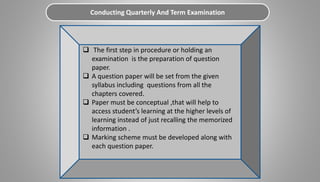
Conducting Quarterly And Term Examination
 The first step in procedure or holding an
examination is the preparation of question
paper.
 A question paper will be set from the given
syllabus including questions from all the
chapters covered.
 Paper must be conceptual ,that will help to
access student’s learning at the higher levels of
learning instead of just recalling the memorized
information .
 Marking scheme must be developed along with
each question paper.
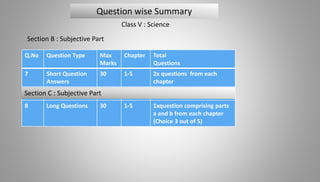
Question wise Summary
Q.No Question Type Max
Marks
Chapter Total
Questions
1 Fill in the blanks 10 1-5 2 blanks from each chapter
2 MCQs 10 1-5 2 MCQs from each chapter
3 True and False 05 1-5 2x statements from each
chapter
4 Puzzle 05 3 5 words with statements
5 Match the
columns
05 1-5 1x key word from each chap
6 Label the
diagram
05 1-5 5x parts to be labeled
Class V : Science
Section A : Objective Part
Question wise Summary
Q.No Question Type Max
Marks
Chapter Total
Questions
7 Short Question
Answers
30 1-5 2x questions from each
chapter
MCQs 10 1-5 2 MCQs from each chapter
8 Long Questions 30 1-5 1xquestion comprising parts
a and b from each chapter
(Choice 3 out of 5)
Class V : Science
Section B : Subjective Part
Section C : Subjective Part
POINTS TO REMEMBER
 Quality and framing of question must be given
prime importance.
 Objective type questions can be reproduced as
given in exercise.
 Subjective question can be rephrased or
modified appropriately.
 Marks distribution for all parts of a question
must be indicated in question.
Example: Define photosynthesis. Differentiate
between photosynthesis and respiration.(2+4=6)
 A question with two possible answers should
not be indicated.
Example: Quaid-e-Azam was born in ___________
Question Paper Setting
Layout of Question Paper
 All papers must be submitted in computerized
form, hand written papers are not accepted.
 FF Standard font size to compose the papers is
‘Arial – size 12/14’ for paper composed in English
and ‘Urdu Naskh Asiatype – size 14/16 in Urdu.
 Maximum time for objective part must be
indicated on the paper.
 Framing of questions and instructions must be
clear and in simple language.
 Sufficient space must be provided for the
answers.
 Long questions must be in sub-parts but not more
than three parts.
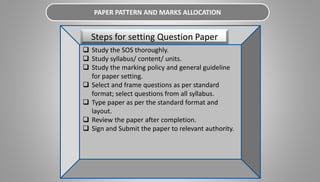
PAPER PATTERN AND MARKS ALLOCATION
 Study the SOS thoroughly.
 Study syllabus/ content/ units.
 Study the marking policy and general guideline
for paper setting.
 Select and frame questions as per standard
format; select questions from all syllabus.
 Type paper as per the standard format and
layout.
 Review the paper after completion.
 Sign and Submit the paper to relevant authority.
Steps for setting Question Paper
Marks Allocation
Oral Examination
Class Subjects
Nur English Urdu - - Islamiat Computer GK
Prep English Urdu Science S.Studies Islamiat Computer GK
I English Urdu - - Islamiat - GK
II English Urdu - - Islamiat - GK
III English Urdu - - Islamiat - GK
Oral Examination
Marks Allocation
Subject 1st Qtr 2nd Qtr 3rd Qtr 4Th Qtr Total
Exam Winter Tsk
English 10 10 30 10 40 100
Urdu 10 10 30 10 40 100
Math 10 10 30 10 40 100
Science - 20 20 10 50 100
Islamiat - 20 20 10 50 100
Computer - 20 20 10 50 100
Art - 20 20 10 50 100
Junior Section
Marks Allocation
Subject 1st
Qtr
2nd Qtr 3rd Qtr 4Th Qtr Total
Exam Wint
er
Tsk
Open
Book
Exam Open
Book
English 10 10 25 5 10 30 10 100
Urdu 10 10 25 5 10 30 10 100
Math 10 10 25 5 10 30 10 100
Science - 20 20 5 10 35 10 100
Islamiat - 20 20 5 10 35 10 100
Comput
er
- 20 20 5 10 35 10 100
Art - 20 20 5 10 45 - 100
I To VIII
Thank You

Paper Setting.pptx

  • 2.
  • 3.
  • 4.
    TYPES OF ASSESSMENTS AssessmentAs & For Learning  Before and During coaching  Provide feedback to teacher to provide next steps in learning  Class assessments and class tests Assessment OF Learning  After coaching  Judging and Assigning grades  Weekly tests, Quarterly and Term Examination
  • 5.
    Conducting Class Test Content to be tested must be decided appropriately.  Maximum marks and time allocation should be decided.  A class test should not be limited to very simple questions.  It must contain higher order question.  Level of difficulty must be increased as level of class increases. Example : For some multiple-choice questions, student must be asked to choose the correct answer and then provide a one or two-lined explanation of how they got that answer.
  • 6.
    Conducting Quarterly AndTerm Examination  The first step in procedure or holding an examination is the preparation of question paper.  A question paper will be set from the given syllabus including questions from all the chapters covered.  Paper must be conceptual ,that will help to access student’s learning at the higher levels of learning instead of just recalling the memorized information .  Marking scheme must be developed along with each question paper.
  • 7.
    Question wise Summary Q.NoQuestion Type Max Marks Chapter Total Questions 1 Fill in the blanks 10 1-5 2 blanks from each chapter 2 MCQs 10 1-5 2 MCQs from each chapter 3 True and False 05 1-5 2x statements from each chapter 4 Puzzle 05 3 5 words with statements 5 Match the columns 05 1-5 1x key word from each chap 6 Label the diagram 05 1-5 5x parts to be labeled Class V : Science Section A : Objective Part
  • 8.
    Question wise Summary Q.NoQuestion Type Max Marks Chapter Total Questions 7 Short Question Answers 30 1-5 2x questions from each chapter MCQs 10 1-5 2 MCQs from each chapter 8 Long Questions 30 1-5 1xquestion comprising parts a and b from each chapter (Choice 3 out of 5) Class V : Science Section B : Subjective Part Section C : Subjective Part
  • 9.
    POINTS TO REMEMBER Quality and framing of question must be given prime importance.  Objective type questions can be reproduced as given in exercise.  Subjective question can be rephrased or modified appropriately.  Marks distribution for all parts of a question must be indicated in question. Example: Define photosynthesis. Differentiate between photosynthesis and respiration.(2+4=6)  A question with two possible answers should not be indicated. Example: Quaid-e-Azam was born in ___________
  • 10.
    Question Paper Setting Layoutof Question Paper  All papers must be submitted in computerized form, hand written papers are not accepted.  FF Standard font size to compose the papers is ‘Arial – size 12/14’ for paper composed in English and ‘Urdu Naskh Asiatype – size 14/16 in Urdu.  Maximum time for objective part must be indicated on the paper.  Framing of questions and instructions must be clear and in simple language.  Sufficient space must be provided for the answers.  Long questions must be in sub-parts but not more than three parts.
  • 11.
    PAPER PATTERN ANDMARKS ALLOCATION  Study the SOS thoroughly.  Study syllabus/ content/ units.  Study the marking policy and general guideline for paper setting.  Select and frame questions as per standard format; select questions from all syllabus.  Type paper as per the standard format and layout.  Review the paper after completion.  Sign and Submit the paper to relevant authority. Steps for setting Question Paper
  • 12.
    Marks Allocation Oral Examination ClassSubjects Nur English Urdu - - Islamiat Computer GK Prep English Urdu Science S.Studies Islamiat Computer GK I English Urdu - - Islamiat - GK II English Urdu - - Islamiat - GK III English Urdu - - Islamiat - GK Oral Examination
  • 13.
    Marks Allocation Subject 1stQtr 2nd Qtr 3rd Qtr 4Th Qtr Total Exam Winter Tsk English 10 10 30 10 40 100 Urdu 10 10 30 10 40 100 Math 10 10 30 10 40 100 Science - 20 20 10 50 100 Islamiat - 20 20 10 50 100 Computer - 20 20 10 50 100 Art - 20 20 10 50 100 Junior Section
  • 14.
    Marks Allocation Subject 1st Qtr 2ndQtr 3rd Qtr 4Th Qtr Total Exam Wint er Tsk Open Book Exam Open Book English 10 10 25 5 10 30 10 100 Urdu 10 10 25 5 10 30 10 100 Math 10 10 25 5 10 30 10 100 Science - 20 20 5 10 35 10 100 Islamiat - 20 20 5 10 35 10 100 Comput er - 20 20 5 10 35 10 100 Art - 20 20 5 10 45 - 100 I To VIII
  • 15.