Presented by;
ASHFAQ AHMAD
Objectives
By the end of this presentation, students should
be able to;
 Organize their pre-examination time productively.
 Become aware of command in biology paper.
 Identify clues and hints in the stimulus material of
question.
 Interpret graphs, bar charts, histograms, figures
and any other information given in question.
 Learn strategies to tackle information in all
assessment components .
Organize your
pre-
examination
effort
1: Plan early
get and review CIEs syllabus
• List of terms
• meanings of complicated processes
Prepare revision checklists
Make revision time table
2: Self Assessment
 Identification of weak and strong areas
 Every topic of syllabus must be covered

Try to answer self-assessment questions by using traffic
light code
Green – I know it all
Orange - I have some idea
Red – I need to start studying this lesson
Prepare the relevant topic
Choose the topic that you wish to revise
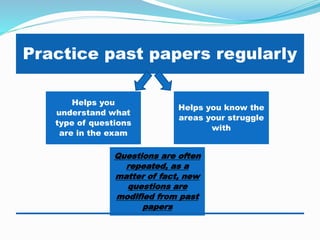
Practice past papers regularly
Helps you
understand what
type of questions
are in the exam
Helps you know the
areas your struggle
with
Questions are often
repeated, as a
matter of fact, new
questions are
modified from past
papers
Discuss difficult
topics – the one who
is best become
leader and teach
others
Distribute past Exam
questions to each
member of your
group
Give each person
time to research and
produce best answer
Then get the person
to teach and share
the question he is
responsible for
EXAMINATION
TIPS
What you should look for
in a question?
Style of
question
Instructions
in questions
Number of
marks
1: Number of marks
Paper 1 – 1 mark for each multiple
choice question
Paper 2 & 6 – marks in square
brackets e.g. [2]
Help you decide how much to write
How long it to spend
Remember! If there are two or more marks
for a question - do not write same thing in
two ways.
For example;
1:The leaf is very large
2:The leaf has large surface area
Both gives the same meaning.
2: Instructions in Questions
 Look at command words – that tell
you what to do
 Read the whole question including all
stimulus material and parts.
 Stimulus material can be unseen – however
enough information for you to work out an
answer.
You are being tested on your ability to apply
your knowledge to new information.
 Look for clues in the words of the question.
 Underline and circle key words in the
question.
 For example; Name the tissue that transport
sugars made by photosynthesis to other
parts of plant.
Command words in biology
1: Define: concise statement is required that shows
your understanding of term.
2: Name: give name of process or structure of an
organism
e.g. Define the term herbivores.
Expected answer: Herbivores are consumers
that feed mainly on plants.
e.g. Name the green organelle in
photosynthesizing cell.
Expected answer: Chloroplasts
3: State: concise short answer is required without any
explanation
4: Suggest: give logical answers by applying
knowledge and understanding of the subject to
analyze situation.
e.g. State the functions of hydrochloric acid in the
stomach.
Expected answer: Hydrochloric acid lowers the pH to 2.0
at which enzymes such as pepsin, works best. It also kills
harmful bacteria in food.
e.g. Suggest why droopy lettuce leaves become firm and crisp
when dipped in cold water.
Expected answer: Droopy lettuce leaves have insufficient
water and the cells are in state of low turgor. When dipped in
cold water , water enters the plant cell by osmosis, causing
them to swell and becomes turgid, thus the leaves become
firm and crisp.
5: Explain: You have to biological reason to account
for why something is so.
6: List: Write your answer in point form, in either a
single word or a short sentence without explanation.
e.g. Explain why all heterotrophs are consumers.
Expected answer: A heterotroph obtains its nourishment from
organic molecules that have already been produced by
autotrophs. They are not self- nourishing but feed on
autotrophs and/or each other. Thus all heterotrophs are
consumers.
e.g. List the environmental factors affecting the rate of
transpiration.
1: Temperature 2: Air humidity 3: light intensity
4: wind 5: carbon dioxide concentration
7: Describe: state all key points (structure, adaptation,
processes) without explanation. Length of answer
depends on marks allocated.
8: What is meant by: define the term briefly.
e.g. Describe how bacteria reproduce.
Expected answer: Bacteria reproduce by cellular division
known as binary fission. Each bacterial cell divides to produce
two identical bacterial cells.
e.g. What is meant by the term diffusion.
Expected answer: Diffusion is the movement of molecules
down a concentration gradient, from a region of higher
concentration to region of lower concentration.
9: Compare: This means that you have to point out
similarities as well as differences with reference to
the question asked. Number of similarities or
differences may be provided. One mark is for one
similarity or difference.
10: Differentiate: you have to give only differences
with reference to two or more things.
e.g. Differentiate between compositions of inspired
and expired air.
Inspired air Expired air
20% oxygen 16% oxygen
0.04% carbon dioxide 4% carbondioxide
At room temperature At body temperature
Note:
Some questions have two commands in the
question, for example ‘Predict and explain’. This
means you have to say what you think will happen
AND then say why you think it will happen. Usually
the word and is printed in bold type to help you.
3: Understand style of
question
Identify features of cells, tissues, organs
and other structures
 name some structures that are identified by
letters on a diagram or drawing.
 put labels on a diagram using label lines.
For example;
Use label lines to identify the following on the
drawing of a flower: petal, sepal and stamen. [3]
To answer this question:
 You have to know the structure of a flower.
 You also have to be able to find the structures on a
diagram of a flower that you may never have
studied.
 You then have to draw a label line to the structure
and write the name next to the labeling line.
 If you do not draw a label line you may not get any
marks even if you have found the correct structure.
Use information given in the question.
 Questions may ask you to ‘Use examples
from...’or ‘Use only the information in ....’ or
‘With reference to Fig. 6.2’.
 If you read instructions like these, find out what
you are expected to use as examples or take
information from.
 You will not get any marks if you use examples
from somewhere else.
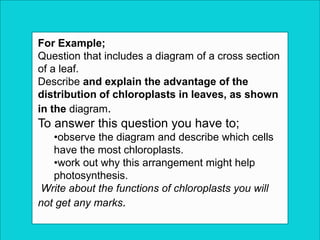
For Example;
Question that includes a diagram of a cross section
of a leaf.
Describe and explain the advantage of the
distribution of chloroplasts in leaves, as shown
in the diagram.
To answer this question you have to;
•observe the diagram and describe which cells
have the most chloroplasts.
•work out why this arrangement might help
photosynthesis.
Write about the functions of chloroplasts you will
not get any marks.
Interpret Stimulus material
Always read the introductory text very carefully .
Underline key points in the information that you are
given.
Interpret Tables
 Look at the column and row headings in a table
 Find the units that have been used. Make sure you
use them if you give any figures in your answer.
 Use a ruler to help read the table.
 Identify the pattern or trend first before thinking of an
explanation.
Interpret Line graphs
 Look carefully at the x-axis which is the independent
variable and make sure you understand what has
been changed.
 Look carefully at the y-axis which is the dependent
variable. Both variables should be described in the
introduction to the question.
 Put your ruler against the y -axis and move it
gradually across the graph from left to right.
 Follow the pattern or trend of the line
 Mark on the graph where something significant
happens.
Bar charts and histograms
 Look carefully at the x-axis and the y-axis to see what
has been plotted.
 It is a good idea to move a ruler across the bar graph
or histogram to help you concentrate on one aspect at
a time.
 You should make yourself some notes about the table,
graph or histogram before answering the questions.
Do calculations
If you are asked to do a calculation:
 You may have to find the figures from a table or graph.
 Write out all the working for your calculation. If you
make a mistake and give the wrong answer, you may
well be given marks for showing how to do the
calculation.
 Make sure that you show the units in the calculation.
 If the units are not given on the answer line, then
make sure you write them after your numerical
answer.
Tips to Answer questions
Make sure you have all the equipment you will need for
the exam in a clear, plastic container. You need two pens,
pencils (preferably HB or B), a clean eraser, a ruler
(which measures in mm), a pencil sharpener and a
calculator.
Paper 1
 1.5 min to read and answer each question.
 Each question tests just one topic.
 Some questions test what you know and understand.
For example: What tissue in the eye detects light?
 Some questions test if you can apply what you have
learned to understand new data. These questions
will often have a diagram, graph or table to use.
 Try to decide what the question is testing as you are
reading it. The sequence of questions usually follows
the sequence of topics in the syllabus.
 Answer all questions
Paper 2
 Most of the questions in Section A require short answers. This
means that you write mainly one word or one sentence answers
worth one mark.
 Longer answers will need two or three sentences with two or
three different ideas based on allocated marks.
 Look at the number of command words: ask yourself ‘do you
have to do one or two things?’
 Use the lines given. Stick to the point and do not write too much.
 There will only be a few parts of questions that need extended
writing. These will have four [4] or [5] marks. The question will
often be related to some information you are given. You will need
to write four or five sentences in a sequence that makes sense.
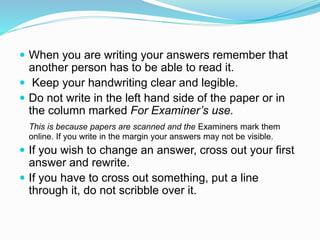
 When you are writing your answers remember that
another person has to be able to read it.
 Keep your handwriting clear and legible.
 Do not write in the left hand side of the paper or in
the column marked For Examiner’s use.
This is because papers are scanned and the Examiners mark them
online. If you write in the margin your answers may not be visible.
 If you wish to change an answer, cross out your first
answer and rewrite.
 If you have to cross out something, put a line
through it, do not scribble over it.
 If you run out of space, use white space on another
part of the exam paper for a continuation answer; do
not try to squeeze in your answer by using very
small writing.
 Try to use the correct spelling. The person marking
your answer will try to recognise what word you
mean.
 Some biological terms have very similar spelling.
One example is ‘ureter’, urethra’ and ‘uterus’.
 Do not leave any question unanswered; make an
educated guess. You may score some marks.
Paper 6 – ATP Skills
1: Drawing tables
If you are asked to draw a table:
 Use a ruler and a pencil to draw the table. Make sure
you rule lines for the columns and the rows.
 Write headings for each column and/or row of the
table.
 Write in units if they are needed, e.g. volume of
water/cm3, mass of seed/g. The unit should be written
after the oblique line (forward slash).
 Do not put units in the table spaces where you write
numbers.
2: Drawing line graphs
If you are asked to draw a graph:
 Choose a simplescale which uses most of the grid
provided on the exam paper.
 Write the name of each axis and the correct unit, e.g. rate
of water loss/g per h, temperature/°C, time/s.
 Plot the points exactly using a sharp pencil. Draw the
points lightly so that you can rub them out if you need to.
Make them more definite when you are sure they are
right.
 Use a cross (x) or a dot in a circle (.) for your plot
points. Do not use a single dot as it may not be seen
after you have drawn your line.
 If you have to plot two lines on a graph, use two
different symbols for the plot points. You can use a
cross, a dot in a circle or a plus sign (+). Label each
line carefully or use a key. Use a pencil for both
lines; do not use a blue or black pen or different
colours as these do not show up on scanned
scripts.
 Read the question carefully before you put a line in
the graph. Look carefully at the points. You have to
decide whether to use a straight line of best fit, a
smooth curve of best fit or join the points by straight
lines.
3: Drawing bar charts
 You may have to draw a bar chart or add some data to a
bar chart;.
 Choose a scale which uses most of the grid provided on
the exam paper; do not make the chart too small.
 Draw the chart in pencil.
 Rule the columns evenly so that they are all the same
width.
 Take care to rule the top of each block in the correct
place – double check with the table of data each time.
 The spaces between the columns on the x-axis should be
identical; they should be the same length, e.g. one large
square on graph paper..
 The y-axis should be properly scaled with equal
intervals just as in a line graph.
 The y-axis should be labelled with units.
 The lines or blocks can be arranged in any order, but
to make comparisons it helps if they are arranged in
descending or ascending order of size.
 You should identify each block by putting a label
directly underneath each block. Do not shade the
blocks or colour code them
4: Planning investigations
Sometimes you are asked to suggest a way of carrying
out an investigation or to improve the method that is in
the question paper.
When you read through an investigation try to work out
three main things:
1. What is being changed – this is called the
independent variable.
2. What is being measured – this is called the
dependent variable.
3. What is being kept the same – these are the
control variables.
 Some investigations need to have two parts:
 The experimental – which measures the process
being studied and contains the living organism, part of
an organism (e.g. a leaf) or enzyme being tested.
 The control – which will be exactly the same as the
experimental except that the living organism willbe
missing or replaced by something non-living. The
control shows that the results are due to the activity of
the living organism and is not due to the apparatus or
an environmental factor.
 All investigations should be repeated to increase the
reliability of the results. If the same results are
achieved (or the results are very similar) then they
are reliable.
. Experimental accuracy
improvements:Using electronic balance
instead of spatula
 Use larger number of sample
 Using lid and polystyrene cup in heating
experiment – Using data logger instead
of timer and stopwatch
 To be fair and keep factors same and
constant
 Use burette instead of measuring
cylinder
 Common one: to repeat and take
average (mean)
 Same apparatus and instruments
 Control temp and PH.
Steps to follow in pH-enzyme
experiment:
 Same volume and concentrations of
same reagents.
 Same of volume of same enzyme
 Same apparatus used.
 Same time intervals
 Control temperature
 Apply different pH
 Note readings and results.
 Plot them and compare
 Repeat and take average
. In germination experiments
where pH is a variable:
 Use same seeds due to age and
species
 Use same number of seeds
 Same of volume of same enzyme
 Use same apparatus
 Keep time intervals the same
 Control temperature
 Conduct experiments over different pHs
 Note readings and results
 Plot them and compare
 Repeat and take average
Experiments where rate
needs to be calculated:
 Add 2~3 cm3 of culture to test tube
 Shake it
 Connect test tube to gas syringe
 Note gas volume
 Control temperature
 Record time taken by stopwatch

 Plot them and compare
 Repeat and take average of results
. Variables to be constant in
experiments involving cooling:
 Room temperature
 Time interval
 Temperature
 Volume of water
To determine number of stomata:
View the leaf under microscope at
high magnification
Count the number of stomata
Determine the area of stomata
Calculate area of stomata (using a grid)
. Determining the rate of
uptake of water by plants
(transpiration rate)
Conditions to keep constant
 Plant species
 Number of plants
 Volume of water
 Time interval
 Apparatus
 Light intensity
Method
 Control pH and temp.
 Note readings
 plot and compare
 Repeats and take average
. Drawing certain parts of
plant/ animal:
 Use a sharp HB pencil.
 Draw a clear and similar shape.
 Avoiding shading
 Make accurate labels (at least 2)
 Draw according to the magnification
asked in the paper.
A special test for lipids.
An important feature of fats and oils is that
they are insoluble in water. This means
that you cannot make an aqueous solution
of a fat or oil on which to carry out a
biochemical test. However, the fact that
lipids are insoluble forms the basils of a
physical test. This is known as the
emulsion test: How to?
 2 cm3 of ethanol are added to the
unknown solution, and the mixture is
gently shaken.
 the mixture is poured into a test tube
containing an equal volume of distilled
water.
 If a lipid is present, a milky-white
emulsion is formed.
. A control is needed to make
sure that results are valid:.
-To show that the test solutions are not
contaminated, each test should be carried out on a
sample of water. This should give a negative result.
Examples:
 To test for Protein, a few drops of Biuret reagent
are added to 2 cm3 of the unknown solution (to
be tested for containing protein) and the mixture
is gently shaken. A MASSIVE/PURPPLE color
is a positive result (protein is present)

Biology (1).pptx

  • 1.
  • 2.
    Objectives By the endof this presentation, students should be able to;  Organize their pre-examination time productively.  Become aware of command in biology paper.  Identify clues and hints in the stimulus material of question.  Interpret graphs, bar charts, histograms, figures and any other information given in question.  Learn strategies to tackle information in all assessment components .
  • 3.
  • 4.
    1: Plan early getand review CIEs syllabus • List of terms • meanings of complicated processes Prepare revision checklists Make revision time table
  • 5.
    2: Self Assessment Identification of weak and strong areas  Every topic of syllabus must be covered  Try to answer self-assessment questions by using traffic light code Green – I know it all Orange - I have some idea Red – I need to start studying this lesson Prepare the relevant topic Choose the topic that you wish to revise
  • 6.
    Practice past papersregularly Helps you understand what type of questions are in the exam Helps you know the areas your struggle with Questions are often repeated, as a matter of fact, new questions are modified from past papers
  • 7.
    Discuss difficult topics –the one who is best become leader and teach others Distribute past Exam questions to each member of your group Give each person time to research and produce best answer Then get the person to teach and share the question he is responsible for
  • 8.
  • 9.
    What you shouldlook for in a question? Style of question Instructions in questions Number of marks
  • 10.
    1: Number ofmarks Paper 1 – 1 mark for each multiple choice question Paper 2 & 6 – marks in square brackets e.g. [2] Help you decide how much to write How long it to spend
  • 11.
    Remember! If thereare two or more marks for a question - do not write same thing in two ways. For example; 1:The leaf is very large 2:The leaf has large surface area Both gives the same meaning.
  • 12.
    2: Instructions inQuestions  Look at command words – that tell you what to do  Read the whole question including all stimulus material and parts.
  • 14.
     Stimulus materialcan be unseen – however enough information for you to work out an answer. You are being tested on your ability to apply your knowledge to new information.  Look for clues in the words of the question.  Underline and circle key words in the question.  For example; Name the tissue that transport sugars made by photosynthesis to other parts of plant.
  • 15.
    Command words inbiology 1: Define: concise statement is required that shows your understanding of term. 2: Name: give name of process or structure of an organism e.g. Define the term herbivores. Expected answer: Herbivores are consumers that feed mainly on plants. e.g. Name the green organelle in photosynthesizing cell. Expected answer: Chloroplasts
  • 16.
    3: State: conciseshort answer is required without any explanation 4: Suggest: give logical answers by applying knowledge and understanding of the subject to analyze situation. e.g. State the functions of hydrochloric acid in the stomach. Expected answer: Hydrochloric acid lowers the pH to 2.0 at which enzymes such as pepsin, works best. It also kills harmful bacteria in food. e.g. Suggest why droopy lettuce leaves become firm and crisp when dipped in cold water. Expected answer: Droopy lettuce leaves have insufficient water and the cells are in state of low turgor. When dipped in cold water , water enters the plant cell by osmosis, causing them to swell and becomes turgid, thus the leaves become firm and crisp.
  • 17.
    5: Explain: Youhave to biological reason to account for why something is so. 6: List: Write your answer in point form, in either a single word or a short sentence without explanation. e.g. Explain why all heterotrophs are consumers. Expected answer: A heterotroph obtains its nourishment from organic molecules that have already been produced by autotrophs. They are not self- nourishing but feed on autotrophs and/or each other. Thus all heterotrophs are consumers. e.g. List the environmental factors affecting the rate of transpiration. 1: Temperature 2: Air humidity 3: light intensity 4: wind 5: carbon dioxide concentration
  • 18.
    7: Describe: stateall key points (structure, adaptation, processes) without explanation. Length of answer depends on marks allocated. 8: What is meant by: define the term briefly. e.g. Describe how bacteria reproduce. Expected answer: Bacteria reproduce by cellular division known as binary fission. Each bacterial cell divides to produce two identical bacterial cells. e.g. What is meant by the term diffusion. Expected answer: Diffusion is the movement of molecules down a concentration gradient, from a region of higher concentration to region of lower concentration.
  • 19.
    9: Compare: Thismeans that you have to point out similarities as well as differences with reference to the question asked. Number of similarities or differences may be provided. One mark is for one similarity or difference. 10: Differentiate: you have to give only differences with reference to two or more things. e.g. Differentiate between compositions of inspired and expired air. Inspired air Expired air 20% oxygen 16% oxygen 0.04% carbon dioxide 4% carbondioxide At room temperature At body temperature
  • 20.
    Note: Some questions havetwo commands in the question, for example ‘Predict and explain’. This means you have to say what you think will happen AND then say why you think it will happen. Usually the word and is printed in bold type to help you.
  • 21.
    3: Understand styleof question Identify features of cells, tissues, organs and other structures  name some structures that are identified by letters on a diagram or drawing.  put labels on a diagram using label lines.
  • 22.
    For example; Use labellines to identify the following on the drawing of a flower: petal, sepal and stamen. [3] To answer this question:  You have to know the structure of a flower.  You also have to be able to find the structures on a diagram of a flower that you may never have studied.  You then have to draw a label line to the structure and write the name next to the labeling line.  If you do not draw a label line you may not get any marks even if you have found the correct structure.
  • 23.
    Use information givenin the question.  Questions may ask you to ‘Use examples from...’or ‘Use only the information in ....’ or ‘With reference to Fig. 6.2’.  If you read instructions like these, find out what you are expected to use as examples or take information from.  You will not get any marks if you use examples from somewhere else.
  • 24.
    For Example; Question thatincludes a diagram of a cross section of a leaf. Describe and explain the advantage of the distribution of chloroplasts in leaves, as shown in the diagram. To answer this question you have to; •observe the diagram and describe which cells have the most chloroplasts. •work out why this arrangement might help photosynthesis. Write about the functions of chloroplasts you will not get any marks.
  • 25.
    Interpret Stimulus material Alwaysread the introductory text very carefully . Underline key points in the information that you are given. Interpret Tables  Look at the column and row headings in a table  Find the units that have been used. Make sure you use them if you give any figures in your answer.  Use a ruler to help read the table.  Identify the pattern or trend first before thinking of an explanation.
  • 26.
    Interpret Line graphs Look carefully at the x-axis which is the independent variable and make sure you understand what has been changed.  Look carefully at the y-axis which is the dependent variable. Both variables should be described in the introduction to the question.  Put your ruler against the y -axis and move it gradually across the graph from left to right.  Follow the pattern or trend of the line  Mark on the graph where something significant happens.
  • 27.
    Bar charts andhistograms  Look carefully at the x-axis and the y-axis to see what has been plotted.  It is a good idea to move a ruler across the bar graph or histogram to help you concentrate on one aspect at a time.  You should make yourself some notes about the table, graph or histogram before answering the questions.
  • 28.
    Do calculations If youare asked to do a calculation:  You may have to find the figures from a table or graph.  Write out all the working for your calculation. If you make a mistake and give the wrong answer, you may well be given marks for showing how to do the calculation.  Make sure that you show the units in the calculation.  If the units are not given on the answer line, then make sure you write them after your numerical answer.
  • 29.
    Tips to Answerquestions Make sure you have all the equipment you will need for the exam in a clear, plastic container. You need two pens, pencils (preferably HB or B), a clean eraser, a ruler (which measures in mm), a pencil sharpener and a calculator.
  • 30.
    Paper 1  1.5min to read and answer each question.  Each question tests just one topic.  Some questions test what you know and understand. For example: What tissue in the eye detects light?  Some questions test if you can apply what you have learned to understand new data. These questions will often have a diagram, graph or table to use.  Try to decide what the question is testing as you are reading it. The sequence of questions usually follows the sequence of topics in the syllabus.  Answer all questions
  • 31.
    Paper 2  Mostof the questions in Section A require short answers. This means that you write mainly one word or one sentence answers worth one mark.  Longer answers will need two or three sentences with two or three different ideas based on allocated marks.  Look at the number of command words: ask yourself ‘do you have to do one or two things?’  Use the lines given. Stick to the point and do not write too much.  There will only be a few parts of questions that need extended writing. These will have four [4] or [5] marks. The question will often be related to some information you are given. You will need to write four or five sentences in a sequence that makes sense.
  • 32.
     When youare writing your answers remember that another person has to be able to read it.  Keep your handwriting clear and legible.  Do not write in the left hand side of the paper or in the column marked For Examiner’s use. This is because papers are scanned and the Examiners mark them online. If you write in the margin your answers may not be visible.  If you wish to change an answer, cross out your first answer and rewrite.  If you have to cross out something, put a line through it, do not scribble over it.
  • 33.
     If yourun out of space, use white space on another part of the exam paper for a continuation answer; do not try to squeeze in your answer by using very small writing.  Try to use the correct spelling. The person marking your answer will try to recognise what word you mean.  Some biological terms have very similar spelling. One example is ‘ureter’, urethra’ and ‘uterus’.  Do not leave any question unanswered; make an educated guess. You may score some marks.
  • 34.
    Paper 6 –ATP Skills 1: Drawing tables If you are asked to draw a table:  Use a ruler and a pencil to draw the table. Make sure you rule lines for the columns and the rows.  Write headings for each column and/or row of the table.  Write in units if they are needed, e.g. volume of water/cm3, mass of seed/g. The unit should be written after the oblique line (forward slash).  Do not put units in the table spaces where you write numbers.
  • 35.
    2: Drawing linegraphs If you are asked to draw a graph:  Choose a simplescale which uses most of the grid provided on the exam paper.  Write the name of each axis and the correct unit, e.g. rate of water loss/g per h, temperature/°C, time/s.  Plot the points exactly using a sharp pencil. Draw the points lightly so that you can rub them out if you need to. Make them more definite when you are sure they are right.
  • 36.
     Use across (x) or a dot in a circle (.) for your plot points. Do not use a single dot as it may not be seen after you have drawn your line.  If you have to plot two lines on a graph, use two different symbols for the plot points. You can use a cross, a dot in a circle or a plus sign (+). Label each line carefully or use a key. Use a pencil for both lines; do not use a blue or black pen or different colours as these do not show up on scanned scripts.  Read the question carefully before you put a line in the graph. Look carefully at the points. You have to decide whether to use a straight line of best fit, a smooth curve of best fit or join the points by straight lines.
  • 37.
    3: Drawing barcharts  You may have to draw a bar chart or add some data to a bar chart;.  Choose a scale which uses most of the grid provided on the exam paper; do not make the chart too small.  Draw the chart in pencil.  Rule the columns evenly so that they are all the same width.  Take care to rule the top of each block in the correct place – double check with the table of data each time.  The spaces between the columns on the x-axis should be identical; they should be the same length, e.g. one large square on graph paper..
  • 38.
     The y-axisshould be properly scaled with equal intervals just as in a line graph.  The y-axis should be labelled with units.  The lines or blocks can be arranged in any order, but to make comparisons it helps if they are arranged in descending or ascending order of size.  You should identify each block by putting a label directly underneath each block. Do not shade the blocks or colour code them
  • 39.
    4: Planning investigations Sometimesyou are asked to suggest a way of carrying out an investigation or to improve the method that is in the question paper. When you read through an investigation try to work out three main things: 1. What is being changed – this is called the independent variable. 2. What is being measured – this is called the dependent variable. 3. What is being kept the same – these are the control variables.
  • 40.
     Some investigationsneed to have two parts:  The experimental – which measures the process being studied and contains the living organism, part of an organism (e.g. a leaf) or enzyme being tested.  The control – which will be exactly the same as the experimental except that the living organism willbe missing or replaced by something non-living. The control shows that the results are due to the activity of the living organism and is not due to the apparatus or an environmental factor.  All investigations should be repeated to increase the reliability of the results. If the same results are achieved (or the results are very similar) then they are reliable.
  • 41.
    . Experimental accuracy improvements:Usingelectronic balance instead of spatula  Use larger number of sample  Using lid and polystyrene cup in heating experiment – Using data logger instead of timer and stopwatch  To be fair and keep factors same and constant  Use burette instead of measuring cylinder  Common one: to repeat and take average (mean)  Same apparatus and instruments  Control temp and PH.
  • 42.
    Steps to followin pH-enzyme experiment:  Same volume and concentrations of same reagents.  Same of volume of same enzyme  Same apparatus used.  Same time intervals  Control temperature  Apply different pH  Note readings and results.  Plot them and compare  Repeat and take average
  • 43.
    . In germinationexperiments where pH is a variable:  Use same seeds due to age and species  Use same number of seeds  Same of volume of same enzyme  Use same apparatus  Keep time intervals the same  Control temperature  Conduct experiments over different pHs  Note readings and results  Plot them and compare  Repeat and take average
  • 44.
    Experiments where rate needsto be calculated:  Add 2~3 cm3 of culture to test tube  Shake it  Connect test tube to gas syringe  Note gas volume  Control temperature  Record time taken by stopwatch   Plot them and compare  Repeat and take average of results
  • 45.
    . Variables tobe constant in experiments involving cooling:  Room temperature  Time interval  Temperature  Volume of water To determine number of stomata: View the leaf under microscope at high magnification Count the number of stomata Determine the area of stomata Calculate area of stomata (using a grid)
  • 46.
    . Determining therate of uptake of water by plants (transpiration rate) Conditions to keep constant  Plant species  Number of plants  Volume of water  Time interval  Apparatus  Light intensity Method  Control pH and temp.  Note readings  plot and compare  Repeats and take average
  • 47.
    . Drawing certainparts of plant/ animal:  Use a sharp HB pencil.  Draw a clear and similar shape.  Avoiding shading  Make accurate labels (at least 2)  Draw according to the magnification asked in the paper.
  • 48.
    A special testfor lipids. An important feature of fats and oils is that they are insoluble in water. This means that you cannot make an aqueous solution of a fat or oil on which to carry out a biochemical test. However, the fact that lipids are insoluble forms the basils of a physical test. This is known as the emulsion test: How to?  2 cm3 of ethanol are added to the unknown solution, and the mixture is gently shaken.  the mixture is poured into a test tube containing an equal volume of distilled water.  If a lipid is present, a milky-white emulsion is formed.
  • 49.
    . A controlis needed to make sure that results are valid:. -To show that the test solutions are not contaminated, each test should be carried out on a sample of water. This should give a negative result. Examples:  To test for Protein, a few drops of Biuret reagent are added to 2 cm3 of the unknown solution (to be tested for containing protein) and the mixture is gently shaken. A MASSIVE/PURPPLE color is a positive result (protein is present)