More Related Content

PPTX
The GDPR and NIS Directive Risk-Based Security Measures and Incident Notifica... 
PDF
FLIGHT Amsterdam Presentation - Data Breaches and the Law: A Practical Guide 
PDF
Flight East 2018 Presentation–Data Breaches and the Law 
PPTX
The general data protection act overview 
PPTX
Data Protection & Security Breakfast Briefing - Master Slides_28 June_final 
PPTX
Data protection & security breakfast briefing master slides 28 june-final 
PPTX
New Security Legislation & Its Implications for OSS Management 
PPTX
New Security Legislation and its Implications for OSS Management Similar to PAP_Clico_160617_security operation center

PPT
New Security Legislation & It's Implications for OSS Management 
PPTX
Keep Calm and Comply: 3 Keys to GDPR Success 
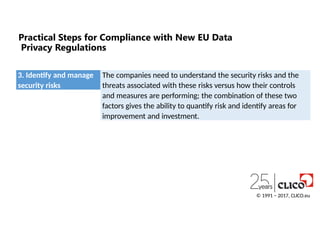
PDF
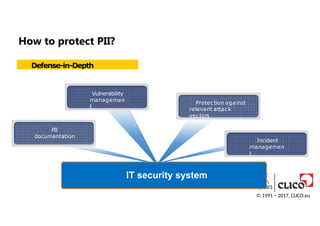
GDPR - Context, Principles, Implementation, Operation, Impact on Outsourcing,... 
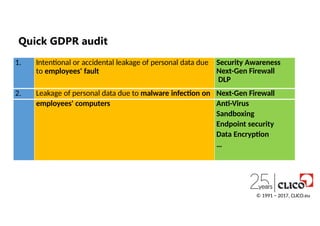
PPTX
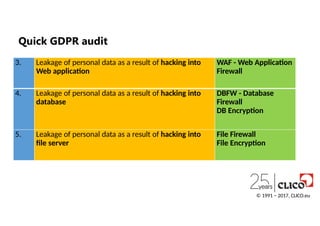
Addressing the EU GDPR & New York Cybersecurity Requirements: 3 Keys to Success 
PPTX
Pronti per la legge sulla data protection GDPR? No Panic! - Domenico Maracci,... 
PPTX
ISACA Houston - Practical data privacy and de-identification techniques 
PPTX
CWIN17 san francisco-geert vanderlinden-don't be stranded without a (gdpr) plan 
PDF
Symantec Webinar Part 5 of 6 GDPR Compliance, the Operational Impact of Cross... 
PPTX
GDPR practical info session for development 
PDF
Data Breaches and the EU GDPR 
PDF
Mind Your Business: Why Privacy Matters to the Successful Enterprise 
PPTX
Pronti per la legge sulla data protection GDPR? No Panic! - Stefano Sali, Dom... 
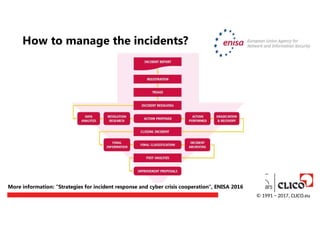
PPTX
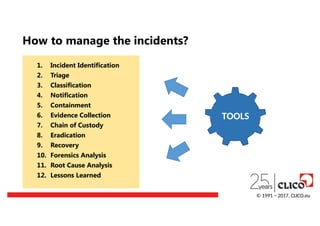
Tim Willoughby - Presentation to Innovation Masters 2016 
PPT
The Countdown is on: Key Things to Know About the GDPR 
PPTX
EU GDPR: The role of the data protection officer 
PPTX
An Essential Guide to EU GDPR 
PDF
INFOMAGAZINE 8 by REAL security 
PPTX

PPTX
GDPR Benefits and a Technical Overview 
PDF
Data Flow Mapping and the EU GDPR Recently uploaded

PPTX
Celonis Optimizing your future with process 
PPTX
The Transformative Technology in Contemporary Businesses 
PDF
UiPath Modern Automation Playbook -Session 2 
PDF
Spec-Driven Development with Kiro: Elevating Software Quality, Traceability, ... 
PDF
HOW TO OVERCOME THE THREATS OF ARTIFICIAL INTELLIGENCE AGAINST HUMANITY.pdf 
PDF
UiPath Automation Developer Associate Training Series 2026 - Session 3 
PDF
shayk.online - Anonymous chat with Sinatra and WebSockets 
PDF
20260212 Security-JAWS activity results for 2025 and activity goals for 2026 
PDF
Explaining the flow of purpose-specific BOM 
PDF
GTM-and-Sales-Plan for a cyber security product 
PDF

PDF
apidays Paris 2025 | Zero Trust By Design 
PPTX
Microsoft Azure News - February 2026 - BAUG 
PDF
Towards a Vibrant AI Hardware Accelerator Ecosystem, invited talk at the 4th ... 
PPTX
Introducing VisualSim 2610 The Next Leap in System Level Modeling 
PDF
Oracle Cloud Infrastructure 2025 Architect Professional (1Z0-1127-25) Master ... 
PDF
Founder & Tech Lead | Web Development & Digital Growth Consultant | Helping B... 
PDF
Escape from the Forbidden Zone: Smuggling green and inclusive tech past the g... 
PDF
Empower your IT team with cloud-based PC management using Dell Management Por... 
PDF
Constraint Collapse and Fidelity Decay in Scaled Language Models PAP_Clico_160617_security operation center
- 1.
- 2.
Agenda
• How tobuild Security Operations Center?
• GDPR and NISD - new UE law for data, networks
and IT systems protection
• How to protect and audit PII?
• How to efficiently manage the incidents?
© 1991 − 2017, CLICO.eu
- 3.
© 1991 −2017, CLICO.eu
More information: „Building a World-Class Security Operations Center: A Roadmap”,
SANS Institute 2015
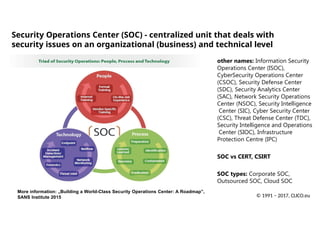
Security Operations Center (SOC) - centralized unit that deals with
security issues on an organizational (business) and technical level
other names: Information Security
Operations Center (ISOC),
CyberSecurity Operations Center
(CSOC), Security Defense Center
(SDC), Security Analytics Center
(SAC), Network Security Operations
Center (NSOC), Security Intelligence
Center (SIC), Cyber Security Center
(CSC), Threat Defense Center (TDC),
Security Intelligence and Operations
Center (SIOC), Infrastructure
Protection Centre (IPC)
SOC vs CERT, CSIRT
SOC types: Corporate SOC,
Outsourced SOC, Cloud SOC
- 4.
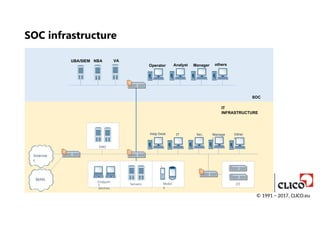
Help Desk ITSec. Manage
r
SOC
IT
INFRASTRUCTURE
Other
s
Interne
t
WAN
Operator Analyst Manager others
UBA/SIEM NBA VA
Mobil
e
Endpoin
t
devices
Servers
DMZ
OT
SOC infrastructure
© 1991 − 2017, CLICO.eu
- 5.
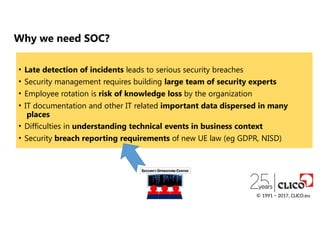
Why we needSOC?
• Late detection of incidents leads to serious security breaches
• Security management requires building large team of security experts
• Employee rotation is risk of knowledge loss by the organization
• IT documentation and other IT related important data dispersed in many
places
• Difficulties in understanding technical events in business context
• Security breach reporting requirements of new UE law (eg GDPR, NISD)
© 1991 − 2017, CLICO.eu
- 6.
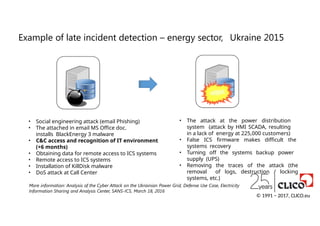
• Social engineeringattack (email Phishing)
• The attached in email MS Office doc.
installs BlackEnergy 3 malware
• C&C access and recognition of IT environment
(+6 months)
• Obtaining data for remote access to ICS systems
• Remote access to ICS systems
• Installation of KillDisk malware
• DoS attack at Call Center
• The attack at the power distribution
system (attack by HMI SCADA, resulting
in a lack of energy at 225,000 customers)
• False ICS firmware makes difficult the
systems recovery
• Turning off the systems backup power
supply (UPS)
• Removing the traces of the attack (the
removal of logs, destruction / locking
systems, etc.)
Example of late incident detection – energy sector, Ukraine 2015
© 1991 − 2017, CLICO.eu
More information: Analysis of the Cyber Attack on the Ukrainian Power Grid, Defense Use Case, Electricity
Information Sharing and Analysis Center, SANS-ICS, March 18, 2016
- 7.
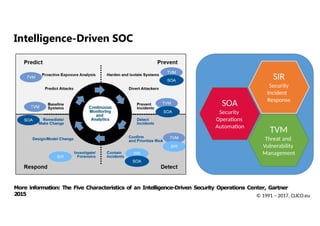
More information: TheFive Characteristics of an Intelligence-Driven Security Operations Center, Gartner
2015
SOA
Security
Operations
Automation
TVM
Threat and
Vulnerability
Management
SIR
Security
Incident
Response
© 1991 − 2017, CLICO.eu
Intelligence-Driven SOC
- 8.
- 9.
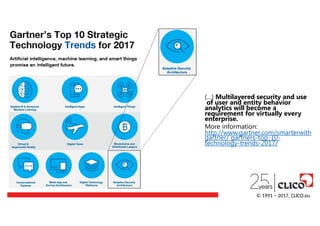
(…) Multilayered securityand use
of user and entity behavior
© 1991 − 2017, CLICO.eu
analytics will become a
requirement for virtually every
enterprise.
More information:
http://www.gartner.com/smarterwith
gartner/ gartners-top-10-
technology-trends-2017/
- 10.
Why EU cybersecuritylaw was tightened?
• GDPR: designed to harmonize data privacy laws across Europe, to
protect and empower all EU citizens data privacy and to reshape
the way organizations across the region approach data privacy
• NISD: bring cybersecurity capabilities at the same level of
development in all the EU Member States and ensure that exchanges
of information and cooperation are efficient, including at cross-border
level
• Other reasons:
• Cybercrime is recognized risk for the economy
• „Security is a cost” approach = no real safety
• „Security checklist” approach = no real safety © 1991 − 2017, CLICO.eu
- 11.
New UE lawfor data and IT systems protection
December 2015, EU Commission reached an agreement on new
law for data and IT systems protection law:
• General Data Protection Regulation (GDPR)
GDPR will give EU citizens stronger rights, empowering them with better
control of their data and ensuring that their privacy remains protected.
• Network and Information Security Directive (NISD)
NISD is complementary to the GDPR, aimed at the protection of IT
systems of operators of essential services and the providers of critical
digital services.
© 1991 − 2017, CLICO.eu
- 12.
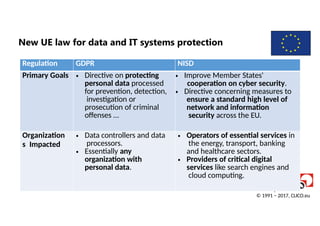
New UE lawfor data and IT systems protection
Regulation GDPR NISD
Primary Goals • Directive on protecting
personal data processed
for prevention, detection,
investigation or
prosecution of criminal
offenses …
• Improve Member States'
cooperation on cyber security.
• Directive concerning measures to
ensure a standard high level of
network and information
security across the EU.
Organization
s Impacted
• Data controllers and data
processors.
• Essentially any
organization with
personal data.
• Operators of essential services in
the energy, transport, banking
and healthcare sectors.
• Providers of critical digital
services like search engines and
cloud computing.
© 1991 − 2017, CLICO.eu
- 13.
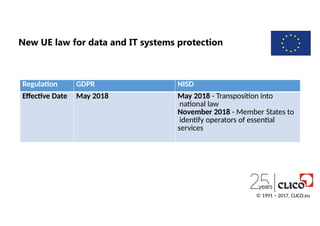
New UE lawfor data and IT systems protection
Regulation GDPR NISD
Effective Date May 2018 May 2018 - Transposition into
national law
November 2018 - Member States to
identify operators of essential
services
© 1991 − 2017, CLICO.eu
- 14.
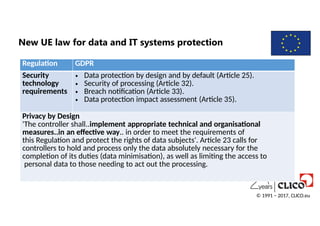
New UE lawfor data and IT systems protection
Regulation GDPR
Security
technology
requirements
• Data protection by design and by default (Article 25).
• Security of processing (Article 32).
• Breach notification (Article 33).
• Data protection impact assessment (Article 35).
Privacy by Design
'The controller shall..implement appropriate technical and organisational
measures..in an effective way.. in order to meet the requirements of
this Regulation and protect the rights of data subjects'. Article 23 calls for
controllers to hold and process only the data absolutely necessary for the
completion of its duties (data minimisation), as well as limiting the access to
personal data to those needing to act out the processing.
© 1991 − 2017, CLICO.eu
- 15.
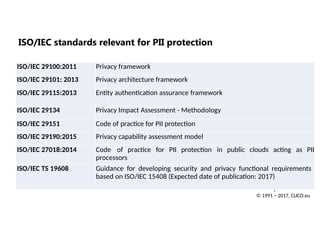
ISO/IEC 29100:2011 Privacyframework
ISO/IEC 29101: 2013 Privacy architecture framework
ISO/IEC 29115:2013 Entity authentication assurance framework
ISO/IEC 29134 Privacy Impact Assessment - Methodology
ISO/IEC 29151 Code of practice for PII protection
ISO/IEC 29190:2015 Privacy capability assessment model
ISO/IEC 27018:2014 Code of practice for PII protection in public clouds acting as PII
processors
ISO/IEC TS 19608 Guidance for developing security and privacy functional requirements
based on ISO/IEC 15408 (Expected date of publication: 2017)
© 1991 − 2017, CLICO.eu
ISO/IEC standards relevant for PII protection
- 16.
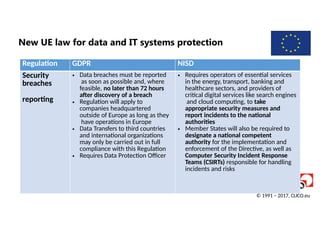
New UE lawfor data and IT systems protection
Regulation GDPR NISD
Security
breaches
reporting
• Data breaches must be reported
as soon as possible and, where
feasible, no later than 72 hours
after discovery of a breach
• Regulation will apply to
companies headquartered
outside of Europe as long as they
have operations in Europe
• Data Transfers to third countries
and international organizations
may only be carried out in full
compliance with this Regulation
• Requires Data Protection Officer
• Requires operators of essential services
in the energy, transport, banking and
healthcare sectors, and providers of
critical digital services like search engines
and cloud computing, to take
appropriate security measures and
report incidents to the national
authorities
• Member States will also be required to
designate a national competent
authority for the implementation and
enforcement of the Directive, as well as
Computer Security Incident Response
Teams (CSIRTs) responsible for handling
incidents and risks
© 1991 − 2017, CLICO.eu
- 17.
©
© 1
1
9
9
9
9
1
1 −
−2
2
0
0
1
1
7
7
,
,
C
C
L
L
I
I
C
C
O
O
.
.
e
e
u
u
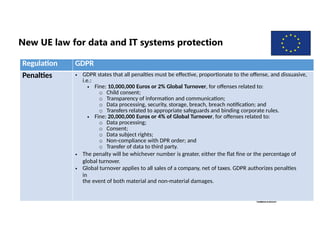
New UE law for data and IT systems protection
Regulation GDPR
Penalties • GDPR states that all penalties must be effective, proportionate to the offense, and dissuasive,
i.e.:
• Fine: 10,000,000 Euros or 2% Global Turnover, for offenses related to:
o Child consent;
o Transparency of information and communication;
o Data processing, security, storage, breach, breach notification; and
o Transfers related to appropriate safeguards and binding corporate rules.
• Fine: 20,000,000 Euros or 4% of Global Turnover, for offenses related to:
o Data processing;
o Consent;
o Data subject rights;
o Non-compliance with DPR order; and
o Transfer of data to third party.
• The penalty will be whichever number is greater, either the flat fine or the percentage of
global turnover.
• Global turnover applies to all sales of a company, net of taxes. GDPR authorizes penalties
in
the event of both material and non-material damages.
- 18.
© 1991 −2017, CLICO.eu
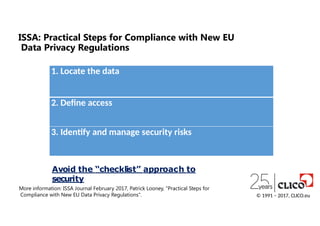
ISSA: Practical Steps for Compliance with New EU
Data Privacy Regulations
1. Locate the data
2. Define access
3. Identify and manage security risks
More information: ISSA Journal February 2017, Patrick Looney, "Practical Steps for
Compliance with New EU Data Privacy Regulations".
Avoid the “checklist” approach to
security
- 19.
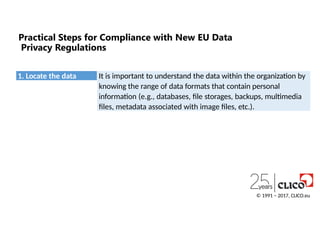
Practical Steps forCompliance with New EU Data
Privacy Regulations
1. Locate the data
© 1991 − 2017, CLICO.eu
It is important to understand the data within the organization by
knowing the range of data formats that contain personal
information (e.g., databases, file storages, backups, multimedia
files, metadata associated with image files, etc.).
- 20.
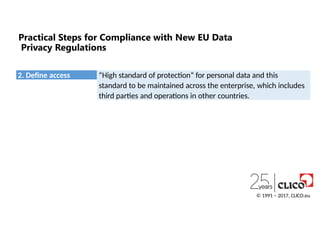
Practical Steps forCompliance with New EU Data
Privacy Regulations
2. Define access
© 1991 − 2017, CLICO.eu
“High standard of protection” for personal data and this
standard to be maintained across the enterprise, which includes
third parties and operations in other countries.
- 21.
Practical Steps forCompliance with New EU Data
Privacy Regulations
3. Identify and manage
security risks
© 1991 − 2017, CLICO.eu
The companies need to understand the security risks and the
threats associated with these risks versus how their controls
and measures are performing; the combination of these two
factors gives the ability to quantify risk and identify areas for
improvement and investment.
- 22.
How to protectPII?
Defense-in-Depth
IT security system
PII
documentation
Vulnerability
managemen
t
Protection against
relevant attack
vectors
Incident
managemen
t
© 1991 − 2017, CLICO.eu
- 23.
1. Intentional oraccidental leakage of personal data due
to employees' fault
Security Awareness
Next-Gen Firewall
DLP
2. Leakage of personal data due to malware infection on Next-Gen Firewall
employees' computers Anti-Virus
Sandboxing
Endpoint security
Data Encryption
…
© 1991 − 2017, CLICO.eu
Quick GDPR audit
- 24.
3. Leakage ofpersonal data as a result of hacking into
Web application
WAF - Web Application
Firewall
4. Leakage of personal data as a result of hacking into
database
DBFW - Database
Firewall
DB Encryption
5. Leakage of personal data as a result of hacking into
file server
File Firewall
File Encryption
© 1991 − 2017, CLICO.eu
Quick GDPR audit
- 25.
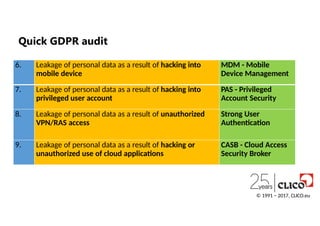
6. Leakage ofpersonal data as a result of hacking into
mobile device
MDM - Mobile
Device Management
7. Leakage of personal data as a result of hacking into
privileged user account
PAS - Privileged
Account Security
8. Leakage of personal data as a result of unauthorized
VPN/RAS access
Strong User
Authentication
9. Leakage of personal data as a result of hacking or
unauthorized use of cloud applications
CASB - Cloud Access
Security Broker
© 1991 − 2017, CLICO.eu
Quick GDPR audit
- 26.
© 1991 −2017, CLICO.eu
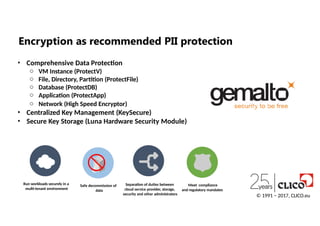
Encryption as recommended PII protection
Run workloads securely in a
multi-tenant environment
Safe decommission of
data
Meet compliance
and regulatory mandates
Separation of duties between
cloud service provider, storage,
security and other administrators
• Comprehensive Data Protection
o VM Instance (ProtectV)
o File, Directory, Partition (ProtectFile)
o Database (ProtectDB)
o Application (ProtectApp)
o Network (High Speed Encryptor)
• Centralized Key Management (KeySecure)
• Secure Key Storage (Luna Hardware Security Module)
- 27.
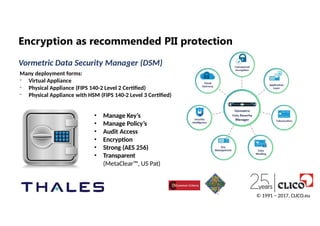
Encryption as recommendedPII protection
Vormetric Data Security Manager (DSM)
Many deployment forms:
- Virtual Appliance
- Physical Appliance (FIPS 140-2 Level 2 Certified)
- Physical Appliance with HSM (FIPS 140-2 Level 3 Certified)
• Manage Key’s
• Manage Policy’s
• Audit Access
• Encryption
• Strong (AES 256)
• Transparent
(MetaClear™, US Pat)
© 1991 − 2017, CLICO.eu
- 28.
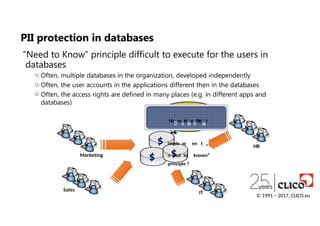
Marketing
$
$ $
Sales
HR
“Need toKnow” principle difficult to execute for the users in
databases
o Often, multiple databases in the organization, developed independently
o Often, the user accounts in the applications different then in the databases
o Often, the access rights are defined in many places (e.g. in different apps and
databases)
Ho
D
w
a
to
t
a
e
b
ffec
a
s
t
e
ivelly
imple
F
m
ire
en
w
t
a
„
n
ll
eed to known”
principle ?
IT
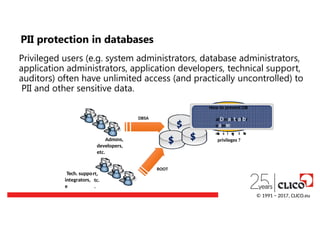
PII protection in databases
© 1991 − 2017, CLICO.eu
- 29.
Privileged users (e.g.system administrators, database administrators,
application administrators, application developers, technical support,
auditors) often have unlimited access (and practically uncontrolled) to
PII and other sensitive data.
Admins,
developers,
etc.
DBSA
Tech. suppo
integrators,
e
rt,
tc
.
ROOT
$
$ $
How to prevent DB
a
dDmai
ntsafbr
oams
e
m
i
s
uFsirien
gwtah
ell
privileges ?
© 1991 − 2017, CLICO.eu
PII protection in databases
- 30.
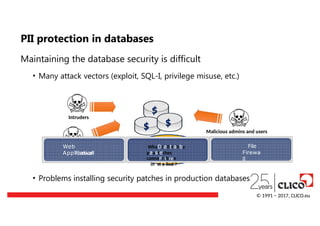
Maintaining the databasesecurity is difficult
• Many attack vectors (exploit, SQL-I, privilege misuse, etc.)
• Problems installing security patches in production databases
Intruders
Malicious admins and users
Malwa
r
e
$
$ $
Web
Application
Firewall
WhaDtaifttahbe
paasteches
cannoFt ibree
winastlallled ?
File
Firewa
ll
© 1991 − 2017, CLICO.eu
PII protection in databases
- 31.
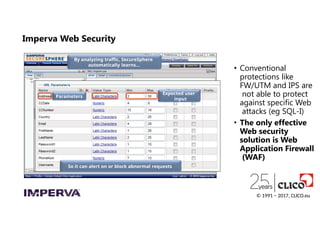
By analyzing traffic,SecureSphere
automatically learns…
Directories
URLs
Parameters
Expected user
input
So it can alert on or block abnormal requests
Imperva Web Security
• Conventional
protections like
FW/UTM and IPS are
not able to protect
against specific Web
attacks (eg SQL-I)
• The only effective
Web security
solution is Web
Application Firewall
(WAF)
© 1991 − 2017, CLICO.eu
- 32.
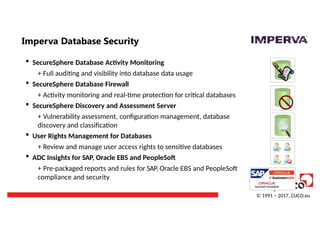
Imperva Database Security
SecureSphere Database Activity Monitoring
+ Full auditing and visibility into database data usage
SecureSphere Database Firewall
+ Activity monitoring and real-time protection for critical databases
SecureSphere Discovery and Assessment Server
+ Vulnerability assessment, configuration management, database
discovery and classification
User Rights Management for Databases
+ Review and manage user access rights to sensitive databases
ADC Insights for SAP, Oracle EBS and PeopleSoft
+ Pre-packaged reports and rules for SAP, Oracle EBS and PeopleSoft
compliance and security
© 1991 − 2017, CLICO.eu
- 33.
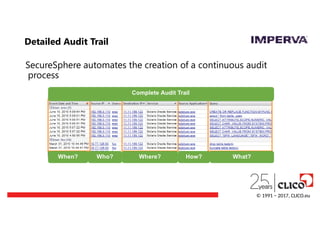
Detailed Audit Trail
When?Where?
Who?
SecureSphere automates the creation of a continuous audit
process
Complete Audit Trail
What?
How?
© 1991 − 2017, CLICO.eu
- 34.
- 35.
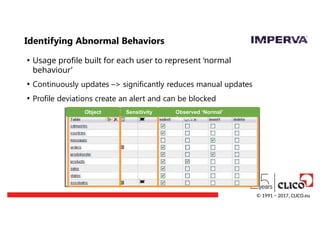
Identifying Abnormal Behaviors
•Usage profile built for each user to represent ‘normal
behaviour’
• Continuously updates –> significantly reduces manual updates
• Profile deviations create an alert and can be blocked
Object Sensitivity Observed ‘Normal’
Access
© 1991 − 2017, CLICO.eu
- 36.
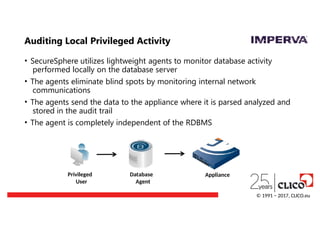
Auditing Local PrivilegedActivity
• SecureSphere utilizes lightweight agents to monitor database activity
performed locally on the database server
• The agents eliminate blind spots by monitoring internal network
communications
• The agents send the data to the appliance where it is parsed analyzed and
stored in the audit trail
• The agent is completely independent of the RDBMS
Privileged
User
Database
Agent
Appliance
© 1991 − 2017, CLICO.eu
- 37.
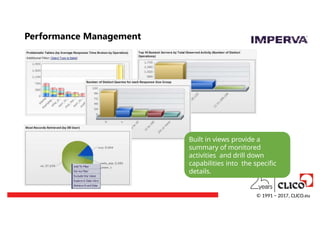
Performance Management
Built inviews provide a
summary of monitored
activities and drill down
capabilities into the specific
details.
© 1991 − 2017, CLICO.eu
- 38.
- 39.
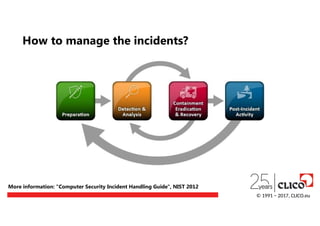
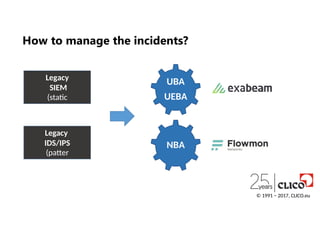
How to managethe incidents?
More information: "Computer Security Incident Handling Guide", NIST 2012
© 1991 − 2017, CLICO.eu
- 40.
- 41.
More information: "Strategiesfor incident response and cyber crisis cooperation", ENISA 2016
© 1991 − 2017, CLICO.eu
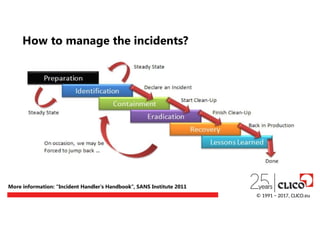
How to manage the incidents?
- 42.
1. Incident Identification
2.Triage
3. Classification
4. Notification
5. Containment
6. Evidence Collection
7. Chain of Custody
8. Eradication
9. Recovery
10. Forensics Analysis
11. Root Cause Analysis
12. Lessons Learned
TOOLS
How to manage the incidents?
© 1991 − 2017, CLICO.eu
- 43.
- 44.
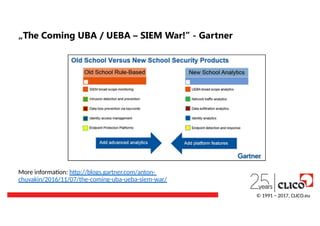
„The Coming UBA/ UEBA – SIEM War!” - Gartner
More information: http://blogs.gartner.com/anton-
chuvakin/2016/11/07/the-coming-uba-ueba-siem-war/
© 1991 − 2017, CLICO.eu
- 45.
- 46.
- 47.
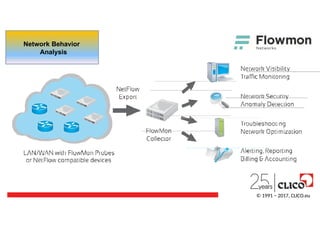
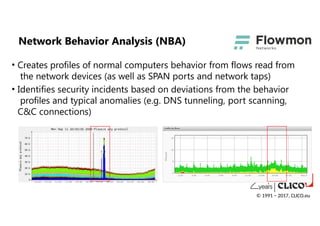
• Creates profilesof normal computers behavior from flows read from
the network devices (as well as SPAN ports and network taps)
• Identifies security incidents based on deviations from the behavior
profiles and typical anomalies (e.g. DNS tunneling, port scanning,
C&C connections)
Network Behavior Analysis (NBA)
© 1991 − 2017, CLICO.eu
- 48.
- 49.
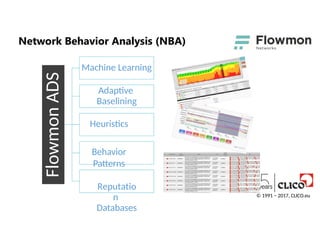
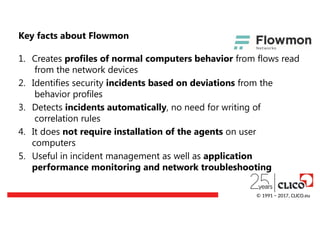
Key facts aboutFlowmon
1. Creates profiles of normal computers behavior from flows read
from the network devices
2. Identifies security incidents based on deviations from the
behavior profiles
3. Detects incidents automatically, no need for writing of
correlation rules
4. It does not require installation of the agents on user
computers
5. Useful in incident management as well as application
performance monitoring and network troubleshooting
© 1991 − 2017, CLICO.eu
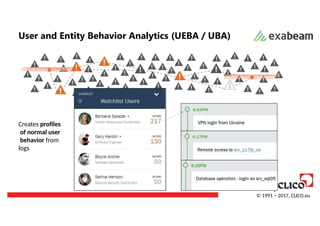
- 50.
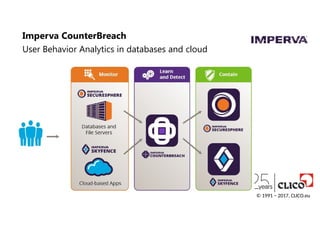
User and EntityBehavior Analytics (UEBA / UBA)
Creates profiles
of normal user
behavior from
logs
© 1991 − 2017, CLICO.eu
- 51.
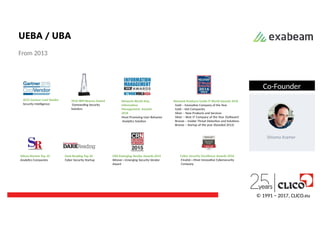
UEBA / UBA
ShlomoKramer
From 2013
Co-Founder
2016 IBM Beacon Award
Outstanding Security
Solution
2015 Gartner Cool Vendor
Security Intelligence
Network Products Guide IT World Awards 2016
Gold – Innovative Company of the Year
Gold – Hot Companies
Silver – New Products and Services
Silver – Best IT Company of the Year (Software)
Bronze – Insider Threat Detection and Solutions
Bronze – Startup of the year (founded 2013)
Network World Asia,
Information
Management Awards
2016
Most Promising User Behavior
Analytics Solution
Dark Reading Top 20
Cyber Security Startup
Silicon Review Top 10
Analytics Companies
CRN Emerging Vendor Awards 2015
Winner—Emerging Security Vendor
Award
Cyber Security Excellence Awards 2016
Finalist—Most Innovative Cybersecurity
Company
© 1991 − 2017, CLICO.eu
- 52.
Key facts aboutExabeam
1. Creates profiles of normal user behavior from logs read from
SIEM and other data sources
2. Identifies security incidents based on deviations from the user
behavior profiles
3. Detects incidents not visible to SIEM, including security breaches
with passwords stolen for legitimate users
4. Provides easy-to-understand and easy-to-proof evidence of the
incident, including list of specific user actions
5. It does not require installation of the agents on user computers
6. It can operate with SIEM or replace it with its own Log
Management System
© 1991 − 2017, CLICO.eu
- 53.
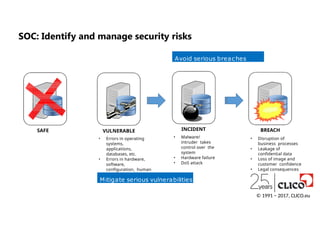
SAFE VULNERABLE
• Errorsin operating
systems,
applications,
databases, etc.
• Errors in hardware,
software,
configuration, human
factor, etc.
INCIDENT
• Malware/
intruder takes
control over the
system
• Hardware failure
• DoS attack
BREACH
• Disruption of
business processes
• Leakage of
confidential data
• Loss of image and
customer confidence
• Legal consequences
Avoid serious breaches
© 1991 − 2017, CLICO.eu
Mitigate serious vulnerabilities
SOC: Identify and manage security risks