THE PALISADES
Summary Design Charrette Findings
The Palisades Design Charrette
• On November 18th, 2013 the City of El Paso’s City

Development and Parks and Recreation Departments
held a public meeting and charrette to obtain public
feedback about various design aspects of the Palisades
trailhead and access improvements project.
• The following slides summarize the results of this

charrette, to include findings from the:
1. Visual Preference Survey
2. Comments on the Three Conceptual Plans
VISUAL PREFERENCE
SURVEY
Summary of Findings
Purpose and Methodology
• Purpose
• The purpose of the Visual Preference Survey was to obtain public feedback on

physical and aesthetic design alternatives for various elements of the Palisades
trailhead and access improvements project.
• Elements included the following:
Entryway
Furniture & Fixtures
Path
Details

Gathering Places
Signs
Along Trails
Parking

• Methodology
• Images of design alternatives for each element were posted for consideration by

meeting attendees.
• Meeting attendees were provided 12 dots and instructed to place their dots on the
images they liked best.
• The following slides summarize the top and bottom images identified within each
element.
• Top images represent the images receiving the largest number of dots, while bottom images

represent those receiving the fewest number of dots.
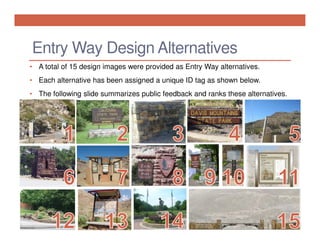
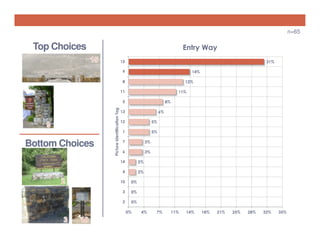
Entry Way Design Alternatives
• A total of 15 design images were provided as Entry Way alternatives.
• Each alternative has been assigned a unique ID tag as shown below.
• The following slide summarizes public feedback and ranks these alternatives.
n=65

Top Choices

Entry Way
15

31%

9

14%

8

12%

11

11%

Bottom Choices

Picture Identification Tag

5

8%

13

6%

12

5%

1

5%

7

3%

6

3%

14

2%

4

2%

10

0%

3

0%

2

0%
0%

4%

7%

11%

14%

18%

21%

25%

28%

32%

35%
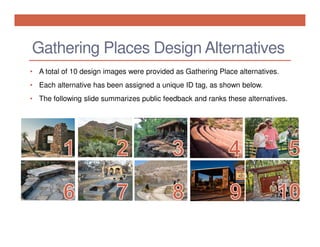
Gathering Places Design Alternatives
• A total of 10 design images were provided as Gathering Place alternatives.
• Each alternative has been assigned a unique ID tag, as shown below.
• The following slide summarizes public feedback and ranks these alternatives.
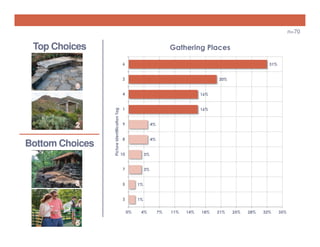
n=70

Top Choices

Gathering Places
6

31%

2

20%

Bottom Choices

Picture Identification Tag

4

16%

1

16%

9

4%

8

4%

10

3%

7

3%

5

1%

3

1%
0%

4%

7%

11%

14%

18%

21%

25%

28%

32%

35%
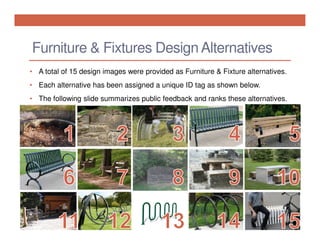
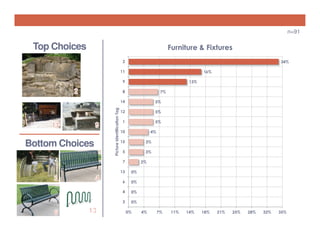
Furniture & Fixtures Design Alternatives
• A total of 15 design images were provided as Furniture & Fixture alternatives.
• Each alternative has been assigned a unique ID tag as shown below.
• The following slide summarizes public feedback and ranks these alternatives.
n=91

Top Choices

Furniture & Fixtures
2

34%

11

16%

9

13%

8

7%

Bottom Choices

Picture Identification Tag

14

5%

12

5%

1

5%

10

4%

15

3%

5

3%

7

2%

13

0%

6

0%

4

0%

3

0%
0%

4%

7%

11%

14%

18%

21%

25%

28%

32%

35%
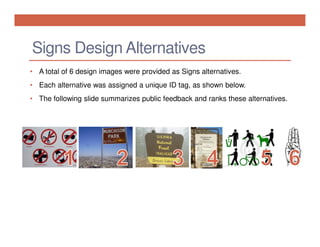
Signs Design Alternatives
• A total of 6 design images were provided as Signs alternatives.
• Each alternative was assigned a unique ID tag, as shown below.
• The following slide summarizes public feedback and ranks these alternatives.
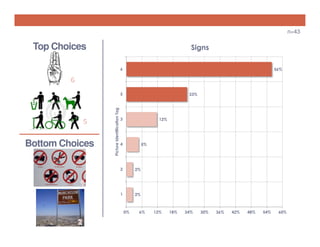
n=43

Top Choices

Signs
6

56%

Bottom Choices

Picture Identification Tag

5

23%

3

12%

4

5%

2

2%

1

2%

0%

6%

12%

18%

24%

30%

36%

42%

48%

54%

60%
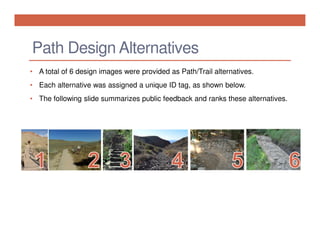
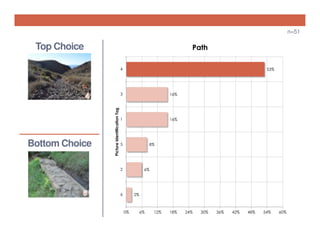
Path Design Alternatives
• A total of 6 design images were provided as Path/Trail alternatives.
• Each alternative was assigned a unique ID tag, as shown below.
• The following slide summarizes public feedback and ranks these alternatives.
n=51

Top Choice

Path
4

53%

Bottom Choice

Picture Identification Tag

3

16%

1

16%

5

8%

2

6%

6

2%

0%

6%

12%

18%

24%

30%

36%

42%

48%

54%

60%
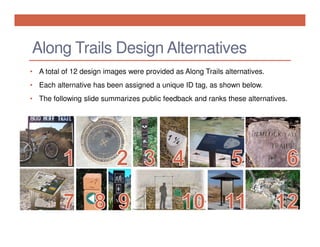
Along Trails Design Alternatives
• A total of 12 design images were provided as Along Trails alternatives.
• Each alternative has been assigned a unique ID tag, as shown below.
• The following slide summarizes public feedback and ranks these alternatives.
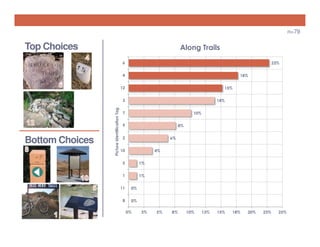
n=79

Top Choices

Along Trails
6

23%

4

18%

12

15%

Bottom Choices

Picture Identification Tag

3

14%

7

10%

9

8%

2

6%

10

4%

5

1%

1

1%

11

0%

8

0%
0%

3%

5%

8%

10%

13%

15%

18%

20%

23%

25%
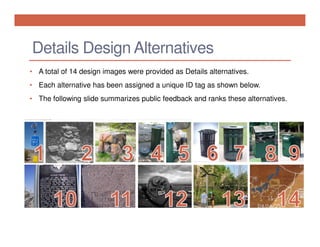
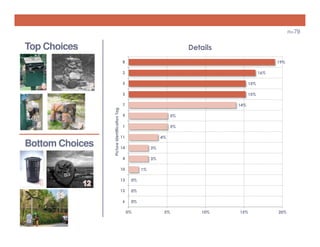
Details Design Alternatives
• A total of 14 design images were provided as Details alternatives.
• Each alternative has been assigned a unique ID tag as shown below.
• The following slide summarizes public feedback and ranks these alternatives.
n=79

Top Choices

Details
8

19%

2

16%

5

15%

3

15%

Bottom Choices

Picture Identification Tag

7

14%

9

5%

1

5%

11

4%

14

3%

4

3%

10

1%

13

0%

12

0%

6

0%
0%

5%

10%

15%

20%
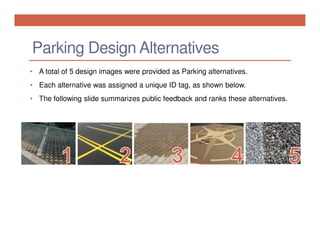
Parking Design Alternatives
• A total of 5 design images were provided as Parking alternatives.
• Each alternative was assigned a unique ID tag, as shown below.
• The following slide summarizes public feedback and ranks these alternatives.
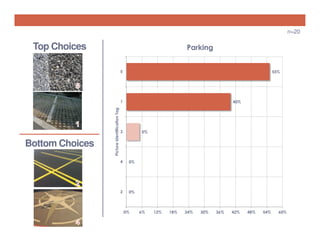
n=20

Top Choices

Parking

5

55%

Bottom Choices

Picture Identification Tag

1

40%

3

5%

4

0%

2

0%

0%

6%

12%

18%

24%

30%

36%

42%

48%

54%

60%
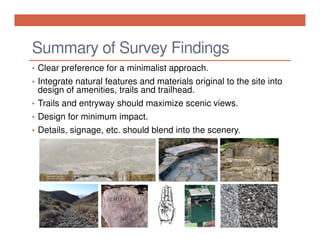
Summary of Survey Findings
• Clear preference for a minimalist approach.
• Integrate natural features and materials original to the site into

design of amenities, trails and trailhead.
• Trails and entryway should maximize scenic views.
• Design for minimum impact.
• Details, signage, etc. should blend into the scenery.
COMMENTS ON THREE
CONCEPTUAL PLANS
Summary of Findings
Purpose and Methodology
• Purpose
• The purpose of the opportunity to comment on each of the three conceptual plans

was to obtain public feedback on the various design options and their elements,
including parking location/layout, amenities, etc. This feedback is intended to serve
as a foundation for the final project design.

• Methodology
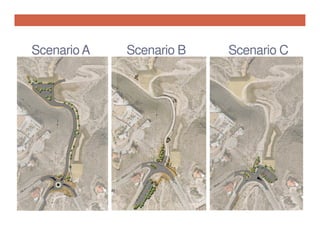
• The three conceptual plans were placed on tables and meeting attendees were

asked to answer two questions about each of the plans.
• The two questions asked were as follows:
1.

What would you change about this plan?

2.

What would you keep about this plan?

• Comments received were then compiled and organized by general theme/category.

Some these general themes include “Parking”, “Amenities”, “Security”, etc.
• The following slides summarize findings from this exercise.
Scenario A

Scenario B

Scenario C
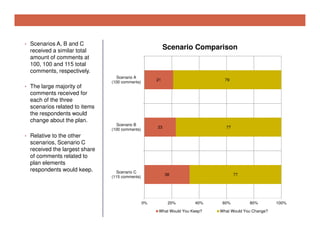
• Scenarios A, B and C

Scenario Comparison

received a similar total
amount of comments at
100, 100 and 115 total
comments, respectively.
• The large majority of

comments received for
each of the three
scenarios related to items
the respondents would
change about the plan.

Scenario A
(100 comments)

21

Scenario B
(100 comments)

79

23

77

• Relative to the other

scenarios, Scenario C
received the largest share
of comments related to
plan elements
respondents would keep.

Scenario C
(115 comments)

38

0%

20%

77

40%

What Would You Keep?

60%

80%

What Would You Change?

100%
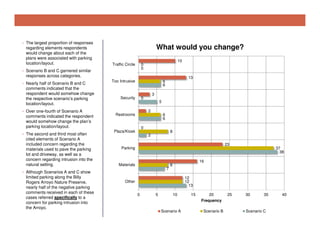
• The largest proportion of responses

regarding elements respondents
would change about each of the
plans were associated with parking
location/layout.

What would you change?
Traffic Circle

10

0
0

• Scenario B and C garnered similar

responses across categories.
• Nearly half of Scenario B and C

comments indicated that the
respondent would somehow change
the respective scenario’s parking
location/layout.
• Over one-fourth of Scenario A

comments indicated the respondent
would somehow change the plan’s
parking location/layout.
• The second and third most often

cited elements of Scenario A
included concern regarding the
materials used to pave the parking
lot and driveway, as well as a
concern regarding intrusion into the
natural setting.

Too Intrusive

Security

3

0

5
2

Restrooms

6
6

0

Plaza/Kiosk

8

2

23

Parking

Materials
7

• Although Scenarios A and C show

limited parking along the Billy
Rogers Arroyo Nature Preserve,
nearly half of the negative parking
comments received in each of these
cases referred specifically to a
concern for parking intrusion into
the Arroyo.

13

6
6

37
38

16

8
12
12
13

Other
0

5

10

Scenario A

15

20
Frequency
Scenario B

25

30

35

Scenario C

40
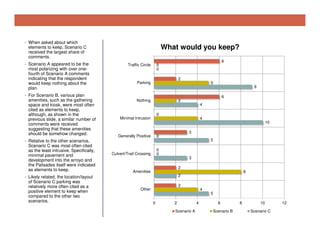
• When asked about which

What would you keep?

elements to keep, Scenario C
received the largest share of
comments.
• Scenario A appeared to be the

most polarizing with over onefourth of Scenario A comments
indicating that the respondent
would keep nothing about the
plan.

6

Traffic Circle

0
0
2

Parking

5
9

• For Scenario B, various plan

amenities, such as the gathering
space and kiosk, were most often
cited as elements to keep,
although, as shown in the
previous slide, a similar number of
comments were received
suggesting that these amenities
should be somehow changed.

6

Nothing

2
4
0

Minimal Intrusion

4
10
3

Generally Positive

0
5

• Relative to the other scenarios,

Scenario C was most often cited
as the least intrusive. Specifically,
minimal pavement and
development into the arroyo and
the Palisades itself were indicated
as elements to keep.

0
0

Culvert/Trail Crossing

3
2

Amenities

8
2

• Likely related, the location/layout

of Scenario C parking was
relatively more often cited as a
positive element to keep when
compared to the other two
scenarios.

2

Other

4
5
0

2
Scenario A

4

6
Scenario B

8

10
Scenario C

12
Summary of Conceptual Plan Comments
• The majority of comments received referred to elements about each of the

conceptual plans meeting attendees would change.

• Of the three scenarios, Scenario C received the largest share of positive

comments, although like its counterparts, a clear concern regarding parking layout
and location was communicated.

• Putting together both positive and negative comments received, the following

bullets summarize elements that should be considered and incorporated in the
final design:
• A plan that limits the impact and level of intrusion into the Palisades and negates any impact to

the Billy Rogers Arroyo Park is a priority.

• As a means of reducing the impact to the natural environment, a plan that reduces on-site

parking and employs alternative parking options should be considered.

• The use of pervious materials natural to the site, rather than concrete and asphalt, for parking

surfaces and gathering spaces should be used.

• Amenities such as an educational kiosk and gathering space at the entry may be considered, but

these amenities must blend well with the surrounding natural environment and have a minimal
impact on that environment.
CONCLUSIONS
Conclusions
• Both the Visual Preference Survey and the comments provided for each

of the three conceptual plans clearly demonstrate that minimal impact to
the natural environment is a priority.
• Trailhead elements and other access improvements ought to use materials natural

to the site and enhance its natural beauty such as its scenic views.

• Parking location/layout is a key community concern in the design of the

Palisades access improvements.
• There is a clear trend that suggests any parking or other encroachment into the Billy

Rogers Arroyo Nature Preserve is unacceptable.
• However, additional information is needed to confirm whether one of the parking

locations/layouts presented is preferred.
• Alternatively, given comments provided, other parking options, such as reducing the

number of on-site spaces need to be considered before final design is completed.
• Finally, there is evidence to suggest materials used (i.e. soft vs. hard) may influence

parking location/layout preference; the community should be given an opportunity to
comment on such options.
Next Steps
• Hold a second public meeting on Monday, February 17th, 2014.
• The purpose of this meeting is two-fold:
1.

Share the results of the November 18th, 2013 Palisades Design Charrette
with the community.

2.

Provide the community with a second opportunity to comment on several
alternative design options that incorporate the findings summarized in this
report.

• The second community meeting is intended to wrap-up the public

input process. Goals of this event should include:
• Finalizing parking location, layout and design materials.
• Entryway and other signage design and materials.
• Inclusion of other amenities as desired, if permitted by the budget.
QUESTIONS?
Contact:
Elizabeth Gibson, GibsonEK@elpasotexas.gov
Laura Kissack, KissackLF@elpasotexas.gov

Palisades Charrette #1 Findings

  • 1.
    THE PALISADES Summary DesignCharrette Findings
  • 2.
    The Palisades DesignCharrette • On November 18th, 2013 the City of El Paso’s City Development and Parks and Recreation Departments held a public meeting and charrette to obtain public feedback about various design aspects of the Palisades trailhead and access improvements project. • The following slides summarize the results of this charrette, to include findings from the: 1. Visual Preference Survey 2. Comments on the Three Conceptual Plans
  • 3.
  • 4.
    Purpose and Methodology •Purpose • The purpose of the Visual Preference Survey was to obtain public feedback on physical and aesthetic design alternatives for various elements of the Palisades trailhead and access improvements project. • Elements included the following: Entryway Furniture & Fixtures Path Details Gathering Places Signs Along Trails Parking • Methodology • Images of design alternatives for each element were posted for consideration by meeting attendees. • Meeting attendees were provided 12 dots and instructed to place their dots on the images they liked best. • The following slides summarize the top and bottom images identified within each element. • Top images represent the images receiving the largest number of dots, while bottom images represent those receiving the fewest number of dots.
  • 5.
    Entry Way DesignAlternatives • A total of 15 design images were provided as Entry Way alternatives. • Each alternative has been assigned a unique ID tag as shown below. • The following slide summarizes public feedback and ranks these alternatives.
  • 6.
    n=65 Top Choices Entry Way 15 31% 9 14% 8 12% 11 11% BottomChoices Picture Identification Tag 5 8% 13 6% 12 5% 1 5% 7 3% 6 3% 14 2% 4 2% 10 0% 3 0% 2 0% 0% 4% 7% 11% 14% 18% 21% 25% 28% 32% 35%
  • 7.
    Gathering Places DesignAlternatives • A total of 10 design images were provided as Gathering Place alternatives. • Each alternative has been assigned a unique ID tag, as shown below. • The following slide summarizes public feedback and ranks these alternatives.
  • 8.
    n=70 Top Choices Gathering Places 6 31% 2 20% BottomChoices Picture Identification Tag 4 16% 1 16% 9 4% 8 4% 10 3% 7 3% 5 1% 3 1% 0% 4% 7% 11% 14% 18% 21% 25% 28% 32% 35%
  • 9.
    Furniture & FixturesDesign Alternatives • A total of 15 design images were provided as Furniture & Fixture alternatives. • Each alternative has been assigned a unique ID tag as shown below. • The following slide summarizes public feedback and ranks these alternatives.
  • 10.
    n=91 Top Choices Furniture &Fixtures 2 34% 11 16% 9 13% 8 7% Bottom Choices Picture Identification Tag 14 5% 12 5% 1 5% 10 4% 15 3% 5 3% 7 2% 13 0% 6 0% 4 0% 3 0% 0% 4% 7% 11% 14% 18% 21% 25% 28% 32% 35%
  • 11.
    Signs Design Alternatives •A total of 6 design images were provided as Signs alternatives. • Each alternative was assigned a unique ID tag, as shown below. • The following slide summarizes public feedback and ranks these alternatives.
  • 12.
    n=43 Top Choices Signs 6 56% Bottom Choices PictureIdentification Tag 5 23% 3 12% 4 5% 2 2% 1 2% 0% 6% 12% 18% 24% 30% 36% 42% 48% 54% 60%
  • 13.
    Path Design Alternatives •A total of 6 design images were provided as Path/Trail alternatives. • Each alternative was assigned a unique ID tag, as shown below. • The following slide summarizes public feedback and ranks these alternatives.
  • 14.
    n=51 Top Choice Path 4 53% Bottom Choice PictureIdentification Tag 3 16% 1 16% 5 8% 2 6% 6 2% 0% 6% 12% 18% 24% 30% 36% 42% 48% 54% 60%
  • 15.
    Along Trails DesignAlternatives • A total of 12 design images were provided as Along Trails alternatives. • Each alternative has been assigned a unique ID tag, as shown below. • The following slide summarizes public feedback and ranks these alternatives.
  • 16.
    n=79 Top Choices Along Trails 6 23% 4 18% 12 15% BottomChoices Picture Identification Tag 3 14% 7 10% 9 8% 2 6% 10 4% 5 1% 1 1% 11 0% 8 0% 0% 3% 5% 8% 10% 13% 15% 18% 20% 23% 25%
  • 17.
    Details Design Alternatives •A total of 14 design images were provided as Details alternatives. • Each alternative has been assigned a unique ID tag as shown below. • The following slide summarizes public feedback and ranks these alternatives.
  • 18.
    n=79 Top Choices Details 8 19% 2 16% 5 15% 3 15% Bottom Choices PictureIdentification Tag 7 14% 9 5% 1 5% 11 4% 14 3% 4 3% 10 1% 13 0% 12 0% 6 0% 0% 5% 10% 15% 20%
  • 19.
    Parking Design Alternatives •A total of 5 design images were provided as Parking alternatives. • Each alternative was assigned a unique ID tag, as shown below. • The following slide summarizes public feedback and ranks these alternatives.
  • 20.
    n=20 Top Choices Parking 5 55% Bottom Choices PictureIdentification Tag 1 40% 3 5% 4 0% 2 0% 0% 6% 12% 18% 24% 30% 36% 42% 48% 54% 60%
  • 21.
    Summary of SurveyFindings • Clear preference for a minimalist approach. • Integrate natural features and materials original to the site into design of amenities, trails and trailhead. • Trails and entryway should maximize scenic views. • Design for minimum impact. • Details, signage, etc. should blend into the scenery.
  • 22.
    COMMENTS ON THREE CONCEPTUALPLANS Summary of Findings
  • 23.
    Purpose and Methodology •Purpose • The purpose of the opportunity to comment on each of the three conceptual plans was to obtain public feedback on the various design options and their elements, including parking location/layout, amenities, etc. This feedback is intended to serve as a foundation for the final project design. • Methodology • The three conceptual plans were placed on tables and meeting attendees were asked to answer two questions about each of the plans. • The two questions asked were as follows: 1. What would you change about this plan? 2. What would you keep about this plan? • Comments received were then compiled and organized by general theme/category. Some these general themes include “Parking”, “Amenities”, “Security”, etc. • The following slides summarize findings from this exercise.
  • 24.
  • 25.
    • Scenarios A,B and C Scenario Comparison received a similar total amount of comments at 100, 100 and 115 total comments, respectively. • The large majority of comments received for each of the three scenarios related to items the respondents would change about the plan. Scenario A (100 comments) 21 Scenario B (100 comments) 79 23 77 • Relative to the other scenarios, Scenario C received the largest share of comments related to plan elements respondents would keep. Scenario C (115 comments) 38 0% 20% 77 40% What Would You Keep? 60% 80% What Would You Change? 100%
  • 26.
    • The largestproportion of responses regarding elements respondents would change about each of the plans were associated with parking location/layout. What would you change? Traffic Circle 10 0 0 • Scenario B and C garnered similar responses across categories. • Nearly half of Scenario B and C comments indicated that the respondent would somehow change the respective scenario’s parking location/layout. • Over one-fourth of Scenario A comments indicated the respondent would somehow change the plan’s parking location/layout. • The second and third most often cited elements of Scenario A included concern regarding the materials used to pave the parking lot and driveway, as well as a concern regarding intrusion into the natural setting. Too Intrusive Security 3 0 5 2 Restrooms 6 6 0 Plaza/Kiosk 8 2 23 Parking Materials 7 • Although Scenarios A and C show limited parking along the Billy Rogers Arroyo Nature Preserve, nearly half of the negative parking comments received in each of these cases referred specifically to a concern for parking intrusion into the Arroyo. 13 6 6 37 38 16 8 12 12 13 Other 0 5 10 Scenario A 15 20 Frequency Scenario B 25 30 35 Scenario C 40
  • 27.
    • When askedabout which What would you keep? elements to keep, Scenario C received the largest share of comments. • Scenario A appeared to be the most polarizing with over onefourth of Scenario A comments indicating that the respondent would keep nothing about the plan. 6 Traffic Circle 0 0 2 Parking 5 9 • For Scenario B, various plan amenities, such as the gathering space and kiosk, were most often cited as elements to keep, although, as shown in the previous slide, a similar number of comments were received suggesting that these amenities should be somehow changed. 6 Nothing 2 4 0 Minimal Intrusion 4 10 3 Generally Positive 0 5 • Relative to the other scenarios, Scenario C was most often cited as the least intrusive. Specifically, minimal pavement and development into the arroyo and the Palisades itself were indicated as elements to keep. 0 0 Culvert/Trail Crossing 3 2 Amenities 8 2 • Likely related, the location/layout of Scenario C parking was relatively more often cited as a positive element to keep when compared to the other two scenarios. 2 Other 4 5 0 2 Scenario A 4 6 Scenario B 8 10 Scenario C 12
  • 28.
    Summary of ConceptualPlan Comments • The majority of comments received referred to elements about each of the conceptual plans meeting attendees would change. • Of the three scenarios, Scenario C received the largest share of positive comments, although like its counterparts, a clear concern regarding parking layout and location was communicated. • Putting together both positive and negative comments received, the following bullets summarize elements that should be considered and incorporated in the final design: • A plan that limits the impact and level of intrusion into the Palisades and negates any impact to the Billy Rogers Arroyo Park is a priority. • As a means of reducing the impact to the natural environment, a plan that reduces on-site parking and employs alternative parking options should be considered. • The use of pervious materials natural to the site, rather than concrete and asphalt, for parking surfaces and gathering spaces should be used. • Amenities such as an educational kiosk and gathering space at the entry may be considered, but these amenities must blend well with the surrounding natural environment and have a minimal impact on that environment.
  • 29.
  • 30.
    Conclusions • Both theVisual Preference Survey and the comments provided for each of the three conceptual plans clearly demonstrate that minimal impact to the natural environment is a priority. • Trailhead elements and other access improvements ought to use materials natural to the site and enhance its natural beauty such as its scenic views. • Parking location/layout is a key community concern in the design of the Palisades access improvements. • There is a clear trend that suggests any parking or other encroachment into the Billy Rogers Arroyo Nature Preserve is unacceptable. • However, additional information is needed to confirm whether one of the parking locations/layouts presented is preferred. • Alternatively, given comments provided, other parking options, such as reducing the number of on-site spaces need to be considered before final design is completed. • Finally, there is evidence to suggest materials used (i.e. soft vs. hard) may influence parking location/layout preference; the community should be given an opportunity to comment on such options.

  • 31.
    Next Steps • Holda second public meeting on Monday, February 17th, 2014. • The purpose of this meeting is two-fold: 1. Share the results of the November 18th, 2013 Palisades Design Charrette with the community. 2. Provide the community with a second opportunity to comment on several alternative design options that incorporate the findings summarized in this report. • The second community meeting is intended to wrap-up the public input process. Goals of this event should include: • Finalizing parking location, layout and design materials. • Entryway and other signage design and materials. • Inclusion of other amenities as desired, if permitted by the budget.
  • 32.