Pairwise testing technique-
Made easy.Enhanced by Samee Ahmed Indikar
Agenda
 What is Pairwise Testing?
 How It is Effective Test Design Technique for
Finding Defects?
 Example
 Limitations
 Tools
 Conclusion
Definition: What Is Pairwise Testing?
 Pairwise Testing is a test design technique that
delivers hundred percent test coverage.
 ISTQB defines All-Pairs Testing (or Pairwise Testing)
as A black-box test design technique in which test
cases are designed to execute all possible discrete
combinations of each pair of input parameters.
 The output of a software application depends on
many factors e.g. input parameters, state variables
and environment configurations. Techniques
like boundary value analysis and equivalence
partitioningcan be useful to identify the possible
values for individual factors. But it is impractical to test
all possible combinations of values for all those
factors. So instead a subset of combinations is
generated to satisfy all factors.
How It is Effective Test Design
Technique for Finding Defects
 All-Pairs technique is very helpful for designing
tests for applications involving multiple
parameters. Tests are designed such that for
each pair of input parameters to a system, there
are all possible discrete combinations of those
parameters. The test suite covers all
combinations; therefore it is not exhaustive yet
very effective in finding bugs.
Pairwise Testing Example
 Car Ordering Application:
 The car ordering application allows for Buying
and Selling cars. It should support trading in Delhi
and Mumbai.
 The application should have registration
numbers, may be valid or invalid. It should allow
the trade of following cars: BMW, Audi, and
Mercedes.
 Two types of booking can be done: E-booking
and In Store.
 Orders can be placed only during trading hours.
Example .. Contd.
 Variables: Order category(Buy, sell),
location(Delhi , Mumbai), Car Brand(BMW,Audi,
Mercedes), Registration number(Valid, invalid),
Order type(ebook,in store),order time(working hr
and non working hr).
 Step1:
 All possible valid combinations:
= 2 X 2 X 3 X 5000 X 2 X 2= 240000
 There is also an infinite number of invalid
combinations.
Example .. Contd.
 Step #2: Let’s simplify
 – Use a smart representative sample.
– Use groups and boundaries, even when data is
non-discrete.
– Reduce Registration Number to Two
 Valid registration number
 Invalid registration number
 Now let’s calculate the number of possible
combinations
= 2 X 2 X 3 X 2 X 2 X 2
= 96
Example .. Contd.
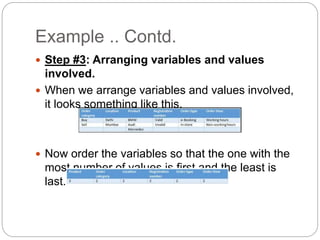
 Step #3: Arranging variables and values
involved.
 When we arrange variables and values involved,
it looks something like this.
 Now order the variables so that the one with the
most number of values is first and the least is
last.
Example .. Contd.
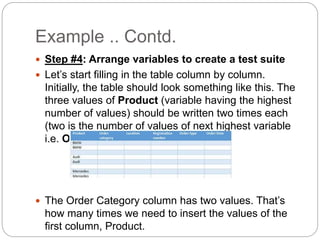
 Step #4: Arrange variables to create a test suite
 Let’s start filling in the table column by column.
Initially, the table should look something like this. The
three values of Product (variable having the highest
number of values) should be written two times each
(two is the number of values of next highest variable
i.e. Order category).
 The Order Category column has two values. That’s
how many times we need to insert the values of the
first column, Product.
Example .. Contd.
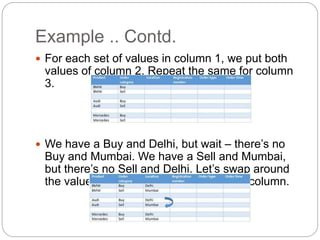
 For each set of values in column 1, we put both
values of column 2. Repeat the same for column
3.
 We have a Buy and Delhi, but wait – there’s no
Buy and Mumbai. We have a Sell and Mumbai,
but there’s no Sell and Delhi. Let’s swap around
the values in the second set in the third column.
Example .. Contd.
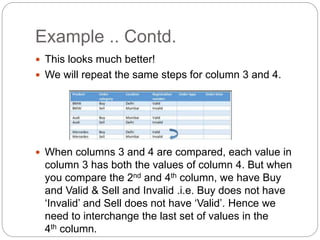
 This looks much better!
 We will repeat the same steps for column 3 and 4.
 When columns 3 and 4 are compared, each value in
column 3 has both the values of column 4. But when
you compare the 2nd and 4th column, we have Buy
and Valid & Sell and Invalid .i.e. Buy does not have
‘Invalid’ and Sell does not have ‘Valid’. Hence we
need to interchange the last set of values in the
4th column.
Example .. Contd.
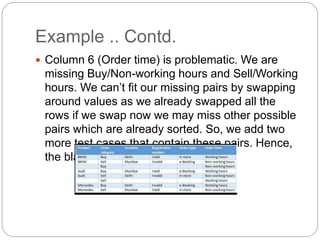
 Column 6 (Order time) is problematic. We are
missing Buy/Non-working hours and Sell/Working
hours. We can’t fit our missing pairs by swapping
around values as we already swapped all the
rows if we swap now we may miss other possible
pairs which are already sorted. So, we add two
more test cases that contain these pairs. Hence,
the blank rows!
Example .. Contd.
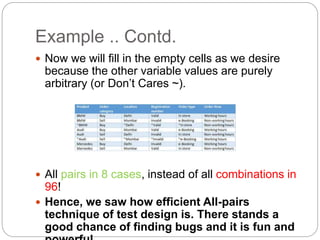
 Now we will fill in the empty cells as we desire
because the other variable values are purely
arbitrary (or Don’t Cares ~).
 All pairs in 8 cases, instead of all combinations in
96!
 Hence, we saw how efficient All-pairs
technique of test design is. There stands a
good chance of finding bugs and it is fun and
Limitations
The pairwise testing technique has some
limitations as well:
 It fails when the values selected for testing are
incorrect.
 It fails when highly probable combinations get too
little attention.
 It fails when interactions between the variables
are not understood well.
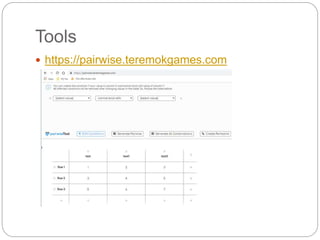
Tools
 https://pairwise.teremokgames.com
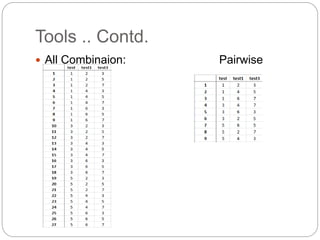
Tools .. Contd.
 All Combinaion: Pairwise
combination:
Conclusion:
 The pairwise testing technique can dramatically
reduce the number of combinations to be covered
but remains very effective in terms of fault
detection. It is indeed a smart test design
technique that guarantees a win-win situation for
both test effort and test effectiveness.
 During the Test planning phase of software
testing, the Pairwise testing technique should
always be taken into consideration. Either we are
doing it manually or using any tool to generate
test cases, it becomes a necessary component of
the test plan because it, in turn, affects Test
estimation.

Pairwise testing technique-Made easy

  • 1.
    Pairwise testing technique- Madeeasy.Enhanced by Samee Ahmed Indikar
  • 2.
    Agenda  What isPairwise Testing?  How It is Effective Test Design Technique for Finding Defects?  Example  Limitations  Tools  Conclusion
  • 3.
    Definition: What IsPairwise Testing?  Pairwise Testing is a test design technique that delivers hundred percent test coverage.  ISTQB defines All-Pairs Testing (or Pairwise Testing) as A black-box test design technique in which test cases are designed to execute all possible discrete combinations of each pair of input parameters.  The output of a software application depends on many factors e.g. input parameters, state variables and environment configurations. Techniques like boundary value analysis and equivalence partitioningcan be useful to identify the possible values for individual factors. But it is impractical to test all possible combinations of values for all those factors. So instead a subset of combinations is generated to satisfy all factors.
  • 4.
    How It isEffective Test Design Technique for Finding Defects  All-Pairs technique is very helpful for designing tests for applications involving multiple parameters. Tests are designed such that for each pair of input parameters to a system, there are all possible discrete combinations of those parameters. The test suite covers all combinations; therefore it is not exhaustive yet very effective in finding bugs.
  • 5.
    Pairwise Testing Example Car Ordering Application:  The car ordering application allows for Buying and Selling cars. It should support trading in Delhi and Mumbai.  The application should have registration numbers, may be valid or invalid. It should allow the trade of following cars: BMW, Audi, and Mercedes.  Two types of booking can be done: E-booking and In Store.  Orders can be placed only during trading hours.
  • 6.
    Example .. Contd. Variables: Order category(Buy, sell), location(Delhi , Mumbai), Car Brand(BMW,Audi, Mercedes), Registration number(Valid, invalid), Order type(ebook,in store),order time(working hr and non working hr).  Step1:  All possible valid combinations: = 2 X 2 X 3 X 5000 X 2 X 2= 240000  There is also an infinite number of invalid combinations.
  • 7.
    Example .. Contd. Step #2: Let’s simplify  – Use a smart representative sample. – Use groups and boundaries, even when data is non-discrete. – Reduce Registration Number to Two  Valid registration number  Invalid registration number  Now let’s calculate the number of possible combinations = 2 X 2 X 3 X 2 X 2 X 2 = 96
  • 8.
    Example .. Contd. Step #3: Arranging variables and values involved.  When we arrange variables and values involved, it looks something like this.  Now order the variables so that the one with the most number of values is first and the least is last.
  • 9.
    Example .. Contd. Step #4: Arrange variables to create a test suite  Let’s start filling in the table column by column. Initially, the table should look something like this. The three values of Product (variable having the highest number of values) should be written two times each (two is the number of values of next highest variable i.e. Order category).  The Order Category column has two values. That’s how many times we need to insert the values of the first column, Product.
  • 10.
    Example .. Contd. For each set of values in column 1, we put both values of column 2. Repeat the same for column 3.  We have a Buy and Delhi, but wait – there’s no Buy and Mumbai. We have a Sell and Mumbai, but there’s no Sell and Delhi. Let’s swap around the values in the second set in the third column.
  • 11.
    Example .. Contd. This looks much better!  We will repeat the same steps for column 3 and 4.  When columns 3 and 4 are compared, each value in column 3 has both the values of column 4. But when you compare the 2nd and 4th column, we have Buy and Valid & Sell and Invalid .i.e. Buy does not have ‘Invalid’ and Sell does not have ‘Valid’. Hence we need to interchange the last set of values in the 4th column.
  • 12.
    Example .. Contd. Column 6 (Order time) is problematic. We are missing Buy/Non-working hours and Sell/Working hours. We can’t fit our missing pairs by swapping around values as we already swapped all the rows if we swap now we may miss other possible pairs which are already sorted. So, we add two more test cases that contain these pairs. Hence, the blank rows!
  • 13.
    Example .. Contd. Now we will fill in the empty cells as we desire because the other variable values are purely arbitrary (or Don’t Cares ~).  All pairs in 8 cases, instead of all combinations in 96!  Hence, we saw how efficient All-pairs technique of test design is. There stands a good chance of finding bugs and it is fun and
  • 14.
    Limitations The pairwise testingtechnique has some limitations as well:  It fails when the values selected for testing are incorrect.  It fails when highly probable combinations get too little attention.  It fails when interactions between the variables are not understood well.
  • 15.
  • 16.
    Tools .. Contd. All Combinaion: Pairwise combination:
  • 17.
    Conclusion:  The pairwisetesting technique can dramatically reduce the number of combinations to be covered but remains very effective in terms of fault detection. It is indeed a smart test design technique that guarantees a win-win situation for both test effort and test effectiveness.  During the Test planning phase of software testing, the Pairwise testing technique should always be taken into consideration. Either we are doing it manually or using any tool to generate test cases, it becomes a necessary component of the test plan because it, in turn, affects Test estimation.